front

White House Correspondents’ Dinner Shooting Puts Trump’s Security Back in the Spotlight

The shooting of a Secret Service agent at the White House Correspondents’ Association dinner on Saturday night has raised concerns about the safety of political leaders amid rising political violence. Despite hundreds of agents from various law enforcement agencies being assigned to secure the event, a suspect armed with a shotgun and other weapons was able to approach just one floor above where prominent figures, including President Donald Trump, Vice President JD Vance, and several cabinet members, were dining.

The alleged gunman, who carried a shotgun, a handgun, and knives, was reportedly staying at the Washington Hilton hotel, where the dinner took place. Trump’s remarks following the incident highlighted the dangers of his role, noting the hotel is “not particularly a secure building. ” This vulnerability is concerning given recent assassination attempts against him during the 2024 presidential campaign.

Attendees had to pass through metal detectors at the ballroom, but only needed tickets to access the hotel, which was open to other guests. Many attendees faced demonstrators protesting the Trump administration’s policies. Video footage showed the gunman rushing past a security checkpoint before shooting the agent, after which he was tackled and arrested by officials.

Inside the ballroom, guests were dining when gunshots were heard. Secret Service agents quickly acted to protect Trump and Vance, while security responses varied for other officials, with some agents forming shields and others reacting differently. The timing for evacuating protectees differed, with some leaving almost immediately and others remaining longer. Trump, who has faced close calls with violence in the past, later acknowledged that carrying on with the event was not feasible after the attack.

With information from Reuters

Source link

A defining week in Africa: between moral voice, political tensions, and economic reality

Africa has shown itself in the past week again as a continent of dramatic contrasts, in which moral leadership, political turmoil, and financial aspiration come into collision in a manner that would not only chart its own future but also that of the world. The continent is going through a time that is both precarious and radical, as the potent moral rhetoric of a papal visit gives way to an ever-worsening political persecution and systemic economic disparities.

A Moral Voice in a Fractured Continent

The visit of Pope Leo in some parts of Africa, such as Angola and Cameroon, has been one of the most intriguing this week. His message attracted crowds of more than 10,0000 people, and it was not only religious but also very political, declaring Africa a beautiful but wounded continent and demanding unity, justice, and an end to violence.

It is not only the size of the meetings but also the content of the message that is important. The Pope was outspoken in an attack on corruption, inequality, and exploitative governance systems—the problems that are at the core of most of the struggles in Africa today. His words about people being more important than corporate interests are well-received in a continent where natural resource wealth has not always translated into widespread prosperity.

This visit was, in a sense, a symbol of a greater fact: Africa is not merely economically or politically challenged; it is morally and structurally challenged. The unity cry in Angola, the nation that is yet to overcome the adverse effects of decades of civil war, is a symptom of the bigger continental necessity to mend the wounds of the past and deal with the inequalities of the present.

Political Tensions and Disappearance of Space of Dissent

As the moral pleas of unity reverberated in stadiums, political realities on the ground painted an even more disturbing scenario. The South African arrest of activist Kemi Seba is part of an increasing trend in some parts of Africa, where there is an increased crackdown on dissenting voices.

Seba, the anti-colonial and anti-Western rhetoricist and critic of Western influence, now risks extradition to Benin on charges of inciting rebellion. His detention highlights a broader conflict: the fight between state power and political activism in an area where the democratic institutions are not yet balanced.

This is not a one-time event. Governments all over the continent are striking a fine balance between ensuring stability and political expression. In other instances, this equilibrium is leaning towards control over being open, and this leaves one worrying about the future of democratic governance.

The consequences are not confined nationally. The political situation in Africa is a topic of keen interest to the rest of the world, not just due to its size and population but because it offers one of the final avenues of democratic growth in the 21st century. Political space is reduced here, causing ripples way beyond the continent.

Structural Gaps in Economic Promise

Africa is still a puzzle economically. On paper, the figures are encouraging. Recently, South Africa obtained the promise of billions of investments, which indicates a great interest of other countries in the areas of green energy, infrastructure, and digital development. But the facts speak otherwise. Of these promised investments, only around 42 percent have been translated into real economic activity—much less than world averages. This delivery gap is indicative of an ongoing problem: it is one thing to attract investment and another to implement it.

Simultaneously, the recent climate financing agreement of South Africa with Germany that provides hundreds of millions of euros of loans and green energy assistance reminds us about the increased role of the continent in the global climate plan. Africa is also being increasingly viewed not only as a beneficiary of aid but also as a prime actor in the shift to sustainable energy.

However, structural problems are quite rooted. The effectiveness of economic initiatives is still hampered by policy inconsistency, poor infrastructure, and governance issues. Even the most ambitious plans of investment have a chance of failing without these underlying problems being addressed.

The Overlooked Crisis: Environment and Illicit Economies

The other trend of importance this week has been the further increase in wildlife trafficking in Nigeria, even though the legislation has been taking measures to reduce it. A lack of complete legislation on wildlife protection has allowed the illegal trade to continue, with several seizures of endangered species over the past few months.

The problem is indicative of a larger problem: that of a nexus between environmental degradation and ineffective enforcement. Africa has one of the most biodiverse regions in the world, but it is rapidly being threatened by illegal trade, climate change, and the exploitation of resources.

The inability to adequately deal with such problems not only damages the ecosystems but also weakens the governance and the stability of the economy. In places where there is poor regulation, illegal economies flourish and, as a result, establish parallel economies that undermine state power and promote corruption.

Africa: Moment between Opportunity and Uncertainty

Collectively, what happened this last week shows a continent at a crossroads. On the one hand, there is an increasing international appreciation of the significance of Africa, be it in climate policy, economic investment, or geopolitical strategy. Conversely, internal threats persist to restrict its ability to exploit these opportunities to their full potential.

The message of unity and justice that the Pope is calling for is the spirit of this moment. Africa is not poor in resources, talent, and potential. The greater challenge it confronts is alignment itself, leadership and citizens, economic growth and social equity, and global engagement and local realities.

Conclusion: A Turning Point, Not a Passing Moment

The events of this week do not represent one-off headlines, but they are evidence of larger trends that are defining the future of Africa. The continent is not just responding to the global events—it is steadily becoming one of the main arenas where the global issues are acted out.

The doubt now arises whether Africa will be able to utilize this moment of attention to become a changed continent. Will investment be translated into development? Will politics become more open? Do ethical demands of cohesion result in practical change?

The responses are unclear. Nevertheless, there is one thing that is clear: Africa is never at the periphery of world affairs any longer. It is here in the center, and what occurs here during times of this kind will make the continent and indeed the world.

Source link

The “cake” being pushed in front of Xi is getting bigger and bigger

The smartest thing Trump can do for the United States is to adopt a “cake-sharing” strategy to cope with the arrival of a multipolar era. He wants to ensure that America still gets the largest slice of the cake, with its power base rooted in traditional energy—oil and natural gas.

This aligns well with “Cold War thinking.” From the perspective of oil reserves, the United States plus its friendly Gulf states accounts for about 55%–60% of the global total. If Venezuela—now under U.S. control—is added, the share rises to 72%–77%.

Spreading out the energy map, according to estimates by the U.S. Geological Survey (USGS), Greenland holds approximately 39 billion barrels of oil equivalent (combining East and West Greenland). Cuba has 4–5 billion barrels.

Nigeria, a major oil-producing country in Africa, has 37 billion barrels of oil reserves. The Trump administration has threatened military action against it under the pretext of “persecuting Christians.”

Iran’s oil reserves stand at 2,086 billion barrels, accounting for 13.3% of the global total.

The regions Trump has singled out—Iran, Venezuela, Greenland, Cuba, and Nigeria—clearly show that he is deciding how to “share the cake” with China and Russia based on the traditional energy map.

Although reserves and actual output are two different things, for Trump this is irrelevant. What he puts on the negotiating table is merely a piece of paper for “bidding”—he doesn’t need to worry about minor details.

On the other side of the negotiating table, China’s chips are new energy and critical minerals. In the area of critical minerals, Iran, Venezuela, Greenland, Cuba, and Nigeria all possess rich potential, and all have varying degrees of investment and cooperation ties with China.

One reason Trump scorns “new energy” may be that, within his limited term, competing with China in the new energy field is simply impossible. In the traditional energy domain, however, the United States holds a significant advantage.

Successfully pocketing Venezuela has encouraged Trump to take risks in Iran. Originally, Trump wanted to approach Beijing for a major deal from the position of a traditional energy hegemon, but Iran’s fierce resistance has dampened his ambitions. The United States has been outmaneuvered by Iran, and Trump has postponed his visit to China.

Iranian President Pezeshkian publicly stated: “China is now also seen by the United States as its main enemy; we are just next in line. They want to take us down first, then deal with China.” Behind this statement lies the landscape of U.S.-China competition over energy and critical minerals.

It cannot be said that Trump is unrealistic—this “cake-sharing” strategy has its own rationality. Nor can it be said that Trump has overestimated America’s military strength, because he knows very well that the United States cannot even handle the Houthis, let alone Iran. One can only say that the success of the “decapitation operation” in Venezuela has inflated his sense of luck, and Israel has exploited this psychology to successfully lure Trump into risking involvement in Iran.

The United States and Israel jointly eliminated the appeasement faction in Tehran and greatly underestimated Iran’s counterattack capability. They wanted to control oil but ended up being controlled by Iran on oil export routes. This is a complete strategic failure, and its medium- to long-term damage to the United States far exceeds the energy sector.

We don’t even need to discuss the rise and fall of petrodollars versus petroyuan—just look at the new energy sector. This round of energy crisis has greatly heightened the global urgency for new energy development, and the countries and regions most urgently in need are precisely America’s allies worldwide, including the Gulf states.

America’s allies are mostly developed countries. They have long recognized that China is a superpower in new energy. Before the Iran war, the broader Western camp was developing new energy while trying to reduce dependence on Iran. Now, however, the sense of urgency has pushed these countries to rely even more deeply on China.

These countries and regions include France, Germany, Portugal, Spain, the United Kingdom, and the European Union, as well as India, Japan, South Korea, and Southeast Asian nations such as Vietnam, Thailand, the Philippines, and Indonesia. They are either industrially advanced or rapidly industrializing countries that heavily depend on stable energy supplies.

In the core area of the Iran war—the Gulf states—are also actively accelerating the development of new energy industries, with the solar industry as the key focus. China is the only source capable of providing cheap, high-quality equipment and products. After the war ends, Iran may also exchange oil for the components needed for new energy development with China, achieving economic diversification like the Gulf states and reducing reliance on oil exports.

China’s solar equipment originally suffered from overcapacity; now it stands to gain relief.

What revolves around the core issues of new energy is nothing more than industrial supply chains and critical minerals. In this regard, mainland China’s industrial strength needs no emphasis. In critical minerals, the Democratic Republic of the Congo—China’s deep cooperation partner—will see half of its cobalt mines belong to Chinese enterprises. Given that Congo holds the world’s largest cobalt reserves, China will possess an indisputable “cobalt dominance.” Cobalt is a key mineral for lithium-ion batteries.

In addition, graphite and tantalum are also dominated by China. Tantalum is a critical metal for capacitors, which are essential for stabilizing wind and solar power generation. Graphite is the anode material for lithium-ion batteries and an indispensable mineral for renewable energy storage systems and solar panel production.

Currently, renewable energy plus nuclear power accounts for 40% of global electricity generation, while fossil fuels still account for 60%. However, when looking at the global share of “capacity” (installed capacity) for renewable energy plus nuclear, it has already reached about 55%. Among this, renewable energy accounts for 49.4% and nuclear for about 5%.

“Capacity” refers to installed capacity—in plain terms, the theoretical maximum power generation. The actual global generation share of renewable energy is about 32%. The gap between theoretical and actual values exists because renewable energy generation is less stable than fossil fuels. Adding nuclear’s actual generation share (about 8%), the actual generation share of so-called low-carbon energy reaches 40% globally.

There is no doubt that the oil crisis will inevitably trigger a “green energy surge.” Looking ahead five years, the actual generation share of green energy will exceed 50%. Assuming nuclear can grow to 10% of actual generation and renewables grow by 8%, China’s additional revenue from the global renewable energy business in the next five years could reach the level of hundreds of billions of dollars.

From this perspective, China—which strongly supported green energy development from the very beginning of the climate agenda—did so not so much for carbon reduction as for industrial preparation in the name of energy security. Expanding the global new energy business is merely an added value.

Of course, the key technologies for manufacturing new energy equipment may be even more important than critical minerals. Last November, China imposed export controls on certain lithium batteries, key cathode and anode materials, and their manufacturing equipment and technologies. Given that China controls about 96% of global anode material production capacity and 85% of cathode material capacity, the impact of these export controls is enormous.

On April 15, according to Reuters, China has held preliminary consultations with solar panel production equipment suppliers and is considering restricting exports of the most advanced technologies and equipment to the United States. If true, Beijing is raising the stakes in new energy, waiting for Trump to come to the negotiating table in May.

Admittedly, Trump has no intention of developing new energy. However, considering that the Democrats may return to the White House in three years, Beijing is now blocking America’s path to new energy development, essentially laying the groundwork for U.S.-China competition three years from now.

If Trump’s energy strategy map on the table also included a new energy layer, he should realize that the setback in the Iran war has allowed the new energy domain to encroach upon the traditional energy domain, enabling China to expand its energy power without firing a single shot. As for critical minerals, the United States has made no outstanding progress—at least nothing sufficient for Trump to boast about.

Now, the “cake” being pushed in front of Xi Jinping is getting bigger and bigger. On the surface, Beijing has gained it effortlessly, but today’s harvest is mainly due to strategic 布局 made one step ahead. These layouts are often “low-profit” but highly effective investments, and new energy is merely one of them.

In an uncertain world, those who provide “certainty” win. Therefore, the winner of the Iran war is China—even if Beijing is extremely reluctant to admit it.

Source link

Shakira slammed by fans for VERY cold reaction as cameraman falls over in front of her mid-gig

SHAKIRA has been slammed by fans for her ice cold reaction after one of her cameramen fell over in front of her during a live performance.

A video of the awkward moment is currently circulating on X, with the Colombian pop star, 49, seen stepping around the fallen production member on the ground.

Shakira has been slammed by some fans for her ‘cold’ reaction to a cameraman falling over in front of her midway through a concertCredit: Getty
The pop star was walking through the crowd during a gig when one of the cameramen filming her toppled over some equipmentCredit: X
Shakira continued making her way to the stage and side-stepped around himCredit: X

In the clip, the cameraman is filming Shakira as she makes her way through a walkway between the crowd, but trips over equipment during the moment.

Shakira side steps around the cameraman, who is on the floor, to continue her journey to the stage and move on with her performance.

Sharing the clip to X, one user wrote: “The camera operator filming Shakira falls, and she doesn’t make the slightest attempt to help him.”

Another said: “Lack of empathy, period. Bet if it were her who trips, they’d pause the show for a few minutes, right? …

BAY BEAUTY

Iconic Baywatch star signs up to reboot alongside Brooks Nader and Livvy Dunne


PEACHY SNAP

Sabrina Carpenter flashes bum in tiny denim hotpants ahead of Coachella

“Anyway, it’s the world we live in today, nothing to be done.”

While some branded the move cold, others defended Shakira, noting that the show follows strict timings, and others were there to help him.

One fan said: “The show timings are timed, if she stopped to help the cameraman she probably would have ruined part of the choreography.”

Another agreed: “There are more people there who can help him. She runs off because if she wasn’t on stage on time, it delays the show.

“It’s a live show.”

The circulating moment comes just a few months after Shakira suffered a nasty fall herself on stage.

During a performance in San Salvador in February, Shakira was singing her hit song Si Te Vas when her right ankle suddenly twisted.

She then completely toppled to her side, falling onto her elbow as she brought her microphone stand down with her.

During the moment, Shakira stopped singing as gasps could be heard amongst the audience.

But ever the professional, she quickly got herself back up and managed to continue the song – with the star’s band continuing as her guitarist cheered her on.

The star is currently on her massive Las Mujeres Ya No Lloran World Tour, which translates to “Women No Longer Cry”.

Her next performance will take place on May 2, when Shakira will perform in Rio De Janeiro, before she heads to the USA.

Some fans declared that the singer should have paused her performance to help the injured production workerCredit: X
But others noted how Shakira needed to be on stage at a certain moment due to the strict show timingsCredit: X

Source link

Hungary’s landmark election draws scrutiny from EU, Russia, and US

Hungarians began voting in an important election on Sunday that could end Prime Minister Viktor Orban’s 16-year rule. This election is significant not only for Hungary but also for Russia and right-wing movements in the West, including the U. S. Orban, who identifies as a eurosceptic nationalist, has developed an “illiberal democracy” that has drawn parallels with Donald Trump’s MAGA agenda. However, many Hungarians are dissatisfied with Orban, 62, due to economic stagnation and high living costs, as well as the growing wealth of oligarchs linked to the government.

Current opinion polls suggest that Orban’s Fidesz party is trailing Peter Magyar’s center-right opposition Tisza party by 7-9 percentage points, with Tisza receiving around 38-41%. Voting started at 6 a.m. local time and is set to close at 7 p.m. Pollsters predict a record voter turnout. Many citizens, like Mihaly Bacsi, express a desire for change, highlighting tensions in the country under the current government. There is hope among voters for a return to Hungary’s Western commitments, which they associate with the pre-Orban era.

The election is being closely monitored by European Union officials, who have criticized Orban for undermining democracy, media freedom, and minority rights in Hungary. A potential defeat for Orban could also impact Ukraine negatively by blocking a crucial EU loan. Orban has framed the vote as a decision between “war and peace,” claiming that Magyar would lead Hungary into conflict, a point Magyar disputes.

Despite backing from figures like U. S. Vice President JD Vance and alliances with far-right European leaders, Orban’s campaign faced challenges due to allegations of collusion with Moscow. Orban emphasizes his goal of protecting Hungary’s national identity and values amidst global challenges. In contrast, Magyar, 45, appeals to voters’ frustrations over state corruption and declining living standards, especially among younger people eager for change.

Orban’s popularity is particularly low among those under 30. To combat this, he has introduced measures like income tax cuts for younger workers and a subsidized mortgage scheme. However, Magyar’s vision for change resonates more with the electorate. Analysts believe the election results are uncertain with undecided voters and changes to the electoral landscape, suggesting outcomes could range from a Tisza supermajority to a Fidesz majority. If Tisza wins, reversing Orban’s changes could be a challenging task for the new government.

With information from Reuters

Source link

UFC 327: Ulberg wins light-heavyweight belt with knockout in front of Trump | Mixed Martial Arts News

The dawn of a new ‌era at light heavyweight commenced in Miami in the ⁠main event of ⁠UFC 327, which saw Carlos Ulberg win the vacant Ultimate Fighting Championship light heavyweight title over former champion Jiri Prochazka.

With United States President Donald Trump sitting cageside on Saturday, Ulberg delivered a perfect left hook to Prochazka’s chin and won the undisputed belt with a knockout at the 3:45 mark of the first round.

Recommended Stories

list of 4 itemsend of list

Ulberg (14-1 MMA, 10-1 UFC) finished Prochazka (32-6-1 MMA, 6-3 UFC) after nearly losing the fight due to a knee injury, catching Prochazka coming in with a left hook, followed by strikes, to win the ⁠title.

“I blew out my knee, but I never counted myself out,” Ulberg said. “I knew all I needed was that one shot, and I ended up getting it. So I knew that Jiri was hesitant to come forward. And as soon as I landed my left hand, he’s going.

“It’s about getting those moments.”

MIAMI, FLORIDA - APRIL 11: Carlos Ulberg of New Zealand, (R), punches Jiri Prochazka of Czechia in a light heavyweight title bout during UFC 327 at the Kaseya Center on April 11, 2026 in Miami, Florida. Carmen Mandato/Getty Images/AFP (Photo by Carmen Mandato / GETTY IMAGES NORTH AMERICA / Getty Images via AFP)
Ulberg punches Prochazka on the mat [Carmen Mandato/Getty Images via AFP]

Ulberg has won 10 in a row, whereas Prochazka has fallen to 1-3 in UFC title fights since June 2022. Two of those losses were to Alex Pereira (13-3).

Ulberg (15-1-0) appeared to tweak something early in the first round when he planted his foot and his right knee buckled awkwardly. Prochazka (32-6-1) immediately went to work on Ulberg’s left leg, repeatedly landing kicks with hopes of taking both legs away, rather than attacking aggressively to end it.

“I felt sorry [for] him, and this is one of the biggest lessons in my life,” Prochazka said. “That fight was won, I had it, it was in my hands. I saw his injury, and … I will be back. Life is about that, learn and be better.”

The matchup was made after former champion Alex Pereira vacated the belt to move up and challenge for the interim heavyweight crown at UFC Freedom 250 at the White House on June 14, on what will be Trump’s 80th birthday.

Earlier, on his way to the arena, Trump’s Truth Social account posted an advertisement for the event.

Trump entered the Kaseya Center accompanied by UFC president Dana White and several members of the Trump family.

As a Kid Rock song blasted from the speakers, Trump walked to his seat, where Secretary of State Marco Rubio was waiting. Also nearby was Sergio Gor, the US ambassador to India.

US President Donald Trump speaks with UFC CEO and president Dana White and US Secretary of State Marco Rubio during UFC 327: Jiri Prochazka vs Carlos Ulberg at Kaseya Center in Miami, on April 11, 2026. (Photo by Julia Demaree Nikhinson / POOL / AFP)
US President Donald Trump speaks with UFC CEO Dana White and US Secretary of State Marco Rubio during UFC 327 [Julia Demaree Nikhinson/AFP]

Earlier, Paulo Costa rallied in the third round to ‌halt Azamat Murzakanov’s undefeated record. Costa (16-4) has won his last two fights, as he used to fight primarily at middleweight. Murzakanov (16-1) had won five of his first seven fights in the UFC by KO/TKO dating back to 2022.

In the co-main event, Azamat Murzakanov (17-0-0) used a right roundhouse to the head to drop Paulo Costa (15-5-0) and end the bout at the 1:23 mark of the third round.

Murzakanov stepped onto the apron of the Octagon after his victory to shake Trump’s hand, and the president praised him. Murzakanov acknowledged Trump during his post-fight interview with Rogan.

Josh Hokit (9-0-0) and Curtis Blaydes (19-6-0) battered each other in the slugfest of the night, with Trump excitedly watching the heavyweights as fans chanted “This is awesome!” while the fighters bloodied each other’s faces. Hokit won by unanimous decision (29-28, 29-28, 29-28).

MIAMI, FLORIDA - APRIL 11: Carlos Ulberg of New Zealand celebrates after his victory via knockout over Jiri Prochazka of Czechia, not pictured, in a light heavyweight title bout during UFC 327 at the Kaseya Center on April 11, 2026 in Miami, Florida. Carmen Mandato/Getty Images/AFP (Photo by Carmen Mandato / GETTY IMAGES NORTH AMERICA / Getty Images via AFP)
Josh Hokit knees Curtis Blaydes in their heavyweight bout [Carmen Mandato/Getty Images via AFP]

Lewis vs Hokit added to White House fight card

White took to social media after Hokit’s win to reveal that a matchup between Hokit and Derrick Lewis had been added to UFC Freedom 250. According to White’s video, Trump asked why Lewis was not on the White House card.

The UFC chief said he called Lewis and offered him a fight, and when Rogan jokingly asked during the broadcast if there was room for Hokit on the card, the match came together.

“President Trump built half of that fight, Rogan built the other half,” White said in the video. “Both guys have agreed and accepted the fight.”

Source link

Trump shares video of Florida killing allegedly by Haitian immigrant

President Trump shared video of a deadly attack allegedly by a Haitian immigrant accused of bludgeoning a woman with a hammer at a Florida gas station, portraying the killing as justification for his administration’s mass deportation agenda.

Rolbert Joachin, 40, was arrested and charged with killing a woman on April 2 in Fort Myers, about 160 miles northwest of Miami. Authorities said the man was from Haiti and arrived in the U.S. in 2022. The woman who was killed was identified as a 51-year-old immigrant from Bangladesh and a mother of two adult daughters.

Trump, who posted the video late Thursday to his Truth Social account, has often sought to portray immigrants as bringing crime to the U.S., and the video emerging from the Florida attack presented him with a new, particularly graphic opportunity to do so. Trump also often paints Democrats and his predecessor, former President Joe Biden, as allowing in immigrants who posed a criminal or national security threat to the U.S.

Critics say the president unjustly paints all immigrants as criminals in an effort to bolster his immigration agenda, when studies have found that people living in the U.S. illegally are less likely than native-born Americans to have been arrested for violent, drug and property crimes.

“The video of her brutal slaying is one of the most vicious things you will ever see,” Trump said in his post, describing the man as an “animal.”

Graphic video captured woman’s killing

The woman who was killed was working as a clerk at the convenience store of the gas station, according to court documents. The killing happened outside the store and the man was arrested the same day.

In security camera footage of her killing posted on the Department of Homeland Security’s X feed, the man can be seen repeatedly slamming the hammer into a black vehicle parked in front of the gas station. Eventually a woman in black pants and a pink shirt comes out and appears to question him.

The man, wearing a yellow shirt and black shorts, walks up to the woman and immediately swings the hammer at her head. The woman falls down on the sidewalk in front of the gas station’s front doors. The man attacks the woman with the hammer multiple times before stepping over her unmoving body and walking away, out of the frame of the camera.

The victim was later identified in a police report as Nilufa Easmin, 51. A GoFundMe started by Samir Bahadur Syed, the President of the Bangladesh Association of Southwest Florida, described her as a “devoted mother who worked tirelessly to provide for her two young daughters.”

Syed said that Easmin arrived in the United States about three decades ago and resided in Miami and Palm Beach before moving to Florida’s west coast. She was a single mother, and her two daughters — one 23 years old and the other about 26 — were born in the U.S., Syed told the Associated Press.

He added that Easmin had been working at the convenience store for nearly five months and that she also held another job.

Fort Myers police said they responded to a report of a woman being hit with a hammer at a Chevron gas station. When officers arrived they found a woman on the ground with blood around her head and multiple cuts.

Officers later located Joachin walking on the street and took him into custody. The police said he has confessed. He was charged with murder and property damage and appeared in court on Wednesday. His arraignment is set for May 4.

An email message sent to the public defender listed in court records as Joachin’s lawyer seeking comment was not immediately returned.

Trump administration criticizes temporary deportation protections

Trump blamed Biden for granting the man temporary protection to stay in the U.S.

Kelly Walker, acting field office director for ICE enforcement and removal operations for the Miami field office, said during a news conference Friday that Joachin arrived in a “water vessel” near Key West, Fla., in August 2022. He was arrested and given Temporary Protected Status in 2023. That status was revoked this week, Walker said.

The Trump administration has harshly criticized the use of Temporary Protected Status, or TPS, which can be granted by an administration to citizens of a country going through turmoil or strife. Immigrants who qualify are allowed to stay in the U.S. and work for a temporary period, although Republican critics contend that the Biden administration misused its TPS authorities to broadly allow hundreds of thousands of people to stay in the country.

There are several lawsuits at the federal courts challenging Trump’s efforts to terminate TPS for more than one million people, including 350,000 Haitians. In March, a federal appeals court sided with a lower judge’s ruling against the end of temporary status for Haiti and the U.S. Supreme Court will hear arguments on April 29.

The Department of Homeland Security and the Trump administration have often highlighted crimes committed by immigrants and created a website where one can look up people arrested by Immigration and Customs Enforcement and the crimes they’ve committed in the U.S.

The administration often highlights “Angel Families” who have lost family members to crimes committed by immigrants.

On Thursday, ICE held an event marking the one-year anniversary of the reopening of an office dedicated to assisting those families, including emotional testimony from some of the surviving family members.

Salomon, Bellisle and Santana write for the Associated Press. Bellisle reported from Seattle and Santana from Washington.

Source link

Pilot humiliates passenger who rushed to front of plane seconds after landing

The woman jumped out of her seat as soon as the plane hit the tarmac and ignored flight crew instructions to return to her seat while the seatbelt sign was still on

A pilot has been praised as a “hero” for ridiculing an entitled woman who rushed down the aisle in an attempt to be the first passenger off the aircraft. A fellow traveller recounted how the woman leapt from her seat the moment the plane touched down and bolted towards the exit.

Despite the seatbelt sign remaining illuminated, she disregarded the cabin crew’s requests to return to her seat until the aircraft had come to a complete stop. Recounting the incident on Reddit, the passenger explained: “The woman in the back unbuckled and darted to the front of the plane to get off first.

“She did not make any eye contact and felt that she was special. I’m talking about going from the very last seat on the plane, down the whole row, and past first class, basically standing at the little kitchen thing in the front.

“The seat belt sign was still on and we were still rolling down the runway. The flight crew had asked her to return to her seat until we reached the gate but she was not even responding.”

The passenger went on to describe how everyone aboard shifted their focus to the woman following the gruelling eight-hour journey. But that’s when the pilot chose to intervene personally.

“Suddenly the captain announced we had a special guest onboard and he would be coming out to greet them after we were settled at the gate,” they continued.

“The woman stood there awkwardly until we did the whole rolling into the gate thing, and whatever planes do when they land, for about 15 to 20 minutes.”

They went on: “Everyone sat there waiting to see what the captain was talking about. Eventually, the captain came out and asked the lady to please move back a little to get to his special guest, then a little more, then a little more.

“He was looking from row to row trying to find a specific person. Everyone is watching and looking around to see who it could be. “

The pilot kept ushering her back one row at a time until she reached the very back of the plane.

Finally, as they approached the rear of the plane he asked her to sit for a second while he grabbed the intercom at the rear of the plane.

The person recalled: “The pilot said: ‘Ladies and gentlemen, I’d like to announce our special guest sitting in seat 42C. Let’s give her a round of applause’. The whole plane went wild with laughter and applause. I loved every moment of that.”

Responding to the pilot’s power move, one user remarked: “That pilot is a hero to the people.”

Another user added: “I was hoping that the special guest was a federal marshal coming onboard to arrest the woman for refusing to follow safety-related commands given by members of the flight crew.”

One passenger said: “Sometimes when a plane is late getting in there are people that have a connecting flight that will be very tight to make. They need to get off the plane quickly to have any chance at their connection.

“The best way to handle that is to inform the stewardess and they can make a general announcement. Of course, sometimes people ignore that announcement and block the aisle for those people anyway.”

Source link

Houthis open new front against Israel, is Red Sea shipping at risk? | US-Israel war on Iran News

NewsFeed

The Houthis in Yemen have launched their first attacks on Israel, opening a new front in the month-long regional war. Al Jazeera’s Virginia Pietromarchi explains why the move could raise new risks for oil shipping, and civilians in Yemen.

Source link

As war on Iran enters second month, Yemen’s Houthis open new front | US-Israel war on Iran News

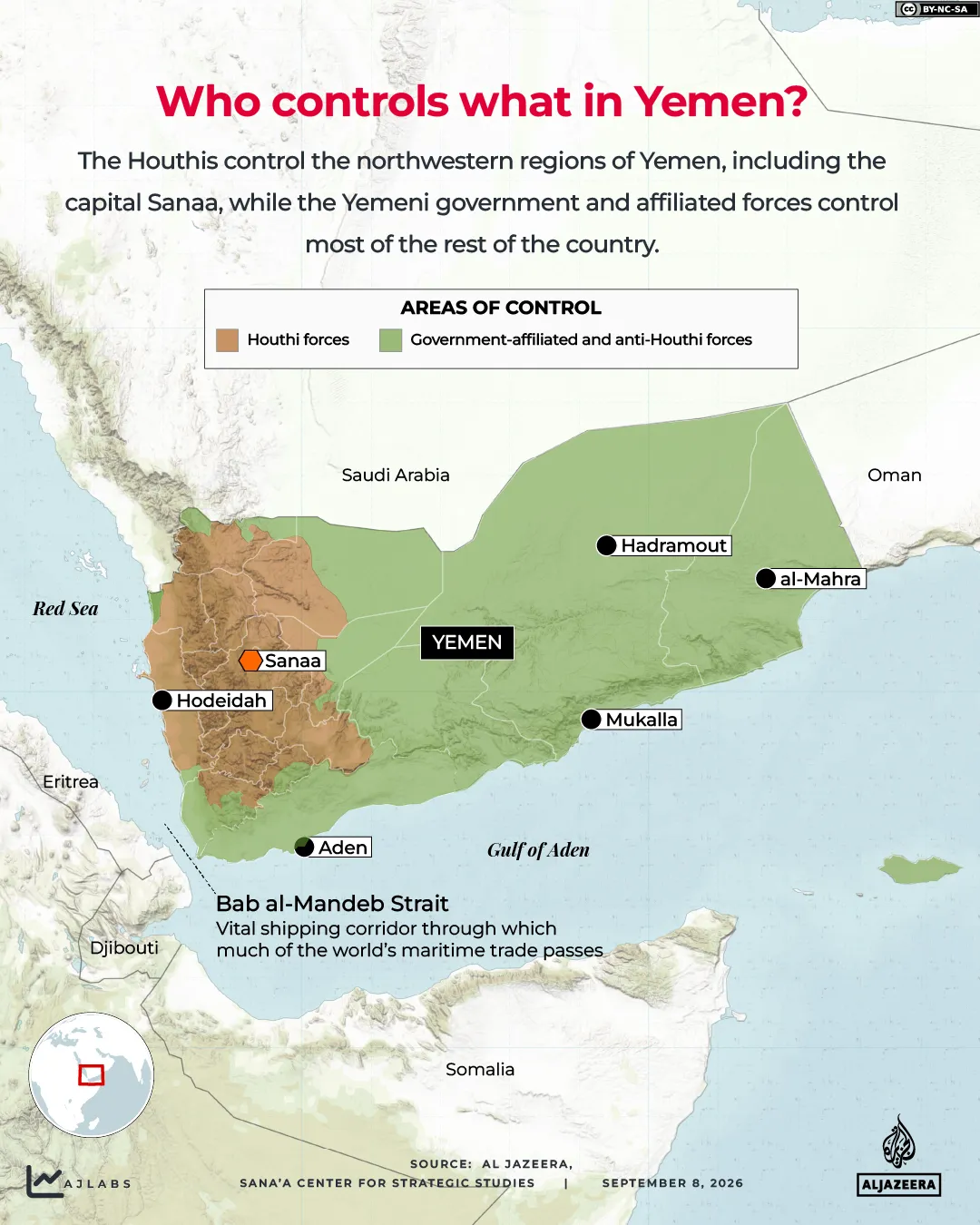
Yemen’s Houthis have attacked Israel for the first time, a month after US and Israeli forces began striking Iran, opening up a new front in a rapidly escalating conflict that has killed thousands of people, displaced millions and rattled the global economy.

The Houthis, who control much of northern Yemen, entered the fray on Saturday with two missile and drone attacks on Israel in the space of fewer than 24 hours. The Israeli army said the attacks were intercepted, but the Iran-aligned group pledged to continue fighting in support of “resistance fronts in Palestine, Lebanon, Iraq, and Iran”.

Recommended Stories

list of 3 itemsend of list

The Houthis had sat out of the hostilities until now, in contrast with their stance during Israel’s genocidal war on Gaza, when their attacks on shipping vessels in the Red Sea upended commercial traffic worth about $1 trillion a year.

Their widely anticipated involvement in the latest conflict comes just as Iran has throttled traffic through the Strait of Hormuz, a vital chokepoint for about a fifth of the world’s oil, raising fears that the Yemeni group will again disrupt Red Sea traffic by blocking the Bab al-Mandeb Strait.

Reporting from Yemen’s capital, Sanaa, Al Jazeera’s Yousef Mawry described Bab al-Mandeb as the group’s “ace”.

“They want to make Israel pay economically. They want to disrupt their trade routes. They want to disrupt the imports and exports in and out of Israel,” he said.

‘Civilians bearing brunt of war’

The Houthi attacks came after US Secretary of State Marco Rubio said that Washington expected to conclude its military operations against Iran within weeks, even as a new deployment of US Marines has begun to arrive in the region, so US President Donald Trump would have “maximum” flexibility to adjust the strategy as needed.

With no immediate diplomatic breakthrough in sight as both the US and Iran harden their positions, many fear that the US-Israel war on Iran, which started on February 28 and has since engulfed the region, will spiral out of control.

The US and Israel continued their bombardment over the past 24 hours, with the Israeli military claiming it had struck an Iranian research facility for naval weapons, while a series of loud explosions rattled Tehran as night fell on Saturday.

Iranian media said at least five people were killed in a US-Israeli attack on a residential unit in the northwestern city of Zanjan. In Tehran, authorities said the University of Science and Technology was the latest educational facility to be struck, prompting Iran’s Revolutionary Guard Corps (IRGC) to issue a threat against Israeli and US universities in the region.

Separately, Iran’s Fars news agency said a water reservoir in the city of Haftgel, located in western Khuzestan province, had also been attacked.

The Iranian Ministry of Health announced that 1,937 people have been killed since the start of the conflict, including 230 children. Iran’s Red Crescent Society said US-Israeli strikes had damaged more than 93,000 civilian properties.

“Civilians are bearing the brunt of this war,” Al Jazeera’s Mohamed Vall, reporting from Tehran, said.

Devastation in Lebanon

Meanwhile, Israel’s devastation of Lebanon continued apace, as the Lebanese Ministry of Health reported that 1,189 people had been killed in Israeli attacks since March 2.

The death toll has been mounting as Israeli troops have pushed further into the south, advancing towards the Litani River in their stated bid to wipe out Hezbollah and carve out a buffer zone along the lines of the “Gaza model”.

Among Saturday’s killings, an Israeli strike killed three journalists in southern Lebanon. In parallel, the Health Ministry announced that Israel had also killed nine paramedics, bringing the death toll among healthcare workers in the latest war to 51.

Lebanon’s Public Health Emergency Operations Centre said an Israeli attack on the town of al-Haniyah, in the Tyre district of southern Lebanon, killed at least seven people, including one child.

An Israeli air raid on the southern Lebanese town of Deir al-Zahrani killed a Lebanese soldier, Lebanon’s National News Agency reported.

Hezbollah, which attacked Israel amid a ceasefire that Israel kept violating in retaliation for the assassination of Iranian Supreme Leader Ali Khamenei, claimed dozens of operations against Israeli forces in the past 24 hours.

Mixed messages

Trump has threatened to hit Iranian power stations and other energy infrastructure if Tehran does not fully open the Strait of Hormuz. But he has extended the deadline he had imposed for this week, giving Iran another 10 days to respond.

With the US midterm elections coming up in November, the increasingly unpopular war is weighing heavily on the president’s Republican Party.

Trump’s envoy, Steve Witkoff, said on Friday that he believed Tehran would hold talks with Washington in the coming days. “We have a 15-point plan on the table. We expect the Iranians to respond. It could solve it all,” Witkoff said.

Pakistan, which has been a go-between between US and Iranian officials, will host foreign ministers from regional powers Saudi Arabia, Turkiye and Egypt in Islamabad for talks on the crisis.

Pakistan’s Minister of Foreign Affairs Ishaq Dar spoke with his Iranian counterpart, Abbas Araghchi, late on Saturday, urging “an end to all attacks and hostilities” in the region.

In a statement, the Ministry of Foreign Affairs said Dar had told Araghchi that Pakistan remains committed to supporting efforts aimed at restoring regional peace and stability.

Dar also announced that Iran had agreed to allow 20 Pakistani-flagged vessels to transit the Strait of Hormuz, calling it a meaningful step towards easing one of the worst energy crises in modern history.

Source link

Missiles overhead, silence below: Israel’s home front holds firm | US-Israel war on Iran News

As the United States-Israeli war on Iran rages on, schools across Israel have been closed, cultural venues shuttered and large gatherings cancelled under police orders.

Dissent against the war, if there is much at all, has little chance of being aired.

Recommended Stories

list of 4 itemsend of list

A few demonstrations against the war, such as those staged by the Israeli-Arab activist group Zazim, still flicker through central cities, but they do so under heavy supervision, with officers warning crowds to disperse when sirens sound or when assemblies grow beyond what commanders deem safe.

The effect is a public sphere constrained less by decree than by the constant threat hanging overhead.

“Kids aren’t going to school, while employers are insisting their parents go to work,” Zazim’s co-founder and executive director, Raluca Ganea, says. Everyone is too overwhelmed by the daily grind to voice any dissatisfaction, she adds.

“We’re enduring multiple missile attacks daily, which means people aren’t sleeping. It’s like a manual for tyrants. It’s how you suppress protest or opposition and it’s working so far,” she added.

“We’ve attempted a couple of protests, but people are just too tired to engage,” Ganea says of Zazim’s efforts to resist the war. “It’s not so much that people are telling you that you can’t so much as protesting becomes impossible when a missile attack could happen at any time.”

Support for the war on Iran has remained strong in Israel, a fact borne out by polls. But as exhaustion grows and resentment builds over having their fates decided by often distant leaders such as Israeli Prime Minister Benjamin Netanyahu and US President Donald Trump, who have shown little investment in their welfare, the societal fractures that came to define the war on Gaza are almost inevitable, she warns.

“It’s depressing,” she says. “The only response people have is to feel helpless when their fate is in the hands of people like Trump and Netanyahu, who really don’t care about them.”

Those who have put their heads above the parapet to object openly to the war are shunned anyway, as 19-year-old Itamar Greenberg knows only too well. People spit at him in the street.

“It comes in waves,” he says of the criticism he faces for his opposition to the war on Iran on the streets of his hometown, near Tel Aviv. “Sometimes they follow me, shouting ‘traitor’ or ‘terrorist’.”

Itamar is clear enough that he isn’t a terrorist, though he seems ready to accept the label of traitor if it means halting the war on Iran.

“At my university, everywhere, they say my opposition to the war on Iran is somehow crossing a red line. For instance, because of the [danger to the Israeli] hostages, some people could understand opposition to the genocide on Gaza, but opposing the war on Iran, the great evil, is somehow too much,” he says.

This picture shows damaged buildings at the site of an Iranian missile strike in Tel Aviv
Emergency personnel work next to a damaged car at a site following Iranian missile barrages in central Israel, amid the US-Israel conflict with Iran, in Tel Aviv, Israel [Ronen Zvulun/Reuters]

Rising censorship

Across Israel, journalists and activists like Itamar describe a pervasive atmosphere of self-policing and censorship that, they say, has left people less informed about the consequences of the war than the citizens in Iran, whom many in their media encourage them to pity.

In a country largely unified against a threat that, for generations, politicians have told them is existential, criticism, dissent or opposition is, for the majority, beyond the pale.

This way of thinking is baked into Israeli society. The systems employed by the country’s military censor today to curtail media reporting predate the establishment of Israel in 1948.

Furthermore, new wartime restrictions on what can and cannot be broadcast of the Iranian missile barrages targeting Israel, where they land and what damage they have done – introduced on March 5 – mean these largely go entirely unreported, Israeli journalists say.

Reporting on the new media restrictions in mid-March, the Israeli magazine +972 documented one instance when journalists were permitted to report on debris that had hit an educational facility, but did not mention the actual strike by an Iranian missile, which had successfully hit its intended target nearby. Nor were they allowed to examine the site.

In another case reported by +972, journalists photographing damage to a residential block said they were approached by a man they believed to be linked to a security agency. He asked police to stop reporters from recording the real target of the attack, which was located behind them. The police officer replied that the journalists would not have noticed that site at all had it not been pointed out, since the visible destruction was concentrated on the civilian building.

The censorship, which had been growing more relaxed in recent years, had been tightened once more during the current war, Meron Rapoport, an editor at +972’s sister paper, Hebrew language Local Call, told Al Jazeera, “We don’t really know what is being or with what explosives,” he said, “The IDF [Israeli army] announcements always refer to strikes being on ‘uninhabited areas,’ which is peculiar, because there aren’t that many uninhabited areas in Tel Aviv. It’s a very compact city.”

Indeed, Iran has launched multiple missiles at Tel Aviv, some of which have resulted in damage and injuries – either by the missiles themselves or by debris falling following interception. Most recently, on Tuesday, missiles triggered air raid sirens in the city, where gaping holes were ripped through a multistorey apartment building.

Israel’s Magen David Adom emergency medical service said: “Six people were lightly injured at four different sites.”

“It’s curious,” Rapoport says. “Israeli commentators are always saying how the Iranian public has no real idea how badly they’re being hit. The irony is that they probably have a better idea of how hard Israel is being hit than most Israelis.”

Source link

Watch the moment pregnant Molly-Mae Hague is left speechless as Tommy calls her a ‘piece of a***’ in front of baby Bambi

MOLLY-Mae Hague was left speechless after boyfriend Tommy Fury called her a “piece of a***” in front of their daughter Bambi.

The Love Island icon, 26, is currently pregnant with their second baby after the couple got back together last year.

Molly-Mae was left shocked by a cheeky comment made by Tommy FuryCredit: YouTube / Tommy Fury
The saucy star made the comment with Bambi in the backseatCredit: YouTube / Tommy Fury
Molly called Tommy ‘terrible’ after his commentCredit: YouTube / Tommy Fury

The couple are getting ready to welcome baby number two, after their daughter Bambi, three, was born in 2023.

Molly-Mae and Tommy often keep fans up-to-date with their family life at home, since reuniting after their split.

Today they shared a hilarious moment in the boxer’s latest YouTube vlog called: “Spend a weekend with me.”

In the video the couple were seen in the car with Bambi in the backseat.

BALM GOOD

Molly Mae’s go-to cleanser is slashed on Amazon — it left my skin glowing


PERRIE EXCITING

Perrie Sian reveals four property empire with £1.1 mansion & Spanish villa

The conversation then turned to Molly saying that she “never looked worse”.

Tommy then quickly said that he “disagreed”.

“I think you look very beautiful. All of your luscious long blonde locks.” the boxer told Molly.

“And it’s very nice to have a piece as good as you in the front seat of the car.”

Molly then quickly asked; “A piece? What do you mean a piece?

To which Tommy replied with a grin: “One piece of a**!”

Molly then chuckled: “Babe, I’m your pregnant missus!”

She then added: “Terrible!”

It comes as Molly-Mae and Tommy quietly broke their baby news to family and close pals months ago, but shared a surprise video with fans in February.

The mum posted a sweet black and white clip on Instagram filmed on January 23, captioning it: “Soon to be four.”

Molly and Tommy welcomed Bambi in 2023Credit: Instagram

It included Bambi who was wearing a “big sister” jumper.

Molly had previously expressed her desire to expand her family with Tommy in scenes aired on her Amazon Prime documentary in January.

Opening up about the future, she revealed: “All I want in this life is to be with him, and to have another baby with him, and to grow old as a family.

“And to live in a nice house together and have a nice life together. That’s all I want.”

Molly-Mae revealed she was expecting her second child in a sweet video last monthCredit: Instagram
The proud mum has been showing off her baby bumpCredit: Instagram

Molly also dropped various clues about her pregnancy before announcing her joyous news, which is said to have strengthened her relationship with boxer Tommy.

A source told The Sun: “Finding out Molly is pregnant has really helped bring them close together again.

“Tommy is determined to do things right this time he has cancelled all of his summer trips with his friends, as he wants to stand by Molly every step of the way.

“Their new home is in a better place for both of them and has more than enough space for two children.”

The couple co-parented Bambi following their messy split in August 2024 – following reports Tommy cheated on her during a lads’ holiday.

Molly-Mae and Tommy Fury’s relationship timeline

From Love Island to a diamond ring and baby – we look at how Molly and Tommy have got to where they are today.

Source link

Blake Snell throws his first bullpen session of spring training

p]:text-cms-story-body-color-text clearfix”>

Unable to ramp up through the first month of spring training because of lingering shoulder soreness, Dodgers left-hander Blake Snell took a step toward readiness Thursday, throwing his first bullpen session.

Two hours before Thursday night’s Cactus League game, Snell threw off the mound in front of a group of reporters and fans at Camelback Ranch. Snell threw 15 pitches — all fastballs — sitting between 87 to 89 mph.

“I feel good,” Snell said after his bullpen. “I was very excited to throw off the mound again and pitch. I’ve been looking forward to this for a while. This being like the first one where I actually could have the catcher down. I was still limited to what I could throw. I was throwing 87 to 89 [mph]. It felt effortless, easy, could command the ball, so [I’m] happy with that. [I’m] just happy to continue to grow and get better.”

The two-time Cy Young Award winner says he’s targeting an April return, and that he’s hoping to get back faster than initially expected.

“I want to pitch in April,” Snell said. “That’s my goal. So, I’ve kind of been the one pushing it, and they’re being more cautious. I think we’re just talking a little back and forth, but I think them seeing me throw a pen today, hopefully that just gives them more confidence to keep it going. I think we won’t really know until I throw a live [batting practice], I think that’s when we’ll really know. How do I recover from that? How do I feel? And then that will be like, ‘OK, let’s get him into games.’ That’s what I would envision. I’m not the front office or Dave, but that’s what I would think.”

Dodgers manager Dave Roberts, however, isn’t ready to give a timetable for Snell’s return.

“I think honestly, to think about when he’s going to come back, we’re just a ways away from even really having that conversation,” Roberts said, noting that six weeks is “the floor” when you also account for a potential rehab assignment.

Thanks to the depth of their pitching staff, the Dodgers can afford to be patient with building up Snell. Right-handers Emmet Sheehan and River Ryan, along with left-hander Justin Wrobleski, are all possibilities for starting assignments early in the season.

“We still need him to pitch, and I know he understands that,” Roberts said of Snell. “But we do have the luxury of trying to err on the side of caution. … We are certainly better when he’s pitching for us, when he’s active.”

Snell, for his part, is thankful to be throwing again without shoulder pain.

“The whole offseason, I mean, every throw kind of hurt,” Snell said. “It was just every throw, I could feel my shoulder. It was just cranky and I couldn’t get it going. And I thought I was doing everything I needed to, and I believe I was, and ultimately, I’m feeling better.”

Source link