Red

Houthis To Expand Shipping Attacks To Northern Red Sea

The Houthi rebels of Yemen say they are widening the scope of their attacks on Saudi shipping to the northern Red Sea to prevent transits through the Suez Canal. The expansion of Houthi kinetic activities there comes amid mixed messages about efforts to open up the Strait of Hormuz, largely closed by Iran after it was hit by the U.S. and Israel on Feb. 28.

The Iranian-backed Houthis already struck Saudi ships in the southern part of that body of water and refineries along the northern portion after imposing a blockade on the Bab al-Mandeb Strait, leading several oil tankers in the Red Sea to avoid that route in favor of the Suez Canal. The expansion of the Houthi campaign against Saudi shipping began with an attack off the port of Yanbu on the NCC Wafa, a Saudi oil tanker, the rebel group claimed today.

“By God’s grace, the Yemeni Armed Forces succeeded in striking the Saudi oil vessel Wafa in the northern Red Sea off the area of Yanbu, using a number of ballistic missiles — and the hit was precise, by God’s grace,” Houthi spokesman Yahya Saree claimed on X. “In tightening the naval blockade on the Saudi enemy at Bab al-Mandeb in the southern Red Sea, the Saudi enemy has moved to reroute its oil vessels toward the northern Red Sea. The Yemeni Armed Forces therefore affirm that their operations will continue and escalate in targeting Saudi oil vessels in the northern Red Sea, to close off every route and prevent passage, in order to cement the ‘blockade for blockade’ equation.”

There was no immediate statement issued by the Saudis and TWZ cannot independently verify the Houthis’ claims.

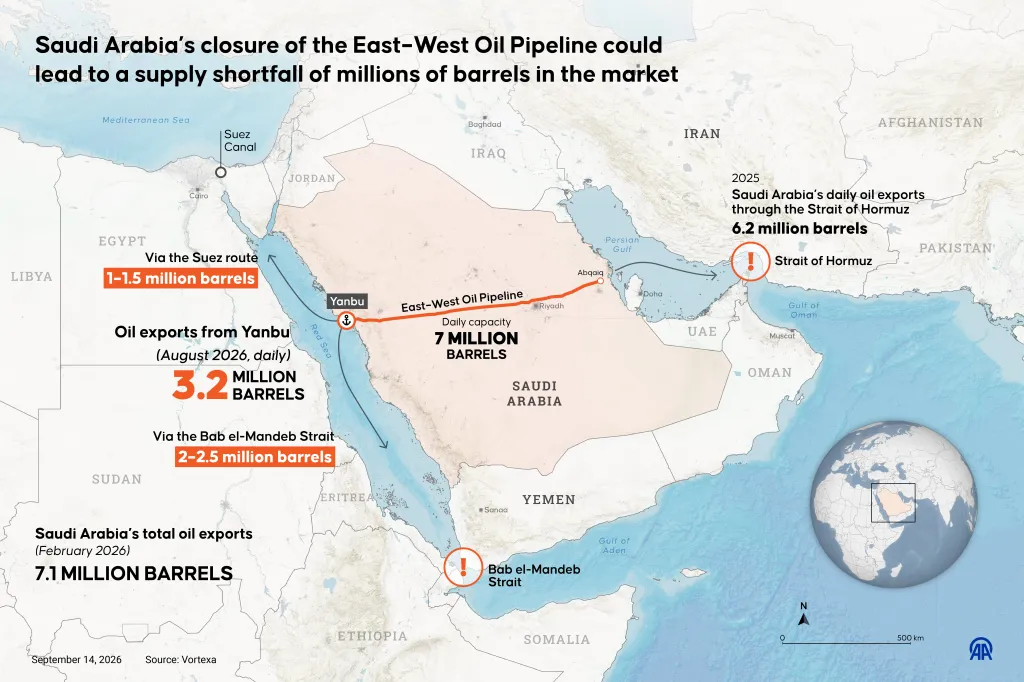
As we have frequently detailed, a Houthi blockade of the BAM threatens to add far greater pressure on oil exports from the Middle East, already drastically affected by the Iranian closure of the Strait of Hormuz and the resumption of the U.S. blockade on Iranian ports. The kingdom has diverted millions of barrels of oil per day through pipelines to its Yanbu port on the Red Sea in an effort to minimize the energy shortages due to the hostilities in the Persian Gulf. As we have noted, the Suez Canal is an important artery in addition to the BAM for ships carrying Saudi energy supplies, though this route drastically increases the cost of exports to Asia given the need to travel around Africa. While tankers carrying Saudi oil through the BAM have been greatly reduced, they are still making their way through the Suez Canal. But that could change if the Houthis start making that route perilous too, which would put a tighter energy squeeze on the west, including Europe, as well as the rest of the globe. They could also continue to attack Saudi oil terminals on the Red Sea, making shipping a moot point if the transfer stations are not operational.

The closing of the BAM to Saudi oil traffic, and now threats to the transit route north to the canal, also raise the specter of the U.S. having to get as involved as it did during the previous Houthi campaign against shipping that ended last September, which could pull resources away from Iranian-focused operations. It’s possible Egypt would have a major problem with such actions too, as it would impact the Canal’s revenue and freedom of movement. This could widen the conflict.

Bab al-Mandeb Strait. (Google Earth)

Meanwhile, there are mixed signals about whether the Strait of Hormuz will be fully reopened to traffic and under what conditions.

“The U.S., Iran and Oman are closing in on an interim agreement to reopen the Strait of Hormuz, with the U.S. aiming for a Wednesday announcement,” Axios reported on Wednesday, citing two regional sources and a U.S. official. “According to two regional sources, the deal under discussion sets up a 60-day temporary arrangement between Oman and Iran in the Hormuz strait, which could be extended.”

All inbound traffic of ships through the strait and into the Gulf would go in a northern lane through Iranian waters, the publication noted. All outbound traffic through the strait and into the Arabian Sea would go in a southern lane through Omani waters, in coordination with Iran. In addition, there would be no tolls or fees charged during this interim two-month period and the parties would work to clear the median lane of the Strait of mines within 30 days.

“After the median lane is cleared, it would be used for inbound and outbound traffic under the terms of a permanent arrangement to be negotiated between Oman and Iran,” the outlet added.

The deal described by Axios largely mirrors the Iran-Oman negotiations we reported on yesterday, with the main differences being the involvement of the U.S. and no imposition of fees. As we noted, both Iran and the U.S. are currently following a bifurcated traffic pattern, with the U.S. Navy recommending transits close to the Omani coastline and Iran pushing shipping toward its shores. The middle of the Strait has been deemed too hazardous because of the threat primarily from mines.

Speaking to Fox News Tuesday night, President Donald Trump said negotiations with Iran have been ongoing but that Tehran faces severe consequences if it fails to open up the Strait.

“If they back out again, they are going to get hit really hard,” Trump proclaimed.

The president has insisted that Iran must fully open the vital chokepoint or face new and more intense attacks that would include power plants, other civilian infrastructure and even strikes on leadership.

There are indications from Iran, however, that any deal to open the Strait is between Iran and Oman and that it might not result in a quick resolution.

The official Iranian Press TV stated on X “that any potential bilateral agreement between Tehran and Muscat regarding maritime traffic in the Strait of Hormuz will not automatically lead to the immediate re-opening of the strategic waterway.”

Reuters on Wednesday concurred that any deal to open the Strait may not be as imminent as Trump has claimed.

“A proposed deal between Iran and Oman would give Tehran control over ships entering the Gulf through the Strait of Hormuz,” the outlet wrote, citing a senior Iranian source and two regional officials. “Despite the apparent step towards yielding to Iranian demands, the sources pushed back against assertions by U.S. President Donald Trump that ‌a deal reopening the strait was imminent, saying important details still had to be agreed.”

Regardless of negotiations, U.S. Central Command stated on X that the Strait of Hormuz southern route along the coast of Oman remains open and that over the past three months, “U.S. forces have assisted more than 1,000 vessels in successfully transiting the strait despite unwarranted Iranian aggression, and these transits continue today.”

Between Houthi actions in the Red Sea region and the ongoing closure of the Strait of Hormuz, commercial traffic in both areas continues to be greatly reduced, though transits through the BAM are spiking upwards, according to MarineTraffic.

The latest “data highlights how headline volumes can obscure underlying maritime risk. Strait of Hormuz crossings fell from 10 to eight on 4 August, with seven vessels exiting the Middle East Gulf and only one entering,” MarineTraffic stated on X. “Five of the eight movements used the Iranian Unilateral Scheme, while no Hormuz Traffic Separation Scheme crossings were recorded.”

Meanwhile, “Bab el-Mandeb traffic rose from 25 to 34, including 18 vessels entering the Red Sea and 16 exiting,” MarineTraffic added. “Yet four dark transits, two sanctioned crossings and six shadow fleet movements indicate that visibility, routing concentration and compliance exposure remain central concerns.”

Amid all this, oil prices have actually fallen, with Brent Crude now trading at slightly over $79 a barrel, down from nearly $85 per barrel yesterday. Still, there are many reasons Trump is pushing a rekindled effort to find a diplomatic off-ramp to a conflict that has killed 18 American troops, wounded hundreds more, drained U.S. weapons stocks and roiled international relations and global financial markets. In addition to the global economic pressures this conflict has created, it is unpopular among the American electorate and crucial mid-term elections will take place in November. Even Fox News, generally supportive of Trump, has released polling data that shows a “majority of voters oppose U.S. military action, and nearly two thirds think the conflict will last at least a year.”

The latest Fox News survey “finds 56% oppose U.S. military action against Iran, including 40% who “strongly” oppose.”

How much these factors will play a role in Trump’s decision-making should become clearer over the next hours and days.

Contact the author: howard@twz.com

Howard is a Senior Staff Writer for TWZ. He writes frequently about conflict, focusing heavily on the Middle East and Ukraine, and interviews with military and intelligence officials and industry leaders from around the globe. He lives near Tampa, Florida, home of U.S. Central Command, U.S. Special Operations Command.


Source link

Red Cross urges international aid as Sudan crisis deepens | Sudan war News

Charity warns that shrinking humanitarian support could threaten efforts to support communities trying to rebuild lives after 1,200 days of conflict.

The International Federation of Red Cross and Red Crescent Societies (IFRC) has called for greater international support for Sudan, saying humanitarian needs are escalating while funding falls far short.

“Sudan is one of the world’s largest humanitarian crises, yet it is also one of its most overlooked” IFRC Special Envoy for Sudan, Derk Segaar, told reporters in Geneva after returning from the Sudan.

Recommended Stories

list of 4 itemsend of list

Sudan plunged into all-out war in April 2023 between the paramilitary Rapid Support Forces (RSF) and the Sudanese military, leading to the deaths of at least 59,000 people, according to Armed Conflict Location and Event Data, a conflict monitoring group.

Aid groups say the figure is an undercount and the true number could be many times higher.

Segaar said while some aid is trickling into Kordofan and Darfur regions, the whole of Sudan has been devastated by the war, including Khartoum, where millions lack reliable electricity, clean water and healthcare, as cholera, malnutrition and floods pose additional risks.

He said 35 million people require humanitarian assistance, more than 9 million are internally displaced, and fighting has driven 4.5 million people out of Sudan.

Fighting

Speaking before a gathering of soldiers, Sudanese Army Lieutenant-General Yasser al-Atta on Monday said the military is advancing on all fronts with the aim of eliminating the RSF before the end of the year.

The location of the gathering was not specified.

“We are implementing the theory of advancing in all directions, with all fronts moving simultaneously, as happened during the recapture of Khartoum state,” al-Atta said.

“Before the end of this year, there will not be a single Janjaweed fighter,” he said, using a term to refer to the RSF, “or a foreign fighter, and we are determined to achieve that”.

Al-Atta’s remarks came days after the army and allied forces carried out a rapid operation in which they seized Bara, Jabra al-Sheikh, Um Sayala and other positions along a key road connecting Omdurman with el-Obeid in North Kordofan.

Sudan’s three Kordofan states – North, West and South – have witnessed continued fighting between the army and the RSF since October 2025.

Diplomacy

Meanwhile, the United Nations is ramping up efforts to get the stalled political process on track.

The UN says representatives from five international organisations, including the African Union, the Intergovernmental Authority on Development (IGAD), the European Union and the League of Arab States held talks with Sudanese political parties on Monday.

“Building on exploratory consultations held in Addis Ababa in June, the Quintet engaged Sudanese civilian political leaders in recent days. Discussions continued on proposals and perspectives for advancing the political process, including through the establishment of confidence-building measures,” said UN deputy spokesman Farhan Haq.

The UN Secretary-General’s Personal Envoy for Sudan, Pekka Haavisto, is also talking with RSF leader General Mohamed Hamdan Dagalo to discuss reducing escalation.

Source link

Red flag code in Spain, Turkey and Greece as ‘people die every year’

People should brush up on this code before heading on their next holiday

Going to the beach or cooling off in the sea when on holiday is one of the most common activities tourists do – and not think twice about. However, when people enter bodies of water, there is always a risk of injury or even death.

Holiday hotspots – like Spain, Turkey and Greece – all have warnings listed on the official GOV.UK Foreign Office pages that provide advice to travellers swimming abroad. The Foreign Office says every year, “people drown in the sea and in swimming pools”.

People who are holidaying with young children should “always supervise” them around pools and the sea – even if they can swim or a lifeguard is present. Situations can change in an instant, even for experienced swimmers.

On the country’s Foreign Office advice page, it said: “Some beaches, especially around Spanish islands, may have strong undercurrents. Hidden rocks or shallow depths can cause serious injury or death. Do not dive into unknown water and do not swim at beaches where a river runs into the sea.”

It adds that most beaches, including those in tourist spots, will use a simple colour-coded flag system to indicate whether an area is safe. These flags follow a standard set of guidelines that are universally recognised, and one should be a clear warning to anyone setting up for a day at the beach.

The Foreign Office said: “Many beaches have a flag system. Make sure you understand the system and follow any warnings (a red flag means you must not enter the water). Take extra care and get local knowledge if there are no lifeguards, flags or signs.”

Beach lifeguards will frequently fly multiple flags at the same time to signal different types of hazards. For example, one flag might be linked to the strength of the water, while another can signal if there is marine life in the area that could sting, like jellyfish.

What do the different coloured flags mean?

  • Red flag (high danger)
  • Yellow flag (medium hazard)
  • Green flag (low hazard)
  • Purple flag (marine pests)
  • Black and white checkered flag
  • Red over yellow (lifeguarded area)

Red flag warns of water conditions that are unsafe, like strong currents, rough surf, or severe undertows. If you see two red flags flying together, the water is completely closed to the public.

Yellow flag warns of moderate surf, light currents, or rougher waters. While swimming is permitted, weak swimmers or children are discouraged from entering, and everyone should take extra care generally.

Green flag signals calm ocean conditions and a low risk of dangerous currents. While it means the water is generally safe, swimmers should still remain aware of their surroundings.

Purple flag warns beachgoers that dangerous stinging marine life is present in the water. This typically means an influx of jellyfish, stingrays, or sea urchins. Crucially, a purple flag is used for smaller marine pests and does not indicate sharks.

Black and white checkered flag designates a specific area reserved exclusively for surfboards, kayaks, and other non-powered watercraft. Swimming or bodyboarding is strictly prohibited inside this zone to prevent dangerous collisions.

Red over yellow flag marks the safest area of the beach. This zone is actively monitored by lifeguards.

Source link

The Sports Report: Dodgers have Skubal, but are swept by Red Sox

Dodgers have Skubal, but are swept by Red Sox

From Maddie Lee: Dodgers president of baseball operations Andrew Friedman felt good enough about his trade discussions with the Detroit Tigers for two-time Cy Young winner Tarik Skubal that he gave manager Dave Roberts a positive update shortly before the team’s game against the Red Sox on Saturday.

“I heard that it was pretty much done,” Roberts recounted Sunday afternoon. “But there’s obviously things that have to go on with medical, so it wasn’t actually even finalized. I just heard that it was pretty much close.”

Friedman, however, wasn’t ready to exhale until he got final word from the Tigers during the game.

“I had no idea and was trying to emotionally hedge,” he said. “I wasn’t getting too high or too low on it until we actually found out.”

There was, it turned out, no need to stress. On Saturday, the Dodgers agreed to trade three prospects — outfielder Zyhir Hope (No. 25 on MLB Pipeline’s top 100), right-handed pitcher River Ryan (No. 68) and right-hander Brady Smith — to the Tigers for one of the best starters in baseball.

Continue reading here

Shaikin: Dodgers traded just 3 minor leaguers for Tarik Skubal. Why couldn’t your team do that?

Shaikin: ‘L.A. is America’s team.’ But the Brewers should have been Tarik Skubal’s team

Plaschke: Tarik Skubal trade brings Dodgers hate, envy … and another championship

————

From Joaquin Ruiz: The Dodgers were swept for just the second time this season after the red-hot Boston Red Sox hit four home runs, including three off embattled starter Emmet Sheehan, to take an 8-4 win on Sunday night at Dodger Stadium.

Boston hit three home runs in four at-bats in the third inning, with Sheehan giving up blasts to Ceddanne Rafaela, Wilyer Abreu and Masataka Yoshida as the Dodgers suffered their second three-game sweep at home in less than a month.

“It was bad execution,” Sheehan said. “I just missed my spots.”

Continue reading here

Dodgers box score

MLB standings

Go beyond the scoreboard

Get the latest on L.A.’s teams in the daily Sports Report newsletter.

Teammates in awe of Myles Garrett

From Gary Klein: The Rams knew the resume. Saw the highlights. Gathered all the intel required.

But they were not aware of Myles Garrett’s aura.

How could they?

It’s not tangible, nor easily defined.

It’s just there.

“You just feel him,” coach Sean McVay said Friday.

McVay felt and said that before. About Aaron Donald. About Jalen Ramsey.

But listening to Rams players talk about Garrett, this feels different.

Mystical.

“You can just feel his aura,” cornerback Trent McDuffie said.

Safety Quentin Lake explained it the same way.

“Just his presence,” Lake said, “his aura.”

Continue reading here

Khalil Mack is a great influence on Chargers teammates

From Joaquin Ruiz: A tempting life as a full-time family man nearly pulled Khalil Mack away from football.

“I was leaning towards coming back the whole time,” Mack said of mulling retirement before signing a one-year, $18-million contract in March to remain with the Chargers. “But it’s just considering the stage of life my kids are at, that balance of being a dad and a husband but still trying to follow the dream. I feel like I’m still in a position to do both.”

The future Hall of Famer decided the show must go on.

And now, with championship aspirations entering his 13th season, and fifth in Los Angeles, Mack is basking in his role as the Chargers’ elder statesman.

“Priceless,” defensive coordinator Chris O’Leary said of the 35-year-old outside linebacker’s presence. “He’s the flag bearer of our culture on defense. He leads the way with his actions. … When it’s time for him to say something, he’s going to say something.

Continue reading here

Angels beat the Brewers

Walbert Ureña pitched three-hit ball over six innings and Wade Meckler hit a two-run homer off Milwaukee ace Jacob Misiorowski as the Angels beat the Brewers 3-0 on Sunday.

Ureña (7-7) struck out seven and walked three as the Angels (43-69) broke a five-game losing streak. The rookie right-hander has a 2.54 ERA and a 2.25 ERA since May 1, a stretch in which he has given up one or fewer earned runs in 12 of 16 starts.

Angels reliever Ryan Zeferjahn replaced the injured Sam Bachman with a runner on second and one out in the eighth. He struck out Brice Turang, gave up an infield single to Jackson Chourio and struck out Garrett Mitchell with runners on first and third to end the inning.

Continue reading here

Angels box score

MLB standings

Sparks beat the Fire

Dearica Hamby scored 23 points, Nneka Ogwumike had 20 of her 22 in the second half and the Sparks — after learning star teammate Kelsey Plum was traded — ended a six-game losing streak with a 106-101 win over the Portland Fire on Sunday.

Plum, sidelined since June 21 with a leg injury, was sent to the Phoenix Mercury late Saturday night. The Sparks are now 3-9 without Plum.

Ogwumike hit the go-ahead three-pointer with 1:25 to play, making it 98-96. Hamby followed with a layup off an Ogwumike assist. In the last 24 seconds, Ogwumike and Erica Wheeler went six for six from the foul line.

Continue reading here

Sparks got some strong assets for Kelsey Plum as they start another rebuild

Sparks box score

WNBA standings

This day in sports history

1852 — The first intercollegiate rowing race is held on Lake Winnipesaukee, N.H., where Harvard beats Yale by four lengths on the 2-mile course.

1936 — American sprinter Jesse Owens wins the 100m (10.3 seconds) in front of Adolf Hitler in a famous race at the Berlin Olympics, first of four gold medals at the Games.

1949 — The National Basketball Assn. is formed by the merger of the National Basketball League and the Basketball Assn. of America.

1955 — Scott Frost, driven by Joe O’Brien, wins the Hambletonian at Good Time Park in Goshen, N.Y. He goes on to become the first trotting Triple Crown winner.

1985 — France’s Lutin D’Isigny becomes the first trotter to sweep the International Trot and Challenge Cup in consecutive years with a 3:03.1 time in the 1½-mile test.

1990 — The PGA Tour announces it will not hold tournaments at golf clubs that have all-white memberships or show any other signs of discrimination.

1996 — Andre Agassi, the Dream Team and the U.S. women’s 400-meter relay team win Olympic gold medals, while the American men’s 400 relay settles for silver. With Carl Lewis idled by a coach’s decision and Leroy Burrell injured, the men’s 400 team is shocked by Canada — the first time the U.S. lost the event at the Olympics.

2003 — Annika Sorenstam completes a career Grand Slam at the Women’s British Open, beating Se Ri Pak by a stroke in a thrilling head-to-head showdown.

2006 — Champ Car driver Cristiano da Matta needs surgery to remove a ruptured blood vessel in his head after his race car collides with a deer that wandered onto the track during a test session at Road America in Elkhart Lake, Wis.

2012 — Michael Phelps rallies to win the 100-meter butterfly for his third gold of the London Games and No. 17 of his career. It’s Phelps’ third consecutive win in the event at the Olympics, and his 21st career medal. Missy Franklin sets a world record in the 200 backstroke for the 17-year-old’s third gold in London.

2013 — Sixteen-year-old Katie Ledecky wraps up a brilliant performance at the world swimming championships with her fourth gold medal and second world record. The youngster turns it on over the final four laps of the 800 freestyle to win in 8 minutes, 13.86 seconds and take down the mark of 8:14.10 set by Britain’s Rebecca Adlington at the 2008 Olympics.

2016 — The International Olympic Committee approves baseball/softball, karate, sport climbing, surfing and skateboarding to be included in the 2020 Tokyo Games.

2016 — Elaine Thompson Herah of Jamaica wins the 200m gold in Tokyo to become the first female to win the 100/200 double in consecutive games.

2017 — Brazilian soccer forward Neymar transfers from FC Barcelona to Paris Saint-Germain for a world-record transfer fee of $222M on a 5-year deal.

2023 — Phoenix Mercury guard Diana Taurasi becomes first WNBA player to reach 10,000 points as she drops 42 points in a 91-71 win over the Atlanta Dream.

Compiled by the Associated Press

This day in baseball history

1901 — Cleveland pitcher Ed Scott pitched a complete game and hit a solo home run off Bill Reidy in the top of the 10th for an 8-7 win against Milwaukee. It was the last game of Scott’s major league career.

1906 — Washington pitcher Tom Hughes hit a solo home run off Fred Glade in the tenth inning for 1-0 win over the St. Louis Browns. He became the first pitcher to win a 1-0 extra-inning game with his own home run.

1914 — New York Yankee catcher Les Nunamaker threw out three Detroit Tigers trying to steal second base on one inning. It will be the only time a backstop has accomplished this feat this century.

1923 — Major League Baseball canceled all games after the death of U.S. President Warren G. Harding in San Francisco on Aug. 2.

1933 — Lefty Grove of the Philadelphia A’s became the first pitcher since Aug. 2, 1931 — a span of 308 games — to shut out the New York Yankees, winning 7-0.

1944 — Tommy Brown, 16 years and 8 months old, played shortstop for the Brooklyn Dodgers in both games of a doubleheader loss, 6-2 and 7-1, to the Chicago Cubs. He had a double and scored a run.

1948 — Cleveland’s Satchel Paige made his first major league start and went seven innings to lead the Indians to a 5-3 victory over the Washington Senators.

1959 — The second game of All-Star play this year was won by the AL 5-3 at the Los Angeles Coliseum. Nellie Fox of the Chicago White Sox singled in the deciding run in the seventh inning.

1961 — The Pittsburgh Pirates scored a 19-0 victory over the St. Louis Cardinals for the largest shutout score in an NL night game.

1969 — The Cincinnati Reds beat the Philadelphia Phillies 19-17 in a wild game at Connie Mack Stadium. Trailing 9-6, the Reds scored 10 runs in the fifth inning to take a seven-run lead. The Reds tacked on two more runs in the sixth inning for an 18-9 lead. The Phillies responded with seven runs on the home half of the sixth and another run in the seventh to get within one run. Cincinnati’s Tony Perez homered in the eighth to make it 19-17. The Phillies two-out rally in the ninth ended with Ron Stone lining out to right with runners on first and second.

1969 — Pinch-hitter Rich Reese hit a grand slam to power the Minnesota Twins to a 5-2 victory over the visiting Baltimore Orioles and end Dave McNally’s 15-game winning streak. His two victories at the end of 1968 had given him 17 straight wins.

1982 — Frank White of the Kansas City Royals hit for the cycle in a 6-5 win over the Detroit Tigers. It was the second cycle of his career.

1987 — Minnesota’s Joe Niekro was caught with a file on the mound and was ejected during the fourth inning of the Twins’ 11-3 win over the Angels. Niekro would be suspended for 10 games by American League president Bobby Brown, who didn’t believe Niekro’s story that he had been filing his nails on the bench and stuck the file in his back pocket when the inning started.

2004 — Tony Batista hit a grand slam in the 12th inning after tying the game with a two-run homer in the ninth, leading Montreal over St. Louis 10-6.

2006 — Chase Utley singled in the first inning of Philadelphia’s 8-1 win at St. Louis to extend his hitting streak to 35 games.

2006 — Matt Murton tied a major league record with four doubles and drove in five runs to help the Chicago Cubs salvage a split of a doubleheader with Arizona 7-3.

2015 — Adrian Beltre became the first major leaguer since the 1930s to hit for his third career cycle and the Texas Rangers held on for a wild 12-9 victory over Houston. Beltre hit a solo homer in the fifth inning for the Texas Rangers, completing the cycle in his first four at-bats.

2024 — By stealing three bases in a 10-0 Dodgers win over the Athletics, Shohei Ohtani becomes the first member of the 30-30 club this season (he has already hit 33 homers). In reaching the two marks in 108 games, he is the third fastest to do so in history, beaten only by Eric Davis (90 games in 1987) and Alex Rodriguez (107 games in 1998).

Compiled by the Associated Press

Until next time…

That concludes today’s newsletter. If you have any feedback, ideas for improvement or things you’d like to see, email me at houston.mitchell@latimes.com. To get this newsletter in your inbox, click here.

Source link

Myanmar’s detained Daw Aung San Suu Kyi meets with Red Cross official

Aug. 3 (UPI) — Myanmar’s detained and ousted democratically elected leader Daw Aung San Suu Kyi met with the International Committee of the Red Cross resident representative in Myanmar on Monday morning, the junta-controlled President’s Office said.

Myanmar’s Presidential Press and Information Bureau published four photos of Aung San Suu Kyi, two showing her with Arnaud de Baecque. In one, she is seen shaking his hand. In a second, they are sitting around a coffee table.

A third photo published by the President’s Office is of a birthday cake with the words “Happy Birthday Aunty Suu, 19.6.2026” written in icing on top of the cake. The fourth photo is of Aung San Suu Kyi cutting the pink-and-white cake with a spatula.

The one-sentence statement accompanying the photographs did not provide context for the meeting or say what Aung San Suu Kyi and de Baecque discussed.

Little information and visual evidence of Aung San Suu Kyi have been made public by the junta government since it detained her and seized control of Myanmar on Feb. 1, 2021. It also appears to be the first confirmed meeting with a foreign representative since her detention.

Aung San Suu Kyi is currently serving an 18-year sentence sentence on multiple charges, including corruption and election-related offenses.

In late April, she was moved from prison to house arrest.

This is a developing story.

Source link

Emmet Sheehan struggles early and Dodgers are swept by Red Sox

The Dodgers were swept for just the second time this season after the red-hot Boston Red Sox hit four home runs, including three off embattled starter Emmet Sheehan, to take an 8-4 win on Sunday night at Dodger Stadium.

Boston hit three home runs in four at-bats in the third inning, with Sheehan giving up blasts to Ceddanne Rafaela, Wilyer Abreu and Masataka Yoshida as the Dodgers suffered their second three-game sweep at home in less than a month.

“It was bad execution,” Sheehan said. “I just missed my spots.”

Boston got to Sheehan early with a pair of RBI singles from Yoshida and Caleb Durbin in the first inning.

The Dodgers (69-43) responded with three runs in the second as Eliézer Alfonzo collected an RBI with a groundout against Red Sox starter Jake Bennett. Andy Pages then drove in two more runs on a single to right. He also hit an RBI double in the seventh for the Dodgers’ final run.

Sheehan (4-8), who has a 6.39 ERA over his past seven starts, gave up six hits and five runs over just 2⅔ innings.

Reliever Wyatt Mills also struggled, giving up two runs over two innings.

Dodgers pitcher Emmet Sheehan walks off the field during the third inning against the Red Sox on Sunday.

Dodgers pitcher Emmet Sheehan walks off the field during the third inning against the Red Sox on Sunday.

(Eric Thayer / Los Angeles Times)

“I don’t know,” Sheehan said about his rough stretch. “If I knew, I would fix it, but I’m going to keep trying to fix it. … The only thing I can do is try to get better. There’s no other option.”

Added Dodgers manager Dave Roberts: “I just don’t think [Sheehan] was sharp today at all. … They took a lot of comfortable swings [and] aggressive swings. There were some strikeouts and some swing-miss. But the end of the day, it’s about limiting runs, and if you can’t keep the ball in the ballpark, then it’s hard to win.”

Bennett (7-4), settled in after his rough second inning and threw 5⅔ innings as Boston won for the 27th time in 32 games after outscoring the Dodgers 20-10 in the three-game series.

Jarren Duran, a Cypress native, added to Boston’s lead with a 420-foot solo homer to center field off reliever Kyle Hurt in the sixth. It was Duran’s first homer since July 5 against the Angels.

Boston (60-51) closed out the scoring in the eighth, with Durbin scoring on a wild pitch from Mills and Andruw Monasterio scoring on a ball that got past Alfonzo.

“I think that if you look at it, unemotionally, they outplayed us,” Roberts said about Boston’s sweep. “They were hungrier. You’ve got a lot of players over there that are under control. They’re fighting a higher seed in the postseason. They’re playing good baseball, and they outplayed us.

“It’s not an excuse. I don’t feel good about it, but that’s kind of what I saw.”

Skubal arrives

Newly acquired Dodgers pitcher Tarik Skubal greets center fielder Andy Pages.

Newly acquired Dodgers pitcher Tarik Skubal greets center fielder Andy Pages in the eighth inning of an 8-4 loss to the Boston Red Sox on Sunday.

(Eric Thayer / Los Angeles Times)

Starting pitcher Tarik Skubal, acquired by the Dodgers in a trade with the Detroit Tigers on Saturday, was in the Dodgers’ dugout during the game, exchanging pleasantries with his new teammates and coaches.

The team also shared a video of Skubal settling in on social media.

“We got better,” said Dodgers closer Edwin Díaz. “That’s the only thing I can say. We got … one of the best pitchers in the league, and now we have him as a teammate. So that’s a really good plus for us.”

Injury updates

Miguel Rojas (ankle) was available off the bench despite exiting Saturday’s game after fouling a ball off his foot.

“I felt better today, able to put some weight on it,” Rojas said, adding that his X-rays were negative. “The good thing is no break. So, I’m fine. If Doc needs me and the situation presents itself … I need to be available every single day.”

Dalton Rushing was scratched with minor right arm irritation; Alfonzo started in his place.

“Dalton had some arm irritation when he was playing catch before the game, which is very uncommon,” Roberts said, adding that X-rays were negative. “I didn’t want to take a chance and kind of push him anymore, so that’s why I decided to scratch him.

“He got treated today, and my expectation is he’s going to be with us on the plane, and then kind of day to day.”

Source link

Red Sea Maritime Security Task Force Commander Talks Major Jump In Escort Requests (Updated)

The head of Operation Aspides, the European-led task force created to provide security for ships transiting the Red Sea region, tells TWZ that there has been a major increase in the number of commercial vessels seeking escorts since the U.S. and Israel started attacking Iran in February. Security concerns in that region have spiked after the Houthi rebels of Yemen imposed a blockade on Saudi shipping and began attacking the kingdom’s vessels and oil infrastructure. Late Thursday, the leader of the Houthis promised additional escalation against the Saudis.

“We have witnessed a significant increase in requests from commercial vessels seeking Aspides’ support for their safe transit through the High Threat Area (South Red Sea/Strait of Bab-al-Mandeb [BAM]/Gulf of Aden),” Rear Admiral Vasileios Gryparis, Commander of EUNAVFOR Aspides, told TWZ in an email. “In particular, the number of protection requests increased by 39% from February 2026 (the start of the US-Israel-Iran confrontation) until now.”

The Hellenic Frigate HS Psara, operating under EUNAVFOR Aspides, provided support to a merchant vessel (MV) crossing the Red Sea. (Aspides)

“The increasing number of protection requests clearly demonstrates that, in times of insecurity, the shipping industry views Aspides as a credible and reliable maritime security provider,” Gryparis added. “We are working daily to maintain and strengthen bonds with the shipping industry, as mutual understanding and effective collaboration are essential to maritime security and the preservation of Freedom of Navigation.”

As we were one of the first to report, Aspides was launched in February 2024 during the previous Houthi campaign against shipping that ended last September. It was created to provide “a shield…to act in purely defensive mode to protect merchant vessels, and two non-executive tasks of ‘accompanying’ to deter with [its] presence and to strengthen maritime situational awareness,” a now former top EU official told reporters at the time.

Since its founding, the task force “has facilitated the safe passage of more than 2,240 merchant vessels and has provided close protection to more than 690 merchant vessels of different flags and interests,” the Aspides commander explained.

Merchant vessels transiting the Red Sea escorted by the Italian Frigate Bergamini. (Aspides)

Aspides did not provide assistance to vessels recently attacked by the Houthis because the task force was not asked, Gryparis told us.

“Those vessels were sailing within the territorial waters under the responsibility of the Kingdom of Saudi Arabia Maritime Rescue Coordination Centre (KSA MRCC),” he stated. “Consequently, assistance was provided by the Saudi Arabian authorities. The vessels in question had not registered their transit with the Maritime Security Centre Indian Ocean (MSCIO) and had not requested protection from EUNAVFOR Aspides.”

In addition to the blockade and strikes on Saudi assets, the Houthis are reportedly considering imposing a toll on Bab al-Mandeb Strait transits. Gryparis told us that such a move, which has yet to be enacted, would not alter Aspides’ goals.

“Such a development would not change the mandate or the mission of Operation Aspides,” the admiral proffered. “Our mission remains clear: to contribute to Freedom of Navigation, protect the lives of seafarers, support the secure flow of global trade by protecting merchant shipping, improve Maritime Situational Awareness, and contribute to regional stability.”

“Of course, any measure that could affect the free passage of commercial shipping has the potential to impact Freedom of Navigation and the confidence of the shipping industry,” he added. “How states or private shipping companies decide to address such a development would be a political and commercial decision for them.”

“From our perspective, we will continue to implement our mandate within our means and capabilities, continuously assess the maritime security environment, provide protection to eligible merchant vessels in accordance with our mandate, and support the shipping industry through Maritime Situational Awareness and the timely dissemination of information and recommendations via the Maritime Security Centre Indian Ocean (MSCIO),” Gryparis noted.

In a fiery speech, Houthi leader Abdul-Malik al-Houthi warned Saudi Arabia of an all-out escalation. He described his group’s actions as being in response to a Saudi “siege” on the Houthis in Yemen.

“The indicators show that the Saudi [side] is heading toward comprehensive escalation,” al-Houthi proclaimed. “We will seek God’s help against it — we will meet his comprehensive escalation with comprehensive escalation.”

“In this phase, regarding what the Saudi [side] has done, the outcome has been good since establishing the equation of (siege for siege) — in targeting Saudi oil tankers, in preventing their movement, turning back 16 ships, and also in shooting down the Saudi [-operated] aircraft that come to conduct reconnaissance and penetrate our airspace — armed drones,” the Houthi leader continued.

For its part, Saudi Arabia is creating its own maritime coalition to protect transits in the region.

“Recognizing the growing challenges facing global maritime security, and the resulting need to strengthen collective naval defense cooperation to protect freedom of navigation and international trade routes, and to secure global energy supply routes through the Bab-al-Mandeb Strait, the Red Sea, and the Gulf of Aden,” the Saudi Defense Ministry announced on Thursday. “The founding states affirm that the establishment of the Multinational Naval Defense Coalition represents a strategic step toward strengthening maritime security in the Bab-el-Mandeb Strait, the Red Sea, and the Gulf of Aden, consolidating defense cooperation among the member states, and supporting stability and prosperity — in a manner that contributes to complementing international efforts to protect international peace and security, in accordance with the provisions of international law.”

About 50 nations were asked to join and 14 so far have signed up. It is unclear at the moment how this will differ from Aspides.

Meanwhile, Iran claims it has completely shut down the Strait of Hormuz to vessels in the wake of recent U.S. attacks.

“Iran’s Persian Gulf Strait Authority (PGSA) says that passage through the Strait of Hormuz is currently impossible because of the continued ‘aggressive actions’ of US military forces in the region, adding that applications for transit would only be processed once stability returns,” the official Iranian Press TV media outlet claimed. Iran, however, frequently makes statements that are outright fabrications or extremely exaggerated. TWZ cannot independently verify this claim.

Traffic through that strategic chokepoint had already been significantly reduced by Iran since the launch of Epic Fury.

In a post on X, U.S. Central Command pushed back on that claim, saying the Strait remains open to shipping.

“CLAIM: Once again, the Iranian government claims it has closed the Strait of Hormuz. This is FALSE,” the command stated. “FACT: The Strait of Hormuz remains open for commercial vessel transit. Iran does not control it. Thousands of ships have sailed through the international waterway over the past four months.”

Regardless of the dueling claims, traffic through the Strait has slowed to a trickle, according to the Kpler global trade intelligence firm.

“The latest maritime risk data points to growing divergence across the region’s two strategic chokepoints,” Kpler stated on X. “Strait of Hormuz crossings fell 77% day on day to just five vessels, with all transits concentrated through the Iranian Unilateral Scheme, suggesting reduced operational confidence and limited routing flexibility. At the same time, Bab el Mandeb remained active, recording 47 crossings despite ongoing sanctioned vessel movements, shadow fleet activity and a dark transit. With US and Iranian public positions still at odds, operators are closely monitoring traffic volumes, routing behaviour and any diplomatic developments that could reshape risk across regional shipping lanes in the days ahead.”

Adding to concerns about energy exports, Egyptian officials yesterday confirmed that the port facility of Damietta was hit by a drone strike on Wednesday, the first public acknowledgment that the country has come under fire during this conflict. Cairo did not say who launched the attack, but Trump hinted it was the Iranians. The New York Times reported that two Iranians, who asked not to be named to discuss security matters, “said the explosion was a drone attack designed to show that global shipping and energy supplies could be more deeply disrupted if Iran chose to escalate. The individuals did not say whether Iran or an Iran-allied militia in the region had launched the attack, or from where.”

Iran, for its part, suggested Israel was to blame. Regardless, the incident raised the specter of another part of the region being brought into fighting that is largely centered on the flow of energy supplies.

While tensions on the waters are heating up, the pace of kinetic strikes on land targets seems to be slowing.

Kuwait reported its air defenses shot down several drones earlier on Friday.

“The sinful Iranian aggression targeted a number of vital and military facilities, where the hostile targets were dealt with and destroyed, resulting in material damage due to the fall of shrapnel, with no human casualties recorded, praise be to God,” the Kuwaiti Defense Ministry reported on X. “The armed forces affirm their continued execution of their missions and duties with high efficiency, within the framework of ongoing readiness and permanent preparedness, and taking all necessary measures to protect the sovereignty of the homeland, preserve its security and stability, in coordination with the competent authorities, in a manner that preserves the safety of citizens and residents.”

Tit-for-tat attacks between the U.S. and Iran have also slowed, with the last American strikes launched on July 29. However, during a cabinet meeting at Camp David, U.S. President Donald Trump indicated that more offensive action could be in the offing.

“We just want to win,” he stated. “We’ll be hitting them very hard. At some point, they will say we can’t take it anymore.”

When asked about a recent report that he had been given a proposal to “go big,” the president said that has already happened.

“We’ve already gone big,” Trump responded. “What’s big?”

That’s it for now. We’ll update this when there is more information to share.

UPDATE: 8:06 PM EDT –

The Houthis’ Sanaa-based Humanitarian Operations Coordination Center (HOCC) sent us a statement pushing back on claims that the Yemeni rebel group is seeking tolls on the BAM.

The Humanitarian Operations Coordination Center (HOCC) has recently become aware of the circulation of a number of reports and claims across certain news websites and media platforms alleging that the Republic of Yemen [Houthis] intends to impose tolls for transiting the Bab al-Mandab Strait.

The HOCC categorically denies the accuracy of these claims and confirms that it has neither taken nor considered any decision to impose fees for transiting the Bab al-Mandab Strait. The HOCC further emphasizes that transit throughthe Bab al-Mandab Strait is free of charge.

Furthermore, the services provided by the HOCC — including the Safe Transit Service for vessels — are, as is well known, entirely free of charge. The Safe Transit Service is a voluntary and cost-free service offered by the HOCC to vessels/companies (falling outside the scope of the declared ban) that wish to confirm the safe transit of their vessels through the Red Sea, Bab al-Mandab Strait, the Gulf of Aden, and the Arabian Sea. All vessels outside the scope of the declared ban may transit safely. Additionally, for added assurance, such vessels may submit a Safe Transit Request by email to the following address: clearances@hocc.gov.ye at any time, and a response will be provided within a few hours.

Accordingly, the HOCC categorically confirms that any individual or entity requesting the payment of money in exchange for transiting the Bab al-Mandab Strait does not represent the Republic of Yemen or HOCC in any capacity whatsoever. The HOCC urges shipping companies not to make any payments or provide any information to unauthorized individuals or entities.

The HOCC warns against any unauthorized use of its name or logo, or any false claim of representation, for the purpose of collecting fees or other payments in connection with transiting the Bab al-Mandab Strait. It further calls upon anyone who is asked to pay such fees to refrain from making any payment, document the incident whenever it is safe and practicable to do so, and report the matter via the email address: compliance@hocc.go.ye, attaching all available details and supporting evidence that may assist in verifying the incident and taking the necessary action.

The HOCC calls upon all media outlets and news websites to adhere to professional standards, exercise due diligence and accuracy when reporting news and information, and refrain from publishing or circulating any information concerning transiting the Bab al-Mandab Strait before verifying it through the HOCC’s official channels.

Contact the author: howard@twz.com

Howard is a Senior Staff Writer for TWZ. He writes frequently about conflict, focusing heavily on the Middle East and Ukraine, and interviews with military and intelligence officials and industry leaders from around the globe. He lives near Tampa, Florida, home of U.S. Central Command, U.S. Special Operations Command.


Source link

Shohei Ohtani homers before Dodgers unravel in loss to Red Sox

The Dodgers patched two-way superstar Shohei Ohtani’s absence from the starting rotation with a pseudo-bullpen day on Friday. In a 9-4 loss to the Red Sox, Ohtani did his part with his bat, but the Dodgers’ pitching wavered.

“You just can’t chase every single win, every single night,” manager Dave Roberts said. “It’s not responsible. It’s just not the right process.”

Back in the Dodgers’ lineup after a day off to address lingering soreness in his left knee, Ohtani had the Dodgers’ first hit, an opposite-field double into the gap off Red Sox left-hander Ranger Suarez in the fourth inning.

That same inning, Ohtani scored the Dodgers’ first run, crossing the plate on a single from Freddie Freeman — who extended his hitting streak to 10 games, the longest by a Dodger this season.

The next inning, Ohtani kept the Dodgers’ rally going after the Red Sox (58-51) pulled Suarez. Facing left-handed Jovani Morán, Ohtani turned on a changeup and sent it into the right-field stands for a two-run homer.

The Dodgers (69-41) used just four pitchers, thanks to left-hander Cole Irvin, who the Dodgers called up on Friday to provide bulk.

After opener Edgardo Henriquez threw a scoreless inning, Will Klein’s struggles continued. Adding to his three-week skid, during which Klein’s been fighting bad mechanics, he gave up three hits, made an errant pickoff attempt, issued a walk and hit Willson Contreras in the helmet. He was charged with three runs (one earned) over 1⅓ innings.

Irvin replaced Klein. What began as a largely efficient outing fell apart in the seventh, when Irvin gave up five runs over 10 batters. He gave up eight hits and six runs over six innings. The effort at least kept the rest of the bullpen fresh.

“Orange County kid that gets to play for one of his hometown teams is pretty special, and I’m pretty thankful for that, and happy and blessed,” said Irvin, a product of Servite High School in Anaheim. “It sucks to lose, but there’s a part of me that’s proud that I get to wear Dodger blue.”

This time of year, bullpen depth is top of mind for teams across MLB, with the trade deadline on Monday approaching.

The Dodgers jump on opportunities throughout the year to add relievers. But Andrew Friedman, the Dodgers’ president of baseball operations, noted earlier this week that the team worked over the offseason to prevent them from having an “acute need” at the trade deadline. That includes their relief corps.

“When you have an acute need, it’s really challenging, because you’re paying 150 cents, 200 cents on the dollar,” Friedman said. “So we try to do everything we can to avoid not having to do something. But when you’re able to be in a position to be a little bit more selective and opportunistic about what potentially is available, it just puts you in a better position. So as much flexibility as we can have, the better.”

Díaz’s velocity is back

Dodgers closer Edwin Díaz pitches against the Seattle Mariners on Thursday.

Dodgers closer Edwin Díaz pitches against the Seattle Mariners on Thursday.

(Gina Ferazzi / Los Angeles Times)

Dodgers closer Edwin Díaz wasn’t perfect in his first two games back from the injured list. But after undergoing surgery to remove five loose bodies from his elbow, and a three-month process to return to a major-league mound, he wasn’t expected to be.

“My first game back, I was a little bit anxious,” Díaz said after giving up two hits and a run to the Mariners en route to recording the save on Wednesday. “But I threw strikes, I made pitches, and at the end of the day I got the W. Tomorrow, we’ll see the video to see what they were [seeing] on the fastball and make an adjustment and try the next time to make some pitches to make them chase.”

The biggest positive was his fastball velocity. Díaz’s velocity was down to begin the year, dipping to about 95.5 mph in his last two outings before landing on the injured list.

On Wednesday, his fastball averaged 96.9 mph and he touched 98.9 mph, according to Statcast.

“I thought the second day was better than the first, and it’s great to have him back,” Roberts said.

Díaz limited the Mariners to one hit in one scoreless inning Thursday and tallied two strikeouts.

After pitching back-to-back days, Díaz will be unavailable through Saturday, Roberts said.

Stewart injured

Dodgers pitcher Brock Stewart delivers against the Arizona Diamondbacks on July 12.

Dodgers pitcher Brock Stewart delivers against the Arizona Diamondbacks on July 12.

(Ronaldo Bolanos / Los Angeles Times)

The Dodgers put Brock Stewart (2.45 ERA) on the 15-day IL with right shoulder discomfort as the corresponding active roster move for Irvin — a hit to the Dodgers’ right-handed, high-leverage depth. They also designated right-hander Chayce McDermott for assignment to clear room on the 40-man roster.

“Should be short term,” Roberts said of Stewart’s IL stay. “He’s done a great job when he’s been active on really pitching well. So we’ve got to make sure, with the calendar on our side, we’ve got to protect him and take a couple weeks and then get him back. This is something that we are being proactive on and really try to talk through it with Brock and understanding our thought behind it, with the bullpen day just the coverage and not trying to put him or anyone else in harm’s way.”

This is Stewart’s third stint on the IL this season. He began the year recovering from the right shoulder surgery that ended his 2025 season. Then days after being activated in early May, he landed on the IL again, after aggravating a bone spur in his left foot. He returned again in late June.

“This is just more of a formality,” Roberts said. “I really believe, the training staff believes that it’s going to be short term.”

Not rushing Snell

The Dodgers had been considering bringing back Blake Snell (loose body elbow surgery) from his rehab assignment early to bridge the gap with Ohtani shut down from pitching.

They instead have decided to have Snell make another rehab start next week, when he’ll target five innings.

By utilizing a bullpen game Friday, the Dodgers built in a full week of rest for Yoshinobu Yamamoto and Emmet Sheehan, who are scheduled to start the next two games against the Red Sox. And they avoided pitching Justin Wrobleski on regular rest.

Source link

Yemen’s Houthis deny plan to charge ships transiting Red Sea | Houthis News

Houthis say Red Sea route remains free to use, pushing back on report of new shipping fees.

Yemen’s Houthi rebels have denied planning to charge ships for passing through the Red Sea, saying passage through the waterway remains free.

The denial came in a statement issued Saturday by the Houthi-run Humanitarian Operations Coordination Center (HOCC), which oversees vessel movement through the Bab al-Mandeb Strait. It said its “safe transit service” was voluntary and free of charge, adding that anyone demanding payment for passage did not represent Yemen or the HOCC. It urged shipping companies not to make payments or share information with unauthorised parties.

Recommended Stories

list of 3 itemsend of list

The statement follows a Reuters news agency report on Wednesday, citing regional sources, that the Iran-aligned Houthis were considering imposing fees on ships transiting the strait – a week after the group declared a maritime blockade on Saudi Arabia. Those sources said the idea was raised with Iranian officials during a Houthi visit to Tehran earlier in July, with Iranian advisers reportedly helping set up an authority to regulate the fees.

The Bab al-Mandeb Strait is a vital chokepoint linking the Red Sea to the Gulf of Aden, used by ships carrying oil and other cargo between Asia, Europe and the Middle East. Any fee on passage would echo Iran’s own efforts to charge ships transiting the Strait of Hormuz, which has been largely shut since the US-Israel war on Iran began earlier this year.

Yemen’s foreign minister-designate, Afrah al-Zouba, said on Tuesday that the Houthis were seeking to “copy the Iranian model”.

A toll on Bab al-Mandeb would hit Saudi Arabia especially hard, since the kingdom has increasingly relied on the strait as an alternative export route while Hormuz remains disrupted.

The Houthis have waged a long campaign against Red Sea shipping, beginning in 2023 after the start of Israel’s genocidal war on Gaza, and only pausing attacks after a ceasefire last October. A United Nations expert report found that the group may have collected significant informal fees from shipping agents in 2024, though this was never independently verified. Traffic through the strait has still not recovered to pre-2023 levels.

In response to the renewed threat, Saudi Arabia this week announced a 14-nation maritime coalition aimed at protecting freedom of navigation through the Bab al-Mandeb Strait, the Red Sea and the Gulf of Aden.

Source link

14 nations back Saudi-led alliance against Houthi Red Sea threats

July 31 (UPI) — Fourteen nations have backed the formation of a Saudi-led coalition to protect shipping routes from Houthi attacks in and around the Red Sea, drawing more countries into the Iran-U.S. war.

The kingdom’s defense ministry announced their support for the multinational defensive maritime alliance Thursday following a meeting in Riyadh attended by the defense ministers and representatives of 43 countries.

According to a statement, the alliance is aimed at “strengthening maritime security, protecting freedom of navigation, securing international trade routes and energy supply routes and safeguarding shared maritime interests in the Bab el-Mandeb Strait, the Red Sea and the Gulf of Aden.”

“The alliance is exclusively defensive in nature and does not target any state, alliance or international organization,” it said.

The statement said participation in the alliance’s activities and operations “will remain a sovereign decision” for each state, meaning any member country can opt out of specific missions.

It also identifies Saudi Arabia its founding state and the alliance’s leader and says thee kingdom will host its permanent headquarters.

A second statement added that other countries that had participated in the meeting “expressed support for the initiative and are in the process of completing the necessary domestic procedures and approvals to join the joint statement.”

The 14 countries are Saudi Arabia, Kuwait, Bahrain, Qatar, Pakistan, Turkey, Egypt, Jordan, Yemen, Bangladesh, Nigeria, Sudan, Djibouti and Somalia, the Saudi Press Agency reported.

The alliance was formed after the Iran-backed, Yemen-based Houthis early last week announced a maritime blockade targeting Saudi vessels traveling through the Red Sea via the Bab el-Mandeb Strait, accusing Riyadh of conducting an “unjust and oppressive siege on our people.”

The blockade threatens energy shipments that exit ports along the western side of the oil-rich nation at a time with Iran is exercising a similar blockade of commercial vessels at the Strait of Hormuz near Saudi Arabia’s eastern side.

The move is expected to further strain energy supplies, potentially causing fuel prices to surge and trigging an international energy crisis. Yemen’s Houthi forces have already claimed to have attacked Saudi oil tankers in the region for allegedly violating its maritime ban.


Source link

EastEnders star told to stay at home by BBC after ‘red alert’ death threats over storyline

Ted Lasso star Annette Badland played villain Babe Smith in EastEnders for three years, and her portrayal was so convincing that the BBC received serious death threats on her behalf

BBC bosses issued a rare “red alert” safety warning to former EastEnders actress Annette Badland after a crazed fan sent death threats that were deemed credible by security experts.

The individual behind the chilling threats was never definitively identified, Annette said. Speaking on Sally Lindsay’s podcast, Annette explained on Sally Lindsay’s podcast: “Because I was leaving, they racked up my villainy and I actually got thrown out of, literally, thrown out of the pub by Danny and cursed them.

“But I had death threats. I got the call from the BBC security saying, ‘We’re getting death threats. There are red alert code words in this, so we have to take it seriously’.”

She was warned that she should only leave her house if it was absolutely necessary, and that if she did go out, she shouldn’t tell anyone where she was going.

Annette says she was effectively under house arrest throughout the six-week investigation: “They eventually traced it to just outside Liverpool. It was in a school, but they didn’t think it was a child. But because it was a public computer they didn’t feel they could get much further.”

Despite that harrowing conclusion to her EastEnders tenure, Annette says she cherished her time on the BBC soap. She holds particularly warm memories of Danny Dyer, whom she describes as “bright, kind-hearted…and daft.”

She recalled Danny’s extraordinary generosity, revealing he taught her to “say the C-word,” which proved tremendously useful when she moved on to Ted Lasso and was handed a script riddled with crude language. She joked: “I said to myself, ‘I’ve worked with Danny Dyer, I can do this’.”

Ironically, however, that “very funny” scene ended up on the cutting-room floor and has never been seen by the public.

It was an unscripted moment, early in her EastEnders stint, that made the show’s writers recognise that in Babe Smith, they had the foundations of a truly iconic villain: “I had a scene with Tim [Timothy West, who played Stan Carter on the show] and he was watching the television.

“I’d been in love with him when I was young and he’d married my sister and I didn’t like that – that was the cause of all my pain and anguish.

“It wasn’t scripted,” Annette added, “but I picked up the remote control and turned the television off. I told him what I thought, put the telly back on, and left. And I think they thought, ‘Ooh, she can be nasty’.”

What followed was three years packed with drama, reaching its peak when Babe was locked inside a freezer and left for dead by an unknown attacker, who was ultimately unmasked as Lorna Fitzgerald’s Abi Branning.

In a dramatic farewell, Babe was caught red-handed stealing from the Queen Vic’s safe, but it was her savage outburst at Linda [Kellie Bright] – branding her a “stuck-up cow” – that saw Mick Carter finally remove her from the pub, and banish her from Walford for good.

Source link

Wrexham transfer news: Crystal Palace’s Danny Imray set for Red Dragons move

Wrexham boss Phil Parkinson has been determined to bolster his wing-back options following Issa Kabore’s return to parent club Manchester City after his loan spell at the Stok Cae Ras last term.

Imray is yet to make a senior appearance for Palace, although he has gained plenty of experience at first-team level elsewhere.

Imray was immediately loaned back to Chelmsford City after securing a permanent switch to Selhurst Park in 2021.

He made 43 appearances across all competitions, scoring two goals, during a season-long loan spell with Bromley in 2024-25.

Imray then spent the opening half of the 2025-26 campaign on loan at League One side Blackpool before joining Championship West Brom in January.

He featured 17 times in all competitions for the Baggies, including in a 2-2 draw with Wrexham at The Hawthorns in April.

Having made 13 first-team signings last summer on the back of securing automatic promotion from League One, Parkinson will not be making wholesale changes to his squad before the 2026-27 campaign.

However, a goalkeeper, a centre-back, a central midfielder and a forward are all potential additions alongside Imray.

Source link

Yemen’s Houthis target Saudi oil facilities along the Red Sea | Politics

NewsFeed

Yemen’s Houthis say they have targeted oil facilities in Saudi Arabia owned by Aramco, in the latest escalation between the two sides. Saudi authorities say they intercepted the missile and drone attacks. Yousef Mowry has more details from Sanaa.

Source link

As oil soars, experts watch Red Sea tankers for clarity on Houthi blockade | Houthis News

Houthi blockade for now is shaping who moves Saudi crude, not whether it moves, analysts say, even as oil prices soar.

As oil prices hit $100 a barrel on Thursday, experts say they are watching to see which vessels Yemen’s Houthis allow to pass through in the Red Sea as that will indicate how the crude market trends.

Brent futures rose $6.58 or 6.96 percent, to $100.65 a barrel, exceeding $100 for the first time since late May.

Recommended Stories

list of 4 itemsend of list

That was on the back of the Iran-aligned Houthis saying they were cutting off the passage Riyadh had been using to ship parts of its crude oil once Iran closed the Strait of Hormuz to retaliate against United States and Israel attacks.

On Monday, the Yemeni group declared a naval blockade on shipments from Saudi Arabia and said they would target Saudi, Israeli, and United States-linked tankers in the Bab el-Mandeb, which links the Red sea to the Indian Ocean.

On Thursday, the Houthis attacked two Saudi Arabian oil tankers, the group said, with a Saudi news agency later confirming that one of the two vessels was set ablaze.

It is not clear if the second one was also hit, according to marine analysis firm, Windward.

“The Houthis are quite mercurial and there is no complete clarity on what the blockade means,” said Michelle Bockmann, a senior maritime intelligence analyst at Windward.

“We’re watching now the ability of Chinese-owned tankers at [Saudi port] Yanbu if they are allowed to go through Bab el-Mandeb. Two have gone through but those had been loaded before the blockade was announced.”

The Houthis have previously relied on China for help, including for drone components, and “the Chinese have previously had a free pass”, said Bockmann, including between 2023 and 2025 when the Houthis attacked cargo ships aligned with Israel and the US in the Red Sea in the wake of the war on Gaza.

Windward tracking shows the cargo that moved through the Bab el-Mandeb chokepoint on July 20 was Saudi in origin but Chinese in crew and destination, and it drew no interdiction. The two vessels passed through the same corridor that Western- and Saudi-linked operators were being warned to avoid.

The enforcement is calibrated to affiliation rather than cargo and the blockade is shaping who moves Saudi crude, not whether it moves, Windward said.

“No one has ever been able to predict their actions… but they know you don’t have to do a lot to get the oil markets to react,” said Bockmann referring to the rise in benchmark oil prices on Thursday.

Rachel Ziemba, adjunct senior fellow at the Center for a New American Security, underscored that the standoff in Bab el-Mandeb is happening while crude buffers have nor been replenished after the peak of the Hormuz crisis earlier this year.

“The multiple chokepoints are new and an example of littoral states looking to use their leverage,” Ziemba said.

INTERACTIVE - Bab al-Mandeb strait red sea map route shipping map-1774773769

Diesel also impacted

For now, both the Houthi threats and the continued closure of the Strait of Hormuz through which nearly one-fifth of the world’s oil transited before the US-Israel war on Iran, has sent prices soaring, including at the pump in the US reaching the national average of $4.09 per gallon (3.4 liter).

“Today’s rise in oil prices could cause $0.10 to $0.20 rise over the next week or two per gallon average price in US,” said Patrick De Haan, head of petroleum analysis at GasBuddy.

But De Haan is looking beyond the two straits and says he’s watching the availability of diesel as price per gallon averages $5.34.

“Diesel prices are being impacted more significantly,” he told Al Jazeera.

One reason behind that is that Ukrainian drone attacks have taken offline some of Russia’s oil refineries. The shortages are being felt domestically leading to Russia banning diesel exports, De Haan said.

“Oil exports are one story, but supplies of diesel gasoline, jet fuel is another story,” he said.

Another unknown in the mix is the role of China which, historically has been a major importer but slashed those imports in the past few months, helping stabilise global prices as some pressure on demand eased.

“It’s been one of the reasons that oil prices haven’t gone up dramatically – that china slashed its imports, and no one predicted that,” De Haan said. “For now, we don’t know if china is using its own strategic reserves or if it will start import again.”

Between those geopolitical plays and the upcoming hurricane season in the US, there is “another wildcard ahead for global refining capacity” and prices, De Haan said.

Source link

Chad Tracy’s record Red Sox win streak mirrors dad Jim’s Rockies run

Winning streaks bring a life of their own to a clubhouse, each day presenting another opportunity to extend the joy and methodically build a feeling of invincibility.

Inevitably the streak ends and everyone sighs, reflects and returns to work. The Boston Red Sox lost the second game of a doubleheader Wednesday to end a win streak that tied an 80-year-old club record when it reached 15 in the opener.

Boston interim manager Chad Tracy stepped into the clubhouse to say a few words afterward but saw veteran players Willson Contreras and Sonny Gray speaking to the team and allowed them the moment.

“We just won 15 games in a row, and I think all of us knew it was going to end at some point,” Tracy said.

Call it the “Tracy Turnaround” redux.

Tracy had never managed, coached or played at the major league level before replacing Alex Cora on April 25, but he was well-versed in experiencing the glorious ride of a winning streak and its abrupt end. His father, Jim Tracy, managed the Dodgers, Pittsburgh Pirates and Colorado Rockies from 2001-2012.

Like his son, Jim Tracy was given an interim manager title when he replaced Clint Hurdle in May 2009 after Colorado’s poor start. It took only a few weeks before the Rockies won 11 games in a row, 17 of 18 and finished 74-42 to make the playoffs.

This year’s Red Sox can only hope their U-turn under Chad Tracy mirrors his dad’s. Boston was 32-46 before winning 20 of 23, including the 15-game win streak.

No surprise that father and son discussed the similarities. Chad was a double-A first baseman with the Texas Rangers in 2009 and closely followed his dad’s fortunes.

“I remember the [Rockies’] run,” Chad said. “You know, we talk very basically about just, he’s excited [about the Red Sox]. He’s a baseball fan. He’s watching constantly, and he’s fired up for it. So, like, we haven’t done a whole lot of comparing to that, but he’s just — he’s a Boston Red Sox fan.”

Jim was rewarded by becoming the second interim manager in MLB history to win the Manager of the Year award. Chad could be in the running to be the third, especially if the Red Sox make the playoffs.

They already are only the sixth father-son combo to manage in the major leagues, following Bob and Aaron Boone, George and Dick Sisler, Bob and Joel Skinner, Buddy and David Bell, and Felipe Alou and Luis Rojas.

The achievement isn’t lost on Jim Tracy, who became so emotional upon learning his son was named interim Red Sox manager he pulled his car to the side of the road. He attended Chad’s first game, a victory over the Baltimore Orioles, on the top step of the dugout.

“One thing that jumped out at me,” Jim Tracy said, “was that when he was presented to the media, his body language in the dugout…. he was not overwhelmed or fazed with anything that was going on. He was ready to do whatever was asked of him.”

That Chad replaced Cora, who led the Red Sox to the 2018 World Series title in his first season, elicited mixed feelings. Cora played with the Dodgers from 1998-2004, including four seasons under Jim.

“It’s a wonderful day, but in some respects, it’s bittersweet,” Jim said the day of Chad’s managerial debut. “I’m proud of [Chad], but the Tracy family loves and respects Alex Cora.

“You have to go back with some special years I had in Los Angeles and Alex was very much a part of that. Bittersweet is the right word because Alex was so good to my son and took such good care of him. But it was reciprocated.”

Source link

War escalates, oil prices surge as Iran-backed Houthis strike Saudi tankers in Red Sea

The U.S. war with Iran escalated again Thursday as Iran-backed Houthis in Yemen attacked two Saudi Araian oil tankers in the Red Sea, causing global oil prices to surge amid fears of yet another vital energy corridor being choked off by the conflict.

The attacks came after the Trump administration threatened additional strikes on Iran’s nuclear infrastructure while pushing a new deal to help Saudi Arabia develop a nuclear energy program of its own. Also Thursday, four Republicans in the U.S. House joined Democrats in a vote to halt the American military campaign absent congressional approval. Senate Republicans blocked a similar measure.

The price of oil hit $100 a barrel for the first time since May, increasing the financial pressure on Americans at the gas pump and the political pressure on President Trump to end a war he promised would last weeks but has persisted for months. At least 18 U.S. service members have died in the war.

The Houthis, who control the populous northwest of Yemen, receive arms and training from Tehran but had remained largely on the sidelines since the U.S. and Israel launched the war. Their latest strikes complicate already fraught negotiations between the U.S. and Iran after the collapse of a ceasefire this month amid renewed hostilities in the Strait of Hormuz, the other major energy passageway choked by the conflict.

The Houthis had this week announced a naval blockade of Saudi ships in the Red Sea, which stretches along Saudi Arabia’s western flank. That blockade centered on the Bab al Mandeb strait, the only southbound route for Saudi tankers headed to Asian markets.

Tanker traffic has already been heavily diminished in the Persian Gulf along Saudi Arabia’s northeast flank and between it and Iran, because of Iran’s threats to vessels traveling through the Strait of Hormuz. Saudi Arabia had diverted its oil exports to its Red Sea ports and out the Bab al Mandeb, dispatching some 4.5 million barrels via that route per day.

In a social media post Thursday, Trump said that if the Houthis continue attacking ships in the Red Sea, the U.S. “will hold Iran responsible” because the Houthis are an Iranian proxy, and inflict “major military punishment” on the Houthis and Iran.

He said he was “very disappointed” in the Houthis, “in that they have, until now, acted very professionally and smart” amid the Iran war.

At a later event Thursday, Trump said the U.S. is “doing extremely well” against Iran, which he accused of having “evil intentions.”

Democrats in the House and Senate cited the war’s spread to the Red Sea as yet another reason that Congress should act to pass a war powers measure to halt the president’s military campaign. Sen. Chris Van Hollen (D-Md.), who led the unsuccessful effort in the Senate, cited the expansion while recalling how Trump had claimed victory in Iran as far back as March.

“If we won back in March, why are more Americans getting killed in July? If we won back in March, why is the Strait of Hormuz closed? If we won back in March, why is the war expanding as Houthis attack ships transiting the Bab al Mandeb strait in the Red Sea? If we won back in March, why are oil and gas prices and diesel prices shooting through the roof again, imposing costs on every American family?” Van Hollen said. “Is that their definition of winning?”

The Houthis’ military spokesman, Yahya al-Sarea, said the group’s forces conducted “a qualitative military operation” targeting two Saudi oil tankers with missiles and drones for what he said were violations of the Houthis’ blockade on the Red Sea.

The Houthis have accused Saudi Arabia of imposing a blockade on airports and seaports in northwestern Yemen, where most of the country’s population lives and which the Houthis otherwise control. They also blamed Saudi Arabia for an attack this month on Sanaa’s airport to prevent the landing of a plane carrying a Houthi delegation returning from the funeral of Iranian Supreme Leader Ali Khamenei, who was killed at the start of the war.

Al-Sarea said that in addition to striking the two tankers, the Houthis forced 10 other ships to turn back from their passage, will “continue their naval operations against the Saudi enemy” and will “continue imposing the equation of blockade against blockade.”

The escalation of the war — and the shock wave it sent through global energy markets — added to regional uncertainty already being stoked by the Trump administration’s announcement Wednesday that it had agreed to work with Saudi Arabia to develop a civilian nuclear program.

That announcement, after years of U.S. attempts to block nuclear proliferation in the Middle East, sparked widespread concern in Washington, where lawmakers will vote on the deal, and in Israel, which has long feared a nuclear arms race in the region.

Trump administration officials said the deal would “uphold the highest standards of nuclear safety and nonproliferation,” with American firms developing the program. But they provided few details, and questions immediately arose about the absence of clear inspection protocols or any requirement that Saudi Arabia first normalize diplomatic relations with Israel.

On Thursday, Trump said the deal would be conditioned on Saudi Arabia joining the Abraham Accords and establishing diplomatic ties with Israel. White House Press Secretary Karoline Leavitt later said that Trump had not talked to Saudi leaders since making that condition public, but that they would have to agree to it or “the deal is off.”

Leavitt said that Trump had raised the matter with Saudi leaders in the past, and that it is something Trump “feels very strongly about.”

Asked whether Israel pressured the president to impose the condition, Leavitt said, “Not to my knowledge.”

Earlier this week, Defense Secretary Pete Hegseth told Congress that the Iran war has already cost the U.S. $37.5 billion. House Republicans on Wednesday pushed through a $1.15-trillion defense policy bill to fund the war moving forward. Most Democrats voted against the measure in protest of the war, and it faces stiff opposition in the Senate.

Trump in recent days has tried to deny polls showing plummeting support for the war among Americans. On Wednesday, before attending the dignified transfer of the bodies of U.S. service members killed in the war to Dover Air Force Base in Delaware, Trump claimed Americans don’t want high gas prices but “aren’t against the war.”

On Tuesday, Trump posted statistics showing that more U.S. service members died in past wars, which Democrats denounced as disrespectful to those killed in the current conflict.

The Houthis seized control of the Yemeni capital in 2014, along with much of Yemen’s populous northwest. Their advance triggered a devastating Saudi-led campaign to dislodge them. Since 2022, the two sides have been in a stalemate, though tensions have been rising again in recent months.

Mohammed al-Basha, founder of the Basha Report, a U.S. risk advisory firm focused on the Middle East and Africa, said the Houthis’ latest escalation comes as their influence is growing because of the increased importance of Bab al Mandeb while the Strait of Hormuz is choked off by Iran.

“This is their moment, because with everything happening in the Strait of Hormuz, Bab al Mandeb quadrupled in importance. By exerting maximum pressure in this period, they can maximize the effect of any kinetic action they’re trying to do,” Al-Basha said.

“Their narrative is very aggressive. They want war. And they feel that because they want war and sense that the U.S. and Saudi Arabia don’t, that they will submit to their demands.”

Source link

Houthis claim attacks on 2 Saudi oil tankers in Red Sea

An armed student rallies in support of the Houthi-imposed naval embargo against Saudi Arabia in Sanaa, Yemen, Wednesday. Hundreds of students gathered at Sanaa University to support the move. Photo by Yahya Arhab/EPA

July 23 (UPI) — The Houthis in Yemen claimed responsibility for two attacks on Saudi oil tankers in the Red Sea with missiles and drones.

The Iran-backed Houthis, who have been fighting for control of Yemen, claimed on Wednesday that they had hit the Encelia and the Layla oil tankers, which they said were violating their blockade of Saudi ships. They had announced the blockade on Monday.

Saudi Arabia’s transportation authority confirmed the attack on the Encelia in a statement. It said there was a fire on board but the crew were all safe. It didn’t mention the Layla.

Houthi military spokesperson Yahya Saree said the group promised to continue naval operations and would continue “enforcing the ‘siege for a siege’ equation,” the BBC reported.

The Houthis claimed they had also forced “10 ships to retreat and return.” That claim could not be independently verified, The Times said, but at least six vessels reversed course in the Red Sea on Monday and Tuesday after the Houthis warned shipping companies to avoid Saudi ports, according to Kpler, a maritime data company. It was not clear if those ships were part of the Houthis’ claims.

The Saudis and the Houthis have been in an effective cease-fire since 2022. But last week, tensions flared when the Houthis accused the Saudis of striking the airport in Yemen’s capital Sanaa. The spat came from a dispute when an Iranian plane had tried to land at the airport.

The Houthis then attacked the Abha airport in Saudi Arabia.

When the Houthis announced the “maritime embargo,” they didn’t give many details. But a media official said they would close the Bab al-Mandab Strait. That strait is on the other side of the Arabian Peninsula from the Strait of Hormuz. It’s the gateway between the Arabian Sea and the Red Sea, and blockades of both straits would cut off Saudi Arabia ships entirely.

The United States and Iran continued to trade attacks for the 12th consecutive night after the cease-fire between the two countries ended.

Astronaut Buzz Aldrin walks on the surface of the Moon during the Apollo 11 mission on July 20, 1969. Photo by NASA/UPI | License Photo

Source link

Houthis Now Attacking Saudi Oil Tankers In Red Sea, Major Energy Supply Implications

Days after declaring the Bab al-Mandeb (BAM) Strait closed to Saudi vessels, the Houthis of Yemen claim to have struck two ships in the Red Sea. The United Kingdom’s Maritime Trade Operations (UKMTO) group has confirmed an attack on at least one vessel in that area.

“The Yemeni armed forces have carried out a significant military operation targeting two Saudi oil tankers that violated the ban imposed by the armed forces in the Red Sea,” the Houthis claimed on Telegram. “The operation involved a number of ballistic and cruise missiles, as well as drones. Thanks to God’s help, the strikes were accurate and caused a large fire on both vessels.”

TWZ cannot independently verify the Houthi claim. However, in a post on X, UKMTO stated that a master of an oil tanker “reports being struck by an unknown projectile which has caused a fire onboard that the crew are currently fighting.”

The incident took place 70NM southwest of Al Shuqaiq, Saudi Arabia, the organization added. “There are no reported casualties and no environmental impact. Authorities are investigating. Vessels are advised to transit with caution and report any suspicious activity to UKMTO.”

The increasing tensions on the BAM come as U.S. President Donald Trump threatened to destroy Iranian bridges and power plants each time Iran hits a ship transiting the Strait of Hormuz, which has been a major flashpoint of tit-for-tat exchanges of fire. Trump also threatened that he will retaliate for the deaths of three U.S. Army soldiers during a July 17 attack on Muwaffaq Salti Air Base (MSAB) in Jordan. He made those statements at a dignified transfer ceremony for the soldiers, plus one killed in Iraq, at Dover Air Force Base in Delaware today.

The incident in the Red Sea took place a day after the U.S. Navy warned that the Houthis had moved weapons near the BAM.

“Recent Houthi statements indicated a readiness to target shipping (specifically Saudi-affiliated) if directed,” the Navy’s Joint Maritime Information Center (JMIC) warned on Tuesday. “According to regional reporting, Iran has instructed the Houthis to stand ready to close the Red Sea oil route should the United States strike Iranian power infrastructure.”

“Sources close to the group stated that the Houthis have completed preparations to attack shipping, including the deployment of missiles and drones positioned near Bab al-Mandeb.”

The Houthis have also “told shipping companies not to load or discharge cargo at Saudi Arabian ports ‌or they may be targeted, according to an email the group sent to companies,” Reuters reported.

As we have frequently detailed, a Houthi blockade of the BAM threatens to add further pressure on oil exports from the Middle East, already drastically affected by the Iranian closure of the Strait of Hormuz and the resumption of the U.S. blockade on Iranian ports. Saudi Arabia has diverted millions of barrels of oil per day through pipelines to its Yanbu port on the Red Sea in an effort to minimize the energy shortages due to the hostilities in the Persian Gulf. This also raised the specter of the U.S. having to get as involved as it did during the previous Houthi campaign against shipping that ended last September, which could pull resources away from Iranian-focused operations.

Before the attack claim, global trade intelligence firm Kpler pointed out on X that while traffic continues through both straits, “operational confidence remains under pressure.”

“Traffic declined sharply across both chokepoints on 21 July, with Strait of Hormuz crossings down 31% day-on-day to nine vessels and Bab al-Mandeb down 34% to 29 amid a worsening security backdrop,” Kpler added. “Four confirmed vessel U-turns near the Gulf of Aden suggest operators are becoming more cautious following Houthi threats against Saudi-linked shipping. At the same time, confirmed maritime attacks continue around the Strait of Hormuz, reinforcing concerns that uncertainty across both regional chokepoints could reshape routing decisions, increase freight costs and sustain higher geopolitical risk premiums for energy markets.”

As noted earlier in this piece, Trump visited Dover Air Force Base to take part in the dignified transfer ceremony honoring Lt. Tyler James Feehan, 25, of Hawaii, Pvt. Isabella Gonzales, 19, of Texas, Sgt. Angel Rampersad, 28, of New York and Sgt. Michael Emmanuel Swinton, 30, of North Carolina.

Feehan, Gonzales and Rampersad were killed during the July 17 Iranian barrage of MSAB. U.S. Central Command (CENTCOM) previously announced Rampersad as missing, but her status was updated to a Duty Status–Whereabouts Unknown and she is believed to be deceased.

Swinton was killed during a controlled detonation of a downed One-Way Unmanned Aerial System on July 19, 2026, at Erbil Air Base, Iraq.

Feehan’s family, from Georgia, was given a ride back to that state on VC-25B, which was heading there for Trump’s next appearance.

Speaking to reporters, Trump said his administration would share the results of the investigation into the MSAB attack and vowed that Iran would “pay a big price.”

Those comments followed an earlier statement the president posted on Truth Social vowing to target key infrastructure sites each time Iran strikes a ship transiting the Strait of Hormuz.

“From this point forward, any time the Islamic Republic of Iran shoots at a ship in the Strait of Hormuz, whether it be by Missile, Rocket, Drone, or any other device or weapon, the United States will bomb and destroy ONE BRIDGE OR POWER PLANT, including those located next to, or in, the Capital City of Tehran,” Trump proclaimed.

Not surprisingly, Iranian officials reacted to Trump’s comments by issuing their own threats in response.

“Iran will retaliate against regional infrastructure and energy facilities with American interests if the United States strikes any Iranian bridge or power plant, responding directly to a new threat from US President Donald Trump,” the Islamic Revolutionary Guard Corps (IRGC)-connected Tasnim news agency stated on X.

Earlier on Wednesday, Jordanian officials said the country was once again targeted by Iran.

“An official military source at the General Command of the Jordanian Armed Forces—Arab Army stated that air defense systems detected six missiles coming from Iranian territory targeting the Kingdom’s territory today, and engaged them immediately upon their entry into Jordanian airspace,” the Jordanian military stated on X. “Air defenses intercepted and shot down four missiles, while the other two fell in two remote, uninhabited areas, without causing any casualties or material damage.”

“The Kingdom’s airspace is under continuous operational monitoring, and the Armed Forces will deal with any aerial threat targeting Jordanian territory according to the applicable rules of engagement, in a manner that ensures the protection of the Kingdom’s sovereignty and the safety of its citizens,” officials added.

Iranian media posted video it claimed showed a direct hit by a drone on the Jordanian port city of Aqaba. TWZ cannot independently verify the claim.

The situation in Jordan is so intense that the U.S. Embassy in Amman issued a security alert.

“President Trump, Secretary of State Rubio, and the Department of State have no higher priority than the safety and security of American citizens,” the embassy cautioned on X. “We remind U.S. citizens that Iran has attacked civilian and critical infrastructure across the Middle East, including hotels, airports, diplomatic facilities, and other civilian locations.”

Over the course of the past 12 days, Iran has lobbed missiles and drones at several Arab nations, taking particular aim at U.S. military installations.

Satellite imagery continues to emerge on social media purporting to show damage at these bases. The images below claim to show a 117-FPS radar at Al-Jaber Air Base in Kuwait destroyed by an Iranian barrage. While the image clearly shows what appears to be a radome destroyed, TWZ cannot independently verify the date, location or provenance of the imagery. CENTCOM, which does not talk about battle damage, declined comment.

Imagery has also emerged purporting to show that U.S. Air Force aerial refueling tankers and other aircraft have evacuated Al Udeid Air Base in Qatar, the largest American base in the region. Again, we cannot confirm the details and CENTCOM, which also does not typically talk about the movements of assets, declined comment.

However, Axios reported last week that the Trump administration “notified Israel it is sending dozens more refueling planes to the country ahead of a potential expansion of military operations against Iran.”

“Israeli officials say the U.S. wants to send several dozen more refueling planes in the coming days, bringing the number of planes to the same level it had at the beginning of the war,” Axios added. “Israeli officials say the U.S. military prefers operating the refueling planes from Ben Gurion Airport, because other air bases in the region are more exposed to Iranian attacks and less safe for U.S. planes. At the moment, the Iranians are still deterred from launching attacks on Israel, because it will likely trigger a massive retaliation.”

The U.S. still sits ready to conduct long-range bomber strikes from bases in the U.S. and the U.K.

There were recent unconfirmed claims by open-source trackers that B-1B Lancer bombers out of RAF Fairford in England took part in yesterday’s attacks on Iran. Again, we cannot verify that and CENTCOM declined comment.

However, Israel’s KAN news outlet claimed that “Israel has been informed by the United States that it intends to escalate attacks on Iran in the coming days and to carry out attacks using heavy bombers for the first time in the current escalation.”

In addition, other U.S. Air Force assets – including EA-37B Compass Call electronic warfare jets – appear headed to the region, according to online flight trackers. While we don’t know for sure these jets will actually head to the Middle East, it could be another sign of the U.S. bolstering assets ahead of an increase in intensity of attacks, which have been largely focused over the past 12 days on Iranian coastal targets.

Amid these rising tensions with Iran, the Houthis have now apparently raised the stakes and it will be absolutely critical to keep the BAM open as the world already sits on the razor’s edge of a full-on energy crisis.

UPDATE: 7:17 PM EDT –

CENTCOM announced a new round of attacks on Iran.

“At 5:30 p.m. ET today, U.S. forces began launching more strikes against Iranian military targets at the Commander in Chief’s direction,” the command stated on X. “The mission will continue to further degrade Iran’s ability to threaten civilian mariners and commercial vessels transiting regional waters.”

Contact the author: howard@twz.com

Howard is a Senior Staff Writer for TWZ. He writes frequently about conflict, focusing heavily on the Middle East and Ukraine, and interviews with military and intelligence officials and industry leaders from around the globe. He lives near Tampa, Florida, home of U.S. Central Command, U.S. Special Operations Command.


Source link

Emily Scarratt permanently joins Red Roses coaching team

England’s record points-scorer Emily Scarratt has committed her long-term future to the Red Roses coaching team.

The 36-year-old joined John Mitchell’s side on an interim basis as the lead attack and backs coach for this year’s Women’s Six Nations.

Following England clinching their eighth successive Women’s Six Nations title in May, Scarratt returned to her role as assistant coach at Premiership Women’s Rugby (PWR) side Loughborough Lightning.

She will now leave her role with Loughborough after joining the Red Roses on a permanent basis.

“The Six Nations was challenging but hugely rewarding in equal measure,” Scarratt said.

“I’d spent so many years in the Red Roses environment as a player, so stepping into a coaching role in the same setting was a new experience and, at times, slightly unnerving.

“There was plenty of uncertainty, but I’ve thoroughly enjoyed the opportunity and learned so much already.

“There’s a huge amount of ambition within this team, and I’m proud to be part of the journey as we continue to grow and build towards the future.”

On leaving Loughborough after eight years as a player and coach, the two-time World Cup winner added: “I’ve been surrounded by incredible people who have challenged and supported me in every way possible.

“I’d like to say a huge thank you to everyone connected with the club. I’ll always look back on my time with immense gratitude. Thank you for everything.”

Former England attack coach Lou Meadows left the set-up after helping England win the Rugby World Cup at a sold-out Allianz Stadium last September.

Scarratt, who retired from playing after the World Cup win, then helped the Red Roses’ attack score 27 more points in 2026 than in the 2025 Women’s Six Nations.

“Emily has already made a significant impact on our environment in a coaching capacity, and during the Six Nations she proved to be a huge asset with the insight, calmness and experience she brings every day,” Mitchell added.

Source link

Champions League qualifying: Haveron ‘proud’ of Larne efforts in Red Star defeat

Larne manager Gary Haveron said he was “proud” of his players’ efforts in their 4-0 home defeat by Red Star Belgrade in the Champions League second qualifying round, first leg.

The Inver Reds trailed at the break after Bruno Duarte converted from the spot, but the Serbian club would add another three in the second period as Duarte grabbed a second, while Vasilije Kostov and Muhammed Cham found the net to all but finish the tie off.

Haveron felt his team can take a lot from the experience but accepts they were up against a “different level” of opposition.

“I’m extremely proud,” Haveron told BBC Sport NI.

“For long stages in the first half we frustrated them and were probably a bit disappointed to come in one down given the soft penalty.

“I thought the shape was really good, discipline really good and in the second half we got caught up in the occasion and chased the game a bit too much. When you give a quality team space in behind, they can hurt you and did that in a 10-minute spell when they scored two goals and killed the tie.

“It’s a learning opportunity for us and we can take so much as a club, coaching staff and players. The quality is different level and some of the finishes were ridiculous.”

Larne will travel to Belgrade for the second leg next Wednesday [19:00 BST] and while Haveron accepts the Champions League is “a step too far”, he is hopeful they can push on in the Europa or perhaps Conference League qualifiers.

“Our ceiling wasn’t the Champions League,” he stressed.

“Winning the first game [against Tre Fiori] gave us an opportunity in the Europa League, gave us an opportunity in the Conference League that gives us a level of football we can be competitive in.

“We made group stages previously [2024/25] but you need to get lucky with the draw and it gives us a chance to be competitive.

“When you get to this stage of the Champions League, it’s a step too far, but about the occasion, the experience and performance, so next week will stand to us going into the rest of the season.”

Source link