MADISON, Wis. — Just two short weeks ago, as the Trojans’ marching band roared joyously from the bowels of Beaver Stadium and a cold Pennsylvania rain poured down on a jubilant Lincoln Riley, it seemed like USC and its embattled coach might’ve finally found a foothold, just as they were about to begin a brutal back half of the schedule. They even had a bye to be sure it stuck.
But by Saturday night, any renewed sense of hope in USC’s season had all but slipped away. Maybe for good.
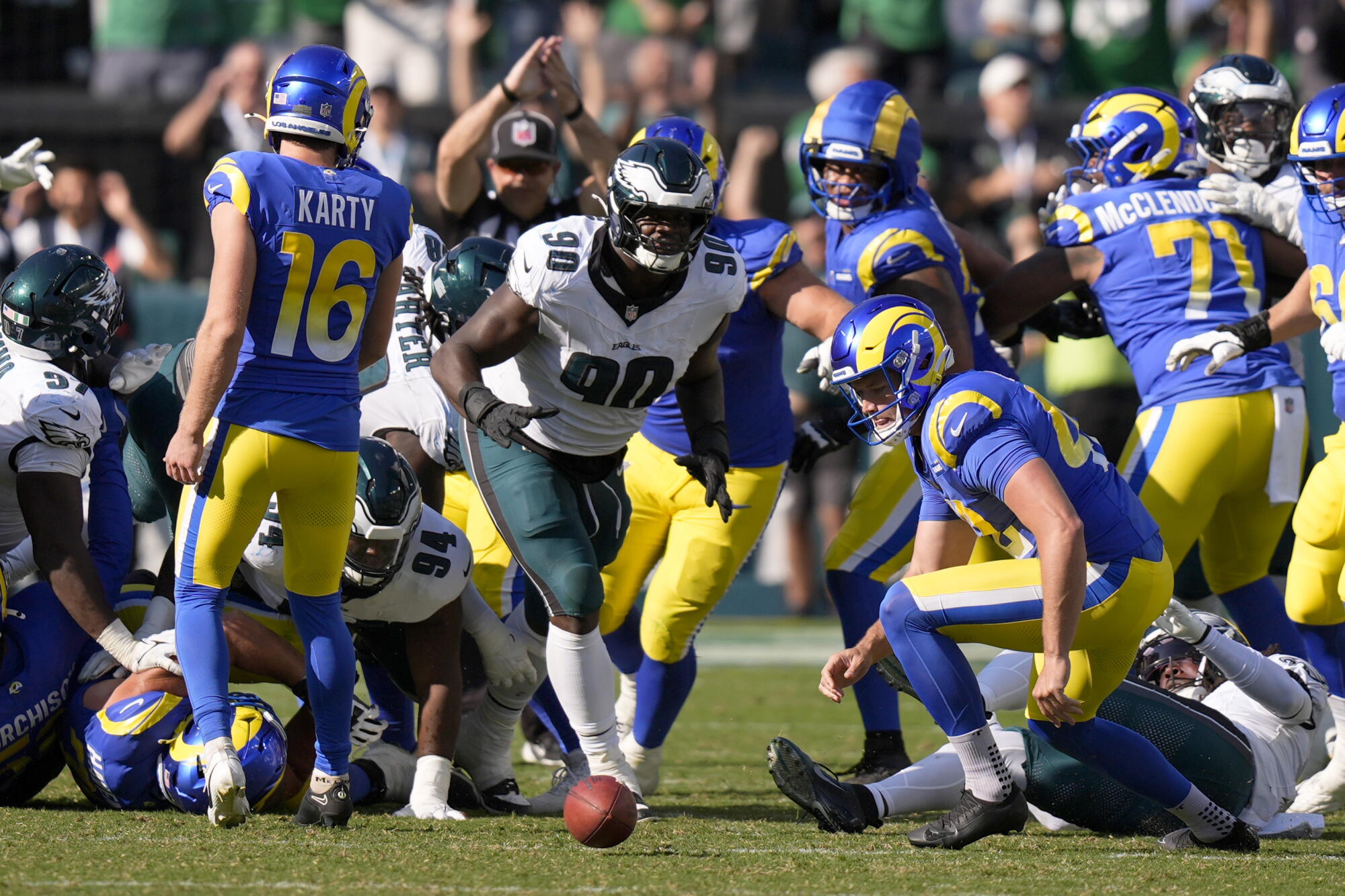
Instead, the Trojans played as poorly as they have all season in a 24-7 loss to Wisconsin. Quarterback Jayden Maiava looked lost. The offensive line was overwhelmed. The rushing attack was worse than nonexistent, with minus-17 yards. And the special teams were an all-too-familiar disaster, with two critical missed kicks.
For one half, it seemed USC’s defense might be the bright spot that kept the Trojans’ hopes alive. It allowed just 78 yards — and just three yards per play — from Wisconsin.
But as the other two phases descended into disaster for USC (6-2, 3-2), its defense could only hold for so long. Wisconsin only managed to rack up 200 total yards, only 58 of which came through the air.
All the Badgers would need in the second half to outlast the Trojans was two successful scoring drives. That was too much for one of the nation’s most high-powered offenses to overcome.
USC certainly didn’t live up to that reputation. Maiava was 31 of 50 for 258 yards, a touchdown and two interceptions. The Trojans’ leading rusher, freshman Shahn Alston, had 28 yards rushing, while their usual starter, King Miller, never found any room against Wisconsin (5-2, 3-1).
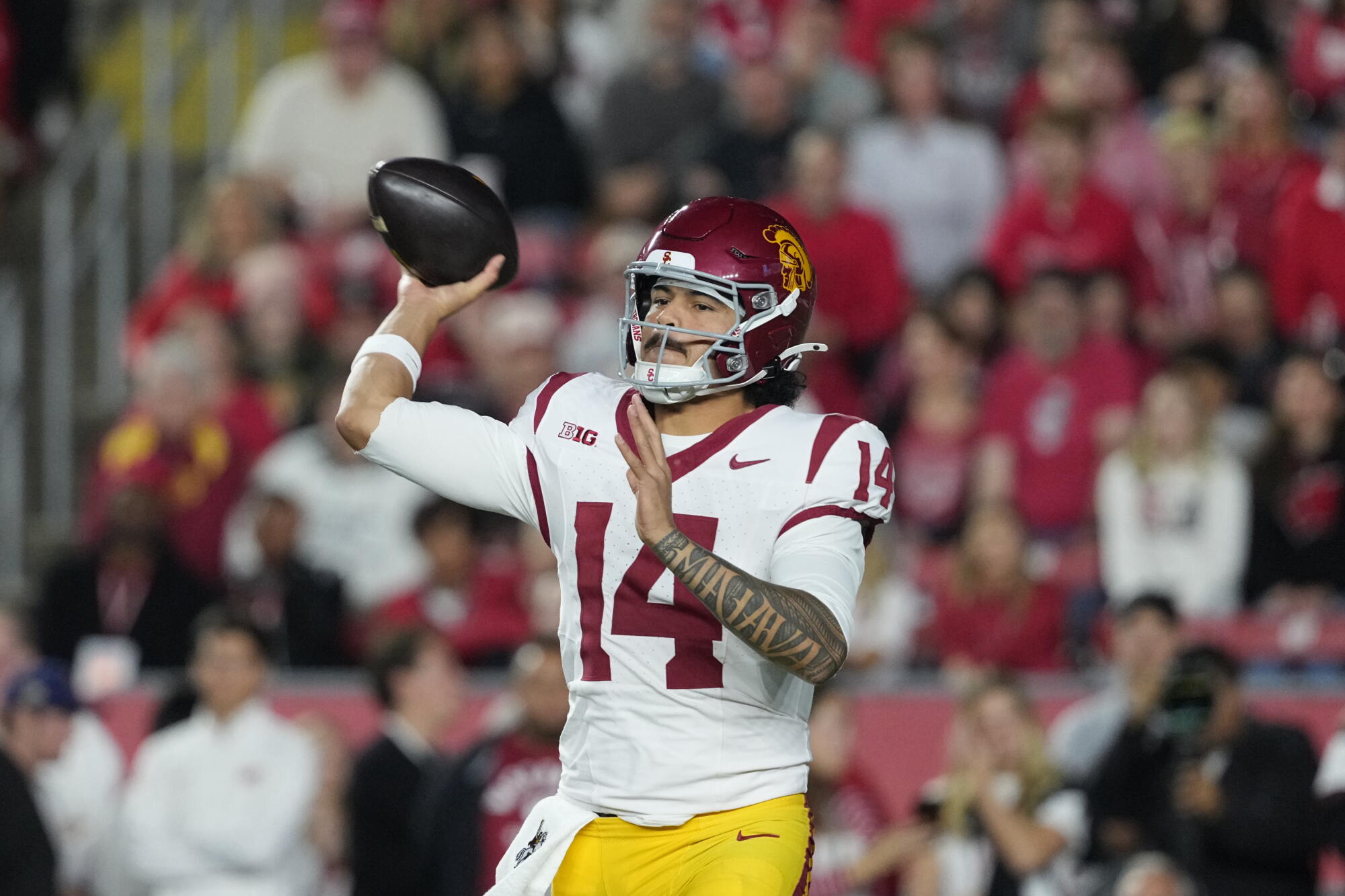
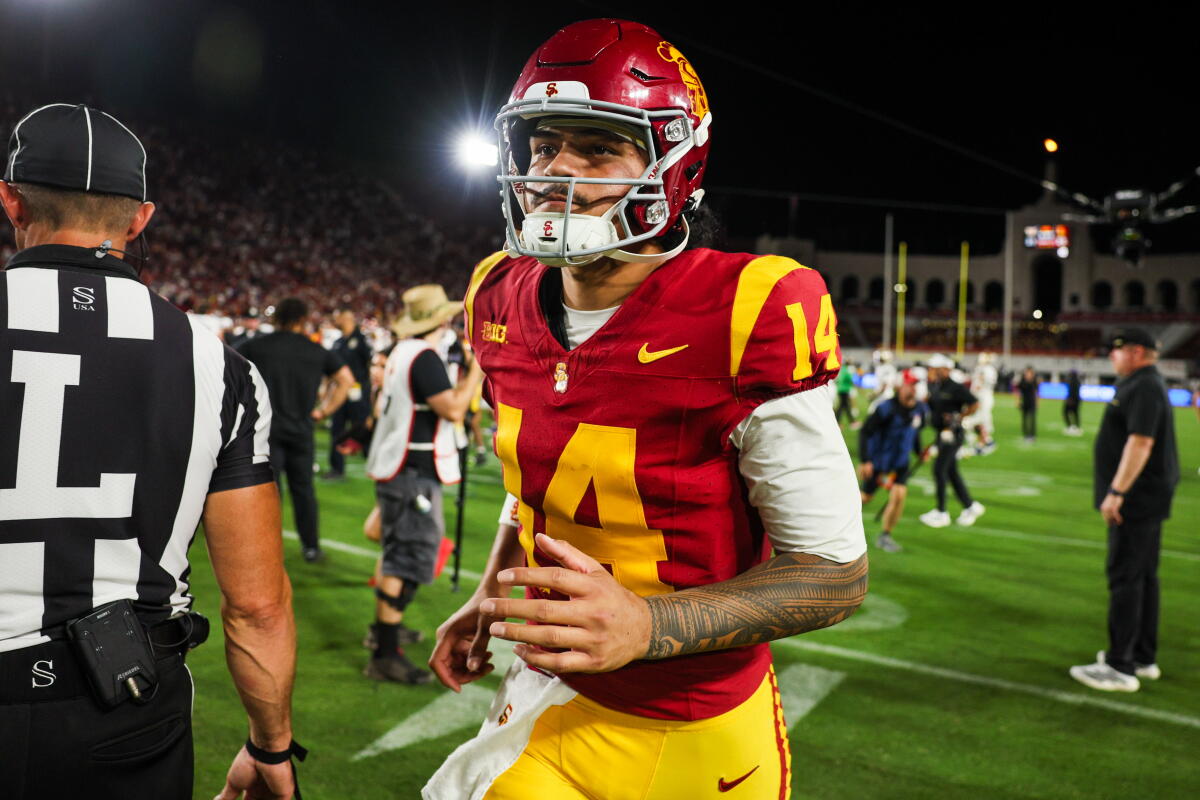
USC quarterback Jayden Maiava passes against Wisconsin on Oct. 24.
(Ross Harried / Associated Press)
That was after USC spent the bye week talking a big game about its renewed focus on the run game.
But nothing about the Trojans’ effort Saturday seemed at all focused.
It was USC’s defense that set the tone early, while its usually high-powered offense struggled to move the ball at all. Wisconsin tallied just eight total yards in the first quarter, as the Trojans swarmed the line of scrimmage and terrorized quarterback Colton Joseph in the pocket.
USC couldn’t do much better on that side of the ball. After an opening three and out, the Trojans were facing the prospect of another empty possession when Maiava threw it downfield on third and 10. But the pass into double coverage was tipped … directly into the arms of Wisconsin cornerback Bryce West.
West returned the interception to the red zone. But USC’s defense clamped down, and the Badgers only managed a field goal.
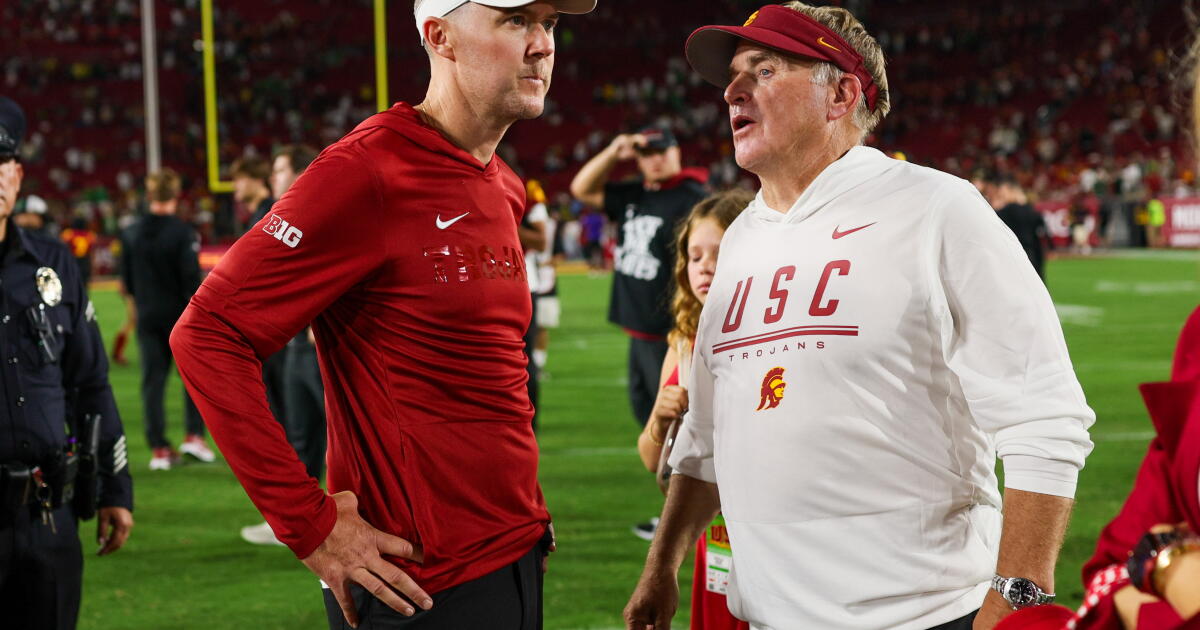
USC coach Lincoln Riley argues a call during the first half Saturday against Wisconsin.
(Matthew Holst / Getty Images)
Maiava gave it back on the ensuing drive. Under pressure on third down, the senior quarterback scrambled and then threw a late pass over the middle. It was picked off.
USC’s rushing attack wasn’t helping, either. The Trojans didn’t have a single yard on the ground through the first quarter and only managed 10 by halftime.
But the Trojans somehow cobbled together a touchdown drive in the second quarter, thanks to three Wisconsin penalties, all of which handed them first downs. The last of the three — a face mask on what would’ve been an incomplete pass to the end zone — gave USC new life at the one-yard line, and even still, it took the Trojans three plays to punch it in. Maiava eventually found tight end Taniela Tupou for the score.
That’s when the Trojans started to sputter on defense. After being unable to move the ball at all for most of the first half, Wisconsin drove the entire field for a score just before halftime. Then the Badgers marched down the field again and scored to open the third quarter.
Down 17-7, USC drove to Wisconsin’s 12-yard line. But under pressure on third down, Maiava threw it away and was called for intentional grounding. The Trojans tried a field goal, but it was blocked.
The missteps continued. Maiava was sacked again on USC’s next drive, once again pushing the Trojans out of field-goal range. Then, a delay of game pushed them back even farther.
Still, early in the fourth quarter, Riley sent out his kicker, Caden Chittenden, for a 58-yard field-goal attempt. A rain had started to fall over Camp Randall Stadium, eerily similar to State College two weeks earlier.
But Chittenden’s career-long attempt came up well short. And soon enough, USC would follow.
No. 9 UCLA was hosting a Michigan State team with one of the least productive offenses in the country led by freshman quarterback Kayd Coffman, who was taking his first college snaps after the Spartans’ top two quarterbacks were injured.
After forcing three turnovers and four sacks, UCLA trounced Michigan State 28-10 Saturday afternoon at the Rose Bowl. The Bruins improved to 7-0 for the first time since 2005 after winning just three games last season.
UCLA’s defense carried it after the offense was flat in the first half, dropping two passes, drawing drive-killing penalties and fumbling twice in Michigan State territory. Both fumbles were forced by Spartans safety Devin Vaught and returned 50-plus yards to the red zone.
While UCLA conceded a touchdown after the first giveaway, allowing Michigan State (2-6, 0-5) to score in two plays, the Bruins avenged the second fumble with an interception from linebacker Donavyn Pellot.
Pellot returned his first career interception 67 yards. Wayne Knight scored on a one-yard run five plays later for his 13th touchdown of the season. The score gave UCLA a lead it would never relinquish.
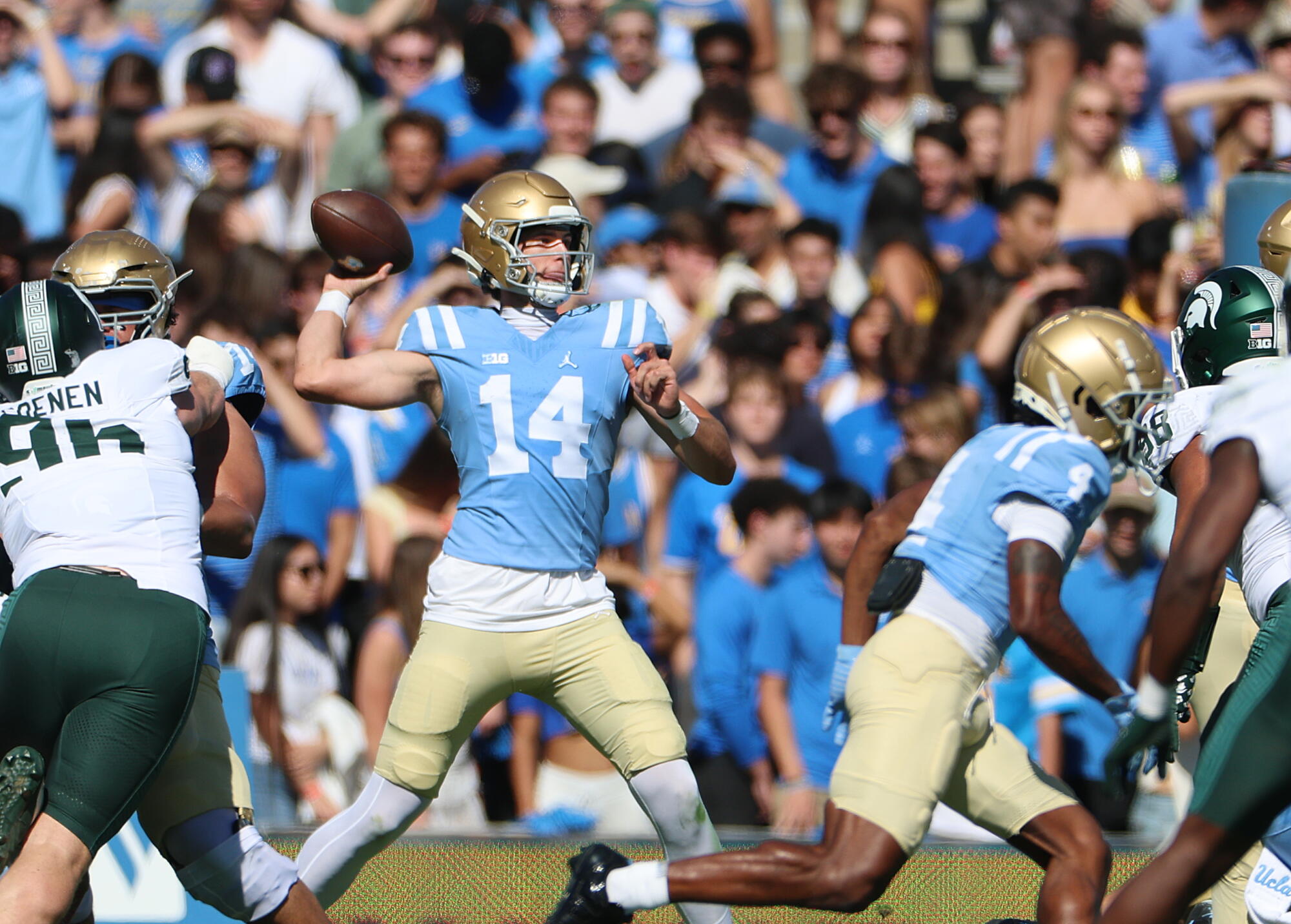
UCLA quarterback Ty Dieffenbach passes in the first quarter against Michigan State at the Rose Bowl on Saturday.
(Allen J. Schaben / Los Angeles Times)
“Second half [was] much, much better than the first half,” UCLA coach Bob Chesney told CBS immediately after the game. “Mistakes in there and uncharacteristic things that we cannot allow to happen at this point in the year.
“So a little bit disappointed in moments, but at the same point in time we did what we had to do.”
Once the offense found its footing, it did not step off the gas.
The Bruins leaned heavily on their running game as they returned to its usual form after being limited to 3.5 yards per carry and failing to surpass 150 yards the past two weeks. All three starting running backs reached the end zone for the third time this season, as UCLA finished with 245 rushing yards at 5.1 yards per carry. Anthony Woods led the UCLA rushing attack with 112 yards and a touchdown in 14 carries.
The running game loosened up the Michigan State defense, and UCLA quarterback Ty Dieffenbach took advantage of an already depleted secondary on the first drive of the second half, unloading a 63-yard pass to sophomore wide receiver Brian Rowe Jr. for his first touchdown of the season.
Dieffenbach made the big play after sustaining an apparent leg injury on a hard hit late in the first half.
With the defense holding the Spartans to just 156 total yards of offense — 73 of which came in the fourth quarter with UCLA in control — Dieffenbach didn’t have to be perfect to secure the win. He completed 18 of 31 passes for 198 yards and a touchdown.
Defensively, UCLA refused to allow a forward push at the line of scrimmage, flying into the backfield and holding Michigan State to 1.6 yards per carry.
UCLA running back Wayne Knight scores a touchdown in the second quarter against Michigan State on Saturday.
(Allen J. Schaben / Los Angeles Times)
And when the Spartans tried to pass, the Bruins dug deeper, making it a nightmare for Coffman until Michigan State coach Pat Fitzgerald turned to fourth-string quarterback Leo Hannan. UCLA finished with four sacks, six tackles for a loss and five quarterback hurries, essentially living in the Spartans’ backfield.
The Bruins sealed their seventh consecutive victory with an interception from safety Malik Hartford, his second forced turnover of the game.
The UCLA defense was one of the team’s biggest liabilities during the past decade, stretching from the Chip Kelly era to last season’s three-win effort.
This season, UCLA hasn’t allowed an opponent to score more than 15 points since Sept. 19.
Welcome back to the Times of Troy newsletter, where I am thrilled to be writing to you today after a harrowing couple of weeks at the Kartje household. But after a bout with stomach ulcers — don’t recommend it! — and a brief hospital stay, I’m now back and ready for the home stretch of USC’s football season, which has gotten a lot more intriguing since we last spoke.
Not only did Lincoln Riley secure a critical road win at Penn State, but the rest of college football’s top tier also collapsed in the week since. The teams ranked Nos. 1, 2, 5, 6 and 7 all lost on Saturday. At 3-1 in the Big Ten, USC is now tied for second place, while the three other teams at the top of the conference — UCLA, Indiana and Ohio State — are all still on the Trojans’ schedule. Two of those teams will face USC with a backup quarterback.
The Playoff picture certainly looks brighter for USC than it did before that trip to State College. But it’s still up to Riley to prove his team can actually deliver on that promise for more than one night.
Fight on! Are you a true Trojans fan?
Get our Times of Troy newsletter for USC insights, news and much more — exclusive to L.A. Times subscribers. Free Members receive a partial preview of each edition.
By continuing, you agree to our Terms of Service, which include arbitration and a class action waiver. You agree that we and our third-party vendors may collect and use your information, including through cookies, pixels and similar technologies, for the purposes set forth in our Privacy Policy such as personalizing your experience and ads.
That starts Saturday, in Madison, Wis., for my money, one of the best college towns in America. But since we’re roughly at the midway point of the football season, let’s look back at the first half for USC, with an eye on where the team could be headed in the second.
Quarterbacks: B
Jayden Maiava is coming off one of his better games as USC’s starting quarterback, having guided the Trojans to victory in State College. And maybe that performance was what Maiava needed to snap out of whatever funk he seemed to be in. Because for a few weeks, his timing and mechanics were a bit out of whack.
He’s still been putting up numbers — seventh in passing yards per game, in spite of my nitpicking. But if he is back to slinging it like he was against Penn State for the rest of the season, USC can keep up with anyone, including Indiana and Ohio State. But through the first half, I would say Maiava was good, not great.
Running backs: B-
King Miller has been a workhorse for USC this season.
(Adam Hunger / Associated Press)
I had high hopes for Waymond Jordan this season, but since his ankle surgeries, he simply hasn’t been the same player through the first half that he was a year ago. Fortunately for USC, that hasn’t been a huge problem. King Miller’s added muscle has given him some added durability, and in turn, USC has used him like a workhorse, with more carries per game so far than basically any other back in the Riley era. But he hasn’t been quite as explosive as he was last season, and that absence of explosion has been noticeable in USC’s offense. The Trojans have just five runs of 20-plus yards in seven games.
Wide receivers/tight ends: A
It’s pretty rare that a team entrusts its entire passing attack to a fleet of freshmen right from the jump. And it’s even more extraordinary to see that trust pay immediate dividends. But that’s been the case for USC so far this season. Trent Mosley has been the most dynamic freshman pass-catcher in the country when healthy. Kayden Dixon-Wyatt leads all Power Four freshmen wideouts in receiving yards (400). And Mark Bowman’s absence has been felt since he’s been out of the lineup. I’ve been blown away by what we’ve seen out of this group, given all it had lost. The last two weeks, we’ve also seen Tanook Hines return to the level on which he left off last year.
Offensive line: A
It’s a credit to what offensive line coach Zach Hanson has been able to accomplish with his group’s development that true freshman Vlad Dyakonov could step in to start at left tackle in the most brutal of circumstances at Penn State and more than hold his own. USC has been able to navigate injuries up front with ease so far this season, after actually losing its starting center before the season even started. The unit has only given up seven sacks in seven games, and their run blocking has been mostly strong as well.
Defensive line: B
USC’s defense looks entirely different when it can effectively pressure opposing quarterbacks. Over the last two weeks, it has managed to rack up seven sacks, one fewer than USC had over its previous five games. That’s a major step forward, and it starts with Luke Wafle and Kameryn Crawford getting more pressure off the edges. If Jide Abasiri and Jahkeem Stewart can use the bye week to get healthier, then suddenly this group looks very dangerous ahead of the second half.
Linebackers: C
I like what I saw out of Ta’Mere Robinson and Elijah Newby in recent weeks, and it’s certainly possible that the linebacker room looks decidedly different coming out of the bye week, with either stepping into a bigger role. It feels like a fork-in-the-road moment for Desman Stephens, given what happened with Oregon and how he’s played outside of that one bad decision. It’s Year 3, and he’s not always in the right place. There’s a lot to work out here still.
Secondary: D+
Through seven games, USC ranks 128th in the nation in pass yards allowed per attempt. Which means I’m probably being kind giving this group the benefit of the doubt inherent to a D-plus. In some sense, this group is what it is. The personnel at safety has not appeared to fit whatever Gary Patterson wants at the position. But the healthy return of Alex Graham at slot corner has helped matters, and Jontez Williams has been solid, albeit unspectacular. Otherwise, well … yeesh. Best-case scenario is Patterson figures out something in the bye week to get the best out of this group.
Injuries shape start of men’s basketball season
We already knew that 7-footer Eric Reibe will miss at least all of USC’s non-conference slate after foot surgery. But according to a person familiar with USC’s roster situation but not authorized to speak publicly told The Times that the Trojans may also be without five-star freshman Christian Collins when they open the season on Nov. 2 against Milwaukee. Collins has been out for several weeks of the preseason with an undisclosed injury, but he’s expected to return sometime in early November. Assuming he continues to progress, he won’t miss much more time.
The earliest Reibe could return, I’m told, is the first week of January, when USC opens conference play. But even that would be an optimistic outlook, considering when Reibe had his surgery. He’d sat out for almost two months, hoping to let the foot heal on its own, before opting for the operation.
A note on House of Troy, Chapter 5
Given my recent health situation, we’ll be taking a one-week break from “House of Troy.” But we’ll be back the following Tuesday, Oct. 27, when Chapter 5 will ready for you wherever you get your podcasts!
Notable quotable
“We have one loss. We just had a terrific win on the road at Penn State. And we’re gonna continue to get things done for the rest of the season. Then, we’ll see what happens.”
—USC president Beong-Soo Kim, when asked about the potential of moving on from Lincoln Riley
Olympic sports spotlight
It’s been a tough season for USC women’s soccer. Entering the weekend, the Trojans had just one win in 14 matches this season … and that lone win came in late August.
But that changed at Northwestern, as USC scored in the first minute of the game and never looked back, delivering a 3-0 win over the Wildcats.
The win won’t change what’s frankly been an unacceptable campaign for a program that was 18-1-4 just two seasons ago. USC is now 2-8-5, with three matches remaining. The time to save this subpar season is already past.
What I’m watching this week
Samantha Sloyan and Summer H. Howell in “Carrie.”
(Liane Hentscher / Prime)
While I was doubled over on the couch for the better part of two weeks, I did happen to stumble onto one of my favorite shows of the year to date. I have a deep respect and love for Stephen King, so I was wary of Amazon’s new adaptation of “Carrie.” But it honestly shattered my expectations.
Adapted by writer and director Mike Flanagan, this modernized version of the classic King story is born out of social media and an Instagram account, “CarrieRed,” which starts terrorizing other students and teachers alike. Meanwhile, Carrie White, the titular character, is thrust into this brutal world of modern high school having spent her life to that point shut in with her strict mother and father. It could’ve been a caricature of high school today, but I thought it was really well done. And it kept me guessing throughout.
That concludes today’s newsletter. If you have any feedback, ideas for improvement or things you’d like to see, email Ryan at ryan.kartje@latimes.com, and follow me on X at @Ryan_Kartje. To get this newsletter in your inbox, click here.
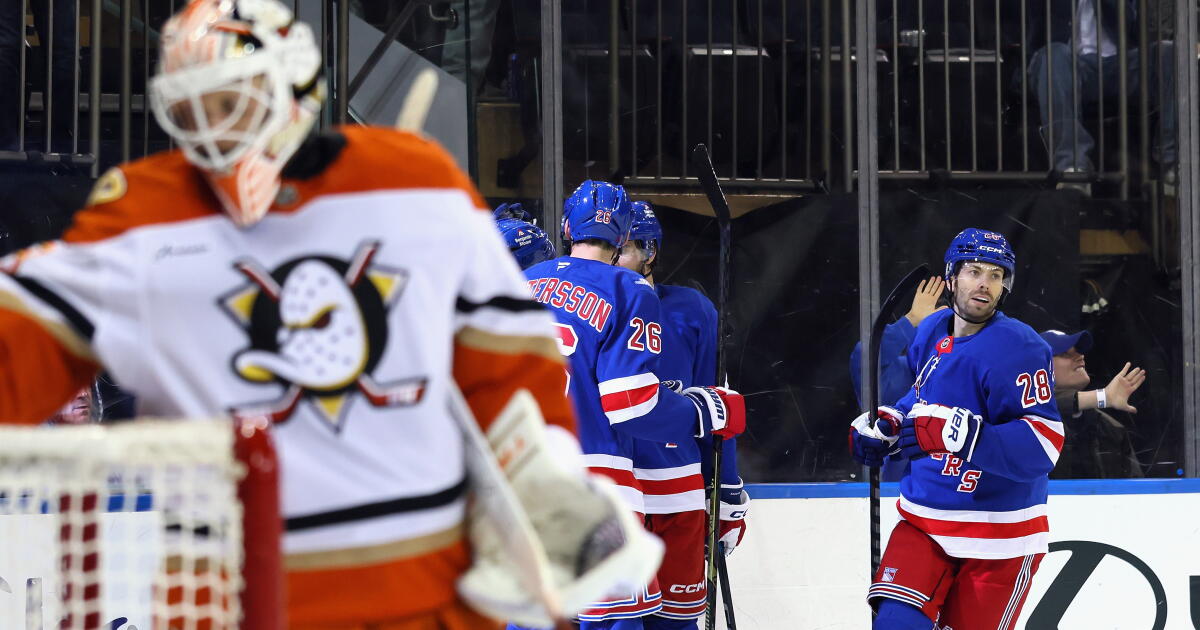
NEW YORK — Sean Durzi scored 78 seconds in, Dylan Garand made 29 saves and the New York Rangers defeated the travel-weary Ducks 5-2 on Monday night to improve to 6-0-0 at home this fall.
The Rangers (7-3-1) did not pick up their sixth victory at Madison Square Garden last season until Jan. 26, their 23rd game there. They lost 27 of 41 at home on the way to missing the playoffs and finishing last in the Eastern Conference.
There is hope of a turnaround given this start, even missing franchise goaltender Igor Shesterkin for the rest of the season. Garand was making a fifth consecutive start since Shesterkin went down, and he has allowed two or fewer goals in nine of 10 NHL appearances dating to his debut last spring.
He got support early and often, with Durzi’s goal making it three home games in a row where the Rangers have scored in the first two minutes. That has only happened once before for New York, in March 1989.
The Ducks scored twice in the final 69 seconds, on goals by Nick Jensen and A.J. Greer, their first goals with Anaheim, to ruin the shutout bid.
Oliver Bjorkstrand scored twice, captain J.T. Miller and Gabe Perreault each had a goal and Alexis Lafreniere recorded two assists. Pavel Dorofeyev, the team’s most notable trade acquisition over the summer, came close on several occasions but remained stuck on two goals for the season.
Putting goalie Ville Husso in a tough spot with sloppy play, the Ducks (4-4-0) looked every bit like a group that endured a 15-hour, delay-filled travel ordeal to the East Coast from Southern California. They did not arrive at their hotel until 2:30 a.m., were on the ice for their morning skate less than nine hours later and were getting shut out until scoring twice in the final 70 seconds.
UCLA football fans are accustomed to watching the Bruins struggle, so it took some time to believe new coach Bob Chesney really could back up his inspirational messages.
After a big road win against longtime nemesis Oregon, video posted online showed Chesney delivering a fiery speech to his team in the tunnel before facing the Ducks. He relayed the story of Hernán Cortes telling his crew to burn boats behind them so that there was no way out but forward. The Bruins, he said, had to burn the boats and fight through the Ducks.
“His speech before the Oregon game — where he talked about burning boats — that just fires you up. It makes me want to run through a wall,” said Brian Jacobsen, a 1987 UCLA graduate.
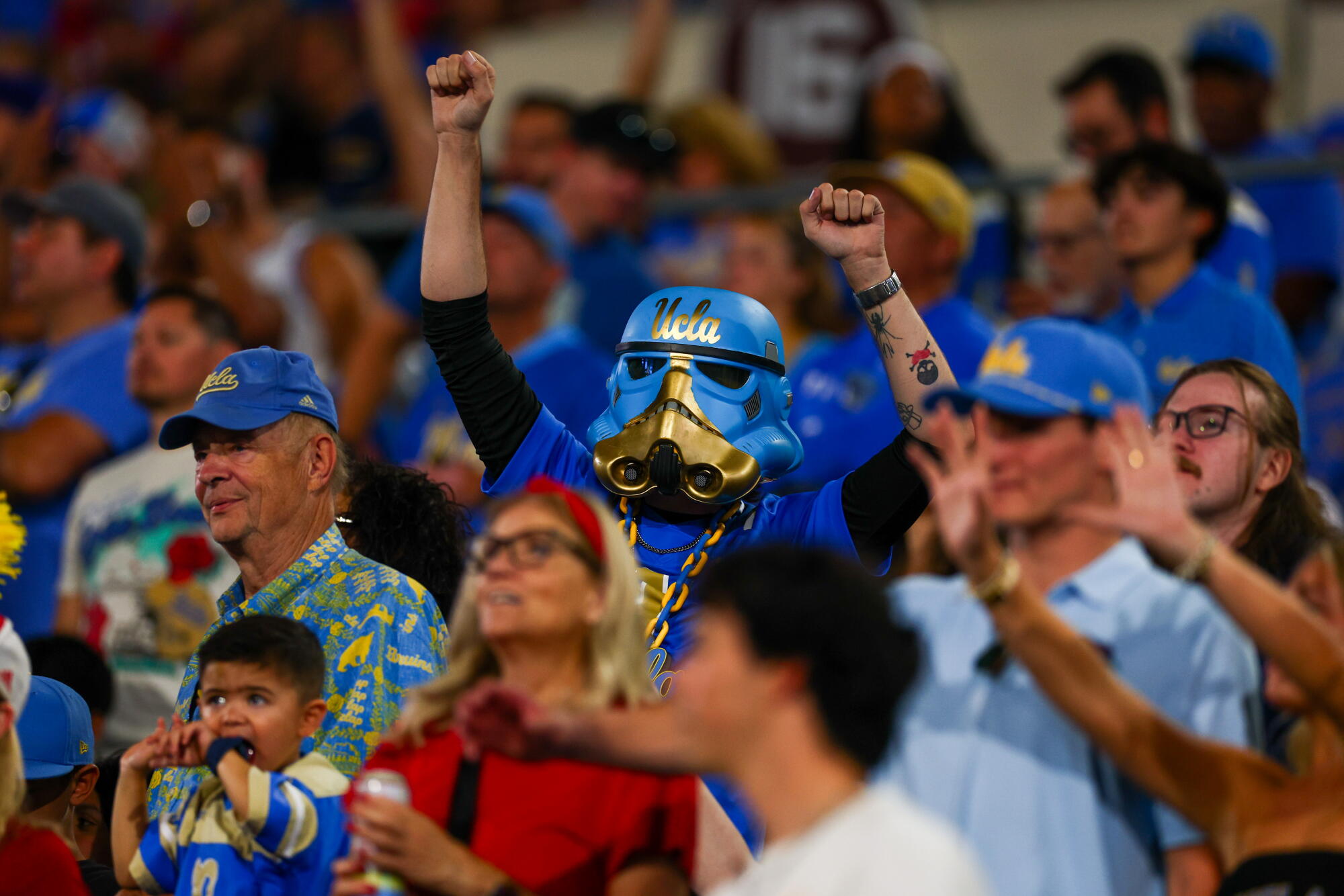
A fan with a UCLA themed Star Wars storm trooper mask dances during the Bruins’ win over Wisconsin at Rose Bowl on Saturday.
(Ronaldo Bolanos/Los Angeles Times)
UCLA fan Luis Flores, 54, grew up watching the Bruins and said he can’t recall feeling this excited about the team.
“It’s the culture and the way the coaches have these kids going the right direction. Where they are disciplined, they believe in [Bob] and they believe in the Bruins,” Flores said.
Jacobsen and Flores were among the 36,045 fans at the Rose Bowl Saturday during UCLA’s 17-7 win over Wisconsin. The Chesney train is picking up steam, but the Rose Bowl was still far from sold out Saturday.
Joel Fierberg, music director of the UCLA Alumni Band, has seen the football program’s highs and lows during his 30 years leading the band.
“There have been some up-and-down years, but I am excited for what’s been happening,” Fierberg said.
Fierberg values fans who have stayed with the Bruins through thick and thin, especially now that the program has given them wins to celebrate.
“There are a lot of fans, including a lot of my band [members], who are here every week regardless,” Fierberg said. “It’s always exciting for them, having lived through the difficult times, to have something to be excited about.”
UCLA fans haven’t seen this kind of dominance since the Bruins opened the 2022 season 6-0.
Jeremiah Calvillo, 15, said he remembers the Chip Kelly era, but he couldn’t be more excited about what this UCLA team has done for him.
“[Chesney] is a very good coach who is leading this program to better things,” Calvillo said.
UCLA running back Anthony Woods and quarterback Ty Dieffenbach celebrate after scoring a touchdown in the fourth quarter against Wisconsin at the Rose Bowl on Saturday.
(Ronaldo Bolanos/Los Angeles Times)
UCLA alum Garry Sakson enjoys seeing all the praise the Bruins have received on social media after beating Oregon in Eugene. Sakson attended as many games as possible during the Kelly era at UCLA.
“The mindset this team has is different,” Sakson said. “With Chesney, it’s the way he acts and carries himself.”
Fans are cautious about discussing UCLA’s chances of making the College Football Playoff, despite the Bruins becoming the last undefeated team in the Big Ten and SEC. That superstitious approach shows how quickly Chesney has raised expectations.
“I’m very optimistic about Chesney in his first year, but talking about the playoffs already is wild. Still, it’s amazing that we’re even in this position,” said 2009 UCLA alum Tim Dawson.
Dawson was a freshman when the Bruins started the 2005 season 8-0 and finished 10-2, during coach Karl Dorrell’s third year.
That season, the Bruins were known for their high-scoring offense and their ability to pull wins out, until they fell to Arizona in Week 9.
This season, the Bruins have a potent rushing game, a dynamic new starting quarterback and defense that has delivered explosive plays. Dawson said this feels different than the 2005 team because the defense is strong.
The players are proud of how quickly they shifted from going 3-9 last season to a 6-0 start.
Fans watch UCLA face Wisconsin at the Rose Bowl on Saturday.
(Ronaldo Bolanos/Los Angeles Times)
“Think the progress that we made from January, when we all arrived, till now is just out of this world,“ UCLA wide receiver Landon Ellis said. “It’ll be hard to look back into history and find teams that have turned it around this fast. So if you’re not all the way in, I don’t know what you are doing,”
Chesney said a bruising win over Wisconsin that shows UCLA can hold its own against brawny Big Ten terms should win over more fans unaccustomed to success.
“I think this win changes things a little bit,” Chesney said. “We won games in different ways, whether it be the offense or defense, but I think [Saturday] was a tough, physical game of football that you got to have a lot of pride in. And I think this should be the one that gives them a lot of confidence to understand just exactly what we are doing.”
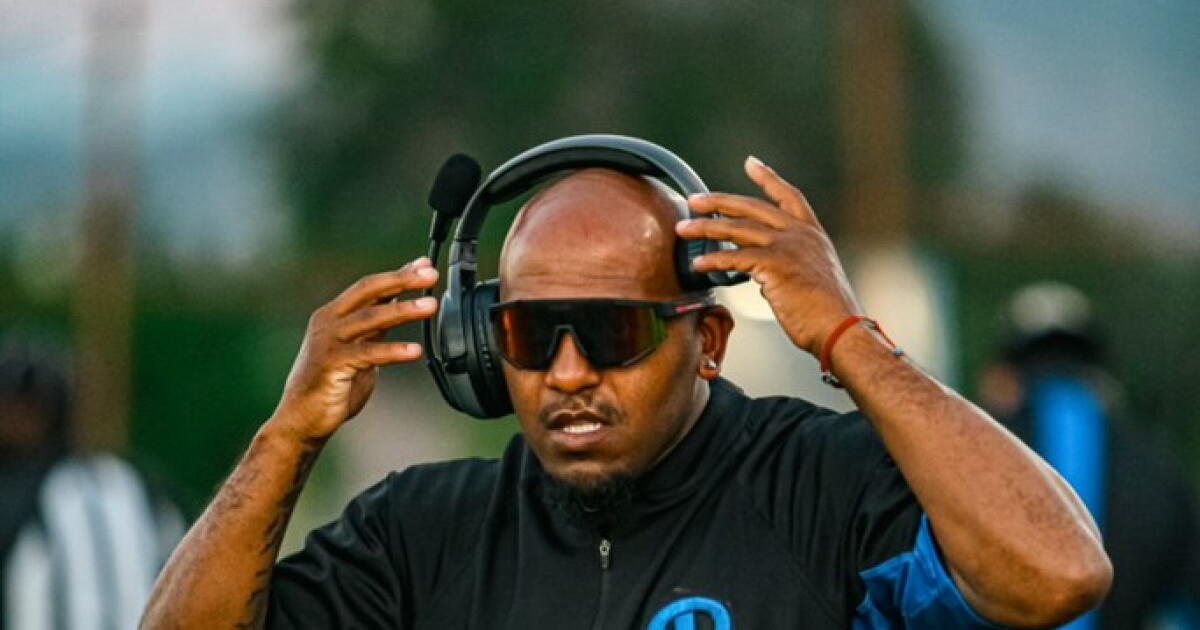
After spending years as an assistant football coach at Sylmar and San Fernando, Boo Williams arrived at Sun Valley Poly this season with a mission to turn around a program that always seemed to have talent but rarely put together many victories.
In his rookie season, Williams has Poly with a 7-1 overall record and a 5-0 mark in the East Valley League going into the final games against Verdugo Hills and Arleta.
Justice Brown has rushed for more than 1,000 yards. King Exudus has been an impact player on defense.
Army Lt. Gen. Frank Lozano, the service’s Portfolio Acquisition Executive for Fires, highlighted this growing trend yesterday during a panel discussion at the Association of the U.S. Army’s (AUSA) main annual convention, at which TWZ has been in attendance.
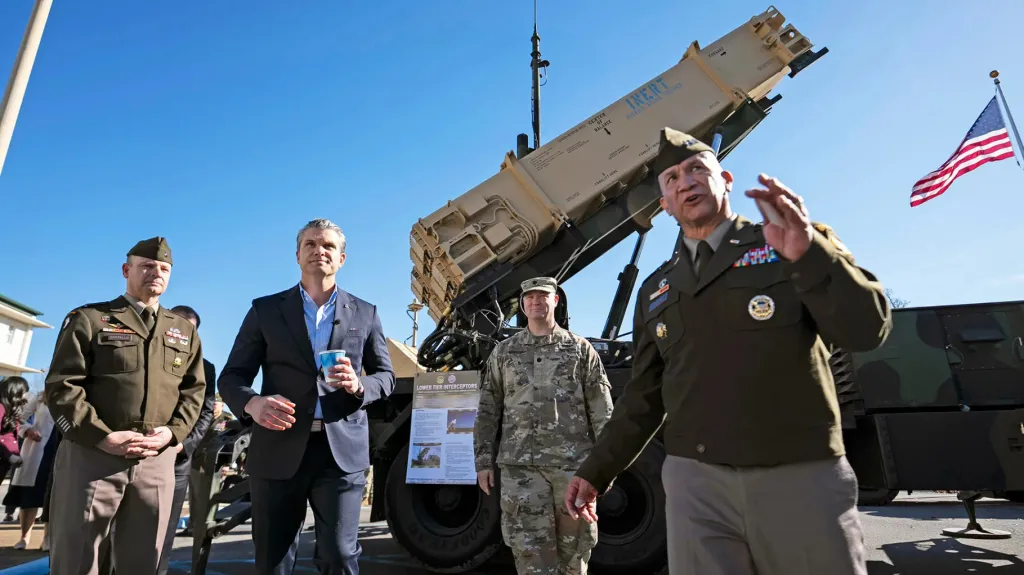
Secretary Hegseth, second from the left, seen in front of a launcher for the Patriot surface-to-air missile system during a tour of Redstone Arsenal in Alabama earlier this year. Army Lt. Gen. Frank Lozano is seen at far right. DoW/USN Petty Officer 1st Class Alexander Kubitza
To provide some immediate context, with the exception of Patriot, the main ground-based air defense systems in Army inventory today are fielded with just one type of interceptor. In the case of Patriot, the service’s procurement of new interceptors had also been increasingly limited to just one type, the PAC-3 Missile Segment Enhancement (MSE). Production of the preceding PAC-3 Cost Reduction Initiative (CRI) missile ended in 2023. Just earlier this year, the Army placed its first order in decades for new PAC-2 Guidance Enhanced Missile-Tactical (GEM-T) missiles, an older interceptor design for Patriot that has remained in production primarily for U.S. allies and partners.
A graphic showing different interceptor load options for existing trailer-based Patriot launchers. Lockheed Martin
Separately, the Army is in the process of fielding Enduring Shield, a new middle-tier air defense system designed to handle multiple interceptor types. However, the service is currently only acquiring AIM-9X Sidewinders to load into them. We will come back to this later on.
An Enduring Shield launcher. USAF Pfc. Sang Woo Choi
“We have the capabilities we need to have to fight and win, but it’s our job to ensure that victory is achievable in the future inside of any dynamic environment scenario fight we might find ourselves in,” Lt. Gen. Lozano said yesterday. “So, it’s incumbent upon Mr. Ingraham [Assistant Secretary of the Army for Acquisition, Logistics and Technology Brent Ingraham] and I to continue to be creative and looking at, well, should we buy GEM-Ts because they’re being produced?”
“GEM-Ts are a really good missile in the battlespace within they operate. I mean, they’re being employed today by air defense brigades around the world,” he continued. “So if we have the opportunity, it’s probably something we should take advantage of, and we’re looking at doing that.
“We’ve had a lot of discussions about even more interceptors. From a PAC-3 MSE perspective, our goal has always been to get to 2,000 [per year],” he added. “Why we’re running programs like LCI [Low Cost Interceptor], and NGSRI [Next-Generation Short-Range Interceptor], and NGCM [Next-Generation C-UAS Missile], and Second Interceptor, is because I think the easy button answer is just buy more of a great missile. We’re going to buy more [PAC-3 MSEs], but when we start talking about overall missile output, we start looking at numbers like is it 4,000, is it 6,000, is it 8,000, we’re looking at a diverse set of capabilities.”
The LCI program is seeking a lower-cost and lower-tier interceptor for Patriot with a unit price of no more than $1 million. PAC-3 MSE’s average unit cost has been around $4 million in recent years.
A PAC-3 MSE interceptor seen being launched. US military A Patriot launcher fires a newer PAC-3-series missile during a test. DoD
NGSRI is the Army’s program to find a replacement for the venerable Stinger. The new missiles have to be compatible with existing vehicle-based and man-portable launchers.
A US Army soldier fires a Stinger from a man-portable launcher during training. US Army
The Army is working to field a new counter-drone interceptor through NGCM. Those missiles will be integrated into launchers the service has now for the Coyote interceptor.
Raytheon Missiles & Defense proves counter-UAS effectiveness against enemy drones
The Second Interceptor effort is for Enduring Shield, which is also known as the Indirect Fire Protection Capability Increment 2 (IFPC Inc 2). The main goal there is to provide increased capability against incoming cruise missiles compared to the AIM-9X.
There is also the Army’s Future Interceptor effort, which also came up separately at the panel yesterday, and is also for Patriot. Unlike LCI, the aim here is to acquire a new interceptor with improved capabilities against hypersonic missiles and other upper-tier threats.
Historically, Army programs like these would eventually result in the selection of a single winning missile design. Lozano’s remarks yesterday point to the service increasingly taking a very different approach.
On “second interceptor, obviously, we just moved into phase two of that program. We’ve got Lockheed Martin competing with Boeing, who was teamed with Anduril,” Lozano said. “But we wanted to turn up the heat on that program. I constantly get frustrated when a funding profile emerges over the FYDP [the Future Years Defense Program], and then magically we lay in a five-year program.”
At left, a model of the Boeing/Anduril offering for the Second Interceptor effort. At right, a rendering of Lockheed Martin’s proposed Second Interceptor. Jamie Hunter/Lockheed Martin
“I’m like, no, I actually need that capability now,” he continued. “So, have we thought maybe what if we ran a 24-month program or a 36-month program, right? And so, in that vein, what we have decided to do is, while those two companies continue to compete, we’re going to create a shoot-off opportunity in [the] fourth quarter [of Fiscal Year 20]27, and I want to run an in-parallel, what I call an in-stride competition.”
“We just held an industry day, and we basically just said, hey, if there’s any other company who didn’t make the first cut in the phase one, but, oh, by the way, who continued to invest in the IFPC Second Interceptor capability, we’d love for you to come out to the range,” he added. “We’ll give you range time, we’ll present targets, and we’ll allow you to recompete with an opportunity to get back into the program folder.”
The Army is doing the exact same thing with NGSRI, where Lockheed Martin and Raytheon have been competing face-to-face. That program is also now planning to hold a new shoot-off that will be open to other vendors in the fourth quarter of Fiscal Year 2027.
A picture showing a test of Lockheed Martin’s NGSRI entrant, called QuadStar. Lockheed MartinRaytheon, which is also the prime contractor for Stinger, has previously released this image in relation to work on its NGSRI design. Raytheon
To reiterate, on top of all this, the Army is also now pursuing at least two new interceptor options for Patriot.
“We have to address the threat, and we need to address the threat in a complementary way, meaning we need to fight on a cost curve that’s affordable for the U.S. Army to maintain and sustain that warfighting capability abroad,” Lozano stressed yesterday.
This gets to the crux of the matter. It is not at all a new observation that just having a stockpile of any particular munition on day one of a conflict is not enough, especially if the fight becomes drawn out. There needs to be sufficient depth to those stocks at the start and the ability to readily replenish them in line with expenditures. The war with Iran, compounded by other crises in the Middle East and the ongoing conflict in Ukraine, has made clear that these core truths apply to all armed forces, even the U.S. military.
Lower-cost munitions are part of the solution, but they also need to be producible at scale on reasonable timelines. The lead time for higher-end munitions today is often measured in months, if not years. Furthermore, being locked into a single vendor has been shown to not just be undesirable, but a potential national security risk in an actual conflict. Lozano’s remarks yesterday, and how the Army is now pursuing new anti-air interceptors, reflect larger trends, not just in the acquisition of larger volumes of munitions overall, but also from a broader array of total suppliers.
The @DeptofWar has reached new framework agreements with a slate of disruptive new entrants to aggressively expand the United States military’s lethal cruise missile and hypersonic missile strike capabilities.
With regard to the LCI program, specifically, Lozano highlighted an additional aspect of all of this yesterday.
LCI has “a unique twist to it because we’re looking for companies who have all-up rounds, but I’m also asking for companies to come in at the component level,” he explained. “We typically don’t do that, right? There’s a lot of risk in managing components and generating all-up round systems. But we’re also looking for weapon system integrators, because I want to be able to create two or three teams who can compete with the all-up round guys to see if we can generate some momentum behind the fact that we need to thicken our inventory with low-cost, affordable munitions.”
The U.S. Navy is now pursuing a roughly similar approach with its Naval Modular Missile (NMM) program. NMM envisions an entirely new family of sea-launched surface-to-air missiles that offer very different capabilities, but that all feature certain common components, as you can read more about here.
A graphic laying out the Navy’s vision for the different members of the NMM family, and shared components between them. USN
It is also important to note here that the underlying aim is not to eliminate more exquisite munitions, or the capabilities that they offer, but to create a more affordable, complementary mix of options.
“What I would say is we’re solely focused on delivering on the programs we are executing now,” Lozano said in closing at the end of the panel yesterday. “We have to deliver, and if we deliver on that wide variety of capability, then we can increase and ramp that capacity. And that would be my wish list, that we have enough resources and we achieve programmatic success in the way that we’re planning to, so we can deliver in mass.”
All signs point to the diversity in munitions that Lozano is talking about here being particularly pronounced in future Army air defense capabilities full of systems firing multiple types of interceptors.
Times of Troy writer Ryan Kartje is out sick this week, but we didn’t want USC fans to miss extended coverage of the Trojans’ win at Penn State. Times sports editor Iliana Limón Romero is filling until Kartje returns.
USC coach Lincoln Riley lingered at Beaver Stadium on Saturday night, soaking up a hard-fought moment of vindication.
Riley celebrated out-coaching Penn State’s Matt Campbell like he won a national championship, offered gleeful remarks to NBC and reporters at his postgame news conference and shook the hands of USC fans who ventured to Happy Valley to catch the Trojans’ first road win over Penn State.
“It’s one of my favorite wins as a head coach no question, for so many reasons,” Riley said after the Trojans’ 31-23 victory. “Obviously phenomenal atmosphere, as good as it gets there in college football, so give credit to Penn State, their fans, but really proud of our team, man.”
Fight on! Are you a true Trojans fan?
Get our Times of Troy newsletter for USC insights, news and much more — exclusive to L.A. Times subscribers. Free Members receive a partial preview of each edition.
By continuing, you agree to our Terms of Service, which include arbitration and a class action waiver. You agree that we and our third-party vendors may collect and use your information, including through cookies, pixels and similar technologies, for the purposes set forth in our Privacy Policy such as personalizing your experience and ads.
And even Riley’s harshest critics had trouble arguing this wasn’t a meaningful win. A serious test his team passed. The kind of beast Riley and the Trojans have struggled to slay.
Yes, the Nittany Lions now sit 3-3 overall and 0-3 in Big Ten play, but White Out games are their super power. When an announced crowd of 114,419 fans commits to wearing white and roaring in unison, it’s hard for any visiting team to pull off a victory. USC had never won in State College, Pa., and Riley noted seemingly no one outside of his team believed the streak would end Saturday.
How did USC do it?
The Trojans figured out how to overachieve in every area that was considered a weakness entering the matchup.
Maiava lights up Nittany Lions
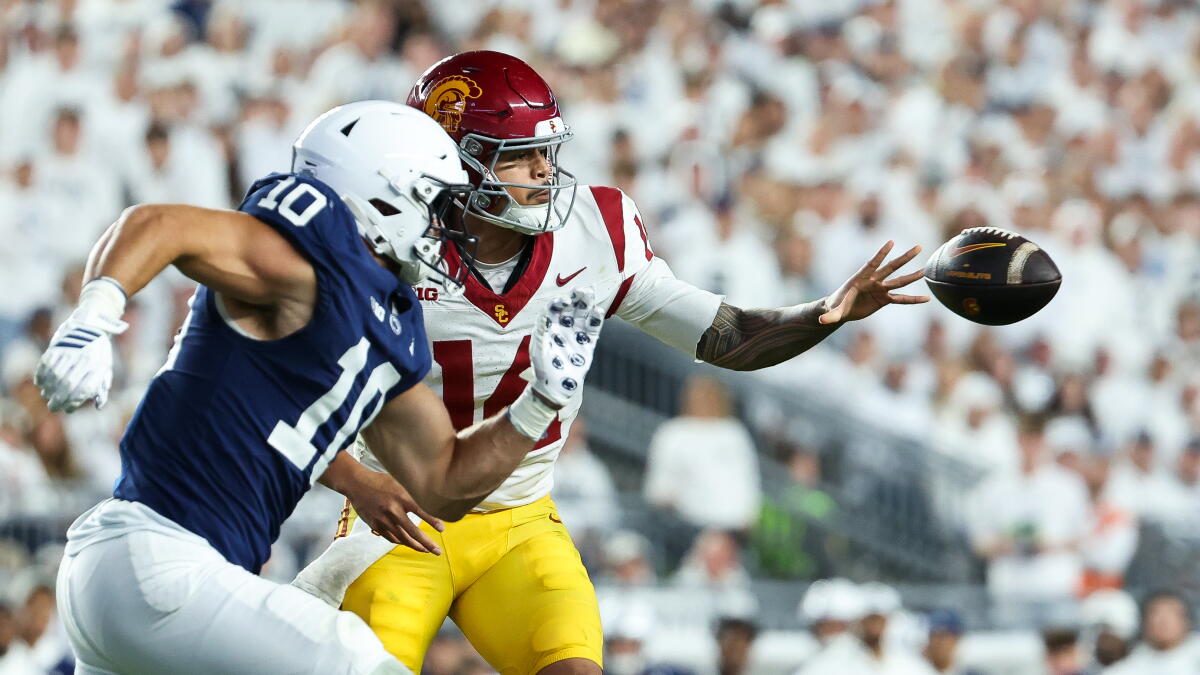
USC quarterback Jayden Maiava delivers an option pitch under pressure from Penn State’s Caleb Bacon on a play that scored a touchdown Saturday at Beaver Stadium.
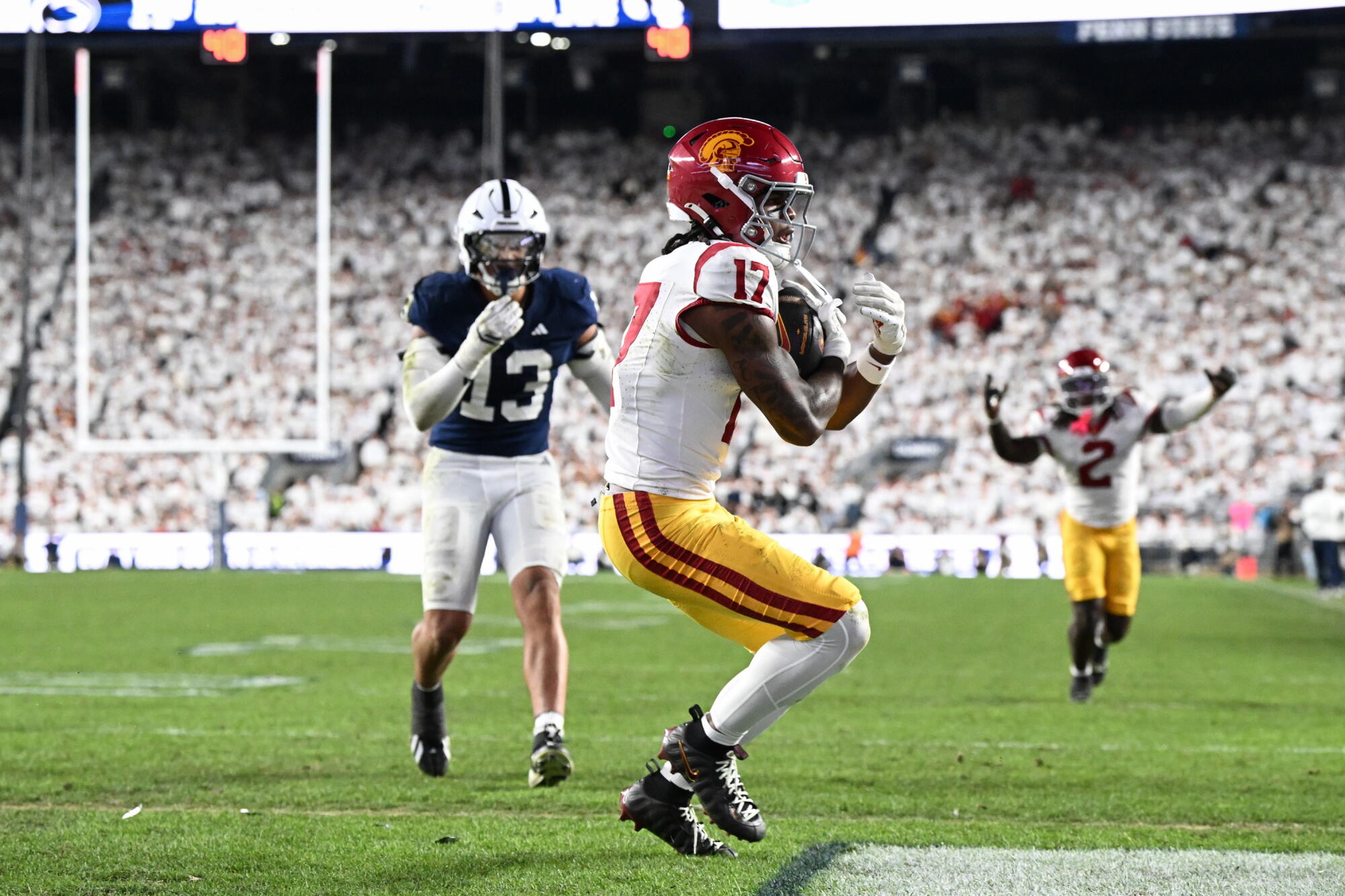
With big-play threats Mosley and Tanook Hines on the field, Maiava looked like an elite Big Ten quarterback dealing the ball in locations only his two ace receivers could catch.
Maiava completed 21 of 33 passes for 301 yards, three touchdowns and no turnovers.
Mosley had nine catches for 111 yards and one touchdown. Hines had four catches for 82 yards and another score. The passing attack opened up enough space for King Miller to earn 102 yards and a touchdown in 19 carries.
Of course fans have come to expect big highlight plays from a Riley offense, but Maiava was unquestionably tentative the past few weeks and the offense wasn’t clicking. It hit top gear at Penn State.
USC’s Christian Pierce punches the ball out of the hands of Penn State’s Brett Eskildsen, forcing a fumble in the fourth quarter at Beaver Stadium on Saturday.
(Isaiah Vazquez / Getty Images)
While Riley has caught considerable heat this season, the USC defense directed by Gary Patterson wasn’t far behind.
The Trojans have shown marked improvement with Patterson shifting from the sideline to the press box the last two games.
Patterson had always worked from the sideline, but he also was always surrounded by staff members who knew his system well. Riley said the goal of the move was to speed up communication.
Desman Stephens II returned from his one-game suspension and led USC in tackles with nine. Luke Wafle and Kennedy Urlacher earned sacks. Jahkeem Stewart played after being listed as a game-time decision on the injury report and recorded a quarterback hurry.
Jontez Williams, Prophet Brown and Elijah Newby were credited with breaking up one pass apiece.
Riley can deliver in crunch time
USc coach Lincoln Riley talks with quarterback Jayden Maiava during the Trojans’ win over Penn State Saturday at Beaver Stadium.
And he was well aware few expected USC to win at Penn State, with betting odds favoring a rebuilding Nittany Lions squad by 1 1/2 points.
Riley’s clock management and use of timeouts, along with his play-calling, unquestionably got the best of Penn State’s Campbell and helped seal the USC win.
Opening the second half with an onside kick set the tone that everything was on the table for USC.
When Riley kept his offense on the field on fourth and four at the USC 13 late in the fourth quarter. Campbell said he called timeout with 4:15 remaining to be sure he put his team position to go get the ball.
Riley was delighted Campbell burned his final timeout and sent on his punt team.
After his defense forced a turnover, Riley’s offense burned time off the clock and lined up for fourth down when Penn State jumped offside.
For once, the Trojans didn’t flinch when it mattered most. USC finished with three penalties for a loss of 25 yards, a remarkable improvement for a team that has racked up a lot of ill-timed penalties during Riley’s tenure.
USC was awarded the first down and took a knee to run out the clock on a victory.
USC’s Kameryn Crawford and Luke Wafle celebrate with fans after their win over Penn State Saturday at Beaver Stadium.
(Barry Reeger / Associated Press)
The Trojans celebrated in the rain before starting a bye week.
“I was not surprised at all that we played well,” Riley said. “I felt like we really had one of the best weeks of prep that we’ve had since I’ve been here. I thought team had a great mindset coming in.
”… I’ve only been a head coach at two schools. They’ve both been blue bloods. … Blue bloods are unbelievable. The advantages far, far outweigh the disadvantages, but the disadvantages at blue bloods are the outside noise is always going to be way over the top, no matter what’s happening. And your ability to deal with that as a coach and then your team is critical if you want to have success in these jobs.
“And I thought our team blocked out everything. Our team knows how good of a team we have in that locker room and didn’t flinch.”
House of Troy ‘Chapter 4: Higher Power’ episode drops this week
Lane Kiffin was stunned when he was fired on the tarmac at Los Angeles International Airport at about 3 a.m. on Sept. 29, 2013.
He called his wife, who was equally surprised by the abrupt end to his tenure leading the Trojans.
“And I remember saying, I do not want to wake up tomorrow,” Kiffin recounts in the latest episode. “My life’s over.”
Kiffin helps provide an inside look back at the highs and lows of his USC era during Episode 4 of “House of Troy” available Tuesday morning at latimes.com/sports and everywhere you get your podcasts.
Olympic sports spotlight
The USC women’s volleyball team has been through some big changes, with coach Brad Keller missing matches Oct. 2 and Oct 4 because of an illness. USC announced on Oct. 5 Keller is taking personal leave and assistant Megan Moenoa is the Trojans’ interim head coach.
The Trojans (8-8, 2-4 Big Ten) earned a 26-24, 25-19, 25-22 road win over No. 15 Indiana (10-5, 3-3) in Bloomington on Sunday. It was Moenoa’s first win since stepping in for Keller.
Sophomore Abigail Mullen led USC with 11 kills, four blocks and nine digs. Freshman Milly McGee earned 31 assists, six digs and one kill.
Polling the people
Please note the following poll included voting before USC’s win over Penn State. The results do help illustrate the stress level Riley faced entering the game.
We asked “Will Lincoln Riley be USC’s coach in 2027?”
That concludes today’s newsletter. If you have any feedback, ideas for improvement or things you’d like to see, email Ryan at ryan.kartje@latimes.com, and follow me on X at @Ryan_Kartje. To get this newsletter in your inbox, click here.
MILWAUKEE — The Dodgers added left-handed reliever Justin Wrobleski to the National League Championship Series roster on Sunday, bolstering their bullpen with a pitcher who can cover multiple innings, as they take on the Milwaukee Brewers, the best team in the regular season.
In the Dodgers’ first best-of-seven series of the postseason, they will carry 13 pitchers and 13 position players — one more pitcher and one fewer position player than the previous round.
To even the balance, they left pinch-runner/defensive replacement Hyeseong Kim off the NLCS roster. Kim appeared in just one game in the NLDS, on defense in the ninth inning of Game 4.
Wrobleski was an All-Star for his first-half performance (2.69 ERA). But an up and down second half included a short stint in the injured list, as the team kept an eye on his workload, and a move to the bullpen. He finished the season strong, allowing just one run in his last eight appearances (8 ⅔ innings).
“Length, having a guy that can go two or three, is something where you essentially protect downside on the pitching,” manager Dave Roberts said Saturday when asked what traits the Dodgers would prioritize when considering which pitcher to add. “As far as handedness, they’re pretty balanced, so that really doesn’t come into play. For us, it’s more of who can take down a couple innings.”
The decision was so confounding, Penn State coach Matt Campbell burned the Nittany Lions’ final timeout with 4:15 remaining. Riley grinned with his team protecting a 31-23 lead in front of a rowdy crowd of more than 106,000 fans decked in all white at Beaver Stadium Saturday night.
USC punted after the timeout and Riley watched his maligned defense recover Penn State receiver Brett Eskildsen’s fumble on the Nittany Lions’ first snap of the ensuing drive.
With no timeouts remaining, Penn State had no room for error while trying to stop USC. The Trojans burned as much clock as they could and were again prepared to snap the ball on fourth down when the Penn State defense jumped offside, effectively sealing the Trojans’ win.
Riley has long been scrutinized for clock management and late-game decision making, but in one of the most hostile environments in the country, he helped the No. 19 Trojans work their way to a 31-23 win.
USC (6-1, 3-1 Big Ten) had the better record and national ranking, but Penn State (3-3, 0-3) was favored to win by 1½ points in a sign of the plunging confidence in Riley and his Trojans.
“We came in here against the odds,” Riley said during his postgame on-field interview with NBC. “Everybody in the country counted us out and said we weren’t going to win a tough road game.
“Trojans came [to] play. Great environment here. Tonight the white-out game went cardinal and gold.”
Quarterback Jayden Maiava, who had struggled at times the past few weeks, completed 21 of 33 passes for 301 yards, three touchdowns and no interceptions. He was sacked once.
Trent Mosley, who returned after missing the past two games with an injury, and Tanook Hines delivered a series of highlight catches to support Maiava. Mosley hauled in nine passes for 111 yards and a touchdown, while Hines added four catches for 82 yards and another touchdown.
King Miller ran for 102 yards in 19 carries and scored off a Maiava option pitch.
USC wide receiver Kayden Dixon-Wyatt catches a touchdown pass ahead of Penn State linebacker Tony Rojas during the second half of the Trojans’ 31-23 win Saturday.
(Barry Reeger / Associated Press)
The teams traded touchdowns and field goals early, entering halftime tied 17-17.
Riley made the curious decision to open the third quarter with an onside kick, but his defense limited Penn State to a field goal.
Miller ran for a 13-yard touchdown on USC’s next drive.
Penn State mounted a long drive that the Trojans’ defense again limited to a field goal, giving USC a 24-23 lead with 14:52 left in the fourth quarter.
Maiava then led a 10-play, 71-yard scoring drive. On the final snap of the drive, Maiava had time to sit in the pocket, scan the field and connect with Kayden Dixon-Wyatt for a 10-yard touchdown. USC hit the extra point and led 31-23 with 11:11 left in the fourth quarter.
USC’s defense forced a Penn State punt and Riley worked the clock to protect the win.
Desman Stephens II returned from his one-game suspension for his hit on Oregon quarterback Dante Moore and led the Trojans with nine tackles.
Freshman Luke Wafle delivered five tackles and one massively important sack of Penn State quarterback Rocco Becht for a loss of 10 yards with six minutes left in regulation.
It was raining in State College late in the fourth quarter. The Trojans’ defense danced on the sideline as the song “Umbrella” played in the stadium and the Trojans lingered on the field to soak up a big road victory.
When No. 21 UCLA football faces off against No. 13 Oregon on Saturday afternoon at Autzen Stadium, defensive coordinator Colin Hitschler wants the Bruins to toe the line between playing with emotion and playing emotional.
“Big-time environments tend to bring a little extra out of your guys, and when you do a little bit extra, you tend to do too much,” Hitschler said. “Football is a hard game, but you can’t make it harder than it already is. Sometimes when you press, you tend to give up big mistakes. In the Purdue game, looking back, we definitely pressed a little bit too hard and got a little emotional. … Got to play with emotions, but we can’t play emotional. We’re in a good spot of growing and understanding that. But this is a new atmosphere, a new environment.”
Aside from the national rankings, the long history between these former Pac-12 rivals and both teams’ chances to contend for the College Football Playoff, the memory of Oregon knocking James Madison out of the Dukes’ first playoff appearance last December remains fresh for many of their players and assistants who followed coach Bob Chesney to the Bruins.
And the 51 points and 514 total yards the Ducks garnered against Hitschler’s defense left a chip on his shoulder.
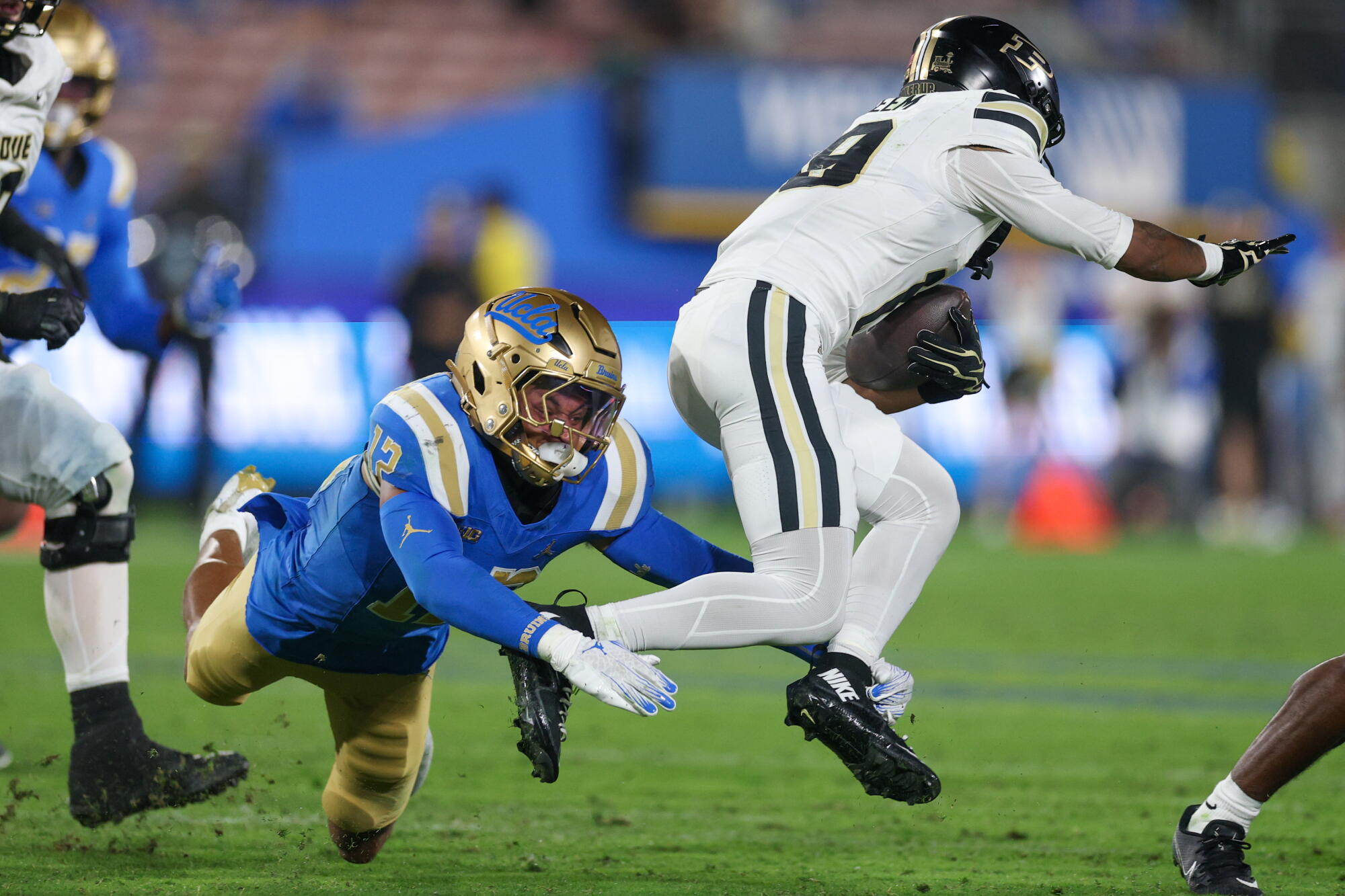
UCLA safety Malik Hartford trips Purdue receiver Asaad Waseem at the Rose Bowl on Sept. 19.
(Ronaldo Bolaños/Los Angeles Times)
“We’re going to continue to be aggressive and continue to find a way to create opportunities for our offense to get the ball in a positive field position,” Hitschler said. “But we got to be on top of our game because they will make you pay no matter who it is at quarterback. They are going to make you pay for your mistakes, and they’re going to find a way to create the explosives they always have, and we got to limit them.”
Although Oregon quarterback Dante Moore — who tallied 313 passing yards and five total touchdowns against Hitschler‘s defense in the playoff — was ruled out for Saturday because of a head injury suffered against USC on Sep. 26, the Ducks’ Dylan Raiola is not a typical backup.
He threw for 4,819 yards and 31 touchdowns in two years as Nebraska’s starter, then went 11 for 11 with three touchdown passes in his Ducks debut before stepping up with 289 yards and two touchdown passes after replacing Moore in a 41-27 win over USC at the Coliseum.
“When you watch him come in and complete that game and do what he did, there’s not a giant drop-off between the two of those guys. They’re both really, really good,” Chesney said. “Dylan obviously had a chance at the end of that USC game to really put himself in position to gain confidence in his teammates and teammates to gain confidence in him, and I thought he was on time. I thought he was accurate. He let those guys compete for footballs, and I’m sure there’s a lot of buy-in in that program right now in him.”
While Raiola is a proven passer, his impact is amplified by the weapons around him. In the backfield, Hitschler touted Dierre Hill Jr. and Jordon Davidson as the best running back duo in the country. While the Bruins have gone toe-to-toe with formidable tailbacks thus far, they have yet to face a one-two punch like Hill and Davidson, which could pose problems for an otherwise staunch run defense.
Raiola’s arsenal includes potent pass catchers, particularly the Ducks’ top two wideouts, Dakorien Moore and Evan Stewart, who have combined for 512 yards and seven touchdowns.
Chesney tabbed Stewart as a matchup “nightmare,” adding that Oregon is going to get him the ball in a multitude of ways by utilizing him in the slot and creating mismatches for Hitschler’s defense. Chesney also said that Dakorien Moore’s extreme speed allows him to take the top off the defense, and that the Ducks will not be afraid to take shots downfield, testing the Bruins’ secondary.
And if the Bruins let emotions get the best of them, like they did against Purdue — when quarterback Ryan Browne threw for 378 yards and two touchdowns — then it may be a long day for Hitschler’s secondary.
The Bruins’ biggest headache could be 6-foot-5 tight end Jamari Johnson, who caught seven passes for 159 yards against USC, particularly with all three of UCLA’s starting cornerbacks shorter than 6 feet.
“The tight end we faced last year, and he’s special. They do a really good job of getting into different personnel packages, and then if you go to a bigger group, they’re going to spread you out. They’re going to try to find a matchup with that tight end,” Chesney said. “He can catch everything in his general vicinity; he’s absolutely phenomenal.”
With an explosive Ducks offense set to perform in the friendly confines of Autzen Stadium, the Bruins trusting the playbook may be most important.
“Football is football no matter where we are,” fifth-year offensive lineman Hall Schmidt said. “We don’t have a magic potion for Oregon, but we definitely have ourselves, and we have the tools that we’re going to use.”
This is a bad time for the Chargers to see Denver. Their offense is still struggling, Justin Herbert took a beating at Seattle, and here comes that Broncos pass rush. With the exception of last week, Denver’s offense has scored on good defenses.
Peyton Manning sat in the studio and cued the video. Stafford looked off a Philadelphia safety last Sunday to hold him in place. He froze a cornerback with a glance. Then he threw an out-and-up to Puka Nacua, absorbing a big hit as he released the ball.
“That’s a lot of looking off,” Manning said.
Hall of Fame linebacker Luke Kuechly, watching from his own home studio, agreed.
“The quarterback will lie to you,” Kuechly said. “He’s going to look you off. He’s going to pump you. But the one thing that never lies to you is the route.”
Welcome to “The Breakdown,” the ESPN2 show in which Manning and Kuechly provide different perspectives from opposite sides of the ball, discussing strategy, preparation and key storylines heading into marquee NFL matchups.
This show airs on Friday at 12:30 p.m. PDT, and this week’s episode focuses on Monday night’s game between the Rams and Buffalo Bills at SoFi Stadium. The show is in its second season, and Kuechly replaces Bill Belichick, who played the defensive counterpart to Manning in Season 1.
“I’ve had lots of college coaches and pro players and high school coaches that watch this show that love it,” Manning said. “Because they want the details, but also for the casual fan to be able to understand and follow the game and maybe be entertained at the same time. It’s a delicate balance.”
Elements that Manning and Kuechly identified as critical to Monday’s game:
Stafford’s eyes. The Rams quarterback will try to move Buffalo defenders with his looks, a flick of his shoulders, a tiny pump fake. Kuechly advises defenders to watch the route.
Greg Rousseau. Kuechly identifies Buffalo’s edge rusher as the scariest player on tape, especially with his long arms that almost seem telescopic.
Allen’s ability to throw outside the numbers. The Bills quarterback has the arm strength to get the ball to any of his receivers at any time. “I would need a cutoff man to complete some of the throws he makes,” Manning said.
Quick snaps. Stafford is a master of catching the defense off guard and before it has set. It’s a look, Manning said, that some teams call “cheetah.” Kuechly said the rule for the defense should be that the play starts when the center touches the ball.
The last possession. Manning believes the last team that has the ball will be the team to win, and that the game will be back and forth the whole way.
Manning credits Kobe Bryant as the inspiration for “The Breakdown.” The late Lakers legend created a film-analysis series called “Detail,” which was designed to show the public how a professional basketball player studies game tape. It debuted in 2018 during the NBA playoffs.
Bryant then called Manning.
“He said, ‘Hey, I want you to do ‘Detail’ for football,’” Manning said. “He wanted me to take people behind the ropes in football, so that’s what I did.”
Manning did it alone at first, using only his voice to break down quarterbacks. Eventually, he brought in a defensive specialist for another perspective and they both appeared on camera.
Bryant’s concept of franchising the show across different sports gave Manning the idea to do the same with “Peyton’s Places,” thereby creating spinoffs with his brother, Eli, John McEnroe, Sue Bird and others.
Garrett Mitchell tripled and scored the tiebreaking run in the fifth inning before making a pivotal catch on Manny Machado’s drive to the wall in the eighth, and the Milwaukee Brewers advanced to the National League Championship Series for the second straight season with a 3-1 victory over the San Diego Padres on Wednesday night, winning their best-of-five Division Series in four games.
Mitchell also drove in Sal Frelick with Milwaukee’s first run as the Brewers ended their 12-game postseason road losing streak and reached the team’s fifth League Championship Series.
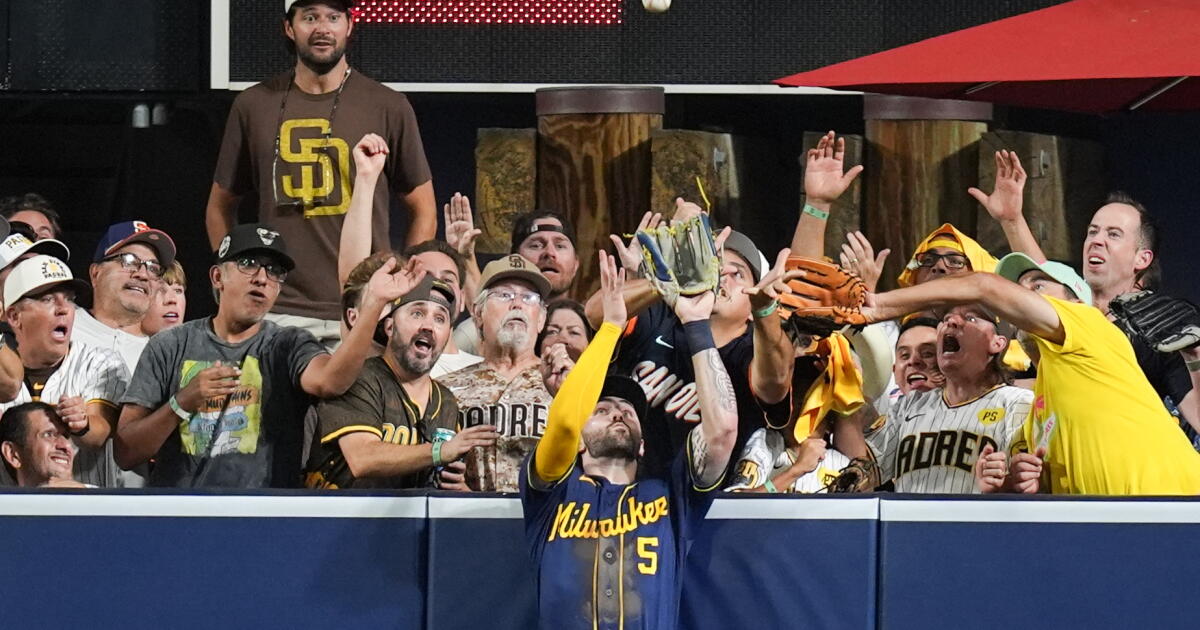
Machado nearly tied Game 4 with a 406-foot drive off reliever Abner Uribe, but Mitchell coolly tracked it down and reached just above the short wall in right-center to keep it in the yard.
Second baseman Brice Turang then ended the eighth with an acrobatic catch of Ty France’s tailing popup in foul ground.
After fending off the surging Padres in four tight games decided by a combined five runs, the 103-win Brewers will get an NLCS rematch with the Dodgers, who eliminated Atlanta on Wednesday.
The Dodgers swept Milwaukee last October on the way to their second consecutive World Series title.
Fernando Tatis Jr. hit a 429-foot homer on an otherwise tepid offensive night for the Padres, who repeatedly tested the majors’ best regular-season team before falling short of only the fourth NLCS appearance in team history.
One night after the Padres avoided elimination in Game 3, Milwaukee claimed its first road playoff win since the 2018 NLCS by sticking to its season-long formula for success.
While four Brewers pitchers combined on a three-hitter and the defense made nearly every big play, Milwaukee’s lineup calmly worked counts, pounded 10 hits through the Padres’ defense and manufactured enough runs to head home smiling.
Game 2 hero Jackson Chourio capped his high-impact series by driving in Mitchell to become the Brewers’ career leader in postseason RBIs at just 22 years old. Chourio has 17 RBIs, including six in this series, in 16 playoff games.
Milwaukee opened the scoring in the third when Frelick reached on an infield single, stole second and came around on a single by Mitchell, an Orange County native and UCLA product.
Brewers starter and former Padres draft pick Robert Gasser threw four innings of three-hit ball, but Tatis ended his 1-for-19 skid since San Diego’s playoff opener with a long shot to center in the third. It was the longest homer ever hit in the postseason at Petco Park by a San Diego player.
Padres starter Walker Buehler yielded just three hits and a run, but manager Craig Stammen replaced him with Game 1 starter Robbie Ray after William Contreras’ leadoff single in the fourth.
Mitchell then stroked a mild liner perfectly over first base and into the right-field corner leading off the fifth, and he scored on Chourio’s single through the drawn-in infield. Chourio surpassed Ryan Braun for the most postseason RBIs in Brewers history.
Jake Bauers singled leading off the sixth and went to third on Cooper Pratt’s ground-rule double before scoring on Frelick’s sacrifice fly.
The Padres were already down 3-1 in the seventh when Mason Miller allowed three baserunners, but no runs. The vaunted closer missed Game 3 for the birth of his first child.
After sitting below .500 and in 11th place in the NL in late July, San Diego roared into the first wild-card spot and then swept the Cubs in the wild-card series last week. The Padres had won 19 of 22 before losing three of four to Milwaukee.
The United Kingdom could be heading toward its most significant expansion of ground-based air defense in generations, under a plan announced by the Conservative Party. For now, however, with the Conservatives in opposition, the proposed £10 billion (about $13.3 billion) “Britannia Shield” exists only as a policy commitment rather than an approved government program. At the same time, it highlights the seriousness of U.K. military deficiencies in this area, as the threat from the air continues to grow.
The proposal will move into the U.K. Ministry of Defense acquisition system if the party returns to government following the next general election and then follows through on the funding and procurement decisions required to turn the pledge into an operational capability. The party has proposed spreading the investment over a decade, with an initial capability intended to emerge during the first term of a future Conservative government and the wider network established after that.
Britannia Shield comes with the character of the air threat facing Europe having changed dramatically over the last decade. Russia’s war in Ukraine has demonstrated the scale at which relatively inexpensive drones can be employed alongside cruise and ballistic missiles, while recent fighting in the Middle East has clearly shown the costs involved in maintaining a sophisticated, layered air defense system under sustained attack. At the same time, the threat is no longer confined to weapons fielded by major state militaries. Small, widely available drone technologies can be weaponized with relative ease by non-state actors, providing a cheap and potentially highly scalable means of attack.
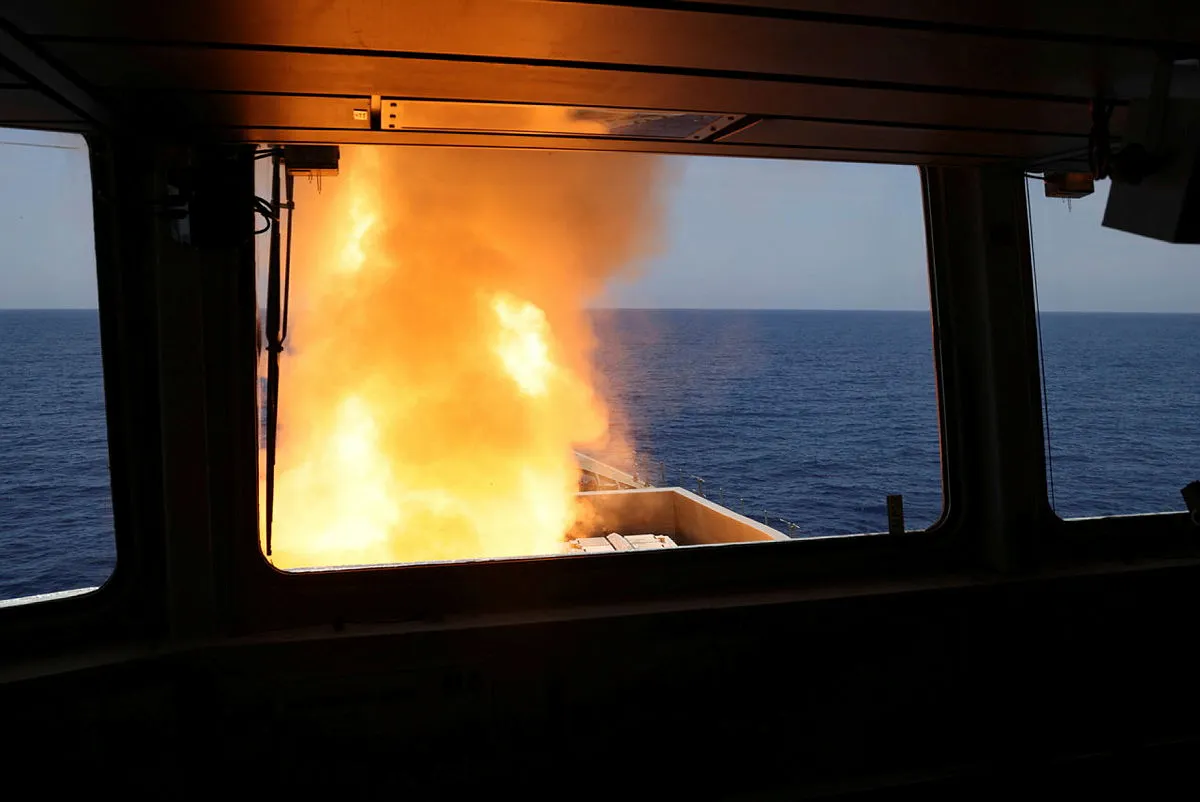
Operating in the Red Sea in 2024, the Type 45 destroyer HMS Diamond uses its Sea Viper missile system to shoot down a missile fired by the Iranian-backed Houthis from Yemen. Crown Copyright
For Britain, which has traditionally relied heavily on fighter aircraft, naval air defense, and the protection provided by geography and NATO, it is increasingly doubtful whether those capabilities provide enough coverage for the infrastructure that would be most important to keep functioning during a major conflict.
While a party press release refers to it directly, Conservative leader Kemi Badenoch has made efforts to distinguish Britannia Shield from a British version of Israel’s Iron Dome.
Iron Dome has become one of the best-known elements of Israel’s layered air defense network, having been developed primarily to deal with short-range rockets, artillery, and mortar rounds threatening populated areas. The system has evolved, however, and newer configurations can also engage threats including cruise missiles and drones. Importantly, Israel’s Iron Dome systems protect a country a twelfth of the size of United Kingdom and deal with only a portion of the potential threats in critical areas.
Iron Dome
Mention should also be made of the U.S. Golden Dome missile defense initiative, which envisions integrating sensors, interceptors, and other defensive capabilities as part of an enormous architecture with a greater emphasis on protecting the U.S. against a range of aerial and missile threats, up to and including intercontinental ballistic missiles.
Talking to the BBC, Badenoch argued that Britain does not face the same kind of persistent rocket and missile threat as Israel and therefore does not require an equivalent level of coverage. Instead, the Conservative proposal is intended to combine improved radar, command and control, interceptor missiles, and counter-drone capabilities into an integrated network designed around the threats Britain is considered most likely to face.
Britain already has some of the components that such a system could leverage. Royal Navy Type 45 destroyers — when they are available — provide a highly capable long-range air-defense layer through Sea Viper missiles, while the Army’s Sky Sabre system uses CAMM missiles for shorter-range engagements. The RAF provides combat aircraft and airborne surveillance capabilities, and Britain is integrated into NATO’s wider air and missile defense architecture. The problem is that these capabilities were not designed to provide a dense, permanent defensive umbrella over critical infrastructure, and the ground-based component in particular remains relatively limited when compared with the scale of the potential target set. There is also the reality that these assets are required to defend locales far from the British Isles themselves.
A British Army Sky Sabre battery. Crown Copyright
The government’s own 2025 Strategic Defense Review acknowledged that changing threat environment, allocating up to £1 billion in new funding for homeland air and missile defense and calling for improvements to the United Kingdom’s wider integrated air and missile defense architecture. Britannia Shield would therefore be a much larger political commitment to expanding and integrating capabilities that already exist, while adding new layers intended to deal with the growing drone and missile threat.
The £10 billion figure provides little idea of the scope of capabilities. The scale of the proposed system will determine whether that additional money represents a major expansion or simply the beginning of a much larger requirement.
Gen. Sir Richard Barrons has previously estimated that an entry-level system of the kind outlined could cost around £80 billion over a decade, illustrating how quickly the cost can rise once the requirement expands from protecting selected sites to providing something approaching comprehensive national coverage.
2/ Estimates suggest north of £80bn for the full cost of a perfect system, so we almost certainly need to think differently than a “dome” solution. A layered air defence will include a number of elements, including the ability to deter and strike back at an adversary.
Badenoch’s description of the threat instead points toward a system in which Britain would identify the infrastructure and military facilities most important to national resilience and then build increasingly dense layers of protection around them. That would include major airbases, ports, energy infrastructure, communications facilities, and other critical nodes, rather than attempting to create a continuous defensive bubble over the entire country.
RAF No. 617 Squadron F-35B jets at RAF Marham in England. Crown Copyright
Such a system would also have to account for the fact that the location of the launch platform can be as critical as the weapon itself. Badenoch described a scenario in which an adversary could operate in the English Channel to launch drones or missiles against targets in Britain. The resulting reduction in warning time would place greater demands on sensors and command systems, but it would also mean that the defensive problem could begin well before an incoming weapon reached British airspace. Maritime surveillance, intelligence collection, fighter aircraft, and naval forces could all potentially contribute to detecting or disrupting a launch platform before it had the opportunity to fire.
A Russian Kilo class submarine, its accompanying tugboat (center), and the RFA fast fleet tanker Tidesurge (background), as seen from a Merlin helicopter from 814 Naval Air Squadron. The helicopter and RFA tanker shadowed the submarine and tugboat as they sailed westward from the North Sea, through the Strait of Dover and into the English Channel in 2025. Crown Copyright
That broader approach is particularly important because the economics of countering drones are fundamentally different from those associated with conventional air defense targets. A system that responds to inexpensive drones by firing a sophisticated interceptor costing hundreds of thousands or millions of dollars would rapidly become unsustainable during a large attack. Any serious British architecture would therefore need several layers, with electronic warfare, guns, low-cost interceptors, and other counter-drone systems, potentially including directed-energy weapons, dealing with the lower end of the threat wherever possible. Meanwhile, more expensive surface-to-air missiles would be preserved for cruise missiles, aircraft and other targets that cannot be economically engaged by cheaper means.
A British Army Wolfhound armored vehicle, seen here with a mounted portable Laser Directed Energy Weapon (LDEW). This was the first high-powered laser energy weapon to be successfully fired from a British Army combat vehicle. Crown Copyright
The recent situation at RAF Fairford adds another dimension to that problem. The United States recently withdrew a dozen B-1 bombers from the Gloucestershire base amid reported concerns about a possible Iran-backed attack, after U.S. officials said commanders had received new information about a potential plot. British authorities maintained that the base was safe, while British sources reportedly questioned whether Iran could reproduce the kind of complex operation carried out by Ukraine against Russian airfields in 2025. The episode nevertheless demonstrated the degree to which even a major military installation can become a concern when an adversary is believed to be looking for unconventional ways to reach it.
A B-1B Lancer assigned to the 9th Expeditionary Bomb Squadron parks on the flightline at RAF Fairford, United Kingdom, in 2023. U.S. Air Force Photo by Senior Airman Ryan Hayman
That brings Operation Spiderweb into the discussion, although there is no public evidence that Iran is preparing a comparable operation against Britain. Ukraine’s June 2025 attack was prepared over roughly 18 months and involved small drones being moved deep into Russia inside containers carried by trucks before being launched remotely against military airfields. The operation illustrated that once relatively cheap drones have been positioned close to their targets, the defender may have little opportunity to intercept them through traditional long-range air defense means. This is exactly a scenario we have been warning of for many years.
Today, Ukrainian intelligence reportedly launched 117 attack drones from trucks that had been placed near Russian air bases. I tasked several collects this morning via @umbraspace and my first images have already started processing. What a remarkable success in a well-executed… pic.twitter.com/LzXulw8jnK
For Britannia Shield, that means protecting an airbase such as RAF Fairford cannot simply be a matter of installing missile batteries. Physical security, counter-intelligence, surveillance of access routes, low-level drone detection, electronic warfare and the ability to identify suspicious activity before an attack begins would all become part of the same defensive problem. Hardened infrastructure would also be essential, helping to protect aircraft, fuel, munitions, command facilities and other critical assets from attacks that penetrate the outer layers of the defense. The distinction is increasingly important as military aircraft themselves become more valuable and as relatively inexpensive unmanned systems demonstrate their ability to threaten aircraft on the ground without ever having to penetrate the surrounding air defense network.
The new British proposal also becomes more complicated because its intended coverage extends beyond the British mainland. Badenoch has specifically referred to defending installations in Cyprus and the Falkland Islands, which introduces a very different set of operational and logistical requirements. A network supporting critical infrastructure in Britain can draw on dense communications infrastructure, nearby industrial support and the wider NATO system, whereas a defensive capability at RAF Akrotiri or in the Falklands requires its own radar coverage, launchers, personnel, ammunition stocks, and sustainment arrangements. Extending the same architecture across those locations would therefore consume considerably more resources.
A RAF 1435 Flight Typhoon FGR4 pair flying over West Falkland island during a routine training flight. Crown Copyright
A similar problem exists with ammunition stocks. Ukraine has repeatedly demonstrated that sophisticated air defenses can come under sustained pressure during large missile and drone attacks, while Western countries have struggled to replenish some categories of precision-guided weapons at anything approaching wartime consumption rates. A British system that looks impressive on paper but has only a small stockpile of interceptors would provide much less meaningful protection during a prolonged campaign, particularly if an adversary deliberately attempted to exhaust the defenses through repeated attacks using inexpensive drones.
Ukraine also offers lessons for how Britain could organize such a network. Mobile air defense teams, distributed sensors, acoustic detection systems, and digital applications that connect air defense operators with military units and civilian spotters have all become increasingly important in Ukraine, where defenders have had to detect and respond to large numbers of drones and missiles across a wide area. There are echoes here of the distributed air defense networks developed during World War II, when observers, radar operators, fighter controllers, and anti-aircraft units were linked together to provide early warning and direct defensive responses. As in 1940, Britain would need an air defense network that is distributed, mobile, and adaptable to new threats.
A RAF Regiment light anti-aircraft gun team man their Bofors 40mm gun in a rain-sodden emplacement in southeast England, to help defend London from flying bombs in World War II. Crown Copyright
The most revealing details of Britannia Shield are yet to be provided. The number of defended sites, the types and numbers of radars, the number of launchers, the size of interceptor stocks, and the proportion of the budget devoted to counter-drone capabilities all remain unclear for now. The same applies to the money required for training, maintenance, software, communications, and replenishment across the life of the system.
There is also a straightforward political limitation to the proposal. The Conservatives have pledged to invest in Britannia Shield as part of a broader plan to increase defense spending, but that money is not currently sitting in a government procurement account waiting to be spent and defense budgets are increasingly stretched by other big-ticket programs. The Conservatives would first have to return to government, establish the program as a formal requirement, and then make the associated spending and procurement decisions. Even if those steps were taken quickly, the most capable elements of the system would take years to design, procure, integrate, and deploy.
A rendering of of the new Dreadnought class of ballistic submarines for the Royal Navy, representing the largest British defense investment of recent years. Crown Copyright
Whether £10 billion would ultimately be sufficient depends on the mission the future government assigns to the system. If Britannia Shield were expected to provide nationwide protection against sustained attacks involving ballistic missiles, cruise missiles, and large numbers of drones, the budget would fall far short, particularly once interceptor stocks and long-term sustainment are included. If it is designed as a layered network protecting a defined group of critical infrastructure sites and military bases, integrated with the RAF, Royal Navy, Army, and NATO systems already in place, the proposal becomes more realistic, but it wouldn’t address higher-end threats, like longer-range ballistic missiles.
That limitation is particularly significant when considering Russia, which remains the most serious military threat to the United Kingdom and its European allies. From what we know so far, Britannia Shield is heavily focused on drones and shorter-range missile threats, but Russia possesses a much broader strike arsenal that includes ballistic missiles, cruise missiles, and hypersonic weapons. A British air defense program that concentrates primarily on the lower and middle tiers of the threat therefore leaves a significant gap at the upper end of the spectrum.
Russian Yars intercontinental ballistic missiles travel through central Moscow during a rehearsal for the Victory Day parade in 2025. Photo by Alexander NEMENOV / AFP
The United Kingdom is also not considering this problem in isolation. Across Europe, governments are increasingly pursuing multinational efforts to strengthen air and missile defenses, as the return of large-scale state-on-state warfare and the experience of the war in Ukraine have made the vulnerability of European infrastructure and military forces much more tangible. Nearly three decades after the end of the Cold War, ballistic and cruise missile defense has once again become a central European security requirement. Britannia Shield would therefore need to be considered not only as a national counter-drone and air-defense program, but as part of a much broader European effort to rebuild layered air and missile defenses against the full range of modern threats.
The experience of Ukraine and the Middle East suggests that Britain is unlikely to solve this problem simply by buying more surface-to-air missiles. Increasingly, air warfare relies on complex networks that find the attacker, identify the weapon, choose the appropriate response, and undertake this all at a cost that can be sustained throughout a conflict. That network also has to extend beyond the airspace itself, because the threat may involve a launch platform approaching the coast, a drone operator operating near a military installation, or small drones already hidden inside the defender’s security perimeter.
Last line of defense: British Army riflemen testing a Mossberg 590M Counter SUAS shotgun (foreground) and handheld Counter-Unmanned Aerial System effectors against drones. Crown Copyright
With their proposed reorientation of Britain’s air defense priorities, the Conservatives have put a financial value and a recognizable name around a capability gap that has become increasingly difficult to ignore. If they return to government, there will be many tougher questions to address, including which sites should receive protection, how many layers are required, how much ammunition must be held in reserve, and how the system can be sustained on a wartime footing.
The recent concerns surrounding RAF Fairford, together with the lessons of Operation Spiderweb, underline why that question is becoming more complicated. The next serious attack on a British military installation may not arrive as a large formation of aircraft or a visible wave of missiles crossing the Channel. It could involve a mixture of long-range weapons, cheap drones, electronic warfare, and hybrid warfare activity taking place much closer to the target. A future Britannia Shield would have to be designed around that reality, and would come with a price tag to match.
SACRAMENTO — The Lakers pressed, switched and swarmed from the opening whistle. After the Sacramento Kings were caught for a shot-clock violation on the first possession of Monday’s preseason game, Luka Doncic raised his fists toward the Lakers bench with a triumphant grin to symbolize the successful start.
But Doncic’s smile toward his teammates had a hint of sarcasm; this is still just an exhibition.
The Lakers teased their new defensive identity in a 127-103 preseason win against the Sacramento Kings on Monday at Golden 1 Center, rolling out their deep group of wings to overcome a short-handed bench.
Playing without star center Walker Kessler, who missed the game with a finger injury, and guard Austin Reaves (ankle), Doncic led the Lakers with 21 points. He took a hard knee to the side of his quad midway through the second quarter, but stayed in the game. With the Lakers up 26 points at halftime, Doncic didn’t need to return.
The star guard actually was bringing down the team’s shooting average. While he was three-for-nine from three-point range in the first half, his teammates combined to make nine of their first 13 three-pointers. Ziaire Williams led with perfect three-for-three shooting from distance with 13 points and one steal while serving as the Lakers’ top on-ball defender. Matisse Thybulle, another key defensive offseason addition, had two steals and made two threes.
The lengthy wings could unlock a new style of defense for the Lakers, who remade their team to support Doncic with three-and-D wings and a rim-running center.
“I think for the first time since I’ve been here, we have multiple guys that go pick up the ball full court and be disruptive at the point of attack,” coach JJ Redick said before the game. “We’re going to ask those guys to do that.”
The Lakers deployed what they call “a line of confrontation.” Williams, Thybulle, second-year forward Adou Thiero and guard Quentin Grimes were among the players who guarded the ball full court. The Lakers forced four steals in the first quarter and 15 for the game. They averaged 8.5 per game last season.
The product Monday is far from what the Lakers hope to show in their regular-season opener Oct. 21 against the Golden State Warriors.
Kessler was wearing a splint on his left pinky finger after he jammed it on the backboard during practice last week. Redick doesn’t expect any of the injuries that kept Reaves, guard Collin Sexton (lower body) and two-way forward Arthur Kaluma (lower body) to be long-term.
Reaves, who tweaked his ankle in practice, still went through his pregame warmup routine Monday.
Even without two of their three top players, the Lakers overwhelmed the Kings, who are expected to be among the worst teams in the Western Conference again. Rookie point guard Darius Acuff, the No. 7 pick in last April’s draft, had 19 points with four assists and five turnovers.
Welcome back to the Times of Troy newsletter, where I, like many of you, can’t help but wonder: What’s going on with Jayden Maiava?
As USC’s quarterback kneeled out the final seconds of an unsatisfying win over Washington on Saturday, he didn’t waste any time celebrating on the field. Maiava spotted an NBC camera trained on him, turned toward the Coliseum tunnel and took off.
The camera followed Maiava and caught USC sports information director Katie Ryan sprinting to reach him. But even after Ryan caught up to the quarterback, Maiava barely broke his stride. He just kept running, the first one up the tunnel, while his Trojan teammates remained on the field.
Fight on! Are you a true Trojans fan?
Get our Times of Troy newsletter for USC insights, news and much more — exclusive to L.A. Times subscribers. Free Members receive a partial preview of each edition.
By continuing, you agree to our Terms of Service, which include arbitration and a class action waiver. You agree that we and our third-party vendors may collect and use your information, including through cookies, pixels and similar technologies, for the purposes set forth in our Privacy Policy such as personalizing your experience and ads.
It was a strange moment, after a game of strange moments for Maiava. And it certainly was not the sort of body language you want to see from your starting quarterback and team leader. Let alone after a win.
It didn’t get much better afterward, when USC trotted him out for the team’s postgame news conference. Maiava was asked about not being able to get into a rhythm. And he proceeded to answer a question that seemingly wasn’t asked.
“Just being able to trust it, fall back on routine plays,” Maiava said.
That’s not new for Maiava, who has often avoided any questions that he doesn’t want to answer by using a non sequitur football cliche. That’s his right. He’s not obligated to play ball with reporters.
USC quarterback Jayden Maiava jogs off the field without pausing for an NBC interview after the Trojans’ win over Washington at the Coliseum on Saturday.
(Ronaldo Bolanos/Los Angeles Times)
But USC has trumpeted Maiava’s progress as a vocal leader for more than a year now. And as the quarterback, he is naturally a representation of the program’s leadership and its larger culture. Which is what makes the body language of the past two weeks, as USC’s season feels on the brink, particularly concerning. Especially in context with what we’ve seen on the field.
The truth is Maiava hasn’t really looked the same since the shutout of Fresno State on Sept. 4, when he appeared to hurt his right shoulder. Maiava was asked about it the following weeks, but he said that he was “great.”
“It’s a physical game,” Maiava said. “It’s what happens.”
No one has mentioned the injury since, but Maiava has been markedly less accurate in the ensuing four games. He’s completing 60% of his passes over that time, after the first two games had him closer to 90%. Maiava’s mechanics have looked far less consistent over that stretch. And then there were the moments Saturday in which Maiava appeared tentative, like he might actually be shying away from running the ball.
During USC’s opening drive, Maiava scrambled away from pressure and had a chance to take off upfield and potentially pick up the first down with his legs. But instead he sprinted wider toward the sideline, in search of receivers who weren’t there in the corner of the end zone. He ended up getting sacked.
A couple possessions later, Maiava launched a prayer down the field off his back foot. It was intercepted and the quarterback threw his hands, fully aware the turnover was his fault.
USC’s problems certainly can’t be laid at Maiava’s feet. The quarterback has been pretty good this season by normal statistical standards. He’s ninth in the nation in passing yards per game (290) and third in total passing touchdowns (15)
But our eyes also don’t deceive us. Maybe he is hurt. Regardless, in order to actually save their season, the Trojans need Maiava to be more than just a passable Big Ten quarterback. They need him to put the team on his back.
Riley said earlier this season that Maiava has come further than any other passer he’s mentored as a college coach. But midway through his third season at USC, it’s this last step in his development that seems to be most troubling Maiava.
Patterson in the press box
USC defensive coordinator Gary Patterson walked onto the field before the Trojans played Oregon at the Coliseum on Sept. 26.
The results at least seemed palpable on Saturday. The defense was much more dialed in on third down, holding the Huskies to just a single conversion on 12 attempts. And the secondary seemed to iron out most of its communication problems.
Whether that can be attributed to Patterson being the one in the booth is impossible for me to say. The bigger question, as I see it, is why there was such a disconnect between Patterson, his scheme and the rest of the staff. Riley seemed to suggest that the way Patterson wanted to do things wasn’t clicking with the rest of the operation.
“Going through some of these first few games, seeing the makeup of the staff, it was a conversation that he and I had on Sunday,” Riley said after USC’s win over Washington. “We thought there were some reasons just kind of in our operation that made sense. He knows this defense obviously better than anyone. He was used to having, I think, a staff at TCU — if you look at his staff there, for years and years, they had little to no turnover, right? So when you had guys who had been coaching with you for 15-20 years, like he had in a lot of ways, you might handle that different. He had a heck of a defensive staff, and it’s kind of like players, right? You’re trying to just move the chess pieces to get everyone in the right position to get the best out of them.”
House of Troy ‘Chapter 3: A New Era’ episode drops this week
Ask most people from within the Trojan family when things started to unravel for USC’s football program, and they’ll inevitably point to the Reggie Bush-related NCAA sanctions as an obvious starting place.
Well, what if I told you that the mess that USC would find itself wrapped up in could’ve been so easily avoided?
At least, that’s the opinion of the key former members of New Era Sports & Entertainment, the failed sports agency that said it paid Bush and his family. Bush continues to deny allegations he violated NCAA rules. What could’ve presumably ended with one calm conversation in 2006 ended up snowballing into a yearslong saga that didn’t just upend USC football, it derailed the lives of everyone involved.
— USC’s pass rush finally played to its potential. The Trojans tallied 25 (!) pressures against Washington and sacked Demond Williams Jr. five times, which was more than its previous three games combined. The most important of those sacks came on the final drive, as Kameryn Crawford dropped Williams on a critical third down, deep in USC’s own territory. Freshman Luke Wafle also got his first college sack, after being close basically 10 other times, and he seemed relieved by that. He wasn’t the only one relieved by the pass rush production. The Trojans’ maligned secondary, in particular, was a major beneficiary.
— Rampant penalties may just be a part of this team’s identity. USC committed nine penalties against Washington and lost 94 yards, but the numbers alone didn’t tell the whole story. Half of those penalties were pretty consequential. An illegal formation call brought back a USC passing touchdown, then a face mask from Wafle kept the ensuing Washington drive moving. The Huskies ended up scoring a go-ahead touchdown. USC has at least eight penalties in three of its past four games.
— Should Desman Stephens II keep his starting job when he returns? Not because of what happened against Oregon, but because of what happened against Washington. I thought his replacement, Ta’Mere Robinson, played the best game of any linebacker at USC this season. Robinson had six defensive stops, twice as many as any other Trojan defender on Saturday. He added a sack and graded quite well in coverage by Pro Football Focus. It’s not like Stephens was playing all that well before his suspension. USC also got a strong showing from reserve linebacker Elijah Newby.
— Alex Graham is clearly essential to USC’s secondary. The Trojans’ Swiss Army knife defensive back returned from injury Saturday and made a marked difference for the whole unit. Graham had four pressures as a blitzer and has looked absolutely lethal in that role. And he played a huge part in taking away Washington’s short-area passing game, which can be dangerous if Williams is able to get loose. There’s no player more valuable on the back end of USC’s defense.
This week … in 2006
USC’s Brian Cushing blocks Sean Douglas’ punt during the Trojans’ win over Washington on Oct. 7, 2006.
(Matt Sayles / Associated Press)
For the second straight week, USC’s defense was backed up deep into its own territory in the final seconds, in danger of losing to a lesser Pac-10 team.
Washington had gotten the ball back with 1:34 remaining, trailing the Trojans, 26-20, when Husky quarterback Isaiah Stanback proceeded to march down the field on USC’s defense. Stanback scrambled to convert a fourth down with 18 seconds remaining, then completed a 19-yard pass to the USC 15.
But with two seconds left, Washington couldn’t get set in time to spike the ball. The clock ran out on their comeback attempt.
The whole experience gave linebacker Brian Cushing flashbacks of USC’s loss to Texas at the Rose Bowl.
“That last minute just got a little nerve-racking,” Cushing said.
Olympic sports spotlight
USC’s men’s water polo team was down 12-11 to California when the Trojans collected the ball with five seconds remaining in their Mountain Pacific Sports Federation opener. Somehow, they managed to win the game from there.
It started with an exclusion. Then a goal with a single tick left on the clock, sending the game to overtime.
It went to a second overtime and USC eventually put away the game 15-14 with a golden goal from Strahinja Krstic. A scintillating start to conference play.
Polling the people
Newsletter editor and poll manager Houston Mitchell is out this week, so we’re extending our poll one more week. If you have not voted, feel free to weigh in now.
Sienna Miller and Dominic West star in the new HBO series “War.”
(Justin Downing/ Sky / HBO)
I’ve been yearning for a slow-burn HBO drama since the end of “Industry’s” most recent season, and I’m optimistic that the network appears to have delivered.
“War” has that potential, at least. The first season of what is apparently an anthology series follows a high-stakes divorce case between a tech mogul played by Dominic West and a movie star played by Sienna Miller. And while it doesn’t seem to be breaking any new ground as a legal drama, the writing and acting appears to be on point — as usual with an HBO show of this magnitude.
That concludes today’s newsletter. If you have any feedback, ideas for improvement or things you’d like to see, email me at ryan.kartje@latimes.com, and follow me on X at @Ryan_Kartje. To get this newsletter in your inbox, click here.
PHILADELPHIA — It’s rarely sunny in Philadelphia for Sean McVay and the Rams.
Before Sunday’s game against the Eagles, McVay was 1-6 against them, 1-4 at Lincoln Financial Field and 0-4 against Eagles coach Nick Sirianni.
The last time the Rams visited here, the Eagles blocked a field-goal attempt and returned it for a touchdown on the final play.
And for much of the game Sunday, gloom once again engulfed McVay and a team that opened the season as a heavy Super Bowl favorite.
Share via
Gary Klein breaks down what went right for the Rams in their 24-20 comeback win over the Philadelphia Eagles.
But it finally lifted midway through the fourth quarter, with quarterback Matthew Stafford leading two touchdown drives that gave the Rams a come-from-behind, 24-20 victory.
“A lot of gutsy efforts,” McVay said, “and I have a headache from hell right now.”
No doubt stress-induced.
While McVay enjoyed watching Kyren Williams rush for two touchdowns and receiver Puka Nacua rush for another, the Rams had to overcome turnovers, penalties and special teams miscues to improve to 2-2.
After sitting out two games because of a hip injury, Nacua caught nine passes for 125 yards, several during the final two scoring drives.
“I’m excited to get on this plane and get up out of here,” Nacua said. “Hopefully, they have some Philly cheesesteaks for us.”
The Rams had mostly had their fill of Philadelphia after losing an NFC divisional game here in 2024 and last year’s debacle that ended with the blocked field goal and touchdown.
“We obviously haven’t found a way to get it done here,” McVay said, “and our guys found a way today.”
Rams players celebrate with Kyren Williams following one of his two fourth-quarter touchdowns against the Eagles on Sunday.
(Chris Szagola / Associated Press)
The Rams can thank their defense.
The Eagles were without receiver DeVonta Smith and left tackle Lane Johnson, and star running back Saquon Barkley left the game in the first quarter after suffering a hamstring injury.
The Eagles were 0 for 12 on third downs. They converted only one of four fourth downs and managed just 172 yards.
“When it was the time for us to make a play, the defense stepped up,” said edge rusher Byron Young, who had 2½ of the Rams’ four sacks, “and we had to do what we do.”
Despite their elation over Sunday’s victory, the Rams have plenty to fix.
Stafford was great down the stretch but otherwise did not look like the reigning NFL most valuable player. He completed 32 of 51 passes for 317 yards with two interceptions.
The Rams, historically one of the league’s least-penalized teams under McVay, had 13 penalties for 91 yards in last Sunday’s 30-26 defeat by the Denver Broncos. On Sunday, they were flagged eight times for 100 yards.
“Any way you could shoot yourself in the foot — we were doing it on the offensive side of the ball,” Stafford said.
Special teams also continued to be an issue. The Rams gave up a long punt return that set up a touchdown, and usually reliable kicker Harrison Mevis missed a 48-yard field-goal attempt.
But the defense kept the Rams within striking distance.
“You’d like to see [us] play as a team where you go and score, and then hold ‘em, score and hold ‘em and score,” receiver Davante Adams said. “But sometimes that’s not how it plays out.
“[The defense] did their thing to put us in a position to win it, and we went down there and finished the job.”
The Rams trailed, 20-10, at halftime, as the Eagles turned two interceptions into 10 points, and Jalen Hurts tossed two touchdown passes to receiver Darius Cooper.
After Mevis missed, it got uglier.
Near the end of the third quarter, it finally looked like the Rams’ defense would be rewarded for a good play: It stopped Hurts on a fourth-down tush push, giving the offense a first down at the Eagles’ 38-yard line.
But Nacua’s penalty for an illegal block stymied the possession, and Stafford’s fourth-down pass for tight end Tyler Higbee fell incomplete.
McVay rallied the offense on the sideline.
“He said, ‘Make things go. Wipe it. Get to the next play,’” Higbee said.
Stafford said McVay was “trying to put some belief” in the team.
“I think we had it,” Stafford said, “but it was great to hear from him.”
The defense came up big again, stopping the Eagles on downs at the Rams’ two-yard line.
On came Stafford, who ranks fourth all time in fourth-quarter comebacks.
“We call it the Mamba period,” said Williams, who rushed for 80 yards in 15 carries and had 10 receptions for 67 yards. “We knew we had to get things done. … Matthew, man, he got us all together. He said ‘Let’s freakin’ do it’ and we did the dang thing.”
Stafford engineered a nine-play, 98-yard drive that Williams finished with a one-yard touchdown run to cut the deficit to 20-17 with less than four minutes left.
Stafford got the ball back with 2:55 left at the Rams’ 21-yard line. He connected with Nacua three times and Higbee once before Williams scored on a seven-yard run with 1:10 remaining.
Rams quarterback Matthew Stafford slides after running the ball against the Eagles on Sunday.
(Matt Slocum / Associated Press)
The play included Williams’ trademark second and third efforts.
“I wasn’t looking at any defender,” Williams said. “I wasn’t looking at any blocks. I was just having that smell, that nose for the end zone.”
Next up: Josh Allen and the 3-1 Buffalo Bills, a 29-26 loser Sunday against the New England Patriots.
The Rams will go into the game a .500 team riding the high of a comeback victory rather than trying to get out of a 1-3 hole.
At some point, the Rams will welcome back edge rusher Myles Garrett, defensive lineman Aaron Donald, who sat out because of a sore back, and tight end Terrance Ferguson, who like Garrett is on injured reserve. They are still more than capable of becoming the team that was hyped throughout the offseason.
So Sunday’s victory — rather than another loss in Philadelphia — could pay dividends.
“Hopefully,” Stafford said, “it was really important come later in the year.”
Readers of the Los Angeles Times Sports section give their thoughts on USC’s loss to Oregon, and the horrific late hit, the Dodgers playoff chances and more.
PHILADELPHIA — Safety Kam Curl did not see it happen initially because he was on the Rams sideline teasing the Philadelphia Eagles about what he thought was his team’s certain victory.
Punter and holder Ethan Evans had a close-up view of the first part, but could not stop the second.
Quarterback Matthew Stafford, an 18th-year pro, said he had never witnessed a game-ending play like it.
Those were just a few of the memories from Rams players when asked about last season’s game against the Philadelphia Eagles at Lincoln Financial Field.
Minutes after the Eagles blocked a late field-goal attempt, the Rams lined up for another one on the final play. Jordan Davis of the Eagles leaped and blocked the kick, scooped the ball and returned it 61 yards for a touchdown that sent the Rams to a 33-26 defeat.
“All I heard was ‘boom, boom,’” Curl said of the kick and subsequent block, “and then I looked and it was all bad from there.”
Philadelphia Eagles defensive tackle Jordan Davis prepares to pick up a loose ball after blocked field-goal attempt against the Rams on Sept. 21, 2025.
And they arrive with several special teams units that remain a concern for a star-studded team that opened the season as the overwhelming favorite to win Super Bowl LXI at SoFi Stadium.
Not that the Rams have looked the part.
They lost their opener against the San Francisco 49ers in Australia, rebounded with a victory over the New York Giants, and last Sunday blew a 16-0 halftime lead in a 30-26 loss to the Denver Broncos in Denver.
Now they play an Eagles team coming off a 27-7 defeat by the Chicago Bears.
Late last season, coach Sean McVay fired special teams coordinator Chase Blackburn, and Ben Kotwica served as interim coordinator for the final two games. During the offseason, McVay hired Bubba Ventrone, who had coordinated special teams for the Indianapolis Colts and Cleveland Browns.
They also signed veteran long-snapper Joe Cardona and linebacker Grant Stuard, a special teams veteran.
The Rams’ field-goal unit is seemingly in a better place than it was last season.
Kicker Harrison Mevis replaced Joshua Karty several games after the debacle against the Eagles. He made 18 of 19 field-goal attempts in nine regular-season games and the playoffs, and has made four of five attempts this season, including two against the Broncos.
The Rams have improved in “that particular phase,” McVay said, “but you have to do it again” against a formidable Eagles field-goal block unit.
“That certainly is not anything we’re taking for granted,” McVay said.
On the same day the Rams lost to the Eagles last season, Ventrone was coaching for the Browns, who blocked a field-goal attempt by the Green Bay Packers with less than 30 seconds left, and then won the game with a field goal.
“It comes down to execution and playing with good fundamentals in those areas,” Ventrone said. “If we can do that, then we’ll be in a better spot.”
While the field-goal unit has mostly thrived, Evans has struggled with consistency, specifically directional placement of his kicks. On Friday, the Rams waived punt returner Xavier Smith, who fumbled in last season’s NFC championship game and made several decision-making errors against the Broncos. Alex Bachman will return punts against the Eagles, McVay said.
The kickoff coverage unit gave up a long return against the 49ers but appears to have improved.
The Rams will need solid performances from the offense, defense and special teams if they hope to defeat the Eagles for only the second time in eight games under McVay.
The Rams would be going for the second consecutive victory over the Eagles had they not blown a 19-point third-quarter lead and had two kicks blocked last season.
The Rams trailed 27-26 when they lined up for a 44-yard attempt with three seconds left.
“You knew it was going to be the last play no matter what,” Rams defensive coordinator Chris Shula said. “You weren’t going to [overtime]. I think I put my headset down.
“You put everything away and you’re like, ‘All right, here we go. This kick is going to decide my mood for this next week.’”
Evans recalled that after Davis blocked Karty’s kick, the ball went over Evans’ head. He attempted to dive on the ball, but he was hit in the back.
“By the time I got up and looked,” Evans said, “[Davis] was already in the end zone.”
The Rams aim to avoid a repeat.
Curl said the formula for success was simple. And it applied for offense, defense and special teams.
Three weeks is only a sliver of the NFL season; a backsliding team has plenty of time to correct its course.
That said, only seven teams in the Super Bowl era have rebounded from an 0-3 start to make the playoffs.
That’s a sobering statistic for the Chargers, Houston Texans and Tampa Bay Buccaneers, all winless so far. As for the 0-3 Miami Dolphins, well, that isn’t quite as shocking.
“We’re searching for every possible way to give ourselves an advantage,” said Chargers coach Jim Harbaugh, whose team lost at Buffalo last Sunday despite five takeaways and a plus-four turnover differential.
The uphill climb continues for the Chargers, who play at Seattle on Sunday, with the defending Super Bowl champions itching to respond to an upset loss at Washington in Week 3.
So far, the change at offensive coordinator to former Dolphins coach Mike McDaniel has been a bust for the Chargers. Their offense has sputtered and wheezed, even as their defense has done its part to keep them in games.
Elsewhere Sunday, the Texans play host to Dallas, Tampa Bay hosts Green Bay, and Miami plays at 3-0 Minnesota.
Of those seven teams that dug themselves out of a foreboding pit, only the 1992 San Diego Chargers turned their season around after an 0-4 start — so it’s pretty much now or never for this year’s class of Sunday strugglers.
The others to make the playoffs after losing their first three games were the 1981 New York Jets, 1982 Buccaneers, 1995 Detroit Lions, 1998 Buffalo Bills, and the Texans, who pulled off the feat in 2018 and last season… and now find themselves back in that dank basement.
“We’ve been here before,” Houston quarterback C.J. Stroud told reporters this week, “so we know we can get this thing turned around.”
For those who have made that euphoric U-turn, there are life lessons to draw upon. Chief among them, don’t panic.
Chargers coach Jim Harbaugh stands on the field before a loss to the Buffalo Bills on Sept. 27.
(Bryan M. Bennett / Getty Images)
Former Lions linebacker Stephen Boyd recalls the composure and calm of Detroit coach Wayne Fontes, after three losses to Pittsburgh, Minnesota and Arizona — two of those by a field goal.
After the third loss, Boyd said, “Wayne Fontes walks into the meeting room with a big smile on his face and says, `Listen, here’s the deal, we’re going to give the ball to Barry [Sanders] a little bit more, and we’re going to get this turned around.’”
Sure enough, the Lions broke through the following week with a win over San Francisco on Monday night. But there were more bumps in the road for Detroit, which by November was still a dismal 3-6. Few could have predicted the club would win its final seven games.
That set the stage for a strange wild-card game against Philadelphia in which the Eagles built a 51-7 lead and held on despite the Lions scoring 30 points down the stretch. The final score: 58-37.
Three years before Fontes kept his cool under pressure, Chargers coach Bobby Ross did the same.
“There were a lot of grumblings that this was just some college coach that didn’t know what he was doing in the pros,” recalled former Chargers linebacker Gary Plummer of Ross, hired out of Georgia Tech. “There were a lot of guys that were essentially jumping off the ship.”
That team held a players-only meeting after falling to 0-3… then got clobbered, 27-0, by the Houston Oilers in Week 4.
Ross held steady, though.
“He told us that he wasn’t changing,” Plummer said. “We were still going to have physical practices. He said that was the only way he knew how to coach.”
The Chargers responded by winning four in a row. Then, after a hard-fought, two-point loss to Kansas City, the Chargers tore off another seven wins.
Defense led the way for those Chargers, allowing just 241 points that season, the fourth-fewest in the NFL.
So far this season, these Chargers are showing similar tendencies. Last Sunday, the defense played a gem of a game, and certainly through three quarters.
Hope still has a heartbeat, but that grows fainter by the loss.
The Democratic National Committee on Thursday filed a lawsuit alleging that President Trump’s administration secretly changed a postcard used by U.S. citizens overseas in a way that makes it harder to register to vote.
The lawsuit contends that the Department of Defense made the change by declaring an emergency, which allowed it to eliminate a specific box on the form. That box is typically checked by potential voters who acknowledge they are U.S. citizens but who have never lived in the United States.
They are usually the children of U.S. citizens, and 38 states allow them to cast ballots provided they have close family connections. Since 2013, the box has appeared on postcards sent to overseas voters.
Republicans have filed lawsuits in multiple states trying to prevent those voters, who typically support Democrats, from casting ballots. Thursday’s lawsuit contends that the administration simply made the change on its own without giving proper notice.
“These American citizens pay U.S. federal and state taxes, but now a years-old plan has culminated in a manufactured ‘emergency’ to justify impeding their right to vote in American elections and potentially disenfranchising them entirely,” the lawsuit states.
The Department of Defense, which administers the form, did not immediately respond to a request for comment.
The number of Americans overseas who have never lived in the United States yet cast ballots in the country was estimated at about 11,500 in 2016. The lawsuit contends the number has likely grown.
Some are already registered and are due to receive ballots for November. Others can opt to check other boxes saying they’re citizens who either intend to return to the U.S. or do not intend to return in order to receive ballots.
The move follows Secretary of Defense Pete Hegseth urging members of the military to cast ballots en masse, implying they could out-vote Democratic jurisdictions, such as Detroit, if they all cast ballots. The same federal law that lets members of the military who live overseas cast ballots also requires that civilians who live overseas be given the same opportunity.
But as Democratic-leaning civilians overseas have out-voted Republican-leaning members of the military in recent years, the GOP hasstarted to target the law, known as the Uniformed and Overseas Citizens Absentee Voting Act, or UOCAVA. Republicans were able to win a court case forbidding the votes of overseas citizens who have never lived in North Carolina from being counted there, but have not yet succeeded in lawsuits in other states, including swing state Michigan.
Susan Dzieduszycka-Suinat is a U.S. citizen in Munich whose 28-year-old daughter also is a U.S. citizen who has never resided in the country but votes regularly. She said the administration’s move was alarming.
“If this works in slicing off a piece of the electorate,” said Dzieduszycka-Suinat, who is president of the U.S. Vote Foundation, “wait until the next emergency.”
Riccardi writes for the Associated Press. AP writer Konstantin Toropin in Washington contributed to this report.