April 13 (UPI) — The U.S. military said it will begin blocking all ships from leaving or entering Iran’s ports on Monday morning in line with a maritime blockade ordered by U.S. President Donald Trump to cut off Iranian oil exports.
U.S. Central Command said in a news release Sunday that the blockade would be enforced equitably against vessels of all nations sailing to or from Iranian ports, including all those on the Persian Gulf and Gulf of Oman, but stressed vessels serving ports in neighboring countries would be left alone.
“CENTCOM forces will not impede freedom of navigation for vessels transiting the Strait of Hormuz to and from non-Iranian ports,” said the news release, which instructs the masters of all ships to monitor “Notice to Mariners” broadcasts and make radio contact with U.S. naval forces on bridge-to-bridge channels in Gulf of Oman and Strait of Hormuz approaches.
The blockade would effectively cut off Iran’s international trade by preventing it from importing or exporting anything by sea, in particular its energy exports on which it is reliant for hard currency.
Further details would be communicated in a formal notice that would be provided to commercial ships and operators prior to the start of the blockade, due to come into force at 10 a.m. EDT, CENTCOM said.
The statement clarified comments by Trump early Sunday in which he appeared to announce a total blockade of the Strait of Hormuz in response to the failure of peace talks in Pakistan at the weekend.
Trump had said the U.S. Navy “will begin the process of BLOCKADING any and all Ships trying to enter, or leave, the Strait of Hormuz.”
On Saturday, CENTCOM announced that the U.S. Navy guided-missile destroyers USS Frank E. Peterson USS Michael Murphy had transited the Strait of Hormuz and operated in the Persian Gulf, preparatory to clearing Iranian mines and reopening the shipping route to commercial vessels.
Tehran responded to the development with unspecified threats against the ports of its neighbors and raised the specter of widening the conflict to the Red Sea, the other sea passage in the region that is critical to the global economy.
“Security in the Persian Gulf and the Sea of Oman is either for everyone or for NO ONE. If Iran’s ports are threatened, NO PORT in the region will be safe,” the Iranian military’s central command said in a statement carried by state-run broadcaster IRIB.
“Naval blockade of Iran? Bab al-mandeb Coming soon?!,” IRIB said earlier in a post referencing the narrow strait at the southern entrance to the Red Sea, which leads to the Suez Canal, where Iran-backed Houthi rebels attacked around 100 commercial ships November 2023 through September 2025.
Oil prices rose in response to the developments while stock markets retreated.
The benchmark Brent crude and West Texas Intermediate both climbed back above $100 a barrel with the Brent contract for June delivery changing hands at $102.31 per barrel in mid-morning trade in London while the WTI contract for May was trading at $104.44.
The FTSE 100 in London was down 0.33%, the DAX in Frankfurt fell almost 1.2% and France’s CAC 40 was off by almost 1%.
Former U.S. special envoy to the region David Satterfield expressed concerns over the blockade, warning that if shipping continued to be affected current supply disruption would widen beyond oil, with serious implications for Gulf countries’ exports of many other critical materials from aluminum and helium to polymers and fertilizer feed stocks.
“The Gulf is a critical global supply point, far beyond hydrocarbons — and the impact if this goes on for several more weeks is going to become quite profound, beyond just the cost of petrol and diesel at the pump,” Satterfield told the BBC.
Secretary of Defense Pete Hegseth speaks during a press briefing at the Pentagon on Wednesday. Yesterday, the United States and Iran agreed to a two-week ceasefire, with the U.S. suspending bombing in Iran for two weeks if the country reopens the Straight of Hormuz. Photo by Bonnie Cash/UPI | License Photo
Welcome back to the Times of Troy newsletter, where it’s officially team-building season across college basketball. It’s a critical time for any program in the transfer portal era. But for Eric Musselman and USC this April, it’s especially paramount.
The last two springs, Musselman has had to rebuild USC’s entire roster essentially from scratch. The coach’s first two teams each had just one carryover from the previous year. Two years ago, just as USC was joining the Big Ten, Musselman had to make over the roster in May … a month after everyone else. Then last spring, he lost his top two scorers (Desmond Claude and Wesley Yates) somewhat unexpectedly — one on the very last day of the portal.
Fight on! Are you a true Trojans fan?
Get our Times of Troy newsletter for USC insights, news and much more.
By continuing, you agree to our Terms of Service, which include arbitration and a class action waiver. You agree that we and our third-party vendors may collect and use your information, including through cookies, pixels and similar technologies, for the purposes set forth in our Privacy Policy such as personalizing your experience and ads.
This offseason, Musselman is starting from a more stable place. USC announced last week that guard Rodney Rice, who was expected to be USC’s best player a year ago, will return next season. He’s a future NBA player. Forward Jacob Cofie should be back after dipping his toes in the NBA draft waters, along with 7-foot-5 center Gabe Dynes. Then there are three top-25 recruits on the way in Darius and Adonis Ratliff and Christian Collins.
It’s looking more and more likely, too, that Alijah Arenas will buck his long-standing plans to declare for the draft and return to college. Whether that would be at USC or somewhere else, however, remains to be seen.
Whatever happens, there is at least a semblance of a nucleus for USC to build around this spring. Which is fortunate for Musselman, given there will be less means to lure players from the portal.
At this time last year, NIL spending had yet to be capped. So Musselman and his staff were given a significant chunk of change to work with, a number nearing eight figures. And they used it to pay up for the likes of not just Rice, Chad Baker-Mazara and Ezra Ausar, but also reserves such as Dynes, Jordan Marsh and Ryan Cornish. The reasoning was to pay a bit above-market to build the team Musselman wanted, to take advantage of their limited window with Arenas, who they hoped would be a program catalyst.
The return on that investment was … less than stellar. Arenas got into a car accident, then had knee surgery, and didn’t play until January. Baker-Mazara, the highest-paid player on the roster, was dismissed from the team before the end of the season. Everything that could go wrong went wrong. But also, many of the bets USC made went belly-up.
This time, the budget won’t be quite as bottomless, both because of NIL restrictions and as a matter of course correction. The approach will have to be more conservative, more targeted. Considering the portal isn’t getting any cheaper, with most starters now going for north of $1 million, it’ll be on Musselman to use his funds expeditiously.
That means, presumably, much less spending on the middle of the roster. It’s part of why Amarion Dickerson isn’t returning, even though USC would’ve presumably welcomed him back. There’s no room to spend up on a sixth man at the moment. Especially one who sat out most of last season.
A lot of basketball programs are reckoning with those realities now that spending is, in some sense, more capped. But many of those programs have a general manager handling those matters. At USC, that’s Musselman. He’s the coach and GM.
He prefers it that way. But it also adds an extra layer of pressure ahead of next season.
Musselman has proven himself plenty capable of building a basketball team. His first serious job in the sport was as general manager of the Rapid City Thrillers in the now-defunct CBA. He built that team into a juggernaut in his early 20’s.
Musselman won’t be able to do that at USC in just a single transfer portal window. But the moves USC makes over the coming weeks should tell us plenty about how much he learned from the last one.
Baseball bounces back
USC pitcher Mason Edwards.
(Shotgun Spratling / For The Times)
After a historically strong start to this season, the Trojans suddenly found themselves in a four-game slump heading into the weekend. But the slide was stopped dead by USC’s ace pitcher, Mason Edwards.
In one of college baseball’s more dominant pitching efforts this season, Edwards struck out 16 of the 30 Iowa batters he faced Friday. Twelve of those 16 came on swinging strikes. Through eight innings, Edwards gave up just one hit before Iowa finally chased him in the ninth.
Thanks to its stellar rotation, USC walked away with a sweep over Iowa, right when it needed one most. Awaiting the Trojans on the road next weekend is Nebraska, which has lost just two Big Ten games this season and just one of its 16 home games.
USC top recruit Saniyah Hall during the final match of the U19 FIBA Women’s Basketball World Cup last summer.
(Lukas Kabon / Anadolu via Getty Images)
—USC has officially hit the $200 million fundraising mark for its Athletics West capital project. That means at least $25 million has been raised since the start of last football season, which is quite a bit to ask of your big-time donors. But what’s maybe more impressive is that during that same stretch, USC also managed to increase the size of the Trojan Victory Fund by more than 770%, according to athletic director Jennifer Cohen. Those extra funds are how USC is managing to stay afloat in this new era where money matters more than ever. The question is whether it can keep up the pace for the foreseeable future.
—The future of USC women’s basketball was on display at the Nike Hoop Summit. A trio of incoming Trojans were featured in Portland last weekend, headlined by No. 1 overall recruit Saniyah Hall, who continues to look like a Day 1 difference-maker on both ends. She led all scorers with 19, while also adding eight rebounds and four steals. Sitaya Fagan and Sara Okeke both suited up for the World team, and Fagan, in particular, impressed with her work in the paint. She got to the line early and often and ended up leading the World team with 15 points.
—The USC women are losing five players to the transfer portal. None of the five — Vivian Iwuchukwu, Gerda Raulusaityte, Yakiya Milton, Dayana Mendes and Malia Samuels — would’ve made much of an impact in a much deeper rotation next season. Samuels played the most of the five last year, but struggled in a reserve point guard role. The Women of Troy will need some reinforcements from the transfer portal, but any additions will be more about padding the rotation instead of finding starters.
—National title-winning Michigan coach Dusty May got his start in college basketball as a USC video coordinator. A quarter-century before May led the Wolverines to a championship, he was a part of the 2001 Trojans team that went to the Elite Eight. Henry Bibby gave May a job on the blind recommendation of two Indiana assistant coaches, who were impressed with his time as an Indiana student manager. He broke down film during the season and ran camps during the summer. In between, he helped out with day-to-day operations. May worked under Bibby through the 2002 season, when legendary Hoosiers coach Bob Knight hired him to do the same job in Bloomington.
Olympic sports spotlight
A hat tip to Times of Troy reader, Craig Schrager, who noted that I’d made no mention recently of USC’s top-ranked women’s water polo team, which had won a dozen matches in a row heading into Sunday’s MPSF tournament final against No. 2 Stanford.
The Trojans looked on their way to a 13th straight win and an MPSF tournament title before the fourth quarter of Sunday’s final. Entering the last quarter with a lead, USC gave up six goals in the final minutes and only responded with two in return, costing them what should’ve been their first MPSF title since 2021.
In spite of the loss, USC should be one of the leading contenders for an NCAA title, when the tournament begins on April 24.
What I’m watching this week
Hannah Einbinder, left, and Jean Smart in “Hacks” season 4.
(HBO Max)
It’s rare these days that a hit show calls it quits at the right time. More often than not, they hang on too long, wringing out every possible drop of content and damaging the show’s legacy in the process.
“Hacks” is a rare exception. I wasn’t sure at the time how this HBO comedy would do a second season, let alone a fifth. But it has proven me wrong at every step. Jean Smart only seems to get better with age, while this show has managed to re-invent itself on multiple occasions. Its final season follows Smart, again as comedian Deborah Vance, as she’s found herself legally unable to perform after breaking her late-night host contract. And somehow, it’s just as funny as ever.
Until next time …
That concludes today’s newsletter. If you have any feedback, ideas for improvement or things you’d like to see, email me at ryan.kartje@latimes.com, and follow me on X at @Ryan_Kartje. To get this newsletter in your inbox, click here.
President Donald Trump on Sunday said that the U.S. Navy would block the Strait of Hormuz to prevent Iranian ships from transiting it unless Iran opens the Strait and agrees to a peace deal with the United States. File Photo by Ali Haider/EPA-EFE
April 12 (UPI) — President Donald Trump on Sunday said the U.S. Navy will block the Strait of Hormuz to cut off Iran’s shipping lanes after peace talks in Pakistan failed to produce a deal.
Vice President J.D. Vance, who Trump sent to negotiate a deal to end the U.S.-Israeli war in Iran, said Saturday that the talks were not successful because the two sides cannot agree on what to do about the Iranian nuclear stockpile and who will control the Strait, CNN and The Washington Post reported.
Trump told Fox News’ Maria Bartiromo that the United States was going to block the Strait — it will “take a little while, but it’ll be effective pretty soon,” he said — and that nations in the Gulf region have agreed to help in the effort.
The blockade, he said, will prevent “any and all ships” from entering or leaving the the waterway, including vessels belonging to Iran, which have been shipping its oil to other countries and reportedly been bringing weapons parts from China to the Middle Eastern nation.
Vance told reporters early Sunday morning that while Iran had not yet accepted the United States’ “final and best offer,” he expressed optimism that a deal can be reached.
“We just could not get to a situation where the Iranians were willing to accept our terms,” Vance said. “I think that we were quite flexible.”
In a post on X, Mohammad Bagher Ghalibaf, who is Iran’s leading negotiator in the talks, said that he and his colleagues had “raised forward looking initiatives, but the opposing side ultimately failed to gain the trust of the Iranian delegation in this round of negotiations.”
“Before the negotiations, I emphasized that we have the necessary good faith and will, but due to the experiences of the two previous wars, we have no trust in the opposing side,” he said.
Secretary of Defense Pete Hegseth speaks during a press briefing at the Pentagon on Wednesday. Yesterday, the United States and Iran agreed to a two-week ceasefire, with the U.S. suspending bombing in Iran for two weeks if the country reopens the Straight of Hormuz. Photo by Bonnie Cash/UPI | License Photo
A U.S. Air Force B-2 Spirit stealth bomber is pictured in 2025 as it takes off on a combat mission from Diego Garcia, which is located in the Chagos Islands and is considered British Indian Ocean Territory. Britain has abandoned a deal to return the islands to Mauritius after the United States withdrew its support over concerns about the military base there. Photo by Tech. Sgt. Anthony Hetlage/U.S. Air Force
April 11 (UPI) — After an about-face by the Trump administration, Britain said it is pausing a plan to transfer ownership of the Chagos Islands to Mauritius because it cannot complete the deal without U.S. support.
Britain on Friday said it is abandoning a deal to return sovereignty to the islands, which would have permitted the both countries to continue using the military base in Deigo Garcia they have operated since the 1970s, because there is not enough time for the U.K.’s parliament to pass a legislation on it, The Guardian reported.
The islands have been controlled by Britain since the 1800s, though in 1968 it granted independence to Maritius — which it also had controlled — but kept possession of the Chagos Islands.
President Donald Trump had in 2024 offered support for Britain to return the islands in return for continued use of the base, which includes billions in annual payments for doing so.
Trump withdrew his support for the deal earlier this year, calling it a “great act of stupidity,” less than a year after Secretary of State Marco Rubio and the Trump administration called the deal an “historic” achievement, at least partially because it kept the Diego Garcia base in use.
The change in opinion came, however, weeks before the United States and Israel started the war in Iran at the end of February because, he said at the time, the U.S. military may need to use the Diego Garcia base, The Hill reported.
“The U.K. had two objectives, one was to comply with international law, the second was to reinforce the relationship with the United States,” Simon McDonald, a former permanent secretary in Britain’s Foreign Office.
“When the president of the United States is openly hostile, the government has to rethink, so this agreement, this treaty, will go into the deep freeze for the time being,” McDonald said.
The deal to return the islands to Maritius stems from an overall effort by Britain to reckon with its colonialist history, as well as a 2019 international court decision that said it had acted illegally by separating the Chagos from Maritius in the 1960s.
The military base on Diego Garcia, which dates to a 1966 treaty between Britain and the United States — which the two countries cleared people living in the area from in order to construct it — was to give the two nations a 99-year lease to continue operating the base.
While the Trump initially supported the deal, it has long been controversial in Britain, with Kemi Badenoch, leader of Britain’s Conservative Party, said it took too long for the current U.K. government to give up on it.
Badenoch said the government had dragged its feet on dropping the deal, calling it a “damning indictment of a prime minister, who fought to hand over British sovereign territory and pay $47 million to use a crucial military base which was already ours.”
Secretary of Defense Pete Hegseth speaks during a press briefing at the Pentagon on Wednesday. Yesterday, the United States and Iran agreed to a two-week ceasefire, with the U.S. suspending bombing in Iran for two weeks if the country reopens the Straight of Hormuz. Photo by Bonnie Cash/UPI | License Photo
1 of 2 | Vice President JD Vance shakes hands with Pakistani Prime Minister Shehbaz Sharif during a meeting, in Islamabad, Pakistan, Saturday. Delegations from the United States and Iran are meeting in Pakistan Saturday to discuss ending the war in Iran. Photo by the Pakistan Foreign Ministry/EPA
April 11 (UPI) — Talks between the United States and Iran began Saturday morning between the two delegations in Islamabad, Pakistan.
Vice President JD Vance arrived at 10:30 a.m. PKT. At Nur Khan air base, Vance walked down a red carpet and met with Pakistani Prime Minister Shehbaz Sharif. Sharif said Friday that the United States is at a “make or break” moment in a national address Friday.
It’s not clear if the talks are direct or indirect, but CNN reported the talks are a mixture of both.
Though there was heavy security, with road closures and checkpoints, the mood in Pakistan was jubilant, The Washington Post reported.
Both sides have repeatedly accused the other of violating the fragile cease-fire that began last week. The United States has said Iran is violating the agreement because the Strait of Hormuz is not open. Only two ships passed through it on Friday, The New York Times reported. Iran is angry that Israel continues to attack Lebanon, though Israel and the United States say they never agreed to stop fighting in Lebanon.
Israel has hit more than 200 targets in Lebanon affiliated with Hezbollah in the past 24 hours, The Times reported the Israeli military said.
Iran can’t find all the mines it set in the strait, The Times reported that U.S. officials said Friday, causing a snarl in Iran’s ability to comply with American demands.
Saturday morning, President Donald Trump posted on Truth Social that the United States is “clearing out” the strait.
“We’re now starting the process of clearing out the Strait of Hormuz as a favor to Countries all over the World, including China, Japan, South Korea, France, Germany, and many others. Incredibly, they don’t have the Courage or Will to do this work themselves. Very interestingly, however, empty Oil carrying ships from many Nations are all heading to the United States of America to LOAD UP with Oil.”
He didn’t clarify what “clearing out” of the strait means.
On Friday, he said that Iranians must negotiate.
“The Iranians don’t seem to realize they have no cards, other than a short term extortion of the World by using International Waterways. The only reason they are alive today is to negotiate!” Trump said in a Truth Social post.
The U.S. delegation includes envoy Steve Witkoff and Trump’s son-in-law Jared Kushner. The Iranian side has more than a dozen senior officials, including Iranian Parliament Speaker Mohammad Bagher Ghalibaf and Iranian Foreign Minister Abbas Araghchi, along with senior security officials and Iran’s central bank governor, The Post reported.
Both sides seem motivated to see the war come to an end, but they remain at odds on several issues. Control of the Strait of Hormuz, war reparations, Iran’s enriched uranium and withdrawal of the U.S. military in the region are some of the sticking points.
April 10 (UPI) — A federal judge has again ordered the Pentagon to restore access to credentialed journalists, ruling the Trump administration was attempting to flout his previous order by disguising it as an interim rule.
“The Department cannot simply reinstate an unlawful policy under the guise of taking ‘new’ action and expect the court to look the other way,” U.S. District Judge Paul Friedman said in his Thursday ruling, obtained by Courthouse News.
The Department of Defense has said it intends to appeal.
The ruling comes in a case filed by The New York Times challenging a policy instituted by the Department of Defense in October requiring all journalists with access to the Pentagon to sign a form acknowledging they could have their credentials revoked for collecting unauthorized information.
Most Pentagon reporters declined and surrendered their credentials.
Last month, Friedman ruled the policy was unconstitutional and ordered the Pentagon to reinstate the credentials of seven journalists with The Times.
As the Defense Department said it planned to appeal the ruling, it unveiled a new revised policy that moved their office space outside the Pentagon building and required credentialed journalists to be escorted by Defense personnel at all times within it.
The Times again challenged the new, revised rule, accusing it of being a Trump administration attempt to defy Friedman’s order.
Friedman on Thursday agreed, finding that instead of returning the credentials to the Times’ journalists and restoring their access to the Pentagon, the Trump administration instead cut off access to all journalists.
“The court cannot conclude this opinion without noting once again what this case is really about: the attempt by the secretary of defense to dictate the information received by the American people, to control the message so that the public hears and sees only what the secretary and the Trump administration want them to hear and see,” Friedman, an appointee of President Bill Clinton, wrote in the 20-page ruling.
“The Constitution demands better. The American public demands better, too.”
After the court rejected the Pentagon’s attempt to restrict the First Amendment freedoms of The Times’ reporters, it invoked a new policy with only slightly different language from the one that was struck down in order to achieve the same unconstitutional end, he said.
“The curtailment of First Amendment rights is dangerous at any time, and even more so in a time of war,” Friedman said. “Suppression of political speech is the mark of an autocracy, not a democracy — as the framers recognized when they drafted the First Amendment.”
Charlie Stadtlander, a spokesperson for The Times, cheered Thursday’s ruling, saying it upholds the paper’s constitutional rights while sending a clear message to the Pentagon.
“Compliance with a lawful order of a court is not optional; it is required in a democracy committed to the rule of law,” Stadtlander said in a statement.
“We are pleased that Judge Friedman saw the revised policy issued by the Pentagon after his last decision for what it was: a poorly disguised attempt to continue to violate the constitutional rights of The Times and its journalists.”
In announcing the Pentagon’s intention to appeal, Sean Parnell, assistant to the secretary of defense for public affairs, argued that they have at all times complied with the court’s original order, saying the revised policy addressed all concerns raised in Friedman’s March 20 opinion.
“The department remains committed to press access at the Pentagon while fulfilling its statutory obligation to ensure the safe and secure operation of the Pentagon Reservation,” he said in a statement.
The Trump administration has been repeatedly accused by critics of taking actions aimed at influencing media coverage, from the October memorandum concerning Pentagon reporters to restricting access to outlets over editorial decisions and seizing control of the White House press pool.
Secretary of Defense Pete Hegseth speaks during a press briefing at the Pentagon on Wednesday. Yesterday, the United States and Iran agreed to a two-week ceasefire, with the U.S. suspending bombing in Iran for two weeks if the country reopens the Straight of Hormuz. Photo by Bonnie Cash/UPI | License Photo
Pakistan has emerged as a key mediator in ceasefire talks between the United States, Iran and Israel, hosting negotiations in Islamabad. The announcement of the initial ceasefire by Shehbaz Sharif signaled Islamabad’s unexpected diplomatic centrality in a high stakes conflict.
This role is not incidental. It reflects Pakistan’s long standing regional ties, security concerns, and strategic positioning between major global and regional powers.
Historical Leverage with Iran Pakistan’s mediation draws on decades of close ties with Iran, shaped by shared borders, religious linkages, and past strategic cooperation. Since 1947, both states have supported each other in regional disputes, creating a baseline of trust that allows Islamabad to act as a credible interlocutor.
Despite occasional tensions, Iran continues to view Pakistan as a state willing to engage without overt hostility, making dialogue politically feasible.
Security Driven Diplomacy Pakistan’s involvement is rooted in hard security calculations. Instability in Iran could spill over into Balochistan, where separatist movements already challenge state authority. A fragmented Iran risks amplifying cross border militancy and separatist narratives.
Additionally, Pakistan’s status as a nuclear power makes regional de escalation a priority, as prolonged conflict increases the risk of external pressure on its own strategic assets.
Military Influence and US Access The central role of the military, particularly Asim Munir, has strengthened Pakistan’s credibility with Donald Trump. Direct engagement between military leadership and Washington has enabled Islamabad to maintain influence within US strategic circles.
This relationship enhances Pakistan’s ability to act as a bridge, especially under an administration that values strong security partnerships.
Emerging Strategic Alignments Pakistan’s deepening ties with Saudi Arabia and parallel coordination with the United States suggest the emergence of a loose strategic alignment. At the same time, Islamabad maintains close relations with China, which has a vested interest in Gulf stability due to energy dependence.
This dual alignment uniquely positions Pakistan as a mediator acceptable to multiple competing blocs.
Implications Pakistan’s role signals a shift in regional diplomacy, where mid tier powers can leverage geography and relationships to shape major geopolitical outcomes. Successful mediation could elevate Pakistan’s global standing, while failure risks exposing its strategic vulnerabilities.
The talks also highlight how regional conflicts are increasingly multi layered, involving overlapping alliances and competing security priorities.
Analysis Pakistan is not acting as a neutral peace broker but as a strategic actor pursuing its own stability. By engaging all sides, it reduces the risk of regional spillover while enhancing its diplomatic relevance.
Its ability to maintain simultaneous ties with Washington, Tehran, Riyadh and Beijing gives it rare flexibility. However, this balancing act is inherently fragile. Any perceived bias could undermine trust and derail negotiations.
Ultimately, Pakistan’s mediation reflects a broader geopolitical reality: influence in today’s conflicts belongs not only to superpowers, but to states that can navigate between them.
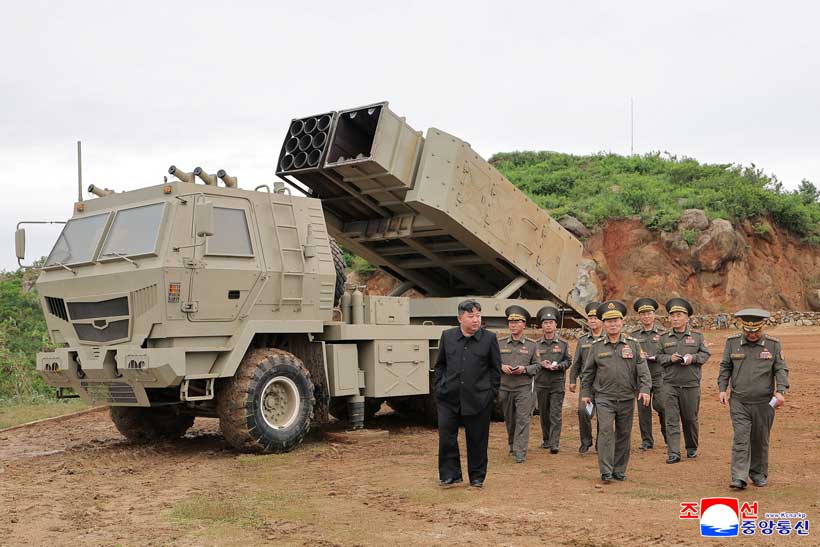
North Korea said Thursday it conducted a series of weapons tests this week, including missiles tipped with a cluster-bomb warhead and electronic warfare systems. This January file photo shows the North’s test-fire of a multiple-rocket launcher system. File Photo by KCNA/EPA
SEOUL, April 9 (UPI) — North Korea said Thursday that it carried out a series of weapons tests this week, including a tactical ballistic missile with a cluster-bomb warhead as well as electromagnetic and other electronic warfare systems.
The tests, conducted from Monday to Wednesday, were part of efforts to assess the performance and battlefield use of several new weapons systems, the North’s official Korean Central News Agency said.
KCNA said that its surface-to-surface Hwasong-11Ka missile was tested with a cluster-bomb payload capable of striking targets over a wide area, claiming it could “reduce to ashes” targets spanning roughly 16 to 17.2 acres.
The Hwasong-11 missile, also known as the KN-23, is a highly maneuverable short-range ballistic missile similar to Russia’s Iskander.
The report came one day after South Korea’s Joint Chiefs of Staff said it detected multiple missile launches on Wednesday from the coastal Wonsan area toward the East Sea. The military also reported the launch of an unidentified projectile from the Pyongyang area on Tuesday.
In addition to the missile tests, North Korea said it conducted trials of an electromagnetic weapon system and carbon-fiber bombs, as well as a mobile short-range anti-aircraft missile system.
The tests were overseen by Kim Jong Sik, a senior official involved in the North’s missile development programs.
Kim said the electromagnetic weapon and carbon-fiber bomb are “special assets of strategic nature” that can be combined with various military systems.
Carbon-fiber bombs — also known as graphite bombs— are designed to disable electrical grids by dispersing fine conductive filaments to short-circuit power infrastructure, causing widespread outages without physical destruction.
Electromagnetic weapons, meanwhile, emit high-energy pulses that can disrupt or damage electronic systems, including communications networks, radar and computing infrastructure.
KCNA also said engineers conducted a test to measure the “maximum workload” of a missile engine using low-cost materials.
The reported mix of electronic weapons systems and cost-efficient production methods points to ongoing efforts to modernize and expand the North’s hybrid warfare capabilities.
The tests came after South Korean President Lee Jae Myung on Monday expressed regret over unauthorized drone incursions into the North.
His remarks drew a rare response from Pyongyang, as Kim Yo Jong, the influential sister of leader Kim Jong Un, described Lee as “frank and broad-minded.”
Seoul’s Unification Ministry called the exchange a positive signal, saying it represented “meaningful progress toward peaceful coexistence on the Korean Peninsula.”
North Korea’s first vice foreign minister, Jang Kum Chol, later rejected that interpretation, calling it a “hope-filled dream reading” and insisting the South remains “the enemy state most hostile to the DPRK.”
The Democratic People’s Republic of Korea is the official name of North Korea.
A South Korean military official said the allies are continuing to track developments in the North’s weapons programs.
“We maintain the ability and readiness to overwhelmingly respond to any provocation under a solid South Korea-U.S. joint defense posture,” Jang Do-young, public affairs director of the Joint Chiefs of Staff, said at a press briefing Thursday.
Defense Minister Ahn Gyu-back, seen here in a plenary session at the National Assembly, said Thursday that his ministry plans to reduce the number of troops deployed to border units “gradually” by 2040. Photo by Yonhap
Defense Minister Ahn Gyu-back said Thursday that his ministry plans to reduce the number of troops deployed to border units “gradually” by 2040, dismissing concerns about a sharp cut in such personnel in a short period of time.
Earlier this week, Ahn told reporters that the defense ministry plans to cut the number of troops deployed at general posts near the inter-Korean border to some 6,000 from the current 22,000 by replacing them with surveillance systems equipped with artificial intelligence technology.
His remarks spawned concerns that the number of troops at border units could be sharply reduced in a short period of time, causing a possible vacuum in the military’s surveillance capabilities.
“(The planned reduction in troops) was a goal to be executed by the year 2040 after phased review,” Ahn wrote in a Facebook post.
“(The plan) should not be translated with the same alarm that suggests (our) troops are shrinking tomorrow,” he said.
The defense chief also said the efficient and scientific management of surveillance operations in border units is a “mandate, not a choice” in a time of sweeping demographic changes. South Korea braces for a drastic population decline, which signals a fall in military manpower resources, in a country where all able-bodied men are mandated to serve at least 18 months.
Ahn earlier stressed the need to revamp the structure of the armed forces, such as introducing a selective conscription system, as part of efforts to tackle the country’s demographic challenges.
Copyright (c) Yonhap News Agency prohibits its content from being redistributed or reprinted without consent, and forbids the content from being learned and used by artificial intelligence systems.
A dispute has emerged between Kenya and the United Nations over allegations of sexual exploitation and abuse linked to a UN backed security mission in Haiti. The force, largely composed of Kenyan police officers, was deployed in June 2024 to stabilise a country where armed gangs control much of the capital.
A UN report, based on findings from its Human Rights Office, concluded that four allegations of abuse were substantiated. Kenya has formally rejected these findings, asserting that its own internal investigation found no evidence to support the claims. This divergence has opened a deeper debate over credibility, jurisdiction, and the persistent problem of accountability in international interventions.
Conflicting Investigative Authority
At the core of the dispute lies a fundamental question: who has the authority to determine truth and accountability in multinational missions. The United Nations, through its human rights mechanisms, operates as an external oversight body, positioning itself as impartial and norm driven. Kenya, by contrast, asserts sovereign control over its personnel, emphasising that its internal inquiry was independent and shared with relevant stakeholders.
This clash reflects a structural ambiguity built into international peace operations. While missions are authorised or supported by the UN, enforcement power over individual personnel remains with contributing states. As a result, accountability mechanisms are fragmented, allowing for conflicting conclusions such as those seen in this case.
Historical Context and Institutional Credibility
The controversy is intensified by Haiti’s history with international peacekeeping missions, particularly the MINUSTAH deployment between 2004 and 2017. That mission was marred by widespread allegations of sexual exploitation and abuse, many involving vulnerable populations, including children. Despite the scale of accusations, prosecutions were rare, largely dependent on the willingness of troop contributing countries to act.
This legacy casts a long shadow over current operations. Allegations, whether proven or disputed, are not assessed in isolation but through a lens of accumulated mistrust. The UN therefore faces pressure to demonstrate that oversight mechanisms have improved, while Kenya is equally motivated to avoid reputational damage associated with past failures of the peacekeeping system.
Power, Reputation, and Strategic Stakes
Kenya’s firm rejection of the UN findings is not only a legal position but also a political one. As the primary contributor to the mission, Nairobi has invested significant diplomatic capital in presenting itself as a stabilising force in Haiti. Accepting the UN’s conclusions would risk undermining both domestic legitimacy and international standing.
For the United Nations, the stakes are similarly high. Its credibility as a guarantor of human rights depends on its willingness to investigate and publicly report abuses, even when doing so creates friction with member states. Backing down or appearing inconsistent would weaken its already challenged authority in overseeing multinational operations.
Victims and the Accountability Gap
Amid institutional disagreement, the position of alleged victims becomes increasingly precarious. When investigative bodies reach opposing conclusions, the likelihood of justice diminishes. The reliance on troop contributing countries to prosecute their own personnel has historically resulted in limited accountability, reinforcing perceptions of impunity.
This gap is not merely procedural but systemic. Without a unified mechanism for enforcement, findings risk becoming symbolic rather than consequential. The repetition of such disputes suggests that structural reforms within the peacekeeping system remain incomplete.
Implications
The dispute signals potential strain in cooperation between Kenya and the United Nations at a critical moment for the Haiti mission. Operational effectiveness may be affected if trust between the UN and its primary personnel contributor erodes. At the same time, the controversy could deter other countries from participating in similar missions, given the reputational risks involved.
More broadly, the case highlights enduring contradictions in international peace operations. The system depends on state contributions but lacks full authority over them, creating a persistent tension between sovereignty and accountability.
Analysis
This episode underscores a recurring paradox in global governance. The United Nations is tasked with upholding universal norms, yet it relies on sovereign states that retain ultimate control over their agents. When allegations of abuse arise, this division of authority becomes a fault line.
Kenya’s rejection of the UN findings is therefore not an anomaly but an expression of this structural tension. Both sides are operating within their respective logics: the UN prioritising normative legitimacy, and Kenya defending sovereign jurisdiction and institutional credibility.
The result is not simply disagreement over facts but a deeper contest over who defines accountability in international interventions. Until this question is resolved, similar disputes are likely to recur, particularly in high risk environments where oversight is most needed and most difficult to enforce.
Weekly insights and analysis on the latest developments in military technology, strategy, and foreign policy.
The rollout of the Trump administration’s defense budget for the 2027 Fiscal Year is underway, with approximately $1.5 trillion in total funding being requested. This is a whopping $445 billionabove what the U.S. military has received for the current fiscal cycle. That is a more than 40 percent year-over-year increase, which includes major planned boosts for aircraft, munitions, missile defense, shipbuilding, and other programs.
The US Air Force’s F-47 sixth-generation fighter, renders of which are seen here and at the top of this story, is one of the big winners in the proposed budget for the 2027 Fiscal Year. USAF
“The Budget builds upon the historic $1 trillion overall Defense topline for 2026,” according to an OMB fact sheet. “The mandatory funding protects key priorities such as providing flexibility in maturing technology for delivery and allowing for acquisition approaches for portfolios of capabilities that broaden opportunities for new entrants.”
It should be noted that the Pentagon has yet to release more granular documents for its Fiscal Year 2027 budget request, which often contain important additional context and nuance.
Still, there are already many significant takeaways about the proposed defense budget for the next fiscal cycle, which we will dive into below.
Aircraft
Renderings that Northrop Grumman (left) and Boeing (right) have released of their competing F/A-XX designs. Northrop Grumman/Boeing
The latest budget request includes major Air Force funding related to Collaborative Combat Aircraft (CCA) drones, including nearly $1 billion in procurement money to actually begin buying them.
There is also $822 million in a separate procurement line for “Collaborative Combat Aircraft Mods,” terminology that typically refers to planned upgrades and other work on tangential capabilities.
The proposed budget includes almost $1.4 billion more for continued CCA research and development, as well.
Pictures of the YFQ-42A (at top) and YFQ-44A (at bottom) undergoing flight testing. GA-ASI/USAF courtesy photo
The budget documents appear to show a year-over-year cut of more than $4.2 billion to the B-21 Raider bomber procurement account, but the reasons for this are unclear. How many B-21s the Air Force has ordered to date and what the current estimated unit cost of the aircraft is are unknown. In February, the Air Force announced plans to accelerate B-21 production, which may be further bolstered by the opening of a second production line, and said its target fleet size of at least 100 bombers remained unchanged.
The Fiscal Year 2027 request for additional research and development funding through the Long Range Strike-Bomber (LRS-B) program account is largely unchanged from last year ($2.86 billion compared to $2.7 billion in Fiscal Year 2026).
B-21 Takeoff and Landing
A view of the F-35 production line. Lockheed Martin
The Air Force is also seeking funding for another 24 F-15EX Eagle II fighters, but there are no details as yet about whether there may be any new changes to the planned total fleet size for those aircraft.
There are no requested funds for research and development or procurement related to the E-7 Wedgetail airborne early warning and control aircraft for the Air Force. Congress blocked a plan the Pentagon and the Air Force put forward last year to cancel the E-7 program and purchase more of the E-2D Hawkeye radar planes flown by the Navy in the interim, ahead of the fielding of future space-based capabilities, as you can read more about here.
A rendering depicting an E-7 Wedgetail in US Air Force service. USAF
A previous budget line for the Air Force’s Next Generation Air-refueling System (NGAS) effort, which has been exploring stealthy tankers and other future aerial refueling capabilities, is notably closed out in the Fiscal Year 2027 proposal. Just over $13 million is included in what appears to be a new line for Advanced Tanker Systems, though how this relates to prior work on NGAS is unclear.
The Army is seeking $2.14 billion for continued research and development of its new MV-75A tiltrotor, also known as the Future Long Range Assault Aircraft (FLRAA), a roughly $610 million year-over-year increase. The Army is currently rushing the type into operation on a very truncated timeline.
A rendering of a pair of MV-75A tiltrotors. Bell
Munitions
The LGM-35A Sentinel intercontinental ballistic missile (ICBM) program’s engineering and manufacturing development (EMD) budget is cut by around $300 million in the new proposed spending plan. As of February, Sentinel was still in the midst of a years-long restructuring effort after suffering huge cost overruns and delays.
A rendering of an LGM-35A Sentinel ICBM. Northrop Grumman
The Air Force and Navy are collectively asking for nearly $2.94 billion in procurement funds for new AIM-260 air-to-air missiles, also known as Joint Advanced Tactical Missiles (JATM), up from $894 million in Fiscal Year 2026. This is a sign the missile is entering full production.
The service is also requesting $452 million to procure AGM-183A Air-Launched Rapid Response Weapons (ARRW), on top of just over $362 million received last year. ARRW is another hypersonic weapon that the Air Force had previously said it planned to cancel amid an initially checked test record.
A live AGM-183A missile under the wing of a B-52 bomber ahead of a test. USAF
The proposed defense budget for the 2027 Fiscal Year includes notable increases in the procurement of various other missiles and munitions already in service.
The Army is notably seeking funding to boost year-over-year purchases of Precision Strike Missile (PrSM) short-range ballistic missiles from 108 to 1,134. PrSM made its combat debut in recent operations against Iran.
A PrSM missile is seen here being fired at an Iranian target during Operation Epic Fury. CENTCOM
Shipbuilding
The Navy is requesting approximately $65.8 billion to procure 34 ships in Fiscal Year 2027. This is the largest shipbuilding budget, when adjusted for inflation, since 1962, according to USNI News.
This includes 18 so-called “Battle Force” ships, as well as 16 other vessels. In Navy parlance, the Battle Force refers collectively to the service’s fleets of aircraft carriers, submarines, major surface combatants, and amphibious warfare ships, as well as combat logistics vessels and some other types of auxiliaries.
On the surface warfare front, funds for an Arleigh Burke class destroyer and the first new FF(X) frigate are included in the proposed budget for the 2027 Fiscal Year.
A rendering of the Navy’s future FF(X) frigate. USNThe Navy’s Medium Landing Ships will be based on the LST-100 from Dutch shipbuilder Damen, a rendering of which is seen here. DamenA rendering of the Trump class battleship. USN
Golden Dome and the push toward space
The Fiscal Year 2027 budget proposal includes $17.5 billion in new funding for the Golden Dome missile defense initiative. Golden Dome is a very large effort with many different components, including planned new sensor architectures and space-based interceptors. The Missile Defense Agency has already established a contracting mechanism with a pool of more than 1,000 vendors to support work related to Golden Dome.
Lockheed Martin
The Space Force is a bigger winner in the new budget proposal, overall, with its topline rising nearly 80 percent, year-over-year, from $40 billion to $71.2 billion.
The Space Force’s 2027 Fiscal Year budget request includes a new procurement line for Space-Based Air Moving Target Indicator (AMTI) capability, for which the service is seeking more than $7 billion.
Space-based AMTI and GMTI sensor systems are chief among the surveillance capabilities the U.S. military wants to increasingly push into orbit, as you can read more about here. Historically, AMTI and GMTI coverage has been provided by aircraft, and space-based developments factor directly into the aforementioned discussion about the future of the E-7 Wedgetail.
There is also an all-new procurement line item requesting $1.56 billion for Proliferated Low Earth Orbit Satellite Communications (SATCOM).
It should be stressed here that the Pentagon’s Fiscal Year 2027 budget request is just that. Members of Congress routinely intercede to add or remove funding for different programs, and it typically takes months for an annual defense spending plan to be passed and signed into law, and then even more time for money to be appropriated to pay for it. In addition, this latest proposed defense budget relies heavily on legislators signing off on additional funds through the reconciliation process.
The Trump administration is expected to also make a separate request for billions more in supplemental funding related to operations against Iran, including to restock key munitions. Officials originally expected to seek $200 billion for that purpose, but more recent reports say that figure could now be down to between $80 and $100 billion.
As already noted, our understanding just of different aspects of the defense budget proposal for the 2027 Fiscal Year itself will evolve in the coming weeks as more granular details are released.
Still, the $1.5 trillion defense spending plan the Trump administration has put forward already sets an important tone as it seeks to substantially increase funding for a host of key programs. At the same time, its unprecedented size could present challenges to getting it approved.
April 8 (UPI) — NATO Secretary General Mark Rutte was set to kick off a visit to Washington on Wednesday with a meeting with U.S. President Donald Trump after European allies’ lack of support for the Iran war prompted fresh threats to pull the United States out of the defensive alliance.
Rutte was expected to use the meeting, at which U.S. Secretary of State Marco Rubio and Defense Secretary Pete Hegseth will also be present, to try to smooth over trans-Atlantic tensions stoked by the refusal of several NATO countries to let U.S. military planes to use their airspace or bases.
Allies also declined to take part in military action to reopen the Strait of Hormuz, effectively blockaded by Iran since the start of the war on Feb. 28, and provide naval vessels to escort oil and gas tankers through the key sea lane.
Trump’s frustration with what he views as a NATO relationship that is unfairly weighted in European allies’ favor boiled over last week after the spat over the strait, with him questioning the point of U.S. membership and saying he would rethink how much the United States contributes to the alliance going forward.
Rubio has also adopted an increasingly hawkish stance calling it a “one-way street” where the United States was always there for other NATO members but was told ‘no’ when it needed to use their military bases, begging the question why it was in the alliance.
The position of European NATO allies is that they were not consulted before the United States launched its airborne offensive in Iran — with the majority of states were not even informed beforehand — and that as a purely defensive alliance, the action has no relevance to NATO.
Former U.S. Ambassador to NATO Kurt Volker told Euronews that vocal criticism of military action against Iran expressed by countries including Germany, France, Spain and Finland ran counter to their own interests.
“The messaging from Europe has been terrible,” said Volker, explaining that it created an opening for Trump to deflect blame onto partners who refused assistance, if his Iran gambit backfires.
“The Europeans could have said, ‘we all have a stake in this and let’s see how we can help,'” added Volker who said this could have been achieved without getting pulled into direct military confrontation with Iran.
Patrick Bury, Senior Associate Professor in Warfare at Bath University, said Rutte had a delicate balancing act to perform of persuading Trump of the alliance’s value while as diplomatically as possible defending members’ right to stay out of the war
“His job is to keep the U.S. in NATO. He represents the alliance as a whole, rather than individual member states,” said Bury.
Matthew Kroenig, vice president and senior director of the Atlantic Council’s Scowcroft Center for Strategy and Security, said if any one could talk Trump down it would be Rutte, calling him a “Trump whisperer.”
Acting Attorney General Todd Blanche speaks during a press conference on the Trump Administration’s efforts to combat fraud at the Department of Justice Headquarters on Tuesday. Last week, President Donald Trump fired Attorney General Pam Bondi over her handling of the Epstein files and the lack of investigation into individuals he felt should face criminal charges. Blanche, a former personal lawyer to Trump, will lead the Justice Department temporarily. Photo by Bonnie Cash/UPI | License Photo
Ukraine has intensified its attacks on Russian energy facilities recently, as peace talks show no signs of progress. Several key facilities have been impacted:
NORSI, Russia’s fourth-largest oil refinery, owned by Lukoil, halted operations on April 5 due to a Ukrainian drone attack. This refinery, which processes 16 million metric tons of oil per year (around 320,000 barrels daily), is also Russia’s second-largest gasoline producer.
The Kirishi oil refinery may restart partial operations within a month after sustaining damage from drone attacks in late March that caused fires. Sources indicate that three of its four main units will resume operations, representing about 60% of its capacity. Last year, Kirishi produced 2 million tons of gasoline, 7.1 million tons of diesel, 6.1 million tons of fuel oil, and 600,000 tons of bitumen.
Novatek’s Ust-Luga processing plant suspended gas condensate processing and naphtha exports after drone strikes caused fires. The complex features three processing units, each with a capacity of 3 million tons per year, processing stable gas condensate into various fuels. In 2025, it processed 8 million tons.
Ukraine’s military reported hitting Russia’s Bashneft-Novoil oil refinery, located over 1,400 km (870 miles) from the border, which can process more than 7 million tons of oil annually.
The Saratov refinery was attacked on March 21, which led to the shutdown of its crude distillation unit. In 2024, it processed 5.8 million metric tons of oil, representing 2.2% of Russia’s refining capacity.
A fire at the Ilsky refinery occurred on February 17 due to drone attacks, with the blaze fully extinguished the next day. The refinery’s annual capacity is 6.6 million tons.
The Volgograd refinery was completely shut down on February 11 from drone strikes, affecting its primary processing unit, which accounts for 40% of its operations, with a processing figure of 13.7 million tons of oil in 2024.
A fire at the Ukhta refinery on February 12, caused by a drone attack, affected its primary oil processing unit, which processes 6,000 tons per day. In 2025, it processed around 3 million tons of oil.
The Afipsky refinery experienced a fire on January 21 due to drone attacks, focusing mainly on exports and processing 7.2 million metric tons of crude oil in 2024.
Additionally, a recent attack by Ukraine damaged facilities at the maritime transhipment complex in Novorossiysk, affecting oil product reservoirs. The damage did not disrupt CPC oil exports via the Black Sea, and U. S. oil major Chevron confirmed that crude oil exports from Tengiz remained stable. Ukrainian drones also caused fires at the Sheskharis oil terminal and damaged an oil pipeline at Primorsk, which saw significant storage capacity losses from drone attacks last month.
Fred Fleitz, former chief of staff of the NSC, predicted Wednesday that U.S. President Donald Trump could meet with North Korean leader Kim Jong-un for a summit sometime this fall. Fleitz made the comment at the Asan Plenum in Seoul. Photo courtesy of Asan Institute of Policy Studies
A former Trump administration official predicted Wednesday that U.S. President Donald Trump could meet with North Korean leader Kim Jong-un for a summit sometime this fall, citing Trump’s continued indications of interest in resuming dialogue with the reclusive leader.
Fred Fleitz, a former chief of staff of the National Security Council under the previous Trump administration, made the remarks as speculation persists that Trump and Kim may resume dialogue around the time when Trump visits China for summit talks with Chinese President Xi Jinping, in May.
“I believe there is a good chance of a Trump-Kim summit this fall,” said the vice chair of the America First Policy Institute at a press event on the sidelines of a forum hosted by the Asan Institute of Policy Studies.
“President Trump has often indicated that he wanted to resume a successful personal diplomacy … It is something that Trump believes in that this was a big success that he has to build upon,” he said.
Fleitz pointed out that although Trump is open to meeting Kim again, he would not back away from the U.S. demand for denuclearization.
“The Trump administration might join talks with North Korea but will be pushing for denuclearization,” he said. “I would strongly advise the Trump administration that another progress should be that North Korea has to stop sending weapons (to Russia for its war) in Ukraine.”
“They are helping a disastrously bloody war and I don’t think it’s a lot to ask for Trump to say that to Kim Jong-un.”
On a similar note, Victor Cha, Korea chair at the Center for Strategic and International Studies, gave an outlook of a “more than 50 percent chance” that Trump will meet Kim, after he meets Xi in Beijing.
“I don’t think Xi Jinping will want a meeting (between Trump and Kim) before his summit with Trump,” he said. “There is a greater than 50 percent chance that they could meet after their (Trump-Xi) meeting in Beijing.”
Cha also noted that unlike the approach to China, Russia or Iran, Trump shows that he puts North Korea in a “different basket” in terms of his potential engagement with Kim.
“I think he clearly wants to engage with him, which is just fascinating,” he said.
Copyright (c) Yonhap News Agency prohibits its content from being redistributed or reprinted without consent, and forbids the content from being learned and used by artificial intelligence systems.
North Korea launched short-range ballistic missiles toward the East Sea on two occasions Wednesday, Seoul’s military said. In this March photo, people watch reports of a North Korean launch at a train station in Seoul. File Photo by Jeon Heon-Kyun/EPA
SEOUL, April 8 (UPI) — North Korea fired short-range ballistic missiles on two separate occasions Wednesday, Seoul’s military said, marking three launches over two days after South Korean President Lee Jae Myung expressed regret over a drone incursion.
At 8:50 a.m. Wednesday, the North launched several short-range ballistic missiles from its coastal Wonsan area toward the East Sea, Seoul’s Joint Chiefs of Staff said in a text message to reporters.
The missiles flew approximately 150 miles, the JCS said, adding that South Korean and U.S. intelligence authorities are analyzing their exact specifications.
“Under a steadfast South Korea-U.S. combined defense posture, the military is closely monitoring North Korea’s various movements and maintaining the capability and readiness to overwhelmingly respond to any provocation,” the JCS said.
North Korea later fired a single short-range ballistic missile from Wonsan toward the East Sea at 2:20 p.m. Wednesday, the JCS said in a separate message. The missile flew approximately 435 miles.
The launches came one day after the South’s military detected an unidentified projectile fired from the Pyongyang area. The JCS said South Korean and U.S. intelligence officials are still analyzing its detailed specifications.
Hawaii-based U.S. Indo-Pacific Command said it detected both days’ launches and was consulting with regional allies and partners.
“Based on current assessments, this event does not pose an immediate threat to U.S. personnel or territory, or to our allies,” the command said in a statement.
The launches came after a statement by Kim Yo Jong, the powerful sister of North Korean leader Kim Jong Un, describing President Lee as “frank and broad-minded” after he expressed regret over unauthorized drone incursions into the North.
Lee had addressed the drone issue earlier Monday during a Cabinet meeting, following last week’s indictment of three individuals accused of carrying out incursions between September and January.
“Although this was not an act by our government, I express regret to the North Korean side over the unnecessary military tension caused by such reckless behavior,” Lee said during the meeting.
While Kim’s remarks struck a less hostile tone than recent statements from Pyongyang, she still included a warning to the South to “stop any reckless provocation against the DPRK” and to “refrain from any attempt at contact.”
The Democratic People’s Republic of Korea is the official name of North Korea.
North Korea’s first vice foreign minister, Jang Kum Chol, later dismissed Seoul’s positive interpretation of the remarks, calling them a “hope-filled dream reading.”
In a statement released late Tuesday and carried by the official Korean Central News Agency, Jang said that the South’s identity as “the enemy state most hostile to the DPRK can never change with any words or conduct by its chief executive.”
Victor Cha, president of the geopolitics and foreign policy department at the Center for Strategic and International Studies, cautioned against reading into the timing of the launches relative to Kim’s drone statement.
“I’m more and more of the view that the recent missile demonstrations we’ve seen by North Korea are not testing and they’re not political statements — they’re exercising,” Cha told UPI during a press briefing at the Asan Plenum policy forum in Seoul.
“I don’t think [North Korea] had any notion of when the South Koreans were going to convey communications on the drone activity,” Cha said. “If anything, these [launches] just happened to be on parallel tracks.”
North Korea last fired ballistic missiles toward the East Sea on March 14 as the United States and South Korea held their annual springtime joint military exercise. Pyongyang later said the launches were part of a firepower strike drill involving 600mm multiple rocket launchers overseen by Kim Jong Un.
Iran showed no sign of accepting Donald Trump’s ultimatum to open the Strait of Hormuz by the end of Tuesday. Trump stated that “a whole civilization will die tonight” unless Tehran reached a last-minute agreement. As the deadline approached, strikes on Iran escalated, targeting railway bridges, a petrochemical plant, an airport, and power lines, according to Iranian media. Explosions were also reported on Kharg Island, which houses Iran’s oil export terminal. Iran stated it would no longer hold back from attacking the infrastructure of neighboring Gulf countries and claimed to have launched strikes on a ship in the Gulf and on Saudi industrial facilities tied to U. S. firms.
In a post on his Truth Social site, Trump expressed his concerns, saying, “A whole civilization will die tonight, never to be brought back again. ” He added that with “Complete and Total Regime Change,” there could be a positive outcome, stating that it could be one of history’s most important moments. Iran, however, rejected a proposal for a temporary ceasefire that had been communicated by intermediaries. A senior Iranian source explained that talks for lasting peace could only commence once the U. S. and Israel stopped their strikes, assured they wouldn’t resume, and compensated for damages. The Iranian source insisted that any settlement must give Iran control of the Strait, enabling them to impose fees on passing ships.
Trump’s deadline was set for 8 p.m. in Washington (midnight GMT and 3:30 a.m. in Tehran) for Iran to end its blockade of Gulf oil, with threats to destroy every bridge and power plant in Iran if they did not comply. Iran indicated it would retaliate against the infrastructure of U. S. allies in the Gulf. Despite intense military actions and heated rhetoric, global markets remained cautious about betting on whether Trump would follow through with his threats or retract them, as he had done in previous situations.
Reports indicated ongoing strikes inside Iran, including hits on railway and highway bridges and facilities. Power outages were reported in parts of Karaj, near Tehran, due to a strike on transmission lines. Israel warned Iranians via social media to keep away from trains, citing safety concerns. A synagogue in Tehran was reportedly destroyed in what Iran called Israeli air strikes, with Hebrew texts found among the debris. Iran’s Revolutionary Guards declared that their response to attacks on their infrastructure would result in a significant reduction of oil and gas supply to the U. S. and its allies.
Amid the rising tensions, Pakistan is trying to mediate an end to the conflict. An Iranian citizen expressed hope that Trump’s threats were a bluff, observing that Trump had previously backed off from similar ultimatums. The two nations had exchanged proposals through Pakistan, but a compromise seemed elusive, with each claiming victory in the conflict. Iran’s ambassador to Pakistan indicated that mediation efforts were at a critical stage but did not provide specific details. A proposal from Pakistan suggested a temporary ceasefire and lifting of Iran’s blockade while postponing a more comprehensive peace discussion. However, Iran’s 10-point response called for an end to the war, lifting of sanctions, and reconstruction pledges from damaged sites, alongside a new mechanism for governing passage through the Strait, which had been effectively blocked to most ships since U. S. and Israeli strikes began in February. Trump’s latest deadline statement used aggressive language, underscoring his seriousness about potential military action against Iran.
South Korea has taken note of remarks by U.S. President Donald Trump, seen during a briefing Monday, that Seoul is not doing enough to support U.S. efforts in its war against Iran, a foreign ministry official said. Photo by Bonnie Cash/UPI | License Photo
South Korea has taken note of remarks by U.S. President Donald Trump that Seoul is not doing enough to support U.S. efforts in its war against Iran, an official at the foreign ministry said Tuesday.
Trump has criticized South Korea, Japan and European allies for not helping the U.S. reopen the Strait of Hormuz, such as by sending warships to escort commercial ships through the waterway, amid the conflict in the Middle East.
“We have been paying close attention to President Trump’s repeated remarks,” Park Il, foreign ministry spokesperson, said in a press briefing.
“The government will carefully review the matter and make a judgment in close coordination with the United States,” he said.
Seoul has reportedly reached out to Washington seeking to clarify Trump’s recent remarks and was told they were not directed specifically at South Korea, but rather reflected broader disappointment over U.S. allies not responding to his calls for assistance.
Both sides share the view that Trump’s comments would have no impact on the bilateral alliance, including efforts to implement trade and security commitments as agreed under the joint summit agreements, sources familiar with the matter said.
Copyright (c) Yonhap News Agency prohibits its content from being redistributed or reprinted without consent, and forbids the content from being learned and used by artificial intelligence systems.
Inside a hangar located near a motorway and a port, sleek fiberglass unmanned attack boats, resembling oversized canoes and painted naval grey, await engine fitting. These boats, initially built by Ukrainian special forces, have been effective in pushing the Russian Black Sea Fleet from nearby waters. If conflicts intensify in the Middle East between Israel and the U. S. and Iran, these British boats may be deployed. Such vessels are increasingly recognized as the future of naval warfare, as well as suitable for various offshore roles like search and rescue.
The manufacturing facility belongs to Kraken, a fast-expanding British defense company that has secured a contract to supply 20 small attack boats to Britain’s Royal Navy and has other agreements with U. S. Special Operations Command. Fueled by venture capital, similar companies globally are producing autonomous attack craft essential for potential conflicts, such as a Chinese invasion of Taiwan or NATO actions against Russia in the Baltic. Kraken offers various drones; the 8.5-meter Scout Medium is highly popular, though it hasn’t confirmed whether any of its boats have been used in the Middle East or Black Sea.
The U. S. military has deployed similar boats like the Global Autonomous Reconnaissance Craft in Gulf operations. U. S. Central Command has been testing unmanned vessels for years, while European nations have advanced their skills with NATO’s Task Force X-Baltic. These vessels, whether autonomous or remotely operated, can carry weapons and surveillance tools, showcasing the rapid evolution of naval warfare, as evidenced by Iranian attacks on commercial ships.
Heavy jamming in Ukraine and the Gulf has led to challenges in keeping remote human-piloted systems operational and has shifted focus towards developing autonomous systems that do not require a communication link. Reports indicate that there were several problems in last year’s tests of these autonomous systems, which is not surprising given the contested regions like the Black Sea and Baltic Sea. Currently, the British Royal Fleet Auxiliary vessel Lyme Bay is expected to load drones for potential mine clearance in the Gulf, but only when the conflict ends and it is safer to operate such craft.
If this mission proceeds, it would highlight the reduced number of functional warships in the UK’s financially constrained navy and showcase changes in military technology. However, experts do not believe that vessels built by companies like Kraken will completely replace traditional warships, despite the reminder from Trump’s “armada” of the significant power that traditional ships hold. Notably, U. S. commanders have deployed these vessels away from battle zones to reduce risks.
Kraken claims it can produce as many as 500 remote-controlled vessels within the current year, with plans to double that by 2027 through partnerships with shipyards in Germany and the Pacific region. Kraken’s founder, Mal Crease, aims to establish a leading maritime offshore systems manufacturer by applying his experiences from Formula One racing and high-performance offshore boats. He acknowledges the complexities of producing quality systems amid conflict while also striving to mass-produce boats in peaceful environments.
Kraken’s team utilizes modular construction to rapidly assemble a variety of vessels by hand, similar to how supercars are made, allowing for quick scale-up in production. However, uncertainties about military spending in the UK remain, with ongoing debates regarding the Defence Investment Plan and budget allocations between the prime minister and the Treasury.
A broader trend is evident as new defense firms such as Kraken and others emerge, differing from traditional defense contractors like Lockheed Martin and BAE Systems, which are known for long development times and high costs. Newer companies, some less than two years old, are more agile and focused on producing weapons systems quickly and affordably.
Many former military personnel are now working with these companies and engaging with clients in various countries, including Ukraine, which is both buying and manufacturing these systems. Reports suggest that missile supplies, like the Tomahawk and Patriot missiles, are dwindling, while drone manufacturers expect to produce hundreds of thousands or even millions of systems annually. Ukraine, in particular, has rapidly grasped the importance of these new technologies and has been sharing its expertise with nations in the Middle East. Conversely, Western nations outside the conflict have been slower to adapt, but some firms are already making swift advancements.
April 6 (UPI) — The United States and South Korea began a joint investigation Monday to locate the wreckage of at least three U.S. aircraft that crashed off South Korea’s northeastern coast during the Korean War, officials said.
The four-week survey of the Gangneung and Yangyang areas of northeastern Gangwon Province seeks to trace the wreckage of a fighter plane and two transport aircraft, ahead of underwater investigations scheduled for August, South Korea’s Ministry of Defense said in a statement.
The joint survey is being conducted by the Pentagon’s POW/MIA Accounting Agency and South Korea’s Ministry of National Defense Agency for KIA Recovery and Identification, which will collect materials, including information from local residents, as well as confirm the availability of medical decompression chamber facilities essential for underwater operations.
“Since 2024, I have been coming to Korea for three years to work with MAKRI to find traces of the heroes who fought in the war,” U.S. Marine Staff Sgt. Jordyn King, deputy team leader of the Pentagon’s DPAA investigation team in South Korea, said in a statement.
“During the one month given to us, we will carefully gather materials so that we can achieve good results in the future underwater investigation.”
Seoul said the survey covers three aircraft crash sites, including that of a transport plane that crashed on Nov. 15, 1952, after departing Gangneung Air Base for Pohang with nine people, including a South Korean service member, on board.
The plane suffered engine trouble mid-flight and crashed into the sea.
A second site is waters near Yangyang County, where a U.S. aircraft crashed on Feb. 21, 1952. The third is in waters near Gangneung, where a transport plane with 17 people on board crashed on Oct. 16 of that same year after suffering a mechanical problem.
“Just as we recover the remains of South Korean troops killed in action, we will spare no support in helping to find the war dead and missing of the U.S. military who helped us,” Lt. Col. Kim Seong-hwan, acting head of MAKRI, said in a statement.
The announcement comes months after the two agencies signed a memorandum of understanding in Arlington, Va., committing to the recovery and identification of remains of soldiers who were classified as missing during the Korean War of 1950-1953, which ended with an armistice.
According to a DPAA release announcing the signing in August, the agreement enhances cooperation and collaboration between the two agencies, while streamlining efforts to locate, excavate and identify the remains of fallen service members.
More than 1.8 million Americans served in the Korean War of 1950-1953, about 37,000 of whom were killed, more than 92,000 wounded and roughly 8,000 were listed as missing, according to Pentagon statistics.
April 5 (UPI) — Explosives were found in a border area between Hungary and Serbia near a pipeline that carries Russian gas, and which both depend heavily on.
Serbian president Aleksander Vucic said Sunday that the explosives were found in backpacks “a few hundred miles from the gas pipeline,” and that he’d alerted Hungarian Prime Minister Viktor Orban that an investigation was being mounted, CNN and The BBC reported.
“Our units found an explosive of devastating power,” Vucic said on Instagram. “I told PM Orban that we would keep him updated on the investigation.
Experts have suggested that a false flag, or staged, operation could be conducted in one of the two countries to help Orban in his re-election campaign, which has seen support for his 16-year rule in Hungary sagging.
Vucic said that although there were “certain traces” of the origin of the explosives and the backpacks that contained them, he could not offer details as Serbia’s military and police authorities are conducting their investigation.
The purchase and use of Russian oil by Hungary and Serbia, both of whose leaders are allies of Russian President Vladimir Putin, has been controversial in Europe amid Putin’s now four-year-long war to take Ukraine.
Orban, who has previously accused Urkaine of blocking its ability to get the fuels it needs, said Sunday in a post on X that an investigation into the “powerful explosive device” is ongoing and that he had convened an emergency meeting of his defense council this afternoon.
Orban allies have suggested that Ukraine could be behind the attempted explosion based on previous allegations that the country is interfering with Russian-linked gas and fuel facilities amid the ongoing war.
These allegations included Hungarian Foreign Minister Peter Szijjarto said it would be “illogical” for it to blow up its own gas pipelines, Ukrainska Pravda reported.
“In recent weeks, dozens of drones have been constantly attacking the TurkStream pipeline, which supplies gas to Hungary, on Russian territory, and now the terrorist attack foiled by Serbia appears to be part of these attacks,” Szijjarto said.
Sunday, Ukrainian Foreign Ministry spokesperson Heorhii Tykhyi said that “Ukraine has nothing to do with this,” Ukriniform reported.
“We categorically reject attempts to falsely link Ukraine to the incident with explosives found near the Turkstream pipeline in Serbia,” Tykhyi said, noting that the incident could be a Russian effort to affect the upcoming election in Hungary.
President Donald Trump delivers a prime-time address to the nation from the Cross Hall in the White House on Wednesday. President Trump used the address to update the public on the month-long war in Iran. Pool photo by Alex Brandon/UPI | License Photo
April 4 (UPI) — President Donald Trump on Saturday reminded Iran that his 10-day deadline for it to reopen the Strait of Hormuz is 48 hours away and “all Hell will reign down” if the trade route is not made passable.
Trump said on March 26 that he had given Iran 10 days to start allowing ships to transit the Strait of Hormuz, through which roughly 20% of the world’s oil and gas supply travels, or he would direct the U.S. military to attack the nations energy sites.
Iran on Wednesday requested a ceasefire in the war launched in February by the United States and Israel, which Trump said he would consider when the Strait is “open, free and clear.”
Saturday morning, in a post on Truth Social, Trump reiterated his expected time frame for the Strait to open, the deadline for which is April 6.
“Remember when I gave Iran ten days to MAKE A DEAL or OPEN UP THE HORMUZ STRAIT,” Trump said. “Time is running out — 48 hours before all Hell will reign [sic] down on them. Glory be to GOD!”
U.S. Sen. Lindsey Graham, R-S.C., said later Saturday after speaking with Trump that he is “convinced that he will use overwhelming military force against the regime if they continue to impede the Strait of Hormuz and refuse a diplomatic solution to achieve our military objectives,” Axios reported.
Iran’s Gen. Ali Abdollah Aliabadi in a statement reportedly called Trump’s post “a helpless, nervous, unbalanced and stupid action,” and then Aliabadi returned Trump’s threat that “the gates of hell will open for you.”
In indirect negotiations, Iran has said that it would not accept a temporary ceasefire, and instead wants an end to the war and promises that the United States and Israel will not stage future attacks against it.
President Donald Trump delivers a prime-time address to the nation from the Cross Hall in the White House on Wednesday. President Trump used the address to update the public on the month-long war in Iran. Pool photo by Alex Brandon/UPI | License Photo
Many international shipping vessels, such as the one pictured in March, have been anchored and idling in the Middle East after Iran closed the Strait of Hormuz to non-Iranian traffic after the United States and Israel engaged in a war there. Friday, Iran allowed vessels linked to France and Japan to transit the Straight for the first time in weeks. File Photo by stringer/EPA
April 3 (UPI) — A French-owned shipping vessel on Friday was the first Western ship permitted to transit the Strait of Hormuz since the United States and Israel started the war in Iran.
The container ship, owned by the company CMA CGM, is one of several that were permitted to transit the Strait after weeks of Iran permitting few, if any, vessels to pass through it.
The French ship sailed under the flag of Malta and is believed to have been idling in the Persian Gulf since early March, similar to many other vessels, after Iran choked off non-Iranian traffic in response to the war.
The ship switched on its transponder and looked to leave the gulf Thursday afternoon after Iran permitted several ships to transit the Strait, Euronews and The Guardian reported.
The other vessels were three tankers, at least one of which was a liquefied natural gas tanker with a Panamian flag that is owned by a Japanese company.
The Strait of Hormuz is one of the busiest trade routes in the world and, among other things that are shipped through it, sees roughly 20% of the world’s oil and gas supply transit daily under normal circumstances.
The United States has discussed sending U.S. Navy vessels to escort ships through the Strait, although that could be expensive, time consuming and put U.S. troops and assets in danger. Other nations — including Britain — were beginning to look for ways to move vessels through the Strait regardless of the war in Iran.
France, for example, struck a deal with South Korea on Friday to work together to secure safe passage for their vessels through the strait.
Both nations rely on oil and gas from the region, on top of other parts of the global supply chain in which they participate, and said they are working together to deal with the economic and energy crises that have been triggered by the war in Iran.
President Donald Trump delivers a prime-time address to the nation from the Cross Hall in the White House on Wednesday. President Trump used the address to update the public on the month-long war in Iran. Pool photo by Alex Brandon/UPI | License Photo