Aug. 18 (UPI) — The Pentagon has directed 30 U.S. academic institutions to immediately and comprehensively review their collaborations for ties to “foreign entities of concern” under threat of losing future federal research funding.
The Department of Defense announced the directive Monday, giving the unidentified institutions until Aug. 31 to report their findings in order to maintain eligibility for federal grants.
“Universities are critical partners in executing a wide range of Department of War research programs, and the Department must therefore ensure that our research investments are well protected from foreign exploitation,” Joseph Jewell, assistant secretary of Defense for Science and Technology, said in a statement, referring to the Defense Department by its secondary title authorized by President Donald Trump last year. Its statutory name remains the Department of Defense.
The audits are part of a broader effort to protect Defense Department research from foreign adversaries and follow legislation Congress passed in December 2024 as part of the fiscal 2025 National Defense Authorization Act requiring annual reviews of research grants for compliance with Pentagon research-security policies.
The institutions are to review academic, financial and research ties with entities identified under Section 1286 of the fiscal year 2019 NDAA, as well as those associated with rebranded Confucius Institutes.
The list includes 130 academic and research institutions located in China, Russia and Iran. The list was updated last month.
The Pentagon said the audits are to protect U.S. taxpayer-funded research from getting into the hands of adversarial nations as well as from unauthorized transfer and intellectual property theft. It added that the audits will also aid the Department of Defense in better anticipating emerging threats and adapting to evolving adversarial tactics.
The Department of Defense “has zero tolerance for academic partnerships that compromise our national security,” Emil Michael, under secretary of Defense for Research and Engineering, said in a statement.
The institutions are also being directed to implement mitigation plans that include terminating what the Pentagon called “problematic partnerships.”
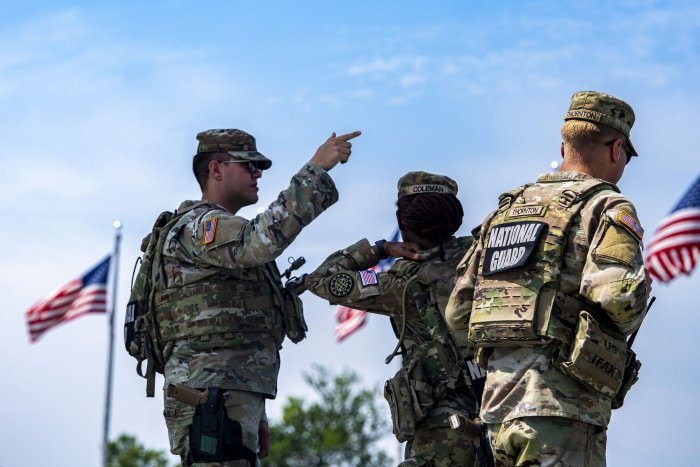
Members of the National Guard patrol near the Washington Monument on Tuesday. Photo by Bonnie Cash/UPI | License Photo
Weekly insights and analysis on the latest developments in military technology, strategy, and foreign policy.
The U.S. Missile Defense Agency (MDA) has plans for a new radar to succeed the AN/TPY-2. The AN/TPY-2 is most commonly associated with the Terminal High Altitude Area Defense (THAAD) ballistic missile defense system, but it can also be used as a stand-alone sensor in a larger integrated air defense network. MDA’s main desire now is to find a more mobile radar system to make them less susceptible to enemy missile and drone attacks. Iran’s successful targeting of largely static missile defense radars this year, including the reported destruction of at least one AN/TPY-2, has been a wake-up call to just how vulnerable these prized assets have become already. TWZ explored this reality and its implications in a detailed feature earlier this year.
MDA put out a call yesterday for “innovative prototype concepts” for what it is currently calling the Forward-Based Mode (FBM) Radar Next. This notably came just ahead of the annual Space & Missile Defense (SMD) Symposium in Huntsville, Alabama, that opened today and at which TWZ is in attendance.
The contracting notice stresses that the agency is currently in the pre-solication phase of this effort, but that it does have plans to eventually pursue these prototypes through an Other Transaction Authority (OTA) agreement. OTA is a mechanism typically used to support rapid prototyping and other research and development work outside of a typical and often drawn-out contracting process. In its budget request for the 2027 Fiscal Year, which was released earlier this year, MDA also explicitly asked for funding for a pair of “next generation radar prototypes to prove out and mature emerging technologies for the future FBM Radar fleet.”
The AN/TPY-2 radar, one of which is seen here, is what the U.S. military primarily uses today to meet its forward-based mode requirements. RTX
For some additional context, MDA uses the term FBM here to refer to a radar used to detect threats, traditionally ballistic missiles, after launch. Deployable radars like the AN/TPY-2 employed in this role are typically emplaced at semi-permanent sites. The U.S. military also has higher-end static strategic radar sites around the globe, along with space-based assets, to help provide additional layers of early warning detection.
At the time of writing, the U.S. military is publicly known to have two AN/TPY-2s deployed in the FBM mode in Japan, as well as three more at sites in Israel, Qatar, and Turkey. Additional AN/TPY-2 are also currently forward-deployed elsewhere globally as a component of the THAAD system.
AN/TYP-2s, as well as the generators needed to power them, are trailer-mounted and technically road mobile. However, they are not designed to be very rapidly relocated from one site to another. This brings us back to the FBM Radar Next.
An AN/TPY-2 together with its trailer-mounted generators in position at Kwajalein Atoll in the South Pacific for a test. MDA
“As adversarial missile capabilities become increasingly sophisticated, the need for agile, survivable, and highly precise forward-based sensors has never been greater. Current static or semi-mobile radars are vulnerable to counterattacks and lack the rapid relocation capabilities necessary for modern distributed operations,” the pre-solication notice explains. “FBM Radar Next will close this gap by providing a system that can be quickly transported, set up, and operated in austere forward locations while maintaining interoperability with existing Command and Control, Battle Management, and Communications (C2BMC) networks.”
In terms of transportability and deployability requirements, “the system must be capable of rapid deployment and transport via C-17 military airlift and tactical ground vehicles,” the notice says. “The radar must demonstrate rapid setup and teardown times (e.g., operational within specified hours of arrival, and tear down within minutes to maximize survivability).”
A trailer-mounted generator for the AN/TPY-2 radar seen being unloaded from a C-17 cargo plane, giving a sense of the size of the entire system. ENERCON
The next-generation radar must also be capable of “high-sensitivity detection, persistent tracking, and precise discrimination of advanced threats in high-clutter and contested electromagnetic environments,” the notice continues. MDA also wants “engineered physical, thermal, and electromagnetic signatures to ensure platform survivability in contested environments.”
Furthermore, “the design must support remote operations, command and control integration, and automated system health monitoring,” the notice adds. Minimizing the onsite operator footprint is critical to improving personnel safety and increasing overall tactical flexibility.”
MDA wants the FBM Radar Next to be able to slot into more “versatile deployment architectures, with the capability to operate either as a highly integrated single aperture or as multiple distributed arrays to optimize geographical coverage, sensitivity, survivability, or electronic protection.” In line with this demand, there are additional requirements for a modular design with open architecture systems, as well as seamless integration with the existing Command and Control, Battle Management, and Communications (C2BMC) architecture.
A highly networked and distributed concept of operations could open the door to more novel radar configurations, including ones involving larger groups of smaller types, to succeed the AN/TPY-2. Smaller individual radars could also have reduced signatures, be easier to conceal, and be more readily relocatable, all helping to reduce vulnerability. This could also make the entire system more resilient in the event that nodes are lost or otherwise rendered inoperable for any reason.
There could be benefits in terms of unit cost and scalability of production from such an approach, too. Prime contractor Raytheon is understood to have only produced 16 AN/TPY-2s to date, in total, for all customers, not just the U.S. military. The unit cost of a single one of those radars is generally pegged at around $250 to $300 million, and these are long-lead-time items that take years to deliver.
“The system design must prioritize manufacturing ease, design-for-manufacturing-and-assembly (DFMA) principles, and cost-efficiency. It is critical that the prototype demonstrates a viable pathway to rapid, high-volume production at an affordable unit cost,” MDA’s FBM Radar Next notice makes clear. “This ensures the capability to quickly scale production and cost-effectively replace radar units in highly active forward-deployed environments.”
Regardless of the approach MDA ultimately decides to pursue, the threat ecosystem that is driving the FBM Radar Next plans is real now, and is not just limited to enemy missile attacks. Weaponized drones, especially long-range one-way attack types, present real dangers to high-value targets. This fact had already been driven firmly into the public consciousness by the ongoing war in Ukraine. It has now been further demonstrated by Iran’s aforementioned targeting of prized air and missile defense radars around the Middle East during fighting earlier this year. The ramifications of all of this go well beyond these particular conflict zones, too.
NEW: The radar for a THAAD system was struck and apparently destroyed in Jordan while two other THAAD radar systems may have been hit in the UAE, satellite images show – w/ @ThomasBordeaux7https://t.co/qiuWVQgyda
— Gianluca Mezzofiore (@GianlucaMezzo) March 5, 2026
A compound was damaged on Al Dhafra Air Base, UAE. Sat dishes were visible at the site as recently as mid-June of last year. It is unclear if they were still there when strikes occurred, but Iran struck the same area again on Monday. pic.twitter.com/nRyb7c6Kj5
As we wrote back in March after Iran’s very deliberate targeting of U.S. and allied radars became clear:
“Strategic air and missile architectures, in general, exist in a world now where the threats they face are not limited to very-long-range standoff capabilities possessed only by peer or near-peer adversaries.“
“It used to be, generally, that you had to fire a ballistic missile or high-end cruise missile in an attempt to strike one of these systems. Now, long-range one-way-attack drones, as well as increasingly capable cruise and ballistic missiles, continue to proliferate steadily, including to smaller nation-state armed forces and even non-state actors. An attack could even come from a small drone with a C4 charge launched from a fishing trawler 10 miles away from one of these critical radar installations. The threat of these kinds of near-field attacks has largely been overlooked for years, even as the low-end drone threat has exploded and ‘democratized’ precision-guided weaponry, as they did not fit the established aerial threat matrix and the countermeasures used to repel those threats.”
…
“The scale and scope of Iran’s retaliatory attacks so far, while clearly threatening, pale in comparison to what one would expect to see in a major high-end fight between the United States and China in the Pacific. The overall ramifications would also be more severe.“
“Beyond the more immediate impacts of losing this kind of strategic radar coverage, there are far larger implications. In some cases, these radars are designed to provide critical early warning and verification of incoming nuclear strikes, or other large-scale attacks by a major adversary, targeting a nation’s home soil. They are critical parts of the nuclear deterrent. As such, losing these sensors can have major downstream impacts on strategic decision-making cycles based on concerns about what suddenly is not being seen. Fewer radars also means fewer ways to double-check that a track is not a false positive in a scenario where the total available decision-making time could be seriously truncated, to begin with. These are concerns TWZ explicitly highlighted after Ukraine’s attack on the Armavir Radar Station in Russia in 2024.”
During a panel discussion at the SMD Symposium today, U.S. Army Lt. Gen. Richard Zellmann, Deputy Commander of U.S Space Command, further underscored the reality of the current threat ecosystem, including one-way attack drones layered in with traditional missile barrages. The general also highlighted the impact of more readily available space-enabled targeting and navigation capabilities.
“We see, I think, the low end on Epic Fury [the official nickname for U.S. operations against Iran earlier this year]. Sure, the missiles are more high-end, but we’ve seen our adversary employ a number of one-way attack systems that are coupled with these ballistic missile volleys,” Zellman explained. “We are really at this point in the history of warfare because of the democratization of space. Space isn’t a sanctuary. It’s no longer just the playground of nations with a lot of money.”
“The commercialization of space has created what many call essentially a transparent battlefield. And because I can see everything all the time with commercial ISR [intelligence, surveillance, and reconnaissance; in this case primarily satellite imagery], it’s given our adversaries capabilities that they haven’t had in the past,” he continued. “That ISR, if you couple it with a platform that has access to GPS or some other PNT [Position, Navigation, and Timing] system, and then you add in another layer of over-the-horizon comms, like say from an Iridium or a Starlink [satellite communications terminal], and you have a pretty lethal asymmetric weapon system that our adversaries can get a hold of.”
Footage of an Iranian attack drone slamming into the headquarters of the US Navy’s 5th Fleet at Naval Support Activity (NSA) Bahrain moments ago. pic.twitter.com/wHbje3eiiy
Munitions that use GPS, or a similar form of navigation, alone for guidance are only employable against static targets. This, in turn, only drives home even more the importance of the transportability and deployability requirements that are at the heart of the FBM Radar Next plan.
It’s also important to note that, like AN/TPY-2 now, FBM Radar Next will still be just one part of a larger air and missile defense architecture. In our analysis earlier this year, we noted that Iranian attacks on radars in the Middle East had reinforced arguments for new layered defenses to protect those and other prized assets and for migrating more early warning and missile tracking capabilities into space. There is still a question of how much of that functionality will be shared and eventually ported over into orbital sensing capabilities. As Lt. Gen. Zellmann pointed out today, threats to space-based capabilities continue to grow, and that domain can no longer be considered a sanctuary, either. Having a layered, redundant, and flexible mix of terrestrial and orbital sensing for ballistic missile tracking will remain highly important for the foreseeable future.
What exactly a successor to the AN/TPY-2 looks like in the end remains to be seen. What is clear now is that very real missile and drone threats have prompted a major rethinking on the part of MDA about how future missile defense radars will need to be employed to ensure they can survive going forward.
Forty-two weapons were recovered by the Mexican military in Naco, Sonora, in 2009. File Photo courtesy of the Bureau of Alcohol, Tobacco, Firearms and Explosives
Aug. 17 (UPI) — Russia’s Foreign Intelligence Service accused the intelligence services of a Western country of preparing, together with Ukraine, an operation aimed at portraying Moscow as an illegal supplier of weapons to drug cartels and organized crime groups in Mexico, Colombia and Venezuela.
The Russian agency said in a statement that Russian-made weapons captured by Ukrainian forces during the war are being transported to the three Latin American countries to be used as part of the operation.
According to the Foreign Intelligence Service, those responsible are also preparing photographs and videos intended to show Russia supplying weapons to Latin American criminal organizations through intermediaries.
The agency said the materials would be accompanied by forged documents seeking to link representatives of the Russian Armed Forces to the weapons transfers.
“The authors of this provocation naively hope in this way to undermine Russia’s constructive relations with the countries of this region and induce Latin American governments to support the anti-Russian policy pursued by the West,” the intelligence service said.
The statement did not identify the Western country it accused of orchestrating the operation or provide public evidence to support the allegations.
Russian intelligence said the objective would be to damage Moscow’s relations with Latin American countries and bring their governments closer to Western policies toward Russia.
As of Monday, the governments of Mexico, Colombia and Venezuela had not publicly responded to the allegations. Ukraine had also not issued an official response to the new statement.
The accusation comes after Russia previously linked Ukraine to Mexican criminal organizations. In late June, Russian officials accused Kyiv of maintaining ties with Mexican cartels, allegations that the Ukrainian Embassy in Mexico publicly rejected.
The Ukrainian diplomatic mission at the time described the claims as part of a Russian disinformation campaign and denied that Ukraine had ties to Mexican drug trafficking organizations.
In the final part of its Monday statement, the Foreign Intelligence Service framed the accusation within what it described as an information war waged by “Euro-Atlantic elites” against Russia since the start of the conflict in Ukraine.
The Russian agency cited as precedents the April 2022 Bucha massacre, which it described as a “bloody staging,” and the 1939 Gleiwitz incident, a false-flag operation carried out by Nazi Germany before the invasion of Poland.
Welcome back to the Times of Troy newsletter, where we’re dedicating the next two editions of Times of Troy to determining a range of outcomes for this make-or-break season of USC football. We’ll save the rose-colored takes for next week, when the Trojans will be on the doorstep of their season opener against San José State. But for today, as we did at this time last year, let’s consider the other, darker side of that same coin — and talk about how it could all go wrong.
Because, rest assured, there will be plenty of landmines to navigate through a gauntlet schedule that includes all three of the top three teams in opponent adjusted efficiency (FEI) from last season (Indiana, Oregon, Ohio State), plus the 14th-ranked team in the same category (Washington). Then there’s a trip to one of the hardest places to play in America (Penn State) to boot.
Fight on! Are you a true Trojans fan?
Get our Times of Troy newsletter for USC insights, news and much more.
By continuing, you agree to our Terms of Service, which include arbitration and a class action waiver. You agree that we and our third-party vendors may collect and use your information, including through cookies, pixels and similar technologies, for the purposes set forth in our Privacy Policy such as personalizing your experience and ads.
USC will need to win at least three of those five games to make the Playoff. Which is borderline cruel to ask.
For the purposes of this exercise, let’s assume that USC opens its season 3-0, with wins over San José State, Fresno State and Louisiana. Anything less, it’s fair to say, would be an unmitigated disaster.
How those three weeks go, though, will be important for the progress of USC’s young players, who need to find their bearings fast in order for USC to fulfill its potential.
It would be an especially unfortunate twist of fate for that process to be interrupted or for the team’s depth to take a hit through that easy, early stretch. But barring injury, those first three weeks should give USC time to get some of its young stars — such as receivers Kayden Dixon-Wyatt and Boobie Feaster, tight end Mark Bowman, cornerback Rock Hill and defensive end Luke Wafle, especially — up to speed.
The slate really begins Sept. 19, when USC opens conference play with its furthest possible trip east, at Rutgers. With Oregon awaiting the next week and the added dynamic of cross-country travel, you could certainly convince me the Trojans could be caught flat-footed in this game, leaving things a bit too close for comfort. But if USC somehow loses to Rutgers in its Big Ten opener, coach Lincoln Riley might not make it much past Halloween.
So let’s say the Trojans are 4-0 when Oregon comes to the Coliseum in late September. Really, it’s this game that will tell us where USC is actually headed this season.
Because the stage will have never been bigger for quarterback Jayden Maiava, who had his worst game of 2025 in Eugene last fall. That performance, according to Pro Football Focus, featured double the turnover-worthy throws (six) of any other game Maiava has started at USC. Any worst-case for USC probably includes some form of unraveling from the quarterback.
But even with Maiava at his best, Oregon is still the deeper and more well-rounded team. The front seven should be as formidable as it’s ever been under coach Dan Lanning. The quarterback might be the NFL’s No. 1 overall pick next spring, and his weapons on offense are as good as any in college football. That firepower proves too much for USC, which gets beat at home for the first time since November 2024.
Losing to Oregon would be a bitter pill for a young team to swallow. And it would also be a particularly bad time to start spiraling. Because the next three weeks are all losable games. Washington has a mobile quarterback (Demond Williams) capable of wreaking havoc on USC’s defense if its front seven can’t keep him contained. And while we don’t know what to expect from new coach Matt Campbell and Penn State, the White Out at Beaver Stadium a week later will be no joke. Even Wisconsin shouldn’t be overlooked two weeks after that. Especially at Camp Randall.
There’s a world in which USC has lost three of four, we’ll spot them a win at Wisconsin, after starting the season 3-0. That slump could be an absolute back-breaker. Because guess who looms after that?
Oh, just Ohio State and Indiana.
Pretty bleak, right?
Suddenly, in this most demoralizing scenario, USC is out of the Playoff picture at the halfway point of the season. The positive vibes around Gary Patterson’s hire are gone, and a significant segment of the fanbase will have resigned themselves to never seeing a good USC defense again in their lifetimes.
The conversation around Riley’s future will have reached a fevered pitch. The seat will have gotten scorching hot. The Trojans would now be playing for their coach’s job. The pressure, on a particularly young team, would be immense.
And then, Ohio State comes to town. The Buckeyes have lost three times on the road in the last two seasons, compared to just once at home. But those three road losses were either in the postseason to a top-two team, at Oregon or the inexplicable 2024 loss to a far inferior Michigan team in The Game. Chalk this up to a loss, as Ohio State tramples over both of USC’s fronts.
Indiana, meanwhile, has yet to lose a home game in two years under Curt Cignetti. I don’t expect that to change this year, either.
So with losses to Ohio State and Indiana — and a presumably smooth win at Maryland — USC would be 6-5 heading into the crosstown rivalry. And I think we can all agree that no scenario would be more of a worse case for USC than UCLA emerging from its first season under Bob Chesney as the better-trending program between the two.
I don’t think that’s where this season is headed. This is an absolute worst-case scenario, after all. The schedule does give USC serious spiral potential. And stranger things have happened in the crosstown rivalry.
But if USC were to end this season at 6-6, with a baffling loss to the Bruins, I think I can say pretty confidently that the whole program will be headed in a new direction after that.
Will Ryon Sayeri remain USC’s kicker this season?
(Kenneth Richmond / Getty Images)
—Is USC’s starting offensive line already set? It’s starting to feel that way. The season-ending injury to center Kilian O’Connor limited USC’s options, with Tobias Raymond now almost assuredly set to step in there. But from what we’ve seen in open periods, there hasn’t been much movement elsewhere. Hayden Treter has been the preferred option at left guard, while Alani Noa has primarily been at right guard. Elijah Paige and Justin Tauanuu have once again been the bookends at tackle. Whether that’ll be the case by the midway point of the season, we’ll see, but USC seems confident with Treter and Noa flanking Raymond on the interior.
—Could USC make a change at kicker? Riley would like us to believe that it’s definitely a possibility, despite the fact that last season’s All-Big Ten third-team kicker Ryon Sayeri has returned. Sayeri wasn’t going to get the job last year until former Nevada Las Vegas kicker and freshman All-American Caden Chittenden got injured and relinquished it with Sayeri’s strong play. “I don’t know that I’ve ever been in a situation as a coach where you have like two guys that you believe in as much as I believe in them,” Riley said. Still, it would be bold to replace a guy who was as consistent as Sayeri was for most of last season.
—USC football got its Class of 2028 quarterback. Trey Wright is currently just the 25th-ranked passer in the class, according to 247 Sports. But Riley, who prefers to offer just one quarterback in each class, clearly sees something in the Frisco, Texas, signal-caller. Wright certainly piled up stats as a sophomore, throwing for over 4,000 yards and 38 touchdowns while rushing for nearly 1,800 yards and 16 touchdowns. The comparisons with Kyler Murray were natural even before the Vikings quarterback, who won a Heisman with Riley, sent Wright a video that he posted on social media. Wright is just 5 feet 10 and 175 pounds. But he looks like a heck of an athlete.
—Most of USC’s starting lineup for next hoops season is injured right now. Which is not exactly … ideal. But only center Eric Reibe is expected to miss real time into the season. Georgetown transfer KJ Lewis’ ankle should be healed by the start of the season in November. He’s expected to start playing live five-on-five in October. Rodney Rice (shoulder) should be good to go before that, while other key contributors have battled through bumps and bruises this summer. Reibe’s situation is especially odd. He sought a second opinion on his foot injury, according to a person familiar with the decision, and was told to sit out the summer to try to avoid surgery. Well, he ended up getting the surgery anyway, losing seven weeks of potential recovery time.
Polling the people
This is obviously a critical season for Riley’s future, and everyone seems to have a number in mind of what it’ll take for Riley to keep his job.
So, what is the fewest number of wins you’d accept from Riley and USC without calling for a change?
You don’t see many female serial killers — estimates historically range around just 8% to 12% — but that premise is a thrilling starting point for Hulu’s new cat-and-mouse crime thriller, “Furious.” Emmy Rossum stars as Alice Black, a female FBI agent who’s tasked with tracking down a sex trafficking survivor who has taken to murdering the men who abused her.
But the show gets much deeper than that, as lines start to blur between what’s right and wrong and who’s the actual villain in the story. Only a few episodes are out so far, but what I’ve seen so far suggests we might be looking back on this show as one of the best of 2026.
That concludes today’s newsletter. If you have any feedback, ideas for improvement or things you’d like to see, email me at ryan.kartje@latimes.com, and follow me on X at @Ryan_Kartje. To get this newsletter in your inbox, click here.
Aug. 17 (UPI) — Iran has accused Qatar of holding three of its pilots for half a year in violation of international law, heightening tensions between the two nations and threatening to expand the war in the Middle East, despite Doha claiming not to have the pilots.
“Qatar’s government has exhausted its opportunity to delay and toy with the fate of three heroic Iranian pilots,” Maj. Gen. Ali Abdullahi, the newly appointed chief of staff of Iran’s Armed Forces, said in a statement Sunday.
“They must be released immediately and unconditionally and returned to the homeland.”
Four Iranian pilots in two SU-24s were shot down over Qatari airspace March 2, as Iran was attacking Al Udeid Air Base in response to joint Israeli-U.S. attacks on Iran days earlier that ignited the ongoing war. A Qatari foreign ministry spokesperson said that a search had been launched for their crews, but it was never stated that they had been found. Iran later announced that one of the four pilots had died in the attack.
On Saturday, Brig. Gen. Mohammad Bagherzadeh, head of the Iranian military’s committee for missing personnel, identified the remaining three pilots in a letter to the International Red Cross that accuses Qatar of violating articles of the Geneva Convention concerning the treatment of prisoners of war, the state-run Islamic Republic News Agency reported.
Bagherzadeh accused Doha of denying the pilots contact with their families and Iranian authorities, citing Articles 70 and 78 of the Third Geneva Convention that states POWs have the right to submit complaints and requests to representatives who visit their place of captivity or to hold discussions and negotiations.
The letter urged the ICRC to address the situation.
“Qatar must know that Iran will not retreat from its proud pilot sons. The path for the presence of the expert team of the Islamic Republic of Iran must be facilitated as soon as possible,” Brig. Gen. Seyed Majid Mousavi, commander of the Islamic Revolutionary Guard Corps, said Sunday in a statement.
“Continuing this trend will not be cost-free for Qatar, and any delay or obstruction will place a heavy responsibility on their shoulders.”
Qatar has denied the accusations. Majed Al Ansari, spokesperson for Qatar’s Ministry of Foreign Affairs, said Qatar was not holding any Iranian pilots and had handed over the remains of one Iranian pilot that its search teams had found.
Qatar invited Iranian officials in April to visit Qatar and be briefed on the search-and-rescue operations, “but the Iranian side has yet to respond to the invitation,” he said in a statement Sunday.
Aug. 16 (UPI) — U.S. President Donald Trump said Sunday he ordered the Pentagon to scale back its joint military exercises with South Korea, saying that Seoul declined to help the denuclearization of Iran.
In a social media post, Trump said the drills scheduled to begin this week are expensive and “send a signal that is totally inappropriate and hostile” to North Korea. He said North Korea “has been unthreatening and respectful” white he has been in the White House.
“Therefore, and based on the fact that it is too late to cancel, I have instructed Secretary of War, Pete Hegseth, to substantially reduce the Joint Military Exercises!” Trump wrote.
The annual Ulchi Freedom Shield exercises, involving 18,000 South Korean troops over 11 days, were to strengthen readiness against threats from North Korea and began Monday to run through Aug. 27.
North Korea, which has long condemned the exercises as preparations for invasion, last week denounced the scheduled drills, describing them as a provocation that would raise tensions in the region.
South Korea has yet to response to Trump’s surprise and last-minute direction.
On Saturday, Trump posted a June 2019 photo of his meeting with North Korean leader Kim Jong Un at the Korean Demilitarized Zone. He wrote that he gets along “GREAT!” with Kim “despite the unfriendly look on this particular picture.”
An E-2D Hawkeye prepares to launch from the flight deck of the Nimitz-class aircraft carrier USS Abraham Lincoln in 2018. U.S. Central Command Adm. Brad Cooper visited the ship on Saturday. U.S. File Photo by Mass Communication Specialist 3rd Class Jeff Sherman/Navy
Aug. 16 (UPI) — The commander of U.S. Central Command visited the USS Abraham Lincoln days after the aircraft carrier drew public attention over reports of poor conditions on board and attempted suicides of sailors.
Adm. Brad Cooper visited the ship as part of a 10-day tour of the Middle East, U.S. Central Command said in a statement. Cooper also met with senior civilian and military leadership in Bahrain, Iraq, Iran, Israel, Jordan, Saudi Arabia, and the United Arab Emirates.
The Lincoln, which is based in San Diego, has been at sea for a record of more than 260 days after being deployed to Venezuela and then the Middle East, where it is currently.
Families of sailors serving on the ship have told media outlets several crew members have tried to jump overboard or have been stopped from doing so in recent months. There have also been reports of a lack of fresh food on board and moldy showers, among other issues.
“Unfortunately, the media are trying to paint our warriors as victims,” Navy Secretary Hung Cao said in a statement on Friday. He later said that Lincoln would return home and be replaced with the USS George Washington.
Senate Democrats have been pressing the Trump administration about the conditions on the Lincoln as well as its planning for its conflict with Iran.
“I was just speaking to a spouse just about three days ago and this is the current problem right now,” U.S. Sen. Ruben Gallego, D-Ariz., said on ABC News’ This Week on Sunday. “It really goes to the deep, deep, deep problem here is that this administration did not plan for this war, did not plan how to get out of this war, did not really understand how this war was going to escalate.”
Defense Secretary Pete Hegseth has said media reports have “completely misrepresented” the situation, while President Donald Trumptold reporters that the deployment’s length is “not nearly long enough.”
Members of the National Guard patrol near the Washington Monument on Tuesday. Photo by Bonnie Cash/UPI | License Photo
The government of German Chancellor Friedrich Merz approved a landmark bill to expand the powers of the Federal Intelligence Service (BND) and the Domestic Intelligence Service (BfV) by 2027. This expansion grants them offensive and operational tools, including cyber counter-sabotage and espionage, with funding of €1.51 billion. This move has sparked significant concern among Chinese and Russian intelligence agencies regarding the radical shift in German security doctrine, stemming from the geopolitical context and the fears of Germany’s adversaries, China and Russia, regarding the ongoing hybrid warfare. The German initiative was driven by the escalating pace of gray and hybrid warfare, the most recent example being the discovery of a booby-trapped drone at Leipzig’s strategic airport. Consequently, intelligence, strategic, and security circles in Beijing and Moscow are closely monitoring this historic intelligence revolution approved by Chancellor Merz’s government on August 12, 2026. This draft law (exceeding 700 pages) represents the most significant shift in Germany’s security doctrine since the end of World War II in 1945. From the perspective of Chinese and Russian intelligence, this shift constitutes a security revolution that ends the strict constraints imposed on Germany since World War II, transforming German intelligence agencies from mere information-gathering tools into entities capable of launching offensive and counter-sabotage operations. For these reasons, this internal German intelligence transformation is being closely monitored and analyzed in depth within intelligence and military circles in Beijing and Moscow, given its strategic dimensions and its connection to Berlin’s attempt to break free from American dependence. This move, analyzed by Chinese and Russian intelligence and military circles, is seen as a targeting of Russia and China. Although Berlin attempts to frame counterintelligence as a general effort, German officials, such as Interior Minister Alexander Dobrindt, have explicitly stated that the goal is to deter Russian and Chinese sabotage operations and enable German intelligence to inflict pain on adversaries and operate on equal footing with allies like the US Central Intelligence Agency (CIA), rather than relying on them entirely. The German Federal Parliament (Bundestag) is expected to formally pass the bill after the summer recess, allowing these offensive powers to become fully operational in Germany by early 2027.
Military think tanks and research centers affiliated with the Chinese People’s Liberation Army and Russian circles alike are analyzing all the operational and political dimensions of this strategic decision in Germany, focusing on understanding the German desire to shift from a defensive doctrine to an offensive operational approach and to adopt a cyber sabotage strategy and a counter-terrorism measure called “Hack-Back.” For the first time, the German Federal Intelligence Service (BND) and the Federal Intelligence Service (BfV) are granted legal authority to penetrate the information systems of adversaries and attackers and modify or delete data to prevent large-scale cyberattacks and dismantle the infrastructure of hackers. This includes German approval for field sabotage operations in situations of German defense tension, whereby the BND is permitted to carry out active sabotage operations abroad, such as disabling servers and replacing military or vital technology components with damaged ones to prevent attacks, such as in drone factories and chemical laboratories of hostile states. This has been interpreted by Chinese and Russian circles as a German crushing of the principle of separation between German domestic and foreign intelligence agencies. According to Chinese and Russian analyses, the new German law is also generating considerable legal controversy within Germany itself, as it narrows the historical distance between intelligence agencies (those concerned only with collecting information) and the police agencies (those concerned with implementation).
Here, the Chinese intelligence reading of the German reform can be understood as the end of historical restrictions imposed on Berlin, as Beijing views the move as a reversal of the strict restrictions imposed since the end of World War II and Berlin’s shift from purely information gathering to carrying out covert operations and penetrating adversaries’ networks. In addition to what this represents for Beijing and Moscow in terms of reducing dependence on Washington, Chinese intelligence is monitoring Germany’s attempt to build independent self-reliance capabilities to reduce intelligence dependence on the United States and its allies amid mutual strategic suspicions. Intelligence, military, political, and strategic circles in Beijing also view with caution the (militarization of German digital space). Here, the Chinese analysis considers that allowing the disruption of infrastructure and the modification and deletion of data places German agencies in the ranks of major countries with active offensive doctrines, given the reliance of German domestic and foreign intelligence agencies on the pattern of practical and technical dimensions of reform and hybrid capabilities in reforming their security and intelligence agencies, through directly confronting drones, disrupting spy servers, or tampering with components of a weapon under production without resorting to human physical violence, with the expansion of the use of artificial intelligence technologies, through expanding the use of facial recognition technologies and reducing data protection restrictions to store and analyze information for longer periods. However, at the same time, German circles are facing parliamentary challenges, given that the draft law is undergoing legislative proceedings in both houses of the German parliament (the Bundestag and the Bundesrat) amidst local human rights objections warning of the erosion of personal freedoms and the principle of separating intelligence from the police.
Here, the Russian intelligence perspective (Moscow) on the German intelligence draft law comes to the fore. Russian intelligence agencies (SVR, GRU, and FSB) view this move as a direct response to their operations and interpret it within the context of an acknowledgment of hybrid warfare. Moscow believes that Germany is now officially treating Russia as an enemy in a state of undeclared war. The increase in the budget of Germany’s foreign intelligence agency (BND) by 26%, reaching €1.51 billion, is seen as an indication of a long-term security buildup against Russia. Moscow also viewed this as a move to neutralize cognitive denial, especially given accusations from German domestic and foreign intelligence agencies that Russia is exploiting German bureaucratic sluggishness and strict data privacy measures to carry out cyberattacks and sabotage operations. Therefore, the Russian interpretation of this German decision can be seen as a direct response from Berlin to Moscow, aimed at closing this digital and security gap between the two sides. It can be interpreted as a German intelligence strategy of reciprocity, or, according to the Russian analysis, as an attempt by Germany to encircle disinformation networks by granting German intelligence the ability to take down Russian propaganda and disinformation servers, which pose a direct threat to Russia’s soft power tools aimed at destabilizing Germany.
Stay ahead of the geopolitical week.
MD Briefing delivers expert analysis across five global fronts — the Indo-Pacific, energy, geoeconomics, European security, and the Middle East — every Monday morning. Free.
On the other hand, Chinese intelligence circles, primarily the Ministry of State Security (MSS), which acts as the Chinese intelligence service, analyze German law from the perspective of technological and geopolitical conflict, targeting industrial and academic espionage by China. Here, the Chinese analysis focuses on the expansion of the powers of the German domestic intelligence agency (BfV) and the use of artificial intelligence. This analysis primarily aims to track Chinese soft networks that focus on stealing advanced German technology and conducting economic espionage in order to protect German infrastructure and communications. Beijing believes that the new German laws, which compel German telecommunications companies and digital platforms to hand over data to German intelligence, are primarily intended to isolate Chinese technology and impose complete German sovereign control over cyber data in the face of China. The most sensitive aspect of Russian and Chinese analyses lies in their dual interpretation of Germany’s desire to break free from the Five Eyes framework. They see it as either an intelligence network for exchanging signals intelligence, comprising the US, UK, Canada, Australia, and New Zealand, whose decisions are guided by Washington, or as a new dilemma facing Germany in building self-reliant capabilities and ending its dependence on the United States. This latter scenario serves the interests of China and Russia, promoting multipolarity and a multipolar international world and ending the one-way street of Washington. The German Chancellery has publicly stated that reliance on allies (specifically the US) has been a one-way street, where Germany receives information without the ability to exchange it or protect itself independently. From a Chinese and Russian intelligence perspective, this represents a new German policy of hedging against Trump’s unpredictability. Moscow and Beijing believe that the primary motivation behind the conservative Merz government’s actions is strategic skepticism regarding the reliability of the United States, particularly with Donald Trump in the White House, and Berlin’s fear of the politicization or severing of US intelligence flows. This reinforces the Chinese-Russian view that this is a technologically impossible German attempt to break free from US control and dictates.
Accordingly, assessments in Beijing and Moscow agree that Germany—despite its ambition—will not be able to completely break free from intelligence dependence on America anytime soon. The United States controls the global cloud infrastructure, internet cables, and critical cyber technologies, making German intelligence independence a costly ambition that will take years to materialize technologically. However, it does give Berlin at least greater parity in dealing with partners, which China and Russia are trying to maximize.