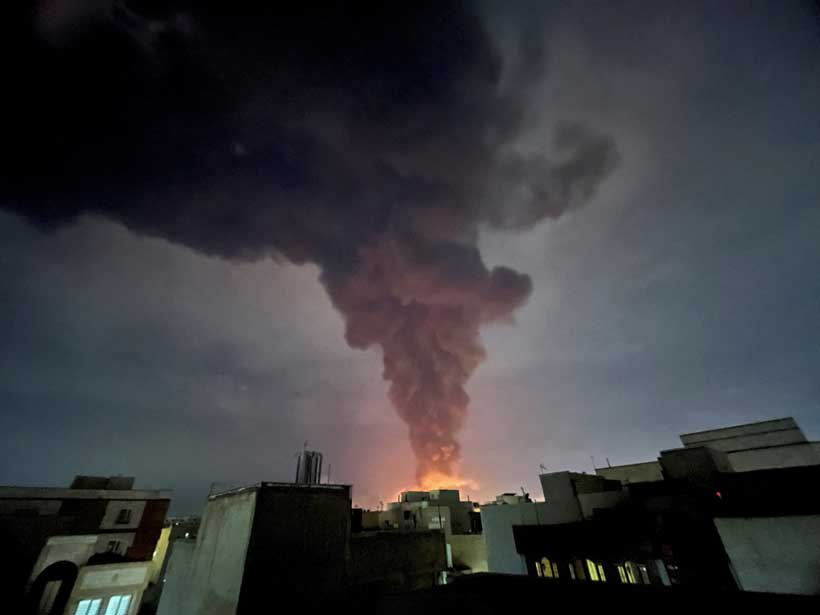
We can analyze China’s current stance on the escalating Iranian conflict by understanding its true position. China does not desire a full-scale war that would destroy its oil interests, but it is not averse to the continuation of the neither-peace-nor-war situation that drains its adversaries, such as Washington. This positions China as a player that pushes for calm during critical times, while simultaneously providing Iran with the economic lifeline it needs. Here, China plays a dual and complex role in the Iranian conflict (the Iranian-American/Israeli conflict), balancing its strategic support for Tehran to safeguard its energy interests and undermine American influence with its pursuit of a ceasefire to avoid widespread economic chaos.
Based on current developments up to early May 2026 and statements by Iranian officials that war is a possibility, the regional and international landscape reveals a divide between actual military escalation and cautious diplomacy. The Chinese position and the likelihood of war can be analyzed based on several factors. China views the current conflict with Iran as a proxy war, prioritizing stability over stability. China considers Iran a strategic partner, and its stance is characterized by a delicate balance. The Chinese Foreign Ministry has repeatedly called for de-escalation and a complete ceasefire to prevent further escalation in the Middle East, while simultaneously condemning American escalation. China has stated that American and Israeli military operations against Iran violate its sovereignty and has expressed grave concern about the potential imposition of a blockade on Iranian ports and the Strait of Hormuz. While Beijing seeks to protect its investments and economic interests, China is deeply concerned about any disruption to oil and energy supplies, especially since a direct war would lead to imported inflation, negatively impacting its economy. Therefore, China’s current stance is characterized by a cautious, mediating role. China is attempting to play the part of a peace broker but is also wary of the potential damage a war could inflict on its relations with the United States, especially given the ongoing diplomatic exchanges between the two countries.
Regarding the likelihood of war (and the expected scenarios), despite the tense rhetoric, a full-scale, direct war between the United States and Iran remains a risky prospect for all parties. Current indicators suggest that a war is already underway (indirectly), particularly since the start of direct military operations (US/Israeli strikes) against Iran and its allies in February 2026. This indicates that a direct war remains a strong possibility. The option of blockade and proxies also remains a possibility. Chinese intelligence and military assessments suggest that Iran might prefer to carry out its threats through proxies in the region or by disrupting oil shipments in the Strait of Hormuz, rather than engaging in a direct war, to avoid a conventional military defeat. Despite Chinese diplomatic efforts to contain the situation, and despite the escalation, attempts are still underway, such as Pakistani mediation, to reach a ceasefire. This indicates a desire among the parties to keep the door open for political solutions.
As for my perspective on the proxy war between China and Iran against the United States and Israel, the current conflict is likely to continue as a proxy war of attrition, with limited and precise strikes, rather than a full-scale ground invasion. China will likely exert further pressure, continuing to push for diplomatic solutions because any large-scale war would threaten the stability of global energy supplies, on which it depends. It’s worth noting that the region is going through a critical moment and a dangerous phase of mutual deterrence. Iranian officials’ statements are as much messages of deterrence as they are an acknowledgment of the potential for escalation.
Regarding China’s role in the continuation of the war or its support for Iran (strategic and economic support), China considers the Iranian Strait of Hormuz and its purchases of Iranian oil as a vital economic lifeline. China is the largest buyer of Iranian oil (approximately 80-90% of exports), providing Tehran with crucial funding to sustain its activities. China also seeks to help Iran circumvent US sanctions, assisting Iran in bypassing these sanctions through an unofficial oil fleet, thus keeping the Iranian economy afloat. Furthermore, there is a strategic Chinese-Iranian partnership opposed to the West and US sanctions against Tehran. China views Iran as a partner in undermining the US-led global order through organizations such as BRICS and the Shanghai Cooperation Organization. Moreover, China is exploiting the current situation to its advantage. Chinese intelligence, military, defense, and security analyses suggest that the continuation of the Iranian war drains US resources and provides China with an opportunity to enhance its influence, absorbing the shock of the war and potentially emerging with strategic gains.
At the same time that China is playing a role in halting the Iranian war through mediation diplomacy to de-escalate tensions, with China acting as a hidden mediator to urge Tehran to cooperate and reach a ceasefire with the United States to protect its economic interests, despite China’s support for Iran, the war harms China by closing the Strait of Hormuz and threatening its energy security. This prompts Beijing to urge an end to the war and the reopening of waterways. Therefore, China is pursuing a policy of diplomatic pressure, consistently calling for restraint and believing that the best solution is an immediate ceasefire, according to statements by its permanent representative to the United Nations.
Accordingly, we conclude that a full-scale war is theoretically possible but practically unlikely as a final option due to the exorbitant cost to all parties. However, the continuation of retaliatory strikes and economic sanctions remains the most probable scenario at present.