While running for California governor in 2018, Gavin Newsom declared that he would rather be bold and fail than retreat to the safety of mediocrity.
The two-term governor known for taking big political risks once again made good on that vow Thursday when he moved to offer clemency to every inmate sentenced to death in California.
Amid a hum of speculation about how the mass commutation could help or hurt his presidential prospects in 2028, the Democratic politician sent a clear, defining message to Americans about where he stands and the type of leader they could expect.
“If my job is just to read the polls, you can have an AI chatbot as governor,” Newsom said in an interview Friday. “I was hired for my judgment, and like it or hate it, that was why I think I was given this privilege, and that’s the responsibility of a leader. My job’s leadership, not stewardship. It’s not management. It’s to lead.
“I’m here to change polls, change minds.”
The sweeping decision comes more than 20 years after Newsom emerged in the national consciousness when, as mayor of San Francisco, he defied federal law and allowed same-sex marriages in the City by the Bay.

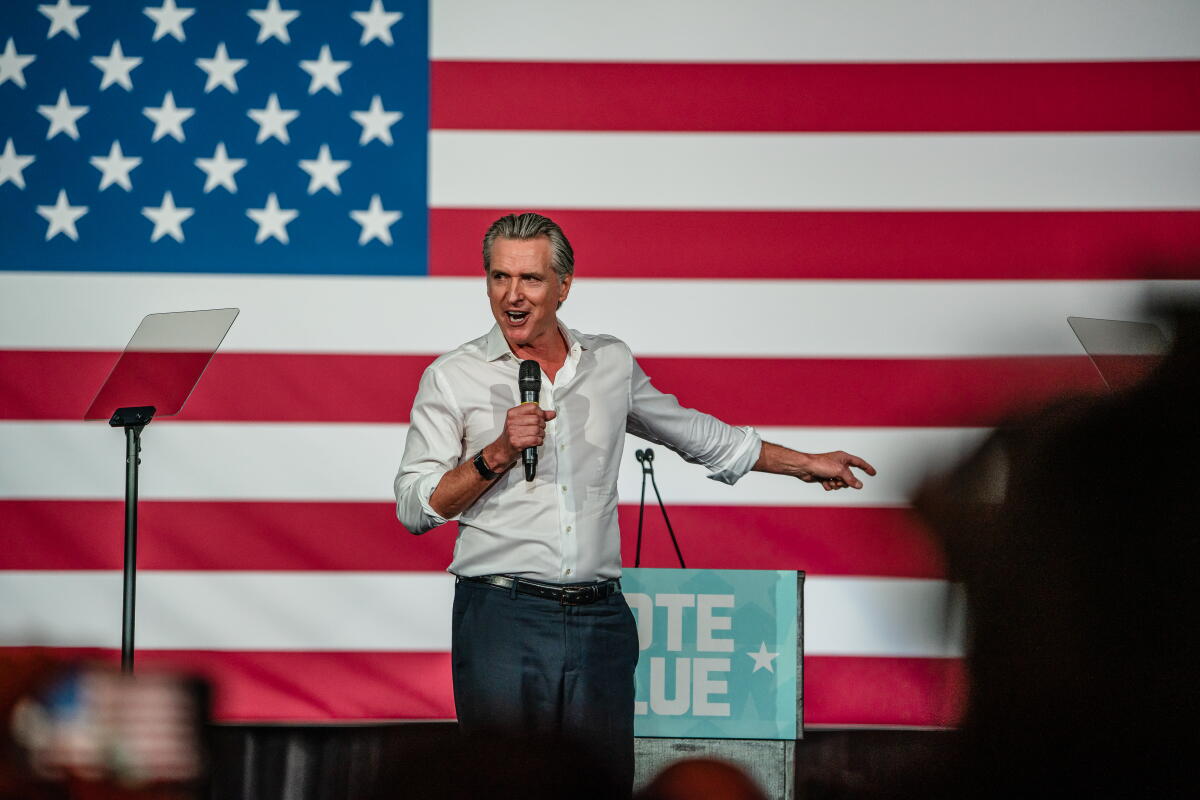
California Gov. Gavin Newsom speaks at the “Stop the Power Grab rally” at the Hollywood Palladium in Los Angeles on Nov. 1, 2026.
(Ariana Drehsler / For The Times)
Bold moves that test the limits of his power, such as a controversial, first-in-the-nation stay-at-home order during the early days of the COVID-19 pandemic and spearheading Proposition 50 last year to redraw California’s congressional districts to offset Republican attempts to gerrymander red states, have defined his leadership, for good or bad.
The Democratic governor said those kinds of decisions are “sort of embedded in my DNA.” About a decade ago he said he was pushed to describe his core motivation. Though he admits it sounds trite, the governor said: “It’s to stand up for ideals and strike out against injustice.”
The death penalty, he said, is not handed out equally. He quoted Bryan Stevenson, the founder of Equal Justice Initiative, who said you’re better off being rich and guilty than poor and innocent.
“I couldn’t not have done this,” Newsom said. “There was an easy out, but … I would the rest of my life felt, you know, ashamed of myself.”
Commuting the death sentences of all 548 state prisoners awaiting execution pushes the bounds of his authority once again. California voters have twice rejected ballot measures to abolish the death penalty, first in 2012 and again in 2016, and Newsom’s decision overrides the will of the courts and state laws that permit capital punishment.
Under the state Constitution, Newsom has the power to commute about 40% of the death sentences on his own. The rest of the cases, which involve prisoners who had a felony conviction on their record prior to receiving a death sentence, or racked up additional crimes while awaiting execution, require approval from the California Supreme Court — a constitutional check to ensure the governor’s actions are not an abuse of power.
The court rejected 10 commutations handed out by Gov. Jerry Brown in his last full month in office — all of which involved people convicted of multiple felonies — and did not provide an explanation for the action.
Despite Newsom’s push to commute all death sentences, capital punishment remains legal in California and prosecutors can continue seeking that punishment.

Los Angeles County Dist. Atty. Nathan Hochman speaks during a news conference at the Hall of Justice last month.
(Ronaldo Bolaños / Los Angeles Times)
Los Angeles County Dist. Atty. Nathan Hochman said until the law is changed, his office “will continue to evaluate every death penalty-eligible case with the rigor, care and restraint these decisions demand.”
Sacramento County Sheriff Jim Cooper urged Newsom to reconsider the commutations.
He said he remembers watching Luis Bracamontes, who was sentenced to death for killing Sacramento County Sheriff’s Deputy Danny Oliver and Placer County Sheriff’s Detective Michael Davis Jr. in 2014, “laugh in court while their families, including Danny’s two young daughters, had to sit and watch.
“Deputy Danny Oliver and Detective Michael Davis Jr. should be alive today, enjoying long and healthy lives with their families,” Cooper said in a statement. “Instead, the man who murdered them has now escaped his sentence.”
Others accused the governor of reducing the death penalty sentences to seek an advantage in the 2028 presidential election.
“The people of California deserve leaders who put politics and personal ambition aside and pursue truth, accountability, and justice with courage, integrity, and transparency,” said Michael Hestrin, Riverside County district attorney, in a statement. “Instead they have been presented with a decision that demonstrates a profound disregard for the victims, their families, and the prosecutors who dedicated themselves to seeking justice on their behalf.”

Luis Bracamontes looks up in Sacramento Superior Court in 2018 as the verdict is read in the killing of two law enforcement officers. Bracamontes was found guilty.
(Rich Pedroncelli / Associated Press)
A poll conducted in August by the Pew Research Center found that about two-thirds of voters nationally favor the death penalty for people convicted of murder.
Political analysts suggest that reducing the sentences adds to Newsom’s credentials as a progressive leader and aligns him with Democratic primary voters on the issue if he runs for president. Republicans, however, could take advantage of Newsom’s action and cast him as a soft-on-crime liberal who is out of touch with most Americans, which risks turning away moderate voters.
But others cautioned that national political elections are hard to predict.
Gar Culbert, chair of the political science department at Cal State Los Angeles, said it would be politically advantageous for Newsom to try to appeal to the Democratic Party’s base as he considers a run for president. Culbert said he doesn’t believe the death penalty will be a substantial issue in a general election when, if Newsom becomes the Democratic presidential nominee, his Republican challenger would attack his record as California governor regardless.
“It’s possible he’s not being strategic,” Culbert said. “Maybe he doesn’t have to be strategic because he just might think it’s the right thing to do.”
The governor first issued a moratorium on executions about two months after he took office in 2019, saying capital punishment is discriminatory and unjust. Without the moratorium, 45 people would be subject to execution now, according to his office.
Daniel Zingale worked for Newsom as a senior advisor in the governor’s office at the start of his first term. Part of Zingale’s job at the time was to consider how the governor’s actions would be received by the public.
“The only piece of data he was not interested in in that process were the polls,” Zingale said. “His view, and I agree with this, is this is not an issue that you can leverage politically.”
Newsom’s decision to commute the sentences won’t have much practical effect in a state that has not executed a prisoner since 2006. At Newsom’s command, the death chamber was dismantled at San Quentin State Prison, now San Quentin Rehabilitation Center, after he issued his moratorium.
His successor, Gov.-elect Xavier Becerra, has also said he will continue the pause on executions.
There was no immediate need to offer commutations to save the lives of the inmates.
Taking no action would have been the safe bet, Newsom said in an interview about his decision a day after he made the announcement. Many people around him, he said, advised him to do nothing.
He also understands that commuting the sentences could make him vulnerable if he runs for president.
“I’m not an idiot. The ads write themselves,” Newsom said. “But I just also would be fake. I wouldn’t be myself and if I’m going to be up there and not be myself, I couldn’t do that.”
With the clock ticking on his time in office, the governor said he also doesn’t want to leave with regrets.
“I don’t want to be one of the elders on some panel talking about what I would have, could have, should have done,” Newsom said. “I’ve spent my life trying not to be that person. I’ve been willing to take risks. I’ve been willing to go first on so many issues.
“If others aren’t willing to do it, you know what? I’ll raise my hand, and I’m happy, honestly, to take the hits.”