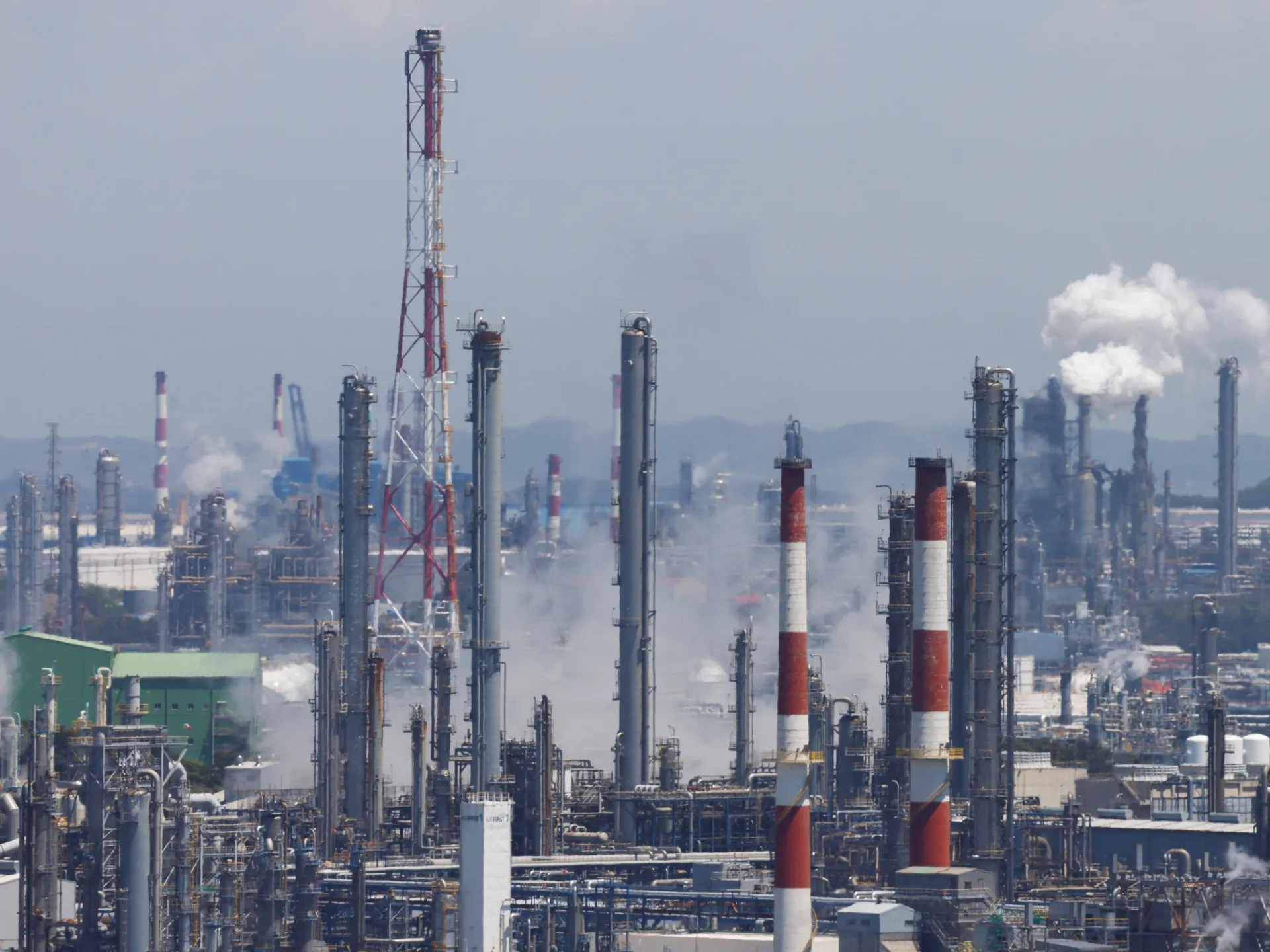
Ukrainian reports of South Korean fuel exports to Russia come amid strained tensions between Seoul and Kyiv.
Published On 8 Oct 20268 Oct 2026
South Korea’s Ministry of Foreign Affairs has said the government will take legal action over illegal fuel shipments to Russia if allegations from an adviser to Ukrainian President Volodymyr Zelenskyy are confirmed.
The Foreign Ministry said on Thursday it had not confirmed whether South Korean fuel, including diesel, had been exported to Russia.
Recommended Stories
list of 3 itemsend of list
It added that exports of some products, such as diesel and jet fuel for commercial purposes, were not included in a South Korean exports control list to Russia.
On Wednesday, the South Korean presidential office dismissed a statement by Vladyslav Vlasiuk, an adviser to the Ukrainian president on sanctions policy, that 176,000 tonnes of fuel were shipped from South Korea to Russia via sanctioned tankers in July and August.
Ukraine’s top sanctions official said the alleged findings run counter to South Korea’s sanctions policy towards Russia.
“Since Russia’s invasion of Ukraine, our government has consistently implemented sanctions and export controls against Russia in close cooperation with the international community,” South Korean presidential spokesperson Kang Yu-jung said on Wednesday, according to the Yonhap news agency.
“We ask that Ukraine also refrain from distorting the relevant policies of the Republic of Korea without sufficient verification of the facts and making public remarks that can damage international trust,” she added.
Relations between South Korea and Ukraine have been strained for the past couple of weeks after Seoul accused Zelenskyy of having “unilaterally disclosed” to the United Nations General Assembly that Kyiv had transferred two North Korean prisoners of war to South Korea.
Seoul Korea demanded an official apology from Kyiv, claiming the Ukrainian president had breached a non-disclosure agreement. Kyiv said no such agreement was in place.
Pyongyang and Moscow, meanwhile, have deep ties, with the two countries having signed a mutual defence treaty in 2024. According to Ukrainian and South Korean estimates, about 14,000 to 15,000 North Korean soldiers were sent to support Russia’s war efforts against Ukraine.
North Korea and South Korea remain technically at war because the 1950–1953 Korean War ended in an armistice rather than a peace treaty.
The European Parliament has called for tougher action against China’s economic coercion and support for Russia, warning that relations with Beijing have reached a “critical point”.
ADVERTISEMENT
ADVERTISEMENT
MEPs backed the resolution by a landslide on Wednesday, urging the EU to consider deploying its powerful Anti-Coercion Instrument if Beijing weaponises Europe’s dependence on critical raw materials.
October is shaping up to be a crucial month for EU-China relations. EU leaders, whose countries now all run trade deficits with China, are pressing the European Commission to deliver concrete results from negotiations with Beijing.
Tensions also extend well beyond trade. The EU has become increasingly alarmed by Beijing’s close relationship with Moscow and its role in sustaining Russia’s full-scale invasion of Ukraine.
“The relations have now reached a critical point, mostly due to China’s unfair economic practices such as dumping and spying and its position on Russia’s war of aggression against Ukraine,” the resolution adopted by EU lawmakers reads.
The text was backed by 454 MEPs, with 86 voting against and 110 abstaining.
Lawmakers described China’s role in the Ukraine war as that of “a decisive enabler”, pointing to “Chinese diplomatic backing and material assistance that sustains the Russian military-industrial complex”.
Pressure to use anti-coercion tool
They also call on EU countries and the Commission to “urgently” take action on “the weaponisation of critical dependencies by China.”
Europe felt the vulnerability of those dependencies in 2025, when China restricted exports of rare earths, which are vital to the EU’s automotive, defence and clean-tech industries, amid its escalating trade war with the United States.
The MEPs said the EU should consider using the Anti-Coercion Instrument (ACI) when China instrumentalises such EU dependencies.
The ACI is an EU mechanism that allows the bloc to adopt radical measures – up to restrictions on licences and intellectual property rights – against a third country that uses economic coercion against the EU.
China’s dominance of the production and processing of strategic raw materials has become a major sticking point in trade negotiations, giving Beijing considerable leverage as Brussels seeks to curb its dependence on Chinese imports.
A Commission proposal pushing companies to diversify their suppliers in strategic sectors is in the making and should be presented by the end of the year.
The resolution comes two days after Germany and France harden their stancetowards Beijing, calling for a new trade tool that could allow the Commission to impose measures leading to “an immediate cut-off from the internal market if needed”.
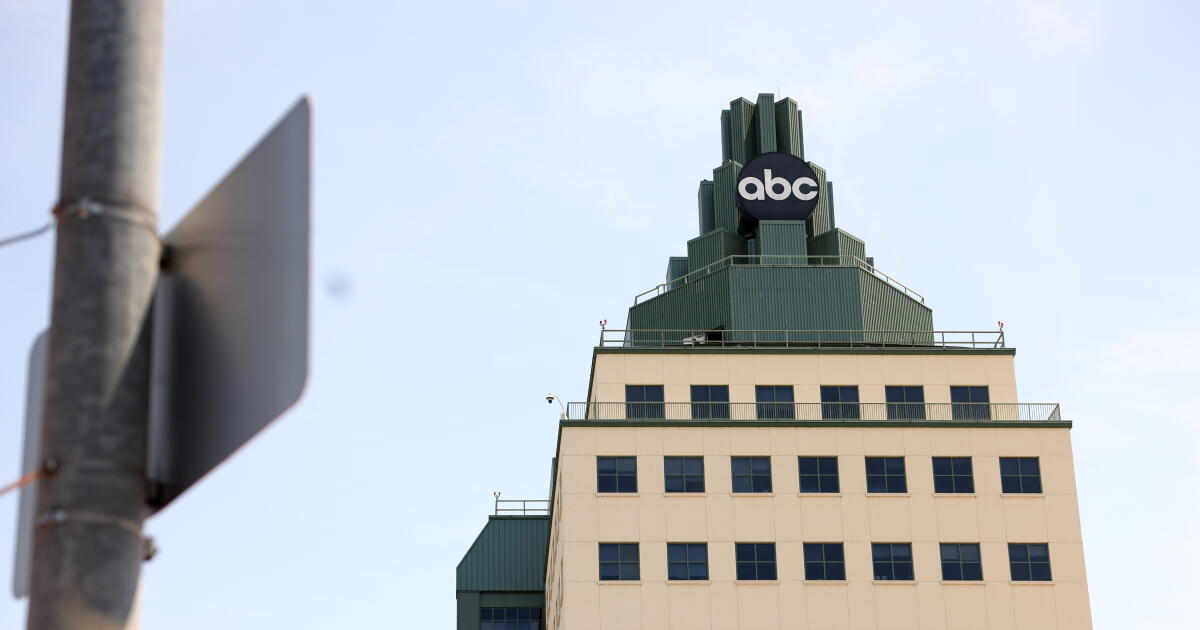
Editorial decisions at ABC News are being influenced by the Federal Communications Commission’s early license review of its TV stations, the network’s legal team told a U.S. District Court judge Tuesday.
The Disney-owned network is seeking a restraining order to stop the FCC’s action, which its attorneys said was unprecedented and an attempt by the Trump White House to chill free speech.
Disney attorney Beth Wilkinson said the FCC’s action is having an impact on ABC News coverage in the weeks leading up to the midterm elections, as the network tries to avoid further action from the agency that regulates over-the-air broadcast TV licenses.
“We are making different editorial decisions,” Wilkinson said during the court hearing in Washington. “We are watching everything that we do because every time we do something — even not broadcasting this presidential speech — brings out the anger in the administration and the retaliation from the agency.”
Wilkinson was referring to President Trump’s frustration over ABC’s decision not to air his July 16 speech about voter fraud. The network chose to run it on its news streaming platform. FCC Chairman Brendan Carr criticized the move and said it would be considered in the license renewal process.
Wilkinson cited Carr’s complaint as an example of how the review is being driven by Trump’s unhappiness over the network’s coverage across its news programs, its late-night show “Jimmy Kimmel Live” and its topical daytime chat show “The View.” The FCC’s action, she said, is the administration “retaliating with their government power against ABC’s right to protected speech.”
Assistant U.S. Atty. Dimitar P. Georgiev argued for the FCC that ABC is trying to avoid the commission’s regulatory process by taking the case to the U.S. District Court. Georgiev said the license renewal was initiated because of a dispute over documents in the commission’s investigation into alleged discriminatory hiring practices at Disney.
Judge Loren L. AliKhan did not issue a ruling. She asked the FCC to provide further documentation on its claim. Disney will have until Oct. 14 to respond.
Trump has frequently threatened to have TV station licenses pulled when he believes he is treated unfairly on news and talk programs. He has also successfully extracted multimillion-dollar settlements from CBS and ABC after suing the networks over news content he said had treated him unfairly.
ABC is the first network to take the FCC to court over the threats.
Wilkinson noted that Carr said during a visit to Trump’s Mar-a-Lago Club in Palm Beach, Fla., that “broadcasters that are running hoaxes and news distortions, also known as fake news, have a chance now to correct course before their license renewals come up.”
The licenses for eight ABC-owned TV stations, including KABC in Los Angeles, were originally scheduled for renewal between 2028 and 2031.
Carr has said ABC’s daily talk show “The View” should not be exempt from the FCC’s equal time rule that requires broadcasters to bring on opposing candidates to provide balanced coverage. Wilkinson noted that the program — which was given the exemption in 2002 — has avoided using clips of politicians during its popular “Hot Topics” segment at the top of the program.
Carr also said earlier this year that stations could be subject to discipline if they “don’t operate in the public interest” after criticisms from the White House about coverage of the Iran war.
Carr called for the ABC license review in April, days after Kimmel delivered gags about the White House Correspondents’ Assn. dinner attended by Trump for the first time as president and described First Lady Melania Trump as having a “glow like an expectant widow.”
The satirical remarks drew criticism after a man later breached security at the Washington Hilton event while armed with a shotgun, handgun and several knives. The dinner was cut short and rescheduled.
Protests have continued across France for a third week as tens of thousands of school pupils and trade unionists have taken to the streets across many cities.
Students initially began boycotting classes in deprived areas of Paris on September 21 over teacher shortages and poor conditions, but protests have quickly morphed into a nationwide movement, with some of the largest demonstrations taking place on Tuesday.
Recommended Stories
list of 4 itemsend of list
School blockades have turned violent, with protesters accused of hurling items at police and officers allegedly responding forcefully using batons, tear gas and rubber bullets. In one case, a teenager lost his hand in a grenade explosion.
The mass demonstrations, which also coincided with a public sector strike over government budget plans last week, have presented another challenge for President Emmanuel Macron’s cash-strapped government ahead of next year’s elections, amid an ongoing fiscal crisis as government debt has rocketed in recent years.
Here’s what we know:
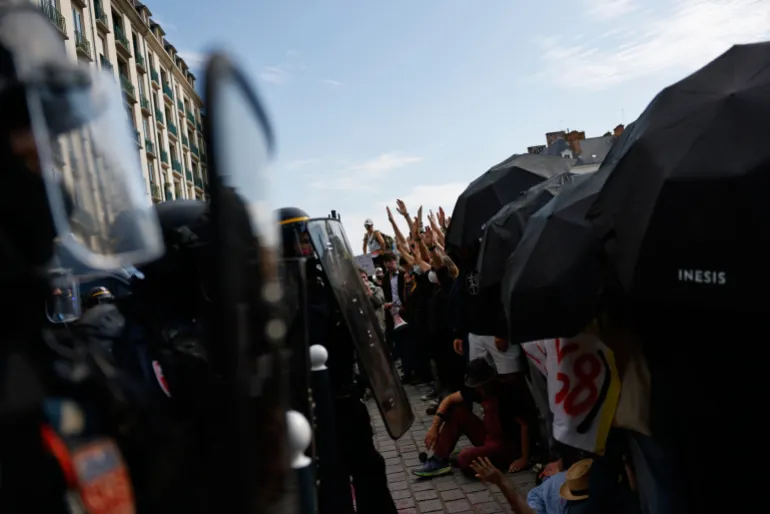
Riot police face students during a protest against under-resourced schools in Rennes, western France, on October 6, 2026 [Jeremias Gonzalez/AP]
What do protesters want?
Students have been protesting over what they say are poor conditions in France’s high schools – or lycees – especially in poorer areas. Protests have been held in Strasbourg, Bordeaux, Nantes, Marseille, Lyon and other towns and cities.
Students say absent teachers are not replaced, dilapidated school buildings are sometimes rodent-infested, there are inadequate tables and chairs, large class sizes and long classroom hours.
The intense heatwave which hit France in the summer exacerbated existing problems in neglected school buildings, which also suffer from a lack of air conditioning, school pupils say.
The protests have coincided with ongoing nationwide public sector strikes over a proposed 2027 cost-cutting budget that aims to achieve 54 billion euros ($61.3bn) in savings as Macron’s government races to bring a large public deficit under control.
Public sector staff and unions object in particular to a government plan to freeze salaries to save about two billion euros ($2.27bn).
Parents are also increasingly present at protests amid widespread anger about the police response to demonstrating minors.
But the protests are happening amid wider discontent over soaring fuel and commodity prices and reduced public spending under Macron.
Government officials have meanwhile accused political opposition groups and unionists of taking advantage of the student movement. Prime Minister Sebastien Lecornu accused political opponents last week of encouraging escalation.
What has happened so far?
At least 6,100 people had been arrested by early Tuesday, many of them under the age of 18, as police tactics come under intense scrutiny.
Serious injuries have also been reported.
A 15-year-old lost a hand in the northern city of Lens on Monday after he reportedly came into contact with a police stun grenade, which then exploded. Public prosecutors say investigations are ongoing into whether the youth actively picked up the grenade or if it landed on him.
Overall, at least 190 high school students have been injured, Education Minister Edouard Geffray said on Monday. On Sunday, he said 78 teaching staff had been injured, and 24 schools had been burned or ransacked.
Some 715 police officers have been injured, according to Interior Minister Laurent Nunez on Tuesday.
Officials said as many as 589 schools have been disrupted this week, down from 735 on Friday last week.
Rights groups, including Amnesty International, have criticised the use of force against minors amid media reports of students being hit with batons and rubber bullets, as well as sprayed with tear gas.
What happened on Tuesday?
Protesters again blockaded schools on Tuesday as thousands demonstrated over their demands.
Placard-waving crowds were reported in southern Marseille, eastern Strasbourg and other major cities.
In Paris’s 20th district, protesters outside the shut Helene Boucher lycee tipped over rubbish bins and bicycles and created a makeshift barricade, The Associated Press news agency reported. Parents, meanwhile, positioned themselves between the demonstrators and police to protect their children.
“They are our children. Teachers, parents, federations, we all share the same goal: the protection of children’s rights, and it is a legitimate right to demonstrate and to make demands,” said Emilia Sichili Suriam, one member of a parents’ association.
Interior Minister Nunez rejected criticism of the police on Tuesday, saying the response has been proportionate in “almost all cases”. He claimed that the protests were transforming into “riots”.
What does this mean for the French government?
These are only the latest in a series of high-profile protests that have marked Macron’s presidency and undermined his government’s reform efforts ahead of elections in April and May.
Macron will not run in next year’s elections, but his image and that of his government have no doubt been tainted by photos of police chasing students in the streets, France expert Jacob Ross, from the German Council on Foreign Relations (DGAP), told Al Jazeera.
“He is not taken seriously any more because many think of him as already out of government,” Ross said of Macron. “But this is still very significant for his government because it has become clear that they don’t have the capacity to calm things down. There’s clearly little fiscal room to manoeuvre.”
Macron’s terms have long been beset by political and financial instability. Successive prime ministers have faced difficulties in pushing through policies in the highly polarised National Assembly where Macron’s centrist Renaissance party and allied blocs lack a majority.
Critics have taken aim at Macron’s deeply unpopular austerity measures, which have seen drastically reduced government spending taking a toll on pensions and healthcare. Officials, however, have defended these policies amid rising debt following COVID-19-era spending.
On Sunday, Lecornu said the government had kickstarted initiatives to address the protesters’ demands and that a report was expected by the end of the month. He, however, added that Paris would not “yield an inch” to violence.
Meanwhile, frontrunner and opposition leader Marine Le Pen of the far-right National Rally party submitted a shadow budget on Tuesday promising 140 billion euros ($157.6bn) in cost savings by 2032 if elected next year.
Unite general secretary Sharon Graham said: “Leeds Bradford Airport is very profitable and can more than afford to come back to the table with an offer that doesn’t fall short of our members’ expectations.
“Our hardworking members should not be paid less than those doing the same jobs at other airports.
“Workers taking action at Leeds Bradford Airport have Unite’s full support in their fight for fairer pay.”
It also previously revealed plans to one day launch long-haul flights, with most routes being to Europe including Spain.
Although the airport is losing all of it’s easyJet flights next year, which will be axed by January 2027.
Unite regional officer Neil Whitaker said they had “no choice but to strike,” citing a “fair pay rise” needed to call it off.
A Leeds Bradford Airport spokesperson told Sun Travel: “Leeds Bradford Airport acknowledges the proposed industrial action due to take place between 16-18 October involving a group of operational colleagues.
“We respect the right of employees to participate in lawful industrial action. However, we are disappointed by this and do not believe strike action is the right way to resolve the issues still under discussion.
“The airport has made what we believe is a fair and responsible offer that is significantly above inflation and reflects both current economic conditions and the need to ensure the long-term sustainability of the business.
“Our priority now is to minimise disruption for customers, many of whom have worked hard and saved for important holidays, family visits and business travel. At this stage we anticipate running near-normal operations during the period.
“Leeds Bradford Airport plays a vital role in connecting Yorkshire to the world. Industrial action has the potential to cause inconvenience for thousands of customers and local businesses who rely on those connections.
“We remain committed to constructive dialogue with Unite and would welcome continued discussions aimed at reaching a resolution.
“It is important to recognise that any profits generated by Leeds Bradford Airport are reinvested back into the airport and has been for a number of years. Those funds support improvements to facilities, infrastructure, operations and customer experience including the ongoing LBA:REGEN project which saw the opening of a new central search zone and staff welfare facilities this week.”
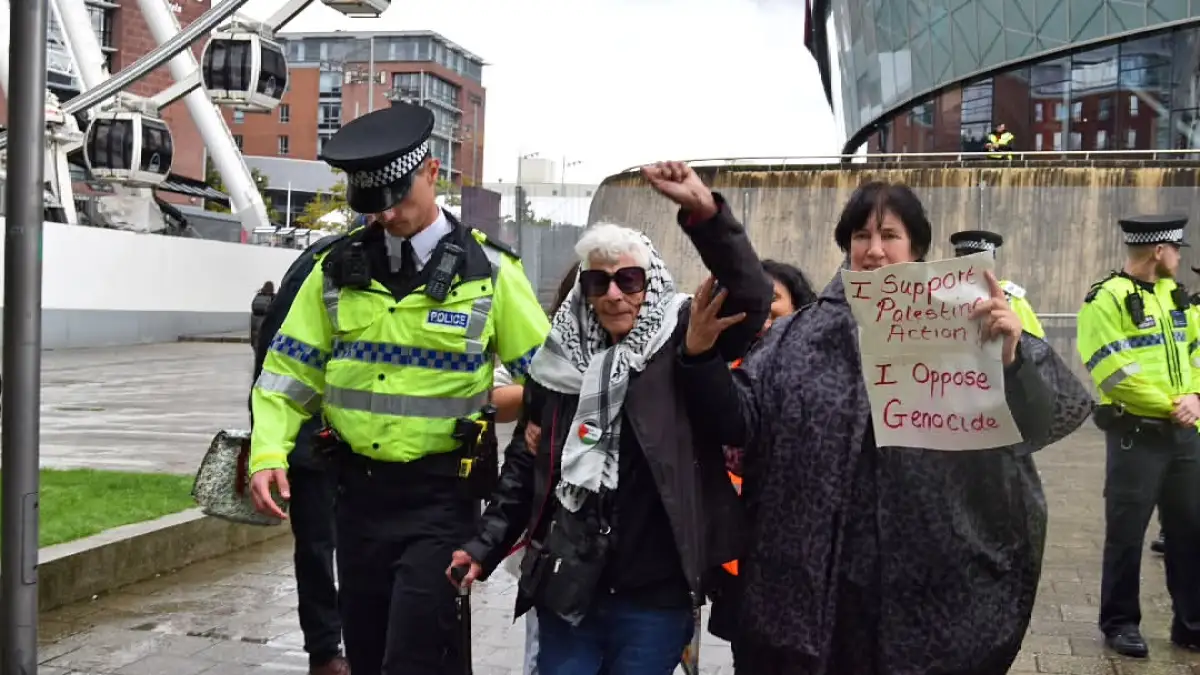
‘I’ve been trying to get arrested for quite some time.’ 94-year-old Jewish human rights barrister Margaret Owen was detained at a pro-Palestine rally in Liverpool after displaying support for Palestine Action, a group proscribed as a terrorist organisation in the UK.
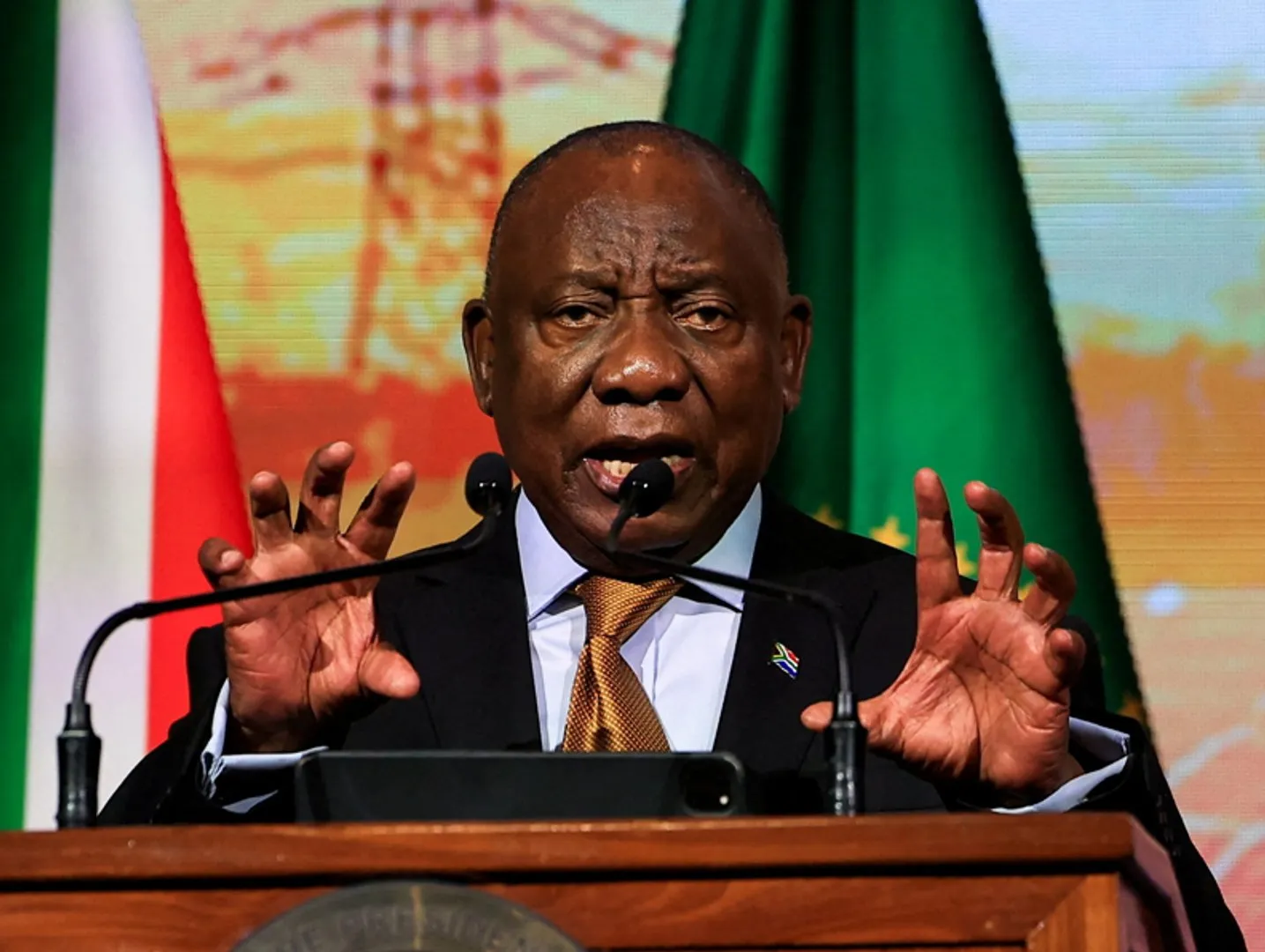
South Africa’s President Cyril Ramaphosa has announced new measures to combat femicide and gender-based violence in the country. Since July, the bodies of at least 11 women have been found in an area east of Johannesburg prompting a nationwide outcry for action
Argentina gives UK two weeks to cease operations or face maritime court action.
Published On 29 Sep 202629 Sep 2026
Argentinian President Javier Milei has threatened the British government with legal action unless it stops an oil project off the disputed Falkland Islands, the British-administered territory over which Buenos Aires claims sovereignty.
Milei gave the United Kingdom a two-week ultimatum on Monday evening, saying it must halt all work on the Sea Lion oil project or Argentina will ask the International Tribunal for the Law of the Sea, a maritime court in Hamburg, Germany, to order a stop to the project.
Recommended Stories
list of 3 itemsend of list
He called the operations “the illegal plundering of our resources” and declared “Argentina will not stand idly by” as the UK causes “irreversible and irreparable” damage.
The companies developing the project, Israel’s Navitas and Britain’s Rockhopper, have shrugged off Argentina’s threats, insisting they have valid exploration licences issued by the UK.
The tribunal, an independent court established under the 1982 UN Convention on the Law of the Sea, can issue legally binding emergency orders. But even if it ordered the UK to halt the project, it has no means of forcing the government to comply.
The UK rejects Argentina’s sovereignty claim, arguing that the islanders have the right to determine their own future and develop their natural resources. In a referendum in 2013, residents of the Falklands voted overwhelmingly to remain a British overseas territory. Argentina says the islands were populated illegally.
Milei’s administration has already taken legal action against the project authorised by Britain, arguing it violates a United Nations resolution calling for both sides to desist from unilateral actions in the islands until their dispute is resolved.
Buenos Aires has doubled down on its claim over the Falklands since United States President Donald Trump said Washington was open to reviewing its historically neutral stance on the territory.
The British government for its part has said it stands behind the businesses operating near the Falklands.
The dispute over the Falkland Islands led to a war between Britain and Argentina in 1982. It killed 649 Argentinian soldiers, 255 British soldiers and three islanders after Argentina invaded the archipelago that year.
Demonstrators protest against UK government’s proscription of Palestine Action as a terrorist organisation.
Published On 28 Sep 202628 Sep 2026
Police in the United Kingdom have arrested more than 50 people protesting in support of the banned Palestine Action group outside a Labour Party conference in the northwestern English city of Liverpool.
The local Merseyside Police confirmed the arrests in a statement published on Sunday.
Recommended Stories
list of 3 itemsend of list
The police said those taken into custody at the protest, organised by Defend Our Juries, had displayed material in support of Palestine Action, proscribed as a “terrorist” group by the Labour government in July 2025 under the Terrorism Act.
According to the statement, police respected the rights of people to protest lawfully while aiming to keep the peace and ensure the public are safe.
A police officer speaks to a supporter of the group Palestine Action as demonstrators gather to protest outside the conference venue on the first day of the annual Labour Party conference in Liverpool, northwest England, on September 27, 2026 [Oli Scarff/AFP]
More than 250 protesters sat outside the conference centre holding banners with words supporting the group on Sunday, before dozens of police began making arrests.
English band Massive Attack singer Robert Del Naja was among those arrested.
After asking demonstrators if they were going to continue holding up the signs, officers led people away, telling them they had been arrested under the Terrorism Act.
Reporting from Liverpool, Al Jazeera correspondent Milena Veselinovic said the protesters wanted to put proscription “front and centre of the UK Prime Minister Andy Burnham’s agenda” on the first day of his party’s annual conference.
“Being arrested is nothing in comparison to what the people in Gaza are going through, and it’s also worth it, because this is about our right to free speech,” one protester told Al Jazeera.
Another said that “there are priests, there are healthcare workers, there are people who deeply care, and deeply care about right and wrong.”
Kerry Moscogiuri, chief executive of Amnesty International UK, said protesting “is one of the most effective tools” to make government leaders listen and described the arrests as “a truly shameful attack on freedom of speech”.
“The new prime minister can reform our laws so that communities are protected in coming together and demonstrating on the issues they care about. Will he do so?” she said.
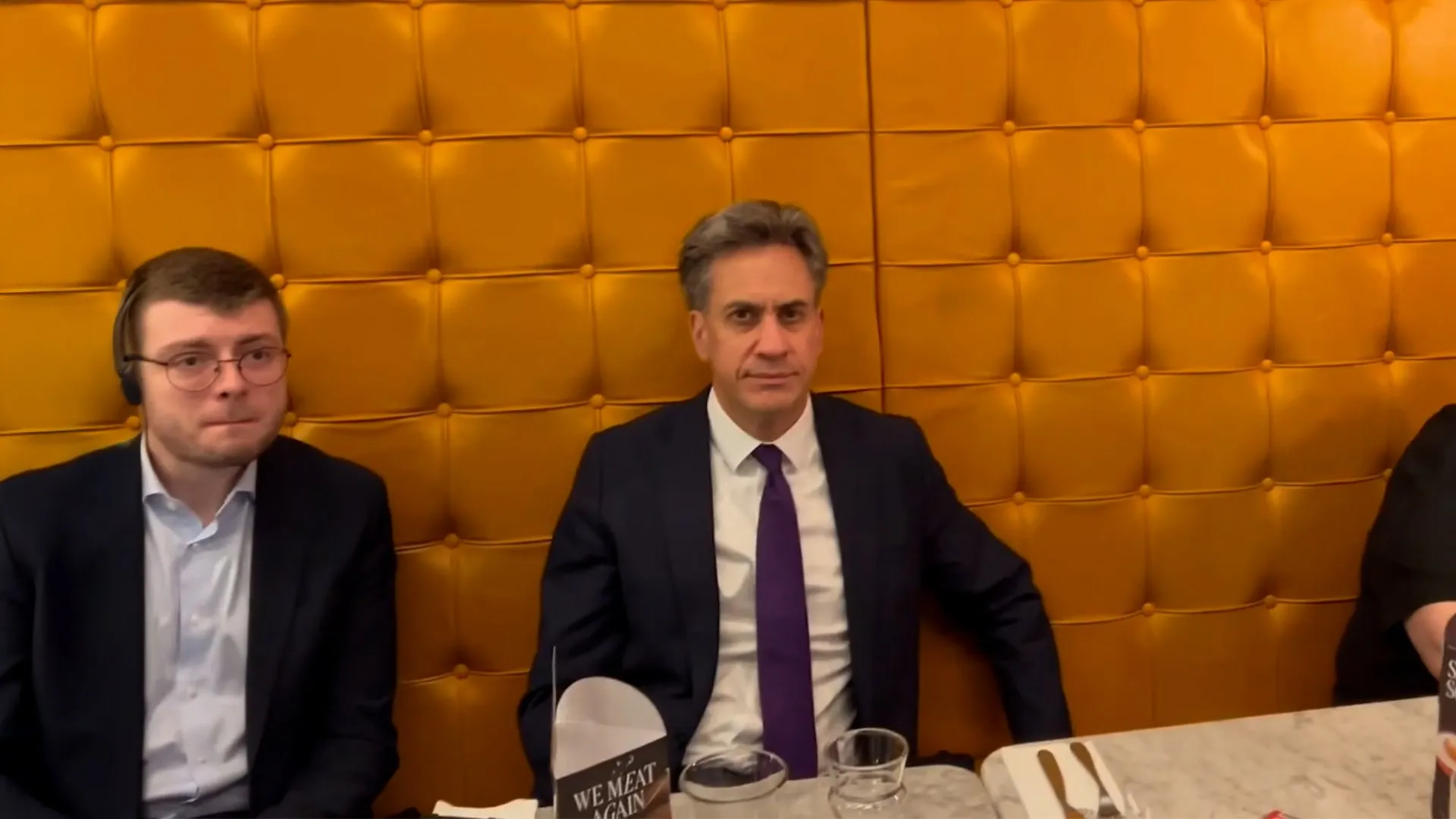
Activists also confronted Foreign Secretary Ed Miliband inside a restaurant in Liverpool, demanding that he lift the ban on the group and declare Israel’s genocide in Gaza.
The activists left after Miliband reportedly refused to comment.
A civil disobedience campaign has emerged since Palestine Action was outlawed in July 2025, with more than 3,600 people arrested for showing their support for the group, often while holding signs reading, “I oppose genocide. I support Palestine Action.”
The UK Supreme Court is now set to hear the case after London’s Court of Appeal upheld the government ban in June.
UK Foreign Secretary Ed Miliband was confronted by activists at a Pizza Express restaurant in Liverpool over the proscription of Palestine Action. Nearby, more than 50 demonstrators were arrested while protesting in support of the group outside a Labour Party conference.
Head of the Roman Catholic Church holds ’emotional’ two-hour meeting with seven abuse victims in French town of Lourdes.
Published On 27 Sep 202627 Sep 2026
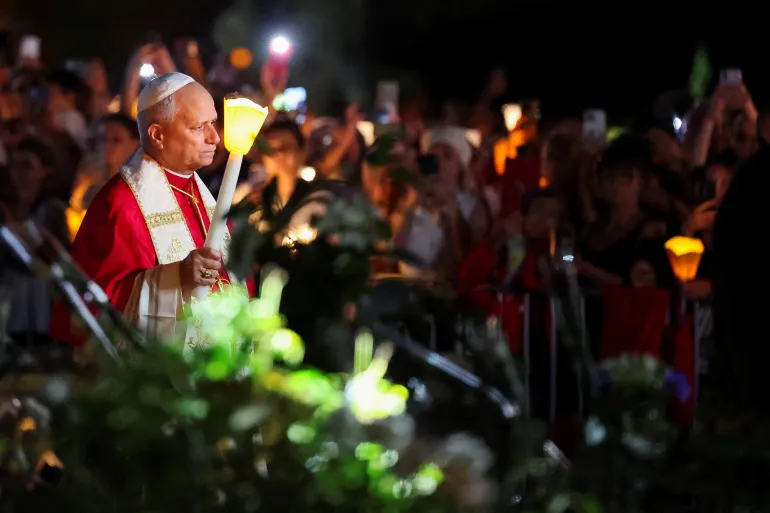
Pope Leo XIV has thanked a group of survivors of clerical abuse “for their painful testimony” and “reaffirmed his commitment” to end harm by Catholic priests at a meeting in southwestern France, the Vatican said.
On Sunday, the pontiff visited the pilgrimage town of Lourdes, where he privately met seven survivors of child abuse, now adults, and promised to further efforts to reform the Church in the wake of the global sexual abuse scandal.
The group said in a later news conference that the meeting was emotional and touching.
“When he saw the state I was in, he took me into his arms,” survivor Jean-Marie Delbos said, adding, “It was an extraordinary moment.”
The 80-year-old was abused as a pupil at the nearby boarding school of Notre-Dame de Betharram, where staff have been accused of physical and sexual abuse over several decades.
The survivors said they felt heard and that they were impressed by Leo’s compassion and knowledge of their individual cases.
But they hoped the words would be accompanied by action.
Jerome Guillement, who has written about a priest abusing him as a teenager, said at the news conference that the pope understood the “systemic” nature of sexual abuse in the Church.
“From his point of view, the perpetrators are individuals, but what allows it to continue is the systemic dimension within the institution,” he said.
“He certainly believes that the Church has done a great deal in France, but he also believes that the Church in France still has a tremendous amount left to do.”
Pope Leo participates in a candlelight procession at the Sanctuary of Our Lady of Lourdes in Lourdes, France, September 27, 2026, as part of his four-day apostolic journey to France [Stephane Mahe/Reuters]
Local leaders hoped Leo’s visit would help repair the Church’s standing after a 2021 independent inquiry found that some 330,000 French children had been abused by Catholic clergy and lay leaders over seven decades.
The pope told an estimated 150,000 people gathered for a Mass in a field near the famed Catholic shrine in Lourdes earlier on Sunday that the Church must have the courage to face its past.
Veronique Garnier, another survivor who met with the pontiff, said she had found the Mass, in which Leo referred to abuse without directly apologising for it, troubling and wondered why she had attended.
But she said she was encouraged by her meeting with Leo.
“I do indeed believe there is hope – hope that there can be change and truly listening to us at a deep level, rather than just superficially with beautiful words that are never followed by any real action,” she said.
Leo also spoke about the abuse scandals in a closed-door meeting with French bishops on Sunday, according to a Vatican-provided text.
He was expected to visit the northeastern city of Metz on Monday before returning to Rome the same day.
Cuba’s deputy foreign minister slams US sanctions, labelling them ‘equivalent to genocide’.
Published On 27 Sep 202627 Sep 2026
A senior official in Cuba has warned that any prospective United States military action taken against the island nation would constitute a serious international crime, and has rejected claims made by US President Donald Trump that Cuba is a failed state.
On Sunday, Carlos Fernandez de Cossio, the country’s deputy foreign minister, told the US cable television channel C-SPAN’s flagship programme, Washington Journal, that it would be an “atrocious international crime for the US to use military force against Cuba, which is a peaceful neighbouring country”.
His comments come after Trump said during his Tuesday speech at the United Nations General Assembly (UNGA) that “freedom will be coming” to the island. His remarks prompted the Cuban delegation to exit the assembly hall. On Saturday, Trump brought up military action, telling reporters, “I don’t think we’ll need the military. Cuba is failing very badly.”
Fernandez de Cossio said that coercing nations who do not “submit” by disrupting their commercial shipments, attempting to handicap a population through starvation, depriving it of stable healthcare and withholding fuel, as the US has “done for nine months now”, is “equivalent to a genocide”.
The US has maintained a foreign policy of maximum economic pressure against Cuba for more than 60 years. The Trump administration has previously said that it wants a shake-up in Cuba’s government. Earlier this year, the administration enforced an additional oil and fuel blockade against the island, which has crippled the nation’s infrastructure, causing widespread fuel scarcity and rolling power outages. Government officials in Cuba cited systemic difficulties in securing food supplies and other basic necessities for the country of more than 10 million.
Fernandez de Cossio said Havana must ready its citizens for the prospect of US military aggression, adding that while Cuba recognises it might stand alone, it will still exercise its legitimate right to self-defence.
He explained that bilateral diplomatic channels with the US remain open but have yielded minimal results due to the economic stranglehold of ongoing sanctions, adding that Havana remains willing to engage with Washington in a “respectful manner” only if discussions accommodate mutual dignity, benefit both populations, and respect state sovereignty.
Several countries condemned the US’s continued economic sanctions and blockade of Cuba during the UNGA earlier this week.
New Orleans Pelicans star Zion Williamson had a “friendly and casual ‘friends with benefits’ sexual relationship” with the woman who is accusing him of raping and abusing her multiple times between 2018 and 2023, according to a court filing by the former Duke standout’s legal team.
A document submitted to Los Angeles County Superior Court on Monday states that Williamson denies “each and every allegation” made against him by a Jane Doe in a second amended complaint filed in June.
Williamson’s filing describes the interaction between the former No. 1 overall draft pick and his accuser as “infrequent and sporadic.”
“All interaction among and between the Plaintiff and Defendant was pleasant and entirely consensual, with the Plaintiff initiating and communicating her desire to be intimate with the Defendant,” the document states, “and the Plaintiff herself decided to end the relationship because she became upset when she realized that the Defendant was focusing his time and energy on professional basketball and on being a father, and did not have sufficient time or interest to maintain a relationship with the Plaintiff.”
The second amended complaint lists the causes of action as assault, battery, sexual battery, intentional infliction of emotional distress, domestic violence and stalking. The response from Williamson’s team states that the statute of limitations has expired on each cause of action.
The initial complaint, filed in May 2025, also included false imprisonment and conversion as causes of action, which are not included in the latest complaint.
The lawsuit provides details of two instances in 2020 during which Williamson allegedly raped his accuser in a Beverly Hills apartment he was renting at the time.
“These two incidents were not isolated,” the lawsuit states. “Defendant continued to abuse, rape, assault, and batter Plaintiff in California and other states, including Louisiana and Texas, until the relationship ended in 2023.”
The lawsuit also alleges that Williamson committed many other acts of violence against his accuser, including strangling her multiple times to the point that she lost consciousness, suffocating or smothering her, striking and kicking her “with great force,” threatening to kill her and her family members, and pointing a loaded firearm to her head.
Williamson “was either drunk or on cocaine” while allegedly committing many of those acts, the lawsuit states.
Canada pledges 100 million Canadian dollars ($71m) in aid for Palestinians as the UK and France call for action against Israeli settlement expansion in the occupied West Bank.
Published On 23 Sep 202623 Sep 2026
Canadian Prime Minister Mark Carney has announced that Canada is pledging 100 million Canadian dollars ($71m) in international assistance for Palestinians in an effort to preserve “the possibility of a two-state solution”.
Speaking on the sidelines of the United Nations General Assembly (UNGA), Carney outlined that 80 percent of the funding will go towards direct humanitarian aid. The remaining 20 percent will be allocated to “support peace and security”, including Canada’s multiyear initiative to train Palestinian police in the occupied West Bank.
Recommended Stories
list of 3 itemsend of list
Carney prefaced the pledge by noting that Palestinians in Gaza continue to endure “immense human suffering”, while Israelis confront “existential threats from Hamas and from Iran and its proxies”.
The prime minister was also critical of Israel’s E1 settlement project, with the “intention to bring forward trade restrictions targeting goods produced in those illegal Israeli settlements”.
Canada is one of the 12 states that announced restrictions on trade in goods with settlements in the occupied territory.
Since the beginning of Israel’s genocidal war on Gaza, Ottawa has pledged more than 600 million Canadian dollars ($426m) in aid for Palestinian civilians.
‘Shame on all of us’
Carney was not the only Western leader to speak on Palestine. French President Emmanuel Macron also slammed world leaders for restrictions on aid in a UNGA speech on Tuesday.
“There are those who claim that peace has been achieved, but this has not opened the way for humanitarian aid deliveries. This sight is shameful. Shame on all of us,” he said.
“But what is our credibility worth if we remain inactive in the face of Gaza?” he added.
British Prime Minister Andy Burnham with French President Emmanuel Macron in London, UK [File: Leon Neal/Reuters]
British Prime Minister Andy Burnham said failure to deliver a two-state solution will “corrode trust” in politicians who have talked about the issue but not taken action.
Burnham told delegates from dozens of countries that the UK has also banned trade with illegal Israeli settlements in the West Bank because the E1 settlement expansion plan is “a deliberate attempt to block a two-state solution”.
“We all live in an era of low trust in politics. Many people in this room, many politicians around the world, have spoken for decades about a two-state solution. But if we fail to back those words with deeds, we will further corrode trust in the political, diplomatic and international process,” Burnham added.
WASHINGTON — President Trump on Monday headed into a week full of high-stake meetings with world leaders after spending a 72-hour period banning reporters from the White House, mulling whether it was time to “blow … up” Iran, and proposing to house military drones and snipers in his triumphal arch in the nation’s capital.
The weekend — which also included the announcement of a security deal over Greenland and the creation of a new “A.I. Force” — captured an American president operating unpredictably across multiple fronts even as each one drew friction. The actions now stand to color the backdrop of a week that will feature meetings with world leaders at the United Nations General Assembly in New York and a state visit by Chinese President Xi Jinping in Washington.
Each of those moves carries its own political weight ahead of the diplomatic talks, but also ahead of the midterm elections, where these topics are front and center in key races.
Trump’s handling of the Iran war, its subsequent shocks to the global economy, his push to fast-track the development of artificial intelligence and the Greenland agreement are likely to come up in meetings with world leaders. His deal with Denmark to bolster U.S. military presence in Greenland, a territory Trump has repeatedly tried to annex, is expected to be signed Tuesday in New York, though action is still needed by the Danish and Greenland governments before it can be enforced.
While all the details of the Greenland deal are not public yet, Trump has said it is a “dream come true for the United States of America.”
“This solution is a great one for the United States of America, Denmark, Greenland and all of our Allies,” Trump wrote on social media Friday. “We look forward to working with the wonderful people of Denmark and Greenland toward a magnificent future with respect to this large, and highly strategic, parcel of land. We will be very protective of it.”
In an interview Sunday, Trump also indicated that he was trying to make a decision on Iran as the war stretches into its eighth month. The president said he would “probably be open” to meeting with Iranian President Masoud Pezeshkian during the U.N. General Assembly.
“My question is, if and when do I blow the entire nation up?” Trump told Fox News. “They better behave.”
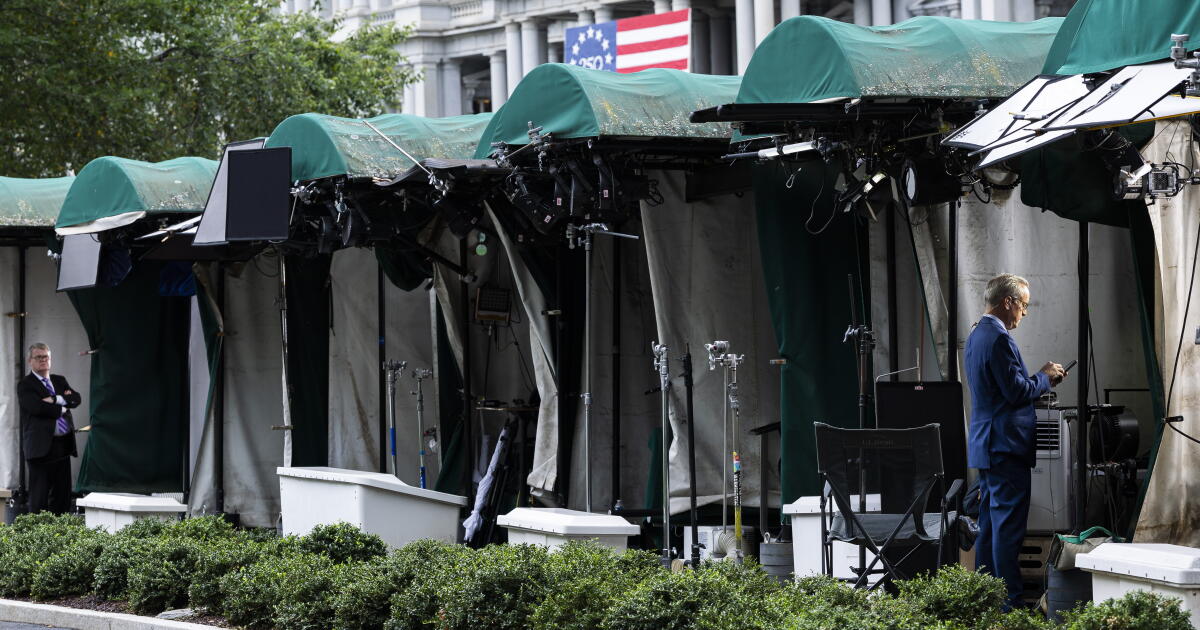
Of all the actions Trump took, the press dispute has become the most contentious and drawn an immediate legal response. Three major news outlets — CNN, MS NOW and Politico — sued the Trump administration Monday for banning their reporters from the White House grounds, and major television networks suspended their pool coverage of the president’s activities.
In a joint statement, the organizations said the White House has acted “without notice or process” and called the arbitrary decision a “blatant violation” of the 1st Amendment.
Trump, meanwhile, argued Monday that the banned news outlets are “corrupt” and a “threat to our national security.”
Vice President JD Vance defended the press ban.
“He’s not banning media outlets. What he’s doing is saying we’re not going to give you special access to the White House if you engage in what is effectively propaganda,” Vance said Monday, arguing that the three outlets push out “negative” coverage of Trump.
The tense showdown between Trump and the White House press corps led to audio problems during the president’s ribbon-cutting ceremony for a new helipad on the South Lawn. Without television cameras and microphones set up by the major TV networks, it was impossible to hear what Trump was saying through the White House’s official YouTube stream, signaling further technical difficulties in the week ahead.
Behind the public displays of control, news reports have painted a picture of a president increasingly frustrated by the lack of credit he feels he is owed. At a recent closed-door meeting, reported by the Wall Street Journal, Trump told advisors he was aggravated that his allies hadn’t lauded him enough for his efforts to take over the Kennedy Center or other accomplishments made during his second term.
Trump has tried to put his name on the building’s facade and run into resistance from Democrats, arts patrons and a federal judge who blocked the move last week. Trump was then photographed aboard Air Force One looking at a large printout appearing to show demolition plans for the center.
Over the weekend, Trump posted on social media a link to a news article that claimed he was seeking to fix “safety hazards” at the performance center. He then posted an image of him watching the Western Hemisphere with the words, “His Hemisphere,” and wrote that his proposed triumphal arch near the National Mall would be used as a military complex for drones and snipers.
Trump also announced that he would be creating the “A.I. force,” modeled after the Space Force he launched during his first term, to ensure the country does not “in any way hinder or stifle the growth of the industry.” The announcement came amid growing backlash to data centers and the fast-paced development of artificial intelligence, an issue that in recent weeks has prompted stark warnings about the technology’s power and its threats to humanity.
Tech executives, including Dario Amodei and Sam Altman, have even called for a slowdown on the technology’s advancement and last week, four leading AI companies — Anthropic, OpenAI, SpaceXAI and Google — faced a lawsuit claiming they made an illegal deal to slow the pace of their respective AI development.
Trump’s announcement over the weekend comes as lawmakers, including congressional Republicans in tight races, have called for new guardrails on the technology.
Despite technology becoming a political flashpoint during the midterms, Trump has dismissed concerns about AI as a hoax and asserted that those who oppose data centers are intent on being “backwards and poor.”
Sen. John Kennedy (R-La.) is among the lawmakers who have called for action on regulating the technology, and he has warned that not doing so could come at a cost on Nov. 3.
“We really need to send a memo around explaining we’ve got midterm elections coming,” Kennedy told Politico. “I may send that out.”
Looking at today’s schedule, it’s mostly arrivals into the airport after 9.30pm that are affected.
Only two flights from the UK are affected by the strike action today.
The first is a flight from Manchester Airport to Charleroi which was scheduled for 10.55pm and has since been cancelled.
The second is a flight from Charleroi to Manchester Airport which was scheduled for 19.35pm and has also been cancelled.
Ryanair has asked passengers to monitor their Ryanair App for the latest updates regarding their flight.
In a previous statement, the airline said: “We sincerely apologise for any inconvenience caused as a result of these ATC strike delays/cancellations, which are entirely beyond airlines’ control.”
Yesterday, about 40 flights in total were cancelled at Charleroi Airport.
According to Skeyes, the Belgium‘s official national air navigation service provider, the nightly strikes are expected to affect more than 800 flights.
The strike is set to continue until October 10Credit: Getty
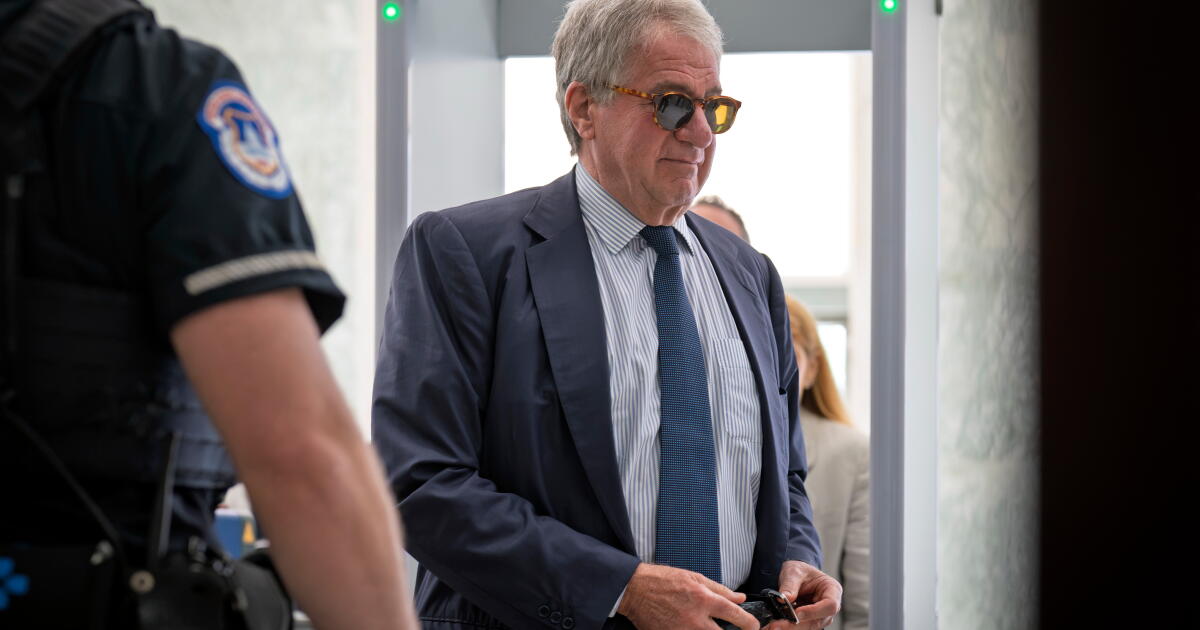
WASHINGTON — The House approved a resolution Wednesday holding billionaire Leon Black in contempt of Congress, referring the matter to the Department of Justice after he defied the Oversight Committee’s subpoenas in its investigation into disgraced financier Jeffrey Epstein.
The action was swift and without a formal vote, and now leaves it to the Justice Department to decide whether to seek criminal prosecution. Black has refused to respond to the subpoenas’ requests to appear and to turn over any potential nondisclosure agreements involving the investigation into Epstein.
Republicans and Democrats from the Oversight Committee joined in a bipartisan effort to advance the resolution forward.
“No one is above the law,” Rep. James Comer (R-Ky.), the Oversight Committee chairman, said in a statement. “We will continue to seek transparency for the American people and justice for survivors in our investigation of the federal government’s handling of the Jeffrey Epstein and Ghislaine Maxwell criminal cases.”
California Rep. Robert Garcia, the panel’s top Democrat, called the vote “an important step toward justice and accountability.”
Black’s lawyers have denounced the Oversight Committee’s pursuit of the former head of a private equity firm as an abuse of congressional power. They said he “had no knowledge of any of Epstein’s heinous conduct.”
“The Committee has continued to insist on looking for information that does not exist,” attorneys Susan Estrich and Aaron Cutler said in a statement. They called the action “politically motivated” and have sued the committee and asked the Office of Congressional Conduct to open a probe into Comer’s tactics.
“This an outrageous action that ignores the facts and the truth about Mr. Black,” they said.
Epstein investigation churns in Congress
Black is the latest among several prominent figures, including former President Clinton and Bill Gates, who have been asked to appear as part of the Oversight Committee’s long-running probe of Epstein. Survivors of Epstein’s alleged sexual abuse have told personal stories of being young women in a trafficking enterprise organized by Epstein and his colleague Maxwell.
In June, Black did appear for a voluntary interview at the committee. Lawmakers said later that he refused to answer their questions about the nondisclosure agreements.
The committee issued two subpoenas seeking to compel Black to produce the NDAs and to appear for a deposition July 16. The committee said it had accommodated Black’s request to delay the deposition to Sept. 3, but he refused to appear.
On Tuesday the Oversight Committee voted unanimously to approve the contempt recommendation, sending it to the full House.
Black co-founded the private equity firm Apollo Global Management and stepped down in 2021 during the fallout over his ties to Epstein. Lawmakers have alleged that Black paid Epstein $180 million during their years-long relationship.
A 2021 review commissioned by Apollo found that Black paid Epstein $158 million from 2012 to 2017, after Epstein pleaded guilty in 2008 to soliciting prostitution from a minor. The review said the payments were for “bona fide tax, estate planning and other related services.”
GENEVA: The United Nations rights chief called Monday for countries and “frontier” artificial intelligence companies to act urgently to rein in a technology he warned posed “unprecedented risks”.
In a letter sent to countries and AI developers and shared with the media, Volker Turk cautioned that the world was “on the cusp of irreversible change, affecting not just us but generations of humanity to come”.
“The current race towards ever more powerful AI is a step change towards greater existential risks to every aspect of our lives.”
He sent the letter at a time when worries over the risks of “superintelligent” computer systems have been on full display, after a researcher publicly resigned from leading AI firm Anthropic over fears that the technology could escape human control.
Another Anthropic employee, who did not resign, stated publicly that “we really do earnestly believe AI could kill all humans”, and that he thought the chances were greater than “10 percent within the next decade”.
Amid the outcry, Anthropic CEO Dario Amodei called Saturday for AI companies to “pace the frontier” — or coordinate a slowdown in the technology’s development, with his chief competitors, xAI’s Elon Musk and OpenAI’s Sam Altman, publicly supporting him.
“In today’s world, we are almost entirely reliant on a small number of powerful companies to make the right choices on Al development for all of humanity,” Turk lamented.
“I call on States and companies to mobilise urgently through multilateral fora to chart a path for action to govern advanced, frontier AI models, grounded in international human rights law.”
Filmmaker Paul Greengrass is often associated with a cinematic aesthetic colloquially known as “shaky cam” — handheld cinematography enabled by lightweight digital cameras that function a lot like another character in the room, on foot, at eye-level, responding and reacting to action and dialogue the way a person would.
It’s a style that has served him well in modern action thrillers like his installments of the “Bourne” franchise, and films depicting recent real-world events like “Captain Phillips” and “The Lost Bus.” Now, Greengrass applies his signature style to the Middle Ages — can shaky cam work in a medieval movie?
It may seem odd, but it’s a brilliant creative choice when considering that while “The Uprising” is technically about the 1381 Peasants’ Revolt in England, that’s not really what it’s about. It’s about right now.
The shaky cam is intended to jolt us into that awareness. When we pick up with our protagonist, a pathetic ploughman (Andrew Garfield) living a grief-filled and wretched existence, a plague has wiped out half the population. A small group of men hoards wealth and resources, while the peasant class is heavily taxed, laws brutally enforced. As Greengrass lays out the bare facts of this situation with a cinematic style that’s more news documentary than stuffy period piece, the parallels to our own current situation are laid bare.
“The Uprising,” which Greengrass wrote and directed, is told in a fairly simple fashion, with an emphasis on visual storytelling and visceral sensation (the disparate English accents are also lost in the melee of the mob). All we need to know is that the council advising the 14-year-old King Richard II (Woody Norman) conspires while the young royal prays and his mother (Katherine Waterston) glowers. Outside, a bloodthirsty mob armed with farm tools marches on London, led in part by Garfield’s ploughman, who started his own local uprising when he fought back against the taxman. He joins forces with Wat Tyler (Cosmo Jarvis), a former soldier, and John Ball (Jamie Bell), a priest deemed heretic, as the crowd demands an audience with the king.
As the chaos unfolds, Greengrass doesn’t pontificate on the morality of these events and, in fact, maintains a rather neutral stance on them for most of the film, withholding judgment. A revolution is not right or wrong for most of “The Uprising.” It is simply inevitable under the conditions the film presents.
The ploughman wants to play by the rules, but it’s how the revolt plays out that radicalizes him. While Greengrass shows us the uprising in all its messy confusion as the logical outcome of oppression, by following our protagonist as he witnesses treachery and deceit, Greengrass ultimately arrives at the belief that revolution is necessary, even in failure, and that freedom is worth more than anything.
The opening and closing of “The Uprising” are bracing and stark in their storytelling — the middle is a bit mushy and confusing. But it’s the performances that carry us through. Garfield, sensitive and earthy, is our bellwether as the events descend into bloody carnage dictated by muddled agendas. When he turns, we turn, and the anguish that Garfield wordlessly conveys is our compass.
Greengrass surrounds Garfield with actors who deliver bigger performances, like Jarvis as the brutish but shrewd Tyler, and Bell as the fervent Ball. Thomasin McKenzie plays a young woman, Alyce, steeped in her own trauma and loss, who attaches herself to the ploughman, and her ability to express wide-eyed, barely contained hysteria and fear is unmatched. Young Norman is riveting as the increasingly dastardly king.
The Peasant’s Revolt of 1381 is a fascinating moment because it’s a time when the notion of democracy wasn’t even a twinkle in a feudal servant’s eye. The mob’s actions are frustrating because they’re religiously bound to the king, who they believe is an emissary of God, and desperate to change their day-to-day existence. When those two instincts collide, it’s bound to be complex and conflicting, and Greengrass delivers that with a boots-on-the-ground style.
The murkiness of it all clarifies by the end of the film, not just in terms of its heroes, villains and message, but Greengrass also situates this story within a recognizable cinematic and storytelling history. There’s a thrill as it all comes together. Greengrass might be taking a big swing (of the scythe), but his blade finds its target nevertheless.








![A policeman speaks to a supporter of the proscribed group Palestine Action as they gather to protest outside the conference venue on the first day of the annual Labour Party conference in Liverpool, north-west England on September 27, 2026 [Oli Scarff/AFP]](https://i0.wp.com/occasionaldigest.com/wp-content/uploads/2026/09/AFP__20260927__C9GU2MN__v1__HighRes__BritainPoliticsLabourConferencePalestineConflic-1790556936.jpg?w=640&ssl=1)
![Pope Leo participates in a candlelight procession at the Sanctuary of Our Lady of Lourdes as part of his four-day apostolic journey to France, in Lourdes, France, September 27, 2026 [Stephane Mahe/Reuters]](https://i0.wp.com/occasionaldigest.com/wp-content/uploads/2026/09/2026-09-27T202553Z_140704132_RC2VRNAYDPZJ_RTRMADP_3_POPE-FRANCE-1790546103.jpg?w=640&ssl=1)


![British Prime Minister Andy Burnham looks at French President Emmanuel Macron as they pose for photos ahead of a bilateral meeting at 10 Downing Street on September 3, 2026 in London, UK [Leon Neal/Reuters]](https://i0.wp.com/occasionaldigest.com/wp-content/uploads/2026/09/2026-09-03T133923Z_1327001305_RC2MBNAX5ATT_RTRMADP_3_BRITAIN-FRANCE-1788466043.jpg?w=640&ssl=1)