Month: November 2026

Lewis Hamilton enjoys Mexico City Grand Prix pole as Kimi Antonelli aims to clinch title

Hamilton said his pole, on his 43rd start for Ferrari, was “one of the greatest feelings”.

It is not the first time he has qualified fastest for Ferrari – that was when he took sprint pole at the Chinese Grand Prix last year, in only his second race for the team.

But that was followed by a difficult debut season, when he looked a shadow of his former self, and was pretty much taken to the cleaners by Leclerc.

Hamilton’s record is such that his performances last year left many perplexed – not least himself. He was consistently down on himself, even saying at one low point in the summer of 2025 that he was “just useless” and suggesting Ferrari should change drivers.

As this followed a similarly challenging final year for Mercedes, it inevitably led to questions about his future, whether age was catching up with him. After all, he had no explanations for his performances himself.

His form has improved this year, with a car that he finds much more to his liking, and he has a number of times referenced these perfectly valid questions. He did so again on Saturday.

“It’s impossible to rank 105 pole positions,” he said. “They have all been unique in their own way. It feels more special in this period where they’re not every week and it’s the first one with Ferrari in red.

“I’ve now had pole with three different teams, which is pretty phenomenal. And all the questions people had about whether a 40-year-old has still got it, there you go.”

The battle between Hamilton and Leclerc has been much more even this year.

Hamilton leads his team-mate by eight points in the championship and in qualifying there is nothing to choose between them – it is now 12-10 in their head-to-head and Leclerc is ahead on average pace by just 0.037secs, when the gap was 0.15secs last year.

“I have been fortunate to have many great experiences with Mercedes over the years,” said Hamilton. “We have had sprint pole but I have been really dreaming and eyeing for that first pole with the team.

“Charles is very, very quick over one lap. He has had an engineer he has worked with for years. It’s an environment he is very aware of and used to.

“I am still settling in and learning, with new engineers this year. We have really found a good rapport and are really doing a great job. There is lots more to come, we just have to keep on at it, but what an amazing feeling to get that first.”

Hamilton goes into the race with less knowledge than his rivals, a breakdown in second practice meaning he was not able to do his race-simulation run.

“It will will be a massive challenge to find the right balance but I am hopeful, it will be challenging and tough,” he said.

Source link

Polish president holds crisis talks in court standoff | Courts News

A dispute over the politicisation of Poland’s constitutional court is deepening, with no side appearing to back down.

The Polish president has held crisis talks with political leaders as a dispute over the independence of the country’s top constitutional court deepens.

Representatives of nationalist, far-right, and some governing coalition parties attended President Karol Nawrocki’s talks at the presidential palace on Saturday, while Prime Minister Donald Tusk’s governing centrist party, Civic Coalition, stayed away.

Recommended Stories

list of 3 itemsend of list

Nawrocki said in a statement that he convened the “urgent” consultations “due to the threat to Poland’s internal security” presented by the sudden suspension on Friday of the Constitutional Tribunal’s chief judge, Bogdan Swieczkowski.

No breakthrough had emerged by Saturday afternoon.

Meanwhile, in a Saturday evening speech addressing the ongoing crisis, Tusk accused conservative nationalist opposition leaders of wanting to “destroy democracy and rule of law”.

“Let’s call things by their name,” he said. “For years in Poland there exist organisations and politicians who wish to destroy democracy and rule of law.”

Followers of the opposition right-wing Law and Justice party (PiS) gathered outside the court on Saturday, extending protests that have been running for weeks in support of PiS-friendly judges.

Constitutional crisis

The Constitutional Tribunal is Poland’s top court for deciding constitutional matters. It has been at the centre of a years-long political saga related to the politicisation of Polish courts, which Tusk says began under the right-wing PiS government.

Swieczkowski, whom the PiS appointed during its 2015-2023 government, was accused of using his powers as head of the court to block parliament from electing new judges.

Tusk argued that the court’s judges were not politically neutral and that Swieczkowski’s removal was a “painful” but necessary decision to restore the rule of law in Poland after years of erosion under PiS rule.

The court’s official X account on Friday described the government’s move as a “coup d’etat”.

Nawrocki, himself a right-wing figure, has also blocked nominations to the court under his administration.

A key complaint brought by Tusk and his pro-European party was that the court’s PiS-aligned judges frequently ruled in favour of Polish legislation over EU law.

The European Commission on Saturday urged Nawrocki to accept the nomination of new judges at the centre of the country’s constitutional crisis, the AFP news agency reported.

US Ambassador to Poland Tom Rose called for calm on all sides.

“The last thing Poland needs is a confrontation that spirals into something far worse,” Rose wrote in a post on X.

Source link

The Turkish Soap Opera of Venezuela Business Dealings

Turhan Mildon appears to have leveraged is White House connections to retain his Venezuela ventures. (Venezuelanalysis)

In Venezuela, reality feels more and more like a puzzle. We have to look at what officials choose to say and not say, what is leaked, what remains behind the curtain, and try to weave a plausible narrative out of that.

The government’s opacity has become the norm. There are key decisions about the country’s future with little to no public explanation, contradictory statements, figures that are hard to believe or put into context. Affairs that should be debated and familiar to everyone are shrouded in uncertainty.

For years, the justification was that the US blockade forced everything to be kept secret, so that the enemy would not use that information to its advantage. Then, when corruption scandals broke out, we were told it was the price to pay for doing business under sanctions.

Fast forward to the present, and the blockade has given way to US neocolonial tutelage. But opacity has only gotten worse. Sometimes Trump officials are the ones explaining what happens in our country. The greatest example is the recent oil deal, but there is another sector plagued by these dark interests: the cement industry, which is especially important now amid the post-earthquake reconstruction needs.

A few days after the June 24 double earthquake, Acting President Delcy Rodríguez ordered an audit of Vencement, a company belonging to the Miller Holding conglomerate, whose CEO is Turkish businessman Turhan Mildon. In March 2025, the young entrepreneur reportedly received a concession to operate 10 cement plants owned by the Venezuelan state. The factories belong to the Socialist Cement Corporation, created by Chávez in 2009 after nationalizing the industry.

The concession to Mildon was greenlit by former Minister of Industry Alex Saab, who was surrendered to US agencies in May to face money laundering charges. In that case, we likewise did not have the privilege of an official explanation[a] for why a naturalized Venezuelan-Colombian dual citizen could be “deported” to the US, contrary to the constitution.

With the announced review of cement contracts, and in line with Washington’s directive of cutting out the insiders who had privileged treatment during the Maduro government, Rodríguez unilaterally canceled the concession, alleging non-fulfilment of investment targets.

This sector has been mired in controversy due to the shortages of cement and speculation with its prices. Though production costs for a 42-kilo cement bag are around $8, scarcity or hoarding often led to prices above $35. With the official investigation, there was an order to surveil the plants, block any removal of material, and restrict Vencement personnel from doing inventory or fulfilling existing orders.

But Vencement was not Mildon’s only venture in Venezuela. In November 2025, Saab intervened in the Lamar Group, a company from Zulia State that produced and exported shrimp, which was awarded to the Turkish businessman. The official explanation was that Lamar’s former owner, José Enrique Rincón, was involved in financing an alleged coup attempt against Maduro. In parallel, the government handed Café Madrid and Fama de América, two coffee producers nationalized around 15 years ago, to Mildon as well.

According to Forbes Turkey, Miller Holding and its affiliates, particularly in Venezuela and the Democratic Republic of the Congo, where Mildon also became extremely influential overnight, had $2.6 billion in profit in 2025. Nevertheless, because the companies are not publicly traded, it is hard to assess their true value. The business sector in Turkey is hardly a paragon of transparency either.

Mildon stated in the same interview that he felt “very sad” when US forces kidnapped Maduro in January, but added that he was not concerned about his businesses. “In my grandfather’s time, professional experience was key. Nowadays, it’s who you know,” the businessman said.

This prompts  multiple questions. How did Mildon get a concession for a sector as strategic as cement, not to mention his other endeavors? His representatives claimed that there were four other competitors, but government sources told the New York Times that the private businesses that receive state assets to operate under “strategic alliances” are handpicked.

Furthermore, Mildon claims Vencement is currently producing 4.5 million tons of cement per year, whereas the NYT reported that, according to data shared by government insiders, output is actually around a third of that. Maybe authorities would like to clarify?

Another obvious question is, why Mildon? Some mention his family’s ties to the Turkish government and President Recep Tayyip Erdoğan, with Mildon’s conglomerate receiving over a dozen important contracts in recent years. Amid US sanctions against Venezuela, risk-taking Turkish businessmen secured juicy opportunities in Venezuela. Others add that a separate advantage was Mildon getting access to inner circles thanks to his relationship with María Eugenia Ceballos, daughter of Chief Admiral and former Interior Minister Remigio Ceballos. Surely love cannot trump a fair bidding process, or can it?

It looks like it, because Mildon’s Turkish soap opera was not canceled with Maduro’s kidnapping and Saab’s handover. Mildon reportedly managed to preserve his assets in Venezuela after getting engaged and married to Alina Habba, a lawyer with close ties to Trump who worked in the Justice Department.

Habba, who also possesses quite the dubious CV for all the influence she wields, got the US president to pardon Venezuelan banker Julio Herrera Velutini, who had been charged with bribery and fraud before being convicted of a campaign finance violation misdemeanor. Habba received a $50 million contract, while still working in the Justice Department, from Concord Partners, a company created by the Herrera Velutini family in Florida. This honestly looks like Olympic-level competition for lack of transparency and shady deals.

But returning to Mildon and Habba, their lavish wedding at the Waldorf Astoria Hotel in New York featured senior Trump officials such as US Attorney General Todd Blanche, FBI Director Kash Patel, and White House attorney Will Scharf.

Apparently, Mildon’s new romance led Rodríguez to change course, declaring that the cancelation of the cement contracts had been a clerical error. On October 13, the Miller conglomerate issued a press statement clarifying that none of its agreements had been canceled.

Beyond the Turkish soap opera that has taken hold in Venezuela, we go back to the fundamental question: what conditions do private businesses need to clear before getting hold of strategic Venezuelan state companies? Who is following up on the investment, production, and fiscal commitments? What mechanisms ensure that these concessions will lead to any economic benefits apart from corporate profits? It seems like all these questions get trumped by contractors’ White House connections .

One of the characteristics of the Venezuelan political shift in recent months has been the sanctification  of private investment. Amid legislative reforms and commissions charged with determining which “non-strategic” assets should be privatized, key sectors such as electricity or the basic industries might soon be in the hands of multinational corporations.

I’m not a big believer in trickle-down economics, in this case that Venezuelans’ well-being will come once corporate profits are assured. But if on top of that, business is the outcome of the most vulgar influence trafficking, we are truly doomed. This soap opera needs a plot twist.

Jessica Dos Santos is a Venezuelan university professor, journalist and writer whose work has appeared in outlets such as RT, Épale CCS magazine and Investig’Action. She is the author of the book “Caracas en Alpargatas” (2018). She’s won the Aníbal Nazoa Journalism Prize in 2014 and received honorable mentions in the Simón Bolívar National Journalism prize in 2016 and 2018.

The views expressed in this article are the author’s own and do not necessarily reflect those of the Venezuelanalysis editorial staff.

Source link

Sunday 1 November Anniversary of the Revolution in Algeria

From the start of the sixteenth century, Algeria had been under the partial rule of the Ottoman Empire. In 1830, the country was invaded by France. The conquest of Algeria was a long and bloody affair, and unusually for French foreign territories, Algeria’s status was that it was treated as being part of France rather than as a colony.

Emigration from Europe to Algeria was encouraged by the French, with tribal lands confiscated by the French government and Europeans even becoming the majority of the population in some cities like Algiers.

In the middle of the twentieth century, local resentment to the presence of France by the local Muslim population led to the uprising known as the ‘Red (bloody) All Saints’ Day’ (French: Toussaint Rouge).

On November 1st1954, the Christian festival of All Saints’ Day, 70 individual coordinated attacks were made on police and military targets across Algeria by the National Liberation Front (FLN). These attacks signaled the start of the Algerian War. The events of November 1st 1954 became known as the ‘Red (bloody) All Saints’ Day’ (French: Toussaint Rouge).

While France won the conflict and regained control of the country, the brutality of the suppression of the revolution further alienated the Algerians and resulted in a loss of support for France’s control of Algeria, both in France and abroad. This change in attitude directly led to independence from Algeria on July 5th 1962.

Phoebe Bridgers’ phone-free Lost Tour lets an arena hear her think

I can’t tell you exactly what time Phoebe Bridgers started her concert Friday night or exactly what time it ended. I’m reluctant to say which of her band members was dressed as a crocodile since I can’t check my memory against a photo.

Most regretfully, I can’t report the precise words Bridgers used to describe her difficult relationship with her late father as she introduced her song “Still Standing” — though I can say her language so quieted the thousands of people inside Inglewood’s Intuit Dome that it almost felt like you could hear her thinking.

The first of three hometown shows on Bridgers’ Lost Tour, Friday’s gig was a phone-free experience: As you walked into the arena, you surrendered your device to a venue employee, who locked it in a fabric pouch that would put you beyond the reach of the digital world, including your clock and your camera and your voice recorder, until you walked back out.

In her lengthy preamble to “Still Standing” — it’s a chilling highlight from the singer’s latest album, “Lost Weekend,” about how abuse can shape ideas of love — Bridgers thanked her fans for going along with the no-phones policy, which she framed as a necessary condition for performing such intimate material.

Had phones been allowed, she added, this very moment “would have been a TikTok video with someone who doesn’t like my face commenting on it.” (A quote that sharp I could easily remember.)

Widely expected to land multiple nominations for February’s Grammy Awards, “Lost Weekend” — which in addition to Bridgers’ dad’s death addresses the flowering of her romantic relationship with the comedian Bo Burnham — complements all the emotional bloodletting with a biting sense of humor. Friday’s show opened, as the album does, with “The Outside,” which ushers the listener into her dad’s funeral this way: “Crying in a suit and tie / But you should see the other guy / One more time for old time’s sake / I’ll watch him get carried away.”

At Intuit, after she brought out Billie Eilish to join her for her song “Savior Complex” — guaranteed Instagram content in any other circumstance — Bridgers said, “You don’t have your phones,” then added a literal “ha-ha.”

It’s anyone’s guess whether Bridgers would’ve been able to muster the deep feelings she put across Friday if she hadn’t banned the handheld computers whose bluish glow has become a ubiquitous feature of the concert landscape. For all her vulnerability on “Lost Weekend,” she remains a pro who’s been performing since she was a teenager; my suspicion is that she probably would’ve found a way to get there.

What I know is that she did get there: Wearing a Peter Pan costume the night before Halloween, Bridgers sang folky ballads like “Kill Me” and “The Governor’s Waltz” with a tenderness that belied a pretty tough view of her experiences over the last few years; relatively rowdy rock songs like “Bobby” and “Lost Boys,” meanwhile, crackled with an energy bordering on the ecstatic.

The show took place across a pair of stages: one beneath an illuminated dome that resembled either a spaceship or an old-fashioned greenhouse, the other a smaller circle positioned near the middle of the arena floor. Bridgers and her musicians (who’d dressed up as Tinker Bell and John and other Pan-related characters) moved a couple of times between the two, which was about it as elaborate as the production got.

Beyond Eilish, Bridgers welcomed the indie-pop band Muna, which did its song “Silk Chiffon,” and her younger brother, Jackson, who sang a vocal part in “I Can’t Wait” performed on the new album by Geese’s Cameron Winter. At the beginning of “Lost Weekend’s” title track, Bridgers had to futz with her keyboard when it didn’t do what she wanted.

“Of course, this happens at home,” she said.

In the audience, the lack of phones provided for a level of attention you could practically feel, never less so than in “As Above,” which she did after “Still Standing” and for which she centered herself alone at the base of a cone of light.

“I thought about my mom driving herself to the hospital,” she sang, green felt hat perched on her head, daring us not to turn away.


Source link

Average U.S. pump prices during Trump’s term now exceed Biden’s (UGA:NYSEARCA)

Oct 31, 2026, 8:20 PM ETUnited States Gasoline Fund LP ETF (UGA), USO, UCO, , , , , By: Carl Surran, SA News Editor
Gas station pump with diesel and gasoline options.

Nature, food, landscape, travel/iStock Editorial via Getty Images

The average price of gasoline paid by U.S. motorists during President Trump’s second term has surpassed the average during the Biden administration, according to various reports released this week that analyzed data from the American Automobile Association.

A gallon of regular

Source link

Trump lawsuit against Wall Street Journal over Epstein birthday letter is dismissed

A federal judge on Saturday threw out President Trump’s multibillion-dollar lawsuit against the Wall Street Journal and media mogul Rupert Murdoch over an article reporting on his ties to disgraced late financier Jeffrey Epstein.

U.S. District Judge Darrin Gayles in Miami ruled that the president did not prove the defendants made defamatory statements with actual malice. Gayles dismissed the suit with prejudice, meaning it cannot be refiled and the dismissal is permanent and incontrovertible.

The ruling said the lawsuit was “grasping at straws” as it attempted to “manufacture” flaws in the Journal’s investigative reporting.

The lawsuit was over an article the Journal published last year describing a sexually suggestive letter that the paper said bore Trump’s name and was included in a 2003 album compiled for Epstein’s 50th birthday.

The letter was reportedly collected by jailed British socialite and Epstein co-conspirator Ghislaine Maxwell as part of a birthday album for Epstein years before he was first arrested in 2006 and subsequently had a reported falling-out with Trump.

The letter bearing Trump’s name includes text framed by the outline of what appears to be a hand-drawn nude woman and ends with, “Happy Birthday — and may every day be another wonderful secret,” according to the newspaper.

Trump denied writing it and called the story “false, malicious, and defamatory.”

The lawsuit, filed in federal court in Miami, accused the paper and its reporters of having “knowingly and recklessly” published “numerous false, defamatory, and disparaging statements,” which, it alleged, caused “overwhelming financial and reputational harm” to the president.

Collins writes for the Associated Press.

Source link

Iran war live: Araghchi says talks under way on 2-day plan to reopen Hormuz | US-Israel war on Iran News

Source link

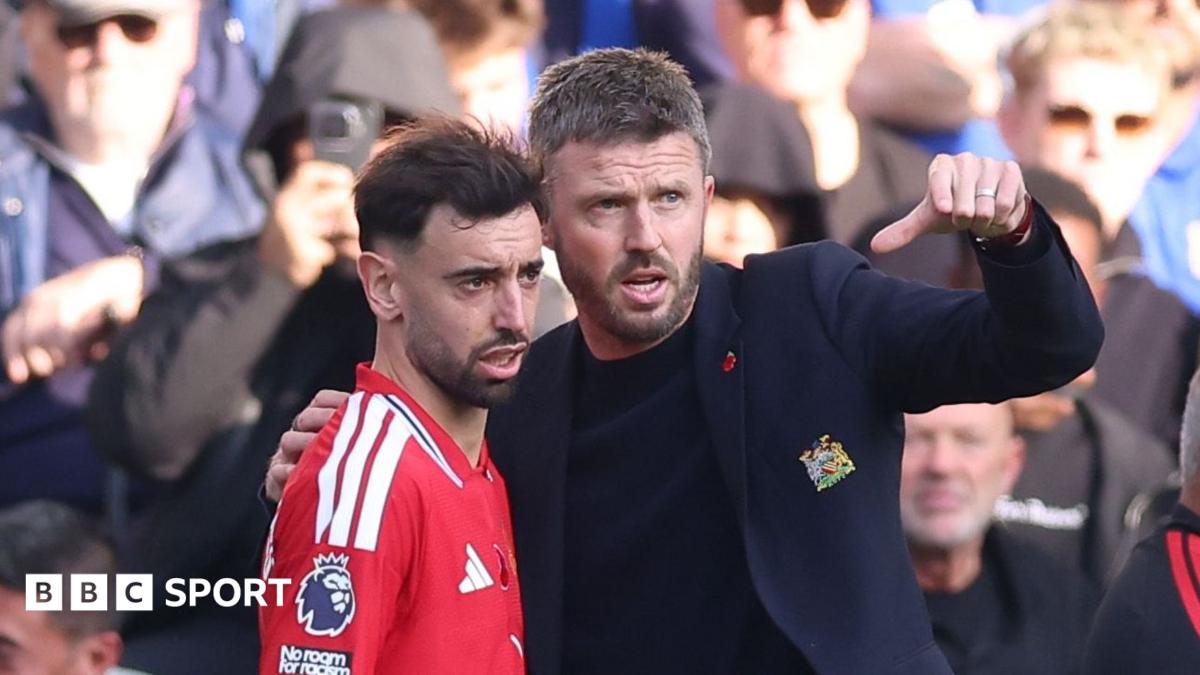
Manchester United: Are Old Trafford club really heading for a relegation scrap?

You would have to be touching 60 to have any recollection of the last time United were relegated.

Legend has it that old boy Denis Law sent them down with an impudent back heel he didn’t celebrate when he was at Manchester City. The reality is United were already doomed under then-boss Tommy Docherty.

United have not been in the relegation zone after nine games or more since November 1986, when they collected a single point in Sir Alex Ferguson’s first two games in charge following Ron Atkinson’s dismissal.

Their lowest position after at least nine games of a season since then was 17th in 1989-90. They are back there again right now, mainly thanks to the failings of others in results elsewhere on Saturday.

It is now nine games in all competitions since Carrick’s side won, their worst run since 1988-89. Their single Premier League win of the season was when they came from behind to beat Ipswich at home in August.

Of course, United’s supporters have very recent experience of seeing their team in the lower reaches of the table. They were 16th under Ruben Amorim after 37 games of the 2024-25 season. The caveat is they were 14 points clear of third-bottom Leicester and at no point in that tortuous campaign were they in danger of relegation.

One club that has been at real risk in recent years is Tottenham, who were third bottom and two points behind West Ham with four games of last season remaining.

So, it could happen, even if it remains unlikely a club that should post revenues in excess of £700m for the current campaign will finish in the bottom three.

“You can look at it like that, or you can look at how far you can move up the league quite quickly if you win football matches,” was Carrick’s response when asked if his players are equipped for the “mentality shift” required to deal with the present situation. “That’s the way it’s got to be approached.”

Source link