A Russian Navy corvette burned and capsized after being struck by Ukrainian uncrewed service vessels (USVs) while docked in Benghazi, Libya. In addition, a Russian cargo ship was struck by Ukrainian USVs while operating off Benghazi in the Mediterranean. These strikes follow a suspected Ukrainian drone attack on a Russian cargo ship in the Baltic Sea on Saturday. Taken together, they appear to mark a new phase in Kyiv’s campaign to strike at Moscow’s naval capabilities and shipping far beyond the Black Sea.
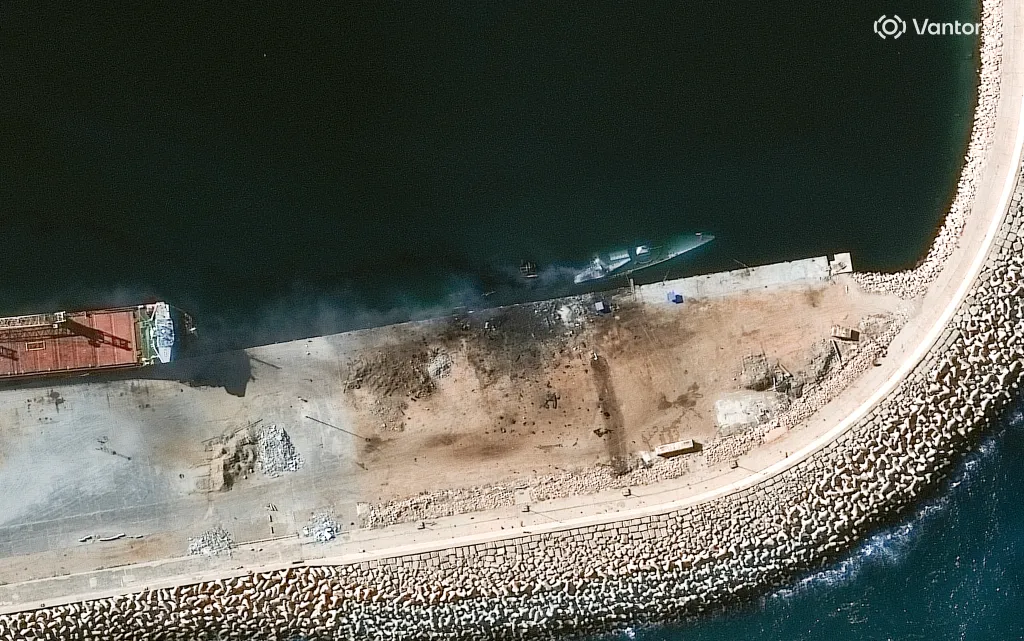
Satellite images obtained by TWZ show the Project 20380 Steregushchiy class corvette Merkury capsized and sunk with only the forward bow still visible. Smoke can be seen wafting up, with debris scattered around the dock.

A wider shot shows how far the sea drones had to travel inside the port to hit the Merkury.

An image collected by Planet Labs shows the vessel still in flames before rolling over into the water.

The following image shows the Merkury before it was struck.

The Merkury was docked at the Benghazi port in eastern Libya “when several Ukrainian sea drones were launched at the ship from a base run by Ukrainian forces in western Libya,” The Associated Press reported, citing an initial investigation into the attack. “At least four drones were intercepted and destroyed, while two hit the warship.”
We cannot confirm if the drones were launched from land, as the AP reports, or a vessel.
Local sources told Al Jazeera late on Sunday the ship “was carrying weapons, ammunition and drones in its cargo. Local sources quoted residents as saying that they saw three drones attack the vessel.”
The ship would have been carrying all these things by default as it is a relatively advanced Russian warship, although it is not typically used for moving cargo.
An “unknown number of Libyan and Russian nationals were killed in the attack at dawn,” the publication added.
Video emerged on social media claiming to show the moment the Merkury was attacked.
Merkury is a very new and modern surface combatant for the Russian Navy. It was commissioned in 2023, the official Ukrainian United24 media outlet reported. “It carries a crew of approximately 90 personnel.”
The Steregushchiy class ships are among Russia’s more modern corvettes. With a standard displacement of 1,800 tons, a length of 343 feet, and a flight deck for a helicopter, the corvettes are closer to frigates, according to some classification systems. Their primary armament consists of two quadruple launchers for Uran anti-ship missiles, a 12-cell Redut vertical launch system for various air defense missiles, and two quadruple tubes for Paket-NK anti-torpedo/anti-submarine torpedoes.
“Although assigned to Russia’s Black Sea Fleet, the warship had been operating from Northern Fleet bases in the Arctic amid the war in Ukraine,” United24 added. A Ukrainian source confirmed to TWZ that the Merkury was struck by sea drones launched by the Security Service of Ukraine (SBU). The SBU has not commented.
As we noted at the top of this story, the Russian cargo ship Ascalon was also struck by Ukrainian sea drones while off Benghazi.
“According to Ukraine’s military intelligence, Ascalon was used to transport weapons,” the Ukrainian UNN media outlet reported. “The vessel is also considered one of the participants in the so-called ‘Syrian Express’ — a route for supplying military cargo from Russian ports to Syria via the Bosporus.”
“The ship belongs to the Russian company M Leasing LLC, which is under U.S. sanctions for its involvement in transporting military cargo,” UNN added. “Ascalon itself was also placed under U.S. restrictions.”
After the sea drone attacks, Sky News Arabia published an image it said was of one of the vessels that was used.
Video emerged purporting to show the Libyan National Army shooting at one of the sea drones.
These two strikes are a major escalation, but are part of an established pattern of Ukraine hunting for Russian and Russian-affiliated vessels in the Mediterranean going back years.
“These incidents follow a series of attacks and unexplained explosions involving Russian-linked vessels in the Mediterranean, including Ursa Major, Seajewel, Vilamoura and Arctic Metagaz,” the Ambrey maritime security firm told us.
As we reported in December, Ukrainian aerial drones struck a tanker belonging to Russia’s so-called ‘shadow fleet’ in the Mediterranean.
A source from within the Security Service of Ukraine (SBU) told TWZ at the time that “a new, unprecedented special operation” was carried out “more than 2,000 kilometers” (1,243 miles) from Ukrainian territory.
The target was the Oman-flagged crude oil tanker Qendil, empty at the time of the attack and sailing from the Indian port of Jamnagar, where it had been unloaded on December 1.
Ukraine’s campaign against Russian naval and shipping assets is growing far beyond the Mediterranean too, with the Baltic Sea, right in Russia’s backyard, quickly becoming a third epicenter beyond the Mediterranean and the Black Sea.
Finnish officials confirmed that a Russian corvette was attacked in the Gulf of Finland on Nov. 11, although little is known about the strike, BBC reported at the time.
“Ukraine’s SBU security service said it targeted the ship Naro-Fominsk as part of a broader drone operation against Russia’s Ust-Luga oil export depot on the Baltic coast,” the publication explained.
In April 2024, there was a fire on a Russian warship at Baltiysk in Kaliningrad. The fire damaged communications and electronic systems aboard the Buyan class corvette Serpukhov. A Ukrainian military intelligence official subsequently claimed that this was the result of a covert joint operation conducted by his GUR agency and a pro-Kyiv Russian military group.
The following video shows the sabotage attack on the Serpukhov.
On June 3, Ukraine struck the Project 20380 Steregushchiy class corvette Boikiy, we reported at the time. That was believed to have been the first strike of its kind against the Baltic Fleet.
The Boikiy is the sister ship of the Merkury, United24 noted.
Then there was the most recent strike. As the Merkury was struck in Benghazi, recovery efforts were underway for the Sparta II, a Russian-owned cargo ship struck by Ukrainian drones on Saturday in the Baltic.
On Sunday, a Russian rescue vessel began towing the Sparta II “out of Finnish waters after two days of firefighting,” Reuters reported, citing Finland’s coast guard.
Commander Ilja Iljin from the Border Guard’s Headquarters “told the Finnish Yle news outlet on Saturday that the Sparta II was hit by Ukrainian drones in Russian territorial waters, lost its steering ability and drifted into Finnish territorial waters. As a result, the responsibility for maritime rescue was transferred to Finland,” the publication reported.

The Ukrainian campaign against Russian shipping “has not been confined to the Black Sea for some time,” Ambrey noted. “Russian naval assets, military logistics and commercial shipping face an expanding threat across the Baltic and Mediterranean.”
As we have frequently noted, many successful Ukrainian USV attacks have been recorded against Black Sea Fleet vessels and facilities, forcing the general evacuation of Russian naval assets from occupied Crimea and to bases in Russia proper. These facilities have all come under attack since the force posture shift.
Though Russia is the target of these sea drone attacks, the incidents highlight vulnerabilities and general uncertainties when it comes to identification of friend or foe for naval drones for all navies, a fact TWZ outlined in detail recently.
Regardless, with three major high-profile strikes, including the destruction of another modern Russian corvette, it is clear that the threat Ukraine poses to Russian shipping and advanced naval assets far from the Black Sea is growing in frequency and magnitude.
Contact the author: howard@twz.com