Black

Supreme Court voting rights ruling fuels a new push to defend Black representation

Same fight. New generation.

That’s the mantra of a multiracial group of civil rights leaders and activists organizing opposition to a mostly white conservative alliance dismantling the Voting Rights Act and political districts that allowed Black and other nonwhite voters to choose more of their elected leaders for the last half-century.

“We have to respond as quickly as possible,” NAACP President Derrick Johnson said in an interview. “The real question,” Johnson told the Associated Press, “is how do we as a country really address the effort to shrink us backwards into a 1950s reality?”

Johnson’s 117-year-old association, which was at the forefront of legal and legislative fights for Black political rights in the 20th century, is among scores of groups coming together Saturday in Alabama for a rally and tribute to the Civil Rights Movement that helped bring about the 1965 Voting Rights Act. They plan events in Selma, where voting rights advocates were attacked by white law enforcement officers on Bloody Sunday, and Montgomery, where a rescheduled march concluded two weeks later.

Unlike 61 years ago, the Alabama events are not the pinnacle of a protracted movement. Instead, civil rights activists hope they serve as a catalyst for a renewed crusade after the U.S. Supreme Court, two weeks ago, further weakened the VRA by no longer allowing race to be considered in how congressional and other districts are drawn.

They acknowledge difficulty in countering a white-dominated conservative network entrenched in the White House, Capitol Hill, federal courts and many state legislatures of the Old Confederacy, where a majority of Black Americans still live.

The VRA “was the foundational nucleus of the Civil Rights Movement,” said Jared Evans of the Louisiana-based Power Coalition for Equity and Justice. “They’ve taken that from us,” he said, with the recent Louisiana v. Callais decision on congressional districts and the earlier Shelby v. Holder decision in 2013 that rolled back federal oversight of election procedures in states and localities with a history of discrimination.

Georgia Sen. Raphael Warnock, who is senior pastor of Atlanta’s Ebenezer Baptist Church, where the Rev. Martin Luther King Jr. once preached, said from his pulpit that the result is “Jim Crow in new clothes.”

Warnock pointed to King and the last voting rights movement. “We need political power. We need economic power. We need personal power,” he said, assuring parishioners that “your adversaries know that your voice matters” because they’re “bending over backwards” to diminish it.

Evans reached further back into history to say what must happen next.

“Our response must be and will be a second Reconstruction period,” Evans said.

Some Democrats want an answer from Congress

The ultimate goal, organizers said, is to win more elections, sway policy fights and protect diverse political representation at all levels.

U.S. Rep. Terri Sewell, a Black lawmaker who represents Selma, Alabama, said an immediate priority is to “reform and reintroduce” Democrats’ flagship voting bill, the John R. Lewis Voting Rights Act.

Sewell, whose seat ultimately could be threatened under redistricting, said Democrats want to “completely” eliminate partisan gerrymandering.

She also said the legislation would “bring back pre-clearance,” the requirement for certain federal approvals that the court struck down in Shelby.

“We need to come up with a modern-day formula for showing just how egregious the behavior of these state actors is,” Sewell said.

The Supreme Court ruled in Callais that states do not have to draw majority nonwhite districts under the Voting Rights Act and, in fact, should not consider race at all when drawing boundaries. By arguing that the law’s remedies to combat discrimination had themselves become racist, the decision allows states to redraw heavily Black districts that have historically elected Democrats while arguing that the designs are based on party interests, not race.

President Trump praised the decision as “a BIG WIN for Equal Protection under the Law, as it returns the Voting Rights Act to its Original Intent, which was to protect against intentional Racial Discrimination.”

Groups mobilized for redistricting sessions

Many of the same groups who’ll be in Alabama on Saturday have already gone to Southern statehouses, where white Republican lawmakers moved swiftly to redraw congressional districts after Callais.

Alabama and Louisiana lawmakers reverted to a single majority-Black district, each scrapping a second district that had been ordered by lower federal courts under now-reversed VRA interpretations. Tennessee lawmakers gutted a majority Black district by splitting greater Memphis into three different sprawling districts — itself an obvious racial gerrymander the court had previously forbidden, Evans said.

Anticipating the Callais outcome, Florida and Texas proceeded with redistricting before it came down. Georgia Gov. Brian Kemp, a term-limited Republican, has called a June session to redraw congressional lines for the 2028 cycle. Mississippi and South Carolina have delayed the matter for now.

South Carolina state Senate Majority Leader Shane Massey was among the few white Republicans who pushed back against GOP redistricting plans. He said that not even pressure from Trump could sell him on disenfranchising Black South Carolinians instead of doing what’s best for his state.

Other white conservatives are still talking openly about ousting Reps. Jim Clyburn and Bennie Thompson, the only Black U.S. House members from South Carolina and Mississippi, respectively.

Evans, the Louisiana activist, predicted the fight ahead won’t just be about congressional representation.

“Look for them to go after state house and state senate seats — and then it will be the local level,” he said, adding that “it’s going to be an entire erasure of Black representation.”

The issue is more than a partisan Washington fight

Heavily minority districts drawn under the VRA before Callais nearly always elect Democrats. Black Americans have overwhelmingly aligned with the party since President Lyndon B. Johnson signed the Civil Rights Act and Voting Rights Act, sparking a decades-long migration of most white Southern politicians to the Republicans. Latino and Hispanic voters still lean Democratic in most places as well.

The immediate fight shapes the midterm campaign scramble for control of the U.S. House during the final years of Trump’s presidency. Trump initially pushed Republican-run states to redistrict to protect the party’s fragile House majority.

But Johnson, the NAACP leader, said all voters should see more than partisan warfare or a regional battle over race.

Beyond party allegiance, Johnson argued, white conservatives want to curtail a range of rights “depending on how you pray, depending on who you love,” while also pushing economic policies that punish workers across racial and ethnic lines. From legislation to the confirmation of federal judges who decide constitutional questions, those policy outcomes start with election results.

“It’s not a Black problem,” Johnson said. “That’s an American problem.”

There is no singular movement or leader yet

Evans, Johnson and others acknowledged the complexity in harnessing disparate organizations and galvanizing voters on issues like redistricting and gerrymandering. But they insist the brazen nature of Republicans’ course has spurred engagement.

Johnson said he was on an organizing call in Mississippi this week that had 8,000 participants. Evans pointed to packed hallways in the state Capitols in Baton Rouge and Nashville, respectively.

The NAACP and allies have challenged new maps in multiple states, despite Callais. Many groups want to spur midterm turnout among Black voters, and others are disenchanted with white conservatives’ maneuvers in racially diverse places.

Johnson stressed the need for perseverance.

The 1954 Brown v. Board of Education decision was seismic, with a unanimous court declaring segregated public schools unconstitutional and reversing 19th-century precedents denying Black Americans’ fundamental rights.

But it took 17 years — and many more court battles — for it to be implemented in most Southern school districts. Fights over mandated student busing continued beyond the South. It was a decade after Brown before Congress and Johnson enacted the movement’s seminal laws.

There’s no clear leader of a modern movement.

Johnson said it’s worth remembering that even with King at the helm before his assassination, “there was tension around strategy” in the 1950s and 1960s.

But even “through that tension, through many episodes, we were able to get directly in the right place.”

Barrow and Brown write for the Associated Press.

Source link

Margot Robbie wows in black tailcoat jacket with gold embroidery at London premiere of new play she produced

BARBIE actress Margot Robbie stands and delivers in a dandy highwayman outfit.

The Aussie, 35, wore a black tailcoat jacket with gold embroidery — like 1980s singer Adam Ant.

Margot Robbie stands and delivers in a dandy highwayman outfit Credit: Getty
Aussie Margot wore a black tailcoat jacket with gold embroidery Credit: Splash

She was attending the London West End premiere of the play 1536 — a drama about three Essex women set in Tudor England during Anne Boleyn’s downfall.

Margot, a producer on the play, said at The Ambassadors Theatre: “The conversations these women have are the same ones that women now are having.”

Earlier this year we revealed how Margot was named the world’s most beautiful woman.

The Aussie beat fellow actress Scarlett Johannson to the honour in the poll organised by website Ranker.

Read more on Margot Robbie

COME INTO MY WORLD

Margot Robbie stuns recreating Kylie Minogue’s hit video for Chanel ad


LIP SERVICE

The lip balm Margot Robbie wears in Wuthering Heights is just £6

Margot attended the London West End premiere of the play 1536 Credit: Splash
She looked like 1980s singer Adam Ant Credit: Redferns

There were more than seven million votes cast in total.

But the married mum-of-one has not always been convinced about her looks.

She once said: “In my big group of girlfriends at home, I am definitely not the best looking.

“I did not grow up feeling like I was particularly attractive.”

Source link

The disaster unfolding on Russia’s Black Sea coast is of its own making | Environment

Southern Russia is facing one of the largest environmental disasters in its modern history. In April, repeated Ukrainian strikes on Russian oil infrastructure in Tuapse triggered massive refinery fires and oil spills along the Black Sea coast, including near Sochi. Residents described “black rain” falling from the sky as smoke and petroleum residue spread across the region. Weeks later, wildlife is still dying, beaches remain polluted and volunteers trying to respond say their efforts have often been obstructed. The authorities, meanwhile, have focused less on confronting the scale of the catastrophe than on silencing those speaking out about it. Despite the ongoing environmental damage, officials are already discussing reopening the beaches and launching the tourist season.

The catastrophe raises difficult questions about environmental destruction during wartime. Ukraine, which has experienced countless environmental catastrophes related to Russia’s all-out war, has been among the leading actors advocating for the recognition of ecocide as an international crime, even though the concept has yet to be formally codified in international law. Following the April strikes, however, some environmental activists in Russia and beyond are now also accusing Ukraine of hypocrisy and causing long-term environmental harm through strikes on oil infrastructure. There is a real debate over whether such actions can be justified, even when targeting an aggressor, if their environmental consequences may last for decades.

But focusing exclusively on Ukrainian strikes risks obscuring the deeper structural causes of the disaster. Russia’s oil infrastructure is deeply embedded in its war economy, and environmental damage of this magnitude does not occur in a vacuum. It is shaped by years of deregulation, lack of oversight and the systematic dismantling of environmental protections. These trends have only intensified during the full-scale invasion, as environmental safeguards have increasingly been cancelled in order to sustain the war economy. This includes recent legislative changes affecting the protection of Lake Baikal — a unique ecosystem that contains around 23 percent of the world’s unfrozen freshwater — raising concerns among experts about long-term environmental risks.

For years, environmental organisations in Russia have been labelled “foreign agents” or declared “undesirable”, independent environmental movements have been dismantled and activists forced into exile. The current catastrophe is unfolding in a country where ecological disasters are often silenced rather than addressed.

What is striking in the current situation is not only the scale of the damage but the response of the authorities. Rather than responding with transparency and accountability, Russian officials have largely attempted to silence discussion around the disaster. This recalls earlier patterns, including the initial response to the Chornobyl disaster, where secrecy and delayed disclosure significantly worsened the human and environmental consequences.

In this sense, responsibility does not lie only in the immediate cause of the disaster, but also in the absence of preparedness, regulation and accountability.

This disaster has also triggered an unusual wave of discussion within Russia itself, much of it unfolding online, despite increasing censorship. Volunteers on the ground have reported being obstructed and, in some cases, harassed while trying to rescue wildlife. Journalists attempting to document the situation have faced detention. Even as the catastrophe unfolds, the space to speak about it remains tightly controlled.

Yet the public reaction is telling. Much of it is happening on Instagram, which is banned in Russia, and on other social media platforms, with people still using VPNs to speak out and read real news. Rather than turning primarily into accusations against Ukraine, much of this discussion has been directed at the Russian authorities. The disaster is being used, implicitly and sometimes explicitly, to question the lack of coordination, the absence of transparency and the broader political system that allows such crises to happen.

This is significant. In a country where even calling the war a war is effectively prohibited, environmental catastrophe has become one of the few channels through which criticism can still surface.

The situation also exposes a deeper problem that goes beyond Russia. It highlights a fundamental gap in international law: the lack of effective mechanisms to address large-scale environmental destruction in the context of war.

Recent events illustrate the consequences of this gap. The destruction of the Kakhovka Dam caused massive ecological damage, yet failed to generate sustained legal or political accountability at the international level. Since then, environmental destruction has continued to accompany the war, without clear mechanisms to address it.

More broadly, the issue is being sidelined. The war in Ukraine has become so heavily politicised globally that discussions of its environmental consequences are often reduced, avoided or absorbed into larger geopolitical narratives. From the perspective of an environmental activist from Russia, this creates a deep sense of helplessness. These issues are becoming harder to raise, not because they are less important, but because they are competing with an overwhelming number of global crises.

This frustration is also visible within parts of the Russian antiwar movement, where there is a growing perception that international actors are more focused on the economic consequences of the conflict than on addressing its deeper causes and risks that go beyond military threats.

Meanwhile, environmental destruction across Russia, a country that spans one-10th of the Earth’s land surface, continues with little international attention. This includes not only wartime damage, but also longstanding patterns tied to extractivism, colonial governance in national republics, and the systematic marginalisation of Indigenous communities. These are not separate issues. They are part of the same underlying problem, one that remains largely unaddressed.

Environmental exploitation in Russia’s regions has long been tied to older imperial patterns of control and dispossession. These same southern regions are also the regions where the Russian Empire committed genocide against the Indigenous Circassian people, exterminating and expelling more than 95 percent of the local population in the late 19th century. And now, what the Russian authorities seem to care about is not the environmental devastation itself, but reopening the beaches so the region can continue generating income.

While Europe is preparing to spend hundreds of billions of euros responding to what it sees as a growing Russian military threat, far less attention is being paid to the political and economic structures sustaining environmental destruction inside Russia itself. From the perspective of an environmental activist and someone finishing a master’s degree in international affairs, there is a striking gap in how the root causes of this crisis are being addressed.

Too little attention is paid to the deeper structures that sustain it: Russia’s colonial governance and extractivist economic model in the regions of Russia. These issues remain underexplored not only in political decision-making but also in academia and media coverage. This gap is particularly visible in the missed opportunities to engage with emerging Russian decolonial movements and Indigenous activists from national republics, who have long been raising precisely these concerns. Their perspectives remain marginal, even though they are essential for understanding both environmental destruction and political instability in the region.

Many international organisations and NGOs have also scaled down or abandoned work related to Russia’s internal environmental and human rights issues, as well as broader regional dynamics in Eastern Europe and Central Asia. As a result, entire areas of expertise are disappearing at the very moment they are most needed. Voices that could contribute to a deeper understanding, and potentially to long-term solutions, are increasingly sidelined or ignored.

And when catastrophe comes, people are left asking how it became possible for oil to fall from the sky.

The views expressed in this article are the author’s own and do not necessarily reflect Al Jazeera’s editorial stance.

Source link

After Voting Rights Act setback, Black Americans brace for new fight

At 16, Edward Blackmon Jr. was arrested during a demonstration for voting rights in his Mississippi hometown. He was loaded with schoolmates into a truck once used to haul chickens and left in the summer heat before spending three nights in an overcrowded jail cell without a bed.

It was a moment that set him on a path to become a civil rights lawyer and one of the first Black lawmakers elected in the state since Reconstruction.

Blackmon was part of a generation of Black Americans across the South who fought in courtrooms and in the streets to dismantle barriers to voting and achieve political representation in a region scarred by the legacy of slavery and its aftermath.

One of the crown jewels of that struggle, the Voting Rights Act, was hollowed out by a Supreme Court ruling last week. The court’s conservative majority said states should not rely on racial demographics when drawing congressional districts, a ruling that opened the door to transforming how political power is distributed and making it harder for minorities to get elected.

The majority opinion described racism as a problem of the past. Others saw the decision as another example of its resurgence — “a defibrillator to the heart of Jim Crow,” as one Louisiana politician put it.

Blackmon’s son, Bradford, a 37-year-old state senator in Mississippi, said how the political lines are drawn “shapes who has a real chance before anyone ever votes.”

“It’s just sad that we made progress and then they are always trying to roll it back when it shows that minorities are making more progress than I would guess that those in charge think that they’re allowed to make,” he said.

The elder Blackmon, now 78, said he was resigned to the reality that the fight of his youth is not over.

“It’s just another cycle — an ongoing struggle without a foreseeable ending,” he said.

A legacy at risk

The case, involving a challenge to Louisiana’s congressional map, clarified how the Voting Rights Act can be used to contest district lines that may weaken the voting power of Black residents.

For many Black Americans, the decision was a death knell for a cherished pillar of the Civil Rights Movement. Before the Voting Rights Act of 1965, Black voters in the Deep South had no guarantee of equal access to the ballot. Within a year of its passage, more than 250,000 Black Americans had gained the right to vote. By 2024, nearly 22 million Black voters were registered nationwide, according to the U.S. Census Bureau.

The United States is now witnessing the unraveling of nearly a century of organizing, civil disobedience and personal sacrifice by ordinary people who helped build Black political power to heights unseen since Reconstruction. Veterans of the voting rights movement — people who confronted police violence alongside John Lewis on the 1965 “Bloody Sunday” march in Selma, Ala., or rallied with the Rev. Martin Luther King Jr. — are seeing those hard-won victories stripped away from their descendants.

“I’m the first generation of Americans born with equal rights,” said Jonathan Jackson, a Democratic congressman from Illinois who is the 60-year-old son of the Rev. Jesse Jackson, the late civil rights leader. He said the idea that his children could grow up with fewer protections was “surreal and devastating.”

For Charles Mauldin, who was beaten by law enforcement as a teenager on Bloody Sunday, the ruling reflects a skirmish that was never as settled as some hoped.

“I’m disappointed but not surprised,” said Mauldin, 78, of Birmingham, Ala. “They’ve been chipping away at the 1965 Voting Rights Act for the last 60 years.”

Who holds power now

In Louisiana, younger Black politicians say the high court’s ruling could reshape not just who wins elections, but whether candidates can compete at all, particularly in down-ballot races that often serve as steppingstones to higher office.

Davante Lewis, a 34-year-old Democrat who serves on the state’s utility regulatory board, said he expects districts could be redrawn in ways that make it harder for candidates like him to win.

“They can target my communities … to ensure that I can’t get to an elected office,” said Lewis, one of several plaintiffs in the Louisiana gerrymandering case that went to the Supreme Court.

Jamie Davis, a Black farmer in northeast Louisiana and a Democratic candidate for U.S. Senate, said the decision risks discouraging voters already skeptical that their voices matter.

“I want to be optimistic, but how can you be optimistic when voter turnout in the past election cycles has been really low?” Davis said.

Tennessee is among the states bracing for new redistricting efforts. State Rep. Justin Pearson, who represents Memphis and is running for Congress, said people who struggled to pass the Voting Rights Act are “shocked and devastated that they’re having to relitigate the same fights that they fought 60 years ago.”

But he also predicted that efforts to reduce Black representation could “reinvigorate a civil rights movement in the South that demands equal representation, that demands fairness, that demands justice and equality.”

Supporters of the Supreme Court ruling said it reinforces a race-neutral approach to redistricting, and they say political lines should not be drawn primarily based on race.

Democratic Mississippi state Rep. Bryant Clark said that view ignores how race and party align in the state. In Mississippi, where most Black voters are Democrats and most white voters are Republicans, he said the two are often indistinguishable.

“It’s just a roundabout way to basically legalize racially discriminatory redistricting in the state,” Clark said.

In 1967, his father, Robert Clark Jr., became the first Black lawmaker elected to the Mississippi Legislature since Reconstruction.

With Black residents making up about 38% of Mississippi’s population, Edward Blackmon Jr. said the current maps allow Black voters to elect candidates in some districts while keeping Republican majorities intact across much of the state.

He said lawmakers have little incentive to change that balance because moving Black voters into more districts would make those seats less reliably conservative and force candidates to compete for a broader electorate.

“Where do you think the population goes? They don’t just disappear,” Blackmon said. “What incumbent wants that type of district right now?”

Fight continues

Blackmon was raised in Canton, “when Jim Crow was in full bloom.”

Black children attended separate schools, and during cotton-picking season, classes let out early as rickety trucks with wooden sides arrived to take students to the fields, where they spent hours working.

At home, he watched those inequalities play out in quieter ways.

His father, a World War II veteran who left the sharecropping farm where Blackmon’s grandfather had worked, struggled to find steady work in Mississippi after returning from military service and becoming involved in civil rights organizing. He eventually left for New York to make a living — part of a generation of Black veterans who faced barriers to jobs and opportunities their white counterparts received.

Blackmon remembers sitting nearby as his father and other community leaders gathered on the porch, talking late into the night about forming a local NAACP chapter.

“It was embedded in my memory and experience that it was worth the struggle,” he said.

When the Voting Rights Act passed, it did not immediately change those realities. In places like Canton, federal officials set up registration tables on downtown streets so Black residents could sign up to vote without facing harassment or intimidation from local authorities.

In the years that followed, Blackmon and other lawyers used the law to challenge at-large election systems that prevented Black communities from electing candidates of their choice. Cities and counties were forced to redraw maps into single-member districts.

When those districts still diluted Black voting strength, activists returned to court.

“Without the Voting Rights Act, Mississippi would look so much different than it looks now,” Blackmon said.

Willingham, Brook, Bates and Amy write for the Associated Press and reported from Boston, New Orleans, Jackson and Atlanta, respectively. AP writers Kristin Hall and Travis Loller in Nashville and Safiyah Riddle and Kim Chandler in Montgomery, Ala., contributed to this report.

Source link

George Michael’s black leather jacket he wore in Faith music video fetches huge six-figure sum at auction

THE black leather biker jacket George Michael wore for the music video of 1987 hit Faith fetched £176,400 at auction.

Organisers said “a fan” bought the item, made by London fashion brand La Rocka, and confirmed it would remain in the UK.

George Michael Faith World Tour
George Michael’s leather BSA jacket fetched £176,400 at auction Credit: Getty
Propstore Music Live Auction
It was first purchased for around £290, and he wore it on his Faith World Tour in 1988 Credit: PA

The jacket, which George also wore on his 1988 Faith tour, features a BSA logo on the back embellished with crystals.

When first sold in La Rocka’s London shop, the jackets cost £290.

Also sold at the Propstore auction in London was a Gibson Les Paul ’59 once owned by Slash of Guns N’ Roses.

It fetched £233,100, a record for a guitar at auction.

read more on george michael

WHAMILTON!

George Michael’s life to be made into gritty Broadway show after secret talks


TRIPLE WHAMY

Blow to fans as three George Michael documentaries will NOT be shown on UK TV

It was one of 327 rare instruments, handwritten lyrics, stage-used pieces, and iconic personal artefacts sold at the event, which achieved an auction total of £1.9m.

Further success came from the sale of Peter Hince’s Queen collection, which realised a total of £350,000.

Lots from the former roadie for the legendary rock band were led by Freddie Mercury’s Gold Shure 565 SD Microphone Award, the first of his microphones with direct provenance to come to market, which sold for £151,200.

Peter Hince said: “I’m absolutely thrilled with how the auction has turned out, especially seeing Freddie’s gold microphone achieve such a strong price.

“It means a lot to know these pieces are going to fans who truly appreciate what Queen meant and still means today.”

A poster signed by John Lennon, one of the last four items he signed, was sold for £75,600 and Oasis hitmaker Noel Gallagher’s Les Paul Custom 20th Anniversary Guitar also sold for £34,650.

The fedora worn by Michael Jackson in his 1987 Pepsi commercial sold for an eye-watering £34,650.

Source link

The Black Caucus is the ‘conscience of Congress.’ Supreme Court ruling has it bracing for a big hit

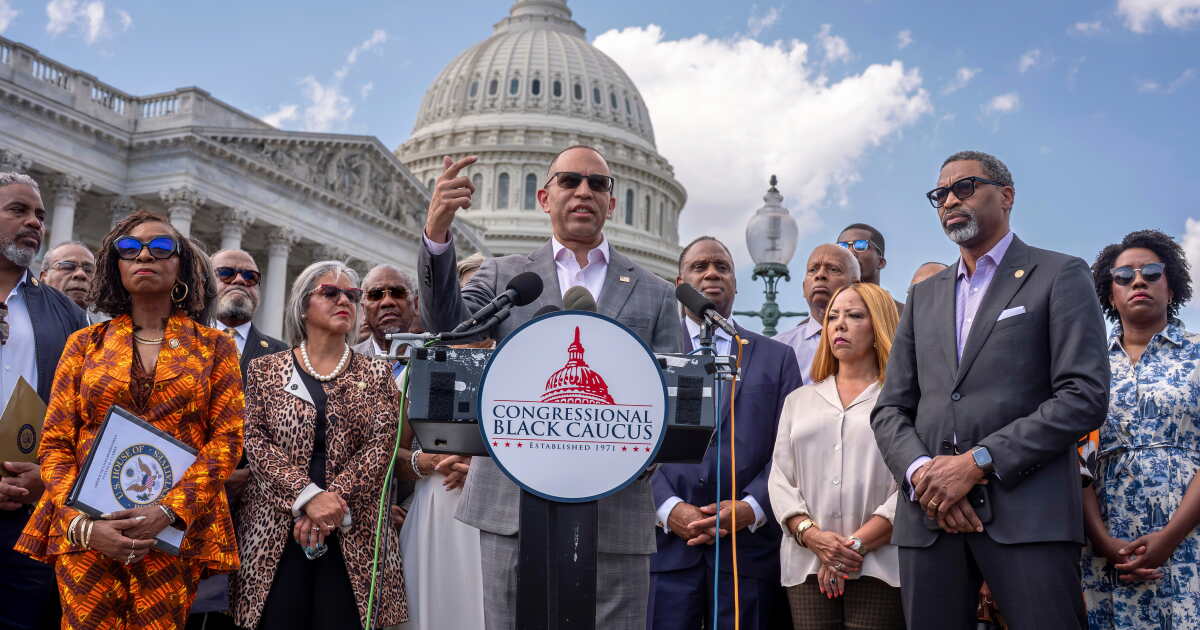
Black members of Congress are bracing for a crippling shake-up of their ranks after a Supreme Court ruling gutted a key section of the Voting Rights Act that had protected minority communities in political redistricting and helped boost their representation.

Wednesday’s decision clears the way for Republican-led states to redraw U.S. House districts without regard to race, potentially creating many more GOP-friendly seats.

Rep. Yvette Clarke, chair of the Congressional Black Caucus, told reporters that its members and Democrats would fight the effects of the ruling.

“The Supreme Court has opened the door to a coordinated attack on Black voters across the country,” Clarke said. “This is an outright power grab.”

Under Section 2 of the Voting Rights Act, voters could challenge electoral maps that appeared to dilute the ability of minority communities to elect representatives of their choosing. The expected wave of congressional redistricting by Republican-controlled states after Wednesday’s ruling, especially for the 2028 election and beyond, is likely to result in a much smaller Black Caucus.

Changes are coming, but how quickly is unknown

Clarke was joined by over a dozen of the 60 Black Caucus members, including Democratic House Minority Leader Hakeem Jeffries. Their responses to the court’s decision ranged from outrage to defiance to mourning.

It’s not clear how many seats will ultimately be affected by the ruling, but redistricting experts predict that more than a dozen now held by minorities could be swept away.

Rep. Troy Carter, one of two Black Democrats from Louisiana, the state at the center of the case, called the ruling “a devastating blow to our democracy, plain and simple.”

Republican leaders in several Southern states already have been discussing how to apply the ruling and create new GOP-friendly congressional maps. In Florida, Republicans wasted no time approving a new U.S. House map, part of which redrew one district created to elect a Black representative.

“I would be surprised if we do not see former slave-holding states moving at lightning speed to target districts that provide Black voters and other voters of color an equal opportunity to elect candidates,” said Kristen Clarke, general counsel for the NAACP and the first Black woman to be assistant attorney general in the U.S. Department of Justice’s civil rights division.

It’s not clear whether state-level voting laws or constitutional prohibitions against racial discrimination will provide any protection, she added.

Republican officials and Black conservatives praised the decision as a victory against race-based mandates. Linda Lee Tarver, of the Project 21 Black Leadership Network, said in a statement civil rights laws were not intended “to institutionalize racial line-drawing as a default feature of our political system.”

Voting Rights Act expanded Black representation

The Congressional Black Caucus was formed in 1971 as court-ordered redistricting under the Voting Rights Act, passed just six years earlier, sent more minorities to Congress.

The number of Black representatives in Congress jumped from nine to 13. Shirley Chisholm, the first Black woman elected to Congress, decided to expand the Democracy Select Committee created in the 1960s by Democratic Rep. Charles Diggs into the more formal Congressional Black Caucus.

The CBC raised its profile in its first year when it boycotted President Nixon’s State of the Union address after he refused to meet with the group. Nixon eventually acquiesced. The group created a list of over 60 recommendations to help the Black community, including counteracting racism and building adequate housing. It earned the nickname the “conscience of the Congress.”

“That caucus has had such an important voice in American politics — the things that we’ve been able to achieve together, the creation of equity and access,” Democratic Sen. Raphael Warnock of Georgia said during a separate news conference Wednesday. “And I’m afraid that with this ruling, we could see that caucus shrink in a hugely significant way.”

What can Black constituents do

The ruling upset Thomas Johnson when he heard about it while visiting Louisiana’s Capitol in Baton Rouge. Johnson, who is Black, is from New Orleans and represented by Carter. He fears Republicans could redraw the state’s congressional map in a way that dismantles predominately Black districts.

“I feel like this is an embarrassing attack upon the minorities, particularly the Black community,” Johnson said. “We have very little [voice] in Congress.”

Antjuan Seawright, a Democratic strategist who advises the Black Caucus, said he expects the group will be involved in multiple legal fights for members whose districts will be targeted after the Supreme Court ruling. He also said the ruling makes voter turnout efforts even more important “if we want to change course on some of the things that are likely to happen because of this decision.”

Democratic Rep. Terri Sewell of Alabama, whose state was at the center of a major Voting Rights Act case decided in favor of Black representation nearly three years ago, agreed that the party now needs to focus on getting voters motivated ahead of this year’s midterm elections.

“Now more than ever, we need communities across this nation to mobilize — in state legislatures, in the courts and at the ballot box,” Sewell said. “We need to vote like we’ve never voted before.”

Tang writes for the Associated Press. AP writers Leah Askarinam, Matt Brown and Ali Swenson in Washington and Sara Cline in Baton Rouge, La., contributed to this report.

Source link

Civilians or Hezbollah: Who did Israel hit on Lebanon’s ‘Black Wednesday’? | Israel attacks Lebanon News

Beirut, Lebanon – On April 8, Ahmad Hamdi, 22, was sitting on his couch at home in Beirut’s Tallet el Khayat neighbourhood, hours after Israel had launched more than 100 attacks in under 10 minutes across Lebanon.

Then he heard the “indescribable sound” of a rocket. Ahmad jumped off the couch as the glass in his building shattered around him before more rockets hit.

Recommended Stories

list of 3 itemsend of list

Clouds of dust obscured the view from his apartment on the fourth floor. When they dispersed, he saw the building directly facing his had been reduced to a pile of rubble.

He looked back at the couch he had been sitting on. At some point between the second and fourth explosion, shards of shrapnel had hit the couch exactly where his chest had been when the first rocket struck.

“When you think of Tallet el Khayat, you feel it is safe and secure,” Ahmad told Al Jazeera. “No one would expect something like that would happen.”

Indiscriminate attacks

April 8 has become known in Lebanon as Black Wednesday. Israel’s attacks on that day killed at least 357 people across the country. Israel claimed it killed 250 Hezbollah operatives. The exact breakdown of civilians and combatants is still not known, but numerous sources looking into the day’s casualties told Al Jazeera that the attacks appeared to be indiscriminate at best and in some cases may have amounted to the direct targeting of civilians. United Nations experts have described Israel’s attacks on April 8 as “indiscriminate”.

“The method in which the attacks happened in the middle of the day with dozens of strikes all at one time without warning and when civilians were present shows recklessness in Israeli military conduct,” Ramzi Kaiss, Lebanon researcher at Human Rights Watch, told Al Jazeera.

On March 2, Israel intensified its war on Lebanon for the second time in under two years. Earlier that day, Hezbollah had responded to near-daily Israeli attacks on Lebanon for the first time since December 2024 in response to the United States and Israel’s assassination of Iran’s Ayatollah Ali Khamenei.

Israel also invaded southern Lebanon, where it has gone about systematically destroying towns and villages in what experts – and Israeli officials – said is an effort to create an uninhabitable “buffer zone” along its border.

“Part of [Israel’s] military strategy is to create a buffer zone and no man’s land,” Bassel Doueik, the Lebanon researcher for the Armed Conflict Location & Event Data (ACLED) conflict monitor, told Al Jazeera. “What Israel is doing in southern Lebanon is creating a multilayered buffer zone inside Lebanese territory and that is why they are demolishing houses in towns along the border.”

Israel has not stopped attacking Lebanon since October 2023 and has violated a November 2024 ceasefire more than 10,000 times, according to the UN. Most of its attacks have been in southern Lebanon and the Bekaa Valley in the east.

Doubts about Israel’s claims

Israel conducted 100 air strikes and dropped more than 160 bombs across Lebanon on April 8, according to ACLED.

Israel claimed the attacks targeted Hezbollah headquarters, command-and-control sites, military formations and assets of its air force unit and elite Radwan Force.

Hezbollah discontinued the practice of providing the circumstances of its fighters’ deaths in September 2024. The Lebanese group does conduct some public funerals for fighters killed during the battles in southern Lebanon, but it is difficult to ascertain the exact number of those killed, making it hard to prove or disprove Israel’s claims.

But groups investigating the April 8 attacks said the available information casts doubt on the Israeli narrative. Analysts with ACLED said they are still confirming casualties but early indications showed that only a few victims were known Hezbollah members.

“One hundred one women and children were killed on April 8,” Ghida Frangieh, a Lebanese lawyer and researcher with Legal Agenda, a Beirut-based nonprofit research and advocacy organisation, told Al Jazeera. “For this number of 250 to be correct, it means every man killed must have been a Hezbollah combatant. This is not true as we were able to document several civilian men killed during these attacks.”

Lebanese media reported on a number of those killed by Israel on April 8, including employees of local restaurants, teachers, a poet, journalists, Lebanese soldiers and a member of a Druze-majority political party.

In some cases, Israeli attacks wiped out several members of the same family. Seven members of the Nasreddine family were reportedly killed on April 8 in Hermel in northeastern Lebanon. And three generations of the displaced Hawi family, including three children, were killed in the Jnah neighbourhood bordering Beirut.

Israel ’emboldened to continue’ violations of international law

Even if Hezbollah targets were present at all of the sites struck during the April 8 attacks, researchers said the attacks should still be considered indiscriminate. And while there still may be a discrepancy over the exact numbers of Hezbollah members vs civilians killed, international humanitarian law places the burden of proof on the attacking army.

“International humanitarian law is clear: Armed forces must distinguish at all times between civilians and military objectives,” Reina Wehbi, Amnesty International’s Lebanon campaigner, told Al Jazeera. “Even when there is a legitimate military target and in order to avoid indiscriminate, disproportionate or other unlawful attacks, parties must respect the principle of precaution and do everything feasible to verify that targets are military objectives, to assess the proportionality of attacks and to halt attacks if it becomes apparent they are wrongly directed or disproportionate.”

Over the past two and a half years, Israel has regularly violated the laws of war in Lebanon and in Gaza by indiscriminately attacking civilians, targeting paramedics and journalists, and using white phosphorus. Still, experts said there is little chance Israel will be held accountable.

“For the Israeli military, there is no deterrence to committing violations in Lebanon,” Kaiss of Human Rights Watch said. “After the crimes of humanity against Gaza, countries could have immediately suspended arms sales, the transit of arms through airports, placed targeted sanctions on officials, and the US and others could have suspended arms sales, but none of that happened.”

Kaiss said Lebanon could also give jurisdiction to the International Criminal Court (ICC), of which it is not currently a member, to investigate and prosecute Israel’s crimes in Lebanon. The ICC has already issued arrest warrants for Israeli Prime Minister Benjamin Netanyahu and former Defence Minister Yoav Gallant on charges of war crimes and crimes against humanity in Gaza.

Attacks on Beirut have temporarily halted since US President Donald Trump announced a ceasefire in Lebanon on April 16. But the war rages on in southern Lebanon with Israel continuing to kill civilians, including rescue workers. Israel and Lebanon have started to engage in direct negotiations despite Hezbollah’s objections in what the Lebanese state hopes will bring an end to Israel’s attacks and occupation of southern Lebanon.

But on the ground, there has been little deterrence or accountability for Israel’s crimes against civilians.

“This hasn’t happened in the last two years, so the Israeli military on the ground feels emboldened to continue,” Kaiss said.

Source link

‘Earthquake’: Supreme Court limits Voting Rights Act in setback for Black Democrats, boost for GOP

The Supreme Court’s conservative majority on Wednesday sharply limited a part of the Voting Rights Act that has forced states to draw voting districts to help elect Black or Latino representatives to Congress as well as state and local boards.

In a 6-3 decision in Louisiana vs. Callais, the court ruled that creating these majority-minority districts may amount to racial discrimination that violates the 14th Amendment.

When weighing what the Voting Rights Act requires, “we start with the general rule that the Constitution almost never permits the federal government or a state to discriminate on the basis of race,” Justice Samuel A. Alito Jr. wrote for the court.

Alito said states may draw election districts for partisan advantage but may not use race as a basis for redistricting.

The ruling in a Louisiana case appears to clear the way for Republican-led states across the South to redraw their election maps and eliminate voting districts that favor Black or Latino candidates for Congress, state legislatures and county boards.

UCLA law professor Rick Hasen said, “It is hard to overstate what an earthquake this will be for American politics,” adding that the decision makes the Voting Rights Act a “much weaker, and potentially toothless law.”

Hasen said it’s unclear how the decision will affect the November election because in many states early voting has already started and primaries have already taken place.

But the ruling’s long-term consequences for minority representation in Congress, state legislatures and local government are almost “certainly” going to be felt in 2028, Hasen said.

Republican leaders in states across the South have already signaled they intend to move quickly to redraw congressional maps in the wake of the ruling.

Alabama Atty. Gen. Steve Marshall said the state will “act as quickly as possible” to ensure its congressional maps “reflect the will of the people, not a racial quota system the Constitution forbids.” Marshall called the decision a recognition of how much the South has changed since the civil rights era.

“The court rightly acknowledged that the South has made extraordinary progress, and that laws designed for a different era do not reflect the present reality,” he said in a statement.

Florida was already in motion before the ruling came down. But Gov. Ron DeSantis celebrated the decision and said it was all the more reason for state lawmakers to redraw its congressional maps, in a manner that could give Republicans up to four more seats in Congress.

The proposed congressional maps, drawn by DeSantis’ office, were first unveiled to Fox News on Monday. On Wednesday, both chambers approved the maps, and readied them for DeSantis’ final approval.

In Mississippi, Gov. Tate Reeves had already called lawmakers into a special session at the end of May in anticipation of a court ruling on the Voting Rights Act. In a post on X, Reeves underscored the ideological underpinnings to the ruling’s potential implications.

“First Dobbs. Now Callais. Just Mississippi and Louisiana down here saving our country!” Reeves wrote.

Sen. Raphael Warnock of Georgia speaks outside the Capitol.

Sen. Raphael Warnock (D-Ga.) speaks at a news conference outside the U.S. Capitol after the Supreme Court ruling.

(Tom Williams / CQ-Roll Call / Getty Images)

At issue was how to ensure equal representation for Black and Latino citizens.

About one-third of Louisiana’s voters are Black, but the state seeks an election map that will elect white Republicans to five of its six seats in the House of Representatives.

Lower courts said that map violated the Voting Rights Act because it denied fair representation to Black residents.

The state had one Black-majority district, in New Orleans.

Two years ago, judges upheld the creation of a second Black-majority district that stretched from Shreveport to Baton Rouge on the grounds that it was required under the law.

The state’s Republican leaders appealed and argued that race was the motivating factor in drawing the second district.

Alito and the conservatives agreed and called that district an “unconstitutional racial gerrymander.”

The three liberals dissented. The consequences of the ruling “are likely to be far-reaching and grave,” said Justice Elena Kagan, adding that it will allow “racial vote dilution in its most classic form.”

She said the decision means “a state can, without legal consequence, systematically dilute minority citizens’ voting power. Of course, the majority does not announce today’s holding that way. Its opinion is understated, even antiseptic.”

But she said states across the South may draw electoral districts that deprive Black voters of equal representation. Justices Sonia Sotomayor and Ketanji Brown Jackson agreed.

The decision was the latest example of a partisan political dispute in which the court’s six Republican appointees vote in favor of the Republican state plan, while the three Democratic appointees dissent.

The ruling is likely to have its greatest impact in the Southern states, where white Republicans are in control and Black Democrats are in the minority.

The court’s divide over redistricting is similar to the long dispute over affirmative action.

For decades, university officials said they needed to consider the race of applicants to achieve diversity and equal representation.

But in 2023, the court by a 6-3 vote struck down college affirmative action policies at Harvard and the University of North Carolina and ruled race may not be used to judge applicants.

The historic Voting Rights Act of 1965 succeeded in clearing the way for Black citizens to register and vote across the South, but it took longer for Black candidates to win elections.

The dispute was highlighted in a 1980 case from Mobile, Ala. Its three commissioners were elected to six-year terms, and each of them ran countywide.

Even though one-third of the county’s voters were Black, white candidates always won.

The Supreme Court upheld this arrangement as legal and constitutional. In dissent, Justice Thurgood Marshall said Black residents were left with the right to cast meaningless ballots.

In response, Congress amended the Voting Rights Act in 1982 to say states must give minorities an opportunity to elect representatives of their choice.

Four years later, the Supreme Court interpreted that to mean that states had a duty to draw voting districts that would elect a Black or Latino candidate if these minorities had a sufficiently large number of voters in a particular area.

In recent years, the court’s conservatives, led by Justice Clarence Thomas, have chafed at the rule on the grounds it sometimes required states to use race as a factor for drawing election districts.

Alito’s opinion adopted that view and said states are not required or permitted to use race as a basis for drawing districts.

Hours after the ruling came out, President Trump met with reporters in the Oval Office and said he had not yet seen the decision. He was visibly excited, however, when a reporter explained the decision favored Republicans.

“I love it!” he said. “This is very good.”

Former President Obama said in a statement that the court’s decision “effectively guts a key pillar of the Voting Rights Act, freeing state legislatures to gerrymander legislative districts to systematically dilute and weaken the voting power of racial minorities — so long as they do it under the guise of ‘partisanship’ rather than explicit racial bias.”

The Mexican American Legal Defense and Educational Fund, in Los Angeles, also denounced the decision.

“The Supreme Court’s decision blesses racially discriminatory gerrymandering, and dismantles the legal protections for minority voters,” said Nina Perales, the group’s vice president for litigation. It “openly invites states to dilute minority voting strength, and undermines our democracy.”

Source link

The H-60 Black Hawk Gunship Evolves With New Wings And Weapons

Sikorsky unveiled a new incarnation of its Armed Black Hawk helicopter at the Army Aviation Warfighting Summit in Nashville last week. TWZ’s Jamie Hunter spoke with Sikorsky’s Matt Isaacson about how this expands mission sets and provides greater flexibility for the Black Hawk, while minimizing the need for separate types with an air arm’s H-60/S-70 fleet.

​Check out our full tour of the aircraft and its weapons:

The H-60 Black Hawk Gunship Evolves With New Wings And Weapons thumbnail

The H-60 Black Hawk Gunship Evolves With New Wings And Weapons


Contact the author: tyler@twz.com

Tyler’s passion is the study of military technology, strategy, and foreign policy and he has fostered a dominant voice on those topics in the defense media space. He was the creator of the hugely popular defense site Foxtrot Alpha before developing The War Zone.


Source link

Maya Jama looks heaven-sent in slinky black dress as she poses in Vatican Gardens on romantic Rome break

TELLY star Maya Jama is a divine inspiration on a trip to Italy.

The Love Island host, 31, wore a slinky black dress to pose at the classical Vatican Gardens.

Maya Jama wore a slinky black dress to pose at the classical Vatican Gardens Credit: Instagram
Maya’s Instagram photo dump of a romantic Rome break included her clutching a bunch of keys Credit: Instagram

Maya’s Instagram photo dump of a romantic Rome break included her clutching a bunch of keys and at the Sistine Chapel with Man City star boyfriend Ruben Dias.

And she gushed about the trip to her three million fans, writing: “Can you tell I love it here?”

Maya and 28-year-old Portugal footballer Ruben have been ­dating since last year.

She is back at work soon, filming the next series of dating show Love Island which starts in June.

came here for love

Love Island start date revealed & Maya Jama’s back sooner than you think


MAYA’S VERDICT

Maya Jama wades into I’m A Celeb row & reveals why live final ‘went wrong’

Maya at the Sistine Chapel with Man City star boyfriend Ruben Dias Credit: Instagram
Maya and Ruben have been ­dating since last year Credit: Instagram

Maya has waded into the I’m A Celebrity row as she revealed why the live final “went wrong”, and also sent a message to presenters Ant and Dec.

In Friday night’s explosive grand finale, both David Haye, 45, and Jimmy Bullard, 47, clashed with hosts Declan Donnelly and Ant McPartlin, both 50, leading to one of the biggest showdowns ever on live telly.

Viewers watched with their jaws dropped as an on-air argument erupted, after Jimmy called out Adam Thomas, 37, over the “aggressive” way he handled their now infamous camp row.

The former footballer was backed up by boxer David during the fallout, which was broadcast live on ITV, as they both ranted at hosts Ant and Dec.

However, ever the professionals, the Geordie duo were seen trying to calm down the pair, as they tried to stop the shambles which was being aired to millions of viewers.

Maya, who, like Ant and Dec, is a pro at live TV, has now given her verdict on the huge on-air bust-up.

Taking to X/Twitter, the popular presenter, 31, shared a clip of the fallout between Ant and Dec and Jimmy, and penned: “Didn’t watch but from this clip alone (laughing emoji).

“This is why I love live tv so much and hosting the (Love Island) Aftersun show because barely any channels do it anymore out of fear of what can go wrong but people want real reactions and an edited show will never compete to the live experience!”

Showing her support for the I’m A Celebrity hosts, she added: “Ant and Dec I love you forever also.”

Source link

Jennifer Ellison, 42, strips down to bikini and sexy black mini dress in mirror selfies as she celebrates anniversary

JENNIFER Ellison looked incredible in a series of sexy photos celebrating her wedding anniversary.

The actress and former glamour model, 42, has been with her beau Rob for 18 years.

Jennifer Ellison looked gorgeous on an anniversary getaway with her husband Rob Credit: Instagram
She stripped down to a bikini and snapped some stunning selfies Credit: Instagram
The couple have been together for 18 years Credit: Instagram/Jenniferellisonjellistudios

In commemoration of the special day Jennifer shared a series of snaps on her Instagram page, dressed to impress at the five-star Gleneagles Hotel in Scotland.

In the first snap Jennifer is wearing a sexy black strapless bodycon dress that falls at the knee.

It hugs her figure perfectly, accentuating her curves and snatching in her tiny waist.

She finished off the look by adding a pair of stiletto heels and curling loose waves through her long, blonde hair.

Read more Jennifer Ellison

JENNY IN THE FROCK

Jennifer Ellison wows in see-through gown as she cosies up to husband


STAR TARGETED

Jennifer Ellison’s dance studio targeted by thief as she shares chilling CCTV

Another snap shows Jennifer posing in a brown and white bikini while taking a mirror selfie in a hotel.

It features geometric patterns and high-rise bottoms, flaunting her flat stomach.

Later photos feature her and Rob posing by a mirror, both dressed smartly to enjoy a round of drinks.

Jennifer wore a black blazer and matching dress trousers, paired with large dark sunglasses and a matching black bag with gold accent details.

Rob popped the question to Jennifer while they were on holiday in the Maldives in 2008 Credit: Instagram/Jenniferellisonjellistudios
They enjoyed some celebratory drinks together Credit: Instagram/Jenniferellisonjellistudios

Meanwhile husband Rob opted for a smart navy shirt, smart trousers and a chunky watch.

Penned in the post’s caption, Jennifer gushed all about her man, saying: “18 years of me and you. Had the most gorgeous 2 nights away, from start to finish!

Thank you for everything you have given me @tickle.rob Love doing life with you!

My best mate, my husband, my partner in work and crime my everything. For as both as we long shall live.”

Jennifer finished the caption off by thanking a loved one for taking care of her sons while she was away with Rob.

Fans of the star left their love in the post’s comments section, wishing the couple all the best for their anniversary.

One user said: “Happy anniversary guys,” followed by a stream of red love heart emojis.

A second shared: “Such a beautiful couple.”

A third added: “Beautiful Jen, happy anniversary to you both.”

Jennifer and Rob tied the knot in October 2009 after only a year of dating.

Rob popped the big question in May of 2008 while him and Jennifer were on a trip to the Maldives.

Actress Jennifer played the role of Emily Shadwick in Liverpool-set soap Brookside between 1998 to 2000 before going on to play a supporting character in Phantom Of The Opera in 2004.

Today Jennifer mostly stays out of the spotlight, instead running her own dance studio Jelli Studios.

She prepares students who are interested in getting into the industry of dancing or musical theatre.

Jennifer also made a TV appearance in 2022 where she starred on Celebrity SAS: Who Dares wins.

Jennifer and Rob took in the beautiful scenery of Scotland during their two nights away Credit: Instagram/Jenniferellisonjellistudios

Source link

Black Clergy Courted by GOP

Seldom have black ministers been more popular. Historically wooed by liberal politicians as conduits to African American communities, they are now the darlings of conservatives as well.

In the last year, conservative groups have flown a delegation of ministers, including a dozen from Los Angeles, to Washington to chat about racial profiling with Atty. Gen. John Ashcroft and hobnob with conservative scholars at the Heritage Foundation.

California Republican lawmakers have flown ministers of primarily black mega-churches and community chapels, storefronts and sanctuaries to Sacramento for “Pastors Days” and hosted hundreds of them at conservative community-renewal conferences.

A handful of Republican legislators trawl the length of the state, stopping in Berkeley, Los Angeles and San Diego, where they preach conservative remedies to poverty, unemployment and the spread of AIDS. African American pastors turn out by the hundreds to hear them.

“Not bad, when white Republicans can come to Los Angeles, host a meeting for 400 black pastors, and some Latinos too, without anyone really knowing about it,” boasts state Sen. Tim Leslie (R-Tahoe City). “In fact, just weeks ago I spent the night there–in the ‘hood” as the guest of one minister’s family.

Many African American ministers, whose congregants voted overwhelmingly Democratic in the 2000 presidential election, say they are not yet converted–but make it clear they are listening.

“Of course I know the Republican Party has an objective and an agenda–it’s trying to win favor with the black community through the pastors,” said Bishop Frank Stewart of Zoe Christian Center in Los Angeles. “But I don’t think that’s negative…. They’re saying some things that are interesting to me.”

There is deep desperation on both sides of this would-be relationship.

Stark demographic changes make it clear that if the state Republican Party does not diversify, it will go the way of the dinosaur. Latinos in California supported Democrat Al Gore in 2000 by a 2-to-1 margin. Nationally, 90% of blacks and a majority of Latinos and Asians voted for Gore, while white men voted 62% in favor of Bush and white women were split almost evenly.

Courting minorities “is our No. 1 priority,” said Pamela Mantis, deputy director of outreach for the Republican National Committee.

So the GOP goes on the road. Last year, the RNC held African American outreaches in Memphis, Philadelphia, Atlanta and Arkansas, and earlier this month hosted blacks and Latinos in Mississippi. In mid-April, the party will hold an event targeting Haitian Americans in Miami.

“The African American community has felt abandoned by our party for the last 40 or 50 years,” Mantis said, “and the other side, the Democrats, took advantage of that.”

The desperation on the black ministers’ side is the belief by some that they are taken for granted by the Democrats, and that liberal solutions to urban problems have done little to improve their communities.

Some are drawn to conservative notions like the privatization of Social Security, President Bush’s initiative to give faith-based organizations greater access to federal funding, school vouchers and opposition to abortion.

“My vote is now definitely up for grabs,” said the Rev. James Price of Long Beach Christian Center. Republicans “have definitely said things that make me listen.”

He said he decided he favored privatizing part of Social Security, which would allow individuals to make their own investment choices, during the pastors’ trip to the Heritage Foundation.

“My desire is to bring biblical truths to my congregation and we’re supposed to be good stewards of things that we have,” he said. “Timothy says, in Chapter 5.8, that he who does not provide for his own and those of his household is worse than an infidel and has denied the faith.”

Last month, African American pastors from around the country gathered at a hotel near Los Angeles International Airport for the conservative Coalition on Urban Renewal and Education’s annual convention.

The coalition is a nonprofit organization founded by black welfare mother-turned-conservative author Star Parker, best known for her book “Pimps, Whores and Welfare Brats.” It paints liberal Democrats as pimps who buy off black leaders in exchange for their support of a welfare culture. Published in 1997 with a forward by Rush Limbaugh, the book rocketed her to national prominence in conservative circles.

Parker, who now lives in San Clemente, says she enjoys the Republican Party’s praise but questions its support. “Republicans, as a party, are unwilling to acknowledge social problems regarding race,” Parker said. “When I do [conservative] radio shows, racial profiling will come up, they’ll ask me: ‘Well, racial profiling isn’t a big problem, is it?’ And when I say ‘Well, actually it is … ‘ there’s silence.”

Parker organized the black ministers’ visit to Washington last year. Using donations to her nonprofit, she paid for 47 ministers from Los Angeles, Houston, Philadelphia and Chicago to visit Capitol Hill. She also has organized conferences for pastors featuring conservative stars such as Jack Kemp, Dick Armey, Newt Gingrich and Alan Keyes.

“I start with pastors because they’re socially conservative,” Parker said. “I really don’t care about the politics of it all. I’m interested in seeing my community healed.”

The Rev. Eugene P. Pack, assistant pastor at the Praise and Worship Center in Houston, attended the coalition’s conference to learn more about Bush’s faith-based initiative, which the president hopes will allow churches with social service agencies to gain a greater share of federal dollars.

Pack, who with his wife runs a family assistance and crisis pregnancy center in Houston’s struggling 3rd ward, said he had long ago embraced a conservative message and the Republican Party.

“I tell folks, if you read the platform you’ll find out the majority of you are already Republicans,” Pack said. “You just don’t know it.”

Not the Rev. Johnny Hunter of North Carolina, another conference guest. Hunter, the national director of the Life Education and Resource Center, left the Democratic Party several years ago over its pro-choice stand but said he simply could not become a Republican.

“I just can’t do it,” he said. “There are some issues of social justice that really need to be addressed.”

Historically, the last time the Republican Party actively identified with African Americans was during Abraham Lincoln’s presidency. And winning over a pastor does not necessarily mean the flock will follow.

Most black people–63%–say pastors are the most important leaders in the African American community, according to the Barna Research Group Ltd., a Ventura company that tracks cultural trends and Christianity. Yet the African American vote is the only one in the nation that has no correlation between high church attendance and acceptance of the Republican Party, the research firm says.

Among California Republican legislators, the most enthusiastic envoys to black churches have been Leslie and Sen. Ray Haynes (R-Riverside).

Their efforts began about two years ago. Senate Republican Leader Jim Brulte (R-Rancho Cucamonga) hired consultant Tony Lowden, who had worked on recruiting ministers for the Democratic Party, to launch a similar fact-finding mission for Republicans. When Lowden returned, he told Brulte, Haynes and Leslie the time was ripe for them to step in.

Haynes and Leslie say they keep their black pastor events in Sacramento low-profile to avoid any hint of insincerity. Haynes goes so far as to say he is not recruiting blacks for the party, merely building relationships in minority communities and staying true to conservative problem-solving methods.

Haynes said he was surprised by the black churches’ industriousness. “Those pastors are doing more with the hundreds of dollars that they get than we’re doing with millions we dump into bureaucracies.”

Now, after their immersion in black neighborhoods, Haynes and Leslie are conversant in a litany of services of interest to many African Americans, from convict employment programs to mortgage lending opportunities.

None of this is enough to win the many ministers who continue to view the GOP as racially hostile.

“They’re the same people who didn’t want us to come to their schools and now they want to pray with us? I think for myself and I’m just not hearing that,” said the Rev. M. Andrew Robinson-Gaither of Faith United Methodist Church in South-Central.

Gaither went on pastors’ trips to Washington and Sacramento and says he is open to a conservative solutions. But, “I would not want Social Security privatized. I don’t think we should legislate abortion, and then their whole approach to the economy is that business can do no wrong. But business abuses us as much as the government does. As for welfare reform, what about the welfare we give to corporations?”

David Bositis of the Joint Center for Political and Economics, an organization that researches public policy issues of concern to African Americans, said the GOP’s dilemma is how to woo black conservatives without alienating white ones .

Even where black conservatives agree with mainstream conservatives, they do so for different reasons, Bositis said.

Take school vouchers. Bositis’ research shows that the majority of African Americans want school vouchers, but do so out of “desperation,” he said. “Their children are going to schools that are broken.”

White conservatives, as often as not, would use vouchers to move their children away from other kinds of children–such as black ones, Bositis said. “And those are two entirely different things.”

Party officials recognize that an accommodation has to be reached, if only for practical reasons. In 2000, Gore won 71% of the big-city vote. An example was Michigan, where he narrowly won the state’s electoral votes even though Bush won most counties. The reason: Gore took heavily black Detroit, winning 94% of the African American vote.

The GOP does not need the majority of blacks to vote Republican, Bositis said, just a few more. Doubling its national share to 20% would dramatically change its fortunes.

Bositis recently sat down with party leaders, who sought his advice about winning greater black support.

“I believe they really want to do it, but I told them it was going to be a long process, hard to accomplish,” he said. “It’s not necessarily impossible, just extremely difficult.”

Source link

U.S. Army UH-60M Black Hawk Tour And Mission Brief With Its Pilots

TWZ got a personal tour of a U.S. Army UH-60M Black Hawk utility helicopter by its pilot during the Dubai Air Show in November 2025. Sikorsky has built more than 5,000 examples of the Hawk family of helicopters for 36 nations worldwide. Together they’ve racked up more than 15 million flight hours, including five million in combat.

The UH-60M Black Hawk has a maximum gross weight of 22,000 pounds (9,979 kg) and can transport 12 fully-equipped troops (seated). The variant has also been missionized for various roles, including for U.S. special forces as the MH-60M.

Whether used by the National Guard to respond to disasters, delivering humanitarian aid across Europe, supporting relief operations in the Philippines, battling wildfires in the Firehawk version, or hoisting stranded hikers, the Black Hawk is a truly versatile multi-mission helicopter.

Sikorsky’s Black Hawk modernization efforts will enable more power, greater payload and extended range while reducing fuel consumption. 

Furthermore, with a digital Modular Open-System Approach and autonomy for unmanned operations in its new U-Hawk variant, the Black Hawk will be able to support fast capability integration and enhanced survivability through uncrewed battlefield operations.

Check out the full walk-around video below:

U.S. Army UH-60M Black Hawk Tour And Mission Brief With Its Pilots thumbnail

U.S. Army UH-60M Black Hawk Tour And Mission Brief With Its Pilots


Contact the editor: Tyler@twz.com

Source link

Wolf Pack Modular Mini Cruise Missiles Pitched For Apache, Black Hawk

L3Harris is pushing its modular Wolf Pack family of “launched effects vehicles” for the U.S. Army, including to equip its H-60 Black Hawk series and AH-64 Apache helicopters, with an eye on the specific demands of a future conflict in the Pacific. The family of vehicles includes the Red Wolf, configured for long-range precision strikes against targets on land or at sea, and the Green Wolf fitted with an electronic warfare payload. Overall, these are part of a wider drive toward fielding modular, relatively cheap, and small systems that increasingly blur the line between uncrewed aerial systems, especially longer-range kamikaze drones, and cruise missiles, as well as decoys.

Readers can refer to our previous coverage of the Wolf Pack family, and it is also worth noting that the company is under contract with the U.S. Marine Corps to deliver the related PASM, the Precision Attack Strike Munition.

At the Army Aviation Association of America’s Army Aviation Warfighting Summit in Nashville, Tennessee, this week, TWZ caught up with Brad Reeves, the director of strategy and requirements for the Agile Development Group at L3Harris, to talk about the company’s vision for the Wolf family with the Army.

L3Harris has formally rolled out its modular Wolf family of "launched effects vehicles," which includes the Red Wolf, configured for long-range precision strikes against targets on land or at sea, and the Green Wolf fitted with an electronic warfare payload.
A rendering of the Red Wolf launched effects vehicle. L3Harris L3Harris

TWZ: What is the primary driver behind the Wolf family, and how is it relevant to the Army’s rotary-wing fleets?

Brad Reeves: The Department of War has a heavy emphasis on the Pacific and a conflict over there. Mass is an issue. We have a lot of exquisite weapons today, but the numbers are not maybe as high as we might hope for a conflict over there. So, they’re trying to solve that problem. Affordable mass has kind of become the buzzword, which basically means, “hey, how do we get capability that we can buy in quantity without breaking the bank?” And so, with that, the Department of War, actually Secretary Hegseth, issued a memo on April 30 of last year. And one of the things he called out specifically was launched effects, the urgency to get that fielded beginning this year. So, that’s a high-emphasis item for those guys.

A U.S. Army UH-60M Black Hawk. U.S. Air Force photo

Launched effects are really meant to be an affordable mass solution for the Army. But the real story behind this is what we call our Wolf Pack family of systems, and our offering and the capability it brings. And the story here is it’s very capable, but it’s what it does for the Army and for Army aviation. So it’s transforming Army aviation, and it’s addressing platforms that lack some relevancy today in the fight. Black Hawks, Apaches, etc, have a very short-range capability, relatively speaking, when you’re talking about the Pacific, and you have the tyranny of distance and anti-access/area-denial threats. It’s a much harder challenge than what we’ve dealt with in the decades since those aircraft were first invented.

Now we’re basically bringing relevancy to those platforms. We’re transforming from a weapons-effectiveness range and lethality range of single-digit kilometers, maybe up to a dozen kilometers, and we’re now extending that to hundreds of kilometers. We’re taking what before was a single-mission aircraft that’s supporting the Army; it’s doing close combat attack missions for Army soldiers on the ground, and is basically specific to that single service. And we’re now expanding that, and we’re giving that platform a joint or coalition viability in a Pacific flight. And so, the relevance now has increased. We’re taking what was before, a single-domain, fully land-based capability. We’re turning it into multi-domain, so now surface, meaning maritime, and land. And then we’re taking the target sets, which were traditionally tanks, maybe threats that we get from ground forces, etc. Again, we’re expanding that so it can be maritime threats and ground threats. It’s kind of a revolution in the way that the Army is going to fight and what they’re going to contribute to the joint coalition force. The Army desperately needs this capability.

A U.S. Army AH-64D Apache fires a Hellfire missile during training. The basic Hellfire has an operational range of anywhere between four and just under seven miles (seven to 11 kilometers). U.S. Army photo by Spc. Dean John Kd De Dios

TWZ: And what are the differences between the Wolf Pack family members?

Brad Reeves: Our launched effects offering, we call it the Wolf Pack family of systems. Today, we have two high-level mission capability variants. We have the Red Wolf, which is the kinetic variant, so a cruise missile. We have the Green Wolf, which has a purely (non-kinetic) electronic warfare payload. So now you’re also doing suppression of enemy air defenses. These types of missions, the DILR mission — detect, ID, locate, report — and/or electronic attack to suppress this threat.

Wolf Pack is designed to have multiple variants, so one aircraft, let’s say an Apache in this instance, you could launch multiple variants, Green and Red. You have a Green Wolf that goes out ahead and is searching and building the EMBM, the electromagnetic battle management. Through some software we call DISCO, which is AI-driven software, it’s building the landscape where the threats are, whether on the surface or on the land.

The wait is over.

Introducing Red Wolf ᵀᴹ and Green Wolf ᵀᴹ, the first vehicles in our expanding pack of launched effects systems. pic.twitter.com/d4oG7fgeE4

— L3Harris (@L3HarrisTech) July 17, 2025

TWZ: How does PASM, the Precision Attack Strike Munition, differ from these?

Brad Reeves: It comes out of our Wolf Pack family. It’s a unique variant designed for the U.S. Marine Corps AH-1Z Viper, and we’re delivering early operational capability. They did a long-range precision fire, LRPF, last September, and that was somewhat of a graduation event. Now we’re basically starting to work with production at our plant in Virginia.

In February 2025, NAVAIR released this image of a Red Wolf-toting AH-1Z, at which time the munitions were identified only as “a new Long Range Precision Fire (LRPF) capability.” U.S. Navy

TWZ: So these are basically loitering munitions?

Brad Reeves: We don’t consider it a loitering munition, but technically, by definition, yes, what it’s doing is it’s flying a pattern. It’s very smart: it goes out, starts detecting threats, then it will set up a pattern to make sure that a) it’s survivable itself, so it doesn’t fly over a threat and get shot down. But b), it will maximize the search pattern, and then it will deconflict with the others in the pack, so that you can, if you have a large area, you can have one, one will say, “hey, I’m going to go do maybe a zigzag pattern over here looking for threats. You go do a zigzag pattern and then report those back.” Once they find the threats, they’ve got options. Either the aircraft can just avoid the threats because they know where they are, or if they need to go through them, then you can either use electronic attack to jam them, or you can send a signal to one of the kinetic variants. Then the kinetic variant does the destruction of enemy air defenses mission.

That’s kind of why we call it the Wolf Pack: working together collaboratively in a pack to perform a mission that’s assigned by the pilot, and they do that autonomously. They have been ground-launched. They have been air-launched from both manned and unmanned platforms, and they can be launched from rotary-wing or fixed-wing. Since we’re here with the Army, the target is Black Hawks and Apaches very specifically.

In the past, L3Harris has also highlighted the potential benefits of pairing its Red Wolf miniature cruise missile with the U.S. Air Force’s OA-1K Skyraider II. L3Harris

TWZ: Would you say that the Wolf Pack is oriented generally towards the SEAD/DEAD mission?

Brad Reeves: It is much broader. But certainly one of the main applications is SEAD/DEAD. With the EW variant, that’s really applicable when you’re doing SEAD/DEAD, or you’re just looking for platform survivability, meaning you’re going towards a mission, but you want to maybe send something out ahead. These fly at high subsonic speeds. They’re going out ahead when launched from a helicopter. They’re scouting out the area, giving them the picture, and allowing them to either avoid, suppress, or defeat threats that may be in their way.

A graphic depicting a notional ground mission scenario involving the employment of Red Wolf and Green Wolf launched effects vehicles. L3Harris

TWZ: Presumably, the cost point of these means the numbers can be fairly scalable, depending on the requirement?

Brad Reeves: Absolutely, it depends on the mission set. One of the advantages is that, while it is an affordable mass munition, it also comes with significant capability. There are some, what I would call differentiators, that put this capability at the high end of the affordable mass, meaning it’s very inexpensive compared to traditional legacy weapons that the forces are using today. We usually say it’s about five times cheaper than what these aircraft would be using today. There are BAAs, broad area announcements, something the U.S. government will release to industry, asking for different capabilities. Right now, when they’re asking for this type of capability, they’re usually targeting somewhere between $300,000 to $500,000 for that market, per round, and we’re certainly in that sweet spot.

TWZ: Aside from the small turbine engine that they share, how modular are the Wolf Pack vehicles themselves?

Brad Reeves: Some people call it a truck, but for some reason, that offends me. But you’ve got the platform, and we’ve designed it modularly with what’s called WOSA, weapon open systems architecture. And so you can interchange the payload. You can take the platform, you can put a warhead in it, and it becomes kinetic. You can take the warhead out, you can put an EW payload in it. I’m oversimplifying a little bit because with the kinetic variant, there are sensors and other stuff. So you probably wouldn’t physically take a kinetic one and swap out the warhead for an EW payload.

Side-by-side renderings of the Red Wolf and Green Wolf, showing them to be functionally identical, at least externally. L3Harris

TWZ: When it comes to Green Wolf, which has no warhead, is this designed to be expendable or recoverable?

Brad Reeves: We have both. We have a recoverable variant. It depends on what the customer wants. In some instances, they want recoverability. And with recoverability, you lose a little bit of range. So in some instances, it’s going to be on a one-way mission; they just want maximum range. Basically, the parachute equipment we use to recover it takes up a little bit of space that otherwise would be fuel tank space.

The Deceptor small-form-factor software-defined radio frequency (RF) electronic warfare (EW) payload from L3Harris. In its promotional material, the company has indicated that this is a potential payload for the Green Wolf. L3Harris

TWZ: How do these vehicles navigate?

Brad Reeves: It has the standard inertial navigation and GPS. It has those capabilities inside of it, and then the seeker effectively is used purely for in-game targeting.

TWZ: To what degree would you be able to surge production to meet urgent demands?

Brad Reeves: We gave our manufacturing team the problem and said, “Hey, multiple customers are asking for as many as a thousand per year. We expect this to really blow up. How do we know how big a plant to build? How do we know what we can do?” And so they actually designed a modular, scalable production plan. In theory, you can scale up to as many as you want. But right now, what we’re doing is we’re scaling towards a thousand a year, which is the current path, and then if the demand signal spikes, we have the ability to scale above that.

The beauty of this vehicle is that there’s a lot as a significant amount of commonality, which does allow us to scale, and also gives us economies of scale, price, etc.

Meet the “Wolf Pack” thumbnail

Meet the “Wolf Pack”


TWZ: Where are you now with testing?

Brad Reeves: We’ve flown over 50 times in test events with the military. So we’ve done multiple services. We’ve done formal testing with those services. It’s been launched twice off the AH-1Z. We’ve launched off fixed-wing UAS, but this gets a little sensitive with the customers, as to what those platforms are. And we’ve done ground launch.

TWZ: Do you have a pathway toward testing on the Black Hawk and Apache?

Brad Reeves: I am very passionate about making sure this gets fielded to U.S. Army soldiers, specifically the Apache and the Black Hawk. Right now, we’ve obviously got Epic Fury. But if something lights off in the Pacific, this just pales in comparison. If I were young enough to be flying in that fight, I would want more capability. And so I am a little bit of a zealot. The U.S. Army, I know, has to have this capability, and I believe they want it. It’s going to be a game-changer for them, and it’s going to be important to the joint force and coalition forces. It is a significant transformational capability.

Jamie Hunter contributed to this story.

Contact the author: thomas@thewarzone.com

Thomas is a defense writer and editor with over 20 years of experience covering military aerospace topics and conflicts. He’s written a number of books, edited many more, and has contributed to many of the world’s leading aviation publications. Before joining The War Zone in 2020, he was the editor of AirForces Monthly.


Source link