To the surprise of few, President Trump has once again claimed without evidence that Democrats are somehow cheating to win California’s primary elections — writing on social media late Wednesday that federal prosecutors in Los Angeles are investigating the matter.
“The Dumocrats are at it again! They are trying to STEAL THE GOVERNOR OF CALIFORNIA PRIMARY, AND THE MAYOR OF LOS ANGELES, PRIMARY, AWAY FROM TWO GREAT REPUBLICAN CANDIDATES. Here we go with the very late and massive numbers of MAIL IN BALLOTS,” Trump posted to his social media platform Truth Social.
“There’s BIG cheating by the Dumocrats in California. Votes are all tied up. May not be in for weeks. Under investigation by the U.S. Attorney’s Office in Los Angeles,” he wrote in a second post. “Why the vote counting DELAY???”
A spokesperson for the U.S. attorney’s office in Los Angeles — run by Trump loyalist First Assistant U.S. Atty. Bill Essayli — declined to comment Thursday morning on Trump’s claims of an investigation.
California Secretary of State Shirley Weber’s office also did not immediately respond to a request for comment.
Gov. Gavin Newsom’s office responded directly to Trump late Wednesday with its own social media post, writing, “Trump is lying about California again — time to take the phone away from grandpa and put him to sleep.”
On Thursday morning, Newsom’s office wrote that there “is a lot of misinformation floating around about California’s election — including from the President,” and recommended people watch a CNN video about California’s election process. It concluded that delays in vote counting in the state are essentially a result of state leaders deciding that providing voters with “last minute options” for casting ballots is more important than a quick count.
“And yes, for the record: we wish the votes were counted faster, too,” Newsom’s office wrote — a nod to the fact that the issue isn’t new.
In an email, Brandon Richards, Newsom’s deputy director for rapid response, said Trump’s claims are part of “a tinfoil hat level conspiracy theory that has been debunked repeatedly.”
The president’s claims of cheating were predicted before the election by both elections experts and Democratic leaders in California, who dismissed them in advance as more baseless bluster from a president beset by low approval ratings.
A worker puts ballots in a counting machine at the Los Angeles County Ballot Processing Center on Wednesdayin City of Industry.
(Kayla Bartkowski/Los Angeles Times)
Those same experts and Democratic leaders acknowledge that California’s system for counting votes takes a long time and should be quickened, but stress that is not because of anything nefarious. Rather, it is because California allows voters to cast ballots by mail up until election day — and then has to count those ballots, which can number in the millions and are subject to manual signature verification.
Trump has long dismissed such explanations. An election denier since he first entered politics more than a decade ago, Trump has pushed skepticism about elections he and his party lose time and again since — most notably when he claimed, again without evidence, that the 2020 election he lost to Joe Biden was stolen.
Trump even challenged Biden’s victory in court, but his claims were rejected completely because neither he nor his attorneys could produce any evidence substantiating them.
He has combined his tactic of targeting undocumented immigrants for political gain with his skepticism of election integrity by claiming, again without evidence, that such immigrants somehow vote in large numbers, particularly in big blue states such as California, despite experts saying there is no evidence of that.
He has alleged that mail ballots — such as those used by the majority of California voters — are a particularly rich source of voter fraud, despite again having no basis for the claim and it being disputed by experts.
A consistent feature of his election fraud claims is that they arise and target races only when Republicans lose or lose ground.
And, he has tried to use the power of his administration to make sweeping changes to election laws to bar mail ballots and require strict voter ID and proof of citizenship measures, despite the control of elections and their rules being constitutionally given to the states.
Those efforts have prompted a wave of litigation between the Trump administration and California and other blue states, with multiple cases pending in the courts over voter ID, proof of citizenship, mail balloting and the role that the U.S. Postal Service may be allowed to play in processing such ballots.
Trump’s latest remarks came as additional vote counting on Wednesday narrowed the advantage of Republican Steve Hilton over his Democratic challengers in the California governor’s race and closed the gap in the L.A. mayoral race between the MAGA-aligned candidate Spencer Pratt, currently running second, and City Councilmember Nithya Raman, who is running third.
The trend was anticipated. Elections experts warned before vote counting began of the potential for a “red mirage,” wherein earlier voting among Republicans and late voting among Democrats — many of whom were unsure of whom to vote for in the two high-profile races — would create an early illusion of Republican victories despite large volumes of liberal votes from major population centers still to be counted.
It is a trend that has played out repeatedly in past elections, and one that does not come as a surprise to careful elections watchers.
Elections officials in California knew such claims were going to be made, as they’ve been made in the past. Some local elections officials made a point of preparing their staffs for baseless claims of election fraud in advance of this year’s primaries. State officials made repeated efforts to explain the reasons why California elections take time, precisely to undercut claims amid counting that the delays were the result of fraud.
But those claims have come regardless, and not just from Trump.
Above an X post Wednesday suggesting Pratt was losing ground to Raman as more counts came in, Florida Gov. Ron DeSantis wrote, “California keeps dumping votes. Odds are shifting because the vote dumps always seem to go one way. Count until you get the result you want?”
Above another X post Wednesday noting that the California count would take time, Katie Miller, a former Trump administration official and conservative podcaster married to Trump’s top advisor Stephen Miller, wrote, “The Democrats are about to steal the LA mayoral race once again using mail-in voting.”
Both of the posts that DeSantis and Miller were responding to were from Polymarket, a prediction market where people can bet on the outcomes of political races, pop culture events and a slew of other subjects.
Such emerging financial markets, which process billions of dollars in bets, are causing rising concerns about political meddling for profit — including by campaign staffers and other individuals with insider knowledge of polling and other campaign information, or by politicians and their operatives, whose public remarks about politics can swing those markets.
CHICAGO — Former President Obama’s influence in his presidential museum runs deep, from the location on Chicago’s South Side to textured stone adorning its dramatic tower to striped reading chairs that resemble ones in his own home.
The Obama Presidential Center opens to the general public on Juneteenth after a celebratory dedication in Chicago with dignitaries. But tens of thousands of people — friends and family of museum staff, students and journalists — have already been offered a sneak peek of the nearly 20-acre campus as crews finish final art installations and landscaping.
The roughly $850 million project covers the political and personal realms of the nation’s first Black president. Campaign memorabilia and presidential artifacts are displayed in the admission-based museum tower while public spaces of the sprawling campus feature other things important to Obama: a new library, basketball court and picnic area with grills.
“This is a safe space for people to come and, yes, reflect on the historic moments of this presidency and the campaigns, but also to come together as a community to think about what change you can bring to your own neighborhood,” Josh Harris, the Obama Foundation’s vice president of public engagement, said during a recent tour with The Associated Press.
Here’s a closer look at the top attractions of the campus that is expected to draw as many as 1 million visitors annually.
President for a day
Obama’s presidential museum will be the first fully digital museum of its kind. There will be no official papers on display. Instead, visitors will experience high-tech and hands-on exhibits spanning the campaigns, key moments of Obama’s presidency and life at the White House.
One of the largest attractions is a life-sized replica of the Oval Office.
On a recent day, a stream of visitors, including schoolchildren, walked through the circular room, stopping to sit behind the desk and pose for pictures. The top drawer holds a copy of a handwritten letter from his predecessor, President George W. Bush, and Obama’s beloved BlackBerry phone.
“We want to make sure that people from all walks of life have the opportunity sit behind the Resolute Desk,” said Harris. “You think about the possibilities that if a young organizer from the South Side of Chicago can be president, you can be president too.”
Other sections of the museum detail the Affordable Care Act, immigration policies, and smaller moments such as when Obama unexpectedly sang during a 2015 eulogy for those killed in a South Carolina church shooting. A large television screen plays a clip of Obama singing “Amazing Grace.”
Peppered throughout are areas for personal reflection, which museum organizers say is key.
“We’re passing that baton and inviting people to bring change home, however change may be defined, both small or large,” said Louise Bernard, the museum’s director.
Touching iconic ballgowns
When Obama touted the museum’s contents at its groundbreaking in 2021, he predicted one of the top draws.
“We want this center to be more than a static museum or a source of archival research,” Obama joked at the site. “It won’t just be a collection of campaign memorabilia or Michelle’s ballgowns, although I know everybody will come see those.”
Roughly a dozen outfits on mannequins are behind glass, including a black and red dress designed by Narciso Rodriguez that the former first lady wore on Election Night in 2008 in Chicago.
Visitors will also get a chance to touch swatches of the fabrics, including the rose gold chain mail Atelier Versace evening gown she wore at her final state dinner in 2016.
Obama’s personal touches
The museum’s location is near where Barack Obama started his political career, taught law at the University of Chicago and where the family lived. Michelle Obama also grew up on the South Side.
A lifelong basketball lover, Obama requested a glass-paneled, professional grade basketball court to be used for community programs.
The former first lady designed a garden, where lettuce and strawberry plants are sprouting. There are also charcoal grills available for public use — an element that Obama envisioned when he pitched the plan in community meetings nearly a decade ago.
“President Obama always talked about his feelings of being in Chicago and one of his memorable moments was grilling in the park,” Harris said.
The Obamas’ design tastes and love of history are also evident.
The museum campus features dozens of commissioned works of art while different parts of the campus are named after prominent figures. The central “John Lewis Plaza,” named for the late congressman and Civil Rights leader, is designed as a public gathering spot.
Inside a new Chicago Public Library branch, a 70-foot mural depicts literary figures, including Walt Whitman and James Baldwin. At the center, Toni Morrison reads to a boy wearing orange shirt, representing a young Obama.
The presidential reading room features thousands of books chosen by the Obamas, ranging from presidential biographies to best-selling fiction. One of Obama’s favorite parts are two high-backed chairs with blue, yellow and black stripes. They were selected by the former president as top-notch reading chairs similar to ones he has at home.
Pricey admission with free options
Tickets are $30, the highest of any U.S. presidential museum or library. Next on the list is the Richard Nixon Presidential Library and Museum in California, where tickets are $29.
Obama Foundation leaders say the prices are justified for the state-of-the-art facility.
Tickets at the adjacent Griffin Museum of Science and Industry are $25.95. In downstate Illinois, tickets to the Abraham Lincoln Presidential Library and Museum in Springfield cost $15.
Along with free days and discounts for Illinois residents, Obama Foundation officials also argue that most of the campus is free, with only four floors of the museum tower requiring tickets.
Anyone can walk the campus, use the playground, library, sledding hill or grilling area. The tower’s top floor, which feature panoramic views of the nation’s third-largest city, is also free.
“The idea behind this institution, this campus, was to make it accessible to as many people as possible,” Harris said.
The promotion of Conservative MP Alistair Burt to Minister for the Middle East within Britain’s Foreign and Commonwealth Office (FCO) demonstrates that the UK’s friendship with the Saudi-aligned Gulf Cooperation Council (GCC) states will remain toxic.
Between May 2010 and October 2013, Burt was only an Under-Secretary of State at the FCO, with responsibility for “Counter Terrorism, Counter Proliferation, Counter Piracy, North America, Middle East and North Africa, the Maldives and Sri Lanka.” As of earlier this month, he is now a full minister of state, responsible solely for the Middle East; he also holds a second ministerial position at the Department for International Development.
As Under-Secretary, Burt had a long record of protecting the Bahrain-Britain intimate relationship. It was not just, as one activist put it, the usual “meaningless FCO shtick” in which he repeatedly claimed that progress was being made on reforms even when it patently wasn’t. It was a serious of smears, lies and fabrications which went above and beyond the call of duty. There is no reason to believe that his time as a full minister will be any different; in his time out of government office he engaged deeply with GCC lobbyists.
That the lobbyists were interested in him is unsurprising. From 2011 (“the Arab Spring”) until he left the FCO in 2013, despite repeated requests, Burt never admitted that British equipment had been used against pro-democracy demonstrators in Bahrain. He claimed there was no evidence that British-supplied shotguns, teargas and stun grenades had been used in the suppression of protests, despite ample photographic proof. When asked whether AssetCo, a private fire equipment company based in Britain, was involved in the crackdown, he twisted away from the truth; it was.
It was BAE Systems armoured cars, manufactured in Newcastle, which were used by the Saudis when they intervened to save the Al-Khalifa ruling family from wipe-out by deploying troops during the Bahrain protests. Burt claimed meekly that they were only there to “safeguard installations.” The Campaign Against The Arms Trade (CAAT) pointed out that even if this was the case, “the Saudi presence in that country increases the capacity of the Bahraini authorities to suppress protests.”
Burt then smeared a Bahraini human rights organisation for offering criticism of the regime; a group which had, coincidentally, helped to organise the 2011 protests.
In the summer of 2013, a Labour MP asked about rights allegations raised by “the Bahrain Youth Society for Human Rights”. “I have not seen the report,” Burt replied bluntly. The report in question dealt with specific cases of the abuse of prisoners, but he still seemed to know a lot about the specific society. It was almost as if he had been briefed on what to say. He told parliament that the BYSHR was merely “an unregistered non-governmental organisation… and its credibility is untested.” It was a naked attempt to discredit the group.
Mohammed Al-Maskati founded the BYSHR some six years previously. He had applied for it to be registered under Bahrain’s onerous charity regulations, but had been turned down for being too critical of the state. His father-in-law is a prominent political prisoner.
Al-Maskati is now a senior consultant for the highly credible Frontline Defenders organisation. In 2011, Amnesty International adopted his case after the regime sent out a mass text message calling for his death because his society had been a leading organisation in the Pearl Roundabout protests.
Since the mid-2000s, Al-Maskati has been subject to constant judicial and other forms of harassment, including public discrediting. Minister Alistair Burt has looked comfortable about joining in with these attacks.
Burt also displayed studied indifference to anyone facilitating the crackdown and refused to engage with the organisers of the Formula One Grand Prix who were heavily criticised for repeatedly hosting their events in Manama in subsequent years. He also refused to raise with European allies the allegations that they were shipping surveillance technologies to the regime in Bahrain, and completely ignored reports that a British social media monitoring firm, Olton, was also involved, working for the Bahrain ministry of the interior.
What Burt has done since October 2013 until his re-appointment as a senior minister is even more of a concern. He is clearly a man beholden to Saudi-aligned GCC interests. Two months after he stepped down, the Bahrain parliament paid for him to attend the Manama Dialogue, arranged by the PR firm Meade Hall & Associates.
Although he was despatched temporarily to the Department of Health for another ministerial role, when the Saudi Arabian Shura (Consultative) Council arrived on a flying visit to London in 2015, Burt sat down with its members for a cosy meeting.
The new minister’s relationship with the UAE has also remained close. This April, before he was re-appointed to the FCO, Burt took it upon himself to lead a delegation of British MPs to the country, and appeared in the de facto state-controlled media encouraging further economic co-operation. He also became chairman of the All Party Parliamentary Group (APPG) for the UAE.
Burt has also maintained a relationship with Bell Pottinger, the PR firm enlisted to defend the State of Bahrain during the 2011 crackdown. In 2015, he was appointed as a non-executive director of the oil and gas exploration company President Energy, whose own lobbying and public relations are also handled by Bell Pottinger. The PR agency also handles secretariat functions for the APPG on Bahrain, a pressure group for Bahraini state interests; Burt is a member. There is an alternative grouping for those British politicians in favour of democratisation, known as the APPG for Democracy in Bahrain; Burt is not a member.
Even after Alistair Burt left the Foreign and Commonwealth Office, the APPG Bahrain continued to court him, perhaps in the hope that, one day, he might be returned to greater office; so did the UAE and Saudi Arabia, and he has. The minister is clearly the GCC’s man at the FCO; we should be wary about who he really works for.
The views expressed in this article belong to the author and do not necessarily reflect the editorial policy of Middle East Monitor.
Los Angeles County prosecutors are reviewing two sex assault cases against Sean “Diddy” Combs that stem from allegations made by a Florida music producer last year, law enforcement officials and the alleged victim said Wednesday.
Investigators from the Los Angeles Police Department and the Los Angeles County Sheriff’s Department presented the cases to prosecutors in January 2026, according to a statement from the district attorney’s office.
A spokesman for the district attorney’s office declined to say when the alleged incidents occurred or explain why it has taken nearly nine months to make a charging decision.
Combs — who rose to fame as a hip-hop mogul in the 1990s as the face of Bad Boy Records — has gone through a years-long public downfall following myriad allegations of domestic violence and sex abuse. In July, a New York jury convicted him of transporting prostitutes across state lines for drug-fueled bacchanals referred to as “freak offs.”
He was sentenced to four years in federal prison and remains incarcerated at a minimum-security prison in New Jersey.
Combs’ reputation and business began to publicly unravel in 2023 after federal authorities raided his homes, and a leaked video showed him beating his ex-girlfriend, Casandra “Cassie” Ventura, at a Los Angeles hotel.
TMZ first reported on the D.A.’s office’s decision to review the L.A. allegations. A spokesman for Combs declined to comment.
In November, The Times reported that the Sheriff’s Department was investigating Combs on suspicion of a sex assault that happened in East L.A.
Jonathan Hay — a Florida-based music producer who was working with Combs on a project to remix songs written by deceased rap legend Notorious B.I.G., also known as Christopher Wallace — said Wednesday that he is the alleged victim in the cases under review by the district attorney.
Hay told several media outlets in 2025 that he was the “John Doe” from a civil lawsuit filed last July that accused Combs of sex assault in 2020 and 2021. Hay first reported the assaults to police in Largo, Fla., he has said.
According to the suit, Hay, Combs and others were at a Los Angeles warehouse that stored some of Wallace’s possessions in 2020 when Combs “provided drugs to everyone present” and subsequently began masturbating in front of Hay.
Combs “started watching porn on his cell phone, grabbed one of Biggie’s shirts off a rack, and began to masturbate with it in front of the plaintiff,” the suit alleges. In a separate incident in March 2021, Hay alleged Combs forced him to perform oral sex, according to the suit.
“I have an overwhelming feeling of hope as we are knocking on the door of criminal justice,” Hay wrote in an email to The Times on Wednesday. “I am beyond grateful that both the LASD and LAPD investigated this case thoroughly for many months and submitted it to the District Attorney.”
Combs’ civil attorney Jonathan Davis has previously denied Hay’s allegations.
“Let me make it absolutely clear, Mr. Combs categorically denies as false and defamatory all claims that he sexually abused anyone,” Davis said in a statement last year. “He looks forward to vindicating himself in court, where such matters are decided — and not in the media — based on admissible, material evidence, not rank speculation and unsubstantiated allegations.”
Times staff writer Richard Winton contributed to this report.
Here are five takeaways from a gubernatorial contest that was sedentary and sleepy until, suddenly, it wasn’t.
Flashback!
Three months ago, Xavier Becerra seemed so irrelevant he — along with a clutch of other weak-polling candidates — was conspicuously excluded from a scheduled debate at USC. Today, the Democrat has seemingly punched his ticket to November.
The obvious parallel is with another massive underdog, Gray Davis, who also came from far behind to win the last time a gubernatorial primary held this level of uncertainty and suspense. That was back in 1998.
Like Davis, Becerra has a political persona that could be marketed as a sleep aid. No one will ever mistake either of them for, say, Arnold Schwarzenegger. But Becerra’s even-keeled demeanor seemed the perfect prescription following the overnight implosion of Eric Swalwell’s scandal-scarred campaign while presenting a welcome contrast with the endless Sturm und Drang emanating from Washington, D.C.
Despite California’s star-struck reputation (perpetuated mainly by outsiders), the state has elected far more governors like Davis and Becerra than Schwarzenegger and Ronald Reagan. In fact, other than Schwarzenegger, who prevailed in an unprecedented recall campaign, every candidate following Reagan has successfully run for statewide office at least once before being chosen governor.
Becerra was elected attorney general before heading to Washington to join the Biden administration; his candidacy offered worn-out voters a safe harbor amid the Trumpian tempest.
Cha-ching!
There are things money can’t buy which, Tom $teyer — er, Steyer — is just the latest to discover.
The hedge fund billionaire turned Democratic activist sank more than $215 million — a record — into his gubernatorial bid, after spending nearly $350 million in a failed 2020 try for president.
With roughly 60% of the vote counted, he was running an unimpressive third and hoping a lopsided surge of still-to-be-counted ballots will push him into the top two.
Half a billion dollars, which makes for a pretty pricey, “Meh.”
California has a long record of rejecting money-bag candidates for governor and the U.S. Senate — a pattern stretching back more than half a century. Given that hostile history, Steyer would enter the runoff as a distinct underdog, notwithstanding the many added millions he is poised to spend.
“These filthy rich people who don’t have to deal with the kind of financial struggles that people have in connection with their daliy lives just don’t feel relatable,” said Garry South, who ran Davis’ successful 1998 campaign against the free-spending Steyer of his day, former airline executive Al Checchi.
Given the relentlessly negative campaign Steyer has waged, besieged voters could count on many more ugly months of brutality on the airwaves, on computer screens and in their mailboxes.
The only happy ones would be TV station managers and political consultants cashing Steyer’s super-sized checks.
A self-fulfilling prophecy
It was never likely. But the mere prospect of Democrats being shut out of the November runoff was enough to guarantee such a scenario would not happen in this reliably blue state.
With a large pack of Democrats running and just two serious Republican contenders, Democratic partisans feared their fractured vote would let the GOP nab both spots in Tuesday’s top-two primary.
Much of the freak-out was fed by polls supposedly showing Republicans Steve Hilton and Chad Bianco atop the field. But no candidate ever had much more than a paltry 20% support; for all the heavy breathing, the race was always pretty much a multi-candidate tie.
Fearing the worst, however, voters who normally couldn’t tell a “jungle primary” from a jungle gym began thinking a lot like gimlet-eyed political strategists. Democrats, in particular, held onto their ballots much longer than usual, waiting to see which candidate appeared strongest at the end.
“The decision matrix on this was not just the political insiders, but all the normies who heard there might be two Republicans,” said Paul Mitchell, a Sacramento political data expert who developed a popular online tool handicapping various election scenarios. “They’re talking to friends and families. It was kind of crazy.”
In the end, the race among Democrats became less a contest than a self-fulfilling prophecy. Becerra was seen as the candidate with the best chance of advancing to November, so many voters flocked his way — ensuring he would advance to November.
Now he waits to see whether his opponent will be Hilton or Steyer.
Sacramento still a boy’s club
More than 30 states have elected female governors. A few have done so multiple times. But come January, California — which perceives itself as oh-so-cutting edge on oh-so-many things — will install the 41st in the state’s unbroken line of male governors.
“There’s expectations that are put on a woman” that are different from those male candidates face, said Mindy Romero, director of the Center for Inclusive Democracy at USC. Toughness in a man can be seen as abrasive or off-putting in a women. Acting with authority can come across — at least to some observers — as overbearing.
“A woman’s version of a leader still has to be at least somewhat feminine,” Romero said. “That’s what our society expects. So you have to be tough, but do it with a smile.”
But in Sacramento, within the governor’s suite, California’s highest glass ceiling remains firmly intact.
Youth won’t be served
Last fall, over a plate of enchiladas in downtown San José, Mayor Matt Mahan emphatically ruled out a run for governor.
“I have a wonderful marriage,” Mahan said at the time. “I have two wonderful kids. I loved working in the private sector. I’ve got a lot of great friends … I genuinely want to make our city better, and I love the job.”
He should have stuck to those words.
Instead, Mahan and his wealthy Silicon Valley backers talked themselves into a rushed and premature campaign that was never remotely competitive. Investors might have thought they were getting in on the ground floor of the next Amazon. Instead, Mahan’s candidacy was more like Pets.com, a famous e-commerce flop that came to embody the heedless froth of the dot.com bubble.
But it would be equally premature to write Mahan off.
Decades ago, another youthful big-city mayor ran an ill-considered campaign for governor, finishing a distant fourth and failing to muster even double-digit support. That, however, didn’t hurt Pete Wilson’s political career. Four years later, he was elected to the U.S. Senate en route to two terms as California governor.
At 43, Mahan has plenty of highway ahead and a good deal of political potential. His time may yet come.
Hungary’s political landscape has undergone a major shift following the electoral defeat of Viktor Orbán’s Fidesz party after 16 years in power. The new governing Tisza party, led by Prime Minister Péter Magyar, is now reversing several institutions created under the previous administration, including the controversial Sovereignty Protection Office.
The office was established in 2023 under former Prime Minister Viktor Orbán to monitor what the government described as foreign political interference in domestic affairs.
What Happened
The Tisza party has submitted a bill to parliament proposing the abolition of the Sovereignty Protection Office (SPO), arguing that it has no genuine public function and was used for political purposes.
According to the bill, the agency was designed to pressure opposition figures, journalists, civil society organizations, and media outlets by labeling them as serving “foreign interests.”
The SPO did not immediately respond to requests for comment. During its operation, it published studies aligned with the former government’s positions on issues such as migration, Ukraine, and relations with the European Union.
Why the Office Is Controversial
Critics have long argued that the Sovereignty Protection Office functioned as a political tool rather than an independent watchdog. It was frequently accused of targeting government critics and reinforcing narratives favorable to the ruling party at the time.
The European Commission had also launched infringement proceedings against Hungary over the law that created the agency, raising concerns about its compatibility with EU standards on media freedom and democratic oversight.
Opponents compared the SPO to similar legislation in other countries that restrict foreign-funded organizations, warning that it risked undermining press freedom and civil society independence.
Political Shift After the Election
The proposed abolition comes after a major political transition in Hungary, where the Tisza party defeated Orbán’s Fidesz in parliamentary elections, ending more than a decade of uninterrupted rule.
The new government has signaled a broader effort to dismantle institutions seen as politically aligned with the previous administration and restore institutional neutrality in governance.
What Comes Next
The bill will now be debated in parliament, where the Tisza party holds a governing majority. If passed, it would formally dissolve the Sovereignty Protection Office and potentially roll back other measures introduced under Orbán’s leadership.
The move is likely to deepen political divisions in Hungary, where debates over media freedom, foreign influence, and relations with the European Union remain highly contentious.
Sonja Shaw — a Trump-aligned conservative Republican whose public profile rose as she became identified with culture-war causes, including banning transgender athletes from girls’ sports — has emerged as the leading vote-getter in the June primary for California’s superintendent of public instruction.
With more than 80% of precincts at least partially reporting, Shaw was well ahead of Democrat Richard Barrera, holding a lead that would be difficult to surmount.
Both Shaw and Barrera are school board presidents.
Shaw heads the elected Board of Education for Chino Valley Unified in San Bernardino County, a diverse but substantially conservative inland portion of Southern California.
Barrera heads the school board of San Diego Unified, the state’s second largest school district, serving an area with liberal leanings, but that is also politically diverse.
In the primary Shaw was greatly helped by a candidate field that included seven Democrats — most with a voter and financial base that would make them competitive. Incoming results show they divided votes among themselves.
Shaw managed to consolidate the Republican vote, which put her on top for the primary. A second Republican candidate finished far behind her.
On Tuesday night, Shaw sounded hopeful and confident that her campaign themes were resonating beyond her conservative roots.
“I am humbled and grateful that Californians from every corner of our state have rallied behind this campaign,” Shaw said in a statement. “What we’ve built is more than a campaign. It’s a diverse movement of communities who believe our schools can do better and who are determined to make that happen.”
Among its high-profile actions, the Chino Valley board majority put forward a policy that would require parents to be notified if their child expressed gender-identity issues at school. Shaw and her allies also approved a policy that allows parents to challenge the content of library books.
Positioned in a runoff against one Democrat — in a state where Democrats dominate — makes for a challenging campaign.
“Tonight is not the finish line,” Shaw said. “It’s the beginning of the final stretch.”
Barrera, who was not available for comment late Tuesday night, benefited immensely from a $5 million independent expenditure campaign from the California Teachers Assn., which, in the recent past, has seemed determined to spend whatever it takes to get an ally into the state superintendent’s office.
Barrera, besides his work as a longtime public official, has been a senior aide to current state Superintendent Tony Thurmond. Thurmond could not run again because of term limits and instead mounted an unsuccessful campaign for governor.
The state superintendent has limited authority over school districts, which are locally managed. The officeholder instead manages the California Department of Education. This agency guides local school districts and also provides partial oversight. The state superintendent also typically takes advantage of the bully pulpit on education issues.
The office has an uncertain future because Gov. Gavin Newsom is pushing a proposal to reimagine the office and redistribute some of its duties.
Los Angeles City Atty. Hydee Feldstein Soto lagged behind her two well-funded challengers based on early returns Tuesday night. But her incumbent colleague, City Controller Kenneth Mejia, appeared to be faring better in his bid to stay in office, holding a double-digit lead over finance executive Zach Sokoloff.
Progressive Marissa Roy led the field vying to serve as Los Angeles’ top lawyer in the first batch of returns surfacing around 8:20 p.m.
L.A. County Deputy Dist. Atty. John McKinney sat in second, while Feldstein Soto was positioned third. The top two finishers will advance to November’s general election. It could be days before the outcome of the race is clear. Mail-in ballots with a Tuesday postmark will be accepted by county election officials for another week.
With only two candidates running, the controller’s race will be decided this month and will not go to a runoff in November.
The city attorney’s race transformed suddenly this spring after the Los Angeles Police Department’s largest union broke with Feldstein Soto and backed McKinney. Independent expenditure campaigns have thrown $3 million behind McKinney in recent weeks, with much of that money coming from a political action committee controlled by Airbnb.
Feldstein Soto sued the rental giant for violating price gouging laws in the wake of the Palisades fire last year and has openly questioned whether McKinney would shy from aggressive litigation against Airbnb if elected.
“Special interests have gotten really accustomed to special treatment at City Hall. They get special treatment all the time,” Feldstein Soto said in a recent interview, suggesting that both McKinney and Roy had been compromised by outside spending. Independent expenditure campaigns supporting Roy also received roughly $725,000.
McKinney told The Times that if elected, he would “absolutely” sue Airbnb if necessary.
A representative for Feldstein Soto’s campaign declined to comment on the early returns late Tuesday night.
The three leading candidates often sounded like they were campaigning for different jobs.
Roy said she would run the city attorney’s office as L.A.’s “largest public interest law firm,” focusing on tenants’ rights, wage theft and other issues affecting working-class Angelenos. A deputy attorney general in the California Department of Justice, she also vowed to sue the Trump administration, linking arms with the attorney general’s office and other city attorneys in aggressive litigation to curb what many Californians see as targeted abuses of power.
McKinney talked more like he was running for city prosecutor, leaning heavily on his experience winning high-profile felony trials in the downtown courthouse. He said he would improve the way the city attorney prosecutes gun crimes and animal abusers. Despite his lack of experience as a civil litigator, McKinney also said he could bring down the city’s litigation costs, which exploded under Feldstein Soto.
“While all votes have not yet been fully counted, we feel optimistic about qualifying for the General Election in November. People want political courage. They want leadership,” McKinney said in a statement Tuesday night. “What is already clear, is that this election has been shaped by the pressing and undeniable concerns of the people of Los Angeles.”
She said she improved public safety by repairing her office’s relationship with the LAPD and filed more misdemeanors than her predecessor. Although legal costs surged, Feldstein Soto said she did her best to mitigate damage on a number of difficult cases she inherited when taking office in 2022. The rise of so-called “nuclear verdicts” in civil claims reflects a nationwide trend rather than a fault of her leadership, she said.
Feldstein Soto was endorsed by Mayor Karen Bass and U.S. Sen. Adam Schiff (D-Calif.). Roy had the support of the L.A. County Democratic Party, the city chapter of the Democratic Socialists of America and U.S. Sen. Bernie Sanders (I-Vt.). In addition to the police union, McKinney was backed by his boss, L.A. County Dist. Atty. Nathan Hochman.
The city controller’s race, normally a fairly sleepy affair, has turned into the second-highest-spending race in the city.
Mejia, 35, known for his two corgis that he often features on billboards across Los Angeles, sought to retain his seat as the city’s accountant and auditor.
His only challenger was Sokoloff, a senior vice president for asset management at Hackman Capital Partners. Sokoloff, 37, alleged Mejia did not properly utilize the controller’s office to run audits on city departments and failed to keep up the auditing pace of his predecessor.
Sokoloff’s mother, Sheryl, has spent $7.5 million on independent expenditures in the race, mostly on attack ads and mailers against Mejia. Often, the ads point to allegations that Mejia in 2023 fostered a toxic workplace and made inappropriate sexual remarks to female subordinates.
A woman who identified herself as Sheryl Sokoloff hung up on a Times reporter last week when asked about the race expenditures.
Mejia said Sokoloff’s mother — married to Jonathan Sokoloff, managing partner of private equity firm Leonard Green & Partners — was trying to bankroll the seat for her son.
Mejia has long run on accountability and transparency for the city’s budget and made public-facing databases across dozens of topics on the controller’s website in his first term.
A licensed certified public accountant, Mejia is a member of the Green Party and does not accept endorsements from political parties or politicians. He was endorsed by the Los Angeles Daily News and multiple labor unions, including the United Teachers of Los Angeles and United Auto Workers.
Sokoloff, a Democrat, was endorsed by multiple former controllers, notable Democrats — including Schiff — and the L.A. County Democratic Party, along with other business advocacy groups.
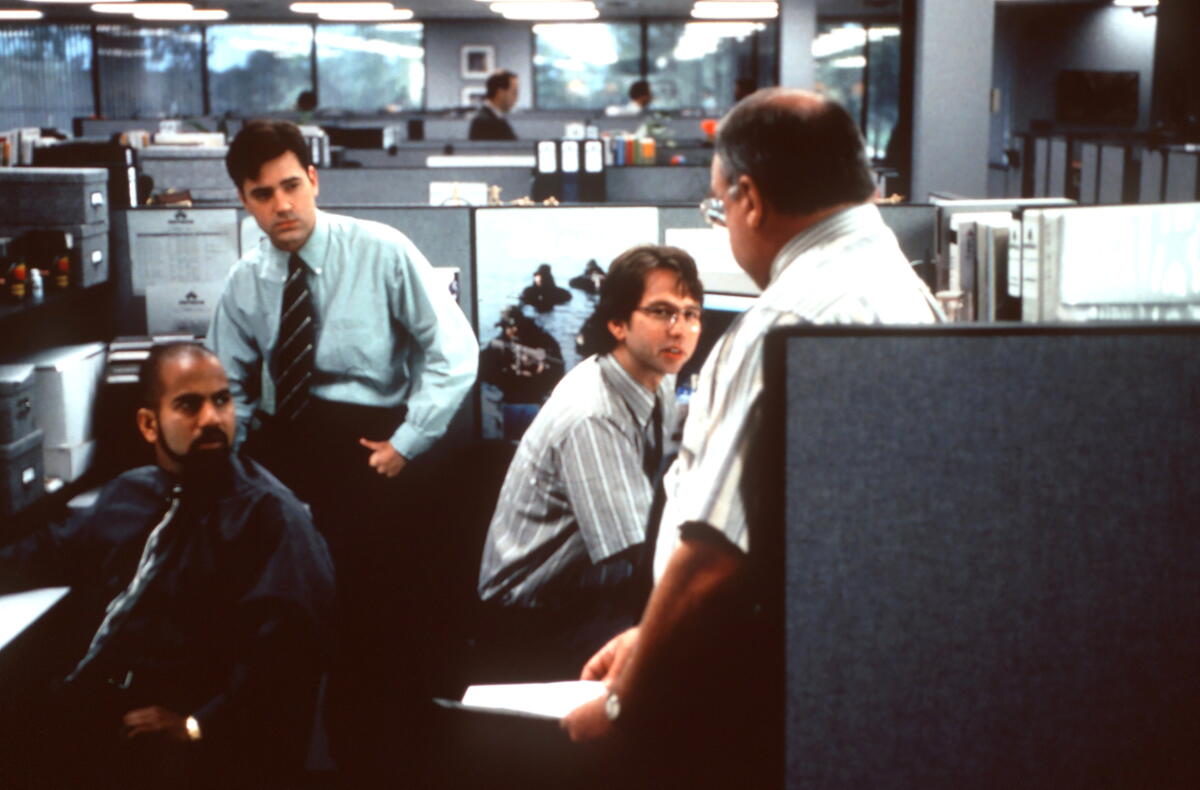
Mindy Kaling was in her early 30s when the first TV series she created, “The Mindy Project,” made its debut and set in motion her attempt at forging an identity as a prolific multi-hyphenate after “The Office,” where she was a writer and cast member for eight seasons. But if you ask her to reflect on that time of her life, she says, it’s a bit of a blur.
As she explained recently, “I remember it, but not all that distinctly. It was such a grind — waking up at 6 a.m. to be on camera, wrapping late. And I did that for 117 episodes.”
But ask her about her 20s, when she was living in New York City and trying to figure out how she could break into the industry as a comedy writer? “I remember incredibly vividly,” she says. “I’m like, did I feel things more intensely back then? I’m not sure. But that period of time … there was just so many highs and lows. And it felt cinematic to me.”
So she made a TV show about it.
Premiering Tuesday with three episodes, “Not Suitable for Work” follows five ambitious 20-somethings living in Manhattan who are navigating the early stages of their careers while trying to have a semblance of a life and the heightened emotions they experience during this period. Kaling calls it the third chapter in her semi-autobiographical TV trilogy, which includes “Never Have I Ever,” about a first-generation Indian American teenager coping with her father’s death while trying to be popular (or at least not super uncool), and “The Sex Lives of College Girls,” about four young women who dorm together and boldly maneuver their new, uninhibited lives on campus.
In the new Hulu series, viewers are introduced to AJ Pascarelli (Ella Hunt), a hard-working and disciplined young woman who moves to town to start a high-pressure finance job, and her roommate Abhinaya “Abby” Chilukuri (Avantika), a savvy and fashion-obsessed assistant to a celebrity stylist. They live across the hall from Josh Teitelbaum (Jack Martin), an idealistic nepo baby of a media titan — he’ll lean into his privilege when it suits him while also trying to distance himself from it — with ambitions of making it in journalism. His two roommates are Kel Washington (Nicholas Duvernay), an insecure but earnest med student who would rather be acting, and Davis Beau Bradley Barrett III (Will Angus), a high-energy, bumbling financial analyst who works at the same corporate firm as AJ and is an undercover hopeless romantic. As one might expect, there are some messy entanglements within and outside the group.
1
2
1.Abby (Avantika), left, and AJ (Ella Hunt) move in together.2.Across the hall live Davis (Will Angus), left, Josh (Jack Martin) and Kel (Nicholas Duvernay).(Gwen Capistran / Disney)
“I hope that young people will respond to the show, “ Kaling says. “We did so much research in it because at a certain point it is funny — I’m in my 40s, and I am often like, ‘I wonder if young people are suspicious about why I’m so obsessed with writing shows about young people.’”
So, why is she?
“Because I find it almost impossible to reflect on the current time I’m in,” she says. “It would be too painful to be too introspective about the time that I’m in. I need a real sense of distance to look back on it, especially since having kids. Once you have kids, it triggers these memories of your own childhood.”
Over video call from New York City, Kaling reflected on the series and her early years of trying to make it. These are edited excerpts from the conversation.
How did you land on the professions that your characters would be pursuing and what did you want to say about ambition at this stage of life?
I love people who have big wants, and sometimes the audience is like, “Maybe you want the wrong thing” and they [the characters] don’t quite know that yet. I love writing about the underdog. And with their particular professions, they’re all things that I had some interest in researching. I’ve always been fascinated by investment bankers. I went to Dartmouth, so I have a lot of friends who went into that, and I swear I’ve had my friends explain their job so many times to me, and I still didn’t totally understand it. We were lucky; a very famous investment bank very generously offered to let me come for a day and meet with young bankers. I also … write about the children of immigrants. I’m very, very interested in that story, and so we got to research what it’s like being the child of Nigerian immigrants. But every single character has a journey, or there’s an aspect of them that I feel like I really relate to, and that is in almost all my shows.
What was it like observing young people in the investment banking world?
They were wary — because they’re smart — of someone from Hollywood coming in to document what they were doing and asking questions. It helped that a lot of the guys liked “The Office” and a lot of the women liked “The Mindy Project” and “Sex Lives of College Girls” because they’re all kind of young. I think that made them trust me a little bit more. For the AJ and Davis characters, so much of what I researched when I was there fed into their plot line … almost all the characters have a boss they fear and idolize, and the way that first-year bankers feel about their managing directors is not dissimilar to the way I felt about Greg Daniels when I started at “The Office.” And the hours are actually not dissimilar.
There’s a moment early on where Jay Ellis’ character, Bill, who is a managing director at this fictional investment banking firm, is asked about work-life balance. I’m curious how you thought about that at the start of your career versus now.
I didn’t care at all about anything except my job for 16 years. It was my entire personality and purpose. When I was in my 20s, the only thing that mattered was being a good comedy writer and succeeding, and one day maybe being able to create my own shows. There was no balance. I didn’t want balance. I wanted to live and breathe comedy writing for my entire life. I hated the weekends, actually. And who wouldn’t? I was a friendless transplant in Los Angeles and I just wanted to get back to working at “The Office.” Every year I was there, I got more ambitious and I wanted to go off and create my own show and have a bigger part as an actor and everything.
It wasn’t until after I did that on “The Mindy Project” … that I just felt like, “OK, I get this. I want to now try being a mom.” Once I had my daughter, Katherine [at 37], it wasn’t that the balance changed, it was my first real, legitimate interest outside of work — that I cared about more than work.
“When I was in my 20s, the only thing that mattered was being a good comedy writer and succeeding, and one day maybe being able to create my own shows,” Kaling says. “There was no balance. I didn’t want balance.”
(Ebru Yildiz / For The Times)
After college, you moved to Brooklyn with two Dartmouth friends to pursue a career in comedy. You eventually got a full-time job as a production assistant on “Crossing Over with John Edward,” a program where people would receive psychic readings. Tell me about that time in your life.
I remember feeling like I had no access and that I didn’t have any place to put my ambition. It was so far away from anything I wanted to do — scripted comedy and reality television could not be further apart. It was a fascinating time because there were such highs and lows. There was the excitement of new crushes and having fun in a new city with two friends, but there was also the crushing disappointment of feeling like I was never gonna make it. I didn’t even have a path forward to making it, but I was lucky, because I lived with my two best friends. We would go to open mic nights, and we would go to restaurant week and see how the rich people in Manhattan were living. We would take the subway uptown to Central Park and walk along Fifth Avenue and like look at these amazing homes and just dream what it was like to be like a wealthy New Yorker who could buy everything that they read about on DailyCandy — now I’m really dating myself here, back when DailyCandy was a thing. But that’s what it was like, I just I felt a lot of extreme emotions.
How did you approach that job?
My boss was a producer and would approach the families and get their information, and then we would have to do research on them, but it was mostly because they would do a little clip package on the different families. I had to get them to sign releases to be on the show and get photographs of their deceased [loved ones] and them. I actually thought it was pretty interesting work. It just had nothing to do with comedy writing, and that job was not clearly going to lead anywhere toward comedy writing, and I came to New York because of “Saturday Night Live.” When I was working there is when my friend Brenda [Withers] … and I started writing this play “Matt & Ben” [a satirical play that imagines the story of Matt Damon and Ben Affleck before “Good Will Hunting” made them famous] in the time we had off. We started writing it, then I got that job as a PA, then the show went up at the Fringe Festival, and then it was going to go off off Broadway, and when it went off-off-Broadway, and I had a steady income, that’s when I quit my job there. I was only at “Crossing Over” for three or so months.
Greg Daniels attended a performance of “Matt & Ben” and it’s what led to you getting on “The Office” at 24.What was that first meeting like?
Back then, because the internet was so different, when I looked up Greg, besides his credits, you couldn’t find a lot of biographical information about him, or even a photo. I don’t think I even knew what he looked like. When I met him, I don’t think I had seen the British “Office” yet; I wasn’t cool. At that time, I had put so much pressure on this job. I only had two interviews — it was this and there was a show that ended up getting canceled while I was waiting to meet the showrunner. It was a pilot called “Nevermind Nirvana,” about an Indian man who married a white woman, and Ajay Sahgal was the writer. I was like, “Oh my God, if anyone is going to get hired to work on the show, it has to be me.” I was pretty excited about that meeting, but when I was sitting in the waiting room at the production offices to meet with Ajay, they told them they weren’t going to pick up the pilot, so I never even got to meet him, and they just told me I could leave.
I’d only had that interview, and then I met with Greg. This is my memory: it was a high-rise building in Century City, in the offices of “King of the Hill,” so there was a lot of like “King of the Hill” cutouts and stuff there. And he’s just a very thoughtful, quiet guy who doesn’t push conversation … I’m someone who’s pathologically chatty, and so talking to Greg, who is completely fine with there being pauses in conversation, and is just a confident grown-up, it was incredibly intimidating. I was very stressed out in our meeting, but I also was blown away by him.
That first season, you were also the only female writer on staff and the youngest —
B.J.[Novak] is a month younger than me. I want to correct that because he’ll read this and go, “Hey … !”
How did that play into how you felt in the room?
I haven’t really ever had imposter syndrome. And this is my probably my personality defect — I felt that even if I hadn’t seen anyone like me in these roles, that I was just going to be the first one, and I was going to work really hard and prove it to them. The staff was super competitive, but they were smart feminist guys. It was hierarchical and stressful, but it was not because of my fellow writers, except that I wanted to impress them. I felt nervous because I wanted to be contributing, but I don’t know why — I just loved the pilot so much that Greg had made, and I loved these characters, and this world — I was like, I can’t possibly lose my job, I love it too much. Which is probably really stupid, I didn’t ever think there’s a possibility that I could get fired here.
Phyllis (Phyllis Smith), Kelly (Mindy Kaling), Dwight (Rainn Wilson) and Michael (Steve Carell) in a scene from Season 2 of “The Office.”
(Paul Drinkwater / NBCUniversal via Getty Images)
We see how AJ wants to impress the boss and takes on more than she can chew and screws up some data before a big presentation. What was that first big mistake or misstep that you made in those early years that you still think about?
I remember Season 2 — because I just wanted to prove to Greg and to the cast and to the director, the cinematographer, and everyone that I was super invested — we were shooting “The Dundies” [episode]. I was an actor on the show as well, but I wasn’t acting in this scene, but it was my episode [that I wrote], and in between takes, John [Krasinski, who played Jim Halpert] and Jenna [Fischer, who played Pam Beesly] were just on set, and I remember going up to them and being like, “Guys, that take was so great!” And I walked away. Greg came up to me and was like, “You know, we really should let just the director talk to the cast between takes.” Greg, he’s my mentor, but he definitely, over the course of the eight years I lived there, had corrected me many times, as he should have, but that was one of the first times. I remember I was so embarrassed, but I didn’t understand it’s not the role of a story editor to be giving feedback to the cast between takes on a show.
The bosses on the show all have different styles and expectations that may seem demanding or annoying on the surface. How do they reflect where you’re at now?
No one trains you on how to be a good boss. And bad bosses are so prevalent. The entire premise of “The Office” hinges on this funny concept that terrible bosses exist. It wasn’t until I was on “The Mindy Project” that I was the employer for the first time. Every single year of that show, it was a battle getting a new season. One of the challenges of being a good boss is being able to put aside those personal, professional battles you’re fighting … but then also realizing that you’re a mentor to other people, and you have to start thinking about things that you never thought you needed to — overtime, maternity leave, respect in the workplace, the things that make the workplace enjoyable for everyone else who’s there working for you. And it’s not like that comes naturally.
The double blessing of having a good boss, which I did in Greg Daniels and Howard Klein [an executive producer on “The Office”], is that they modeled that for me. Even though I could not be more different than Greg. Even to this day, I’m realizing I have all the unique challenges of being a single mom, being the creator of these shows with crews and casts, but then also being able to be empathetic for all the people that work for me and making sure I make time to listen to them when they want to talk to me about an issue that they’re having; it’s a continual challenge that I’m hoping I’m getting better and better at [managing].
When Bill is asked about work-life balance, he’s also asked if he has inspirational words to impart. It’s very much about overworking and being productive. How do you tackle the question today?
I used to say “you have to write your own part.” And everyone would get annoyed because they’re like, “I’m not a writer.” I’ve had to really think about the question so I could be helpful. We all want a linear path to success. And if my career has taught me anything, it’s that the linear path just was not how I got my job. You know when you go on Google Maps and it shows you all the different paths — the fastest, one path with the toll road and one path that’s going to take seven minutes longer. I’ve only ever taken the one that’s seven minutes longer, or the toll; it’s never been the easy way. The sooner I got used to that, the better.
Before I let you go, in the show, one of the celebrity clients Abby is dealing with is Austin Blanchett, Cate Blanchett’s fictional nephew. Was it always going to be Cate? What other celebs were in the running?
It was Cate Blanchett’s nephew before we had Harry Richardson. When I worked on “Ocean’s Eight,” one of the biggest surprises on it was that Cate Blanchett was incredibly funny and did not take herself seriously at all. I suspect if anyone was going to think it was funny that in this fictional world of the show she had this useless nepo nephew that she had to help get jobs, it would be Cate. I hope she doesn’t sue me. I think she would think it was funny.
Media freedom advocates condemn move as latest effort to curtail independent reporting on the US military.
Published On 2 Jun 20262 Jun 2026
The United States Department of Defense has barred journalists from its press office, the latest move by the Pentagon to restrict media access since President Donald Trump’s return to the White House.
Acting Pentagon Press Secretary Joel Valdez said on Monday that the administration had re-designated the office as a “Sensitive Compartmented Information Facility” due to its use by speechwriters with access to classified government information.
Recommended Stories
list of 4 itemsend of list
“These speechwriters routinely handle classified material and require SIPRNet access,” Valdez said in a statement provided to Al Jazeera, referring to the secure computer network used by the Pentagon to share classified information.
“As a result, journalists will no longer be permitted to enter the office space. Access to the office of the Assistant to the Secretary of War for Public Affairs and to the Press Secretary remains available by appointment only,” Valdez added, using the Trump administration’s preferred title for Defense Secretary Pete Hegseth.
The Washington Post first reported the change.
The move follows a slew of steps by the Trump administration to curtail the ability of US media outlets to report on the military and other areas of the government.
In March, the Defense Department said it would no longer allow media outlets to maintain offices at the Pentagon after a judge sided with The New York Times in a lawsuit challenging the imposition of new rules for obtaining press credentials.
The Pentagon also announced that journalists would require an official escort while inside the complex, a policy that The New York Times is seeking to overturn in a separate lawsuit filed in May.
The National Press Club, the main professional organisation for journalists in the US, condemned the latest restrictions as a “troubling escalation” in the Trump administration’s efforts to curtail media scrutiny of the Pentagon.
“Independent reporting on the US military is not optional,” National Press Club President Mark Schoeff Jr said in a statement.
“When journalists are pushed farther from the institutions they cover, the American people are left with less information, less transparency, and less oversight. Any effort to restrict that access should alarm everyone who values a free and informed society.”
The Freedom of the Press Foundation, a nonprofit advocacy organisation, also criticised the move.
“It’s rare for anything other than disingenuous spin and outright lies to come out of the Pentagon’s press office these days, so it’s hard to imagine what basis they have to call the space classified,” Seth Stern, chief of advocacy at the organisation, told Al Jazeera.
“The only thing sensitive or confidential about the information released by Pete Hegseth’s Pentagon is that it’s not true.”
NEW ORLEANS — A sharply divided Louisiana Supreme Court on Monday signed off on abolishing an elected office won by a New Orleans exoneree who had spent nearly 30 years in prison for murder before his conviction was vacated.
The 4-3 decision leaves Calvin Duncan with little path forward to try assuming the role of Orleans Parish clerk of criminal court, a job he won in a landmark election last year before Republican lawmakers raced to eliminate the office this spring.
In a blistering dissent, the court’s Democratic justices said the ruling opened the door to allowing Louisiana lawmakers to subvert the will of voters. The court’s conservative majority disagreed, writing that “this change was entirely within the authority of the Legislature.”
The court also rejected the New Orleans City Council’s attempt to hold a special election, which would have given Duncan the option to run again.
“At a time when our voting rights are under unprecedented attack, this decision clarifies that if we want to live in a democracy, we have to fight for it with every tool our system of government provides,” Duncan said in a statement.
Signed by Republican Gov. Jeff Landry, the bill eliminating the New Orleans clerk’s office was championed by GOP lawmakers as a necessary step toward government efficiency. Supporters denied that it had anything to do with Duncan or his past.
Democrats blasted the change as overreach from a largely white, conservative Legislature that they accused of seeking to thwart the will of a predominantly Black city. Those tensions surfaced again last month when Landry signed a new congressional map that eliminated one of the state’s two majority-Black House districts.
Duncan was convicted of a 1981 murder and was released from prison in 2011. In 2021, an Orleans Parish district judge vacated Duncan’s sentence, finding he had been unjustly convicted and the charges against him were dropped. Duncan is listed on the National Registry of Exonerations.
Matt Brown, who starred with his family in the Discovery reality television show “Alaskan Bush People,” was found dead in the Okanogan River in Washington state, law enforcement officials said Sunday.
Brown’s body was discovered Saturday by a group of private citizens who were conducting a search, the Okanogan County Sheriff’s Office said in a statement.
Brown’s brother, Bear Brown, said in a video posted Saturday on social media that fellow brother Noah had been with the search team, helped pull the body out of the river and identified him.
The official cause and manner of death is still to be determined by the coroner, the sheriff’s office said. But the Brown family believes Matt Brown died by suicide, Bear Brown said in the video.
Witnesses said they saw Matt Brown in or near the river and that he “took his own life,” Bear Brown said on social media.
“I would have never suspected he would hurt himself, honestly,” Bear Brown said in the emotional video. “He struggled for a long time.”
Bear Brown said his brother had battled with alcohol and drugs and that Matt Brown told him in their last conversation that he had “fallen off the wagon.”
The Brown family and their life in the Alaskan wilderness were the subject of the reality TV show “Alaskan Bush People,” which ran on the Discovery Channel from 2014 to 2022.
Suicide prevention and crisis counseling resources
If you or someone you know is struggling with suicidal thoughts, seek help from a professional or call 988. The nationwide three-digit mental health crisis hotline will connect callers with trained mental health counselors. Or text “HOME” to 741741 in the U.S. and Canada to reach the Crisis Text Line.
Internet culture is showing up in a big way in theaters, as low-budget horror films “Backrooms” and “Obsession” led this weekend’s box office and beat out big franchise films like “Star Wars: The Mandalorian and Grogu.”
A24’s “Backrooms” topped the charts with $81.5 million in the U.S. and Canada in its opening weekend, according to studio estimates. The film is directed by 20-year-old YouTuber Kane Parsons, who based it on his internet series of the same name.
“Backrooms,” which reportedly had a production budget of about $10 million, stars Chiwetel Ejiofor as a furniture store owner who finds a mysterious portal in his basement. The film made a total of $118 million worldwide.
In second place was Focus Features’ “Obsession,” which hauled in $26.4 million in its third weekend in theaters, up 10% from the previous weekend’s total. The film, which had a production budget of less than $1 million, has now grossed $104.7 million domestically for a global total of $148 million.
“Obsession” director Curry Barker is also known for his YouTube sketch comedy channel.
The success of two YouTube-native filmmakers at the box office indicates the growing power of the platform — and online culture as a whole — in attracting audiences to cinemas.
Walt Disney Co. and Lucasfilm’s “The Mandalorian and Grogu” fell to third place this weekend with a domestic gross of $25 million. Lionsgate’s musical biopic “Michael” ($11.7 million) and Sony Pictures’ family comedy “The Breadwinner” ($7.5 million) rounded out the top five at the box office, according to Comscore data.
Politics is about persuasion and emotion, not rocket telemetry, so it’s not hard to figure out what’s going on.
“You look at Xavier and he seems to be perceived as a thoughtful, credible, trustworthy choice. That’s what I hear when I talk to regular people who aren’t political insiders,” said Darry Sragow, a Democrat strategist who’s spent decades running California campaigns. “So you see the people who want to take him out going after one of the words I just used here, which is ‘trustworthy’ and, to some extent, ‘credible.’”
A recent Steyer mail piece — which, naturally, features a grim-faced portrait of Becerra — accuses him of “mismanagement,” “scandal” and “incompetence,” and cites a 2024 quote from Susan Rice, a former Biden domestic policy advisor, describing the ex-Cabinet member as an “idiot.” (Apparently “bitch-a—,” another Rice epithet from the same Axios news report, was deemed unsuitable.)
The mail piece also quotes Xochitl Hinojosa, a Justice Department spokesperson in the Biden administration, saying Becerra “was not effective in government,” though several people who worked in the White House could not think of any occasion, or any reason, Hinojosa would have meaningfully interacted with Becerra.
Pretty weak sauce. But at least Hinojosa, who delivered her gibe on one of CNN’s talking-head shows, was willing to publicly attach herself to the criticism.
Six former Biden administration officials were quoted by Politico “reacting with a mix of incredulity, mockery and resignation” to Becerra’s sudden ascendance in the governor’s race. Critics also unloaded to NBC News and other outlets. All of them spoke anonymously.
Therefore, it’s impossible to discern their motivations. Jealousy? Ego? An attempt to stay politically relevant?
Or maybe Becerra was, indeed, a feckless, flailing and thoroughly awful Cabinet member, deserving of scorn and shame.
Ron Klain, who was Biden’s chief of staff during the first two years of his presidency, doesn’t believe so.
“I think he did an excellent job as HHS secretary and I think the record shows that,” Klain said, citing, among other accomplishments, Becerra’s work helping negotiate a drop in the price of prescription drugs and expanding healthcare coverage under the Affordable Care Act.
On COVID-19, Becerra “wasn’t confirmed until several months into the Biden administration. Dr. [Anthony] Fauci had been on the job and was quite a well-known figure to Americans. So, of course, he became more the face of the COVID response.”
“On immigration,” Klain went on. “Xavier’s part was small and discreet. He wasn’t the secretary of Homeland Security. He didn’t run the border. He oversaw an office called the Office of Refugee Resettlement” responsible for processing children who crossed the border alone. “I was in meetings where he was a passionate and forceful advocate for these minors,” Klain said.
Still, there are legitimate questions, notwithstanding Becerra’s deflections — Trump! MAGA! Trump! — about his handling of the migrant children, some of whom died, suffered horrible abuse or were catastrophically injured, according to revelatory reporting by the New York Times. It’s worth noting, however, that Becerra inherited a plan to deal with unaccompanied minors that was drafted and phased in by Rice and her Domestic Policy Council.
There is an unhappy history between the two; apparently Becerra was not alone in drawing Rice’s ire. In 2022, an article in the American Prospect accused her of creating an “abusive and dehumanizing workplace,” in which Rice routinely berated others, including the Health and Human Services secretary.
On social media, Rice has made no secret of her continued contempt for Becerra, a display that carries no small whiff of ax-grinding and score-settling. She highlighted the refusal of Biden’s Homeland Security chief, Alejandro Mayorkas, to endorse Becerra in the governor’s race, though it would be surprising if Mayorkas, Biden, Kamala Harris or any high-level Democrat picked a favorite in such a fiercely contested primary.
Becerra “had big things to do and he got them done,” said Neera Tanden, who succeeded Rice as head of Biden’s Domestic Policy Council and has vigorously defended Becerra against attacks on social media.
“I am not on or coordinating with the Becerra campaign,” Tanden said. “I just know these attacks are ridiculous.”
If Becerra makes it past Tuesday’s primary to the November runoff, his career merits careful scrutiny — and not just those years spent in the Biden Cabinet. Many voters are still getting to know Becerra, who is the likeliest candidate to be California’s next governor. Anonymous quotes, drive-by commentary and incendiary mailers may be standard campaign fare. But voters deserve better.
That means there’s no chance of a Republican sweep in this blue state, and suddenly, what has up until now been a pretty dry governor’s primary race has turned into one that has a slim-but-genuine chance at a surprise ending — two Democrats on the November ticket.
“It’s a low probability,” political data guru Paul Mitchell told me, “But there’s always a chance.”
Those of you who have hung on to your ballots like winning lottery tickets, and those who plan on voting in person, will largely decide what happens next: An Xavier Becerra-Steve Hilton top two is a virtual election for Becerra since there just aren’t enough Republican voters in the state to carry a general election. A Becerra-Steyer face-off would force both candidates to define a vision of California beyond generic liberal ideas.
Personally, I wouldn’t mind seeing California have that Dem-on-Dem showdown so that voters of all parties (or none) have the chance to pin these would-be leaders down on the details of their policies. So far, this election has been light on the specifics, but the state faces real problems — from a failing healthcare system to gas prices that literally mystify even lawmakers.
Everything changes when a candidate becomes a winner, so maybe it would be good for democracy to have an old-fashioned war of ideas in this moment when the future of California holds so many unknowns.
Is Steyer just a billionaire dilettante trying to buy an office? Is Becerra beholden to the many corporate interests who have funded his campaign? Those are just the top-line questions many voters still have.
“There’s lots of shades of blue,” pointed out Chad Peace of the Independent Voter Project, on a press call to support open primaries. “When we only look at things as, ‘Oh, there’s red and there’s blue,’ we forget that.”
But voters remain nervous, and the ballot is still packed — along with the top three, former Rep. Katie Porter and San José Mayor Matt Mahan are still campaigning, though with falling support.
Voters, Mitchell said, “are really thinking about the implications” of their vote, and perhaps don’t want to throw it away on a candidate they perceive as having no chance. That’s why the new polls showing Steyer as a contender have the potential of stirring up momentum, especially for voters who originally saw themselves filling in the bubble for one of those candidates on the decline.
Recent polls have put Steyer in a near-dead-heat with Republican front-runner Hilton, both hovering slightly above or below 20%. Becerra, the former California attorney general and a former Biden Cabinet secretary, leads them both by a few points, especially among Latino voters. As my colleague Gustavo Arellano has pointed out, Becerra would be the state’s second Latino governor, after Romualdo Pacheco, who held the office for 10 months in 1875.
“A Dem-Dem race, maybe we’ll get more people involved, because it’s going to be a harder fight, you know?” Diane McClure told me. She’s a board member of the California Nurses Assn., which endorsed Steyer early — in large part because he supports a plan for single-payer health insurance, which that union has long fought for.
McClure, of course, would love to see Steyer take the top spot in that easy-win scenario against Hilton, though that seems doubtful. But a Steyer-Becerra race?
“Maybe it’s a good thing, maybe it’ll wake some people up,” she said.
For his part, Steyer is staying the course. At a Sacramento stop Friday, he bounded around chatting with about four dozen mostly union supporters, wearing trademark Nikes, this time a vintage pair with a tartan plaid swoop.
“Four days,” Steyer said when he finally took the microphone. “I really need you to stand with me. But let me say this: you stand with me, I stand with you.”
Unlike his debate performances, Steyer is passionate, and, though it seems unlikely based on his television appearances, has an amiable charisma dotted with a fair amount of light profanity.
“Make a decent living, buy a house, have a great education for your kids, and retire,” he said. “That’s what we’re trying to build here. We can easily do that. When people say that’s not possible, bull—, that’s bull—.”
It was enough to sway Ricky Carter, one of the few non-union members in the room, who was invited because his wife, Barbara, was on a prayer chain with another invitee. An older Black man originally from South Los Angeles, Carter represents a demographic where Steyer has growing popularity.
“I believe him. He got it right in here,” he said, pounding a fist over his heart. “It ain’t about no color, creed and race. … It’s about the people.”
Indeed, elections are about the people, though it doesn’t always feel like it. But suddenly, this one does.
In a few days, Los Angeles voters will be casting ballots for city attorney — and in a few months, they could be voting to sharply diminish the city attorney’s authority.
The city’s Charter Reform Commission has proposed splitting the city attorney’s office into two parts — an elected city prosecutor, charged with handling criminal misdemeanors, and a mayor-appointed and City Council-confirmed city attorney who would represent the city in civil cases and advise the mayor, city council and city departments.
The City Council is reviewing the recommendation as part of sweeping changes to city government, including expanding the council from 15 to 25 seats, which could go before voters in the Nov. 3 general election.
The proposed changes to the city attorney’ office, however, come in the midst of a heated primary campaign, where incumbent Hydee Feldstein Soto is up against three challengers, including a state deputy attorney general and a deputy district attorney.
Both of those challengers say plans to bifurcate the city attorney’s office are rooted in longstanding conflicts between Feldstein Soto and the City Council.
And last year, City Council took a 12-0 vote to direct Feldstein Soto to withdraw an effort to halt a federal judge’s order prohibiting LAPD officers from targeting journalists with crowd control weapons.
“When I first heard about this idea, I thought it was probably the greatest indictment of the current city attorney that I’ve heard yet,” said John McKinney, a Los Angeles County deputy district attorney who is running for city attorney in Tuesday’s primary.
McKinney opposes the bifurcation, saying it will cause overlap and confusion. “If she was doing a good job … we wouldn’t even be having this discussion,” he said.
Marissa Roy, another candidate in the race, hasn’t taken a position on bifurcation but said Feldstein Soto’s actions triggered the proposed change.
“The only reason that bifurcation, or splitting the city attorney’s office, is even going to be going before voters is because we’ve had an incumbent city attorney who has gone so rogue to politicize the role,” said Roy, a deputy state attorney general.
Roy said accused Feldstein Soto of inappropriately blocking an affordable housing project in Venice. And in her office’s role of drafting ordinance language, Roy said, Feldstein Soto has returned to city council ordinance language that isn’t “faithful to the intent of the drafter.”
Feldstein Soto said the proposal to bifurcate the office has nothing to do with her performance.
“This issue comes up every single time charter reform comes up,” Feldstein Soto said. “To me this is all political opportunism.”
Feldstein Soto has opposed the split, and former city attorneys have also come out against it, saying an appointed position threatens the independence of the city attorney’s office, takes away from voters the right to elect a city attorney and could cost taxpayers money in order to split the office.
In a March letter to the Charter Reform Commission, Feldstein Soto said an attorney “serving at the pleasure” of the mayor and city council would face an “innate, human pressure to harmonize legal advice with the political goals of the appointing officials.”
“I have been able to provide honest, accurate legal advice to the Mayor, City Council, Controller and departments — even when that advice is unwelcome — precisely because I am an independently elected officeholder with an ultimate duty to the public,” she wrote. “An appointed City Attorney, serving at the pleasure of the Mayor and City Council, faces enormous political pressure on all of these issues, behind closed doors, cloaked in privilege without an independent voice.”
Burt Pines, a former city attorney who served from 1973 to 1981, deeply opposes the bifurcation proposal, citing the threat to independence as the largest issue at stake. As city attorney, he said, he was empowered to tell city officials when a proposed action was unlawful and refuse to support it.
“You want to be able to call the shots as you see them, true to the law,” Pines said in an interview.
Advocates say other cities have bifurcated offices, and splitting it could reduce conflict and provide a clear delineation of roles.
After consulting with experts and good governance groups, the commission agreed the benefits of bifurcation outweighed the negatives, and it passed unanimously by the commission.
“It was easy to get consensus on this,” said Raymond Meza, chair of the commission. The commission’s proposal calls for the city attorney to be nominated by the mayor, and confirmed by the City Council.
In its report, the commission said that “the current structure creates conflicts when the same office advises the city and prosecutes cases. Separation provides clearer roles, reduces conflicts, and allows each function to be performed effectively.”
Other cities have different models for the city attorney’s office: Long Beach has a similar model with bifurcated duties, while New York City has legal representation split up several ways. The San Francisco City Attorney provides legal representation for the city and county of San Francisco, and the San Francisco District Attorney’s Office handles criminal cases in the city and county.
Mike Bonin, executive director of the Pat Brown Institute, said he has seen the question of splitting the office come up with at least three different city attorneys to varying degrees.
“Given that the city attorney is an elected position, there’s always going to be somebody who doesn’t like them,” Bonin, a former city council member, said. “You need to divorce the question from the occupant and focus on the role — the charter is not about a particular person, the charter is about the function of the office.”
MINNEAPOLIS — A federal immigration officer wanted for shooting a Venezuelan man during the Trump administration’s Minnesota crackdown was arrested Friday in Texas, authorities said.
Christian Castro, of the Immigration and Customs Enforcement agency, was taken into custody 11 days after Minneapolis prosecutors charged him with assault and falsely reporting a crime in the Jan. 14 nonfatal shooting of Julio Cesar Sosa-Celis.
Hennepin County, Minnesota prosecutors said the state’s Bureau of Criminal Apprehension located Castro, 52, in Texas and worked with agents from the Department of Homeland Security’s Inspector General’s Office and the Texas Rangers to arrest him.
“Today’s arrest is a critical step forward in our prosecution of Mr. Castro,” Hennepin County Attorney Mary Moriarty said.
Online court records do not list an attorney for Castro and it wasn’t immediately clear if he has one. Messages seeking comment were left with ICE, the Homeland Security Inspector General’s Office and the Texas Rangers.
Castro is the second federal agent to be charged over their conduct during the Minnesota crackdown, which was known as Operation Metro Surge. He is one of two agents that ICE Director Todd Lyons said lied about the circumstances of the incident.
Hennepin County attorney Mary Moriarty holds up a document containing charges against ICE agent Christian Castro during a news conference at the Hennepin County Government Center in Minneapolis, on Monday, May 18, 2026.
(Renée Jones Schneider/Minnesota Star Tribune Via Associated Press)
According to prosecutors, Castro fired through a home’s front door and shot Sosa-Celis in the thigh after Castro and another officer chased a different man, Alfredo Alejandro Aljorna, to the Minneapolis apartment duplex where he and Sosa-Celis lived. Sosa-Celis and Aljorna were legally in the U.S., Moriarty said.
Federal authorities initially accused Sosa-Celis and Aljorna of beating an officer with a broom handle and a snow shovel. A federal judge later dismissed the charges, and ICE and the Justice Department opened an investigation into whether officers lied about what happened.
In a statement after the charges were announced, ICE said the U.S. attorney’s office was investigating statements made by officers, who could face disciplinary action including being fired and prosecuted. ICE called the Hennepin County attorney’s action “unlawful and nothing more than a political stunt.” DHS’s Inspector General’s Office, which Moriarty credited with assisting in the arrest, is separate from ICE and is meant to serve as a watchdog for DHS agencies, including ICE.
Minneapolis last month released video showing the moments before Sosa-Celis’s shooting, captured from a distance by a city-owned security camera.
The video appears to show a person standing with a snow shovel outside the house, near the street, then retreating toward the house and tossing the shovel into the yard. This happens as a person being chased by another person runs up from the street, falls on the sidewalk, gets up, and keeps heading toward the house.
The three appear to scuffle near the front steps for about 10 seconds. The exact moment when Sosa-Celis is shot isn’t clear. A car with flashing lights pulls up, and another person walks up.
The Trump administration sent thousands of officers to the Minneapolis and St. Paul area as part of President Trump’s national deportation campaign and considered Operation Metro Surge a success.
But tensions mounted during the weekslong campaign, and the shooting deaths of U.S. citizens Renee Good and Alex Pretti by federal officers sparked mass unrest and raised questions about officers’ conduct.
Minnesota leaders and the Trump administration have clashed over who has the authority to investigate and prosecute federal officers for on-duty conduct.
Moriarty’s office last month charged immigration agent Gregory Donnell Morgan Jr. with assault for allegedly pointing his gun at people in a car on a highway. He turned himself in last week and his lawyer disputes the charges.
The county is also investigating Good’s and Pretti’s killings and sued the Trump administration in March to gain access to evidence in those cases and the Sosa-Celis shooting.
The Foreign Office has updated its travel advice for Brits to a number of destinations as a new Ebola outbreak has been declared in the Democratic Republic of Congo
13:15, 28 May 2026Updated 13:15, 28 May 2026
The World Health Organisation has declared Ebola in the Democratic Republic of Congo and Uganda a Public Health Emergency of International Concern(Image: Getty Images)
The Foreign Office has updated its travel advice for a number of countries after an Ebola outbreak earlier this month in the Democratic Republic of Congo (DRC).
On May 15, the country’s Ministry of Health confirmed an outbreak of Ebola Bundibugyo in the North-Eastern Ituri Province, while cases have also been confirmed in Uganda. The World Health Organisation (WHO) has since declared Ebola in the Democratic Republic of Congo and Uganda a Public Health Emergency of International Concern.
As a result, a number of destinations to introduce stricter measures for travellers from health screenings for foreign nationals to quarantine for residents in certain cases.
For example, Kenya has introduced enhanced health screenings for passengers arriving from Uganda, Ethiopia, and DRC, while Tanzania has also introduced increase public health measures for incoming travellers.
Now the Foreign Office has updated its travel advice for Uganda, Angola and the Central African Republic, with warnings around new health screenings and entry requirements for anyone travelling to those destinations.
Due to the outbreak, you may experience heightened health screening at international borders in the region. Check entry requirements for the country you’re travelling to or transiting.”
The Foreign Office has already been advising “against all travel to parts of Central African Republic” before the Ebola outbreak in the DRC and Uganda, but has updated its advice due to the country sharing a border with the DRC.
Virginia Messina, Group CEO of African Travel and Tourism Association (ATTA), said: “Established protocols are in place within countries bordering the DRC and as a result tourism operations and business trips across the wider African continent continue normally. As of 27 May, no other cases have been detected outside of Uganda and DRC. The risk to travellers on standard itineraries outside affected areas remains very low, and it’s important to highlight that Ebola is not easily transmitted through casual contact.
“However, travel rules and screening measures may change quickly. The WHO (World Health Organisation) and the European Centre for Disease Prevention and Control (ECDC) are scaling up efforts to contain the virus but continue to advise against blanket travel restrictions and neither the UK, nor any European country has introduced entry bans.”
Green Bay Packers running back Josh Jacobs has been released from a Wisconsin jail a day after being arrested in relation to an alleged incident over the weekend. He still faces the possibility of being charged with several crimes, including some related to domestic abuse, pending further investigation.
“After reviewing the available evidence in this case, the Brown County District Attorney’s Office is not yet prepared to make a formal charging decision,” Dist. Atty. David Lasee said Wednesday in a news release. “Our office has requested additional investigation, as there is reason to believe that additional evidence may exist that would impact whether criminal charges are appropriate, and what charges would be issued.
“Mr. Jacobs will be released from custody at this time, and a final charging decision will be made by our office at a later date.”
Jail records show that Jacobs, 28, was released at 12:20 p.m.
Jacobs’ lawyers — David Chesnoff, Richard Schonfeld, and Clarence Duchac — said in a joint statement Wednesday that they remain confident their client ultimately will not be charged in the matter.
“We are extremely pleased that Josh has been released from custody and that no criminal charges have been filed against him,” they said. “As we previously stated, we encourage everyone to keep an open mind while the matter is fully reviewed. We remain confident that, once all of the evidence is gathered and evaluated, it will confirm that no charges should be brought against Josh in the future.”
According to the Hobart/Lawrence Police Department, officers were dispatched to a complaint involving Jacobs on Saturday at 8:37 a.m. He was arrested Tuesday on allegations that included strangulation and suffocation, battery-domestic abuse, criminal damage to property-domestic abuse, disorderly conduct-domestic abuse and intimidation of a victim.
Jacobs’ lawyers said in a statement Tuesday that he “vehemently denies the allegations.”
A three-time Pro Bowl selection, Jacobs spent the first five years of his NFL career with the Raiders, leading the league with 1,653 rushing yards in 2022, and the previous two seasons with the Packers.
“We are aware of the matter involving Josh Jacobs,” a Packers spokesman said Tuesday. “As it is an ongoing legal situation, we will withhold further comment.”
Speaking to reporters Wednesday at the team’s voluntary workouts, Coach Matt LaFleur said, “I know there’s going to be a lot of questions about Josh. I’m going to stick with the statement that we put out as an organization and just let the process play out.”
NFL spokesman Brian McCarthy said Tuesday that the league is “aware of the report and have been in contact with the club.”
WASHINGTON — The Trump administration wants all current and future federal employees to sign nondisclosure agreements, part of a continuing crackdown on leaks to the media.
The notice in the Federal Register from the Office of Personnel Management posted Tuesday asked for comment on a draft NDA to be used by federal agencies for “both new and existing employees.”
“The form is intended to document Federal employees’ acknowledgment of, and agreement to comply with, current legal obligations to safeguard non-public, confidential, or proprietary information, created or obtained through their official duties, while expressly preserving the right to make disclosures authorized by law,” the notice said.
The Office of Personnel Management noted “several recent instances” where internal agency communications related to rulemaking and policy development were disclosed without authorization. It also discussed specific instances in which federal employees at the FBI and the Department of Homeland Security disclosed information without authorization about planned immigration enforcement actions.
In one case, the New York Times and Washington Post received unauthorized information on the U.S. raid on Venezuela in January and delayed “publishing what they knew to avoid endangering U.S. troops,” the request for comment said.
Representatives for the two newspapers did not immediately respond to a request for comment.
Ferreting out leaks that the administration deems harmful to its messaging has been a priority across multiple agencies since President Trump returned to the White House. As part of that crackdown, the FBI in January seized the electronic devices of a Washington Post reporter, a move that alarmed media organizations and advocates of press freedom.
One other notable incident occurred last year when dozens of reporters turned in their access badges at the Pentagon, rejecting new rules imposed by Defense Secretary Pete Hegseth that would leave journalists vulnerable to expulsion if they sought to report on information — classified or otherwise — that had not been approved by Hegseth for release.
The American Federation of Government Employees did not immediately respond to requests for comment.
WASHINGTON — President Trump had another medical exam Tuesday, putting his health under renewed public scrutiny as he has worked to dismiss concerns over his age and stamina.
The 79-year-old president spent more than three hours at Walter Reed National Military Medical Center for what the White House described as preventive medical and dental checkups. It was Trump’s fourth publicly disclosed medical exam since he returned to office for a second term, and it comes as he tries to project strength ahead of midterm elections that will test his sway with voters.
In a social media post after the visit, Trump said he just finished his “6 month physical” and “Everything checked out PERFECTLY.”
For decades, administrations have released selected results from presidential physicals, offering the public a glimpse at the commander in chief’s health. But the results are filtered through the White House and must be approved by the president, raising questions about what the public does and doesn’t get to see.
Trump turns 80 next month and was the oldest person elected president. His immediate predecessor, President Biden, was 82 when he left office, dropping out of the 2024 race because of widespread concerns he was too old for the job.
A Washington Post/ABC News/Ipsos poll conducted in April found that less than half of U.S. adults think Trump has the mental sharpness or physical health to serve effectively as president.
“I think concern for the president’s physical health is probably at an all-time high, and I think advanced physical age is the No. 1 concern,” said Dr. Jeffrey Kuhlman, who served as a White House physician for more than a decade under Presidents Obama, George W. Bush and Clinton.
For a president of Trump’s age, a complete physical would be expected to include advanced heart testing, screening for common cancers and a cognitive assessment, along with basics like height, weight and blood pressure, Kuhlman said.
The White House has not disclosed what the visit entailed but expressed confidence in what it will show.
“President Trump is the sharpest and most accessible President in American history who is working nonstop to solve problems and deliver on his promises, and he remains in excellent health,” White House spokesperson Davis Ingle said in a statement.
No law requiring presidents to disclose medical records
In the weeks leading up to his visit, Trump has been saying he feels as good as he did five decades ago — even as he jokes about his fondness for fast food and his minimal exercise regimen. Yet he’s also sensitive to perceptions about his age, noting that he takes extra caution descending the steps from Air Force One to avoid headlines about a stumble.
There is no law requiring presidents to publicize their health records, and the degree of transparency has varied by administration. Trump’s past reports have been criticized for offering scant detail and providing statistics that some medical experts eyed with skepticism.
At public appearances, Trump often is seen wearing makeup to conceal bruising on his hands, which the White House attributes to handshaking and regular aspirin use. He sometimes has appeared drowsy during meetings and closed his eyes for long stretches, though he denies having fallen asleep.
Trump often boasts of having “aced” cognitive tests while frequently deriding Biden, who faced questions about his mental acuity. Biden and his aides pushed back aggressively against doubts raised about his fitness for office.
Some of Trump’s previous physicals have included the Montreal Cognitive Assessment, used to screen for dementia and cognitive impairment. His physicians reported a score of 30 out of 30 for him at 2018 and 2025 checkups.
Yet critics have pointed to Trump’s meandering speeches and sometimes bellicose rhetoric as evidence of cognitive decline.
Last month, a statement from more than 30 neurologists, psychiatrists and other medical experts — who acknowledged they’ve never examined him — said Trump was mentally unfit to serve and warned of an “increasingly dangerous decline” in his behavior based on what they called “objectively observable signs of serious medical concern.″
“Any so-called medical professionals engaging in armchair diagnosis or false speculation for political purposes are clearly breaking the Hippocratic Oath they’ve sworn to,” Ingle said.
Just like any other patient, presidents get to choose what’s disclosed about their health, said Sara Rosenthal, a bioethicist at the University of Kentucky who studies presidential health. Questions about transparency have become more acute as America elects aging presidents like Trump and Biden, she said.
“We can expect very little disclosure about the true health status of any president unless they’re in perfect health,” said Rosenthal, who has suggested an independent medical organization to review and report on the health of the president and those in the line of succession.
‘Nothing should be hidden’
Trump’s first medical report in his second term was released in April 2025. In July, he was diagnosed with chronic venous insufficiency, a common condition in older adults that causes blood to pool in his veins. Photographs have shown the president with swollen feet, ankles and calves, described by the White House as a symptom of chronic venous insufficiency leading to “mild swelling” in his lower legs.
Following his last publicly disclosed exam, described as a routine follow-up in October, Trump’s physician issued a one-page summary saying the president was in “exceptional health” without divulging many specific results.
The frequency of Trump’s medical checkups is not uncommon for someone his age, according to S. Jay Olshansky of the University of Illinois-Chicago, who has studied the health of past presidents. It’s part of a strategy to catch problems while they’re still treatable, Olshansky said.
Olshansky says the public deserves to see more than White House medical summaries that “may be subject to editorial discretion.” Full, unredacted medical records should be made public, he said. “Nothing should be hidden.”
The waits are so long that the UK Foreign, Commonwealth and Development Office (FCDO) has been forced to issue an official warning with the UK half term now in full swing
There have been long waits at Copenhagen Airport (Image: Getty)
Brits heading to a popular EU destination have been warned about long delays.
Long queues at arrivals have been plaguing Copenhagen Airport in Denmark in recent days. The waits are so long that the UK Foreign, Commonwealth and Development Office (FCDO) has been forced to issue an official warning.
“Travellers flying into and out of Copenhagen Airport from non-Schengen destinations (including the UK) are experiencing long delays at passport control. Embassy staff are in discussion with the relevant authorities on managing this pressure. Passengers with accessibility requirements, who need assistance (e.g. with very young children) or who have tight flight connections should make themselves known to airport staff in yellow vests who are monitoring the queue. For travellers departing from Copenhagen to the UK and non-Schengen destinations, we recommend giving yourself extra time to allow for queues at passport control,” the comment released on Sunday reads.
The long wait times come in the weeks after the EES border check system was fully implemented at Copenhagen Airport, after a partial rollout in October last year. The new system means that non-EU travellers arriving in the country from outside the Schengen Area, such as those with UK passports, will be fingerprinted at border control.
The scheme has been more than 12 years in development and has been delayed time and time again. Copenhagen Airport completed its rollout of the EU’s new Entry and Exit System (EES) last month.
The implementation of the EES system has caused issues across the whole of Europe, including in the UK. Long queues formed at Dover last week, before the new border checks were suspended amid concerns for drivers stuck in the sweltering bank holiday heat.
Holidaymakers faced hours-long waits on Friday at the Port of Dover and travellers on Saturday came up against similar disruption. In a bid to ease congestion, the French authorities suspended extra EU border checks under its EES, the port announced.
It also said anyone who has missed their ferry crossing because of queues can travel on the next available slot free of charge.
EES involves people from third-party countries such as the UK having their fingerprints registered and photograph taken to enter the Schengen Area, which consists of 29 European countries, mainly in the EU.
There have been delays at other European ports. Passengers in airports in countries such as France, Germany, Belgium, Italy, Spain and Greece were waiting several hours at border checks, the Airports Council International (ACI) body said last month.
Olivier Jankovec, the director of the ACI European division, told the Financial Times: “This situation, in the coming weeks and certainly over the peak summer months, is going to be simply unmanageable. We are seeing those queueing times now, at peak times, when traffic is just starting to build up.”
Last week, the boss of budget carrier easyJet urged European member states to be more flexible and avoid long airport queues caused by EES.
He said: “We are in correspondence with all the European member states, encouraging them to use the flexibility they have already been given by the EC, because it is unacceptable if customers are made to wait in border queues because, frankly, they have had since 2017 to prepare.
“It is really inexcusable. They have got the means to avoid allowing the queues to overrun by opening up the passport desks. It is completely in the gift of the European member states to smooth this through.”