For those of us who remember the bicentennial, the semiquincentennial is a complete and utter dud. Many fine festivities will take place on and around July 4, but compared with the years-long nationwide celebration that marked this country’s 200th anniversary, 250 feels like a nonevent.
Perhaps it was inevitable. Semiquincentennial (meaning half of a 500-year anniversary) certainly doesn’t roll off the tongue as easily as bicentennial and our current president isn’t making it any catchier. Mostly because he seems to think 250 is the new 80 (the birthday President Trump recently marked with his UFC Freedom 250 cage match on the White House lawn).
To be fair, the federal government’s involvement in bicentennial planning also got bogged down with political and personal hubris. The national commission, originally created by President Lyndon B. Johnson, was reformed under President Richard Nixon. Plagued by criticism and scandal, it was eventually dissolved by Congress and replaced by a new commission that decided to mostly fund community celebrations.
There was much hand-wringing over missed opportunities at the time, but for more than a year, state and local governments staged reenactments, parades and patriotic events all over the country while the commercial sector star-spangled the crap out of everything: T-shirts, bell-bottoms and bathing suits; curtains, bedspreads and throw rugs; dishware, glassware and Tupperware.
The Declaration of Independence appeared on highball glasses, tea towels and collectible plates. Beginning in 1974, CBS ran mini-history lessons called “Bicentennial Minutes,” which were then sent up on shows as diverse as “Hee Haw” and “Maude.” George Washington and other Founding Fathers graced Pez dispensers, coasters and the cover of Mad Magazine. There was a bicentennial Barbie and a colonial Campbell’s Soup doll. McDonald’s sold red, white and blue milkshakes, Burger King offered a flag-bedecked series of glass tumblers, Disney characters wore tricorn hats for a line of park merchandise.
Some called it the “buy-centennial” but for a kid who daily rocked Stars and Stripes sneakers, and, thanks to a year’s worth of American-history-themed “Schoolhouse Rock!,” could, and would, sing the preamble to the Constitution or the anthem “No More Kings” at the drop of a hat, it was great fun.
Now, of course, “No More Kings” is an anti-Trump protest theme, and the right has so co-opted patriotism that wearing a flag-emblazoned T-shirt can feel somehow partisan. American history itself has become a bone of contention, with the left accusing the right of whitewashing this country’s inarguable sins — Native American displacement, slavery, gender inequality and racist policies — while the right insists that the left is obsessed with undermining our nation’s power and legacy by “woke”-shaming it.
The only thing each end of our divided political spectrum can agree on is that democracy is under mortal threat from the other.
That’s one good reason to feel less than festive, and there are plenty of others, including increased political violence, the war in Iran, tariffs, surging gas prices, civil rights rollbacks, Immigration and Customs Enforcement tactics, artificial intelligence’s threat to jobs, the resurgence of measles, the rising cost of just about everything and the fact that some critics are claiming that Steven Spielberg’s “Disclosure Day” is less full of wonder than “Close Encounters of the Third Kind.”
But things weren’t so great heading into the bicentennial either. I was 12 at the time, born nine months after Alabama Gov. George Wallace gave his infamous “segregation now, segregation tomorrow, segregation forever” speech and less than two months before President Kennedy was assassinated. I hadn’t been alive a year when civil rights activists James Chaney, Andrew Goodman and Michael Schwerner were murdered in Mississippi by members of the Ku Klux Klan and hadn’t turned 5 when the Rev. Martin Luther King Jr. and then-Sen. Robert F. Kennedy were also assassinated.
Sure, it was that now-wistfully remembered time when kids went out in the morning and played, mostly unmonitored, until nightfall (with the inevitable trips to the doctor for stitches and tetanus shots for those wounds too obvious to hide from parents). But by the time the bicentennial rolled around, my life had played out against the backdrop of civil unrest and the Vietnam War, both spilling from our black-and-white television almost nightly.
I was 9 when Wallace, then a presidential candidate, was shot and 10 when I learned what OPEC and gas siphoning meant as my family spent hours in an un-air-conditioned car, inching toward the gas pump after the 1973 “Yom Kippur” Arab-Israeli War resulted in oil shortages.
That same year, Vice President Spiro Agnew resigned from office, pleading “no contest” to charges of tax evasion but avoiding prosecution for charges of bribery and criminal conspiracy, and Nixon appointed House Minority Leader Gerald Ford (R-Mich.) to Agnew’s place. In 1974, Nixon, faced with impeachment for his part in the Watergate scandal, became the first president in U.S. history to resign.
The bicentennial’s tall ships festivals, fife and drum parades and Old Glory consumer fest occurred in a country reeling from more than a decade of history-changing assassinations, civil unrest, economic anxiety and high-level political corruption (not to mention a collective fear of the ocean brought on by the 1975 release of Spielberg’s “Jaws”). Democracy was celebrated under Ford, the first, and thus far only, president to come to office through the provisions of the 25th Amendment rather than a national election.
A president who, after being regularly and ruthlessly lampooned by comedian Chevy Chase on the nascent “Saturday Night Live,” reacted by becoming friends with Chase instead of, you know, forcing the network to fire him.
If the bicentennial roiled with some of the same tensions Americans feel today, it did benefit from a cultural cohesion that no longer exists. The year 1976 saw the founding of Apple and the introduction of VHS tapes, but the national audience was still very much a reality. Back then, you couldn’t escape the songs of the summer — “Silly Love Songs” (Wings), “Don’t Go Breaking My Heart” (Elton John and Kiki Dee) and “Afternoon Delight” (Starland Vocal Band) — any more than you could miss those “Bicentennial Minutes.” We all listened to the radio, watched TV, went to the movies and bought books, and our preferences revealed the country’s desire for both comfort and change.
On the bestseller lists, Agatha Christie’s final Hercule Poirot and Miss Marple books marked the end of an era, toggling in the No. 1 spot with the political turbulence of Gore Vidal’s “1876” and Leon Uris’ “Trinity.” “Rocky” beat “All the President’s Men,” “Taxi Driver,” “Network,” “Marathon Man” and “The Omen” at the box office and, later, in the best picture Oscar race.
On television, Americans sought the nostalgic comfort food of “Happy Days,” “The Waltons” and “Little House on the Prairie” amid the more pointed social comedies of “All in the Family,” “The Jeffersons” and “MASH,” all of which had nightly averages of 20 million or more viewers.
In today’s cultural landscape, defined by social media bubbles, streaming services and Spotify libraries, the gap between mass audience and cultural significance is much wider than it was 50 years ago (“The Super Mario Galaxy Movie” may be the highest-grossing movie of the year, but it’s hard to imagine it winning best picture) and mass audience has become a relative term for pretty much everything that is not the Super Bowl.
Even so, we too find ourselves rooting for the little guy (“Project Hail Mary”) and reaching into the past for inspiration (a new “Little House on the Prairie” debuts next week on Netflix) even as we contemplate the future of tech (“The Six Billion Dollar Man” has become every computer genius who can leap a firewall).
I don’t know what it was like to be an adult in 1976, but I remember my parents fretting over the grocery budget, nixing travel plans because of the price of gas and worrying about the future of a country that seemed so irreparably divided. To paraphrase the Diana Ross hit of the time, did we know where we were going to? Not at all. The bicentennial occurred during an election year, with all the partisan denunciations that entails (though when Jimmy Carter narrowly beat Ford, no one thought of contesting the results).
Even so, most Americans were still ready to party, to celebrate the 200th anniversary of a long-shot revolution that resulted in the United States of America.
So does it stink that the semiquincentennial has been such a flop? Yes, it does. But, as is written in its very singable preamble, the Constitution was written “in order to form a more perfect union.” Not “perfect,” but “more perfect.” As in better.
Even in the most troubled times, the cornerstone of our democracy is the understanding that we will always need to do better and there is a living document that allows us to do so.
And 250 years’ worth of that is definitely worth celebrating.
NEW YORK — The Trump administration on Tuesday said it would freeze federal funding for New York’s Medicaid Fraud Control Unit, a state agency responsible for investigating and prosecuting fraud in the safety-net government healthcare program.
In a letter sent to New York officials, U.S. Department of Health and Human Services Inspector General Thomas March Bell accused the state of not securing enough criminal indictments and said millions of dollars in funding would be suspended through at least Sept. 30.
The move is the second suspension of a state Medicaid fraud unit this year by the Republican Trump administration, and part of a barrage of anti-fraud actions it has aggressively promoted in the healthcare sector. They have included the creation of a new task force, targeted investigations, funding deferrals and demands for revalidation of healthcare providers that have touched all states but are focused largely on Democratic ones.
The pulled funding also comes after the administration admitted a glaring error in figures meant to help justify a fraud inquiry into New York’s Medicaid program this year, a mistake critics said revealed a Trumpian tendency to attack first and verify the facts later.
New York Atty. Gen. Letitia James, a Democrat, immediately vowed to fight Tuesday’s funding freeze.
“During my time as Attorney General, my office has recovered over $627 million for Medicaid and was recognized by this very administration for leading the nation in anti-fraud efforts,” she wrote. “We are considering all legal options to stop this outrageous action.”
Letter accuses New York of low performance compared to other states
Bell’s letter to James and New York Medicare Fraud Control Unit Director Amy Held argues that the unit is moving too slowly on cases and amassing too few indictments and convictions for wrongdoing in the Medicaid system. It notes that compared with four similarly sized units in other states, it secured the lowest number of criminal fraud convictions between 2023 and 2025.
The letter acknowledges that one reason the state has fewer criminal convictions than others is that it made a deliberate choice to focus on “high impact, complex fraud cases” rather than smaller-scale individual cases, but says that trade-off didn’t produce sufficient results.
“Enough is enough,” Bell wrote. “The New York MFCU has failed to comply with the terms and conditions of its MFCU grant award.”
Bell said in the letter that the funding suspension could be lifted before Sept. 30 if New York takes corrective action, “showing it has remediated concerns that formed the basis for this suspension.” He said if the state doesn’t fix the problems, the freeze will continue.
New York officials dispute the Trump administration’s claims
New York’s attorney general’s office said in a statement that it has “long been recognized as a national leader in effectively investigating and prosecuting Medicaid fraud schemes,” including by the Health and Human Services inspector general’s office. A 2025 report from the office notes that New York is one of four states that made up half the total civil recoveries in that year.
A spokesperson for the attorney general’s office said most of the unit’s criminal convictions focus on company owners, executives and corporations that would return large amounts to Medicaid.
“This administration’s unprecedented attack on New York is another political distraction,” James said in a statement.
The funding cutoff follows a similar move in Hawaii. In early June, Bell told Hawaii officials that Medicaid fraud funding would be cut off there, saying that it had a three-year stretch without a Medicaid fraud indictment or conviction.
Joan Alker, executive director and co-founder of Georgetown University’s Center for Children and Families, said there’s an irony in the federal government cutting off money intended for prosecuting fraud when its stated goal is to do just that.
“If you want to fight fraud, don’t take away money from states’ fraud control units,” she said. “I chalk this up to more political theater to distract voters from historic Medicaid cuts before the midterms.”
Move follows months of federal warnings and deferrals
For months, the Trump administration has contended that states — especially some Democratic-led ones — have been lax about fraud in social safety-net programs, including Medicaid.
It has demanded that at least five states, four of them governed by Democrats, share information about how they identify, prevent and address Medicaid fraud.
The federal government has also withheld some Medicaid funding from Minnesota and California over fraud concerns. Minnesota Gov. Tim Walz, a Democrat who was Kamala Harris’ 2024 running mate, accused President Trump of making cuts because of retribution.
The fraud-busting efforts have also targeted Medicare programs. Dr. Mehmet Oz, who leads the federal Centers for Medicare and Medicaid Services, announced a six-month moratorium on new enrollments for providers of hospice and home care nationally.
Swenson and Mulvihill write for the Associated Press. Mulvihill reported from Haddonfield, N.J. AP writer Anthony Izaguirre contributed to this report.
Britain’s culture minister may challenge Paramount Skydance’s takeover of Warner Bros. Discovery — presenting a potential speed bump to David Ellison’s plan to wrap up his $111-billion deal by September.
Earlier this month, Paramount secured the U.S. Justice Department’s blessing to buy the Warner assets, which include CNN, HBO, Cartoon Network, Animal Planet and the Warner Bros. film and TV studios in Burbank.
Paramount also must win the approval of British and European regulators, who are known for drilling deeply into media matters because of their influence on society.
Britain’s Competition and Markets Authority took a preliminary step this month by opening an investigation into Ellison’s proposed merger.
On Tuesday, Lisa Nandy, Britain’s secretary of state for culture, media and sport, notified Parliament that she was inclined to intervene in the blockbuster deal.
In a written statement, Nandy cited her ability to weigh in on “public interest grounds,” due to concerns about maintaining a competitive media market in Britain.
“The UK’s move to intervene in the Paramount–WBD deal confirms what we’ve been saying for months. The real regulatory risk was never in the US — it’s in Europe,” Forrester VP Research Director Mike Proulx said Tuesday in a statement.
While Nandy cautioned she has not made “a final decision on intervention at this stage,” she has invited Paramount and Warner Bros. to respond to her concerns by Monday.
Lisa Nandy, Britain’s secretary of state for culture, media and sport, has said she may intervene in the deal on “public interest grounds.”
(Alishia Abodunde / Getty Images)
Paramount did not offer immediate comment.
The company owns CBS News, children’s channel Nickelodeon and Channel 5, one of the largest over-the-air television broadcasters in the United Kingdom.
Warner Bros. Discovery owns CNN, Cartoon Network and TNT Sports, which broadcasts the Olympics, Champions League and Premier League soccer matches.
“I am conscious that the proposed acquisition is global in nature,” Nandy wrote in her statement. “In reaching this decision, my focus has been, and will remain, on the UK public interest and the range of services available to UK audiences, including Channel 5, TNT Sports, Cartoon Network, Nickelodeon, and CNN International, as well as Paramount+ and HBO Max.”
If Nandy decides to intervene, the Office of Communications, known as Ofcom, would launch an assessment of the deal. Britain’s Competition and Markets Authority also would determine how the merger might reshape the competitive landscape.
Teams from the two companies have been huddling for months to plan for the melding of the two operations as soon as Paramount receives all of its regulatory approvals.
Australia, New Zealand, China, Saudi Arabia, Ukraine, Serbia, France and Italy have already given their approvals to the deal.
Saudi Arabia’s Public Investment Fund is planning to contribute $10 billion to help the billionaire Ellison family pull off the merger, which would make the Saudi royal family a significant, although passive, equity owner. In addition, the royal families of Qatar and Abu Dhabi have agreed to each contribute $7 billion in equity financing.
The Federal Communications Commission must evaluate the foreign ownership stakes due to Paramount’s holding of CBS broadcast licenses. U.S. antitrust regulators already have concluded the combination would not violate federal anticompetition laws.
The U.S. government stopped short of asking Paramount to make concessions or divestitures. Many expect that Paramount may have to reconfigure its children’s television holdings abroad due to the proposed combination of two large players — Nickelodeon and Cartoon Network.
Nandy suggested that Britain also should scrutinize the impact of combining two major streaming services, HBO Max, a Warner property, with Paramount+.
HBO programming, including “Game of Thrones,” “Boardwalk Empire” and “Succession,” has long been popular in Britain.
A coalition of state attorneys general, led by California‘s Rob Bonta, also is expected to challenge the deal, in part, due to concerns about news media consolidation. Bonta’s office has said the matter remains under review.
Opposition to the deal has been building in the U.S. for months. A group of Hollywood activists — led by actors Jane Fonda and Mark Ruffalo — have spearheaded a “block the merger” campaign that now has support from more than 5,000 entertainment workers.
The group’s open letter calls on Bonta to take action to thwart the Ellison expansion effort. Paramount’s Chief Legal Officer Makan Delrahim has blasted the campaign, calling it “fear-mongering” and a partisan distortion of antitrust law.
Forrester’s Proulx noted differences in attitudes toward the deal among the various constituencies.
“For U.S. consumers, this merger has become a proxy fight about political influence and control of media,” Proulx said. “In the UK, it’s being treated as a structural competition issue where regulators, not consumers, will decide how this deal plays out and how long it takes.”
It’s been about a month into the all-important summer box office season, and already, there is a noticeable boost in optimism.
I wrote last week about how the massive debut of Walt Disney Co. and Pixar’s “Toy Story 5” was a promising sign; many analysts and movie theater operators believe the summer’s theatrical revenue could finally reach pre-pandemic levels.
The cinema business has been propelled by the likes of Paramount Pictures and Miramax‘s “Scary Movie,” Universal Pictures’ “Disclosure Day” and, of course, A24’s “Backrooms” and Focus Features’ “Obsession.”
With more potential blockbusters on the way, my colleagues David Viramontes, audience editor for arts and entertainment, and Cerys Davies, who covers the business of the entertainment industry, joined me to give our best predictions for how this summer will shape up.
What will be the biggest movie of the summer?
Masunaga: After seeing how family movies — specifically, PG-rated films — were the winners of the last two years, I think we’ll be seeing “Toy Story 5” emerge at the top. The movie has already brought in more than $585 million worldwide less than two weeks after it opened, and if its billion-dollar-grossing predecessors are any indication, this franchise may still have a long life at the box office.
Viramontes: After the R-rated, three-hour drama “Oppenheimer” made nearly $1 billion at the worldwide box office in 2023, it would be professional malpractice not to pick Christopher Nolan’s “The Odyssey” as the biggest movie of the summer — and possibly the year. 70-millimeter IMAX screenings were sold out a year in advance and premium format tickets are still hard to come by in Los Angeles. Not to mention tentpole movies like this attract repeat viewings and even encourage viewers to seek out screenings in every format. And we haven’t even talked about how the film boasts one of the most stacked casts in recent history.
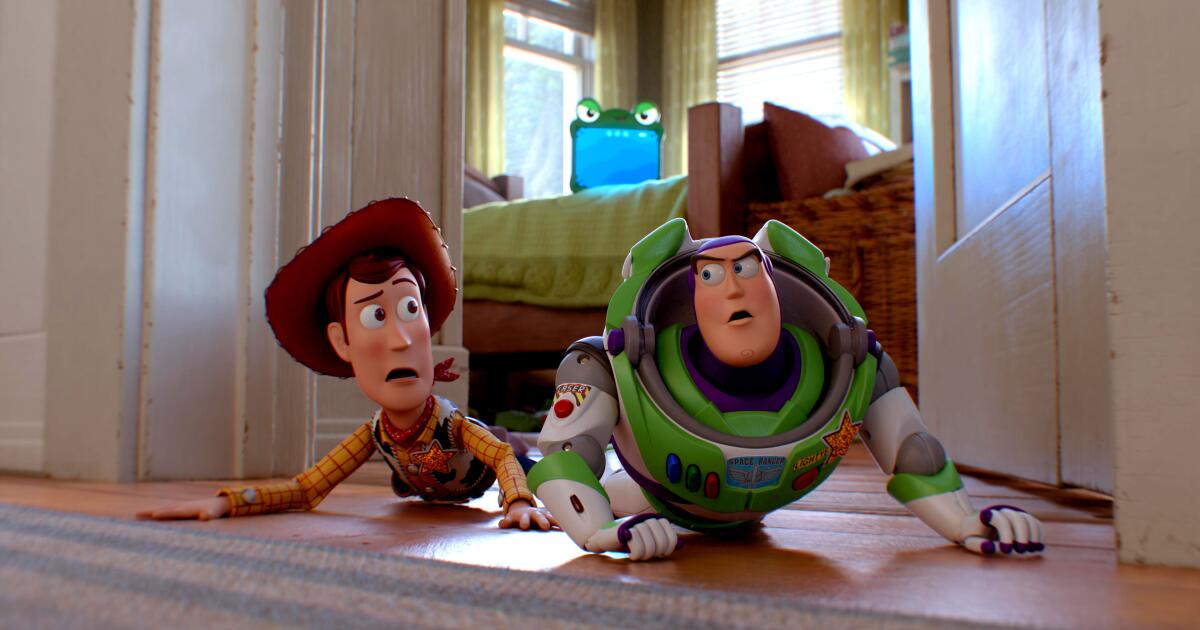
Davies: In an effort to play it safe, I’m going to pick a family movie and bet on “Toy Story 5.” Think about the dog days of summer — when the air gets heavy, a sense of inexplicable boredom takes over and it’s almost too hot to do anything. Deep down, you know the only reprieve is sitting in the comfort of your local theater chain’s air conditioning. But, at this point, you already saw “The Odyssey” with all your friends at the earliest available IMAX showing. What else will scratch that box office itch? I’m willing to bet it’ll be none other than the familiar faces of Woody, Jessie and Buzz Lightyear, as they fend off technology in their home.
You’re reading the Wide Shot
Samantha Masunaga delivers the latest news, analysis and insights on everything from streaming wars to production — and what it all means for the future.
By continuing, you agree to our Terms of Service, which include arbitration and a class action waiver. You agree that we and our third-party vendors may collect and use your information, including through cookies, pixels and similar technologies, for the purposes set forth in our Privacy Policy such as personalizing your experience and ads.
Which movie’s marketing campaign will be the talk of the summer?
Masunaga: The marketing for “The Odyssey” has been less overt than that of other summer releases, giant Trojan horse in Venice Beach notwithstanding. But a film helmed by Nolan and starring a plethora of A-list actors basically markets itself. After all, both official trailers for the film have garnered more than 30 million views on YouTube.
Viramontes: I’m prepared for Spider-Man to be everywhere. From buses and billboards to talk shows and TikTok, the movie will reach full saturation. While “Brand New Day’s” marketing campaign hasn’t reached fever pitch just yet, I’m prepared to be inundated with activations, posters and commercials for the four-quadrant fave that’s poised to be one of Marvel’s biggest successes in years.
Davies: A massive orange monster named Irene with dozens of eyeballs has nearly engulfed the historic Carney’s restaurant on Sunset. A giant inflatable “Rich” minion, sporting a goatee and a blinged out chain, popped up on Fairfax. And minions have taken over Wendy’s frosty machines with a new banana flavor. At this point, Universal and Illumination could put a minion on every Los Angeles street corner, and I wouldn’t grow tired of them. (The ominous, goggle-wearing eye overlooking the 101 freeway just isn’t enough.)
What will be the biggest wild card of the summer?
Masunaga: The biopic “Young Washington” could make waves. Distributed by Provo, Utah-based Angel Studios, the movie has the backing of the studio’s 2 million Angel Guild members, who determine its slate and get other perks, including free movie tickets. That support proved crucial for 2023’s “Sound of Freedom,” which ended up grossing more than $250 million worldwide, and could end up being a factor here, too.
Viramontes: “The End of Oak Street” has been teasing a dinosaur adventure in trailers, but can the mystery box movie starring Anne Hathaway and Ewan McGregor attract audiences? There’s also potential counter programming to blockbuster hopefuls dotted throughout the summer with “Teenage Sex and Death at Camp Miasma.” But I’m putting my money on “Evil Dead Burn.” Horror movies put butts in seats, and this summer doesn’t have many other straight-down-the-middle scares in store for audiences.
Davies: There’s an Anthony Bourdain biopic called “Tony” hitting theaters in August. These days, it feels like Hollywood will make a biopic about just anyone, but something about seeing Dominic Sessa channel the chef’s undying passion for food and effortless swag on screen seems irresistible. Plus today’s audiences love stories about intense kitchens (“The Bear”) and debatable biopics (“Michael”) — let’s see what happens when the two marry.
Both Warner Bros.-owned DC Studios’ “Supergirl” and Sony Pictures‘ “Spider-Man: Brand New Day” are part of this summer’s lineup. Will we see a turnaround from the recent superhero fatigue at the box office?
Masunaga: This past weekend marked a disappointing debut for “Supergirl,” which brought in just $37.1 million in the U.S. and Canada and about $62.6 million worldwide on a reported budget of $170 million. Box office analysts had been expecting a domestic opening of about $47 million to $50 million. On the other hand, pre-sales for “Spider-Man: Brand New Day” have been extremely strong. Not every superhero movie prints money anymore, so even with a potentially big haul for “Spider-Man,” I don’t know that it’ll signify a complete turnaround for the genre as a whole.
Viramontes: If there’s any superhero with enough pull to rescue the genre from fatigue after “Supergirl’s” poor performance, it’s your friendly neighborhood box office king Spider-Man.
Davies: Tom Holland’s Spider-Man definitely has the potential to cure superhero fatigue, at least for a few months. But as soon as the internet’s favorite couple, Zendaya and Holland, stop walking red carpets and doing press together, audiences are likely to put superhero movies on the back burner once again.
Analysts and theater owners have predicted that this summer’s box office will reach pre-pandemic levels. Will that momentum continue for the rest of the year?
Masunaga: Yes. The lineup of movies this year is more plentiful and varied than in years past, and with massive blockbusters slated for the holiday season, I think it’s very possible we could see a year-end domestic box office total of $9 billion or more.
Viramontes: Yes. We’ll have an action horror in September with “Resident Evil,” Zach Cregger’s follow-up to “Weapons.” In October, Tom Cruise’s long-awaited “Digger” might hit pay dirt. Following that in November is the new “Hunger Games” movie, “Sunrise on the Reaping.” And I don’t even have to mention “Avengers: Doomsday” and “Dune: Part Three,” the juggernauts waiting for us in December, do I?
Davies: Given the overall excitement from audiences of all ages and the variety this summer’s box office has to offer, this season will definitely be the one to do it. When Christopher Nolan, Spider-Man, the minions and the toys from “Toy Story” join forces, there’s no stopping them.
“The Pitt” and its economic effect on California
As film and TV production has fled the Golden State in search of cheaper locales, HBO Max medical drama “The Pitt” stands out as a major contributor to California’s economy.
My colleague Meg James wrote about the economic impact of the show, which films almost entirely on the Warner Bros. lot in Burbank and has provided jobs for about 1,000 people. The show’s first season alone contributed $125 million to California’s gross domestic product, according to an estimate from Oxford Economics.
“We’re old men who didn’t want to go away from our homes any longer,” series star Noah Wyle, who also serves as an executive producer and writer on the show, said, half-joking. “We’ve all been plying our trades out of state, chasing tax credits and being away from our families for a really long time.”
Stuff We Wrote
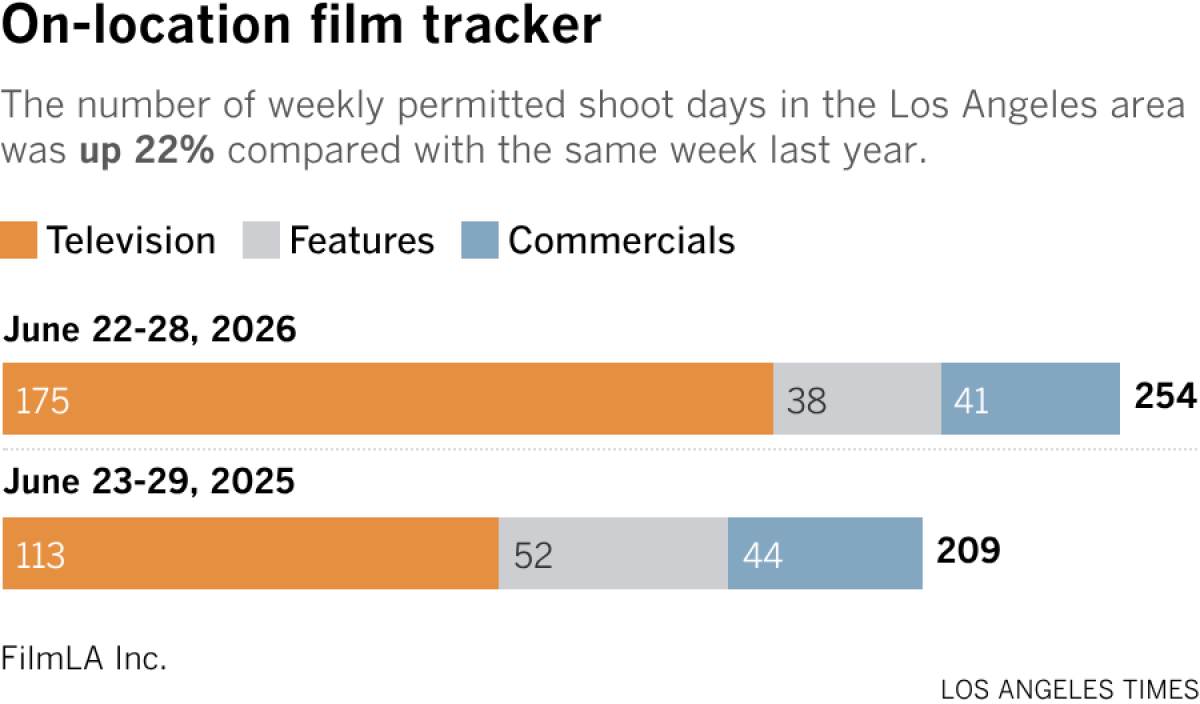
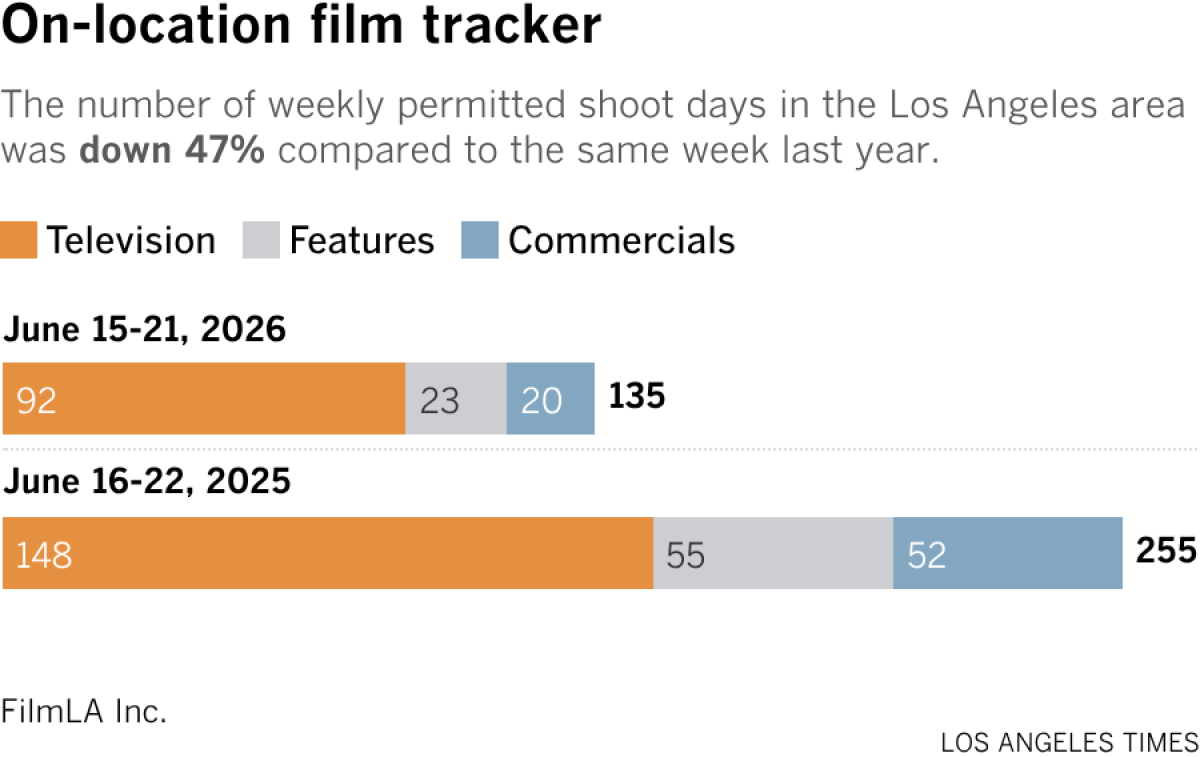
Film shoots
Number of the week
Disney and Pixar’s “Toy Story 5” continued its dominance this weekend, pulling in $70 million in the U.S. and Canada to stay on top at the box office.
The animated film has now grossed more than $585 million worldwide in less than two weeks. The haul for “Toy Story 5” helped push Disney past the $3-billion mark at the global box office, making it the first studio so far this year to hit that milestone.
What I’m watching
I feel like I’m always catching up on shows, and this week was no exception. I’m just now starting Season 2 of Netflix’s “A Man on the Inside,” which continues the hilarious exploits of retired engineering professor-turned-private-investigator Charles, played by Ted Danson. As a fan of “The Good Place,” I’ve loved the similar humor of this latest Michael Schur show.
California officials cheered a U.S. Supreme Court ruling Monday that allows states to continue counting mail ballots postmarked by election day but received in the days after — calling it a win for voter participation and access, including in the upcoming November midterm.
They also acknowledged delays in recent vote counting have spurred frustration, and promised to speed the process through other solutions — including by investing millions into new election infrastructure and vote processing capabilities.
Gov. Gavin Newsom — who called the court ruling a “win for voters, plain and simple” — has previously said the state should be able to count ballots faster, and his latest budget includes $29 million for “increased staffing, technology and equipment upgrades and purchases for counties,” $10 million for voter education and outreach at the state and county levels and $750,000 for combating election misinformation.
The court decision, a loss for President Trump and other critics who contend such policies contribute to unacceptable delays in vote counting, specifically upheld a Mississippi policy to accept mail ballots received within five business days of an election.
But it also lets stand similar policies in other states — including California, which counts ballots postmarked by and received within seven days of an election.
California Secretary of State Shirley Weber, who has long prioritized voter participation over a speedy count, called the high court’s ruling a “win for voters, for the rule of law, and for the future of our democracy.”
She said that she will “keep working to ensure every eligible Californian has the opportunity to be heard, because our democracy is strongest when every voice and vote count.”
Dean Logan, head of the Los Angeles County registrar-recorder/county clerk’s office, said in a statement to The Times that the ruling “affirms what Los Angeles County voters deserve: the assurance that a ballot cast by Election Day will be counted if received within the legal timeframe established in State Law.”
“Our office will continue to provide voter education, multilingual outreach, and leverage available resources to ensure voting access for our 5.8 million registered voters,” Logan said.
Many voting rights experts agree California’s vote counting should and could be faster, but disagree with the Trump administration’s efforts to step in with policies such as election day deadlines.
In 2024, California counted more than 406,000 late-arriving mail ballots, but they represented only about 2.5% of the statewide total. Experts say California’s delayed results have far more to do with the massive influx of mail ballots that are placed in ballot drop boxes or arrive at processing facilities on or just before election day.
Rick Hasen, an election law expert and director of the Safeguarding Democracy Project at UCLA Law, said the court’s decision was a “symbolic loss” for Trump, in that the court rejected his preferred policy on mail ballots, but “doesn’t appreciably change how long it takes to count ballots” because late-arriving ballots were never the problem.
In a report published Thursday, the California Voter Foundation recommended statewide adoption of “sign, scan, and go” programs that allow elections officials to immediately process mail ballots that voters submit in person at polling centers or drop boxes.
The foundation recommended ballot curing programs that speed up the process by utilizing a secure text platform when double checking whether a ballot is legitimate when a voter’s signature doesn’t match state records.
It also urged the state to invest $35 million in a voter education campaign to encourage early ballot returns, and more than $55 million in improving counting capacity and efficiency in county elections facilities.
Trump and other conservatives had called for an end to state policies allowing late-arriving mail ballots to be counted as an overdue fix to a voting system that often can’t produce election results in close races for days after polls close, as was the case in California’s recent primary races for governor and L.A. mayor.
Trump has pointed to California’s time-consuming count as proof of widespread fraud to undermine Republican candidates, though he has never produced evidence to support that claim and Democrats have fiercely denied it.
On Monday, Trump called the high court’s decision to uphold such state policies a “tremendous loss,” and more reason to pass the Save America Act — a bill he has backed that would enforce new voter ID and proof of citizenship requirements and ban mail ballots except for military personnel, individuals suffering from illness, disability, and in other rare circumstances.
He said politicians have “no excuse” other than “CHEATING!” to oppose such measures, especially at “a time when there is a powerful Communist Movement taking place in our Country, one more dangerous than World War I, World War II, Pearl Harbor, or September 11th.”
But California leaders rejected that — saying the criticisms of mail ballots are baseless and an attempt by Trump and his allies to undermine elections in which they are poised to lose, particularly in big blue states such as California, by attempting to wrest control over voting processes that have always been the purview of states, not the federal government.
California Atty. Gen. Rob Bonta said Monday that states have been “primarily responsible for regulating elections” since the nation’s founding, and his office was “pleased that the U.S. Supreme Court has respected that authority.”
“Today’s decision recognizes a basic reality: Mail delays happen. When people vote by election day, their ballots should not be discarded because of those delays,” he said.
Sen. Alex Padilla (D-Calif.), the ranking Democrat on the Senate Rules and Administration Committee, which has oversight over federal elections, praised the high court Monday for acknowledging that nothing in federal law precludes states from counting mail ballots in the days after an election.
“Today’s decision is a victory for voting rights and a rejection of Trump’s attacks on mail and absentee voters,” Padilla said.
Liberal groups and many voting rights experts also hailed the ruling as a win for voters.
Moving up deadlines for mail ballots is just one effort in a much broader political war over voting and the rules that govern it. The U.S. Constitution generally gives states the authority to run their own elections, but the Trump administration has been trying to assert greater federal control — especially around mail ballots.
Earlier this year, Trump signed an executive order directing the U.S. Postal Service to assert control over mail balloting by designing new envelopes with special bar codes that would allow the federal government to ensure ballots only go to and get returned by eligible voters. The order prompted the Postal Service to propose new rules requiring states to hand over their voter mailing lists so it could implement Trump’s directive.
In a letter to U.S. Postmaster General David Steiner on Wednesday, Democratic senators denounced the proposed rule as an “unconstitutional and illegal attempt to transform [USPS] into an election administration agency controlled by the White House and President Trump.”
In a Senate hearing the same day, Steiner said that under the new rule, the USPS would not mail the ballots of a state that refused to turn over its voter lists, but also that his agency would adhere to any court orders curtailing its implementation.
On Thursday, just such an order came down in a federal case in which California and other Democrat-led states challenged Trump’s executive order. U.S. District Judge Indira Talwani ruled that the Constitution does not grant the president “any specific powers over elections,” and blocked his order as unlawful.
Nevada Secretary of State Cisco Aguilar, who is chair of the Democratic Assn. of Secretaries of State, said states such as California were right to focus on increasing investment in their own election infrastructure rather than accepting the Trump administration’s “bad policy ideas” for speeding things up.
Newsom’s office on Monday said that is exactly what California has been doing. It pointed to laws passed by the state Legislature last year that allow election officials to begin processing mail ballots earlier and require them to finish counting ballots sooner.
Families heading abroad for the summer have been warned
Parents have been told to keep small children within arms-reach (Image: Getty)
With countless families anxiously awaiting their summer break at the beach, the holidays could end in tragedy for some if they don’t heed some advice. The Foreign, Commonwealth and Development Office (FCDO) has updated its travel guidance for Spain, urging parents to put their children’s safety first particularly in swimming pools and beaches at the popular holiday destination this summer.
In the update on June 26, the Foreign Office issued specific advise for each swimming location and highlighted a sad but startling truth parents should keep in mind even while trying to relax on holiday: “Every year, people drown in the sea and in swimming pools in Spain.”
According to the Royal Life Saving Society UK, an average of 82 UK citizens drown each year while they are abroad.
Swimming pools
The Foreign Office advised parents to always keep an eye on their children, regardless of their age, while they are in or near swimming pools. For small children, the office urged parents to keep them no further than arms-reach away even if they are able to swim or there is a lifeguard nearby.
Beaches
The Foreign Office advised: “Take care when swimming in the sea. Always supervise children and keep small children within arms-reach. Some beaches, especially around Spanish islands, may have strong undercurrents.”
In the ocean, there are a few more concerns that both everyday beachgoers and parents may need to keep in mind when swimming to avoid serious injuries. This includes hidden rocks, shallow depths, strong undertows and waves coming into shore further and quicker than expected.
The warning continued: “Many beaches have a flag system. Make sure you understand the system and follow any warnings (a red flag means you must not enter the water). Take extra care and get local knowledge if there are no lifeguards, flags or signs.”
The Royal Life Saving Society UK recommends a few simple steps to avoid having an emergency in the water. Including keeping children within arms-reach as it notes: “86% of child drownings occur in the absence of adult supervision.”
Before you head into the water, the experts recommend:
Review local safety notices and learn what the signs and flags mean
Look out for potential hazards in your surroundings and warn the rest of your group
Wear brightly coloured swimwear so you can be seen underwater
Never use inflatables in open water as it can easily be blown out to sea
Take extra care when intoxicated around water and never enter the water whilst under the influence
The FCDO provides travel advice for more than 220 countries and territories across the globe, covering everything from entry requirements and safety risks to health precautions and local regulations.
Unionized members of Kakao Corp. stage a rally outside of the company’s headquarters in Pangyo, south of Seoul, in this file photo taken on June 10. Photo by Yonhap
Unionized workers of Kakao Corp., South Korea’s messenger app operator, took a day off en masse on Monday in a sign of protest amid a continued gridlock in wage negotiations.
In their second collective action, unionized members staged what they called a “Log-out Day” by taking simultaneous annual leave.
Some 2,100 workers from five units of Kakao, including its headquarters, Kakao Pay and Kakao Enterprise, have participated, the labor union claimed.
The company, however, said it estimates only 800 employees from Kakao’s headquarters took part in the latest industrial action.
Wage talks between Kakao’s labor union and management have been at a standstill since May, after the two sides failed to narrow differences in performance-based incentives.
The union is reportedly demanding the company pay around 13 to 14 percent of operating profit as bonuses, while the management has rejected such demands, claiming they put too much burden on the company.
On June 10, workers staged their first-ever strike. Some 1,500 union members walked out from their jobs for four hours and rallied near the company’s headquarters in Pangyo, south of Seoul.
Despite concerns from industry watchers, no disruptions were reported on Monday, including in the company’s key messenger service, KakaoTalk.
Kakao’s management had previously said it plans to continue negotiations with the union, while remaining on standby to ensure stable service operations.
Copyright (c) Yonhap News Agency prohibits its content from being redistributed or reprinted without consent, and forbids the content from being learned and used by artificial intelligence systems.
A bowl of lemons sits on a table in the conference room Mauricio Pochettino has turned into an office at the U.S. men’s soccer team’s beachfront resort in south Orange County. The citrus fruit, the coach believes, has the spiritual ability to absorb negative energy. On the corner of another table, the flame from a candle flickers.
“I like candles,” says Pochettino, who believes they release therapeutic fragrances and create a calming environment.
But it is the massive, blood-red mural covering the entire south side of the room that truly reveals what Pochettino believes. In the center of the wall, just behind the coach’s desk, white block letters spell out “Why Not” above a script “U.S.,” which, despite the periods, is meant to be read as “us.”
Pochettino has turned the question in a mantra for a World Cup team that has answered it with two wins in as many games and has a chance to win a third match in the tournament for the first time when it meets Turkey at SoFi Stadium on Thursday.
The idea came to him during a team meeting last November when he sensed his players had doubts about their upcoming World Cup run. So Pochettino turned those doubts into a question. If South Korea could come from nowhere and make the semifinals of the 2002 World Cup, and if Morocco could do the same four years ago in Qatar, why not the U.S.?
Why not us?
“Hey, come on, guys, are you listening to me?” Pochettino said he asked the group. “We need to believe.”
Before he could convince his players, however, he had to convince himself. And that might have been the hardest part.
The 54-year-old Pochettino is a benevolent Svengali with a whistle; Ted Lasso with an Argentine accent. Belief isn’t so much a concept for him as it is a way of life. But when he and his coaching staff took over the U.S. team in the fall of 2024, following its disastrous performance in the Copa América, he said he inherited a demoralized, dispirited group.
“We received a big bang,” Pochettino said, mimicking a punch to the face. “We were knock[ed] out for a while.”
“We were so naive,” he continued. “The situation was way worse than we really believed.”
Pochettino refused to change the system that has brought him success at European clubs Tottenham, Paris Saint-Germain and Chelsea. So he set out to change the players instead. That would take time, something he had very little of since he took over with the World Cup just 20 months away.
“It’s difficult to analyze the process, you know,” Pochettino said during an informal, 40-minute discussion at his team’s Dana Point hotel, the sun setting over the ocean through the open patio doors of his office.
“When you put the seed on the soil, [the] first seed, you don’t see nothing. Then you start to grow the tree. It was difficult to explain the plant because it’s not easy.”
The seed Pochettino planted with the national team took time to sprout. He lost five of his first 10 games, including a disastrous four-game stretch that included Nations League losses to Panama and Canada in the spring of 2025. The team’s supporters revolted, but Pochettino rejoiced.
“What happened, that was [a] good crash,” he said. “When we detect all the problems, we go for the solution. And we knew that the solution will arrive. The object is to challenge people.”
U.S. men’s soccer coach Mauricio Pochettino during the second half of his team’s World Cup match vs. Paraguay at SoFi Stadium.
(Robert Gauthier / Los Angeles Times)
So he stayed the course.
“That was the process. Now is not a coincidence,” he said of the team’s success.
Pochettino has long believed that building a roster isn’t about picking the best players, but picking the right players. Players who fit his tactical approach, players who get along with one another, players who contribute to the team chemistry.
For him, the human connection, human respect is as important — if not more important — than the ability to dribble through tight spaces. And those traits are particularly important in a World Cup since the team will spend every day together for six weeks or more.
Although Pochettino’s team includes 13 holdovers from the 2022 World Cup roster, it also includes five players who made their national team debuts in the last 18 months.
Sometimes, he concluded, it is easier to simply change the player than it is to change what the player thinks or believes. And the newbies have totally bought in.
“We’re all in total belief. We’re all totally supportive and have faith in the process that he’s been outlining,” said goalkeeper Matt Freese, who made his first appearance for the national team more than 12 months ago and now is starting in a World Cup. “Our task was to keep believing, keep working hard and keep trusting. And we did that. We fully bought into the process.”
That process has made Pochettino the first U.S. coach to win a group stage in 16 years while his two victories in as many games match Bruce Arena, the most successful World Cup coach in U.S. history, who managed eight games over two tournaments.
The lemons and candles Pochettino keeps in his office are manifestations of energia universal or universal energy, a foundational concept common to many Eastern philosophies that believe a fundamental life force connects all things. Pochettino said he has long felt this connection and it has been a foundational part of his coaching.
But it doesn’t stop with the candles and citrus fruit. Pochettino also has filled the mural behind his desk with inspirational sayings.
“The talent has brought us here, but it is heart, effort and unity that will make us unforgettable,” one reads.
“If I dream of touching the moon, maybe I can get close to it. If I only dream of getting close, I’ll stay on Earth,” another says.
Each ends with the coach’s initials, similar to the way a painter signs his portraits.
Pochettino’s faith in the power of fruit and candles and his penchant for penning aphorisms hasn’t taken away from the ferociousness of his approach to soccer. Many players say the training sessions under Pochettino — which are intricate, focused and highly physical — are frequently more intense than the games. But most also are punctuated with laughter.
“Training is still very competitive, it’s very intense,” said midfielder Max Arfsten, who made his national team debut under Pochettino last year. “That’s the culture that the coaches created. Everyone’s still trying to prove something.”
Although Pochettino has spent his life in Argentina and Europe and still splits his time between houses in Barcelona and London, flying to the U.S. for matches and training camps, he’s been a quick study in this country’s culture and quirks.
“One of the things that we really like, and we learn from you, is in the way that you approach life. It’s more casual than formal,” said the coach, whose English is still a work in progress. “People are very approachable and make you feel comfortable. That, for me, was a massive surprise. You always want to welcome people.
“Even the music, even the food. People say ‘no, Americans have crazy food.’ Yes, you have crazy food. But also you have Whole Foods. In Europe, you don’t have a Whole Foods.”
And Pochettino has adopted it all. He’s become a big fan of country artist Lainey Wilson, went to hear Teddy Swims, a uniquely American genre-blending singer, last winter in New York, and is learning the words to John Denver’s “Take Me Home, Country Roads,” the unofficial victory anthem of the World Cup team.
Perhaps more important, at times he’s taken his lemons and his candles and pushed them aside, replacing them with another distinctly American trait: the in-your-face confidence to will yourself to victory from the most hopeless situations.
It’s how Americans won at Valley Forge even before they were Americans and how they won on the beaches of Normandy when the concept of America was threatened. It’s how Americans went to the moon and invented the internet.
“We’re American. We don’t take s—,” midfielder Sebastian Berhalter said Pochettino told the team during one meeting. “Even though he’s Argentinian, he has that mindset of, ‘Look, this is what we do. This is who we are. This is what America’s about.’ Even from an outside perspective, he showed us Americans what we’re about.
“He really drills that into us.”
For decades Americans have measured World Cup success in advancing beyond the group stage. Pochettino entered this summer’s tournament predicting a run to the semifinals, runs like South Korea and Morocco made.
“When people believe in each other, impossible dreams become possible,” reads another message the coach has scratched onto the wall of his office.
It’s been more than 30 years, but Andy’s toys are proving irreplaceable at the box office.
Walt Disney Co. and Pixar’s “Toy Story 5” opened to a massive $160 million in the U.S. and Canada last weekend, marking the biggest domestic box office debut so far this year. Internationally, the film brought in $152 million for a worldwide total of $312 million.
With those numbers, “Toy Story 5” broke several franchise records for opening weekend totals. As my colleague Cerys Davies and I wrote last week, it’s a sign of the long-running juggernaut’s firm grip on audiences amid a sea of Hollywood sequels, reboots and spinoffs.
You’re reading the Wide Shot
Samantha Masunaga delivers the latest news, analysis and insights on everything from streaming wars to production — and what it all means for the future.
By continuing, you agree to our Terms of Service, which include arbitration and a class action waiver. You agree that we and our third-party vendors may collect and use your information, including through cookies, pixels and similar technologies, for the purposes set forth in our Privacy Policy such as personalizing your experience and ads.
“‘Toy Story’ has been breaking ground since it first hit the screen more than 30 years ago,” Disney Entertainment Studios Chairman Alan Bergman said in a statement. “It’s wonderful to see ‘Toy Story 5’ continuing that tradition and connecting with audiences around the world to deliver the biggest opening for the franchise and the biggest of this year as well.”
For theater owners, “Toy Story” may have seemed like a surefire bet. After all, the franchise has grossed more than $3 billion in worldwide box-office revenue, and its third and fourth installments each made more than $1 billion globally.
The big opening weekend for “Toy Story 5” has no doubt brightened the outlook for many theater operators as the all-important summer movie season gets underway.
Already, last weekend’s box-office totals were a whopping 80% improvement compared with a year ago, when Universal Pictures’ live-action “How to Train Your Dragon” was in its second weekend in theaters. But more importantly, the domestic box office is now up 14% to $4.46 billion compared with the same time a year ago, according to data from Rentrak.
This summer’s lineup of films, including “Toy Story 5,” will play an important role in terms of whether 2026 will truly be the year that the theatrical business turns the corner from the COVID-19 pandemic and the dual Hollywood strikes of 2023.
In one promising sign, summer box-office revenue so far is up 15.2% to about $1.84 billion compared with the same May to mid-June period in 2025. (That summer ultimately ended in a dismal finish of $3.67 billion.) Compared with pre-pandemic 2019, this year’s summer box office to date is down just 1.9%.
Studio executives and theater owners have told me they feel good about this summer and are optimistic about the overall outlook for 2026.
It’s easy to see why. The deck is stacked, with upcoming titles such as Universal and Illumination’s “Minions & Monsters,” Disney’s live-action “Moana,” Christopher Nolan’s “The Odyssey” and Sony Pictures’ “Spider-Man: Brand New Day.”
In a propitious sign, presales for “The Odyssey” and “Spider-Man” have already shown massive demand. Overall, there’s just more and varied movies in theaters now, which expands the pool of potential moviegoers, theater owners have said.
Take A24’s “Backrooms” or Focus Features’ “Obsession,” for instance. The two original and digital-native films shocked the industry by keeping a weeks-long grip on the box office, largely by attracting Gen Z audiences who were familiar with the 20-something directors from their followings on YouTube.
Beyond these two, as well as Steven Spielberg’s “Disclosure Day,” many of this summer’s films continue established franchises.
Although not all spinoffs have performed this year — including Disney and Lucasfilm’s “Star Wars: The Mandalorian and Grogu,” which saw ticket sales drop sharply after its late May opening — “Toy Story” has remained a consistent force in theaters over the decades.
Disney and Pixar executives credit the films’ focus on character relationships, particularly that of Tom Hanks’ Woody and Tim Allen’s Buzz Lightyear. And as the franchise spanned years, its appeal became generational.
“Having parents now that say, ‘I grew up with ‘Toy Story,’ and now I’m showing my kids,’ has been really gratifying,” Pixar Chief Creative Officer Pete Docter told me by phone a week before the movie’s opening.
“Toy Story” is now the most-watched franchise on the Disney+ streaming service, with more than 2 billion hours streamed. And its beloved characters have spawned 19 theme park rides, four themed lands, two hotels and roughly $1 billion a year in global retail sales.
That has no doubt kept the franchise front and center for both adults and children, as well as fueling interest in future stories.
Stuff We Wrote
Film shoots
Number of the week
The FIFA World Cup has been a major boost for broadcasters, as an average of 6 million viewers tuned in to Fox and cable network FS1 for the first 16 group stage matches, an increase of 128% compared with the last World Cup in 2022, according to Nielsen data released last week.
On Spanish language network Telemundo, which is owned by Comcast, the first 12 group stage matches drew an average of 7.5 million viewers, up 234% from four years ago. (The Telemundo telecasts are also streamed on Peacock.)
I was in the Bay Area last week on vacation and didn’t watch many of the games, but I did catch my colleague Clara Harter’s great read about the mutual love and respect between fans of Mexico and South Korea and how that has played out in Los Angeles.
What I’m watching
Since I was out of town last week, I didn’t watch a ton of TV. But I did make time to watch the series finale of “The Way Home,” a quirky time-travel drama on Hallmark that I’ve followed for all four seasons.
I’m a big fan of time-travel stories (The “Back to the Future” trilogy is one of my favorites), so the usual past-future questions, plus the complicated family dynamics anchored by matriarch Andie MacDowell, made this a must-watch for me. The series finale was a satisfying ending, though there are definitely some loose strings that deserve further exploration.
Liam Payne’s 9-year-old son has inherited the late singer’s fortune.
Bear Grey Payne, the only child of Payne and British singer and former “X-Factor” judge Cheryl Cole, has been named the sole beneficiary of the former One Direction star’s estate, according to court documents reviewed by People.
Bear now has more than $29 million to his name. According to the filing, a portion of the inheritance can be accessed now, but the majority will be held in a trust for another nine years, until Bear turns 18.
During a 2019 appearance on “The Jonathan Ross Show,” Payne opened up about fatherhood and spending time with Bear after the singer and Cole had called it quits.
“He comes over to my house every so often, and we just hang out and do whatever,” Payne said of his then-2-year-old son. “I think you put pressure on yourself as a dad sometimes. It’s hard to connect with it with a 2-year-old … but they literally will laugh at anything. We put this Batman costume on him in the house, and it was a little bit slidey on the floor, and he kept falling off the sofa. And if I said ‘Whoopsie-daisy!’ and it was like the best thing ever.”
Payne, who was one-fifth of the global boy-band sensation One Direction, died Oct. 16, 2024, after falling from a balcony at the CasaSur Palermo Hotel. Officials determined the 31-year-old singer died from multiple traumas caused by the fall. He had traces of alcohol, several narcotics and a prescription antidepressant in his system when died, according to officials.
The boy-band star turned solo artist had been open about his battle with addiction and mental health and shared updates on his sobriety journey on social media.
After Payne’s death, the National Criminal and Correctional Prosecutor’s Office of Argentina charged five people for alleged involvement in the pop singer’s death, including a representative for Payne and the manager and the head of reception of the Buenos Aires hotel where the British singer fell to his death.
Another hotel employee and a waiter whom Payne met in a restaurant were charged with supplying the singer with narcotics.
Times staff writers Alexandra Del Rosario and Karen Garcia contributed to this report.
WASHINGTON — The Supreme Court refused Monday to block an excessive force lawsuit against a former Los Angeles Police Department officer who shot and killed a knife-wielding man whose speeding truck had slammed into several cars near downtown Los Angeles.
The court turned down an appeal petition from the Los Angeles city attorney’s office, over the objections of Justices Clarence Thomas and Samuel A. Alito Jr.
Litigation over the six-second shooting incident has extended over six years.
Federal judges in California agreed that Officer Toni McBride had reason to fire four shots at the suspect in April 2020 but not the two final shots that killed him.
Daniel Hernandez was alleged to be under the influence of methamphetamine when he got out of his truck and walked toward the officer. She repeatedly ordered him, “Drop the knife,” as he approached.
The majority reasoned that in the one-second pause between shots four and five, McBride “could have and should first reassessed the situation” and possibly concluded the suspect no longer posed a danger.
The city’s attorneys said the appeals court failed to consider the “totality of circumstances from the perspective of a reasonable officer on the scene” and its decision refused “to allow for reasonable mistakes in fast-moving, life-threatening encounters.”
UC Berkeley law dean Erwin Chemerinsky filed a response for the Hernandez family. He urged the court to stand aside and let a jury decide whether the officer’s actions were reasonable.
“The 9th Circuit simply held that it should be for the jury to resolve the factual dispute over what happened,” he said.
The justices had considered the appeal since late February before finally turning it down without comment on Monday.
The Supreme Court has repeatedly ruled police officers may be sued for unreasonable searches and seizures only if they are shown to have knowingly violated clearly established law.
However, this doctrine of “qualified immunity” has divided judges over whether a particular rule or limit has been clearly established.
“It has been clearly established for more than a decade that when an officer shoots and wounds a suspect, and he falls to the ground, the officer cannot continue to shoot him, absent some indication that he presents a continuing threat,” wrote Judge Jacqueline H. Nguyen.
“A fallen and injured suspect armed only with a bladed instrument does not present a continuing threat merely because he makes nonthreatening movements on the ground. … Under such circumstances, a jury could reasonably find that she employed constitutionally excessive force. If so, she is not entitled to qualified immunity,” she said.
The five dissenters said the officer made a reasonable split-second decision.
Judge Ryan Nelson said McBride “was justified in shooting Daniel Hernandez to alleviate the risk that he posed when he advanced toward her while armed and ignoring commands to stop. … She cannot be reasonably expected or required to reassess her shooting in a tight six second period during an intense and dangerous situation throughout which Hernandez was rising and never stopped moving.”
Judge Patrick Bumatay echoed this concern.
“Judges review police shootings only in hindsight. We review police tapes years after the fact. We get to rewind, pause, fast forward — analyzing the situation frame-by-frame. While the advent of police bodycam videos has been a welcome change, we can’t ignore that real life isn’t in slow motion,” he said.
“Toy Story 5,” the latest installment to one of Disney Pixar’s longest-running franchises, topped the box office this weekend.
The tech-fueled tale, led by fan favorite characters Woody, Buzz Lightyear and Jessie, earned $160 million for its opening weekend at the domestic box office and a global total of $312 million, according to Rentrak Data. The animated feature now holds the biggest box office opening of the year, further signaling what could be a massive summer for theaters.
“Toy Story 5” features the original cast, including Tom Hanks as Woody, Tim Allen as Buzz Lightyear and Joan Cusack as Jessie. The story follows the beloved band of toys as they grapple with the introduction of technology into their home, with a tablet named Lilypad. The production budget for “Toy Story 5” is about $150 million to $200 million, and a crew of about 300 people worked on the film at Pixar’s Emeryville, Calif., headquarters.
“Tech versus toys is a very easy concept for families and parents to grasp. Every family goes through that to some degree,” said Andrew Cripps, head of theatrical distribution for Walt Disney Studios.
With the successes of “Inside Out 2” and “Zootopia 2,” sequels have proved to be dependable releases for Disney and Pixar in recent years. But “Toy Story” has been a steadfast juggernaut for the entertainment giant. This new release marks a new debut weekend record for the 31-year-long franchise, beating the nearly $121-million opening of 2019’s “Toy Story 4.” The original opened with $29 million in 1995, 1999’s “Toy Story 2” hit $57 million, and the third installment from 2010 received $110 million.
“The franchise is just so big,” Cripps added. “It’s in the theme parks. The consumer products keep it alive. It’s been 31 years with five movies, so it’s not like it’s overstayed its welcome. They’re very good at Pixar. They tell a story when they have a story worthwhile telling, and it feels like this one was worthwhile.”
Across the franchise’s lifetime, “Toy Story” has grossed more than $3 billion worldwide. The new movie also landed the second-highest animated opening weekend of all-time, behind only “Incredibles 2,” which earned $182 million.
With this uptick, there’s a chance the box office could climb back to pre-pandemic numbers. The 2026 box office is tracking 1.1% behind the summer of 2019 and 16% ahead of last year, according to Paul Dergarabedian, head of marketplace trends at Rentrak data.
“The industry’s on a roll,” Dergarabedian said. “There’s some unpredictable things that have happened so far this year, with the holdover strength of ‘Project Hail Mary,’ ‘Michael’ and ‘The Devil Wears Prada 2.’ Their worldwide grosses are incredibly impressive. It’s a phenomenon.”
“Toy Story 5” is just the first of several theatrical tentpoles hitting the big screen later this summer. Rentrak predicts this could be another $4-billion summer season domestically, following in the steps of the 2023 “Barbenheimer” summer.
The Foreign Office has issued travel advice warning UK holidaymakers
Millions of Brits head to Italy each year(Image: Janoka82 via Getty Images)
British holidaymakers are being warned that they risk being slapped with a 500 euro fine when visiting one of the most sought-after destinations in Europe.
Millions of Brits are set to head overseas during the summer months, desperate for some sun, a change of scenery, as well as a well-deserved rest. The Foreign Commonwealth and Development Office (FCDO), the Government’s foreign affairs department, plays a key role in keeping UK citizens informed when travelling abroad – offering travel guidance covering more than 220 countries and territories across the globe.
In its travel advice for Italy, the FCDO cautions that “some Italian towns and cities have specific laws, and you could be fined for breaking them”. This, the FCDO noted, can include activities such as eating and drinking near major churches, historic monuments and public buildings.
It is also against the law to enter or bathe in public fountains across numerous towns and cities, including Florence and Rome, or to swim in the canals of Venice. The island of Capri is enormously popular with tourists and can be accessed by ferry from both Naples and Sorrento.
The stunning island nestled off Italy’s Amalfi Coast is celebrated for its Mediterranean charm and rich ancient heritage. However, visitors are being made aware that bringing any disposable plastic items onto the island – such as bags, cutlery, plates, cups, food packaging, trays and straws – is strictly prohibited.
Should you be caught doing so, you could face a penalty of up to 500 euros. Additional FCDO guidance regarding Italy adds: “Illegal traders operate on the streets of all major Italian cities. It is illegal to buy items from unlicensed street traders. If you do, you could be stopped by the local police and fined.
“It’s illegal to remove sand, shells or pebbles from coastal areas in Italy. You could face a large fine for doing so. It’s also illegal to collect various species of flowers, plants and herbs from mountain and wooded areas. For more information, check with the regional authorities of the area you’re visiting.”
The Foreign Office has lifted its no-go travel warning after Iran and the US signed a deal
Simon Calder says airlines will be desperate for people to ‘take summer holidays’ after the easing of travel advice
A travel expert has provided an update on journeys to and from the Gulf region following the US and Iran reaching an agreement to cease hostilities between the two nations. Speaking outside the Foreign, Commonwealth & Development Office (FCDO), Simon Calder confirmed that travel insurance was ‘once again valid’ after both the Iranian and American presidents put pen to paper on a deal to end the conflict.
Mr Calder stated that those wishing to visit the region could now do so ‘with some confidence’. He said: “I’m at the Foreign Office which has just changed its advice for travellers going to the Gulf region, in particular Dubai, which last year was visited by 1.4 million British travellers.
“As from now, the no-go warning which prevailed for the whole of the UAE, including Dubai and Abu Dhabi, as well as to the countries of Qatar, Bahrain and Kuwait, has been lifted. The Foreign Office still warns that you need to be ready for trouble to resume at any time, but it means that travel insurance is once again valid and anybody planning a trip to the UAE or Qatar or elsewhere in the region can do so with some confidence.
“The immediate effect, I think, is going to be a big marketing campaign by the giant airlines: Emirates of Dubai, Etihad of Abu Dhabi, and Qatar Airways based in Doha. They will be wanting to get people to both connect through their hubs, but also to take summer holidays. Be warned, it is extremely hot with average daily highs around 40°C.”
Content cannot be displayed without consent
Not only do millions of holidaymakers head to the Gulf states, but countless others use them as a stopover for journeys to Asia and Australia. That meant the tourism industry took a particularly severe blow when the US and Israel launched strikes on Iran in late February.
The FCDO decision means tourists can now return without putting their travel insurance at risk. But that doesn’t mean flights will restart straight away.
Virgin Atlantic halted flights until winter 2027 after the conflict began, and a spokesperson confirmed on Thursday that this ‘remains the case’.
British Airways announced earlier in June that it wouldn’t restart flights to the UAE until October 2026. Emirates has maintained flights to and from the region throughout the hostilities.
Mr Calder continued: “The immediate effect, I think, is going to be a big marketing campaign by the giant airlines: Emirates of Dubai, Etihad of Abu Dhabi, and Qatar Airways based in Doha. They will be wanting to get people to both connect through their hubs, but also to take summer holidays. Be warned, it is extremely hot with average daily highs around 40°C.”
“But it means that anybody who’s planning to travel perhaps to Asia or to Australia now will be able to travel with confidence through one of the Gulf hubs. In addition, I imagine that airfares will fall because the Asian carriers will not be able to command such a premium.
“Stand by for some really good holiday offers, but I personally won’t be seeing you on the beach in Dubai until about November.”
California’s political watchdog commission on Thursday finalized a $31,500 fine against Gov. Gavin Newsom, alleging that the Democratic leader failed to report three dozen behested payments totaling $5.5 million mostly to support wildfire recovery by the deadline under state law.
The Political Reform Act requires elected officials to disclose payments of $5,000 or more that they solicit or direct others to give to a charitable, legislative or governmental purpose within 30 days.
The California Fair Political Practices Commission said 34 of the violations were for failing to report on time that Newsom and his staff directed outreach from companies and foundations that wanted to help after the Los Angeles wildfires to the California Fire Foundation. The nonprofit was started in 1987 by the California Professional Firefighters to support the families of fallen firefighters and communities impacted by fire.
The donations include $1 million from the Chuck Lorre Foundation and $500,000 apiece from Lockheed Martin, the Anthem Blue Cross Foundation and BlackRock, among others gifts.
The governor also failed in 2024 to report on time two behested payments, totaling $100,000 from the Schmidt Family Foundation and Schwab Charitable Funds to the Institute for Local Government, a nonprofit within the League of California Cities.
The commission said the governor reported all of the payments “prior to public discovery” or contact from its enforcement division, which it considered a mitigating factor. Newsom also signed the stipulation and agreed to the fine.
Tara Gallegos, a spokesperson for Newsom’s office, said the issue involved late paperwork at a time when the governor’s staff was focused on emergency response and supporting survivors. She also underscored the fact that the reports were filed before he was contact by the FPPC.
Gallegos said the fine is unrelated to an alleged investigation into the governor and his wife by the Department of Justice, which Newsom announced this week.
Newsom alleged Monday that Trump is using the government as political weapon to target him and his wife, Jennifer Siebel Newsom. Newsom announced the investigation after he learned that the FBI and Internal Revenue Service asked his associates questions about nonprofits and businesses related to the couple.
The governor’s office characterized the investigation as a fishing expedition. The Trump administration declined to comment.
A source familiar with the matter, who requested anonymity because they were not authorized to discuss it publicly, said two federal probes have been going on for about a year, and that they originated not from Washington, D.C., but from conversations between whistleblowers and federal prosecutors based in Sacramento. The probes are linked to Newsom’s former chief-of-staff, Dana Williamson, and Siebel Newsom’s taxes, the source said.
The FPPC violations mark the second time Newsom has reported payments late, which increased his penalty for the new infractions. The commission fined Newsom in 2024 for failing to timely report 18 payments totaling $14.4 million.
The Foreign Office has issued fresh travel advice for 14 countries following the announcement of a ‘memorandum of understanding’ between the US and Iran amid Middle East tensions
15:28, 18 Jun 2026Updated 15:33, 18 Jun 2026
The Foreign Office has issued travel advice for 14 countries(Image: Getty Images/Stock Photo)
Significant travel updates have been released by the Foreign Office for 14 countries after the US and Iran revealed a ‘memorandum of understanding’, in the wake of the Middle East conflict.
The Foreign Office has now removed its travel ban to destinations including the United Arab Emirates and Qatar, while also providing additional updates for 12 other nations. The Foreign, Commonwealth & Development Office (FCDO) published new guidance on Thursday, 18 June, for the 14 countries amid “regional tensions”.
On the Foreign Office’s ‘warnings and insurance’ section for each nation, they confirmed: “The US and Iran have announced a memorandum of understanding in relation to the conflict in the Middle East.”
The complete list of nations receiving the updated guidance includes: Cyprus, Turkey, Oman, Saudi Arabia, Qatar, United Arab Emirates, Bahrain, Jordan, Yemen, Syria, Palestine, Israel, Iran and Kuwait, reports the Express.
While the FCDO has warned of regional tensions, it “no longer advises against all but essential travel to the UAE”. Since March, there had been a warning in place against all but essential travel to the UAE, but with the update today (June 18), it’s the first time it’s been waived.
In additional guidance, the FCDO outlined that should “hostilities resume”, Brits should take the following steps:
Read if you’re affected by a crisis abroad – GOV.UK. This includes guidance on “how to prepare for a crisis” with suggestions on what you might include in your emergency supplies and “what to do in a crisis”
The Foreign Office has updated its travel advice for 14 countries including Cyprus and Turkey
14:27, 18 Jun 2026Updated 15:32, 18 Jun 2026
The Foreign Office has updated its advice for Cyprus and Turkey(Image: Getty Images/iStockphoto)
The Foreign Office has updated its travel advice for a number of countries including Cyprus and Turkey, in relation to the Middle East War.
The UK government has issued an update around ‘regional tensions’ in the two holiday hotspots, after the US and Iran announced a ‘memorandum of understanding’ this week. It also comes as a warning against travel to the UAE has been lifted, including the likes of Dubai and Abu Dhabi.
The Foreign Office hasn’t advised against travel to either Cyprus or Turkey throughout the conflict, which started earlier this year. At the time of writing, it only has one warning in place for a region in Turkey, which was unrelated to the conflict, warning against “all travel to within 10km of the border with Syria due to fighting and a heightened risk of terrorism”.
Now, the government body has issued an update for Brits planning to head to Cyprus and Turkey for holidays in time for the peak holiday season.
The updated advice explains: “The US and Iran have announced a memorandum of understanding in relation to the conflict in the Middle East. The situation remains unpredictable and attacks could resume at short notice.
“Should hostilities resume, British nationals should:
read If you’re affected by a crisis abroad – GOV.UK. This includes guidance on “how to prepare for a crisis” with suggestions on what you might include in your emergency supplies and “what to do in a crisis”
monitor local and international media for the latest information
stay away from areas around security or military facilities
keep your departure plans under review, and ensure your travel documents are up to date
if you are advised to take shelter, stay indoors or find the nearest safe building or designated shelter. An interior stairwell or a room with as few external walls or windows as possible may provide additional protection. The greatest risk is from falling debris caused by intercepts. You are safest inside a secure structure
“Before the 8 April ceasefire, the Iranian regime had stated its intention to target locations associated with the United States and Israel. This included US or Israeli-linked organisations, businesses, facilities and institutions. Iran has previously targeted civilian infrastructure across the region such as ports, hotels, roads, bridges, energy facilities, oil production sites, water systems, and airports.”
The Foreign Office has lifted its warning against travelling to the United Arab Emirates including Dubai and Abu Dhabi
14:16, 18 Jun 2026Updated 14:55, 18 Jun 2026
(Image: Getty Images/arabianEye)
The Foreign Office has lifted its travel ban to the United Arab Emirates.
The FCDO has had a warning against all but essential travel to the UAE in place since March, due to the Middle East war, but today (Thursday 18th June), it updated its advice and no longer warns against travel to the region. It has also issued updates for 14 countries including Cyprus and Turkey.
However, the government body still has a stark warning in place for Brits. As part of an update on ‘regional tensions’ it warns:
“The US and Iran have announced a memorandum of understanding in relation to the conflict in the Middle East. The situation remains unpredictable and attacks could resume at short notice.
“Should hostilities resume, British nationals should:
read If you’re affected by a crisis abroad – GOV.UK. This includes guidance on “how to prepare for a crisis” with suggestions on what you might include in your emergency supplies and “what to do in a crisis”
monitor local and international media for the latest information
stay away from areas around security or military facilities
keep your departure plans under review, and ensure your travel documents are up to date
if you are advised to take shelter, stay indoors or find the nearest safe building or designated shelter. An interior stairwell or a room with as few external walls or windows as possible may provide additional protection. The greatest risk is from falling debris caused by intercepts, and you are safest inside a secure structure
“Before the 8 April ceasefire, the Iranian regime had stated its intention to target locations in the Gulf associated with the US and Israel. This included US or Israeli-linked organisations, businesses, facilities and institutions. Iran has previously targeted civilian infrastructure across the region such as ports, hotels, roads, bridges, energy facilities, oil production sites, water systems, and airports.”
A controversial proposal to tax California billionaires to fund healthcare has tenatively qualified for the November ballot, setting the stage for a more intense and expensive battle over whether the state should squeeze the ultra-rich.
Supporters say the proposed tax is crucial to compensate for federal healthcare funding cuts, approved by President Trump and the Republican-controlled Congress, that will harm millions of the state’s most vulnerable residents.
In April, supporters of the billionaire tax submitted nearly 1.6 million signatures, roughly double the number needed to qualify. The California secretary of state’s office on Wednesday declared that enough valid signatures were submitted. The initiative will officially qualify for the Nov. 3 ballot on June 25 unless the proponents withdraw it beforehand.
The initiative would impose a one-time tax of up to 5% on taxpayers and trusts with assets valued at more than $1 billion, with some exceptions, such as property. The levy could be paid over five years. Ninety percent of the revenue would fund healthcare programs, and the remaining funds would be spent on food assistance and education programs. The proposal would cost the state’s richest residents about $100 billion if a majority of voters support it.
Opponents of the measure say the proposal is an ineffective attempt to address the long-term effects of the healthcare cuts and would destroy California’s economy and budget.
The state budget in California is already largely dependent on income taxes paid by its highest earners. Because of that, revenues are prone to volatility, hinging on capital gains from investments, bonuses to executives and windfalls from new stock offerings, and are notoriously difficult for the state to predict.
The proposal already triggered a fierce debate, accentuating the divide between the rich and poor in a state that’s expensive to live in.
The Service Employees International Union-United Healthcare Workers West and other supporters of the billionaire tax say that it would raise $100 billion, offsetting federal funding cuts to healthcare as well as funding education and state food assistance.
But supporters face strong opposition from billionaires with deep pockets. Tech executives and other business leaders oppose the idea and have threatened to move to other states. Opponents say taxing billionaires would harm California’s economy while not addressing underlying financial issues.
The proposal also has divided politicians within the Democratic Party. California Gov. Gavin Newsom spoke out against the billionaire tax, expressing fears that billionaires would move out of the state. But U.S. lawmakers such as California Rep. Ro Khanna and Vermont Sen. Bernie Sanders have backed a billionaire tax, saying the rich should pay their fair share to fund essential services.
Business executives have already poured millions of dollars into groups that oppose the billionaire tax or are promoting alternative solutions to wealth inequality.
Tech executives, venture capitalists and business leaders have donated roughly $118 million to a nonprofit called Building a Better California, according to data on the secretary of state’s website. Most of the funding comes from Google co-founder Sergey Brin, who has given more than $82 million to the group. Executives from DoorDash, Ripple, Stripe and other companies also have contributed.
The group says it supports policies such as expanding access to affordable housing, protecting innovation, requiring government transparency and securing more stable education funding.
PayPal and Palantir co-founder Peter Thiel has contributed $3 million to the California Business Roundtable, which opposes the tax. Former Google Chief Executive Eric Schmidt donated $1 million to that group as well.
California would probably collect tens of billions of dollars from the wealth tax if it passed, but it could also lose other tax revenue, a December letter from the state legislative analyst’s office said. The office also mentioned that it’s tough to predict the exact amount the state would collect because of factors that can affect a billionaire’s wealth such as fluctuating stock prices.
California billionaires who were residents of the state as of Jan. 1 would be affected by the ballot measure if it passes. Some wealthy residents announced plans to moves out of state. On Dec. 31, venture capitalist David Sacks announced that he was opening an office in Austin, Texas, the same day Thiel publicized his firm had opened a new office in Miami.
ATLANTA — A federal judge who was disciplined after an investigation found she had sex with a police officer in her chambers and attended a partisan event, then lied when confronted with the allegations, has recused herself in a fight over Georgia election records after the U.S. Department of Justice raised questions about her ability to be impartial.
The Justice Department sought to remove U.S. District Judge Eleanor Ross from the case, citing her reported attendance at an event for Fulton County Dist. Atty. Fani Willis, who prosecuted President Trump. Ross filed an order Tuesday recusing herself, writing that she was doing so “out of an abundance of caution for the potential perception of bias.”
The Justice Department had sued Georgia Secretary of State Brad Raffensperger for seeking an unredacted statewide voter list, and Ross was presiding over that case.
“Both the Trump administration’s present and Willis’s past efforts have become heavily polarized,” Ross wrote, explaining that she “cannot discount” that an objective observer might interpret her attendance at an event sponsored by Willis’ campaign as support for the district attorney’s position, even if she only went to see former colleagues.
Ross received a “private reprimand” after a court investigation found that she had sex in the courthouse with a high-ranking uniformed police officer within earshot of staff, attended a partisan event and then initially lied to deny the allegations.
The investigation report says Ross went to an event hosted by a district attorney’s campaign. The judge said the district attorney had been a friend since 1999 and acknowledged having gone to the a private mixer held on the sidelines of the event to visit with former colleagues in the district attorney’s office.
Ross previously worked in the Fulton County District Attorney’s Office and overlapped there with Willis there before Willis was district attorney.
Willis in August 2023 obtained an indictment against Trump and 18 others, accusing them of participating in a wide-ranging scheme to overturn Georgia’s 2020 election results. That case was ultimately dismissed in November.
A weekend BASE jumping accident in a Utah canyon killed two people, one of them a daredevil athlete best known for performing onstage with Madonna at the 2012 Super Bowl, authorities said.
The Sheriff’s Office in Grand County, Utah, confirmed one of the dead was Andy Lewis, an extreme athlete known for feats in BASE jumping, a dangerous sport that involves parachuting to the ground after jumping from a tall fixed object such as a building, a bridge or a desert cliff overlooking a deep canyon.
In BASE jumping circles, Lewis had a huge following and a reputation for pushing the envelope — leaping into tighter spaces or deploying his parachute later than his peers would dare, said John McEvoy, a BASE jumping instructor in Twin Falls, Idaho, who has jumped with Lewis.
“He had an incredible level of athleticism and skill that was developed over years of practice,” McEvoy said. “But then he would take an incredible amount of risk.”
Lewis’ other sport made him an overnight celebrity, thanks to Madonna
Lewis was also a prominent figure in the niche sports of slacklining and tricklining, which combine elements of high-wire walking with aerial acrobatics — sometimes at perilous heights.
Lewis went from obscure athlete to overnight celebrity when he appeared onstage in Madonna’s 2012 Super Bowl halftime show. Dressed in a Roman toga, Lewis bounced and executed tricks on his inch-wide line as though it was a trampoline while Madonna sang behind him.
“My phone actually rang itself to death three days in a row,” Lewis said soon afterward in an appearance on Conan O’Brien’s late-night show.
Emergency responders were dispatched Sunday to a report of people injured in a BASE jumping attempt at Mineral Bottom, a remote desert area near the Utah-Colorado line, according to the Sheriff’s Office. Lewis and an unidentified 50-year-old man died at the scene, the office said in a news release.
Sheriff’s Lt. Al Cymbaluk confirmed to the Associated Press that it was Lewis the extreme athlete who died. He said he had no further details on the fatal accident.
BASE jumping is far more dangerous than skydiving
Though there’s no official tally of BASE jumping deaths, a list compiled by the website BASEaddict.com shows 540 total fatalities worldwide since 1981 — including 30 people killed last year. Prominent deaths include BASE jumper Dean Potter and his climbing partner, Graham Hunt, who were killed in 2015 while attempting a wingsuit flight in Yosemite National Park.
A study focused on BASE jumping in Norway, published in a medical journal in 2007, estimated that BASE jumping carried risks of injury or death five to eight times greater than skydiving.
Lewis openly acknowledged the sport’s inherent danger.
“It’s weird to think about how many people are dead, because it’s like a normal thing,” Lewis told documentary filmmaker Ella Warnick in an interview published last year.
Lewis owned BASE Jump Moab, a business that offered excursions to inexperienced customers using tandem jumps, in which the customer was harnessed to a guide wearing the parachute.
Sheriff’s spokesperson Cymbaluk said he didn’t know whether Lewis and the other man killed were performing a tandem jump.
Tandem BASE jumping carries additional risk because it straps together two people, one of whom generally lacks experience, under a single parachute, McEvoy said. But because they involve novices, they also tend to be the most low-risk, basic types of jumps.
“Within BASE, it’s a very controversial topic,” McEvoy said. “There’s a lot of people who say it’s the stupidest thing in the world and others arguing, `No, we’re giving people the experience of their lives.’”
No one immediately returned phone, text and Facebook messages left Monday for BASE Jump Moab.
Lewis won four straight world championships in competitive slacklining from 2008 through 2011. Lewis set a Guinness World Record for slackline surfing, swaying his feet side to side in a rocking motion that mimics surfing, while keeping his balance above China’s Diaoshuilou waterfall in 2011.
In 2014, he walked a slackline suspended between two hot air balloons more than 4,000 feet above the Nevada desert.
Steven Spielberg’s latest sci-fi thriller, “Disclosure Day,” topped the box office this weekend, an encouraging sign for what could be a big summer for theaters.
The film, which stars Emily Blunt and Josh O’Connor, brought in $44 million in the U.S. and Canada for a worldwide total of $92.9 million, according to studio estimates. The opening weekend totals beat box office analysts’ expectations of about $40 million to $50 million.
“Disclosure Day” is Spielberg’s latest alien-centric movie that charts a desperate race to show the world the truth about extraterrestrials.
The film, which had a production budget of about $115 million, was also scored by legendary composer and longtime Spielberg collaborator John Williams, who is now 94 years old.
Spielberg described the film in April as “way closer to truth than fiction” during a speech at the CinemaCon trade convention in Las Vegas. The veteran director of 1977’s “Close Encounters of the Third Kind,” 1982’s “E.T. the Extra-Terrestrial” and 2005’s “War of the Worlds” said at the time that he’s been curious about “what’s going on in the night” since he was a child and “been very fixated on the possibilities.”
Focus Features’ “Obsession” came in second at the box office with a domestic haul of $19 million, a continuation of the film’s strong run in theaters.
“Scary Movie,” “Backrooms” and “Masters of the Universe” rounded out the top five at the box office.
Recent box office performance — particularly with Gen Z hits “Obsession” and A24’s “Backrooms” — along with a slate of upcoming blockbuster franchise installments has buoyed the hopes of exhibitors and studio executives for a strong summer.
Next week, Walt Disney Co. and Pixar will release “Toy Story 5,” while Warner Bros.’ DC Studios has “Supergirl” landing in late June.
Universal Pictures and Illumination’s “Minions & Monsters,” Disney’s live-action “Moana,” Christopher Nolan’s “The Odyssey” and Sony Pictures’ “Spider-Man: Brand New Day” are all slated for July.
That steady cadence of new and different films is key for a healthy box office and a successful summer, said Daniel Loria, editorial director at the Box Office Co.
“We’re seeing that momentum come back on a weekend-by-weekend basis,” he said. “What we needed to get back to a healthy industry post-pandemic is consistency, and that’s the difference here in 2026.”