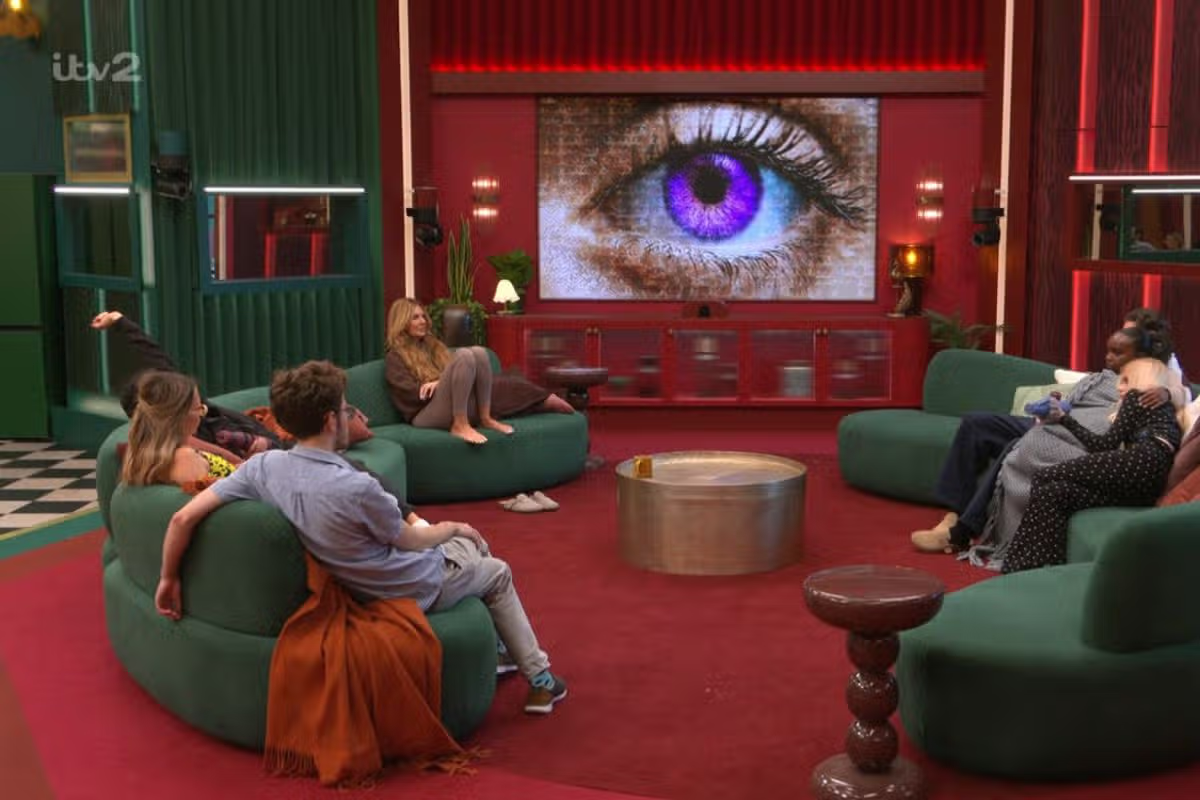
Four Big Brother housemates will face the public vote this week
This week saw another nominations twist (Image: ITV)
ITV Big Brother has revealed who will face the public vote this week.
Emotions have been running high in the iconic house in recent weeks, with personalities continuing to clash. Viewers have witnessed plenty of explosive rows and heated moments as the housemates live in the House of Time this week.
As part of the new theme though, another nominations twist has been introduced. Tonight’s (October 20) explosive episode saw the housemates take part in nominations in Big Brother’s Time Zone.
They each drew a number from a bag in secret to determine the order they could enter the Time Zone. The first housemate to enter was Philip and the final housemate was Rhianna, with the timing being important.
As the first housemate to enter, Philip had to choose four name disks to place on the nomination podiums and chose Catrin, Harry, Sam and Twinks. The remaining housemates took turns to enter the Time Zone and had the opportunity to swap up to two names on the nomination podiums but could not swap themselves.
Big Brother later revealed that Catrin, Harry, Sam and Twinks will be the next housemates to face the public vote ahead of Friday night’s live eviction, airing on ITV2 and ITVX. However, viewers were unimpressed with the line up as one person wrote on X: “I don’t know if I can watch this show any longer.” Another said: “This is an absolute joke.”
A third fumed: “Truly truly truly could not have gone worse, I feel sick to my STOMACH”, as a fourth added: “Four chances for a good nom selection and its still horrid.”
A fifth stated: “It just isn’t making a fun viewing experience.” A sixth viewer commented: “Boycott the vote! We refuse to vote!!!! We are done!!!” Another raged: “This line up is such a fix omg. I’ve had enough.”
Viewers were also quick to share who they would be voting for, and it’s not looking good for one housemate. One person wrote: “Harry is gonna go, but I still don’t think it’s fair.”
Another said: “So we’re all getting rid of Harry yeah?” A third added: “Voting for Harry to go”, as a fourth penned: “Well all my votes will be going to Harry.”
Voting for Friday’s eviction opens at 10:15pm tonight (Oct 20) with viewers being asked to vote for the housemate they wish to evict from the House.
Friday night (October 23) will see the next eviction from the Big Brother House and the evictee’s first live interview with hosts AJ Odudu and Will Best, with fears already rising over a potential double eviction – though this is yet to be confirmed by ITV.
Ensure our Latest TV stories always appear at the top of your Google Search by making us a Preferred Source. Click here to activate or add us as Preferred Source in your Google search settings
Big Brother continues tomorrow at 9pm on ITV2 and ITVX
ITV have issued a statement after a furious backlash from fans in the way Omar has been treating fellow housemate Rhianna.
21:06, 20 Oct 2026Updated 21:12, 20 Oct 2026
Omar in Big Brother(Image: ITV)
ITV has issued a statement after furious Big Brother fans voiced their concern about Omar’s behaviour towards Rhianna on Monday night’s episode.
Fans were quick to rush to social media to complain about his actions and some even called for producers of the show to “step in” after the altercation left Rhianna in tears. Others insisted he needed to be removed immediately.
ITV today released a statement pointing to their strictly-enforced welfare protocols. It said: “All Housemates receive Respect and Inclusion training and an extensive briefing from the Big Brother Senior team to prepare them for living in the House and to set out Big Brother’s expectations for appropriate behaviour and language.
“Housemates are monitored 24 hours a day and any instances of inappropriate behaviour are responded to appropriately.
To see more of the stories you love from The Mirror and to find them easily in Google then make us your preferred source. Free and easy-to-do, just click on the link here to find more from The Mirror at the top of your feed.
“Welfare and safeguarding are prioritised throughout the production, with a dedicated welfare team available to support Housemates before, during and after their time in the House.”
The issue arose as viewers watched on as Rhianna appeared to end her relationship with Omar. She questioned his maturity in conversation.
Rhianna was later called to the Diary Room. She was asked by Big Brother if she was okay and she told them: “I’m not that good but I’ll be fine. Obviously me and Omar have not been good over the last few days and sometimes I don’t like the way he speaks to me.”
She added: “I wouldn’t let a boy speak to me like that outside of here so why am I letting him speak to me like that… If it keeps going in circles, we can just be friends.”
Fans quickly shared their views on social media and said the viewing was “uncomfortable”. One user on X, formerly known as Twitter, said: “Big Brother really needs to intervene between Omar and Rhianna and call out the abhorrent actions of Omar.
“The way he speaks to her, the double standards and all the red flags are so concerning for her and any other potential future partners.”
Former I’m A Celebrity Star and regular guest on Big Brother companion shows Dean McCulloch shared a TikTok and captioned it: “Omar needs to be removed from the house with immediate effect.”
He said: “Those scenes that we had to watch tonight and that behaviour that Rihanna had to endure is completely unacceptable. That’s not even good TV. That’s not even close to being good TV.
“The way that he has spoken about her and to her and the way he is treating her . . . should not be tolerated in any way shape or form. He needs to be made an example of. The way he leaned over her, spoke to her in her ear, the way he told her she needed to fix up, the way he said look at me…we’ve moved into a dark place and Rihanna needs to be protected.”
ITV’s comment comes after Women’s Aid also responded to the scenes. On Instagram, they said: “We’re seeing coercive and controlling behaviours being given a platform in popular media like Big Brother. We’ve been contacted by many viewers who have expressed concern. Not only does Big Brother risk minimising survivors’ experiences, it also risks presenting abuse as a form of entertainment.
“Producers should understand their responsibility to keep contestants emotionally and physically safe. The women in these programmes are real people and need real support. We continue to urge television companies such as ITV to engage with experts like Women’s Aid to understand the nature of abuse and how they can do better to protect contestants.”
For confidential support, call the 24-hour National Domestic Abuse Freephone Helpline on 0808 2000 247 or visit womensaid.co.uk
BIG Brother’s Omar El Mayer will remain in the spy house despite being accused of “coercive and abusive” behaviour towards Rhianna Collins – but I’ve heard of events that have happened in the shared bedroom that feel even more worrying.
The Sun’s mole on the show has shared details of one strange action the jewellery salesman has performed before bed and how it has raised eyebrows on set amid fan outcry.
Big Brother’s Omar El Mayer will remain in the spy house despite being accused of “coercive and abusive” behaviour towards Rhianna CollinsCredit: ITVWomen’s Aid have spoken out over Omar’s behaviour as viewers rush to complain to OfcomCredit: ITV
Omar, 21, scolded Rhianna, also 21, for speaking about their argument to her co-stars before using “red-flag” language including “don’t talk about me”, “don’t cry”, “don’t look away from me”, “sort yourself out” and “fix up”.
Now unaired scenes can be revealed and it all hangs on Big Brother’s thorough duty of care measures.
Our source said: “If there are people sharing a bed, Big Brother has a rule that every night they individually have to show the camera a thumbs up or thumbs down to show that they consent to that situation.
Omar, 21, scolded Rhianna, also 21, for speaking about their argument to her co-stars before using “red-flag” languageCredit: ITVThere is a rising storm around Omar remaining on the showCredit: Shutterstock Editorial
“If there is no sign, or a thumbs down, Big Brother intervenes and calls them to the diary room.
“Over the last few nights Omar has been putting thumbs DOWN and so has been called into the diary room.
“When he’s in there he doesn’t really seem to explain much.”
The revelation shocked me, as a Big Brother fan as well as someone who closely reports on the show, because surely it seems more likely Rhianna would be the one flagging concern to bosses.
Our source added: “It’s raised eyebrows – if he’d done it once, fair enough, but the fact he’s done a thumbs down over a few nights suggests it’s a pattern of behaviour to control the narrative.
“There’s clearly complex emotions at play but it’s troubling.”
The revelation comes amid a rising storm around Omar remaining on the show.
As yet, bosses have not moved to remove him from the house.
A Big Brother spokesman said: “All Housemates receive Respect and Inclusion training and an extensive briefing from the Big Brother Senior team to prepare them for living in the House and to set out Big Brother’s expectations for appropriate behaviour and language.
“Housemates are monitored 24 hours a day and any instances of inappropriate behaviour are responded to appropriately.
“Welfare and safeguarding are prioritised throughout the production, with a dedicated welfare team available to support Housemates before, during and after their time in the House.”
Yesterday Women’s Aid spoke out following complaints over last night’s “worrying” scenes between Omar and Rhianna.
Spokesman Veronica Oakeshott told The Sun: “The nature of abuse means that it often begins with ‘red flag’ coercive and controlling behaviours like isolating you from friends or repeatedly putting you down, before escalating into other forms of abuse.
“Coercive control creates invisible chains and a sense of fear that impacts every element of a survivor‘s life.
“It’s worrying to see behaviours like this being given a platform in popular media like Big Brother.”
Women’s Aid has been contacted by “many viewers who have expressed concern”, added Veronica.
We also told how fans, ex-Housemates and celebrities have all demanded Omar is axed over his behaviour – with viewers in their droves contacting TV regulator, Ofcom.
She added: “We continue to urge television companies such as ITV to engage with experts like Women’s Aid to understand the nature of abuse and how they can do better to protect contestants. We would welcome a discussion with the Big Brother team.”
Scenes between Omar and Rhianna have seen her telling Omar “I don’t want to argue with you”, to which he replied “Well, then, don’t say mad things that you don’t mean. It’s not fair. You need to sort it out, get it together.”
Rhianna then whispered “I’m sorry” and he accepted her apology saying “it’s OK” before they spent the night together in bed.
In another sinister moment from last night’s hard-to-watch episode, Omar interrupted Rhianna’s conversation with Rochelle and Phillip to whisper in her ear.
Bending down to Rhianna in bed to conceal his warning, Omar said: “Do me a favour, I know you’re upset, but don’t talk about me. Thank you.”
One viewer commented: “The fact Omar’s comfortable doing this on national TV scares me for what he does behind closed doors.”
Another added: “This has become dangerous now. Omar needs removing from the house.
“He has been gaslighting and emotionally abusing Rhianna for weeks.
“You don’t have to be a genius to know what would be happening if the cameras and other housemates weren’t there.”
Tensions keep rising in the iconic house as housemates continue to clash
A clear divide continues to cause friction in the house (Image: ITV)
ITV Big Brother fans have issued the same complaint seconds in tonight’s explosive episode.
Tensions continue to bubble over in the iconic house as a clear divide causes frictions amongst the housemates. Just last night (October 18) saw Catrin left in tears after she expressed her frustrations over comments made behind people’s backs.
When Twinks mentioned there was a hierarchy in the house, things turned sour when Philip and Rochelle confronted the comments made. Twinks was also seen in tears as she admitted to Big Brother she was struggling in the house, with Philip admitting he was no longer going to talk to the newcomer.
The explosive scenes come after Rob’s live eviction on Friday, October 16 after he was voted the fifth housemate to leave the Big Brother house following a public vote.
Tonight’s episode brought yet more drama and chaos with just weeks to go until the final. However, just seconds in tonight’s instalment (October 19), viewers issued the same complaint when a preview was shown.
The episode had barely started when a preview hinted more drama to come, especially between Omar and Rhianna as they appeared to call time on their relationship.
Ensure our latest TV stories always appear at the top of your Google Search by making us a Preferred Source. Click here to activate or add us as Preferred Source in your Google search settings
Taking to social media, viewers threatened to switch off their television screens over the Rhianna and Omar-focussed episode, with many growing tired of their relationship. One person wrote: “An episode centred around the showmance? I might have to check out lol.”
Another said: “Cracks are definitely appearing between Omar and Rhianna”, as a third added: “The Omar Rihanna love story is so boring is that really the only thing that’s been happening the last few days?”
A fourth stated: “Not looking forward to this episode just knowing that Omar and Rhianna will have more than 5 seconds of airtime! Annoyed already!”
A fifth slammed: “Not another Omar and Rihanna edit please”, a sixth echoed: “Omar and Rihanna double eviction WHOS WITH ME.” One person stated: “Looks like this episode is about Omar and Rhianna.”
Viewers have previously commented that the pair are better suited apart as one person said: “Rhianna I love you dearly when will you finally be done with Omar.”
Taking to Instagram though, one viewer shared a reminder on this year’s cast, adding: “Reminder. It’s a TV show. No one’s been set up. They are willingly taking part in a show. You’re welcome.”
Big Brother continues tomorrow at 9pm on ITV2 and ITVX
A Russian satellite, Kosmos 2612, may have passed within approximately 85 feet (26 meters) of a U.S.-registered satellite belonging to commercial imagery provider ICEYE. This would be an extraordinarily close and potentially dangerous pass-by for two objects in space traveling at thousands of miles per hour. For weeks beforehand, ICEYE-X36, which would be of special interest to Russia, had already found itself in increasingly close orbital alignment with its pursuer. The two satellites now look to be drifting further and further apart, but the episode has been a clear sign of what is to come as the potential for conflict in space only continues to grow.
Publicly available space tracking data from the satellitemap.space and orbitalradar.com websites show that Kosmos 2612 (also written sometimes Cosmos 2612 and abbreviated K2612) and ICEYE X36 had their especially close encounter at approximately 16:07 UTC today. Private space services company LeoLabs also told TWZ today that it could not “confirm or contradict what other data sources have stated publicly,” but that it has “high-confidence that the objects came within approximately [emphasis in the original] 500 meters [1,640 feet] of each other.” Kosmos 2612 had been making progressively closer passes by ICEYE X36 in recent days.
Short time-lapse of part of this morning’s first pass of ICEYE-X36 (59103) and COSMOS 2612 (68762) over South America under partly cloudy skies. pic.twitter.com/t8RhwmKcV4
6/x Note that while ICEYE-X36 was Finnish built, it is (like other ICEYE sats who’s ownership transferred) no longer Finnish. It is registered in the US but might be Ukranian owned/leased now.
“COSMOS 2612 closed from hundreds of kilometers away to extreme proximity to ICEYE-X36. It then maneuvered around ICEYE-X36, remained nearby for an extended period, and then began moving away,” LeoLabs also stated in a report assessing the situation, which was updated today and provided to TWZ. “The latest observations show the spacecraft strongly diverging and confirm that the close-proximity activity had ended.”
LeoLabs’ broader assessment here is supported by data from other publicly available sources, as seen below.
UPDATE: Cosmos 2612 appears to have maneuvered following a close approach with the ICEYE satellite.
The latest TLEs show 2612 in a larger orbit that will drift away with no further maneuvers.
None of the distances stated earlier may seem especially close, let alone worrisome, by terrestrial standards. However, this is absolutely abnormal for operations in space that are not being directly coordinated by the parties involved. As a point of reference, in 2020, another Russian satellite, Kosmos 2542, came within 150 to 300 kilometers (93 to 186 miles) of USA 245, a KH-11 spy satellite, and became a major international news story.
“We are aware of the situation and tracking it closely,” a spokesperson for ICEYE’s U.S.-based division told TWZ this morning. “Our constellation architecture is designed for continuity and resilience.”
ICEYE was founded in Finland, but now has offices globally. The company specializes in providing imagery via synthetic aperture radar (SAR) from satellites like ICEYE X36, which was launched in 2024.
SAR has the benefit of being able to capture images day or night, and regardless of bad weather or other obscurants like heavy smoke. There are trade-offs in terms of the kinds of details typically visible via SAR compared to what is seen in visual spectrum imagery. Ukrainian authorities have been utilizing ICEYE imagery for years now, including for targeting purposes, as part of the ongoing conflict with Russia. There have been reports in the past that ICEYE X36 has been operating more directly under the control of the Ukrainian government, but this has not been confirmed.
The Main Directorate of Intelligence of the Ministry of Defense of Ukraine (better known by the acronym GUR) previously released this SAR image of the highly strategic Kerch Bridge that links the occupied Crimean Peninsula to undisputed Russian territory, which it said came via ICEYE. GUR
Kosmos 2612 is one of six satellites (Cosmos 2609 through Cosmos 2614) the Russian military launched via a single Soyuz-2.1b rocket on April 17. The exact purpose and configuration of these satellites are unconfirmed. However, they appear to be so-called inspector types capable of rendezvousing and maneuvering close to other objects in space. We will come back to this later on.
What is clear is that Kosmos 2612 has spent the past three weeks deliberately maneuvering to extremely closely shadow ICEYE X36.
“Over two weeks beginning on September 30, 2026, Cosmos 2612 executed a series of new maneuvers that brought it back into coplanar alignment and placed it at nearly the same altitude as the commercial satellite,” Clayton Swope, Deputy Director of the Aerospace Security Project and Senior Fellow at the Center for Strategic and International Studies (CSIS) think tank in Washington, D.C., along with Research Assistant Chantal Li, wrote in an analysis of the situation just last Thursday.
“According to current orbital elements, the Russian #KOSMOS 2612 satellite is now within 1-2 km [0.6 miles to 1.2 miles] of #ICEYE-X36,” Dr. Marco Langbroek, currently a lecturer on Space Situational Awareness at the Faculty of Aerospace Engineering of Delft Technical University in the Netherlands, wrote in a thread on X on Saturday. “Based on current elements, it might come within meters of the latter within a few hours from now. This is an #RPO [rendezvous and proximity operation] without consent.”
2/x Initially I was skeptic whether #ICEYEX36 really was an intentional target: but a series of manoeuvers by #Kosmos2612 starting on Sept 30, were clearly designed to bring the two objects very close and synchronise their orbital periods, orbital altitude and eccentricity: pic.twitter.com/BhIoi8Rtbe
“New TLEs [two-line elements] show that K2612 made a manuever [sic] on Oct 16 and is now stationkeeping within 5 km [3.1 miles] or less of ICEYE X36,” Jonathan McDowell, an astrophysicist and astronomer, who previously worked for the Harvard-Smithsonian Center for Astrophysics and has long been tracking objects of interest in orbit, also wrote in a series of posts on X on Saturday. “To my knowledge this is the first LEO [low Earth orbit] rendezvous of two active satellites where the owner of one of the sats did not give approval.”
McDowell later clarified that “close passes” of objects in orbit had certainly occurred previously, “but not I think rendezvous [sic] (matching velocity vector).”
“This is the most advanced and potentially dangerous uncooperative RPO we’ve observed,” Adam Marsh, LeoLabs vice president for technical solutions, separately told Breaking Defense.
Unprecedented orbital maneuvering
As underscored by the previous interaction of Kosmos 2542 and USA 245, close shadowing of satellites in orbit is certainly nothing new. The U.S. government, as well as Russia and others, have been observed engaging in this kind of activity in the past. At the same time, just how close Kosmos 2612 got to ICEYE X36, and how long they spent in close alignment, are, at the very least, highly unusual.
“It’s important to note that ‘red’ on ‘blue’ engagements, such as this, are relatively uncommon in Low Earth Orbit (LEO),” LeoLabs’ report points out. At the same time, “this was not a routine conjunction or ‘fly by.’ The sequence included a controlled approach, changes in relative position, close-proximity loitering, additional small maneuvers, and a controlled departure. The behavior is consistent with sophisticated rendezvous and proximity operations (RPO).”
On top of this, there are other signs that what just happened between Kosmos 2612 and ICEYE X36 may follow a Russian playbook of sorts that could also be used in a prelude to an on-orbit anti-satellite attack.
Within weeks of their launch in April, Kosmos 2610, 2611, 2612, 2613, and 2614 had all moved orbital planes shared by multiple ICEYE satellites. Three of them subsequently made close passes by ICEYE X36, specifically, but none of them initially kept station with it. ICEYE CEO Rafal Modrzewski did say “the company later moved its satellite, prompting further Russian manoeuvres [sic],” according to a story Reuters published last week.
🛰️ Russian satellites approaching ICEYE: a closer look at the timeline.
Tracking data via @LeoLabs_Space . Analysis via COMSPOC SSA.
On April 16, Russia launched six maneuverable satellites (Cosmos 2609-2614) from Plesetsk. Five of them — Cosmos 2610, 2611, 2612, 2613, and 2614… pic.twitter.com/ISoToOptnp
To take a step even further back, before Kosmos 2542 was caught shadowing USA 245 in 2020, there were reports that the U.S. spy satellite had shifted its orbit. This was possibly prompted by the movements of another Russian ‘inspector,’ Kosmos 2543. This does not appear to have ever been confirmed.
While in space, Kosmos 2542 had deployed Kosmos 2543 in November 2019. Then, on July 23, 2020, the U.S. military said that it had detected Kosmos 2543 itself launching a smaller object in what it described as a test of a space-based anti-satellite weapon. In a subsequent interview with Time, then-Chief of Space Operations Gen. John “Jay” Raymond, U.S. Space Force’s top uniformed officer, disclosed that American forces had first observed Russian “nesting doll” satellites – a reference to traditional Russian matryoshka dolls – similarly demonstrating the “characteristics of a weapon system” in 2017.
U.S. officials have been warning for years that Russia’s growing array of inspector-type satellites, ostensibly designed to examine other assets the country has in orbit if they break down or otherwise malfunction, are inherently dual-purpose in nature. Beyond launching projectiles, a host of other modes of attack, kinetic and non-kinetic, are enabled by the underlying ability of a spacecraft to maneuver very close to other objects in orbit and hold that position. This includes the use of grappling arms to cause damage or just tow a satellite out of orbit, spraying aerosols to harm or impair optics and solar panels, and electronic warfare jamming. A satellite could turn out to be the weapon itself, becoming a kinetic interceptor that smashes into its target on command.
A U.S. Defense Intelligence Agency graphic highlighting some of the ways on-orbit attack can be carried out. DIA
One satellite shadowing another closely in orbit allows various kinds of intelligence gathering, as well. Collection of imagery and signal emissions can offer valuable details about a target’s capabilities and vulnerabilities, as s well as how it is being used in a particular context.
“As observed by LeoLabs Global Radar Network and analyzed by our team, COSMOS 2612 demonstrated a sequence of capabilities that could be used to inspect, characterize, shadow, or potentially interfere with another spacecraft,” according to LeoLabs’ report. “These actions require planning, maneuverability, precise navigation, and significant fuel. They may also indicate the use of onboard sensors capable of measuring the relative position of another spacecraft.”
What has just transpired between Kosmos 2612 and ICEYE X36 highlights how just a viable threat of attack can be disruptive in its own right. Simply forcing an imagery-gathering satellite out of position could prevent it from collecting over an intended area, or at least doing so in the most effective manner.
Furthermore, satellites only have a limited amount of fuel with which to maneuver in any way after reaching orbit. Harassment in space that forces them to burn off that finite resource at a higher-than-expected rate could reduce their total operational life expectancy, as well as further limit their effectiveness and make them more vulnerable to attacks or accidents. Debris in space is a steadily growing hazard that satellites increasingly need to dodge.
“We can only speculate about the operation’s goal, but it could have been anything from simply intimidation to outright destruction or sabotage of a U.S.-registered satellite,” CSIS’ Clayton Swope told TWZ directly today in light of the new developments regarding Kosmos 2612 and ICEYE X36. “Perhaps the operation is on hold. There are, however, several other satellites that shadowed ICEYE X36 back in May that could be brought in[to] action too.”
Attribution and broader ramifications
It is important to point out that space, as a domain, inherently creates complications when it comes to attributing any form of attack, should one occur. Satellites do suffer mishaps, sometimes with catastrophic results, the causes of which are not always clear.
Update: Debris from active PRC satellite Yaogan 50-02.@S4S_SDA has now cataloged 62 pieces of debris originating from the PRC’s active Yaogan 50-02 satellite (68196 / 2026-051A) on around 20 July 2026 (ref my initial analysis on Substack, link in thread).
Some recordings of USA 32 (#19460), whose fragmentation in LEO on 13 Sep 2026 at approximately 2113 UTC was confirmed by U.S. Space Forces–Space (S4S). By the time of the recordings, a large number of fragments had already dispersed over a wide section of the track. pic.twitter.com/gjRxCTPz2o
“While the intention behind COSMOS 2612’s behavior remains uncertain, the deliberate nature of the activity, the fuel required to conduct this activity, and the proximity to a Western commercial imaging satellite make the event strategically important,” LeoLab’s report notes. “This event, and the capabilities demonstrated, do not establish hostile intent. It does, however, demonstrate capabilities that could support intelligence collection, on-orbit inspection, coercive signaling, interference, or preparation for future counterspace operations.”
It is very possible, if not highly probable, that Kosmos 2612’s recent activities will be indicative of a trend going forward. Aggressive and potentially dangerous maneuvering by armed forces in close proximity to each other is not uncommon within the atmosphere, especially in the air and at sea. Extending a variation on those tactics into the space domain would make sense, especially given the central role that capabilities in orbit increasingly play in modern military operations globally. Those roles extend to early warning, general intelligence gathering, weapons guidance, near-real-time communications, and beyond.
American officials have already said in the past that American assets in space are routinely the target of “reversible attacks,” meaning ones that do not cause permanent damage. That also speaks to the difficulty of attribution if there is no lasting effect or impact to draw attention to.
The U.S. government’s long-time monopoly on the space domain has also been steadily eroding in recent years, especially in light of China’s massive expansion of its intelligence-gathering and other satellite constellations. The scale and scope of what commercial satellite imagery and other space services providers, like ICEYE, offer today have led to a further democratization of space-based capabilities to countries like Ukraine that do not possess significant, if any, constellations of their own.
This satellite image indicating multiple Russian Tu-95 Bear bombers having been damaged or destroyed at Belaya Air Base after a Ukrainian strike last year is indicative of what ICEYE provides commercially. Courtesy ICEYE
More details may yet emerge about Kosmos 2612 and its recent rendezvous in orbit with ICEYE X36, but it already points to how space has become an increasingly likely potential zone for direct conflict going forward.
ITV viewers have issued the same complaint following the latest episode of Big Brother
The Big Brother housemates are struggling to get along (Image: ITV)
Big Brother viewers have been left ‘devastated’ by recent scenes in the ITV show.
The reality competition returned to screens on Sunday night (October 18), thrusting viewers into the aftermath of Friday’s eviction. Radio presenter Rob was forced to leave the house after losing the public vote to his co-stars Yasmin and Twinks.
Following Rob’s sad exit, Big Brother has introduced this week’s big theme: The House of Time. In the coming days, each housemate will be taking part in tasks to win time with their loved ones.
But the exciting twist has been overshadowed by a huge row that broke out between housemates just minutes into the latest episode. It came after Catrin was left in tears over the divide among her co-stars, admitting she felt uncomfortable because housemates have secretly been “nasty about each other”.
“I feel so frustrated. I feel like there is such a clique. I just hate it,” she confided in Lynx. Her complaint soon made its rounds in the house, and sparked a heated row between Twinks and Philip.
After spotting Catrin’s low mood, Yasmin asked her co-stars: “Is she ok? She looked like she’d been crying.” Twinks then explained that the 23-year-old was struggling to adjust to the hierarchy in the house, implying that the so-called “King Philip and Queen Rochelle” are key players in the housemates’ divide.
She said: “Yeah she is. She’s struggling with the dynamics of the house. Big time. It’s getting to her a lot. She’s a sensitive, stunning, little soul and the whole us and them, the whole hierarchy of this spot. Let’s not pretend this isn’t a thing.”
Tensions reached boiling point when Rhianna reported the conversation to Philip, who wasted no time before confronting Twinks. Storming into the lounge, he fumed: “Twinks. Who is the highest person in here?”
Twinks defended herself and replied: “You are.” After some back-and-forth, Philip then hit back with: “Keep your f***** mouth shut.” In another scene, the 53-year-old vented his frustrations with Twinks to his close friends and brutally referred to her as a “c***”.
The row proved too much for Twinks as she was left contemplating quitting the show altogether. Confiding in Big Brother, Twinks revealed that she felt “hideous” after her spat with Philip. “I am so unwelcome in this place,” she said as she tried to fight back tears.
She added: “Why would I put myself through this? It doesn’t feel nice. ‘Grow thick skin, it’s the big Brother house.’ Maybe I don’t want a thick skin, maybe I had to have a thick skin growing up and I’ve spent the last 15 years trying to feel soft and feel things.
“It’s not nice, they’re not nice people. I really genuinely feel like Cat would have such a better chance if I wasn’t here. She’s such a sweet, kind, and empathetic person.”
Viewers at home were left ‘devastated’ as they watched Twinks and Catrin crying over the divide among the contestants, with many calling for Big Brother to take some form of action to resolve tensions in the house.
Try ITVX Premium free for a week
This article contains affiliate links, we will receive a commission on any sales we generate from it. Learn more
ITVX Premium offers exclusive ad-free content that can be streamed on-demand and on the go, with everything from Hollywood blockbusters to bingeable British box sets.
An annual plan costs £59.99 – equal to £4.99 per month – after a seven-day free trial.
An X user posted: “Big Brother has to do something. This feels so icky. #bbuk,” while someone else agreed: “BB please do something I’m begging.”
A third viewer made the same request, writing: “This is actually uncomfortable to watch now. @bbuk you need to do something […].” Others were moved by Twinks’ breakdown, as one posted: “Twinks has me sobbing this house is literally horrific vibes, she’s not had a break since day 1 #bbuk.”
Yet another supporter said: “They have completely broken Twinks, this is so devastating #BBUK,” with a final fan exclaiming: “NOOOOO Twinks can’t leave omgggg big brother do something #Bigbrother#Bigbrotheruk #BBUK.”
Catrin and Twinks have been struggling to settle in since they joined the show just over two weeks ago.
Big Brother continues Monday at 9pm on ITV2 and ITVX
First came the letter from acting Deputy Atty. Gen. Trent McCotter — just three weeks before the Nov. 3 election — demanding that Los Angeles County’s top elections official launch a sweeping investigation into thousands of voters the Trump administration alleges are “likely noncitizens” and withhold their ballots in the meantime.
The letter arrived with a thumb drive purporting to contain the list of voters in question, and a handwritten note providing the password. Dean Logan, head of the L.A. County Registrar-Recorder/County Clerk’s office, said accessing the device broke security protocols, and he wouldn’t open it.
Then came an Excel spreadsheet, listing some 20,000 voters by name, date of birth and address. It appeared to contain voters from across the state of California, not just L.A. County, and provided no information on the Trump administration’s methodology for questioning those voters. Logan’s office again pushed back.
“We cannot withhold or refuse to count ballots based solely on unverified allegations, nor can we disregard the legal requirements governing our election — and we certainly have no authority to act on records that are outside of our jurisdiction,” Logan said.
On Friday, the back and forth escalated yet again, when the Justice Department warned in a letter to L.A. County attorneys that county elections officials who tabulate ballots from the flagged voters could face criminal prosecution for being “aiders and abettors to a federal crime.”
For the last week, Trump administration officials and California election leaders have been locked in a fiercely contentious standoff over alleged election fraud that independent elections experts say is like nothing they have ever seen before.
The battle — which escalated into a federal lawsuit filed Thursday by the Justice Department against the state, Secretary of State Shirley Weber and Logan — features striking assertions of official misconduct. They include willful indifference to systemic election fraud among California officials, as alleged by Trump officials, and a nefarious effort by the administration to “lay the groundwork” for questioning any unfavorable election results next month, as alleged by California leaders and independent elections experts.
With little public clarity around the voters whose registration is being contested and how the administration came to question their eligibility, the debate has centered instead on the efficacy of vetting voter rolls right before an election and the increasingly bitter claims of political meddling from the many federal, state and local officials involved.
“More dangerous nonsense from a President losing his grip on reality,” Gov. Gavin Newsom posted on X.
Acting Deputy Atty. Gen. Trent McCotter sent a letter demanding that L.A. County’s top elections official investigate thousands of voters the Trump administration alleges are “likely noncitizens.”
(Finn Gomez / Getty Images)
“No, Governor. You are violating federal law by facilitating voting by noncitizens,” responded First Assistant U.S. Atty. Bill Essayli, the top federal prosecutor in Los Angeles, whose office is leading the lawsuit.
“Mail ballots are already in most voters’ hands, and Election Day is less than three weeks away. Every count, recount, hand count, lawsuit, and audit has found that there’s no widespread voter fraud in the U.S. The Trump Admin’s last-minute demands are meritless, and we look forward to making our case in court,” California Atty. Gen. Rob Bonta wrote on the same platform.
“We produced a list of 20,000 noncitizens on your voter rolls, and your response is ‘it’s too late’ because you already mailed the ballots. Not good enough,” Essayli shot back. “It’s a violation of the U.S. Constitution and federal law for California to dilute the votes of American citizens.”
Both sides have accused the other of being unreasonable and of ignoring practical concerns about voting and election security, though in very different ways.
Trump administration officials have said their effort “should not be controversial,” and reflects a common-sense approach to election oversight. “The law is clear, aliens in the United States cannot vote in federal elections,” McCotter said.
In its lawsuit, the Justice Department argued it is “not practicable or feasible” for the federal government to investigate “thousands, let alone tens of thousands, of individuals” before the November election alone, so California and local officials should be required to help them do it.
California officials — joined by independent elections experts — have accused the Trump administration of breaking the law to bolster a grand election conspiracy the president has propped up for years without evidence, including by trying to purge voters from rolls right before an election.
David Becker, executive director of the nonpartisan Center for Election Innovation & Research, said the National Voter Registration Act prohibits states from conducting systemic maintenance of voter lists within 90 days of an election, and that the U.S. Supreme Court recently affirmed that limit.
Bonta said the timing of the Justice Department’s demands “reeks of desperation and bad faith.”
Dean Logan, head of the L.A. County Registrar-Recorder/County Clerk’s office, attends the opening of a new ballot processing center in City of Industry in 2024.
(Irfan Khan / Los Angeles Times)
State officials and election experts also have questioned why Homeland Security Secretary Markwayne Mullin suggested California had some 190,000 noncitizen voters on its rolls as recently as July if the number now stands at 20,000.
“What happened to the 170,000? You just got those wrong?” Bonta said. He also noted with derision that the administration’s lawsuit repeatedly hedges its assertions by saying that federal officials “believe” that noncitizens “may be” registered in California.
“You believe, or you know?” Bonta said. “They may be or they are?”
Kiersten Pels, a Justice Department spokesperson, said the 20,000 flagged voters “are the ones that have been manually verified” as ineligible, but that number “can and will go up” as federal authorities continue their work. She referred additional questions about the figures to Homeland Security, which did not respond to questions.
Becker said the administration’s figures “should be treated with serious skepticism,” given similar claims falling apart elsewhere. He cited a Homeland Security claim of about 16,000 noncitizens on Nevada voter rolls dropping to 185 voters before Nevada officials investigated and found every single one of those voters was a citizen.
California officials have not shown a similar interest in launching their own investigation.
In a letter to McCotter, Weber wrote that treating the 20,000 voters on the Justice Department’s list as “ineligible until proven otherwise” would not only violate the 90-day quiet period before an election, but amount to “an unprecedented suspension — and even denial — of voting rights.”
She said if the Trump administration has any proof for its claims, California would “review that evidence and any supporting data or methodology” and “take the appropriate steps in compliance with federal and state law” to address any problems. “However, I will not disenfranchise thousands of Californians — or order any county elections official to do so — based solely upon an unsupported and likely inaccurate ‘belie[f]’ that certain voters are ‘likely’ noncitizens.”
A spokesperson for Logan’s office said Friday that it was reviewing the Justice Department’s spreadsheet — in part to determine how many of the voters are actually in L.A. County — but had yet to receive requested information on the methodology used for flagging those voters.
Nevada Secretary of State Cisco Aguilar, chair of the Democratic Assn. of Secretaries of State, said the Trump administration’s efforts in California are “another attempt by the federal government to harass and intimidate elections officials,” and that their timing is “obviously a political attempt” to prevent voters — particularly Latino voters —from holding the Trump administration accountable for its failed leadership.
But he also said that California officials — to the extent they can under the law, and working closely with Bonta — should work to refute the Trump administration’s claims through their own review of the data, just as Nevada officials did.
“We are not afraid to defend our elections,” he said. “And California should take that same approach. You cannot be reactive to these situations. You have to be strategic.”
AJ Odudu and Will Best hosted another live eviction on Friday, which saw one housemate bid farewell
Another housemate was forced to leave on Friday(Image: ITV)
Another housemate has been kicked out of the Big Brother house.
The hit ITV2 competition returned to screens on Friday night (October 16) for another live eviction. The housemates nominated earlier this week, leaving Twinks and Rob at risk of elimination.
Twinks received six nominations from Rochelle, Frankie, Rhianna, Philip, Yasmin and Omar. Rob also received six nominations from Philip, Rhianna, Omar, Frankie, Lynx and Rochelle. After receiving the most nominations, Twinks and Rob joined Yasmin in the eviction line-up, after she was handed a killer nomination at the end of a House of Power task.
This marked Rob’s second week being up for eviction. He was notably saved by the public last week, when Pauline bid her farewells to the house for the final time. But did he manage to survive another eviction?
Who left Big Brother tonight?
After surviving last week’s eviction, Rob has now been voted out of the Big Brother house. “I’ve made five weeks!” Rob declared, after his exit was announced by hosts AJ Odudu and Will Best.
Fans were quick to react to the eviction, with many taking to social media to share their thoughts on who was sent packing. “Absolutely abysmal that Rob is the first man to get the boot considering who else is in there but hey, these were the cards we were dealt,” one person wrote on X.
Ensure our latest Big Brother stories always appear at the top of your Google Search by making us a Preferred Source. Click here to activate or add us as Preferred Source in your Google search settings
Another added: “I’M SCREAMING.” A third said: “I’m actually so upset. Why did they vote Rob out???? He was having such a good time.”
The frustration continued, as someone else commented: “Devastated but I would’ve been upset whatever happened.” A fifth viewer echoed the sentiment: “Rob is ROBBED! How people even booing him is WILD! He was the most himself of everyone in that house that got him evicted sadly. Rob you were a fantastic housemate.”
Meanwhile, other viewers predicted the winner of the series, after Yasmin received loud cheers at the eviction. “Yasmin is going to win surely after that reception?” one person wrote. Another added: “Aww Yasmin’s face when she heard the cheers.”
Elsewhere on tonight’s Big Brother, the housemates took part in a characteristic survey as part of this week’s shopping task. In the garden, the housemates had to select a random ball, take a seat on the “mood swing”, and throw it into the net of the housemate they believed received the most votes for a certain characteristic.
When it was Rhianna’s turn for the red team, she retrieved the ball that said “most secretive”. As she made her decision, Rhianna said: “I feel like the most secretive in the house could be Frankie, only because you have a lot going on in your head and you’re just telling Yasmin something.”
Rochelle then described Yasmin as the “most flirty”, before Frankie had to identify who had been branded the “biggest headache”. Tensions later flared in the house, after Rob called Philip and Rochelle out for eating the red team’s basic rations.
“I f****** know I’m right, is what I’m saying,” Philip fumed. “If I want a cracker, I’ll have a f****** cracker and don’t tell me I can’t otherwise, okay?”
Although Celtic conceded four, the scoreline did not flatter Benfica. The Portuguese side created chances aplenty in both halves and hit the woodwork twice in addition to their four goals.
Celtic’s lack of depth in defence was exposed once again in the absence of the injured Cameron Carter-Vickers as Gianluca Prestianni and Duran tormented the visitors’ back four.
However, it is in forward areas where O’Neill perhaps has his biggest headache.
Club record signing Kasper Hogh was hooked at half-time and has now failed to score in 10 of his first 11 outings since joining from Bodo/Glimt in the summer.
Duran shifted inside for the second half and posed far more of a threat than his Danish team-mate.
“If I’m a creative midfield player and I’ve got Duran and Hogh to pick from, I’m taking Duran every day of the week,” former Celtic midfielder Scott Allan said.
“He looks to get off the side of defenders, if you put a ball in the area, he’s more likely to be alive to it.
“Hogh just isn’t firing on all cylinders. I can take that if he’s doing the other side of the game a lot better than he is.
“You can see why Martin O’Neill made the substitution at half-time and there’s no doubt Celtic looked much better going forward.”
O’Neill admitted he sees Duran as being better through the middle, when asked about his Colombian talisman post-match, but given Hogh’s price tag he might not be inclined to pull him out of the firing line just yet.
“[Duran] has played wide at his previous clubs,” O’Neill said. “But I personally feel his best position is through the middle.
“It’s now a matter of us trying to fit him in and I think we can do that. It’s a real battle for places now.”
Big Brother fans weren’t impressed with one star’s actions during the latest episode
Philip sparked backlash on Thursday(Image: ITV)
One Big Brother star has sparked backlash after their comments in the house.
The hit reality series returned to screens on Thursday (October 15), ahead of the next eviction. Yasmin, Twinks and Rob will all face the public vote on Friday night (October 16). Yasmin notably received a killer nomination this week, while Twinks and Rob each received six nominations from their fellow housemates.
The housemates tackled another shopping task during the latest episode, as the house transformed into Big Brother’s body. The teams were given various challenges to determine who would be awarded the luxury shopping budget, while the losing side had to face basic rations.
Drama quickly ensued when Rochelle upset Harry during the task, leading to him storming out of the living area. Harry was supported by his fellow housemates as he broke down in tears in the bathroom.
But the tension didn’t end there, as Philip later shared his true feelings about Rochelle, who he has appeared to be close with in the house. During a whispered conversation in the garden, Philip told Lynx: “Lynx, I have wished for her to go.
“So, if she f****** goes, because it’s got that way now. I haven’t got no time for her. I haven’t, I’m telling you, I’m speaking honest with you. That’s why I have time in bed, because I want to stay away from her. And that’s no word of a lie that.”
Ensure our latest Big Brother stories always appear at the top of your Google Search by making us a Preferred Source. Click here to activateor add us as Preferred Source in your Google search settings
Philip went on: “Rochelle has said too much… And it’s funny what she kept saying to me and all. She’d say, ‘You’re my best friend in here.’ She said, ‘You’ll never turn on me, will you? Never turn on me.’ She kept saying that to me. She’s got too f****** much to say.”
Lynx added: “And it’s never-ending. And like you make such a pure soul like Harry get like that today, and then you come in the bathroom and make it about you. It’s just sometimes you just have to think about what you say.”
Philip continued: “See, she’s had a very privileged [life] from a child. I think she’s been spoiled, and I think she’s got away with everything. Everything she wants, she got. She never wants to listen about you, about your life, about your things. And do you know what? I’m not really interested and I don’t want to tell her.”
Lynx then said: “Since Sam went or like, when he was giving his reason to vote her, he was like, ‘All you talk about is me, me, me.’ God that stuck with me.”
Philip shared that Sam was “f****** right” about what he said, before concluding: “This is what she’s like. And come on, Lynx, she’s got on everyone’s [nerves]. She has. The ones [that have] gone and the ones [that are] here, she f****** has.”
Content cannot be displayed without consent
Viewers were left speechless after hearing Philip’s comments, with many sharing their shock on social media. “Not a good look,” one person wrote on X.
Another added: “Wow can’t believe Philip’s now turning on Rochelle. I sense a downfall coming.” A third said: “Not Philip showing his true colours after that chat about Rochelle!”
A fourth viewer echoed the sentiment, saying: “Philip is giving game player, sorry not sorry.” Someone else similarly shared: “Philip turning on his ‘best friend’ is not what I expected.”
The drama continued in the Big Brother house on Thursday, as one star struggled to control their emotions
Tensions rose in the Big Brother house on Thursday(Image: ITV)
Emotions ran high during the latest episode of Big Brother.
It’s been a tense week in the house, following the results of the latest nominations. Yasmin was instantly put up for eviction after receiving a killer nomination this week. It was soon revealed that Twinks and Rob would be joining Yasmin in facing the public vote, after they each received six nominations from their fellow housemates.
During Thursday’s (October 15) episode, the house was transformed into Big Brother’s body, as part of this week’s shopping task. The housemates, who remained in their two teams, were tasked with keeping Big Brother’s body healthy and happy.
Team captains Rob and Samuel became Big Brother’s brain, and were able to hold all the power. All the other housemates became blue and red blood cells, and had to obey every command given by their side of the brain. The team that performed the best would be rewarded with a luxury shopping budget, while the other team would have to make-do with basic rations.
It later became too much for Harry, as he started to feel the pressure of being in the house. “I feel like all our lot have f***** off. I feel like we’re just left and even then, Rochelle just said, ‘What did you do to stand out?'” he said.
Rob tried to comfort his friend, saying: “This process is hard enough without people making it harder for each other. You can tell me to shut up if this is an overreach, but from a couple of people it feels there’s an assumption that you can’t do a challenge.”
Ensure our latest Big Brother stories always appear at the top of your Google Search by making us a Preferred Source. Click here to activate or add us as Preferred Source in your Google search settings
Several jibes from his fellow housemates later proved too much for Harry. During the task, Rochelle told Harry to “f****** concentrate”, adding: “It’s really annoying. He won’t be laughing when he’s got no f****** thing to eat next week.”
Harry didn’t take too kindly to Rochelle’s comments, as he was soon seen slamming the bedroom door and rushing into the bathroom. Philip and Lynx stepped in to try and calm Harry down by getting him to take a moment in the toilet cubicle.
Harry soon emerged in tears, saying: “I feel s*** man. Just can’t be a****.” Rochelle later apologised to Harry, and became emotional as she reflected on her behaviour.
“I’m desperate to get home and just hope that I’m more patient and just different. I can just be horrible and I have to be better,” she tearfully said to Yasmin and Rhianna. Meanwhile, in the kitchen, Rob and Samuel acknowledged that they needed to support Harry more during their time in the house.
After watching the emotional scenes, viewers were quick to share their concern on X, with one person writing: “That is my worst nightmare – having a meltdown and like 6 people surrounding me. LET HIM BREATHE.” Another added: “Harry has a beautiful soul. Rochelle needs to leave.”
A third said: “Sad to watch Harry be so emotional, he’s clearly hurting.” Someone else echoed the sentiment, saying: “Seeing Harry sad has genuinely upset me.”
The remaining Big Brother housemates returned to the Diary Room to nominate on Wednesday
21:54, 14 Oct 2026Updated 21:56, 14 Oct 2026
The Big Brother housemates nominated on Wednesday(Image: ITV)
Three Big Brother housemates are at risk of eviction this week.
The latest round of nominations took place in the house on Wednesday (October 14), with the remaining housemates entering the Diary Room to share their choices. This comes after Yasmin received a killer nomination this week.
After losing a dominoes task, Yasmin was chosen by the winning blue team to be put up for eviction for the first time. The group then made their own selections for who they wanted to be at risk of leaving on Friday (October 16) night.
For the first time this series, there will be three housemates facing the public vote. Twinks and Rob received the most nominations from their fellow housemates, meaning they will join Yasmin in facing eviction this week.
Twinks received six nominations from Rochelle, Frankie, Rhianna, Philip, Yasmin and Omar. Rob also received six nominations from Philip, Rhianna, Omar, Frankie, Lynx and Rochelle.
Rochelle received four nominations, while Omar and Rhianna each had two. Catrin, Lynx, Philip and Sam were all voted for once, while Frankie and Harry received no nominations from their fellow housemates.
Voting for Friday’s eviction opened at 10pm, with viewers being asked to vote for the housemate they wish to evict from the house. After learning the result of this week’s nominations, it didn’t take long for fans to share their frustrations on social media.
“My 3 current fave housemates are up for eviction,” one fumed on X. Another said: “Actually fuming.” Someone else commented: “Yasmin vs Twinks vs Rob is an abysmal eviction lineup while the horror group coast their way through btw.”
A fourth fan echoed the sentiment, saying: “Cancel the eviction. I don’t want any of them to go.” Another furious viewer wrote: “I’m done with this.”
Elsewhere in tonight’s episode, Omar played a prank on Rochelle by hiding her nail kit in the store room. However, she didn’t see the funny side, as she was soon heard screaming: “Where is it? Where’s my f****** bag? Where is it?”
Rochelle left the bedroom and headed to the garden to ask the other housemates. Lynx said: “I don’t know. I don’t f****** know,” before Yasmin added: “Rochelle, you haven’t even looked properly.”
Omar then turned to Lynx, saying: “She will never find it, where we put it. Does Frankie know?” After searching high and low for her nail kit, Rochelle headed to the Diary Room to share her frustrations.
“Where’s my nail, where’s all my nail stuff? The whole lot’s gone… where, who has taken it? I f****** hate him. I want my nail stuff… just tell them to give it to me back… I’m literally gonna rip this place apart till I find it.”
Some Big Brother fans demanded another housemate be nominated for eviction after the task
The task descended into chaos(Image: ITV)
It came after a ‘brutal’ task caused chaos.
Fans of Big Brother were left raging as they claim some housemates made the ‘worst choice ever’ with a killer nomination. It comes as the housemates were confronted with the final power game in their teams.
Rob chose Yasmin, Omar and Rhianna to represent the red team. Meanwhile, Samuel picked Rochelle, Catrin and himself to play on behalf of the blue team.
Housemates had to take it in turns to place a domino in a line on a beam. Once all 60 dominos were lined up, one player knocked down the first domino to trigger a run and win the game.
However, after having to restart, Yasmin said: “We’re actually f**ked.” Rihanna was displeased with Omar’s attempt at encouraging comments and told him: “Shut up Omar. Just one second, please.”
Back in the living area, Rob commented: “Please don’t start bickering.” Frankie said: “We’ve got a civil war going on now, falling apart.”
The blue team thought they had victory in their grasp but had to start the whole thing again. At one point, Sam quipped: “Guys are showing your true colours in this game.”
To which Yasmin responded: “Sam, is that not the game? It’s the rules.” And Catrin noted: “No, I think you’re just being quite bitter with it. Quite nasty, I’ll be honest.”
Amid rising tensions, Yasmin knocked over the other team’s dominos which meant that her team was disqualified and the blue team was named winner. The entire group was called to the Task Room and Big Brother revealed the prize.
He said: “Congratulations, you have won today’s power game… but you have not won power of the House. You have won the power of the vote… you are now in possession of a killer nomination.”
Harry replied: “That’s crazy.” Big Brother instructed: “You must now select one housemate from the opposite team to receive this killer nomination. Whichever housemate you select will automatically face the public vote this Friday.”
Lynx quickly tried to put Rob up for eviction again, repeating previous reasons for nomination about his singing. Omar was suggested by Samuel and Catrin because of comments he made to Yasmin and Rihanna during the dominos challenge.
The house seemed to descend into chaos as the blue team struggled to come to a decision. Ultimately Yasmin was chosen.
It did not take long for fans watching along at home to share their feelings about it. One posted on social media: “Worst possible outcome. Not our Yasmin.” While another replied: “How’s that happened? Like the worst choice.” Someone else commented: “This killer nomination has actually ruined my mood.”
Others demanded that Omar be nominated for eviction later in the week after his recent behaviour. This included his conversation with Samuel as he confronted him for calling his behaviour as ‘classeless’.
One person said: “I genuinely don’t think Omar knows what classless means… that whole conversation was embarrassing. I wish Sam had the confidence to challenge him.”
A viewer agreed: “Actually don’t think I can watch anymore till Omar is out. I feel like I’m losing the plot because he’s moving around like that and they’re all just saying he’s a sweet misunderstood little superstar.”
Big Brother continues tomorrow at 9pm on ITV2 and ITVX.
Sean and Heidi Cripe will never forget the call from their son’s high school saying Davis was being taken to the emergency room.
“He chugged an energy drink — like, just trying to be cool,” said Sean Cripe, recounting the day nearly a decade ago.
The teen’s heart soon fell out of rhythm and he died. While such deaths are rare, doctors across the country have warned for years that energy drinks contain high levels of caffeine that can seriously harm children, causing problems such as abnormal heartbeats, increased heart rate, sleep disturbances, dehydration, agitation, high blood pressure and seizures.
A newly formed coalition of doctors is highlighting these risks in the wake of a sponsorship deal between Monster Energy and the Big 12 Conference college athletic organization. The group has asked conference leaders to pause the sponsorship and the NCAA to review energy drink marketing to youths in general, citing the deaths of three children including Davis, a 16-year-old from South Carolina.
The doctors stress that they’re not just concerned about Monster but all energy drinks and any similar partnerships.
“Kids are going to see energy drinks now promoted by the universities and the athletes that they admire and want to emulate,” said Dr. Matthew Nelson, an Idaho cardiologist involved with the effort. “The kids will think of them as sports drinks, which they’re not.”
Too much caffeine can harm kids in many ways
Various medical groups, including the American Academy of Pediatrics, say children and teens should avoid energy drinks altogether. Yet many are not. According to the latest results of the federally funded Monitoring the Future survey, run by the University of Michigan, 23% of 12th-graders, 20% of 10th-graders and 18% of eighth-graders reported consuming energy drinks daily.
Depending on the product, caffeine content can range from 80 to 300 mg per serving. By comparison, a typical 8-ounce coffee contains about 80 to 100 mg and some sodas contain 50 mg or less. Overall, the pediatrics academy recommends children ages 12 to 18 limit caffeine to 100 mg a day. Younger kids are discouraged from consuming any caffeine.
Caffeine and other stimulants increase heart rate and the reactivity of the nervous system — basically “how fast things go in the body, which can create an overload of the system,” said Dr. Tamara Hannon, an Indiana pediatrician who chairs the academy’s nutrition committee.
She likened it to running a blender until the motor heats up too much. “The same thing can happen when you deliver stimulants to people,” she said. “The heart can wear out, the nervous system can go haywire and you can have really serious consequences.”
Mixing different types of caffeine can be risky
Children with preexisting conditions such as high blood pressure are at especially high risk, Hannon said, but even healthy children who get too much of a stimulant can have serious problems. That includes young athletes.
Another consideration: Kids often drink various types of caffeinated beverages. That was the case with Davis Cripe, who died in 2017. According to the coroner at the time, Davis had no prior heart condition and drank a Mountain Dew and a latte from McDonald’s earlier in the day. He experienced arrhythmia after having the energy drink.
It wasn’t the first time Davis drank one, although he didn’t consume them regularly.
“We had talked to him and let him know that they weren’t healthy,” Sean Cripe said. “We didn’t understand they could be deadly.”
Trade group says the energy drink industry tries to protect kids
The American Beverage Assn. — which includes Monster and other companies comprising 94% of the energy drink category — said members voluntarily disclose caffeine totals on product labels, which carry advisories such as: “Not intended for children, pregnant or nursing women, or persons sensitive to caffeine.” Members also don’t sell or market energy drinks in K-12 schools.
Monster Energy said in a statement that caffeine and other drink ingredients are found in a broad variety of food products. “Mainstream energy drinks have been marketed worldwide for more than 30 years and more than 100 billion energy drinks have been sold and safely consumed globally,” the company added.
The deal between Big 12 and Monster calls for a co-branded logo on football and basketball jerseys, fields and courts, and across digital and social media channels.
“The energy drink category is not new to collegiate athletics,” the Big 12 Conference said in a statement, adding that beverage companies are always looking for ways to reach sports fans.
The NCAA doesn’t have the authority to regulate conference or school sponsorship agreements, Dr. Deena Casiero, the association’s chief medical officer, told the doctor group in a letter. She said the association offers schools educational resources on caffeine and student-athlete health, and caffeine has been a topic of interest for an NCAA committee, which recently commissioned a cardiac advisory group.
How to educate kids about excess caffeine
To protect children, teachers and coaches can educate them about the dangers of too much caffeine and the difference between energy drinks and sports drinks, according to the U.S. Centers for Disease Control and Prevention. Sports drinks are designed to help replace water and electrolytes lost through sweating after activity.
Parents and other adults can also model good behavior by not consuming energy drinks in front of kids.
On a related topic, Harvard Medical School experts say there’s no scientifically valid evidence behind the common belief that caffeine can stunt a person’s growth.
At well visits, parents should talk with pediatricians about all the beverages their children are consuming, said Hannon, who often advises families to “Rethink your drink.”
Sean Cripe said sharing stories like his could also help children understand that energy drinks are not for them.
Big Brother fans predicted that this week would see a dramatic change to how nominations work
23:13, 12 Oct 2026Updated 23:15, 12 Oct 2026
Fans think they know who will be in danger of eviction(Image: ITV)
GK Barry and Kate Lawler have confirmed the next dramatic twist after the latest episode of Big Brother aired.
Fans believe they have already worked out the next housemate to be evicted after the presenters of ITV’s companion series The Group Chat confirmed the latest shake-up to nominations.
The current iteration of the show has seen a certain theme be imposed on the house. Following on from ‘the house of revelation’ it has now become ‘the house of power’.
It all began with the entrance of Gemma Collin s who spent a brief 48 hours among the housemates. Scenes shown during Monday night’s (October 12) saw Gemma spend her final day and make an abrupt exit.
Between this, the contestants were split into the red team and the blue team. Members of each side was picked by a captain picked by Gemma herself.
This saw the likes of Rob and Sam chosen to select who they wanted to team up with. Each had to then nominate someone over the last two days who should face a task.
Tonight, Twinks beat Lynx by building a tower of cards with four layers. It meant that the red team were treated to a pizza party with Gemma, while the blue team were left out. In addition, they were not permitted to sit on the sofas and could only shower for two minutes.
Try ITVX Premium free for a week
This article contains affiliate links, we will receive a commission on any sales we generate from it. Learn more
ITVX Premium offers exclusive ad-free content that can be streamed on-demand and on the go, with everything from Hollywood blockbusters to bingeable British box sets.
An annual plan costs £59.99 – equal to £4.99 per month – after a seven-day free trial.
Following the main show, Kate Lawler and GK Barry interviewed Gemma and reflected on her stint back in the Big Brother house. They also eventually revealed this week’s twist to nominations.
Normal nominations will still take place but there could be an extra person up for the vote. GK Barry said: “Whoever wins this task as a group, they get to decide who is up for eviction.” Kate added: “The winning team is going to be in possession of a killer nomination.”
Taking to X following the shock announcement, one fan penned: “Killer nom for Phillip would be just lovely.” Another added: “Oh a killer nomination. I need red team to win.”
Someone else said: “This actually sounds exciting. I wonder if 3 will go up for eviction the, double eviction maybe?”
Big Brother continues tomorrow at 9pm on ITV2 and ITVX
Price says her focus is simply on Kotaskova, who took Cameron the distance in London in April.
Her loss on the scorecards at light-middleweight is her only defeat in a 15-fight career and will present a tough challenge for Price in her 11th fight since giving up her amateur status.
At one stage it had seemed as though all roads led to a showdown with Shields, with the two facing off after Price’s win over Pineiro earlier this year.
Shields called out Price as recently as August having reclaimed titles at middleweight.
A two-fight deal had been speculated but, when pressed on what happened, Price told BBC Sport Wales: “There was nothing on my side. The money wasn’t great, I wanted to fight in America and in Wales, but she wouldn’t come here, and there was no rematch clause.
“Everything basically was stacked against me and it just didn’t make sense.
“I have to stand on my own two feet and think: ‘I’m Lauren Price, I’m unified champion, Olympic gold medallist.’
“If I was towards the end of my career or if I had a few losses, absolutely you jump on it.
“But there’s no rush and there’s equally exciting fights out there.
“That fight will definitely happen, but only when it’s the right time and it makes sense.”
Big Brother has returned to screens on ITV2 for another drama-filled series
Fans had to do a double-take(Image: ITV)
Big Brother fans were left stunned after spotting a never-before-seen house feature.
The show returned to screens last month for a brand new series, originally welcoming 16 contestants into the famous house. And it’s fair to say the show – hosted by AJ Odudu and Will Best – has delivered on the drama.
Recently though, eagle-eyed ITV viewers had their jaws on the floor after they noticed one of the bathrooms has a “luxury toilet and bidet” inside of it.
Rushing over to X, fans shared their shock, with one person writing: “sorry, they have a massage toilet????” Another person penned: “All the budget went for the special toilet then.”
A third chimed in: “THEY HAVE A JAPANESE SELF-CLEANING TOILET???” Someone else wrote: “They’ve got a luxury toilet seat & bidet!???”
It comes after an argument took place inside the Big Brother house between an unlikely duo recently. The House of Power kicked off during Sunday’s (October 11) episode and it didn’t take long before a row broke out between Phillip and Rochelle.
During a conversation with house guest Gemma Collins, Phillip and Rochelle opened up about Twinks moving into the house as one of the new arrivals alongside Catrin.
Phillip explained: “I said her [Twinks] ‘you’ve come into our house, our house’. I said ‘don’t you f****** forget it’. However, Rochelle disagreed saying: “You didn’t f****** say it like that’.”
A furious Phillip hit back, saying : “Don’t call me a liar” before adding “You’ve got too much to f***ing say for yourself, you f****** nosey t*** and you can f*** off away from me”. However, Rochelle insisted: “I haven’t called you a liar.”
The row didn’t last long and they quickly made up much to the amusement of their fellow housemates but some fans have been left wondering if Phillip is “turning on” Rochelle because he heard the crowd chanting “Get Rochelle out” during Friday’s (October 9) live eviction which saw Pauline forced to the leave the house.
Taking to X, formerly known as Twitter, one fan penned: “Phillip turning on Rochelle after he heard the get Rochelle out chants. More faces than a town clock that one.” Another added: “I think Phillip heard the ‘get Rochelle’ out chants.”
Phillip and Rochelle ended up on a blazing argument during the latest episode of Big Brother but fans of the ITV2 reality show are convinced they know the real reason behind their row
Rochelle and Phillip come to blows in the Big Brother house(Image: ITV)
Another argument has blown up inside the Big Brother house between an unlikely duo.
The House of Power kicked off during Sunday’s (October 11) episode and it didn’t take long before a row broke out between Phillip and Rochelle.
During a conversation with house guest Gemma Collins, Phillip and Rochelle opened up about Twinks moving into the house as one of the new arrivals alongside Catrin.
Phillip explained: “I said her [Twinks] ‘you’ve come into our house, our house’. I said ‘don’t you f****** forget it’. However, Rochelle disagreed saying: “You didn’t f****** say it like that’.”
A furious Phillip hit back, saying : “Don’t call me a liar” before adding “You’ve got too much to f***ing say for yourself, you f****** nosey t*** and you can f*** off away from me”. However, Rochelle insisted: “I haven’t called you a liar.”
The row didn’t last long and they quickly made up much to the amusement of their fellow housemates but some fans have been left wondering if Phillip is “turning on” Rochelle because he heard the crowd chanting “Get Rochelle out” during Friday’s (October 9) live eviction which saw Pauline forced to the leave the house.
Taking to X, formerly known as Twitter, one fan penned: “Phillip turning on Rochelle after he heard the get Rochelle out chants. More faces than a town clock that one.” Another added: “I think Phillip heard the ‘get Rochelle’ out chants.”
A third person said: Phillip heard the crowd saying ‘get Rochelle out’ now he thinks if I turn on her people will love me, well no.” A fourth agreed: “Philip heard the ‘get Rochelle chants’ and is now turning on her.”
However, some fans are convinced Phillip will go on and win the entire series, with one viewer writing on social media: “Honestly Phillip for the win” and someone else posting: “Love Phillip he owns it, says how it is, he’s funny and he cheers the housemates up as well. Phillip to win for me.”
The argument between the friends comes just days Rochelle said her and Phillip were “the Beckhams” because they were “better together” in reference to celebrity couple David and Victoria Beckham.
Elsewhere in the episode, Big Brother shared the House of Power rules explaining: “Housemates, as you know, this week is all about the power. Soon, the house will be split into two teams. In your teams, you’ll take on a series of tasks. At stake – power in the house. “
Celebrity house guest Gemma then had pick two team captains, she chose Sam and Rob, and they then had to decide who they wanted on their teams in preparation for the head-to-head battles that lie ahead.
The winning team gets power of the house until the next game and are the only ones allowed to use the kettle, toaster, air fryer, hot tub and hair appliances.
The losing team must do all the cleaning, are only allowed two minutes in the shower each and aren’t allowed to sit on the sofa.
Big Brother airs Sunday to Thursday on ITV2 and ITVX at 9pm
The new housemate has quickly become a frontrunner to win the ITV2 show
16:52, 09 Oct 2026Updated 15:52, 11 Oct 2026
Twinks entered the Big Brother house just over a week ago as a late arrival(Image: ITV)
A Big Brother housemate looks almost unrecognisable in a snap taken before she found fame.
The ITV2 reality show originally welcomed 16 contestants into the famous house last month, but two new faces have just joined the chaos. East Londoner Twinks entered the house last Friday (October 2), alongside teaching assistant Catrin.
Fashion stylist Twinks has quickly become a fan favourite, although she struggled to bond with some of her co-stars straight away. She has quickly built a reputation for her eye-catching style and it seems to have started long before viewers met the reality star.
In a throwback snap shared by her close friend Louise O’Mahony, the Big Brother housemate is seen with pink hair, a far cry from her current blonde look.
The picture was posted by her fashion designer ‘best friend,’ whose designs have actually made it into the Big Brother house. Louise has revealed online that Twinks has been wearing outfits from her clothing brand on the show.
Louise also shared a sweet tribute about their friendship, writing on Instagram: “If you told me 13 years ago that Twinks would go into the BB house I honestly …wouldn’t be surprised.
“She has entered the Big Brother house as a new housemate of 2026!! Thank god frankly, because that house needs some sparkle and whimsy injected into it ASAP! Who better to bring the vibes back up than the Queen of charisma, curator of colour, the Party Princess!”
Content cannot be displayed without consent
The heartfelt statement continued: “One of the last things she said to me was “I’ll do anything to make my friends laugh” well, here we are…Who knows what chaos might come in the next few weeks! For any friends and fans seeing this, she’s going to need us to get behind her, sing her praises in the comments and make sure she doesn’t get voted off in any public votes.”
Twinks was immune from nominations during her first week in the house, but housemates will be free to put her up for the public vote during the next nomination vote. She has so far been a popular with the likes of Rob, Harry, Pauline and Sam.
But she initially failed to win over Rochelle,57, and Philip,53, who were sceptical about the Londoner from the moment she walked into the house. And it seems Twinks already anticipated some tension with the “mature members of the house”.
Just before joining the show, she told ITV: “I’m apprehensive about meeting the more mature members of the house from what I’ve seen. We’ve got a lot of youngers in there and I tend to go into big sis, mummy mode with youngers. I’m surprised at the more mature members of the House.”
On the flip side, the 36-year-old knew who she would instantly click with. “I’m excited to meet Rob and Sam – I think that’s where you’ll find me. I’m a silly goose in high glam,” she said. “I really have no interest in talking shit behind people’s backs or being shouted at. I do not want to be shouted at. I just want to sing some show tunes!”
Big Brother continues tonight at 9pm on ITV2 and ITVX
The Big Brother house has said goodbye to yet another contestant
22:18, 09 Oct 2026Updated 22:37, 09 Oct 2026
The Big Brother house has lost yet another housemate (Image: ITV)
A divisive housemate has just been kicked out of the Big Brother house.
The ITV2 competition returned to screens tonight (October 9) for its hotly-anticipated live eviction. The housemates nominated face-to-face earlier this week, leaving carer Pauline and radio presenter Rob at risk of elimination.
Pauline, 31, had received five nominations from Lynx, Philip, Rhianna, Rochelle and Catrin. While 25-year-old Rob received six nominations from Frankie, Lynx, Omar, Philip, Rhianna and Yasmin.
This eviction marked Pauline’s third week being nominated for the public vote in just four weeks, and the Essex-based star was naturally upset to be facing the chopping block yet again. Her response to being nominated sparked a huge row in the house after newcomer Catrin broke down in tears because Pauline refused to speak to her after the face-to-face vote.
Tensions boiled over when Rochelle, 57, found the teaching assistant in tears and decided to confront Pauline. Their heated spat ended with Big Brother issuing a formal warning to Pauline for “unacceptable behaviour”. But has she managed to survive yet another eviction?
Who left Big Brother tonight?
Pauline has been evicted from the Big Brother house following a public vote. Her exit stunned her co-stars and left Yasmin in tears. But the 31-year-old was in good spirits as she danced her way out of the famous house.
Fans were quick to react to the eviction and took to social media to share their thoughts on who was sent packing. “Very disappointing Pauline had to leave just as Twinks brought her back to life. Things were just getting interesting! #bbuk,” commented one.
Someone else shared: “We are getting rid of too many big characters week after week. Can we get rid of some of the deadwood please. We need to keep the drama going #BBUK.”
Try ITVX Premium free for a week
This article contains affiliate links, we will receive a commission on any sales we generate from it. Learn more
ITVX Premium offers exclusive ad-free content that can be streamed on-demand and on the go, with everything from Hollywood blockbusters to bingeable British box sets.
An annual plan costs £59.99 – equal to £4.99 per month – after a seven-day free trial.
Yet another supporter said: “Either option would have been horrible there but happy that Pauline can finally get a bit of peace,” with a fourth fan praising: “at least she came out grinning and dancing! #bbuk.”
Others have been left regretting their votes, with one viewer stating: “We voted the wrong person out. She was finally coming out her shell. Regret voting Pauline now:( #BBUK.”
Like many buff-bodied Traitors hunks before him… Tom Daley… Freddie Fraser… James Blunt stepped up to take on the pensive shower cutaway scene in this year’s series.
Viewers were left in hysterics by James’ take – nipples out, thoughtfully scrubbing himself in a very awkward manner and donning a shower cap – all while puzzling over whether he’d be next for murder.
Fans took to X to share their excitement at the scenes.
“Not James Blunt in the shower!!!” cried one.
Others soon chimed in:
“James Blunt with a shower cap and huge brush was just not on my 2026 bingo card.”
“Can only assume that James Blunt is taking his first ever shower and is more of a bath man.”
“All of these shower scenes from previous seasons have nothing on James Blunt and his haircap and scrubber.”
Fans are hoping it doesn’t mean the end for the British Army Captain. In last year’s Celebrity edition, poor Tom Daley was murdered hours after he stripped off.
If we’ve learned anything it’s that you can be too squeaky clean when it comes to the Traitors.
“If you intend to come,” USC coach Lindsay Gottlieb said Wednesday at Big Ten media days, “you should probably get your tickets early.”
The success of the two West Coast schools has been a bigger problem for the rest of the Big Ten than Los Angeles basketball fans. In the two years since USC and UCLA left the Pac-12 for the Big Ten, each school has topped the standings once and the Bruins have won the conference tournament twice, going on to the Final Four two years ago and winning the championship last April.
UCLA has some holes to fill this season but is still expected to be top-25 caliber. Watkins returns after missing last season with a torn ACL and will join the country’s top recruiting class to try to help USC return to the nation’s elite and extend the rivals’ dominance over their new league.
“Honestly, for me, I’m just excited to be back and whatever comes with that will come,” Watkins said. “I know the team is excited. We’re preparing for a great season ahead. I’m ecstatic.”
The question that poses for the rest of the conference is whether any of the legacy Big Ten teams can mount a challenge to this newfound tilt from Midwest to West. Iowa and Michigan look like the strongest contenders to break the California grip on the league, but there could be as many as eight other Big Ten teams in the preseason Top 25 poll.
“Our league is stronger and tougher than it has ever been,” Michigan coach Kim Barnes Arico said. “Every night, you’re going to face a top-25 opponent in our league. It’s incredibly, incredibly challenging.”
The Big Ten has been through this before. When Maryland jumped from the ACC in the fall of 2014, the Terrapins claimed at least a share of first place in six of the next seven seasons. Either Ohio State or Indiana topped the standings in the three years prior to the latest expansion, but since then it’s been all UCLA and USC at the top.
UCLA forward Sienna Betts, right, drives to the basket under pressure from Indiana forward Maya Makalusky on Feb. 15 at Pauley Pavilion.
(Jessie Alcheh / Associated Press)
The Bruins have work to do after accounting for six of the first 18 picks in the WNBA draft, but have five returnees assuming larger roles, including sophomore Sienna Betts and junior Timea Gardiner.
“I think we’re not trying to repeat an outcome, we’re really just trying to repeat a process,” Gardiner said. “Really just giving everything we can to each and every day. We have such an amazing group that is committed to doing that, so we will let the cards fall where they may.”
USC, meanwhile, added the No. 1 and No. 5 recruits in the country and a pair of impact transfers to a Watkins-Jazzy Davidson backcourt after going 18-14 without the preseason Big Ten player of the year. The Trojans have loaded up the roster to make a run at the their first Final Four in 40 years. Gottlieb resisted when asked if she had built a super team, but didn’t exactly deflect the notion, either.
“I’ve never called it that,” Gottlieb said. “We’ve just tried to assemble a team that we think can have championship aspirations. We’ve got a lot of excellent players that are all going to play whatever role they’re asked to the best of their ability. If you do that at the highest level, it becomes a super team.”
Super team or not, the challenge the rest of the Big Ten continues to face has not changed.
“It’s great for our league,” Purdue coach Katie Gearlds said. “Obviously, UCLA winning the championship last year, USC as good as they’re going to be this year having Juju back healthy and the star power that they have, it just elevates and lifts our games and gets more eyeballs on us. I think if you talk to anybody that’s here, we all want to find a way to beat them, but it’s cool that we have them in our league and they are as good as they are.”