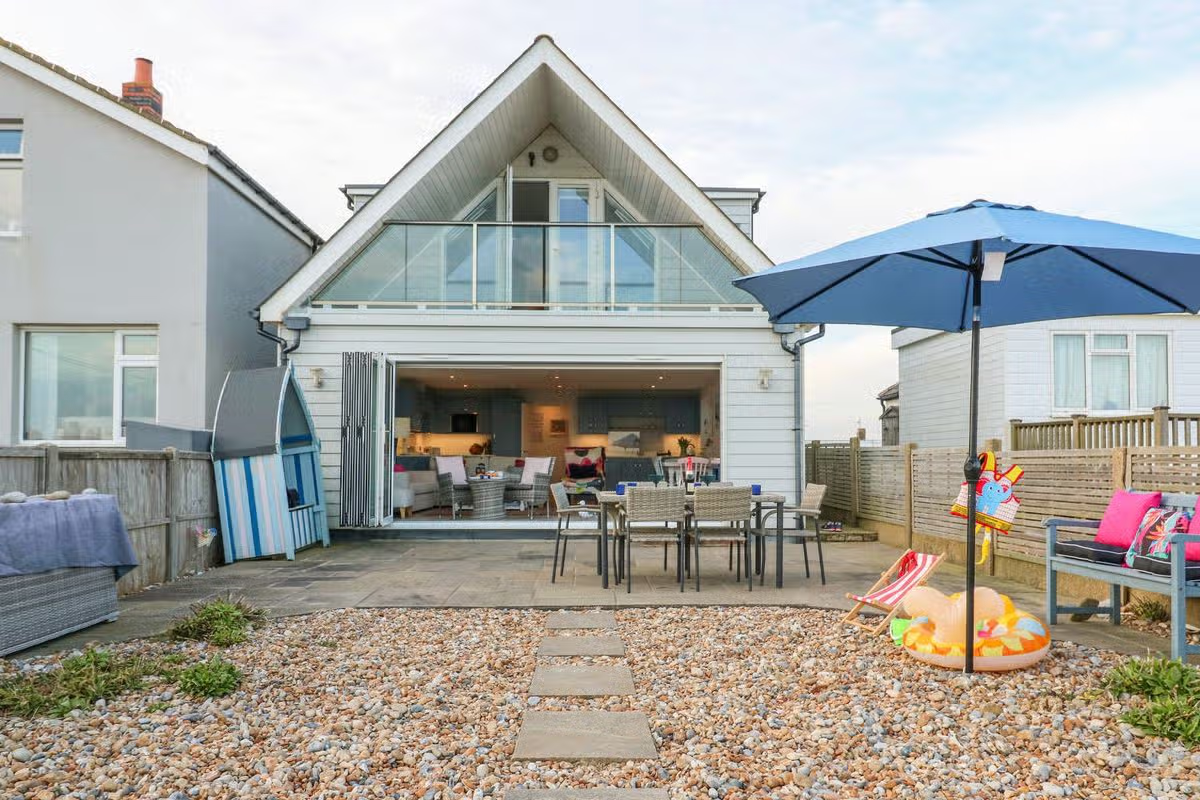
Sykes Holiday Cottages has crowned some of the UK’s best holiday cottages in its latest awards including best for young families, with the best views and pet-friendly properties
This article contains affiliate links, we will receive a commission on any sales we generate from it. Learn more
The UK is filled with beautiful holiday homes whether you’re after a cosy cottage for a romantic break, or a castle-turned-holiday-rental for a weekend away with a huge group of friends and family. The sheer amount of offer can sometimes make it a little trickier to unearth the hidden gems.
Luckily, Sykes Holiday Cottages have helped to narrow it down as they have unveiled the winners of their 2026 Sykes Gem Awards. I was a judge as part of a wider panel, with scores based on a number of factors including guest reviews, the quality of a property, amenities on offer, and even overall popularity.
This year’s winners have included a Grade II-listed lighthouse, a stay in the grounds of the historic Culzean Castle, a cosy glamping hut in the heart of Herefordshire, and a romantic bolthole on the Isle of Lewis.
You can check out the full list of winners here, but below are 12 properties which won gold that we think you’ll definitely want on your radar for your next UK holiday…
It’s not just Sykes Holiday Cottages that’s been serving up a dose of staycation inspiration. Earlier this year, HolidayCottages gave us plenty of UK holiday ideas when it unveiled its 2026 Showcase Awards with categories including winners for Most Iconic Design, Extraordinary Stays and the best in UK and Ireland.
Have you got a holiday story to share? Email us at webtravel@reachplc.com
JAKE Humphrey candidly revealed how fellow kids TV presenter Holly Willoughby robbed him of his “big moment” in a new interview with Davina McCall — only for the clip to mysteriously disappear.
During an emotional chat with Davina’s Begin Again podcast, Jake, 47, opened up about his childhood bullying trauma, his relationship with his grandfather and a brutal rejection from BBC Sport earlier in his career.
Jake Humphrey talked openly about difficult moments from his life that shaped the man he’s becameCredit: Begin AgainHolly Willoughby decided to defect to ITV instead of signing up for a CBBC kids’ TV show with JakeCredit: CBBC
He also spoke about his friendship and working partnership on CBBC with Holly. The pair were popular with young viewers in the early 2000s and presented CBBC’s coverage of talent show Fame Academy.
Jake revealed the pair’s chemistry was so good that channel bosses proposed they have their own show which they would have complete creative control over.
Sign up for the Showbiz newsletter
Thank you!
A delighted Jake saw it as his “big moment” and couldn’t wait to get planning, but his dreams disappeared the following day when Holly tentatively called him and said she wanted to pursue a presenting career with ITV.
Jake said the blow taught him a valuable lesson about the industry and not relying on others to share your vision.
Jake thought the kids’ show was going to be his ‘big moment’Credit: Begin AgainThe pair remain good friends, and Holly now has her own YouTube channelCredit: Shutterstock Editorial
The clip was published on the Begin Again TikTok and Instagram accounts before seemingly being pulled and edited out of the podcast.
The Sun has contacted a representative for Begin Again for comment.
In an unearthed interview from 2012, Jake told The Mirror that while he and Holly were working on Celebrity Fame Academy, she would stay at his flat in London as she was based in Brighton.
Jake recalled: “Eventually, it got to the point where we couldn’t be bothered to get the blow-up bed out so for about six months we slept in the same bed.”
Jake stressed that “nothing ever happened” romantically between him and Holly, but joked that may have been a different story if he hadn’t been dating.
Jake teased: “I wouldn’t want to say I met my wife too early but I would just say Holly’s worst habit is she sleeps naked – joking, of course.
“Holly’s a good mate but I look back on my time with her and wonder what might have been but I was going out with Harriet at the time and she lived in Leeds.”
Holly’s career in the spotlight began when she was scouted by a model agency at the Clothes Show Live aged just 14.
She then broke into television presenting, hosting shows on CBBC, before landing a job with its telly rival CITV.
That springboarded her career towards This Morning, which she signed for in 2009, and she worked on the ITV daytime show up until last year.
Holly has now swapped terrestrial TV for her own YouTube show, Together, which is produced by husband Dan’s Hungry Bear Media and currently has over 26,000 subscribers.
A 90s POP star looked unrecognisable as he belted out his big hit at his daughter’s wedding.
The singer, now, 62, found fame thanks to his massive dance song back in the day – but can you guess who it is?
Do you recognise this 90s pop star?Credit: TikTok/faithadamsuThe singer, who had a huge hit in 1994, sang at his daughter’s weddingCredit: TikTok/faithadamsu
The star in question is Mark Carson Adams who goes by the stage name Duke.
The Newcastle singer is best known for his massive 1994 house anthem So In Love With You.
Sign up for the Showbiz newsletter
Thank you!
Mark thrilled guests at his daughter Faith’s wedding, when he took to the stage to perform his famous song.
Dressed in a black tux, the 90s star sang his famous dance tune, as he got the party started.
At one point the bride and groom joined him on stage to dance, as their guests gathered around.
Mark’s daughter shared the moment on TikTok and playfully wrote over the top of the video: “When your dad decides to sing his 90s hit at your wedding and your friends are no.1 fans.”
Mark looked very different to his heydayCredit: UnknownSo in Love With You was a huge hit for MarkCredit: Wikipedia
The singer looked different to his 90s heyday, after ditching his moustache and goatee beard.
Mark was 30 when So In Love With You was released, and the song propelled him to stardom.
The smash hit dance tune was included on his 1995 album, The 10 Commandments Of Love.
The song was also famously remixed by Fatboy Slim as Pizzaman and topped the US Billboard Dance chart in 1997.
Although So In Love With You remains his biggest hit to date, Mark has continued to perform.
The singer’s Instagram is filled with all the live events he has played at, plus all the shows he has coming up.
A pair of best friends nipped to France for lunch and came home the same night, spending less than £75 on the whole trip. Mel Evans travelled to Beauvais with her friend and work colleague, Joanne Howard.
Mel managed to snap up return flights from Birmingham for just £48. The retail workers took an 8.45am Ryanair flight and landed at Beauvais Airport at 10.55am local time before taking an 85p bus into the town centre.
“We had seven hours to explore before we needed to get the bus back to the airport,” said Mel, from Chesterfield, Derbyshire. “The itinerary was to visit the cathedral and wander around the pretty streets and shops, look around the local markets and have some lunch and a drink.
“I love architecture and got lost looking at the cathedral, chateau and old houses. I was in my element. When we got there, we headed straight to the market and had a walk around. They had fish, meat, clothing, bags, purses and all sorts.
“We then headed to the cathedral. There was a lovely street nearby where I took pictures. We walked around the cathedral, then went inside and watched the astronomical clock.
“There was a craft fair, so we bought a few souvenirs for £5. We then headed to the Oise museum, which looked like a château from the outside. It had beautiful grounds.
“We then headed for lunch in the main square. After lunch, we walked around the town some more, stopping in shops and churches. We had a £2.50 ice cream, and found a street with old buildings. Then we looked around a second market and headed back to the main square for a £2.15 coffee until it was time to head for the bus.”
Their two main meals and two drinks cost £38 before they caught the bus back to the airport and boarded their 10:50 pm flight home. They landed back in the UK at 11 pm and, after travelling home, Mel was finally in bed by 12:30 am.
Mel and Joanne have been friends for 12 years and have already been on four day trips abroad together to Milan, Bergamo, Alicante and Oslo. Mel says everything went according to plan – and she would happily do it all over again.
Mel said: “I’m the planner, and Jo turns up; she’s very happy to go with the flow and my itinerary. It works well. There were no hiccups at all.”
Mel and Joanne’s trip began on 19 Sept with a £9.50 parking fee at Birmingham International train station, where they left their car for 24 hours before taking the free shuttle to departures. Their flight took around one hour and 10 minutes. After paying 85p each for the bus into Beauvais, they began exploring the town.
Mel then enjoyed a burger while Joanne had an omelette in the main square alongside two Coke Zeros. With no delays or other problems, the pair had plenty of time to enjoy their whistle-stop visit before catching the 85p bus back to Beauvais Airport.
The whole trip cost less than £75 each. Mel said: “At the end of the day, before flopping into bed, I felt very grateful I’d been able to travel. The next day is when I feel tired. I like that you can explore other countries in a day without having to book annual leave. You can explore the world one day at a time.”
Mel and Joanne have more day trips planned for the rest of the year, with France, Italy and Spain all on their travel radar.
Mel added: “We love day trips. It gives us something to look forward to, and we have a few more booked for this year. Friends and family think it’s great how we nip to France, Italy or Spain just for a day.
“My family call me Judith Chalmers because I’m always away. Day trips aren’t for everyone, as they are long days, but for how nice it feels to sit in a local cafe or park in another country makes it all worthwhile.
“I definitely recommend it to anyone. My biggest tip is to use a site such as Skyscanner to search for flights. Midweek tends to be cheaper than the weekend, and it’s best to book around 12 weeks in advance.”
Taylor Swift showed off her newly-chopped hair in a stunning, slinky gown as she prepares to accept the first-ever Artist Director Honors awardCredit: GettyCharli xcx leaned into the vamp with a velvet two-piece setCredit: Shutterstock EditorialBebe Rexha wore an all-black lace look with lace up knee high bootsCredit: GettyActress Teyana Taylor wore a feathered Zuhair Murad gownCredit: Splash
Taylor Swift, who is set to accept the inaugural Artist Director Honors award, wore a slinky Tamara Ralph gown.
The pop star paired a sparkly silver skirt with a form-fitting black bodice and mesh side cutouts.
Sign up for The Sun newsletter
Thank you!
She also showed off her new collarbone length haircut with long, cascading earrings.
Presenter Charli xcx stepped out in an all-black velvet ensemble from Saint Laurent with dramatic, billowing sleeves.
The low-rise column skirt and tiny top showed off her toned stomach, an a mesh insert covered her chest.
Lisa from Blackpink brought the drama in a floor-length, furry red capeCredit: Shutterstock EditorialPop star Sombr rocked a bedazzled belt as he’s nominated for three awardsCredit: Shutterstock EditorialSinger PinkPanthress, nominated for five awards, wore a Nina Ricci gownCredit: GettyTyla brought her signature glam look in a two piece snakeskin set from MowalolaCredit: Shutterstock Editorial
Other stars kept up the black theme.
One Battle After Another actress Teyana Taylor wore a plunging feathered gown from Zuhair Murad, while Bebe Rexha wore an all-black lace look with over the knee boots.
Lisa from the K-pop group Blackpink turned heads in a form-fitting red gown and a dramatic furry red cape.
Most read in Entertainment
The star is up for four awards tonight and will perform her single SaWaDiKa during the ceremony.
Presenter Rachel Dratch donned a structured metallic dressCredit: GettySisters Paris and Nicky Hilton twinned in silverCredit: Getty
Sombr also kept up the fur theme with an oversized striped jacket over his bare chest.
The pop star accessorized with layered necklaces, black sunglasses, and a bedazzled belt that reads “sex”.
She paired the burgundy and polka dot dress with light, blushing makeup and a fishtail braid.
Singer Troye Sivan wore a high-necked Erdem suitCredit: Shutterstock EditorialSinger Normani opted for a full golden metallic gown with full flower embellishmentCredit: Getty
Presenter Tyla brought the heat in a blue snakeskin two-piece bra and skirt set from Mowalola.
SNL alum Rachel Dratch wore a structured metallic dress, while sister duo Paris and Nicky Hilton twinned in silver, with presenter Paris rocking tall bedazzled boots and a sparkly mini dress with cut-outs.
Troye Sivan brought the drama in a high-necked Erdem suit with a draped black sash with white feathers.
Singer Normani also went for a metallic look with a large flower embellishment.
Singer Chloe Bailey left little to the imagination in a mirrored gownCredit: Shutterstock EditorialActress Ella Bright wore a corseted black gown that matched her new dark hairCredit: ReutersReality star Lisa Rinna rocked a wild blonde pixie and gown with fake nipplesCredit: Shutterstock EditorialSinger JoJo also wore a black column skirt paired with a braCredit: Getty
Singer Chloe Bailey wore a body-hugging silver dress with intricate beadwork and mirrored embellishments.
The tight bodice on the dress left little to the imagination – including her nipple peeking out the top.
Off Campus star Ella Bright stepped out in a black corseted gown that matched her new dark hair.
Real Housewives star Lisa Rinna debuted a wild new hair look coupled with a white gown with fake nipples.
Singer JoJo paired a black column skirt and bra top for her VMAs appearance.
EXCLUSIVE Some of the biggest stars of Coronation Street, EastEnders and Emmerdale have united for a new staging of a classic play and looked back on their time on the world’s longest-running TV soap
17:35, 27 Sep 2026Updated 18:05, 27 Sep 2026
Twelve Angry Men is on tour across the UK
Coronation Street, Emmerdale and EastEnders have been the UK’s biggest soaps for decades and now the stars truly have aligned as a group of actors from each of them have united to take on a stage production based on a film that is often one of the greatest films ever made
Soap legends Bill Ward, Tristan Gemmill, Ben Nealon and Gray O’Brien have teamed up together to appear as four of the jurors in Twelve Angry Men, which follows a jury as they deliberate the guilt of a boy on trial for murdering his father. All four of them have gone on to carve out successful careers on the boards since their time on screen, but Gray, 58,who played the villainous Tony Gordon on Coronation Street, has admitted he would be keen to return to TV if the opportunity was there.
“It’s not that I choose to do theatre, I’ll be brutally honest. It’s because nowhere in telly will employ me. That’s the thing about men coming out of soaps. Look at some of the best actresses we have in this country, Suranne Jones, Katherine Kelly, they’ve all used Coronation Street as a springboard into other things but it doesn’t work that way for men and I don’t know why that is,” he tells The Mirror.
Tony was the second husband of Underworld boss Carla Connor (Alison King). Introduced as a ruthless businessman, things quickly turned evil and he raped Carla before tying her up in the factory and setting it on fire during a major siege week in 2010. Carla made it out alive, but Tony did not. Gray admits he had no idea where the character was going when he first signed up to appear, but didn’t expect things to pan out as they did.
“It’s only supposed to be about seven houses,” he laughs when discussing the increasingly dramatic nature of the programme. Prior to joining Coronation Street, Gray had appeared in Casualty and River City, but joining the Manchester-based soap was a poignant moment for Gray because his father was such a fan.
“My father was a huge fan of Coronation Street, everyone says they are the biggest fan, but he was. Unfortunately, he died in 2000 and I joined in I think 2007 so he didn’t get to see it and he would’ve loved the part,” he adds.
But the star is happy with his latest role as touring fits in with his lifestyle and ultimately has happy memories of his time on set. It’s a similar case for Bill Ward, who played Charlie Stubbs and, after years of high-profile storylines, one of which saw Charlie abuse Shelley Unwin (Sally Lindsay), his character was murdered by girlfriend Tracy Barlow (Kate Ford) almost 20 years ago.
“I loved it, and people do still talk to me about it,” he smiles, adding “It was a really, really great piece of writing. The writers, I was very, very lucky. The writers really, really wrote for that character, for Charlie Stubbs, and I always used to look forward to getting the next week’s script to see what he would be up to because it was always it was very thoughtful, but it was also very innovative. A lot of the kind of the absolute delight, and I loved my time on it.”
Following his stint in Coronation Street, Bill, 59, went on to play James Barton in Emmerdale, but has also enjoyed a stellar career in theatre, starring in productions of Legally Blonde and Everybody’s Talking About Jamie amongst a host of others.
Things are never safe in soap land and a decade on from Charlie’s dramatic exit, former Casualty star Tristan Gemmill, 59, arrived to play Tracy’s ex-husband Robert Preston. Like Charlie, Robert did not exit in a black cab and his departure from the street was also explosive – being shot through the door of the Rovers Return Inn on Christmas Day.
At the time, Tristan’s children were young and he recalls having to calm them down when they saw the hard-hitting scenes. “Being shot through the door of the Rovers was harsh. It a hell of an exit. We all watched it on Christmas Day with my kids. I thought ‘Oh, look, we’ve had Christmas lunch. Let’s sit down and watch Daddy’s episode of Coronation Street because it’s where he leaves the show.’ It was a big mistake! They got so upset and I spent hours calming them down!”
For Ben Nealon, who played Alex Harkinson on EastEnders but is better known for starring as Capt Jeremy Forsythe on Soldier Solider, the theatre is definitely home, but he is always pleasantly surprised when members of the public recognise him for his signature role.
“With Solider Solider, it’s strange. In some ways, was really lucky, and all of us who were in it were really lucky to be last bastion of a show that was on television when there were still only five channels
“We had 17 million viewers, which is bigger than Game of Thrones now. I’m still amazed that that people come up and say ‘Hey, Jeremy!’ because it’s such a long time ago.” When asked if there is one genre he prefers, Ben, 59, admits he feels “really lucky” to have had a career spanning over three decades to begin with.
“I love doing theatre because of the rehearsal process, the immediacy of it. Of doing, it changes every night based on where you are, what the audience are like.
“I think in television these days, very rarely do you get a chance to rehearse much at all. You might do a couple of rehearsals for the camera and then off you go, so to have that in-depth analysis that you get in a in a rehearsal room for two or three weeks is is a real joy, and, and I think why most of do this job.”
After decades of starring on stage and screen, the four actors are keen to discuss taking on roles of various jurors in a new production of Reginald Rose’s legal drama. “It’s things like social justice, immigration, racism, one man standing against a mob, these are all ideas that he comes back to again and again and again.
“And so I’ve sort of gone backwards into his other work, if you see what I mean, and tried to find reasons, and I’ve researched the period,” Bill says.
Having already hit a few venues in the UK on its lengthy tour, Tristan is thrilled with the way audiences have responded. He explains, “We’re finding that the audiences are, are really engaged because the, Reginald Rose, the writer, has, has structured it in such a clever way where, where by, at the, at the beginning, you just see 12 blokes walk into a room.
“You know that it’s a jury deliberating on a murder case, but you don’t know any more than that. And then as, as time goes on, you almost fill in the gaps backwards, so that eventually you know what everybody in the room knows, because they’ve sat in the court for three days and listened to the proceedings. So, the way he drip-feeds the information is, is really clever.”
The pass looked doomed the moment it left Jayden Maiava’s hands.
It was third-and-long, midway through the second quarter last November in Eugene, Ore. USC was down just a score, and Maiava, the Trojans’ big-armed quarterback, was trying to make something happen. But the receiver he’d locked in on was unavailable and an Oregon edge rusher was charging at him unchecked. So Maiava let one fly down the middle of the field, and the pass sailed into a crowd of Duck defensive backs.
That regrettable interception, one of two for Maiava that day, ended up being one of the turning points in that game — and in a 2025 season that fell one win short of the College Football Playoff. The loss to Oregon last season served as a rude awakening for USC and Maiava, a reminder of how far both still had to go before reaching their potential.
A year later, as the two Big Ten powers meet again on Saturday, Maiava and the No. 12 Trojans (4-0, 1-0 Big Ten) find themselves at another critical mile marker. A win over No. 20 Oregon (2-1, 0-0) would put USC firmly in the conversation for the College Football Playoff. A loss would have folks taking serious stock of where the Trojans stand in their fifth season under coach Lincoln Riley. And at the center of it all is a quarterback who so far seems entirely unfazed by that outside pressure.
USC quarterback Jayden Maiava looks down field to pass against San José State on Aug. 29 at the Coliseum.
(Ronaldo Bolanos/Los Angeles Times)
“He’s playing with great confidence,” running back Waymond Jordan said of Maiava. “We’re going to keep seeing him getting better and better and better.”
Ask anyone at USC about Maiava at the moment, and they will invariably say something similar.
“It’s the most confident Jayden I’ve seen in the three years I’ve been around him,” left tackle Elijah Paige said.
Through four games, the numbers certainly suggest he’s on the cusp of a big season. Maiava leads all of college football with 12 touchdown passes and ranks seventh in completion percentage (75.7%). His name is already being floated in early Heisman Trophy conversations.
But Maiava also hasn’t been tested much through four games this season. His protection has been near-perfect, with just a single sack allowed. According to Pro Football Focus, Maiava has been under pressure on a mere 16 dropbacks — or 13% of the time — and, more often than not, that’s because he held the ball too long. Maiava’s average time to throw while under pressure so far this season is nearly four seconds, which, by Big Ten standards, is an eternity.
All of that’s likely to change this week against Oregon. The Ducks are loaded with talent along the defensive line and in the defensive backfield. While they’ve tallied just five sacks through three games, they’ve forced five interceptions, most of any team in the Big Ten. That’s after finishing second in the conference in that category a year ago.
Maiava hasn’t been quite as sharp the last two games after a dynamite start in which he had as many touchdowns (6) as incomplete passes through two weeks. But he knows Oregon will make him pay for any mistakes he makes Saturday, just as it did last season.
“Definitely a lot to learn from that game coming into the next one,” Maiava said. “Definitely turning the ball over, clean that up. Being stingy with the ball, being able to get the ball in playmakers’ hands and just continue to stay on the same page and move as one.”
He’ll almost certainly be without two of his top playmakers against Oregon, with freshman Trent Mosley unlikely to play and sophomore big-play threat Corey Simms already ruled out. Though, so far this season, Maiava has had no problem overcoming the absence of his two top receivers from a year ago, Makai Lemon and Ja’Kobi Lane.
USC still has standout freshmen Kayden Dixon-Wyatt and tight end Mark Bowman to pace the passing attack. The offense has also barely made use of two receivers who were expected to be at the top of the depth chart, Tanook Hines and Terrell Anderson, both of whom should play more of a part Saturday.
USC coach Lincoln Riley talks with quarterback Jayden Maiava on the sideline during a game against San José State on Aug. 29 at the Coliseum.
(Kevin Terrell / Getty Images)
“He’s done a really nice job with all the new faces around him, which is hard to do at this position,” Riley said of Maiava.
That’s a testament to his development since 2024, when Maiava arrived at USC with a howitzer arm but little polish to his game as a passer. He’d never gotten any individual training as a quarterback. His mechanics and footwork were especially raw.
After taking over at the end of that 2024 season, though, Maiava has continued to get progressively better. Now Riley views him as “one of the best quarterbacks in the country.”
“Of all the guys I’ve been fortunate enough to coach, I don’t know that I’ve had any that have improved from Day One to this point as much as Jayden has,” said Riley, who has coached three Heisman-winning quarterbacks. “It’s been fun to see him grow as a player and leader, starting to embrace what it means to be the starting quarterback at USC. I think a guy that’s just going to get better and better in his prime to play his best football.”
USC will need him at his best Saturday if it hopes to knock off Oregon, which has its own star quarterback in need of a big moment. Dante Moore could have been one of the top picks in the NFL draft a year ago, but returned to the Ducks, only for them to suffer a stunning loss to Oklahoma State.
Oklahoma State’s coach later acknowledged that Moore was tipping whether Oregon was running or passing on a given play by his pre-snap stance.
USC quarterback Jayden Maiava looks to throw a pass against Rutgers on Sept. 19 in Piscataway, N.J.
(Adam Hunger/Associated Press)
“That was a game and that was a moment that helped mold us,” Moore has said since. “I learned from that, and I’m glad it happened.”
Moore will have the benefit Saturday of facing a struggling USC secondary. The Trojans have yielded 10 yards per pass attempt this season and now could be without starter Alex Graham, who’s listed as questionable. It has been especially difficult for USC to get off the field on third and fourth down, which Riley said has been a central focus this week.
“As a secondary, we’ve got to be a little bit tighter in those situations,” Riley said. “We’ve got to make those competitive plays. We have a good defensive line. We have a group that can rush the passer. We’ve got to make guys hold onto that ball, make our pass rush work, and make those plays when we get to the point of attack.”
Not to mention the Trojans have got a great quarterback, one that Riley expects to lean on his experience as USC faces its biggest test of the season.
“He’s just mentally in a really, really good place to go do that,” Riley said of Maiava. “He’s the guy I want taking us into this game, for sure.”
Will Best and AJ Odudu have sent fans into meltdown after sharing another Big Brother update live on air
22:56, 25 Sep 2026Updated 22:57, 25 Sep 2026
Big Brother’s AJ Odudu and Will Best have sent fans into meltdown
ITV Big Brother fans have all said the same thing as hosts AJ Odudu and Will Best share a huge announcement live on air.
The hosts returned for tonight’s live eviction as one housemate was forced to leave immediately and say their goodbyes as their Big Brother journey came to an end.
Earlier this week, Pauline and Chesley received the highest number of nominations from their fellow housemates when they were asked to choose who they wish to face the public vote.
It came after a huge row broke out with Jedward earlier in the week, following this week’s theme of double trouble. Chelsey found herself at the centre of drama and chaos, with other housemates suggesting Pauline had a game plan.
For the last few days, it’s been up to the public to decide who leaves as they were asked to cast their votes. At the start of tonight’s live eviction (September 25), it was confirmed there had already been a staggering amount of votes cast, with over half a million at that point.
More came pouring in until the lines closed towards the end of the show. As Will and AJ returned to the stage for the second live eviction of the series, it was announced that Chelsey was the second housemate to leave the show.
But after her exit interview, viewers were greeted with another huge twist tonight, with hosts Will and AJ sharing an iconic announcement.
It was confirmed that this week’s theme was the “House Of Nothing”, but keeping in line with the theme, the hosts refused to say anything more about what it may involve, leaving it up to viewer imagination.
Viewers were quick to have their say though as one person wrote on X: “Oh the house of nothing is guaranteed to make this lot completely crack, I’m so ready #BBUK,”
Another said: “A house of nothing.. interesting, I wonder if they will take away their food and luxury items”, as a third added: “If the house of NOTHING means it’s really back to basics, I’m here for it.”
A fourth echoed: “House of Nothing. Please take all the furniture and beds away.” A fifth stated: “‘House of Nothing’ means No sofa, No dining room, no beds. Basically an empty house?!”
Viewers will need to wait until Sunday’s instalment to find out more, but if recent episodes are anything to go by, there is sure to be plenty of drama.
Big Brother continues on Sunday at 9pm on ITV2 and ITVX
Big Brother continues to be plunged into chaos with explosive rows almost daily
Big Brother viewers have been distracted by a background detail as the chaos continues (Image: ITV)
ITV’s Big Brother has certainly been delivering plenty of drama and chaos since it launched earlier this month, from explosive rows to clear divides and feuds.
Just last night (September 24) yet another row broke out as Rochelle and Johanne went head to head following concerns over uncooked chicken.
Wanting to cook her chicken further, Rochelle hit back at Johanne to say this would be against the rules for this week’s shopping task.
Rochelle also hit back at Johanne before she was called into the Diary Room and warned against making “threats to violence”.
But with all the chaos to keep viewers entertained, fans cannot help but be distracted with one background detail, which they say continues to make them feel sick.
That detail is the state of the house, with housemates leaving clutter in each room. Taking to Facebook, one person wrote: “How can BB not sit there and punish them all for the living conditions of the house.
“Ok they cleaned ABIT last night but my god it’s a squat, and putting it on TV is embarrassing. How can adults not know how to clean up and make there home clean. Which it is now there home it’s madness.”
One person replied: “There should be house rules and that be part of one”, as another branded it as “disgusting”. A third added: “I don’t understand how they can relax and be comfortable and eat and sleep in such squalor.” A fourth echoed: “Totally agree, I keep getting distracted by the absolute state of the bedroom, I mean it’s disgusting.”
They then continued: “When Big Brother said last night the punishment for talking about nominations would be to clean the house I thought thank God for that . It should be part of the rules to keep it half decent at least !!”
A fifth fumed: “Should be made to tidy bedroom and make beds. Hang clothes in wardrobes”, as another penned: “Didn’t they normally have to clean every now and then back in the day.”
The living conditions were also picked up on The Group Chat spin off show when hosts GK Barry and Kate Lawler took a secret trip to the house.
It’s not just viewers though that are appearing to struggle with the messy conditions, with housemate Rochelle often seen in tears over the lack of cleaning.
Earlier this week she was seen crying to Big Brother needing a vacuum cleaner, with last night’s instalment saw her raising concerns over the mess in the kitchen.
The concerns come as Pauline and Chelsey face the live eviction tonight (September 25) with only one housemate being forced to say their goodbyes.
Big Brother continues tonight at 9pm on ITV2 and ITVX
Chelsey and Pauline are both at risk of being sent packing and according to the bookies, the odds “do not look good” for one of the housemates.
Bookmaker Coral makes Chelsey 1-20 to be evicted from the Big Brother house this evening. Those odds indicate there is a 95% chance she will lose the public vote. Pauline is 8-1 to depart.
Coral’s John Hill: “The odds do not look good for Chelsey. We think there is a 95% chance she will be evicted this evening, making her one of the shortest-priced contestants in history in our Big Brother eviction betting.”
Pauline had the most votes with six housemates nominating her; Chelsey, Charlotte, Omar, Frankie, Rochelle and Philip and Sam, Harry, Pauline, Johanne and Rob nominated Chelsey, leaving her with five votes.
Millie became the first housemate to be evicted from this year’s series last Friday (September 18) after facing a public vote alongside fellow housemates Pauline and Rochelle.
Speaking after her eviction, Millie admitted she was surprised by the result, telling presenters AJ and Will: “I am actually quite shocked, I’m not going to lie but do you know what, I had the best time and I love absolutely everyone in there.”
She added: “I could hear the reaction from out here, and Rochelle doesn’t want to be in there. It’s a mix of everything, but I’ve made friends for life in there. So I’m happy.”
Since her exit, Millie has appeared on spin-off show Big Brother: The Group Chat, where she revealed her very honest opinion housemates Omar and Rhianna’s romance.
When hosts GK Barry and Kate Lawler asked Millie if she was a fan of the pair, she instantly replied: “No, I’m not.” She was then asked if she thought their romance was for convenience as there was no one else in the house.
She said: “100%. Number one, [Rhianna] she’s a very boring person herself. And I think the only way she knows she’ll get kept in is if she hooks up with someone. I genuinely think that’s what it is.”
Kate then asked if Rhianna was playing a game with Omar and Millie replied: “She is playing it 100% because she is not interested in Omar at all. When I was watching and I watched them kissing under the covers, I was like, ‘Sorry, what? Make it make sense’.”
Omar and Rhianna are not the only housemates sparking up a romance in the house. Nominated housemate Chelsey has also been getting to know Lynx leaving fans moaning “This is not Love Island“.
Big Brother continues tonight on ITV2 and ITVX at 9pm
Big Brother was also forced to issue a warning to the housemate
Big Brother’s Rochelle found herself at the centre of drama again(Image: ITV)
Big Brother housemates were forced to intervene after a huge row broke out once again and “threats of violence”.
There has been plenty of chaos in the Big Brother house in just over a week since the show returned to screens. Already, viewers have witnessed heated clashes and a live evictions as personalities continue to clash.
Last night’s instalment (September 23), saw the housemates nominate for the first time this series as they told Big Brother who they wished to face eviction this week. After receiving the highest number of votes, Pauline will once again face this week’s eviction alongside fellow housemate Chelsey.
Viewers are being asked to choose who should leave as one housemate will be forced to say their goodbyes in tomorrow’s live eviction (September 25).
But before that, the drama continued in tonight’s instalment with more explosive rows and rule breaks forcing Big Brother to dish out the punishments.
For this week’s shopping task, Big Brother has transformed the House into Noah’s Ark. Each housemate was assigned an animal persona and must take part in a range of different challenges, with Philip and Charlotte in charge as Noah and his wife.
Samuel and Johanne were lions; Pauline and Omar were elephants; Yasmin and Harry were sharks; Chelsey and Frankie were crows; Lynx and Rhianna were rabbits and Rob and Rochelle were bugs.
It didn’t take long before things turned sour as tensions started to rise. When tasked with cooking, Rochelle appeared to struggle with her and Rob required to cook for the whole house.
Getting increasingly stressed, Rochelle could be heard saying: “This isn’t my thing” as she fought back tears. But when served their food, the housemates noticed things were not quite as it seemed.
Concerns were raised over whether the chicken was cooked properly, meaning Johanne wanted to cook her own chicken – however this was against the rules.
Convinced the chicken was uncooked, Johanne said she was going to put the chicken in the airfryer for a while longer – which was against the rules.
Rochelle fumed: “I don’t think you’re allowed to… the chicken is cooked.” However, Yasmin hit back that people would not eat raw chicken.
Stating she wanted to cook her own chicken, Rochelle hit back she was not allowed to, but Johanne fumed: “Who are you talking to? I’m not eating it. I’m not eating it. Now what?”
She added: “Sit your a** down. Who the hell are you talking to? I want to cook my chicken longer – I can do that. Who are you talking to? Your craziness needs to really calm down.”
Fuming that Rochelle was “unstable”, Johanne then fumed: “It’s not my fault you didn’t take cooking classes….You started screaming like a crazy woman. I’m not your child.”
Rochelle replied: “The minute you walked in, you were going to say it was sh*t.” Johanne commented: “You need to learn how to cook.”
After a heated exchange, Johanne said: “You’re a self-entitled 80-year-old woman. I’m not the one. Get your old a** together. You old hag!”
The back and fourth continued to become heated as Philip was forced to intervene, telling his co-stars to “calm down”. The other housemates were stunned by what they witnessed as Rochelle was soon called to the Diary Room. Big Brother then warned Rochelle against threats of violence which was deemed unacceptable.
Big Brother continues tomorrow at 9pm on ITV2 and ITVX
A stunning new poll showing Los Angeles City Councilmember Nithya Raman gaining a double-digit lead over incumbent Karen Bass in the mayor’s race is increasing pressure on Bass and her allies to go sharply negative against her opponent and to seek support from conservative and undecided voters to narrow the gap.
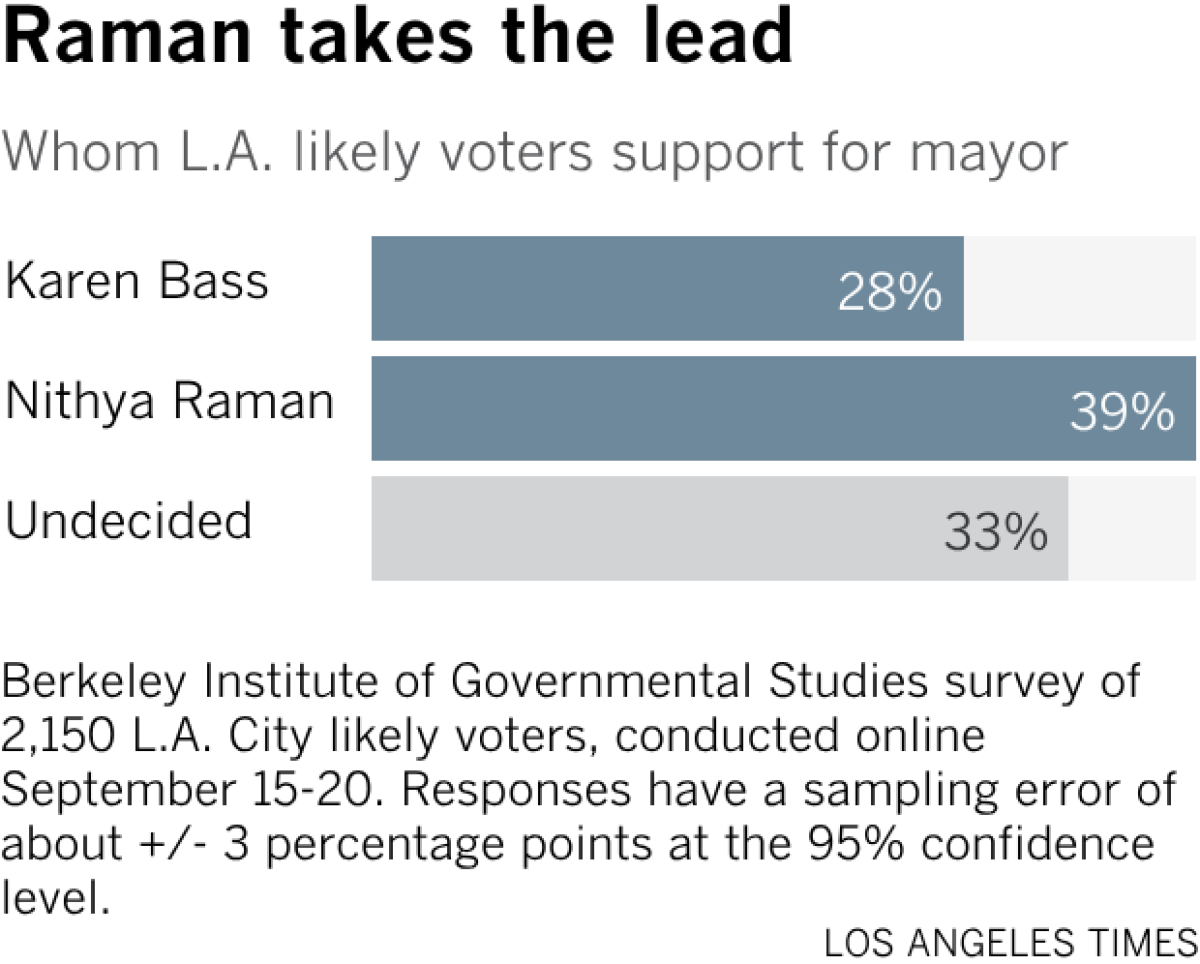
The poll, conducted by the UC Berkeley Institute of Governmental Studies and co-sponsored by The Times, showed Bass trailing Raman by 11 percentage points — with 28% of likely voters saying they supported the mayor while 39% said they would vote for Raman. The remaining 33% were undecided, an unusually high number this close to the Nov. 3 election.
“The bottom line is this is a huge shot in the arm politically for Raman — and it’s not a good day for the mayor,” said Zev Yaroslavsky, a former L.A. City Council member who now runs the Los Angeles Initiative at the UCLA Luskin School of Public Affairs.
Dan Schnur, a former Republican political consultant, said the poll could have instant negative effects for the mayor’s fundraising ability as potential supporters might now view Raman as the favorite in the race.
“The most immediate tangible result of a poll like this is that Bass’ greatest advantage was her fundraising and it now becomes much more challenging to raise money,” he said.
Bass, appearing Wednesday at a news conference in Hollywood, said she’s seen multiple polls that show a tight race. She said that Raman is “absolutely not” the front-runner in the race.
Mayor Karen Bass speaks at Vermont/Santa Monica Metro Center on Wednesday, touting progress on construction of affordable housing.
(Kayla Bartkowski / Los Angeles Times)
The mayor said she is working to highlight the city’s progress in making rent more affordable, pointing to newly released numbers that show that more than 10,000 units of housing with restricted rents have been built since she took office in December 2022.
“The No. 1 issue to Angelenos continues to be lack of affordability, and our primary way of addressing that from the city is housing,” she said. “So we are absolutely addressing affordability.”
Others in the Bass camp seemed more anxious about the poll results.
“It put a pit in stomachs,” said one supporter close to the Bass campaign who requested anonymity to speak candidly about the poll. “But there is still an outside chance for Bass. It’s not total doomsday.”
The supporter said that the Bass campaign truly doesn’t believe Raman’s lead is that big, but that the poll was still “not good news,” especially for fundraising.
Mike Bonin, a progressive former L.A. City Council member who now runs the Pat Brown Institute at Cal State Los Angeles, said Bass needs to focus on winning over voters who chose former reality television personality Spencer Pratt in the primary election in June. Many of those voters are now on the fence.
Pratt received 26% of the vote in the primary, and most of the voters who cast ballots for him — 63% — say they still haven’t decided whom to vote for in the runoff, the poll found. Among the Pratt voters who have decided, 22% favored Bass compared with 16% for Raman.
Bonin said he expects Bass and her allies to attack Raman’s progressive views in order to reach Pratt voters. Raman is a member of the Democratic Socialists of America and opposed raises for Los Angeles Police Department officers that had been championed by Bass.
“The nature of the attacks will try to reach the Pratt voters particularly since they are the largest bloc of undecideds and they skew conservative,” Bonin said.
The Los Angeles Police Protective League, the union representing LAPD officers, is already airing campaign ads critical of Raman over her opposition to a law barring homeless encampments next to schools. In the coming days, the group will also roll out commercials highlighting Raman’s ties to the DSA, which has endorsed her mayoral bid, said union spokesman Tom Saggau.
“Our own poll told us that the Pratt folks were very much undecided, and that when they heard more about Nithya’s record, and her co-governing with DSA, they moved off of her,” he said, adding that his group still views the race as a dead heat.
Raman, not surprisingly, cheered the poll results.
“This poll reflects the momentum we’re seeing on the ground. Angelenos are ready for change and want to see a City That Works,” Raman said in a post on Instagram.
Raman campaign officials said the poll probably will help their fundraising efforts, which they said had already been gaining momentum over the last few weeks. And Schnur, the former GOP political consultant, said the wide lead allows Raman to spend more time touting her own credentials instead of disparaging Bass.
“For the most part Raman has the front-runner’s luxury of putting out a positive message and reinforcing her own credentials,” Schnur said.
Estevan Montemayor, who is running the pro-Raman Estamos con Nithya independent expenditure group, said his group’s role will be to inform voters about Raman’s positives while the Bass campaign attacks.
“They’re gonna come after Nithya and we’re gonna be here to tell her success story,” he said.
Bass supporter Stuart Waldman, chief executive of the Los Angeles County Business Federation, said the large number of undecided voters this close to the Nov. 3 election is worrying but also leaves an opening for Bass to gain ground.
“Any swing in any direction could make a big change,” Waldman said. “We have no idea who’s going to vote. … Usually by this point in time, everything has tightened up.”
Councilmember Nithya Raman, lower right, campaigns at a Latinos Con Raman rally at La Cita Bar in downtown Los Angeles.
(Genaro Molina / Los Angeles Times)
In courting those undecided voters, however, Bass is burdened by high unfavorability numbers, according to the Berkeley IGS/L.A. Times poll.
The mayor had 63% unfavorable ratings, the poll found, with 28% favorable and 9% having no opinion. By comparison, 40% had a favorable view of Raman, according to the poll, while 39% said they had an unfavorable view of her and 21% had no opinion.
Mike Murphy, a Republican political consultant, said that Bass needs to accept responsibility on core issues upsetting Angelenos about her tenure, such as homelessness and the 2025 Palisades fire, which killed 12 people and destroyed thousands of homes. In a recent interview with The Times, Bass said her biggest mistake as mayor was being in Ghana when the fire began amid high wind warnings.
“You have to say, ‘I hear you,’” he said. “Voters don’t think Karen gets that they are mad about things that happened during her term.”
Then, Murphy said, he believes Bass needs to attack Raman as being more establishment than Bass.
Murphy noted that Bass has frequently attacked Raman for being “at City Hall longer than I have,” which he called a powerful message to voters who are considering Raman because they want change. Raman was elected in 2020 and Bass in 2022.
Other polls taken in the campaign have shown a closer race than the Berkeley IGS/L.A. Times poll.
In an early August poll commissioned by an independent expenditure group supporting Bass, the mayor had the edge, 41% to 35%, with 24% undecided.
Mayor Karen Bass greets community members after speaking at Vermont/Santa Monica Metro Center.
(Kayla Bartkowski / Los Angeles Times)
The Bass campaign cited some of those polls when responding to the Berkeley IGS/L.A. Times poll Wednesday, calling it an “outlier poll” and accusing the pollsters of getting it wrong.
“In the primary … they got it wrong and undercounted Karen Bass’ support,” campaign spokesperson Alex Stack said in a news release.
Stack added that polls conducted online, like the Berkeley IGS/L.A. Times poll, “systematically [undercount] working-class families, seniors, and non-English speaking communities who regularly turn out on Election Day.”
Mark DiCamillo, the director of the Berkeley IGS Poll, defended the methodology, saying he has spent 45 years polling in California and eight years running the Berkeley IGS Poll.
“What would you expect from a campaign down by double digits? They attack the poll,” he said.
Solar stocks fell sharply on Thursday, led by First Solar’s (FSLR) 10.3% plunge to a new 52-week low, as high borrowing costs add pressure to an industry that depends heavily on project financing.
Losses among solar stocks were broad, including Enphase
At midseason in high school football, the Chaminade High passing duo of sophomore quarterback Jeremy Mellalieu and senior receiver Andrew Cordero has surpassed many of the players ranked higher in preseason forecasts. That’s what happens frequently when it’s time for gauging performance over potential.
Mellalieu, who won the starting job with three games left in his freshman season, has led the Eagles to a 5-0 start.
“He’s really letting the ball fly and trusting us, and we’re making good catches,” Cordero said. “He’s definitely running a lot harder when he breaks the pocket. He’s confident and when he has to, he’s tucking the ball and running.”
Mellalieu, who is 6 foot and 180 pounds, has passed for 1,071 yards and 12 touchdowns with three interceptions. Cordero, 6-0 and 175 pounds, has shown excellent speed in breaking away from defenders while catching 20 passes for 455 yards and seven touchdowns.
“I think he’s played on a different level of confidence,” Mellalieu said of Cordero. “I feel he’s really finding himself in being more elusive when he catches the ball and making plays. He’s turning a bubble screen into a 50-yard gain or first down.”
Together, the duo and their teammates have the Eagles ready for a competitive Mission League schedule. Sierra Canyon remains the overwhelming favorite, but the Eagles’ improvement after a 5-6 season in 2026 is noticeable.
Quarterbacks have been the story at midseason, with teams passing a lot more and quarterbacks showing off their ability to run and pass. The performance of JSerra quarterback Hayes Cloutier last week against Bishop Amat perfectly explains the trend. He ran for 124 yards and three touchdowns and passed for 190 yards and two touchdowns.
Calabasas quarterback Dominik Hardy threw four touchdown passes in 27-17 win over Birmingham.
(Craig Weston / For The Times)
Star Thomas of Orange, Chase Curren of Crespi, Chris Fields III of Carson, Ryan Rakowski of Palos Verdes, Jaden Jefferson of Corona Centennial, DJ Mitchell of La Habra, Dominik Hardy of Calabasas and Grady Long of La Serna have been showing off their ability to pass and run. Among the passers with strong five-week efforts have been Matthew Escobedo of Cantwell-Sacred Heart, Jordan Malikin of Warren, Gerald Torres of King/Drew, Seth Solorio of San Pedro and Nicholas Hoang of Culver City.
With quarterbacks throwing often, receivers are putting up impressive statistics. Landon Lattimore of Saugus has 11 touchdown receptions. Owen Martinez of Cantwell-Sacred Heart has 41 receptions. Paul Turner of Birmingham is separating himself from all City Section receivers with his big-play catching ability. Gavin Honore has been keeping the Mater Dei offense afloat. Quentin Hale of Corona Centennial has been close to uncoverable.
For running backs, AJ McBean of Gardena Serra, Jaxsen Stokes of Sierra Canyon, Adrian Petero of Santa Margarita, William Fredericksen of JSerra, Maliq Allen of St. John Bosco, Gatsbee Gumban of Nogales, Salvador Villa of Simi Valley, Arman Papazyan of Glendale, Brandon Hernandez of Panorama, Tru Warrior Casas of Fairfax and Ceasar Reyes of Garfield have been dependable running machines. Gumban has 926 yards rushing in five games.
There’s one blocker who has established himself as the best in Southern California. Lucas Rhoa of Orange Lutheran needs to be observed and copied the way he is using his size, strength and agility. If anyone resembles a future NFL player, it’s him.
It was the battle in the trenches between Orange Lutheran and Sierra Canyon, which won 28-10.
(Craig Weston / For The Times)
When it comes to delivering as expected, Sierra Canyon’s defensive line made up of the trio of Kasi Currie, Stephen Harrison and Marcus Fakatou can’t be stopped. They’re distrupting offenses similar to the lineman group that was at Santa Margarita last season during the Eagles’ successful Division 1 title run. Junior defensive end Kingston Sula of Carson has recorded five sacks.
Sophomore linebacker Eli Zamorano of Sierra Canyon gets tackle against Orange Lutheran.
(Craig Weston / For The Times)
Among linebackers, junior Luke Ulibarri of El Camino Real has been credited with 86 tackles in five games. Sophomore Eli Zamorano of Sierra Canyon and freshman Aydan Steen of Santa Margarita have been the best first-year varsity contributors. Mater Dei’s linebacker group, led by Mike Davis and Dailon Clanton, have led a very good defense.
Jalen Flowers of Palos Verdes takes off on punt return vs. Carson.
(Nick Koza / For The Times)
Special teams players have been coming through, from Tucker Murray of Corona del Mar (one punt return, one kickoff return for touchdowns) to Jalen Flowers of Palos Verdes. Among kickers, Charles Szares of Sherman Oaks Notre Dame is five for five on field goals and 23 for 23 on PATs. Mateo Akerman of Corona del Mar came out from the soccer team and has been booming almost every kickoff into the end zone for a touchback.
The impressive two-way contributors include sophomore Roshaun Brown of Jefferson. He has five interceptions and five touchdowns receiving. Nolan Scott of Corona del Mar continues to make impact as a tight end and defensive end.
There are 46 unbeaten teams left. Among the surprises are Harvard-Westlake, San Marino, St. Bernard, Royal, all of which have struggled to obtain winning records in recent years.
Los Angeles Councilmember Nithya Raman has taken a wide lead over incumbent Karen Bass in the L.A. mayor’s race, according to a new poll released Wednesday, although a high percentage of voters remain undecided less than two weeks before mail-in ballots are sent out for the Nov. 3 election.
Raman is favored by 39% of likely L.A. voters, compared with 28% for Bass, according to the poll by the UC Berkeley Institute of Governmental Studies, which was co-sponsored by The Times. The poll found that 33% of voters were undecided.
“Raman clearly has the advantage. Her task is a little less onerous than Bass’,” said Mark DiCamillo, the director of the Berkeley IGS Poll.
Adding to Bass’ low poll numbers are high unfavorability ratings.
The mayor had 63% unfavorable ratings, the poll found, with 28% favorable and 9% having no opinion. By comparison, 40% had a favorable view of Raman, according to the poll, while 39% said they had an unfavorable view of her and 21% had no opinion.
The survey released Wednesday was conducted online with a sample of 2,150 likely city voters between Sept. 15 and Sept. 20. It has a margin of error of about 3 percentage points.
The poll represented the strongest showing yet for Raman, who trailed Bass in almost every poll during the primary campaign and who came in second to Bass in the primary election, with 29% of the vote compared with Bass’ 34%.
Mayoral candidate and Councilmember Nithya Raman, center, enjoys a light moment with Alliance of Californians for Community Empowerment (ACCE) Action members at La Cita Bar in downtown Los Angeles.
(Genaro Molina / Los Angeles Times)
Even so, DiCamillo said the large number of undecided voters means the race is far from over.
“It’s extraordinarily unusual to see this many undecided voters at this point in the race,” he said. Mail-in ballots will be sent out beginning Oct. 1, local elections officials say.
The large number of undecided voters can be linked to the elimination of mayoral candidate Spencer Pratt in the June 2 primary, according to DiCamillo. The former reality TV star received 26% of the vote in the primary, and most of the voters who cast ballots for him — 63% — say they haven’t decided whom to vote for in the runoff, the poll found.
Among those Pratt voters who have decided, 22% favored Bass compared with 16% for Raman.
One of the most significant findings in the poll was a massive “generational divide” among L.A. voters, DiCamillo said.
Raman, 45, dominated the 72-year-old Bass among younger voters, with 66% of likely voters ages 18 to 29 choosing the council member while just 4% chose Bass, according to the poll.
Raman also had 64% of likely voters ages 30 to 39 compared with Bass’ 12%, and the council member had 50% of likely voters ages 40 to 49 compared with Bass’ 18%. Raman also was leading among voters 50 to 64 years old by a slim margin of 35% to 33%.
Bass, meanwhile, led among the oldest set of voters — those 65 and up — but not by the same margins. Bass had 41% of likely voters in that group compared with Raman’s 21%.
According to the poll, 56% of likely voters thought Bass did a poor or very poor job responding to the disaster, which killed 12 people and destroyed more than 4,000 homes, including Pratt’s.
Fourteen percent of the likely voters thought Bass had done either an excellent or a good job and 17% thought she had done a fair job.
Mayor Karen Bass campaigns at Ernest E. Debs Regional Park on Sunday.
(Kayla Bartkowski / Los Angeles Times)
The most important issues to likely voters were fixing city infrastructure, moving homeless people indoors, crime and public safety, and building more affordable housing, the poll found.
The poll shows Raman leading in nearly every geographic area of the city. Bass was leading in South Los Angeles and the Harbor region, 37% to 34%, but central Los Angeles as well as northeast and the east side of Los Angeles broke strongly for Raman.
The San Fernando Valley went 34% to Raman and 26% to Bass with 40% still undecided. The Westside favored Raman by a single percentage point, at 35% to 34%.
Raman has led in other polls recently, though none by as wide a margin as in the Berkeley IGS/L.A. Times poll. Shortly before the primary, a separate Berkeley IGS/L.A. Times poll showed Raman leading Bass in a potential head-to-head matchup by just four percentage points, with 32% support compared with the mayor’s 28%.
On the negative side, Raman was booted from her position in the council as chair of the Housing and Homelessness Committee, a move she said was politically motivated.
The pop star duo have revealed exactly what happened during the tense row
Pop stars Jedward sparked chaos in the Big Brother house (Image: ITV)
Jedward have broken their silence on the heated Big Brother row that left them “traumatised”.
The pop star duo, whose real names are John and Edward Grimes, joined the reality show on Sunday and had already sparked chaos by Monday night. It all started when they offered 21-year-old Rhianna some friendly advice while relaxing in the garden hot tub.
Rhianna approached the pair and asked for their unfiltered opinions about her, and they didn’t hold back. They criticized her relationships in the house and encouraged her to get out of her comfort zone, telling her “you’re not in Love Island“.
The conversation spiralled out of control when Rhianna reported it back to her close friend Chelsey, revealing she was really upset. Fellow housemate Lynx then realised the young woman was sad and decided to confront Jedward.
When Lynx approached the twins, the discussion became even more heated and ended with John splashing Lynx with water from the hot tub.
John has now explained exactly what happened in that heated moment, arguing that the water splashing was “innocent”. Speaking on Big Brother’s companion show, The Group Chat, he said: “I had given the girl [Rhianna] a bit of advice.
“She left, I literally thought she was calling it a night. Suddenly Chelsey is back and I’m like ‘Ok that must be it then’. And he [Lynx] was about to – I don’t know if he was about to get into the tub – but the water was just there.”
He went on to add: “It could have got way worse. I think the splashing was just innocent. It was just an innocent moment.” Other housemates were forced to step in after the splashing incident as Lynx was left furious with the twins.
Edward revealed his own perspective on the argument, adding: “I’m traumatised, I’m gonna have to check into a therapist. I will never get into a hot tub and not think of this.”
The musicians were at the heart of drama throughout their Big Brother journey but they have insisted they didn’t set out to “make trouble”. They had actually hoped to form some connections and enjoy a few days in the famous house.
However, Jedward’s time on the show came to end in Tuesday’s (September 22) episode. They returned to social media before their final scenes had even aired and shared unfiltered posts about the remaining housemates.
Writing on X, formerly Twitter, one post said: “The truth hurts I guess I think we deserve a medal for the honesty and impact we brought to the house authentic vibes always. They acting too pretentious and predictable and raging we clocked.”
While another added: “Don’t ask for an opinion if you can’t handle the truth I was calm, collected, fair and straight with them #bbuk.”
Big Brother’s The Group Chat is streaming now on ITVX
Two housemates were then forced to say their goodbyes on Friday night (September 18), with fake contestant Tays leaving alongside bartender Millie. But viewers have also been watching romances bloom between Chelsey and Lynx, as well as Omar and Rhianna.
However, this won’t be Rhianna’s first love story to play out on screen. She previously dated Made in Chelsea star Freddy Knatchbull and appeared in several episodes of the show alongside him.
In her first scene on the Channel 4 series, the 21-year-old revealed that she doesn’t use the name she was given at birth. The Russian star actually chose her current name at just six years old, after her mother became a British citizen.
“I’m Russian but I’ve lived everywhere,” she explained to Freddy’s friends. When asked what her real name is, Rhianna shared: “I changed my name too, when I was like six. Because my mum became a British citizen.”
She went on to reveal her potential choices: “As a six-year-old, she’s asking me ‘Oh, change your name if you want.’ And I was like ‘Okay.’ Gave her three options: Zendaya, Rihanna like the singer, or Kylie Jenner.”
Try ITVX Premium free for a week
This article contains affiliate links, we will receive a commission on any sales we generate from it. Learn more
ITVX Premium offers exclusive ad-free content that can be streamed on-demand and on the go, with everything from Hollywood blockbusters to bingeable British box sets.
An annual plan costs £59.99 – equal to £4.99 per month – after a seven-day free trial.
The Big Brother star didn’t reveal her birth name on the show. But she touched on her unusual upbringing, during which her mother hired a full-time bodyguard to stop her being a “wild child”.
Reflecting on her teenage years, Rhianna said: “I would meet people for the first time and they’d be like ‘Rhianna, by the way, there’s someone following you.’ Can you imagine trying to meet guys and then a bodyguard is with you?”
The so-called stay-at-home daughter is now hoping to win over the nation and take home the Big Brother crown. Living with strangers will also be a new experience for her. “I’ve never done that before,” she admitted before starting the show.
“I’ve never stayed in a hostel, gone to summer camp or boarding. I’ve never been in a situation where I have to stay the night with complete strangers and that is really exciting for me. I get to meet people that I most likely wouldn’t have met in my day-to-day life.”
Big Brother continues on ITV2 and ITVX tonight at 9pm
When Dodgers manager Dave Roberts said earlier this week that the best was yet to come, his expectations were centered on the offense.
In the Dodgers’ 10-4 rout of the San Francisco Giants on Saturday, that better version of the offense was on display, putting together a pair of three-run rallies in back-to-back innings to take pressure off the pitching staff.
“This is the first time, seems like all year, that we’ve had four or five hitters swing the bats well for four or five games,” Roberts said. “So it’s been really good to see.”
This month, Mookie Betts, Kyle Tucker and Teoscar Hernández have led the group, with Max Muncy and Will Smith heating up this week. The Dodgers’ 15 hits Saturday were their most in a game since July 2 against the San Diego Padres, and just two shy of their season high.
Reinforcements should be coming soon too. Shohei Ohtani (right biceps and left knee) hit off the Trajekt machine Saturday and ran the bases before the game. Roberts said there’s a “good chance” that he’ll be activated off the 15-day injured list during the Dodgers’ series against the San Diego Padres this week. He can be reinstated as early as Wednesday.
Center fielder Andy Pages (fractured left hand) went through a simulated game Saturday. He could return Tuesday.
“You’re going to go through your waves,” said Betts, who finished the day with three doubles and a single. “You’ve just got to ride them. … Right now we’re getting them across, and we’re just going to keep giving ourselves chances. That’s the main thing.”
The offense kept the Dodgers in the game, despite Tarik Skubal struggling.
Skubal pitched only five innings, tied for his shortest start with the Dodgers. And he surrendered four runs, the worst mark of his Dodgers tenure.
Entering the game, Skubal appeared to be peaking. His previous two starts, both against the Reds, were some of his most efficient.
That efficiency, however, regressed against the Giants (64-91).
“Fastball command wasn’t great,” he said. “Not driving it up and in, kind of pulling the ball down at times, pushing it up at times. I think almost [all] pitching is all fastball command, and mine wasn’t great today.”
Though he got through the first two innings without giving up a run — thanks in part to a diving catch by Tucker in the right-center field to end the first — he issued two-out walks in each.
The Dodgers’ offense used that time to mount a lead. Betts hit the first of those doubles in his first at-bat, and Muncy authored his own to drive in the first run.
The next inning, rookie Josue De Paula’s walk, and singles from Alex Freeland and Betts combined to push in another run.
Dodgers baserunner Kyle Tucker slides head first into Giants catcher Andrew Knizner while scoring a run in the fifth inning Saturday.
(Gina Ferazzi / Los Angeles Times)
Then Skubal began to struggle. With a runner on second and one out, he pitched to a full count against designated hitter Victor Bericoto. Skubal missed down the middle with a fastball, and Bericoto sent it 425 feet to center field. It landed on the netting on the other side of the wall to tie the score.
The Dodgers’ offense, coming alive in September, struck back in the third. Smith hit his second home run in as many nights, launching the second pitch of the inning into the left-field pavilion.
The Giants took a different approach to tie the score for a second time. After back-to-back singles, they used back-to-back sacrifice bunts to advance the runners and score another run.
Then the two teams traded runs again. Betts put the Dodgers (95-60) up with an RBI double in the fourth. Skubal gave up back-to-back doubles in the fifth.
That marked both the end of Skubal’s start and the beginning of the Dodgers’ offensive onslaught.
“Obviously, I wasn’t very good today,” Skubal said. “But the offense and defense and bullpen picked me up big time. And that’s what good teams do, they pick each other up and win series and win baseball games. So, hats off to them.”
The Dodgers brought seven batters to the plate in the fifth, and all but one reached base. Tommy Edman hit a two-run single. And pinch-hitting Miguel Rojas almost matched him, but Giants left fielder Turner Hill made a perfect throw to nab Edman in a close play at home to end the inning.
Betts’ and Smith’s bats stayed hot to open the sixth with a leadoff double and one-out RBI single, respectively. The Dodgers took advantage of the Giants’ sloppy infield play to load the bases for De Paula, who lined a two-run single into shallow center field.
Those were the kinds of stifling rallies that had defined the Dodgers’ offense earlier in the season, when they were scoring regularly in double digits.
“I think our potential’s winning the World Series,” Tucker said. “So until we do that, then I can say we reached it. But we feel like we’re in a good spot right now. Our pitching staff’s done a great job all year giving us an opportunity to win every single night. Our defense has played pretty well behind them, and then offensively we’ve done a solid job as well.
“Right now we’ve got a few guys that are feeling good, a few guys that are banged up. But we’re still out there grinding, trying to win as many games as possible before the season ends and just trying to carry it all the way to the playoffs.”
Tucker picked up some extra bumps and bruises Saturday, most notably fouling a pitch off his right knee in the third inning. Once the game became a blowout, Roberts pulled him.
“I feel like everyone’s grinding at this point in the season,” Tucker said. “But I’ll be good with it.”