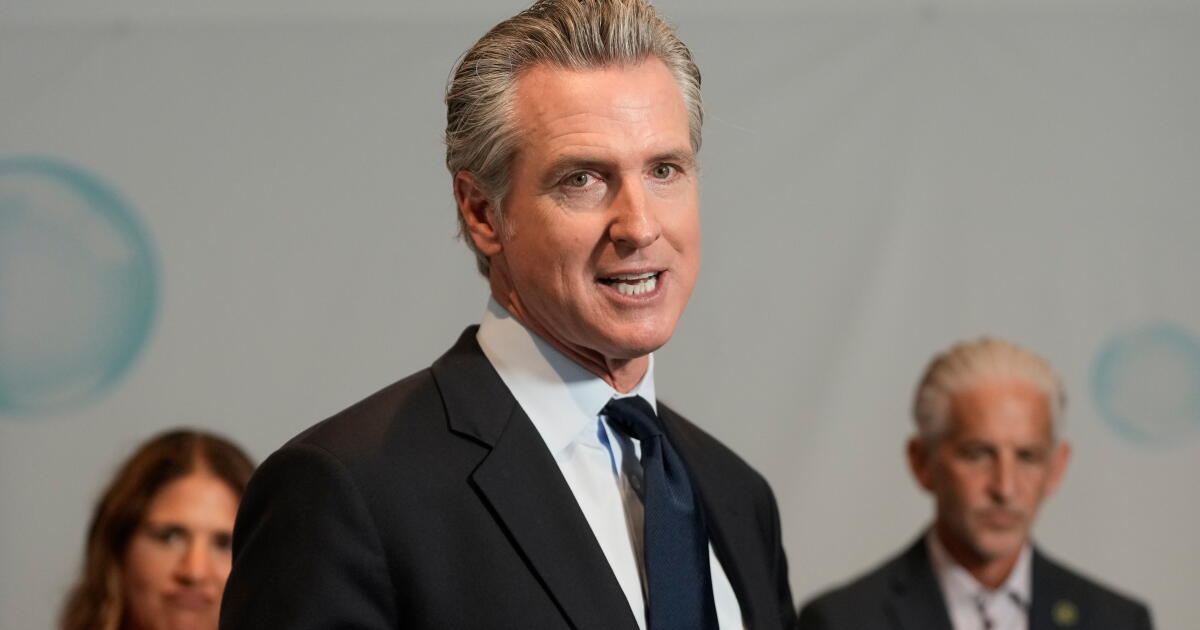
WASHINGTON — Los Angeles Mayor Karen Bass and L.A. County Supervisor Kathryn Barger met privately with President Trump and administration officials Wednesday to press for federal support and yet-unpaid wildfire recovery funding as the region continues to rebuild from the 2025 fires.
“This afternoon we met with President Trump and Administration officials to advocate for families who lost everything,” Bass and Barger said in a statement. “We had a very positive discussion about FEMA and other rebuilding funds as well as the support of the President to continue joining us in pressuring the insurance companies to pay what they owe — and for the big banks to step up to ease the financial pressure on L.A. families.”
Barger said the two leaders had a “high-level discussion” with the president in the Oval Office, sharing stories about what fire survivors are experiencing day to day. She added that “we left details behind with the President,” but did not specify whether Trump made any funding or policy promises during the meeting.
“First and foremost, today’s meeting was to thank the President for his initial support of infusing federal resources to expedite debris removal, as well as his recent tweet about insurance companies, which have already proven fruitful,” she said in a statement provided to The Times.
Bass was similarly reserved about the discussions, telling reporters that “we will follow up with the details,” but signaled progress is being made on federal support.
“I think what’s important is that we certainly got the president’s support in terms of, you know, what is needed, and then the appropriate people were in the room for us to follow up. And that was Russ Vought, who is the head of the Office of Management and budget,” Bass told KNX on Wednesday.
The meeting comes on the heels of a yearlong standoff between California leaders and the Trump administration over wildfire recovery funding, disaster response and whether the federal government should have a say in local rebuilding permitting.
California leaders, led by Gov. Gavin Newsom, have accused the Trump administration of withholding billions in critical wildfire aid, prompting a lawsuit over stalled recovery funds. Officials allege political bias in the delay of billions of dollars from the Federal Emergency Management Agency.
Newsom visited Washington in December. When he made his rounds on Capitol Hill, he met with five lawmakers, including three who serve on the Senate and House appropriations committees, to renew calls for $33.9 billion in federal aid for Los Angeles County fire recovery.
But the governor said he was denied a meeting with FEMA and would not say whether he had attempted to meet with Trump to discuss the issue.
Bass, meanwhile, appears to have found a path to the president on a subject that has been paramount for her community.
The fruitful meeting comes after Trump lobbed insults at the mayor at a news conference earlier this year, where he called her “incompetent” for how she handled last year’s wildfire recovery efforts. He alleged that under Bass’ leadership, the city’s delay in issuing local building permits will take years when it should have taken “two or three days.”
California officials, including Newsom, have urged the Trump administration to send Congress a formal request for the $33.9 billion in recovery aid needed to rebuild homes, schools, utilities and other critical infrastructure destroyed or damaged when the fires tore through neighborhoods more than 15 months ago.
What Bass and Barger’s meeting with the president ultimately produces remains to be seen.
The billions in recovery aid have not yet materialized, but the meeting could potentially give those discussions new momentum.
The White House did not immediately respond to a request seeking comment about the meeting.
Earlier this month, Trump criticized insurance provider State Farm on Truth Social for its handling of the devastating Los Angeles County wildfires. He accused the insurance giant of abandoning its policyholders when tragedy struck.
“It was brought to my attention that the Insurance Companies, in particular, State Farm, have been absolutely horrible to people that have been paying them large Premiums for years, only to find that when tragedy struck, these horrendous Companies were not there to help!” Trump wrote.
But the rebuke didn’t come out of the blue. It stemmed from a controversial February visit to Los Angeles by Trump administration officials.
Trump tapped Environmental Protection Agency Administrator Lee Zeldin in an effort to strip California state and local governments of their authority to permit the rebuilding of homes destroyed in the Eaton and Palisades fires.
Within the week, Zeldin was in Los Angeles, bashing Newsom and Los Angeles officials at a roundtable with fire victims and reporters, saying that residents were suffering from “bureaucratic, red tape delays and incompetency” and that leadership was “denying them … the ability to rebuild their lives”.
After these meetings, Trump directed Zeldin to investigate the insurers’ responses. State Farm, facing roughly $7 billion in fire-related claims, is also under formal investigation by California’s insurance commissioner over its handling of the crisis.
Despite tensions with the administration, Bass and Barger appeared confident that progress was being made on the insurance and funding issues.
“Our job is to fight for our communities,” their joint statement concluded. “When it comes to this recovery, our federal partners are essential, and we are grateful for the support of the President.”
SACRAMENTO — Before it all came crashing down, Eric Swalwell appeared on the cusp of rising to the top of the Democratic field in the California governor’s race.
Swalwell had just announced a statewide tour and aired his first ad. The former prosecutor and Dublin city councilman launched his campaign on “Jimmy Kimmel Live!” in November, a comfortable setting for a politician who’d built a national reputation by appearing on cable news shows to attack President Trump.
Influential forces in Sacramento had begun coalescing behind the then-Bay Area congressman, including some consultants and advisors close to Gov. Gavin Newsom. Newsom hasn’t endorsed, but his associates’ involvement lent credibility to Swalwell.
Swalwell’s campaign quickly collapsed with the explosive allegations that he sexually assaulted a former staffer and had acted inappropriately with other women who were just beginning political careers. Swalwell denies the allegations but dropped out of the race for governor and resigned his seat in the House.
The whiplash over Swalwell’s rapid rise and fall has Democratic leaders facing questions about whether they had a blind spot about his alleged behavior.
His onetime allies in Congress are being asked whether they knew about his conduct, which has been described as an open secret on Capitol Hill. Unions who backed Swalwell have fled, and political consultants are returning donations.
Lorena Gonzalez, president of the California Federation of Labor Unions, speaks to Kaiser Permanente nurses and healthcare workers at the Kaiser Permanente Zion Medical Center in San Diego on Jan. 26.
(K.C. Alfred / San Diego Union-Tribune via Getty Images)
California Federation of Labor Unions President Lorena Gonzalez, whose group endorsed Swalwell and three others in the race, said she confronted Swalwell more than a month ago after hearing rumors about womanizing and illicit photos.
“He’s a liar,” Gonzalez said. “He’s just a very skillful politician who did not tell the truth even when asked directly.”
Though he was little known in much of California, Swalwell, 45, was a youthful and fresh face in a field of candidates, many of them veteran politicians, when he entered the contest.
A little more than a week ago, his campaign was on an upward trajectory. His first statewide ad emphasized his hometown roots and concerns faced by Californians, including rising costs at his favorite doughnut shop in his hometown of Dublin. He rolled out new endorsements from state and federal elected officials almost daily.
Former and current advisors close to Newsom were also helping Swalwell’s campaign, multiple sources told The Times. Others associated with the governor are also helping rival candidates.
“He’s a liar. He’s just a very skillful politician who did not tell the truth, even when asked directly.”
— California Labor Federation president Lorena Gonzalez
Other Democrats in the race said the warnings about Swalwell should have been investigated more thoroughly by the powerful California politicians and interest groups that backed him.
Antonio Villaraigosa, the former mayor of Los Angeles, called him a “flash in the pan” — someone who lacked substance.
“People thought just because he was popular on TV that maybe he had been vetted,” Villaraigosa said. “He had not been vetted.”
Gubernatorial candidates Katie Porter and Antonio Villaraigosa share a moment while participating in a candidate forum in Los Angeles on Jan. 10.
(Christina House / Los Angeles Times)
Swalwell’s entrance into the race last fall came at a time when elected officials and leaders of powerful interest groups in Sacramento were unimpressed by the field, particularly after big-name Democrats including former Vice President Kamala Harris, Sen. Alex Padilla and state Atty. Gen. Rob Bonta had passed on running.
Steven Maviglio, a Sacramento-based Democratic consultant, said there was pressure to find the “perfect candidate” for the state’s most powerful office.
“Democrats are looking for a fighter against Trump, and he fit the bill,” Maviglio said. “That was enough for most people.”
As with most members of California’s congressional delegation, Swalwell was an unfamiliar figure to many Californians living outside his Alameda County district, even though he had a lighthearted, robust presence on social media.
He’d never held statewide office when he was elected to Congress after a career that included serving on the Dublin City Council and working as a criminal prosecutor for Alameda County.
But he appeared to be close to former House Speaker Nancy Pelosi (D-San Francisco), who selected him to be an impeachment manager for the case against President Trump in 2021.
Former House Speaker Nancy Pelosi (D-Calif.) addresses the crowd at the California Democratic Party State Convention in San Francisco on Feb. 21, 2026.
(Christina House/Los Angeles Times)
At a forum in Washington this week, Rep. Pelosi rejected suggestions that Democrats looked past the accusations.
“None whatsoever,” she said, when asked what allegations she’d heard about.
Sen. Adam Schiff (D-Calif.), who previously worked alongside Swalwell on the House Judiciary Committee and endorsed him, said on MS NOW that he felt betrayed and “sickened” by the allegations.
“My paramount feeling is that I’m grateful these women came forward,” Schiff said. “I’m grateful that they did so when they did — it prevented our state from making a potentially terrible mistake.”
Sara Azari, an attorney for Swalwell, said in a statement that he denies all of the allegations of sexual misconduct and assault and will pursue “every legal remedy” against those making the claims.
“These accusations are false, fabricated and deeply offensive — a calculated and transparent political hit job designed to destroy the reputation of a man who has spent twenty years in public service,” Azari said.
Attorney Lisa Bloom reaches toward a photo at a news conference where Lonna Drewes, left, is seen with former Rep. Eric Swalwell, at a news briefing in Beverly Hills on Tuesday. Drewes detailed a 2018 encounter in which she claimed Swalwell drugged and sexually assaulted her after offering professional mentorship.
(Myung J Chun/Los Angeles Times)
On Tuesday, Lonna Drewes accused Swalwell of drugging and raping her in 2018 while she worked as a model, an allegation now being investigated by the Los Angeles County Sheriff’s Department.
Azari, in an interview on NewsNation, said of Drewes’ allegation: “Two adults consenting, which is our position is, is not against the law.”
California Democratic Party Chairman Rusty Hicks declined to answer questions this week about whether the scandal hurts the party’s credibility, saying only that the allegations are “clear for voters: [Swalwell] is not a suitable choice.”
In an interview with The Times, Hicks said the party relies on delegates to vet candidates before endorsement votes at the party convention. While no gubernatorial candidate reached the necessary level of support to earn the endorsement at the February gathering,Swalwell had the largest share with 24%.
Gonzalez, of the labor federation, said she called Swalwell in the first week of March after being contacted by several people about his sexually inappropriate behavior.
She described the awkward conversation — and his immediate denials. None of it was true, he said. If there was anything sordid to find in his past, it would have been dug up by Trump and conservatives who went after him when he was helping to try and impeach the president, he said.
At the union group’s endorsement meeting, members grilled Swalwell about several issues, including his claimed residency in Livermore, his involvement with a nonunion film production, and his ability to manage his own finances.
The issue of inappropriate sexual behavior never came up at the endorsement, Gonzalez said.
“We were in a position, like so many, of trying to figure out who this guy was with all these red flags, but being told by a lot of surrogates that they were his choice — whether it’s people in Congress or folks who knew him from home,” Gonzalez said.
Other institutional players also threw in their support. The California Medical Assn. endorsed Swalwell early in February. The group represents more than 50,000 physicians in the state and spends heavily in elections.
“It definitely was a nod that that’s where the establishment should head,” Maviglio said.
California Medical Assn. spokesperson Erin Mellon said the group met with candidates and backed Swalwell “based on the information available to us” at the time.
Behind the scenes, Swalwell was courting attention. He began hanging out at the Grange, a favorite hotel bar in Sacramento for state lawmakers and lobbyists, trying to make connections, according to a source who ran into him there.
Months earlier, he sent a text to a California political consultant with questions about who should help his campaign. He asked about the well-known firm of Bearstar Strategies, according to the text exchange, which was viewed by The Times.
Swalwell texted, “would you recommend having our IE go to them?” to the consultant, a reference to an “independent expenditure,” which is an outside committee that raises money in support of candidates but is barred from coordinating with their campaigns.
Bearstar Strategies ultimately launched an independent committee to support Swalwell, which in recent weeks raised more than $7 million from political action committees for the California Medical Assn., DaVita and other medical industry groups, as well as Uber.
Antonio Villaraigosa, left, shakes hands with Tom Steyer during a gubernatorial candidate forum in Sacramento on April 14, 2026.
(Godofredo A. Vásquez / Associated Press)
Bearstar Strategies, whose members have long advised Newsom, also provides media consultants for a committee running attack advertisements against environmentalist Tom Steyer, another candidate in the race. Swalwell would have benefited from the committee’s spending.
Jim DeBoo, a consultant and Newsom’s former chief of staff, is helping on the anti-Steyer committee, according to multiple sources, which has raised $14 million from real estate agents’ and utility industry groups. DeBoo didn’t respond to a request for comment, and a representative for Bearstar declined a request for an interview.
No one has claimed that any of those consultants or individuals knew about Swalwell’s alleged behavior. Bearstar Strategies said in a statement last week that it had suspended all activity on Swalwell’s independent expenditure.
Jamie Court, president of the nonprofit Consumer Watchdog, said institutional groups backed Swalwell because they thought he could win and they wanted to maintain the status quo in Sacramento.
SACRAMENTO — Gov. Gavin Newsom has dismissed questions about the race to succeed him in California for much of the last year.
“You know my position,” he said to reporters last month. “I don’t talk about this governor’s race.”
But as his party runs the risk of losing the most powerful office in the state, Newsom recognizes that he may need to step in and endorse one of the Democratic candidates whether he wants to or not.
California Democrats have put themselves in an unnecessary pickle in the 2026 gubernatorial election: Too many candidates, with few policy distinctions between them, are running to replace Newsom. Opinion polls show no clear favorite and Democrats largely splitting votes.
The tepid support raises the possibility that two Republicans in the race could place first and second in the June primary and advance to the general election. By their own strategic blunder, Democrats could be knocked out of the contest in a state where they outnumber Republicans nearly 2 to 1.
It’s a disaster everyone saw coming and no Democrat, except perhaps Newsom, has the power to stop, said Thad Kousser, a professor of political science at UC San Diego.
“Gavin Newsom’s megaphone is loud enough to echo across this race, leading other prominent members of the party to endorse whomever he chooses and vaulting someone, finally, out of the crowded pack,” Kousser said. “This could be the last remaining chance for the party to avoid splitting its vote in June and being locked out of November.”
Endorsing a successor before the primary carries inherent risk and perhaps more so for Newsom, who is positioning himself as a potential leading candidate in the 2028 presidential contest. Publicly backing a candidate for governor ties Newsom to the outcome of the race and the candidate.
“If it doesn’t work, his endorsement would broadcast his political vulnerabilities and attach him to his party’s weakness just at the time when he needs to project his personal strength,” Kousser said. “But if his intervention rescues the party and elevates his chosen successor into being an overwhelming favorite in the general, it would further elevate his national profile while winning him a close friend in Sacramento.”
Newsom is taking a wait-and-see approach for now, tracking polls to determine whether his intervention is necessary.
President Trump’s decision to endorse conservative commentator Steve Hilton over the weekend could relieve some pressure on Newsom to weigh in.
If Trump’s support causes support for Hilton to rise and Bianco to drop, it’s more likely that one Democrat and one Republican will place in the top two in the primary.
Trump’s endorsement left Kousser and other California political observers scratching their heads. If a candidate from each party advances to November, the Democrat is expected to easily win the race because of the voter registration advantage.
But the governor publicly celebrated a California Supreme Court ruling this week that Bianco halt the investigation.
“This rogue sheriff chased conspiracy theories, tried to undermine our elections, and got the ruling he deserved,” Newsom posted on X, the social media platform owned by Elon Musk. “Trump and MAGA’s election denialism is a cancer, a danger to our democracy, and it must be stopped.”
Rob Stutzman, a Republican political consultant in California, compared Newsom’s posts about Bianco to “trying to return a gift.” The Democratic governor’s attack could boost Bianco’s profile and support among Newsom-hating voters.
“Trump has probably bailed the Democrats out of their dilemma by elevating Hilton and for Newsom’s response to be to elevate and draw attention to Bianco, just doesn’t make any sense, and it’s everything Bianco wanted out of this whole ballot seizure gambit to start with,” Stutzman said.
Newsom’s reluctance to endorse a Democrat in the race is, in part, a reflection of his feelings about leaving a position he’s held for eight years and a recognition of his own “sell-by date” in the post. His answers to questions about the contest vary from declining to comment to pointing out that voters don’t appear interested in the race, either.
The focus on national politics, attention Trump draws “24 hours a day” and earlier speculation over whether former Vice President Kamala Harris or U.S. Sen. Alex Padilla would run for governor distracted from the candidates in the field, he said.
“But when I’m out in the community, people aren’t talking to me about it, which is interesting this late, just weeks and weeks before early voting,” Newsom said in March. “And so, as a consequence, I’m not directly as engaged as perhaps I might need to be.”
His comments suggesting that he isn’t paying attention to the race haven’t sat well with some of the candidates. Some Democrats, including San Jose Mayor Matt Mahan, were already running against Newsom’s record.
For Newsom, inaction is more risky than picking a losing candidate, Kousser said. Though California’s top-two system and poor leadership from the state party would mostly be to blame if Democrats lose, giving control of California to the GOP would bolster criticism of Newsom’s leadership.
“A Republican victory in the state Newsom leads would be read, on the national stage, as a rejection of his legacy,” Kousser said.
RANCHO MIRAGE, Calif. — As Republicans vie for their best shot to win the California governor’s office in two decades, the fight between the most prominent candidates to win over the party of President Trump has switched from subdued to vicious.
Conservative commentator Steve Hilton, at their first one-on-one debate in Rancho Mirage earlier this month, accused rival Riverside County Sheriff Chad Bianco of coddling illegal immigrants and called him “wishy-washy.” The law enforcement chief called Hilton, a British immigrant, a “fraud” and heartless for denying others the same pathway to U.S. citizenship he received.
“What an outrageous and offensive insult that Chad just made to every legal immigrant in this state and in this country,” Hilton fumed.
The heated exchange took place days before the California Republican Party weighs making an endorsement in the 2026 race for California governor. Hundreds of party delegates will gather in San Diego this weekend to decide, though it’s unclear if either candidate will be able to win the 60% vote threshold to receive the official party nod.
Most polls have shown the two Republicans as the top candidates in the race, despite registered Democratic voters outnumbering Republicans nearly 2-to-1 in California.
Bianco and Hilton are competing against eight heavyweight Democrats who are splintering their party’s votes in the election to replace termed-out Gov. Gavin Newsom. Under California’s unique primary system, the two candidates who receive the most votes in the primary will move on to the November general election, regardless of party affiliation.
The prospect has alarmed state Democratic leaders, who unsuccessfully urged struggling candidates todrop out to avoid their party being shut out of the November election.
Still, a lot can happen before the June 2 primary to stir up the race. President Trump endorsed Hilton late Sunday, which could significantly influence the state’s GOP voters. More than 6 million Californians voted for Trump in the 2024 presidential election, though he was trounced by Vice President Kamala Harris, one of the state’s top Democrats.
Riverside County Sheriff Chad Bianco, a Republican candidate for governor, and Kate Monroe, chief executive of VETCOMM, talk with a woman lying on the sidewalk on Skid Row in Los Angeles in January.
(Jason Armond / Los Angeles Times)
On the campaign trail, Bianco and Hilton have frequently raised the prospect of a Republican being elected governor as the result of failed Democratic rule of the nation’s most populous state and the world’s fourth-largest economy.
“For the first time in probably our lifetimes, really since Ronald Reagan … every legitimate poll has either shown me or Steve Hilton at the top two Republicans at the top of [every] statewide poll,” for the last six months, Bianco recently told about 100 attendees at a Valley Unity Republican Women luncheon at the Woodland Hills County Club overlooking verdant fairways.
Hilton, who has participated in more gubernatorial forums and debates than Bianco, said polling that shows him besting Democratic rivals proves that Californians are fed up with 15 years of one-party rule.
“I tell you right now, there is not a single one of them who represents to the slightest degree the change we need in California,” he told a few hundred people at Big Bear’s Calvary Chapel. “We are going to do it this year.”
From afar, Bianco appears to be out of central casting for a GOP candidate for governor: an armed lawman, with a salt-and-pepper mustache and close-cropped hair who has dedicated his life to protecting the vulnerable and locking up criminals.
Bianco, echoing independent pollsters as well as political strategists in both parties, said having “Riverside County Sheriff” next to his name on the official state ballot will be a major boon to his campaign.
“I will tell you this, if we took the names and the party off of the ballot and simply went up with resume — we made you all read a resume of who you’re going to put as your next governor — I would win this election 100% to nothing,” Bianco told the GOP women’s group.
Republican gubernatorial candidate Steve Hilton greets a member of the Big Bear Valley Republican Assembly before speaking at a town hall at Calvary Chapel in Big Bear in March.
(Gina Ferazzi / Los Angeles Times)
But Bianco’s badge hasn’t shielded him from Hilton’s blistering attacks about the sheriff’s past statements about immigration, pandemic mask mandates and Black Lives Matter protests — which is disqualifying for some GOP voters.
Bianco opposes “sanctuary city” laws, calls for the deportation of criminal illegal immigrants and says the border must be secured. But he has also supported a pathway to citizenship for lawful, working undocumented people and told his constituents that his deputies were not taking part in ICE raids.
In the early days of the COVID-19 pandemic, Bianco ordered county residents to wear masks or face punishment, though he later pushed back at Newsom’s stay-at-home orders.
That same year, he and his deputies were photographed kneeling and speaking with protesters in the aftermath of the killing of George Floyd, an action he has since recast as praying.
Bianco’s wife, Denise, on Thursday accused Hilton of endangering her husband by sending mailers to voters that featured Bianco’s face surrounded by circles that she described as a “bullseye target.”
“We have all watched way too much political violence directed at law enforcement officers in recent years. I never imagined it would come from a political candidate directed at my husband,” she said in an Instagram post. “Steve, why on God’s earth would you think it’s acceptable to put my husband’s face, a dedicated sheriff, on a shooting target?”
Election security has also highlighted differences in the candidates’ views.
Hilton and Bianco echoed Trump’s call to make GOP voter turnout “too big to rig.” But their statements about alleged malfeasance differed.
Hilton decried “total corruption in the voting system in California.”
“I’ve said for the longest possible time that I don’t understand why we can’t do things the way that most places do it, which is vote on one day, count on one day, get the results on one day,” he said.
Asked by a voter about electoral fraud in California in March, Bianco replied that he was confident that law enforcement in California ensures that such fraud is “not happening here,” while agreeing that such “cheating” occurred in states such as Ohio and Pennsylvania in the 2020 election.
But the same month, he seized more than 650,000 ballots from the November election as part of an investigation to determine if they were fraudulently counted.
California voters have not elected a Republican as governor since Arnold Schwarzenegger won reelection in 2006. Two Republicans on the ballot in the June 2 primary election hope to change that.
(Justin Sullivan / Getty Images)
Hilton has sought to capitalize on these positions, labeling Bianco the “shifty sheriff,” an attack that resonates with some voters.
“The man lies. The man is not honest about taking a knee to BLM, which is unacceptable,” said Agnes Gibboney, 71, of Rancho Cucamonga. “And coming up with three, four different excuses is unacceptable. And then to get mad at the voters for asking the question.”
Bianco has labeled Hilton as a shape-shifting opportunist, pointing to him championing a climate change agenda while advising British Prime Minister David Cameron and expressing support for views expressed by Sen. Bernie Sanders (I-Vt.) in the 2016 presidential election, and posting a picture of Hilton hugging Newsom on social media.
“Steve is a fraud. He’s a liar, and I’m not going to sit by and just let him do it anymore,” Bianco said after the Rancho Mirage debate. “When he starts attacking me, he starts attacking my deputies, my profession, I’m not gonna let it happen anymore.”
“He remade himself just for this governor election, and everyone is starting to see through it,” Bianco said.
The son of Hungarians who emigrated to Britain, Hilton served as an advisor to Cameron before becoming an American citizen. At campaign events, supporters have gifted Hilton with a Kézimunka, a traditional Hungarian embroidered cloth, which was stitched with a heart, as well as stars-and-stripes bathing trunks.
“My parents are Hungarian refugees from communism,” Hilton said. “I am fighting to make sure that this state that I love does not turn into the country that I left …. I have renounced my U.K. citizenship. I’m all in for California and America.”
Of the two candidates, Hilton has been more publicly visible, and benefits from GOP voters seeing him speak on Fox News for several years.
Both men argue one-party Democratic rule of California has destroyed a state once viewed as the epitome of the American dream.
Hilton describes state leaders as “far-left lunatics.” They’ve ruined the most amazing, the most beautiful place on earth,” and tweaked a popular Texas slight about someone being all hat and no cattle to describe Newsom.
“He’s all hair, nothing there. Don’t you think it’s time in California we have a governor with less hair?” said Hilton, who sports a smooth crown.
Bianco calls the state’s Democratic leaders “far-left psychopaths” who have enacted policies, taxes and fees that are forcing Californians to flee the state.
“We all know government has completely failed and we’re ready to take our state back,” he said, later adding, “They don’t want our lives better. I do …. No one leaves California because they want to. It’s government agenda and policy that is harming California and making it bad.”
Most of the candidates’ pledges, such as tackling unaffordability, reducing gas prices, increasing capacity in state prisons, protecting gun owners’ rights and keeping trans athletes out of girls’ locker rooms, are nearly identical.
They both promise to slash California’s vehicle registration fees, a proposal that echoes former Republican Gov. Arnold Schwarzenegger’s pledge to repeal the car tax during the 2003 recall election that was immortalized by his campaign dropping a wrecking ball on an Oldsmobile in Costa Mesa.
Schwarzenegger was elected governor soon after.
No candidate in either party can match Schwarzenegger’s global appeal, or voters’ familiarity with the state’s most recent Democratic governors — including Jerry Brown, the scion of a storied political family — or Newsom’s charisma, added GOP strategist Rob Stutzman, a former Schwarzenegger advisor who is not aligned with any candidate in the 2026 race.
“Voters are finding this to be an uninspiring list of candidates. And in fact, the impressive list would be those that chose not to run, right?” he said, referring to Harris, Sen. Alex Padilla and Atty. Gen. Rob Bonta. “So it’s not a surprise that there isn’t much interest.”
Though Hilton and Bianco were previously cordial in person, such as when they crossed paths at September’s state GOP convention, their public criticism of each other has ratcheted up in recent weeks, which could sway the many undecided GOP voters in the race.
“My main contention is looking to see whether or not they’re gonna follow the will of the Lord. So I’m paying attention to what they say and what they do,” said retired Air Force IT specialist David Solomon, 42, after seeing Hilton speak in Big Bear. “It really just comes down to who’s gonna be able to enact their plan.”
Jane Price, a 77-year-old Sherman Oaks resident, said she worried that Republicans failing to unite behind a candidate would give Democrats an edge in the governor’s race.
“We don’t want to split, right? That’s a problem,” the charter member of the woman’s GOP group said after seeing Bianco speak. “The state of California is at stake. We were thriving here in California. But now, it has been nothing but a downhill slide. We need people who appreciate what California is all about.”
If conservative commentator Steve Hilton is elected California’s next governor, as President Trump wants, it would mark a “political revolution” for the liberal state, the candidate said.
The state’s Democrat-controlled Legislature, “after all their years of lecturing us about democracy,” would be forced to work with him “to enact the changes that Californians just voted for,” and he would be willing to work with them too, the Silicon Valley entrepreneur and former Fox News host said.
“You want to know how I’m gonna work with a Democrat Legislature? I’m not. I’m gonna get every single one of them unelected,” Bianco said. “Every single day, I’m gonna stand on the steps of the Capitol, and I’m gonna tell the California voting public about the idiots in Sacramento that are ruining their lives.”
For the first time in years, the state GOP is riding into its convention this weekend on a wave of optimism about the upcoming gubernatorial race.
According to recent polling, Hilton and Bianco both stand a chance of winning more votes in the June 2 primary than any of the many Democratic candidates, who have spread thin their party’s nearly 2-1 advantage in voter rolls. If the GOP candidates do that, they would advance to a head-to-head contest in November’s general election, and one would become the state’s first Republican governor since Arnold Schwarzenegger.
Much could change to prevent that scenario. More Democrats could drop out. Voters could coalesce around one or two of those left. Hilton, with Trump’s endorsement, could consolidate Republican support and push Bianco out of contention.
Still, the prospect of a Republican governing California, a stronghold of the anti-MAGA movement, has captivated political experts and spectators alike.
Gov. Gavin Newsom imposed a moratorium on the death penalty shortly after taking office, a policy the next governor could reverse. At San Quentin, an inmate is moved from his cell on death row.
(Robert Gauthier / Los Angeles Times)
Trump, in his recent endorsement, said he has “known and respected” Hilton for many years and would help him “turn it around” in California after an “absolutely horrendous job” by Gov. Gavin Newsom and other state Democrats.
“With Federal help, and a Great Governor, like Steve Hilton, California can be better than ever before!” Trump wrote.
Many Democrats predict the opposite: grandstanding and gridlock as either Hilton or Bianco’s MAGA-aligned agenda meets stiff resistance from powerful state Democrats repulsed by the president’s movement.
“If the new governor decided to go hard MAGA, they would face enormous pushback,” said state Sen. Ben Allen (D-Santa Monica), who considers it unlikely for both Republicans to advance.
“I don’t think there’s any question that the state would descend into chaos,” said Phil Angelides, a Democrat and former state treasurer who lost to Schwarzenegger in the 2006 gubernatorial race.
The limits of power
California governors hold substantial power.
They direct and appoint leaders to the state’s many executive agencies, boards and commissions, which oversee vast portfolios in vital areas, such as the environment, California’s university systems and the state parole board. They craft the state budget and have a line-item veto to eliminate legislative appropriations. They can make major unilateral decisions — such as welcoming federal troops into California cities — and command a bully pulpit to drive public opinion and policy, including through statewide ballot measures.
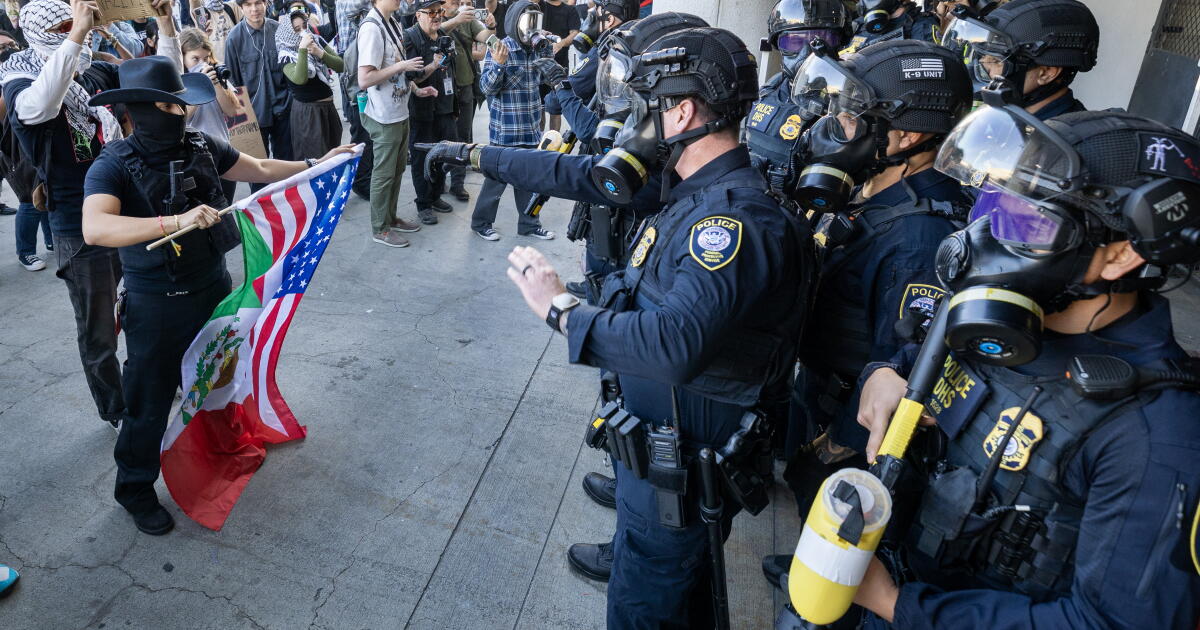
Demonstrators confront California National Guard troops and police outside a federal building during protests in Los Angeles in 2025 after the Trump administration sent in the National Guard. The Republican candidates for California governor said they would welcome similar orders by the Trump administration.
(David McNew / Getty Images)
California’s next governor would have the power to end Newsom’s moratorium on the death penalty, appoint state judges and grant state pardons. During emergencies the governor would be able to reshape state regulations, suspend laws and redirect funding, as Newsom did during the COVID-19 pandemic by banning price gouging, halting evictions and postponing the 2020 tax deadline.
But their power also has limits.
Many of the governor’s appointees are subject to state Senate confirmation. The Legislature can change and amend the governor’s proposed budget and pass a budget bill distinctly different from his proposal. Democrats, with their supermajority, can also override the governor’s vetoes.
The independently elected state attorney general can sue to defend state laws, regulations and residents, a power current officeholder Rob Bonta, a Democrat, has exercised more than 60 times to challenge the Trump administration. The California Supreme Court, which leans liberal, can rein in the executive branch if it determines it has violated the state Constitution or other statutes.
Trump has repeatedly pushed the limits of executive authority and benefited from having a Republican-controlled Congress and a conservative U.S. Supreme Court majority that holds an expansive view of executive power. Hilton or Bianco would face the opposite in California, where many legislators would refuse to acquiesce to a Republican governor, especially one almost certain to face a swift recall, political experts said.
Hilton or Bianco could “potentially build alliances” with Democrats on issues such as housing and affordability and drive change that way, said Kim Nalder, a political science professor and director of the Project for an Informed Electorate at Sacramento State. But “if the Democratic majority in the Legislature decides to dig in its heels, then they could oppose practically everything [the new governor] would do.”
Nalder said Hilton or Bianco could also “try to rule in a Trumpian way” by testing the boundaries of their authority. She expects Bianco would do so given his recent decision to “violate the norms of democracy” by seizing more than half a million 2025 ballots as part of an unusual local sheriff’s investigation into allegations of voter fraud that state and county officials say have no merit.
But he “wouldn’t have the public support or the hold on the other branches of government that Trump has,” she said, “so it would be much more difficult.”
Angelides said electing either Hilton or Bianco would put someone “deeply associated with the MAGA movement” atop a deeply blue state government in which many career employees hold opposing views, which would cause a cascade of disruptions.
“There’s no reason to believe it will be different than the chaos we’ve seen in the Trump administration: an evisceration of a number of state agencies, as well as the departure of a lot of talented people who will not stay and would not jeopardize their careers, their reputations, to work under a governor from the MAGA movement,” Angelides said.
State employees are protected by powerful unions with deep ties to Democratic leaders, which Hilton said he would sever.
A Bonta spokesperson said in a written statement that the attorney general “works in service of the people of California — not the Governor,” and would not hesitate to exercise his independent authority under the state Constitution.
“We hope to maintain a close working relationship with whomever California’s next Governor is, but our mission and our priorities will not change,” the spokesperson said. “Regardless of who is in that office, we will continue to enforce civil rights laws, investigate and prosecute complex crimes, protect public safety, stand up for consumers and the environment, and fulfill our duty to Californians.”
Senate President Pro Tempore Monique Limón (D-Goleta) also offered a diplomatic response, saying in a statement that “it is critical that whoever our next Governor may be helps advance the lives and goals of California and its communities.”
In their own words
Hilton and Bianco both said they would radically reshape state government, in part by dismantling regulations that are hampering development and making basic necessities — housing, food, gas, electricity — too expensive.
Hilton, a top advisor in British Prime Minister David Cameron’s coalition government more than a decade ago, would install agency leaders who would be hyper-focused on slashing costly regulations in order to “reduce the burden of cost and hassle on California families and businesses,” he said. “Elections have consequences, and so it would be irresponsible not to use maximum aggression to make the changes as quickly as possible.”
The top two Republican candidates running for California governor said they would have a much better relationship with President Trump than Democratic Gov. Gavin Newsom, who challenged the president’s policies in court and mocked him on social media.
(Mark Schiefelbein / Associated Press)
Bianco said “every single regulation in this state is leaving” if he wins, with California becoming far more business friendly. “The environmental activism, the environmental activism terrorists who are controlling state government, are going to be put in their place, which is outside where nobody hears from them.”
Both Hilton and Bianco also sharply criticized California Democrats for challenging Trump at every turn, a practice they would end.
“I would be wanting to work with the administration to help Californians,” Hilton said.
“Why would you ever push back on a president unless they were seriously trying to destroy your state?” Bianco said. “California is failing because of its own policies.”
Hilton said he expects Bonta to lose to his Republican running mate for attorney general, Michael Gates. Bianco said that if Bonta remains in office, he would completely “defund” the state Justice Department.
Hilton and Bianco also shared similar thoughts on Trump’s immigration crackdown and deployment of the National Guard to Minneapolis and Los Angeles, the latter without Newsom’s approval.
Hilton said that he “certainly would never want to see, in California, the scenes that we saw in Minneapolis, nor would I want to see repeated the scenes that we saw in our state last summer,” but that those clashes were “provoked and instigated by Democrat sanctuary policy,” which he would end.
California’s sanctuary policies largely bar local police and corrections officials from conducting or assisting federal authorities in immigration enforcement, which state leaders say is not their responsibility and could undermine community trust in local police.
Bianco said that Trump sent in troops because Newsom “was derelict in his duties to protect the people of California,” and that it is more important to address “failed Democrat policies for the last 20 years.”
“President Trump has done not one single thing to harm California in the last year,” he said.
Matt Lesenyie, an assistant professor of political science at Cal State Long Beach, said that if Hilton or Bianco becomes governor, Sacramento will see “a lot of gridlock and grandstanding, and that’s from both parties.”
But he also said he does not expect that to happen, because undecided voters are going to “figure it out” and coalesce behind a Democrat — even if at the last moment.
“That last slice of the electorate,” he said, “doesn’t wake up until the last two weeks.”
Times staff writer Katie King contributed to this report.
That’s for sure. It’s reminiscent of the panic that followed Joe Biden’s wretched debate performance in Atlanta, the biggest disaster to hit the city since a 2009 flood caused more than half a billion dollars in damage.
In California, the high anxiety is a result of the state’s “jungle” primary, in which all candidates appear on the same ballot, regardless of party, with the top two finishers advancing to a November runoff. With so many Democrats running, there’s the genuine prospect of them splintering partisan support, resulting in the leading GOP candidates — Chad Bianco and Steve Hilton — grabbing both slots and moving past June 2.
How likely is that to happen?
I can’t say. And Nostradamus is away on spring break.
But one of California’s leading political savants, Paul Mitchell, has developed a helpful online tool to suss out the possibilities. Visitors to his site have run tens of thousands of simulations, which right now put the odds of a Democratic freeze-out at about 17% to 20%.
Which suggests it’s unlikely. But it’s also not impossible.
Why don’t some Democrats step aside, for the good of the party?
That’s easy for you to say.
Anyone putting themselves out there by seeking public office has to have a certain amount of faith, in both their capabilities and the prospect of good fortune smiling upon them. (Luck being a greatly undervalued factor in political success.)
To be clear, no one is running away with the gubernatorial contest. For all the talk of Republicans “leading” in the polls, it’s more like a four- or five-way tie for first place, when you factor in the margin of error. And 20% support — which is roughly what the top candidate receives in surveys — is hardly a number to strike fear in the heart of rivals.
Several of the candidates mired near the bottom of polls — Antonio Villaraigosa, Xavier Becerra,Betty Yee — are probably looking at the end of the line if they lose this race. So you can understand, if not necessarily agree with, their reluctance to drop out and call it a day, in the hope that, just maybe, that proverbial bolt of lightning will strike.
So why doesn’t someone force some candidates to drop out?
Like who? There is no Tammany Hall. This isn’t Chicago under Boss Daley. Modern-day California has never had that kind of all-powerful political machine.
The closest approximations were in San Francisco, where brothers Phil and John Burton held great sway, and Los Angeles, where another pair of siblings, Howard and Michael Berman, exercised enormous clout with their compatriot, Henry Waxman. But their influence was mainly limited to Congress, the Legislature and local politics. They weren’t kingmakers when it came to electing California governors.
And the two major political parties, which never wielded the power they enjoy in other states, have become even less influential in this entrepreneurial age of politics, when candidates raise their money online and boost their profile by going on the political chat shows on TV.
The governor could certainly try to pare the Democratic field. But he’d risk humiliating himself and hurting his presidential prospects in the process.
How so?
It would be embarrassing if Republicans were to seize the governorship on Newsom’s watch. (At least among those political insiders who pay attention to that kind of stuff.) It would also be embarrassing if the governor tried to muscle candidates aside and failed.
It’s not at all clear Newsom would have much clout. He isn’t particularly close to any of the candidates running. No one needed his blessing to enter the race, or his backing to sustain their candidacy. And there isn’t very much the term-limited governor, playing out his final months in office, can offer as incentive to quit.
Newsom also has to consider how it would look if he tried to ease out the laggards — whose ranks happen to include all the prominent candidates of color: Becerra, Villaraigosa, Yee and state Supt. of Public Instruction Tony Thurmond.
“Trump’s endorsement would be huge,” said Jon Fleischman, a conservative strategist and former executive director of the state GOP.
“Actually,” he went on, ‘I think it would be determinative” — virtually guaranteeing either Hilton or Bianco finished in the top two in the June 2 primary, ushering them past the rope line into November’s runoff.
If there’s an inside edge in the Trump Endorsement Sweepstakes, it would seemingly go to Hilton.
He’s familiar to the president as a former Fox News host. He’s interviewed Trump several times and the two occasionally text and talk on the phone. Bianco has no such personal connection, which might explain his ballot-seizing stunt.
Steve Hilton could have the inside track on a Trump endorsement, given their personal relationship.
A Trump endorsement comes in all sorts of flavors.
As The Downballot recently noted, “His bag of tricks includes dual endorsements, triple endorsements, pre-endorsements, Election Day endorsements, yanking endorsements … belated endorsement of a candidate after initially endorsing just one candidate [and] non-endorsements after promising to endorse.”
There was also the time Trump endorsed “ERIC” when Republicans Eric Schmitt and Eric Greitens faced each other in Missouri’s Senate primary. (Schmitt won and is now the state’s junior U.S. senator.)
Trump’s backing still counts a good deal, even as his approval ratings sink to sub-basement levels. The president remains popular with Republicans and, critically, the kind of GOP loyalists who vote in primary contests, which is why both Hilton and Bianco would welcome a presidential laying on of hands.
There’s good reason, however, to think Trump might pass on endorsing in the governor’s race, or opt to deliver one of his dual he-and-him endorsements.
The GOP’s best — and perhaps only — hope of winning the governorship is the Democratic-freeze-out scenario. So, tactically, Trump’s wisest move may be to bless neither Hilton nor Bianco. Or support both. That would avoid elevating one over the other, which could make it easier for a Democrat to finish among the top two and advance past the June primary.
“I think Trump’s people are smart enough to know that there’s a reason why he may not be served by endorsing a candidate,” Fleischman said. “I wouldn’t be surprised if the prevailing wisdom there is we better not endorse anybody, because we don’t want to tilt this one way or the other.”
If Trump were to back Hilton or Bianco, it’s not hard to imagine Democratic interests seizing upon the president’s benediction and putting significant money behind an ad blitz promoting the president’s favorite in hopes of boosting him — and him alone — into the top two.
In 2018, his main rival was fellow Democrat Antonio Villaraigosa. Two major Republicans were also in the race, John Cox and Travis Allen. There was no real concern about those two nabbing both spots in the June primary. Rather, Newsom and Cox had a shared interest in boxing out Villaraigosa.
So the Newsom and Cox campaigns opened a private back-channel, trading gossip, swapping insights on the race and even sharing some empirical data. One poll, showing Cox getting a bigger boost from a Trump endorsement than Allen, passed from Democratic hands in hopes it would reach the White House and nudge the president into supporting Cox.
SACRAMENTO — Californians have never been forced to choose between Gavin Newsom and Kamala Harris, two homegrown political darlings, during any election.
Twenty-eight percent of the California Democrats who were surveyed selected the governor as their top choice in the 2028 presidential election. U.S. Rep. Alexandria Ocasio-Cortez (D-New York) followed with 14% and former U.S. Transportation Secretary Pete Buttigieg received 11%. Harris came in fourth, with only 9% of voters in her own state naming her as their preferred Democratic nominee.
“It’s quite a positive result for Newsom,” said Mark DiCamillo, director of the Berkeley IGS Poll. “He’s separated himself from the rest of the pack, and especially when you compare him to the other major Californian in the considerations, he’s three times as much as Kamala. That’s quite impressive.”
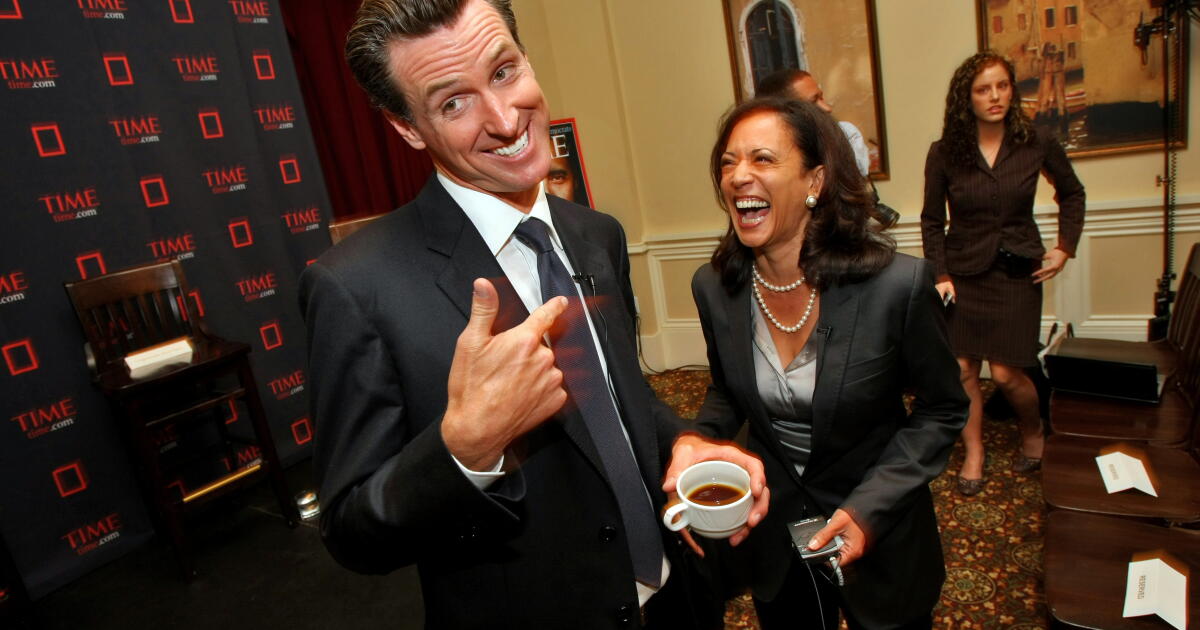
The political careers of the governor and former vice president have orbited each other but never crossed since Newsom was sworn in as San Francisco’s mayor and Harris as the city’s district attorney on the same day in 2004. Now the two Bay Area natives are both flirting with the 2028 presidential contest as they travel the country promoting their life stories on respective book tours.
When Harris jumped into the 2020 and 2024 races for the White House, Newsom said he wouldn’t run against her. He’s discredited the idea that the two politicians have some kind of a sibling rivalry and noted that their trajectories ran adjacent and never collided.
Newsom was asked again last month whether he would vie against Harris in a presidential contest. The governor said he hasn’t “gotten in the way of her ambition ever,” and he doesn’t imagine that he would in the future. His answer changed when he was pressed to respond specifically to the potential for 2028.
“That’s fate. I don’t, I don’t know,” Newsom said to CNN’s Dana Bash, throwing up his hands. “You know, you can only control what you can control.”
Newsom and Harris had greater support from Black and Latino voters than white and Asian American Democrats in the new poll. She performed well among Democrats younger than 30 compared with other age groups, while Newsom fared better with older Democrats. More women selected Newsom as their first or second choice than they did Harris.
Neither California heavyweight performed particularly great among Democratic voters in the Bay Area, which DiCamillo called a curious finding for two politicians from the region. Support was higher for Harris and Newsom in almost every other region of the state.
DiCamillo believes the presence of Ocasio-Cortez on the list probably pulled some support from Harris. California voters in other recent polls were also sour on a third presidential run by Harris.
An Institute of Governmental Studies poll in August gauged interest in the potential candidacy of Newsom and Harris. About 45% of the state’s registered voters said they were enthusiastic about Newsom running, compared with 36% for Harris. Almost two-third of voters in that survey, and half of Democrats, said Harris should not run for president again.
Although Newsom clearly beat the field of candidates in the most recent poll, DiCamillo said receiving support from a little more than a quarter of those surveyed in his own backyard isn’t exactly wonderful. The governor’s approval rating is also down.
The poll found that 48% of California registered voters say they approve of the job Newsom is doing, with the same share disapproving of his performance. That marks a drop from 51% approval the last time DiCamillo asked in August. Disapproval also climbed, by 5 percentage points.
Voters held positive opinions about Newsom’s participation in international conferences, which was described in the poll as the governor “offering an alternative to the policies being promoted by President Trump on issues like climate change and the economy.” The poll found 59% of statewide registered voters approve and 37% disapprove.
“Though Californians may hold mixed views on his gubernatorial tenure, they overwhelmingly see him as the strongest counter to Trump and MAGA candidates,” Mora said. “Harris’s earlier presidential defeat, compounded by persistent voter biases against women and candidates of color, may also be shaping these early numbers.”
The Berkeley IGS/Times poll surveyed 5,019 California registered voters online in English and Spanish from March 9 to 14. The results are estimated to have a margin of error of 2.5 percentage points in either direction in the overall sample, and larger numbers for subgroups.
WASHINGTON — President Trump has once again mocked Gov. Gavin Newsom’s dyslexia as “disqualifying” for leadership, marking at least the fourth time in a week that the president has targeted the California Democrat for being open about his diagnosis.
In remarks Monday in the Oval Office, Trump said Newsom was “dumb” and should never be allowed to be president because he has “admitted that he has learning disabilities, dyslexia.”
“That’s how crazy it’s gotten with a low-IQ person,” Trump said. “Honestly, I’m all for people with learning disabilities but not for my president. … And I know it’s highly controversial to say such a horrible thing.”
But in the course of his needling, Trump mistakenly elevated his political rival to the rank of commander in chief — repeatedly referring to Newsom as “the president of the United States.” Newsom took the opportunity to turn the tables on the president.
“I, GAVIN C. NEWSOM, AM OFFICIALLY PRESIDENT OF THE UNITED STATES (THANK YOU DONALD!)” he wrote on X Monday.
The clash is the latest in a storied contest of chest-beating between Trump and Newsom, who have made sport of bad-mouthing one another across campaign rallies, interviews and social media.
A model stealth bomber sits in front of President Trump during an executive order signing in the Oval Office Monday.
(Aaron Schwartz / Bloomberg via Getty Images)
The president has frequently cast Newsom as a symbol of the liberal governance he opposes, while the governor has leaned into the confrontations, often using them to elevate his national profile and position himself as a leading Democratic counterweight. His sparring with the president appears to be part of an aggressive strategy to amplify his own messaging as he weighs a potential run for president in 2028. This time, Newsom used the spotlight to support young people with dyslexia.
“To every kid with a learning disability: don’t let anyone — not even the President of the United States — bully you,” Newsom wrote on X. “Dyslexia isn’t a weakness. It’s your strength.”
The insults first materialized when a video went viral of Newsom speaking at a book tour appearance with Atlanta Mayor Andre Dickens during which he discussed his lifelong struggle with the learning disability. Since then, the president has repeatedly poked at the vulnerability.
Trump has brought up the governor’s dyslexia at least four times in the last week. He mentioned it at a political rally in Kentucky last week, where he equated dyslexia with a “mental lack of ability,” and again during a Fox News Radio interview on Friday, in which he reiterated that “presidents can’t have a learning disability.” In a post on Truth Social, Trump labeled Newsom’s admission a “politically suicidal act,” calling him “dumb” and “A Cognitive Mess!”
After the Kentucky rally, Newsom responded to Trump.
“I spoke about my dyslexia, I know that’s hard for a brain-dead moron who bombs children and protects pedophiles to understand,” he said.
Dyslexia affects as much as 20% of the population, according to the Yale Center for Dyslexia and Creativity. Despite affecting a such a wide portion of the population, the condition is widely misunderstood, according to dyslexia researcher Dr. Helen Taylor of the University of Cambridge.
“In some ways, Trump’s awful comments are just a cruder version of assumptions that already run through our culture,” she said. “If anything, [it’s] the opposite. There is evidence of an overrepresentation of people with dyslexia in business leadership roles.”
According to Taylor, there is a link between dyslexia and “enhanced abilities” in areas such as discovery, invention and creativity.
“The same cognitive trade-offs that can make routine tasks like reading more difficult support strengths in navigating complexity and guiding groups toward better future outcomes,” she said.
Newsom often describes his early experiences with dyslexia as a source of insecurity when he was growing up. In his memoir, the governor writes about his mother, Tessa Newsom, attempting to help him with homework. The lessons ended with him “running out of the room screaming that I didn’t know what was wrong with my brain.”
Back when Newsom was a boy in the 1970s, dyslexia was recognized but still not fully understood. He recalls a day when his mother grew so concerned that she took a deep breath and told him, “It’s OK to be average, Gavin.”
“I understood even back then that this, too, came from her deep reservoir of love for me,” Newsom writes in his book “Young Man in a Hurry.” “But I don’t recall crueler words ever said about me.”
The challenges from his learning disorder persist in his work at the state Capitol. Newsom finds reading off a teleprompter challenging. His aides describe days of painstaking preparation before major addresses to live audiences. Late edits to a speech, and the resulting changes to the words on the screen, threaten to throw off his delivery.
All memos in the governor’s office are written in 12 point Century Gothic font with specific spacing between lines, formatting that his aides say helps him with his disability.
The governor reads his daily briefings a few times in the morning, underlines sentences and writes down notes to retain the information on yellow cards he keeps in his suit pockets.
The ritual, he has said, helps him compensate for his dyslexia and feel confident communicating. But it also adds to the public perception of Newsom as a smooth-talking, and at times rehearsed, politician. His excessive preparation has become a trait he considers a “super power.”
His effort to thoroughly absorb reading material and desire to understand issues before he speaks about them means he’s often well-prepared. In his perception, the learning disorder has brought out his grit and resilience, and helped him hone other skills, such as quickly reading a crowd.
Without missing a beat, Newsom directed the journalist to the exact page in his 246-page budget that touched on the issue.
“While people with dyslexia are slow readers, they often, paradoxically, are very fast and creative thinkers with strong reasoning abilities,” according to the Yale Center for Dyslexia and Creativity.
The governor’s wife, Jennifer Siebel Newsom, discussed the president’s attacks Tuesday in a video on X in which she emphasized that “learning differences do not determine someone’s potential.” She listed a number of qualities she considered disqualifying for the presidency, including being a convicted felon, bankrupting businesses, having numerous associations with convicted sex offender Jeffrey Epstein, and sending “masked extremists to terrorize Black and brown communities and rip kids away from their families.”
“Everything that Donald Trump represents is frankly beyond disqualifying,” she said. “Day in and day out, Trump says things that make him unfit for office. He degrades our vulnerable communities, our institutions, even the Constitution itself.”
Two of the Newsoms’ four children have also been diagnosed with dyslexia.
Quinton reported from Washington, D.C., and Luna from Sacramento.
SACRAMENTO — Gov. Gavin Newsom’s former chief of staff, Dana Williamson, left state service with two things: a federal corruption investigation and more than $50,000 in pay for vacation time she accrued but never took.
State payroll records reviewed by The Times show Williamson used approximately $30,000 in unused vacation time to remain on California’s payroll through Jan. 31 — seven weeks after Newsom’s office indicated she had departed — before collecting an additional $22,000 lump-sum payout for the hours she had left.
Large cash-outs for departing state workers with hundreds of hours of time off on the books have been a recurring issue in California. The state’s unfunded liability for vacation and other leave owed to employees has ballooned in recent years to $5.6 billion, fueled by generous time-off provisions and a long-standing failure to enforce policies that cap most employees’ vacation balances at 640 hours.
Many state workers accumulate large balances of unused vacation after decades of being on the government payroll. The typical public employee retires with more than two decades in public service, according the California Public Employees’ Retirement System. Their unused time off is paid when they leave state employment at their final rate of pay.
Williamson, however, amassed 462 hours of unused leave in less than two years on the job. She earned $19,612 a month as the governor’s chief of staff.
John Moorlach, director at the conservative think tank the Center for Public Accountability at the California Policy Center, said that a job like Williamson had probably involved incredibly long workdays but that the pace in which employees accumulate days off is a major financial burden.
“A normal blue-collar worker would say, ‘Really? Really?“” said Moorlach, a former Republican state senator from Orange County. “You don’t find this perk in the private sector.”
Williamson notified Newsom in November 2024 that she was under federal investigation and was put on paid administrative leave through Dec. 16, the governor’s office said.
Federal charges against Williamson, which were filed in November 2025, allege she siphoned $225,000 out of a dormant state campaign account belonging to gubernatorial hopeful Xavier Becerra and illegally claimed $1 million in luxury handbags and travel as business expenses on her tax returns. She pleaded not guilty to the charges.
A status conference in Williamson’s case was moved to April 16 after she recently underwent a successful liver transplant and due to the large volume of discovery — more than 280,000 pages so far — according to court records filed last month.
Williamson’s attorney, McGregor Scott, did not respond to a request for comment.
State payroll records show Williamson earned $40,000 in regular pay in 2025, which the state controller’s office said included her December 2024 and January 2025 paychecks. The governor’s office said Williamson’s December 2024 paycheck included 11 days of paid administrative leave, and the remainder of both paychecks was covered by her unused leave.
With her final cash-out of $22,000 in remaining time off, she made a total of $62,000 last year — all tied to administrative leave and unused vacation time rather than time worked.
“That’s shocking, honestly,” said Assemblyman Josh Hoover (R-Folsom), adding that stockpiled vacation time overall is something the state Legislature should look into.
The state paid $453 million in unused leave benefits to state workers in 2025. That was an average of more than $20,000 to the 21,000 employees who received a lump-sum check. The amount paid to departing or retiring state workers has steadily increased each year. In 2024, the state paid $413 million for unused time off.
“Obviously, employees are an important part of our state and they accrue vacation time,” Hoover said. “But, if this is something being used to pad people’s salaries … we need to look into that and possibly reform that.”
Last year, 80 state employees took home at least $250,000 in unused time off, and 1,081 employees were paid more than $100,000. Those numbers have been increasing each year. For example, the state paid 16 state workers more than $250,000 for unused time off in 2010, and 309 employees were paid more than $100,000.
In 2024, the state paid out a record $1.2 million to a prison supervising dentist for unused time off. Last year, the top amount paid for unused leave was about $650,000 to an assistant fire chief with the California Department of Forestry and Fire Protection.
The state owed nearly $5.6 billion to state workers for unused vacation and other leave benefits in 2024, according to the most recent financial accounting report issued by the state controller’s office. Although that unfunded liability held steady when compared with 2023, it has risen sharply from pre-pandemic amounts.
In 2019, the state owed $3.9 billion for employees’ unused time off before COVID-19 curtailed travel and work-from-home policies resulted in fewer workers taking time off. State employees have argued that under-staffing at state agencies can make it difficult to take vacations.
Nick Schroeder, a policy analyst at the nonpartisan California Legislative Analyst’s Office, said the state has plans to reduce unfunded liabilities for pensions and retiree healthcare, but that isn’t the case with unused time off.
“There isn’t a plan to address it,” Schroeder said.
When an employee retires with a large leave balance, the department where that person worked last is on the hook for the amount.
“It can be a big effect on that individual department’s budget,” Schroeder said.
During budget deficits — including in the current fiscal year — the state has cut employee pay or deferred annual raises in exchange for additional days off, a strategy that helps balance budgets but also adds to workers’ growing vacation balances.
In Newsom’s January budget proposal, which estimated a $3-billion deficit, the governor recommended providing $91 million in ongoing funding to the California Department of Corrections and Rehabilitation to help the prison system pay departing employees for their unused time off. The department said that from 2020 to 2025, it paid about $130 million annually on average to employees leaving state service, according to a Legislative Analyst’s Office report.
When employees cash out banked leave, the state pays them not only for the hours they have accumulated, but also for the additional vacation and holidays they would have earned had they taken that time off.
That means a person with 640 hours of vacation would also be paid for all of the vacation and holidays they would have earned had they taken those 80 days off. Each hour of leave is paid based on an employee’s final salary — not what they were earning when the time was accrued.
Most private-sector employers cap vacation accrual between 40 and 400 hours and stop employees from earning additional time once they reach those limits. Some companies have moved in the opposite direction, adopting “unlimited paid time off” policies. Under those systems, employees do not accumulate vacation days that can be banked or cashed out, but critics say the policies can lead to workers taking less time off because there is no guaranteed number of days and employees may feel pressure not to appear absent.
Jon Coupal, president of the Howard Jarvis Taxpayers Assn., said there appears to be little appetite in the state Capitol to address California’s burgeoning vacation liability.
“This problem is systemic within California government and no one seems willing to take it on,” Coupal said. “At the same time, they are clamoring that there is a budget crisis. I suspect they will continue to kick the can down the road.”