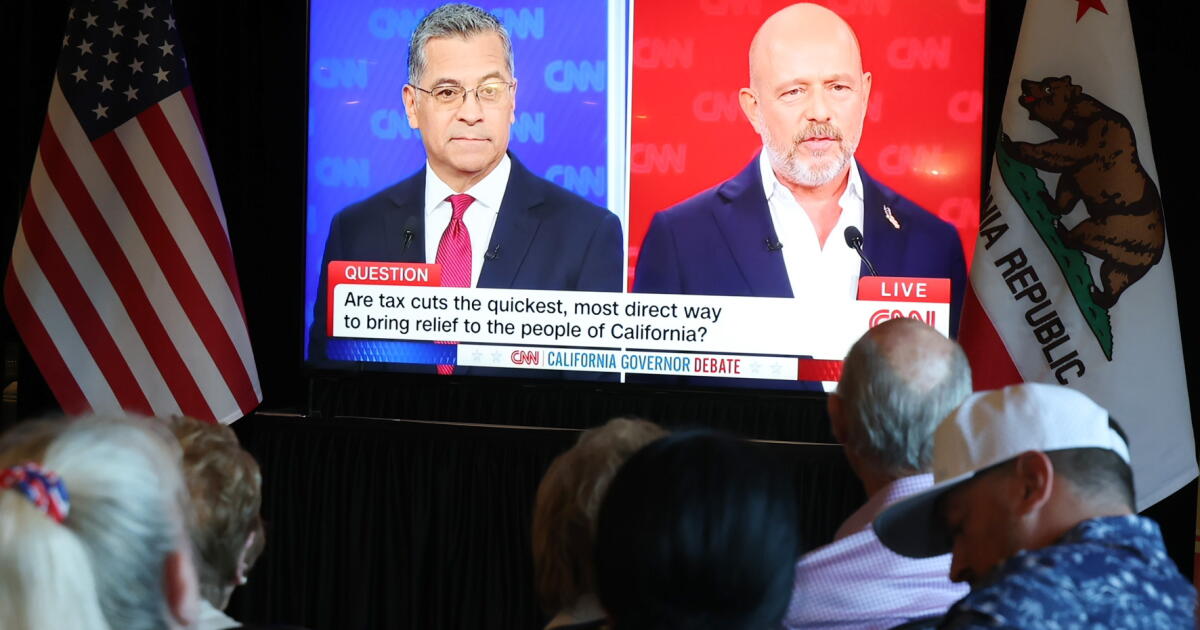
california governor

With Swalwell exit, California governor’s race is starting anew

Eric Swalwell is out — of the California gubernatorial race and Congress, spending time with family, as they say, after allegations of rape and sexual misconduct. That could be considered good news for the slew of Democrats who remain in the running, and even the two Republicans currently polling near the top.

But this muddled campaign season has clearly failed to capture voters’ imagination. This despite a sex scandal, a billionaire spending his millions, a dark horse spending tech-bro millions, a debate where the invitations were so controversial the event was canceled and a sheriff seizing ballots in a failed MAGA-pandering stunt. (President Trump ended up backing his opponent.)

After all that, you’d think Californians would care, at least in a spectacle sort of way.

But they don’t. At least not yet.

So is “undecided” going to remain the leader in the race until voters are forced to fill in their ballots? Even Republicans, with the Trump-endorsed Steve Hilton and Riverside Sheriff Chad Bianco as their main choices, can’t make up their minds.

Times columnists Anita Chabria and Mark Z. Barabak ponder why the race is such a hot mess, who benefits from the Swalwell implosion, whether anyone will ever get excited about any of these candidates — and what all that means for the future of California.

Chabria: We are less than 50 days out from the primary on June 2 and somehow this race remains both boring and unpredictable.

There’s lots of talk about whether the two remaining top Democratic candidates, former Rep. Katie Porter and billionaire investor Tom Steyer, will scoop up Swalwell’s supporters — or if a second-tier contender such as San José Mayor Matt Mahan, former state Atty. Gen. Xavier Becerra or ex-L.A. Mayor Antonio Villaraigosa may rise from the near-dead with a surprise surge.

With such a short amount of time and candidates who have already proved their lack of charisma, I’m worried that what happens next really comes down to money — which Steyer and Mahan have. Mahan’s tech-industry backers are already said to be lining up millions of dollars in ad buys to blitz his name and image on our consciousness in these final days, like a breakfast cereal we didn’t know we wanted to buy.

Ditto Steyer, though he’s got a much higher profile and backing from several key unions.

Do you think that money is going to rule the finish line in this one, or do any of the other candidates have a shot through sheer determination?

Barabak: Let’s be real.

If Tom Steyer was some schmo named Tom Steinway without a vast fortune buoying his political ambitions, he wouldn’t be remotely in the running, much less talked about as one of the putative front-runners. As it is, Steyer has burned through the equivalent of a small country’s GDP and he’s still not cracking 15% in polls.

That’s not exactly a ringing endorsement, notwithstanding all those he’s managed to leverage through his wealth.

California has a long history of rejecting moneybag candidates. In fact, not one has ever been elected governor. That said, we’ve never seen a contest like this one — and that was before Swalwell’s candidacy went up in salacious smoke.

The closest parallel — absent that above-referenced self-immolation — was in 1998. Voters weren’t crazy about the two leading candidates, including a rich guy blasting them with a firehose of TV advertising, so they opted for the colorless guy running far back in the pack. (And yes, dear reader, Gray Davis was eventually recalled, but that came well after the fact.)

There’s a saying in Iowa, around its presidential caucuses. The secret is to organize, organize, organize and then get hot at the end. California, obviously, is not the kind of state you win by holding a million and one kaffeeklatsches. But the principle — lay the groundwork, then count on timing and good fortune — could apply here.

Who might that be? Mahan’s sudden cash gusher can’t hurt. But your guess is as good as mine.

Chabria: The thing about organizing is that for Democrats, much of that work is done by labor unions. They provide the people, the phone banks, the door knockers. The California Labor Federation this time around endorsed basically everybody (Swalwell, Steyer, Villaraigosa and Porter), giving none of the Democratic candidates an advantage.

In a rare move, the California Labor Federation and Service Employees International Union California pulled their endorsement of Swalwell, as have other unions after these allegations came out. But labor remains split among the other candidates (though Steyer seems to be gaining unions’ affections), a real problem when it comes to that kind of organizing.

It’s that division of real people power that makes me worry money will have even more influence this time around.

But also, there is the unknown. There’s chatter online that a famous or strong contender (Kamala? A celebrity?) could stage a last-minute write-in campaign. Although state law no longer allows a write-in for the general election, there’s a tiny window left for one in the primary. What do you think? Could someone new swoop in and excite the voters enough to go rogue?

Barabak: Well, there’s Steve Cloobeck.

Who, you’re probably asking?

He’s a rich real estate developer who quit the race in November after an unsung yearlong campaign. Upon exiting, he enthusiastically endorsed his close friend, Eric Swalwell.

Speaking with our colleague Seema Mehta, Cloobeck said he wished the Legislature would amend the state Constitution so he could file to reenter the governor’s race — a delusion right up there alongside President Trump comparing himself to Jesus.

Seriously, political gossips abhor a vacuum, so they fill it with all sorts of fantastical scenarios of candidates riding in on white horses and rescuing us from … what exactly?

I’ve been the rare voice arguing this governor’s race is not at all boring. Boring would have been Kamala Harris holding a commanding lead for the Democratic nomination and people speculating whether anyone could stop her. While this bunch of candidates won’t send laser light dancing across the darkened sky, there are plenty of quite capable people still in the running, unless you’re looking for someone to entertain and/or offer California four years of distraction and diversion.

And we’ve seen what putting a reality-TV star in the White House has gotten us.

Chabria: At the end of the day, or at least election day, this is a question of whom we trust with the future of California. Ultimately, that’s why this race is a hot mess — none of the candidates, Republican or Democrat, have offered a vision inspiring enough to make voters want to trust them with the next four or eight years.

To me, that’s the real failure here. I don’t think voters would mind boring at all, if it was dolled up with credibility and competence.

I agree with you that we don’t need another reality star in any elected office. And more than one of these candidates has the skills to run the state. But in an era of deceit, arrogance and flashy incompetence, voters do want someone they feel they can trust.

So far, none of the candidates have delivered that sense of security, that they are campaigning as a public servant — instead of the thirsty contender hoping for a rose.

So either someone steps up and earns the rose, or it goes to the top-two least-worst. The June primary is holding on to her secrets for now.

Barabak: You know me; always one to look on the bright side!

If you’re a Republican, the bright side is the long shot, but not impossible, prospect of Bianco and Hilton nabbing both spots on June 2. That would mean one of the two lands in the governor’s office in January, notwithstanding California’s overwhelmingly Democratic leaning.

For an unaffiliated voter and political noncombatant like me, a Californian who deeply cares about my home state, the bright side is this: At least people are finally paying attention to the governor’s race.

So dive in! You’ve got just under seven weeks to make up your mind.

Source link

Swalwell “suspends” campaign for governor’s race following allegations of sexual assault, nude photos

Embattled Rep. Eric Swalwell suspended his campaign for California governor on Sunday but continued to deny he sexually assaulted anyone.

His campaign to succeed Gov. Gavin Newsom has all but collapsed as key Democratic supporters, including Rep. Nancy Pelosi and Sen. Adam Schiff, abandon him.

“To my family, staff, friends, and supporters, I am deeply sorry for mistakes in judgment I’ve made in my past,” Swalwell wrote on social media Sunday.”

“I will fight the serious, false allegations that have been made — but that’s my fight, not a campaign’s.”

House ethics rules bar members from having sex with a subordinate, and House Democratic Leader Rep. Hakeem Jeffries from New York is seeking an investigation into the allegations.

Rep. Anna Paulina Luna (R-Fla.) announced plans to force a House vote to expel Swalwell, a motion supported by some House Democrats. Rep. Jared Huffman, a Democrat representing Northern California, is among those calling on him to resign.

The Manhattan district attorney’s office opened an investigation into sexual assault allegations against Swalwell by the former staffer, and the Alameda County District Attorney’s Office on Saturday said the office was in the process of evaluating “whether any alleged criminal conduct occurred” in the agency’s Bay Area jurisdiction.

The 45-year-old Democratic candidate established himself as a frontrunner in the race to succeed Gov. Gavin Newsom, despite not having a broad base of supporters in California.

A one-time member of the House Intelligence Committee and a savvy social-media user, Swalwell relished his role as a foil to President Donald Trump, using his many platforms to attack and taunt the twice-impeached, criminally convicted president.

He previously worked as a criminal prosecutor, and was elected to Congress in 2012 after he defeated Rep. Pete Stark, a fellow Democrat.

He cast himself as a centrist middle-class guy and featured his wife and three young children prominently in his campaign for governor. In an interview with the Times last year, he talked about his decision to continue in politics, despite the toll on his family.

Reports published in the San Francisco Chronicle and CNN offered a stark contrast to Swalwell’s wholesome image, alleging that he forced himself on a young staffer and sent women pictures of his penis and sexy messages.

CNN also reported on another woman’s alleged account of a sexual encounter with Swalwell that involved fending off his advances over drinks, and then waking up in his hotel room with no memory of how she got there.

Swalwell and his team threatened legal action against several individuals, Swalwell’s attorney Elias Dabaie confirmed to the Times. Swalwell himself took to social media on Friday night and called the allegations “lies” intended to hurt him in the race.

But campaign staffers resigned, his fundraising website went offline and even his self-described “best friend” in Congress, Sen. Ruben Gallegos from Arizona, withdrew his endorsement. Powerful labor groups, including the California Labor Federation, SEIU California and the California Police Chiefs Assn., withdrew their support.

Other Democrats in the race include billionaire Tom Steyer; former Orange County Rep. Katie Porter; State Supt. Tony Thurmond; former U.S. Health and Human Services Secretary Xavier Becerra,; San José Mayor Matt Mahan; former Los Angeles Mayor Antonio Villaraigosa, and former state Controller Betty Yee.

The top GOP gubernatorial candidates are Steve Hilton, a former Fox News commentator, and Riverside County Sheriff Chad Bianco.

Source link

Accusation of sexual assault threatens Swalwell governor bid

For weeks, salacious talk swirled in campaign circles, ricocheted through email chains and was served up, like a buzzy side dish, over gossipy lunches from Sacramento to San Diego.

The talk revolved around Eric Swalwell, the 45-year-old congressman from the East Bay and one of the top Democratic contenders for California governor. The rumors involved allegations of inappropriate behavior with young staffers.

Pressed by rival camps, pursued by the political press corps, the claims were largely confined to unvetted corners of the internet until this week, when Swalwell’s campaign — knowing the whispers were getting louder — issued a public statement denying any wrongdoing.

The move was a prebuttal. Strategists figured it better to get out front of the chatter and address the online innuendo, even if it meant exposing the allegations to a much wider audience. The campaign’s statement was followed hours later by a categorical denial from the congressman.

“It’s false,” Swalwell told reporters Tuesday night in Sacramento. He said he never behaved inappropriately with female staff members or had a sexual relationship with any staffer or intern. There were no quiet legal settlements, he said. No hiding behind nondisclosure agreements.

Then, on Friday, the San Francisco Chronicle published a lengthy report — filled with highly specific and graphic details — quoting a woman who worked nearly two years for Swalwell, stating she had sexual encounters with him while he was her boss. Twice, she alleged, he sexually assaulted her when she was too intoxicated to consent.

The woman, who is 17 years younger than Swalwell, said the congressman began pursuing her within weeks of her hiring at age 21 to work in his district office in the East Bay Area. That was in 2019.

The woman said she largely kept quiet about Swalwell’s behavior out of fear she would suffer personal and professional consequences. She told the Chronicle she did not share her account with authorities because she was afraid they would not believe her. The newspaper said medical records show the woman obtained pregnancy and STD tests a week after one of the alleged assaults.

Swalwell issued another categorical denial.

“These allegations are false and come on the eve of an election against the front-runner for governor,” he said in a statement, somewhat overstating his status in the neck-and-neck gubernatorial race. “For nearly 20 years, I have served the public — as a prosecutor and a congressman and have always protected women.

“I will defend myself with the facts and where necessary bring legal action,” Swalwell said. “My focus in the coming days is to be with my wife and children and defend our decades of service against these lies.”

Even before the Chronicle published its article, once the privately bandied rumors were suddenly the open, you could almost hear the sound of a dam bursting. Swalwell’s competitors were quick to amplify the assertions, grappling for advantage in a race that remains stubbornly knotted up.

“Very, very troubling,” said fellow Democrat Katie Porter. “Deeply troubling,” echoed Betty Yee, another of the Democratic hopefuls.

A third Democrat running, Antonio Villaraigosa, was more inventive, accusing Swalwell “of skipping town” — he did not attend a Wednesday candidate forum in Sacramento — “as more and more women come forward with sexual harassment allegations.”

At that point no one with firsthand knowledge had come forward to contradict Swalwell’s denial of wrongdoing.

But with Friday’s article in the Chronicle, opponents escalated their attacks. San Jose Mayor Matt Mahan and state schools superintendent Tony Thurmond both called on Swalwell to quit the race.

One of his highest-profile backers, Democratic Arizona Sen. Ruben Gallego, withdrew his endorsement and expressed regret he had defended Swalwell on social media prior to the Chronicle’s account. Democratic Rep. Jimmy Gomez of Los Angeles also withdrew his endorsement and urged Swalwell to abandon his candidacy.

Behind closed doors, other major Swalwell backers were reassessing their support.

It’s understandable — and probably necessary — for the congressman to retreat, as he suggested, to spent time with his wife and family.

But in light of the Chronicle’s report, and its damning allegations, he’ll need to do more than issue strongly worded statements on threatened legal action if he has any hopes of salvaging his gubernatorial candidacy and political career. (Swalwell gave up his congressional seat to run for governor.)

If the allegations are false, he needs to refute each and every detail in thorough, incontrovertible fashion. If they’re true, then what could Swalwell possibly have been thinking — not just forcing himself on his alleged victim, but running for governor knowing what he’d done? Was he convinced his behavior would never come to light? Did he believe that adamant denials would allow him to brazen his way through?

Swalwell has a lot of explaining to do — about his behavior, his disclaimers, his judgment.

And even though the June primary is still many weeks away, he has very little time to do so.

Source link

GOP’s best shot at California governor’s office in decades mired in angry internal debate

As Republicans vie for their best shot to win the California governor’s office in two decades, the fight between the most prominent candidates to win over the party of President Trump has switched from subdued to vicious.

Conservative commentator Steve Hilton, at their first one-on-one debate in Rancho Mirage earlier this month, accused rival Riverside County Sheriff Chad Bianco of coddling illegal immigrants and called him “wishy-washy.” The law enforcement chief called Hilton, a British immigrant, a “fraud” and heartless for denying others the same pathway to U.S. citizenship he received.

“What an outrageous and offensive insult that Chad just made to every legal immigrant in this state and in this country,” Hilton fumed.

The heated exchange took place days before the California Republican Party weighs making an endorsement in the 2026 race for California governor. Hundreds of party delegates will gather in San Diego this weekend to decide, though it’s unclear if either candidate will be able to win the 60% vote threshold to receive the official party nod.

Most polls have shown the two Republicans as the top candidates in the race, despite registered Democratic voters outnumbering Republicans nearly 2-to-1 in California.

Bianco and Hilton are competing against eight heavyweight Democrats who are splintering their party’s votes in the election to replace termed-out Gov. Gavin Newsom. Under California’s unique primary system, the two candidates who receive the most votes in the primary will move on to the November general election, regardless of party affiliation.

The prospect has alarmed state Democratic leaders, who unsuccessfully urged struggling candidates to drop out to avoid their party being shut out of the November election.

Still, a lot can happen before the June 2 primary to stir up the race. President Trump endorsed Hilton late Sunday, which could significantly influence the state’s GOP voters. More than 6 million Californians voted for Trump in the 2024 presidential election, though he was trounced by Vice President Kamala Harris, one of the state’s top Democrats.

Riverside County Sheriff Chad Bianco

Riverside County Sheriff Chad Bianco, a Republican candidate for governor, and Kate Monroe, chief executive of VETCOMM, talk with a woman lying on the sidewalk on Skid Row in Los Angeles in January.

(Jason Armond / Los Angeles Times)

On the campaign trail, Bianco and Hilton have frequently raised the prospect of a Republican being elected governor as the result of failed Democratic rule of the nation’s most populous state and the world’s fourth-largest economy.

“For the first time in probably our lifetimes, really since Ronald Reagan … every legitimate poll has either shown me or Steve Hilton at the top two Republicans at the top of [every] statewide poll,” for the last six months, Bianco recently told about 100 attendees at a Valley Unity Republican Women luncheon at the Woodland Hills County Club overlooking verdant fairways.

Hilton, who has participated in more gubernatorial forums and debates than Bianco, said polling that shows him besting Democratic rivals proves that Californians are fed up with 15 years of one-party rule.

“I tell you right now, there is not a single one of them who represents to the slightest degree the change we need in California,” he told a few hundred people at Big Bear’s Calvary Chapel. “We are going to do it this year.”

From afar, Bianco appears to be out of central casting for a GOP candidate for governor: an armed lawman, with a salt-and-pepper mustache and close-cropped hair who has dedicated his life to protecting the vulnerable and locking up criminals.

Bianco, echoing independent pollsters as well as political strategists in both parties, said having “Riverside County Sheriff” next to his name on the official state ballot will be a major boon to his campaign.

“I will tell you this, if we took the names and the party off of the ballot and simply went up with resume — we made you all read a resume of who you’re going to put as your next governor — I would win this election 100% to nothing,” Bianco told the GOP women’s group.

 Republican gubernatorial candidate Steve Hilton

Republican gubernatorial candidate Steve Hilton greets a member of the Big Bear Valley Republican Assembly before speaking at a town hall at Calvary Chapel in Big Bear in March.

(Gina Ferazzi / Los Angeles Times)

But Bianco’s badge hasn’t shielded him from Hilton’s blistering attacks about the sheriff’s past statements about immigration, pandemic mask mandates and Black Lives Matter protests — which is disqualifying for some GOP voters.

Bianco opposes “sanctuary city” laws, calls for the deportation of criminal illegal immigrants and says the border must be secured. But he has also supported a pathway to citizenship for lawful, working undocumented people and told his constituents that his deputies were not taking part in ICE raids.

In the early days of the COVID-19 pandemic, Bianco ordered county residents to wear masks or face punishment, though he later pushed back at Newsom’s stay-at-home orders.

That same year, he and his deputies were photographed kneeling and speaking with protesters in the aftermath of the killing of George Floyd, an action he has since recast as praying.

Bianco’s wife, Denise, on Thursday accused Hilton of endangering her husband by sending mailers to voters that featured Bianco’s face surrounded by circles that she described as a “bullseye target.”

“We have all watched way too much political violence directed at law enforcement officers in recent years. I never imagined it would come from a political candidate directed at my husband,” she said in an Instagram post. “Steve, why on God’s earth would you think it’s acceptable to put my husband’s face, a dedicated sheriff, on a shooting target?”

Election security has also highlighted differences in the candidates’ views.

Hilton and Bianco echoed Trump’s call to make GOP voter turnout “too big to rig.” But their statements about alleged malfeasance differed.

Hilton decried “total corruption in the voting system in California.”

“I’ve said for the longest possible time that I don’t understand why we can’t do things the way that most places do it, which is vote on one day, count on one day, get the results on one day,” he said.

Asked by a voter about electoral fraud in California in March, Bianco replied that he was confident that law enforcement in California ensures that such fraud is “not happening here,” while agreeing that such “cheating” occurred in states such as Ohio and Pennsylvania in the 2020 election.

But the same month, he seized more than 650,000 ballots from the November election as part of an investigation to determine if they were fraudulently counted.

Bianco put the investigation on hold shortly before the California Supreme Court halted it pending further review.

Former California Gov. Arnold Schwarzenegger

California voters have not elected a Republican as governor since Arnold Schwarzenegger won reelection in 2006. Two Republicans on the ballot in the June 2 primary election hope to change that.

(Justin Sullivan / Getty Images)

Hilton has sought to capitalize on these positions, labeling Bianco the “shifty sheriff,” an attack that resonates with some voters.

“The man lies. The man is not honest about taking a knee to BLM, which is unacceptable,” said Agnes Gibboney, 71, of Rancho Cucamonga. “And coming up with three, four different excuses is unacceptable. And then to get mad at the voters for asking the question.”

Bianco has labeled Hilton as a shape-shifting opportunist, pointing to him championing a climate change agenda while advising British Prime Minister David Cameron and expressing support for views expressed by Sen. Bernie Sanders (I-Vt.) in the 2016 presidential election, and posting a picture of Hilton hugging Newsom on social media.

“Steve is a fraud. He’s a liar, and I’m not going to sit by and just let him do it anymore,” Bianco said after the Rancho Mirage debate. “When he starts attacking me, he starts attacking my deputies, my profession, I’m not gonna let it happen anymore.”

“He remade himself just for this governor election, and everyone is starting to see through it,” Bianco said.

The son of Hungarians who emigrated to Britain, Hilton served as an advisor to Cameron before becoming an American citizen. At campaign events, supporters have gifted Hilton with a Kézimunka, a traditional Hungarian embroidered cloth, which was stitched with a heart, as well as stars-and-stripes bathing trunks.

“My parents are Hungarian refugees from communism,” Hilton said. “I am fighting to make sure that this state that I love does not turn into the country that I left …. I have renounced my U.K. citizenship. I’m all in for California and America.”

Of the two candidates, Hilton has been more publicly visible, and benefits from GOP voters seeing him speak on Fox News for several years.

Both men argue one-party Democratic rule of California has destroyed a state once viewed as the epitome of the American dream.

Hilton describes state leaders as “far-left lunatics.” They’ve ruined the most amazing, the most beautiful place on earth,” and tweaked a popular Texas slight about someone being all hat and no cattle to describe Newsom.

“He’s all hair, nothing there. Don’t you think it’s time in California we have a governor with less hair?” said Hilton, who sports a smooth crown.

Bianco calls the state’s Democratic leaders “far-left psychopaths” who have enacted policies, taxes and fees that are forcing Californians to flee the state.

“We all know government has completely failed and we’re ready to take our state back,” he said, later adding, “They don’t want our lives better. I do …. No one leaves California because they want to. It’s government agenda and policy that is harming California and making it bad.”

Most of the candidates’ pledges, such as tackling unaffordability, reducing gas prices, increasing capacity in state prisons, protecting gun owners’ rights and keeping trans athletes out of girls’ locker rooms, are nearly identical.

They both promise to slash California’s vehicle registration fees, a proposal that echoes former Republican Gov. Arnold Schwarzenegger’s pledge to repeal the car tax during the 2003 recall election that was immortalized by his campaign dropping a wrecking ball on an Oldsmobile in Costa Mesa.

Schwarzenegger was elected governor soon after.

No candidate in either party can match Schwarzenegger’s global appeal, or voters’ familiarity with the state’s most recent Democratic governors — including Jerry Brown, the scion of a storied political family — or Newsom’s charisma, added GOP strategist Rob Stutzman, a former Schwarzenegger advisor who is not aligned with any candidate in the 2026 race.

“Voters are finding this to be an uninspiring list of candidates. And in fact, the impressive list would be those that chose not to run, right?” he said, referring to Harris, Sen. Alex Padilla and Atty. Gen. Rob Bonta. “So it’s not a surprise that there isn’t much interest.”

Though Hilton and Bianco were previously cordial in person, such as when they crossed paths at September’s state GOP convention, their public criticism of each other has ratcheted up in recent weeks, which could sway the many undecided GOP voters in the race.

“My main contention is looking to see whether or not they’re gonna follow the will of the Lord. So I’m paying attention to what they say and what they do,” said retired Air Force IT specialist David Solomon, 42, after seeing Hilton speak in Big Bear. “It really just comes down to who’s gonna be able to enact their plan.”

Jane Price, a 77-year-old Sherman Oaks resident, said she worried that Republicans failing to unite behind a candidate would give Democrats an edge in the governor’s race.

“We don’t want to split, right? That’s a problem,” the charter member of the woman’s GOP group said after seeing Bianco speak. “The state of California is at stake. We were thriving here in California. But now, it has been nothing but a downhill slide. We need people who appreciate what California is all about.”

Source link

‘Revolution’ or ‘chaos’: The massive stakes if a Republican becomes California governor

If conservative commentator Steve Hilton is elected California’s next governor, as President Trump wants, it would mark a “political revolution” for the liberal state, the candidate said.

The state’s Democrat-controlled Legislature, “after all their years of lecturing us about democracy,” would be forced to work with him “to enact the changes that Californians just voted for,” and he would be willing to work with them too, the Silicon Valley entrepreneur and former Fox News host said.

If firebrand Riverside County Sheriff Chad Bianco is elected governor, he will take a decidedly different approach, he said.

“You want to know how I’m gonna work with a Democrat Legislature? I’m not. I’m gonna get every single one of them unelected,” Bianco said. “Every single day, I’m gonna stand on the steps of the Capitol, and I’m gonna tell the California voting public about the idiots in Sacramento that are ruining their lives.”

For the first time in years, the state GOP is riding into its convention this weekend on a wave of optimism about the upcoming gubernatorial race.

According to recent polling, Hilton and Bianco both stand a chance of winning more votes in the June 2 primary than any of the many Democratic candidates, who have spread thin their party’s nearly 2-1 advantage in voter rolls. If the GOP candidates do that, they would advance to a head-to-head contest in November’s general election, and one would become the state’s first Republican governor since Arnold Schwarzenegger.

Much could change to prevent that scenario. More Democrats could drop out. Voters could coalesce around one or two of those left. Hilton, with Trump’s endorsement, could consolidate Republican support and push Bianco out of contention.

Still, the prospect of a Republican governing California, a stronghold of the anti-MAGA movement, has captivated political experts and spectators alike.

A person, seen from behind, walks with hands behind his back in front of another person next to rows of prison cells

Gov. Gavin Newsom imposed a moratorium on the death penalty shortly after taking office, a policy the next governor could reverse. At San Quentin, an inmate is moved from his cell on death row.

(Robert Gauthier / Los Angeles Times)

Trump, in his recent endorsement, said he has “known and respected” Hilton for many years and would help him “turn it around” in California after an “absolutely horrendous job” by Gov. Gavin Newsom and other state Democrats.

“With Federal help, and a Great Governor, like Steve Hilton, California can be better than ever before!” Trump wrote.

Many Democrats predict the opposite: grandstanding and gridlock as either Hilton or Bianco’s MAGA-aligned agenda meets stiff resistance from powerful state Democrats repulsed by the president’s movement.

“If the new governor decided to go hard MAGA, they would face enormous pushback,” said state Sen. Ben Allen (D-Santa Monica), who considers it unlikely for both Republicans to advance.

“I don’t think there’s any question that the state would descend into chaos,” said Phil Angelides, a Democrat and former state treasurer who lost to Schwarzenegger in the 2006 gubernatorial race.

The limits of power

California governors hold substantial power.

They direct and appoint leaders to the state’s many executive agencies, boards and commissions, which oversee vast portfolios in vital areas, such as the environment, California’s university systems and the state parole board. They craft the state budget and have a line-item veto to eliminate legislative appropriations. They can make major unilateral decisions — such as welcoming federal troops into California cities — and command a bully pulpit to drive public opinion and policy, including through statewide ballot measures.

People holding signs face a row of uniformed guards in helmets, holding shields with the words California National Guard

Demonstrators confront California National Guard troops and police outside a federal building during protests in Los Angeles in 2025 after the Trump administration sent in the National Guard. The Republican candidates for California governor said they would welcome similar orders by the Trump administration.

(David McNew / Getty Images)

California’s next governor would have the power to end Newsom’s moratorium on the death penalty, appoint state judges and grant state pardons. During emergencies the governor would be able to reshape state regulations, suspend laws and redirect funding, as Newsom did during the COVID-19 pandemic by banning price gouging, halting evictions and postponing the 2020 tax deadline.

But their power also has limits.

Many of the governor’s appointees are subject to state Senate confirmation. The Legislature can change and amend the governor’s proposed budget and pass a budget bill distinctly different from his proposal. Democrats, with their supermajority, can also override the governor’s vetoes.

The independently elected state attorney general can sue to defend state laws, regulations and residents, a power current officeholder Rob Bonta, a Democrat, has exercised more than 60 times to challenge the Trump administration. The California Supreme Court, which leans liberal, can rein in the executive branch if it determines it has violated the state Constitution or other statutes.

Trump has repeatedly pushed the limits of executive authority and benefited from having a Republican-controlled Congress and a conservative U.S. Supreme Court majority that holds an expansive view of executive power. Hilton or Bianco would face the opposite in California, where many legislators would refuse to acquiesce to a Republican governor, especially one almost certain to face a swift recall, political experts said.

Hilton or Bianco could “potentially build alliances” with Democrats on issues such as housing and affordability and drive change that way, said Kim Nalder, a political science professor and director of the Project for an Informed Electorate at Sacramento State. But “if the Democratic majority in the Legislature decides to dig in its heels, then they could oppose practically everything [the new governor] would do.”

Nalder said Hilton or Bianco could also “try to rule in a Trumpian way” by testing the boundaries of their authority. She expects Bianco would do so given his recent decision to “violate the norms of democracy” by seizing more than half a million 2025 ballots as part of an unusual local sheriff’s investigation into allegations of voter fraud that state and county officials say have no merit.

But he “wouldn’t have the public support or the hold on the other branches of government that Trump has,” she said, “so it would be much more difficult.”

Angelides said electing either Hilton or Bianco would put someone “deeply associated with the MAGA movement” atop a deeply blue state government in which many career employees hold opposing views, which would cause a cascade of disruptions.

“There’s no reason to believe it will be different than the chaos we’ve seen in the Trump administration: an evisceration of a number of state agencies, as well as the departure of a lot of talented people who will not stay and would not jeopardize their careers, their reputations, to work under a governor from the MAGA movement,” Angelides said.

State employees are protected by powerful unions with deep ties to Democratic leaders, which Hilton said he would sever.

A Bonta spokesperson said in a written statement that the attorney general “works in service of the people of California — not the Governor,” and would not hesitate to exercise his independent authority under the state Constitution.

“We hope to maintain a close working relationship with whomever California’s next Governor is, but our mission and our priorities will not change,” the spokesperson said. “Regardless of who is in that office, we will continue to enforce civil rights laws, investigate and prosecute complex crimes, protect public safety, stand up for consumers and the environment, and fulfill our duty to Californians.”

Senate President Pro Tempore Monique Limón (D-Goleta) also offered a diplomatic response, saying in a statement that “it is critical that whoever our next Governor may be helps advance the lives and goals of California and its communities.”

In their own words

Hilton and Bianco both said they would radically reshape state government, in part by dismantling regulations that are hampering development and making basic necessities — housing, food, gas, electricity — too expensive.

Hilton, a top advisor in British Prime Minister David Cameron’s coalition government more than a decade ago, would install agency leaders who would be hyper-focused on slashing costly regulations in order to “reduce the burden of cost and hassle on California families and businesses,” he said. “Elections have consequences, and so it would be irresponsible not to use maximum aggression to make the changes as quickly as possible.”

A man in a dark shirt, left, gestures toward the chest of another man, in dark suit and ballcap, while speaking

The top two Republican candidates running for California governor said they would have a much better relationship with President Trump than Democratic Gov. Gavin Newsom, who challenged the president’s policies in court and mocked him on social media.

(Mark Schiefelbein / Associated Press)

Bianco said “every single regulation in this state is leaving” if he wins, with California becoming far more business friendly. “The environmental activism, the environmental activism terrorists who are controlling state government, are going to be put in their place, which is outside where nobody hears from them.”

Both Hilton and Bianco also sharply criticized California Democrats for challenging Trump at every turn, a practice they would end.

“I would be wanting to work with the administration to help Californians,” Hilton said.

“Why would you ever push back on a president unless they were seriously trying to destroy your state?” Bianco said. “California is failing because of its own policies.”

Hilton said he expects Bonta to lose to his Republican running mate for attorney general, Michael Gates. Bianco said that if Bonta remains in office, he would completely “defund” the state Justice Department.

Hilton and Bianco also shared similar thoughts on Trump’s immigration crackdown and deployment of the National Guard to Minneapolis and Los Angeles, the latter without Newsom’s approval.

Hilton said that he “certainly would never want to see, in California, the scenes that we saw in Minneapolis, nor would I want to see repeated the scenes that we saw in our state last summer,” but that those clashes were “provoked and instigated by Democrat sanctuary policy,” which he would end.

California’s sanctuary policies largely bar local police and corrections officials from conducting or assisting federal authorities in immigration enforcement, which state leaders say is not their responsibility and could undermine community trust in local police.

Bianco said that Trump sent in troops because Newsom “was derelict in his duties to protect the people of California,” and that it is more important to address “failed Democrat policies for the last 20 years.”

“President Trump has done not one single thing to harm California in the last year,” he said.

Matt Lesenyie, an assistant professor of political science at Cal State Long Beach, said that if Hilton or Bianco becomes governor, Sacramento will see “a lot of gridlock and grandstanding, and that’s from both parties.”

But he also said he does not expect that to happen, because undecided voters are going to “figure it out” and coalesce behind a Democrat — even if at the last moment.

“That last slice of the electorate,” he said, “doesn’t wake up until the last two weeks.”

Times staff writer Katie King contributed to this report.

Source link

Swalwell campaign denies online claims that congressman behaved inappropriately with staffers

A spokesman for Rep. Eric Swalwell, a leading Democratic candidate for California governor, on Tuesday denounced online claims that the congressman had inappropriate relationships with young congressional staff members.

“This false, outrageous rumor is being spread 27 days before an election begins by flailing opponents who have sadly teamed up with MAGA conspiracy theorists because they know Eric Swalwell is the frontrunner in this race,” spokesman Micah Beasley said in a statement that was first reported by Politico.

Allegations that Swalwell (D-Dublin) acted sexually inappropriately with young women have been swirling online for weeks, with the tempo growing in recent days as Democratic strategists, Washington, D.C., insiders and social media influencers posted about the allegations, including that he made these women sign nondisclosure agreements.

“In 13 years, no one in Eric Swalwell’s Congressional office has ever been asked to sign an NDA. Ever,” Beasley said. “In 13 years, not a single ethics complaint by any staff in his office or any other office has ever been lodged. Ever.”

The Times has not independently corroborated reports of inappropriate behavior.

Swalwell, 45, did not respond to requests for comment.

He entered the campaign to replace termed-out Gov. Gavin Newsom in November, and recent opinion polls show he is among the Democratic front-runners. Swalwell had the support of 13.7% of voters in an average of recent polling compiled by Real Clear Politics, behind only Republican Steve Hilton, a conservative commentator who had an average of 14.7%

This is the second controversy Swalwell has faced in recent days.

Late last month, he accused President Trump of trying to sway the governor’s race based on reports that the FBI could release documents related to a decade-old investigation about his association with an alleged Chinese spy.

The investigation centered on Swalwell’s ties to a suspected intelligence operative, Christine Fang, or Fang Fang, who worked as a volunteer raising money for his congressional campaign. Swalwell cut off ties to Fang in 2015 after intelligence officials briefed him and other members of Congress about Chinese efforts to infiltrate the legislative body.

Swalwell was never accused of wrongdoing. In an interview with The Times in November, he said he was cleared by the FBI and a GOP-led House Ethics Committee of any impropriety in his ties to Fang.

FBI Director Kash Patel directed agents in the bureau’s San Francisco office to redact the case files for public release, according to a report by the Washington Post, a highly unusual move to release case files tied to a investigation that did not result in criminal charges.

Swalwell’s attorneys filed a cease and desist letter with Patel and the FBI. No documents have been released as of Tuesday afternoon.

Times staff writer Melody Gutierrez contributed to this report.

Source link

Billionaire candidate for California governor catching heat for past business interests, wealth

Billionaire hedge fund founder turned environmental warrior Tom Steyer, a leading Democratic candidate for California governor, is facing mounting questions about how he earned his wealth — notably investments in private prisons that are now being used to house undocumented immigrants facing deportation.

Some of the most vicious political attacks come from his Democratic rivals and Sacramento special interest groups as the June 2 primary election fast approaches, but Steyer has been dogged for years about his past, controversial business ventures and how they help fund his unbridled campaign spending.

Steyer, 68, faced that ire during a town hall event in San Diego last week.

“Tom, you’re not going to come to San Diego and ignore this detention center,” Holly Taylor, a 37-year-old Democrat screamed at Steyer, holding signs with QR codes to help detainees at an Otay Mesa private prison that Steyer’s hedge fund backed. “It’s a concentration camp. They’re drinking water out of a toilet.”

Taylor, a crime scene cleaner from Pacific Beach, is among scores of people who gather weekly at the facility to raise money for detained immigrants to provide them some comfort amid the Trump administration’s Immigration and Customs Enforcement raids.

In 1986, Steyer, co-founded Farallon Capital, which had shares valued at $89.1 million in the Corrections Corp. of America in 2005, according to the Securities and Exchange Commission. That company, now known as CoreCivic, operates private prisons around the nation that are housing people picked up by federal immigration agents, including the one in Otay Mesa.

It is not the first time Steyer has faced criticism about the connection with private detention facilities. At the California Democratic Party convention in February, protesters dressed in orange prison jumpsuits sought to draw attention to the controversy.

His Democratic rivals have also seized upon the issue to question the billionaire’s progressive credentials.

“Before he was a progressive, he made millions off of companies that operate ICE detention centers, that operate private prisons that incarcerated young children,” state Supt. of Public Instruction Tony Thurmond said during a recent interview with a political influencer known as Mrs. Frazzled.

“His entire campaign is built on the backs of kids in cages,” Rep. Eric Swalwell, (D-Dublin) wrote Tuesday in a post on X.

People protest outside of a lunch held by California gubernatorial candidate Tom Steyer

People protest outside of a lunch held by California gubernatorial candidate Tom Steyer at the 2026 California Democratic Party State Convention in San Francisco on Feb. 21.

(Jeff Chiu / Associated Press)

Several years earlier, Yale University’s graduate teachers union called upon the school — Steyer’s alma mater — to divest from Farallon because of concerns about how the private prison company treated detainees, notably minorities.

Steyer has repeatedly expressed remorse about his former firm’s ties with the detention company. In 2012, he sold his stake in Farallon, which was named in reference to islands off the coast of San Francisco and was once one of the largest hedge funds in the world.

“I deeply regret that Farallon made that investment, and I personally ordered the investment in CCA to be sold because it did not accord with my values then or now,” Steyer told The Times in 2019 after he launched a short-lived presidential campaign.

Asked to comment about the latest iteration of the controversy, Steyer’s campaign pointed to comments he made in March at a town hall in San Francisco about how among the hundreds of thousands of companies his hedge fund invested in, the private prison company changed the course of his life.

“It was a mistake, and I sold it over 20 years ago, thinking, not that it won’t be profitable, it’s just a mistake. I don’t want to be in that business. But let me say this, it wasn’t just a mistake,” Steyer said. “It was also a big wake-up call that I was in the wrong place, that I was in a business that was taking me to places I absolutely didn’t want to go. And there’s a reason I walked away from that business and walked away from a ton of money, because I felt like that is not the life I want.”

He added that he and his wife, Kat Taylor, have spent the past two decades pushing for rehabilitative justice — treatment instead of mass incarceration except for violent felons.

“Am I a perfect person? No, have I made mistakes? Yes,” Steyer said. “But for those of you who like to read the Bible, there is a moment on the road to Damascus when someone makes a change, and I have made a big change, and I did it a long time ago, and I’ve been pushing very, very hard the other way.”

Farallon also invested in fossil fuel projects, including an Australian coal mine that denuded thousands of acres of koala habitat and generated an enormous amount of carbon emissions.

Steyer, who has a net worth of $2.4 billion according to Forbes, has painted himself as a reformed billionaire who walked away from Farallon because of angst about how he earned his fortune. He has spent hundreds of millions of dollars supporting Democratic causes, notably efforts to fight climate change.

“The truth is that is not where I think there is value, and that is not what I’m seeking in my life,” he said at a Sacramento town hall in March when retired state employee Gina Coates asked how, as a woman of color, she could believe his promises given his privilege as a wealthy white man.

“In terms of trusting me, let me say this, I left my business 14 years ago, and anybody who cared about money would not have done it,” Steyer said.

Steyer later said at the town hall that he left Farallon because he realized that he didn’t want to remain on that path.

“I want to have a meaningful life,” he said. “I want to stand with the people of this state and have actual prosperity. Twelve trillionaires and 40 million people who can’t make rent is not success.”

But Steyer and his wife continue to receive significant income from the hedge fund, including millions of dollars in investments, holdings and various complicated transactions in 2024, according to a statement of economic interest and tax returns he was required to file with the California Secretary of State’s office because of his gubernatorial run.

A Steyer campaign spokesman said Steyer created guardrails to ensure that he does not profit off companies he morally disagrees with.

“Tom has put in place an investment policy to ensure that he does not directly invest in fossil fuels, payday lending, or private prisons,” spokesman Anthony York said. “To the extent he inadvertently incurs exposure to those industries through third-party managers or liquid legacy investments, Tom will donate all profits to charity.”

After leaving Farallon, Steyer became one of the nation’s top Democratic donors. And he has used his wealth to fund his political ambitions. Steyer contributed nearly $342 million of his own money to his short-lived 2020 presidential campaign, according to the Federal Election Commission.

In the 2026 governor’s race, Steyer has donated nearly $112 million to his campaign as of Thursday, according to the California secretary of state’s office. He has been an ubiquitous presence on the airwaves, including local news programs and campaign ads that aired during the “Puppy Bowl” on the Animal Planet channel on Super Bowl Sunday. In the past month, Steyer has aired more than 5,000 ads, according to iSpot, which tracks television commercials.

California, home to 23.1 million registered voters, is home to some of the nation’s most expensive media markets. And candidates, particularly those who are not well known, need to spend heavily on television advertising if they hope to have a successful campaign.

But money is no guarantee of success. Billionaire Meg Whitman, the former eBay chief and formerly a longtime Republican donor, spent $144 million of her money on her 2010 gubernatorial bid. That set a record for a candidate’s contribution in a state race at the time, but Whitman lost to Jerry Brown by nearly 13 percentage points.

In 1998, Democratic multimillionaire Al Checchi who had been the co-chair of Northwest Airlines spent $40 million of his wealth on an unsuccessful run for governor, also a record at the time.

Steyer is one of the top three Democrats in the sprawling field to replace termed-out Gov. Gavin Newsom. And his liberal positions are drawing the ire of powerful forces in Sacramento. On Tuesday , the state’s Realtors donated $5 million to an independent expenditure committee opposing Steyer’s bid.

Taylor, who confronted Steyer at the San Diego town hall, said she had not planned to be so vocal. But as the event unfolded, she decided she had to speak, not only to Steyer but to the attendees. She and her compatriots gather every Sunday outside the Otay Mesa facility to raise money to help detainees buy food in the prison commissary and call their families.

“My main issue is that he has gotten financial gain off of these people suffering,” she said.

Source link

President Trump endorses Steve Hilton in the California governor’s race

President Trump endorsed conservative commentator Steve Hilton for California governor late Sunday night.

The endorsement could have a major impact on a race that remains up for grabs, with recent opinion polls showing Hilton and his top Republican rival, Riverside County Sheriff Chad Bianco, as top contenders in the 2026 contest.

“He is a truly fine man, one who has watched as this once great State has gone to Hell,” Trump posted on Truth Social, adding that he has known Hilton for many years.

Trump in his endorsement praised Hilton while attacking the record of California Gov. Gavin Newsom, using a derogatory name for the governor. Newsom is serving the last year of his final term as governor as he weighs running for president in 2028.

“Gavin Newscum and the Democrats have done an absolutely horrendous job. People are fleeing, crime is increasing, and Taxes are the highest of any State in the Country, maybe the World. Steve can turn it around, before it is too late, and, as President, I will help him to do so! With Federal help,” Trump said.

Despite California’s solidly Democratic electorate, a recent poll by UC Berkeley’s Institute of Governmental Studies found Hilton and Bianco leading the crowded field of candidates just months before the June 2 primary — leading to the possibility of Democrats being shut out of a November election that will determine California’s next governor. The crowded field of Democrats in the race has splintered their party’s voters, providing an opening for the Republicans, the poll showed.

Under the state’s top-two primary system, the top two candidates advance to the general election, regardless of their party affiliation.

If Trump’s endorsement leads to California Republican voters coalescing behind Hilton, severely damaging Bianco’s campaign, that likely would reduce the odds of two GOP candidates finishing in first and second place in the primary.

Trump’s endorsement came the day after Hilton and Bianco squared off in a testy debate in Rancho Mirage that was moderated by Richard Grenell, Trump’s former ambassador to Germany, and days before the state GOP meets in San Diego to consider an endorsement in the race.

On Saturday, Bianco said he suspected that Trump would weigh in on the race and that his team had been in talks with the president’s advisors.

“Of course, I would want him to support me. He’s the president of the United States,” Bianco said in an interview.

Hilton on Saturday questioned whether the president would weigh in on the race.

“I’ve said that I’d be honored to have the President’s endorsement. I think that the California Governor’s race is pretty low on his [agenda] right now,” he said in an interview. “I haven’t asked for that, and I’m not expecting him to weigh in.”

Jon Fleischman, the former executive director of the California Republican Party, wrote on Substack late Sunday that he believes that Trump’s endorsement will significantly boost Hilton’s support among GOP voters.

“This Timing Is Not Accidental,” he wrote, noting that while it was previously unclear whether either candidate could receive the 60% of delegate votes to secure the party nod at its upcoming convention. “Well, obviously this endorsement from the President for Hilton will supercharge his momentum going into the weekend convention”

Source link

Swalwell accuses Trump of trying to influence California governor’s race with old FBI files

Rep. Eric Swalwell, a leading Democratic candidate for governor of California, has accused President Trump of trying to sway the election following reports that FBI Director Kash Patel may release documents from a decade-old investigation into the congressman’s ties to a suspected Chinese spy.

According to a report by the Washington Post, Patel has directed agents in the bureau’s San Francisco office to redact the case files for public release. According to the outlet, it’s highly unusual for the FBI to release case files tied to a probe that did not result in criminal charges.

The investigation centered on Swalwell’s ties to a suspected intelligence operative, Christine Fang, or Fang Fang, who worked as a volunteer raising money for his congressional campaign. Swalwell cut off ties to Fang in 2015, after intelligence officials briefed him and other members of Congress about Chinese efforts to infiltrate the legislative body.

Swalwell was not accused of impropriety.

The FBI did not immediately respond to a request for comment.

“Through great reporting, we now know the outrageous ends the White House will go to target political opponents,” Swalwell said in a prepared statement Saturday, calling the decade-old story “nonsense.”

“Donald Trump is targeting me. He’s trying to influence the election,” Swalwell said in a post on X. “There is only one reason why: he’s scared.”

Swalwell accused Trump of “desperately trying” to stop him, because he’s now the favored candidate for California governor.

“What Trump wants the most is to have a Western White House. An enabler on the opposite coast,” he said. “A lot of people have bent the knee to this administration. But I will not. And neither will the people of California.”

It’s not the first time Swalwell has accused the administration of targeting Trump’s political opponents.

Last year, Swalwell sued Federal Housing Finance Agency Director Bill Pulte, accusing him of criminally misusing government databases to target Trump’s political opponents. Pulte had accused Swalwell of mortgage fraud and referred him to the Justice Department for a potential federal criminal probe. Swalwell dropped that suit this month.

Swalwell, a former prosecutor who ran for president in 2020, announced his bid for California governor in November. Swalwell said his decision was driven by the serious problems facing California and the threats posed to the state and nation with Trump in the White House.

U.S. Sen. Adam Schiff (D-Calif.), who has endorsed Swalwell for governor, shared the Post story on X Saturday, saying, “This abuse of the FBI is as dangerous as it is unlawful.” Schiff served with Swalwell on the House Intelligence Committee, where they riled Republicans by investigating President Trump during his first term.

Schiff served as the lead manager of Trump’s first impeachment and Swalwell as a manager of Trump’s second impeachment.

“Time and again, the President and his appointees have weaponized the Department of Justice against those who dare stand up to Trump,” Schiff wrote. He added that there was no doubt that Trump and Patel “will stop at nothing to try to tell Californians who their next governor should be.”

The Post story unleashed a flood of critiques from California politicians, including Rep. Jimmy Gomez (D-Los Angeles), who sits on the House Intelligence Committee. On X, Gomez accused Patel of “wasting resources” on a “closed, decade-old case where Swalwell cooperated with the FBI and was found innocent of any wrongdoing.”

“Reopening it now, right as he leads in the polls and ballots are about to drop, is a political hit-job!” Gomez said. “Trump and Kash Patel are weaponizing the FBI against people they deem political enemies.”

Rep. Jamie Raskin of Maryland, the top Democrat on the House Judiciary Committee, released a statement accusing Patel of working at “the behest of the White House” and “wasting the resources of the FBI and perhaps violating the Hatch Act by ordering agents to spend hours preparing a political smear file for a personnel vendetta.”

According to the Associated Press, Fang came into contact with Swalwell’s campaign as he was first running for Congress in 2012. She also participated in fundraising for his 2014 campaign and helped place an intern in his office, the report said. Federal investigators alerted Swalwell to their concerns — and briefed Congress — about Fang in 2015, at which point the California Democrat says he cut off contact with her, the AP reported in 2021.

In 2023, the House Ethics Committee closed a two-year investigation into the allegations of his ties to Fang.

In closing the probe, the ethics committee wrote in a letter to Swalwell that it had “previously reviewed allegations of improper influence by foreign agents and in doing so, cautioned that Members should be conscious of the possibility that foreign governments may attempt to secure improper influence through gifts and other interactions.”

Times staff writer Kevin Rector contributed to this report.

Source link

Trump endorsement in California governor’s race could be crucial

Chad Bianco couldn’t fly to Mar-a-Lago, wreathe President Trump in honeyed words, bestow the Riverside County Peace Prize upon him and hand-feed him his favorite dish — a Big Mac? — from a platter of 24-karat gold.

Security, logistics and all of that.

So the Republican candidate for California governor did the next best thing: He confiscated hundreds of thousands of ballots from last November’s special election in a trumped-up investigation of supposed voting irregularities. Never mind the complete lack of evidence or the fact Proposition 50, the subject of Bianco’s investigation, was approved by a clear-cut majority of voters.

The intent of Riverside County’s grasping sheriff was as transparent as a pane of glass. It’s all about trying to win the endorsement of Trump — he of phantasmagorical election-fraud claims — in California’s neck-and-neck-and-neck gubernatorial contest.

Bianco, fellow Republican Steve Hilton and a passel of Democratic hopefuls are bunched together in a contest that remains utterly wide open just weeks before voters start receiving their ballots in the mail.

“Trump’s endorsement would be huge,” said Jon Fleischman, a conservative strategist and former executive director of the state GOP.

“Actually,” he went on, ‘I think it would be determinative” — virtually guaranteeing either Hilton or Bianco finished in the top two in the June 2 primary, ushering them past the rope line into November’s runoff.

If there’s an inside edge in the Trump Endorsement Sweepstakes, it would seemingly go to Hilton.

He’s familiar to the president as a former Fox News host. He’s interviewed Trump several times and the two occasionally text and talk on the phone. Bianco has no such personal connection, which might explain his ballot-seizing stunt.

Gubernatorial hopeful Steve Hilton waves to a crowd at the Pier Plaza in Huntington Beach.

Steve Hilton could have the inside track on a Trump endorsement, given their personal relationship.

(Allen J. Schaben / Los Angeles Times)

(The Democrats’ nightmare scenario is both Republicans making the runoff, icing the party out of the governor’s office for the first time since Arnold Schwarzenegger left in January 2011. More on that in a moment.)

A Trump endorsement comes in all sorts of flavors.

As The Downballot recently noted, “His bag of tricks includes dual endorsements, triple endorsements, pre-endorsements, Election Day endorsements, yanking endorsements … belated endorsement of a candidate after initially endorsing just one candidate [and] non-endorsements after promising to endorse.”

There was also the time Trump endorsed “ERIC” when Republicans Eric Schmitt and Eric Greitens faced each other in Missouri’s Senate primary. (Schmitt won and is now the state’s junior U.S. senator.)

Trump’s backing still counts a good deal, even as his approval ratings sink to sub-basement levels. The president remains popular with Republicans and, critically, the kind of GOP loyalists who vote in primary contests, which is why both Hilton and Bianco would welcome a presidential laying on of hands.

There’s good reason, however, to think Trump might pass on endorsing in the governor’s race, or opt to deliver one of his dual he-and-him endorsements.

The GOP’s best — and perhaps only — hope of winning the governorship is the Democratic-freeze-out scenario. So, tactically, Trump’s wisest move may be to bless neither Hilton nor Bianco. Or support both. That would avoid elevating one over the other, which could make it easier for a Democrat to finish among the top two and advance past the June primary.

“I think Trump’s people are smart enough to know that there’s a reason why he may not be served by endorsing a candidate,” Fleischman said. “I wouldn’t be surprised if the prevailing wisdom there is we better not endorse anybody, because we don’t want to tilt this one way or the other.”

If Trump were to back Hilton or Bianco, it’s not hard to imagine Democratic interests seizing upon the president’s benediction and putting significant money behind an ad blitz promoting the president’s favorite in hopes of boosting him — and him alone — into the top two.

The move comes from a well-thumbed political playbook, seeking to elevate a preferred opponent, that was used most recently in California by Democratic Sen. Adam Schiff. He helped lift Republican Steve Garvey into the November 2024 runoff to keep from having to face a tougher opponent, fellow Democrat Katie Porter. Schiff easily defeated Garvey.

In this case, Democrats would aim to tee up one of the two Republicans who would almost certainly go on to lose in the fall.

Which is what happened the first time Gavin Newsom ran for governor.

In 2018, his main rival was fellow Democrat Antonio Villaraigosa. Two major Republicans were also in the race, John Cox and Travis Allen. There was no real concern about those two nabbing both spots in the June primary. Rather, Newsom and Cox had a shared interest in boxing out Villaraigosa.

So the Newsom and Cox campaigns opened a private back-channel, trading gossip, swapping insights on the race and even sharing some empirical data. One poll, showing Cox getting a bigger boost from a Trump endorsement than Allen, passed from Democratic hands in hopes it would reach the White House and nudge the president into supporting Cox.

Though there’s no proof the survey ever reached Trump, the president eventually threw his support behind the San Diego County businessman, lifting him past Allen in the primary. Cox went on to lose handily to Newsom in November.

This time, with more than a half dozen plausible candidates and no obvious path to victory for any one, it’s every man and woman for themselves.

The same goes for Trump, who may do himself the most good in California, politically, by doing nothing at all.

If he can only resist.

Source link

Rep. Swalwell, candidate for California governor, has an AI side gig

During the Los Angeles writers’ strike in 2023, Democratic Rep. Eric Swalwell wanted to reach out to his donors in Hollywood and ask what he could do to help them. But he didn’t have an easy way to find the screenwriters who backed his many campaigns.

So Swalwell and his congressional chief of staff launched an AI technology company that sifts and analyzes campaign fundraising data.

The company has since been used by dozens of political campaigns, including by Sen. Adam Schiff (D-Calif.) and Rep. Jimmy Gomez (D-Los Angeles). Even Swalwell’s current campaign for California governor hired the artificial intelligence company, called Findraiser.

But some details of Swalwell’s private venture remain unclear, including the company’s investors.

Craig Holman, a governmental ethics expert with the nonprofit consumer advocacy organization Public Citizen, said it’s common and legal for candidates to use their own businesses to promote their campaigns or the campaigns of others, as long as all business interactions are charged at market value.

He said Swalwell can talk about his business privately but cannot do so in relation to his role in Congress, to avoid running afoul of ethics rules barring using one’s position for personal monetary gain.

Holman called it “odd and politically unwise” that Swalwell’s business will not publicly disclose all of its investors.

Swalwell, who has represented Northern California in Congress since 2013, is among the top Democrats in the governor’s race, according to a recent poll, but thus far none of the candidates has a breakaway lead.

Findraiser is close to profitability, his onetime chief of staff, current campaign manager and Findraiser CEO Yardena Wolf said in a podcast interview that aired in October.

The company received more than $67,400 from congressional campaigns in the 2025-26 cycle, according to filings with the federal government.

Members of Congress are not barred from owning outside companies or accepting a small outside salary, with exceptions. Swalwell makes no income from the company, according to filings he has made with the state of California, though he could benefit if the company was ever sold.

“Findraiser is a platform like hundreds of other tools in the market that helps Democratic campaigns communicate more efficiently,” a Swalwell spokesperson said. “Congressman Swalwell and the Findraiser team consulted the House Committee on Ethics on the conception and implementation of the tool every step of the way.”

Still, it highlights how mixing public service and private business can raise ethics questions.

Wolf told The Times that none of Findraiser’s investors have business before Congress, but she declined to reveal the names of the backers.

The fair market value of Findraiser is between $100,001 and $1 million, according to campaign finance documents filed with the state this month.

Swalwell stated on the documents that he is a part owner. Besides the Congress member and Wolf, the other member of the company listed with the state is Paul Mandell, who runs an event business.

The company’s website boasts that it provides a “straightforward AI-powered chatbot that supercharges your fundraising database searches. This first-of-its-kind tool sits on top of your political fundraising database, allowing you to ask simple, intuitive questions and receive the results you need instantly.”

The website also contains testimonials, including from former Democratic National Committee Chair Jaime Harrison, who says Findraiser provides the AI technology that makes it “easier than ever for campaigns to connect with the right donors and raise what they need to win.”

The amount of money campaigns are paying to use Findraiser is nominal, federal campaign finance records show. During the 2025-26 cycle, Swalwell’s campaign for Congress reported paying Findraiser $6,630. His campaign for governor paid the company $975.

Wolf, in an interview with The Times, declined to provide details about the company’s staff or how much it charges customers.

In her interview with the political podcast “The Great Battlefield,” she recounted that the writers’ strike was the impetus for Findraiser and said Swalwell came up with the name.

She conceded that it is “pretty unusual” for a member of Congress to start a company with his chief of staff. She also said there was “a lot of ethics back and forth — of lawyers and all of that, to make sure that we were aboveboard and that everything is kosher.”

Among other things, Findraiser has helped Swalwell’s campaigns pull in more money, she said. For example, the campaign could identify donors who gave small amounts to Swalwell but larger checks to other politicians, Wolf said.

“We’ve been able to set up meetings with people like that, and they’ve increased their contributions.”

Aside from Wolf, one other staff member who works for both Swalwell’s campaign and his government office is also being paid via a contract to do digital work for Findraiser, Wolf confirmed.

Michael Beckel, director of money in politics reform at Issue One, a bipartisan advocacy group, said that although there is no prohibition on a member of Congress hiring his own company, voters may perceive an issue.

“Voters may see self-dealing as evidence that a candidate is prioritizing personal enrichment over public service, which damages confidence in elections and governmental institutions,” he said.

“If donors give money knowing it will personally benefit the candidate, that undermines the integrity of the political system.”

Swalwell’s campaign declined to respond to Beckel’s statements.

Wolf in her podcast interview last year said the business was “going really well.”

“We have PACs that use it. We have first-time candidates, as well as 20-year incumbents who are using it. We have congressional races and Senate races,” Wolf said.

Around 2024, the company began offering beta testing, she said.

“Obviously, both Eric’s and my network are people who are in the political space and just in our day to day, as we were talking to people, we had people say, ‘Well, I want to use it,’” Wolf said. “And so we had a group of people who ended up beta testing.”

A spokesperson for Swalwell’s campaign said that “Findraiser spread through word of mouth among campaigns across the country. Any decision by a campaign or candidate to utilize the tool is based on their choice and their organization’s strategic prioritization.”

The Times contacted 16 congressional campaigns that reported using Findraiser in recent federal filings. None would tell The Times how they came to hire the company.

Both Schiff and Gomez have endorsed Swalwell in his campaign for governor.

Schiff’s paid about $2,000 for two months of Findraiser services last year. However, Wolf, in her podcast interview, said Findraiser works with Schiff “a lot.”

Ian Mariani, a spokesperson for Schiff’s campaign, said the company “is one of many campaign vendors used by our team, and it helped us engage with several people.”

Source link