mass commutation

Can California prosecutors stop Newsom’s death penalty commutations?

Dozens of elected prosecutors linked arms this week with local police departments and the families of crime victims in an effort to stop Gov. Gavin Newsom from wiping away death sentences for hundreds of California convicts.

Earlier this month, the governor announced that he was moving to reduce the sentences of 548 prisoners from death to life without parole. The prospect of a mass commutation drew immediate outcry from some in state law enforcement, leading to a petition Monday to the California Supreme Court that aims to block the maneuver.

“Only this Court can stop the Governor’s disregard of the law — his abuse of power,” the group wrote in its petition.

More than half of California’s county prosecutors joined the Criminal Justice Legal Foundation — a Sacramento-based advocacy group that files litigation on behalf of crime victims, often opposing early releases and sentence reductions for violent offenders — in calling for the state Supreme Court to halt the commutations, which must be finalized before Newsom leaves office on Jan. 3.

“By the Governor’s own account, his decision was not based upon an individualized assessment of the circumstances of the crimes, the histories of the offenders, their conduct during incarceration, or the views of the victims and prosecuting district attorneys,” the filing said. “Instead, the Governor made a categorical determination that every death sentence should be commuted based upon his general opposition to capital punishment.”

They argue the last-minute mass mercy is unlawful in part because the governor skipped key procedural steps before declaring his intent to commute the sentences for so-called “twice convicted” felons, who make up the majority of those sentenced to death in the state.

Several legal experts, however, said the group’s petition is premised on a clear misreading of the law.

“Frankly, I think the arguments are frivolous,” said Erwin Chemerinsky, dean of the UC Berkeley Law School, during a news conference hosted by Prosecutors Alliance Action on Tuesday. “If we just focus on the law, it’s clear that Gov. Newsom has the authority to commute these sentences in this way.”

Others were more blunt.

“Either the Criminal Justice Legal Foundation and the district attorneys do not understand what the governor did on Nov. 5 … or do not understand the law,” said UC Berkeley law professor Elisabeth Semel, who runs the school’s Death Penalty Clinic.

Under state law, at least four justices of the California Supreme Court must approve commutations when a condemned inmate has an additional felony conviction — approval Newsom formally sought when he announced his intentions on Nov. 5.

Critics have decried the move as a betrayal of California voters, who twice upheld the state’s death penalty laws, and “a slap in the face” to victims’ families, who were promised justice at the sharp end of a lethal injection needle.

But their actual legal challenge is far more narrow. In effect, prosecutors accuse Newsom of flubbing the choreography in the bureaucratic dance that typically precedes commutations, by failing to provide formal notice to prosecutors ahead of his announcement and by not reviewing each case individually.

Chemerinsky and others who study the law say Newsom’s opponents are playing the wrong tape.

“Nothing in the California Constitution, nothing in the California penal code requires that it be an individualized determination,” Chemerinsky said.

The California Supreme Court said as much in 2018, when it published an administrative order on commutation. The procedures at issue apply when a particular inmate has petitioned the governor for clemency, but not when the governor initiates the order.

“The California Constitution does not require the justices of this court to determine whether, in the view of each justice, the applicant deserves clemency,” the justices wrote at the time.

Opponents also called the governor’s assurance that convicts will still die in prison “obviously cruelly false,” citing a recent administrative change that would allow some inmates sentenced to life without the possibility of parole a chance at a reduced sentence.

“Contrary to the Governor’s assertion, life without the possibility of parole no longer guarantees that you will spend your life in prison,” said Los Angeles County Dist. Atty. Nathan Hochman, who was among 30 county prosecutors to throw his weight behind the move to block commutations. “The Governor cannot tell victims’ families with any degree of certainty that these murderers will spend the rest of their natural lives behind bars.”

But Michael Romano, who runs the Three Strikes Project at Stanford Law School, said that’s simply not true.

“These regulations have nothing to do with the people who’ve been sentenced to death,” Romano said. “The people who receive clemency from Gov. Newsom receive the longest possible sentence available in American law and that is where they will stay.”

Even if the death sentences remain in place, California has not executed an inmate since 2006. Its death chamber, long housed at San Quentin, has been dismantled under Newsom. Meanwhile, the state’s slow-moving post-conviction system and the dearth of so-called “death qualified” attorneys means automatic appeals drag on for years, sometimes decades, at the cost of hundreds of thousands of dollars per inmate to Golden State taxpayers.

the death chamber of the now-closed lethal injection facility at San Quentin State Prison

A 2010 file photo shows the death chamber that was used for lethal injections at San Quentin State Prison until it was dismantled under Gov. Gavin Newsom, who also closed the prison’s death row.

(Associated Press)

“Some victims absolutely want the death penalty. But many others don’t,” said Santa Clara County Dist. Atty. Jeff Rosen, one of few elected prosecutors to publicly endorse the governor’s position.

California currently spends $200 million a year exhausting the appeals of condemned felons whom it has no practical means to execute. Rebuilding that infrastructure would cost untold millions more, and take years of legal wrangling to make operational. By the time such a system could start killing people, experts say, the California Supreme Court is all but certain to have ruled the death penalty unconstitutional under state law.

Critics say those failures are by design.

“The very people who want to get rid of the death penalty have done everything in their power to obstruct it,” said Anne Marie Schubert, head of the Criminal Justice Legal Foundation, which led the effort to block the commutations. “They create the problem and then argue the problem is too big.”

Despite Newsom’s likely success, several procedural steps remain before the governor can formally lift death sentences.

The California Supreme Court has given parties until Tuesday to submit briefings, arguing either for or against the governor’s proposed clemency order. Newsom will then have until Dec. 4 to respond.

Experts say the justices could issue a decision as soon as the following Tuesday, though they are likely to wait until the week before Christmas to rule on the twice-convicted felons. The governor can rewrite the remaining death sentences with the stroke of a pen, though California Atty. Gen. Rob Bonta told the court Newsom would do so only after the court rules on the majority.

“The Governor will not proceed with a grant of commutation to any individuals with death sentences until the Court acts, including those convicted of a single felony,” Bonta said in a filing Monday.
Source link

With death sentence clemency, Newsom takes another big political risk

While running for California governor in 2018, Gavin Newsom declared that he would rather be bold and fail than retreat to the safety of mediocrity.

The two-term governor known for taking big political risks once again made good on that vow Thursday when he moved to offer clemency to every inmate sentenced to death in California.

Amid a hum of speculation about how the mass commutation could help or hurt his presidential prospects in 2028, the Democratic politician sent a clear, defining message to Americans about where he stands and the type of leader they could expect.

“If my job is just to read the polls, you can have an AI chatbot as governor,” Newsom said in an interview Friday. “I was hired for my judgment, and like it or hate it, that was why I think I was given this privilege, and that’s the responsibility of a leader. My job’s leadership, not stewardship. It’s not management. It’s to lead.

“I’m here to change polls, change minds.”

The sweeping decision comes more than 20 years after Newsom emerged in the national consciousness when, as mayor of San Francisco, he defied federal law and allowed same-sex marriages in the City by the Bay.

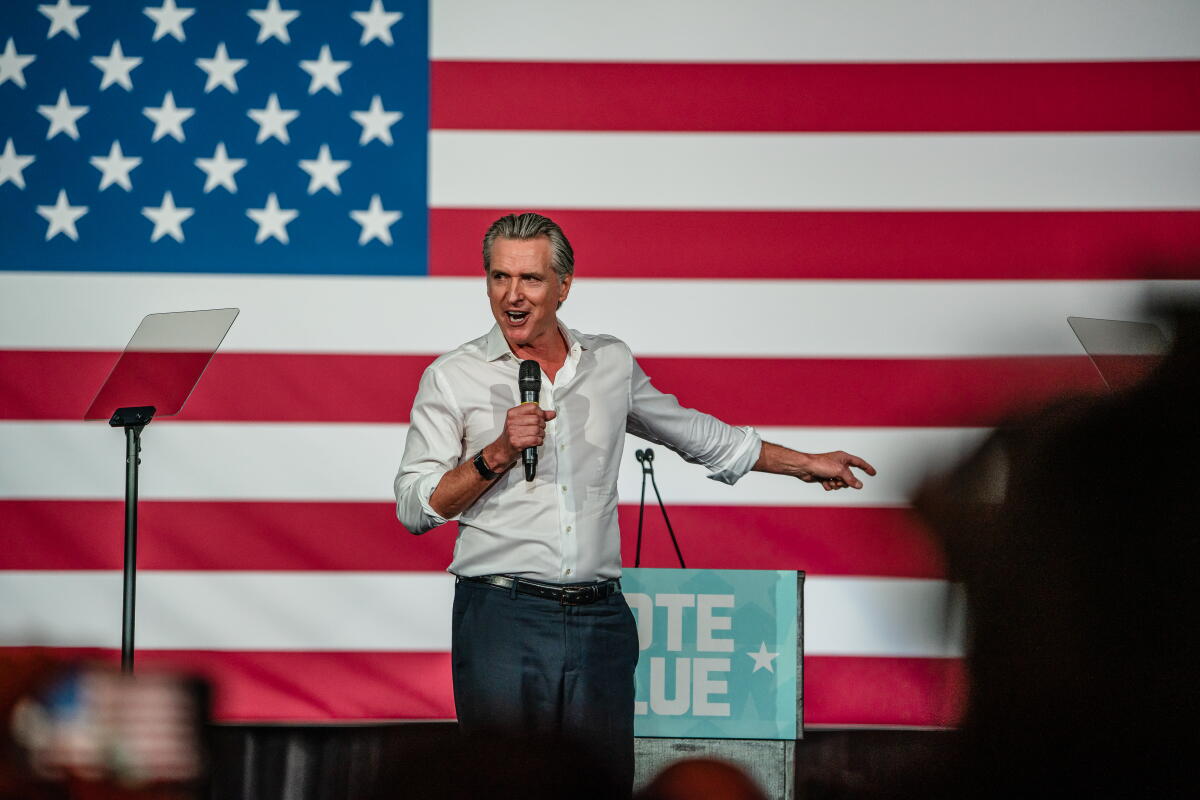
California Gov. Gavin Newsom speaks at a rally with a huge U.S. flag behind him

California Gov. Gavin Newsom speaks at the “Stop the Power Grab rally” at the Hollywood Palladium in Los Angeles on Nov. 1, 2026.

(Ariana Drehsler / For The Times)

Bold moves that test the limits of his power, such as a controversial, first-in-the-nation stay-at-home order during the early days of the COVID-19 pandemic and spearheading Proposition 50 last year to redraw California’s congressional districts to offset Republican attempts to gerrymander red states, have defined his leadership, for good or bad.

The Democratic governor said those kinds of decisions are “sort of embedded in my DNA.” About a decade ago he said he was pushed to describe his core motivation. Though he admits it sounds trite, the governor said: “It’s to stand up for ideals and strike out against injustice.”

The death penalty, he said, is not handed out equally. He quoted Bryan Stevenson, the founder of Equal Justice Initiative, who said you’re better off being rich and guilty than poor and innocent.

“I couldn’t not have done this,” Newsom said. “There was an easy out, but … I would the rest of my life felt, you know, ashamed of myself.”

Commuting the death sentences of all 548 state prisoners awaiting execution pushes the bounds of his authority once again. California voters have twice rejected ballot measures to abolish the death penalty, first in 2012 and again in 2016, and Newsom’s decision overrides the will of the courts and state laws that permit capital punishment.

Under the state Constitution, Newsom has the power to commute about 40% of the death sentences on his own. The rest of the cases, which involve prisoners who had a felony conviction on their record prior to receiving a death sentence, or racked up additional crimes while awaiting execution, require approval from the California Supreme Court — a constitutional check to ensure the governor’s actions are not an abuse of power.

The court rejected 10 commutations handed out by Gov. Jerry Brown in his last full month in office — all of which involved people convicted of multiple felonies — and did not provide an explanation for the action.

Despite Newsom’s push to commute all death sentences, capital punishment remains legal in California and prosecutors can continue seeking that punishment.

Los Angeles County Dist. Atty. Nathan Hochman speaks during a news conference at the Hall of Justice

Los Angeles County Dist. Atty. Nathan Hochman speaks during a news conference at the Hall of Justice last month.

(Ronaldo Bolaños / Los Angeles Times)

Los Angeles County Dist. Atty. Nathan Hochman said until the law is changed, his office “will continue to evaluate every death penalty-eligible case with the rigor, care and restraint these decisions demand.”

Sacramento County Sheriff Jim Cooper urged Newsom to reconsider the commutations.

He said he remembers watching Luis Bracamontes, who was sentenced to death for killing Sacramento County Sheriff’s Deputy Danny Oliver and Placer County Sheriff’s Detective Michael Davis Jr. in 2014, “laugh in court while their families, including Danny’s two young daughters, had to sit and watch.

“Deputy Danny Oliver and Detective Michael Davis Jr. should be alive today, enjoying long and healthy lives with their families,” Cooper said in a statement. “Instead, the man who murdered them has now escaped his sentence.”

Others accused the governor of reducing the death penalty sentences to seek an advantage in the 2028 presidential election.

“The people of California deserve leaders who put politics and personal ambition aside and pursue truth, accountability, and justice with courage, integrity, and transparency,” said Michael Hestrin, Riverside County district attorney, in a statement. “Instead they have been presented with a decision that demonstrates a profound disregard for the victims, their families, and the prosecutors who dedicated themselves to seeking justice on their behalf.”

Luis Bracamontes looks up as the verdict was read in the killing of two law enforcement officers.

Luis Bracamontes looks up in Sacramento Superior Court in 2018 as the verdict is read in the killing of two law enforcement officers. Bracamontes was found guilty.

(Rich Pedroncelli / Associated Press)

A poll conducted in August by the Pew Research Center found that about two-thirds of voters nationally favor the death penalty for people convicted of murder.

Political analysts suggest that reducing the sentences adds to Newsom’s credentials as a progressive leader and aligns him with Democratic primary voters on the issue if he runs for president. Republicans, however, could take advantage of Newsom’s action and cast him as a soft-on-crime liberal who is out of touch with most Americans, which risks turning away moderate voters.

But others cautioned that national political elections are hard to predict.

Gar Culbert, chair of the political science department at Cal State Los Angeles, said it would be politically advantageous for Newsom to try to appeal to the Democratic Party’s base as he considers a run for president. Culbert said he doesn’t believe the death penalty will be a substantial issue in a general election when, if Newsom becomes the Democratic presidential nominee, his Republican challenger would attack his record as California governor regardless.

“It’s possible he’s not being strategic,” Culbert said. “Maybe he doesn’t have to be strategic because he just might think it’s the right thing to do.”

The governor first issued a moratorium on executions about two months after he took office in 2019, saying capital punishment is discriminatory and unjust. Without the moratorium, 45 people would be subject to execution now, according to his office.

Daniel Zingale worked for Newsom as a senior advisor in the governor’s office at the start of his first term. Part of Zingale’s job at the time was to consider how the governor’s actions would be received by the public.

“The only piece of data he was not interested in in that process were the polls,” Zingale said. “His view, and I agree with this, is this is not an issue that you can leverage politically.”

Newsom’s decision to commute the sentences won’t have much practical effect in a state that has not executed a prisoner since 2006. At Newsom’s command, the death chamber was dismantled at San Quentin State Prison, now San Quentin Rehabilitation Center, after he issued his moratorium.

His successor, Gov.-elect Xavier Becerra, has also said he will continue the pause on executions.

There was no immediate need to offer commutations to save the lives of the inmates.

Taking no action would have been the safe bet, Newsom said in an interview about his decision a day after he made the announcement. Many people around him, he said, advised him to do nothing.

He also understands that commuting the sentences could make him vulnerable if he runs for president.

“I’m not an idiot. The ads write themselves,” Newsom said. “But I just also would be fake. I wouldn’t be myself and if I’m going to be up there and not be myself, I couldn’t do that.”

With the clock ticking on his time in office, the governor said he also doesn’t want to leave with regrets.

“I don’t want to be one of the elders on some panel talking about what I would have, could have, should have done,” Newsom said. “I’ve spent my life trying not to be that person. I’ve been willing to take risks. I’ve been willing to go first on so many issues.

“If others aren’t willing to do it, you know what? I’ll raise my hand, and I’m happy, honestly, to take the hits.”

Source link

Newsom moves to commute California death sentences to life in prison

Gov. Gavin Newsom told the California Supreme Court Thursday that he will commute the death sentences of all 548 state prisoners awaiting execution, reducing their punishments to life in prison without parole.

Newsom can commute about 40% of the death sentences with the stroke of a pen, but the rest will require the high court’s approval in order to be finalized.

The mass commutation would apply to inmates convicted of some of the most heinous acts in the state’s history. Newsom and other opponents of capital punishment have long argued that the process is costly, cruel and discriminatory, with death sentences disproportionately handed down to defendants of color.

“I take this action because I firmly believe that state-sanctioned killing is incompatible with California’s values, undermines the foundation of our legal system, and diminishes each of us,” Newsom wrote in a letter to Californians explaining his decision. “I know we cannot execute people in our imperfect legal system and remain true to our core values, first among them justice and human decency.”

The move comes in Newsom’s final months as governor and as he considers a run for president. Reducing the death sentences could help him in a primary with a Democratic base of like-minded liberal voters, but potentially hurt him in a general election with a national electorate that supports capital punishment.

The decision to officially spare the condemned inmates is largely symbolic in a state that has not executed a prisoner since 2006, though experts say it could save millions of dollars in court costs every year. Only 13 inmates have been killed since voters reinstated the death penalty in 1978. The state’s electorate reaffirmed its support a decade ago, voting down a ballot initiative that would have abolished capital punishment. Polls show its popularity has waned in the years since.

Despite his outspoken opposition to state-sanctioned executions, the governor has declined to use his political influence with voters to pursue a ballot measure that would amend the state Constitution to align with his position and officially end the death penalty. Without changing state law, criminals can continue to be sentenced to death in California.

“California voters have voted to keep the death penalty on the books and I respect that,” Newsom wrote in the letter to Californians. “But the constitution also gave every governor clemency authority, and that power exists for moments when law as applied cannot be squared with justice. For me, this is that moment.”

Newsom made national headlines two months after his inauguration in 2019 when he issued a temporary moratorium on executions and vowed to dismantle the death chamber at San Quentin State Prison, now called San Quentin Rehabilitation Center.

Calling the death penalty system a “failure,” Newsom said the punishment is also often reserved for poor people who cannot afford expensive legal representation, fails to deter crime and wastes taxpayer money.

Careful to avoid elevating a death penalty debate in the midterm elections, Newsom intentionally waited until after the general election on Tuesday to go a step further and launch the process of commuting all California death penalty sentences.

The decision is another bold signature Newsom move that sits well with his base of support in California and wealthy, white and college-educated national voters who would be crucial to his success in a Democratic presidential primary, said Mike Madrid, a Republican political consultant.

However, his liberal stance on government executions could also create a vulnerability for him if he advances in the 2028 presidential election as the party’s nominee.

“Gavin’s exactly right with that base Democratic voter on that position,” Madrid said. “One hundred percent. It makes him a champion.”

But more moderate blue-collar voters who helped the party flip Congress in the midterms, Madrid added, are “not in line with him on this.”

A poll conducted in August by the Pew Research Center found that about two-thirds of voters nationally favor the death penalty for people convicted or murder.

Those numbers could shift following the botched lethal injection of Christa Pike in Tennessee in September and Defense Secretary Pete Hegseth’s now-scuttled plan to livestream the execution of Ft. Hood shooter Nidal Hasan by firing squad.

“Those events have really ripped the veneer off the death penalty in this country,” said attorney Natasha Minsker of the California Anti-Death Penalty Coalition. “The death penalty is an act of violence. It’s taking another life. I think that’s become clear to the entire country.”

The state spends more than $200 million a year to adjudicate automatic death penalty appeals and habeas corpus petitions for inmates who, in all likelihood, will never be executed, according to a 2025 report by the Habeas Corpus Resource Center.

The case of Clarence Ray Allen, the last inmate killed by lethal injection in California 20 years ago, is emblematic of how the law has failed, death penalty opponents say.

Allen was 76, making him the second-oldest person ever executed in the United States. He had been on death row for 23 years and his appeals cost the state more than $750,000. Many current condemned inmates are even older — some in their 80s and 90s — and their appeals even more drawn out and expensive.

“It’s just a broken system,” said Michael Hersek, former executive director of Habeas Corpus Resource Center and an ex-state public defender.

Taxpayers foot the bill for both the defense and the prosecution in post-conviction capital cases, as well as the administrative judicial costs associated with years of complicated appeals in state and federal court.

The existing appeal requirements were instituted to counter long-standing racial bias in capital sentencing. Attempts to reform and expedite the appeals process over the years have further gummed up the system.

“There is no indication that the situation has improved, and … [there are] data indicating that it has worsened,” Justice Leondra R. Kruger wrote for the California Supreme Court in 2024.

It’s estimated that death penalty appeals alone constitute about a quarter of the work of the California Supreme Court.

“It’s ludicrous, the amount of time, resources and energy put into these cases,” Hersek said.

Some victims’ families agree.

“The death penalty is this promise to people who are angry and broken that you’re somehow going to make them feel better by executing this person,” said Bethany Webb, whose sister Laura was among eight people killed in a mass shooting in Seal Beach in 2011.

Their mother was also shot and badly injured in the attack.

“It is brutalizing to family members, the whole system,” Webb said.

Others say Newsom’s latest move is a betrayal of the justice they were promised.

“It’s total disrespect for the victims. It’s a slap in the face,” said Sandy Friend, whose 8-year-old son Michael Lyons was abducted, raped and murdered in 1996.

She and other relatives stressed the unique brutality of many capital crimes, saying Newsom did not consider victims’ suffering when commuting their killers’ sentences.

The commutations would go to inmates such as Charles Ng, who was convicted of killing six men, three women and two infant boys in Northern California in 1984 and 1985. Also in line to benefit is Richard Allen Davis, who abducted and murdered 12-year-old Polly Klaas of Petaluma in 1993, sparking a months-long search that gripped the nation. Another condemned inmate, Christopher Cheary, was convicted of murdering, raping and torturing his girlfriend’s 3-year-old daughter, Sophia Acosta, in Tulare County.

Gov.-elect Xavier Becerra also opposes the death penalty. If state leaders wanted to resume executions, experts say it would take the better part of a decade and millions of dollars in new spending for the state to design and approve a workable protocol for lethal injections, rebuild a death chamber and secure the gray-market drugs necessary to perform executions.

Legal experts believe the end of the death penalty is likely inevitable in California, with or without Newsom’s involvement.

In 2024, the Office of the State Public Defender sued California Atty. Gen. Rob Bonta’s office, arguing “persistent and pervasive racial disparities infect California’s death penalty system.”

This spring, the California Supreme Court ordered Bonta’s California Department of Justice to show cause why it should not declare the death penalty unconstitutional — a move widely read as signaling the justices’ ultimate intent to end it.

“The statistical findings in the studies invoked by petitioners are extraordinarily disturbing,” Bonta wrote in his reply to the order in August. “Evidence of pervasive racial disparities in the administration of the death penalty could show that California’s capital punishment system gives rise to a constitutionally intolerable risk of arbitrariness.”

Around 60% of the inmates in line for commutations would require review and approval by the California Supreme Court before Newsom’s term ends in January. Those cases involve prisoners who had a felony conviction on their record prior to receiving a death sentence, or racked up additional crimes while awaiting execution.

The high court previously rejected 10 clemency cases without much clarification when Gov. Jerry Brown submitted them in 2018 months before he left office.

If approved by the California Supreme Court, the immediate effect could be relatively muted. The death chamber was taken down and all but a handful of the remaining condemned inmates were relocated from segregated housing in San Quentin to other facilities across the state after Newsom’s 2019 moratorium.

The decision to formally pause executions drew support from the late Pope Francis during Newsom’s 2024 trip to the Vatican, according to the governor’s retelling of a brief conversation between the two men.

In a subsequent interview, the governor said his Catholic background and the inequities in the criminal justice system influenced his refusal to sign off on executions. His father, the late William Newsom, also opposed the death penalty.

His father and grandfather were involved in the case of Pete Pianezzi, a friend who was wrongfully convicted of first-degree murder in the shooting and killing of a gambler and busboy in Los Angeles in 1937.

Pianezzi escaped the death penalty by a single vote and served 13 years in prison. He was later exonerated.

Even if it were possible to limit inequity and wrongful convictions in the criminal justice system, Newsom has said he would still be against the death penalty.

“The decision is among the most difficult in my career, not because I doubt its necessity for our state but because I know its announcement may surface excruciating memories for victims’ families,” Newsom wrote in the letter to Californians. “Today I am acting on my long and deeply held conviction that individually and collectively we are stronger as a society when we reject state-sanctioned killing.”

Source link