EAST RUTHERFORD, N.J. — This summer’s World Cup will be remembered for a lot of things.
It was the first to be played in three countries, the first with 48 teams and the overall attendance nearly doubled the previous record. Norway’s Erling Haaland and Cape Verde’s Vozinha were captivating while Egypt and Canada both won World Cup games for the first time, advancing to the Round of 16.
And Spain, glorious Spain, gave up just one goal in eight games to dethrone the reigning champions and become the first nation in history to own both the men’s and women’s World Cup titles at the same time.
But the tournament will also be remembered for a classless and churlish Argentina, which forever stained itself with a thuggish performance in the game and an ungracious one afterward.
If La Albiceleste had simply kept its composure it would have secured a place next to Brazil and Germany, the only other countries to reach three finals in four World Cups, as one of the greatest teams of all time. Instead, some of its players turned the postgame handshakes into a brawl, with Argentine midfielder Leandro Paredes drawing a red card for grabbing Spain’s Eric Garcia by the throat and shoving him to the turf.
It was believed to be the only red card ever handed out after a World Cup final, and the ignominy it brought was well-deserved. But the childishness was just beginning. When Spain assembled on the podium to accept the World Cup trophy, which had been Argentina’s moments earlier, the South Americans turned their backs.
More than an hour later Lionel Messi, who has cemented his stature as the greatest player in World Cup history, soiled that status by leading the players out of the locker room and through a back exit to the team bus, avoiding the media many had been so eager to speak with during the team’s unbeaten run to the final.

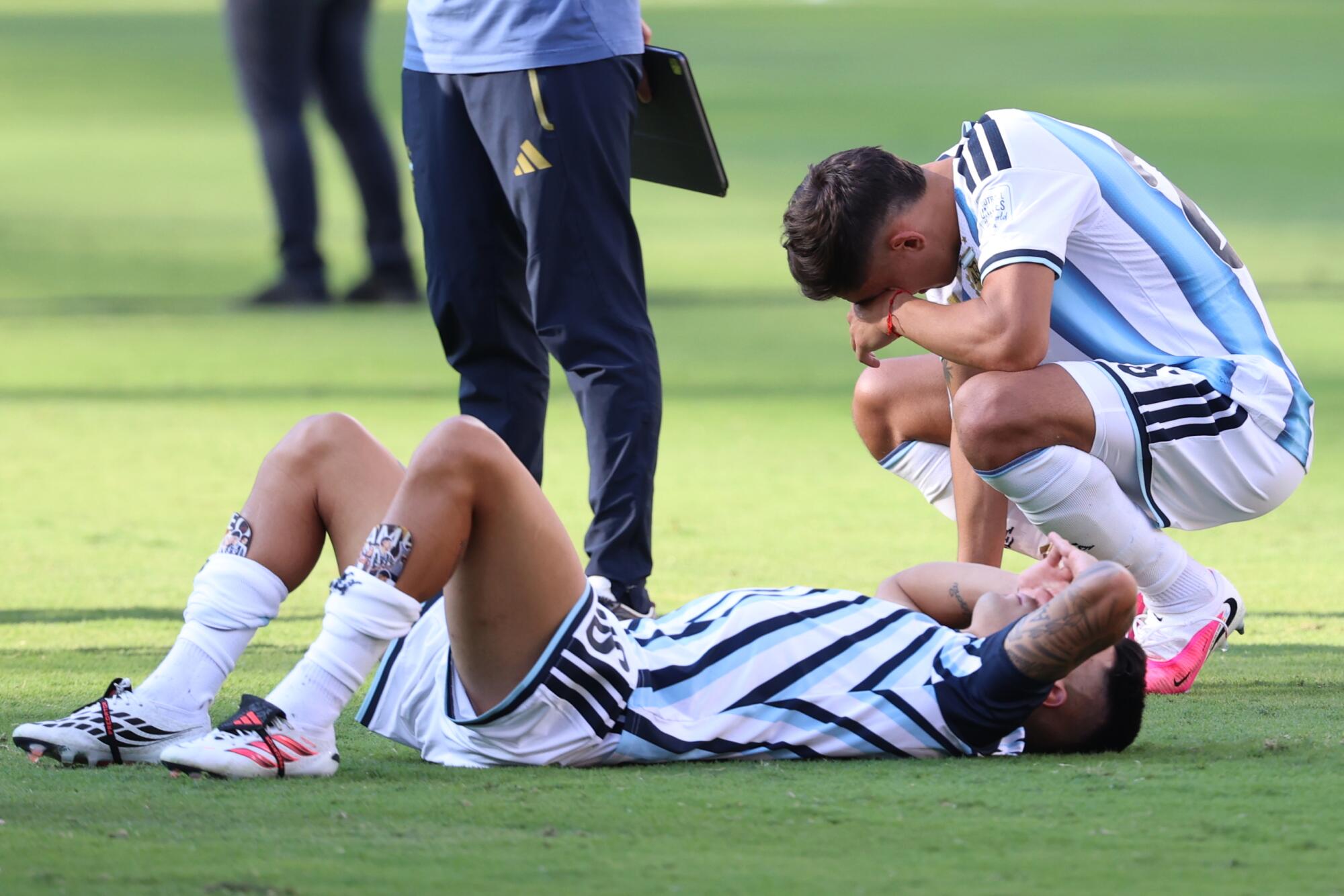
Argentina’s Nahuel Molina, top, reacts after Spain won the World Cup final between Spain and Argentina in East Rutherford, N.J.
(Pamela Smith / Associated Press)
It was an attack on class and decorum as well as violation of FIFA rules, which require players to leave the stadium through a “mixed zone” accessible to media. They are not required to stop or speak, but certainly someone owed some accountability to the tens of thousands of fans in Argentine jerseys who packed Times Square and MetLife Stadium over the weekend and the millions in Argentine who filled plazas and town squares to watch the team play.
“We’ve been great in victory and we need to be great in defeat,” Argentine coach Lionel Scaloni said moments after Paredes was booked for assault. “We have shown today that we know how to lose, too. We lost the game and we accept that.”
Scaloni, who did address the media, later broke down in tears.
“I already cried all the tears I had in the dressing room,” he said in Spanish.
Scaloni, 48, may be out of a job when his contract expires in December, but his message for the fans was don’t cry for me, Argentina.
“It is hard to ask people to enjoy this equally. It is very hard to convince people that this is a triumph,” said Scaloni, who has lost just twice in 15 World Cup games.
“When you win, not everything is good. When you lose, not everything is bad.”
But while Argentina was being petty and petulant, Spain was practically perfect in every way. Not only did it concede just one goal in the tournament, it held Argentina without a shot into extra time Sunday — the first time that’s ever happened in a World Cup final — and ran its unbeaten streak to a record 38 games overall.
The win, which came on substitute Ferran Torres’ goal moments into the second extra-time period — and less than 20 minutes after Argentina was reduced to 10 men when Enzo Fernández was given a second yellow card for a foolish tackle — not only made Spain the first country to be the men’s and women’s world champion at the same time, it also made it the first to be the men’s world, European and Olympic champion at the same time.
No country in history has dominated the sport as Spain is dominating it now. And since Spain is the second-youngest team to win the World Cup in 56 years, La Roja could be on top for some time.
“After the match, some of the players who have been with us the longest asked me ‘coach, what is left for us win? We’ve won everything,’” said Spain’s manager Luis de la Fuente. “I told them, well the next match in September.”
That’s a UEFA Nations League match with England, which finished third in this World Cup. A little further down the road is the 2030 World Cup, which Spain will co-host, making it the first country in history to defend its title at home.
“When you arrive at a moment like today and think about the journey we’ve taken, you realize the importance of that process,” said De la Fuente, a former youth national team coach who managed many of the players on the World Cup team — among them Dani Olmo, Mikel Merino, Mikel Oyarzabal, Unai Simón, the tournament’s top goalkeeper, and Rodri, tournament’s top player — to U-19 and U-21 European titles.
“We certainly wouldn’t be here today — we wouldn’t have achieved anything — without the journey we’ve shared with these players,” the coach continued. “We have that raw material, those wonderful Spanish footballers. And they way they compete, that is what brought us here.
“That goes back many years.”
De la Fuente, soft-spoken and professorial, is also scrupulously polite, an example many of his players follow. And while it is undoubtedly easier to display grace and dignity in victory than it is in defeat, the difference in the way Argentina and Spain exited the World Cup was far greater than the gap that separated them on the scoreboard, something De la Fuente unwittingly highlighted in speaking about his team late Sunday.
“It seems people were surprised that, alongside talent and brilliance, good people can also play the game,” he said. “This proves that it is possible; that good, supportive, generous people with strong values can form a genuine team.
“We played against the best national teams in the world, yet we were the best team. We demonstrated that a team built on good people — supportive people, people who hold values and principles that prioritize the common good over individual interests. Traveling with people like that makes for a better, safer journey.”
In Spain’s case, it also makes a World Cup champion.
Staff writers Eduard Cauich and Jad El Reda contributed to this story.