first time

How the Kings got to the brink of another first-round playoff exit

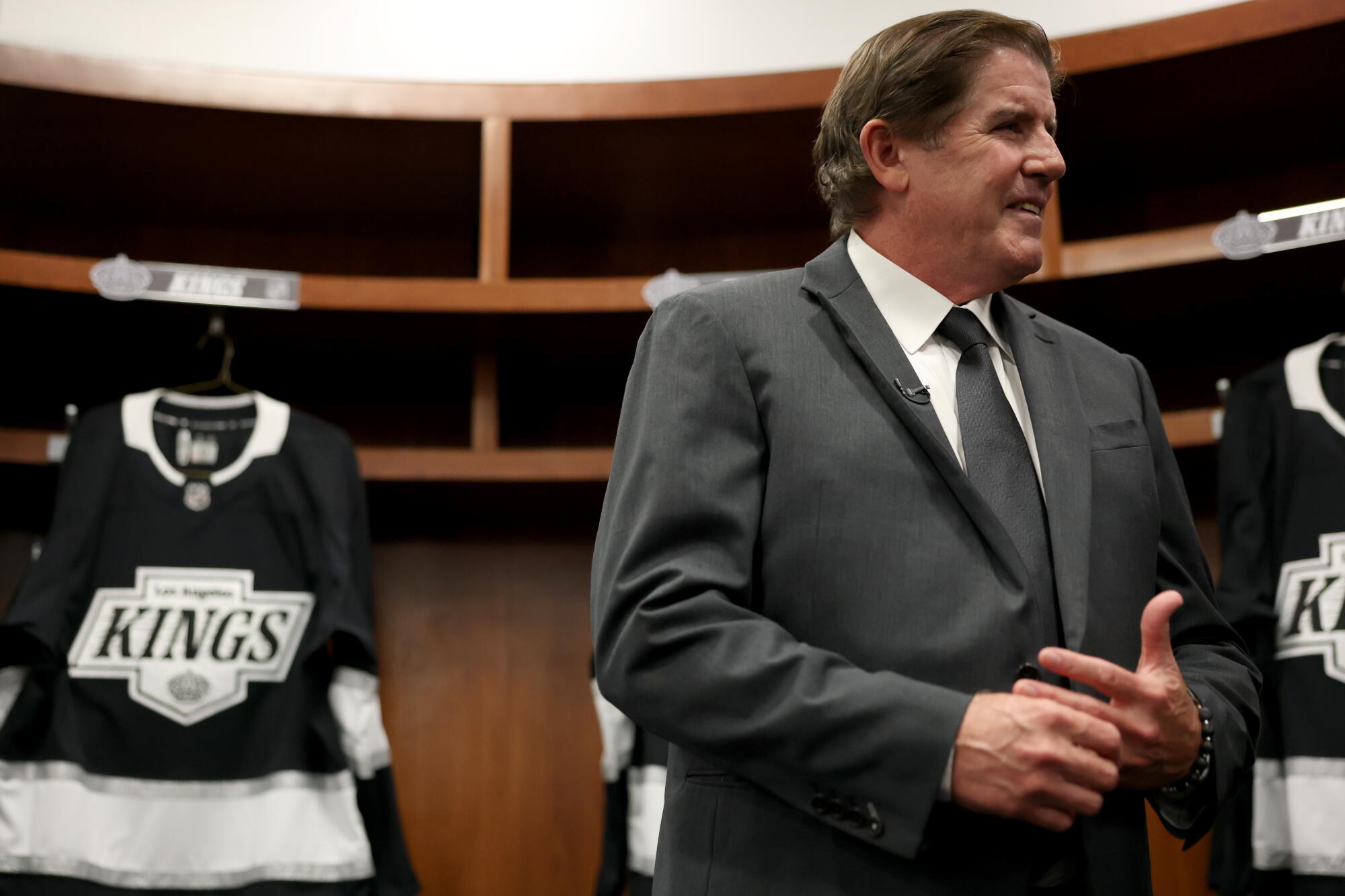
Kings coach D.J. Smith gave his team the day off Friday, but he sent his players home with a message: if they don’t show up for work Sunday, they’ll have the rest of the spring and summer off, too.

Players don’t like to call any game a “must-win” because of the pressure it brings, but there’s no other way to look at Sunday’s game for the Kings. After losing the first three games of their best-of-seven playoff series with the Colorado Avalanche, the Kings are one loss away from being eliminating in the first round for a fifth consecutive season.

“Must-win game,” agreed defenseman Drew Doughty, who hasn’t played on a winning team in a playoff series since the Kings last won the Stanley Cup in 2014. “Everyone’s going to give everything and we’ve got to win that one. And then hopefully go back to Denver.”

The most recent loss came Thursday when the Avs scored two fluky goals on pucks that bounced in off the skates of Kings players and put another one into an empty net in a 4-2 victory that pushed the Kings to the brink of elimination once again.

“You don’t like the result,” Smith said. “And it’s tough to swallow.”

For Colorado, the best team in the NHL during the regular season, it hasn’t been the most stylish of postseasons. But after a pair of hard-fought 2-1 wins at home, the Avs have a chance to sweep a playoff series for the first time since 2022, when they won their last Stanley Cup.

“All the games have been tight. We’re right there,” forward Quinton Byfield said. “Each guy, including myself, we just have to give a little bit more.

“We’re doing the right things, we just have to dig in a little bit more.”

It’s hard to say how. The Kings’ power play has been good, scoring a goal in each of the three games, and their penalty kill even better, shutting out the top-scoring team in the NHL on nine tries with a man advantage.

The Kings have been physical and fast and goaltender Anton Forsberg has been brilliant in his first career playoff series, making 90 saves in the three games. Yet none of that has paid off with a win.

“Sometimes you play real well for stretches and you don’t get the results. And then you’ll win a game you don’t deserve to win,” Smith said. “Maybe we didn’t stay with it long enough.”

“Those games are over with,” a frustrated Byfield added. “You can’t look back at those games. It’s just on to the next one, that’s our focus.”

Doughty said the Kings need to wear down the Avalanche, something they clearly couldn’t do in the two games played in Denver’s mile-high altitude. They might have a better chance Sunday at sea level.

“I don’t think we’re creating enough Grade A chances,” he said. “They’re statistically one of the best teams in the neutral zone. So for us to beat them, we’ve got to wear them down in the D zone, make them tired and score goals that way. We haven’t done that enough.”

Every team has its kryptonite and the for the Kings that appears to be the first round of the playoffs. Over the past dozen seasons, the team has gone 9-27 in the postseason, taking a series to a seventh game just once in six tries. Along the way they’ve changed general mangers twice, changed head coaches five times and even changed their opponents, facing the Avs this year after losing four straight series to the Edmonton Oilers.

None of that has changed the results.

Smith, in fact, is an interim coach, having taken over for Jim Hiller with 23 games left in the regular season. He figures to be coaching for his future Sunday since a playoff sweep won’t look good at his resume.

“There’s no quit in there,” Smith said of the Kings’ locker room. “We’ll get reset with practice [Saturday] and I think you’re going to see our best effort.

“Now we’ve got to make a few changes and see if we can spark something.”

If that works, the Kings will be heading back to Denver. If it doesn’t, they’ll be heading home for another long summer.

Source link

Bob Spitz proves Rolling Stones are rock’s greatest band in biography

By early 1963, the Station Hotel in London had become an epicenter of the burgeoning British blues scene. On a blustery, snowy night that February, the Rolling Stones’ classic early lineup took the stage for one of the first times, dazzling the audience with ferocious renditions of blues standards like Muddy Waters’ “I Want to Be Loved” and Jimmy Reed’s “Bright Lights, Big City.”

Multi-instrumentalist Brian Jones, the band’s founder and leader, synchronized guitars with Keith Richards, who favored a distinctive slashing and stinging style. Drummer Charlie Watts, the group’s newest member, a jazz aficionado and an accomplished percussionist, propelled the music forward with a rock-solid beat.

Anchoring the rhythm section with him was bassist Bill Wyman, who was recruited more for his spare VOX AC30 amp that the guitarists could plug into than for his musical skills. The stoic bassist proved a strong and innovative player. Together, he and Watts would go on to form one of rock’s most decorated rhythm sections.

Ian Stewart’s energetic boogie-woogie piano style rounded out the sound. Months later, manager Andrew Loog Oldham kicked him out of the band for being “ugly,” although Stewart continued to record, tour and serve as the band’s road manager until his death in 1985.

The Rolling Stones rehearse on a stage under lights in 1964

This April 8, 1964, file photo shows the Rolling Stones during a rehearsal. The members, from left, are Brian Jones, guitar; Bill Wyman, bass; Charlie Watts, drums; Mick Jagger, vocals; and Keith Richards, guitar.

(Associated Press)

Fronting the group was Mick Jagger. Channeling the music like a crazed shaman, Jagger shimmied and sashayed, owning the stage like few lead singers have before or since. By the end of the night, the Stones had the crowd in a frenzy. Although only 30 people had made it to the gig because of the treacherous weather conditions, the hotel’s booker had seen enough: He offered the Stones a regular gig.

“The Rolling Stones had caught fire. The music they were playing and the way they played it struck a chord with a young crowd starved for something different, something their own… It was soul-stirring, loud and uncompromising,” writes Bob Spitz in “The Rolling Stones: The Biography,” his magisterial work that charts the 60-year journey of “the greatest rock and roll band in the world.”

Spitz, the author of strong biographies on the Beatles and Led Zeppelin, as well as Ronald Reagan and Julia Child, captures the drama, trauma and betrayals that have kept the Stones in the public’s consciousness for more than six decades. It’s all here: The Stones’ evolution from a blues cover band to artistic rival of the Beatles; the musical peaks — “Aftermath,” “Let It Bleed” and “Exile on Main Street” as well as misfires like “Dirty Work”; Keith’s descent into a debilitating heroin addiction that nearly destroyed him and the band; the death of the ‘60s at the ill-fated Altamont free concert; Marianne Faithfull, Anita Pallenberg, Bianca Jagger, Jerry Hall and other lovers, partners and muses; the breakups, makeups and crackups; and perhaps most important, the unbreakable bond between Jagger and Richards at the center of it all.

Although Spitz unearths little new information, he excels at presenting the Stones in glorious Technicolor. Spitz homes in on the telling details and anecdotes that give the band’s story a deep richness and poignancy.

Take “Satisfaction,” the Stones’ 1965 classic and first U.S. chart topper. The oft-told story is that Richards woke up in the middle of the night, grabbed the guitar that was next to his bed, and recorded the iconic riff and the phrase “I can’t get no … satisfaction” on a cassette recorder in his Clearwater, Fla., hotel room before falling back asleep. But as Spitz notes, the song initially went nowhere in the studio. That is until Stewart purchased a fuzz box for Richards a few days later, which gave the tune a raunchier sound that perfectly matched Jagger’s lyrics of frustration and alienation. A classic was born.

Piercing the Stones mythology

Spitz’s deep reporting often pierces the mythology surrounding the band. Contrary to the popular belief of many fans, for instance, Jones bears much of the responsibility for the rift with his bandmates and his tragic demise.

The most musically adventurous member of the group — he plays sitar on “Paint It Black” and dulcimer on “Lady Jane” — Jones wasn’t a songwriter. That stoked his jealousies and insecurities, along with frontman Jagger stealing the spotlight from him. A monster of a man, Jones impregnated multiple teenage girls and physically and emotionally abused several women, including Pallenberg. Perhaps that’s why she left him for Richards. Over time, Jones made fewer contributions in the studio and onstage, becoming a catatonic drug casualty. The Stones fired Jones in June 1969 but would have been justified doing so a couple years earlier. He drowned in his pool less than a month later.

Author Bob Spitz

Author Bob Spitz

(Elena Seibert)

Similarly, Stones lore has long romanticized the making of “Exile on Main Street” in the stifling, dingy basement of Richards’ rented Villa Nellcôte in the South of France, where the Stones had decamped to avoid British taxes. In this telling, Richards, deep in the throes of heroin addiction, somehow managed to come up with one indelible riff after another built around his signature open G tuning — taught to him by Ry Cooder — leading the band to create one of the best albums in rock history. That’s not entirely accurate, according to Spitz.

Yes, Richards came up with the licks for “Rocks Off,” “Happy” and “Tumbling Dice.” But it’s equally true that a strung-out Richards missed myriad recording sessions, invited dealers, hangers-on and other distractions to Nellcôte, and repeatedly failed to turn up to write with Jagger. Far from completing the album in the druggy haze of a French basement, the band spent six months on overdubs at Sunset Sound in Los Angeles, where Jagger contributed many of his vocals.

Beatles vs. Stones

One of the more interesting themes Spitz develops is the symbiotic relationship between the Beatles and Stones, with the Fab Four mostly overshadowing them — until they didn’t.

John Lennon and Paul McCartney wrote “I Wanna Be Your Man” and gave it to the Stones, whose 1963 rendition, with Jones on slide guitar, became the group’s first UK Top 20 hit. The Lennon-McCartney songwriting partnership inspired Jagger and Richards to begin penning their own songs. In early 1964, the Beatles came to the U.S. for the first time, making television history with their appearance on “The Ed Sullivan Show” and playing Carnegie Hall. A few months later, the Stones kicked off their inaugural American tour at the Swing Auditorium in San Bernardino. In 1967, the Beatles released “Sgt. Pepper’s Lonely Hearts Club Band,” a psychedelic masterpiece. The Stones responded with “Their Satanic Majesties Request,” a psychedelic mess.

The Rolling Stones: The Biography cover

The Rolling Stones: The Biography cover

As the Beatles began to splinter, Spitz writes, the Stones sharpened their focus. The band released “Beggars Banquet” in late 1968 and “Let It Bleed” the following year, albums every bit as innovative and visionary as “The White Album” and “Abbey Road.” For the first time, the two groups stood as equals.

When the Beatles broke up in 1970, the Stones kept rolling. With Jones replaced by virtuoso guitarist Mick Taylor — whose fluid, melodic style served as a tasty foil to Richards — they produced what many consider their finest works, “Sticky Fingers” and “Exile on Main Street.” More impressively, the band, with Taylor’s successor, Ronnie Wood, has continued to dazzle audiences with incendiary live shows, touring as recently as 2024 behind the late-career triumph “Hackney Diamonds.” The Beatles, by contrast, retired from the road in 1966 and devoted their energies to the studio.

Hundreds of books have been written about the Rolling Stones, but few sparkle quite like Spitz’s. For anyone who loves or even likes the Stones, it’s indispensable.

Like most of the band’s biographers, Spitz gives short shrift to the post-“Exile” period after 1972. He curtly dismisses 2005’s strong “A Bigger Bang” and 2016’s “Blue & Lonesome,” a back-to-basics album of blues covers, as “adequate endeavors that signaled a band living on borrowed time.” That critique is both off target and under-developed. Spitz ignores the band’s legendary live album, “Brussels Affair,” recorded in 1973, or why the band waited decades before officially releasing it.

These are small quibbles. Spitz has written a book worthy of its 704-page length; another 50 or so pages covering the later years would have made it even stronger. To quote the Rolling Stones: “I know it’s only rock ‘n roll, but I like it, like it, yes, I do.”

Marc Ballon, a former Times, Forbes and Inc. Magazine reporter, teaches an advanced writing class at USC. He lives in Fullerton.

Source link

Ryan Ward has solid Dodgers debut, bullpen blows it again at Rockies

What do you know? The once-stampeding Dodgers have been caged by the Colorado Rockies.

With a 9-6 loss Sunday at Coors Field, the two-time defending World Series champions lost back-to-back games for the first time this season. The Dodgers again couldn’t hold a lead, letting the Rockies tee off for 15 hits.

Nor could the Dodgers keep up offensively at the hitter-friendly park — though they put some pressure on in the ninth inning, when Shohei Ohtani led off with a ground-rule double and the Dodgers scored twice to cut the lead to three runs. Then the new guy, Ryan Ward, made the final out in his big league debut, robbed of a hit and a chance to keep chipping away by a diving Troy Johnston in right field.

Before that, the Rockies — who beat the Dodgers twice in 13 meetings all of last season — chased starter Roki Sasaki from the game in the fifth inning and then ruffled the Dodgers’ relievers. That included closer Edwin Díaz, who came on in the eighth and promptly gave up three singles, a walk and two runs before being pulled with the Dodgers trailing 8-4.

Dodgers starting pitcher Roki Sasaki follows through on a throw during a game in Denver.

Dodgers starting pitcher Roki Sasaki gave up three runs on seven hits in 4-2/3 innings Sunday against the Rockies in Denver.

(David Zalubowski / Associated Press)

He and Blake Treinen combined to face eight batters without getting an out.

“They both weren’t sharp,” said manager Dave Roberts, who had theories but not many answers — though he did have real concern, especially about Díaz, who recently had his right knee checked out by the medical staff.

Roberts said the closer wanted to pitch after nine days off, even though it wasn’t a save situation. But his velocity was slightly down (95.4 mph vs. 95.8) and so, “today was a tough evaluation,” the manager said.

“It really was,” Roberts said. “Because, you know, I know what it’s supposed to look like, and when it doesn’t look like that, it gets a little concerning, really.”

And losing for the second time to the Rockies, who are now 9-13? Being in danger of losing their four-game series, after arriving in Denver without having lost to a National League opponent, against a club that hasn’t made the postseason since 2018?

It’s well below the bar the Dodgers have set, and it added a bitter note to Ward’s otherwise sweet debut.

Ward punched a big league clock for the first time wearing No. 67 and cranked his first hit off Rockies starter Michael Lorenzen in the fourth inning, lining a changeup to right field for a single that scored Andy Pages, made it 3-0 and got the 20-some members of Ward’s party up, jumping in place, hugging and high-fiving.

“When I was on first base, I got to see them all jumping around up there,” Ward said. “That was a pretty special moment.”

He also singled in the sixth and swung on the first pitch in his first at-bat, a fly out in the third inning.

The Dodgers gave Sasaki a 2-0 lead in the third. Alex Freeland drove in Hyeseong Kim, and Shohei Ohtani doubled in Freeland — and extended his career-best on-base streak to 51 games, moving past Willie Keeler into third place in Dodgers history.

Sasaki went 4-2/3 innings, threw 78 pitches and gave up three runs on seven hits, striking out two and walking two. His ERA after his fourth start: 6.11, worst in the six-man rotation.

The Dodgers fell behind 6-4 in the seventh when Treinen — who was cleared Friday after he was struck in the head by a batted ball during batting practice — gave up four consecutive hits, including a two-run home run by Mickey Moniak.

The result likely will be a minor detail when Ward tells the story years from now about getting the call after first baseman Freddie Freeman was placed on the paternity list.

The Dodgers’ No. 19 prospect and reigning Pacific Coast League MVP spent the last seven years in the minors. Last season, he hit 36 home runs and drove in 122 runs with a .937 on-base-plus-slugging percentage for triple-A Oklahoma City, and he has a 1.020 OPS and four homers this year.

Ward made it a point to improve his chase rate, draw more walks and get on base more frequently, everything the Dodgers asked of him. He also passed the broadest patience test.

“The plate discipline, being a better hitter … he’s done all that,” Roberts said. “He’s improved his defense. But honestly, for me, just not to let his lack of opportunity in the big leagues deter him. That’s easy when you get frustrated and let it affect performance, and he hasn’t done that.”

If anything, Ward said, the waiting made him better.

“I used it to keep going. ‘OK, if I’m not there yet, what do I have to do to get there?’” he said. “‘What part of my game do I need to work on to keep getting better?’

“I used it as fire to keep working.”

That will be the Dodgers’ assignment too.

In the finale of the four-game series Monday, the Dodgers are expected to start left-hander Justin Wrobleski (2-0, 2.12) against Colorado left-hander Jose Quintana (0-1, 5.63).

Source link

Coachella 2026: Sabrina Carpenter brings out Madonna to perform new song ‘I Feel Free’

Anyone who thinks Coachella’s biggest surprises are reserved for Weekend 1 was proven wrong Friday night as Sabrina Carpenter welcomed Madonna on stage during her Weekend 2 headlining set. The crowd exploded with waves of cheers as the iconic pop star came on stage.

Madge joined Carpenter as a surprise guest during “Juno,” in which Carpenter reemerged in a gown that was a nod to Botticelli’s “The Birth of Venus” for a torch-passing duet of Madonna’s 1990 pop-house gauntlet “Vogue.”

The classic was followed by the debut of the gloriously upbeat “I Feel Free,” the first track from the pop icon’s forthcoming new album “Confessions II,” due out July 3.

The singer announced the record, a sequel to 2005’s “Confessions On A Dancefloor,” on April 15, alongside a 60-second teaser video for “I Feel Free.”

The Coachella performance, however, marks the first time the song has been heard in full — a fitting full circle moment 20 after Madonna played the Sahara Tent in 2006, complete with the same boots and costuming from that gig. “Confessions II” will be Madonna’s first full-length album since 2019’s “Madame X.”

  • Share via

“Let’s try to be together. Let’s try to avoid disagreements,” Madonna said as she spoke about the moon and planets aligning.

Before the pair ended with “Like a Prayer,” accompanied by a choir, Madonna had another reason to be grateful.

“This is probably the first time I’ve ever performed with someone shorter than me,” Madonna said to Carpenter as the crowd laughed. “Thank you for giving me that experience.”

Senior Audience Editor Vanessa Franko contributed to this report.

Source link

Kings (vs. Avalanche) and Ducks (vs. Oilers) face tough first-round task in NHL playoffs

The Kings looked nothing like a playoff team heading into the NHL’s trade deadline. They had lost six of their last eight games, had just fired their coach and had saw their second-leading scorer go down with a broken leg in the Olympic tournament.

They were backing away from the playoffs, not heading toward them. So general manager Ken Holland did the prudent thing and largely stood pat, trading a couple of veterans for draft picks and making only a pair of minor acquisitions.

Turns out he wasn’t waving a white flag but rather a green one because the Kings hit the gas after that, gathering points in 16 of their final 20 games, finishing the regular season as one of the hottest teams in the NHL. That earned them a fifth straight trip to the playoffs and a first-round meeting with the Colorado Avalanche, the league’s winningest team, beginning Sunday in Denver.

The Ducks, meanwhile, advanced to the postseason for the first time since 2018 but they stumbled in, losing eight of their last 10 and blowing a five-point lead in the Pacific Division and the home-ice advantage that went with it over the final three weeks. The Ducks, the third-place team in the Pacific Division, will start on the road in Edmonton on Monday.

Kings interim coach D.J. Smith during a game in March in Boston.

Kings interim coach D.J. Smith during a game in March in Boston.

(Charles Krupa / Associated Press)

“It’s been a climb. Probably didn’t look very good a while ago,” said Kings interim coach D.J. Smith, who could lose the interim part of that title after going 11-6-6 after replacing Jim Hiller behind the bench with 23 games to play. “It’s a credit to the guys, the leadership. They played playoff hockey for a while now. And it’s allowed us this opportunity.”

Actually, crediting the Kings with playing playoff hockey isn’t necessarily a compliment since the team hasn’t won a postseason series since hoisting the Stanley Cup in 2014. But it’s been more than a decade since the Kings have entered the playoffs carrying this kind of momentum and they have a few people to thank for that.

Anton Forsberg has been key for the Kings down the stretch.

Anton Forsberg has been key for the Kings down the stretch.

(Ronald Martinez / Getty Images)

Journeyman goaltender Anton Forsberg, who spent most of his first season in Los Angeles backing up Darcy Kuemper, won five straight starts in April to key the Kings’ fast finish. Russian winger Artemi Panarin, acquired from the New York Rangers just before the Olympic break and a month before the trade deadline, contributed nine goals and 18 assists in 26 games, helping make up for the loss of forwards Kevin Fiala and Andrei Kuzmenko to injuries. And Quinton Byfield scored 10 times in his final 13 games to set a career high with 24 goals.

“Since the break I feel like we’ve really come together as a group,” Byfield said.

The team displayed uncommon grit as well, going to overtime an NHL-record 33 times. (They lost 20 of those games; if they have gotten the second point in just a third of those, they would have won the division.)

And finally, the Kings were also fueled by a desire to give captain Anze Kopitar one more chance at a title. Kopitar, who announced in September that this season would be his last, gave an emotional good-bye speech to the fans after the final regular-season home game. His teammates were determined to give him an encore in the playoffs.

“That had a lot to do with it,” Smith said. “Guys were playing for him. He gets one more chance to play at home.

“We found a way.”

Kopitar, however, credited his coach for the team’s fast finish.

“Once Smithy came in, he just changed the energy a little bit and we’re trying to be a little more aggressive versus sitting back,” said Kopitar, the Kings’ all-time leader in games, points and assists.

Anaheim Ducks left wing Cutter Gauthier stands on the ice during.

Cutter Gauthier is the first Duck to score 40 goals in a season since Corey Perry in 2013-14.

(Melissa Majchrzak / Associated Press)

For the Ducks, they’re not only returning to the playoffs for the first time in eight seasons — only the Detroit Red Wings have a longer active postseason drought — but they also posted a winning record for the first time since 2018.

Troy Terry, who played two games as a rookie that season, is the only Duck remaining from that team.

“This year has just felt different from the start,” he said. “It was less question marks about the potential of the team. We knew what we could be.”

Which isn’t to say it’s been easy. The team had two seven-game winning streaks but also weathered losing streaks of nine and six games.

“We had a couple of roller coasters there, starting and then slowing down and getting back on it,” said coach Joel Quenneville, who has taken five teams to the NHL playoffs, winning three Stanley Cups in Chicago.

The Ducks’ 273 goals this season are the most in franchise history but the 288 they allowed is third-worst all time, leaving the team with the second-highest goal differential of any playoff team. (Only the Kings are worse at -22.)

Speaking of history, winger Cutter Gauthier, with 18 goals in the final 23 games, is the first Duck to score 40 goals in a season since Corey Perry in 2013-14. At 22, he’s also the second-youngest to get there, trailing only Paul Kariya.

Source link

‘Dr. Pimple Popper’ Sandra Lee is coming back from a stroke

Last fall, “Dr. Pimple Popper” suddenly became a patient herself.

Dr. Sandra Lee, the reality TV dermatologist and surgeon known for tackling ick-inducing skin situations on camera, had a bad day a week before Thanksgiving 2025 while she was taping new episodes of her show at her Upland office.

“I had what I thought was a hot flash. I got super sweaty and didn’t feel like myself,” she told People in an interview published Tuesday. She said she finished the shoot and then headed to her parents’ nearby home, where that evening she experienced shooting pains in one leg and later had trouble navigating down a flight of stairs in the middle of the night.

When she awakened the next day, she said, her left side wasn’t working properly and she was having trouble speaking clearly. It was definitely more than a hot flash.

Her doctor dad — also a dermatologist — told her to get herself to an ER, where she had an MRI that showed evidence of an ischemic stroke, where a vessel supplying blood to the brain gets obstructed. The diagnosis was a shock.

“As a physician I couldn’t deny that I had slurred speech, that I was having weakness on one side,” she said, “but I was like, ‘Well, this is a dream, right?’”

Lee, 55, said unmanaged cholesterol levels and high blood pressure were likely contributors to the stroke, plus the stress of balancing her real-life practice with the demands of “Dr. Pimple Popper.” She returned to production in January, she said, though she was more than a little freaked out.

“I don’t like that I don’t have total control of my left hand or the grip wasn’t as strong. If I feel like I’m not at my best — it’s very scary,” Lee said.

Her neurologist told the outlet that Lee’s symptoms are pretty much gone. Lee said she still notices slight differences when she speaks.

The TV doc is on blood thinners now and is still doing some physical therapy after spending two months post-stroke working through PT and occupational therapy. Lee had to make sure her left hand, among other body parts, was functional and that her balance and movement bounced back.

She does, after all, do precise procedures on camera for the Lifetime audience.

And with new episodes of “Dr. Pimple Popper” set to debut Monday for the first time since 2023, Lee remains fascinated by the people who spend time watching her do extractions and excisions, both on the show and online.

“People watch the videos over and over again because it helps them go to sleep at night,” she told People. But, she added, “Others watch it like it’s a scary movie or a roller coaster.”


Source link

‘Percy Jackson’ star Walker Scobell skipping prom amid death threats

Walker Scobell just wants people to stop sending death threats to every teenage girl who might know him — and anybody else.

The 17-year-old “Percy Jackson and the Olympians” star announced Sunday on social media that he will be skipping his prom and called out those who are threatening everyone who could potentially be in his orbit because of where they live.

“Just to let everyone know, I will not be attending prom,” Scobell, who plays the titular demigod in the Disney+ series, wrote in a message posted to his Instagram Story. “Please stop sending death threats to EVERY teenage girl who could remotely be associated with me based on their proximity to where I live. It’s not fair to them or their families.”

“Maybe also just stop sending death threats in general,” he added. “That’s just not cool. Kinda weird I have to say this.”

“Kinda weird” indeed.

Based on the book series by Rick Riordan, “Percy Jackson” is a coming-of-age twist on ancient Greek mythology that follows Sobell’s title character as he learns he is the half-human son of Poseidon and what that means for him. Scobell was 13 when he was cast in the show.

The actor previously said that it felt “a little bit weird” to go back to school after the first season of the series had been released but it helped that he’s been going to the same school since the fourth grade.

“Because I feel like I know everybody so well, and I’ve known them for such a long time that … it’s weirder to act like it’s weird,” Scobell told People earlier this year. “I feel like you just accept it right away, and everyone has, which has been super nice for me.”

This is not the first time the “Percy Jackson” franchise’s so-called fans have been out of line.

Aryan Simhadri, who portrays Percy’s best friend Grover Underwood in the series, spoke out last year about an unsettling encounter with a handsy fan when a group of “40 drunk college girls” recognized him.

“I was feeling pretty uncomfortable, so I put my hands in my back pockets,” Simhadri told Entertainment Weekly. “And then she reached around and put her hand inside of my back pocket, with my hand already in there. There’s not enough room in the back pocket of jeans for more than one hand. She lingered there a little longer than I would have liked. Not that I would have liked it at all.”

And Leah Jeffries, who plays Percy’s other best friend, Annabeth Chase, was the target of racist backlash when her casting was announced in 2022. Riordan, who also co-created the show, slammed the attacks in a blog post at the time, saying, “We should be able to agree that bullying and harassing a child online is inexcusably wrong.”

Source link

Why the Dodgers are being careful with using Edwin Díaz

As Dodgers closer Edwin Díaz prepared to play catch on the field before the series finale Sunday against the Texas Rangers, he hoped to be available in a save situation.

“I’m really happy with how I’m feeling today,” he said, emphasizing that he wasn’t dealing with any physical ailments.

He’d been unavailable the night before during the Dodgers’ 6-3 win. So, manager Dave Roberts went to right-hander Blake Treinen to begin the ninth, and then, after a walk and an error by third baseman Max Muncy, had left-hander Alex Vesia come in to get the last out.

On Friday, Díaz had blown a save opportunity for the first time in his early Dodgers tenure. But Muncy’s walk-off homer secured the win.

Díaz’s velocity has been down this season and Friday, his fastball velocity sat at 95.5 mph and slider at 87.8, according to Statcast, 1.7 mph and 1.3 mph down from last season, respectively.

“Two miles an hour, that’s pretty significant,” Roberts said Sunday. “So I think that’s why we sort of flagged it. We wanted to have him down [Saturday] and kind of see what we get. Because a couple days ago there were a lot of throws in there too. So just trying to also, like we’ve done many times, play the long game with our guys.”

Roberts described his level of concern as “low.” Díaz also emphasized to the coaching staff that he felt good. Roberts didn’t think the velocity dip stemmed from mechanical issues.

“Today I’m still kind of yellow-lighting him,” Roberts said before the game.

Diaz described lower velocity early in the season as a theme since he tore the patellar tendon in his right knee in 2023.

“But as soon as the season starts going, I start feeling better and better and better,” Díaz said. “And my velo at the end of the year will be what I’m throwing always.”

The last two seasons, Díaz’s fastball velocity averaged 96.6 mph in March and April, compared to 97.7 in August and September, according to Statcast. His only injured-list stint in that time, for a right shoulder impingement, sidelined him for the first couple of weeks of June 2024.

Before Díaz’s three-run inning Friday against the Rangers, he had given up only one run and two hits in five appearances.

Dodgers pitcher Edwin Díaz sits in the dugout after blowing a save, giving up three runs against the Rangers on Friday.

Dodgers pitcher Edwin Díaz sits in the dugout after blowing a save, giving up three runs against the Rangers on Friday.

(Gina Ferazzi/Los Angeles Times)

“I didn’t have my life on my fastball and I couldn’t command my slider the way I wanted to,” Díaz said of his blown save. “I was feeling good. But I didn’t have my best stuff that day. That’s part of the game. I just flush it right away.”

His addition has helped elevate the bullpen — which owned a 3.38 earned-run average entering Sunday, an improvement from last year (4.27) — through not only his own performance but also by pushing his fellow relievers up an inning.

On the other end, Dodgers starters had thrown at least six innings in each of their last four games to minimize the tax on the bullpen.

“Everybody’s doing their job,” Díaz said. “All the guys are putting a lot of work together. We are winning a lot of close games. That’s something we want, to help this team to win.”

Source link

L.A. Times readers celebrate UCLA women’s basketball’s title win

Four years ago, at the McDonald’s All-American game, future Bruins Kiki Rice and Gabriela Jaquez stood side by side at the end of the contest, having been named co-MVPs. It was the first time the two MVPs of the annual event were headed to the same college program.

Now, as the only remaining members of UCLA’s 2022 No. 1 recruiting class, they have reached their ultimate goal: an NCAA championship. Their work ethic, their high character, their loyalty, and the pride they take in wearing the four letters on their jerseys will long be remembered and appreciated. With fellow senior and graduate-student teammates — Lauren Betts, Angela Dugalic, Charlisse Leger-Walker and Gianna Kneepkens, all transfers from former Pac-12 teams — they have put themselves into the Bruin record books.

To this awesome group of young women: Thanks for the memories and the joy you have brought to Westwood. You will be missed.

Sandy Siegel
Sherman Oaks

After witnessing their first-round victory in person, the UCLA women looked ready to make a run in the NCAA tournament. What we saw was a way to compete in any style of play. There was a little bit of everything. But clearly they were the best team. Congratulations on your first title. I can’t wait to see the banner hanging in the rafters. Being a lifelong fan of UCLA sports, it just looks right when you see it in lights. UCLA BRUINS, NATIONAL CHAMPIONS!

David DeLong
Thousand Oaks

As a Trojan alum, it was awkward, but nonetheless, I was elated to see UCLA knock off USC. Party on!

David Marshall
Santa Monica

The UCLA women’s basketball team’s first NCAA national championship was especially sweet because they had to defeat USC in the title game!

Nick Rose
Newport Coast

Long live the Pac-12 Avengers!

Mark Ryan
Fullerton

What a great article on Gabriela [Jaquez] by Mirjam [Swanson.] I just so loved rooting for this UCLA women’s team because they’re such wonderful people as well as players. Having said that, Gabriela would have been my choice for MVP, but I’m fine with Lauren [Betts.]

Michael Reuben
Anaheim Hills

It was refreshing to watch the postgame after UCLA soundly defeated the University of South Carolina on Sunday. Everyone was crying — players, coaches, losers because they lost, winners because they won. This was so much nicer than the angry confrontation between coaches at the end of the South Carolina-UConn game on Friday, after which [Geno] Auriemma petulantly stalked off. As in politics, women seem to do it better without men.

Henry A. Hespenheide
Hermosa Beach

Remembering Lopes

Growing up in L.A. during the 1970s, the photo of Davey Lopes sliding into second against Dave Concepcion brought back memories of the Dodgers’ rivalry with the Big Red Machine during that decade. Being a huge fan of those Dodger teams, a large color photo of the Dodger infield of [Steve] Garvey, Lopes, [Bill] Russell and [Ron] Cey adorned my DTLA office for many years.

Davey Lopes was the most exciting of that great infield and the inspirational leader of the ‘74, ‘77, ‘78 and ‘81 World Series teams. Not only was he superior at stealing bases — he stole 47 at the age of 40 — but also hit for power, as exemplified by his team-leading three homers and seven RBIs in the ‘78 World Series. RIP, Davey.

Ken Feldman
Tarzana

Garvey, Cey, Russell and Lopes. What an infield! I grew up with that group, and they cemented my love for the Dodgers at a young age. Every spring you could count on those four as starters in the infield. Davey Lopes was just superb. A terrific base stealer who had over 500 steals in his career. Always reliable at second base and at the plate. He was an All-Star his last four years with the Dodgers, culminating with the World Series win in 1981 over the hated Yankees. Davey, we will miss you for sure.

Dave Ring
Manhattan Beach

Davey Lopes was the heartbeat of those great Dodgers teams — grit, intelligence, and pure excitement every time he reached base. For fans who grew up watching that legendary infield, his passing feels deeply personal, but his legacy will endure.

Steven Ross
Carmel

Championing fans

I had the privilege of attending Major League Baseball ownership meetings for a decade. Arte Moreno and his then team president, John Carpino, were the absolute leaders in advocating that MLB needed to be as financially fan friendly as possible. In my opinion, the Angels fully back their desire to have a sustainable and comfortable fan experience by offering a wonderful game-day fan experience.

When I am able to attend an Angels game, I do not hear gripes about parking costs, concession prices or ticket prices. The stadium staff at every level are simply wonderful and always so welcoming. And while I have no stats, the number of families and children in attendance appear significant.

Should the team ever come under different ownership, I hear that one of the under tapped values of owning the Angels is the ability to increase ticket and related revenues. The proven focus on having a sustainable fan game experience is the sole dictate of the owner.

Lew Wolff
Los Angeles

Sticker shock

After taking the time to sign up for LA28 with the hopes of getting an opportunity to purchase tickets for the Olympics, including tickets to the opening ceremony, I was gravely disappointed after receiving a time slot for purchases to learn that opening ceremony tickets were “currently unavailable.“ In further checking for other opportunities to purchase reasonably priced tickets, I also was disappointed to see that the cheapest tickets available for some of the high-interest sporting events were in the hundreds of dollars. It doesn’t look like the plan to have locals purchase tickets and fill the seats for the venues is going to work out the way LA28 thought it would. Shame on them.

Ruthanne Rozenek
Los Angeles

The Los Angeles Times welcomes expressions of all views. Letters should be brief and become the property of The Times. They may be edited and republished in any format. Each must include a valid mailing address and telephone number. Pseudonyms will not be used.

Email: sports@latimes.com

Source link

Davey Lopes, part of Dodgers’ long-running infield, dies at age 80

Davey Lopes, the no-nonsense, base-swiping second baseman on a historic Dodgers infield that played together for a record 8½ seasons, died Wednesday at age 80, the Dodgers announced.

The first 10 years of Lopes’ 16-year major league career were spent with the Dodgers, and he returned to the organization in 2011 to serve as first-base coach for five years. Lopes was a four-time All-Star who won two stolen base titles, one Gold Glove and helped the Dodgers to four World Series, including the championship in 1981.

Taken in the second round of a 1968 Dodgers draft haul considered the most talented in baseball history, the 5-foot-9, 170-pound Lopes rose from a rough-and-tumble Rhode Island upbringing to become the team’s everyday second baseman and leadoff batter by 1973.

Lopes played outfield in the minor leagues but became part of a bold move by Dodgers manager Walter Alston before the 1973 season: Lopes would move to second base, Bill Russell from center field to shortstop and Steve Garvey from third to first base. Ron Cey would be installed at third. The Dodgers moved longtime coach and scout Monty Basgall — known as an exceptional infield instructor — from the front office to the field to help the players adjust to their new roles.

The quartet took the infield together for the first time in the second game of a doubleheader against the Cincinnati Reds in a sold-out Dodger Stadium on June 23, 1973. They stuck together through their 1981 World Series championship season, after which Lopes was traded to the Oakland Athletics for Lance Hudson, a utility player who never reached the major leagues.

Lopes continued to play well, not retiring until 1987 at age 42. He stole 557 bases and was successful in 83% of his attempts, one of the best rates in major league history. He also displayed power for a leadoff batter, hitting 155 home runs, including a career high of 28 for the Dodgers in 1979.

Although Lopes’ lifetime batting average was .263, he had an excellent eye, walking nearly as many times as he struck out and logging an excellent .349 on-base percentage. He scored 1,023 runs in 1,812 career games.

As games progressed, Lopes typically batted after the pitcher, who was at the bottom of the order. He became adept at stalling tactics that gave pitchers ample rest if they’d just returned to the dugout after running the bases.

Times assistant sports editor Houston Mitchell, a lifelong Dodgers follower, described what happened next: “Lopes was a magician at wasting time to give the pitcher a chance to towel off and cool down a bit. Especially if there were two out. Lopes would spend an extra moment or two in the on-deck circle. He’d take his time getting the round weight off his bat. Then he would slowly walk to the batter’s box.”

David Earl Lopes was born May 3, 1945, and raised in East Providence, R.I., a town of Irish, Portuguese and Cape Verdean immigrants seeking jobs in factories and along the waterfront. One of 12 children, Lopes was a toddler when his father died. Lopes’ mother, Mary Rose, worked as a domestic.

Lopes often described his upbringing as difficult, referring to his neighborhood as a “ghetto” and describing it to Times columnist Jim Murray as “roaches, rats, poor living conditions, drugs as prevalent as candy.”

“If it hadn’t been for sports, there’s no telling what I’d be or where I’d be,” Lopes told The Times’ Ross Newhan in 1973. “All I had to do is step off the porch to a choice of all the things you associate with a ghetto.”

Long before he became an accomplished base stealer, Lopes said he became an expert at shoplifting. “I never stole anything major, just clothes and baseballs and bats,” he told Murray.

Lopes needed an adult role model and one came along in the coach at an opposing high school, Mike Sarkesian, who grew up in a Providence tenement but became the basketball coach and athletic director at Iowa Wesleyan College the year Lopes graduated from high school.

“Whatever I missed by having not really had a father, Sarkesian provided,” Lopes told Newhan. “He could relate to my problems, my environment. The drive, the determination, not to give in to the ghetto, to make something of my life, stems from my relations with him.”

Sarkesian recruited Lopes to play baseball at Iowa Wesleyan. Two years later, Sarkesian became athletic director at Washburn University in Topeka, Kan., Lopes went with him. Lopes was taken by the San Francisco Giants in the eighth round of the 1967 MLB draft but opted to return to Washburn, where he played baseball and basketball well enough to be inducted into the school’s Hall of Fame in 1987.

The Dodgers drafted him in the second round a year later and Lopes signed for $10,000. He skipped spring training his first two minor league seasons to complete his classes at Washburn and graduated in 1969 with a degree in elementary education.

Lopes spent the 1968 and 1969 seasons at Class-A Daytona Beach, and married Linda Lee Vandover during his first season. The night before the wedding he broke up no-hitters in both games of a doubleheader with late-inning hits.

A promotion to triple-A Spokane came in 1970. His manager was Tommy Lasorda and the team was exceptional, posting a record of 94-52. Among his teammates were Garvey and Russell as well as other future major leaguers Bill Buckner, Bobby Valentine and Tom Paciorek.

Lasorda recalled Lopes as so shy he wouldn’t speak to anyone. “It took two years, but he finally came around,” Lasorda said. “[He] finally got to the point where he felt he belonged.”

Lopes showed improvement at the plate his second year at Spokane, batting .306 with Cey as a teammate. The Dodgers moved their triple-A affiliate to Albuquerque in 1972 and in his third season at that level Lopes exhibited the blend of power and speed that would be his calling card, posting a slugging percentage of .476 while stealing 48 bases.

Five years in the minor leagues after having attended college meant Lopes was 27 when he made his major league debut that September. He was the opening day second baseman the following year and turned 28 a month into the season.

Lopes quickly made up for lost time, his stolen base totals increasing in each of his first three full seasons from 36 to 59 to 77. On Aug. 24, 1974, he stole five bases in a game against the St. Louis Cardinals, becoming the first NL player to do so since 1904.

It wasn’t long before the best catcher in baseball, the Reds’ Johnny Bench, lauded Lopes, saying, “He’s the best there is at stealing. Lopes not only has the knowledge and speed, but also the quick acceleration. He has everything.”

The once reticent Lopes also showed leadership qualities as early as 1976, when a throw by new Dodgers outfielder Dusty Baker had missed the cutoff man.

“We don’t play that way,” Lopes told Baker.

“Hey, I almost threw him out.” the Dodgers newcomer replied.

“We don’t play that way,” Lopes emphasized.

“I’d never had a player get in my face like that, and I didn’t like it too much,” Baker recalled of the incident. “I looked up and the whole team was coming over to back up Davey.”

Lopes was popular with fans as well. In 1980, he received 3,862,403 votes to lead all MLB players and start at second base in the All-Star Game at Dodger Stadium. That was his third of four consecutive All-Star appearances.

The Dodgers were consistent winners with Lopes, Garvey, Russell and Cey anchoring the infield, but lost the World Series in 1974 to the Athletics and in 1977 and ’78 to the Yankees. In 1981, however, they broke through, winning the Fall Classic for the first time since 1966 by defeating the Yankees in six games.

“They can do anything they want with us now,” said Lopes, who set a record by stealing 10 bases in 10 attempts that postseason. “I’ve got the ring. They can’t take that away from me.”

Youngster Steve Sax, however, did take his job. Lopes, 36, was traded to the A’s during the offseason. He was hardly through, playing another six seasons and even stealing 47 bases in 99 games in 1985 for the Chicago Cubs to become the first 40-year-old player to steal more bases than his age.

Lopes retired after the 1987 season and spent the next four years as a coach under Valentine with the Texas Rangers. Next he coached for three years under another former teammate, Baltimore Orioles manager Johnny Oates, and for four years with the San Diego Padres under Bruce Bochy.

In 2000, Lopes got his shot at managing, signing a three-year deal with the Milwaukee Brewers, who posted losing records in his first two seasons. When the Brewers won only three of their first 15 games in 2002, Lopes was fired.

“A lot of people discouraged me from taking [the Brewers job] because they thought I was just setting myself up for failure,” Lopes told The Times’ Ross Newhan, sensing the odds were catching up to him, “but I was determined to show them I could do it.”

Lopes returned to the Padres as a first-base coach from 2003-2005. He spent one season as the Washington Nationals’ first-base coach and baserunning adviser, and he served in the same capacity for the Phillies from 2007 to 2010.

The Phillies led the major leagues in stolen base percentage three times during his tenure and won the 2008 World Series championship, but that season began with a serious health issue for Lopes. Days before spring training, he was diagnosed with prostate cancer. It was in remission by opening day.

In 2011, Times columnist Bill Plaschke lobbied for the Dodgers to add Lopes to the coaching staff. General manager Ned Colletti did just that. Lopes displayed an empathy for young players, saying, “I’ve been there, I know what it’s like when you’re young and you need to know somebody is covering your back. Sometimes you feel lost, and you need a coach or manager to alleviate that.”

Lopes served as Dodgers first-base coach for five years — immediately improving the team’s base-stealing prowess — before closing out his five-decade baseball career in 2017 as a coach for the Nationals under his old teammate Baker.

“I’m not doing much. I’m retired, taking it easy,” Lopes said about retirement on a podcast. “It was not a difficult decision to make, but one I was kind of hesitant to make. But it all works out.

“I got the opportunity to play, manage or coach for a long, long time. I’m extremely thankful. I was one of the lucky ones in the big leagues for 45 straight years. That’s a long time. I have no complaints.”

Lopes is survived by two brothers, Patrick and John, and four sisters, Jean, Judith, Mary and Nina.

Source link

A forgotten 1974 love song is getting a belated moment in ‘The Drama’

Early in “The Drama,” things are still good between Emma (Zendaya) and Charlie (Robert Pattinson). The young happy couple, about a week away from getting married, have enjoyed a whirlwind romance. As this dark comedy’s opening credits roll, they’re blissfully practicing their first dance, laughing and stumbling as they try to get their twirls and steps right.

But the scene’s highlight is the song that plays in the background, airy, gentle and simple. Spare guitar chords give way to a female voice that sounds unpolished but beautiful: “I want to lay with you/ In an open field/ Where yellow flowers are suns of Earth.”

For many viewers, this will be the first time they’ve ever heard “I Want to Lay With You,” one of the most gorgeous love songs of the 1970s. It’s also likely they’ll have no idea who the singer is. Her name is Shira Small, and in 1974, she recorded an incredible album, “The Line of Time and the Plane of Now,” when she was 17. She never recorded another — at least, not yet. Now nearly 70, Small may finally be getting her moment in the spotlight.

“I’m cracking up,” says Small over Zoom from her Cooperstown, N.Y., home, “because I had no idea whatsoever that that movie was coming out until my dear sister informed me via you.” Flashing a relaxed smile and sporting long gray hair, Small knows little about the controversial “The Drama,” an A24 film with a heavily guarded twist.

A couple does a dip, embracing and smiling.

Robert Pattinson and Zendaya in the movie “The Drama.”

(A24)

But it’s becoming a delightfully frequent occurrence that Small learns after the fact that her music is featured prominently in a movie or television show. “The record company does what they do and then they send me royalties and I get it in a statement,” she explains. “I had a song that HBO bought for ‘Pause With Sam Jay.’ They sent me an email that was not even to me — it was this interdepartmental thing. At the bottom, it said, ‘Oh, by the way, it airs tonight.’”

Jemma Burns, music supervisor for “The Drama,” had been a fan of Small’s album, thinking “I Want to Lay With You” would be perfect for this idyllic scene, right before Emma and Charlie’s relationship implodes over a disturbing revelation that turns their dream wedding into a nightmare.

“He was trying to set up the rom-com tone,” says Burns of the movie’s writer-director Kristoffer Borgli, “one that would contrast with the modernity of the setting and where the film goes. He wanted something that was from a bygone era, but also something that felt disarmingly charming. The two lead characters are very switched-on, fashionable, arty. So it felt like something they would’ve had in their record collection.”

The youngest of five siblings, Small always loved singing. But even as an adolescent growing up in Harlem, she felt like an old soul, her thoughts running deeper than the average kid’s.

“My focus was on not understanding war and hatred and bigotry,” she says. “I was seriously into trying to make love happen everywhere.”

Against the backdrop of the war in Vietnam and the Black Power movement, Small was well on her way to becoming a hippie, a transformation amplified by her enrollment in a private Quaker boarding academy, George School, in Newtown, Penn., on a full scholarship. When she arrived at George School, Small recalls, laughing, it was “very rich and very white. But I’ve always been a flotation device. I can walk around like I don’t have a clue about things.”

A smiling woman crouches and extends her hands to a child.

Shira Small, photographed in 1971 at George School in Newtown, Penn.

(Courtesy of Shira Small)

At George School, Small sported an Afro and smoked weed. She was drawn to theater and music, impressing music teacher and classical pianist Lars Clutterham, who saw she had talent. They worked on songs together, with Small coming up with the lyrics and vocal melodies. Every student had to complete a senior project, so Small proposed that hers be an album. Not long after, she and Clutterham drove to a Philadelphia studio for a one-day session.

The 10 songs on “The Line of Time and the Plane of Now” — each recorded in only one take — mix folk, soul and jazz, radiating innocence. The arrangements, awash in old-school analog warmth, are straightforward: guitar or piano supplemented with drums, leaving plenty of space for Small’s lilting voice, which contains both idealism and, even as a teen, traces of real-life sorrow.

Her mother died while she was at George School, inspiring “My Life’s All Right,” a ballad about surviving tough times, which later appeared on the Sam Jay show. “Eternal Life” sprang out of her in one burst, celebrating the power of love to transcend life’s harsh realities. As for the movie’s “I Want to Lay With You,” it was about a boy Small liked. She just can’t remember who anymore.

“It was somebody who was just as much a friend as a person that I had a crush on,” she recalls. “I honestly felt that we could have a life together.”

Small laughs at her adolescent self. “Like I knew what it would be like to have a freaking life together! To be able to wake up with somebody and have a beautiful day and always make them smile.”

According to Small, George School’s parents and students raised money to pay for the album and 300 copies were produced. “It was a joyous time,” she recalls. “I was on my way — to somewhere!” After graduation, though, she struggled to find her footing, eventually graduating summa cum laude from the City University of New York with a theater degree. But then she chose pre-med, becoming a physician assistant.

“When I became pre-med, it was so hard for me that I was just tunnel-visioned,” explains Small about why she said goodbye to music. “I had to devote my whole self to it. It was so all-encompassing that I could think of nothing else.”

But there was another reason she walked away from music. From an early age, Small suffered debilitating stage fright. “It was so bad that it would twist my stomach into a knot,” she recalls. She gutted it out to do plays at George School and, later, record her album. After a while, though, “It just got to be too much.”

Still, didn’t she miss singing? “Constantly,” replies Small, who retired about five years ago from the medical profession. “I sang unconsciously a lot. My patients always picked up on it — they’d be like, ‘Every time you come in, you’re singing.’”

But although Small abandoned music, “The Line of Time and the Plane of Now” never went away. In 2006, the Numero Group, an archival record label, put together a compilation, “Wayfaring Strangers: Ladies From the Canyon,” devoted to under-the-radar female singers from the 1970s. Numero Group co-founder Ken Shipley made sure “Eternal Life” was included.

“I was the first person to ever reach out to Shira,” he says proudly in a separate phone interview. Shipley heard “Eternal Life” on a burned CD of femme-folk artists that was making the industry rounds at the turn of the millennium while he was putting together his “Wayfaring Strangers” lineup. “Shira was a top want for me.”

The Numero Group put “Eternal Life” on Spotify in 2013. But when the label released the full album digitally in 2022, “I don’t know that anybody really cared,” Shipley says. Undeterred, he reissued it on vinyl the following year. Maybe listeners just needed time.

“Music finds a way,” Shipley says. “Music’s like water. It’s going to get down the creek into the river into the ocean. It’s going to find its audience.”

Sure enough, strange serendipitous moments started happening for Small. A future bandmate’s ex had one of her songs on a playlist, having no idea it was Small. She recently started working part-time at a local opera house and one of the opera singers adored “Eternal Life,” unaware that Small was an employee.

And now, royalty checks arrive for the usage of her songs in films like “The Drama.” It still feels unreal to Small that her album generates revenue. “It was never for commercial purposes,” she says. “I can’t believe that I am collecting any royalties on that music and that it just keeps going and going.”

Small’s husband died in 2019 after 34 years of marriage. It sent her spiraling, but then something remarkable happened. “The day I came out of it, the music was gushing out of me so fast that I couldn’t keep up with it,” she says. “I had to walk around with a voice memo. I hadn’t spoken to Lars in more than a decade. I sent him all of these voice memos and he sent me a note: ‘Shira, you still got it.’”

In 2024, she released her first song in 50 years, “Why,” which lays out her fears for the world. Her voice is different, deeper, possessing a lifetime of experience that her teenage self couldn’t have possibly imagined. Small is now plotting out an album and has some shows lined up. Even better, she’s worked through her stage fright.

Eventually, she’ll perform her old songs, but she’s figuring out how to hit that higher register from her youth. “I’ve gone through decades of hormones and cigarettes and all the other things that I did that I’m happy I lived through,” she says, wryly.

“I still have a thing about yellow flowers in open fields,” she admits. “We have these huge sunflower fields here. The whole idea of being in such a beautiful place with yellow flowers that light up a great day is what popped into my head when I wrote that lyric.”

I ask her what she makes of that young woman she hears on “The Line of Time and the Plane of Now” today.

“I know her so well,” replies Small. “You know why? Because she’s still here. I am, at this point, everybody I’ve ever been ever, leading up to this moment.

“I still feel the same way about many things,” she continues. “I’m probably angrier now than I was when I was a child, but I still have this underlying thing about looking at a bigger picture to help me keep my lid on. When I think back on ‘Eternal Life’ and ‘My Life’s All Right,’ that music was born from my core. And my core does not have an age.”

Source link

‘SNL’ recap: Jack Black joins the Five-Timers Club

Almost a year ago to the day, Jack Black hosted “Saturday Night Live” for the first time in 20 years, fresh off the success of “A Minecraft Movie.” Now, the star of another freshly minted videogame-to-movie hit, “The Super Mario Galaxy Movie,” has returned after crushing it last time with a high-energy performance.

Having reached the Five-Timers Club, as addressed in an obligatory monologue sketch featuring Jonah Hill, Tina Fey, Candice Bergen and others, Black was a returning hero. He’s frequently cited as one of the favorite hosts among the cast. And while this time may not have reached the frenetic highs of last year’s manic and musical outing, it had some memorable moments.

Most notable was a video for a country-style song about gaining wisdom and then completely forgetting what that wisdom was. Black sang in that sketch along with musical guest Jack White. Black also appeared as a frustrated office worker trying to get a coworker (Ashley Padilla) to stop talking to him and others annoyed by the woman.

Black paired up with Marcello Hernández to play martial arts instructors who teach unorthodox self-defense methods. It played to Black’s physical comedy chops, but something felt off about the execution, especially because of the hard-to-understand dialogue. Black played the last Spartan to be considered for inclusion in the group of 300 Greek fighters against Persia (spoiler: he doesn’t make it in). He played an intrusive Airbnb host with Melissa McCarthy, who was also on board for the Five-Timers sketch.

And, finally, he played one of a set of awkward husbands who come to life singing “Carry On Wayward Son” together.

While the monologue was a blast of fresh chaos (or at least the sense of chaos) with Black jamming out with White, the rest of the show didn’t have the same kind of verve, falling back on familiar sketch formulas. That said, Black committed throughout and sang well when he had the opportunity.

Musical guest Jack White appeared in a few sketches and performed “Derecho Demonico” and “G.O.D. And The Broken Ribs.”

Breaking a streak of cold opens featuring President Trump and/or members of his cabinet, this week’s opening sketch featured instead a March Madness NCAA post-game roundup featuring Ernie Johnson (James Austin Johnson), Kenny Smith (Kam Patterson), Charles Barkley (Kenan Thompson) and coach Bruce Pearl (Jeremy Culhane). The joke here was that Barkley, already known for being outspoken, has been getting kudos for speaking out in favor of immigrants on a CBS broadcast. On the show, he jokes that it’s “the first time I went viral without a prescription for Valtrex.” Emboldened, this version of Barkley keeps saying he’s going to be careful with his words, before weighing in on the Iran war, the Artemis II space mission (“A waste of money. They just flying around the moon.”) and the firing of former U.S. Atty. Gen. Pam Bondi. Bondi (Padilla) appeared to refute the comments, referring to “The final four… years of this country.” Barkley said he was going to choose his words carefully one more time before delivering, “Live from New York… It’s Saturday Night!”

For his induction to the Five-Timers Club, Black was joined by a jacket-clad Hill who revealed that there’s something wrong with the lounge where the Five Timers hang out. The room, indeed, appeared spooky and abandoned with cobwebs and Fey wearing a robe made out of Paddington, which she said she got after hosting “SNL UK” last month. Fey revealed the lounge has fallen apart after literally being run into the ground by too many Five-Timers Club sketches. The suave Hernández character Domingo appeared briefly but was conked on the noggin by White, who also achieved Five-Timers status, but as a musical guest. He left early to move his hearse: apparently musical Five Timers only get their parking validated for 15 minutes. Black chose to rock out to revive the lounge, launching into a version of White’s “Seven Nation Army” with the guitarist accompanying him. After a brief musical rockening, Black told the audience, “Stick around, we’ll be White Black!”

Best sketch of the night: If only we could remember why this song was so good

Beyond his spot-on Trump impression, Johnson has proven to be adept at musical impressions, and here he does a nice job launching into a country song, “Words to Live By,” about a man who hears his father’s dying words … and then forgets what the wisdom was that was imparted. Black takes over as a man who climbed a mountain in Tibet and spent 20 hours with a guru, only to forget what he learned while walking down the mountain and getting a text from his wife. That would have been plenty, but a third section features Andrew Dismukes as an annoyed father refusing to listen to his 6-year-old son’s words. “You don’t even know how to wipe your own butt,” he sings, “you maybe only know the names of like 30 weird Pokemon guys.” The three singers at least remember the name of the “Men in Black” device that erases your memory: The Neuralyzer.

Also good: There’ll be peace when you are done (watching this sketch)

What looked at first to be a repeat of a recent sketch about wine-drinking wives chatting in the kitchen and playing truth or dare instead pivoted to a scene about husbands stuck together in a den with nothing to talk about. That might have been premise enough for a piece about men having trouble making friends, but instead, a mumbled lyric for the Kansas song “Carry On Wayward Son” turned into a full-blown sing-along that peaks when the men jam out with ribbon sticks and strip their outerwear to reveal colorful jumpsuits. When you have a guest who can sing as well as Black, you’ve got to lean into that talent.

‘Weekend Update’ winner: A scandal that keeps ballooning

Patterson had some funny moments as the new Black version of Professor Snape slated to appear in the new “Harry Potter” series, but Sarah Sherman was tough to ignore as Kristi Noem’s husband Bryon, currently embroiled in a scandal over online chats. Sherman as Bryon Noem wore two giant balloons under a shirt, challenging “Update” co-host Michael Che and others to make fun of his kink. “I dare you to find one thing that’s funny about this whole situation,” Bryon said. The segment got more and more absurd as Bryon challenged the cue-card master Wally Ferensten, Lorne Michaels (shown having already left, leaving a spinning desk chair), Kristi Noem (Padilla) and even the dog she shot, shown in heaven with a halo. It was as distasteful a segment as you’d expect from “Update,” yet also somehow straddled the line between wallowing in the scandal and mining some genuine laughs out of it.

Source link

Kids ate the multiplex: How family movies are taking over moviegoing

As “The Super Mario Galaxy Movie” lands in theaters, coloring stations, collectible popcorn containers and mascot Marios are all in place to entice arguably the most prized moviegoers to Hollywood today: kids.

By Sunday, Universal Pictures expects the five-day opening of the “Super Mario” sequel to reach $186 million domestically, and around $350 million worldwide. That would make it easily the biggest hit of the year, surpassing a pair of successes that also launched with young moviegoers in mind: Pixar’s “Hoppers” ($297 million worldwide) and Amazon MGM’s “Project Hail Mary” ($300.8 million).

It’s not the start of a new trend but the culmination of one. In 2024, PG-rated movies outgrossed any other rating for the first time in decades, with $3.18 billion in domestic ticket sales according to Comscore. Five of the top six movies worldwide were PG movies: “Inside Out 2,” “Moana 2,” “Despicable Me 4,” “Wicked” and “Mufasa: The Lion King.”

Last year was no different. PG-rated films amassed $2.96 billion, again besting the longtime leader, PG-13. The top draws globally were “Ne Zha 2,” “Zootopia 2,” “Lilo & Stitch,” “A Minecraft Movie” and the PG-13-rated but not exactly kid-adverse “Avatar: Fire and Ash.”

Good news has been hard to come by in Hollywood. Contraction, most recently with Paramount Skydance’s planned purchase of Warner Bros. Discovery, has added to the anxieties of an already jittery industry. While ticket sales are up so far in 2026, they remain more than 20% below pre-pandemic levels. In February, AMC, the nation’s largest exhibitor, said it would continue to shutter underperforming theaters.

But despite a lot of talk about the imperiled future of moviegoing, future moviegoers — kids — are turning out in droves.

“There’s a recognition that this is an increasingly important group of movie fans and we’re doing everything we can to make sure their experience is wonderful,” says Michael O’Leary, president and chief executive of Cinema United, the trade group for theater owners.

Gen Alpha, those aged 12 or younger, may even be the movies’ best hope. A study last year by the National Research Group found that no generational group wanted to watch movies on the big screen, as opposed to at home, more than Gen Alpha.

“We’re emboldened by some of the research that indicates younger folks are the fastest growing demographic of people going to the movies,” O’Leary says. “We’re very much focused on the fact that we have to build the next generation of movie fans.”

Mario, Minions and more

In 2023, “The Super Mario Movie,” part of Universal’s collaboration with Nintendo and “Minions”-maker Illumination, grossed $1.36 billion. Its sequel is likely to get close to that, and add to a mounting string of $1 billion kids movies. The most recent was The Walt Disney Co.’s “Zootopia 2,” which became the highest-grossing Hollywood animated film of all time with a whopping $1.87 billion.

Increasingly, a generation that grew up with smartphones, iPads and Netflix is propelling today’s biggest blockbusters.

“What’s been true for a long time and is maybe even truer today: Families want to be out,” says Jim Orr, distribution chief for Universal, which recently announced the expansion of its exclusive theatrical window from three weekends to five. “They want to do things. They want to make memories.”

“No one talks about: Remember that great time when we sat on the couch?”

And this year may be the most kid-catered year at the movies yet. There are 26 wide-release PG movies slated for 2026, up from 24 in 2025 and 18 in 2024.

That includes a summer lineup that’s family friendly on a nearly week-to-week basis. Potential blockbusters lined up include “Toy Story 5” (June 19), “Minions & Monsters” (July 1) and the live-action “Moana” (July 10). Though currently unrated, “The Mandalorian and Grogu” (May 22) and “Supergirl” (June 26), not to mention “Spider-Man: Brand New Day” (July 31), will all also target young moviegoers.

A PG comeback

The PG surge comes several years after most family movies detoured to streaming during the pandemic, a shift that some, at the time, feared would become permanent.

“The family film has literally come back from near-extinction,” says Paul Dergarabedian, head of marketplace trends for Comscore. “The one genre that really took a major hit with the pandemic was the family film.”

But kids increasingly count among a key category for theaters: the habitual moviegoer. That’s considered going to six or more movies a year. And it’s not just younger kids. Last year, 41% of Gen Z moviegoers went to the movies at least six times, according to NRG, up from 31% two years earlier.

For cinephiles who have long feared movie theaters effectively turning into mini theme parks, the predominance of kid-oriented franchise blockbusters is unlikely to allay those concerns. Mid-budget, adult releases are increasingly rare. Dramas and comedies have struggled to attract audiences. Family-friendly movies occupying a bigger slice of cinemas is partially because adult moviegoing has waned.

But if older moviegoers are harder to coax away from the couch, families have been more eager. For them, the appeal of getting out of the house, despite rising ticket costs or the options on streaming services, is as strong as ever.

“In many instances, they’re going to the theater to get away from all of the other screens that inhabit their lives,” says O’Leary. “When I was a kid, you went to the movies, in part, to escape from something. So it’s a new variation on that old theme.”

Dergarabedian has taken to calling PG the new PG-13. If slightly adult-leaning movies once occupied the center of the multiplex, that territory now belongs to the PG movie.

“The kids that are going to the movies today are going to take their kids tomorrow,” Dergarabedian says. “As long as people keep making kids, the future of the movie theater experience is assured.”

Coyle writes for the Associated Press.

Source link

UCLA coach Bob Chesney grades Bruins on effort not perfection

UCLA football coach Bob Chesney wasn’t looking for star performances during the Bruins’ first spring practice on Thursday — instead, he wanted his players to focus on holding themselves accountable for putting in their best effort.

“We talk about the mirror test. Don’t worry about what your coach says, don’t worry about what your other teammates say,” Chesney said. “Go look at yourself in the mirror. That’s really the only guy that’s gonna know, right?”

There was excitement and intensity but perfection wasn’t expected. For the new head coach, it was about whether the fundamentals UCLA worked on throughout the winter carried over, he said.

“While I watch it out here, the things that don’t take skill, the things that don’t take great genetics, were the things I wanted to focus on today more than anything — the effort,” Chesney said.

UCLA quarterback Nico Iamaleava stretches with teammates at Spaulding Field on Thursday.

UCLA quarterback Nico Iamaleava stretches with teammates at Spaulding Field on Thursday.

(Robert Gauthier/Los Angeles Times)

“We’ll go and watch the film and figure the rest of it out, but I didn’t think it was a bad day.”

Chesney said he plans to build on each practice, and his coaching staff will set a standard that trickles down to the players. He said there will always be something to improve and something to build toward.

Ta’Shawn James, a defensive back who transferred from Iowa to UCLA, showed strength during drills — an encouraging sign early in his progression.

“It’s Day 1, it’s the first time we’re running at full speed, it’s the first time we’re out here seeing people redirecting, what his makeup speed looks like,” Chesney said. “When he makes a mistake, how quickly can he recover? What’s his range in the open field? What’s the speed differential? All those things are things we’re looking through on just about everybody out there.”

Running back Wayne Knight followed Chesney from James Madison and adds to an already gritty running back group that could become one of the team’s deepest units.

“Not to name names, but they are all physical, they’re all downhill players. They protect the football well. What their bodies look like is phenomenal,” Chesney said. “ … There’s some stuff in that room that’s just a little bit different right now, so we got to keep them healthy, keep them playing downhill and doing what they do.”

At right tackle, the competition is wide open.

“A lot of guys, we’re not really at a spot to just nail that down just yet. Give me a couple more days on it. But, right now, there’s a lot of guys rotating through a lot of different places,” Chesney said.

As spring practice gets started, it is not about individuality, Chesney said, but about identifying and correcting mistakes.

“Dwelling on the past, if it was bad, is not gonna get you anywhere. Getting too high in the successful moments isn’t gonna get you anywhere,” he said.

Chesney wants his squad to play without any limitations or hesitations.

“You set these standards, you live by these standards, you hold them accountable to these standards, not only the coaches and the players, but everybody that’s part of this program.

UCLA coach Bob Chesney leads the Bruins through their first spring football workouts on Thursday.

UCLA coach Bob Chesney leads the Bruins through their first spring football workouts on Thursday.

(Robert Gauthier/Los Angeles Times)

“That starts to build trust within the team,” he added.

UCLA’s social media accounts highlighted Chesney’s efforts all offseason to preach personal accountability and serving others, doling out a mix of John Wooden and Ted Lasso life lessons.

Chesney reiterated at the start of the next chapter — spring football workouts — that he wants his players to keep pushing to be great people. If they expect to be successful on the field, Chesney argues, they must first be successful off it.

“You can only be one degree of separation from how you’re living your life,” he said. “… We don’t have any bad guys that are bad students, that are bad teammates, we don’t have any of that, we have really good guys so they have a chance to be great at football.”

Alum donates $10 million

UCLA alumnus Angelo Mazzone III committed $10 million to the football program to help maintain the infrastructure needed to compete at the highest levels.

“For him to be as generous as he is and willing to help us with that, I think that’s a big deal,” Chesney said. “It talks about just the investment and the belief people have in this program at this current moment and rightfully so.”

Source link

‘Survivor 50’: How the competition show keeps its torch burning

Within the first 72 hours of a 26-day game, “Survivor 50,” featuring 24 veteran players, had already delivered feuding, anguish and heartbreak. Legendary rivals Ozzy Lusth and Benjamin “Coach” Wade appeared to bury the hatchet, only for their conflict to reignite soon after. Kyle Fraser was forced out due to injury, and Jenna Lewis-Dougherty, who competed in both the show’s inaugural season and “All-Stars,” was the first person voted out after more than two decades away from the game.

Yet there were also moments of nostalgia, connection and excitement as returning players arrived on the beach, grateful to be part of the show’s landmark 50th season.

This raw display of humanity has kept the show’s torch burning for over 25 years. “‘Survivor’ is built on a timeless idea because human nature doesn’t change,” says Jeff Probst, the host, executive producer and showrunner of the reality competition series. “It’s essentially behavioral psychology in the wild.”

Back in Fiji’s Mamanuca Islands for “Survivor 50: In the Hands of Fans,” the show has added a novel element. Fans were given a say in key decisions, voting online to shape production and game mechanics, from choosing tribe colors to requiring castaways to earn rice and supplies instead of receiving them at the start.

“What a great twist,” says Wade in an interview over Zoom. “‘In the Hands of Fans’ transforms the game. Instead of it being, ‘They are playing,’ it’s ‘We are playing.’”

Though he was disappointed to be deprived of staples upon his arrival, he smiles and says that if he were watching at home rather than competing, he also would have wanted players to start with nothing.

A man in a ball cap and black T-shirt smiles as he holds a black guitar.
A man in a ball cap and black T-shirt grilling on a barbecue pit.

Singer-songwriter and “Survivor” superfan Zac Brown coooked and performed for contestants on the show. (Robert Voets/CBS)

“Survivor” has also leaned into its famous fan base this season, bringing in self-proclaimed superfans, including Grammy-winning singer-songwriter Zac Brown — who appeared in Episode 4 as a reward for a winning tribe for whom he spearfishes, cooks and performs. The show also nods to Billie Eilish via the Billie Eilish Boomerang Idol featured in the season premiere. The game piece was handpicked by the Oscar- and Grammy-winning pop star — whose 2022 song “TV” references “Survivor” — and accompanied by a letter in which she outlined its instructions.

But Mike White, creator of “The White Lotus,” represents the show’s most intertwined cultural crossover. He drew inspiration for his hit HBO series from “Survivor” and cast several former tribemates in cameos. “Survivor 50” also features “The White Lotus” Easter eggs.

Returning to the franchise for the first time since he finished as runner-up in 2018, in the Season 50 premiere he says, tearfully, “There are times in ‘White Lotus’ where I’m so fried … it’s a 129-day shoot, but I look back on my ‘Survivor’ experience, and I’m like, ‘Dude, I did that and I can do this.’” Yet White’s hard-won resilience couldn’t protect him from being voted out in a blindside in Episode 4, proving that fame offers no immunity.

And that is the point. At its core, “Survivor” is about watching people from all walks of life dropped into a remote, unforgiving landscape where they must outwit, outplay and outlast one another for a $1 million prize — hungry, exhausted and sore, roasting in the blazing sun or shivering through rainstorms, and enduring grueling physical competitions. They must cooperate with the very people they’re competing against. And as alliances form and fracture, each day grows more fraught.

Two men sit on a sandy beach.

Former “Survivor” contestants Mike White, left, and Quintavius “Q” Burdette in Season 50.

(Robert Voets/CBS)

“It’s very simple but very deep,” Probst says. “The goal is not to get voted out, but the strategy in achieving that goal is infinite, so the game’s easy to understand, but it’s impossible to master. That’s why it’s so much fun to watch. You’re constantly asking yourself, ‘What would I do?’”

It’s one thing to ask from the comfort of home, but another to live it out, and on national television to boot, says Wade. Coach “When you step on that beach, the stakes are so much higher,” he explains. “Nobody really thinks about the million dollars. They’re thinking about surviving, not getting voted off.”

“Most people would be able to do it,” he continues. “But what you’d realize is what happens to your character and your facade when you’re deprived of everything — food, comfort, reaching out to your friends and having a support system that you know and trust. When you strip all of that away, this stops being a game, and your character will be forged, revealed or shattered.”

decorative section break

A four-time player, Season 23 runner-up and 2015 Survivor Hall of Fame inductee, Coach is one of the show’s most legendary figures. Known as the Dragon Slayer, he’s often shown meditating, praying, waxing philosophical, and pontificating on nobility, integrity and honor. His grandiose persona rubbed many the wrong way early on, earning him a villain label.

Reflecting on his legacy, Wade partly blames the edit but acknowledges he often took himself too seriously, was arrogant, and tried too hard to be larger than life, yet he stresses his authenticity. “The way I look, dress and talk — I’m polarizing,” he says. “That’s who I am in my real life, so that’s who I am out there.”

Probst affirms that what you see is what you get. “Coach shows up authentically every day,” he says. “He wears his mythology on his sleeve and has it tattooed on his body. When he pulls back his hair into a ponytail and quotes Magellan, that’s Coach: ‘I’m the guy with quotes about war and victory and fearlessness and courage. That’s actually who I am.’”

This season, Wade calls himself “Coach 4.0,” but Probst remains skeptical. “Every time he plays, Coach refers to himself as the new version of Coach,” Probst says. “But the minute he starts talking, everybody thinks the same thing: ‘Coach, you may have some more maturity and life experiences now that you’re married and have kids, but you’re exactly the same.’”

That’s not a critique of Coach. After observing more than 750 players over 25 years, Probst believes, “We are capable of much more than we think we are, and simultaneously, at our core, we generally are who we are. It doesn’t mean you can’t change or become a better version of yourself, but you’re going to have some core instincts.”

A man with shoulder length greying hair in black T-shirt stand in front of a counter.

Benjamin “Coach” Wade in “Survivor 50.” (Robert Voets/CBS)

A shirtless man holding an object by a wooden table as a group of people sit behind him and watch.

Coach in 2011’s “Survivor: South Pacific,” the show’s 23rd season. (Monty Brinton/CBS)

The show’s unflinching exploration of human nature traces back to visionary British television producer Charlie Parsons. He conceived the social experiment based on a combination of his curiosity about people, the influence of “Lord of the Flies” and “Robinson Crusoe,” and his boarding school experience.

“It was an all-boys school and quite a competitive place, so there was an element of survival in that,” Parsons says over Zoom. “It wasn’t a bad experience, but if you’re 13 and you’ve never lived away from home before, it can be quite a wrench to live for a month at a time away from your parents. On one occasion I called my parents and said, ‘Will you rescue me?’ And they didn’t.”

In 1988, Parsons turned his concept into “The Castaways,” a three-part documentary for a magazine-style television program he was showrunning.

Several years later, he was approached by Disney’s Buena Vista Productions to make an American version of a successful British morning show he created. When that didn’t pan out, he pitched what would eventually become “Survivor,” developing it with Buena Vista in hopes of selling it to ABC.

But, he says, the radical concept didn’t fit neatly into existing TV genres, and the network balked. “It’s difficult to imagine, but back in the ‘90s this idea of reality TV basically didn’t exist,” Parsons says. “Television was reasonably siloed … ABC took a long time deciding because they could see that there was something about it, but in the end they passed.”

In 1997, however, the concept found immediate success in Sweden with “Expedition Robinson,” leading to expansion in more Scandinavian countries.

The leap to America required a new alliance. During Parsons’ development process with Buena Vista, he’d met fellow British TV producer Mark Burnett at a party in Los Angeles where he’d told him about the reality competition format he was building. Burnett then called every six months pressing to produce it until Parsons finally agreed to grant him the American licensing rights.

“Mark had an incredible energy and presence, which meant that he could go and sell the s— out of it,” Parsons says. “He could persuade the networks to take a risk on something risky.”

Even so, as Burnett relayed in a comprehensive 2010 Television Academy interview, he faced a difficult pitching process. But after every major network passed, he re-approached CBS, where then-CEO and President Les Moonves was game to try original programming during summertime when reruns caused dwindling viewership. But when Moonves commissioned a pilot, Burnett said a stand-alone episode was too costly and couldn’t capture the show’s slow-burn endgame.

Instead, he proposed a sponsorship model built on integrating products into the game, pitching the value of a castaway using a branded cellphone to call home, or the desperation for a slice of pizza and a beer. After Burnett secured corporate sponsors, Moonves greenlighted “Survivor.”

decorative section break

Though firmly embedded in the culture today, “Survivor” was revolutionary when it debuted May 31, 2000, quickly becoming a cultural phenomenon. The Season 1 finale averaged 51.7 million viewers, surpassing both the Academy Awards and Grammys that year. Time magazine featured Lewis-Dougherty on its late June 2000 cover, and “The Late Show With David Letterman” featured a “Survivor”-themed Top 10 list presented by the show’s 16 castaways.

From its exotic location to the now-iconic buffs, “Survivor” established a world all its own, complete with a unique lexicon of immunity challenges, tribal council and Probst’s signature catchphrase, “The tribe has spoken.” As the enduring face of the show, Probst is central to its legacy, earning four Emmys for his role as host.

But even Probst’s survival wasn’t guaranteed. About 15 years ago, the relentless travel and schedule left him so depleted that he briefly quit the show. A few months of rest, however, allowed him to reevaluate. “It really was, ‘I don’t know if I have anything left in my tank to bring to the game.’ That might be what partly influenced Mark to make me showrunner even faster,” Probst says. “I needed to be more of a storyteller on this show.”

A group of people both sitting and standing on a rocky beach with several boats floating behind them.

The cast of “Survivor” Season 1, standing from left: Ramona Gray, Dirk Been, Gretchen Cordy, Richard Hatch, Sonja Christopher, Susan Hawk, Kelly Wiglesworth, Sean Kenniff, B.B. Andersen and Rudy Boesch. Seated from left: Gervase Peterson, Jenna Lewis, Joel Klug, Stacey Stillman, Greg Buis and Colleen Haskell.

(Monty Brinton/CBS)

He’s quick to note the show’s collaborative ethos, however. “The term ‘showrunner’ is pretty misleading at this point. We make this as a team,” Probst says. Under his stewardship, “Survivor” is more cinematic, reimagined through the lens of Joseph Campbell’s “The Hero’s Journey,” and family friendly. Probst also notes the necessity of continually evolving game design, creating unexpected twists and advantages to keep players on edge and never knowing whom to trust.

The pandemic brought changes as well. With production shut down amid a world in turmoil, Probst felt “Survivor” needed more levity. When filming resumed, due to the 14-day quarantine requirement, back-to-back seasons were shot and the format was shortened from 39 days to 26. The faster-paced “New Era” that began with Season 41 also coincided with CBS’s 2020 diversity mandate requiring at least 50% of the cast to be nonwhite, and Probst dropped his longtime catchphrase “Come on in, guys” in favor of more inclusive language.

By Season 45, in keeping with Probst’s narrative-driven vision, the previously hourlong episodes expanded to 90 minutes.

Television habits have also changed since viewers once dissected tribal council proceedings at the office the next morning. Streaming breathed new life into “Survivor,” with younger viewers discovering it during the pandemic, while its cross-generational appeal keeps it a broadcast powerhouse. The Season 50 premiere drew 9.1 million viewers across live broadcast and delayed streaming, and in the weeks leading up to the launch, viewers revisited older seasons, boosting streaming numbers ahead of the anniversary.

According to Mitch Graham, CBS executive vice president of alternative programming, “Survivor” ranks No. 1 in the coveted 18 to 49 demographic, and the Season 50 launch generated the biggest social media engagement in the franchise’s history.

Even as the reality TV landscape has grown crowded, Probst remains unfazed. “It’s a show like no other,” he says. “It’s adventure, survival, strategy, interpersonal relationships, social politics. … This multi-layered storytelling gives it durability because any given week you have no idea what you’re going to watch.”

Meanwhile, as Season 50 continues to unfold, no one knows who will be crowned “Sole Survivor” on May 20 in Los Angeles, the show’s first live finale since 2019. But rest assured, by then they’ll have revealed exactly who they are.

Source link

How Dodgers’ Shohei Ohtani can put himself in the 2026 NL Cy Young conversation

Shohei Ohtani’s three straight strikeouts in the fourth inning of his final spring start Tuesday featured a different putaway pitch for each.

He got Angels slugger Jorge Soler to whiff on a sweeper. Jeimer Candelario went down on a curveball. And Jo Adell struck out on a fastball.

“Just shows the confidence he has and different ways he had to attack guys, to get ahead and also put guys away,” manager Dave Roberts said after the Dodgers’ 3-0 loss to the Angels in the Freeway Series finale. “And today the feel was really good, even better than the first outing.”

Pretty much everything was clicking for Ohtani heading into the regular season, even though it was only his second spring training start on the mound. Ohtani recorded 11 strikeouts in four-plus innings. He held the Angels to four hits, three of which were consecutive singles in the fifth, and was charged with three runs, all scored in the fifth.

For the first time in three years, Ohtani is set to begin the season as a fully healthy pitcher. And it will be the Dodgers’ first time managing his two-way schedule all year. Limited the last two seasons by his recovery and build-up from elbow surgery, Ohtani last made 20-plus starts in 2023 with the Angels.

“The desire is high,” Roberts said when asked about Ohtani’s aim to pitch wall to wall. “I think it’s realistic. Then the bigger question is, how are we going to manage that and navigate it?”

Thinking through the plan going into the season, Roberts floated the idea of giving Ohtani a little extra rest between starts. Dodgers starters are already on a six- to seven-day rotation. But a six-man starting pitching group gives the team flexibility as they map out their pitching plan.

“My intent is to be in the rotation under normal rest, normal circumstances,” Ohtani said through interpreter Will Ireton last week in Arizona. “Now if management thinks that I need extra rest, I’ll take it. But I’ll let management handle that. Just looking at our roster, we have a lot of pitchers. It doesn’t hurt to rest more.”

Ohtani’s in-game limits, after a build-up slowed by his participation in the World Baseball Classic as a position player, will be adjusted before each start. But his Freeway Series outing Tuesday set him up well. He stretched out to 86 pitches.

“When you’re talking about the first game of the season, could he get through six innings? Could he touch the seventh? Yes,” Roberts said Tuesday afternoon. “But he won’t touch the eighth inning. So there’s got to be some responsibility as far as how we manage him.”

When it comes to awards, Ohtani is going after a third World Series title. But his trophy case is well stocked with individual accolades too. He’s won four MVPs, five All-Star selections, four Silver Sluggers and a Rookie of the Year award.

The Cy Young, however, has remained elusive. He came close in 2022, when a 2.33 ERA and league-leading 11.9 strikeouts per nine innings earned him a fourth-place finish in the American League. It was the only time in his career that he crossed the 25-start threshold, with 28.

“I would never want to sacrifice our chance of winning and performing in the postseason,” Ohtani said. “So I think that’s really the No. 1 goal in my mind. Just because I want to try to win the Cy Young and throw more innings, that’s not necessarily the priority over winning a championship. So with that being said, if there’s a situation where there’s some injuries and I do have to pitch on shorter rest, I’m happy to do so.”

Would showing that he can make regular starts all year automatically put him in the Cy Young conversation?

“Oh yeah,” Roberts said. “Because of just talent, ability, will. If he does that, he’ll be in the conversation, absolutely. I have no doubt about that.”

Of course, besides reigning NL Cy Young winner Paul Skenes, Ohtani would also be competing for the award with his own teammate, Yoshinobu Yamamoto, who enters the season with the edge.

If Ohtani continues to pitch like he did on Tuesday, while building up the rest of the way, he and the Dodgers will be in good shape.

“It was another good one for him,” Roberts said, “and he’ll be ready to go.”

Source link

Harry Styles returned to charm at ‘SNL,’ and he’s not ‘queerbaiting’

Harry Styles is no stranger to “Saturday Night Live,” having performed multiple times with his former boy band One Direction and more recently as a solo artist. But this isn’t his first time as host either.

This week, the pop star returned to the Studio 8H to host for a second time, more than six years after his debut. That’s a long time in between, during which Styles has starred in a couple of films, “Don’t Worry Darling” and “My Policeman,” and released a trio of albums, including his latest, “Kiss All the Time. Disco, Occasionally.,” which he was there to promote.

Styles has a knack for radiating charm, honed after years in the spotlight as a musician, and now with some notable acting roles under his belt, he’s more than primed for the stage. And the timing is perfect, considering many actors are in Hollywood this weekend for the Oscars.

He delivered again with a variety sketches, including one about a prosecutor distracted by the famous comedian/lawyer appointed to defend an alleged thief, a pretaped sketch that riffed on HBO Max’s hit medical drama “The Pitt,” and a closing sketch where he played himself promoting a line of clothing modeled after some of his most famous outfits for Target.

He also excelled in parts where he could show off his vocals and dancing, like in “Sparkle of the Sea,” an infomercial about a German cruise line, and another pretaped sketch, “She’s an Irish Dancer,” where guys find out just how Irish their dates are in a nod to St. Patrick’s Day on Tuesday. Flatter, though, were sketches about a pair of Best Buy workers, and one where Styles played a drive-thru worker at a White Castle, but that’s because Jane Wickline and Veronika Slowikowska stole the skit as a pair of nerdy girls trying to ask him out to the school dance.

Styles performed his new single, “Dance No More,” after last week’s host Ryan Gosling introduced him, a fitting appearance since Styles crashed his monologue. And Paul Simon also stopped by to introduce Styles before his second song, “Coming Up Roses.

This week’s cold open touched on the ongoing war in Iran. The patriarch (Mikey Day) of a family at a gas station says he needs to fill up their car. As a piano begins to play, his wife (Ashley Padilla) says, “Fill up? Not all the way, right?” “We have to,” Day replies emphatically. “But it’s $5 dollars,” she says before turning to her two children (Marcello Hernández and Sarah Sherman) to say they have to leave one of them behind because gas is too expensive. Why? “The Epstein files,” exclaims President Trump (James Austin Johnson), who jumps into the scene. “It’s called butterfly effect. Epstein was the first domino,” he says, miming dominoes falling. Trump goes on to introduce himself by saying we might remember him from campaign promises such as “lower gas prices” and “no more wars” (“Psych!”). “We love to make promises because a promise is a lie that just hasn’t happened yet.” As for the stock market, he puts it in a way that Harry Styles fans might understand — it’s going in one direction, garnering loud cheers and applause. He jokes about Iran’s age, saying it is old and nobody likes them, “Iran is like ballet and opera and weird Timothée Chalamet,” referring to the actor’s comments that have caused an uproar.

But Trump says he has everything under control, meeting with top minds including influencer and boxer Jake Paul, who he says was booed “very badly” at his fight against Mike Tyson. “Did someone say booze?” Department of Defense Secretary Pete Hegseth (Colin Jost) says as he emerges from the family’s car and dozens of cans fall to the ground. (“It was just a couple of road sodas, chill.”) He then thanks Trump for the “beautiful, size 16 Florsheim shoes,” a reference to the Wall Street Journal report that they are the president’s gift of choice to close friends and advisors. Hegseth goes on to say that they are “hashtag winning” the war with Iran, and as for the Strait of Hormuz, he advises that the tankers moving oil should just do what he does at a DUI checkpoint: “Close your eyes and gun it.”

In his monologue, Styles, dressed in a grey pinstripe suit and bright blue tie, said he couldn’t resist hosting when he heard they booked his favorite-ever musical guest. After his tour ended in 2023, he took a lot of time off, realizing he’d spent much of his life on the road and “making songs about fruit that people think were about sex.” He just really likes fruit — and sex. He also said a lot of people pay attention to the clothes he wears (true, see above), with some people accusing him of “queerbaiting,” to which he responded, “Maybe you don’t know everything about me, dad.” But as far as what he did in his time off, he took up boring things, like jogging (his sub-three hour marathon in Berlin was the buzz of the running world). It’s better than the alternative, he says, as the screen flashed to an image of the former Prince Andrew. But now he’s promoting his new album, “Kiss All the Time. Disco, Occasionally.”, because what’s better than kissing? He actually doesn’t want to kiss all the time, leading to a brief appearance and disappearance of cast members Chloe Fineman and Sherman, unless its Ben Marshall. He complimented Marshall’s backside, and gave him a smooch on the lips: “Now that’s queerbaiting.”

Best sketch of the night: I don’t know if your dad did this, but my dad used to pop it twice

The first sketch of the night took us into a courtroom, where a New Jersey prosecutor (Styles) rose to present his case against the defendant, Mr. Donovan (Tommy Brennan), who didn’t have an attorney. So the judge (Kenan Thompson) appointed one: comedian Sebastian Maniscalco (Hernández). It’s the second time Hernández has played the comedian, whose caricature of Maniscalco in a red blazer and black turtleneck is at turns spot on, exaggerated and completely hilarious. He chimed with retorts as the prosecutor explained the charges of stealing $5,000 in merchandise, including a belt. “Let me tell you something about a belt. When I was a kid, the belt wasn’t to keep the pants up, it was to keep the volume down,” Maniscalco says, motioning to his waist and explaining how his dad would use it. Maniscalco’s manic energy was too much for the courtroom sketch artist, though, who complains to the judge about having to draw him, showing a sketch of a blurred, multi-limbed man. Kudos to Styles who managed to mostly keep his composure as Hernández glided around him. But Styles had the last laugh with his own impression of Maniscalco, before a final sketch of him was revealed. Put it in the Lourve!

Also good: Why get real healthcare when you’ve got ‘Mahaspital’

The Pitt,” one of the buzziest TV shows in America, has been lauded for its realistic portrayal of emergency rooms and the stresses that medical workers endure on a regular basis. So when the opening scenes of this pretape began playing, the crowd went wild. But this isn’t “The Pitt,” it’s “Mahaspital,” brought to you by producer Robert F. Kennedy Jr. and the team behind Make America Healthy Again. Styles channels Noah Wyle’s Dr. Robby, marching toward an incoming patient on a gurney as she’s pushed through the ER hallway. “What she needs is a steak,” he says. “Give me beef tallow and six raw eggs, too.” The sketch touches on many of the hallmarks of the MAHA movement: healing crystals, vaccine skepticism, raw milk and lots and lots of protein. And we can’t forget that Central Park bear.

‘Weekend Update’ winner: Battle of the heart (emojis)

“Update” anchors Michael Che and Jost focused most of their attention on the Iran war this week, but they also touched on another event happening this weekend: the Oscars. They brought in Tucker Carlson (Jeremy Culhane) to talk about the best picture nominees. Culhane’s impression of the conservative pundit was pretty impressive, capturing his cadence and habit of using rhetorical questions — I hope we see it again.

But it was Day and Hernández who stole the segment as emojis aerial tramway and heart, respectively, who joined to comment on Apple’s addition of eight new emojis. Heart emoji on the new additions: “All I know is they’re all going to be more popular than this loser,” pointing to Day. “I’m No. 1 because I’m useful. People use me for everything.” But you can’t put an aerial tramway down, who tried to explain other ways to use the emoji somewhat unsuccessfully. At least he has a solid crew of bangers: orange square, division sign, snorkel and “my boy, the goat” building with a horn on it. Day was dedicated to the bit, making Hernandez crack with muffled laughter. Don’t be surprised if you see a lot more of aerial tramway (and his girlfriend, on with two arrows) in your texts.

Source link