Switzerland’s glaciers are rapidly receding due to a combination of winters with too little snow and record-high temperatures across Europe this summer, scientists say. In all, one of the world’s top ski destinations has lost nearly one-fifth of its glacial ice in just five years.
In a report (PDF) published by the Swiss Glacier Monitoring Network (GLAMOS) and the Swiss Commission for Cryosphere Observation of the Swiss Academy of Sciences (SCNAT) on Thursday, researchers said Swiss glaciers lost 5.5 percent of their ice volume over the hydrologic year ending September 30, 2026, and nearly 20 percent since 2021.
Recommended Stories
list of 3 itemsend of list
Why is Switzerland, famed for its Alpine terrain and winter sports, losing its glaciers and what does this mean for the country?
Here’s what we know.
What have scientists discovered?
In September, a GLAMOS team visited 23 glaciers in Switzerland to record end-of-summer measurements of ice melt and snow accumulation.
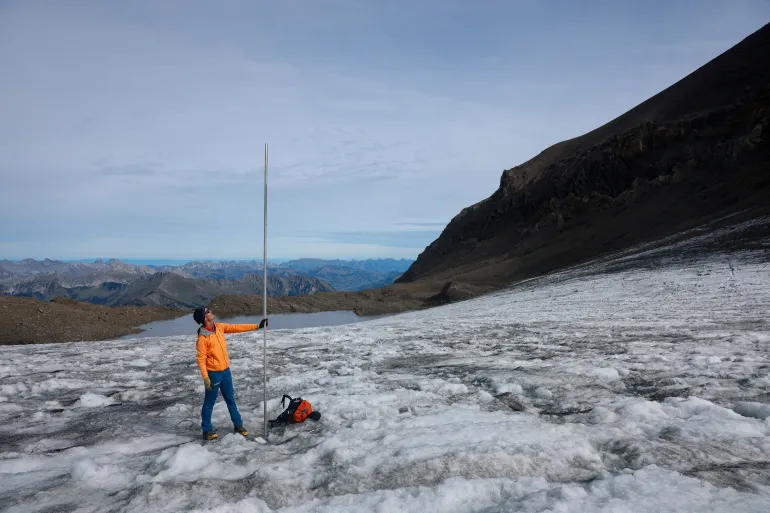
Visiting one glacier named Scex Rouge in the Western Swiss Alps in early September, GLAMOS chief Matthias Huss, one of the report’s researchers, told the Reuters news agency that a measuring pole, about four metres (13 feet) high, was drilled into the ice in July to provide the team with a point of reference.
“Now when we have come back here, we saw the pole was out by three metres [10ft]. So just in August and September of this year, even excluding the heatwaves of June and July, we have lost three metres of ice at an elevation of almost 3,000 metres [9,843ft],” he explained.
“This clearly indicates these conditions that we had this summer, they are just inconsistent with the survival of these small glaciers in the Alps,” he added.
Glaciologist at ETH Zurich and head of GLAMOS Matthias Huss holds a pole that indicates four metres of ice lost over the past year on the Scex Rouge glacier amid climate change at Glacier 3000 in Les Diablerets, Switzerland [File: Denis Balibouse/Reuters]
Why are glaciers in Switzerland losing ice?
According to the report, the total mean thickness of individual glaciers in Switzerland has fallen by between 2.5 and four metres in 2026. At glacier tongues – narrow glacial extensions of a glacier which project from land into a body of water – it had decreased by as much as 10 metres in some places over the summer.
“We can clearly attribute the massive ice loss to the warming, and thus anthropogenic [caused by humans] climate change. The summer has been the hottest on record in Switzerland. In addition, there was little snow in winter, and therefore the glaciers were poorly protected when the heat started,” GLAMOS chief Huss told Al Jazeera.
He noted that while their measurements have indicated that the melting has affected all glaciers in Switzerland equally, the effects were most visible on smaller glaciers.
“Those shrink very quickly and sometimes even completely disappeared. Also, large glaciers lost an enormous quantity of ice, but they remain impressive,” he added.
The report’s scientists warned that the glaciers also lost a total of about 2.2 trillion litres of water (581 billion gallons) between July and September alone.
“This is more than four times the annual drinking water consumption of all Swiss households,” the report’s researchers said and warned this could impact the country’s future water supply.
What does this mean for Switzerland?
Switzerland is a country known for winter sports and Alpine tourism, which depends on the glaciers. About 4 percent of the country’s entire workforce is employed in the tourism sector.
“This affects tourism and also how we perceive the mountains – they are no longer white but increasingly grey and black,” he told Al Jazeera.
He added that the water provided by glaciers is also important for the economy. “It is used to fill up hydropower lakes that produce clean energy, and supplies the biggest streams of Europe,” he said.
“We’re not yet seeing the full consequences as glaciers are still around and they contribute water when we need it. But this potential is soon being lost,” he added.
Harry Zekollari, a glaciologist and associate research professor at the Department of Water and Climate at the Vrije Universiteit Brussel, shared a similar view.
He stressed that glaciers are important natural water suppliers, as they provide water when people need it most – in summer, when it is hot and dry.
“With climate change, glaciers initially provide more water during summer as they rapidly melt. However, as glaciers become smaller, there is less ice to be melted, and as such the water supply in summer decreases. This peak in water supply has now been passed for glaciers in the European Alps, meaning that we expect glaciers to provide less and less water in the coming years,” he told Al Jazeera.
“Glacier changes can also cause natural hazards, and since most of the ice lost turns into water that reaches the oceans, the consequences of glacier loss [in Switzerland and elsewhere] will be felt for coastlines all around the globe,” he added.
Is there a solution?
Yes. According to Zekollari, in order to save as much glacier ice as possible in Switzerland, the world needs to stabilise rising temperatures as soon as possible.
“Projections for the European Alps and Swiss glaciers show that if we are able to rapidly stop emissions, we may still be able to save about one-third of their ice mass. However, in a case with strong warming, these glaciers are projected to lose more than 90 percent of their volume by 2100,” he said.
He noted that the situation is less grim globally as some glaciers in other regions are more persistent.
“However, even globally, future emissions play a big role and will decide whether we lose about 25 percent of glacier mass by 2100 – that’s the good case, with limited warming – or rather 50 percent – the bad case, with more warming,” he said.
“The losses in the longer term – past 2100 – are even larger due to the long response of glaciers, but also here it is the future warming that decides how much remains. Every 0.1 degree Celsius warming matters.”
FAO director said he was informed his contract would not be renewed because of allegedly breaching impartiality rules.
Published On 2 Oct 20262 Oct 2026
A senior UN agency director has said that he lost his job because he criticised Israeli policies in Gaza.
Ben Davis, who had been Director of Rural Transformation and Gender Equality at the Food and Agriculture Organization (FAO), told AFP news agency on Wednesday that he was informed in July that his contract would not be renewed because he had allegedly breached impartiality rules.
Recommended Stories
list of 3 itemsend of list
He said that he was accused of organising weekly silent protests at the Rome-based organisation.
“They accused me of organising these moments of silence on the situation of starvation and famine in Gaza,” Davis said.
Davis was also criticised for a report he worked on about food availability in Gaza and humanitarian law, published in May.
“We were told to take it down,” he said. “We weren’t allowed to make any references to humanitarian law.”
‘Game of human rights’
FAO Director-General Qu Dongyu appeared to warn FAO staff on Tuesday that “we don’t allow you to play the game here of human rights”.
He was speaking in public comments made at the start of a filmed session on forestry.
“Of course, human rights is very important, but we have the human rights agency in Geneva,” he added. “If you want to take care, go there.
“That’s why some senior members play the political game here, I fire him … You should follow the FAO constitution … You are against staff regulations … But I’m a very soft person, I didn’t fire that many,” he said.
“I will fire more people if they are against the law,” he added.
Director-General of the Food and Agriculture Organization of the United Nations Qu Dongyu delivers his speech during a World Food Forum meeting [File: Andrew Medichini/AP]
FAO did not respond to an AFP request for comment.
Asked if he thought the director-general’s comments were about him, Davis said “absolutely”.
“He has already scolded me in public in the past for being too political.”
Davis also said he was “concerned” about the director-general’s comments on firing more people.
Hundreds of people attended the moments of silence at their height, while now there are only 30 to 40 people coming on a weekly basis, he said.
Israel’s genocidal war on Gaza has killed over 74,000 people since October 2023, and at least 1,431 Palestinians have been killed in Israeli attacks since the so-called ceasefire between Hamas and Israel was agreed upon in October 2025.
A woman who appeared on ITV’s Long Lost Family shared the heartbreak she recently endured following her sister’s death
12:27, 01 Oct 2026Updated 12:29, 01 Oct 2026
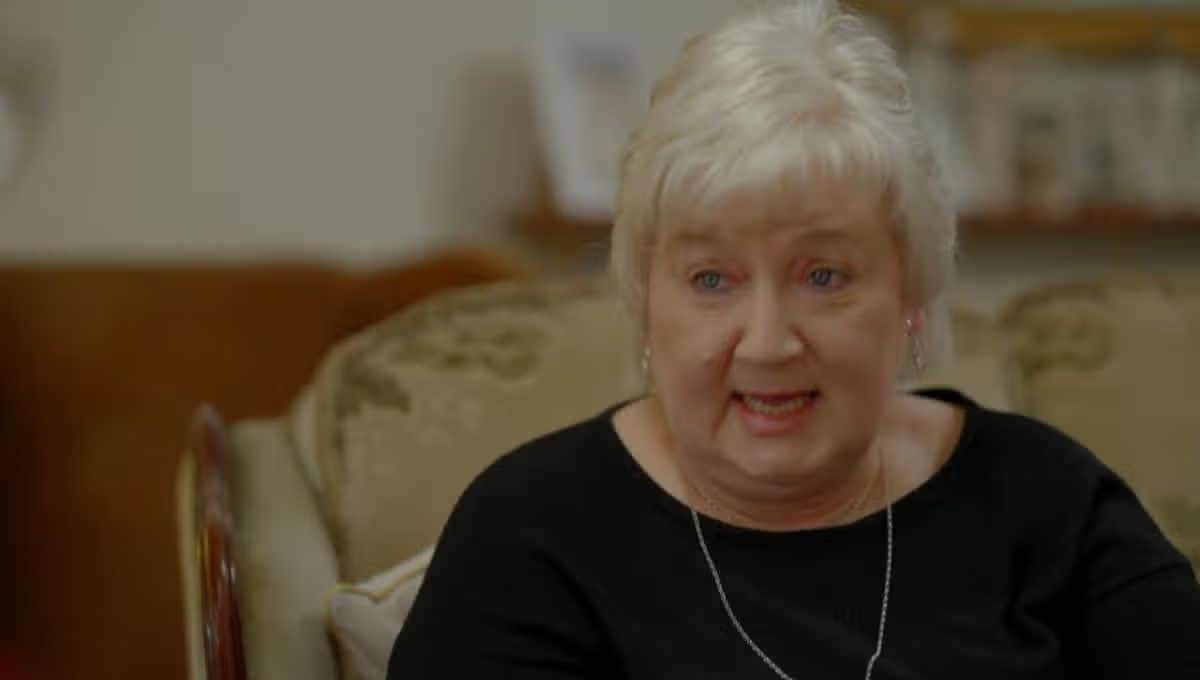
Long Lost Family: Elaine talks about Gail and sees photo of Naomi
Long Lost Family took an emotional turn as two adopted sisters met after spending decades apart.
The moving ITV show, presented by Davina McCall and Nicky Campbell, returns to screens tonight with another tearjerking episode. In the show, Nicky meets Naomi, who is longing to find her biological twin sisters and mother.
Naomi has spent much of her life wondering about the family she never knew. Now living in Gloucestershire with her husband of 30 years, she is finally retracing the events surrounding her adoption and searching for answers about her birth family.
Adopted as a baby, Naomi grew up in a loving home with her adoptive parents in Plymouth. She always knew she had been adopted, but as she got older, questions about her biological family became increasingly difficult to ignore
When Naomi was a teenager, her parents showed her a letter they had kept since her adoption. What she discovered inside came as a major shock.
The letter revealed that Naomi’s birth mother had been just 19 when she gave birth. It also contained a revelation Naomi had never expected: her birth mother had given birth to twin girls, who had subsequently been adopted by other families.
Naomi recalled: “I was obviously very surprised when I found out that I had sisters. It was shocking.”
Both of Naomi’s adoptive parents died while she was in her 20s. In the years that followed, her desire to uncover more about her origins and find her birth family only grew stronger.
With Naomi’s birth mother now identified, the search turns to the two sisters she never knew she had. The team manages to uncover their names, Gail and Elaine, but the discovery brings both hope and heartbreak. They learn that Gail has sadly died, leaving Elaine as the only surviving twin.
Elaine tells presenter Nicky that she and Gail grew up together in a happy, loving home with their adoptive parents. Despite being separated from their birth mother as babies, the sisters shared a close childhood and had a positive upbringing.
But in the 1990s, Gail was diagnosed with Motor Neurone Disease (MND). The illness gradually progressed over the following years, profoundly affecting her life before she sadly died in 2020.
Elaine also revealed that she recently lost her mum and her adoptive mother. Given her circumstances, she was elated to meet her sister.
Sobbing, Elaine said, “The fact that she’s gone to so much effort to find us, she must really want to meet us.”
When the sisters finally met, the pair couldn’t let each other go. Elaine said, “I’m so glad you found me. You’ve looked for so long, long, and I didn’t even know you existed.”
Naomi later said, “She was as warm and welcoming as her photo looked. Um, all I could have hoped for.”
Long Lost Family continues on Thursday 1st October at 9pm on ITV and ITVX.
President Trump might not look smaller, but he is.
At home and abroad, among a significant majority of Americans that includes increasing numbers of Republicans, as well as in the eyes of foreign leaders, the president of the United States is shrinking by the day into a hapless peacock, a cartoon figure posting comic word balloons at all hours on the falsely labeled Truth Social network or bloviating for the (fewer and fewer) cameras by day.
Consider Trump’s losses and humiliations just over the past week:
But for the U.S. and Israeli delegations, formerly deferential diplomats at the United Nations mostly sat on their hands for Trump’s boastful and bullying annual address on Tuesday; at one apparent applause line, he seemed to pause for claps that didn’t come. The Federal Reserve raised interest rates over his objections (its hand forced by the inflation Trump’s tariffs and war have caused). The usually compliant Supreme Court killed his rule against mail ballots for the midterm elections. A federal judge blocked Trump (again) from putting his name on the Kennedy Center. Daily it seems, news stories quote once-supportive truckers and farmers breaking with him over the cost of fuel.
There’s more: A long-loyal Florida Republican, Rep. María Elvira Salazar, aired a campaign ad telling Trump that his immigration policies have gone too far and Latino supporters “feel betrayed.” Republican Senate candidates in Iowa and Michigan demanded that Trump end his stalemated war against Iran. The Republican chairman of the Senate Armed Services Committee berated Trump on the Senate floor for kowtowing to China’s President Xi Jinping with this week’s state visit. And a Republican senator from Nebraska urged an investigation of Donald Trump Jr. over his business dealings and his recent wedding that a Russian oligarch bankrolled.
Sure, Trump still has unprecedented control over his party; he only recently ended several Republican officeholders’ careers by endorsing their foes in party primaries. But the primaries are over. More Republicans by the day are trying to distance themselves from a president who’s setting records for unpopularity with just about each new poll. CNN’s latest, conducted last week, found that two-thirds of Americans disapprove of Trump’s job performance and believe, contrary to Trump’s claims, that the United States is losing the war against Iran. In another poll, from Fox News, two-thirds of voters said Trump had made the economy worse.
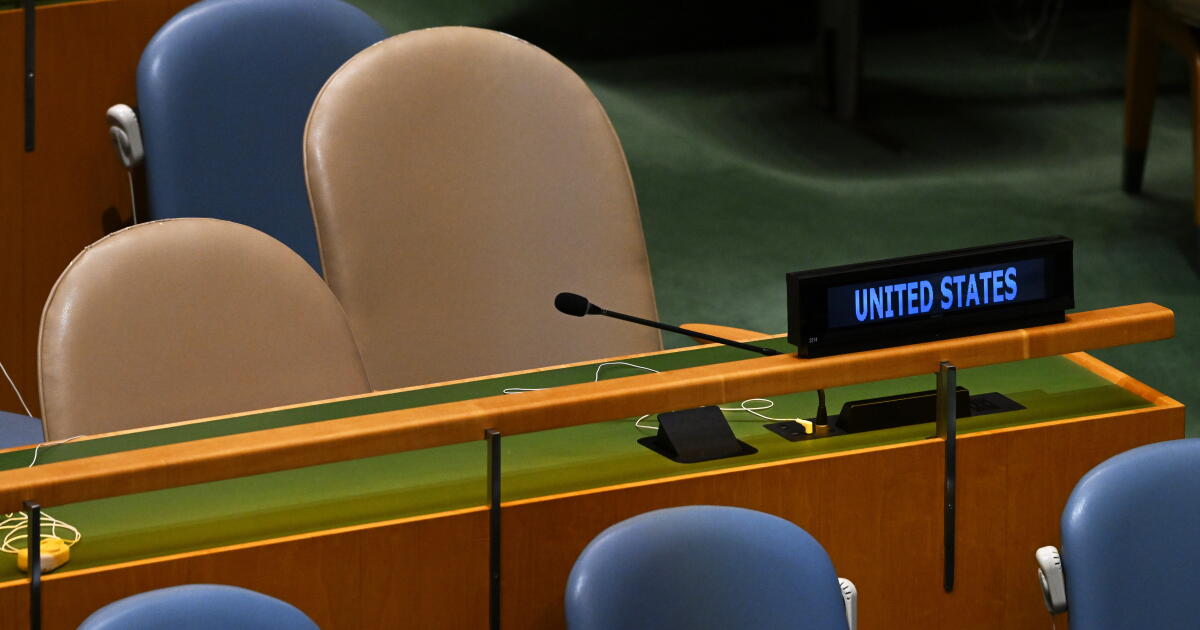
On the foreign stage, as evidenced by Trump’s failed applause lines at the U.N., leaders no longer compete for ways to play to his vanity. Instead, some are forming workarounds to achieve their policy ends without the conspicuously absent United States — on defense, trade, climate change and more. They’ve learned to discount his empty hyperbole, which is why there wasn’t a collective eruption at the U.N. on Tuesday when Trump suggested he might “annihilate” Iran.
To be sure, many don’t doubt he’s capable of that war crime. In fact, in the same address, Trump included among a number of false boasts one that’s all too real: about U.S. military strikes against small boats in the Caribbean and eastern Pacific that have killed numerous people — 234 to date — whom the administration claims, without evidence, to be drug-runners. These are illegal extrajudicial killings — actual war crimes.
Alas, as president, Trump might be a smaller man, but he retains a “crazy” amount of power, as he gushed himself last Thursday to an audience in the Mar-a-Lago’d Rose Garden. Why, he could even ban fishing and put Bass Pro Shops out of business, he told the billionaire founder of the chain.
That’s not true, but the wannabe autocrat has done plenty that the Constitution and federal law don’t allow a president to do, besides the Caribbean killings — like starting a war without Congress, wiping out entire federal programs authorized by law, demolishing a whole wing of the White House and banning specific news organizations because he doesn’t like their coverage.
Also, any inclination to relish Trump’s self-diminishment should be offset by the fact that he’s simultaneously diminishing the country’s stature and leadership in the world, in ways that could well outlast him. Longtime allies in Canada, Europe, Australia and Asia, in a break from the 80-year-old postwar order that the United States built, are forging new ties among themselves, separate from the newly unreliable United States and a president who is often hostile to allied leaders and openly enamored of dictators in China, Russia and elsewhere.
“To the victor belong the spoils,” Trump crowed to the U.N., in bragging about the United States’ confiscation of Venezuela’s oil and oil revenue since taking over the country in January. The U.S. president thus embraced, before a global audience, the very approach that his country and its postwar allies had rejected in building a new world order that included the U.N.
This week in celebrating China, which along with Russia provides assistance to Iran against the United States, Trump continues his abasement of himself and the nation.
After he’d visited Beijing in May, Trump actually declared China a co-superpower with the United States. “It’s the two great countries. I call it the G-2,” he told Sean Hannity on Fox News. Imagine Hannity’s conniption, and Republicans’, had Presidents Biden or Obama so forfeited America’s singular standing as the world’s superpower. And now, Trump is giddy about hosting Xi for a state visit with all the trappings. Rather than wait for Xi at the White House, as he typically greets visiting leaders, on Wednesday the eager Trump insisted on meeting Xi’s plane at Joint Base Andrews in Maryland for a red-carpet welcome.
In May, China’s Communist Party-controlled newspaper said Trump arrived in China as a “giant with a limp,” crippled by an Iran war then in its third, indecisive month.
Four months later, that war drags on, depleting U.S. stockpiles and defenses, including against an expansionist China. And Xi meets a man who’s no longer looking like a giant.
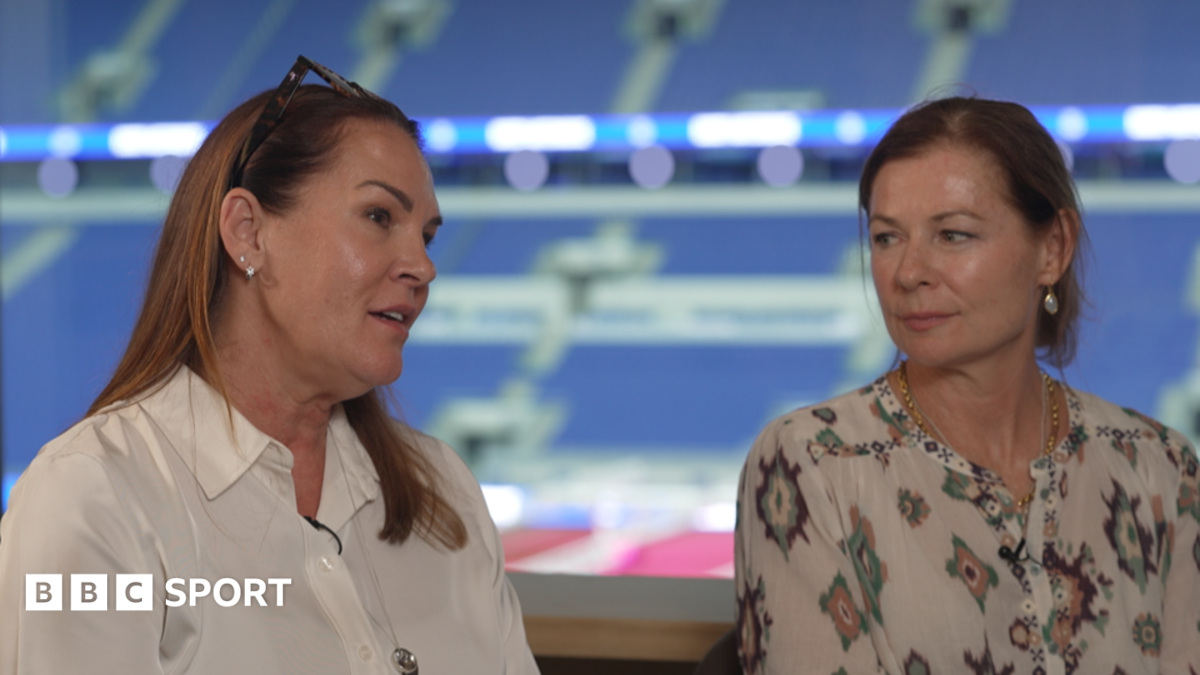
Amanda Thorpe has said previously she believes her husband would still be alive had he received more support from the England and Wales Cricket Board (ECB) after leaving his coaching role. Following the inquest into his death, the ECB said it was “a profound tragedy” and added Thorpe’s passing was a “stark reminder” of the challenges many face with mental health.
Matt Beard died a month after leaving his role as manager of Burnley Women. He had been in the post for only two months. When the inquest into his death was postponed indefinitely, Burnley said they were “aware of an ongoing legal process” and would “not be making any comment at this time”.
Amanda: “Graham had been struggling for the previous year to 18 months during Covid. Graham didn’t really like following rules and there were quite a few in Covid – like playing under bubble conditions. So he had been having some medication and therapy in his job. But then Graham lost his job and he didn’t see it coming.
“He did pride himself with having been in the game his whole life. He just couldn’t believe that he was blindsided by it.
“I think at least two other people were sacked at the same time, which does happen at the end of disastrous Ashes series.
“Also he was probably drinking too much and found the whole of the last trip in Covid very stressful. He then took a playful video at the end of the tour, when they had a few drinks with the opposition. One of the players sent it to two friends and someone unfortunately leaked it, so it was in the Sydney Morning Herald.”
Simon: “Going for a few drinks with the opposition – you would think that that happens in sport all the time, but they lost?”
Amanda: “Yes. It’s OK if you win but you’re not allowed to have a drink if you lose. He was probably in shock. He couldn’t believe it. And he was embarrassed and ashamed about this stupid video, which to me he blew way out of proportion. But he was in this tunnel where he thought he’d messed it all up. So he went into a quick and steep decline.”
Simon: “During that period, what could have been done? You said that he was seeking some help. What might have made a difference, do you think?”
Amanda: “He was havingtherapy sessions. He had 10 sessions. There’s obviously the confidentiality but I found out after he made a very serious attempt on his life, when he really hurt himself very badly, that he’d mentioned suicide. I didn’t know about that at the time. Of course, I feel that if I’d known, things could have been different. And I did feel that he wasn’t really getting better. It was difficult. I felt like maybe he did need more help – maybe residential but we didn’t really know where to find that.”
Simon: “Debbie, Matt also lost his job…”
Debbie: “He did.”
Simon: “Were there any signs that he was struggling with mental health, and then was there a steep decline afterwards?”
Debbie: “I think there were changes in behaviour, looking back. Performance-wise the team weren’t doing well so there was a lot of abuse on social media. He could never really speak his truth during media interviews of what was going on behind the scenes and he used to sound off to me at home.
“I’ve found out since that he had spoken to his brother quite a lot about his mental health. But whenever I would say to Matt ‘how are things?’, he’d be, ‘I’m all right, I’m all right’, because he always wanted the best for other people.
“He didn’t want to concern me and the family that he was having these thoughts and that he was going through these different struggles.
“The sackingcame out of the blue and there was a lot of speculation around that. He was starting to drink more than he would have done normally. In terms of his behaviour, I would say he was taking a lot of risks as well. So maybe that was the start of this with him.”
Loose Women star Coleen Nolan has spoken out about a family feud
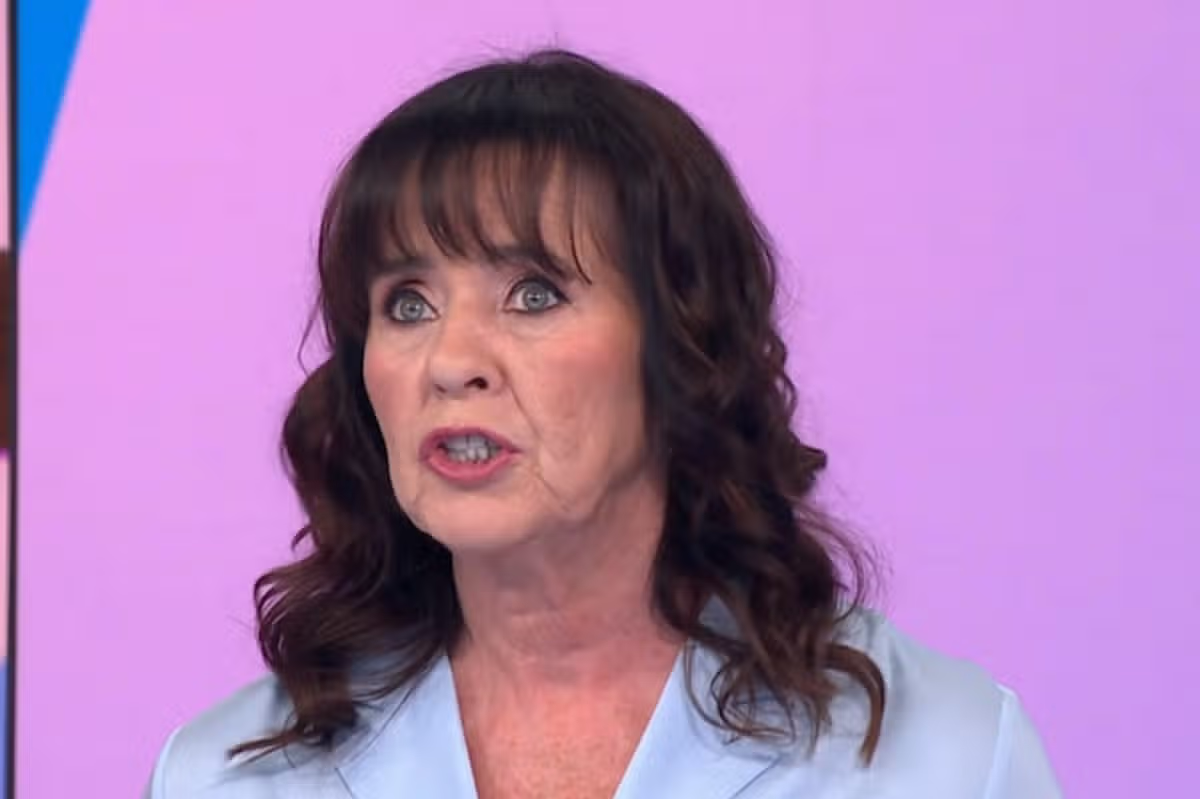
Coleen Nolan reveals heartbreaking family feud ‘I lost those relationships’(Image: ITV)
Coleen Nolan has opened up about a sad family rift in which some members of her family have ‘never spoken to her again’.
The beloved presenter returned to screens on Wednesday (September 23) for Loose Women. Along with Coleen, the panel consisted of Kaye Adams, Janet Street Porter and Jane Moore.
While on the show, the conversation turned to the topic of Earl Spencer’s book – which has made plenty of headlines. “I think that’s the thing when you’re writing your memoir. You can only do it from your perspective and your truth,” Coleen said.
She then shared that she waited until her mum and dad passed away before writing and releasing her own autobiography. Coleen said: “My mom and dad weren’t alive because I knew it would really hurt my mom to hear some of the things that I was going to say my truth about my dad.
“He was a brilliant dad. But had his moments where he wasn’t, and that would have upset my mom.” Coleen then shared that, due to her memoir, a family rift erupted.
She said: “Now, because I wrote those things, I had my dad’s side of the family, a couple of his sisters who never spoke to me again because of that, because they never saw him like that, and he was their golden boy, he was the only boy in the family. They absolutely idolised him.
“Even though I said he was a great dad, he drank too much for me and I didn’t like him when he was drunk and those kinds of things. I had to accept that. I lost those relationships.”
Jane Moore then asked Coleen: “Do you think that’s because you did it publicly? If you’d have that conversation with them privately, would you have carried on speaking to them?”
Coleen replied: “No, they were never, ever, ever gonna believe that. They just didn’t see anything bad at all. And, that’s okay.”
The TV star has been open about the relationship with her father – who died in the 90s – over the years. In 2024, she explained on Loose Women how she would be “scared” whenever her dad Tommy would return home from the pub at weekends.
“My dad was quite a big drinker and I think he’s the reason I became almost phobic about, well not about drink but about drunk people,” Coleen said. She added: “And even now I love when people get tipsy and have a good time but as soon as they cross that line to where their personality changes I have to leave.
“I can’t stand it because I don’t know whether it’s gonna go aggressive, you can see it in their face can’t you? That’s where I’ve gotta leave, and that stems from, as a kid, watching my dad.
“He was a brilliant dad but at weekends he’d come home and he was the quiet drunk and that scared me more because I knew he was in that mood. So that sent me the other way.”
Loose Women airs Monday to Friday at 12:30pm on ITV1.
EXCLUSIVE: Strictly Come Dancing legends Vincent Simone and Brendan Cole have had their say on the divisive new presenting trio of Josh Widdicombe, Emma Willis and Johannes Radebe.
Strictly Come Dancing’s Josh, Emma and Johannes hosted for the first time on Saturday(Image: CREDIT LINE:BBC/Guy Levy)
Strictly legend Vincent Simone has branded one new host of the hit dance show ‘lost and nervous’ after their debut showing on Saturday. He didn’t hold back as he laid bare his thoughts – but he did hold special praise for another, admitting they pleasantly surprised him.
All eyes were on the new trio of presenters on Saturday night prime time as Emma Willis, Josh Widdicombe and Johannes Radebe took centre stage after the exit of Claudia Winkleman and Tess Daly. But Josh felt the wrath of Vincent, who labelled him a “lost lamb” before saying he hopes it’s just first show nerves.
Speaking exclusively to the Mirror, Vincent went on: “Emma, professional as always. But I’m sure she was probably as nervous as everybody else. There’s a huge amount of pressure on their shoulders to hold a show together which is essentially new but old.”
And he admitted Johannes’ style shocked him. “Johannes surprised me in a good way,” he said. “I thought he was going to be all flamboyant, running around, talking about himself.
“I don’t know the guy, I’ve met him a couple of times but I thought he seemed really professional and seemed like he was doing a really good job as a host. I heard he was just going to be roaming around, talking to the couples and what have you.
“He would have been as nervous as hell. They all would have been. Given that, I think he did a good job.”
The opinion was matched by Brendan Cole, who also had his say on the new hosts, admitting he would have hoped for a Bruce Forsyth vibe to take the hot seat. He said: “I wanted the old-school class of the likes of Brucey [Bruce Forsyth].
“There aren’t many around that good that you could choose from, but it’s a big world out there. I’m sure they could be found. I want somebody old school. I want somebody triple threat – actor, singer, dancer. Somebody who, when they’re at the helm like Brucey was, absolutely knows showbiz like the back of their hand.”
But despite his disappointment, he held out praise for Johannes too. “I liked Johannes, actually. He did really well for the first show. I didn’t know what his role was going to be, and I think he held himself very, very well.”
Fans also had their say shortly after the launch show on Saturday and were divided in their opinions. Taking to X, formerly known as Twitter, one fan said: “I know it’s only the first few minutes, but I just cannot gel to there being three hosts #strictly.”
Another defended the line-up, adding: “3 presenters was an interesting choice by producers but Emma, Johannes and Josh really do work together. Natural already.” And it was also backed by no-nonsense judge, Craig Revel-Horwood who branded the new trio “fabulous”.
Vincent and Brendan were talking to the Mirror on behalf ofSky Vegas.
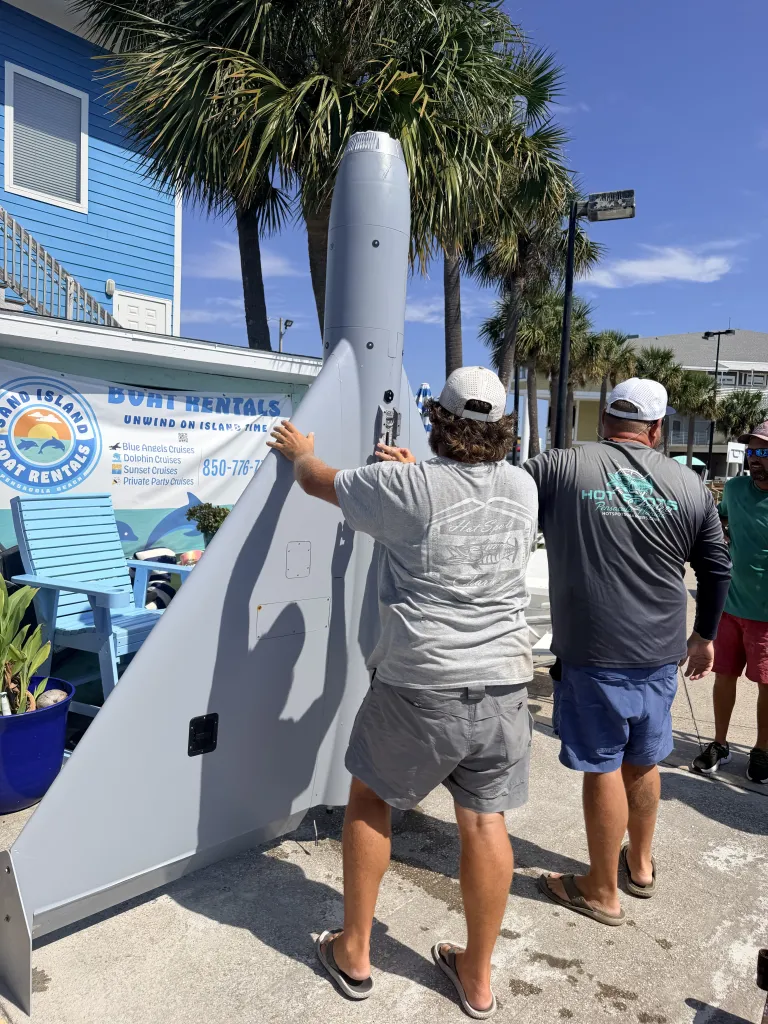
A Florida fishing charter boat made a very unusual catch Saturday while operating near Eglin Air Force Base. Located in the western end of the Florida Panhandle, Eglin is home of the U.S. Air Force weapons test wing. Hot Spots Charters pulled a delta-wing aerial drone out of the water during an excursion, according local charter captain Charlie Green. The recovered drone closely resembles a clone of the Iranian Shahed-136 one-way attack weapon, specifically the U.S. military’s Low-Cost Uncrewed Combat Attack System (LUCAS) that took center stage during its first combat use in Operation Epic Fury. The target version of that drone is built by SpecktreWorks and is designated the FLM-136. It was originally designed for mimicking one-way attack munitions, specifically the Shahed-136, which it was reverse engineered from, for testing and training before it was weaponized into LUCAS.
An Eglin AFB spokesperson told us the installation recently lost a drone, but would not confirm it was the same one found by Hot Spots Charters.
“I can confirm that we were doing a test and the test article went down,” the spokesperson told us, declining to provide further details about what kind of drone, when it was lost or the location it went down. They referred us to the Pentagon, which could not immediately provide any additional details.
“The drone was found by local charter Capt. Daniel Arsenault with Hot Spots Charters,” said Green, who is also an aviation photographer whose work can be found at Aquatic Charlie on social media. “He saw the object at a distance and went over to check it out. When he did, he pulled a good size mahi-mahi out from underneath it, complementing his already stocked cooler full of fish from that morning charter. His passengers helped him haul it aboard.”
The drone found by Hot Spots Charters. (Charlie Green)
“Arsenault and his charter company did all the due diligence possible to notify local agencies of the recovery- and was eventually collected by one of them,” Green added. He did not know which agency.
Images taken of the drone shared with us by Green show that it did not have the engine, propeller or the nose cone/seeker intact. Losing these kind of components is common for impacts into water.
(Charlie Green)
While the Eglin spokesperson offered scant details, the host unit at the installation is the 96th Test Wing, which is the “test and evaluation center for Air Force air-delivered weapons, navigation and guidance systems, command and control systems, and Air Force Special Operations Command systems,” according to the wing’s homepage. It oversees the massive Eglin Gulf Test Range, which “provides approximately 120,000 square miles of overwater airspace, covering the eastern third of the Gulf of Mexico from the Florida panhandle to the Florida Keys. The land range covers 724 square miles and contains 70 specific test and training areas, including an approved depleted uranium test range and the only qualified air-to-ground supersonic range east of the Mississippi River.”
Eglin Test Range. (Eglin Air Force Base)
As noted in the opening of this article, the LUCAS drone was used for the first time in combat during the opening day of the Operation Epic Fury war on Iran on Feb. 28.
“Costing approximately $35,000 per platform, LUCAS is a low-cost, scalable system that provides cutting-edge capabilities at a fraction of the cost of traditional long-range U.S. systems that can deliver similar effects,” Navy Capt. Tim Hawkins, a CENTCOM spokesperson, told TWZ when the command stood up Task Force Scorpion Strike (TFSS), the military’s first one-way attack drone unit, back in December. “The drone system has an extensive range and the ability to operate beyond line of sight, providing significant capability across CENTCOM’s vast operating area.”
“LUCAS drones deployed by CENTCOM have an extensive range and are designed to operate autonomously,” CENTCOM added in a press release. “They can be launched with different mechanisms to include catapults, rocket-assisted takeoff, and mobile ground and vehicle systems.”
TFSS falls under the auspices of U.S. Special Operations Command Central (SOCCENT), which oversees U.S. special operations activities across the Middle East.
A LUCAS drone. (NAVCENT/C5F/U.S. Army Spc. Kayla McGuire) NAVCENT/C5F/U.S. Army Spc. Kayla Mc Guire A LUCAS drone. (Courtesy photo/Naval Air Warfare Center Weapons Division)
While we aren’t sure if the drone found by Hot Spots Charters is the one lost by Eglin, it wouldn’t be the first time something like this has happened in Florida. For example, in 2021, beachcombers in Florida’s Palm Beach County found a U.S. Air Force BQM-167A high-performance target drone that washed ashore.
Indeed, the Air Force has a handful of 120-foot boats, the only vessels in its service, to help recover drones after they are shot down during live-fire exercises, or otherwise need to be recovered from these waters. The boats are operated by a contracted crew from Florida Offshore and retrieve around 100 of the drones each year.
The FLM-136’s origins as a target drone are highly relevant here. Counter-unmanned aerial system (C-UAS) capabilities are being hotly pursued on all fronts across the U.S. military as the threat from them has ballooned. During the war in Ukraine and multiple engagements with Iran, including Operation Epic Fury, one-way attack drones have proven to be a massive threat that is heavily influencing how wars are fought. As far as Eglin AFB goes, maybe the most high-profile C-UAS development as of late that has emerged from there has been arming USAF fighters with FALCO APKWS laser-guided rockets to shoot down exactly the same kind of threat that the FLM-136 is meant to emulate. This program began in 2019, which TWZ was first to report on, but was finally rushed into service years later as the standoff with Iran went hot. Now there are many other programs aimed at dealing with these same threats, including a more capable “fire and forget” air-to-air APKWS.
A 2019 test of air-to-air APKWS laser-guided rockets occurred off Eglin AFB. (USAF)
LUCAS development is continuing at a high-pace, with its ability to swarm cooperatively with other LUCAS drones — a feature we reported as central to the LUCAS vision when the existence of the program was disclosed — being worked on now. You can read more about this here. These systems need sanitized airspace for development activities, and the vast ranges over the gulf are some of the best in the country for it.
So, it’s not surprising to see an FLM-136 floating in the waters off Eglin AFB. Even in the war with Iran, there were multiple losses of LUCAS drones where they were found intact. These weapons are produced to be risked in large numbers, and some failing, for whatever reason, is just part of the calculus.
Locals in Iraq appear to have recovered a crashed and almost entirely intact Low-Cost Unmanned Combat Attack System (LUCAS), an American copy of the Iranian Shahed-136 Attack Drone, which is confirmed to have been used recently by Task Force Scorpion Strike during U.S. attacks on… pic.twitter.com/SEqO6627en
We will update this story with any additional details we can find about this drone. Though we don’t yet know for sure where it came from, one thing is for certain, the folks on the Hot Spots Charters boat that found it will always have a good tale about the one that didn’t get away.
Alexandre Pantoja and Joshua Van hope their fight Saturday at Crypto.com Arena will last longer than 26 seconds.
It has been nine months since their first bout, which ended in less than a minute because of a Pantoja injury and made Van the UFC flyweight champion. Pantoja aims to reclaim the belt he lost at UFC 331, with the main event beginning at 6 p.m. and streaming on Paramount+.
Pantoja dislocated his elbow when he fell while trying to defend against one of Van’s moves on Dec. 6 at UFC 323 in Las Vegas. The fight ended immediately.
Van celebrated winning the 125-pound title, but both fighters walked away from that night feeling everyone deserved more than the premature result.
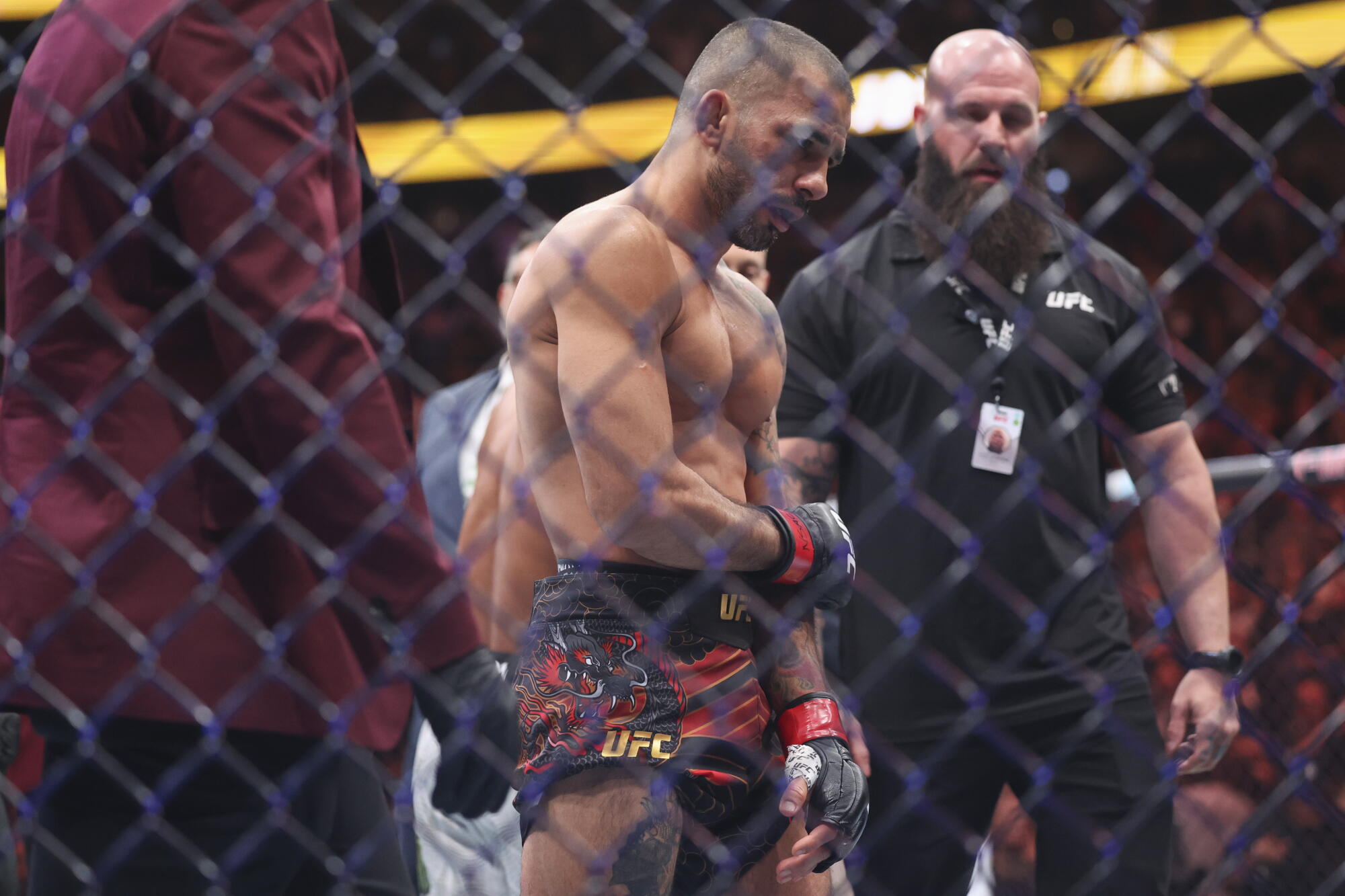
Alexandre Pantoja holds his arm after losing his flyweight title fight on Dec. 6 in Las Vegas.
(Ian Maule / Getty Images)
Pantoja, of Brazil, has not competed since that night. He has spent most of the past nine months recovering from the injury, while Van successfully defended his title once against Tatsuro Taira in May, winning by stoppage in the final round.
“It’s been [nine] long months,” Pantoja said. “I’ve been working hard. And at a certain point, I think that after two years as champion, five title fights — almost six title fights — at a certain point it’s good to take some time off, enjoy my family, enjoy myself. But at the same time, I’m really hungry to win again.”
Pantoja said he returned to the gym two days after that first fight. Although the injury kept him out of the octagon, he didn’t want to stay away from training for too long because he said that would have made it harder to get back to fighting at the championship level.
During his time out of the octagon, he observed how the division changed.
“I see a lot of good fights. We’re seeing the top 10 change almost completely,” Pantoja said Wednesday. “I see incredible fights in the flyweight division. And I think this Saturday, with my fight against Joshua Van in the main event here in Los Angeles, is very special.”
Van, meanwhile, enters the rematch coming off a five-round championship bout.
“I’ve been working on my ground game, and you’ll see it,” said Van, who holds dual American and Myanmar citizenship. “I tried it in the fight against Taira, but I didn’t quite pull it off. But this time, you’ll see a different level from Joshua Van.”
The champion’s confidence remains undiminished, as he sees the rematch as an opportunity to put any debate surrounding that first fight in 2025 to rest and prove his place in the division.
“When I beat him, I’ll be one of the greats in this division, and then the next challenger will come and try to take the belt from me,” Van said.
Pantoja said Van has changed since December, highlighting the fight against Taira and noting the champion has refined aspects of his fighting style.
Joshua Van celebrates after defeating Alexandre Pantoja in a flyweight title bout during UFC 323 on Dec. 6 in Las Vegas.
(Ian Maule / Getty Images)
“I think Van definitely evolved a lot after our fight,” Pantoja said. “He had the fight against Tatsuro Taira; I think he evolved and corrected some mistakes he made in that fight. So I think it’s going to be completely different.”
Pantoja doesn’t consider himself the same fighter who will face Van.
“The drive is always the same,” Pantoja said. “I’ve had the same drive since I was a kid — I’ve always wanted to fight the best fighters in the world. The drive is the same; it’s just that I think I’m much more mature now.”
Pantoja said Van is a top-tier fighter, but he believes the injury prevented both of them from showing everything they were capable of.
“He’s an incredible fighter,” said Pantoja, 36. “When you watch Joshua Van fight, his expression never changes — he always tries to stay in control. And that proves just how good you are.”
Although Pantoja officially lost that night, the injury changed the course of the fight before it could truly get underway.
“I injured my arm. I know that, as an athlete, I lost that fight, and now I have the opportunity to fight world champion Joshua Van — and that’s what I want. I want him at his best because I’m at my best too,” Pantoja said.
Tensions have escalated since their first encounter.
At a news conference in August in Los Angeles, the fighters got into an exchange that forced UFC president Dana White to intervene. Pantoja stood up from his seat after Van interrupted him, but the situation did not escalate into a physical confrontation.
“As far as I’m concerned, I’m his dad,” Van said. “He was being respectful before the fight, and I don’t know what he’s doing in interviews and stuff like that to make me look like the bad guy.”
Pantoja offered a different explanation.
“He does a very good job,” Pantoja said. “He needed a lesson. When I stood up, I tried to teach him a lesson. I’m from the ‘90s. Back then, if you didn’t respect your mother or father, you’d get a slap.”
Despite the disagreement, both have shown respect for their opponent’s skills. Van described Pantoja as a “very, very dangerous” fighter.
“He’s going to be motivated, he’s going to be hungrier, and I think this will be the best Pantoja we’ll see,” Van said. “So I’m very well prepared for this fight.”
Pantoja, for his part, knows he’s facing a champion who’s already had the chance to prove he can go the distance for five rounds. The Brazilian also viewed Van’s fight against Taira as a source of insight for his preparation.
“An incredible fight, very good,” Pantoja said of his 24-year-old opponent. “I think it’s a good fight for all the fans. It showed me something, but I know Joshua Van is very young and can fix a lot of things from that fight.”
For the Brazilian, the goal this weekend is clear.
“At the end of the day, what matters is the victory,” said Pantoja. “However it plays out — whether it’s by decision, split decision, KO or submission — I think the closer we get to the fight, the less those things matter. The closer we get to the fight, the championship doesn’t matter anymore, the money doesn’t matter — all that really matters is the win.”
Van doesn’t expect to let the fight go to the scorecards.
“I don’t think it’ll go five rounds; I’ll finish it within the first three rounds,” he said confidently. “It’ll be by knockout or submission, but I’m leaning more toward a knockout.”
If Pantoja regains the championship, he would become only the third flyweight champion in UFC history to reclaim the belt after losing it, joining Deiveson Figueiredo and Brandon Moreno.
For the Brazilian, returning to Los Angeles also holds personal significance. He recalled that it was the first city he visited when he arrived in the United States in 2014 and that, back then, he slept in a gym.
Now he’ll return as a title challenger in the main event of UFC 331.
“It’s so nice that people see where I started here and see how far I’ve come,” Pantoja recalled. “For me, the best part is being the same guy I was when I arrived here in 2014; I’m the same guy right now, and I’m very happy and proud of myself.”
On Thursday’s episode, the show hears from Jake, 36, who lives in Australia but was born and grew up in the UK in a single parent family. Jake always knew that he was the result of an extra marital affair. His mother had been a nurse and had met his married father when he was a doctor at the same hospital.
Jake recalled that when he was a newborn, his father occasionally visited, bringing his two children Katie and Tom, who were aged five and three at the time. One of Jake’s most precious keepsakes are two photographs of his brother and sister holding him as a baby.
However, sadly, his mother’s relationship with their father did not last, and Jake never saw his siblings again. When he was 14, Jake and his mum emigrated to Australia.
Despite not seeing his siblings since he was a child, Jake has been desperate to find them and contacted Long Lost Family for help, emotionally saying: “I feel like I always missed out. I missed out on something, that, you know, was really a connection that I craved really. I’ve always somewhat felt a little bit alone. And I just need that connection.”
Sadly, Jake was unable to successfully meet his father after attempting to track him down and therefore unable to learn any more about his siblings. Jake had also tried multiple other avenues to find his siblings, but Katie and Tom appeared to have vanished off the face of the earth.
Even Long Lost Family struggled locating the siblings through their conventional searches. However, the team soon discovered in the series’ files something surprising after receiving thousands of applications.
Months before Jake had applied to the show, Long Lost Family received an application from a woman in Canada called Katie, who was looking for a birth father – with the same surname as Jake’s father. Following a DNA test, it confirmed that Katie was Jake’s half-sister, in an incredible discovery.
Katie is a lawyer who now lives in Toronto and she had no idea that she even had a younger brother. The duo’s brother, Tom, supports Katie’s decision but has chosen not to be involved in any filming at this time.
In an exclusive clip obtained by the Mirror of Thursday’s episode, it sees host Davina share the news with Jake, who breaks down in tears over the discovery.
Asking where his siblings live, Davina explains: “So… Katie, her mum met her stepdad. They moved to… Australia!” Jake is left floored by this discovery as he too moved from the UK to Australia. The guest exclaims: “No way, you’re kidding! No way!” before wiping away tears.
Jake adds: “So they weren’t even that far away. I can’t believe it!” Davina then adds that Katie is a lawyer and she has since moved to Toronto.
The guest then asks: “Did they enjoy Australia? Were they happy?” with Davina responding: “They’ve had good lives, I think the family situation, it’s been difficult for all of you, I think, in different ways.
“I think it’ll be really nice for you to be able to speak together about it. Weirdly, we found her because… she applied to Long Lost Family to find your dad.” This piece of information leaves Jake in tears as he exclaims: “Wow!”
Viewers will have to tune into Thursday’s episode to see the two siblings have an emotional reunion.
Long Lost Family continues on Thursday 17th September at 9pm on ITV and ITVX
Kieron: Kilmarnock could have won by three or four and it wouldn’t of flattered them. Hibs were so poor tonight. David Gray’s position is hanging by a thread.
Stuart: The players on that pitch have to take as much responsibility as Gray for this result, nowhere near good enough. Amateur performance.
Andy: How can Gray continue to keep his job? The players are not playing for him. The club is a mess. Banning the only fans that bring an atmosphere. Benching three of our best players. So confusing.
Chris: Question the tactics. Thought for long time long ball is desperate and lacks ambition. Pressure indeed on David Gray.
Lee: If we end the game two points off bottom spot then it’s surely time up for the Hibs manager. It’s not a run and recovery from a bad position needed, it’s deliver and results from the get go the support demands for a club of our size.
Stuart: The players on that pitch have to take as much responsibility as David Gray for this result, nowhere near good enough. Amateur performance.
Paul: Long balls to no-one as usual from Hibs and as usual our keeper is a weak link. Gray has to go even if we win as this is awful football. Bring in Neil Lennon or Steve Clarke asap before our season drifts to nothing as usual.
Andy: How can Gray continue to keep his job? The players are not playing for him. The club is a mess. Banning the only fans that bring an atmosphere. Benching three of our best players. So confusing.
Brian: Worst backline in Scotland, midfielders trot about like headless chickens, feel sorry for strikers. Gray clueless. No plan. No tactics. Blah, blah, blah after game as usual but won’t resign. Board have to act.
SMcDhfc: David Gray has lost the team, it was obvious tonight. As an attacking force, we were shocking, lots of huffing and puffing but not one real effort on target. The players should be embarrassed after that display, but they will get the result they are after, Gray sacked.
Craig: I like Gray but believe it’s time he goes. He has one formation. It’s just not good enough. But, if he goes, Malky MacKay [director of football] should go too. His signings have been terrible.
Avril, 77, was recently reunited with her daughter Eleanor after 60 years on Long Lost Family after being told she’d never find her child
18:32, 14 Sep 2026Updated 18:33, 14 Sep 2026
Avril, 77, was recently reunited with her daughter Eleanor after 60 years on Long Lost Family after being told she’d never find her child (Image: ITV)
A Long Lost Family star has made an emotional admission after being told for years that she would never find her daughter.
Avril, now 77, was only 15-years-old when she became pregnant, her mum then shipped her off to a mother and baby home in Carlisle, where she gave birth to a baby girl she called Michelle.
At only eight-weeks-old, Avril gave Michelle up for adoption and she was renamed Eleanor. Avril sought the help of Long Lost Family’s Davina McCall and Nicky Campbell, who travelled to Newcastle, to find her daughter, where she was emotionally reunited after 60 years apart on the ITV show.
However, this wasn’t Avril’s, who also has daughter Sharon, first attempt to reconnect with her first child, having previously contacted a rival programme to assist her in finding her long-lost daughter.
Speaking to Express.co.uk, Avril admitted that The Trisha Goddard Show rejected her because they believed they would never locate her. She explained: “I was listed on a couple of adoption agencies. I tried The Trisha Goddard Show, and she used to help people find their family.”
The ITV programme, which broadcast on Channel 5 from 2004 to 2012, regularly featured emotional family reunions, deep-rooted family secrets or disputes concerning adopted children.
But after reviewing Avril’s case, Channel 5 bosses conceded that even with the programme’s resources, they wouldn’t be able to trace her daughter, reports the Express.
She recalled: “Basically, I was told that I would never be able to find her because she had been issued a new birth certificate.
“So that led me to believe that there wouldn’t be an original birth certificate, and I was told that by two or three different professional people. But after 30 years, you just think, ‘Well, there’s not much else I can do. Hopefully, she might be able to find me’, but you just don’t know.”
The TV star went on to share that her other daughter, Sharon, proved to be her greatest supporter when she considered approaching another television programme for assistance. She said: “I have another daughter, Sharon, and I told her about Michelle.
“She was the one who said, ‘Yes, you should do it’. So that’s what I did. I wrote to Long Lost Family, and it went from there.”
The mother and daughter were eventually reunited on Eleanor’s birthday, with Avril telling her: “There aren’t any words to tell you, Eleanor. That I’ve always loved you and that you’re still mine. You’re my child.”
It comes as the reunited mother and daughter recently appeared on This Morning, where Avril said of meeting for the first time and if they had an instant bond: “Yeah, she was back in my arms where she belongs.”
A man from London was determined to find his sister, following the death of their mother
Michael was searching for his sister on Long Lost Family(Image: ITV)
A brother and sister have finally been reunited after they both applied to appear on the ITV show.
The latest episode of Long Lost Family, which aired on Thursday (September 10), followed Michael, 56, who was trying to find his older sister, whom he had never met. The retail worker from South East London was determined to fulfill his mother’s dying wish to track down his sister, who had been given up for adoption as a baby.
Mary had been in a Catholic mother and baby home when she took care of her daughter, Angela, for three months before she was placed for adoption. But Michael explained that his mother didn’t think she had a choice.
Their mother, Mary, died of cancer eight years ago at the age of 74, and she had asked Michael to find his sister, Angela, for her. “She said, could you please try and find Angela for me please?” Michael shared. Ever since then, he has been desperate to find her.
Two years ago, in an attempt to find his sister, Michael took a DNA test and got a match with a woman named Gemma. The DNA report suggested that she was his half-sister. He assumed that Gemma was Angela’s new adoptive name and messaged her, however, he never received a reply.
“It’s made me happy, but in another way, it’s made me sad because obviously she’s been looking. It makes me think, why is she not on here, she’s given up. I’m so close now,” he said.
Michael went on: “I’m so close. And it’s like just a brick wall is just there. But I want to knock this brick wall down, but it’s very difficult.” In a twist, the Long Lost Family team discovered that Gemma, who had been named Angela at birth, had also contacted the show in the past to find her biological family.
Gemma was told about her mother’s death off-screen before host Nicky Campbell informed her that she had a brother, and passed on an emotional message. “Your brother, Michael, wanted to tell you that she didn’t want to give you up for adoption. She thought about you every day. She always, always loved you, and she wanted to tell you that. She wanted to see you and tell you that”, Nicky told Gemma.
Later in the episode, Davina McCall informed Michael of the wonderful news that Gemma had been found. This left him feeling incredibly emotional to hear that his sister wanted to have contact with him.
Davina explained: “She has been looking for 30 years. She was really sad to hear that your mum had died, but she was so grateful that someone was looking for her. She applied for Long Lost Family, so it’s incredible.”
Michael couldn’t wait to meet her but wistfully said, “I just wish my mum was here. 30 years? Oh god, if only I had knew.” Gemma traveled from Manchester to London to meet her brother, and when they came face-to-face, they could not stop crying. “This has been the best day of my life. It’s like a dream come true, I finally met my sister,” Michael added.