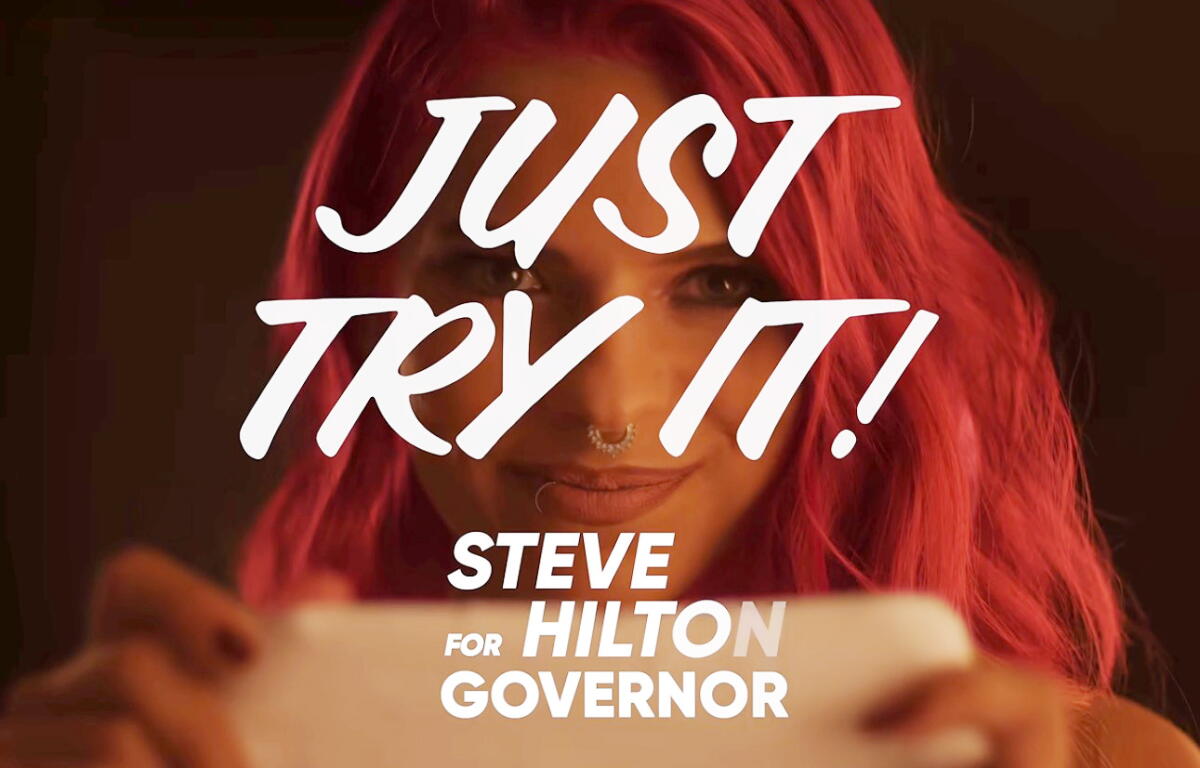
Your prospect of winning is small. So small, you could peer through a microscope, blink and miss it. How, then do you draw voters to your candidacy and boost your chances?
Actually, let’s not pretend. A very real flesh-and-blood Republican, Steve Hilton, is running for California governor and if your idea for grabbing attention doesn’t involve a make-believe lesbian couple, double entendre and a soft-core porn vibe, you’re very clearly lacking in imagination.
Hilton ran an ad featuring just such elements, garnering coast-to-coast notice, millions of views and ensuring the tagline — “Now lick it” — while not as resonant as, say, “The only thing we have to fear is fear itself,” will forever live in political infamy.
What the spot tries to do, convince folks in this left-leaning redoubt to be venturesome and vote for Hilton, is not the least offensive, though your friendly political columnist, hardly a prude, found the execution a bit, well, icky.
You’re reading the L.A. Times Politics newsletter
Expert columnists cover the insights, legislation, players and politics you need to know.
By continuing, you agree to our Terms of Service, which include arbitration and a class action waiver. You agree that we and our third-party vendors may collect and use your information, including through cookies, pixels and similar technologies, for the purposes set forth in our Privacy Policy such as personalizing your experience and ads.
Being a cis white male of a certain age, however, means perhaps we shouldn’t be the one to judge. We’re certainly not the target audience. So we turned to two of the youngish, hippest people we know, Daughters No. 1 & 2, who are both well-accomplished 30-somethings and truly upstanding citizens.
What follows is their spontaneous reaction.
Daughter No. 1: “Stupid, infantilizing.”
Daughter No. 2: “Wtf is this fake woke AI ad? Ew.”
(For the record, Hilton said the ad was not AI generated. He apologized, sort of, to those who took offense.)
We also asked the Fabulous Mrs Z. — who has impeccable judgment, notwithstanding all the years she’s stayed married to your friendly political columnist — for her response. “It’s just so strange and stupid,” she said. “Why would he approve this ad? It makes me question his judgment.”
What do the pros say?
Of course, that’s just four people — one of whom doesn’t even live in California — so it’s not much of a sample.
For more insight, we turned to some political professionals.
And who better to weigh in than Fred Davis, the madcap genius behind another infamous California campaign spot, the so-called Demon Sheep ad he concocted for Carly Fiorina’s 2010 U.S. Senate campaign. The Felliniesque production included lightning bolts, a Roman column and a man covered in sheepskin crawling on all fours and leering with a glowing red eye — the point being that Fiorina’s rival, Tom Campbell, was supposedly a profligate wolf in fiscal-conservative sheep clothing.
Strange, yes, but definitely more memorable than an accountant in green eyeshade laboring over the books.
Anyway, Davis — who’s featured Paris Hilton, bad hair and a giant rat in a crown as part of his out-there oeuvre — loved the new Hilton campaign spot, calling it “super attention-getting, super interesting.” (Which is not the least surprising from a man whose chosen epitaph is, “If you don’t notice it, why bother?”)
“I think it’s a brilliantly done ad,” Davis said, “wonderfully written.” And, he added, “I can’t imagine it gaining him one vote.”
Which was sort of the point, no?
Kevin Spillane also appreciates Hilton’s effort, given his own Sisyphean struggles as a Republican strategist in California.
A screen grab from Steve Hilton’s “Just Try It” ad. Columnist Mark Z. Barabak found execution of the spot a bit, well, icky.
(Steve Hilton for Governor)
“They’re doing something out there and on the edge. I don’t fault them for that,” said Spillane, who supports Hilton and has contributed to his campaign. “It’s a clever concept of trying to get people to do something that they’re not used to doing.”
Which is to say vote for a Republican for statewide office in California.
But Spillane, too, questioned the execution. “I actually was fine with the ad until they got to the ‘lick it’ line,” he said, insisting he is also no prude. “That’s just a little too explicitly sexual.”
Running, not advancing
To his credit, Hilton has been running hard for governor. Much harder than his Democratic rival and the prohibitive front-runner, Xavier Becerra. Hilton has issued an abundance of policy proposals and spoken before pretty much any group or microphone-wielding reporter or podcaster who’ll have him.
None of which has garnered Hilton anywhere near the publicity captured by his racy “Just Try It, California” ad.
Hilton’s edgy attitude and pugnacious put-downs would place him right at home among the network’s collection of trolls, provocateurs and Democrat-bashing gargoyles.
But Hilton should leave the advertising to someone else.
The Bank of Lao is the central bank of the country.
The Government adopted October 7th 1968 as the founding day of the banking sector, as this was the date of the first printing of the liberated Laotian Kip currency under the leadership of the Lao People’s Revolutionary Party. The currency was printed in a cave in Viengxai district, Hauphanh province, which was a revolutionary base at the time.
In 1975 after the establishment of the Lao People’s Democratic Republic, the Bank of Lao merged with the former Lao National Bank to become the central bank for the new country.
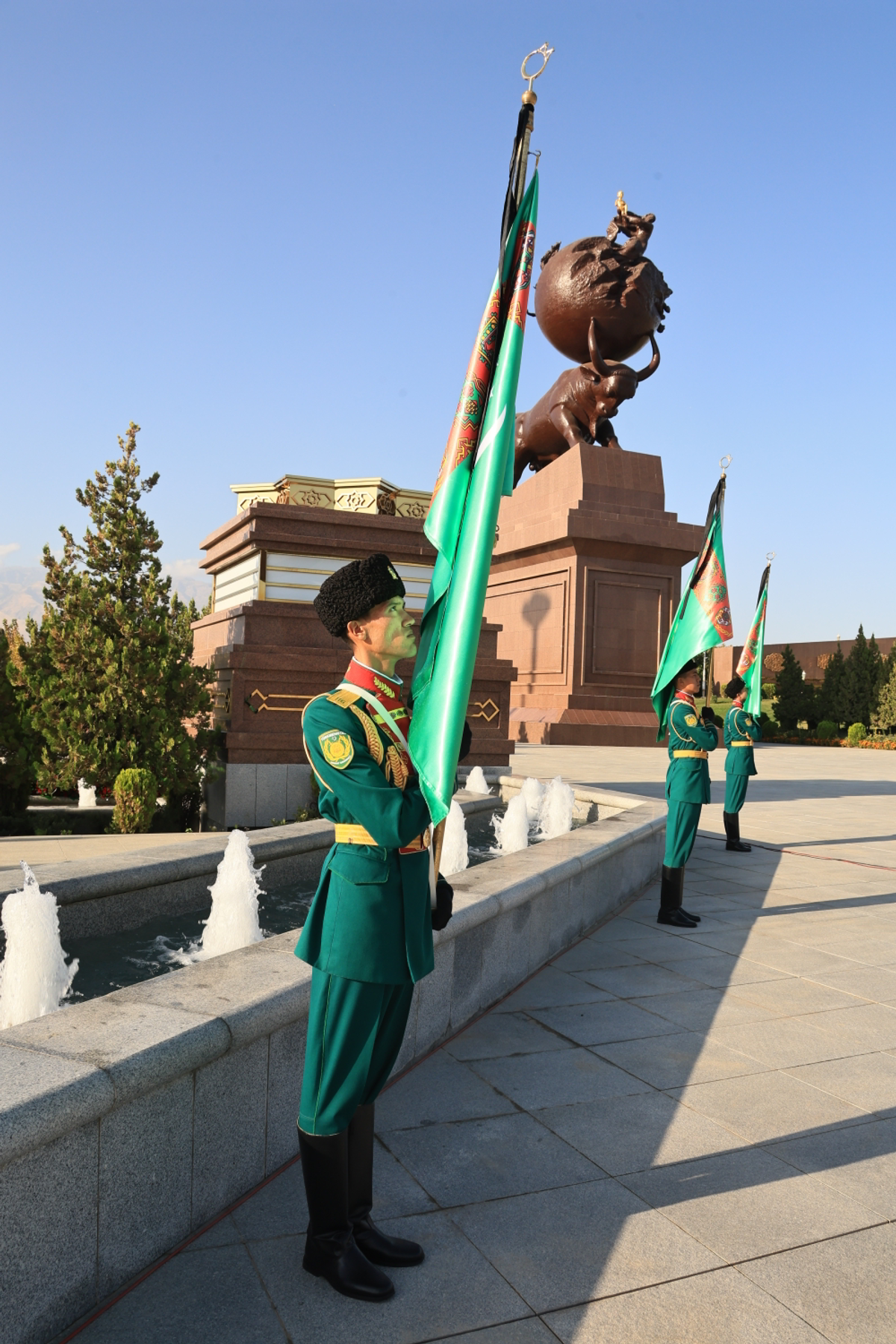
At 1:12am on October 6th 1948 an earthquake struck Turkmenistan. The earthquake was recorded as having a magnitude of 7.3 and the epicentre was just south of the capital, Ashgabat.
Within a matter of minutes, Ashgabat and about 40 surrounding villages were reduced to rubble, with almost all brick buildings collapsing and concrete structures heavily damaged.
Details of the damage were censored by the Turkmen government, so estimates of casualties vary. At the time, deaths were estimated at 10,000. After independence from Soviet rule, it was revealed that the number was closer to 110,00, which was 10% of the population of the country at the time.
That’s not to say that the Soviets didn’t try to respond. A thousand doctors and medical employees immediately arrived in Ashgabat from all parts of the former Soviet Union to assist the survivors and the surrounding Soviet states offered help in whatever way they could.
On Earthquake Memorial Day in 2009, Turkmen President Gurbanguly Berdymukhamedov said about 176,000 people suffered due to the Earthquake.
“One of the most powerful earthquakes in the world occurred in Ashgabat and its surroundings on October 6th 1948, at 1:12… [the] Natural disaster was a severe test for Turkmen people and razed to the ground the city with 198,000 people for 15-20 seconds,” Berdymukhamedov said.
In 2002, the government of Turkmenistan commemorated the devastating event by issuing special coins featuring images of President Suparmurat Niyazov and his family members. The earthquake killed Niyazov’s mother and the rest of his family, leaving him an orphan.
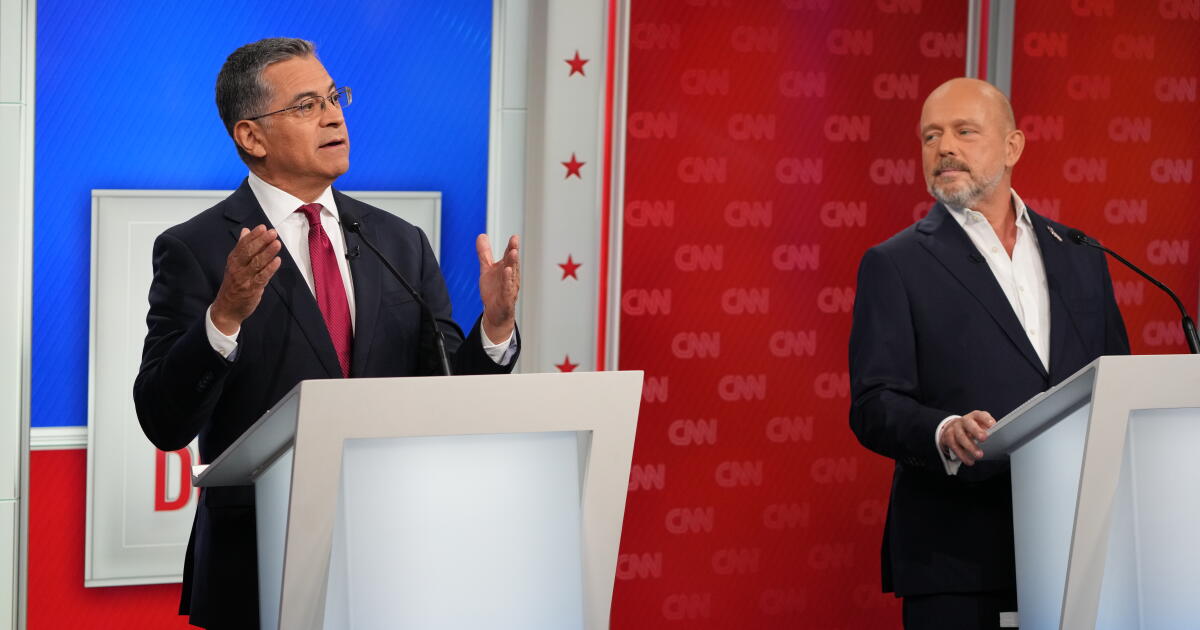
SACRAMENTO — Look, Xavier Becerra could cruise to a South Pacific island and bask on the beach until election day and Californians would still choose him as their next governor.
Who won the debate? Becerra, because he came across as calm, collected and capable of governing this troubled state — certainly very few voters’ ideal candidate, but the only real choice for most Californians.
Moreover, Hilton’s only previous political experience was as an advisor to a British prime minister and his sole claim to U.S. notoriety was as a Fox News TV host–not exactly resume boosters in California.
He’s a shoo-in simply because he has a “D” beside his name in this state where Democrats outnumber Republicans nearly 2-to-1 and despise the GOP president.
Expert columnists cover the insights, legislation, players and politics you need to know.
By continuing, you agree to our Terms of Service, which include arbitration and a class action waiver. You agree that we and our third-party vendors may collect and use your information, including through cookies, pixels and similar technologies, for the purposes set forth in our Privacy Policy such as personalizing your experience and ads.
“You’re the candidate who is supported by the machine in Sacramento — the unions, big business, all these people that for 16 years have given us the highest cost of living in the country, made it impossible to build anything, given us the highest unemployment rate, the highest poverty rate….
“And that’s why we’ve got to try something different this time instead of voting for more of the same.”
OK, fair point. But try what exactly? That’s where Hilton stalls or veers erratically.
He’d build “10 new cities.” Build them where exactly? He doesn’t say.
He definitely doesn’t want to construct new apartment buildings in the suburbs “when we have got so much space that we could be building on in California.”
Like out in Southern California deserts or Central Valley farm fields — requiring two-hour commutes to urban jobs?
And where does the water come from for these 10 new cities as the West scrambles for what’s left of diminishing supplies? But unfortunately there was no discussion of that during the debate.
One debate exchange that caught my attention was about vaccines. Hilton seemed to be carrying the torch for whacko anti-vaxxer Robert F. Kennedy Jr., Becerra’s successor as U.S. health secretary in the Trump administration.
Debate co-moderator Dana Bash recalled what Hilton said previously about children’s vaccinations: “The government should have nothing to do with these fundamental and vital decisions.” And she asked whether he’d push to eliminate California’s vaccine requirements.
“No,” Hilton replied. “I’m pro vaccine.” But then he seemed to wander all over the stage looking to have it both ways.
It’s a “very, very emotional issue for a lot of parents,” he said, adding there’s “data around the world” showing that where vaccine “mandates are lower… you actually have higher [vaccination] compliance, where parents don’t feel that they’re being bullied into doing something that they don’t want to do. And that’s what I want to see here.”
But he ultimately said,“I’d follow the law.”
In California, the law requires all children without medical exemptions to be vaccinated for several diseases — including polio, measles, mumps, chickenpox, hepatitis B and whooping cough — before they’re admitted to school.
That’s a blessing. When I grew up, practically every kid at some point was bedridden with one or more of those dangerous ailments. Then some saviors invented vaccines.
“We had nearly eradicated measles,” Becerra said, responding to Hilton. “When I left HHS, you rarely heard of a case of measles…. Today, children are dying of measles. Today, the spread of measles has reached a proportion we haven’t seen since the 1960s.
“That’s what happens when vaccine deniers take over.”
Becerra achieved all he needed to in the debate. He didn’t screw up. He kept cool and actually was fairly quick on his feet in replying to Hilton’s attacks, while planting a MAGA hat firmly on the Republican’s head.
He missed an opportunity to accomplish more, however — like making Californians feel really good about voting for him, rather than merely because he’s the only Democrat left standing in the contest to replace the termed out Gov. Gavin Newsom.
Voters might like to hear what Becerra’s vision is — if he has one — for the California he wants to build.
What does he have in mind besides just defending California against Trump? That’s a given. How’s he going to lower our living costs? Upgrade public education? Prevent wildfires? Details, not platitudes.
Rather than relaxing on his lead, Becerra should be constantly moving around the state, introducing himself to Californians and — more importantly — listening to their problems and ideas. To his credit, he’s doing that this week.
“The debate was boring and uneventful, but Becerra won it,” says Republican consultant Rob Stutzman. “He is perfectly vanilla and that makes it really hard to pin him down in an attack.”
“We got the genuine Xavier Becerra. That’s exactly who he is,” says veteran Democratic strategist Garry Sragow, a longtime political ally. “Thoughtful, committed and very decent, but does not go very high on the charisma meter.”
In California right now, a candidate’s charisma rates much lower than a simple “D.”
Big Brother continues to deliver plenty of drama and chaos as viewers are once again invested in another series
A Big Brother star made history over 20 years ago(Image: ITV)
Big Brother’s first ever winner is looking almost unrecognisable decades on from their £70k success.
The hit social experiment has once again returned to screens, bringing with it plenty of drama and chaos as regular people from across the UK move in to the iconic house where they will live for several weeks.
However, before the reality show made its iconic return to ITV, Big Brother had originally launched on Channel 4 screens back in 2000, before making its way to Channel 5 during its third series in 2002.
There has been plenty of iconic moments throughout Big Brother, with the show remaining a firm favourite amongst viewers as housemates face brutal tasks and weekly evictions. But as a brand new series continues, with the new housemates hoping to leave their mark, we have taken a look back at the show’s first ever winner, including his most iconic moment.
Who won the first ever Big Brother?
Craig Phillips was the first ever contestant to win Big Brother UK back in 2000, making history from the launch show. The then-builder from Liverpool saw his life change after 64 days in the iconic house, winning a staggering £70,000 cash prize.
At just 28 years old at the time, Craig became a firm favourite in the Big Brother house where he stayed alongside Nick Bateman (then known as ‘nasty Nick’) as well as Melanie Hill. His success also continued when he won a National Television Award for Best Live Television Moment of the Year.
What did Craig Phillips do with his Big Brother prize money?
After winning the £70,000 cash prize, Craig decided to put his winnings to a good cause, donating it to his friend Joanna Harris who had Down’s Syndrome, to pay for her heart and lung transplant.
According to the official Craig Phillips website: “He had begun raising money with friends for Harris sometime before entering Big Brother, raising only small amounts of money towards the £250,000 needed for her operation in the USA, but within 6 days of winning he achieved the target required for her life saving operation thanks to public support and generous donations from celebrities.”
Craig has worked closely with a variety of charities, often taking part in fundraising events such as abseiling one of London’s tallest buildings as well as sky diving.
Where is Craig Phillips now?
Since his Big Brother success, Craig Phillips has far from faded from the spotlight. He has gone on to build a successful career as a property developer, DIY expert and television presenter, famed for popular shows such as 60 Minute Makeover and Trading Up.
He has also not been a stranger to reality TV, having raised £40,000 for charity from Back to Reality as well as appearing on Ant and Dec’s Saturday Night Takeaway
Fans may not have realised he turned his attention to music, releasing a charity single for Christmas 2000, which reached the charts, raising tens of thousands for the Down’s Syndrome Association.
Right now though, the former Big Brother winner lives in Spain with his family having also launched the Mr & Mrs DIY TV channel alongside wife Laura.
Craig Phillips’ most ‘iconic’ Big Brother moments
Arguably his most iconic moment was his confrontation with Nick Bateman, then nicknamed Nasty Nick. After Nick was seen breaking the rules, Craig gathered the housemates calling for an intervention before going face to face with his co-star.
Another iconic moment was causing mass panic on Ultimate Big Brother when he gate crashed and staged an eviction.
With millions of people tuning in to the live final, Craig made history winning the first ever Big Brother series as he stepped out to a huge crowned, later earning him the National Television Award.
Speaking to Channel 4 back in 2020, Craig was asked what it was like winning Big Brother as he replied: “This is a question I’ve been asked thousands of times and if I am being honest it’s so hard to answer! Because it was and still is the most surreal moment and experience, I’ve ever had!
“It was the ultimate combination of emotional highs as well as a scary situation to be in – once I’d stepped out the door I started to live a life that most people dreamed of having, almost the entire country knew my name and appeared to love me!
“Every A-List celeb I chatted to became my friend, people and companies were paying me obscene amounts of money to be associated with them, I had bodyguards that chauffeured me around day by day and we changed hotel every night for month and months!”
Big Brother continues tonight at 9pm on ITV2 and ITVX
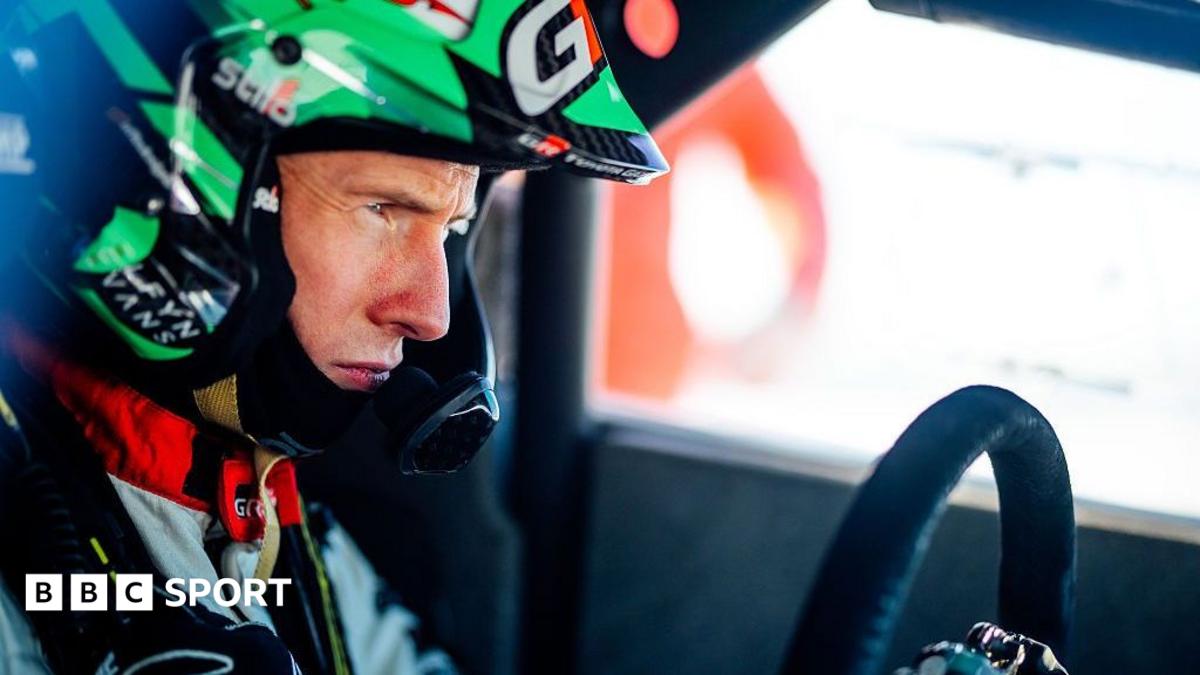
For what must have felt like an eternity, Elfyn Evans feared history was repeating itself yet again.
At 3.05pm local time in Sardinia on Sunday, Evans could only stand and watch as another world rally title looked to be slipping from his grasp.
Evans was preparing in his head yet another runners-up speech – it would be his sixth – as he waited for Oliver Solberg to cross the finish line and be crowned world champion.
How could this be happening again?
Of the five previous times he had been championship runner-up, three had been decided on the final day and twice after he had taken a lead into the final event.
But at 3.06pm, for once the motor-racing gods were on his side.
With just two turns to go on the final stage of the final round and with victory in sight, Solberg somehow careered off the track into the Sardinian sand to hand Evans his first world title.
In the most dramatic of finishes, the 37-year-old from north Wales became the first British winner of the of the World Rally Championship (WRC) in 25 years.
Only two British men had taken the title since the WRC’s 1977 inception, matching the exploits of legendary pair Colin McRae (1995) and Richard Burns (2001).
Louise Aitken-Walker was Britain’s first world champion when WRC ran a women’s version in 1990.
PHILADELPHIA — It’s rarely sunny in Philadelphia for Sean McVay and the Rams.
Before Sunday’s game against the Eagles, McVay was 1-6 against them, 1-4 at Lincoln Financial Field and 0-4 against Eagles coach Nick Sirianni.
The last time the Rams visited here, the Eagles blocked a field-goal attempt and returned it for a touchdown on the final play.
And for much of the game Sunday, gloom once again engulfed McVay and a team that opened the season as a heavy Super Bowl favorite.
Share via
Gary Klein breaks down what went right for the Rams in their 24-20 comeback win over the Philadelphia Eagles.
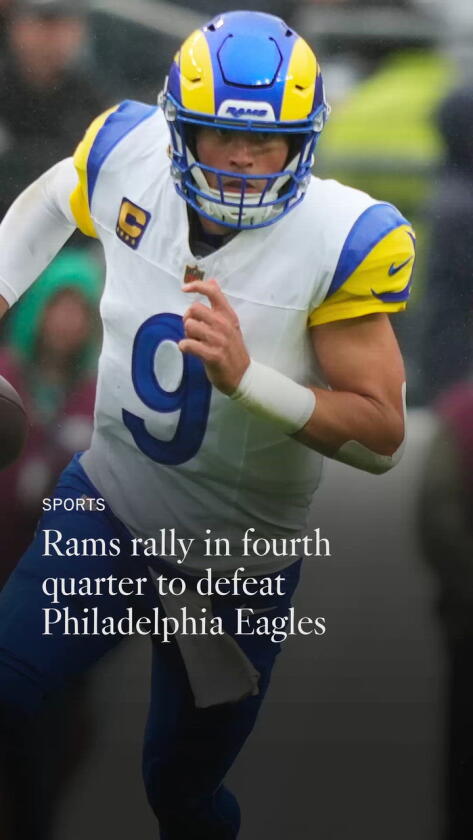
But it finally lifted midway through the fourth quarter, with quarterback Matthew Stafford leading two touchdown drives that gave the Rams a come-from-behind, 24-20 victory.
“A lot of gutsy efforts,” McVay said, “and I have a headache from hell right now.”
No doubt stress-induced.
While McVay enjoyed watching Kyren Williams rush for two touchdowns and receiver Puka Nacua rush for another, the Rams had to overcome turnovers, penalties and special teams miscues to improve to 2-2.
After sitting out two games because of a hip injury, Nacua caught nine passes for 125 yards, several during the final two scoring drives.
“I’m excited to get on this plane and get up out of here,” Nacua said. “Hopefully, they have some Philly cheesesteaks for us.”
The Rams had mostly had their fill of Philadelphia after losing an NFC divisional game here in 2024 and last year’s debacle that ended with the blocked field goal and touchdown.
“We obviously haven’t found a way to get it done here,” McVay said, “and our guys found a way today.”
Rams players celebrate with Kyren Williams following one of his two fourth-quarter touchdowns against the Eagles on Sunday.
(Chris Szagola / Associated Press)
The Rams can thank their defense.
The Eagles were without receiver DeVonta Smith and left tackle Lane Johnson, and star running back Saquon Barkley left the game in the first quarter after suffering a hamstring injury.
The Eagles were 0 for 12 on third downs. They converted only one of four fourth downs and managed just 172 yards.
“When it was the time for us to make a play, the defense stepped up,” said edge rusher Byron Young, who had 2½ of the Rams’ four sacks, “and we had to do what we do.”
Despite their elation over Sunday’s victory, the Rams have plenty to fix.
Stafford was great down the stretch but otherwise did not look like the reigning NFL most valuable player. He completed 32 of 51 passes for 317 yards with two interceptions.
The Rams, historically one of the league’s least-penalized teams under McVay, had 13 penalties for 91 yards in last Sunday’s 30-26 defeat by the Denver Broncos. On Sunday, they were flagged eight times for 100 yards.
“Any way you could shoot yourself in the foot — we were doing it on the offensive side of the ball,” Stafford said.
Special teams also continued to be an issue. The Rams gave up a long punt return that set up a touchdown, and usually reliable kicker Harrison Mevis missed a 48-yard field-goal attempt.
But the defense kept the Rams within striking distance.
“You’d like to see [us] play as a team where you go and score, and then hold ‘em, score and hold ‘em and score,” receiver Davante Adams said. “But sometimes that’s not how it plays out.
“[The defense] did their thing to put us in a position to win it, and we went down there and finished the job.”
The Rams trailed, 20-10, at halftime, as the Eagles turned two interceptions into 10 points, and Jalen Hurts tossed two touchdown passes to receiver Darius Cooper.
After Mevis missed, it got uglier.
Near the end of the third quarter, it finally looked like the Rams’ defense would be rewarded for a good play: It stopped Hurts on a fourth-down tush push, giving the offense a first down at the Eagles’ 38-yard line.
But Nacua’s penalty for an illegal block stymied the possession, and Stafford’s fourth-down pass for tight end Tyler Higbee fell incomplete.
McVay rallied the offense on the sideline.
“He said, ‘Make things go. Wipe it. Get to the next play,’” Higbee said.
Stafford said McVay was “trying to put some belief” in the team.
“I think we had it,” Stafford said, “but it was great to hear from him.”
The defense came up big again, stopping the Eagles on downs at the Rams’ two-yard line.
On came Stafford, who ranks fourth all time in fourth-quarter comebacks.
“We call it the Mamba period,” said Williams, who rushed for 80 yards in 15 carries and had 10 receptions for 67 yards. “We knew we had to get things done. … Matthew, man, he got us all together. He said ‘Let’s freakin’ do it’ and we did the dang thing.”
Stafford engineered a nine-play, 98-yard drive that Williams finished with a one-yard touchdown run to cut the deficit to 20-17 with less than four minutes left.
Stafford got the ball back with 2:55 left at the Rams’ 21-yard line. He connected with Nacua three times and Higbee once before Williams scored on a seven-yard run with 1:10 remaining.
Rams quarterback Matthew Stafford slides after running the ball against the Eagles on Sunday.
(Matt Slocum / Associated Press)
The play included Williams’ trademark second and third efforts.
“I wasn’t looking at any defender,” Williams said. “I wasn’t looking at any blocks. I was just having that smell, that nose for the end zone.”
Next up: Josh Allen and the 3-1 Buffalo Bills, a 29-26 loser Sunday against the New England Patriots.
The Rams will go into the game a .500 team riding the high of a comeback victory rather than trying to get out of a 1-3 hole.
At some point, the Rams will welcome back edge rusher Myles Garrett, defensive lineman Aaron Donald, who sat out because of a sore back, and tight end Terrance Ferguson, who like Garrett is on injured reserve. They are still more than capable of becoming the team that was hyped throughout the offseason.
So Sunday’s victory — rather than another loss in Philadelphia — could pay dividends.
“Hopefully,” Stafford said, “it was really important come later in the year.”
From the late 19th century, Britain and French had been wrestling for control of the New Hebrides, a group of about 80 islands in the South Pacific Ocean.
In 1906, they agreed to share control through a unique Anglo-French Condominium.
With the movement for independence gaining momentum in the 1960s, Father Walter Lini established the New Hebrides National Party (now the Vanua’aku Pati) in 1974.
The date for full independence of Vanuatu was agreed in 1979 when the drafting of a constitution got underway. The Constitutional Committee consisted of representatives of different political parties, religious leaders and local tribal chiefs.
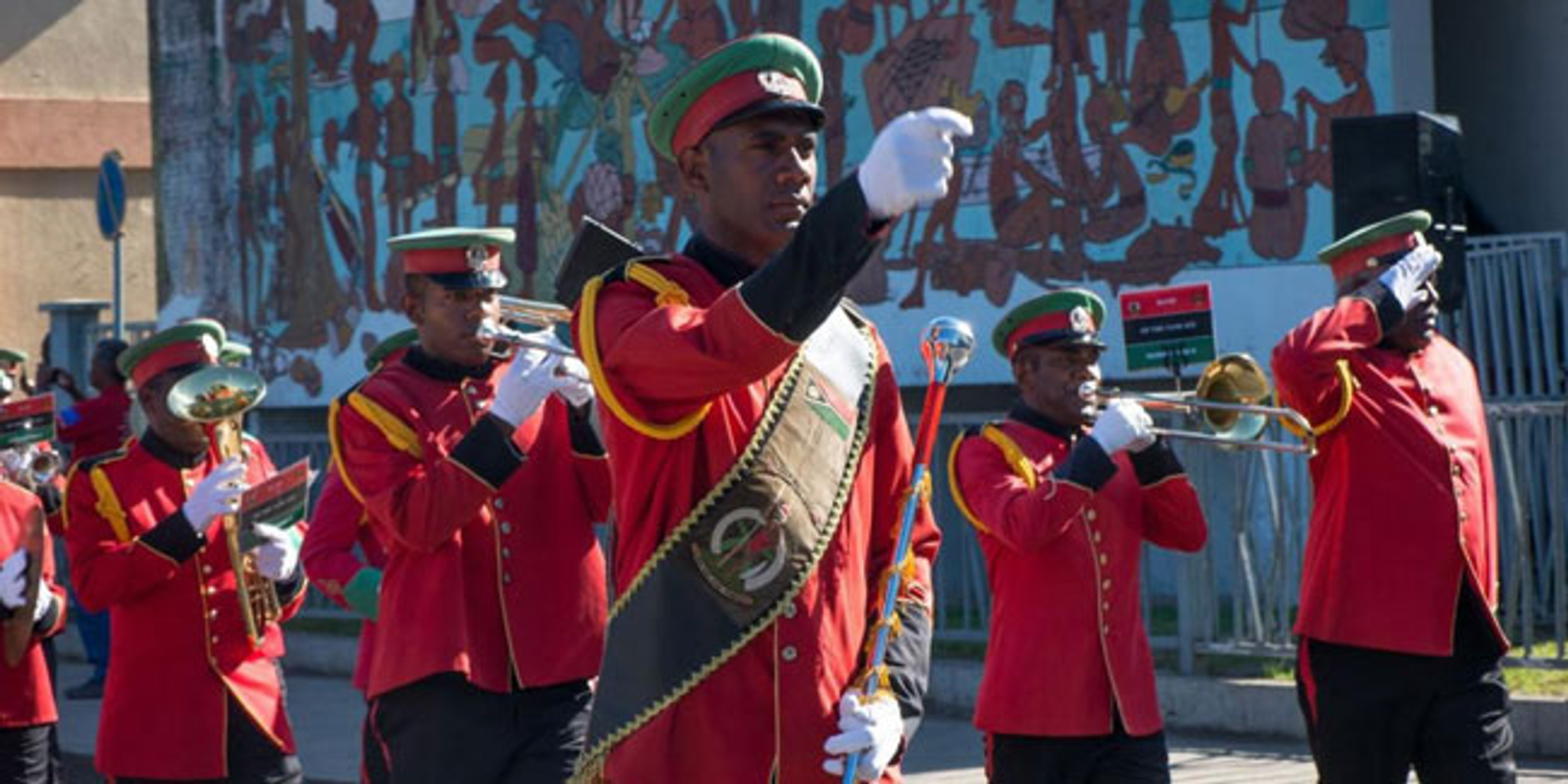
The Constitution was signed on October 5th 1979. It came into force on July 30th 1980, when the New Hebrides gained independence as the Republic of Vanuatu
The feast day was a public holiday in Italy until 1977, when it was removed as part of a law reducing the number of holidays for economic reasons.
In advance of the 800th anniversary of the death of St. Francis in 2026, two combined bills (Noi Moderati and Fratelli d’Italia) were proposed in 2025 to reinstate the October 4th holiday.
On October 1st 2025, the Italian senate gave final approval to the bill after it had passed in the lower house the previous week week with 247 votes in favour and just two against.
The bill, backed by the ruling right-wing parties, calls for cultural initiatives dedicated to Italy’s patron saint and the values he embodied: peace, fraternity, inclusion and environmental protection.
The emperor is a symbol of Bulgarian national identity whose repatriation stoked tensions with Greece.
Published On 3 Oct 20263 Oct 2026
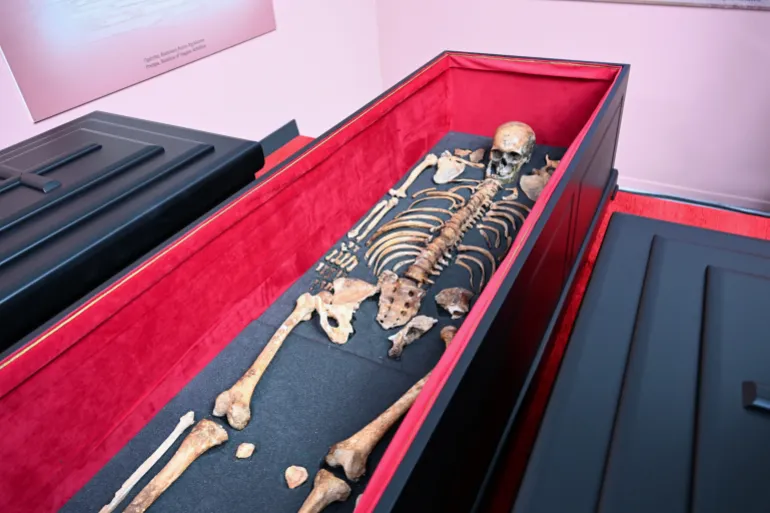
More than 1,000 years after his death, the remains of medieval ruler Czar Samuel have arrived in Bulgaria.
A symbol of Bulgarian national identity, Samuel was a warrior emperor who battled the Byzantine Empire to expand his kingdom before suffering defeat and dying soon after in 1014. His supposed remains were discovered in a Greek border area in the 1960s.
Recommended Stories
list of 4 itemsend of list
The coffin and remains were flown on Saturday to the Bulgarian capital, Sofia, on board a military aircraft that was surrounded by air force fighter jets.
Thousands of people poured into a public square to honour the czar’s arrival, which capped years of fraught negotiations between Bulgaria and Greece until an accord was reached this week.
Bulgarian politicians across the spectrum paid tribute to the medieval ruler, listening to the national anthem and a 21-gun salute.
“Today, we Europeans are learning to read history with a desire to belong not only to our homeland, but also to the culture that unites us across the entire European continent,” Bulgarian Prime Minister Rumen Radev said.
“That is why Europe must not reopen old wounds but must work for peace as the supreme good,” Radev continued, referring to the centuries-old rivalry between neighbouring Greece and Bulgaria.
Crowds cheered as fighter jets performed a flypast.
Martin Nestorov, a 42-year-old software engineer, told the AFP news agency he attended the ceremony “to welcome Czar Samuel back to Bulgaria, where he belongs”.
“I am here because I am Bulgarian, and a Bulgarian is returning to his homeland,” added Tsanka Zlatkova, 65, a retired art historian.
A procession brought the remains to be laid in the Church of Saint Sofia, a sixth-century basilica that is the capital’s namesake and where church officials say Samuel was baptised.
The remains of medieval ruler Czar Samuel inside a coffin Saturday, October 3, 2026 [Giannis Papanikos/AP]
Competing claims
The handover of Samuel’s remains is part of a broader accord between the Greek and Bulgarian culture ministers.
In exchange, Greece is slated to receive 48 objects that Bulgarian troops pillaged from churches and monasteries in Greece during World War I.
Speaking before the handover, Greek Prime Minister Kyriakos Mitsotakis said he hoped the ceremony would boost Greece’s campaign to repatriate the Parthenon Marbles, a collection of 2,500-year-old marble sculptures taken from the Acropolis in Athens and later displayed in the British Museum.
“The global community is essentially re-evaluating its longstanding stance on protecting cultural heritage,” Mitsotakis said, adding that historical heirlooms “cannot be treated as the spoils of war”.
Bulgaria is not the only country to have claims on Samuel. A huge statue of the czar stands in the North Macedonian capital of Skopje, with Macedonians claiming him as “their” ruler.
In 2022, a bilateral commission recommended presenting Samuel as the head of a state that “most contemporary historiographers consider to be the Bulgarian Empire”, based in what is currently North Macedonia.
Three weeks is only a sliver of the NFL season; a backsliding team has plenty of time to correct its course.
That said, only seven teams in the Super Bowl era have rebounded from an 0-3 start to make the playoffs.
That’s a sobering statistic for the Chargers, Houston Texans and Tampa Bay Buccaneers, all winless so far. As for the 0-3 Miami Dolphins, well, that isn’t quite as shocking.
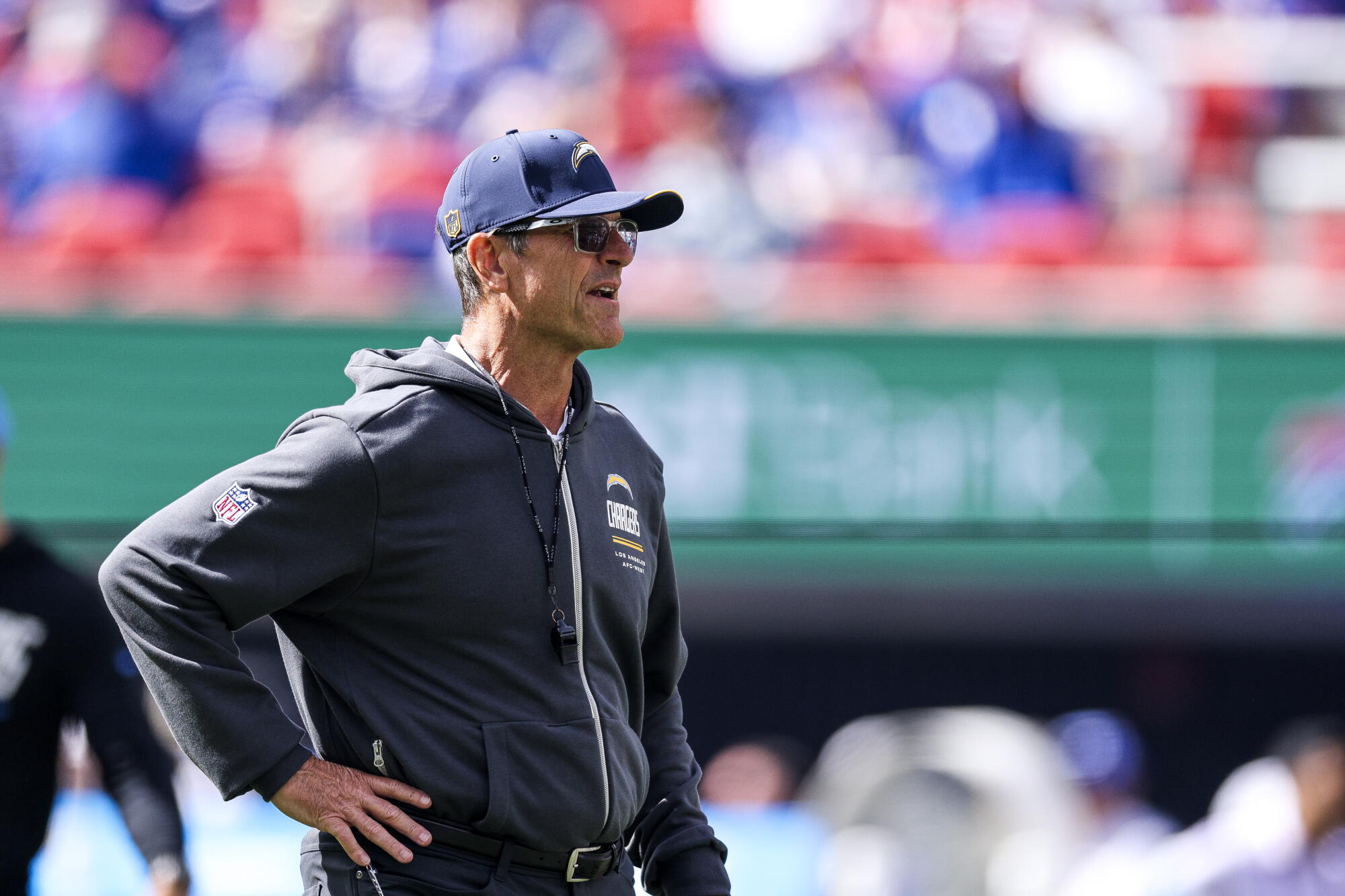
“We’re searching for every possible way to give ourselves an advantage,” said Chargers coach Jim Harbaugh, whose team lost at Buffalo last Sunday despite five takeaways and a plus-four turnover differential.
The uphill climb continues for the Chargers, who play at Seattle on Sunday, with the defending Super Bowl champions itching to respond to an upset loss at Washington in Week 3.
So far, the change at offensive coordinator to former Dolphins coach Mike McDaniel has been a bust for the Chargers. Their offense has sputtered and wheezed, even as their defense has done its part to keep them in games.
Elsewhere Sunday, the Texans play host to Dallas, Tampa Bay hosts Green Bay, and Miami plays at 3-0 Minnesota.
Of those seven teams that dug themselves out of a foreboding pit, only the 1992 San Diego Chargers turned their season around after an 0-4 start — so it’s pretty much now or never for this year’s class of Sunday strugglers.
The others to make the playoffs after losing their first three games were the 1981 New York Jets, 1982 Buccaneers, 1995 Detroit Lions, 1998 Buffalo Bills, and the Texans, who pulled off the feat in 2018 and last season… and now find themselves back in that dank basement.
“We’ve been here before,” Houston quarterback C.J. Stroud told reporters this week, “so we know we can get this thing turned around.”
For those who have made that euphoric U-turn, there are life lessons to draw upon. Chief among them, don’t panic.
Chargers coach Jim Harbaugh stands on the field before a loss to the Buffalo Bills on Sept. 27.
(Bryan M. Bennett / Getty Images)
Former Lions linebacker Stephen Boyd recalls the composure and calm of Detroit coach Wayne Fontes, after three losses to Pittsburgh, Minnesota and Arizona — two of those by a field goal.
After the third loss, Boyd said, “Wayne Fontes walks into the meeting room with a big smile on his face and says, `Listen, here’s the deal, we’re going to give the ball to Barry [Sanders] a little bit more, and we’re going to get this turned around.’”
Sure enough, the Lions broke through the following week with a win over San Francisco on Monday night. But there were more bumps in the road for Detroit, which by November was still a dismal 3-6. Few could have predicted the club would win its final seven games.
That set the stage for a strange wild-card game against Philadelphia in which the Eagles built a 51-7 lead and held on despite the Lions scoring 30 points down the stretch. The final score: 58-37.
Three years before Fontes kept his cool under pressure, Chargers coach Bobby Ross did the same.
“There were a lot of grumblings that this was just some college coach that didn’t know what he was doing in the pros,” recalled former Chargers linebacker Gary Plummer of Ross, hired out of Georgia Tech. “There were a lot of guys that were essentially jumping off the ship.”
That team held a players-only meeting after falling to 0-3… then got clobbered, 27-0, by the Houston Oilers in Week 4.
Ross held steady, though.
“He told us that he wasn’t changing,” Plummer said. “We were still going to have physical practices. He said that was the only way he knew how to coach.”
The Chargers responded by winning four in a row. Then, after a hard-fought, two-point loss to Kansas City, the Chargers tore off another seven wins.
Defense led the way for those Chargers, allowing just 241 points that season, the fourth-fewest in the NFL.
So far this season, these Chargers are showing similar tendencies. Last Sunday, the defense played a gem of a game, and certainly through three quarters.
Hope still has a heartbeat, but that grows fainter by the loss.
Portadown, Northern Ireland – When the summer holidays arrived, Chris Nelson worried about his mother.
At night, he lay awake waiting for her to return. During the day, he rang family members to ask if she was safe. There were threats and letters through the door.
Recommended Stories
list of 4 itemsend of list
“I was afraid to leave the house,” he told Al Jazeera.
His mother, Rosemary Nelson, was a lawyer representing the Catholic residents opposing the Protestant Orange Order parade along Portadown’s Garvaghy Road in Northern Ireland in the late 1990s.
Every July, as marching season approached, there was a standoff.
Orangemen sought to return from Drumcree church along what they regarded as their traditional route. Residents opposed the passage of the anti-Catholic organisation through a majority Catholic street. In some years, police forced the parade through. In later years, it was blocked.
Rosemary would spend summer evenings alongside the residents on Garvaghy Road. Before leaving home each evening, she told her son that she was going to look after families and make sure their children were okay. She compared them to his friends at primary school.
“She was a big believer in helping the underdog,” said Chris, now 39. “She did a lot of work for free.”
His mother helped people from both sides of the community. When work allowed, the family went to Bundoran, across the border, and for a day the fear would pass.
But one night, during a standoff in 1997 when the state police force, the Royal Ulster Constabulary (RUC), used batons to clear Catholic locals from the road, “she was beaten by the police”, said Chris. “She was spat on”, bruised and bloodied.
“That was very traumatic. I was always thinking something was going to happen to my mum.”
On a Monday in March 1999, nearly a year after the Good Friday Agreement brought an end to the conflict, Rosemary drove away from her home in Lurgan.
As she braked at a nearby junction, a bomb beneath her car exploded. Her eight-year-old daughter, Sarah, was at primary school nearby and heard the blast. The family had spent the previous weekend in Bundoran together.
Chris, 11 at the time, and his older brother were away on a school ski trip when they received a phone call with the news of her death.
“That was hard”, he said, his voice tailing off.
A legacy of loss
Nearly three decades later, another standoff has recast these childhood memories into fears for the next generation, with a renewed attempt by the Protestant Orange Order to march through the Catholic neighbourhood, threatening to unravel a fragile peace.
The Troubles began in the late 1960s as protests by Catholics against discrimination were met by repression and violence. Republican paramilitaries fought for a united Ireland as loyalists and the army battled to preserve British rule, in a conflict that killed more than 3,500 people.
The 1998 Good Friday Agreement established a framework for peace and power-sharing.
Under the agreement, the people of Portadown have lived in relative peace for the past 28 years.
But this was suddenly unsettled by a last-minute decision by the High Court to allow the march. In response, Catholic residents blocked the road. Many camped out as Orange men gathered at the top of the road, awaiting police permission to pass – an image of division that never truly left.
Portadown Orangemen march from Drumcree Church to start their march towards Garvaghy Road, which was stopped a short distance later by police, in Portadown, Northern Ireland on September 27, 2026 [AFP]
Many of the Garvaghy Road residents are now parents, and fear what their children might inherit from a dispute they hoped had been left behind.
Paul O’Connor, of the Pat Finucane Centre human rights group in Northern Ireland, said Rosemary Nelson is among 21 people whose deaths were linked to the Drumcree dispute.
Many are still being investigated, with families continuing to seek justice and pressing for public inquiries amid concerns about collusion between the British state and loyalist paramilitaries, many of which were members of the Orange Order.
“These murders encompass LVF (Loyal Volunteer Force) killings at that time, and are all linked to the Drumcree disputes. They were responsible for many of the killings around the Mid Ulster area at that time. They were trying to destabilise the peace process, with many riots spreading around, including into Derry,” O’Connor told Al Jazeera.
He worked with Rosemary Nelson and is now seeking a public inquiry into the murder of Sean Brown, another Drumcree-linked case, he believes. The 61-year-old father of six from Bellaghy, County Derry, was abducted and murdered in May 1997.
The following year, the three Quinn brothers – Richard, 10, Mark, nine, and Jason, eight – died after loyalists petrol-bombed their home in Ballymoney, County Antrim, as they slept. Their deaths, during the unrest surrounding Drumcree, brought widespread calls for the Orange Order to end its standoff.
Protesters block the Garvaghy Road in Portadown, Northern Ireland on September 27, 2026, preventing a parade of marchers from the Orange Order using the route through the mainly nationalist area of the town [AFP]
Fear and loathing in Mid Ulster
In Portadown town centre, a Union flag flies among plinths dedicated to the Ulster Defence Regiment, a locally recruited unit of the British army and the Ulster Covenant – a document signed when nearly 500,000 people opposed a form of self-government for Ireland in 1912.
Around the corner, in the Edgarstown housing estate, Ulster Volunteer Force (UVF) flags hang from lampposts, and the kerbs are painted red, white and blue, alongside a mural of a Rangers FC badge.
The area is one of the heartlands of unionism. The Orange Order was founded in 1795 in the village of Loughgall, a few miles from Drumcree.
The Orangemen say they have marched the route through Garvaghy Road since 1807. The parade has been blocked from Garvaghy Road since 1998, but the Orangemen have continued submitting requests to march.
The latest Parades Commission decision permitted 35 men to walk without music. Since then, Orangemen have repeatedly approached the police line before returning to the church.
UVF flags fly alongside UK flags in the Edgarstown estate, Portadown, Northern Ireland, on October 1, 2026 [Caolán Magee]
Irish nationalists have criticised the police assessment underpinning the decision to allow the march, while unionists have denounced police for failing to forcibly remove protesters blocking the route.
Al Jazeera contacted the three main unionist parties – the Democratic Unionist Party (DUP), the Traditional Unionist Voice (TUV) and the Ulster Unionist Party (UUP) – for comment but received no response.
Addressing around 200 supporters in Portadown, loyalist activist Jamie Bryson described protesters as “an unlawful snarling mob”.
He has called for the First Minister, Sinn Fein’s Michelle O’Neill, and police Chief Constable Jon Boutcher to resign, and demands that the Orange men must be allowed to walk the Garvaghy Road.
O’Neill has faced criticism for standing beside the protesters.
At Drumcree Church, the Orangemen were not marching, but sitting down drinking tea and eating crisps. Around six men, one wearing his sash, huddled under a gazebo in the cold.
“We are waiting patiently for the chief constable to apply the law of the land,” Nigel Dawson, the Portadown Orange Order district master, told Al Jazeera.
“Portadown District has never in its history stopped a parade down the road to have a confrontation with its neighbours, ever. So I don’t know where the fear and trepidation comes from.”
Another Orangeman, who requested anonymity, added: “We are determined to get home after Sunday service … We just want to go home.”
Orange Order members sit outside Drumcree church as they await passage along Garvaghy Road in Portadown, Northern Ireland, on October 1, 2026 [Caolán Magee]
Around a mile further down the Garvaghy Road, Irish folk band the Mary Wallopers performed to hundreds of residents and supporters.
Children danced and slid down the embankment, as parents watched from above. Palestine and Ireland flags flew in the wind.
Linda O’Neill, 51, a Garvaghy Road resident, told Al Jazeera the scene would have been unimaginable 30 years ago.
“It was horrendous growing up as a teenager. We stayed in our own community. We didn’t access the town centre … This community was a ghetto. And that was deliberate.”
Another resident, Ciaran O Ferghail, remembered summers spent surrounded by British forces.
“This community was turned into a war zone. There were tanks and British Army everywhere, thousands of RUC. This community was completely under siege every summer, by the Orange Order, the British military, the RUC and loyalist paramilitaries. We were surrounded on every road and in every direction.”
O’Neill said the confrontation changed as residents began asserting their rights.
In 1995, hundreds sat down on Garvaghy Road to block the parade. The ensuing violent standoff between security forces and Orangemen and their loyalist supporters ended in a compromise allowing the march through. Residents say they understood it would be the last.
But the following summer, the parade returned. Police initially blocked it, then reversed course after five days of widespread loyalist attacks. Officers forced residents off the road and beat them, sparking riots in Catholic communities.
In 1997, security forces sealed off the Catholic neighbourhood before dawn and allowed the parade through at midday amid loyalist threats to kill Catholics if it was stopped. Nationalist protests and violence followed. From 1998, the march was banned from Garvaghy Road. But for residents, summers remained marked by the army’s steel barricades until 2000.
Children play on the embankment as music rings out along Garvaghy Road in Portadown, Northern Ireland, on October 1, 2026 [Caolán Magee]
Lessons from the past
Chris Nelson, almost 40, is around the same age his mother was when she was killed.
The Garvaghy Road protests mark the first time he has chosen to speak publicly about his mother.
He went on to study law at university, but says his life would have followed a different trajectory if she were still here.
The public inquiry into his mother’s death found no evidence that state security agencies had “directly facilitated” her murder, but it “could not exclude the possibility” that individual members of those agencies had helped the perpetrators.
The inquiry brought the past back repeatedly as he tried to get on with his life. But seeing photographs of families linking arms on Garvaghy Road brought back unavoidable memories of his mother.
“If she were here, that’s where she would be,” he said, “standing with the people of the Garvaghy Road”.
While there has been no violence in Portadown, in Derry’s Waterside, two recent nights of disorder saw petrol bombs and masonry thrown at police. Officers described the crowd on the second night as mostly young people.
The renewed attempt to bring the Orange Order parade through Garvaghy Road risks leaving its mark on children on both sides. With some schools closed, Chris Nelson worries about parents having to explain to their kids what is happening.
“Children don’t forget things“, he said. “They absorb everything.”
He remembers how it felt waiting for his mother each night, and how that worry followed him through the summer holidays. He wants something different for the children growing up now.
“Children shouldn’t grow up knowing the difference between Catholic and Protestant.
“It isn’t something that should be brought into the mind of a child.”
A ‘Garvaghy Road says no’ sign with an Irish tricolour in the background in Portadown, Northern Ireland, on October 1, 2026 [Caolán Magee]
Since 1990, the ‘Tag der Deutschen Einheit’ has been a national holiday in Germany. It is the only official national holiday. All other holidays are managed at a federal level.
On November 9th 1989, the Berlin Wall fell, paving the way towards the reunification of Germany which had been split at the end of the second world war.
The reunification of Germany took place on October 3rd 1990 when the former German Democratic Republic (GDR) was incorporated into the Federal Republic of Germany (FRG).
Following the GDR’s first free elections on March 18th 1990, negotiations between the GDR and FRG culminated in a Unification Treaty.
Further negotiations between the GDR and FRG and the four occupying powers produced the so-called “Two Plus Four Treaty” granting full sovereignty to a unified German state, whose two halves had previously been bound by a number of limitations as a result of its post-WWII-status as an occupied nation. The treaty was signed on September 20th 1990.
Originally November 9th was proposed to be the national German Unity Day reflecting the huge step taken toward Germany’s unification on that day.
However, the unification treaty declared October 3rd as the official national holiday, ending the division between east and west of Germany.
SACRAMENTO — In recent weeks, the Trump administration has been using taxpayer dollars — your money and mine — to pay for a series of cringy, self-glorifying advertisements that feature, you guessed it, President Trump himself.
In one particularly needy spot, the lyrics “love me, love me” are repeated continuously over fast-cut clips of Trump. The White House claims it’s a call to love America, but if someone I knew posted this, I’d be asking if they were OK. Like, teenage-style, “Are you OK?”
But I’d be missing the point if I went down that path of laughing off these regrettable commercials as just more Trump self-adulation.
Taken with two other recent developments — the banning of certain press from the White House and a further purge of military leadership — some experts on authoritarianism told me what we’re really watching is a further collapse of democracy into an authoritarian cult of personality in which Trump is the state and the state is Trump.
“In authoritarian countries, all leaders, they try to completely blur the line between themselves and the state function,” said Konstantin Sonin, an expert in authoritarianism and a professor at the University of Chicago. “So basically, being ‘anti-me’ is being anti-state. In this Trump advertisement, there is this authoritarian scent.”
State propaganda
Jason Stanley, a former Yale professor who moved to the University of Toronto in part over concerns about the far-right political shift in the U.S., put it even more succinctly.
“Trump is trying to tell you, you live in an authoritarian society now, and that he is the state,” Stanley said. “This is pure, pure state propaganda.”
State propaganda matters because it serves not just as a message, but also a warning, said Federico Finchelstein, a history professor at the New School for Social Research and author of “The Wannabe Fascists,” about dudes who try to destroy democracy from the inside. It tells citizens that being against Trump is being against America, he said — a chilling prospect for those who would oppose him.
Finchelstein points out that painting opponents as communists or socialists — an incessant refrain from Trump and the core of the commercials — is a common practice in non-democracies, turning enemies of the dictator into enemies of the state, and perhaps even criminalizing them.
“This should not be seen as just another outburst or just another ridiculed dimension of a kind of ‘original personality,’” he said of the ads. “This is more of a structural pattern of authoritarianism.”
The press ban
Finchelstein points to the recent White House press ban as another part of that pattern, and another way Trump is removing that line between himself and the state.
Recently, CNN, MS NOW and Politico were denied access to the White House on Trump’s orders. The outlets sued, a judge issued a restraining order, and as of now, it mostly has blown over — though it shouldn’t.
For days, Trump made it clear that the ban was because he didn’t like coverage that made him look bad — and if it made him look bad, it was bad for America.
“Virtually every story about me, or anything having to do with me, is negative, wrong and, in many cases, DANGEROUS for our Country! No matter how GREAT my Achievements, they trivialize and demean,” Trump ranted on social media.
Then Atty. Gen. Todd Blanche, who has made loyalty to Trump his brand, took that a step further, arguing that “after years and years and years of one-sided media coverage of the president from certain outlets, the president finally said it’s not fair to the American people,” and constituted a national security risk.
Trump “tries to blur this line about negative stories about [himself] and negative stories about America,” a classic authoritarian tactic, said Sonin, the University of Chicago professor.
Finchelstein said that that kind of crackdown on dissent comes most often in moments of crisis for the person in power — such as when, say, his approval ratings are at an all-time low, gas prices are soaring because of an unpopular war and an election is looming.
The military concern
But what happens if propaganda and intimidation aren’t enough?
Stanley said that faced with plummeting popularity, Trump seems to have stopped trying to win our approval — instead focusing on consolidating power while he still has time.
“Trump is in a race to be a dictator,” Stanley said. “That’s why he doesn’t try to persuade you anymore. He’s not in the business of persuading. He’s in the business of hard propaganda, of just expressing his power. He’s saying public opinion doesn’t matter anymore.”
Finchelstein, Stanley and others warn that the most dangerous moment for democracies can be when a wanna-be dictator loses momentum.
“We’re in a situation where it matters whether the military will violate the Constitution,” Stanley said.
Make of this what you will, but this week, U.S. Defense Secretary Pete Hegseth continued his purge of seasoned military leaders by confirming the department is firing 20% of top officers.
“The ideological clowns are out. The patriotic cowboys are in,” Hegseth said of the unprecedented hollowing of experienced leadership.
Hegseth also announced that billionaire right-wingers Elon Musk and Palmer Luckey are going to help guide the future of the military, which doesn’t sound terrifying at all. I mean, DOGE went so well.
Sonin, the University of Chicago professor, said despite all this, he has hope — because Trump is “old and unpopular” and support of him may have found a “floor.”
Or as Stanley puts it, Trump can conflate himself with the state all he wants, but it works only if we believe him — and even his supporters seem tired of the lies.
The day commemorates the date when Christopher Columbus first set foot in the Americas.
Columbus’ voyages across the Atlantic Ocean initiated the European exploration and colonization of the Americas.
While the first voyage in 1492 was immensely significant, Columbus did not actually reach the American mainland until his 3rd voyage in 1498. Instead, while trying to find a sea route to India, he made landfall on an island in the Bahamas that he named San Salvador.
He was also not the earliest European explorer to reach the Americas.
There is an old saying that ‘two heads are better than one’. In San Marino that saying is literally taken as a form of government.
In a tradition that dates back to 1243 and based on a custom of the Roman Republic, this tiny republic has not one, but two heads of state.
Known as the Captains Regent, two people are elected every six months by the Grand and General Council, the country’s legislative body.
The two Captain Regent are usually selected from different political parties to give a unique balanced government. Once they have served the six months, they cannot become regents again for another three years.
This may sound a bit bonkers to those of us from countries whose leaders are elected for periods of four or five years, but the roles are mainly symbolic and more like that of a king or queen rather than a president.
Women were prevented from taking public positions in San Marino until 1972. The first female Captains Regent was elected in April 1981.
If you are visiting San Marino on April 1st or October 1st, you can watch the investiture of the new Captains Regent which takes place at the Piazza della Liberta, outside the Government Palace.
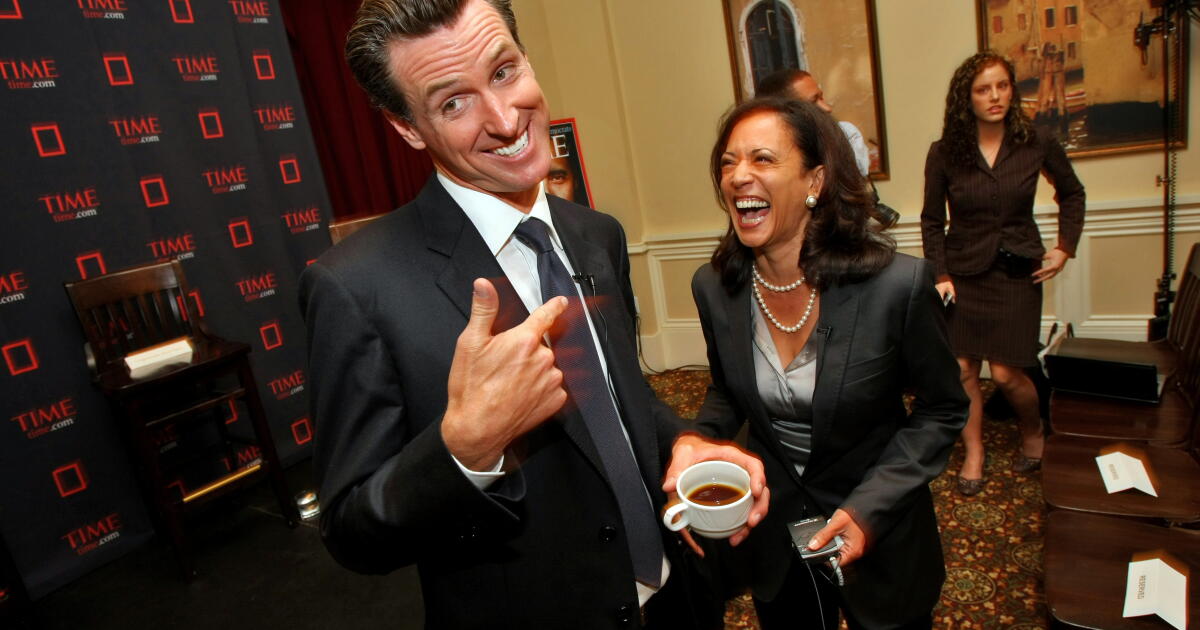
California’s departing governor, who has spent the better part of his second and final term auditioning for the White House, recently said he wouldn’t run if Harris chooses to do so. “Mutual assured destruction,” Newsom called a he-she contest between the two Left Coast rivals, and a “waste of everyone’s time.”
You’re reading the L.A. Times Politics newsletter
Expert columnists cover the insights, legislation, players and politics you need to know.
By continuing, you agree to our Terms of Service, which include arbitration and a class action waiver. You agree that we and our third-party vendors may collect and use your information, including through cookies, pixels and similar technologies, for the purposes set forth in our Privacy Policy such as personalizing your experience and ads.
“That’s objectively true,” Newsom added, driving the knife a little deeper.
But rather than forcing Harris’ hand, Newsom’s professed willingness to stand aside may have simply invited the former vice president to take her sweet time deciding whether or not to run, waiting until the Democratic contest is well underway.
And leaving Newsom in an odd sort of limbo.
The former vice president, lips largely sealed, has done and said just enough to keep the door open to a 2028 run, without firmly committing to the contest. There’s a good chance that Harris — always careful, ever deliberate — doesn’t know what she’ll do. Or, at least, isn’t 100% certain.
She can afford to wait.
Time is on her side
After four years in the White House and her abbreviated 2024 White House bid, Harris has universal name recognition, a nationwide fundraising base and continued support among a significant number of Black women, who just happen to form the backbone of the Democratic Party.
Harris won’t freeze the presidential campaign the way she did the race for California governor. That contest was stalled and the field incomplete until Harris announced, after months of consideration, she’d take a pass. That’s not to say, by any stretch, Harris is the favorite to win the presidential nomination. The criticism Newsom expressed — just a fella jawing away, as he and Tapper cast their fly rods — is a view that is widely held among Democrats.
But the 2028 contest, which unofficially starts the instant the final polls close Nov. 3 — won’t be firmly fixed until it’s clear whether Harris is in or out.
Newsom doesn’t have that luxury of biding time, especially when so many other Democrats are poised to enter the race.
The governor has his own formidable national fundraising base — thanks in good part to his online trolling and anti-Trump hijinks — and a not-small degree of name recognition across the country. But Newsom has yet to fully engage in the see me, feel me aspect of presidential campaigning, which typically requires a candidate’s persistent physical presence and is particularly important in the earliest-voting states.
So his only option is to campaign full bore once he leaves the governor’s office in January, as though he’s running without hesitation or qualification. Then, if Harris jumps into the contest, Newsom can sulk his way back to California, or break his pledge and run against her after saying he wouldn’t.
That, as Newsom suggested to Tapper, would be a gift to the rest of the Democratic field.
Not too long ago, Newsom and Harris were carping over whether he was sufficiently supportive of her hurried-up 2024 presidential bid.
In her account of the campaign, Harris said she reached out to the governor shortly after President Biden announced he was standing aside in favor of his vice president. When she called, Harris wrote, Newsom texted that he was out hiking and would call her back. But, she said, he never did.
Much backing and forthing ensued — Newsom pointing out he didn’t hesitate to endorse Harris once he returned to civilization — with both insisting all the while things are fine between them, really.
Now the two are once more entwined, their fates tied up in mutual ambition and a shared hunger for the White House.
Was Newsom’s CNN interview a feint? Was he just faking respect for Harris as a way to keep in the good graces of Black women voters, all the while hoping against hope she won’t run — and planning to reverse himself if she does?
Will Harris put off her decision, knowing that every day and month that passes deepens the suspense and leaves Newsom twisting?
Will the two finally collide head-on, settling once and for all their intense, if unspoken, competition?
So much drama!
Stay tuned. There’s a reality TV show in there somewhere.
Vintage-inspired mini golf in San Clemente. Mai tais on a sunken ship in Anaheim. Sprawling red rocks in Trabuco Canyon. It’s time to go deeper into great, big, always juicy O.C.
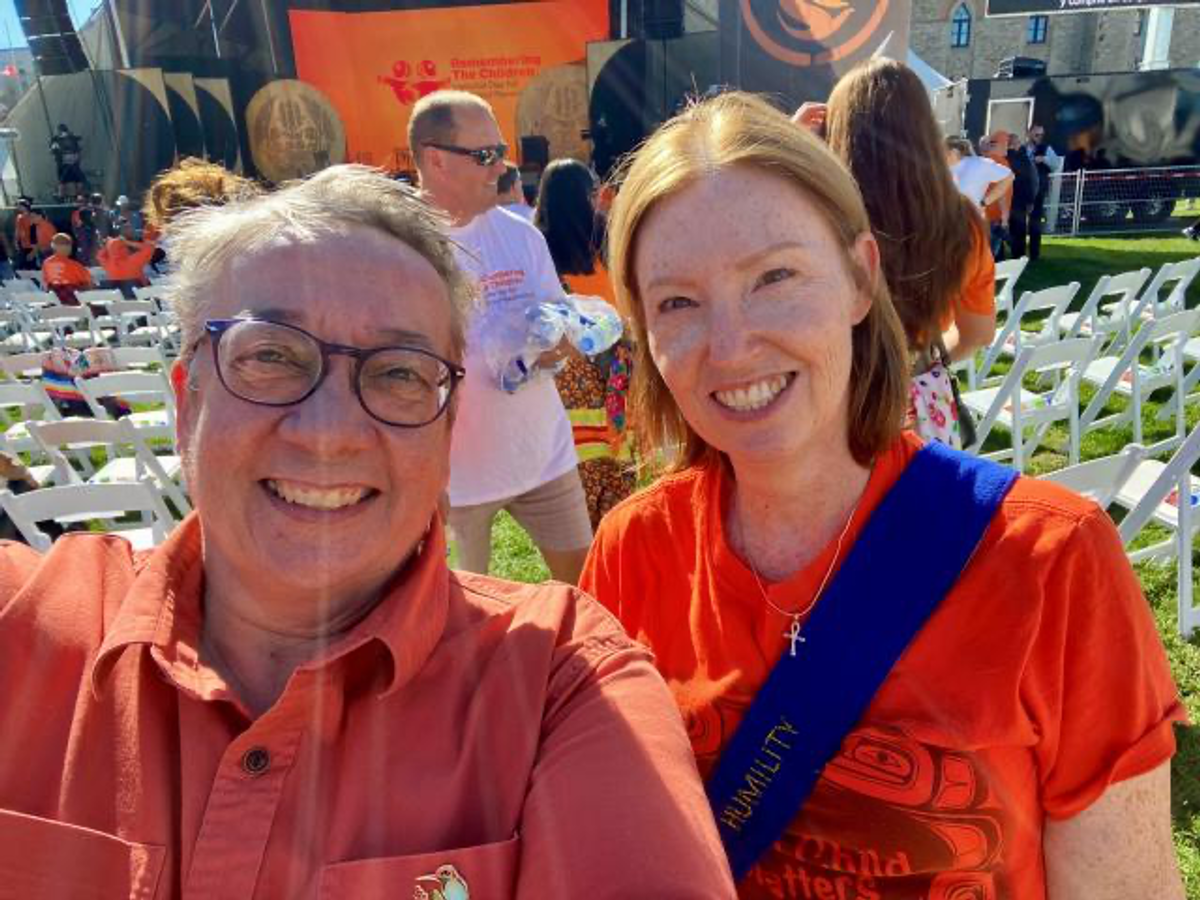
Canadian Heritage Minister Steven Guilbeault says the objective is to create a chance for Canadians to learn about and reflect on a dark chapter in their country’s history and to commemorate the survivors, their families, and their communities, as called for by the Truth and Reconciliation Commission and Indigenous leaders.
Over the course of more than 100 years, some 150,000 Indigenous children were ripped from their families and forced to attend church-run residential schools, where many suffered physical and sexual abuse, malnutrition, and neglect. More than 4,000 are believed to have died.
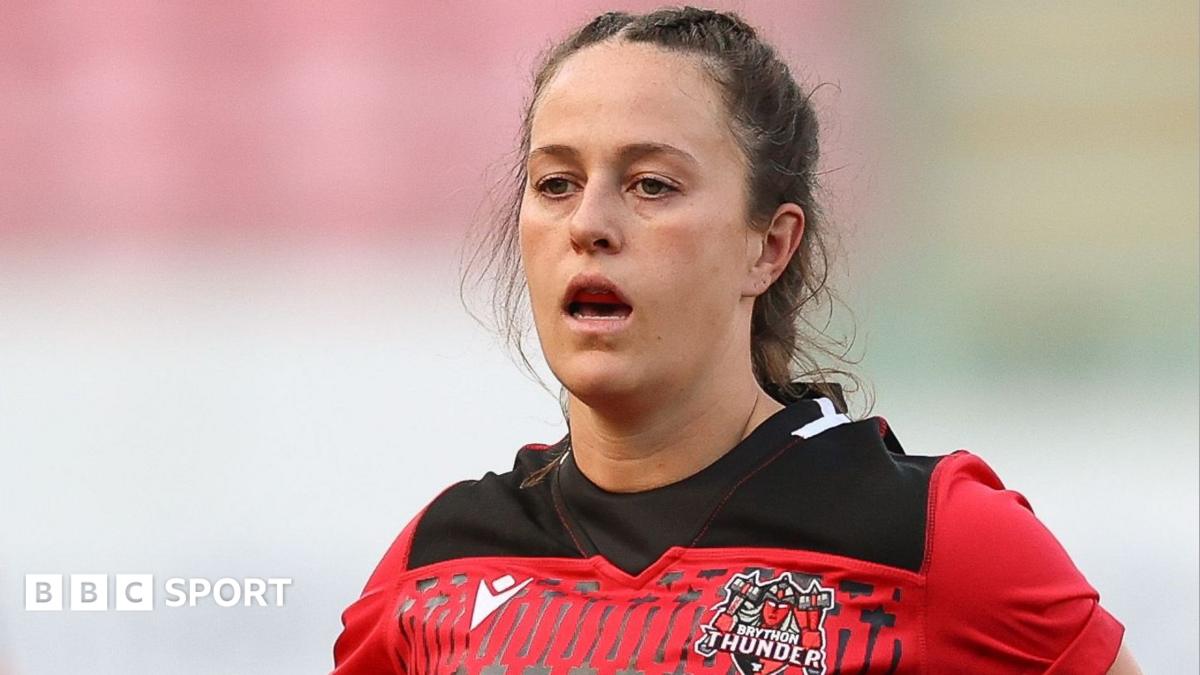
Lewis was part of the Wales squad at the 2022 union World Cup and was set to play in the inaugural WXV tournament a year later.
But she suffered a serious knee injury as Wales beat Italy in the 2023 Six Nations.
Since her recovery Lewis has played for Brython Thunder in the Celtic Challenge but, with no WRU contract, felt she had unfinished business and “didn’t want any regrets”.
“I could have easily just walked away from rugby at that point. I could have just been like ‘I’m done’,” said Lewis.
“But internally, I knew I wasn’t, and I put so much time and effort into coming back and getting back fit, and I was only 28, and I was like, ‘I’ve still got so much time left’, and I just felt individually I didn’t deserve my time to be done based on someone else’s decision.
“So I took some time, and then I just set a goal to myself. If I got the opportunity to play rugby league, great.
“If I had the opportunity to play union, I wouldn’t say no. But this opportunity came up, and I just grabbed it with two hands, and hopefully now it’s paid off.”
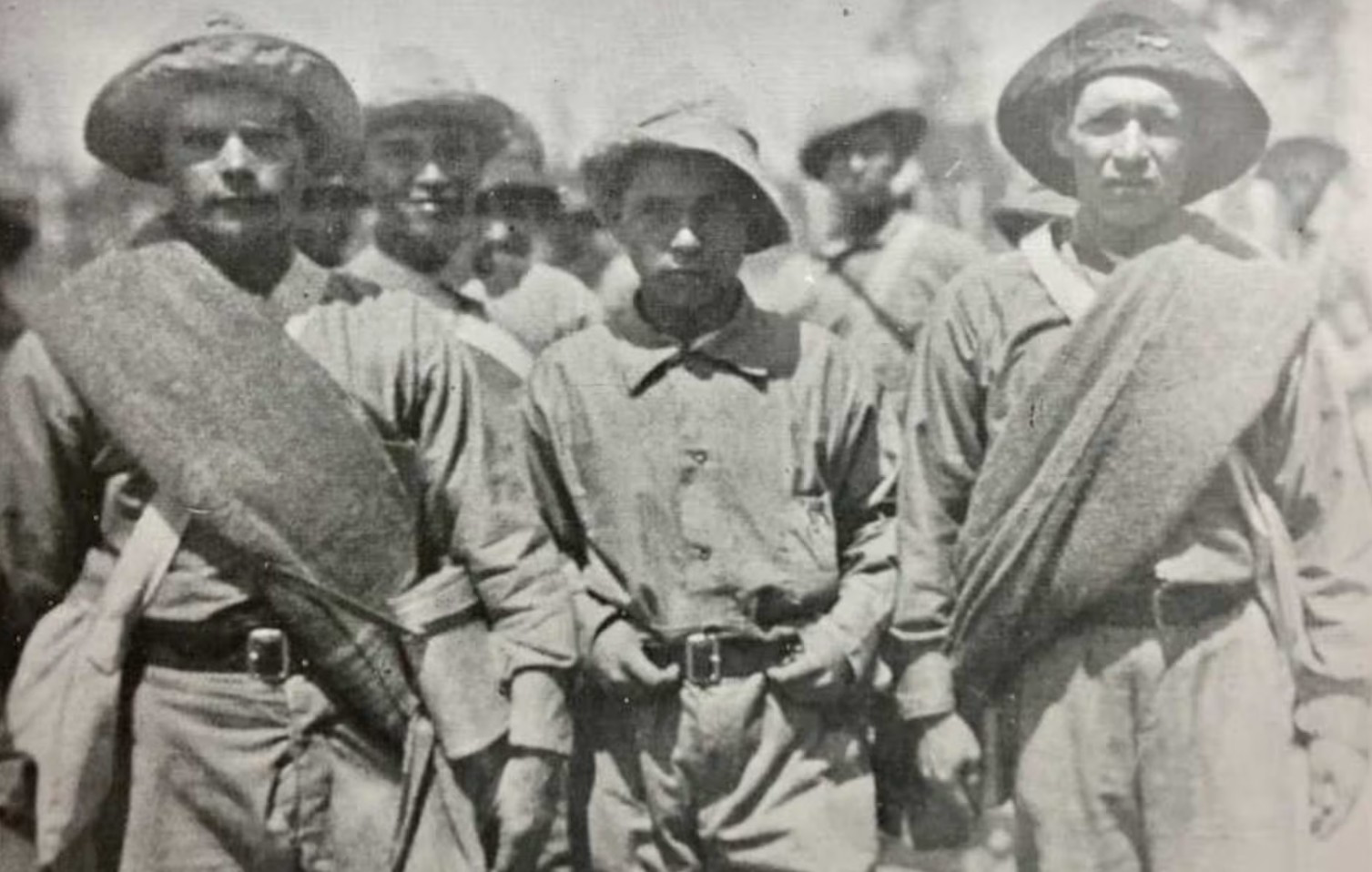
The Gran Chaco or Chaco Boreal is a large lowland plain that today is part of Brazil, Bolivia, Paraguay and Argentina.
From the late nineteenth century, there had been simmering tensions between Paraguay and Bolivia over their control of the area, as the land was of key strategic interest to both countries. It’s not unrelated that Paraguay and Bolivia are the only two landlocked countries in South America.
The situation wasn’t helped when speculation arose that the region could hold significant deposits of oil. This led to major oil companies taking sides, with Royal Dutch Shell backing Paraguay and Standard Oil supporting Bolivia.
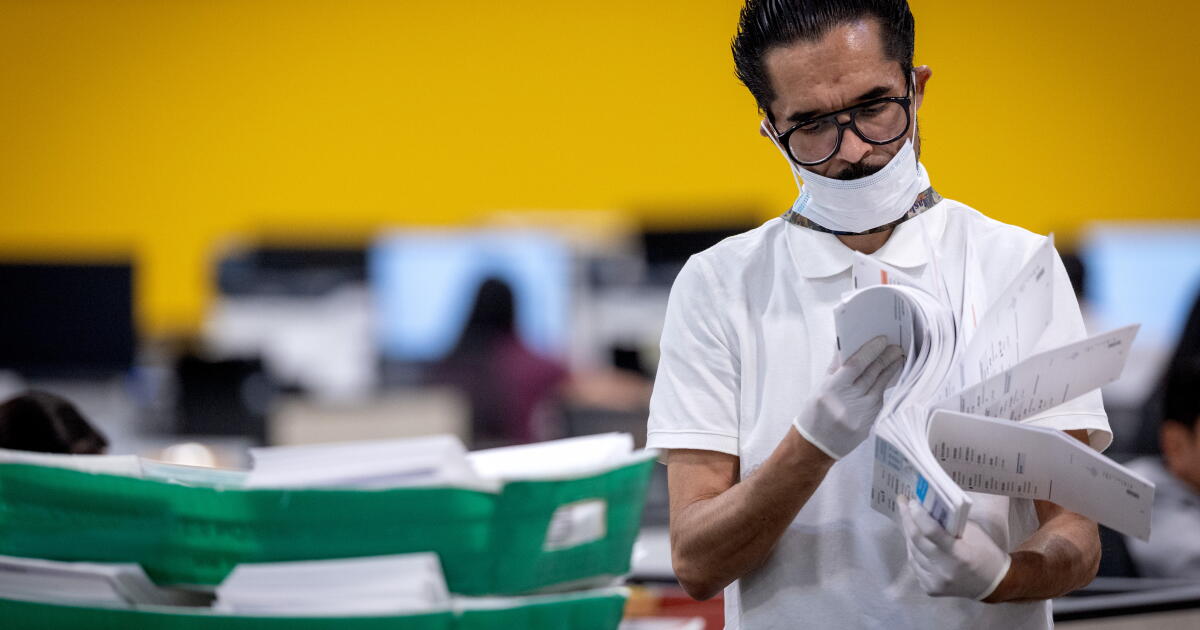
SACRAMENTO — What’s so wrong about requiring every Californian to show a government ID before they’re allowed to vote? That’s what Proposition 39 backers ask. And it’s a fair question.
Here are some valid answers:
It would make California’s already notoriously slow vote count even more pokey.
It would be an added hassle for citizens attempting to exercise their voting right.
It would cost taxpayers a bundle, perhaps hundreds of millions of dollars each year.
It’s another solution by politicians to a problem that really doesn’t exist.
Practically everyone, regardless of political affiliation, must understand by now that there simply is no evidence of widespread — significant, meaningful — voter cheating in California or anywhere else in America. This despite conspiracy-theorists’ fruitless searching and President Trump’s lies about “rigged” elections.
It’s my belief that the main reason Republicans placed Proposition 39 on the California ballot was to boost GOP voter turnout in the Nov. 3 election. And recent independent polling shows that the measure does appeal strongly to Republicans — but not Democrats, who are united in opposition.
The proposition appears to be headed for defeat, largely because Democratic voters in this deep blue state equate it with the discredited president. Trump has turned into poison for Republican candidates in competitive races and any cause that reminds people of him.
You’re reading the L.A. Times Politics newsletter
Expert columnists cover the insights, legislation, players and politics you need to know.
By continuing, you agree to our Terms of Service, which include arbitration and a class action waiver. You agree that we and our third-party vendors may collect and use your information, including through cookies, pixels and similar technologies, for the purposes set forth in our Privacy Policy such as personalizing your experience and ads.
That’s why the Proposition 39 campaign last week released a new major TV ad that essentially asks voters to ignore the president.
This is how conservative consultant Jon Fleischman summarized the ad’s message to Democrats in his blog: “You can hate Trump and still back Voter ID.”
Require voters to show some government-issued identification each time they vote in person, such as a driver’s license or passport. Don’t have one? The state would issue a free ID card to any voter who asked.
Californians who cast mail ballots — more than 80% of voters — would be required to write the last four digits of a government ID number on the return envelope. The number would be determined when initially registering to vote.
The measure also would impose some basically noncontroversial mandates that make sense separately. It would require election officials to maintain accurate voter registration files, weeding out people who have moved or died and verifying citizenship. But counties already do that pretty well.
The contrived bogeyman for election fraud scaremongers is the undocumented immigrant community. But these people, living on the edge and hiding from the government, aren’t going to risk deportation by trying to vote in an election they couldn’t care less about. And political candidates aren’t going to waste their time and money on them. Their targets are the large numbers of apathetic legal voters who sit out elections.
Currently, Californians must provide identification when registering and swear under penalty of perjury — a felony — that they are U.S. citizens. And they must record their signatures when registering and scribble it on the back of the ballot envelope when voting by mail.
Requiring me to add a four-digit number on the back of my “absentee” ballot envelope means I’d have to register all over again to record the PIN. And then remember it every election. A pointless pain.
Assemblyman Carl DeMaio (R-San Diego), a conservative firebrand, instigated and authored Proposition 39. “I do believe that voter fraud is a real problem. Absolutely,” he told me.
But he said the proposition has two main goals: 1, to clean up voter files and make sure ballots are properly validated and counted. 2, to increase public confidence in the voting process. “We have a perception problem,” he says. “Voters have low trust” in the election system.
Republicans mistrust a lot; Democrats not so much.
A California poll released last week by the UC Berkeley Institute of Governmental Studies showed that 84% of Republican voters had a “major concern” about voter fraud. Only 21% of Democrats did.
Can anyone doubt who’s driving the Republicans’ anxiety? The bellicose president. “Mail-in voting means mail-in cheating,” Trump has reiterated. “It’s terrible what’s going on.”
This from the hypocrite who mails in his ballots.
Fortunately, Proposition 39’s crafters left mail ballots pretty much alone, except for requiring a nuisance PIN on the ballot envelope.
That “absolutely” will slow down vote counting, says Assemblywoman Gail Pellerin (D-Santa Cruz), who heads the Assembly Elections Committee and was the longtime chief elections official of Santa Cruz County. Under Proposition 39, officials not only would need to check voters’ signatures against those on file, but also their PINs.
And voting in person would drag while people dug for an ID and an official checked it, Pellerin says. Some people are bound to be denied their voting right by mistake, she asserts.
Tony Quinn, formerly a GOP redistricting consultant and a longtime political analyst, points out that a disproportionately high portion of in-person voters are Republicans. Proposition 39 is “imposing a burden on them,” he says. “I don’t think the authors realize who’s voting in person these days. They sense illegal aliens.”
The UC institute poll showed Proposition 39 being supported by 39% of likely voters and opposed by 52%. It was backed by 92% of Republicans, but Democrats were 80% against. And they outnumber Republicans by nearly 2-to-1 in California.
The proposition also trailed in a poll by the Public Policy Institute of California: 43% yes, 55% no.
In the PPIC poll, Republicans said 39 was by far the most interesting proposition on the ballot.
Trump’s influence? Among the paltry 27% of voters who approve of his job performance, 88% support Proposition 39. But of the 72% who disapprove of the president, 73% oppose the measure.
Trump is toxic.
Proposition 39 is more government regulation for no good reason.










![Portadown Orangemen march from Drumcree Church to start their march towards Garvaghy Road, which was stopped a short distance later by police, in Portadown, Northern Ireland on September 27, 2026 [AFP]](https://i0.wp.com/www.aljazeera.com/wp-content/uploads/2026/10/afp_6abfeb6d30a8-1790962541.jpg?w=640&ssl=1)

![UVF flags fly alongside UK flags in the Edgarstown estate, Portadown, Northern Ireland, on October 1, 2026 [Caolán Magee]](https://i0.wp.com/www.aljazeera.com/wp-content/uploads/2026/10/DSC00033-1790961495.jpg?w=640&ssl=1)
![Orange Order members sit outside Drumcree church as they await passage along Garvaghy Road in Portadown, Northern Ireland, on October 1, 2026 [Caolán Magee]](https://i0.wp.com/www.aljazeera.com/wp-content/uploads/2026/10/DSC00113-1790961532.jpg?w=640&ssl=1)
![Children play on the embankment as music rings out along Garvaghy Road in Portadown, Northern Ireland, on October 1, 2026 [Caolán Magee]](https://i0.wp.com/www.aljazeera.com/wp-content/uploads/2026/10/DSC00134-1790961539.jpg?w=640&ssl=1)
![A ‘Garvaghy Road says no’ sign with an Irish tricolour in the background in Portadown, Northern Ireland, on October 1, 2026 [Caolán Magee]](https://i0.wp.com/www.aljazeera.com/wp-content/uploads/2026/10/DSC00064-1790961515.jpg?w=640&ssl=1)