The guide was adamant. “I’ve picked human teeth out of there and I’m not doing it again.” The small group of tourists looked suitably aghast, except the boy. He was jiggling the wellington boots on his feet and singing to himself. He looked about 14. I sensed that he was the catalyst, the one to make things happen.
“So, if anyone is planning to leave human remains in this ancient place,” went on the guide, throwing the boy a stern look, “I say, DON’T.”
We had arrived on the visitor centre bus from nearby Knowth, the first stop on our tour of Newgrange Neolithic site, 30 miles (50km) north of Dublin. I was on a circuit of the Irish Sea, a ferry and road trip to see the best ancient sites that ring this salty mere at the heart of these islands. It was here, around 5,100 years ago, that a new people arrived and, capitalising on the sea as a cultural superhighway, constructed a dazzling array of stone monuments. Some of Europe’s finest Neolithic passage tombs are here, notably at Newgrange, the only one you can enter. But as the guide was sternly pointing out, some modern folk are irresistibly drawn to leave the ashes of deceased relatives inside, especially at Newgrange.
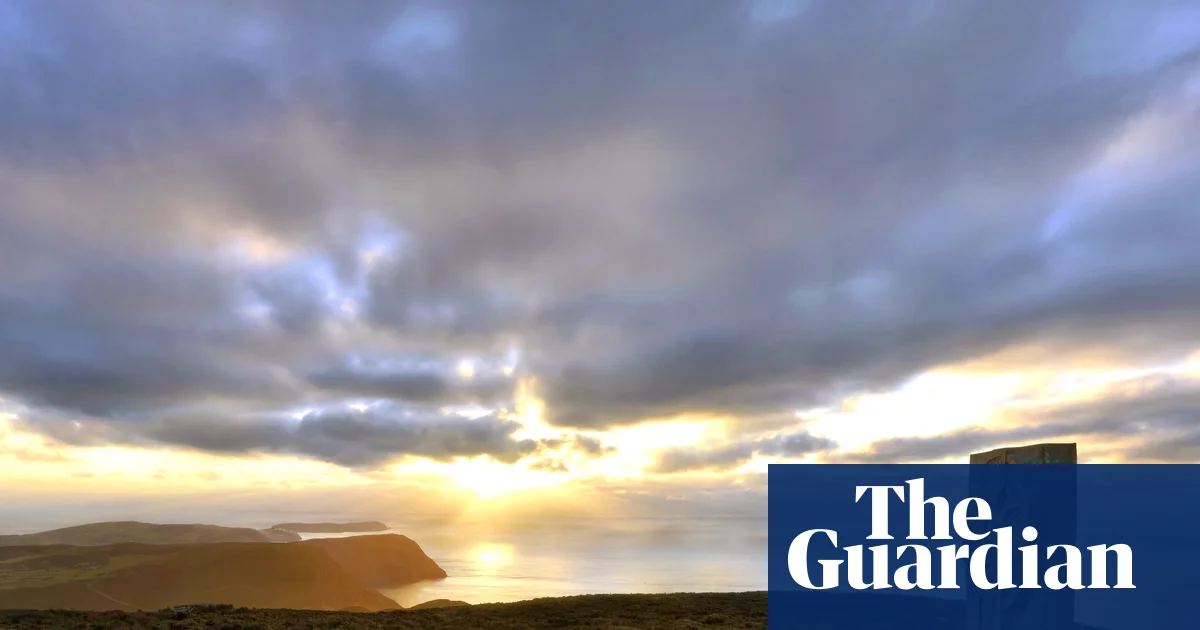
Newgrange is more than 5,000 years old. Photograph: Ruben Galvez/Alamy
The plush visitor centre had been informative but had not conveyed the deep atavistic intensity that drives such tributes. There was magic here. I wanted to feel it. I had a hunch this boy was in touch with it.
“As for pets,” said our guide, “I want no dog or cat ashes either.”
The boy was drumming his hands on his knees, hearing an unheard rhythm. We were about to walk up to the hallowed tumulus with its 19-metre-long passageway that leads to the central chamber, but our guide was determined to get that boy’s attention. “There,” she shouted. The boy’s head shot up. She was pointing at a set of wheelie bins in the corner. “I can promise you,” she went on, grimly, “that if I find your granny’s remains inside my Neolithic chamber, then her last resting place will be that green wheelie bin.”
There was a stunned silence among the tourists. But not the boy. He immediately ran over to the bin, opened the lid and stared inside.
“Nothing,” he reported, slamming it down. “She’s not there.”
The guide looked nonplussed, then marched away towards the hill that is a tomb. “Follow me,” she commanded. “Do not leave the path.”
Everyone obeyed, except the boy. He ran in a great arc off the path, arms flapping like shamanic wings.
We had started our huge circular journey around the Irish Sea at Pentre Ifan, a magnificent tomb from 3500BC, sited on the same Pembrokeshire ridge that provided the bluestone for Stonehenge. I was travelling with my partner, Sophie, and our dog, Stevie, who had gone through complex hoops to prove he was not carrying either rabies or tapeworm into Ireland. He liked the first ferry, from Pembroke Dock to Rosslare; it had an excellent pet lounge, but what fascinated him was the sea. He could not stop staring. His reaction made me pay more attention to him. Could dogs, I wondered, also help connect us with the deep past? After all, their wolf heritage is 30,000 years old, yet they relive it every minute of their lives. If anyone could remember the Neolithic age, it was Stevie.
He had been well cared for initially. We stayed near Wexford, in a dog-friendly hotel, Marlfield House, with superb gardens. Then we toured the ruins of the greatest Irish saint of them all, Kevin. His sixth-century seat at Glendalough, in County Wicklow, is now a busy pilgrimage site. Twelfth-century Trim Castle in County Meath was next, followed by the Hill of Tara with its ancient standing stone, the Lia Fáil. Here all the pagan kings of Ireland were crowned, so the legend goes.
At its base, visitors had laid a collection of apples, flowers and coins. That puzzled me. Were the apples significant? Or had that gang of girls carrying hurling sticks just donated their unwanted snacks? Some people, it was clear, wanted such places to mean something, not simply be dusty artefacts.
I persuaded Stevie to lie down on a nearby grassy mound. Under us was the Mound of the Hostages, a chambered tomb that was already ancient when the Great Pyramid was built. Time slipped away. Those Neolithic people are so distant and mysterious. What we know for certain is almost nothing. They had cows … and dogs. I opened one eye. Stevie had gone. He’d given up communing with the stone age and gone after the hurling sticks.
That night, we stayed in another excellent dog-friendly hotel, Bellinter House, and visited Marcie Regan’s in Trim, a vibrant, dog-loving pub. Not until Newgrange did we meet the dreaded sign, NO DOGS. I’d been forced to leave him in the car, my dæmon, my conduit to the ancient.
Our guide stopped us at the entrance to the great megalithic structure, a turf-topped hill walled with white quartz. Discovered largely intact in 1699, the entrance was guarded by the same five-tonne stone that sits there now, covered in mysterious swirling patterns. Behind was a narrow entrance and a passage that lay under 200,000 tonnes of stone and earth.
Pentre Ifan tomb in Pembrokeshire, which is on the same site that provided the bluestone for Stonehenge. Photograph: Paul Williams/Alamy
“If you get claustrophobic,” said the guide, “you can leave at any time. Do not touch the carvings.”
Out the corner of my eye, I saw the boy come running. He had done a lap of the monument, chanting to himself, his little sister close behind. The guide bowed her head and disappeared inside. The boy ran his fingertips over the carvings and followed. I went in next. My unsatisfied desire for stone age magic was about to be fulfilled.
The tunnel is slightly kinked and rises imperceptibly. You don’t see the final chamber. The mystery grows. There are patterns on some stones. A deep silence descends. I thought of Stevie back in the car. They found the bones of a dog in here, and its DNA showed traces of wolf from both Europe and Asia. Stevie’s Neolithic moment, however, would have to wait.
At the end of the corridor, we arrived in a small chamber. Above, the roof was made of massive stones. In more than 5,000 years, it has not leaked. It looks haphazard, but is perfect, a Rolex assembled by Flintstones. The most impressive thing, however, was not understood until Prof Michael O’Kelly came and stood in this chamber on 21 December 1967. Our guide was now going to recreate that event, and what has happened at dawn on every winter solstice since about 3150BC.
We were in complete darkness. The boy had pressed himself into a niche where a huge stone basin sat. Human remains, ancient ones, had been found there. And then, the guide touched a hidden switch and a golden light came creeping up the passageway towards us, finally illuminating a triple spiral of megalithic art carved into one giant stone. It was like hearing a deep harmonic chord, or the haunting cry of a night bird, something profound and enigmatic. I forgave the bus, the tickets, the gift shop – all the paraphernalia of the tourism business – and saw the genius of this recreation.
Light slowly filled the chamber. We were all dumbstruck, except the boy. He spoke out loud and bold. “Question. Are there aliens here?”
The guide shook her head impatiently. “I won’t have any talk of aliens.”
The boy nodded and turned to his little sister. “That means there are.”
Then he was gone, scurrying down the tunnel in a half crouch, humming to himself.
A huge storm came in that night, downing trees and flooding roads. We drove through it to Belfast and hunkered down in our hotel.
Kevin Rushby’s dog Stevie on the Isle of Man. Photograph: Kevin Rushby
Next day, thankfully in calm weather, we sailed for the Isle of Man. Landing here was like travelling back in time, to around AD1950. Manx ancient monuments do not come with visitor centres and guides, they come only with a cast iron sign, “Ancient Monument”. We climbed the highest peak, Snaefell, visited several fabulous Celtic crosses and spent ages in the wonderful Manx Museum.
Then, one afternoon, we left the car and walked through fields to the island’s most important Neolithic monument, Cashtal yn Ard. It was in a tussocky field behind a kissing gate and a small sign. No ticket required, only some imagination and, if possible, a stone age scent hound. Behind were ranged the dark hills. The monument itself is a collapsed passage tomb that has left the ghostly imprint of its shape in rows of pale stones, marking the entrance, the tunnel, and finally, a low portal into what is left of the central chamber. Nevertheless, Stevie seemed to know the layout. He ran to the entrance, bounded down the tunnel, dodged through the portal and stopped dead. We lay on our backs and watched the skies. After a few minutes, I sneaked a look at the dog. He was curled up asleep at the exact centre of the vanished chamber.
Hassan Agari was born in Medina on 8th of Rabi-ul-Akhar 232 AH His father was Ali Naqi, the 10th Shia Imam. Imam Ali Naqi lived under house arrest in a Samarra, a garrison town about 60 miles north of Baghdad. Hassan’s title became known as Asgari, meaning “the one who lived all his life in a garrison town.”
Even from an early age, Asgari was known for his divine knowledge and he became the 11th Shia Imam on the death of his father in 254 AH at the age of 22.
Becoming the 11th Imam was a big deal. In both the Sunni and Shia branches of Islam, it is believed that the 12th Imam would be the final Imam who would be the ‘Mahdi’ or ‘Guide’ for humanity until the Day of Judgement.
According to Shia tradition, Askari died aged 28 on 8th Rabi’ al-Awwal 260 AH (January 4th 874 AD) after being poisoned on the orders of the Abbasid caliph Al-Mu’tamid and was buried in Samarra, a town some 60 miles north of Baghdad.
In Shia tradition, Asgari did give birth to a son, Muhammad. who would be destined to be the final Imam, but Asgari kept Muhammad’s existence a secret in fear of Al-Mu’tamid finding out and wanting to kill his son.
Aged five, Muhammad al-Mahdi, disappeared on the same day that his father died.
Shias believe that Imam Mahdi will reappear alongside Jesus to be the saviours of the planet in the final judgement days. Sunni Muslims didn’t follow the Shia Imam lineage and most believe that the Mahdi has been born yet.
Hayden Panettiere was candid in her memoir and book tour interviews about the extensive abuse by on-again, off-again boyfriend Brian Hickerson. Now he’s under the microscope as new details surrounding her death and their relationship emerge.
On Thursday, Panettiere’s mother, Lesley Vogel, whom the “Nashville” actor had a strained relationship with, pointed blame for the actor’s death toward an unnamed individual, but earlier this week she outright named Hickerson.
“Although my daughter and I were estranged, it was not for lack of care or love,” she said in a statement to “Entertainment Tonight.” “It was due to the involvement of a toxic individual who I believe led to her death.”
”It leads me to believe there are still questions surrounding what happened,” she said. “And I think we are all looking for answers.”
And earlier this week, she told NBC, “This person in her life that we have been trying to get rid of for quite some time was with her at her death, and that was Brian Hickerson.”
Hickerson broke his silence for the first time since Panettiere died Sunday of an apparent overdose as his attorney Sloan Ellis made a statement on his behalf. “Hayden’s death remains under investigation and it is important to allow that investigation to proceed,” Ellis told TMZ. “As has been publicly reported, police confirmed there were no signs of foul play.”
“Out of respect for Hayden’s loved ones and the ongoing investigation, there will be no further comment at this time.”
Hickerson and his brother Zach Hickerson were present when emergency responders found Panettiere in cardiac arrest on Sunday. According to a report from Greenville, S.C., police, Zach was “very emotional” as paramedics attempted to revive Panettiere, and Brian “did not become emotional until EMS declared her officially deceased.”
According to TMZ, Narcan — a drug used to reverse an opioid overdose — was found at the scene, but it’s unclear whether it was used on Panettiere.
Brian and Zach Hickerson did not respond to The Times’ request for comment.
In the actor’s memoir, “This Is Me: A Reckoning,” which she published in May, she wrote that she and Hickerson met in 2018 at a West Hollywood bar. They fell fast into a whirlwind romance that soured after alcohol-fueled fights turned violent. “It was easy. The easiest happiness that I had come by in a long time,” she wrote in the memoir. “Then, one day, when we were on our second bottle of wine — the bottle that suffocates all the magic and obliterates your defenses — everything changed.”
Hickerson was arrested multiple times on suspicion of domestic violence against Panettiere, beginning in May 2019 in Los Angeles (the charges were later dismissed when prosecutors couldn’t secure a material witness) and again on Valentine’s Day in 2020 in Wyoming (misdemeanor battery charges were eventually dropped). Following an eight-count criminal indictment in July 2020 that covered multiple violent incidents between May 2019 and January 2020, Hickerson pleaded no contest in April 2021 to two felony counts of injuring a spouse or girlfriend. He was sentenced to 45 days in county jail (but served 13 days due to credit for time served) along with four years of formal probation, mandatory domestic violence classes, and a five-year protective order.
After his 2019 arrest was covered in the press, Panettiere wrote that she and Brian “shut ourselves inside” to avoid paparazzi and that she screened calls from friends and family who phoned and texted “constantly,” worried that she was in a “dangerous situation with Brian.”
“What I never told them was that the abuse I’d endured didn’t feel as bad as the thought of being alone,” she wrote.
In “This Is Me,” she graphically detailed the abuse. She claimed that, during one attack, he punched her in the face repeatedly and secretly recorded himself saying, “Why did you hit yourself?” and “You’re all bruised, why did you do that to yourself?” When he was subsequently booked on charges of felony domestic assault, he pleaded not guilty and claimed that Panettiere had done it to herself.
“I didn’t know the person Brian turned into when he started raging,” she wrote. “This other Brian seemed to be dissociating, like the rational Dr. Jekyll part of his brain shut off while the violent Mr. Hyde took over. I was sure he must have a serious mental illness, like bipolar or borderline personality disorder, that could make him change so quickly.”
She continued: “On July 16, 2020, authorities in LA arrested Brian again, charging him with four domestic assault felonies, one misdemeanor count of battery; two felony counts of assault with a deadly weapon (in particular, our garage floor and the stairs, both of which he’d once smashed my body into); and one felony count of dissuading a witness from prosecuting a crime.
“That witness was me. After we’d come back from Wyoming, Brian had called and tried to talk me out of pressing charges against him. As my heart broke into a million pieces, I told him it was too late, and then I told the police.”
Three days before Panettiere’s death, Hickerson attempted to expunge and reduce his past felony charges but was denied by a Los Angeles judge. He made the same request last July, which was denied.
During the press tour for “This Is Me,” Panettiere told podcaster Jay Shetty that she had cut ties with Hickerson but that, historically, he’d always found a way to reconnect just as she thought she was finally free of him. Reportedly, the two reconnected just weeks before her death.
“I thought I had gotten out of it and gotten away from it. … Abusers weave themselves like weeds into your life, and there’s always something that they left behind,” she told Shetty. “There’s always something that they have to come back for. There was always something that they find to keep that connection, keep you on the hook, keep that connection with you, no matter where you you go.”
In May, after Panettiere’s interview with Shetty went live, Hickerson spoke with TMZ and appeared intoxicated and slurred as he spoke about the actor. “Hayden Panettiere is the sweetest thing in the world,” he said. “It’s not about who you spend Saturday night with, it’s who you spend all day Sunday with, and Hayden Panettiere is a Sunday girl.”
“I would be an idiot not to walk away from her and let her flourish in her career,” he continued. “So we probably wouldn’t be good together. I’d like to see what she’s gonna do with the next like 30 years of her career, she’ll always hold a special place in my heart … we’re good buddies.”
Jerry Buss put together what was then thought to be a wild business deal to purchase the Lakers and related assets for $67.5 million in 1979.
Buss had a degree in chemistry, but his money came from real estate holdings and loans that moved between third parties to help him obtain the Lakers, Kings and the Forum from Jack Kent Cooke, who was going through a costly divorce.
Buss’ vision was to infuse Hollywood glamour into an NBA team few in Los Angeles seemed to care about, win championships and share that glory with his family.
Buss realized his Hollywood dream in more ways than he ever could have imagined, with his death in 2013 from complications from cancer touching off battles among his six children over control of the Lakers.
At least two siblings have tried to oust another from a leadership role. One sibling reportedly said two others never should have been born. And one sibling managed to fire the five others from jobs with the team.
The rifts mirror the HBO hit show “Succession.” Buss’ tenure and the family drama has been direct inspiration for two television shows and was chronicled in a docuseries the Lakers produced.
The latest daggers were delivered this week, with attorneys representing Buss’ daughter, Jeanie, admonishing her five siblings — Janie, Johnny, Jim, Joey and Jesse — for announcing the Buss Family Trust was selling its 17.8% ownership of the Lakers to new buyers Bob Iger and Joshua Kushner.
Get the latest on L.A.’s teams in the daily Sports Report newsletter.
By continuing, you agree to our Terms of Service, which include arbitration and a class action waiver. You agree that we and our third-party vendors may collect and use your information, including through cookies, pixels and similar technologies, for the purposes set forth in our Privacy Policy such as personalizing your experience and ads.
Dodgers sweep the Rockies
From Maddie Lee: As Teoscar Hernández popped up from his slide across home plate, Mookie Betts retreated to first applauding.
While the long ball had been the key to the Dodgers’ earlier offensive success Wednesday, keeping it simple unlocked their 10th-inning push. And in the Dodgers’ 6-4 victory Wednesday, it was Betts’ third hit of the night, a low line drive through the middle of the infield, that widened the Dodgers’ lead to two runs.
“It was huge,” Betts said of completing the three-game sweep in Colorado. “Winning every ball game is important, especially now with the playoff race. Every game is important.”
The trip to hitter-friendly Mile High City, and a matchup against the last-place team in the NL West, came at the perfect time for the Dodgers, ending a collective slump. They’d just dropped three of four to the Brewers at Dodger Stadium, in what had already been a rough start to August.
“Obviously, we haven’t played our best baseball lately,” utility player Kiké Hernández said. “And as a good team, as a team that’s leading the division, … the teams at the bottom of the standings, you need to beat those guys.”
Ethan Pecko struck out four in his major-league debut, five Houston relievers pitched shutout ball for five-plus innings and Christian Vázquez homered as the Astros beat the Angels 3-2 on Wednesday night.
Pecko, a 2023 sixth-round selection by Houston, was ranked ninth in the Astros’ system by MLB Pipeline. The 23-year-old right-hander gave up three hits, two runs and two walks in 3 2/3 innings. He was the 17th starter used by the Astros this season, tying a franchise record set in 1965.
Vázquez’s solo homer, his seventh of the year, put the Astros ahead in the third inning.
Denzer Guzman put the Angels ahead in the fourth with what initially appeared to be a three-run homer. But, the call was changed to a two-run double due to fan interference.
Walbert Ureña (8-9) worked five innings for the Angels, giving up three runs and three hits with seven strikeouts.
The 15-year WNBA veteran announced on Wednesday morning that this would be her last WNBA season.
She made the announcement in an interview with Taylor Rooks at Boardroom Talks.
“I feel very fulfilled with the 15 years that I’ve been able to play and compete at such a high level and I am proud to say that I’m retiring from the WNBA,” Ogwumike said.
Drafted first overall in 2012, Ogwumike was the WNBA rookie of the year and went on to have one of the best careers in. league history. She was the league’s MVP in 2016, when she led the Sparks to their most recent WNBA title. She is also a four-time first-team All-Defensive player.
Joseph Paintsil scored a short-handed goal in the 79th minute to lead the Galaxy to a 1-0 victory over the San Jose Earthquakes on Wednesday night.
Paintsil used assists from rookie defender Harbor Miller and Marco Reus to find the net for the fifth time this season. Miller’s helper was his second, while Reus collected his seventh.
The Galaxy (6-8-7) were forced to play a man down from the 45th minute on after midfielder Lucas Sanabria was tagged with a pair of yellow cards in the final nine minutes of the first half.
Nico Hansen finished with one save and had his third consecutive shutout to help the Colorado Rapids beat LAFC 1-0 Wednesday night.
The Rapids (9-10-1) have won three consecutive games, all by shutout, and four of five since the World Cup break.
LAFC (10-7-4) is winless in three straight for the first time this season.
The Rapids took a 1-0 lead in the 22nd minute on an own goal by Jeremy Ebobisse. Youssef Maziz played a free kick from the right side into the area that was redirected by Ebobisse off the back post and into the net.
1921 — Molla Bjurstedt Mallory beats Mary Browne, 4-6, 6-4, 6-2 to win the U.S. women’s national tennis title at the Germantown Cricket Club in Philadelphia.
1931 — Helen Wills Moody beats Eileen Bennett Whitingstall 6-4, 6-1 to capture the women’s title in the U.S. Lawn Tennis Association championship.
1944 — Robert Hamilton upsets Byron Nelson in the final round 1-up to win the PGA Championship.
1960 — Holland’s Hairos II, driven by Willem Geersen, wins the second International Trot at Roosevelt Raceway before a record crowd of 54,861.
1995 — Monica Seles completes a remarkable first week back in tournament tennis, routing Amanda Coetzer 6-0, 6-1 to capture the Canadian Open. Her 74 games sets a tournament record for the fewest played by a champion.
1999 — Seventh Athletics World Championships open at Seville, Spain.
2000 — Tiger Woods wins the PGA Championship in a playoff over Bob May, becoming the first player since Ben Hogan in 1953 to win three majors in one year. He’s the first player to repeat as PGA champion since Denny Shute in 1937.
2003 — The U.S. wins the women’s overall team gold medal at the gymnastics world championships. It is the first gold for the Americans — men or women — at the biggest international event outside the Olympics.
2004 — Michael Phelps matches Mark Spitz’s record of four individual gold medals in Olympic swimming by winning the 100-meter butterfly. He edges teammate Ian Crocker to win his fifth gold medal. Shortly after winning his seventh medal of these Olympics, Phelps gives up his spot in the medley relay to Crocker.
2006 — Tiger Woods wins the PGA Championship for a five-shot victory over Shaun Micheel and his 12th career major. He becomes the first player to win the PGA twice on the same course, having done so at Medinah in 1999.
2008 — Usain Bolt of Jamaica breaks the 200-meter world record, winning in 19.30 seconds at the Beijing Games. He is the first man since Carl Lewis in 1984 to sweep the 100 and 200 at an Olympics.
2012 — Augusta National invites former Secretary of State Condoleezza Rice and South Carolina financier Darla Moore to become the first female members since the club was founded in 1932.
2016 — Allyson Felix and LaShawn Merritt anchor the 4×400 relay teams, and the U.S. exits the final night of action at Olympic Stadium with 31 medals — its most in a non-boycotted Olympics since 1956. The U.S. women’s basketball team beats Spain 101-72 for a sixth straight title.
2018 — Alabama becomes the second team to be ranked No. 1 in the preseason Associated Press Top 25 poll for three straight seasons. The preseason AP poll started in 1950 and since then only Oklahoma from 1985-87 had started No. 1 in three straight years.
2023 — FIFA Women’s World Cup Final, Stadium Australia, Sydney: Spanish captain Olga Carmona scores the only goal of the game as La Furia Roja score a 1-0 win over England.
Compiled by the Associated Press
This day in baseball history
1912 — Walter Johnson won his American League-record 15th straight game, downing Cleveland 4-2 in the opener of a doubleheader. Washington’s Carl Cashion pitched a six-inning no-hitter to give the Senators a 2-0 victory over the Cleveland Indians in the second game, which was called to allow Cleveland to catch a train to Boston.
1938 — New York’s Lou Gehrig hit his 23rd and the final grand slam of his career and drove in six runs to lead the Yankees to an 11-3 win over the Philadelphia Athletics.
1945 — Tommy Brown, 17 years, 8 months, 14 days, of the Brooklyn Dodgers became the youngest major league player to hit a home run when he connected in Ebbets Field against Preacher Roe of the Pittsburgh Pirates.
1957 — Bob Keegan of the Chicago White Sox pitched a 6-0 no-hit victory over the Washington Senators in the second game of a doubleheader.
1958 — Detroit’s Jim Bunning pitched a no-hitter to lead the Tigers to a 3-0 win over the Boston Red Sox in the opening game of a doubleheader at Fenway Park.
1961 — The Philadelphia Phillies beat the Milwaukee Braves 7-4 in the second game of a doubleheader to end a 23-game losing streak, a modern record.
1965 — Milwaukee’s Eddie Mathews hit his 28th home run, and the Braves beat the Pittsburgh Pirates 4-3. With the homer, the duo of Mathews and Hank Aaron passed the Babe Ruth-Lou Gehrig total of 772 home runs to become the top home-run tandem in major league history.
1974 — Nolan Ryan of the Angels struck out 19 Tigers in a 1-0, 11-inning loss to Detroit. It was the third time this season that Ryan struck out 19 batters in a game.
1980 — Pittsburgh’s Omar Moreno stole his 70th base of the season in a 5-1 loss to Houston, to become the first player this century with three consecutive 70-steal seasons. The fleet outfielder swiped 71 in 1978, 77 in 1979.
1989 — New York’s Howard Johnson hit his 30th home run of the season in the Mets’ 5-4 loss to the Dodgers and joined Bobby Bonds and Willie Mays as the only players to achieve 30 home runs and 30 stolen bases in two different seasons.
1995 — Jose Mesa of the Cleveland Indians picked up his 37th save in 37 opportunities to set a major league record, and the Indians beat the Milwaukee Brewers 8-5.
2005 — The Kansas City Royals ended baseball’s longest losing streak in 17 years, defeating the Oakland Athletics 2-1 to end a club-record 19-game skid.
2014 — The San Francisco Giants became the first team since 1986 to win a protest. Rain caused a delay during an Aug. 19 game after the grounds crew couldn’t put the tarp down quickly, and the umpires deemed the field unplayable. The Cubs were declared the winners by a 2-0 score after 4 1/2 innings. MLB ruled to resume the rain-shortened game with the Cubs batting in the bottom of the fifth.
2019 — By defeating the Blue Jays, 16-3, Clayton Kershaw of the Dodgers notches win No. 166 to pass Sandy Koufax for most by a left-hander in franchise history.
Compiled by the Associated Press
Until next time…
That concludes today’s newsletter. If you have any feedback, ideas for improvement or things you’d like to see, email me at houston.mitchell@latimes.com. To get this newsletter in your inbox, click here.
That’s not partiality or wish casting on the part of your friendly political columnist. The fact is Democrats and Democratic-leaning independents overwhelmingly outnumber Republicans in California, in both registration and inclination.
The gregarious and media-savvy Hilton has been waging an energetic and effervescent run for governor, with multiple appearances a day and frequent updates to his cheeky social media accounts.
“He’s going to San Francisco” — into the bowels of the liberal beast — “he’s going into schools, talking to labor groups,” said Hector Barajas, a campaign spokesman. “He’ll go everywhere.”
Becerra not so much.
You’re reading the L.A. Times Politics newsletter
George Skelton and other analysts cover the insights, legislation, players and politics you need to know. In your inbox Monday and Thursday mornings.
By continuing, you agree to our Terms of Service, which include arbitration and a class action waiver. You agree that we and our third-party vendors may collect and use your information, including through cookies, pixels and similar technologies, for the purposes set forth in our Privacy Policy such as personalizing your experience and ads.
That said, if Hilton is flat-out running for a job he stands virtually no chance of winning, Becerra is embarked on more of a leisurely stroll toward his all-but-certain perch in Sacramento.
That’s not a terrible thing at this midsummer stage of the race. Once, in the blessed era before the 24/7 news cycle and the omnipresence of social media, there was a lull in the months after the primary, with campaign activities picking back up around Labor Day.
On Tuesday, during a walking tour of Los Angeles’ Little Tokyo neighborhood, Becerra pushed back on the notion he was taking his election — and California voters — for granted. “If I were trying to coast,” he told reporters, “I’d be out on the coast right now instead of here with you all.”
Becerra’s pace aside, the days between now and the Nov. 3 election offer him plenty of time to spell out what, exactly, he has to offer his home state and how, in a broad sense, he plans to tackle one of the highest profile, most vexing jobs in all of American politics.
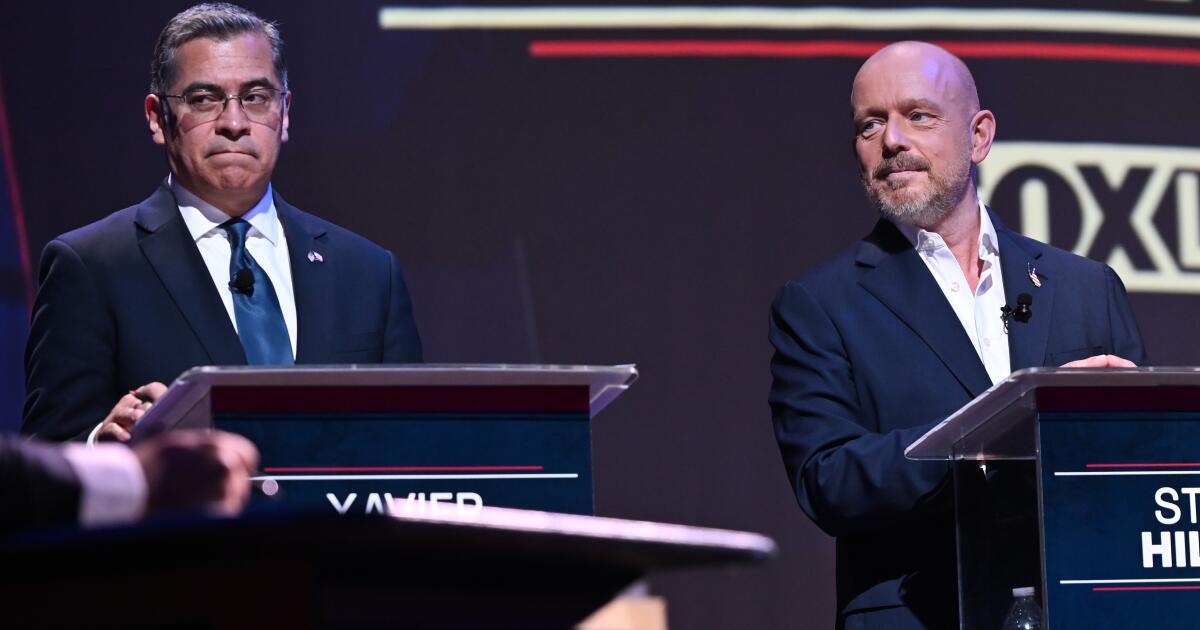
At least one of those days should include a face-to-face debate between Hilton and Becerra. The two shared a stage multiple times during the primary season. They have not appeared together since.
More than a half-dozen news organizations have offered to host the gubernatorial rivals in a one-on-one session. Several other groups have proposed forums that would allow them to discuss their differences together in person.
Barajas, the spokesman for Hilton’s campaign, said the Republican hopeful has agreed to each and every invitation.
“He’s got absolutely no problem” appearing anytime or anywhere, Barajas said. “He will go to East L.A.. He will go to South-Central. He will go into the heart of the Central Valley. It doesn’t matter to him.”
That’s no surprise.
When a candidate is an underdog, like Hilton, they’ll typically show up at the opening of an envelope if it means appearing before a crowd. Conversely, a candidate on a seeming glide path to election, like Becerra, will often balk at giving their opponent the exposure afforded by a debate, much less risk harming themselves with a bad performance.
There’s a lot of virtue signaling that surrounds the notion of candidate debates.
Far from a high-minded discussion of policy differences, they often devolve into a stale recitation of talking points and pre-scripted zingers. After a while, debates can grow redundant and, frankly, boring as contestants repeat well-worn phrases and replow deeply furrowed ground. Such was the case by the time California’s gubernatorial hopefuls met for their sixth televised debate in the spring.
Most voters — many of whom profess to care oh-so-deeply about issues and matters of great import — don’t even bother tuning in. If they found debates that captivating, shows such as the “PBS NewsHour” would routinely outdraw the latest season of “Love Island USA.”
No matter.
There is an audience, however limited, for debates. Even if they don’t bother watching, many voters read about the encounters afterward, catch snippets online, or glean useful insights from the extensive coverage that follows.
Above all, a willingness to debate is a sign of respect — for voters as well as the political process the candidates are a part of. Minimizing direct confrontation with Hilton may play to Becerra’s inherently cautious nature. It also makes sense from a purely strategic standpoint.
But it doesn’t serve the people of California, or give voters their due. This is a campaign for governor. Not a coronation.
Becerra owes California, and Hilton, the chance to take the candidates’ measure side by side before their contest is over. The sooner Becerra commits to a time and place, the better.
Jerry Buss put together what was then thought to be a wild business deal to purchase the Lakers and related assets for $67.5 million in 1979.
Buss had a degree in chemistry, but his money came from real estate holdings and loans that moved between third parties to help him obtain the Lakers, Kings and the Forum from Jack Kent Cooke, who was going through a costly divorce.
Buss’ vision was to infuse Hollywood glamour into an NBA team few in Los Angeles seemed to care about, win championships and share that glory with his family.
Buss realized his Hollywood dream in more ways than he ever could have imagined, with his death in 2013 from complications from cancer touching off battles among his six children over control of the Lakers.
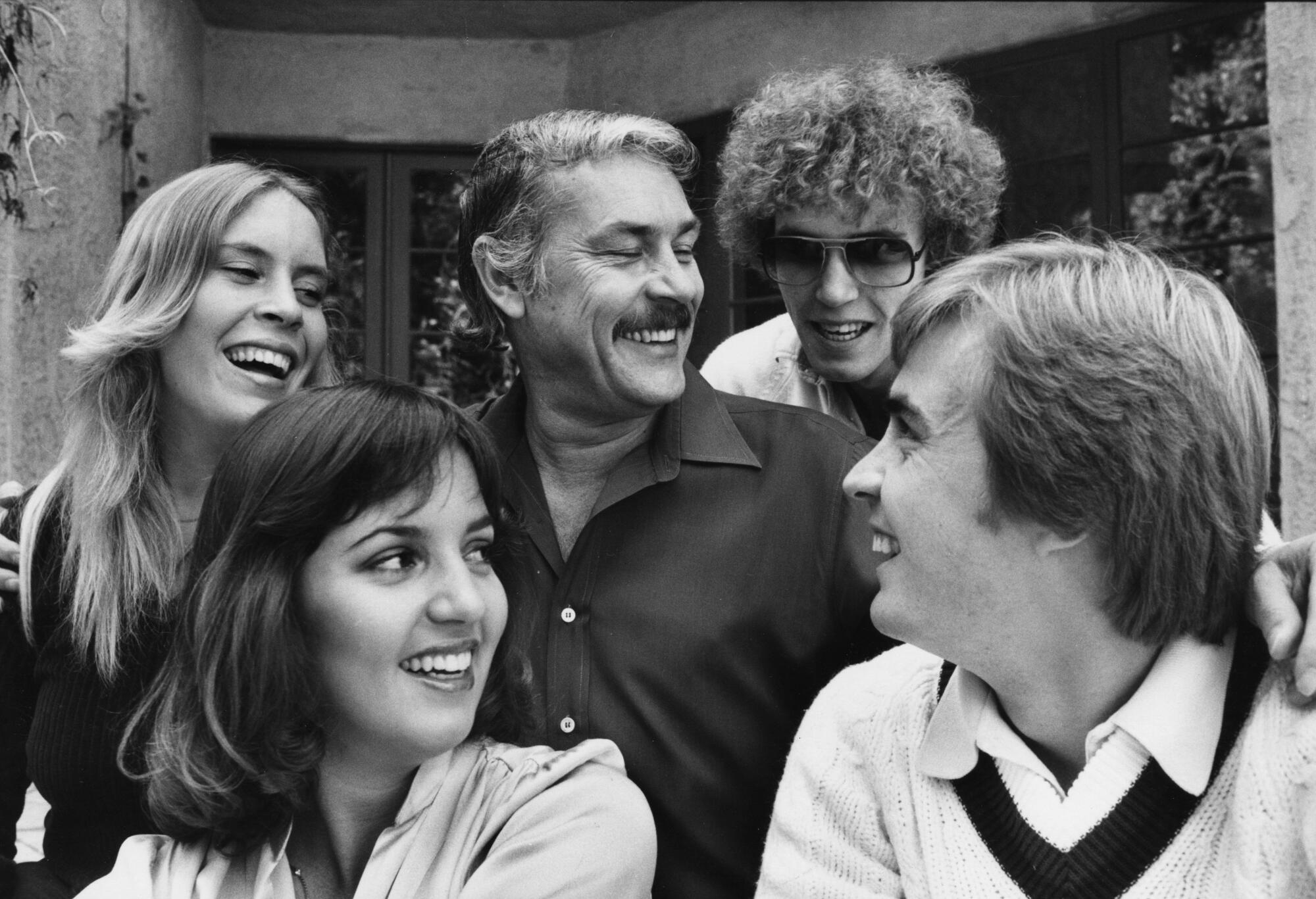
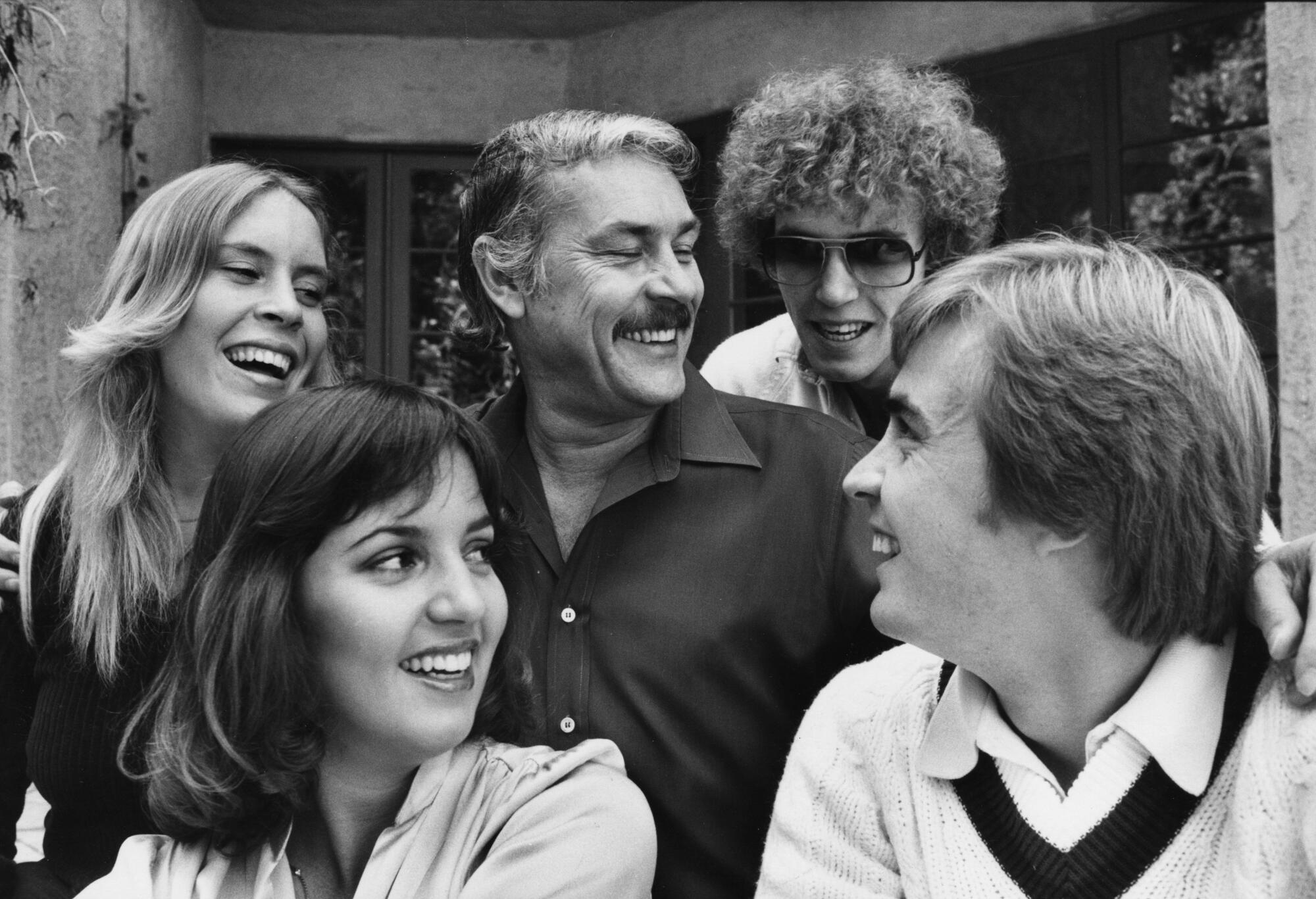
Lakers owner Jerry Buss, center, with children Janie, from left, Jeanie, Johnny and Jim in 1979.
(Gunther/mptvimages.com)
At least two siblings have tried to oust another from a leadership role. One sibling reportedly said two others never should have been born. And one sibling managed to fire the five others from jobs with the team.
The rifts mirror the HBO hit show “Succession.” Buss’ tenure and the family drama has been direct inspiration for two television shows and was chronicled in a docuseries the Lakers produced.
The latest daggers were delivered this week, with attorneys representing Buss’ daughter, Jeanie, admonishing her five siblings — Janie, Johnny, Jim, Joey and Jesse — for announcing the Buss Family Trust was selling its 17.8% ownership of the Lakers to new buyers Bob Iger and Joshua Kushner.
The sale would yield billions for the trust, with Iger and Kushner set to purchase the franchise at a $12.5-billion evaluation for the majority ownership stake of the team and a tagalong provision extending that price to the minority shareholders.
The Buss children are already billionaires following the sale of their majority stake to previous owner Mark Walter in 2025, but in addition to a big jump in share value, the minority stake sale would remove Jeanie from her coveted role as governor.
Neither side is giving up ground, suggesting lawsuits will soon be filed to resolve the family ownership dispute.
How did we get here?
The roots of the infighting date to the early days of Jerry Buss’ team ownership.
Buss focuses on building a family business
For the first 12 seasons Buss owned the team, the Lakers won NBA championships in 1980 and 1982 against the Philadelphia 76ers, 1985 and 1987 against the hated Boston Celtics, and 1988 against the Detroit Pistons.
Former player and shrewd executive Jerry West helped build the Lakers’ rosters, Pat Riley blossomed into an elite coach, and stars Magic Johnson and Kareem Abdul-Jabbar led a collection of elite playmakers during the Showtime era.
Jerry Buss, right, talks with his children Johnny, Jim, Jeanie and Janie in 1979.
(Gunther / mptvimages.com)
The Buss family came along for the ride, with each child working on some aspect of the family business. Jeanie notably helped organize events at the Forum and was eager to take on more challenges while honoring her father’s ambition. Her father put her in charge of the team’s indoor tennis franchise when she was only 19.
As Jerry aged and new stars emerged, including Kobe Bryant, Shaquille O’Neal and coach Phil Jackson, it was clear the next ownership chapter for the Lakers would be messy.
For one thing, Jerry had trouble letting go of what he built.
“I just can’t visualize myself walking away, relinquishing control,” Jerry told The Times in 2002. “My relationship with this team is a lifelong marriage.”
A clear successor emerges
By the time they reached their 40s, Jeanie took on a greater role on the business side, while Jim became a basketball executive.
Joey and Jesse, the youngest Buss children, learned about scouting and business operations.
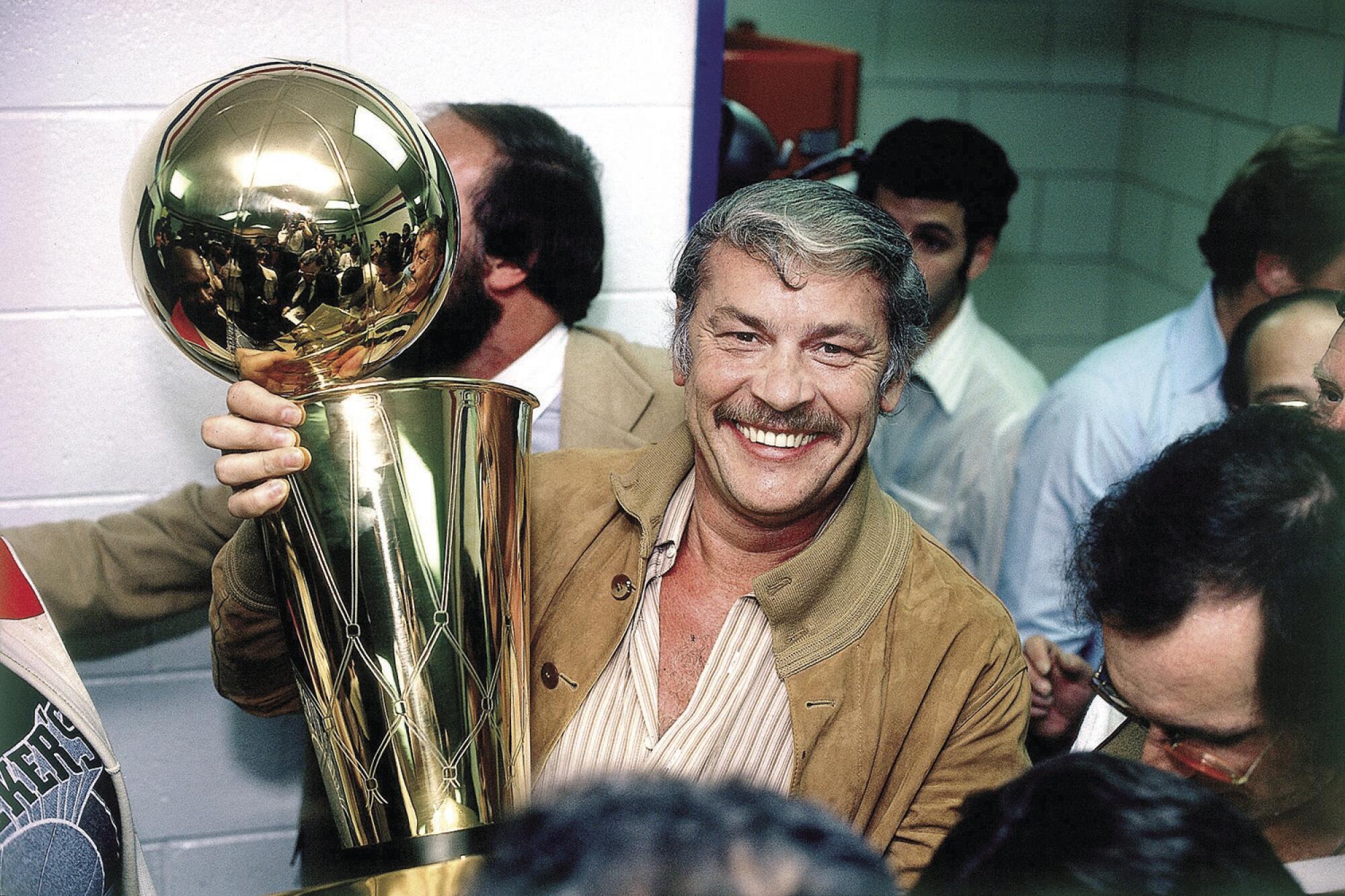
Lakers owner Jerry Buss poses with the NBA championship trophy in 1980.
(NBAE / Getty Images)
Jerry’s health challenges could not be denied and at age 69, he scaled back his involvement.
In 2002, Jeanie emerged as Jerry’s clear successor. At the time, her siblings did not seem interested in the role.
Her biggest challenges seemed to be getting the rest of the NBA to take her seriously after previously partying with her father’s girlfriends and posing nude for Playboy magazine. She told The Times she wished the media hadn’t focused as much on her past and stood by her work moving forward.
Soon after the Lakers hired Jackson in 1999, he asked Jeanie on a date. Their ensuing relationship added challenges to business operations, but The Times reported Jerry didn’t oppose it.
Lakers owner Jerry Buss and his daughter, Jeanie, pose for a photo at the Staples Center.
(Michael Kelley / For the Times)
Jeanie joined her father at NBA board of governors meetings for three years before being the Lakers’ sole representative at the gatherings that featured no other women. She handled an array of business challenges, big and small, and helped supervise the team’s move from the Forum to the Staples Center.
In 2002, all her siblings seemed content with Jeanie emerging as the face of the Lakers’ front office. They either were driven to make a name for themselves in other lines of business or had clearly carved out roles within the Lakers organization.
“My dad likes a system of checks and balances,” Jim told The Times. “Jeanie has more of the administrative part. We all have a good relationship. There’s no jealousy or envy. It’s very smooth.”
Buss family hits troubled waters
The smooth sailing didn’t last forever.
Jeanie helped her father navigate a series of difficult decisions. The Lakers agreed with Jackson to mutually part in 2004 amid a feud between Bryant and O’Neal, the first sign Jeanie was willing to part with someone she loved for the sake of the business. Jackson returned to coach the team in 2005 and held the role until his retirement in 2011, guiding the team to five titles.
In 2013, Jerry died and Bryant ruptured his left Achilles tendon. The Buss children reportedly decided against selling the team immediately after their father’s death, with Jeanie a clear vote against the move.
In 2014, coach Mike D’Antoni’s Lakers won 27 games. In 2015, the team won 21. In 2016, the team hit rock bottom with just 17 wins. Jeanie and Jackson broke up in 2016, ending their four-year engagement. She has since married comedian Jay Mohr.
Lakers star Kobe Bryant and Lakers governor Jeanie Buss stand beside each other on the basketball court.
(Wally Skalij / Los Angeles Times)
In 2017, the Lakers were headed to another losing season when Jeanie fired Jim, the president of basketball operations, and Mitch Kupchak, the team’s general manager. They were replaced by Rob Pelinka, Bryant’s former agent, and Johnson, the former Showtime star turned businessman.
Shortly after the firing, Jim and his brother, Johnny, tried to remove Jeanie from the team’s board of directors, sparking a legal feud that included Jeanie filing a restraining order while she wrestled control of the team.
“It wasn’t like we were trying to get rid of Jeanie as president of the Lakers,” Johnny said during a docuseries the team produced. “We wanted Jeanie to understand that Dad would not have wanted you to just take total control, hire and fire whoever you wanted, without the rest of us being involved.”
Jeanie countered her father created a trust that put her in control.
“They tried to disregard what their father wanted,” Jeanie said in the docuseries. “That’s a betrayal of all the hard work and what he did on our behalf to make this possible. I felt that there was this desire to remove me or stab me in the heart.”
A court ultimately delivered a ruling that Jeanie is still clinging to today as she hopes to retain the family’s minority ownership of the Lakers and her role as governor.
“The co-trustees are bound to vote the Los Angeles Lakers, Inc. shares to ensure that the minimum 15% ownership requirement is maintained in order to ensure that Jeanie Buss may remain controlling owner,” a letter written this week by Jeanie’s attorney reads, citing a 2017 court ruling outlining her role. “Any attempt by the co-trustees to do otherwise and any attempt to aid or abet the co-trustees as such would constitute a breach of trust, breach of fiduciary duty and be in contempt of court.”
The ruling stipulated that co-trustees “would take all actions reasonably available to them, including voting the trust’s shares to ensure that [Jeanie] is elected as the controlling owner of the Lakers on an annual basis during [her] lifetime.”
A title masks more drama
Soon after the ruling, Jeanie included younger brothers Joey and Jesse in the search for a coach to replace Luke Walton. Her siblings continued to hold roles within the team.
With Jeanie’s power firmly defined by the court, the Lakers signed LeBron James in 2018, traded for Anthony Davis in 2019 and won a title during a season shortened by COVID in 2020. It is the sole championship the team has won since Jerry’s death.
LeBron James hugs Lakers governor Jeanie Buss after winning the 2020 NBA championship.
(Douglas P. DeFelice / Getty Images)
The run to the latest title was far from smooth.
ESPN reported that when Jesse called Jeanie to ask a question about a remark Pelinka made during Davis’ introductory news conference in 2019, she told a story of a promise made between her father and mother that Jerry would never have any other children. Jeanie’s mother reportedly was heartbroken when Jerry and his then girlfriend had Joey and Jesse.
The siblings still somehow continued to work in various aspects of the Lakers’ operation.
Jeanie reportedly took intense criticism of the team during the last five years personally and Joey and Jesse wondered whether she might be open to selling the franchise. At the same time, value of NBA teams soared as more billionaires moved into the space. A sale would shift the siblings from millionaires who struggled to invest in growing the Lakers’ operations into billionaires.
A climate opposed to a sale
Jerry created a trust he hoped would prevent his children from feeling pressure to sell the team.
ESPN reported he prepaid inheritance taxes to prevent his children from having to do so upon his death and added provisions to the trust allowing siblings to buy each other out and forcing shares to be redistributed among the siblings when one died rather than passing them on to the next generation of their respective families.
Joey and Jesse began exploring small shares of the team and tried to get other family members on board, ESPN reported. They had not completed their work before Jeanie announced Walter’s offer. Four of the six siblings approved selling 50% of their shares to Walter for a figure that reportedly stunned all of them. Joey and Jesse learned the sale had been approved via a post on X by ESPN’s Shams Charania.
Janie told ESPN the Buss siblings were assured their roles with the team would not change for five years.
Walter’s purchase of the majority stake of the Lakers was approved by four of the six siblings in June 2025, with Jeanie endorsing the deal. She was assured she’d represent the Lakers on the NBA board of governors for at least the next five years.
On Nov. 20, three weeks after the NBA approved the sale to Walter, Jeanie fired Joey, Jesse, Jim, Johnny and Janie, who all worked for the team in various roles.
“I don’t think my dad would be happy with the way things just went down,” Janie told ESPN. “Not at all.”
While she disagreed with the way Jeanie handled the firings, her sister said in an interview with ESPN she didn’t think she meant to hurt her family.
“Jeanie doesn’t have a mean bone in her body, and so she just has to make these tough decisions,” Janie told the network. “And she’s been having to make them … I just wish she would’ve done it differently.”
Firing the last Buss family member
Last week, the family drama flared up again.
When Walter, who is facing multiple investigations into his business practices, reached a deal to sell his majority stake to Iger and Kushner, the family resumed conversations about completely cashing out of the Lakers.
Iger pledged to honor Walter’s agreement with Jeanie to remain as governor for at least five years and spoke highly of the Buss family in multiple interviews and statements released after the deal was announced.
Six days later, five of the siblings voted to approve the sale of their minority stake to Iger and Kushner, effectively firing Jeanie as governor.
Rob Pelinka, from left, Luka Doncic and Jeanie Buss pose for a photo in Katowice, Poland, on Aug. 27.
(Marcin Golba / Associated Press)
“We have decided as a family to sell the remaining Buss Family Trust shares to the Bob Iger group as part of the ongoing transaction,” the family’s statement to ESPN read. “We love the Lakers, Laker fans and will continue to support Los Angeles; but it is time to use this opportunity to move on and exit gracefully while we still can.”
Jeanie’s attorney has contested the sale, citing the 2017 court ruling. The attorney’s letter calls out two of Jeanie’s siblings for sending false information to ESPN: “This is just the latest instance of a years-long pattern whereby Joey and Jesse Buss leak false, defamatory and pernicious ‘information’ to Mr. Charania for the malicious purpose of doing harm to the Los Angeles Lakers so long as Dr. Buss’s chosen successor, Jeanie Buss, carries out her father’s wishes.”
Charania said he stands by his reporting.
The Buss Family Trust issued the following statement to The Times defending the five siblings’ right to sell the team:
“The Los Angeles Lakers have never been just a basketball team. They have been one of the greatest privileges of our lives. Our focus has always been on what we believe is best for the Lakers, the fans who have supported this franchise for generations and the greater Los Angeles community.
“Johnny, Jimmy, Janie, Joey and Jesse have made the decision to sell the family’s remaining stake, and we remain united in that decision. We intend to move forward thoughtfully, respectfully and through the appropriate process.
“We have tremendous respect for Bob Iger and Josh Kushner and believe they understand what the Lakers represent to Los Angeles and our incredibly loyal fan base. We are confident they will honor everything this franchise stands for while building upon the foundation our father created.”
It appears the Buss family will soon be headed back to court to decide their future as Lakers owners.
Eight episodes are currently available to stream on Netflix
Love Is Blind UK has finally returned to screens(Image: Netflix)
Love Is Blind UK bosses have opened up on a history-making moment that viewers never see on the show.
The third instalment of the hit Netflix show has returned to screens this week with the first eight episodes released in one go yesterday (August 19).
Hopeful singles have once again headed to the Love Is Blind dating pods hoping to find ‘the one’ where they will date potential partners. They will only meet face to face for the first time if a couple decides to take their relationship to the next step and become engaged.
The series has proved a hit with Netflix viewers, but there is a wait on their hands before the next batch of episodes will be released (August 26).
As the new release hits screens, executive producer Nazleen Karim and series editor David Cheesman spoke about one thing that viewers did not see and it is an incredible milestone which has made history.
This time around, there was an unprecedented number of engagements as 14 pairs took their relationships to the next step. However, the show only showed six couples’ journey, meaning there was so much more that viewers didn’t get to see play out on screen.
Nazleen said: “When there are more engagements than we can physically follow, we have to make difficult editorial choices. We’re looking for a range of different relationship journeys and stories that together capture the full experience of the experiment.
“Not being selected isn’t a reflection of the strength of a relationship – many couples continue exploring their connection once they leave the Pods.”
David added: “It’s never an easy decision and we wouldn’t want to diminish the love those other couples have formed. We’ve never had as many as 14 engagements which is why we ended up following six couples this time as opposed to five.”
With a combination of “natural drama and love, sexiness, chemistry and humour”, the series is potentially the strongest so far as David confirmed: “Every season brings something different, but this one has some of the most surprising twists, emotional moments and unforgettable characters we’ve seen.”
Hosts Matt and Emma Willis also touched on the monumental engagements as Matt said: “There are clearly a lot of thirsty people in the UK! I think we both got a strong sense that people really were there to get married.
“They weren’t just going in to see what this was all about – they wanted to find a husband or wife. Maybe the RAYE song ‘Where Is My Husband!’ was the inspiration.”
Although the new episodes follow six potential pairs, viewers will need to tune in to see who makes it to the altar, and who, if anyone, continues their marriage in the outside world.
Isese (the Yorùbá word for Tradition) Day celebrates the Yorùbá traditions and religion in a display of culture and spirituality with parties, festivals, parades, lectures and display of other traditional apparels to attract tourists from other parts of the world.
As well as in South-West Nigeria, Isese day is celebrated by Yorùbá diaspora communities around the world.
Yoruba people are a large ethno-linguistic group or ethnic nation in Africa, and the majority of them speak the Yoruba language. The Yoruba constitute approximately 35% of Nigeria’s total population, and around 40 million individuals throughout the region of West Africa.
The Yorubas are the main ethnic group in the states of Ekiti, Lagos, Ogun, Ondo, Osun, and Oyo, which are subdivisions of Nigeria; they also constitute a sizable proportion of Kwara and Kogi States as well as Edo State.
While the majority of the Yoruba live in western Nigeria, there are also substantial indigenous Yoruba communities in Benin, Ghana, Togo and the Caribbean.
The appropriate greeting for Isese Day is “Isese l’agba” and the response is “Isese l’agba gbogbo wa”.
AN abandoned UK village will open to the public for a limited time at the end of the month.
The town, which has been frozen in time since World War II, remains cut off from the world for most of the year.
The abandoned village of Imber in Wiltshire is open to the public for a limited time this monthCredit: AlamyThe public are permitted access to the town for 12 days out of the year, including the August Bank Holiday weekendCredit: Alamy
For just 12 days out of the year, history fans and nature lovers travel to the village of Imber in Wiltshire, which has not been occupied since 1943.
During the second World War, the town’s 150 residents were given 47 days to evacuate their homes so the village could be turned into a military training area for American troops preparing for D-Day.
Sign up for the Travel newsletter
Thank you!
While they were promised they would be able to return after the war, the village is still occupied by the Ministry of Defence (MoD) to this day.
Once every few months, the public is invited to visit the town for free, with roads opening through Imber until 6pm during the August Bank Holiday weekend.
Public access has been granted to the village as well as the Grade I-listed St Giles Church, which will be open from 11am to 4pm daily.
The original surviving building is free to visit during open days with any donations going towards the Churches Conservation Trust (CCT) for maintenance and restoration.
The Ministry of Defence took over the town during World War II, converting it to a military training areaCredit: AlamyResidents of the village were given 47 days to evacuate and never returnedCredit: Alamy
Along with an old pub, the church is one of the few remaining original structures in the village.
Most of the larger stone buildings were damaged during military training, and were subsequently demolished.
Meanwhile, houses in the village are either hollowed-out shells or have been converted into windowless buildings to simulate urban environments for military training.
Those who once lived in the village have the right to be buried on the church grounds, with undisturbed wildlife now the only living residents.
Imber also holds open days during the Christmas and New Year period as well as at Easter, with all visitors required to adhere to the public rights of way and designated areas, and comply with signposting.
Imber village has not been occupied since 1943Credit: AlamyFormer residents of the town can still be buried at St Giles Church in ImberCredit: Alamy
Afghanistan is an Islamic state in Central Asia. With its strategic position between India, Persia and the Silk Road, Afghanistan has been a region coveted by foreign empires since the dawn of civilisation.
The country we recognise today as Afghanistan emerged in 1747, when Ahmad Shah Durrani unified the Pashtun tribes.
In the context of this holiday, our story begins with the arrival of the British in the early nineteenth century.
Threatened by the growth of the Russian Empire, Britain moved into Afghanistan to secure it as a buffer between Russia and the so-called ‘Jewel in the Crown’ of the British Empire, India. This led to the first Anglo-Afghan War when British forces invaded, installed King Shah Shujah, who was assassinated in 1842 and the war ended abruptly with the massacre of the entire British invading force by Afghan forces in the city of Jalalabad.
In 1878, the British returned and the Second Anglo-Afghan War resulted in victory for Britain over the Afghan army in Kandahar and a treaty that gave Britain control of Afghan foreign affairs in exchange for protection and a subsidy.
In 1919, the brief Third Anglo-Afghan War brought British control of any aspect of Afghanistan to an end.
Afghanistan signed the Treaty of Rawalpindi (or Anglo-Afghan Treaty) on August 8th 1919, when Britain formally recognised the sovereignty and independence of Afghanistan and ensured neutral relations between Afghanistan and Britain.
On August 19th 1919, Emir Amanullah Khan declared independence from British influence. Note that it wasn’t independence from Britain, as Afghanistan was never part of the British Empire.