Gadi Eisenkot, Benjamin Netanyahu’s rival in Israel’s upcoming election, held his final campaign rally on Sunday, declaring: “Netanyahu must go home.” The former military chief has positioned himself as a moderate alternative to Netanyahu in Israel’s first national election since the October 7 attacks.
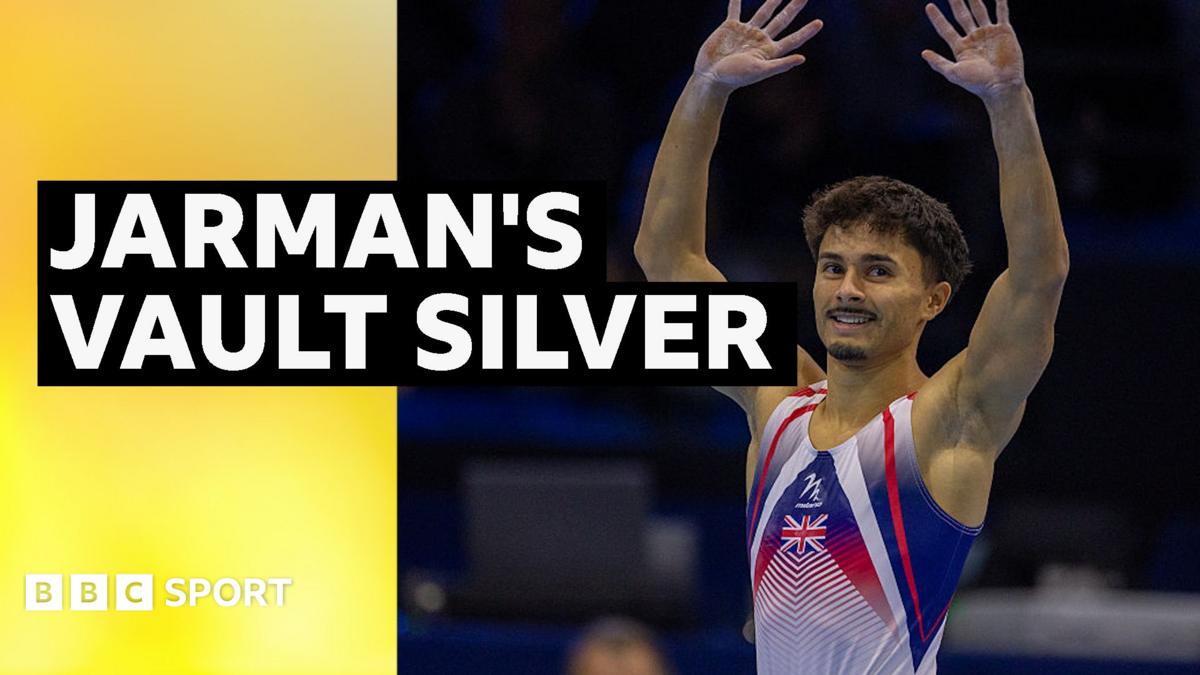
Jake Jarman becomes the first British male gymnast to win two individual medals in the World Gymnastics Championships, after winning silver in a thrilling men’s vault final in Rotterdam.
President Lula da Silva rallied in Sao Paulo and Flavio Bolsonaro in Minas Gerais, on the eve of Sunday’s runoff election. The candidates are now polling at 50% each, according to a Datafolha poll.
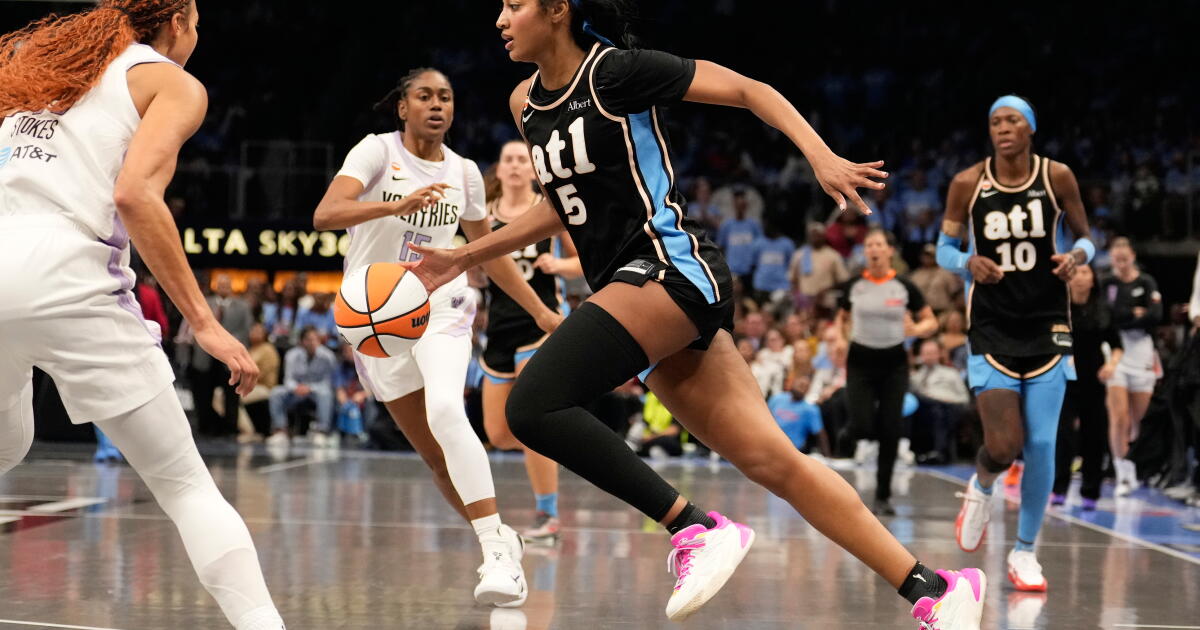
Rhyne Howard added 16 points and Naz Hillmon had 15 for the Dream, who host Game 4 on Saturday.
It was the second straight strong game for Reese, who had 30 points and 16 rebounds in Game 2, which the Dream also won for their first victory ever in the Finals. She now has a double-double in each game of the Finals.
“It feels good when you’re in the Finals. It’s a long season and you play against everybody and go through and push through, but when you can do it at the highest level, this is what you live for, this is what the offseason is for,” Reese said. “I put the work in for this moment and I’m just happy I could lead the team to a win. We’re feeling good going into Saturday.”
With the score tied at 49 in the third quarter, Atlanta scored eight straight, including four by Reese. Golden State got within 59-55 on Tiffany Hayes’ layup, but could get no closer as Atlanta closed the quarter scoring 12 of the final 14 points.
Atlanta has dominated the third quarter so far in the series, outscoring Golden State 63-35 in the three games.
This game was originally scheduled to be played on Thursday at the Gateway Center Arena, where the Dream play most of their home games. The league was able to work with the Atlanta Hawks and State Farm Arena to play the next two games of the championship series there so that they could have a much bigger crowd. Gateway seats 3,500 fans while State Farm Arena can seat more than 17,000.
Wednesday night’s game was sold out, as is Game 4 on Saturday, which will also be played at State Farm Arena.
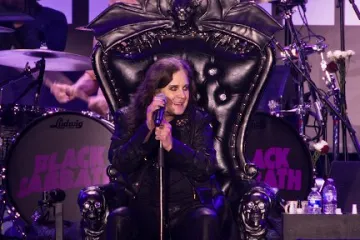
SITTING atop a bat-encrusted throne in front of me and 44,000 other screaming fans at Birmingham’s Villa Park last summer, Ozzy Osbourne took his final bow.
Just 17 days later, the music world was plunged into mourning as wife Sharon announced news of the Black Sabbath legend’s death at the age of 76.
Ozzy Osbourne took his final bow at Birmingham’s Villa Park last summerCredit: SuppliedRocker Ozzy Osbourne with beloved wife SharonCredit: Getty
Speaking to me for her only newspaper interview, Sharon reveals Brummie Ozzy — who she was with for 45 years — knew the epic performance might kill him.
“We never told anyone how sick Ozzy was,” Sharon says. “The doctors told him if he performed, he might die.
Sign up for the Showbiz newsletter
Thank you!
“Ozzy asked how long he had left and they said it was months.
“He said, ‘I’ve had the most amazing life. What is a few more months going to do, with me in pain and being miserable?
And they have poured all their energy into creating a feature-length film of last year’s Back To The Beginning concert, which is out in cinemas next Wednesday.
Bizarre’s Ellie Henman with SharonCredit: SuppliedSharon with Sabbath rocker Tony Iommi at the Back To The Beginning London premiereCredit: Carsten Windhorst & Gerard Hynes
“I am still learning to live with the grief, and that grief will be with me until the day I die,” Sharon says.
“I had counselling in the beginning. And when we watched the movie last week in LA, Aimee had to leave — it was too emotional for her.
“Jack stepped up and helped me with the business and Kelly is dealing with it in her own way.
“I told them we were lucky to have him, and it’s a blessing their dad was so beloved.”
“We kept his phone number on and do you know how many of his friends still text him?” she says, with a sad smile.
“Why should you wipe everything out because they have gone?
“I talk to Ozzy, too. I speak to him about everything that is going on.
“I ask, ‘What would you do? Tell me what to do’. We do whatever we can to take comfort. People I don’t even know have been so gracious — they come up to me to offer their condolences.
“The other day I was pushing my trolley around M&S and a lady approached to pay her respects. It really is touching that people thought of him so highly.
“The thing about Ozzy is that you didn’t even have to like his music, because people just loved the character.
“He was larger than life, a real softie and funny as f***. I mean, the f****** fights we had . . . but it always ended in love. “He’d come out with one line which would be so funny, I’d crack and go, ‘Oh, f*** it’. Life is too short.”
Ozzy knew his epic final performance might kill himCredit: GettyOzzy and Sharon with kids Kelly and Jack in 2015Credit: Getty
Ozzy’s death saw an outpouring of grief all over the world, and Birmingham came to a standstill on the day of his funeral.
“I am blessed to have my husband’s friends. They are incredible and they have all been there for us,” Sharon says.
“We got so many messages, and we are still receiving letters, cards and flowers from fans all over the world.
“We had the honour of spending some time with him on a few occasions and he was just a normal bloke.
“The King loves to laugh . . . he’s really naughty, and Ozzy loved that.”
Ozzy’s farewell concert on July 5, 2025, saw the great and the good of heavy metal travel to Birmingham to perform, including Sabbath bandmates Bill Ward and Geezer Butler as well as Tony Iommi — who supported Sharon at the film’s launch in London on Tuesday.
It is two-and-a-half hours of unbridled rock ’n’ roll joy, with acts including Metallica, Guns N’ Roses and Slayer performing Sabbath’s biggest hits.
Sharon admits Ozzy was worried about being able to go the distance at the concert, which ran for more than ten hours.
“I was petrified because I didn’t know whether he could get through it,” Sharon explains.
“He was just praying his lungs would work and that he could sing because, along with everything else wrong with him, Ozzy had emphysema.
“He could be great for two days and then on the third day he’d wake up and couldn’t breathe. But it was mind over matter. He wanted to play with Sabbath one last time. He wanted to see his mates and the fans.”
Music legend Ozzy back in 1989Credit: GettyOzzy on stage during his final concertCredit: Getty
Emotions aside, Sharon admits there was non-stop fun backstage.
She told how Hollywood actor Jason Mamoa called and asked for tickets to the show, only to be told on the day he had to compere the entire event.
“I said, ‘Just go and talk to the crowd and introduce the bands’,” Sharon recalls.
“He said, ‘I can’t do that’. So I said: ‘F**k off, you’re an actor!’.”
The concert, which raised more than £8million for local charities, has gone down in music history as the greatest gathering of heavy metal artists of all time.
And Sharon hopes Ozzy’s legacy will continue to inspire the next generation.
“People don’t understand how poor Ozzy was [as a child],” she says. “He was born in the Forties and a can of condensed soup and a white bread loaf fed him and his five siblings.
“They all slept on one bed. They didn’t have blankets — they wore coats.
“There was no bathroom, just an outside toilet in a shed.
“He worked so hard to change his life and achieve what he did.
“He was a true working-class hero, and his music will live on forever.”
GREEDY ROCKERS TRIED TO CASH IN ON CONCERT
LAST year Sharon told how one rock band – a household name – tried to profit from Ozzy’s Back To The Beginning fundraiser.
I gasped when she told me who the gutless group was.
Sharon asked me not to run the name of the band, who have a string of No1 albums, because it would make their name mud – and rightly so.
Sharon told me: “It was a charity event but everyone’s expenses were paid for.
“We asked this band for theirs and they came back with a sum over £800,000. I said, ‘F*** off’.
“I explained Metallica were bringing their whole stage set, everything, and their expenses were nowhere near that.
“For this band, it was about money. But this was not a concert to make a profit – it was for charity.
“They were taking the p***.”
If the band’s fans knew, they would be horrified. I hope one day she tells the world who it was.
Trust me, you’d be stunned.
GOT TIME FOR GLASTO, SAM?
Sam Fender is set for a huge 2027Credit: Getty
SAM FENDER has announced his biggest ever tour, a new album and dropped a big hint that he could headline Glastonbury in 2027.
The Seventeen Going Under singer will hit the road for the first time in 18 months next summer, with stadium shows across the UK and Ireland.
He will play Newcastle’s St. James’ Park on June 3 and 5, followed by Cardiff’s Principality Stadium on June 10.
Then there will be two nights at London’s Wembley Stadium on June 18 and 20, Dublin’s Marlay Park on July 1, Edinburgh’s Murrayfield Stadium on July 8 and Manchester’s Etihad Stadium on July 15 and 17.
The Proper Massive Stadium Tour will see Sam, right, perform to over 600,000 fans, and tickets go on sale at 9.30am next Friday, October 30.
Sam’s fourth album – a follow-up to 2025’s People Watching – could well be out by then, too, as fans who pre-order it will get access to tickets on Wednesday.
It’s hard not to see the clear gap in Sam’s schedule over Glastonbury weekend though – June 23 to 27.
I’ve heard some exciting whispers about next summer’s event and with Sam on board, it’d be a belter.
RYLAN: STRICTLY IS IN MY DNA
Rylan Clark missed out on a role in Strictly’s presenting line-upCredit: Getty
RYLAN CLARK says he’s thrilled his pal Emma Willis landed the Strictly job after he missed out on a role in the BBC show’s presenting line-up.
In an exclusive chat to celebrate Rylan teaming up with M&M’s to give away free Vue cinema tickets for Halloween, he said: “I love Emma to bits and I’m so over the moon for her. I think her, Josh Widdicombe and Johannes Radebe are doing a fantastic job.
“Being part of the show for four years hosting It Takes Two, it will always be a part of my DNA.
“I still love watching the show and long may they keep dancing.”
Rylan, inset, who has been going on secret missions for M&M’s by giving cinema-goers jumpscares before handing them free tickets, added: “I hid in a photobooth, a sofa and a ticket machine to give people spooks.
“There was one group that had quite an OTT reaction.
“They were very scared, even when it was revealed it was me, but maybe the teeth scared them off.”
TOM GRENNAN launches his bid to return to the charts tomorrow with new single, Wrapped In Gold.
Tom Grennan has launched his bid to return to the chartsCredit: Getty
The emotional track will feature on his upcoming fifth album. But before that, Tom will take to the stage at London’s O2 Arena to perform at Capital’s Jingle Bell Ball.
I previously told how John Legend, Jamie Miller and Becky Hill and will be part of the December line-up, with Queen of Christmas Mariah Carey also in talks to sing.
MUNYA CHAWAWA appears to be angling to become the first influencer to be cast as James Bond.
The funnyman looked dapper as ever as he enjoyed his new role as Oatly’s first-ever Diplomat of Taste.
Munya Chawawa in his new role as Oatly’s first-ever Diplomat of TasteCredit: Supplied
He was driven through London in a three-car motorcade to celebrate the opening of The Oatly Embassy in West London.
On Fridays and Saturdays, guests can enjoy free oat-based drinks and a tour of the Museum of Modern Oats.
Munya said: “If there are two things people say about me, it’s that I love oats and I’m great at diplomacy.”
IN the last six months of her short life, there was one person Amy Jade Winehouse could turn to unreservedly.
Dale Davis, her band leader and confidante, provided her with a shoulder to cry on and a reason for her to break into the infectious laughter that came with her wicked sense of humour.
There was one person legend Amy Winehouse could lean on in her final daysCredit: AlamyDale Davis, 57, was Amy’s band leader and closest confidante from ages 19 to 27Credit: supplied
He was there to give Amy “a cuddle” during her final public outing, and three days later — on the night before she died aged 27 in 2011 — he spent 15 minutes on the phone to her, telling her she was “the best”.
“We were always chatting in those final months,” he says today to mark the 20th anniversary of Amy’s stellar Back To Black album.
“I remember her saying to me, ‘Dale, I’ve just realised that I’ve spent my whole adult life with you’.
“I was with her from when she was 19 to 27. The things I miss about her most are her big grin and that glint in her eyes.”
Dale joined Amy’s band in 2003 as bassist because the original choice was “too expensive” and, as he self-deprecatingly admits, he was “the uglier, cheaper” alternative.
A year later, he became her musical director and remains the keeper of her flame by leading The Amy Winehouse Band on its regular tours of the UK and abroad.
Though he was 17 years her senior, they bonded over a shared love of “hip-hop, soul and Nineties R&B”.
He adds: “We were also the only members of the band who drank Jack Daniel’s — so there was a lot of affinity there. If Amy loved you, no matter who it was, she loved you hard. She always had my back and I always had hers.”
Reaching the 20th anniversary of Back To Black, released on October 27, 2006, is a milestone Dale finds “surreal”.
Amy’s second album, the follow-up to her debut Frank, catapulted the vivacious, naturally talented singer on to the world stage and has sold more than 20million copies (and counting).
It contained raw, personal songs loaded with pathos and humour, such as Rehab, Me & Mr Jones, Tears Dry On Their Own and Love Is A Losing Game, all delivered in deliciously smoky, jazzy tones.
It charted in graphic detail Amy’s turbulent relationship with the love of her life, Blake Fielder-Civil, as well as her battles with drug and alcohol addiction.
“I believe she was the first star of this millennium, of the broadband generation,” maintains Dale.
“She was a most courageous performer and human being. Amy had a massive heart, but it left her open to the highs and the lows.”
To give an example of her inner conflict, Dale vividly recalls being with her on February 10, 2008, when she scooped five Grammy awards in the wake of Back To Black.
“Life was never dull and that night I saw an indication of what she was going through,” he says.
Amy phoned Dale for 15 minutes just hours before she diedCredit: Free for editorial useHe now keeps her memory alive by leading the Amy Winehouse band with members Ade Omotayo, Dale Davis, Nathan Allen and Hawi GondweCredit: PA
Amy could not attend the ceremony in Los Angeles because she’d been denied a visa amid drug and legal issues, but she was hooked up remotely to perform from London’s Riverside Studios.
“When she won her third Grammy, it was just me and her on stage,” continues Dale.
“Everyone else had walked off. I said, ‘Well done, Amy’. And she just said, ‘No, this is s*** because Blake’s not here’.
“While she was winning all those awards, her heart was going through the extreme pain of not being with him. There was no middle ground with Amy, and things like that are so destabilising to your mental health.”
When he considers the Back To Black songs, he says Wake Up Alone was Amy’s favourite, but he singles out a sad track, Love Is A Losing Game, and a funny one, Me & Mr Jones.
There’s an exquisite demo rendition of Love Is A Losing Game on the new, expanded anniversary editions, just Amy’s sublime, soulful voice and the strums of an acoustic guitar.
Dale says: “She was equally comfortable with an orchestra or on her own.
“The great thing about that version is that she delivers the most beautiful performance and then, at the end, she goes, ‘Is that all right?’. That really sums her up.
‘Amy had a massive heart’, said DaleCredit: GettyNext week will see the 20th anniversary of her iconic and most vulnerable album Back to BlackCredit: Getty
“Amy was so bright and so intelligent, but because she spoke so normally, it fooled people.”
Of Me & Mr Jones, with its old-school jazz vibe and jaw-dropping line, ‘What kind of f***ery is this?’, Dale says: “That’s my favourite song on the album. It’s right up my street. It’s got doo-wop. It’s got swing.
“I can imagine the mischievous grin as she’s thinking, ‘Right, I’m going to turn this into a funny old song’.
Also, you can’t play it on the radio. That’s the great thing about Amy — she knew no boundaries.”
Yet Dale senses that the star who burned bright for a fleeting moment “sold herself short in the end”.
“Amy was the most rebellious person I’ve ever come across,” he decides.
In 2004, the year Frank came out, Dale remembers “having breakfast with Nick (Shymansky, her first manager), who said, ‘We’ve got some issues with Amy’. I said, ‘Just leave her be, she’s a punk’.
“She had that spirit which could be destructive. However, the only harm she ever did was to herself.
“At the same time, she was so funny — her observational humour was ridiculous.
“I could always tell something funny was coming when I saw that glint in her eyes.
Back to Black has sold over 20 million copies (and counting)Credit: Not known clear with picture deskThe singer drew inspiration from her turbulent relationship with husband Blake Fielder-CivilCredit: Getty – Contributor
“Had she lived, Amy would have been like Barbra Streisand or Bette Midler — an all-round entertainer.
“I can imagine her having her own TV programme or being a great actress. She even talked about wanting to do some acting.”
When I caught up with Dale this week, he was preparing for last night’s Back To Black 20 show, directed by the album’s producers, Mark Ronson and Salaam Remi, at The Roundhouse in Amy’s London stomping ground of Camden.
Among the singers due to step into her ballet flats at the gig were Baby Rose, Corinne Bailey Rae, FLO, Jessie Reyez, Jorja Smith and Lianne La Havas.
Mention of the venue prompts Dale to cast his mind back to Amy’s final public outing, which took place there on July 20, 2011 — three days before she left us too soon.
Dale was by her side for a showcase by her goddaughter, the singer Dionne Bromfield.
Amy bravely appeared on stage — “dancing and being a good sport” — to support Dionne, but declined to take the mic.
“She was wearing a vest and jacket and looking as well as when I first met her,” says Dale.
“After the show, Amy said, ‘Let’s hang out’. So I spent two hours with her and we chatted so much. Before we left, we went outside and she said, ‘Cuddle me because I’m cold’.
“I spent the last ten minutes holding her. When I look back on that moment, I’m thinking it wasn’t like her because she was never cold.”
Amy was married to Blake Fielder-Civil from 2007 to 2009Credit: PA:Press AssociationBritish soul singer Dionne Bromfield is famously Amy’s honorary goddaughterCredit: Getty
Dale believes Amy’s “eating disorder got her in the end”, a subject of great sadness to him.
He says: “She was never ever big — curvy at most. But I know a comment was made one year and then suddenly all the weight came off. I felt sorry for her.
“It has taken me a long time to realise what eating disorders are.
“I wish I’d had more knowledge so I could have helped.
“Towards the end, her nervous system was getting more and more shocked with the lack of eating.
“And when Blake went to prison, she also stopped sleeping. That had a massive impact on her physical state.”
This brings us to Dale’s phone call with Amy, which started at 11.15pm on July 22, 2011, hours before she died.
Many faced criticism over Amy’s death including father Mitch and mother JanisCredit: Getty – ContributorDale was there to offer Amy ‘a cuddle’ in her final monthsCredit: Redferns
“Even at her funeral service, I ended up right next to the coffin because there was no room for me elsewhere. All those weird things draw me in to make sure that I protect her legacy.”
Dale describes their final conversation: “Amy said, ‘Dale, I’ve had a little bit to drink’. And I said, ‘Well, you don’t sound at all drunk’.
“Then she said, ‘I’ve been watching some old clips of me on YouTube. I CAN sing, can’t I?’. And I just said, ‘Of course you can. You’re the best’.
“I’m so glad that, on her last evening, she could turn round and say that because she was the least arrogant person about her abilities.”
In the wake of Amy’s tragic death, there have been blame games involving various parties — Blake, management, the music industry, the media, her parents.
Mention of this prompts Dale to launch a staunch defence of Amy’s divorced mum and dad, Janis and Mitch.
He says: “I feel so sorry for Janis because when Amy started to get famous, Janis had her own health problems.
“Amy always said her mother was so serene — and then she had to go through her struggles and watch the demise of her daughter.”
Turning to her London cabbie dad, who left the family home when Amy was about ten but became more involved in her life as her career took off, Dale says: “People point the finger at Mitch.
“Me and my dad don’t really get on, but we love each other and are there for each other.
“It was very difficult for someone like Mitch coming back into Amy’s life when she’d become a self-made multimillionaire. It must have been quite hard to try to direct someone when they’ve made it themselves.”
On a more general note, Dale adds: “The industry and everyone else can take steps to do everything they can — but there’s always going to be someone who slips through the net.”
Next up for him is a UK tour with his Amy Winehouse Band, a chance to hear some of that beautiful, rebellious spirit.
“They tried to make me go to rehab but I said no, no, no.”
UK tour details at theamywinehouseband.com. The Back To Black 20 Concert is on BBC Two on Saturday, 9.35pm, and Radio 2, Monday, 7pm. Expanded editions of Back To Black, with unheard demos and a 2007 live show, are out on Friday.
WASHINGTON — Xavier Becerra was dubbed a “rising star” before he even entered the halls of Congress.
His June 1992 Democratic primary victory over Los Angeles school board member Leticia Quezada in California’s 30th Congressional District earned the 34-year-old candidate that description in The Times.
When the boyish, affable congressman became the first Latino lawmaker appointed to the powerful House Ways and Means Committee in his second term, national outlets took notice.
Thirty years later, in the final weeks of his gubernatorial race with Republican Steve Hilton, Becerra now finds himself poised to lead the most populous state in the country.
An examination of Becerra’s more than 25 years in Washington shows a politician who was skilled at building important alliances and amassing power on Capitol Hill, but had some stumbles along the way and faced criticism for his performance in his highest profile role.
Becerra built his reputation as a diligent consensus-builder — a workhorse rather than a show horse, to use an analogy favored by political scientists — but also revealed himself to be an ambitious political operator in key moments.
“He’s an affable person who’s not afraid to pull out a knife in politics while smiling,” said Christian Grose, a political science professor at USC.
Becerra’s campaign declined to comment on his time in Washington.
Becerra’s origin story traces back to his youth in Sacramento, and a moment when a high school friend was about to throw out a blank, unused application to Stanford University. The elite university was only 125 miles away, but it might as well have been across the ocean from the working-class world Becerra was raised in. Still, he applied.
He earned a law degree there four years later, and it was at Stanford that he met his wife, Carolyn Reyes, who became a physician.
After living in Boston while Reyes attended Harvard Medical School, Becerra moved to Los Angeles to work for state Sen. Art Torres. Within a few years he was tapped by Henry Lozano, then chief of staff to trailblazing Latino Rep. Edward Roybal, to run for state Assembly in 1990; and then, two years later, to succeed Roybal, who was retiring after 30 years in Congress.
Roybal endorsed Becerra, whose victory in the heavily Latino district that included Central and Eastside Los Angeles communities, was seen as a passing of the torch to the next generation.
Frank Villalobos, the founder and president of Barrio Architects, was among the leaders in East L.A. who encouraged Becerra to run for political office, and he said he was impressed early on by Becerra’s genuine commitment to the community and his ability to unite the area’s sometimes divided political factions.
“I thought if we kept this going, someday he’ll become the governor,” Villalobos said.
Becerra was part of a wave of young Latino lawmakers entering Congress, and his growing power within Democratic ranks helped him escape Roybal’s long shadow. Soon after Becerra’s barrier-breaking appointment to the Ways and Means Committee — which writes tax legislation — Becerra became chair of the Congressional Hispanic Caucus, a position he held from 1997 to 1999.
An early test
He put his growing stature to the test a few years later when he decided to enter the L.A. mayor’s race in 2001.
It didn’t go well.
Former state Assembly Speaker Antonio Villaraigosa was also running, and Becerra — who had slept on Villaraigosa’s couch when he first ran for Congress — faced criticism for potentially splitting the Latino vote.
Becerra performed poorly, winning only 6% of the vote in the Democratic primary. His nice-guy reputation took a hit when his campaign was found to have been behind automated phone calls attacking Villaraigosa by a woman who falsely gave the impression that she was county Supervisor Gloria Molina, whose endorsement had been crucial in Becerra’s first run for Congress.
Becerra also faced criticism for his role in contacting White House staffers as part of an effort to push for the release of convicted L.A. cocaine dealer Carlos Vignali, whose father was a political contributor to Becerra. Vignali’s sentence was commuted by President Clinton on his last day in office; Becerra acknowledged calling the White House several times to discuss the possibility of Vignali’s release. Villaraigosa also wrote a letter on Vignali’s behalf.
Becerra told The Times in 2001 that he wasn’t lobbying for Vignali’s release, but merely asking White House officials to review the details of the conviction on behalf of the family.
“If I was going to try to put pressure on, I would have tried to call the president,” Becerra said at the time.
Villaraigosa fared better than Becerra but ultimately lost the 2001 election to City Atty. James Hahn, then rebounded to win the first of two terms as mayor in 2005.
Becerra got the better of Villaraigosa in their rematch this year in the Democratic gubernatorial primary, and won Villaraigosa’s support after.
“We’ve been friends a long time and, yes, we’ve been adversaries as well, but most of the time we’ve been friends,” Villaraigosa told The Times. “He’s got the experience and the wherewithal to lead this state.”
As for Becerra as a house guest during his first run for Congress?
“He makes his bed. He was neat,” said Villaraigosa. “He was pretty inconspicuous.”
Capitol Hill climbing
After his mayoral defeat, Becerra’s focus returned to Washington, where an alliance with another powerful Californian was a boon to his career on Capitol Hill.
Becerra was a close ally of former House Speaker Nancy Pelosi (D-San Francisco), serving as assistant to the speaker from 2007 to 2009.
John Lawrence, Pelosi’s former chief of staff, said that Becerra’s standing within the California delegation and particularly among Latino lawmakers was a big part of his appeal.
“Speaker Pelosi had set a goal of elevating minorities and women who had historically been excluded from leadership,” he said.
Their relationship took a hit after Becerra told progressive lawmakers in 2009 that he believed party leadership gave up too easily on including a public option in the Affordable Care Act, which was signed into law the following year.
“I understand I have tire tracks on my back because Xavier threw me under the bus,” Pelosi said during a Democratic Party leadership meeting in 2009, Politico reported.
And Pelosi would later question Becerra’s appointment in 2021 to be secretary of Health and Human Services. She has not endorsed Becerra in the gubernatorial race.
But any bad blood between the two didn’t stop Becerra from continuing to advance within the party ranks.
He became chair of the House Democratic Caucus in 2012, leading weekly meetings of all Democrats in the House and uniting the party’s members.
Former Wisconsin Democratic Rep. Ron Kind said Becerra was an excellent listener and skilled at building consensus.
“He could get in the room with anyone and find common ground,” Kind said.
Becerra joined several high-stakes negotiations, notably a 2013 bipartisan effort to pass comprehensive immigration reform, in the wake of the “Gang of Eight” deal struck in the Senate.
John Yarmuth, a Democratic congressman from Kentucky who was also part of the House negotiation, said Becerra was “an amazing positive force” in the process.
“I think he, more than anyone else, was focused on fixing the problem,” Yarmuth said.
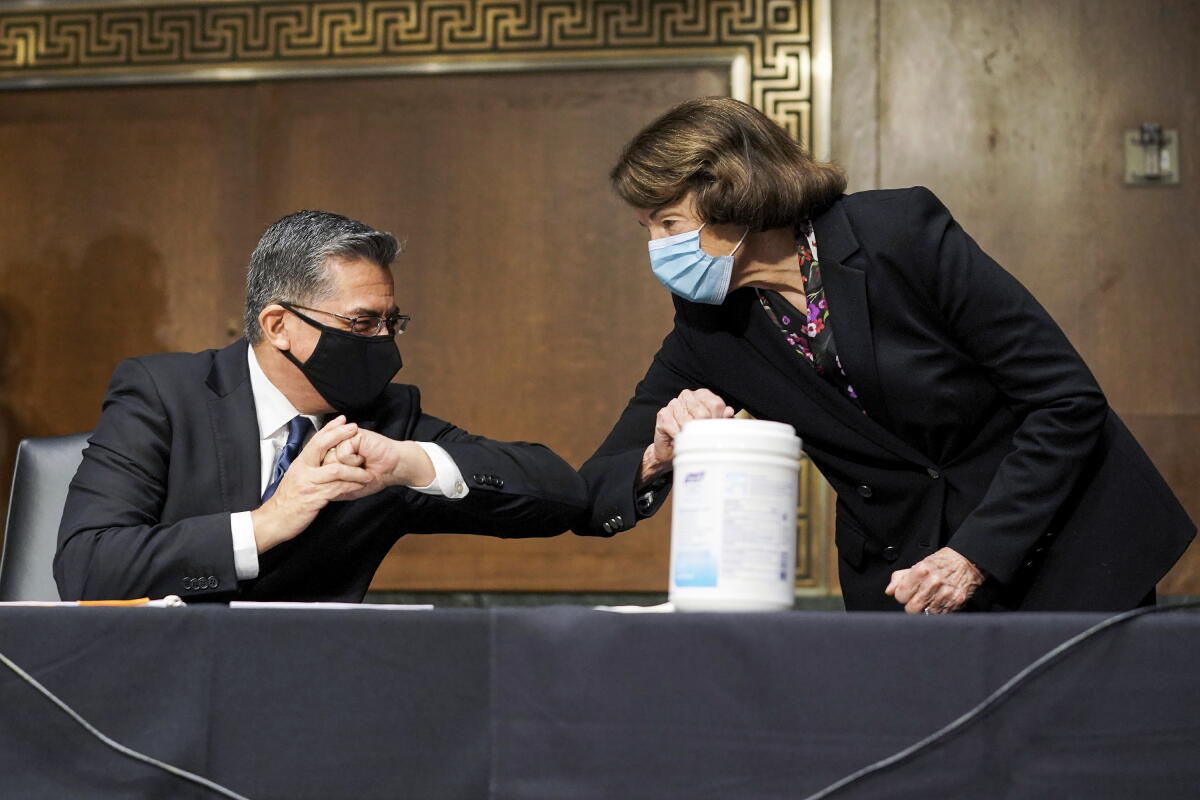
Xavier Becerra bumps elbows with U.S. Sen. Dianne Feinstein (D-Calif.) before his Senate committee confirmation hearing for Health and Human Services secretary in 2021.
(Greg Nash / Associated Press)
The group was able to achieve a compromise, but it never saw the light of day.
Then-House Speaker John Boehner, an Ohio Republican, later blamed then-President Obama, whom he accused of “poisoning the well” on an immigration compromise. Yarmuth said Republicans were spooked about potential blowback.
Several potential off-ramps appeared during Becerra’s time in Washington. He was considered by Obama for U.S. trade representative in 2008, but Becerra declined the offer. After flirting with the idea of running for outgoing U.S. Sen. Barbara Boxer’s seat, Becerra declined to enter the race, ultimately won by then-California Atty. Gen. Kamala Harris. He was briefly floated as a potential running mate for Hillary Clinton in the 2016 presidential election, but that didn’t materialize either.
In late 2016, Becerra found himself at a crossroads.
After more than a decade on the Ways and Means Committee, he faced the possibility of becoming the top Democrat on the committee and had the endorsement of the outgoing top Democrat, Rep. Sander Levin of Michigan.
But Harris’ victory in the 2016 Senate race created a vacancy for state attorney general.
Becerra decided to return home to Sacramento to take the role and spent the next four years as the state’s top law enforcement official, serving as “defender-in-chief” of the state, as USC’s Grose put it, against the Trump administration.
Fraught second act in D.C.
Becerra returned to Washington in 2021 for a second act that would prove to be far more controversial than his first.
Despite having no background in healthcare, Becerra was nominated to be the secretary of Health and Human Services and confirmed, over significant opposition by Republicans.
He took the reins of the healthcare agency as the country was still grappling with the COVID-19 pandemic and struggled to establish a clear role for himself in a response effort that was centered in the White House.
In his first year in office, he was called out by reporters for failing to hold regular press briefings.
And he faced criticism when health officials under his purview offered contradictory information in late 2021 about reduced quarantine requirements for people testing positive for COVID-19.
And Becerra’s chief of staff at Health and Human Services and longtime advisor, Sean McCluskie, pleaded guilty last year to participating in a scheme to use campaign funds from a dormant Becerra state political committee to pay for McCluskie’s frequent travel between Washington and California.
Dana Williamson, a longtime political consultant for Becerra and former chief of staff to Gov. Gavin Newsom, pleaded guilty earlier this year for her role in the scheme. McCluskie and Williamson are scheduled to be sentenced in December. Neither Becerra nor Newsom were accused of wrongdoing.
Democratic operative Xochitl Hinojosa, who served as the spokesperson for the Department of Justice in the Biden administration, earlier this year offered a blunt assessment of Becerra’s performance.
“He was not effective in government, and I think that a lot of people in the Biden administration are talking about this because they realize that he was not an effective HHS secretary,” Hinojosa said on CNN in May.
While other members of the Biden administration have defended Becerra’s performance, his time at the helm highlighted an issue that even allies concede has bedeviled Becerra in the past, his tendency to sometimes recede into the background.
Loretta Sanchez, a former Democratic congresswoman from Orange County who credits Becerra with encouraging her to run for Congress, put it simply.
“Will Xavier be bold?” she said. “I hope he takes those bold moves, because California needs it.”
“This process will require several weeks, with the CAS Award expected at the end of November 2026,” the court said in a statement on Monday.
Senegal are contesting the decision by the Confederation of African Football (CAF) to declare Morocco champions, despite Senegal beating the hosts 1-0 after extra time in January’s final in Rabat. Their arguments, plus those of Morocco and CAF, were heard by CAS in Lausanne on October 8.
At the time, CAS said it expected a decision within days but has now decided to issue a complete ruling, including legal grounds, known as a CAS Award.
Senegal walked off the pitch for 14 minutes after a penalty was awarded against them late in regulation time, with several players returning to the dressing room in protest before they resumed play.
Morocco missed the spot kick, sending the match into extra time, where Senegal scored the winner to secure victory.
However, they were stripped of the title two months later after CAF’s Appeal Board ruled that Senegal had forfeited the match by walking off the pitch, overturning the result and awarding a 3-0 victory to Morocco.
Senegal quickly followed with an appeal to CAS, which was lodged on March 25 but heard some six months later. The basis of their arguments is that the referee’s decision is final and he allowed the match to be completed.
“I know it’s a long wait for the fans, a few months after the final between Senegal and Morocco,” CAS Director General Matthieu Reeb said outside the hearing earlier this month.
“The facts are set, are clear and the discussions will be on some procedural issues and legal aspects,” he added.
The CAS panel is presided over by French sports law expert Gerald Simon, with the assistance of Italian international law professor Luigi Fumagalli and Hamburg-based lawyer and professor of law at the University of Zurich, Ulrich Haas.
CAS decisions are called awards and hold the same value as a national court judgement. CAS awards may be enforced by sports federations or state courts, depending on the circumstances.
India reached 118-5 after seven overs with Naman Dhir hitting 24 off six balls before rain forced an end to the game.
Published On 17 Oct 202617 Oct 2026
India and the West Indies were forced to settle for a 2-2 stalemate in their five-match Twenty20 International series after Saturday’s deciding match lasted just 48 minutes before it met a watery end.
At Bengaluru’s M Chinnaswamy Stadium, where play began an hour and 45 minutes behind schedule and the match was reduced to nine overs a side, India had reached 118-5 in 7.4 overs when the rain returned, forcing the umpires to call off play with not even a five-overs-a-side shootout possible.
Recommended Stories
list of 4 itemsend of list
The stadium was hosting its first international fixture since the October 2024 Test match between India and New Zealand and more than 20,000 expectant fans braved the inclement weather.
Their patience was rewarded when India’s batters went on the rampage after being put in by West Indies captain Shai Hope, with Ishan Kishan, Sanju Samson and the impressive Naman Dhir – with an unbeaten 24 off six balls – leading the way.
India lashed eight fours and seven sixes in their limited batting stint, with Kishan bringing up the 100th six of the series by swinging Romario Shepherd over long leg and out of the stadium.
But then, the skies opened up again, emphatically washing away any prospect of a decisive outcome.
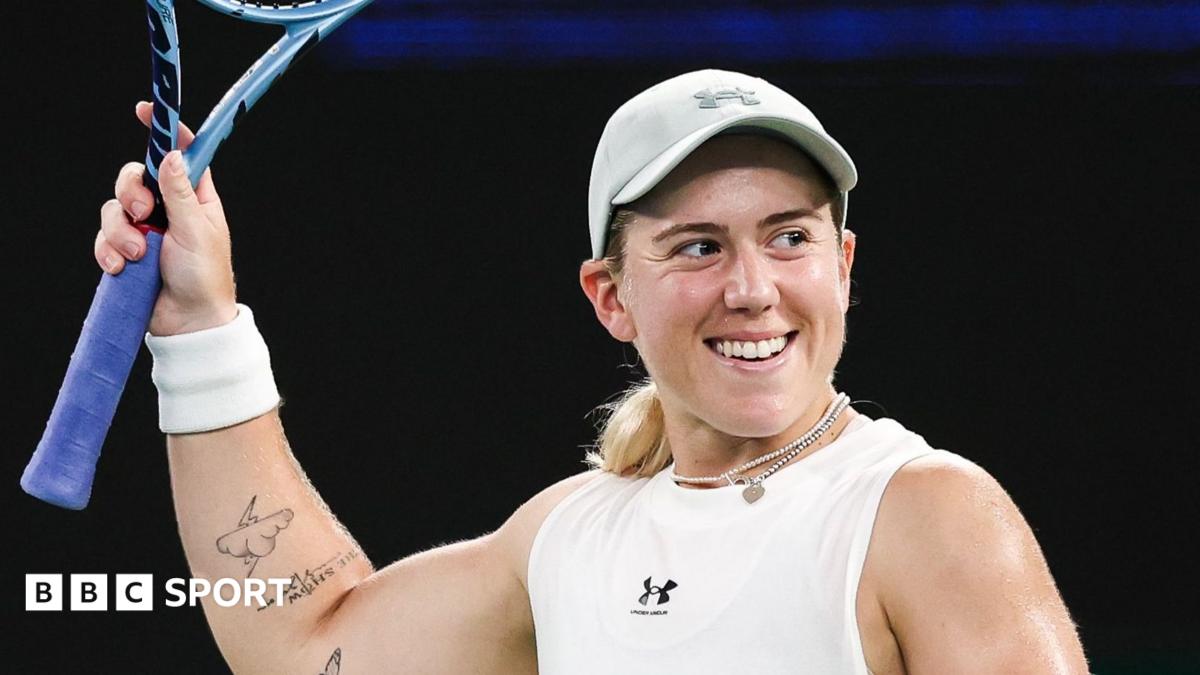
Sonay Kartal’s dream week continued as she beat former Grand Slam champion Jelena Ostapenko at the Wuhan Open to reach the biggest final of her career.
British number five Kartal is playing in only her third event since returning from a six-month absence with a back injury, but she now stands one more victory away from a WTA 1,000 title – one of the most prestigious prizes outside of the Grand Slams.
The 24-year-old’s composure helped her secure a 7-6 (11-9) 7-6 (7-5) victory in a pulsating semi-final against Latvia’s Ostapenko.
Kartal trailed 4-1 in both sets but remained level-headed and took advantage when 34th-ranked Ostapenko stuttered in high-pressure moments.
Remarkably, Kartal survived three set points in the first set, and three more set points in the second, to secure a victory which will long live in the memory.
“That was probably one of the toughest matches I’ve ever played,” said Kartal.
“At times she is unplayable and you have to ride that wave. Mentally, this is one of the best performances of my career.”
The world number 170 is the lowest-ranked player to reach a WTA 1,000 final since the format was introduced in 1990.
Kartal will play French Open finalist Maja Chwalinska – who beat six-time major champion Iga Swiatek in their semi-final – for the title on Sunday.
Reaching the final means Kartal, who has been as high as 44th in the world, will return to the world’s top 50 and become Britain’s number one player when the next rankings are released on Monday.
Great Britain’s Millie Couzens beats her compatriot Josie Knight in the final of the women’s individual pursuit at the Track Cycling World Championships in Shanghai.
WASHINGTON — President Trump bypassed his White House chief of staff last week in selecting Katie Zacharia as his press secretary and chief messenger, triggering days of scathing headlines about her credentials and abilities before her ignominious resignation on Friday.
Susie Wiles, that senior-most aide ostensibly in charge of the president’s team, is facing his scrutiny over a different set of problems: widespread public anxiety over corruption in government under the Trump administration. The issue has surpassed the economy as the top concern of voters entering next month’s election, according a Fox News poll released this week.
Marco Rubio, the president’s secretary of State and national security advisor, has been silent on Trump’s decision to cut a deal with Moscow on diesel sales that could fuel Russia’s war against Ukraine. The president’s poll numbers have been below water across the board, but especially so on foreign policy, where over two-thirds of Americans disapprove of his job performance and support Kyiv’s fight for freedom.
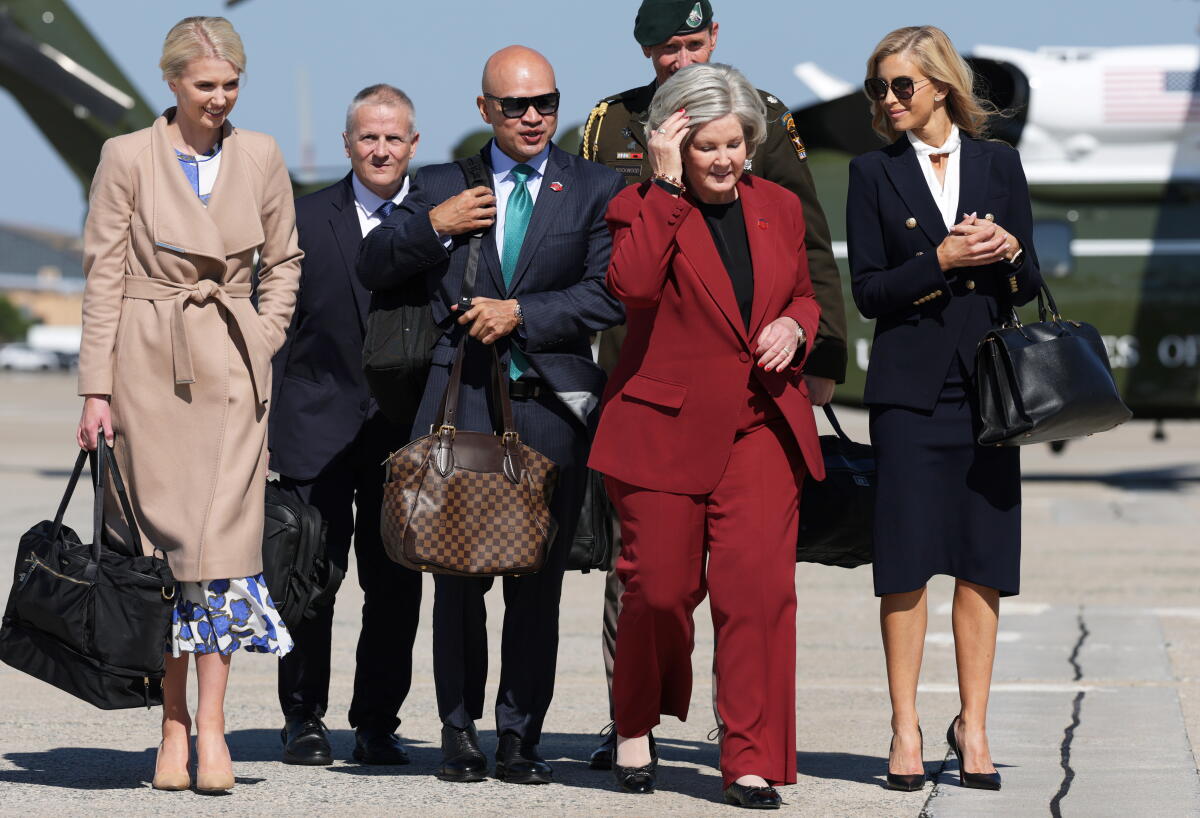
Trump aides walk to board Air Force One on Tuesday: Natalie Harp, Trump’s executive assistant, left; Walt Nauta, director of Oval Office operations (in sunglasses); Chief of Staff Susie Wiles; and then-Press Secretary Katie Zacharia.
(Alex Wong / Getty Images)
And on Thursday, the president was forced to reverse a course set out by Defense Secretary Pete Hegseth and the Pentagon to live-stream the execution of a convicted mass shooter by firing squad.
In the final stretch of the 2026 midterms, nearly two weeks out from election day, a White House that has enjoyed relative stability over the past two years has returned to the state of disarray that characterized much of Trump’s early political career, anticipating sweeping losses to Democrats in the House and Senate.
Staff upheaval is expected as officials brace for a blame game over Republican performance, with some distancing themselves from what they see as a fading political movement.
Polls suggest that Republicans are likely to lose control of the House, setting up two years of relentless congressional probes through the twilight of the Trump era, and that Democrats could even flip the Senate, winning in ruby red states from Ohio to Alaska.
It is historically a time for closing arguments, when politicians deliver their final pitches to voters in neat, disciplined packages.
Yet Trump’s campaign blitz across the country in recent weeks has generated a muddled message, dismissing the importance of the election itself at the risk of depressing Republican votes, overshadowing local candidates seeking distance from his record and touting an economy unrecognizable to most Americans.
President Trump walks ahead of Katie Zacharia at the White House.
(Win McNamee / Getty Images)
The president’s selection of Zacharia, who lasted just five days on the job, raised fresh questions about his message discipline in the final stretch.
And infighting within the White House has reinforced a narrative among political pundits that Democratic gains are a fait accompli, despite Zacharia, in her first and only press briefing, foretelling of Republican energy and excitement “never seen before in the history of midterms thanks to President Trump.”
Election officials across the country fear that, anticipating inevitable losses, Trump may be laying the ground to challenge the authenticity of the election results themselves.
“You know, this is the only guy that — it’s ‘promises made, promises kept,’ but he did more things than he promised,” Trump said Thursday, referring to himself in the third person. “I think we did. We did much more than we promised.”
The extent of the coming West Wing shakeup could be extensive, reaching into a Cabinet that has had far less turnover than Trump experienced in his first term.
Zacharia is the second senior official forced out by Trump in just three days, after Kimberly Guilfoyle, the former fiancée of one of Trump’s sons who served as U.S. ambassador to Greece, was revealed by the Wall Street Journal to have asked a Trump donor to pay off her $100,000 credit card bill.
Now, the president has begun asking political allies and donors about Wiles’ job performance, according to a recent Politico report, and several top administration officials are vying for her role, anticipating her resignation after the elections next month.
The conclusion of the midterms will also kick off the start of the 2028 presidential election season, when Republican hopefuls — including many from Trump’s Cabinet — are expected to launch exploratory committees.
British Defense Secretary Wes Streeting and U.S. Defense Secretary Pete Hegseth stand for anthems at the Pentagon on Thursday.
(Finn Gomez / Getty Images)
“We have to get through the midterms first,” Trump said at the end of August, asked about Hegseth reportedly considering a run. “I bet there’s a lot of people considering it that you don’t know about. You have a lot of people.”
The party of incumbent presidents regularly loses seats in midterm elections, and it is common for presidents to shake up their staffs halfway through a term.
But the last time a term-limited Republican president faced voters in midterm elections, in 2006, Democrats swept into power in both houses of Congress — and President George W. Bush’s political capital never recovered.
That year, 37% of voters said they approved of Bush’s job performance. Polls published this month by AP and Reuters have found Trump already below that threshold.
In the GOP presidential primaries that followed, candidates jockeying to replace Bush distanced themselves from his legacy. He ultimately left office with an approval rating of 25%.
IT IS two years to the day since Liam Payne’s family – and his millions of fans – had their hearts broken when the pop star plunged to his death from a third-floor balcony at the Casa Sur Hotel in Buenos Aires.
Now, a bombshell update has ripped through the investigation. Argentinian businessman Rogelio ‘Roger’ Nores, 38, once facing the terrifying prospect of prison for negligent homicide, has been officially cleared of all criminal liability. Two hotel workers have also walked free.
It has been almost two years since Liam Payne plunged from a third-floor balcony at a hotel in Buenos AiresCredit: Shutterstock EditorialLiam’s close friend Rogelio ‘Roger’ Nores, left, with the former One Direction star in the days leading up to his deathCredit: Unknown
Meanwhile, two defendants charged with selling cocaine to Liam await their fate, but case sources now think a full trial over his death will never take place.
For Liam’s grieving family and millions of devoted fans, Roger being cleared does not bring closure.
It simply shines a spotlight on the agonising black holes still in the official narrative as a UK inquest into Liam’s death is still ongoing, despite a series of setbacks.
Here are the chilling questions that still demand answers:
Who really delivered the fatal dose?
Liam and Argentinian waiter Braian Nahuel Paiz, who is accused of supplying drugs to the pop star
While Nores and two hotel workers, Gilda Martin and Esteban Grassi, have had manslaughter charges dropped, the drug trail hasn’t gone cold. Toxicology reports confirmed a lethal cocktail of “alcohol, cocaine, and a prescription antidepressant” in Liam’s system.
Two men, Ezequiel Pereya, 22, and Braian Paiz, 26, are currently languishing in an Argentine jail awaiting trial, accused of selling Liam the narcotics.
Braian Paiz was working at a high end restaurant in Buenos Aires when he first met the One Direction singer on October 2, 2024.
He has claimed as Liam was leaving he asked the starstruck waiter if he had any cocaine and the pair exchanged Instagram handles.
Over a week later Liam, who was still in the Argentine capital, contacted him to ask for drugs.
Braian admitted in his witness statement: “He ended up convincing me to get [drugs] for him. And, in all honesty, I didn’t want to miss the opportunity to see him again. That’s why I agreed to do it.”
In a later newspaper interview, he said: “I’ve suffered so much psychological damage due to all this and the social condemnation, and of course I’m worried now I might be in prison for many years. But I don’t regret meeting Liam. I was a fan.”
But it has become clear Liam was getting drugs from many sources, so the question remains: how did a global superstar, supposedly in a secure VIP suite, become a target for local dealers? Was there a wider network exploiting vulnerable guests at the Casa Sur?
When will the trial of the two accused take place?
Floral tributes to Liam in his hometown of WolverhamptonCredit: PA
The two defendants charged with selling cocaine to Liam in the lead up to his death are still awaiting trial.
Restaurant waiter Braian Nahuel Paiz, 26, and hotel worker Ezequiel David Pereyra, 22, served over one year in police precincts and in a federal prison until they were released in March.
The Sun understands that there have been negotiations for a plea deal for the two young men.
That could mean that a full trial over Liam’s death never takes place.
The pair are accused of selling drugs to Liam but if the plea deal goes ahead that charge could be reduced to supply of drugs for free, which carries a maximum sentence of six months.
According to legal experts, given the pair have no prior criminal convictions, the sentence would already be covered by time served.
Pereyra’s defense attorney, Augusto Maria Cassiau, told The New York Post: “We would be inclined to accept the offer.”
What part will Cheryl play in the ongoing investigation?
Cheryl has been officially named as a co-administrator of Liam’s massive estateCredit: PA:Press Association
Since Liam tragically passed away without leaving a will, his entire £25.7 million estate will eventually pass to his young son.
In May 2025, Cheryl was officially named as a co-administrator of his massive estate alongside attorney Richard Mark Bray.
However, her power is strictly administrative. She and Bray can “manage the money” but cannot distribute it without further legal authority.
Shortly after Liam’s passing, Cheryl issued a searing statement condemning the “abhorrent reports and media exploitation” surrounding his death, begging for Liam to be given “the little dignity he has left”.
Cheryl is a plaintiff, on behalf of their son Bear, in the case against the waiter and the hotel worker, who are charged with supplying Liam drugs.
The Sun understands that she could ultimately have the last say over any plea deal agreed with the Argentine authorities – but she, or her lawyers, have so far not objected to the rulings in Roger’s favour.
Now as the inquest stalls, how much longer will Cheryl and Bear have to wait for the final legal chapter to close?
What happened on the balcony?
An aerial view of the poolside area of the hotel where Liam diedCredit: AFP
The most haunting mystery of all. We know Liam fell from the third floor of the hotel, where he was staying in Room 10.
But the moments leading up to that fatal plunge are still shrouded in silence. The UK coroner, Crispin Butler, has been desperately chasing “eyewitness statements” from Argentina since late 2025.
Following his death, it was reported that Liam jumped off his balcony, perhaps trying to reach the swimming pool below that it was claimed he had been denied access to because of his intoxicated state.
But it later became clear he had fallen backwards, possibly after falling unconscious, causing unsurvivable injuries to his head and dying instantly.
The toxicology report read: “Due to the position in which the body was found and the injuries from the fall, it is presumed that Payne did not adopt a reflexive posture to protect himself and may have fallen in a state of semi or total unconsciousness.”
After forensic experts studied the singer’s hands, they did not find any defensive injuries, which led them to believe that “the injuries on the body were vital and produced at the same time, and that no injuries were observed that could suggest the intervention of third parties”.
Are there witnesses who saw the build-up? Were there warning signs ignored by hotel management before he stepped onto the balcony? And why did they let him back into his room?
Why are the Argentine authorities not working more closely with their UK counterparts?
For Liam’s family, the wait for justice is becoming a cruel joke.
The UK inquest has been delayed repeatedly, first pushed to May 2026, and now stalled again because British coroners are still waiting on fully translated case files and evidence disclosures from the Foreign, Commonwealth and Development Office.
Coroner Crispin Butler told a pre-inquest hearing there had been no updates since a last review in January 2025, when he said he would seek full reports and eyewitness statements before a final inquest.
He added: “We have had no further disclosure of evidence from Argentina via the Foreign, Commonwealth and Development Office.”
It has been 24 months. Why are the Argentine authorities dragging their heels in handing over the final, unredacted timeline?
BBC sitcom Daddy Issues will come to an end after the third series has aired but not before a star-studded lineup of guest stars has joined the cast for its final outing
22:21, 14 Oct 2026Updated 22:58, 14 Oct 2026
Daddy Issues will come to an end after the third and final series has aired(Image: BBC/Fudge Park Productions/James Stack)
Daddy Issues will come to an end after the third and final series has aired, the broadcaster has confirmed. The BBC Three sitcom stars Aimee Lou Wood as Gemma and David Morrissey as Malcolm, following a pregnant party girl who moves into a flat share with her recently-divorced father.
But the programme, which is Danielle Ward and co-written with David Reed has confirmed a string of guest stars for its final outing. Men Behaving Badly star Neil Morrissey will be amongst those joining the cast, taking on the role of as Malcolm’s new friend Ellis.
Ensure our latest headlines always appear at the top of your Google Search by making us a Preferred Source. Click here to activate or add us as your Preferred Source in your Google search settings.
Shobna Gulati, best known as Sunita Alahan in Coronation Street and Anita in dinnerladies, will play new neighbour Odette whilst former Peep Show star Sophie Winkleman will play campsite owner Mary.
Sarah Hadland, best known for her role as Stevie Sutton in Miranda and for her Strictly Come Dancing stint, will be back as Rita, joining fellow returning cast members David Fynn as Derek, Taj Atwal as Cherry and Celebrity Traitors star Sharon Rooney as Catherine.
The new run of six episodes will focus on Gemma’s newfound set of calamities as she tries to settle into her new promotion at the salon whilst daughter Sadie thrives at nursery. Chaos ensues when the flat she still shares with her dad floods, and a new romance leaves her stuck in a web of lies.
Over the last few years, actress Aimee, who the BAFTA Television Award for Best Female Comedy Performance after making her screen debut in Netflix hit Sex Education, has enjoyed global success with US comedy drama The White Lotus.
Through her role as Chelsea, she earned Emmy and Golden Globe nominations. Aimee has also hosted an episode of Saturday Night Live UK, starred as Sally Bowles in the West End production of Cabaret and is due to appear in a string of Hollywood films including The Beatles, Anxious People, and The Idiots.
Speaking about the series coming back, Aimee shared nothing but excitement as she expressed her joy at being part of the comedy series.
She said: “I’m so happy to be back with David and the brilliant Daddy Issues cast for one final time. Gemma and Malcolm are one of the funniest and sweetest comedy double acts on TV, and I’ve loved being a part of it.”
Meanwhile, David Morrissey added: “I love doing Daddy Issues so much, such a great cast and crew! So I’m delighted to be coming back to have more adventures with Gemma, Malcolm and the gang!”
THE Pussycat Dolls shrugged off the Lil Kim ‘tour axe’ while stripping to some striking outfits at their packed London gig on Tuesday night.
Lady Marmalade star Lil Kim, 52, didn’t appear for the final night of the Pussycat Dolls’ run at London’s O2 Arena, with the headline act fed-up of her unpredictable behaviour.
The Pussycat Dolls shrugged off the Lil Kim ‘tour axe’ while stripping to some striking outfitsCredit: GettyKim shot to fame in 1994 after being discovered by late rap legend The Notorious B.I.G.Credit: Shutterstock Editorial
A source said: “Kim didn’t show up to their gig in Manchester on Saturday night, and it was all very last minute. It threw everything into chaos and a sign just went up at the last minute to say she wouldn’t be performing.
Sign up for the Showbiz newsletter
Thank you!
“As a result, she hasn’t been asked back for the closing night in London tonight, which was seen as the grand finale.”
But shrugging it off entirely, Nicole Scherzinger and her glam bandmates Ashley Roberts and Kimberly Wyatt looked sensational in racy outfits at the gig.
The girls opted for silver leotards, with Ashley wowing in a two piece and showing off her toned physique.
Kimberly had her long pins on display with cut out tights on and white boots.
The girls looked sensational in silver bodysuitsCredit: GettyThey performed the final London night at the O2 Arena on TuesdayCredit: Getty
And Nicole looked as glamorous as ever in her dazzling bodysuit, embellished with sequins.
The Pussycat Dolls all rocked beautiful makeup looks and styled their hair down, while having the time of their lives on stage.
The girls wowed their fans and put Lil Kim’s tour axe.
No official reason for support act Kim’s absence in Manchester was given, though some fans claimed she was ill.
However, others noticed she had shared social media videos of herself on her tour bus in the build-up to the gig where it looked she was playing video games.
One fan wrote on TikTok: “She was on the tour bus prepping for GTA 6.”
Another posted: “Omg we were there last night how bad is that, not even a comment on sorry she’s no show or anything, playing GTA in the trailer apparently, previous videos of her trying glad she didn’t show.”
Kim also came under fire from baffled fans at a previous gig in Paris when a music video playing on the big screens behind her during her set appeared to be synced from her phone and private messages kept popping up before the feed was quickly pulled.
The larger than life star then invited Kim to join the Brooklyn-based rap group Junior M.A.F.I.A, before she launched her solo career with her double-platinum album Hard Core, which debuted at number 11 on the Billboard 200.
Grammy-winner Kim’s biggest hits in the UK are all collabs, including the 2001 number one ‘Lady Marmalade’, a cover commissioned for the Moulin Rouge soundtrack, and 2003 track ‘Can’t Hold Us Down’ with Christina Aguilera, which reached number six.
The Sun contacted representatives for the Pussycat Dolls and Lil’ Kim.
BREAKING Bad star RJ Mitte made his final public appearance just days before he tragically passed away.
The actor, 34, smiled on the red carpet at the premiere of his new movie, Talking to Strangers, on September 30 in California.
RJ Mitte at the screening of “Talking To Strangers” at Fine Arts Theatre on September 30Credit: GettyRJ Mitte stared in Breaking Bad and died on MondayCredit: Getty
RJ, who played Walter White Jr. in the Emmy Award-winning show, died on Monday in Brownsville, Texas.
Announcing his passing, the actor’s representative told Deadline: “It is with profound sadness that we share the tragic passing of beloved actor, philanthropist, and passionate disability rights advocate RJ Mitte.
Sign up for the Showbiz newsletter
Thank you!
“Drawing from his own experience living with cerebral palsy, RJ brought authenticity to the role and built a platform on disability awareness and inclusion.”
RJ’s cause of death was not immediately disclosed, however, TMZ reported that he died by suicide.
RJ at the Beverly Hills event in late SeptemberCredit: GettyRJ photographed for Breaking Bad Season 5Credit: Alamy
His new movie tells the story of introvert with cerebral palsy who meets a vibrant force of nature who he goes on to form an unlikely and complicated friendship with.
Talking to Strangers is available to stream on Prime Video.
Just four days before his death, RJ posted to Facebook about the movie.
He wrote: “Had the pleasure of attending the LA premier for a film I made, Talking to Strangers The Movie, now streaming on Amazon Prime Video.
Most read in Entertainment
“It’s got a little love, some comedy, and maybe even some drama.”
Speaking on a podcast, RJ praised the film for “pushing social norms” and “stepping out of the realm of comfort”, pagesix reports.
He served as a proud celebrity ambassador for several organizations, including United Cerebral Palsy and Shriners Children’s.
Giving advice to young people with disabilities, he told Future of Personal Health: “My hope is to inspire a ‘never give up’ mentality.
“If there is something you want in life, pursue it no matter how hard it may be.
“Keep your dreams alive. Don’t lose sight of who you want to become.”
In Breaking Bad, his character also had cerebral palsy, although the actor’s real-life condition was milder compared to his character.
RJ played the son of Bryan Cranston and Anna Gunn’s characters on the hit crime drama.
He appeared in 56 episodes.
Last year the late actor got engaged to his girlfriend Kennedy Suarez after years of dating.
If you or someone you know is affected by any of the issues raised in this story, call or text the 988 Suicide & Crisis Lifeline at 988, chat on 988lifeline.org, or text Crisis Text Line at 741741.
How to get help
EVERY 90 minutes in the UK a life is lost to suicide It doesn’t discriminate, touching the lives of people in every corner of society – from the homeless and unemployed to builders and doctors, reality stars and footballers. It’s the biggest killer of people under the age of 35, more deadly than cancer and car crashes. And men are three times more likely to take their own life than women. Yet it’s rarely spoken of, a taboo that threatens to continue its deadly rampage unless we all stop and take notice, now. If you, or anyone you know, needs help dealing with mental health problems, the following organisations provide support: CALM, www.thecalmzone.net, 0800 585 858 Heads Together,www.headstogether.org.uk HUMEN www.wearehumen.org Mind, www.mind.org.uk, 0300 123 3393 Papyrus,www.papyrus-uk.org, 0800 068 41 41
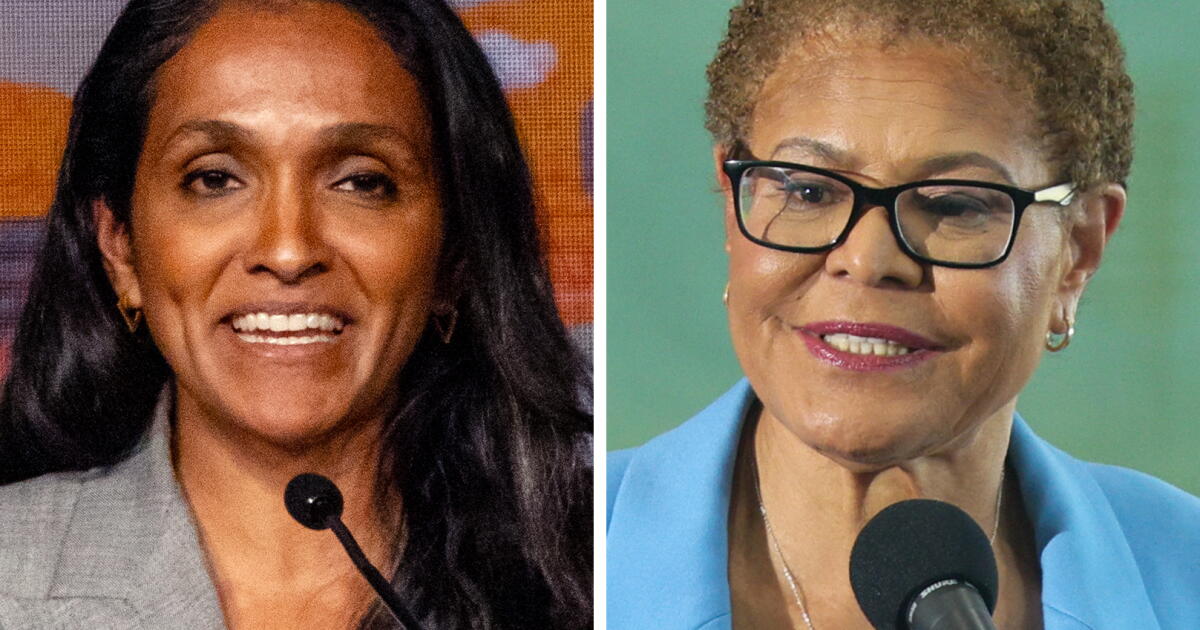
Los Angeles Mayor Karen Bass and challenger Nithya Raman will be on the same stage Tuesday night for their final debate before the Nov. 3 election, but the two mayoral candidates are expected to come in with starkly different game plans.
With recent polls showing Raman in the lead, the councilmember will likely try to avoid making any kind of flub during the in-studio debate hosted by NBC4 and Telemundo52 in Universal City.
“A successful debate for Raman is one in which not very much happens,” said Dan Schnur, a professor of politics at USC, UC Berkeley and Pepperdine.
Raman floundered at the last NBC4/Telemundo debate during the mayoral primary, when Spencer Pratt was also on stage. She got better marks after a debate with Bass before the Sherman Oaks Homeowners Assn. in August.
Along with avoiding mistakes, Raman will need to paint a positive view of the city she hopes to lead, said Sara Sadhwani, a professor of politics at Pomona College.
“She needs to able to spell out a vision for the city of Los Angeles and inspire confidence that she would be able to deliver on such a vision,” she said.
For Bass, it’s a different task entirely. The mayor was the top vote-getter in the June 2 primary, but numerous several polls now show her trailing. The Berkeley IGS / L.A. Times poll, conducted Sept. 15-20, showed Raman with an 11-point lead over the incumbent.
To gain ground, Bass needs to go on the attack and convince voters that Raman isn’t fit to lead, Schnur said.
“Bass needs to explain to voters why voting for a relatively unproven candidate would be a dangerous risk to take,” he said. “I’m curious if it will go down the road of the nasty,” Sadhwani said. The debate, being conducted in partnership with Loyola Marymount University, will run from 7 p.m. to 8 p.m. and will be moderated by NBC4 news anchor Colleen Williams, NBC4 chief political reporter Conan Nolan and Telemundo 52 news anchor Alejandra Ortiz.
The Times will have live coverage.
You’re reading the L.A. on the Record newsletter
Sign up to make sense of the often unexplained world of L.A. politics.
By continuing, you agree to our Terms of Service, which include arbitration and a class action waiver. You agree that we and our third-party vendors may collect and use your information, including through cookies, pixels and similar technologies, for the purposes set forth in our Privacy Policy such as personalizing your experience and ads.
An influencer digs in on Bass
Social media creator Ed Choi made headlines this week, posting and then removing an Instagram video showing him and Raman declaring in unison: “Only you can stop fascist liars.”
The pair used that phrase as an image of Bass appeared on the video. Raman, facing criticism for her words, said she was referring to Trump and Immigration and Customs Enforcement raids, not the mayor or Los Angeles Police Chief Jim McDonnell, and had asked for the video to be taken down.
Choi defended his messaging, saying in a subsequent Instagram video that Bass is in fact a fascist, pointing to to Bass’ decision to appoint McDonnell, a former L.A. County sheriff. He also cited the Los Angeles Police Department’s treatment of anti-ICE demonstrators as evidence that the city is “descending into fascism.
Raman voted in 2024 to support Bass’ selection of McDonnell, even as her fellow Democratic Socialists of America colleagues on the council cast opposed his appointment. On the campaign trail, she has repeatedly criticized McDonnell, saying the LAPD should not have used tear gas on anti-ICE protesters exercising their First Amendment rights.
Choi also claims in his video that Raman is committed to defunding the police. But Raman no longer supports that idea, saying in February that LAPD staffing should not get any smaller.
Banned word lawsuit
When the Los Angeles City Council considered banning the use of the N-word and C-word at its meetings last year, Stacey Segarra-Bohlinger was in attendance to give the politicians a piece of her mind.
“This is going to bring lawsuits,” said Segarra-Bohlinger, who often sings parody songs at council meetings and has been a member of the Sherman Oaks Neighborhood Council.
Segarra-Bohlinger filed suit Tuesday, represented by lawyers with the Foundation for Individual Rights and Expression. The group contends that word bans — which can lead to people who use those words getting kicked out of meetings and potentially barred from future ones — violate First Amendment protections of free speech.
“The Council has weaponized the Word Ban and Meeting Ban to silence, remove, and prospectively exclude its critics,” asserts Segarra-Bohlinger’s lawsuit, filed in U.S. District Court in Los Angeles.
Segarra-Bohlinger filed the suit after her repeated use of the C-word at two council meetings last year, once while singing a parody song of the Ghostbusters theme song in which she repeated the line “Council is afraid of the word c—” four times.
Council President Marqueece Harris-Dawson is standing by the ban.
“In a moment of very serious attacks on our basic rights in this country, it’s especially absurd that some individuals would waste the court’s time defending the right of racists and misogynists to hurl invectives at the public simply to hear their own profanity,” he said in a statement to The Times.
State of play
—MONEY, MONEY, MONEY: Hedge fund manager Aaron Sosnick dropped another $3 million into Estamos Con Nithya, the pro-Raman independent expenditure committee sponsored by Western States Regional Council of Carpenters. Sosnick, who has been pushing for an expansion of the city’s bike lane network, has now put $6 million into the committee.
— UNION KERFUFFLE: The LAPD’s officer union said Tuesday it will oppose Measure FD, the half-cent sales tax measure on the Nov. 3 ballot pushed by the city firefighters’ union — setting up a bitter and expensive clash between two of the city’s most powerful unions.
— LEFT UNREAD: Citing lingering concerns about the potential misuse of police license plate readers, the Los Angeles City Council voted Tuesday to delay an agreement that would enable the deployment of hundreds of the controversial devices until officials are satisfied that the technology will be wielded responsibly.
— LAUSD WOES: The state’s school Fiscal Crisis and Management Assistance Team concluded that the Los Angeles Unified School District is at “high risk” of insolvency — and needs to move quickly to avoid losing control over budget decisions.
— HIT THE SKIDS: Federal authorities along with local partners like LAPD made more than a dozen arrests on Skid Row during a massive drug trafficking crackdown in the troubled Downtown neighborhood.
— LAPD’S LEGAL BILLS: The city of Los Angeles has shelled out nearly $480 million over the last five and a half years to end legal disputes involving the Police Department, including claims of excessive force, litigation over traffic accidents and cases filed by employees who allegedly faced retaliation after reporting misconduct.
— POLLING UPDATE: New polling from the pro-Nithya Raman independent expenditure group that was conducted between Oct. 2 and Oct. 7 found that Raman is leading the mayor 43% to 33% with 23% undecided. The poll’s margin of error is 3.5%.
— A separate poll sponsored by the United Firefighters of Los Angeles City, Local 112 and conducted between Sept. 25 and Oct. 5 found a tighter race, within the margin of error, with Raman leading 35% to 33% with 19% undecided. That poll’s margin of error was 4%.
— A third poll conducted for the Bass independent expenditure group Unidos con Bass of 602 likely Latino voters found the incumbent ahead by 12 points, 40% to 28% for Raman. The poll, conducted between Oct. 1 and Oct. 8, has a margin of error was 4%. That’s a 36-point swing from a UC Berkeley IGS/L.A. Times poll from September that found Raman ahead with Latinos by 24 points, 45% to 21%.
QUICK HITS
Where is Inside Safe? The mayor’s signature program went to Councilmember Ysabel Jurado‘s district on Santa Fe Avenue and 23rd Street and moved 35 people indoors.
On the docket next week: Bass and Raman will square off in a debate Tuesday night at 7:00 p.m. on NBC4/KNBC and Telemundo 52/KVEA.
Stay in touch
That’s it for this week! Send your questions, comments and gossip to LAontheRecord@latimes.com. Did a friend forward you this email? Sign up here to get it in your inbox every Saturday morning.
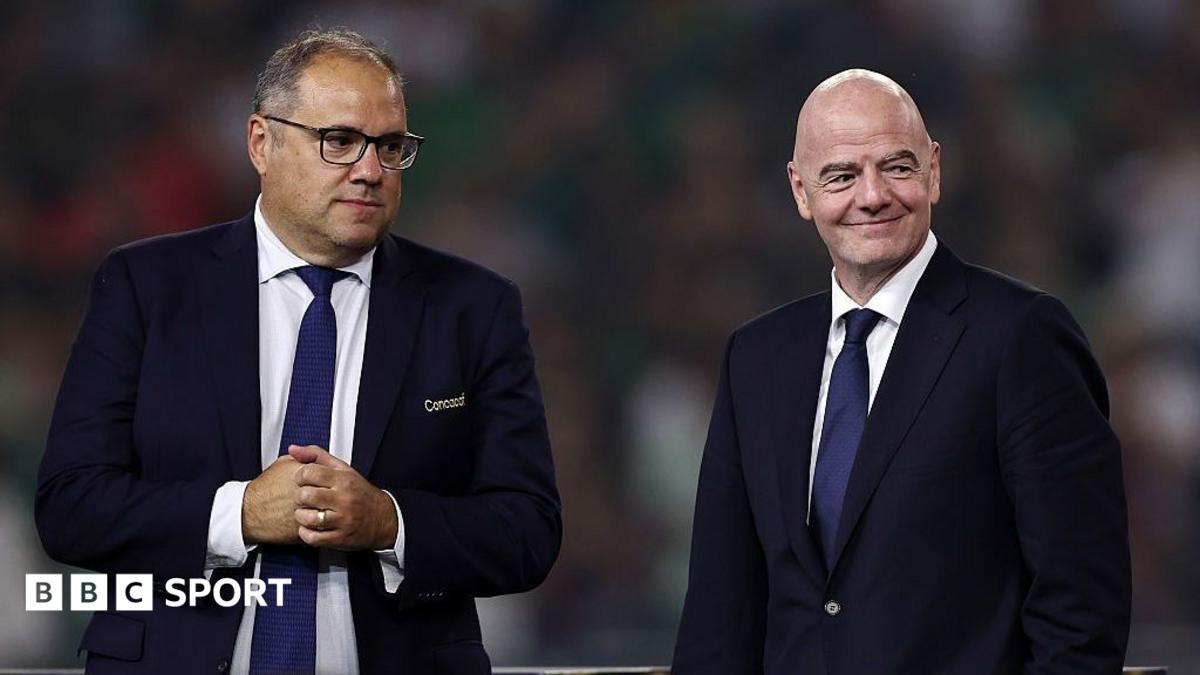
Gianni Infantino’s chances of being re-elected as Fifa president appear to have been given a major boost with potential rival Victor Montagliani set to remain as head of Concacaf.
The Canadian, 61, was widely seen as a possible candidate after Infantino’s failed plan to sell stakes in the World Cup to private investors sparked a global backlash.
However, Montagliani never confirmed he wanted to challenge Infantino, and according to sources, he has now told colleagues that he will instead seek a final term as head of the confederation which governs North and Central America and the Caribbean.
As first reported by the Guardian, it means he will not stand against Infantino, 56, who is seeking a fourth term in March’s presidential election.
The rebellion against him, spearheaded by European governing body Uefa, must now try to identify a unifying candidate by the deadline of 18 November.
Meanwhile, Aleksander Ceferin will stand for a fourth term as Uefa president.
Ceferin informed delegates of his decision at a meeting of all 55 national association chiefs in Berlin.
Uefa also reaffirmed its opposition to Infantino as it published a 14-point plan to reform world football’s governing body.
At that point Ceferin, who was initially elected in 2016, was embroiled in a row over Uefa changing its statutes to allow him to serve for a fourth term.
However, there had been a growing expectation the 58-year-old would stand.
This has only been made more likely since Uefa launched its efforts to oust Infantino, who scrapped his sell-off plan following widespread opposition.
“I want to thank the national associations for their trust,” Ceferin said.
“We have faced extraordinary challenges over the past years, and we have faced them as one team. There is still important work ahead, and I have therefore accepted their request.
“My ambition remains the same: to keep European football united, make our game stronger and leave Uefa ready for the next generation.”
Ceferin has ruled out standing against Infantino himself but is committed to finding a candidate around which the game can unite in March’s FIfa election.
Thousands of Argentina fans poured into Buenos Aires’ Monumental stadium ahead of Lionel Messi’s final international match. The World Cup-winning captain and Argentina’s all-time leading scorer is ending a 21-year international career, saying it’s time for a new generation.
EXCLUSIVE: The star opens up in new book A Magical Life, saying: ‘Even though I was losing him, I just kept telling myself – I still do – how lucky I was.’
23:00, 03 Oct 2026Updated 01:23, 04 Oct 2026
Paul Daniels and Debbie McGee in 2015, a year before he died(Image: Ken McKay/ITV/REX/Shutterstock)
Debbie McGee had been in bed for barely half an hour when the nurse woke her to say her wonderful, magical husband was nearing the end. After almost four decades together, there was nowhere else Debbie wanted to be than with Paul Daniels.
She says: “I got up and went to him, laying alongside him on the hospital bed, just cuddling him. Paul always used to tell people that I was the best thing that happened to him. I wanted him to know that he was the best thing that ever happened to me.”
Ten years after Paul’s death at 77, Debbie, 67, has laid bare the agony and the profound tenderness of his final weeks in her new autobiography, titled A Magical Life.
She says: “Even though I was losing him, I just kept telling myself – I still do – how lucky I was.”
To see more of the stories you love from The Mirror and to find them easily in Google then make us your preferred source. Free and easy-to-do, just click on the link here to find more from The Mirror at the top of your feed.
The pair had met during a summer season in Great Yarmouth in 1979, the year The Paul Daniels Magic Show began its 15-year run on BBC1.
They married in 1988 and, although they had no children together, she became stepmother to his three sons, Paul Jr, Martin and Gary.
Their professional partnership continued long after his television heyday, with the couple still touring together in 2015. By the autumn, however, Debbie had begun to notice Paul seemed unusually tired, not least when he struggled to learn his lines for a pantomime.
Soon he began missing parties, leaving her to go alone, and when she returned he was often in bed. Even wrapping the Christmas presents, something they usually enjoyed together, no longer interested him.
Debbie writes: “Paul would usually have six projects on the go at any one time. He would get up in the morning and be straight on his laptop. He couldn’t sit still.
“But now he didn’t seem interested in anything. He would just sit in front of the TV until he fell asleep.
“When he was up and about, his balance seemed to have gone. He kept falling over.” Blood tests led to a suspicion of pernicious anaemia and a course of injections was prescribed.
But Paul continued to weaken, and Debbie rang the surgery desperate for answers. She told the doctor: “I can’t describe what’s happening but this isn’t my husband.”
Eventually, Paul was referred to a neurologist. However on the morning of the appointment he was sick after breakfast, and so Debbie called an ambulance. A CT scan later revealed a glioblastoma that had spread across much of the left side of his brain and was extending towards the right.
The consultant asked Paul: “Do you want me to tell you what’s wrong?” He replied: “No. Tell Deb.” Paul waited in the hospital corridor while Debbie stayed to hear the results, expecting an explanation of how doctors would treat him.
But though radiotherapy was discussed, the consultant could not promise it would improve his condition. Paul’s severe claustrophobia also made the prospect of wearing a treatment mask daunting.
Debbie says: “In desperation, I asked, ‘Is there any treatment he could have in America?
“‘If this was your spouse, what would you be doing?’” The consultant promised to discuss the case with oncologists, but told Debbie quite frankly: “In all honesty, if this were my spouse, I would be taking them home and making them as comfortable as possible.”
In the end Debbie was told Paul might have two months, and went home to prepare for his return.
When she came back to the hospital, she found him in his Crombie coat and favourite trilby, dancing with a nurse. Debbie recalls: “In that moment it was hard to believe there was anything wrong with him at all.
“He seemed like himself again. The man I loved. My Paul.”
After they announced his diagnosis publicly, around 800 emails and letters arrived in a single day. His sons and grandchildren visited.
With Paul prone to falling because of the tumour, Debbie’s sister Donna also moved in to help watch over him, finally allowing Debbie to get some much-needed sleep. Debbie says: “Paul didn’t ever want to know what was wrong with him.
“I think he knew that he was dying but he couldn’t discuss it. I didn’t try to press him. There was no benefit to distressing him.”
Days were spent watching Only Fools and Horses and taking short walks when the weather allowed. Paul had a Magnum ice cream every afternoon. Debbie remembers: “It was a very loving, peaceful month. I couldn’t deny what was happening, but I really forced myself to stay in the moment and not look forward and not look back.
“I would wake up, put my make-up on and smile, although it was sort of fake. Each new day I told myself, he’s still alive today so we’ll make the best of it.”
One film they watched together during those weeks has become impossible for her to watch again.
She explains: “I only cried in front of Paul once and I only saw him cry once in front of me. It was when we were watching one of the films in the Best Exotic Marigold Hotel series.
“At the end of it, there’s a wedding. The young couple at the centre of the film get married. I turned to Paul to see that he had tears streaming down his face.
“I can’t watch that movie any more.” As his condition deteriorated, nurses began sitting with Paul overnight. On March 14, Debbie’s mother visited for her birthday and went to say goodbye.
“Paul couldn’t speak very well by then but he sang ‘Happy Birthday’ to Mum in a whisper,” Debbie says.
That was the last day Debbie remembers her husband being conscious. Afterwards, she just sat with him and talked, though she found it difficult to say much without crying.
Debbie adds: “Paul and I had a fairy tale life. Through the good times and the bad, we had faced every challenge together. We really were a team.
“I hope he knew that I was with him, loving him until the very end.”
A Magical Life by Debbie McGee is out on October 8 (Mirror Books).
World number two Luke Humphries secured his place in the World Grand Prix final with a 5-3 victory over James Wade.
Humphries averaged 96.92 and threw 10 180s as he reached the final for the fourth successive time.
The 31-year-old Englishman will face Welshman Gerwyn Price on Sunday evening in Leicester after he beat Nathan Aspinall in the other semi-final.
“I’ve got to do it again because there’s so many major finals I’ve let slip. Gezzy [Price] is playing well but if I play like that again, it’s going to be a cracking game and I hope it is,” Humphries told Sky Sports.
“To make four Grand Prix finals on the trot is super special. It’s history for myself and I’m proud of that but unless I pick that trophy up, unfortunately that history doesn’t mean anything.”
Humphries, who won this title in 2023 but has lost in the past two finals, took the opening set of the semi-final but Wade produced a brilliant 141 checkout en route to drawing level.
The pair exchanged the next two sets before Humphries took control of the contest to move 4-2 ahead.
Wade refused to go quietly and pulled one back to keep the match alive but Humphries held his nerve in the eighth set to seal victory on double top.
In the other semi-final, Price beat a spirited Aspinall 5-2.
The Welshman took a three-set lead as Aspinall struggled to reproduce the form that had seen him average 105.15 in his quarter-final win over Ryan Joyce.
Aspinall briefly rallied and produced a superb 132 checkout – the highest of the match – to get a set on the board.
The 35-year-old then threatened to turn the match around when he reduced the deficit to one set at 3-2.
However, Price regained his composure and closed out the next two sets without reply to secure his place in the final.
Price said he was “frustrated” by Aspinall’s antics during the match as he interacted with a partisan crowd at the Mattioli Arena.
“I’m glad to come through the game. Nathan was complaining about the crowd, but they were on his side,” Price said.
“He’s performing a little bit on stage. I’m great friends with Nathan, but take it on the chin sometimes when you’re losing.”