The brilliant Korean filmmaker Lee Chang-dong is a suffering protagonist’s best friend, exploring the buried pain in people like no other filmmaker. But he’s never been so delicately novelistic, and so accessibly human, as with his latest movie, “Possible Love,” even when Lee is spinning the enigmatic vibes he’s known for.
A marriage story weighty enough to bear two fascinatingly complex couples, it explores a web of isolation and desire knotted with the divisions and woes of society today: class, labor, media. The film fairly vibrates with ominous tension even in scenes in which seemingly nothing happens. (Which, admittedly, is a Lee staple if you remember his last film, 2018’s eerie psychological thriller “Burning.”) Astonishingly acted, intricately written, with nary a shot out of place and never insulting to its audience, “Possible Love” is a masterpiece of everyday struggle — essentially, who bears it and who doesn’t — and easily among the year’s best films.
At the funeral for a colleague who committed suicide in the wake of a disastrous labor strike, out-of-work Ho-seok (Sul Kyung-gu, of Lee’s “Peppermint Candy”) would rather brood in the car alone and let his patient, grasping-for-connection wife Mi-ok (Jeon Do-yeon, a Cannes prize-winner for her turn in Lee’s “Secret Sunshine”) be around others. With these blue collar parents’ grade-school-age son a tangibly quiet presence, a seemingly impassable unhappiness oozes from the opening scenes. The appearance inside the funeral home, however, of a documentary crew interviewing laid-off workers spurs Mi-ok to engage with the outgoing director, Ye-ji (Cho Yeo-jeong), whose reserved, well-to-do husband Sang-woo (Zo In-sung) is in tow. When Mi-ok agrees to participate in Ye-ji’s film, a friendship forms.
Is it friendship, though, or a mutually useful rapport? The women couldn’t be more unalike in terms of background and status. Mi-ok has to tell Ye-ji that her expensive clothes don’t jibe with someone championing labor issues. But they have a breezy, even jokey openness, fed by the stories Mi-ok tells on camera as well as soju-fueled double dates with their spouses. They also have in common husbands who are remote, albeit for vastly different reasons. Hedge-fund-rich Sang-woo has an air of cool privilege, while the gloomy, taciturn Ho-seok harbors unprocessed trauma about what happened during the strike, the details of which are judiciously doled out to us in flashbacks. (Lee drew the background for his scenario from a real-life labor protest met by a government crackdown that shocked the country.)
But underneath what seems promising, the beginnings of empathy and maybe healing, there’s something performative and calculated in this fast bond. There are Ye-ji’s filmic needs — “I’m trying to love these people,” she says privately to Sang-woo after he calls her behavior with them “Method acting” — and Mi-ok’s swirl of intentions, hoping to save her husband with not ignoring the allure of her new pal’s quietly confident and wealthy man. Right at the moment when more cracks materialize, Ye-ji invites this broken family for a shared weekend at Sang-woo’s vacation mansion.
You may be forgiven for anticipating a potboiler climax when a lush hideaway with a private beach is concerned, and what occurs there is indeed juicy. But that’s only because Lee, in his finest screenplay to date, has laid out precisely where his vectors of hardship, exploitation, pent-up anguish and hidden desire are going to converge. Just add more alcohol and more reminders of these couples’ experiential chasm, and Lee’s command of irony in a simmering atmosphere is in a league all its own.
The documentary angle, of course, is this great director probing the ethics in his own vocation as an intrusive force, one that shapes lives, emotions and, in this case, the weight of a genuine tragedy. In much the way he finessed a truth about art facing evil in “Poetry,” the camera here is both predatory and a tool for catharsis. In one scene, the confluence is literally breathtaking.
Best-of lists were made for performances like Jeon’s. With tear-swollen eyes and an anxious intelligence that imbues Mi-ok’s mission of repair with heartbreaking energy, she is this movie’s restless soul of want: a wife, lover, worker and mother trapped between the balm of recollecting better times and worry for the future. Alongside Sul’s deftly handled, physical characterization of a proud man swallowed by hurt he could never imagine, “Possible Love” stands as one of the more sensitively wrought depictions of a wounded marriage you’ll ever see.
And when it’s over, it somehow doesn’t feel over. Maybe no scene better embodies Lee’s exquisite communion with his characters than his last one, which supplies them with a hint of grace. “Possible Love” hovers over the moment’s sublimity like the moonlight and I haven’t stopped thinking about its elemental beauty since.
‘Possible Love’
In Korean with subtitles
Rated: R, for language, some sexuality and nudity
Running time: 2 hours, 44 minutes
Playing: Opens Friday, Oct. 23, in limited release; on Netflix Nov. 6
The Prince of Wales made a surprise appearance on the Graham Norton Show tonight and opened up about the hilarious moment he was mistaken for singer Prince
Prince WIlliam was a special guest on The Graham Norton Show(Image: Prince and Princess of Wales/Instagram)
Prince WIlliam has recounted the time he was once mistaken for the singer Prince at a UK event.
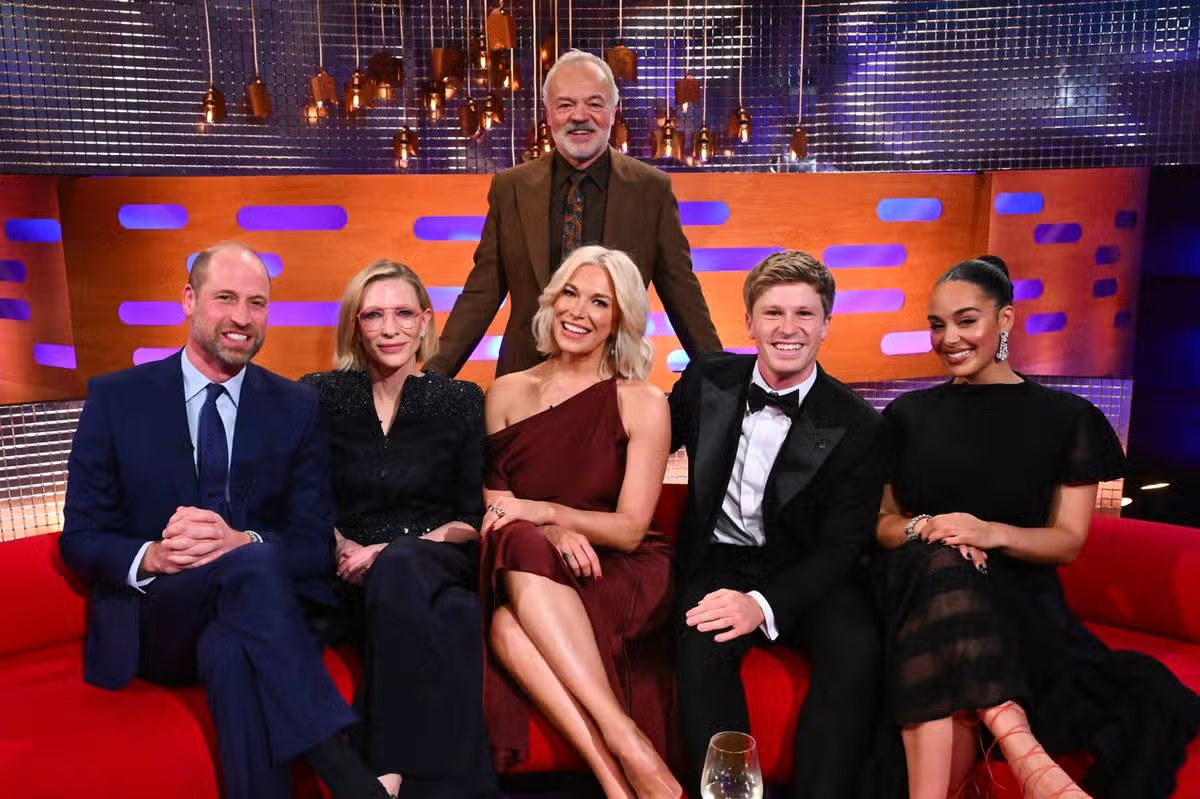
Tonight The Prince of Wales made a surprise appearance on the Graham Norton Show as part of a special edition to mark the Earthshot Prize. During the episode he sat on the sofa with Cate Blanchett, Robert Irwin and Hannah Waddingham, all of whom are involved with the prize.
The prince was a surprise for the audience, as Norton first spoke with Cate, Robert and Hannah. He then suddenly mentioned involving the prince in the chat, with William then making his surprise appearance. Before William emphasised the urgent need to tackle climate change he opened up about an encounter with a member of the public which had the audience howling with laughter.
Graham said: “Recently you were at an event and someone didn’t know who you were?” To which WIlliam responded: “Yes, that happens quite regularly actually. I went to a place in Somerset and was looking around some of the local communities there and one lovely gentleman looked up at me from his seat and said ‘when are you going to sing?’ and I looked at him, I’ve had many requests over many years for all ranging parts of society and I said ‘I’m sorry what do you mean?’ he goes ‘when are you going to sing your performance?’
“And a lady behind tapped his arm and went “no, no he’s not that prince.” it turned out he wanted me to sing purple rain – which I don’t know the lyrics for.”
It comes as next month, Mumbai will stage the Earthshot Prize where the future king will meet Bollywood stars as he learns about India’s hugely popular film industry, play with cricketing royalty and preside over the ceremony awarding £5million in prize money to those with ideas to repair the planet.
Prince William went on to speak about the origins of the Earthshot Prize, and its role in identifying and supporting innovators around the world. He said: “For many years I was hearing stories about environment issues and one thing that struck me was the negativity and doom which got me down.
“I thought we could do something more powerful and more optimistic and the idea of an awards’ ceremony came about and we could talk about urgency and optimism together. It’s all about getting excited.”
Blanchett, an Earthshot Prize council member, described the Prize as a “tapestry of solutions”, while Irwin, a global ambassador for the prize, spoke about the role the prize has played in building a new generation of environmental advocates.
To see more of the stories you love from The Mirror and to find them easily in Google, then make us your preferred source. Free and easy to do, just click on the link here to find more from The Mirror at the top of your feed.
William’s Earthshot Prize project is halfway through its decades-long cycle to recognise and reward issues and ideas to help save the planet and the event has already been staged in London, Singapore, Cape Town, Boston and Rio de Janeiro.
Since its launch in 2021, he has managed to attract a host of stars to his cause, from Hollywood names Leonardo DiCaprio, Matthew McConaughey and Cate Blanchett to broadcaster and naturalist Sir David Attenborough and former prime minister of New Zealand Jacinda Ardern.
The initiative was inspired by former US president John F Kennedy’s Moonshot project which set scientists the challenge of placing an astronaut on the moon and returning him safely – and in the process helped advance mankind’s achievements.
CAMILA Cabello accidentally poured water over her dancer before throwing the bottle in her FACE live on stage during a performance.
The awkward moment happened as the Havana songstress, 29, was doing her thing while singing her 2024 tune June Gloom.
Camila Cabello accidentally poured water over her dancer before dropping it in her FACE live on stageCredit: TiktokThe singer was showing off her best moves on stage when she made the blunderCredit: Tiktok
Camila looked incredible as she performed the song, which is from her fourth studio album, C,XOXO, while sitting on a rotating carousel.
The star wowed in an all-white outfit and matching knee high boots.
Sign up for the Showbiz newsletter
Thank you!
Half way through she started to pour water over herself.
While she showed off her sexy dance moves, one of her dancers was on the floor pushing the carousel around with her arms.
The dancer carried on like a true professional as if nothing had happenedCredit: TiktokCamila pictured at the Lucas Museum of Narrative Art Opening Night in LA last monthCredit: Alamy
After Camila had finished with all the water in her bottle, she accidentally threw it into her dancer’s face.
But like a true professional, the dancer carried on as if nothing had happened.
Shortly after the tune ended, the pair pointed at each other and smiled as the dancer walked off stage.
The fan captioned the post: “The poor dancer taking a bottle accidentally from Camila lol.”
The superstar has had a pretty successful career since shooting to fame as part of Fifth Harmony on The X FactorUSA in 2012.
The girl group, which consisted of Ally Brooke, Dinah Jane, Lauren Jaurengui and Normani, ended up placing third on the second series of the singing competition.
Fifth Harmony released songs such as Worth It, Work from Home and That’s My Girl, and have won various awards.
The band were together until 2018 and reunited last year.
But Camila decided to go solo and left the group in 2016.
Her most popular songs include Havana, Senorita, Band Things, Never Ben The Same and My Oh My.
She dated singer Shawn Mendes between 2019 and 2021, and for a few months in 2023.
Actor Julie Hesmondhalgh was a Celebrity Traitors superfan and made some surprising friendships before being the third person out of the show this year
Julie Hesmondhalgh was obsessed with Traitors and made new friends on the series.(Image: Jonty Davies/Good Housekeeping UK/Press Association)
Actor Julie Hesmondhalgh has described her time on Celebrity Traitors as “extraordinary” and revealed a quirk of the show means people become friends faster than usual.
The former star of Coronation Street, 56, admitted she was “obsessed” with the show before signing up to star in the 2026 version.
She says she has made some friends for life and explained to Good Housekeeping UK: “The extraordinary thing is that you’re all on the same footing. There’s no status at all. You have these accelerated friendships because there’s a lot of time off-camera when you’re travelling in cars together and aren’t allowed to discuss the game. People tell you about their lives; I found out so much about people and I was really touched that they trusted me.”
Asked who she became closest to, she added: “Romesh [Ranganathan] is one of the greatest human beings. We were in there right at the start, alongside Ross Kemp. The three of us were a very unlikely little threesome. I adored Ross, too.”
Julie was banished as a Faithful from BBC show early on after being voted out in a round table. She was the third celebrity to leave.
The acclaimed actress is best known for starring as Hayley Cropper in Corrie between 1998 and 2014.
She said: “The short storyline was supposed to be Roy Cropper [David Neilson] falling for Hayley, then running for the hills when she comes out as trans. But everybody loved the relationship. It became a key storyline almost by accident, which was the best way, because it wasn’t an issue that was shoehorned in.”
On her exit, she added: “There’s a photo of me on the floor, foetal. I was like, ‘What have I done?’ I have no regrets about leaving, but when I watch the credits and see that so many of the cast and crew names are the same, it feels a bit strange.
“Had I stayed, it would have become embarrassing. Anachronistic. But I maintain that Hayley and Roy’s love story was important. It got people talking. It’s so upsetting that trans rights have now gone backwards.”
In real life she is married to writer Ian Kershaw and they have two grown up daughters Martha and Lyss.
Julie reflected: “I found a lot of motherhood a struggle. Balancing my own life and work with motherhood was tricky at times. I have a lot of regrets about losing my rag with my kids. I took things too personally; I felt like they were almost trying to make my life difficult, which obviously they weren’t. They were just children.”
Asked by the magazine who she’d invite to a fantasy Christmas lunch, she said: “Patti Smith, because I adore her. Rebecca Lucy Taylor [who performs as Self Esteem]. James Baldwin. Naomi Klein – I loved Doppelgänger and realised she’s funny as well as formidable. Tony Benn. Oh, and AOC [American politician Alexandria Ocasio-Cortez]. Who else? Emma Thompson – I’ve never met her, but I think she’s a good person.”
* The full interview can be read now in the December issue of Good Housekeeping UK.
Big Brother fans have been unimpressed with one star who just days ago was favourite to win
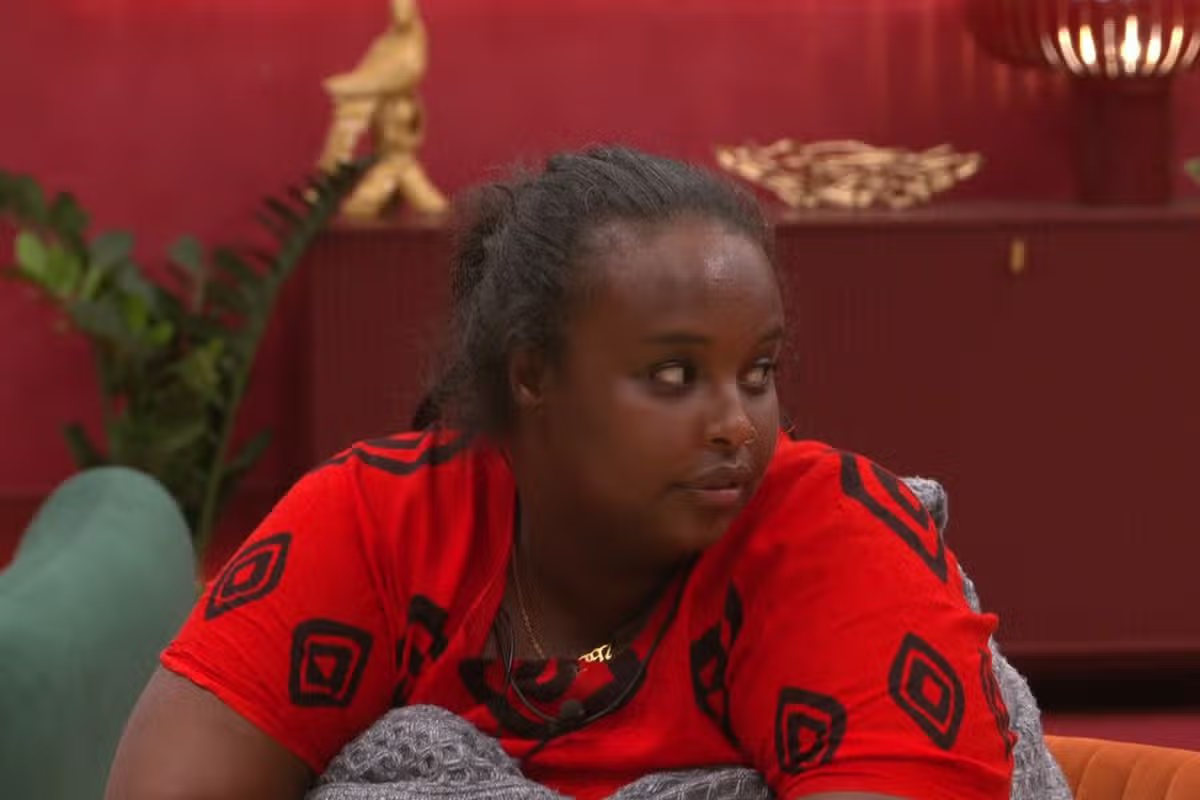
According to latest betting odds, Yasmin is no longer favourite to win (Image: ITV)
The Big Brother star was in the running to win the show.
ITV Big Brother fans have admitted that one star has “fumbled” their potential win in a matter of minutes. Tensions continue to run high in the iconic house as the housemates live in this week’s House of Time.
Just last night (October 20), a game changing nominations twist saw four housemates up for eviction. This week will see Catrin, Twinks, Harry and Sam facing the public vote as viewers are being asked to choose who they wish to evict.
It comes after the housemates each took a turn in the Time Zone where they nominated as usual. But with four names in the zone, each housemate afterwards had the opportunity to swap two of those names – with the last person ultimately having the final say.
But amongst the drama, it was Yasmin who came under fire with fans after her nomination choices. As a result, she is now no longer favourite to win, according to latest betting odds.
According to Coral’s John Hill, despite being up for eviction, Twinks is actually the new favourite to win, with odds sitting at 5/4. Yasmin has drifted from 4/5 odds to now 7/4.
John Hill said: “Twinks is the safest of the four housemates, according to our odds. She is also the new favourite to win the show, with Yasmin’s odds drifting over the last couple of days.”
Ensure our latest TV stories always appear at the top of your Google Search by making us a Preferred Source. Click here to activate or add us as Preferred Source in your Google search settings.
Viewers have shared their disappointment with the star as one person wrote on X: “Yasmin is fumbling this win those cheers got to her head.” Another said: “Yasmin literally took away the win in one episode last night”, as a third fumed that the star had gone “from the people’s princess”, adding: “That is crazy.”
A fourth added: “Even since Yasmin heard the cheers on Friday night she now thinks she is untouchable. Get rid of her.” A fifth raged: “Yasmin really plummeted her own stock, how embarrassing.”
However, one person defended: “Yasmin has one bad episode and people are acting like she murdered someone oh ok.”
Another said: “Yasmin does one thing you deem as wrong and you all turn on her and insult everything about her.”
Of course, betting odds are not guaranteed to happen, the power is still in the public’s hand as they have the power of the vote. But with hours to go until the next live eviction on Friday, one star has been dealt a brutal blow.
Currently, Sam is favourite to go with odds sitting at 4/5 compared to Frankie’s odds at 3/1. Twinks’ odds sit at 8/1. Coral’s John Hill added: “This is the toughest eviction to call so far in the series. Sam is the favourite to go, but Frankie and Catrin are both in danger, especially if Big Brother decides to throw in a double eviction.”
Big Brother continues tonight at 9pm on ITV2 and ITVX
96-year-old Emma Finch was found dead in her own home, but detectives suspected a sinister reality
Murder Scene The Incident Room returns to Channel 5
A killer who faced police after a chilling crime remained silent, as chilling footage has been revealed in a Channel 5 true crime documentary.
Taking viewers beyond a crime scene, the Channel 5 series once again plunged people into the heart of another brutal criminal investigation as detectives investigate high-profile murder and criminal cases across the UK.
Back for a new series on Channel 5, Murder Scene: The Incident Room aired a chilling episode tonight (October 14) titled A Killer in the Family. Tonight’s heartbreaking instalment transported viewers to a devastating 2024 fire in Hampshire when firefighters made a heartbreaking discovery.
But when detectives arrived on the scene to piece together what happened, they were soon faced with a chilling reality. 96-year-old grandmother Emma Finch was found dead on her bedroom floor, with suspicions soon turning to her grandson Joshua Powell.
The episode heard from detectives involved and how they pieced together vital information, as the police interview with Joshua was also shown.
But with 96 hours to question him, and detectives working against the clock, Joshua decided to exercise his right to silence on multiple occasions.
The episode hears how the evidence against Joshua “kept getting stronger” before detectives had a sufficient amount to bring a charge of murder, with viewers also hearing heartbreaking accounts from family, including Emma’s son Peter.
What happened to Joshua Powell, and where is he now?
On May 16, 2025 – a day before the anniversary of Emma’s killing – Joshua pleaded guilty to the murder of his grandmother. The documentary heard: “He was left with no option but to plead guilty. By admitting his guilt and telling everyone how he killed Emma, he did at least avoid putting the family through a trial.”
Months later, on November 14, Joshua Powell was sentenced at Portsmouth Crown Court, where he was handed the sentence of life imprisonment with a minimum term of 26 years.
Aged 17 at the time, he would be 53 before even being considered for release. As of 2026, he would still be in prison for his crime.
At the time of the sentencing, Senior Investigating Officer, Detective Chief Inspector Howard Broadribb, said: “Joshua’s callous actions took advantage of Emma’s trust in him. His subsequent denials when faced with mounting evidence against him showed a total disregard for Emma and her family.
“His subsequent admission at court spared them from having to endure a trial, but that is little comfort when compared to the loss that they have suffered. I hope that this sentence gives all of Emma’s relatives the opportunity to grieve their loss in the knowledge that justice has been served.”
Murder Scene: The Incident Room airs Mondays at 8pm on Channel 5
UCLA senior starting quarterback Nico Iamaleava will miss the rest of this season with a knee injury, according to a person with knowledge of the injury not authorized to discuss it publicly.
The injury is a blow for the No. 12 Bruins, who are 5-0 during coach Bob Chesney’s first season and have a favorable path to a spot in the College Football Playoff.
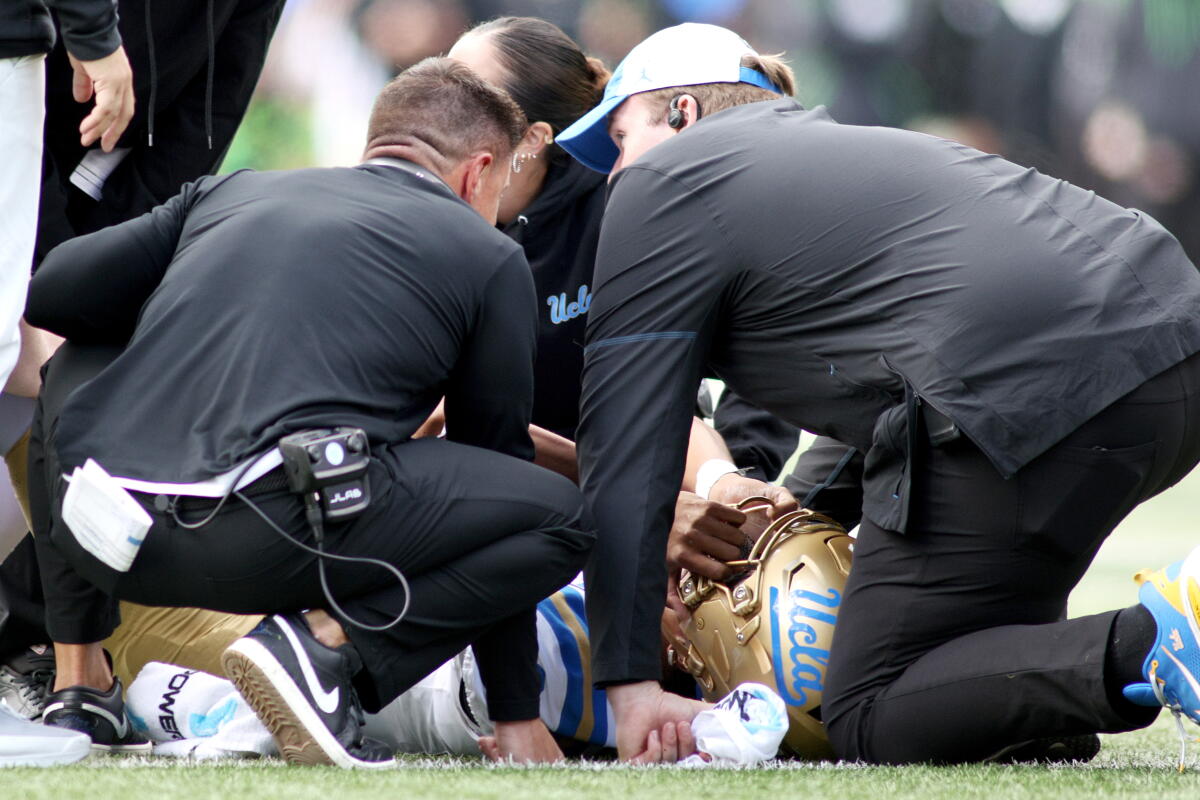
The quarterback was running with the ball when he was spun around and was tackled. He grabbed his leg as he was hit in the head by Oregon’s Bear Alexander. Iamaleava briefly returned for one play and Chesney said during a halftime TV interview the quarterback was fine after getting hit in the quad.
Iamaleava, however, did not return with the team after halftime and eventually emerged from the locker room in the third quarter wearing street clothes.
UCLA quarterback Nico Iamaleava is examined by medical staff while coach Bob Chesney watches Saturday in Eugene, Ore.
(Lydia Ely / Associated Press)
Before his exit, Iamaleava went 10 of 17 passing for 162 yards and two interceptions. Through five games, the quarterback tallied 982 passing yards, 144 rushing yards, five total touchdowns and four interceptions.
After Saturday’s win, Chesney said that he thought Iamaleava injured his thigh, but he noted the injury may have been more extensive and it would require a full medical evaluation.
Senior quarterback Ty Dieffenbach, who had been listed third on the depth chart behind Iamaleava and his younger brother Madden, ran the UCLA offense during the second half. He completed three passes for 43 yards and one touchdown, helping the Bruins earn a 17-15 win.
“When someone goes down, and someone’s gotta step up, you’re either exposed or you’re revealed,” Chesney said. “One of the two is going to happen when your number gets called, and for Ty to step up in that moment when Nico couldn’t go and to put himself in the spot where he was revealed for knowing the run game, knowing what to get us into, the touchdown pass I thought he threw.”
Madden Iamaleava appeared in two games this season, taking over the offense against Purdue when his older brother went down with a shoulder injury and against Maryland with UCLA up multiple scores.
Chesney turned to Dieffenbach, who started last season at Cal Poly, during one of the biggest moments of the season. Dieffenbach said after the win he didn’t know he would be asked to lead the offense if Nico Iamaleava was knocked out.
UCLA quarterback Ty Dieffenbach prepares to receive the ball during a win over Oregon Saturday in Eugene, Ore.
(Lydia Ely / Associated Press)
The decision to play Dieffenbach instead of Madden was based on the game script and the threat of Dieffenbach in the ground game, Chesney said.
“We are really on a week-to-week basis here, and this week we felt like we had to run a little bit more with the quarterback possibly, and that’s where I felt Ty had a really nice week and that put us in that spot,” Chesney said. “This is just one of those things that I’m sure if Madden would’ve went in there, he would have done a phenomenal job as well. But I thought Ty was the guy we decided on at this moment based on the previous week of practice.”
Chesney and Dieffebach acknowledged that the fight for the UCLA backup spot never ends.
“Every week is a battle between me and Madden for the two-spot, and I mean both of us were executing in practice,” Dieffenbach said. “… When I heard that I was [going to play, it was] just tunnel vision, just ready to go execute.”
Prior to helping earn UCLA’s first victory at Autzen Stadium since 2004, Dieffenbach spent the 2025 campaign at Cal Poly, where he started 11 games, throwing for 1,305 yards, nine touchdowns and nine interceptions, alongside 321 ground yards and four scores.
Dieffenbach’s one-year stint in San Luis Obispo was preceded by two years at Pittsburgh, where he did not see any game action. The signal caller’s transfer to UCLA marked a return to Southern California for the Agoura High product, who started his high school career as a wide receiver but finished his three varsity seasons with 4,153 passing yards and 48 touchdowns.
San Francisco 49ers receiver Mike Evans may have earned a spot in the trash-talking hall of fame on Sunday without even trying.
Or so he says.
Late in the second quarter of the 49ers’ 32-29 victory in Seattle, Fox Sports cameras showed Evans and Seahawks cornerback Trevon Diggs jawing after a play. In one of the season’s most meme-able moments so far, Evans put his hands on Diggs’ shoulder pads and turned the two-time Pro Bowl selection around to look at his name, as if to say, “Who are you?”
Diggs, a seven-year veteran who led the league with 11 interceptions in 2021 as a member of the Dallas Cowboys, appeared to be offended and shoved Evans in the facemask.
Retired cornerback and renowned trash-talker Richard Sherman, who played for both the Seahawks and 49ers during his 11-year career, gave Evans some high praise on X.
“Mike Evans Checking to see the name on the back of the Jersey is an all-time Gif and trash talk moment that I wish I would have thought of,” Sherman wrote.
Evans’ move was very similar to one from a 2019 viral clip in which Toronto Maple Leafs star Auston Matthews checked the back of then-career minor leaguer Scott Sabourin of the Ottawa Senators during a preseason game. (Sabourin would go on to play in 74 NHL games for four teams over seven seasons.)
But Evans, a five-time Pro Bowler in his first season with San Francisco after 12 years with the Tampa Bay Buccaneers, told reporters after the game that he was just trying to figure out his vocal opponent‘s identity.
“I was blocking him until the whistle, and then he said something, like I’m doing extra, something like that,” said Evans, who finished with seven catches for 113 yards and one touchdown. “I didn’t know that was him at first, because I played against him a few times and we always been cool, you know? He was a good player. I honestly didn’t know it was him, because in the helmet, it’s hard to tell sometimes.
“And we were just talking trash, and I think I like pushed him and then I was like, ‘Who are you?’ And I looked to make sure. ‘Oh, it’s f— Diggs.’”
Hmmmm, Diggs was a good player? Maybe Evans is a trash-talking master after all.
CCTV footage released by Al Arabiya shows the moment of a Houthi strike on Riyadh’s international airport on Saturday. The attack killed at least 12 people and injured more than 300. A warning this video contains distressing images.
And though it was just a preseason game Thursday night, Doncic and Reaves showed why they form one of the most dynamic offensive backcourts in the NBA.
The Lakers duo linked up on the very first play against the Sacramento Kings, with Reaves passing to Doncic as he cut to the basket before scoring while being fouled.
Both played 25 minutes, with Doncic finishing with 23 points on six-for-16 shooting during the Lakers’ 114-110 win over the Kings at Crypto.com Arena. Reaves had eight points on two-for-seven shooting, eight assists and five rebounds.
Doncic, who picked up a technical foul with six minutes and 48 seconds left in the third quarter, and Reaves, who played in his first exhibition game after missing the first two, gave the fans something to be excited about.
Doncic’s moment came in the second quarter when he drilled a 31-foot, one-legged three-pointer off a pass from Sandro Mamukelashvili (19 points).
Reaves’ moment came late in the second quarter when he had a nice hesitation move that froze Emanuel Sharp, allowing him to waltz along the baseline for a layup.
Lakers coach JJ Redick explained why Doncic and Reaves have been so close in their time playing together.
“I think there’s good chemistry with each other,” Redick said. “I think it’s just the natural way they like each other. They like playing together. I think having them together means there’s automatically two ballhandlers on the court. I think that’s like an underrated part of the NBA now … having two-to-three ballhandlers on the floor at all times.”
Injury update
Walker Kessler and Collin Sexton both missed their third straight preseason game and Ziaire Williams missed his second straight game. Cameron Carr, Dalton Knecht and Arthur Kaluma also didn’t play.
Kessler, the Lakers’ big acquisition at center from the Utah Jazz, has been nursing a finger injury he sustained after hitting the backboard during practice.
“We’ve got to check in tomorrow. … It’s not concerning. He’ll play in the preseason,” Redick said.
Redick said Williams had “some soreness, but it’s not anything that we’re concerned about.”
Flight BA295 had reached a cruising altitude of 37,000ft on its way from London to Chicago before the mid-air emergency
The oxygen masks deployed on the British Airways flight from London Heathrow to Chicago on October 5, 2026(Image: SWNS)
A passenger aboard a London to Chicago British Airways flight says the cabin was “silent” as they dropped 27,000ft in minutes. A “technical issue” caused the aircraft to drop and declare an emergency, and return to London on October 5.
Scott Tanner, 39, was a passenger on the plane when it began descending “noticeably” and they were told to put on oxygen masks. Flight BA295 had reached a cruising altitude of 37,000ft after taking off from Heathrow before the mid-air emergency.
Flight tracking data showed the aircraft dropped sharply down to 9,000ft. Scott said their was “silence” for 10 minutes before they were told they could remove their masks, and retuned to London after five hours in the air.
Scott, from Torbay, Devon, told Talk to the Press: “About an hour into the flight I was listening to an audiobook when, completely without warning, the oxygen masks suddenly dropped throughout the cabin.
“An automated announcement instructed everyone to put on their masks immediately. For around 10 minutes afterwards there was no further information from the flight deck.
“There was simply silence apart from the automated announcement repeating on a loop, which was probably the most disconcerting part. Despite this, everyone remained remarkably calm. I did not hear a single scream.
“We could feel the aircraft descending quite noticeably, although it felt controlled rather than like a plunge. The captain then told us that we were below 10,000 feet and could remove our masks.
“He later explained that we would be returning to Heathrow, but because the aircraft was carrying fuel for the transatlantic journey we would need to circle for several hours to burn it off. We eventually landed safely after about five hours in the air.”
Scott says British Airways provided passengers with hotel accommodation, but further arrangements were “frustrating”. He said: “I was initially rebooked via Charlotte despite direct flights being available, and I had to negotiate to have this changed.
“When I asked whether BA might offer some gesture in recognition of what had happened, I was repeatedly sent between different desks and eventually told that any compensation would have to be dealt with online.”
The plane left London Heathrow’s Terminal 5 at 11:50am, with an expected flight time of eight hours and 40 minutes before landing at Chicago O’Hare International Airport. The flight crew issued a squawk 7700 code – the international aviation signal for a general emergency – shortly after beginning the steep descent.
Passenger Tom Nicholls told the Mirror there was a “sudden bit of turbulence” during the emergency. Mr Nicholls explained: “The plane adjusted but it didn’t feel like it was descending rapidly. I’d say the pilots did a very good job.
“The oxygen masks popped out soon after and there was a bit of uncertainty onboard. The couple in front couldn’t get to theirs but by the time they’d found a spare seat with a mask, the captain announced we were below 10,000ft so they were not needed.”
A spokesperson from British Airways said: “The safety of our customers and crew is always our top priority, and the aircraft landed safely after our highly-trained pilots returned to Heathrow following a technical issue.
“Customers disembarked the aircraft normally and our teams are working to get their travel plans back on track as quickly as possible.”
An ‘epic moment’ has reportedly caught Celebrity Traitors bosses off guard and forced them to scrap huge plans they had for the series. The change will reportedly “make great TV”
Bosses have been forced to scrap a cliffhanger but what has replaces it “will make great TV”
The Celebrity Traitors bosses have been forced to scrap a cliffhanger but what has replaces it “will make great TV” according to sources.
The show sees twenty-one famous faces head to The Traitors castle, ready to play the ultimate game of deception and betrayal in the hope of winning a cash prize of up to £100,000 for a charity of their choice.
Fans quickly become invested in the show and to keep viewers hooked it has become known for it’s cliffhangers.
Tonight, viewers will tune in to watch the result of last Friday’s cliffhanger. The all-star line-up will be casting their votes on who to banish from Ardross Castle after the Withnail and I actor battled to convince them he was a faithful.
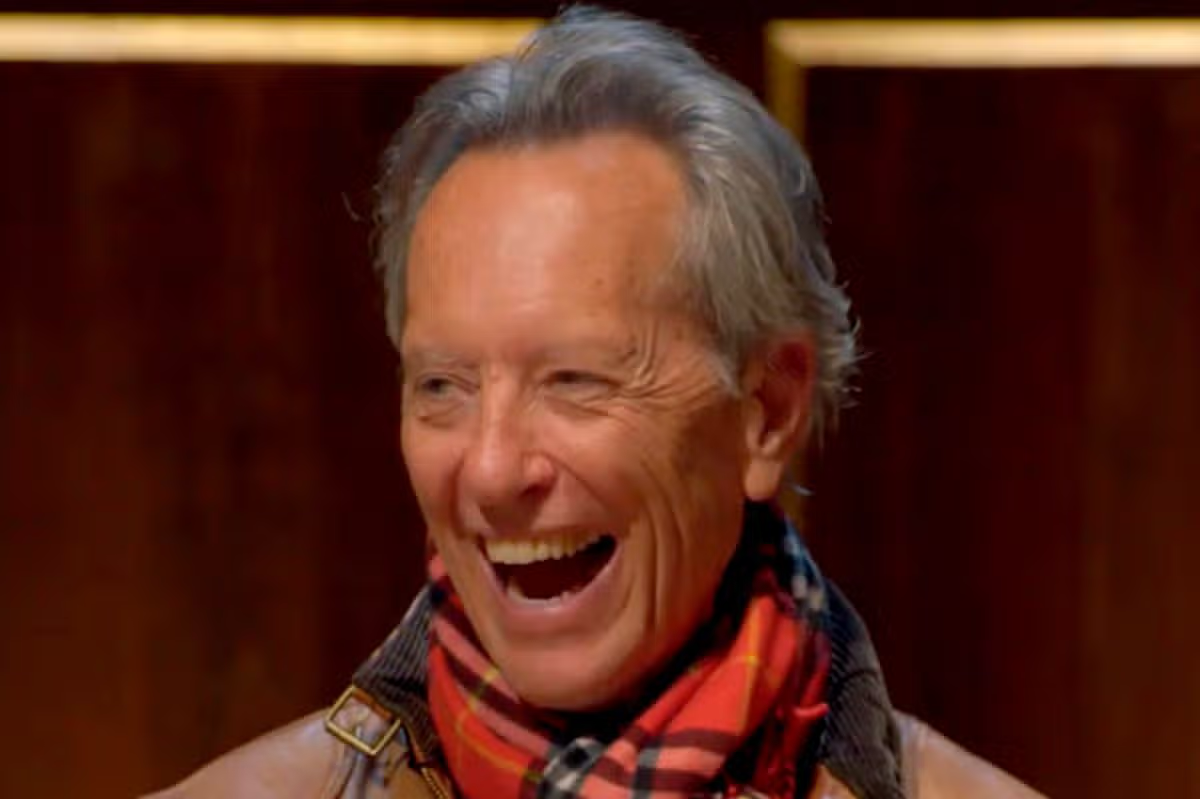
Actor Richard E. Grant was chosen by host Claudia Winkleman to be a Traitor alongside presenter Maya Jama. However, just minutes into the game, comedian Joe Lycett casually asked him what role he had been given, to which Grant immediately replied, “Traitor!”
He then spent the rest of the premiere manically back-pedaling to convince his fellow contestants that he was actually a Faithful who had simply made a bad joke.
A source told The Sun: “Cliffhangers on The Traitors have become legendary so bosses never want to disappoint and hope to have the nation on tenterhooks all week, waiting for Thursdays to come around – that’s part of the reason the format being fed out twice a week works.
“So they plot out likely moments in gameplay that will be the Friday cliffs. But during filming, something so unbelievable happened even execs didn’t see it coming.
“It forced them to throw plans out the window to accommodate the epic moment – which should make great TV.”
Production firm Studio Lambert decide what elements of the show would make good teasers during pre-production.
Speaking at the launch of the series, executive producer Sarah Fay said: “We always have an idea before going into pre-production what might be cliffhangers but we have to be so reactive because who knows what the story is going to be.
“Last year we went to deadlock [at the Round Table] when it was down to David [Olusoga] and Mark [Bonner] where it was a tie. We never knew that that was going to happen until obviously, it was happening right before our eyes.
“I think the beauty of this game as well is every episode we’ve probably got about three options of what the cliffhanger could be because it’s so nail-biting.”
The Mirror has contacted the BBC press office for comment.
The Celebrity Traitors returns tonight at 8pm on BBC One.
This story contains spoilers for Episode 8 of HBO Max’s “Lanterns.”
From the very first time Tom King and DC Studios’ James Gunn ever talked about a Green Lantern show, they envisioned John Stewart as the kind of hero who could generate excitement and change the tide of any battle upon his arrival.
“The idea was to build a character as compelling and impactful as, say, Thor in the Marvel universe,” says King, the “Lanterns” co-creator, during a recent video call. “Someone who arrives in a movie with a thunderclap, and … the audience [just] screams when they arrive because you’re in love with that character … not just [for] the power set they have, but the integrity of that character.”
That hero officially takes flight in Sunday’s “Lanterns” finale.
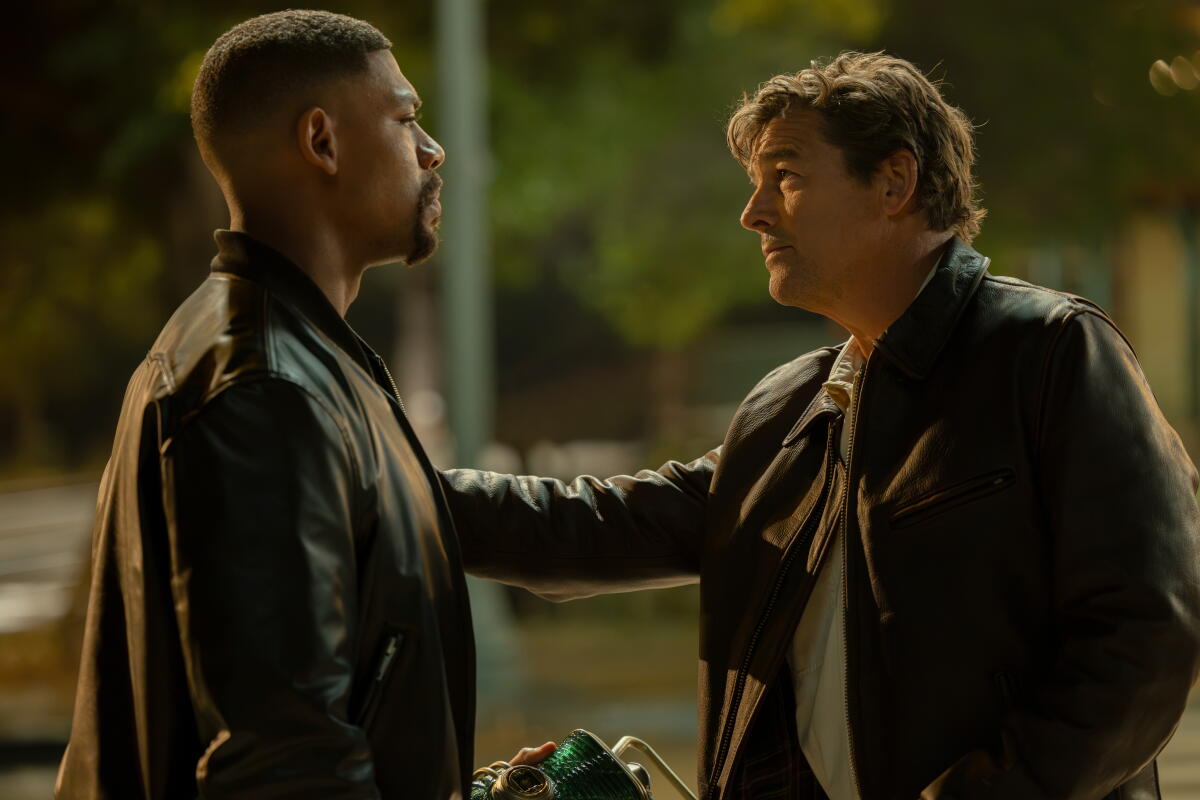
Episode 8 of the HBO Max superhero crime drama, titled “Dirt and Stars,” sees John Stewart (Aaron Pierre) take up the mantle as Earth’s newest Green Lantern. After solving the mystery of his predecessor Hal Jordan’s (Kyle Chandler) death, Stewart claims Jordan’s power ring as his own, recites his oath and jets off toward his next adventure. (A second season of “Lanterns” has not been announced, but the character will appear in Gunn’s upcoming “Superman” sequel, “Man of Tomorrow.”)
Co-created by King, Damon Lindelof and Chris Mundy, “Lanterns” introduces Jordan as a grizzled, veteran member of the Green Lantern Corps, intergalactic space cops who are armed with a special ring that allows them to manifest objects and manipulate energy.
In the finale, John Stewart, left, claims Hal Jordan’s (Kyle Chandler) ring as his own.
(John Johnson / HBO Max)
Stewart is a new Green Lantern recruit, but when an investigation into the whereabouts of a killer alien robot on the run goes awry, they go their separate ways.
“One of the cool things about the canonical Green Lanterns is that, technically speaking, there’s only one ring delegated to this particular sector in which Earth fell,” says Lindelof of one of the show’s central conflicts.
The creative team knew from the jump that Stewart would be the one to bear that ring at the end of the season, but the idea that Stewart would be a child prodigy whose parents preordained his path to become the next Green Lantern developed over time.
“We [decided] the first part of John’s life is going to be [about] coming to terms with the fact that he doesn’t really want the ring — or he doesn’t want the ring on those terms,” Lindelof says. “Then there would have to be some period of time where he was living his dream. … Then and only then would he be able to wipe the slate clean, as it were, and gravitate back toward a healthy way to want the ring.”
In the comics, Green Lanterns are known for their oaths, which they recite when recharging their rings or to reaffirm their commitment to the group. In “Lanterns,” Stewart creates his own version that acknowledges his journey and perspective on becoming a Green Lantern.
“We talked a lot about it in the room, but the feeling was that he was changing the relationship with the Guardians in that moment,” Mundy says, referring to the immortal aliens that created the Green Lantern Corps.
In the end, Hal, left, is able to impart lessons that nobody else would have been able to teach John.
(John Johnson / HBO Max)
The Guardians had once considered Stewart an ideal replacement for Jordan because he was willing to blindly follow orders, but by the time he claimed Jordan’s ring, it’s clear Stewart has no plans to be affiliated with the Guardians or the Green Lantern Corps in that way, and the writers wanted his oath to reflect that.
“We wanted John to take [the role] on his terms,” Mundy says. “Even though Hal didn’t train him as well as he should have trained him, he taught him lessons that nobody else would have taught him. … [Including] how you need to be your own person even as you’re working for this organization.”
Besides his unconventional path to becoming a Green Lantern, Stewart is in possession of a unique lantern for recharging his ring that was forged by Sinestro, Jordan’s disgraced mentor.
The “Lanterns” showrunner remained coy when asked whether this lantern’s more ominous origins could lead to any unintended consequences for Stewart.
“It’s rife with possibility, is what I will say,” Mundy says.
In separate interviews, Mundy, Lindelof and King discussed the “Lanterns” finale, Stewart and Jordan’s bittersweet reconciliation and the show’s fiercely protective mothers. Their comments have been edited for clarity and length.
Because the “real” Hal is killed in 2026, his relationship with John is left unresolved. John shares a moment with the Halogram, the backup version of 2006 Hal’s consciousness, after working with him and the mystery is solved, but can you address that lack of proper closure for them?
Mundy: We talked about this thing as a love story between these guys in a certain way, but one of them has to die in order for them to truly come together. Even over the course of the Halogram being in the show, he never called John “Junior” ever. He always called him “trainee.” Until the last moment when he says … “I love you, too, Junior.” There’s something very bittersweet about the fact that the two people we spent all that time with don’t fully have their moment together.
King: What I think is hinted at between the Halogram and the final Hal we get is this Sinestro subplot. This is right from the comics, but Hal’s best friend, his mentor, the person who trained him, betrayed everything he trusted and Hal had to put him away. I think the trauma of that moment closed Hal up. It damaged him … so he was unable to see John for what he is and unable to listen to John the way he should. [With the Halogram] John finally encounters a Hal who hasn’t gone through that and they can have conversations they couldn’t have before. John can start to feel the empathy that Hal denied him, and he can see Hal for who Hal really is.
Lindelof: I love the idea that that version of Hal and John are unresolved. There is no apology. There is no forgiveness. The only closure that John can get is from this earlier version of Hal who has a lot of sympathy and empathy, not just for John, but for himself. Obviously, this is a crazy sci-fi superhero show, but that feels more authentic to life. Sort of like when someone that you love is gone, and you find a note that they wrote or an old birthday card and you extrapolate new meaning from it even though it’s from an earlier version of them.
Viewers get some backstory on the romance between Kerry Kane (Kelly Macdonald) and Hal.
(John Johnson / HBO Max)
Why was it important to show more of 2026 Hal Jordan’s life before his death in the finale?
Lindelof: The only flavoring that we get of him directly [before this] is in the diner scene, when John comes for his apology and doesn’t get one. Only toward the very end of that scene after John has hit Hal, and Hal says, “Don’t let anybody know that you were here,” is there a flash that something has changed in this guy. It’s one thing for Kerry to tell us that they were in love, or to hear Hal’s “buttercup” voicemail, but I think that the audience needed to see it and experience it. Hal is not a changed man in 2026, but he’s an evolved man. And there’s real tragedy inherent in all of the decisions that he’s making because we know that all of those decisions basically lead him to be a corpse in the stands at a football game. The subtle differences by which Kyle plays older Hal versus Halogram Hal is really on sharp display in the finale.
With Noah being a Manhunter, it turned out that he and John were dealing with similar questions around lineageand legacy and nature versus nurture. How did the exploration into these themes evolve during the show’s development? Much of it is unpacked in their truck ride together.
King: The basic idea [was] that John had been one of these kids who had been told, “You’re going to be this when you grow up.” Like a Tiger Woods or Michael Jackson-esque child. We started talking about what that’s like — to be a prodigy, to be forced into [something]. The idea that you’re kind of programmed by your parents. And then we were talking about Manhunters. The problem with Manhunters is they’ve been programmed to do this one thing, and they can’t defy their programming [to eradicate mankind]. That’s why they had to eventually be erased. Then we started talking about the parallel of programming and overcoming programming, and what makes you human, what doesn’t, that parallel came first. Those were the very nascent ideas, and we took that to our brilliant writers room, and [Breannah Gibson], Justin [Britt-Gibson] and Vanessa [Baden Kelly] added their own personal experience to that and made it a much richer … and personal story.
Mundy: John still doesn’t know if he’s about to die in this car. Noah is trying to learn about himself and figure out if he wants to kill John or die himself. The important thing was to hold that tension and then kind of step that conversation through chapters. There’s anger about what happened to Zoe. After he understands that a little bit better, he says “these are the different ways my life could go.” And then John can actually bring a piece of himself. We talked all the time about the way John was raised and the programming of the Manhunters and what’s “programming” and what’s “being raised.” Then there’s a confession that ends up being false, but also this request to be killed. There were three distinct sections of that conversation, and we wanted them all to be meaningful and personal.
In the final scenes of the episode, John and Kerry have a conversation about what parents are willing to do for their children.
(John Johnson / HBO Max)
With both Hal and John, so much of their intergenerational trauma is tied to their fathers. But with Noah and John, you also see just how big of a role their mothers have played in shaping them. How did that aspect come about?
Mundy: Once we knew that Noah was a Manhunter, it felt too cheap and too easy for that to be the answer [to the mystery of Hal’s death]. But it felt key to the answer of it, and we were talking so much about parenthood and what you would do for your child and what it means. What’s protecting people and what’s not? It just became a given pretty early on that Kerry would be the answer at the end. It just fit into the same story Bernadette was going through. And [John’s] conversation with Kerry explains so much of that.
Lindelof: I think this all came from Vanessa Baden Kelly. We had written the pilot, where John’s father is shooting the apple off of his head, and then when Vanessa came on shortly thereafter, she’s like, “Where’s mom?” It is one of those moments where you realize it, particularly because we were three men, but also inside of the canon of these superheroes, it’s always a dad. So the idea was having Bernadette really be the mastermind of John’s upbringing as a way to provide a simultaneous salve for her husband’s shame about being afraid about losing out on the opportunity.
I think that Kerry is an equally fierce mother. Obviously, she loves Hal. But when you watch it a second time after you’ve seen the finale, you realize that there’s guilt there as well because of what she did to him, all in the name of her son.
John starts to reframe what Bernadette did as something for him, as opposed to something for her — in a lot of ways, it was a selfless act. She’s doing it knowing that her child will hate her, but that he’ll be the Earth’s Green Lantern, and there’s going to be an aspirational quality to that for generations to follow.
The Celebrity Traitors got under way in dramatic fashion this week and traitor Richard E Grant admitted he ‘just went mad’ with one of his decisions.
Richard E Grant has spoke about his Traitors experience
Celebrity Traitors star Amol Rajan has said Richard E Grant told him that he “just went mad” when he decided to remove him from the game.
Writing in his newsletter Amol said he asked Richard why he chose to eliminate him and the actor replied: “To protect myself. And that’s a compliment!”
Amol replied: “But if you really wanted protection, you should have recruited me. That would have been a compliment!” He says Richard told him: “Ah yes, that makes sense. But I think I just went mad.”
Traitor Richard gave away the game almost immediately in the show’s second series when the actor admitted he was a traitor, despite the aim of the game being to hide the fact.
To see more of the Traitors stories you love from The Mirror and to find them easily in Google then make us your preferred source. Free and easy-to-do, just clickon the link hereto find more from The Mirror at the top of your feed.
Richard was picked by Claudia Winkleman to be one of two contestants picked to be a traitor – a player who attempts to “murder” others on the show while pretending to be an ordinary participant.
But rather than go under the radar, Richard announced his role as a traitor. And he has now admitted to Amol Rajan that he doesn’t know what came over him.
Richard and fellow traitor, Love Island host Maya Jama, chose to murder the former BBC presenter in episode two.
Amol explained: “He said: “I was so thrilled to be chosen as a traitor that, in my unguarded excitement, I said, ‘Of course I’m a traitor.’ I clearly need to diffuse all the heat that’s coming in my direction.”
Richard added: ““Well, the game had actually started, I was so relieved that it started because I had been so blatant about saying I came into this thing and it’s called Traitors, because I wanted to be a traitor.
“So when I walked into the bar, somebody said, ‘so you’re a faithful or a traitor?’, and I said, ‘I’m a traitor’, of course.”
While Amol admitted he would have liked to have been recruited to be a traitor, that accolade fell to comedian James Acaster.
The decision left Amol being murdered from the game and speaking on The Celebrity Traitors: Uncloaked on Friday, he said: “It’s hard not to watch it and think I, obviously, with 20/20 hindsight, I played the wrong game. That was a crazy, crazy once-in-a-lifetime [opportunity].”
He went on: “I think I would have been quite a good traitor because I’d actually known what it was like to be a faithful.”
And in advice to Richard he said maybe the star should have tried to stay off the radar a bit more rather than confess so blatantly. Amol said: “I think the one tactic that you should try to abide by is to keep a little bit, you know, fly under the radar a little bit for the first few days. Just shut up for the first few shows.”
After the second episode left fans wondering what was to come in a tense cliffhanger, viewers have to wait until Thursday to find out. Celebrity Traitors isn’t on again until Thursday (October 8, at 8pm), with the show once again doing a Thursday-Friday double.
The Celebrity Traitors airs on Thursdays and Fridays on BBC1 at 8pm.
History was made this week on Capitol Hill when a female senator womansplained sports to a male senator, and surprisingly, the gender-shaming reversal did not cause the universe to collapse on itself.
During a Judiciary Committee hearing Tuesday, MAGA’s manhood cloak was breached when Sen. Amy Klobuchar (D-Minnesota) revealed that Sen. Eric Schmitt (R-Missouri) had mixed up the names of basketball teams in an unsuccessful attempt to perjure former Special Counsel Jack Smith.
Smith was testifying before the committee because he had led the investigations into Donald Trump’s efforts to overturn the 2020 election and retain classified documents. Several Republican lawmakers have said that Smith overstepped his duties and launched a “witch hunt” against Trump and his allies.
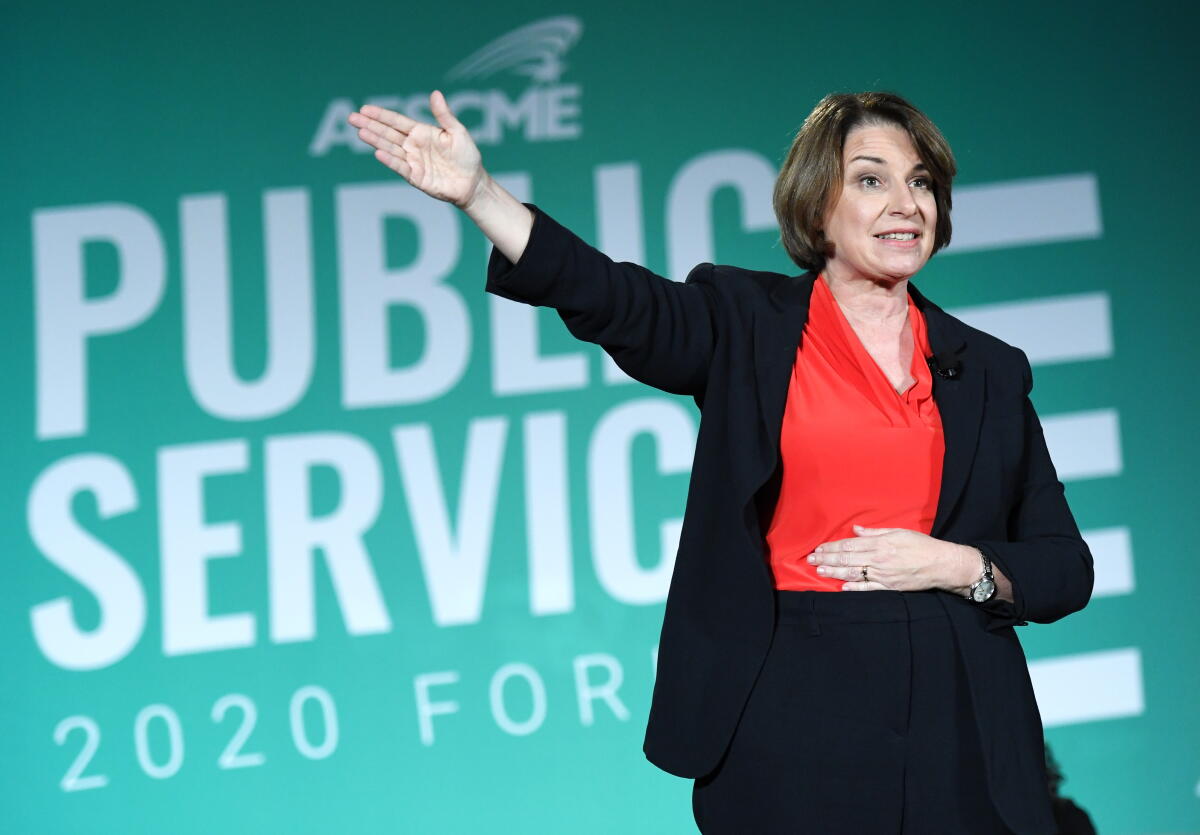
Sen. Amy Klobuchar (D-Minn.) speaks during a 2020 event in Las Vegas.
(Ethan Miller / Getty Images)
Schmitt was trying to suggest Tuesday that Smith improperly colluded with Fulton County Dist. Atty. Fani Willis on their separate criminal cases against Trump by placing the former special counsel on Willis’ home turf of Atlanta in 2024.
But a watershed Watergate moment this was not. If Schmitt’s effort to ensnare Smith was set to a musical score, it would have been far more “Curb Your Enthusiasm” than “Mission Impossible.”
His gotcha moment became a schooling by Klobuchar on basketball, turning the tables on the age-old art of mansplaining. For those who need a quick definition, it’s when a man explains something to a woman in a patronizing way, with sports usually at the top of that talk-down-to-her list. He assumes she knows less than he does, even if she’s versed on the subject.
Klobuchar is an avowed sports fan and the daughter of respected Minneapolis sportswriter Jim Klobuchar and a former prosecutor known for her sharp questioning. The combination proved unfortunate for Schmitt during the hearing when he tried to catch Smith in a lie.
The Republican senator asked Smith, “Did you go to an NBA game between the Golden State Warriors and the Atlanta Hawks on Feb. 3, 2024?”
Smith, whose normally commanding presence has launched countless memes, appeared genuinely perplexed. “What city would that be in?” he asked.
“Atlanta,” replied Schmitt.
Smith denied he was there.
“So your testimony today is that you did not go to a Hawks game on Feb. 3, 2024. Is that correct?” Schmitt said.
“I have no recollection of that,” a bewildered Smith said.
As evidence, Schmitt introduced text messages from Smith’s security detail about seating arrangements for a game, displayed on a poster board that was taken down so quickly that Smith and various senators said they didn’t have time to read it.
“I think you’ve already perjured yourself,” said Schmitt, a former Missouri attorney general who then used the rest of his time to condemn Smith for subpoenaing the communications of Republican lawmakers while investigating Trump.
“You have weaponized the Department of Justice against political enemies to an extent that has never happened in the history of this country,” Schmitt proclaimed. “You will go down as a total dirtbag.”
Klobuchar, who was up next to question Smith, asked if the poster board could be produced again.
“I’m a former prosecutor too, and I have never seen anyone just say, ‘What do you think of this?’ and put it down,” she said.
Schmitt’s evidentiary board was produced again, and this time for more than a few seconds. There was no mention of Atlanta in the text messages.
One could almost hear the sound of Schmitt’s perjury trap crumbling under Klobuchar’s heel.
“Could it then be that it was the University of Iowa, [which] is the ‘Hawkeyes,’ could that be it?” she asked Smith. “That might be the confusion over the names of the team.”
Then she addressed Schmitt: “Perhaps you should have looked at it more carefully. I think people should have their facts straight before they accuse people of being a ‘dirtbag,’ and not get the teams wrong.”
Leave it to a man to confuse the Atlanta Hawks, an NBA team, with the Iowa Hawkeyes of women’s college basketball. Perhaps his emotions got in the way.
Smith said he attended the game in Maryland to see the Hawkeyes’ supremely talented star, Caitlin Clark. Regardless of his whereabouts, Republicans contend that Smith was on a political witch hunt after then-Atty. Gen. Merrick Garland appointed him to oversee the twin investigations into Trump. Smith’s team scrutinized the retention of national defense information and classified documents at Trump’s Mar-a-Lago estate, as well as the president and his allies’ efforts to overturn the results of the 2020 election and impede the peaceful transfer of power.
When Trump won the presidency a second time, Smith moved to dismiss both cases because Department of Justice policy prohibits the criminal prosecution of a sitting president.
Now, it’s game time for Judiciary Committee members who’d like to put Smith on the ropes. There’s just one new rule: Don’t talk sports around the ladies. They deliver a knockout punch.
Menopause has been having a moment lately, and Washington is taking notice. On Sept. 16, the Senate held its first hearing on the dismal state of federally funded menopause research and vast gaps in treatment and care. Within 24 hours, the Department of Health and Human Services also convened pharmaceutical manufacturers and physicians to troubleshoot the alarming lack of availability of estradiol patches, an essential menopause hormone treatment, and the Food and Drug Administration held a full day of expert panels on female-dosed testosterone, which is currently only FDA-approved for men.
One week later, Health and Human Services joined the American Urological Assn. for a discussion about a silent killer of postmenopausal women: urosepsis from recurrent urinary tract infections. There is a simple solution — localized vaginal estrogen — and yet because of outdated guidelines and lack of clinician training, the medication is too often ignored or denied. Nor is the prescription routinely covered by Medicare, despite its well-established health and longevity benefits for women over age 65.
These are among the attempts to now, finally, address decades of policy failures — a refreshing change, quite frankly, given neither political party has ever prioritized menopause. That 2026 marks the year when menopause has entered the policy arena comes as little surprise to me. I’ve been beating this drum for years. Every aspect of daily life that menopause touches — the soaring cost of medical care, inadequate access to health insurance, extreme underinvestment in scientific research focused on women’s health, even the myriad ways midlife women are stretched to the limit caring for kids and aging parents — is smack in the middle of the political zeitgeist. These are the kitchen table issues on the minds of voters this election.
Menopause moment, meet the midterms.
Another issue rightly revealed by menopause is the chasm of public trust in government. As one of the four expert witnesses who testified at the Senate, I was heartened that it was a true bipartisan endeavor. But that’s a rarity these days in Congress, an institution rife with dysfunction. Our federal health agencies have become so shamelessly politicized they are on a collision course with science — from HHS’ overt moves to undermine childhood vaccines, to the decimation of leadership at the Centers for Disease Control and Prevention, which is struggling to respond to the crisis of measles outbreaks across the country.
My goal as a policy advocate is to help turn the tide on this country’s long record of neglect when it comes to menopause. Like many other women’s and reproductive health advocates, after the 2024 election l turned my attention to state legislatures — not just as a consolation prize but as a way to test what range of reforms were feasible and to get as many good laws as possible passed. It was the right move. Over the last two years, more than 60 bills have been introduced in 28 states — to do things like require private insurance and Medicaid to cover menopause care and treatment, improve clinician training and public education, and bolster antidiscrimination protection in the workplace. Ten of those states now have 21 laws on the books.
California is one and can claim real leadership. Among the bills passed by the Legislature, Assembly Bill 2270 from 2023-24 incentivizes continuing medical education on menopause for clinicians, the majority of whom receive little to zero training while in medical school and residency. The California Department of Corrections is now collaborating with medical experts to help bring menopause resources to incarcerated women in state prisons.
Newsom also just vetoed AB 1940, which would have codified menopause as a protected category in the state’s workplace antidiscrimination laws.
The Legislature has been especially deft at easing access to FDA-approved hormonal treatments, including testosterone, often used off-label by menopausal women: AB 82 ends the requirement to report prescriptions to the state’s tracking database; AB 1778 proactively declassifies testosterone as a controlled substance under state law, should there be action in Washington to do the same under federal law.
Although Newsom twice vetoed bills to mandate insurance coverage for menopause treatment — and deserved all the flak he received — the 2026-27 state budget includes a minor course correct: a $3.4-million “trailer bill” to invest in public education and make menopause treatments more affordable; Medi-Cal patients are not fully covered by the addendum, though, making it a toothless reform for those who need support the most.
Why should California’s menopause agenda, or that of the other 27 states that have introduced reforms, matter to the rest of the country? They offer useful models of what to do — or in the case of Medicaid exclusion, what not to do — in crafting meaningful policies. Perhaps more important, they offer a rationale that can help persuade the public; those who might balk at a congressional bill or federal policy, in part because of skepticism of the federal government or the current administration, can listen to and learn from other stakeholders, including governors and state lawmakers and activists.
Take for example the FDA decision in November 2025 to remove the long-critiqued “black box” warning on estrogen products for menopause. This was the culmination of a decade-long campaign by physicians, researchers and scientists — who had been waging the fight for accurate labeling well before the acronym MAHA ever existed and regardless of which party held power. Yet the very image of Health Secretary Robert F. Kennedy Jr. using his moment at the podium to credit the Trump administration’s deep commitment to women’s health posed a serious credibility challenge. Aligned and contemporaneous state reforms offered much-needed reassurance and clarity to many.
Trust in government is understandably at a low point, but this happens to be when menopause finally has caught the attention of policymakers at all levels of power. Some are taking long-overdue steps for women’s health, however implausibly. Let’s take the wins.
Jennifer Weiss-Wolf is the author of “When in Menopause: A User’s Manual & Citizen’s Guide.” She is executive director of NYU Law’s Birnbaum Women’s Leadership Center.
If there’s one positive to come out of the controversial play and video from Saturday’s USC vs. Oregon football game during which Oregon quarterback Dante Moore suffered a concussion after a late hit by USC’s Desman Stephens, it’s that high school football coaches are using it as a teachable moment on how not to react after a player is injured.
Stephens received a one-game suspension from USC after he was seen celebrating when hitting Moore in the head as he gave himself up on a slide to end a running play.
Whittier coach Lorenzo Hernandez said he reminded his players, “You’re always in someone’s lens.”
“You have to be compassionate about someone being injured,” he said.
St. John Bosco coach Jason Negro said there were plenty of lessons to point out to his players.
Negro said in a text, “As mentors, educators, and coaches we are constantly using moments like this to educate our players on how not to be. Football is a small fraternity and regardless of rivalries or spirited competitions we have to respect the health and safety of our opponents. Celebrating in a moment like that is disheartening and would never be tolerated here at Bosco.
“It wasn’t just the Dante Moore situation. It was also the situation from the Texas vs Tennessee game, too, with the unnecessary antics that draw penalties.
“We have to do better in making our kids realize there is a proper way to conduct yourself in an athletic contest. Personal character is revealed in these moments so choose wisely when you plan your actions after you make a good play.”
The fan-favourite baking competition has returned to Channel 4, with 12 amateur bakers hoping to impress Paul Hollywood and new judge Nigella Lawson, who has replaced Dame Prue Leith.
In the first episode of this series, the bakers were tasked with making Nigella’s stout cake and a self-portrait showstopper, and despite two creations collapsing onto the floor, no one was sent home after contestant Shannon had to quit the challenge halfway through on medical advice.
Ahead of biscuit week tonight, Tuesday 29 September, one contestant has recalled his own experience on the show. Howard Middleton took part in the fourth series back in 2013, but was devastatingly sent home during week six.
He’s now revealed that before filming even began, there was a moment that left him feeling sick. Speaking on behalf of Smooth Spins, Howard shared his first impression of the famous white tent.
He said: “It’s interesting because you get two shots of it. So, we were ferried from the hotel to the tent in a little minibus, and you just see the tent emerging from the minibus, and it’s at that point you sort of think, ‘Oh God, I feel a bit sick!’ That’s when it starts to feel real.
“When you actually go into the tent the first time, you get a tour, where someone explains how the ovens work and the hobs and everything around the kitchen. I just remember thinking that I hadn’t understood a word that you’d just said because I was so in awe of actually being in the tent.
“Even after the explanation, I still kept having to ask how to work the oven and the hob afterwards. It’s very overwhelming, and I did feel a bit sick.”
He went on to talk about meeting his fellow bakers, revealing they only met the night before. Howard continued: “Obviously we’ve all gone through the audition process, and you’ve met certain people along the way, but it’s not until the night before you actually start filming that you know who’s got into the tent. It may be that you’ve met one or two of them, or you remember seeing them during the auditions, but most of the time they’re strangers, really.
“On the first night when you meet everyone, you can make up your mind about them. Sometimes people can be very loud if you are out for dinner or something, and you start to understand what they will be like in the tent.”
After their first impressions of each other, Howard shared that the bakers did spend time together when the cameras stopped rolling, though he admitted that his time on the show was likely different to now. Back then, the contestants stayed in a hotel further from the tent, whereas he claimed that now, due to security reasons, they stay much closer.
He went on: “And the security is much tighter than it was. We were free to go out for meals together in the evening, although, to be perfectly honest, you’re so tired by the time you’ve finished a day of filming that you really don’t want to socialise that much.
“We also realised that those of us who would be catching up at the hotel bar late at night – none of us made it through to the finals! So if there’s a lesson to be learned, it’s don’t go out the night before!”
The Great British Bake Off continues tonight at 8pm on Channel 4
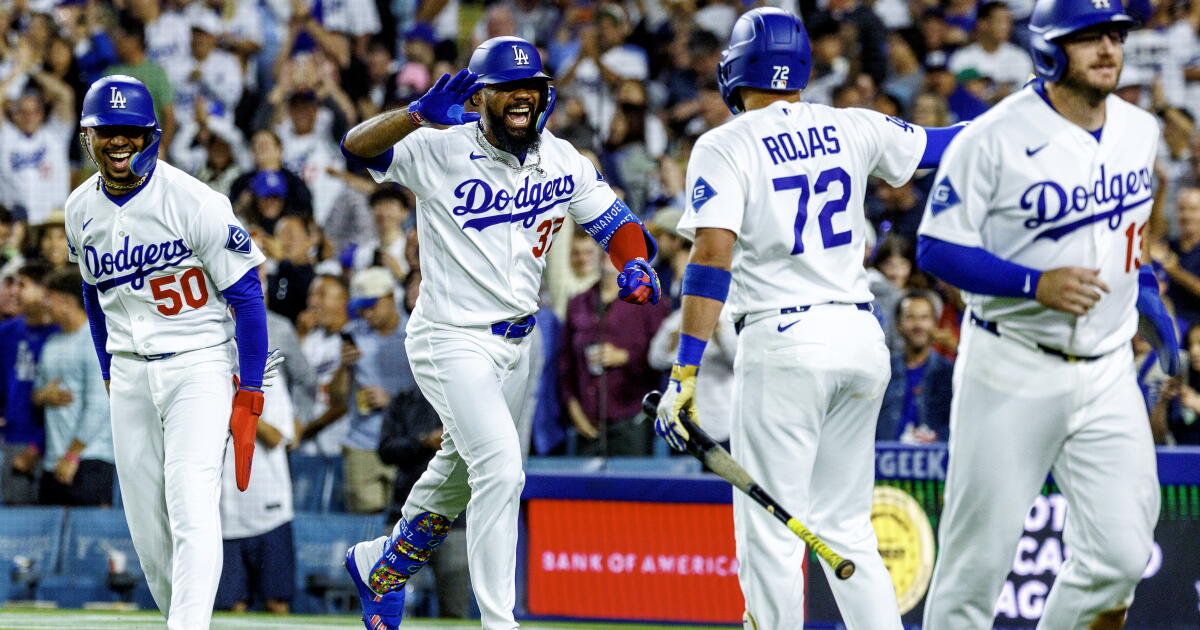
When Dodgers rookie Josue De Paula debuted a little over two weeks ago, he was the youngest player in the lineup by four years. And when veteran infielder Miguel Rojas pinch-hit for Alex Freeland in the eighth inning, the 21-year-old De Paula and 29-year-old Kyle Tucker were the only Dodgers under 30 remaining in the batting order.
“You’ve got to have both,” veteran shortstop Mookie Betts, who turns 34 next month, said in a recent conversation with the Times. “You need experience, but you also do need youth. I don’t know what the balance is, to be honest.”
The age of the Dodgers’ stars is the most persistent knock on a group that just finished a 100-win regular season and has the second-best odds to win the World Series (16.7%), according to Baseball Prospectus.
It’s the threat looming beyond every new accomplishment. Yes, the Dodgers are in the midst of a historic run. Only one other organization has strung together so many consecutive postseason berths, and that Braves team of the 1990s and early 2000s won only one World Series.
The Dodgers are aiming to become the first National League team to claim three straight championships.
But how long can this last?
The Dodgers’ lineup is the oldest in the majors, according to Baseball Reference, with an average age of 30.9 years old when weighted by at-bats and games played. Their star corner infielders, Freddie Freeman and Max Muncy, are the oldest of the everyday starters, at 37 and 36, respectively. Even two-way phenom Shohei Ohtani turned 32 in July.
“That’s a fact, we’re an older team,” manager Dave Roberts said. “With age, there’s experience. I know we’re not going to fall off a cliff, our team.”
Plenty of young players in the Dodgers’ system have been blocked by older stars over the years. But in addition to a sky-high payroll, the Dodgers are known for their player development.
Even after the trade deadline — when the Dodgers sent two MLB Top-100 prospects, outfielder Zyhir Hope (No. 25) and right-hander River Ryan (No. 68), to the Tigers as part of the trade package for left-hander Tarik Skubal — the organization’s farm system ranked No. 1 on MLB Pipeline’s rankings.
Serving as a reminder of that strength, when the Dodgers called up De Paula straight from double A, he immediately showed his bat belonged in the big-leagues.
At the same time, injuries stoked the flames of the age discussion. De Paula got his shot because Ohtani finally went on the injured list, after managing problems with his left knee and right biceps for much of the season.
Freeman pushed through knee tendinitis in September. Teoscar Hernández (left hamstring strain) and Betts (right oblique strain) both had monthlong IL stints earlier in the season but have helped carry the offense lately.
“As I’ve gotten older, I’m definitely taking a lot more care of my body,” Betts said. “I know I had an oblique [injury] earlier, but as far as just showing up every day and whatnot, I feel like we do a good job in taking care of our bodies and staying healthy for the most part.
“But I mean, people are talking like we’re the only ones in the league that’s getting hurt. You look everywhere around the league, somebody’s hurt.”
That’s true. And it also isn’t just the guys in their mid-to-late 30’s sustaining soft-tissue injuries. Dodgers catcher Dalton Rushing, 25, served back-to-back IL stints for a flexor strain in his forearm down the stretch.
The Dodgers’ roster has proven deep enough to withstand injuries, as the team posted the second-best regular-season record in the majors this year.
“We’re not going to win games the same way that Milwaukee or Tampa Bay or these younger teams are winning games,” said Rojas, 37. “We’re going to win games a different way. We’re going to win games with a lot of talent, with experience, and winning moments.”
Over the years, the Dodgers have brought in players with postseason experience. But roster continuity also has meant that 17 players on this year’s projected postseason roster also contributed to both of the Dodgers’ last two World Series-winning seasons.
So, after playing more games than any other team the past couple years, the Dodgers may be a little hobbled going into their first-round bye. Regardless, they just completed their first 100-win season since 2023.
“The experience, how smart these guys are on the field, I think those things help win moments and win battles on the edges in October,” president of baseball operations Andrew Friedman said when the Dodgers clinched the NL West title earlier this month. “It’s not as easy to navigate through a 162-game season with an older roster. But I do think that experience in those moments will definitely help and we’ll see it shine through at different points in October.”
JAKE Humphrey candidly revealed how fellow kids TV presenter Holly Willoughby robbed him of his “big moment” in a new interview with Davina McCall — only for the clip to mysteriously disappear.
During an emotional chat with Davina’s Begin Again podcast, Jake, 47, opened up about his childhood bullying trauma, his relationship with his grandfather and a brutal rejection from BBC Sport earlier in his career.
Jake Humphrey talked openly about difficult moments from his life that shaped the man he’s becameCredit: Begin AgainHolly Willoughby decided to defect to ITV instead of signing up for a CBBC kids’ TV show with JakeCredit: CBBC
He also spoke about his friendship and working partnership on CBBC with Holly. The pair were popular with young viewers in the early 2000s and presented CBBC’s coverage of talent show Fame Academy.
Jake revealed the pair’s chemistry was so good that channel bosses proposed they have their own show which they would have complete creative control over.
Sign up for the Showbiz newsletter
Thank you!
A delighted Jake saw it as his “big moment” and couldn’t wait to get planning, but his dreams disappeared the following day when Holly tentatively called him and said she wanted to pursue a presenting career with ITV.
Jake said the blow taught him a valuable lesson about the industry and not relying on others to share your vision.
Jake thought the kids’ show was going to be his ‘big moment’Credit: Begin AgainThe pair remain good friends, and Holly now has her own YouTube channelCredit: Shutterstock Editorial
The clip was published on the Begin Again TikTok and Instagram accounts before seemingly being pulled and edited out of the podcast.
The Sun has contacted a representative for Begin Again for comment.
In an unearthed interview from 2012, Jake told The Mirror that while he and Holly were working on Celebrity Fame Academy, she would stay at his flat in London as she was based in Brighton.
Jake recalled: “Eventually, it got to the point where we couldn’t be bothered to get the blow-up bed out so for about six months we slept in the same bed.”
Jake stressed that “nothing ever happened” romantically between him and Holly, but joked that may have been a different story if he hadn’t been dating.
Jake teased: “I wouldn’t want to say I met my wife too early but I would just say Holly’s worst habit is she sleeps naked – joking, of course.
“Holly’s a good mate but I look back on my time with her and wonder what might have been but I was going out with Harriet at the time and she lived in Leeds.”
Holly’s career in the spotlight began when she was scouted by a model agency at the Clothes Show Live aged just 14.
She then broke into television presenting, hosting shows on CBBC, before landing a job with its telly rival CITV.
That springboarded her career towards This Morning, which she signed for in 2009, and she worked on the ITV daytime show up until last year.
Holly has now swapped terrestrial TV for her own YouTube show, Together, which is produced by husband Dan’s Hungry Bear Media and currently has over 26,000 subscribers.