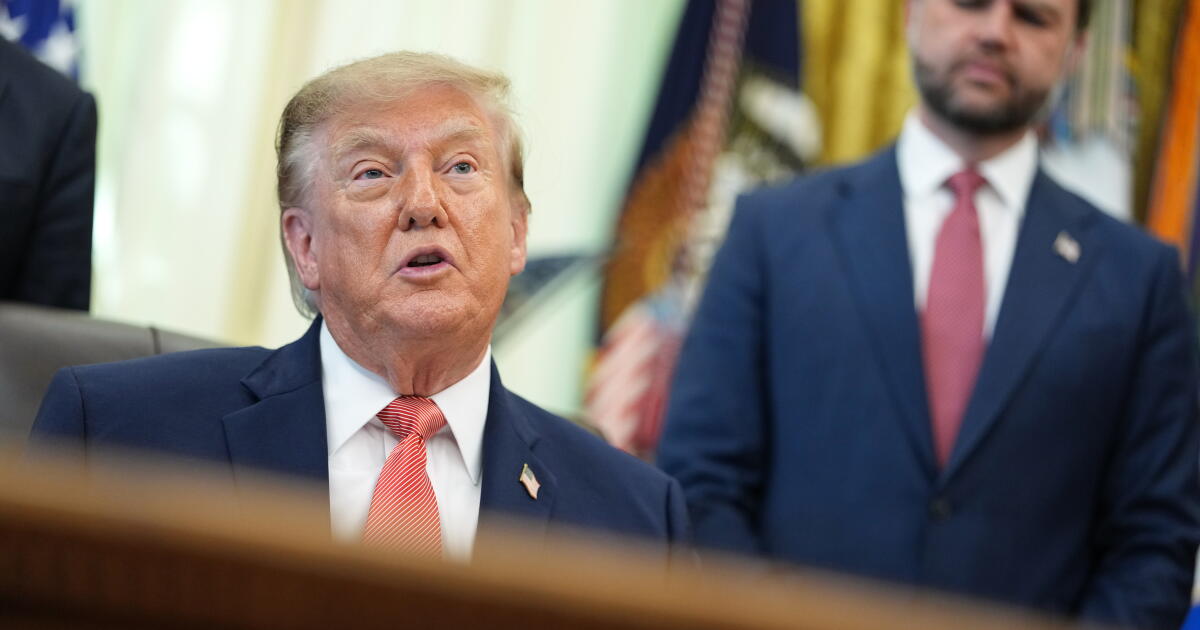
LONDON — British Prime Minister Keir Starmer has signaled that President Trump should apologize for his false assertion that troops from non-U.S. NATO countries avoided the front line during the Afghanistan war, describing Trump’s remarks as “insulting” and “appalling.”
Trump said that he wasn’t sure NATO would be there to support the United States if and when requested, provoking outrage and distress across the United Kingdom on Friday, regardless of individuals’ political persuasion.
“We’ve never needed them, we have never really asked anything of them,” Trump said of non-U.S. troops in an interview with Fox News in Davos, Switzerland, on Thursday. “You know, they’ll say they sent some troops to Afghanistan, or this or that, and they did, they stayed a little back, a little off the front lines.”

In October 2001, nearly a month after the Sept. 11 attacks, the U.S. led an international coalition in Afghanistan to destroy Al Qaeda, which had used the country as its base, and the group’s Taliban hosts. Alongside the U.S. were troops from dozens of countries, including from NATO, whose mutual-defense mandate had been triggered for the first time after the attacks on New York and Washington.
U.K. sacrifice
In the U.K., the reaction to Trump’s comments was raw.
Starmer paid tribute to the 457 British personnel who died and to those who have been left with profound life-long injuries.
“I will never forget their courage, their bravery and the sacrifice they made for their country,” Starmer said. “I consider President Trump’s remarks to be insulting and frankly appalling and I am not surprised they have caused such hurt to the loved ones of those who were killed or injured and, in fact, across the country.”
Prince Harry weighed in too, saying the “sacrifices” of British soldiers during the war “deserve to be spoken about truthfully and with respect.”
“Thousands of lives were changed forever,” said Harry, who undertook two tours of duty in Afghanistan in the British army. “Mothers and fathers buried sons and daughters. Children were left without a parent. Families are left carrying the cost.”
After 9/11, then-Prime Minister Tony Blair said that the U.K. would “stand shoulder to shoulder” with the U.S. in response to the Al Qaeda attacks. British troops took a key role in many operations during the Afghan war until their withdrawal in 2014, particularly in Helmand province in the south of the country. American troops remained in Afghanistan until their chaotic withdrawal in 2021 when the Taliban returned to power.
More than 150,000 British troops served in Afghanistan in the years after the invasion, the largest contingent after the American one.
Ben Obese-Jecty, a lawmaker who served in Afghanistan as a captain in the Royal Yorkshire Regiment, said that it was “sad to see our nation’s sacrifice, and that of our NATO partners, held so cheaply by the president of the United States.”
Trump and Vietnam
Anger was further fueled by the fact that the comments came from someone who didn’t serve in the Vietnam War at a time when he was eligible.
“It’s hugely ironic that someone who allegedly dodged the draft for the Vietnam War should make such a disgraceful statement,” said Stephen Stewart, author of “The Accidental Soldier,” an account of his time embedded with British troops in Afghanistan.
Trump received a deferment that allowed him to not serve in Vietnam because of bone spurs, but he has been unable to remember in which foot, leading to accusations of draft dodging.
Repeated NATO slights
It wasn’t the first time that Trump downplayed the commitment of NATO countries over the last few days. It has been one of his pivotal lines of attack as he escalated his threats to seize Greenland, a semiautonomous territory belonging to Denmark.
Trump’s allegation that NATO countries won’t be there when requested stands in stark contrast to reality.
The only time Article 5 of NATO’s founding treaty has been used was in response to the 9/11 attacks on the U.S. The article is the key mutual defense clause, obliging all member countries to come to the aid of another member whose sovereignty or territorial integrity might be under threat.
“When America needed us after 9/11 we were there,” former Danish platoon commander Martin Tamm Andersen said.
Denmark has been a stalwart ally of the U.S. in Afghanistan, with 44 Danish soldiers killed there — the highest per capita death toll among coalition forces. Eight more died in Iraq.
The latest controversy surrounding Trump comes at the end of a week when he has faced criticism — and pushback — for his threats to Greenland.
Trump also threatened to slap tariffs on European nations opposed to his ambitions to annex Greenland, which raised questions over the future of NATO. And though Trump backed down after a meeting with NATO Secretary-General Mark Rutte in which he said they formed the “framework” for a deal over Arctic security, transatlantic relations have taken a hit.
His latest comments are unlikely to improve relations.
Diane Dernie, whose son Ben Parkinson suffered horrific injuries when a British army Land Rover hit a mine in Afghanistan in 2006, said that Trump’s latest comments were “the ultimate insult” and called on Starmer to stand up to Trump over them.
“Call him out,” she said. “Make a stand for those who fought for this country and for our flag, because it’s just beyond belief.”
Taking her up on that, Starmer said, “what I say to Diane is, if I had misspoken in that way or said those words, I would certainly apologize and I’d apologize to her.”
Pylas writes for the Associated Press. AP journalist Anders Kongshaug contributed to this report from Copenhagen.
Did you learn it in school, read it in a newspaper? Did you get your information on social media or though chatter with friends?
Even in an age of misinformation and disinformation — which we really need to start clearly calling propaganda — we continue to rely on old ways of knowing. We take it for granted that if we really need to get to the truth, there’s a way to do it, even if it means cracking the pages of one of those ancient conveyors of wisdom, a book.
But we are entering an era in America when knowledge is about to be hard to come by. It would be easy to shrug off this escalation of the war on truth as just more Trump nonsense, but it is much more than that. Authoritarians take power in the short term by fear and maybe force. In the long term, they rely on ignorance — an erasure of knowledge to leave people believing that there was ever anything different than what is.
This is how our kids, future generations, come to be controlled. They simply don’t know what was, and therefore are at a great disadvantage in imagining what could be.
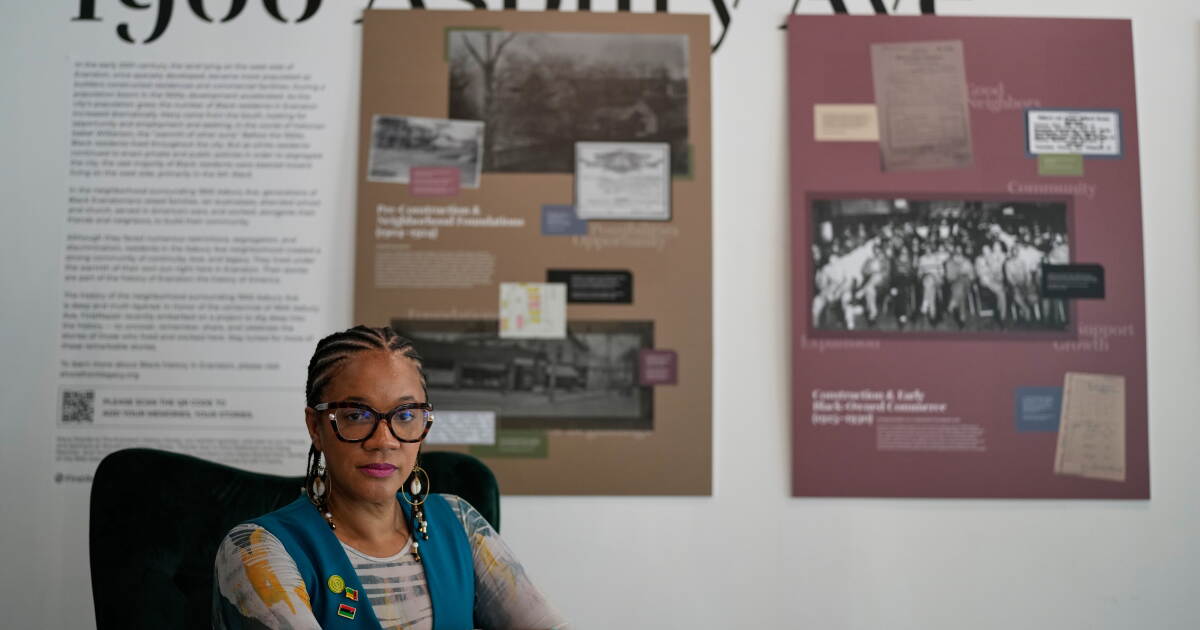
The original photo shows Armstrong in handcuffs being led away by a federal officer with his face blurred out. Armstrong is composed and steady in this image. A veteran of social justice movements and a trained attorney, she appears as one might expect, her expression troubled but calm.
In the photo released by the White House, Armstrong is sobbing, her mouth hanging open in despair. In what is clearly nothing more than overt racism, it appears her skin has been darkened. Her braided hair, neatly styled in the original picture, is disheveled in the Trump image.
On the left, a photograph from the X (formerly Twitter) account of U.S. Secretary Kristi Noem, showing Nekima Levy Armstrong being arrested. On the right, the photo has been altered before being posted to the White House’s X (formerly Twitter) account.
(@Sec_Noem via X/@WhiteHouse via X)
A strong, composed resister is turned into a weeping, weak failure.
“YET AGAIN to the people who feel the need to reflexively defend perpetrators of heinous crimes in our country I share with you this message: Enforcement of the law will continue. The memes will continue. Thank you for your attention to this matter,”
The same week, the Trump administration began ripping down exhibits at the President’s House in Philadelphia that told the story of the nine Black people held in bondage there by George Washington. I’ve been to that exhibit and had planned to take my kids this summer to learn about Joe Richardson, Christopher Sheels, Austin, Hercules, Giles, Moll, Oney Judge, Paris and Richmond.
They are names that barely made it into American history. Many have never heard of them. Now, this administration is attempting to erase them.
How do you know what you know? I learned most of what I knew about these folks from that signage, which is probably in a dump somewhere by now.
The information we once took for granted on government websites such as the Centers for Disease Control and Prevention is gone. Climate change information; LGBTQ+ information; even agricultural information. Gone (though courts have ordered some restored).
The Smithsonian is undergoing an ideological review.
And now, our government is telling us it will alter in real time images of dissenters to create its own narrative, demand we believe not our own eyes, our own knowledge, but the narrative they create.
He was speaking specifically about an incident in his town in which a corrections officer recruit was detained by ICE this week. In video taken by a bystander, about five agents pull the man from his car as he drives home after work. They then leave the car running in the street as they take him away.
Joyce told reporters the man had a clean background check before being hired, had no criminal record, and was working legally in the country. The sheriff has no idea where the man is being held.
Joyce’s sentiment, that what we are being told isn’t what’s happening, applies to nearly everything we are seeing with our own eyes.
A woman shot through her temple, through the side window of her car? You don’t understand what you are seeing. It was justified, our vice president has told us, without even the need for an investigation.
Goodbye Renee Good. They are attempting in real time to erase her reality and instead morph her into a domestic terrorist committing “heinous” crimes, and maybe even worse.
“You have a small band of very far left people who are doing everything they can … to try to make ICE out to be the ultimate enemy, and engage in this weird, small-scale civil war,” Vice President JD Vance said this week.
Protesting turned into civil war.
Next up, artificial intelligence is getting into the erasure game. Scientists are warning that those who wish to destroy truth will soon unleash AI-run operations in which thousands if not millions of social media posts will offer up whatever alternative reality those in control of it wish. Under the pressure of that avalanche of lies, many will believe.
The message the White House is sending with Armstrong’s photo is that they control the truth, they decide what it is.
Our job is to fight for truth, know it when we see it, and demand it not be erased.
NUUK, Greenland — One year ago, days before Donald Trump reclaimed power, the head of Denmark’s People’s Party took a trip to Mar-a-Lago. Morten Messerschmidt thought he and Trump shared a common view on the perils of European integration. Together, he told local media at the time, they could make the West great again.
In Europe, just as in the United States, Messerschmidt thought it was “nationale suverænitet” — national sovereignty — that had over centuries given countries large and small the tools to build their culture, traditions and institutions. Those were the values that conservative movements across the European continent are fighting to protect.
But Messerschmidt now finds himself on the defensive. The far-right politician is suddenly distancing himself from an American president who, off and on over the last year, has made aggressive plays to annex Greenland, targeting Danish borders that have existed for roughly 300 years.
Trump pulled back from military threats against the island this week. “It’s total access — there’s no end,” he said in an interview on Thursday with Fox Business. Asked whether he still intended on acquiring the island, Trump replied, “It’s possible. Anything is possible.”
Despite Trump’s fixation on Greenland since his first term, he declined to meet with Messerschmidt at Mar-a-Lago last January. Instead, the Danish politician found himself discussing the matter with Marla Maples, the president’s ex-wife.
“Portraying me as someone who serves a cause other than Denmark, and who would sympathize with threats to our kingdom, is unhealthy,” Messerschmidt wrote on Facebook this weekend. “It is slander.”
The Danish People’s Party is one of many far-right groups across Europe, which aligned with Trump’s MAGA movement in their fervent opposition to immigration and related issues, suddenly in rebellion against an administration it once thought of as an ideological ally.
The president’s moves are now compelling them to reconcile their alliance with Trump with a core tenet on the political right, that nationalism is largely defined by people and place over historic stretches of time — or as Trump often said on the campaign trail, “without a border, you don’t have a country.”
“Donald Trump has violated a fundamental campaign promise — namely, not to interfere in other countries,” Alice Weidel, co-leader of Germany’s far-right Alternative for Germany Party, or AfD, said in Berlin. Her colleague added: “It is clear that Wild West methods must be rejected.”
The rupture could jeopardize the Trump administration’s own stated goals for a future Europe that is more conservative and aligned with the Republican Party — a plan that relied on boosting the very same parties now questioning their ties to the president.
In its national security strategy, published in November, the White House said it would “cultivate resistance to Europe’s current trajectory within European nations,” hoping to restore “Europe’s civilizational self-confidence and Western identity.”
And it is not clear whether the president’s decision to walk back his most aggressive threats is enough to contain the diplomatic damage. “The process of getting to this agreement has clearly damaged trust amongst allies,” Rishi Sunak, former prime minister of the United Kingdom and leader of its Conservative Party, told Bloomberg on Thursday.
Trump’s pressure campaign urging Ukraine to accept borders redrawn by a revanchist Russia had already strained relations between his inner circle and Europe’s far-right movements. But several prominent right-wing leaders say his aggressive posture toward Greenland amounted to a bridge too far.
On Wednesday in Switzerland, addressing growing concerns over the plan, Trump still left threats lingering in the air, warning European leaders that he would “remember” if they blocked a U.S. takeover.
“Friends can disagree in private, and that’s fine — that’s part of life, part of politics,” Nigel Farage, leader of the far-right Reform UK party in Britain, told House Speaker Mike Johnson in London earlier this week. “But to have a U.S. president threatening tariffs unless we agree that he can take over Greenland by some means, without it seeming to even get the consent of the people of Greenland — I mean, this is a very hostile act.”
In France, the head of Marine Le Pen’s far-right party, National Rally, said the United States had presented Europe “with a choice: Accept dependency disguised as partnership or act as sovereign powers capable of defending our interests.”
With overseas territories across the Pacific, Caribbean and Indian oceans, France has the second-largest maritime exclusive economic zone in the world after the United States. If Trump can seize Greenland by force, what is stopping him, or any other great power, from conquering France’s islands?
“When a U.S. president threatens a European territory while using trade pressure, it is not dialogue — it is coercion. And our credibility is at stake,” said the party’s young leader, Jordan Bardella.
“Greenland has become a strategic pivot in a world returning to imperial logic,” he added. “Yielding today would set a dangerous precedent.”
With a faster internet speed, higher standards of living, vibrant main cities and stunning scenery, it’s no wonder this city is attracting a younger generation
Denmark is an archipelago of 444 named islands – of which about 70 are inhabited with Copenhagen as its capital (Image: Getty Images/iStockphoto)
A staggering two-fifths (39%) of Gen Z and Millennials planned to live or work abroad last year – and there was one European country that was top of the list for younger expats to go.
With a score of 7.88 out of ten based on affordability, healthcare, broadband speed and other areas, Scandinavian country Denmark polled number one as the best place for expats to relocate.
Just under two hours away from the UK, Denmark has a high income economy, a significantly quicker internet speed than average and policies including the 11th hour rule which ensures every employee has a minimum of 11 hours’ rest within 24, contributing to a high standard of living for its residents.
Research by international health insurance specialists, William Russell, analysed other factors including environmental performance and LGBT+ equality to find the leading Gen Z relocation hotspot.
In addition to the practicalities of Denmark for people looking to move there, it is also jam-packed with stunning natural beauty.
This includes untouched dunes, twisted forests, traditional seaside villages, the famous white cliffs of Møn, Jaegersborg Deer Park, which has around 2,000 deer, and many other diverse, scenic landscapes on its 70 inhabited islands.
Denmark is also home to the second longest bridge in Europe – connecting to Sweden. People can also experience the buzz of its vibrant capital city, Copenhagen. Mixing modern architecture and culture with sustainable living and royal history, the city described as ‘Northern Europe’s cosiest capital’ is packed with cafes, shops and fabulous restaurants.
If Denmark doesn’t quite hit the spot, other countries in the top 10 had various areas with impressive stats for potential expats to ponder. Iceland ranked as the safest destination for young expats, with a Global Peace Index score of 1.1 and the Netherlands healthcare score index was one of the highest scores in the dataset. The top 10 relocation destinations for Gen Z Brits were predominantly European with Canada the only place further afield.
You can check out the top 10 list below…
Denmark
Netherlands
Luxembourg
Iceland
Spain
Austria
Finland
Belgium
Norway
Canada
Have you moved abroad because you found a better quality of life outside the UK? Email us at webtravel@reachplc.com
Giel Malual and John Kiel walked nearly 1,000 miles from England to Scotland to raise money to build schools in Sudan, but were shocked by what they experienced in the UK
08:43, 23 Jan 2026Updated 08:43, 23 Jan 2026
John Kuei and Giel Malual walked 900 miles across the UK(Image: Instagram/@asylum_speakers)
Two men who walked 900 miles from Kent to John O’Groats to raise money to open a school in Sudan has said there was one thing that shocked them about the UK.
Giel Malual and John Kuei, both from Sudan, trekked from Dungeness in Kent to John o’Groats in Caithness over 33 days.
Given the current political climate, Giel admitted he was worried about how he and John would be treated and received on their long journey. However, this was to be the least of their worries as the nation opened its doors to help Giel and John in whatever way they could.
The pair said they were inundated with messages of support from people offering hot meals, free rooms, that some Airbnb hosts refunded them, and that people would stop their cars to chat and make donations.
All of this, Giel said, gave them a greater feeling of the impact of a “loud minority” that hid the truth about the UK.
He told the Guardian: “We hear a lot of negativity from a loud minority in this country…with the political dynamic going on in the country, we thought people may have some reservations about us.
“But we have seen for ourselves there’s nothing to actually fear.”
Beginning in December last year, the pair originally aimed to raise £35,000 to open a school at a Sudanese refugee camp in Chad, but their walk was so warmly received that they have now raised £90,000 and plan to build multiple schools instead.
The pair were supported by Asylum Speakers, an organisation that aims to help amplify the voices of refugees in the UK and which helped support Giel and John logistically on their trip.
After a gruelling 900 mile walk across England and Scotland, Giel and John both made it to their end destination of Duncansby Head lighthouse in Scotland on Wednesday.
Arriving back in London on Thursday, they were met with a heroes welcome. Giel emphasised the “true value” of British society had been people helping them “without judging us based on what we look like”.
Among the examples of the warm welcome the pair received was when they stopped off in Edinburgh where they were welcomed by the Sudanese community who had organised an event to meet.
In a statement on Instagram at the time, Giel said: “It was an emotional moment for me, I have never cried this hard in my life.”
DAVOS, Switzerland — President Trump on Thursday inaugurated his Board of Peace to lead efforts at maintaining a ceasefire in Israel’s war with Hamas, insisting that “everyone wants to be a part” of the body he said could eventually rival the United Nations — despite many U.S. allies opting not to participate.
The new peace board was initially envisioned as a small group of world leaders overseeing the ceasefire, but it has morphed into something far more ambitious — and skepticism about its membership and mandate has led some countries usually closest to Washington to take a pass.
In a speech at the World Economic Forum, Trump sought to create momentum for a project to map out a future of the war-torn Gaza Strip that has been overshadowed this week, first by his threats to seize Greenland, then by a dramatic retreat from that push.
“This isn’t the United States, this is for the world,” he said, adding, “I think we can spread it out to other things as we succeed in Gaza.”
The event featured Ali Shaath, the head of a new, future technocratic government in Gaza, announcing that the Rafah border crossing will open in both directions next week. That’s after Israel said in early December it would open the crossing, which runs between Gaza and Egypt, but has yet to do so.
Shaath, an engineer and former Palestinian Authority official from Gaza, is overseeing the Palestinian committee set to govern the territory under U.S. supervision.
Trump tried not to let those not participating ruin his unveiling party, saying 59 countries had signed onto the board — even though heads of state, top diplomats and other officials from only 19 countries plus the U.S. actually attended the event. He told the group, ranging from Azerbaijan to Paraguay to Hungary, “You’re the most powerful people in the world.”
Trump has spoken about the board replacing some U.N. functions and perhaps even making that entire body obsolete one day. But he was more conciliatory in his remarks on the sidelines of the forum in the Swiss alps.
“We’ll do it in conjunction with the United Nations,” Trump said, even as he denigrated the U.N. for doing what he said wasn’t enough to calm some conflicts around the globe.
Secretary of State Marco Rubio said some countries’ leaders have indicated they plan to join but still require approval from their parliaments.
Why some countries aren’t participating
Big questions remain, however, about what the eventual board will look like.
Russian President Vladimir Putin said his country is still consulting with Moscow’s “strategic partners” before deciding to commit. The Russian was hosting Palestinian President Mahmoud Abbas on Thursday in Moscow.
Others are asking why Putin and other authoritarian leaders had even been invited to join. Britain’s foreign secretary, Yvette Cooper, said her country wasn’t signing on “because this is about a legal treaty that raises much broader issues.”
“And we do also have concerns about President Putin being part of something which is talking about peace, when we have still not seen any signs from Putin that there will be a commitment to peace in Ukraine,” she told the BBC.
Norway and Sweden have indicated they won’t participate. France declined after its officials stressed that while they support the Gaza peace plan, they were concerned the board could seek to replace the U.N.
Canada, Ukraine, China and the executive arm of the European Union also haven’t committed. Trump calling off the steep tariffs he threatened over Greenland could ease some allies’ reluctance, but the issue is still far from settled.
The Kremlin said Thursday that Putin plans to discuss his proposal to send $1 billion to the Board of Peace and use it for humanitarian purposes during his talks with Abbas — if Russia can use of those assets the U.S. had previously blocked.
Others voice reservations
The idea for the Board of Peace was first laid out in Trump’s 20-point Gaza ceasefire plan and even was endorsed by the U.N. Security Council.
But an Arab diplomat in a European capital said that Middle Eastern governments coordinated their response to Trump’s invitation to join the Board of Peace and that it was crafted to limit the acceptance to the Gaza plan as mandated by the U.N. Security Council.
Speaking on the condition of anonymity to discuss the matter more freely, the diplomat said the announced acceptance is “preliminary” and that the charter presented by the U.S. administration contradicts in some parts the United Nations’ mission. The diplomat also said that other major powers are unlikely to support the board in its current form.
Months into the ceasefire, Gaza’s more than 2 million Palestinians continue to suffer the humanitarian crisis unleashed by more than two years of war. And violence in Gaza continues.
Key to the truce continuing to hold is the disarming of Hamas, something that the militant group that has controlled the Palestinian territory since 2007 has refused to do, despite Israel seeing it as non-negotiable. Trump on Thursday repeated his frequent warnings that the group will have to disarm or face dire consequences.
He also said the war in Gaza “is really coming to an end” while conceding, “We have little fires that we’ll put out. But they’re little,” and they had been “giant, giant, massive fires.”
Iran looms large
Trump’s push for peace also comes after he threatened military action this month against Iran as it carried out a violent crackdown against some of the largest street protests in years, killing thousands of people.
Trump, for the time being, has signaled he won’t carry out any new strikes on Iran after he said he received assurances that the Islamic government would not carry out the planned hangings of more than 800 protesters.
But Trump also made the case that his tough approach to Tehran — including strikes on Iran’s nuclear facilities in June last year — was critical to the Israel-Hamas ceasefire deal coalescing.
Zelensky announces discussions involving U.S., Russia and Ukraine
Trump also spoke behind closed doors for about an hour with Ukrainian President Volodymyr Zelensky and called the discussion “very good” without mentioning major breakthroughs. Trump’s special envoy Steve Witkoff and his son-in-law Jared Kushner are expected in Moscow for talks aimed at ending Russia’s nearly 4-year-old war in Ukraine.
Zelensky later addressed the Davos forum and said there would be two days of trilateral meetings involving the U.S., Ukraine and Russia in the United Arab Emirates starting Friday — following the U.S. talks in Moscow.
“Russians have to be ready for compromises because, you know, everybody has to be ready, not only Ukraine, and this is important for us,” Zelensky said.
Boak, Madhani and Weissert write for the Associated Press. Madhani and Weissert reported from Washington. AP writer Samy Magdy in Cairo contributed to this report.
Torbjørn “Thor” Pedersen, a Danish adventurer who set off on his journey in 2013, was faced with an array of issues, including conflicts, visa problems, convincing ships to give him passage, and, notably, a global pandemic
Torbjørn “Thor” Pedersen initially thought the gargantuan task would take only three or four years(Image: Courtesy Thor Pedersen / SWNS)
A man who visited every country on Earth without boarding a single plane has revealed the one destination he truly yearns for. Torbjørn “Thor” Pedersen, a Danish explorer who embarked on his quest in 2013, originally believed the mammoth undertaking would require just three or four years, but it turned into the beginning of an almost decade-long odyssey.
Throughout his expedition, Torbjørn reached all 197 nations acknowledged by the United Nations plus several with limited recognition, totalling 203 destinations visited.
What distinguishes Torbjørn’s accomplishment from other globe-trotting endeavours is his commitment to reaching every nation without air travel, though predictably, this came with considerable obstacles.
Despite his professional background in logistics and shipping, “nothing quite prepared” Torbjørn for the hurdles that awaited, including conflicts, visa complications, persuading vessels to grant him passage, and crucially, a worldwide pandemic.
During this challenging time, with borders shuttered due to the Covid crisis, Torbjørn found himself marooned in his most cherished location for two years, yet this allowed him to develop “real friendships”.
Speaking to Business Traveller Middle East recently, when pressed to identify the destination he’d “return to tomorrow” given the chance, he responded: ” Hong Kong. I was there long enough to form real friendships and get a deep understanding of (the place) – its culture, its landscape, and everything it has to offer.
“And then the project had to continue, and I was yanked out of it. I miss Hong Kong.”
Hong Kong isn’t classed as a sovereign country, but rather a special administrative region of China, a status the former British colony acquired in 1997 following the end of the UK’s 99-year lease of the New Territories.
Its governance falls under the concept of “one country, two systems”, which involves China consenting to grant the territory a “high degree of autonomy”, according to the BBC.
Hong Kong is renowned for its bustling markets, shopping, temples, dim sum, and East-meets-West culture, alongside sights such as Victoria Peak, The Big Buddha (an enormous bronze statue on Lantau Island), and its spectacular skyline.
The territory also boasts the 800m-long Central-Mid-Levels escalator and walkway system, which has the reputation of being the world’s longest outdoor escalator system.
Discussing his quest previously, Torbjørn explained: “I got wind that no one in history has gone to every country in the world completely without flying and I was caught up in the idea that I might have my shot at doing something remarkable.
“The idea was to do it with public transport wherever possible so that means hundreds of buses, trains and ferries then you ask if you can get on someone’s fishing boat or a container ship.
“I have to spend a minimum of 24 hours in a country. What I do isn’t tourism, it’s like running a marathon or going to the moon, it’s an accomplishment.”
JERUSALEM — Several countries have said they will join President Trump’s Board of Peace, while a few European nations have declined their invitations. Many have not yet responded to Trump’s invites.
Chaired by Trump, the board was originally envisioned as a small group of world leaders overseeing the Gaza ceasefire plan. But the Trump administration’s ambitions have since expanded, with Trump extending invitations to dozens of nations and hinting at the board’s future role as conflict mediator.
A White House official has said about 30 countries were expected to join the board, without providing details, while about 50 had been invited.
Here is a tally by the Associated Press on what countries are joining, which are not and which are undecided.
Countries that have accepted to join the board
— Argentina
— Armenia
— Azerbaijan
— Bahrain
— Belarus
— Egypt
— Hungary
— Indonesia
— Jordan
— Kazakhstan
— Kosovo
— Morocco
— Pakistan
— Qatar
— Saudi Arabia
— Turkey
— United Arab Emirates
— Uzbekistan
— Vietnam
Countries that will not join the board, at least for now
— France
— Norway
— Slovenia
— Sweden
Countries that have been invited but remain noncommittal:
People are urged to brush up on the rules and regulations for the country they’re going to before heading to the airport
11:16, 21 Jan 2026Updated 12:23, 21 Jan 2026
Travel expert warns of ID law catching Brits out in Portugal(Image: Getty)
Anyone planning a stay at a European hotspot this year has been reminded of an important rule that experts say has been catching Brits out. Travel specialist Simon Hood has warned of a ‘little-known’ law that could leave holidaymakers in a spot of bother when heading to a popular Mediterranean destination.
Located on the western reaches of the European Union, Portugal has become a favourite with British holidaymakers since the late 1950s. The rise of the budget airline, resorts along the Algarve, and affordable cost-of-living has made it a mainstay among Brits, transforming the nation into a European favourite.
According to Portugal’s National Institute of Statistics (INE), approximately two to three million British nationals visit the country’s cities and resorts each year. Ranking the UK behind Spain, but ahead of the United States, as Portugal’s largest tourism markets.
However, one ID law many may not be aware of could end people’s stay on the coast, according to travel expert Simon Hood, executive director of relocation firm John Mason International Movers. Simon warns that failure to comply with a single piece of local legislation could result in detention by police, a fine, or even the seizure of property.
Simon explains: “Over the years, I’ve heard countless stories from friends and relatives running into a spot of local trouble in Portugal by failing to follow one simple rule. Portuguese law clearly states you need to carry your national ID card, or passport, at all times.
“While the UK doesn’t have a national ID card, at least not yet, a UK driver’s licence alone is not sufficient, meaning you’ll be expected to always carry your passport. Many British holidaymakers believe a UK driver’s licence is enough, but it isn’t.
“The UK Foreign Office and US State Department both advise that a scanned copy of your passport should be enough if asked to produce ID by police. But they could still ask you for the hard copy.”
Simon says the consequences of failing to produce ID when asked by police could be serious, including the potential to derail your Portuguese holiday. He said: “The consequences include an unspecified fine assumed to be somewhere in the region of a few hundred euros, possible detention, and being escorted to your hotel or Airbnb to produce ID.
“It could even lead to the seizure of property. So, if you’re bringing back a bottle of bubbly to the hotel and then suddenly stop without ID, your evening plans could be a tad delayed.”
The legislation mandates that citizens and residents aged 16 or older must carry identification in public, such as an identity card, passport, or residence permit. Accepted documents include:
Portuguese Citizens: Citizen Card (Cartão de Cidadão) or passport.
EU/EEA/Swiss Nationals: Residence permit, valid national identity card, or passport.
Third-Country Nationals (Non-EU): Residence permit or valid passport.
Enabled to modernise Portugal’s bureaucracy upon joining the European Union in the mid-1980s, the move was in part designed to align the country with policing standards across the bloc and has since become an ingrained daily habit across Portugal. People must produce these documents upon the request of authorised law enforcement or immigration officers.
By law, all paid accommodation providers (hotels, rentals) must collect and record these identification details for all foreign guests. For more information, you can view official guidance on the Portuguese Government Portal.
Simon explains why Brits in particular fall afoul of these rules. “Carrying ID and having national ID cards is commonplace across the EU, it’s something people don’t think twice about out of habit, but not so much in the UK. It’s not cultural here to carry ID, in fact, the opposite, most Brits when asked would opt not to,” he said.
“The recent uproar over the government’s ‘BritCard’ plans is a testament to this weird quirk in our national identity. Even going back to the early 2000s, we didn’t want them. I suppose it’s a difference between us and the continent.
“However, when in Portugal, carry your passport; a scan alone might not be sufficient, and you’d really hate to be escorted by the police back to your hotel room on holiday. On balance, I’d take my passport with me; it’s not worth the risk.”
Since the beginning, guests at Children’s Fairyland have been welcomed by a sculpture inspired by the nursery rhyme “There Was an Old Woman Who Lived in a Shoe,” now a pink, oversized ankle boot with a crooked roof and eye-popping, candy-like buttons. Today, the shoe is raised on a concrete, plant-adorned platform, but it originally sat flat on the ground, forcing grown-ups to duck to enter the park.
The entrance to Children’s Fairyland is a nod to “There Was an Old Woman Who Lived in a Shoe.”
(Michaela Vatcheva / For The Times)
That was more than just a quirk of design. It was a mission statement.
The 10-acre garden wonderland, nestled around Oakland’s urban sanctuary of Lake Merritt, has maintained one core rule since it opened its gates on Sept. 2, 1950: “No child without an adult, and no adult without a child.” For Fairyland aims to show the world through the eyes of a young’un — a place filled with curiosity, but also perhaps a bit off-kilter, where one can walk into a whale and find a fishbowl, slide down a dragon and get lost in an “Alice in Wonderland” maze of cards.
Share via
And yet, for more than 75 years now, Fairyland has had a grown-up sized influence. Fairyland is considered the first “storybook”-style park in the country, launching a national fad. Legend has it that Walt Disney visited Fairyland while Disneyland was in the planning stages and was so taken with it that he poached some staff. Fairyland’s “magic keys,” which unlock audio tales throughout the park, were an innovation felt across numerous industries. And the park has been instrumental in the puppet space, home to what’s said to be the oldest ongoing puppet-focused theater in the country. Those at L.A.’s own long-running Bob Baker Marionette Theater today cite Fairyland as an inspiration.
It is Fairyland’s thesis that continues to feel revolutionary. And that’s a belief that the way to understand, learn and grow is via the stories we tell one another, and those narratives need no fancy tech or digital accouterments.
Kymberly Miller, CEO of Children’s Fairyland, says she’s working on a plan for the park’s next 75 years.
(Michaela Vatcheva / For The Times)
“Families want simplicity,” says Kymberly Miller, Fairyland’s CEO. “They want to come in and be like, ‘I feel really safe here.’ It’s a contained space. It’s big but it’s small. Kids can run around and make up things to do with the canvas of Fairyland.”
To enter Fairyland, and it’s estimated that about 150,000 people do each year, is to not just set foot into a handcrafted fantasyland but to also step back in time. It persists at a time theme parks have increasingly targeted a young market with a host of upscale tricks. Legoland, for instance, will this March open a new land in Lego Galaxy with a family roller coaster as its signature attraction. Also this year, the Universal Kids Resort is slated to open in Frisco, Texas. It’s a smaller Universal Studios geared toward a younger audience but featuring cinematic brands such as “Shrek” and “Jurassic World.”
Children’s Fairyland from above. The park is situated around Oakland’s Lake Merritt.
(Michaela Vatcheva / For The Times)
The nonprofit Fairyland is downright quaint in comparison — tickets are under $20, with steeper discounts for Oakland residents. Surviving societal, technological and bureaucratic shifts, it’s become the little park that could, its durability a statement of defiance in our fast-paced, divisive world.
And its story begins once upon a time.
“Children’s Fairyland” was inspired by a kid-focused zoo in Detroit and has long featured animals for little ones to meet.
(Children’s Fairyland)
Children’s Fairyland was the vision of Arthur Navlet, a retired owner of Oakland’s largest nursery. On a visit to the Belle Isle Aquarium in Detroit, Navlet and his wife were smitten by the park’s children zoo, which, as detailed in the book “Creating a Fairyland” by Randal J. Metz, a former Fairyland art director who currently leads the park’s puppet program, exhibited the animals amid fairy tale-like enclosures. Navlet had an idea for a fanciful park in Oakland, and took the concept to the Lake Merritt Breakfast Club, a long-standing civic-focused group dedicated to preserving and sustaining Lakeside Park.
With the organization, and soon the city, behind him, Navlet tapped painter and sculptor William Russell Everitt to create the Fairyland look. It wasn’t always a smooth partnership. Everitt, for instance, created a model of an English cottage that Navlet thought was a bit too realistic. Everitt, writes Metz, took a baseball bat to the tiny sculpture and stormed out of the room. But he didn’t quit the project, and future designs were full of oblong shapes, zig-zagging roofs and slanted walls, designs that were playful but also a nonsensical view of reality.
And thus the Fairyland-style was established. Copy-cats soon followed around the country. In California alone, Fairyland helped inspire the likes of Fairytale Town in Sacramento and Fresno’s Storyland. Fairyland, meanwhile, kept innovating.
An audience watches “King Midas and the Golden Touch” at the Storybook Puppet Theater at Children’s Fairyland in Oakland. Children’s Fairyland has had a grand influence on the puppet arts.
(Michaela Vatcheva / For The Times)
Kids take in a puppet show at Children’s Fairyland. The park runs multiple shows per day.
(Michaela Vatcheva/For The Times)
“They started adding puppetry and magic and all these things kids absolutely loved,” says Metz. “That started here at Fairyland. There was no other place that was doing that at the moment. After Fairyland opened in 1950, Life magazine did a big full-color spread, and then all over the United States people wanted to build Fairylands.”
While Fairyland started a national trend, perhaps the most famous person to visit the park was Disney, who, says Metz, arrived at Fairyland on Easter Sunday in 1954, a year before Disneyland opened in July 1955. While the Walt Disney Family Museum and other Disney historians say there is no official record of Disney visiting the park, local newspapers of the era documented his appearance and many, including Metz, take it as fact that Disney spent an afternoon at Fairyland.
Willie the Whale at Children’s Fairyland, one of the park’s most famous installations.
(Michaela Vatcheva / For The Times)
Metz writes in his book that Disney was particularly taken with Fairyland’s mini post office, which allowed children to send letters straight from the park. Disneyland to this day has mailboxes in the park. Many draw a comparison to Fairyland’s Willie the Whale and Disneyland’s Monstro at the start of the Storybook Land Canal Boats, as both aim to swallow guests. The parks also share a love of garden-strewn pathways and an emphasis on breaking up environments with trees, mixing fantasy and nature to create a calming, safe-feeling environment. And Disney, of course, hired Fairyland’s director Dorothy Manes to work on Disneyland.
“She was one of the few women in administrative leadership,” says Cindy Mediavilla, a retired lecturer from UCLA’s department of information studies and author of the book, “The Women Who Made Early Disneyland.”
To Mediavilla, she is an overlooked Disneyland personality, working to set up tour school groups, help define children’s activities and be an advocate for Disneyland’s overly congenial hospitality. “She was credited with coming up with response to people who come up and say, ‘We love Disneyland. Thank you so much,’” says Mediavilla. “She was credited with coming up with the phrase, ‘It’s been my pleasure.’”
She also helped maintain Disney’s direct line to Fairyland, as Disney in 1957 would once again poach from Fairyland, this time puppeteer Bob Mills to run Disneyland’s budding marionette program. Fairyland’s importance in the area of the puppet arts would be hard to overstate. Celebrities in the space, such as Frank Oz, apprenticed at Fairyland, and Metz continues to run multiple shows per day, both revivals and original creations.
Burt, with master puppeteers Lewis Mahlmann and Frank Oz at Children’s Fairyland.
(Children’s Fairyland)
Metz’s workshop is directly behind Fairyland’s puppet stage, and it’s a mini marionette museum, filled with books, pictures and, of course, puppets. Behind his desk hangs a Pinocchio puppet he made for the Walt Disney Co., and retired puppets from Highland Park’s Bob Baker Marionette Theater can also be found in Metz’s nook. It’s a treasure trove, as intermixed with Fairyland’s puppets will be those from Walt Disney World’s Epcot, such as a fiery red Pantalone from the theme park’s Italy pavilion.
“Children’s Fairyland, for a lot of puppet theaters, including Bob Baker Marionette Theater, is really the one that we look to,” says Winona Bechtle, Bob Baker’s director of partnerships.
“How do you build out a space and experience around a puppet show?” Bechtle continues. “Of course, they’re different than us, as they have the infrastructure of the amusement park around them, but it’s a full-scale immersive experience that takes you beyond a small stage in a church or a community theater. When you’re at Fairyland, there’s a pomp and circumstance to entering the park, approaching the theater and taking a seat. Us, as puppeteers at Bob Baker Marionette Theater, continue to remain inspired by it.”
Randal J. Metz, director of the puppet program at Children’s Fairyland. It’s “kiddie tech,” says Metz, when asked about the power of Children’s Fairyland.
Not all of Fairyland’s innovations stuck. In its early days, the park hoped to establish a “pet lending library,” and briefly advertised that guests could borrow rats, guinea pigs, lizards, snakes, foxes and more for a two-week period. It’s safe to say it didn’t get off the ground, although Fairyland today does house donkeys, goats, chickens and bearded dragons, among other animals, for children to meet.
And yet Fairyland’s magic keys, introduced in 1958, would inspire not just other parks but museums and zoos around the country. The conceit sounds simple today: Kids are given a small plastic key, for which they insert in a box near an installation and then are regaled with music and a short nursery rhyme or folktale. It was the brainchild of Bay Area television host Bruce Sedley, who also fashioned himself as an amateur inventor.
“That’s the icon of Fairyland,” says artist Jeff Hull, an Oakland native who once acted at Fairyland as a child performer and has created numerous immersive art projects, including “The Cortège” last fall in L.A.
“You put the magic key in these boxes that look like storybooks and now you’re hearing an audio track that corresponds to an installation? That in itself is immersive art,” says Hull. “That’s storytelling. That’s an installation as performance. That’s the recipe for what so many people have continued to do and expand on.”
To now walk among Fairyland is to feel as if an arm is being extended, an invitation to play, to be silly and to wonder. Children’s Fairyland is full of hand-painted delights. Stroll a path and look down and spy some smiling sunflowers hidden in the bushes. There are fun house mirrors, a whimsical train, a mechanical Geppetto waving in a workshop and a cat ready to set sail atop the mast of a ship.
There’s even a mini chapel — yes, a chapel — complete with stained glass windows initially designed by children, for those who need a meditative break from running the grounds. A vintage Ferris wheel, themed to “Anansi’s Magic Web,” is an opportunity to rediscover the folktale via the attraction’s netting-like design.
A Ferris wheel inspired by “Anansi’s Magic Web” at Children’s Fairyland.
(Michaela Vatcheva / For The Times)
Maintenance is a large expense for the park, as most sets need to be repainted yearly due to a combination of environmental and hands-on wear, but the park is also vibrant and in conversation with nature. The striking red-and-bronze sculpture of the smiling Ching Lung the Happy Dragon, for instance, circles around and through a towering tree.
“We believe very strongly in ‘kiddie tech,’” says Metz. “We wanted everything to be hands-on. When children are excited about a set at Fairyland, we try to let them imagine they are in it. Henceforth Alice in Wonderland’s tunnel, and going through the cards and pretending you’re one of Alice’s people.”
Carissa Baker, a Los Angeles native who is now an assistant professor of theme park and attraction management at the University of Central Florida, says that Fairyland created its own stamp on children’s architecture and fairy-tale imagery. “Now, we look at the elaborate spaces of theme parks, and we have all these elaborate forms of fantasy environments,” Baker says. “But I kind of see the seed of these fantasy environments in a place like Children’s Fairyland.”
Miller has been overseeing Fairyland for about five years, and she talks of setting the tone for the park’s next seven decades. First, she’s been working on expanding the park’s access. Those, for instance, who receive any sort of financial assistance can visit the park for $5 per person, a program started in 2023 that now serves close to 20,000 people. Next up is building structures to house the park’s eight-person maintenance team to better manage repairs and upkeep.
Children play at Children’s Fairyland.
(Michaela Vatcheva / For The Times)
Broadening Fairyland’s story content is also a goal. Later this year, Fairyland will debut a puppet program inspired by Native American folklore as Metz and Miller seek to continue to diversify Fairyland’s offerings.
“There’s people whose stories are not being told in the park,” says Miller. “Most of the stories told here are Northern European in nature. So it’s really my job to unpack some of that with staff and figure out how to create more access.”
And long-term, Miller would love to add some fresh fairy tale installations. That would require successful fundraising endeavors, but Miller stresses any future additions would be in line with what already exists, meaning a focus on imaginative play rather than “digital expression.”
Old fashioned, yet inventive and timeless. That’s the Children’s Fairyland way.
WASHINGTON — President Trump took command of a White House press briefing on Tuesday to tell reporters directly why he believes his first year back in office has been a success — though his showcase at times included false claims and a lack of clarity on his foreign policy agenda.
“I don’t like to do this, to be honest with you, but I do it because we got to get the word out,” Trump told reporters during a nearly two-hour appearance in which he took roughly 20 questions from reporters.
In his remarks, the president repeated claims that the 2020 election was “rigged,” reiterated his annoyance at not being awarded the Nobel Peace Prize for ending “eight wars,” and dismissed concerns about the economy as he claimed the country is “doing so well” because of his tariffs.
Trump called Venezuelan opposition leader María Corina Machado a “good woman” for giving him her 2025 Nobel Peace Prize, calling his political foes “sick people,” and said Los Angeles Mayor Karen Bass was “incompetent” for how she handled last year’s wildfire recovery efforts.
The president alleged that under Bass’ leadership, the city’s delay in issuing local building permits will take “years” when it should have taken “two or three days.”
“You had the incompetent mayor of Los Angeles who decided to go to Africa during the fire,” he said. “The place went crazy. Well, they still haven’t gotten their permits.”
At one point, Trump was asked about California Gov. Gavin Newsom, a Democrat who is widely expected to be eyeing a run for president in 2028, and who is in Davos, Switzerland, this week to talk about the California economy at the World Economic Forum.
“I don’t know that he is going to be the nominee,” Trump told reporters. “I just hate how California is being run. We actually have people leaving, it’s never happened before, but I hate the way it’s being run. He and I had a very good relationship, really close to the word exceptional, but now we seem not to.”
Trump kicked off the press briefing by sifting through dozens of mug shots of undocumented immigrants whom his administration has arrested and targeted for deportation. He boasted that many of the individuals were “murderers, they’re drug lords, drug dealers” in keeping with his campaign promise that he would be targeting the “worst of the worst.” But since he retook office, his administration has also cracked down on legal immigration, and at times, detained U.S. citizens.
As he talked about immigration, Trump lamented the fatal shooting of 37-year-old Renee Good by an Immigration and Customs Enforcement agent in Minneapolis — but partly because the president said her parents, particularly her father, were “tremendous Trump fans.”
“A lot of people, they say, ‘Oh, he loves you,’” Trump said. “I hope he still feel the same way.”
While Trump tried to focus on the success of his domestic policies, much of his appearance was dominated by his stance on foreign policy. The president, who was scheduled to leave for Davos on Tuesday evening, has repeatedly threatened to acquire Greenland and impose tariffs on European countries that send troops to help Denmark defend its Arctic territory.
Asked how far he would be willing to go to acquire Greenland, Trump said: “You’ll find out.” He was later asked if he was willing to risk breaking up the North Atlantic Treaty Organization for the territory, to which the president responded: “I think that we will work something out where NATO’s going to be very happy and where we’re going to be very happy.”
Trump was also asked about Greenlanders who have said they do not want to be part of the United States and have expressed dismay about Trump’s desires to seize the island.
“I haven’t spoken to them,” Trump said. “When I speak to them, I’m sure they’ll be thrilled.”
At the press briefing, the president insisted that “Norway controls the Nobel Prize,” an assertion he made over the weekend in a text message sent to Norway’s prime minister, Jonas Gahr Store. In the text message, Trump wrote that he no longer felt an “obligation to think purely of Peace” when it comes to acquiring Greenland because he didn’t win the Nobel Peace Prize.
Norway has repeatedly said the award is given by the independent Nobel Committee, not the government, Store said in a statement.
Trump told reporters to not “let anyone tell you that Norway doesn’t control the shots.”
“I should’ve gotten the Nobel Prize,” Trump said.
Machado, last year’s Nobel Peace laureate, gave Trump her award during a White House visit last week. Trump appeared to have taken kindly to the gesture, telling reporters that he has “such respect for María, doing what she did.
“She said, ‘I don’t deserve the Nobel Prize. He does,’” Trump said. “How nice, right? Good woman.”
The president said he wanted to discuss the wide range of topics personally with reporters because he felt that he was not getting enough credit for the job he had done in the last year.
“A lot of people are listening to the fake news a little bit. I think we’ve done a much better job than we have been able to promote,” Trump said. “We have taken a mess and made it really good. It’s going to get even better.”
Times staff writer Gavin Quinton in Washington contributed to this report.
NEWARK, N.J. — Mikie Sherrill, the four-term congresswoman and former Navy helicopter pilot who cast her November election in New Jersey as a victory over President Trump’s vision for the country, was inaugurated Tuesday as the state’s 57th governor.
Sherrill, 54, is just the second woman to lead the state of nearly 9.5 million people and is the first person from a major political party to be elected to a third straight term in more than six decades, succeeding two-term Democrat Phil Murphy.
She swept to victory over her Trump-endorsed GOP rival in part by pinning blame for high costs on the president’s tariffs and promising that her first action once in office would be to order a freeze on skyrocketing utility rates.
Sherrill spoke about New Jersey’s role in the Revolutionary War and quoted from the Declaration of Independence’s grievances against the king, drawing a comparison to Trump.
“We see a president illegally usurping power,” she said. “He has unconstitutionally enacted a tariff regime to make billions for himself and his family, while everyone else sees costs go higher and higher. Here, we demand people in public service actually serve the public.”
During her speech she also signed two executive orders, one declaring a freeze on utility rates, which have been rising sharply, and another aimed at establishing new sources of electricity production incident solar and nuclear.
Sherrill took the oath of office on a copy of the Constitution owned by the state’s first governor in Newark, the state’s largest city whose voters made up a key component of her winning coalition.
It is a departure from previous inaugurations, which have included military artillery salutes along the Delaware River outside the statehouse in Trenton. Tuesday’s ceremony included a similar gun salute and a military helicopter flyover.
She is being sworn in as her former congressional colleague Abigail Spanberger comes into office in as Virginia’s governor after a similar double-digit victory over her Republican opponent and as the midterm elections start to come into sharper focus. Democrats are hopeful the president will be a drag on GOP candidates in key races across the country.
Sherrill takes over from Murphy, a former Obama administration ambassador and Wall Street finance executive, who delivered on a number of progressive promises over eight years, including raising taxes on income over $1 million, boosting the minimum wage, expanding early childhood education and fully funding the state workers’ pension, which was underfunded for years before he took over.
Murphy said Friday in his final news conference that he has been in regular touch with Sherrill about the transition. He summed up his two terms as governor as having lived up to promises he made on the campaign trail.
“We were who we said would be,” Murphy said. “We didn’t campaign on my thesis and pull a fast one.”
He is also passing along a state budget that has swelled over the years, raising the prospect of potential shortfalls if state revenues dip as well as an unfunded promise to continue a property tax relief program begun in the governor’s second term.
Sherrill will have a Democrat-led Legislature to work with, one of more than a dozen where the party controls the legislature and governorship.
The first woman to be governor of New Jersey is Christine Todd Whitman, a two-term Republican who went on to serve as George W. Bush’s Environmental Protection Agency administrator.
New Jersey’s governorship has often switched back and forth between the parties. The last time the same party prevailed in a third straight gubernatorial election was in 1961.
The UK was ranked second most miserable country in a 2024 mental wellbeing survey, with only Uzbekistan scoring lower – but YouTuber Wendall travelled 4,000 miles from Walsall to discover a thriving nation full of friendly people
Wendall got a warm welcome in chilly Tashkent(Image: YouTube/Wendall)
A global survey conducted in 2024 has ranked the UK as the second most miserable country on Earth, according to a report on people’s mental well-being. The Mental State of the World Report revealed that increased wealth and economic growth do not necessarily equate to better mental health.
While countries like the Dominican Republic, Sri Lanka, and Tanzania top the rankings, nations such as Britain and Australia trail at the bottom of the list.
The team from Sapien Labs, who compiled the report, suggest that factors including high smartphone usage, particularly among children, along with the declining significance of family and community, are contributing to widespread dissatisfaction with life.
Only one landlocked former Soviet republic in Central Asia scored lower than the United Kingdom. Adventurous YouTuber Wendall, known for his global travels seeking out intriguing stories about different ways of life, journeyed all the way from Walsall to the Uzbek capital, Tashkent, to explore what life is like in Uzbekistan – a country supposedly even more downbeat than Britain.
However, what he found was a vibrant community with a positive, upbeat outlook on life and an absolute passion for European football. He also noticed a stark contrast with the people he met during his travels around the UK.
There are no direct flights to Uzbekistan, so Wendall’s 4,000-mile trek required a stopover in Turkey, where he splashed out £12 on a pint at 5am. Prices, however, are considerably more wallet-friendly in Tashkent.
His £60-per-night hotel was remarkably luxurious compared with UK lodgings, and there was little evidence of the hardship one might anticipate from a country that spent 67 years under Soviet rule.
“In recent years it’s been slowly, carefully reopening to the world,” Wendall explained. “On the surface, this seems a nation very much on the up, now open for tourism and business like never before.”
There’s certainly a laid-back approach to daily life that would be unthinkable in Britain. City park booths allow residents to try their hand at archery, while a vendor at Tashkent’s vibrant street market peddles beautifully crafted — yet menacing-looking — knives that would undoubtedly raise eyebrows on British high streets.
Surprisingly, most residents were perfectly comfortable appearing on camera, while back in the UK many of his interviewees preferred to remain off-screen.
One resident explained how dramatically Uzbekistan has transformed over the last decade: “You can say that it changed a lot in terms of education, politics and freedom. There is no war. It’s peaceful.”
While salaries were modest in the years following the Soviet collapse, they’re now climbing, she noted, with many Uzbeks who had sought opportunities overseas now choosing to return home. Tashkent’s metro network is significantly cleaner — and far more architecturally captivating — than the London Underground, Wendall noted, with ticket prices well below what you’d pay for a similar trip back home.
At the bustling street bazaars, you can snap up a knock-off Real Madrid top for next to nothing. And while English isn’t widely spoken among residents, they’ll enthusiastically shout out names of major European football teams in a bid to connect with visitors who don’t speak Uzbek.
When browsing the city’s street stalls, costs can initially appear eye-watering due to the exchange rate — one Uzbekistani som equals just £0.000062. A basic stuffed flatbread might cost 5,000 som, which works out at roughly 30p.
For a modest sum more, you can tuck into a serving of plov, a rice-based creation with lamb, carrots, and onions that’s celebrated as Uzbekistan’s signature dish. Wendall wasn’t particularly keen on it, though at those prices it’s hard to grumble.
Even a generous measure of brandy at one of the capital’s swankiest establishments will only set you back £1.50. It’s puzzling why Uzbeks have earned a reputation for being even gloomier than Brits.
Ultimately, Wendall was thrilled with his journey to the “world’s most miserable country.” He reflected: “It’s the supposedly most miserable, depressing country in the world — the only country more depressed than the UK. Well, I’ve met some wonderful people. I’ve been met with nothing but smiles, hospitality and a welcome I’ll never forget.”
YouTube content creator Suitcase Monkey took a tour of a country he described as the ‘best’ destination in Europe that has stunning castles and an ‘iconic’ lake
A YouTuber says Slovenia is Europe’s most ‘overlooked’ destination(Image: Getty)
A stunning European country with flights starting at just £43 is being hailed as one of the continent’s “most overlooked” destinations. From thrilling adventures to rich history and world-class wines, Slovenia offers something for every type of traveller.
The small nation, with a population of just over 2 million, experienced a tourism surge last year, with visitor numbers climbing nine per cent. Around 7.3 million international tourists booked overnight stays in Slovenia in 2025, with nearly one million arriving during July alone.
YouTube travel creator Paul Taylor, better known as Suitcase Monkey, described his Slovenian adventure as “packed but peaceful”. His six-day journey began in the capital Ljubljana, which he praised for being “so central” that it served as an ideal starting point.
In his video, Paul, who dubbed Slovenia the “best most overlooked country”, explained: “Home to just 300,000 people, its river walk is the obvious highlight, but its many offshoots and compact nature make it perfect for finding on foot.
“Whilst walking anywhere in the city it is impossible to miss its most dominant centrepiece and it was our first stop. Ljubljana Castle is worth a visit.”
The magnificent castle can be accessed either via a challenging uphill walk from the city centre or by taking its dedicated funicular railway, which whisks visitors to the historic landmark in approximately two minutes. Paul was particularly impressed by a 4D film at the castle that chronicles the building’s fascinating history.
Paul was particularly fascinated by Slovenia’s recent history. The nation has only existed in its present form since 1991, having formerly been part of the Kingdom of Yugoslavia.
Paul and his wife Chiaki subsequently explored Lake Bled, which boasts an ancient church and “iconic views”. He remarked: “Just watching the world go by from various locations was magical.
“Especially on the more remote western side and this peace and quiet is what I’ll remember.”
Slovenia also features the breathtaking Postojna, a network of underground caverns forming part of the Classical Karst UNESCO World Heritage Site. Those visiting these spectacular caves can embark on a 90-minute train journey weaving through the rocky corridors.
After exploring the impressive cave system, Paul noted: “This is the world’s first underground railway. With almost 4km of track it acts as the grand entry point for Postojna cave, a massive network of passages, tunnels, and an ancient gift shop.
“Although its arrival may grab the headlines, it’s the 120m deep, 24km cave system that makes up the majority of the time for any visit. The caves are full of intricate stalactites and stalagmites.”
Beyond its picturesque landscapes, Slovenia also appeals to thrill-seekers, with the gorgeous Soca River frequently used by rafting enthusiasts. The mountainous landscape is equally popular among canyoning fans.
Flights to Slovenia depart from several UK locations including Heathrow, Manchester, Bristol and Edinburgh. Bargain flights can be found on SkyScanner for as little as £43 from Gatwick.
We checked into this quaint pubs-with-rooms in the picturesque Surrey Hills, now famed for its incredible cuisine as well as its cosy setting
08:00, 17 Jan 2026Updated 10:23, 17 Jan 2026
A quaint gastropub nestled in the Surrey countryside(Image: The Merry Harriers)
In the heart of leafy Surrey Hills, The Merry Harriers, a 16th century village inn, offers a boutique stay along with hearty seasonal cooking. The warmth from the roaring fire was most appreciated on a blustery winter’s day, and walking into the cosy ambiance of the bar area, we could see why this place attracts so many visitors as well as locals, and is listed as one of The Good Food Guide’s 100 best pubs of 2025.
The food at The Merry Harriers
Eating in a snug room off the main dining area, lit with candles and decorated with homely furnishings, felt intimate and relaxed, like we were dining in someone’s front room. The menu consists of seasonal dishes using local produce. To begin, we opted for the sensational chicken liver parfait with plum ketchup, while for mains we devoured the pub’s version of bangers and mash, and the venison fillet served with neeps, buttered kale and fine beans.
It would have been rude not to try one of the tempting desserts on offer, so we went for the Jamaican ginger sticky toffee pudding, which was dripping with whisky toffee sauce and was both rich and warming.
Breakfast brought yet more treats, including Jacks chilli scrambled eggs served on fresh sourdough. We were let in on the secret to what makes the eggs so special. We won’t spoil the surprise, but we’ll definitely be trying it at home.
The rooms at The Merry Harriers
There are three different room types – inn rooms, garden rooms and shepherd huts (fire pits included) – to accommodate everyone from solo travellers to family groups. Up a staircase from the bar, our room was full of thoughtful touches, such as the radio quietly playing when we first walked in to carry on the cosy atmosphere from below. With idyllic views of the surrounding area, we were sure of a peaceful night’s sleep.
The local area
Despite being just 30 minutes from London, The Merry Harriers feels like true country living and it’s only a short drive from stunning National Trust locations such as Oakhurst Cottage and Hydon’s Ball and Heath. We had a mooch around the charming market town of Godalming, with buildings from the 16th and 17th centuries. Now packed with independent coffee shops and cafés as well as popular high street stores, it was perfect for exploring on a rainy day.
How much does it cost to stay at The Merry Harriers?
Rooms at The Merry Harriers start from £160 per night. Garden rooms and shepherd huts are dog-friendly but require a ‘pet charge’ when booking.
COPENHAGEN — President Trump suggested Friday that he may punish countries with tariffs if they don’t back the U.S. controlling Greenland, a message that came as a bipartisan Congressional delegation sought to lower tensions in the Danish capital.
Trump for months has insisted that the U.S. should control Greenland, a semiautonomous territory of NATO ally Denmark, and said earlier this week that anything less than the Arctic island being in U.S. hands would be “unacceptable.”
During an unrelated event at the White House about rural health care, he recounted Friday how he had threatened European allies with tariffs on pharmaceuticals.
“I may do that for Greenland too,” Trump said. “I may put a tariff on countries if they don’t go along with Greenland, because we need Greenland for national security. So I may do that,” he said.
He had not previously mentioned using tariffs to try to force the issue.
Earlier this week, the foreign ministers of Denmark and Greenland met in Washington this week with U.S. Vice President JD Vance and Secretary of State Marco Rubio.
That encounter didn’t resolve the deep differences, but did produce an agreement to set up a working group — on whose purpose Denmark and the White House then offered sharply diverging public views.
European leaders have insisted that is only for Denmark and Greenland to decide on matters concerning the territory, and Denmark said this week that it was increasing its military presence in Greenland in cooperation with allies.
A relationship that ‘we need to nurture’
In Copenhagen, a group of senators and members of the House of Representatives met Friday with Danish and Greenlandic lawmakers, and with leaders including Danish Prime Minister Mette Frederiksen.
Delegation leader Sen. Chris Coons, a Delaware Democrat, thanked the group’s hosts for “225 years of being a good and trusted ally and partner” and said that “we had a strong and robust dialogue about how we extend that into the future.”
Sen. Lisa Murkowski, an Alaska Republican, said after meeting lawmakers that the visit reflected a strong relationship over decades and “it is one that we need to nurture.” She told reporters that “Greenland needs to be viewed as our ally, not as an asset, and I think that’s what you’re hearing with this delegation.”
The tone contrasted with that emanating from the White House. Trump has sought to justify his calls for a U.S. takeover by repeatedly claiming that China and Russia have their own designs on Greenland, which holds vast untapped reserves of critical minerals. The White House hasn’t ruled out taking the territory by force.
“We have heard so many lies, to be honest and so much exaggeration on the threats towards Greenland,” said Aaja Chemnitz, a Greenlandic politician and member of the Danish parliament who took part in Friday’s meetings. “And mostly, I would say the threats that we’re seeing right now is from the U.S. side.”
Murkowski emphasized the role of Congress in spending and in conveying messages from constituents.
“I think it is important to underscore that when you ask the American people whether or not they think it is a good idea for the United States to acquire Greenland, the vast majority, some 75%, will say, we do not think that that is a good idea,” she said.
Along with Sen. Jeanne Shaheen, a New Hampshire Democrat, Murkowski has introduced bipartisan legislation that would prohibit the use of U.S. Defense or State department funds to annex or take control of Greenland or the sovereign territory of any NATO member state without that ally’s consent or authorization from the North Atlantic Council.
Inuit council criticizes White House statements
The dispute is looming large in the lives of Greenlanders. Greenland’s prime minister, Jens-Frederik Nielsen, said on Tuesday that “if we have to choose between the United States and Denmark here and now, we choose Denmark. We choose NATO. We choose the Kingdom of Denmark. We choose the EU.””
The chair of the Nuuk, Greenland-based Inuit Circumpolar Council, which represents around 180,000 Inuit from Alaska, Canada, Greenland, and Russia’s Chukotka region on international issues, said persistent statements from the White House that the U.S. must own Greenland offer “a clear picture of how the U.S. administration views the people of Greenland, how the U.S. administration views Indigenous peoples, and peoples that are few in numbers.”
Sara Olsvig told the Associated Press in Nuuk that the issue is “how one of the biggest powers in the world views other peoples that are less powerful than them. And that really is concerning.”
Indigenous Inuit in Greenland do not want to be colonized again, she said.
Niemann and Superville write for the Associated Press. Superville reported from Washington. Emma Burrows in Nuuk, Greenland and Geir Moulson in Berlin contributed to this report.
A study comparing the cost of living in six European countries found this gorgeous place was the most affordable for British expats, despite higher energy costs
12:12, 15 Jan 2026Updated 12:12, 15 Jan 2026
This gorgeous spot is the cheapest in Europe(Image: Kathrin Ziegler via Getty Images)
YourOverseasHome examined the price of everyday necessities across six European nations alongside the UK, with one breathtaking country emerging as the clear winner for British expatriates.
Jet-setting can raise numerous queries, from which drinks to steer clear of mid-flight to precisely what airport security scanners detect.
Travel specialists at eShores gathered the most searched-for travel queries and exposed the most widespread misconceptions.
YourOverseasHome revealed: “Despite there being a few cities and towns that have reputations for being expensive destinations, Italy is by far the cheapest place to live long term when you’re not spending like a traveller.
“This is despite the fact that energy costs more in Italy!”.
“Of course, we acknowledge the fact that the true cost of living will vary significantly from region to region, but to live in a run-of-the-mill town or village outside the usual tourist hotspots, Italy is apparently the most reasonable.”
Whilst electricity bills might be steeper in Italy, food shopping is typically far more budget-friendly compared to the UK.
Seafood, confectionery and gin cost more than twice as much in Britain as they do in Italy, though iceberg lettuce was most economical in the UK.
Brits might also slash their housing expenses in Italy, where the cost of decorating materials or hiring a domestic cleaner falls below UK rates.
Electronic goods like televisions or Amazon Alexa Echo Dots came with smaller price tags in Italy compared to Britain.
UK residents could also grab a cappuccino at an Italian café for merely £1 on average, versus roughly £3.20 back home.
Nevertheless, dining out proved most affordable in Spain, where a three-course meal would only cost someone around £13 typically.
Dental visits were most budget-friendly in Spain, running about £21.50 against Germany’s £50.
Britons might also cut costs on entertainment by relocating overseas, with cinema tickets carrying much steeper prices in the UK than in the other nations examined.
Yet certain items remained more affordable in Britain, with paracetamol retailing for nearly 10 times the cost in Italy.
Greece recorded the steepest fuel charges at £86 for 50 litres of unleaded petrol versus the UK’s £81.
In Portugal, British emigrants could make savings on petrol, where the equivalent quantity of fuel costs approximately £78.
Christopher Nye, chief editor at YourOverseasHome.com, commented: “We know that thousands of Britons are considering moving abroad, more so than ever! UK natives are looking to jump ship to avoid high energy costs and neverending price rises.
“But if you’re moving under the assumption that you’ll be getting more for your money, you could very well be jumping from the frying pan into the fire, as prices have shot up across the eurozone too.”
Following the UK, Germany was ranked as the next priciest place to reside, with Spain and France trailing behind.
WASHINGTON — The State Department said Wednesday it will suspend the processing of immigrant visas for citizens of 75 countries whose nationals are deemed likely to require public assistance while living in the United States.
The State Department, led by Secretary Marco Rubio, said it had instructed consular officers to halt immigrant visa applications from the countries affected in accordance with a broader order issued in November that tightened rules around potential immigrants who might become “public charges” in the U.S.
The suspension, which will begin Jan. 21, will not apply to applicants seeking non-immigrant visas, or temporary tourist or business visas.
“The Trump administration is bringing an end to the abuse of America’s immigration system by those who would extract wealth from the American people,” the department said in a statement. “Immigrant visa processing from these 75 countries will be paused while the State Department reassess immigration processing procedures to prevent the entry of foreign nationals who would take welfare and public benefits.”
The statement did not identify which countries would be affected by the pause, but President Donald Trump’s administration has already severely restricted immigrant and non-immigrant visa processing for citizens of dozens of countries, many of them in Africa.
A U.S. official said the list included Russia, Iran and Somalia as well as Afghanistan, Brazil and Egypt, among others. The official spoke on the condition of anonymity because the list had not been made public yet.
Tabby Refael’s messages to Iran are going unanswered.
For weeks, she has called, texted and sent voice memos to loved ones in Tehran, where massive crowds have demanded the overthrow of the country’s authoritarian government.
Are you OK? Refael — a West Los Angeles-based writer and Iranian refugee — has texted, over and over. Do you have enough food? Do you have enough water? Are you safe?
No response.
When the protests, initially spurred by economic woes, began in late December, Refael consistently got answers. But those stopped last week, when Iranian authorities imposed a near-total internet blackout, at the same time that calls to telephone landlines were also failing to connect. Videos circulating online show rows and rows of body bags. And human rights groups say the government is waging a deadly crackdown on protesters in Tehran and other cities, with more than 2,000 killed.
A woman shops at Shater Abbass Bakery and Market in Westwood in June 2025 after U.S. strikes on Iranian nuclear facilities.
(Jason Armond / Los Angeles Times)
Like many in Southern California’s large Iranian diaspora, Refael, 43, has been glued to her phone, constantly refreshing the news trickling out from Iran, where, she fears, there is “a wholesale massacre occurring in the literal dark.”
“Before the regime completely blacked out the internet, and in many places, electricity, there was an electrifying sense of hope,” said Refael, a prominent voice in Los Angeles’ Persian Jewish community. But now, as the death toll rises, “that hope has been devastatingly tempered with a sense of visceral dread.”
Refael’s family fled Iran when she was 7 because of religious persecution. Born a few years after the 1979 Islamic Revolution, she was raised in an era when hijabs were mandatory and people had to adhere, she said, to the “anti-American and antisemitic policies of the state.”
Refael has never been able to return. Like other Iranian Americans, she said she feels “a sense of guilt” being physically far from the crisis in her homeland — watching with bountiful internet and electricity, living among Americans who pay little attention to what is happening on the streets of Iran.
The demonstrations, which began Dec. 28, were sparked by a catastrophic crash of Iran’s currency, the rial. They have since spread to all of the country’s 31 provinces, with protesters challenging the rule of 86-year-old Supreme Leader Ayatollah Ali Khamenei.
People pass by the damaged Tax Affairs building on Jan. 10, 2026, in Tehran. Some parts of the capital have sustained heavy damage during ongoing protests.
“Iranian Patriots, KEEP PROTESTING – TAKE OVER YOUR INSTITUTIONS!!!” he wrote. “Save the names of the killers and abusers. They will pay a big price. I have cancelled all meetings with Iranian Officials until the senseless killing of protesters STOPS. HELP IS ON ITS WAY.”
Trump has repeatedly vowed to strike Iran’s leadership if it kills demonstrators. On Monday, he announced that countries doing business with Iran will face 25% tariffs from the U.S., “effective immediately.”
This frame grab from video taken between Jan. 9 and Jan. 11, 2026, and circulating on social media purportedly shows images from a morgue with dozens of bodies and mourners on the outskirts of Iran’s capital, in Kahrizak.
(Associated Press)
In the U.S., few, if any, places have been following the crisis as closely as Southern California, home to the largest population of Iranians outside Iran. An estimated 141,000 Iranian Americans live in L.A. County, according to the Iranian Diaspora Dashboard, which is hosted by the UCLA Center for Near Eastern Studies.
In Westwood — the epicenter of the community, where the eponymous boulevard is lined by storefronts covered in Persian script — the widespread opposition to Iran’s hard-line theocracy is hard to miss.
This week, the window display of one clothing store featured ballcaps that read, “MIGA / Make Iran Great Again” alongside a lion and sun, emblems of the country’s flag before the 1979 Islamic Revolution. At a nearby ice cream shop, a hand-painted sign behind the cash register read: “Stop oppressing our people in the name of Islam.” In the window of a bookstore across the street, a sign demanded “Regime change in Iran.”
On Sunday, thousands of people were marching through Westwood in solidarity with the anti-government protesters in Iran when, to their horror, a man plowed into the crowd in a U-Haul truck bearing a sign that read: “No Shah. No Regime. USA: Don’t Repeat 1953. No Mullah.” The signage appeared to be in reference to a U.S.-backed 1953 coup that toppled Iran’s prime minister, cemented the power of Shah Mohammad Reza Pahlavi, and lighted the fuse for the 1979 Islamic Revolution.
Share via
Police on Monday announced that the driver, Calor Madanescht, 48, was arrested on suspicion of reckless driving. He was released Monday afternoon, according to L.A. County sheriff’s inmate records.
Video shared with The Times by attendees showed protesters trying to pull him from the vehicle and continuing to punch and lash out at him as police took him into custody.
In a statement posted to X on Sunday, First Assistant U.S. Atty. Bill Essayli said the FBI was “working with LAPD to determine the motive of the driver” and that “this is an active investigation.”
During a Los Angeles Police Commission meeting Tuesday, LAPD Chief Jim McDonnell said he does not expect federal charges and that there is no apparent “nexus to terrorism.”
In Westwood this week, the mood was tense after the U-Haul incident, which, police said, caused no serious injuries. Few store owners wanted to talk as journalists went from shop to shop. Although many Iranian immigrants hope the theocratic regime in Iran will be toppled, they fear for loved ones left behind, and said they preferred to not be in the public eye.
Among those willing to speak was Roozbeh Farahanipour, chief executive of the West L.A. Chamber of Commerce and owner of three Westwood Boulevard eateries.
Roozbeh Farahanipour and his young son wave the pre-1979 Islamic Revolution flag of Iran outside his restaurant Delphi Greek in Westwood, in this June 2025 image.
(Jason Armond / Los Angeles Times)
At his Mary & Robb’s Westwood Cafe — where the walls are adorned with decorative plates featuring American movie icons such as John Wayne and Marilyn Monroe — he conducted interviews all morning about the Sunday protest in Westwood, where he was in the crowd, just feet from the path of the U-Haul.
Farahanipour said Iranian Americans have mixed opinions about what should come next in Iran — including whether Reza Pahlavi, the exiled crown prince and son of the late shah, Mohammad Reza Pahlavi, should have a leading role.
“At the moment, I believe everybody needs to focus on overthrowing this regime. That’s why I participated. Many other people with different backgrounds participated,” he said, adding that he is “not a monarchist” but that “the opposition is unified against the regime.”
Farahanipour was 7 when the Islamic Revolution took place. He remembers riding with his mom to school, listening to a radio reading of “people who were executed by the regime.” One day, his mom’s cousin’s name was read over the airwaves.
Although his family was not Catholic, Farahanipour, 54, attended a Catholic school. He has fond memories of soccer games between the children and priests, who played in their long religious garments. After the revolution, he said, the government attacked the school and executed the principal.
Before seeking asylum in the U.S., Farahanipour was jailed and beaten in Iran for his role as a leader of the 1999 student protests against the government. He has been repeatedly threatened, including with death, by the government over the years, he said.
In 2022, his Persian Gulf Cafe in Westwood was vandalized, its glass front door shattered, after he shared images on Instagram of a memorial at the cafe honoring Iranian women in anti-government protests that year. He said he was unfazed.
Now a U.S. citizen, “officially retired from my role as Iranian opposition,” he said he dreams of returning to Iran for a trial against Khamenei and helping to “ask for the maximum sentence for him.”
Sam Yebri — a 44-year-old Iranian Jewish refugee whose family fled the country when he was 1 — said he has spent the last two weeks constantly getting social media updates about what’s happening in Iran and reaching out to elected officials, pleading with them to speak up for protesters.
Yebri, an attorney and former L.A. City Council candidate, grew up in Westwood. He is a longtime Democrat and said it has been “so maddening to see so many friends and activists who don’t shy away from discussing other issues just absolutely silent and absent in this fight.” He said he views it as “the biggest moment in world history since the fall of the Berlin Wall.”
“The regime must go,” he said, adding that he hopes Trump will “do whatever is prudent to enable the Iranian people to overthrow the brutal mullahs who have their boots on their throats.”
Yebri said he has not returned to Iran since his family fled while he was an infant. He hopes to do so someday, to visit the beautiful places his parents describe — where they honeymooned on the beaches of southern Iran and skied on its snowy mountains.
Alex Mohajer, the 40-year-old vice president of the Iranian American Democrats of California, was born in Orange County, where he was raised by a single mom who emigrated from Iran. He visited family there when he was 14 and “felt a great deal of pride” in seeing that “Western depictions of the country are far afield from reality, that it’s a very warm and loving country where the people are very hospitable and it’s very clear that they’ve lived under oppressive rule.”
Mohajer, who was unsuccessful in a 2024 bid for the California State Senate, wants a future in which he can travel back and forth freely to visit loved ones in Iran. But more immediately, he just wants to know they’re OK. His text messages are also going unanswered.
Times staff writer Libor Jany contributed to this report.
Tucked between Austria and Switzerland, this tiny principality is perfect for nature and history lovers seeking a peaceful escape.
Nicola Roy Spare Time writer
12:29, 12 Jan 2026
This country has a unique charm unlike anywhere else (Image: OlyaSolodenko via Getty Images)
If you’re keen to book in a springtime getaway but fancy steering clear of the typical tourist hotspots, then there’s one destination that should be on your list. Nestled between Austria and Switzerland is Liechtenstein, a small yet affluent principality that’s a dream come true for nature enthusiasts and history buffs.
While Italy and Spain might typically be your first port of call, overcrowding can sometimes put a damper on your holiday relaxation. So, for those planning a break this year, cruise and tour operator Riviera Travel has gone through European tourism data to help holidaymakers discover peaceful destinations, far away from the crowds.
And it was Liechtenstein that came out as the winner, attracting the fewest visitors by a long way.
According to the travel gurus, in 2024 tourists clocked up just over 200,000 overnight stays in this principality. Tucked away between two landlocked nations, this hidden treasure boasts stunning Alpine landscapes and a rich culture too.
Lonely Planet described a trip to Liechtenstein like ‘stepping into a bedtime story’, thanks to its majestic castles and jaw-dropping views. Despite being the smallest country in Europe, it’s well worth a visit, boasting a unique charm unlike anywhere else, reports the Express.
Liechtenstein is split by the River Rhine, with the capital city Vaduz serving as the perfect base to explore the river and its nearby attractions.
For hiking fans, the area boasts stunning trails suitable for all abilities. A standout option is the Liechtenstein Trail, which starts in Balzers on the Swiss border to the south and ends in Schaanwald up north.
Along the way, you’ll encounter mountains, woodlands and waterways, alongside medieval castle remains and charming villages. The route winds through the capital, offering an excellent opportunity to experience much of what this nation provides.
History lovers will want to visit the Liechtenstein National Museum. Housed in a striking 15th century structure, visitors can explore the country’s fascinating past through exhibits and artworks.
Food and wine play a significant role in the Liechtenstein experience. The nation’s weather conditions are perfect for producing wine, with numerous vineyards dotted across the rolling hillsides and valleys.
The Hofkellerei of the Prince of Liechtenstein in Vaduz stands out as an extremely popular choice, offering tours and tastings for individuals or groups of up to nine visitors. TripAdvisor users have been full of praise for the experience, giving it an average score of 4.2/5.
One satisfied visitor commented: “Great tour of the winery and some very tasty wines to taste! Staff were amazing too. Very friendly, helpful and knowledgeable. Well worth a visit.”
For the very best dining experience in Liechtenstein, the Michelin-starred Restaurant Marée is essential. The spot has collected countless awards over the years, with chef Hubertus Real and his team serving seasonal delicacies throughout the year.
Among the restaurant’s glowing five-star testimonials, one person wrote: “Great service, delicious, beautifully presented cuisine, interesting and varied menu. Flawless execution highlighted by a sincere and charming greeting from the hotel’s owner. A very memorable experience – I’d recommend eating in the heated, outdoor space as it’s quite pleasant.”
Since Liechtenstein doesn’t have its own airport, the easiest route is via Zurich, which sits just an hour’s drive away.
This small European country is made up of over 2,000 islands and is under a three-hour flight from the UK. It might not be as popular with tourists as some other European destinations, but it has a lot to offer
Estonia is a country packed full of surprises (Image: NurPhoto, NurPhoto via Getty Images)
A petite European nation, comprising 2,000 islands and a relatively short jaunt from the UK, Estonia is an under-the-radar gem that sees a modest number of visitors.
If you’re yearning for a change of scenery and fancy venturing off the beaten track this year, then Estonia might just tickle your fancy. According to ETIAS, this Northern European jewel lured 70,000 Brits in 2024, a stark contrast to the whopping 17.8 million who flocked to Spain.
That’s 254 times more Brits jetting off to Spain than the former Soviet state. While it may not offer the same allure of sangria, guaranteed sun and Full English breakfasts, Estonia has plenty of other charms up its sleeve. For starters, it’s a haven of natural beauty.
Over half of Estonia is blanketed by forests and peat bogs, and the country boasts over 2,000 islands, reports the Express.
Among these is Naissaar, home to the remnants of deserted Soviet military bases. Nestled just off the coast of the capital, Tallinn, it takes on a desolate, somewhat forgotten aura during the winter months.
Another gem is Hiiumaa, renowned for its lighthouses, unspoilt beaches and forests. It exudes tranquillity and a slightly mystical vibe, making it an ideal spot for cycling, birdwatching and escaping the hustle and bustle.
The Mirror’s Ines Santos explored one of Estonia’s most renowned islands last summer. “As I stepped off the ferry onto Estonia’s largest island, Hiiumaa, all I could hear were birds. All I could see were trees. No big buildings, no tourist attractions – just space to breathe and land untouched by mass tourism. It felt like a place still undiscovered. (And with the third fewest visitors in Europe, it kind of is),” she penned.
Ines was instantly captivated by the nation, embracing its unhurried rhythm and the mindset of its residents. “Estonian life is relaxed. There’s no ‘hustle culture,’ so people have time for hobbies, and visitors like me get to join in,” she observed.
“Sauna culture in Estonia is woven into daily life much like in Scandinavia. In fact, the country feels like the laid-back cousin of the Nordics, with similar design, a love for nature, and a fish-rich diet – but shaped by a very different history.
“Tallinn’s Old Town is full of cobbled streets and medieval buildings that still echo traces of both German and Soviet rule. Estonia only became independent in 1991, and it still wears its freedom with quiet pride. The next morning, I ferried to Estonia’s biggest islands: Hiiumaa and Saaremaa. That’s where the true beauty of the country lies. The ferries here are spacious, modern, and spotless – they feel more like floating lounges than basic transport. There’s many indoor and outdoor viewing decks, a café, and even a convenience store onboard.
“My first activity in Hiiumaa ended up being a favourite: horse riding along Käina Bay, a seaside bird paradise in the Kassari Landscape Reserve. I rode a horse named Custiv through wetlands and woodlands, and he was the best – he did not go off track and followed all my instructions!”.
Tallinn manages to squeeze an extraordinary amount into its modest footprint, seamlessly merging medieval character with contemporary flair. The simplest starting point is Tallinn Old Town, a UNESCO World Heritage Site, where cobblestone lanes, historic merchant buildings and ancient towers guide visitors towards Toompea Hill for sweeping vistas across the city.
For those seeking culture, make your way to Kadriorg Park, a verdant space commissioned by Peter the Great, and explore the refined Kadriorg Art Museum. Close by, the Seaplane Harbour Museum presents one of Europe’s most captivating maritime displays.
To experience contemporary Tallinn, discover the Telliskivi Creative City, brimming with street art, coffee shops and boutique retailers, or wander along the rejuvenated Noblessner waterfront. Rummu Quarry, one of Estonia’s most captivating and unique attractions, offers a blend of raw natural splendour and eerie history.
Once a limestone quarry and Soviet-era prison labour camp, it was deserted in the 1990s and slowly filled with water, submerging buildings and machinery beneath the pristine turquoise depths. Nowadays, it draws visitors for swimming, snorkelling and diving, as well as hiking the surrounding ash hills for sweeping views.
The stark contrast between the vibrant water, stark white limestone and semi-submerged ruins lends Rummu Quarry an otherworldly feel.
The most budget-friendly time to visit Estonia is from January to March, but if you’re after warmer climes, May is your best bet. Car hire in the capital can be as cheap as £6 per day, and accommodation at Dream Stay – Mere Residence Apartments starts from £51 per night (for two people).
Estonia recently made it onto DiscoverCars. com’s list of must-visit destinations.
Flights from London clock in just under three hours and are going for £17 this month.
VATICAN CITY — In his most substantial critique of U.S., Russian and other military incursions in sovereign countries, Pope Leo XIV on Friday denounced how nations were using force to assert their dominion worldwide, “completely undermining” peace and the post-World War II international legal order.
“War is back in vogue and a zeal for war is spreading,” Leo told ambassadors from around the world who represent their countries’ interests at the Holy See.
Leo didn’t name individual countries that have resorted to force in his lengthy speech, the bulk of which he delivered in English in a break from the Vatican’s traditional diplomatic protocol of Italian and French. But his speech came amid the backdrop of the recent U.S. military operation in Venezuela to remove Nicolás Maduro from power, Russia’s ongoing war in Ukraine and other conflicts.
The occasion was the pope’s annual audience with the Vatican diplomatic corps, which traditionally amounts to his yearly foreign policy address.
In his first such encounter, history’s first U.S.-born pope delivered much more than the traditional roundup of global hotspots. In a speech that touched on threats to religious freedom and the Catholic Church’s opposition to abortion and surrogacy, Leo lamented how the United Nations and multilateralism as a whole were increasingly under threat.
“A diplomacy that promotes dialogue and seeks consensus among all parties is being replaced by a diplomacy based on force, by either individuals or groups of allies,” he said. “The principle established after the Second World War, which prohibited nations from using force to violate the borders of others, has been completely undermined.”
“Instead, peace is sought through weapons as a condition for asserting one’s own dominion. This gravely threatens the rule of law, which is the foundation of all peaceful civil coexistence,” he said.
A geopolitical roundup of conflicts and suffering
Leo did refer explicitly to tensions in Venezuela, calling for a peaceful political solution that keeps in mind the “common good of the peoples and not the defense of partisan interests.”
The U.S. military seized Maduro, the Venezuelan leader, in a surprise nighttime raid. The Trump administration is now seeking to control Venezuela’s oil resources and its government. The U.S. government has insisted Maduro’s capture was legal, saying drug cartels operating from Venezuela amounted to unlawful combatants and that the U.S. is now in an “armed conflict” with them.
Analysts and some world leaders have condemned the Venezuela mission, warning that Maduro’s ouster could pave the way for more military interventions and a further erosion of the global legal order.
On Ukraine, Leo repeated his appeal for an immediate ceasefire and urgently called for the international community “not to waver in its commitment to pursuing just and lasting solutions that will protect the most vulnerable and restore hope to the afflicted peoples.”
On Gaza, Leo repeated the Holy See’s call for a two-state solution to the Israeli-Palestinian conflict and insisted on the Palestinians’ right to live in Gaza and the West Bank “in their own land.”
In other comments, Leo said the persecution of Christians around the world was “one of the most widespread human rights crises today,” affecting one in seven Christians globally. He cited religiously motivated violence in Bangladesh, Nigeria, the Sahel, Mozambique and Syria but said religious discrimination was also present in Europe and the Americas.
There, Christians “are sometimes restricted in their ability to proclaim the truths of the Gospel for political or ideological reasons, especially when they defend the dignity of the weakest, the unborn, refugees and migrants, or promote the family.”
Leo repeated the church’s opposition to abortion and euthanasia and expressed “deep concern” about projects to provide cross-border access to mothers seeking abortion.
He also described surrogacy as a threat to life and dignity. “By transforming gestation into a negotiable service, this violates the dignity both of the child, who is reduced to a product, and of the mother, exploiting her body and the generative process, and distorting the original relational calling of the family,” he said.
U.K.’s Starmer slams Trump remarks on non-U.S. NATO troops in Afghanistan as ‘insulting’ and ‘appalling’
LONDON — British Prime Minister Keir Starmer has signaled that President Trump should apologize for his false assertion that troops from non-U.S. NATO countries avoided the front line during the Afghanistan war, describing Trump’s remarks as “insulting” and “appalling.”
Trump said that he wasn’t sure NATO would be there to support the United States if and when requested, provoking outrage and distress across the United Kingdom on Friday, regardless of individuals’ political persuasion.
“We’ve never needed them, we have never really asked anything of them,” Trump said of non-U.S. troops in an interview with Fox News in Davos, Switzerland, on Thursday. “You know, they’ll say they sent some troops to Afghanistan, or this or that, and they did, they stayed a little back, a little off the front lines.”
In October 2001, nearly a month after the Sept. 11 attacks, the U.S. led an international coalition in Afghanistan to destroy Al Qaeda, which had used the country as its base, and the group’s Taliban hosts. Alongside the U.S. were troops from dozens of countries, including from NATO, whose mutual-defense mandate had been triggered for the first time after the attacks on New York and Washington.
U.K. sacrifice
In the U.K., the reaction to Trump’s comments was raw.
Starmer paid tribute to the 457 British personnel who died and to those who have been left with profound life-long injuries.
“I will never forget their courage, their bravery and the sacrifice they made for their country,” Starmer said. “I consider President Trump’s remarks to be insulting and frankly appalling and I am not surprised they have caused such hurt to the loved ones of those who were killed or injured and, in fact, across the country.”
Prince Harry weighed in too, saying the “sacrifices” of British soldiers during the war “deserve to be spoken about truthfully and with respect.”
“Thousands of lives were changed forever,” said Harry, who undertook two tours of duty in Afghanistan in the British army. “Mothers and fathers buried sons and daughters. Children were left without a parent. Families are left carrying the cost.”
After 9/11, then-Prime Minister Tony Blair said that the U.K. would “stand shoulder to shoulder” with the U.S. in response to the Al Qaeda attacks. British troops took a key role in many operations during the Afghan war until their withdrawal in 2014, particularly in Helmand province in the south of the country. American troops remained in Afghanistan until their chaotic withdrawal in 2021 when the Taliban returned to power.
More than 150,000 British troops served in Afghanistan in the years after the invasion, the largest contingent after the American one.
Ben Obese-Jecty, a lawmaker who served in Afghanistan as a captain in the Royal Yorkshire Regiment, said that it was “sad to see our nation’s sacrifice, and that of our NATO partners, held so cheaply by the president of the United States.”
Trump and Vietnam
Anger was further fueled by the fact that the comments came from someone who didn’t serve in the Vietnam War at a time when he was eligible.
“It’s hugely ironic that someone who allegedly dodged the draft for the Vietnam War should make such a disgraceful statement,” said Stephen Stewart, author of “The Accidental Soldier,” an account of his time embedded with British troops in Afghanistan.
Trump received a deferment that allowed him to not serve in Vietnam because of bone spurs, but he has been unable to remember in which foot, leading to accusations of draft dodging.
Repeated NATO slights
It wasn’t the first time that Trump downplayed the commitment of NATO countries over the last few days. It has been one of his pivotal lines of attack as he escalated his threats to seize Greenland, a semiautonomous territory belonging to Denmark.
Trump’s allegation that NATO countries won’t be there when requested stands in stark contrast to reality.
The only time Article 5 of NATO’s founding treaty has been used was in response to the 9/11 attacks on the U.S. The article is the key mutual defense clause, obliging all member countries to come to the aid of another member whose sovereignty or territorial integrity might be under threat.
“When America needed us after 9/11 we were there,” former Danish platoon commander Martin Tamm Andersen said.
Denmark has been a stalwart ally of the U.S. in Afghanistan, with 44 Danish soldiers killed there — the highest per capita death toll among coalition forces. Eight more died in Iraq.
The latest controversy surrounding Trump comes at the end of a week when he has faced criticism — and pushback — for his threats to Greenland.
Trump also threatened to slap tariffs on European nations opposed to his ambitions to annex Greenland, which raised questions over the future of NATO. And though Trump backed down after a meeting with NATO Secretary-General Mark Rutte in which he said they formed the “framework” for a deal over Arctic security, transatlantic relations have taken a hit.
His latest comments are unlikely to improve relations.
Diane Dernie, whose son Ben Parkinson suffered horrific injuries when a British army Land Rover hit a mine in Afghanistan in 2006, said that Trump’s latest comments were “the ultimate insult” and called on Starmer to stand up to Trump over them.
“Call him out,” she said. “Make a stand for those who fought for this country and for our flag, because it’s just beyond belief.”
Taking her up on that, Starmer said, “what I say to Diane is, if I had misspoken in that way or said those words, I would certainly apologize and I’d apologize to her.”
Pylas writes for the Associated Press. AP journalist Anders Kongshaug contributed to this report from Copenhagen.
Source link
The White House put out a fake photo. Here’s why we should all be outraged
How do you know what you know?
Did you learn it in school, read it in a newspaper? Did you get your information on social media or though chatter with friends?
Even in an age of misinformation and disinformation — which we really need to start clearly calling propaganda — we continue to rely on old ways of knowing. We take it for granted that if we really need to get to the truth, there’s a way to do it, even if it means cracking the pages of one of those ancient conveyors of wisdom, a book.
But we are entering an era in America when knowledge is about to be hard to come by. It would be easy to shrug off this escalation of the war on truth as just more Trump nonsense, but it is much more than that. Authoritarians take power in the short term by fear and maybe force. In the long term, they rely on ignorance — an erasure of knowledge to leave people believing that there was ever anything different than what is.
This is how our kids, future generations, come to be controlled. They simply don’t know what was, and therefore are at a great disadvantage in imagining what could be.
This week, the White House altered a photo of Nekima Levy Armstrong, the civil rights lawyer arrested in Minneapolis for protesting inside a church.
The original photo shows Armstrong in handcuffs being led away by a federal officer with his face blurred out. Armstrong is composed and steady in this image. A veteran of social justice movements and a trained attorney, she appears as one might expect, her expression troubled but calm.
In the photo released by the White House, Armstrong is sobbing, her mouth hanging open in despair. In what is clearly nothing more than overt racism, it appears her skin has been darkened. Her braided hair, neatly styled in the original picture, is disheveled in the Trump image.
On the left, a photograph from the X (formerly Twitter) account of U.S. Secretary Kristi Noem, showing Nekima Levy Armstrong being arrested. On the right, the photo has been altered before being posted to the White House’s X (formerly Twitter) account.
(@Sec_Noem via X/@WhiteHouse via X)
A strong, composed resister is turned into a weeping, weak failure.
“YET AGAIN to the people who feel the need to reflexively defend perpetrators of heinous crimes in our country I share with you this message: Enforcement of the law will continue. The memes will continue. Thank you for your attention to this matter,”
That was the official White House response to inquiries about the photo, posted on social media.
The same week, the Trump administration began ripping down exhibits at the President’s House in Philadelphia that told the story of the nine Black people held in bondage there by George Washington. I’ve been to that exhibit and had planned to take my kids this summer to learn about Joe Richardson, Christopher Sheels, Austin, Hercules, Giles, Moll, Oney Judge, Paris and Richmond.
They are names that barely made it into American history. Many have never heard of them. Now, this administration is attempting to erase them.
How do you know what you know? I learned most of what I knew about these folks from that signage, which is probably in a dump somewhere by now.
The information we once took for granted on government websites such as the Centers for Disease Control and Prevention is gone. Climate change information; LGBTQ+ information; even agricultural information. Gone (though courts have ordered some restored).
The National Law Enforcement Accountability Database, which tracked federal police misconduct, has been shut down.
The Smithsonian is undergoing an ideological review.
And now, our government is telling us it will alter in real time images of dissenters to create its own narrative, demand we believe not our own eyes, our own knowledge, but the narrative they create.
“I’ll end with this, we’re being told one story which is totally different than what’s occurring,” said Cumberland County, Me., Sheriff Kevin Joyce.
He was speaking specifically about an incident in his town in which a corrections officer recruit was detained by ICE this week. In video taken by a bystander, about five agents pull the man from his car as he drives home after work. They then leave the car running in the street as they take him away.
Joyce told reporters the man had a clean background check before being hired, had no criminal record, and was working legally in the country. The sheriff has no idea where the man is being held.
Joyce’s sentiment, that what we are being told isn’t what’s happening, applies to nearly everything we are seeing with our own eyes.
A woman shot through her temple, through the side window of her car? You don’t understand what you are seeing. It was justified, our vice president has told us, without even the need for an investigation.
Goodbye Renee Good. They are attempting in real time to erase her reality and instead morph her into a domestic terrorist committing “heinous” crimes, and maybe even worse.
“You have a small band of very far left people who are doing everything they can … to try to make ICE out to be the ultimate enemy, and engage in this weird, small-scale civil war,” Vice President JD Vance said this week.
Protesting turned into civil war.
Next up, artificial intelligence is getting into the erasure game. Scientists are warning that those who wish to destroy truth will soon unleash AI-run operations in which thousands if not millions of social media posts will offer up whatever alternative reality those in control of it wish. Under the pressure of that avalanche of lies, many will believe.
The message the White House is sending with Armstrong’s photo is that they control the truth, they decide what it is.
Our job is to fight for truth, know it when we see it, and demand it not be erased.
Source link
Why Europe’s far right has split with Trump over Greenland
NUUK, Greenland — One year ago, days before Donald Trump reclaimed power, the head of Denmark’s People’s Party took a trip to Mar-a-Lago. Morten Messerschmidt thought he and Trump shared a common view on the perils of European integration. Together, he told local media at the time, they could make the West great again.
In Europe, just as in the United States, Messerschmidt thought it was “nationale suverænitet” — national sovereignty — that had over centuries given countries large and small the tools to build their culture, traditions and institutions. Those were the values that conservative movements across the European continent are fighting to protect.
But Messerschmidt now finds himself on the defensive. The far-right politician is suddenly distancing himself from an American president who, off and on over the last year, has made aggressive plays to annex Greenland, targeting Danish borders that have existed for roughly 300 years.
Trump pulled back from military threats against the island this week. “It’s total access — there’s no end,” he said in an interview on Thursday with Fox Business. Asked whether he still intended on acquiring the island, Trump replied, “It’s possible. Anything is possible.”
Despite Trump’s fixation on Greenland since his first term, he declined to meet with Messerschmidt at Mar-a-Lago last January. Instead, the Danish politician found himself discussing the matter with Marla Maples, the president’s ex-wife.
“Portraying me as someone who serves a cause other than Denmark, and who would sympathize with threats to our kingdom, is unhealthy,” Messerschmidt wrote on Facebook this weekend. “It is slander.”
The Danish People’s Party is one of many far-right groups across Europe, which aligned with Trump’s MAGA movement in their fervent opposition to immigration and related issues, suddenly in rebellion against an administration it once thought of as an ideological ally.
The president’s moves are now compelling them to reconcile their alliance with Trump with a core tenet on the political right, that nationalism is largely defined by people and place over historic stretches of time — or as Trump often said on the campaign trail, “without a border, you don’t have a country.”
“Donald Trump has violated a fundamental campaign promise — namely, not to interfere in other countries,” Alice Weidel, co-leader of Germany’s far-right Alternative for Germany Party, or AfD, said in Berlin. Her colleague added: “It is clear that Wild West methods must be rejected.”
The rupture could jeopardize the Trump administration’s own stated goals for a future Europe that is more conservative and aligned with the Republican Party — a plan that relied on boosting the very same parties now questioning their ties to the president.
In its national security strategy, published in November, the White House said it would “cultivate resistance to Europe’s current trajectory within European nations,” hoping to restore “Europe’s civilizational self-confidence and Western identity.”
And it is not clear whether the president’s decision to walk back his most aggressive threats is enough to contain the diplomatic damage. “The process of getting to this agreement has clearly damaged trust amongst allies,” Rishi Sunak, former prime minister of the United Kingdom and leader of its Conservative Party, told Bloomberg on Thursday.
Trump’s pressure campaign urging Ukraine to accept borders redrawn by a revanchist Russia had already strained relations between his inner circle and Europe’s far-right movements. But several prominent right-wing leaders say his aggressive posture toward Greenland amounted to a bridge too far.
On Wednesday in Switzerland, addressing growing concerns over the plan, Trump still left threats lingering in the air, warning European leaders that he would “remember” if they blocked a U.S. takeover.
“Friends can disagree in private, and that’s fine — that’s part of life, part of politics,” Nigel Farage, leader of the far-right Reform UK party in Britain, told House Speaker Mike Johnson in London earlier this week. “But to have a U.S. president threatening tariffs unless we agree that he can take over Greenland by some means, without it seeming to even get the consent of the people of Greenland — I mean, this is a very hostile act.”
In France, the head of Marine Le Pen’s far-right party, National Rally, said the United States had presented Europe “with a choice: Accept dependency disguised as partnership or act as sovereign powers capable of defending our interests.”
With overseas territories across the Pacific, Caribbean and Indian oceans, France has the second-largest maritime exclusive economic zone in the world after the United States. If Trump can seize Greenland by force, what is stopping him, or any other great power, from conquering France’s islands?
“When a U.S. president threatens a European territory while using trade pressure, it is not dialogue — it is coercion. And our credibility is at stake,” said the party’s young leader, Jordan Bardella.
“Greenland has become a strategic pivot in a world returning to imperial logic,” he added. “Yielding today would set a dangerous precedent.”
Source link
Brits are ditching UK for beautiful country with ‘better cost of living’
With a faster internet speed, higher standards of living, vibrant main cities and stunning scenery, it’s no wonder this city is attracting a younger generation
Denmark is an archipelago of 444 named islands – of which about 70 are inhabited with Copenhagen as its capital (Image: Getty Images/iStockphoto)
A staggering two-fifths (39%) of Gen Z and Millennials planned to live or work abroad last year – and there was one European country that was top of the list for younger expats to go.
With a score of 7.88 out of ten based on affordability, healthcare, broadband speed and other areas, Scandinavian country Denmark polled number one as the best place for expats to relocate.
Just under two hours away from the UK, Denmark has a high income economy, a significantly quicker internet speed than average and policies including the 11th hour rule which ensures every employee has a minimum of 11 hours’ rest within 24, contributing to a high standard of living for its residents.
Research by international health insurance specialists, William Russell, analysed other factors including environmental performance and LGBT+ equality to find the leading Gen Z relocation hotspot.
In addition to the practicalities of Denmark for people looking to move there, it is also jam-packed with stunning natural beauty.
This includes untouched dunes, twisted forests, traditional seaside villages, the famous white cliffs of Møn, Jaegersborg Deer Park, which has around 2,000 deer, and many other diverse, scenic landscapes on its 70 inhabited islands.
Denmark is also home to the second longest bridge in Europe – connecting to Sweden. People can also experience the buzz of its vibrant capital city, Copenhagen. Mixing modern architecture and culture with sustainable living and royal history, the city described as ‘Northern Europe’s cosiest capital’ is packed with cafes, shops and fabulous restaurants.
If Denmark doesn’t quite hit the spot, other countries in the top 10 had various areas with impressive stats for potential expats to ponder. Iceland ranked as the safest destination for young expats, with a Global Peace Index score of 1.1 and the Netherlands healthcare score index was one of the highest scores in the dataset. The top 10 relocation destinations for Gen Z Brits were predominantly European with Canada the only place further afield.
You can check out the top 10 list below…
Have you moved abroad because you found a better quality of life outside the UK? Email us at webtravel@reachplc.com
Source link
‘We walked 900 miles across UK and realised surprising truth about country’
Giel Malual and John Kiel walked nearly 1,000 miles from England to Scotland to raise money to build schools in Sudan, but were shocked by what they experienced in the UK
08:43, 23 Jan 2026Updated 08:43, 23 Jan 2026
John Kuei and Giel Malual walked 900 miles across the UK(Image: Instagram/@asylum_speakers)
Two men who walked 900 miles from Kent to John O’Groats to raise money to open a school in Sudan has said there was one thing that shocked them about the UK.
Giel Malual and John Kuei, both from Sudan, trekked from Dungeness in Kent to John o’Groats in Caithness over 33 days.
Given the current political climate, Giel admitted he was worried about how he and John would be treated and received on their long journey. However, this was to be the least of their worries as the nation opened its doors to help Giel and John in whatever way they could.
The pair said they were inundated with messages of support from people offering hot meals, free rooms, that some Airbnb hosts refunded them, and that people would stop their cars to chat and make donations.
All of this, Giel said, gave them a greater feeling of the impact of a “loud minority” that hid the truth about the UK.
He told the Guardian: “We hear a lot of negativity from a loud minority in this country…with the political dynamic going on in the country, we thought people may have some reservations about us.
“But we have seen for ourselves there’s nothing to actually fear.”
Beginning in December last year, the pair originally aimed to raise £35,000 to open a school at a Sudanese refugee camp in Chad, but their walk was so warmly received that they have now raised £90,000 and plan to build multiple schools instead.
The pair were supported by Asylum Speakers, an organisation that aims to help amplify the voices of refugees in the UK and which helped support Giel and John logistically on their trip.
After a gruelling 900 mile walk across England and Scotland, Giel and John both made it to their end destination of Duncansby Head lighthouse in Scotland on Wednesday.
Arriving back in London on Thursday, they were met with a heroes welcome. Giel emphasised the “true value” of British society had been people helping them “without judging us based on what we look like”.
Among the examples of the warm welcome the pair received was when they stopped off in Edinburgh where they were welcomed by the Sudanese community who had organised an event to meet.
In a statement on Instagram at the time, Giel said: “It was an emotional moment for me, I have never cried this hard in my life.”
Source link
Trump rolls out his Board of Peace at the Davos forum
DAVOS, Switzerland — President Trump on Thursday inaugurated his Board of Peace to lead efforts at maintaining a ceasefire in Israel’s war with Hamas, insisting that “everyone wants to be a part” of the body he said could eventually rival the United Nations — despite many U.S. allies opting not to participate.
The new peace board was initially envisioned as a small group of world leaders overseeing the ceasefire, but it has morphed into something far more ambitious — and skepticism about its membership and mandate has led some countries usually closest to Washington to take a pass.
In a speech at the World Economic Forum, Trump sought to create momentum for a project to map out a future of the war-torn Gaza Strip that has been overshadowed this week, first by his threats to seize Greenland, then by a dramatic retreat from that push.
“This isn’t the United States, this is for the world,” he said, adding, “I think we can spread it out to other things as we succeed in Gaza.”
The event featured Ali Shaath, the head of a new, future technocratic government in Gaza, announcing that the Rafah border crossing will open in both directions next week. That’s after Israel said in early December it would open the crossing, which runs between Gaza and Egypt, but has yet to do so.
Shaath, an engineer and former Palestinian Authority official from Gaza, is overseeing the Palestinian committee set to govern the territory under U.S. supervision.
Trump tried not to let those not participating ruin his unveiling party, saying 59 countries had signed onto the board — even though heads of state, top diplomats and other officials from only 19 countries plus the U.S. actually attended the event. He told the group, ranging from Azerbaijan to Paraguay to Hungary, “You’re the most powerful people in the world.”
Trump has spoken about the board replacing some U.N. functions and perhaps even making that entire body obsolete one day. But he was more conciliatory in his remarks on the sidelines of the forum in the Swiss alps.
“We’ll do it in conjunction with the United Nations,” Trump said, even as he denigrated the U.N. for doing what he said wasn’t enough to calm some conflicts around the globe.
Secretary of State Marco Rubio said some countries’ leaders have indicated they plan to join but still require approval from their parliaments.
Why some countries aren’t participating
Big questions remain, however, about what the eventual board will look like.
Russian President Vladimir Putin said his country is still consulting with Moscow’s “strategic partners” before deciding to commit. The Russian was hosting Palestinian President Mahmoud Abbas on Thursday in Moscow.
Others are asking why Putin and other authoritarian leaders had even been invited to join. Britain’s foreign secretary, Yvette Cooper, said her country wasn’t signing on “because this is about a legal treaty that raises much broader issues.”
“And we do also have concerns about President Putin being part of something which is talking about peace, when we have still not seen any signs from Putin that there will be a commitment to peace in Ukraine,” she told the BBC.
Norway and Sweden have indicated they won’t participate. France declined after its officials stressed that while they support the Gaza peace plan, they were concerned the board could seek to replace the U.N.
Canada, Ukraine, China and the executive arm of the European Union also haven’t committed. Trump calling off the steep tariffs he threatened over Greenland could ease some allies’ reluctance, but the issue is still far from settled.
The Kremlin said Thursday that Putin plans to discuss his proposal to send $1 billion to the Board of Peace and use it for humanitarian purposes during his talks with Abbas — if Russia can use of those assets the U.S. had previously blocked.
Others voice reservations
The idea for the Board of Peace was first laid out in Trump’s 20-point Gaza ceasefire plan and even was endorsed by the U.N. Security Council.
But an Arab diplomat in a European capital said that Middle Eastern governments coordinated their response to Trump’s invitation to join the Board of Peace and that it was crafted to limit the acceptance to the Gaza plan as mandated by the U.N. Security Council.
Speaking on the condition of anonymity to discuss the matter more freely, the diplomat said the announced acceptance is “preliminary” and that the charter presented by the U.S. administration contradicts in some parts the United Nations’ mission. The diplomat also said that other major powers are unlikely to support the board in its current form.
Months into the ceasefire, Gaza’s more than 2 million Palestinians continue to suffer the humanitarian crisis unleashed by more than two years of war. And violence in Gaza continues.
Key to the truce continuing to hold is the disarming of Hamas, something that the militant group that has controlled the Palestinian territory since 2007 has refused to do, despite Israel seeing it as non-negotiable. Trump on Thursday repeated his frequent warnings that the group will have to disarm or face dire consequences.
He also said the war in Gaza “is really coming to an end” while conceding, “We have little fires that we’ll put out. But they’re little,” and they had been “giant, giant, massive fires.”
Iran looms large
Trump’s push for peace also comes after he threatened military action this month against Iran as it carried out a violent crackdown against some of the largest street protests in years, killing thousands of people.
Trump, for the time being, has signaled he won’t carry out any new strikes on Iran after he said he received assurances that the Islamic government would not carry out the planned hangings of more than 800 protesters.
But Trump also made the case that his tough approach to Tehran — including strikes on Iran’s nuclear facilities in June last year — was critical to the Israel-Hamas ceasefire deal coalescing.
Zelensky announces discussions involving U.S., Russia and Ukraine
Trump also spoke behind closed doors for about an hour with Ukrainian President Volodymyr Zelensky and called the discussion “very good” without mentioning major breakthroughs. Trump’s special envoy Steve Witkoff and his son-in-law Jared Kushner are expected in Moscow for talks aimed at ending Russia’s nearly 4-year-old war in Ukraine.
Zelensky later addressed the Davos forum and said there would be two days of trilateral meetings involving the U.S., Ukraine and Russia in the United Arab Emirates starting Friday — following the U.S. talks in Moscow.
“Russians have to be ready for compromises because, you know, everybody has to be ready, not only Ukraine, and this is important for us,” Zelensky said.
Boak, Madhani and Weissert write for the Associated Press. Madhani and Weissert reported from Washington. AP writer Samy Magdy in Cairo contributed to this report.
Source link
‘I’ve visited every country in the world without flying – but there’s only one I miss’
Torbjørn “Thor” Pedersen, a Danish adventurer who set off on his journey in 2013, was faced with an array of issues, including conflicts, visa problems, convincing ships to give him passage, and, notably, a global pandemic
Torbjørn “Thor” Pedersen initially thought the gargantuan task would take only three or four years(Image: Courtesy Thor Pedersen / SWNS)
A man who visited every country on Earth without boarding a single plane has revealed the one destination he truly yearns for. Torbjørn “Thor” Pedersen, a Danish explorer who embarked on his quest in 2013, originally believed the mammoth undertaking would require just three or four years, but it turned into the beginning of an almost decade-long odyssey.
Throughout his expedition, Torbjørn reached all 197 nations acknowledged by the United Nations plus several with limited recognition, totalling 203 destinations visited.
What distinguishes Torbjørn’s accomplishment from other globe-trotting endeavours is his commitment to reaching every nation without air travel, though predictably, this came with considerable obstacles.
Despite his professional background in logistics and shipping, “nothing quite prepared” Torbjørn for the hurdles that awaited, including conflicts, visa complications, persuading vessels to grant him passage, and crucially, a worldwide pandemic.
During this challenging time, with borders shuttered due to the Covid crisis, Torbjørn found himself marooned in his most cherished location for two years, yet this allowed him to develop “real friendships”.
Speaking to Business Traveller Middle East recently, when pressed to identify the destination he’d “return to tomorrow” given the chance, he responded: ” Hong Kong. I was there long enough to form real friendships and get a deep understanding of (the place) – its culture, its landscape, and everything it has to offer.
“And then the project had to continue, and I was yanked out of it. I miss Hong Kong.”
Hong Kong isn’t classed as a sovereign country, but rather a special administrative region of China, a status the former British colony acquired in 1997 following the end of the UK’s 99-year lease of the New Territories.
Its governance falls under the concept of “one country, two systems”, which involves China consenting to grant the territory a “high degree of autonomy”, according to the BBC.
Hong Kong is renowned for its bustling markets, shopping, temples, dim sum, and East-meets-West culture, alongside sights such as Victoria Peak, The Big Buddha (an enormous bronze statue on Lantau Island), and its spectacular skyline.
The territory also boasts the 800m-long Central-Mid-Levels escalator and walkway system, which has the reputation of being the world’s longest outdoor escalator system.
Discussing his quest previously, Torbjørn explained: “I got wind that no one in history has gone to every country in the world completely without flying and I was caught up in the idea that I might have my shot at doing something remarkable.
“The idea was to do it with public transport wherever possible so that means hundreds of buses, trains and ferries then you ask if you can get on someone’s fishing boat or a container ship.
“I have to spend a minimum of 24 hours in a country. What I do isn’t tourism, it’s like running a marathon or going to the moon, it’s an accomplishment.”
Source link
A list of countries joining Trump’s Board of Peace, those not joining and those not committed
JERUSALEM — Several countries have said they will join President Trump’s Board of Peace, while a few European nations have declined their invitations. Many have not yet responded to Trump’s invites.
Chaired by Trump, the board was originally envisioned as a small group of world leaders overseeing the Gaza ceasefire plan. But the Trump administration’s ambitions have since expanded, with Trump extending invitations to dozens of nations and hinting at the board’s future role as conflict mediator.
A White House official has said about 30 countries were expected to join the board, without providing details, while about 50 had been invited.
Here is a tally by the Associated Press on what countries are joining, which are not and which are undecided.
Countries that have accepted to join the board
— Argentina
— Armenia
— Azerbaijan
— Bahrain
— Belarus
— Egypt
— Hungary
— Indonesia
— Jordan
— Kazakhstan
— Kosovo
— Morocco
— Pakistan
— Qatar
— Saudi Arabia
— Turkey
— United Arab Emirates
— Uzbekistan
— Vietnam
Countries that will not join the board, at least for now
— France
— Norway
— Slovenia
— Sweden
Countries that have been invited but remain noncommittal:
— Britain
— China
— Croatia
— Germany
— Italy
— European Union’s executive arm
— Paraguay
— Russia
— Singapore
— Ukraine
Source link
‘Serious’ ID law is catching British people out when visiting European country
People are urged to brush up on the rules and regulations for the country they’re going to before heading to the airport
11:16, 21 Jan 2026Updated 12:23, 21 Jan 2026
Travel expert warns of ID law catching Brits out in Portugal(Image: Getty)
Anyone planning a stay at a European hotspot this year has been reminded of an important rule that experts say has been catching Brits out. Travel specialist Simon Hood has warned of a ‘little-known’ law that could leave holidaymakers in a spot of bother when heading to a popular Mediterranean destination.
Located on the western reaches of the European Union, Portugal has become a favourite with British holidaymakers since the late 1950s. The rise of the budget airline, resorts along the Algarve, and affordable cost-of-living has made it a mainstay among Brits, transforming the nation into a European favourite.
According to Portugal’s National Institute of Statistics (INE), approximately two to three million British nationals visit the country’s cities and resorts each year. Ranking the UK behind Spain, but ahead of the United States, as Portugal’s largest tourism markets.
However, one ID law many may not be aware of could end people’s stay on the coast, according to travel expert Simon Hood, executive director of relocation firm John Mason International Movers. Simon warns that failure to comply with a single piece of local legislation could result in detention by police, a fine, or even the seizure of property.
Simon explains: “Over the years, I’ve heard countless stories from friends and relatives running into a spot of local trouble in Portugal by failing to follow one simple rule. Portuguese law clearly states you need to carry your national ID card, or passport, at all times.
“While the UK doesn’t have a national ID card, at least not yet, a UK driver’s licence alone is not sufficient, meaning you’ll be expected to always carry your passport. Many British holidaymakers believe a UK driver’s licence is enough, but it isn’t.
“The UK Foreign Office and US State Department both advise that a scanned copy of your passport should be enough if asked to produce ID by police. But they could still ask you for the hard copy.”
Simon says the consequences of failing to produce ID when asked by police could be serious, including the potential to derail your Portuguese holiday. He said: “The consequences include an unspecified fine assumed to be somewhere in the region of a few hundred euros, possible detention, and being escorted to your hotel or Airbnb to produce ID.
“It could even lead to the seizure of property. So, if you’re bringing back a bottle of bubbly to the hotel and then suddenly stop without ID, your evening plans could be a tad delayed.”
The legislation mandates that citizens and residents aged 16 or older must carry identification in public, such as an identity card, passport, or residence permit. Accepted documents include:
Enabled to modernise Portugal’s bureaucracy upon joining the European Union in the mid-1980s, the move was in part designed to align the country with policing standards across the bloc and has since become an ingrained daily habit across Portugal. People must produce these documents upon the request of authorised law enforcement or immigration officers.
By law, all paid accommodation providers (hotels, rentals) must collect and record these identification details for all foreign guests. For more information, you can view official guidance on the Portuguese Government Portal.
Simon explains why Brits in particular fall afoul of these rules. “Carrying ID and having national ID cards is commonplace across the EU, it’s something people don’t think twice about out of habit, but not so much in the UK. It’s not cultural here to carry ID, in fact, the opposite, most Brits when asked would opt not to,” he said.
“The recent uproar over the government’s ‘BritCard’ plans is a testament to this weird quirk in our national identity. Even going back to the early 2000s, we didn’t want them. I suppose it’s a difference between us and the continent.
“However, when in Portugal, carry your passport; a scan alone might not be sufficient, and you’d really hate to be escorted by the police back to your hotel room on holiday. On balance, I’d take my passport with me; it’s not worth the risk.”
Source link
Oakland’s Children’s Fairyland inspired Disneyland — and tickets are $19
Since the beginning, guests at Children’s Fairyland have been welcomed by a sculpture inspired by the nursery rhyme “There Was an Old Woman Who Lived in a Shoe,” now a pink, oversized ankle boot with a crooked roof and eye-popping, candy-like buttons. Today, the shoe is raised on a concrete, plant-adorned platform, but it originally sat flat on the ground, forcing grown-ups to duck to enter the park.
The entrance to Children’s Fairyland is a nod to “There Was an Old Woman Who Lived in a Shoe.”
(Michaela Vatcheva / For The Times)
That was more than just a quirk of design. It was a mission statement.
The 10-acre garden wonderland, nestled around Oakland’s urban sanctuary of Lake Merritt, has maintained one core rule since it opened its gates on Sept. 2, 1950: “No child without an adult, and no adult without a child.” For Fairyland aims to show the world through the eyes of a young’un — a place filled with curiosity, but also perhaps a bit off-kilter, where one can walk into a whale and find a fishbowl, slide down a dragon and get lost in an “Alice in Wonderland” maze of cards.
Share via
And yet, for more than 75 years now, Fairyland has had a grown-up sized influence. Fairyland is considered the first “storybook”-style park in the country, launching a national fad. Legend has it that Walt Disney visited Fairyland while Disneyland was in the planning stages and was so taken with it that he poached some staff. Fairyland’s “magic keys,” which unlock audio tales throughout the park, were an innovation felt across numerous industries. And the park has been instrumental in the puppet space, home to what’s said to be the oldest ongoing puppet-focused theater in the country. Those at L.A.’s own long-running Bob Baker Marionette Theater today cite Fairyland as an inspiration.
It is Fairyland’s thesis that continues to feel revolutionary. And that’s a belief that the way to understand, learn and grow is via the stories we tell one another, and those narratives need no fancy tech or digital accouterments.
Kymberly Miller, CEO of Children’s Fairyland, says she’s working on a plan for the park’s next 75 years.
(Michaela Vatcheva / For The Times)
“Families want simplicity,” says Kymberly Miller, Fairyland’s CEO. “They want to come in and be like, ‘I feel really safe here.’ It’s a contained space. It’s big but it’s small. Kids can run around and make up things to do with the canvas of Fairyland.”
To enter Fairyland, and it’s estimated that about 150,000 people do each year, is to not just set foot into a handcrafted fantasyland but to also step back in time. It persists at a time theme parks have increasingly targeted a young market with a host of upscale tricks. Legoland, for instance, will this March open a new land in Lego Galaxy with a family roller coaster as its signature attraction. Also this year, the Universal Kids Resort is slated to open in Frisco, Texas. It’s a smaller Universal Studios geared toward a younger audience but featuring cinematic brands such as “Shrek” and “Jurassic World.”
Children’s Fairyland from above. The park is situated around Oakland’s Lake Merritt.
(Michaela Vatcheva / For The Times)
The nonprofit Fairyland is downright quaint in comparison — tickets are under $20, with steeper discounts for Oakland residents. Surviving societal, technological and bureaucratic shifts, it’s become the little park that could, its durability a statement of defiance in our fast-paced, divisive world.
And its story begins once upon a time.
“Children’s Fairyland” was inspired by a kid-focused zoo in Detroit and has long featured animals for little ones to meet.
(Children’s Fairyland)
Children’s Fairyland was the vision of Arthur Navlet, a retired owner of Oakland’s largest nursery. On a visit to the Belle Isle Aquarium in Detroit, Navlet and his wife were smitten by the park’s children zoo, which, as detailed in the book “Creating a Fairyland” by Randal J. Metz, a former Fairyland art director who currently leads the park’s puppet program, exhibited the animals amid fairy tale-like enclosures. Navlet had an idea for a fanciful park in Oakland, and took the concept to the Lake Merritt Breakfast Club, a long-standing civic-focused group dedicated to preserving and sustaining Lakeside Park.
With the organization, and soon the city, behind him, Navlet tapped painter and sculptor William Russell Everitt to create the Fairyland look. It wasn’t always a smooth partnership. Everitt, for instance, created a model of an English cottage that Navlet thought was a bit too realistic. Everitt, writes Metz, took a baseball bat to the tiny sculpture and stormed out of the room. But he didn’t quit the project, and future designs were full of oblong shapes, zig-zagging roofs and slanted walls, designs that were playful but also a nonsensical view of reality.
And thus the Fairyland-style was established. Copy-cats soon followed around the country. In California alone, Fairyland helped inspire the likes of Fairytale Town in Sacramento and Fresno’s Storyland. Fairyland, meanwhile, kept innovating.
An audience watches “King Midas and the Golden Touch” at the Storybook Puppet Theater at Children’s Fairyland in Oakland. Children’s Fairyland has had a grand influence on the puppet arts.
(Michaela Vatcheva / For The Times)
Kids take in a puppet show at Children’s Fairyland. The park runs multiple shows per day.
(Michaela Vatcheva/For The Times)
“They started adding puppetry and magic and all these things kids absolutely loved,” says Metz. “That started here at Fairyland. There was no other place that was doing that at the moment. After Fairyland opened in 1950, Life magazine did a big full-color spread, and then all over the United States people wanted to build Fairylands.”
While Fairyland started a national trend, perhaps the most famous person to visit the park was Disney, who, says Metz, arrived at Fairyland on Easter Sunday in 1954, a year before Disneyland opened in July 1955. While the Walt Disney Family Museum and other Disney historians say there is no official record of Disney visiting the park, local newspapers of the era documented his appearance and many, including Metz, take it as fact that Disney spent an afternoon at Fairyland.
Willie the Whale at Children’s Fairyland, one of the park’s most famous installations.
(Michaela Vatcheva / For The Times)
Metz writes in his book that Disney was particularly taken with Fairyland’s mini post office, which allowed children to send letters straight from the park. Disneyland to this day has mailboxes in the park. Many draw a comparison to Fairyland’s Willie the Whale and Disneyland’s Monstro at the start of the Storybook Land Canal Boats, as both aim to swallow guests. The parks also share a love of garden-strewn pathways and an emphasis on breaking up environments with trees, mixing fantasy and nature to create a calming, safe-feeling environment. And Disney, of course, hired Fairyland’s director Dorothy Manes to work on Disneyland.
“She was one of the few women in administrative leadership,” says Cindy Mediavilla, a retired lecturer from UCLA’s department of information studies and author of the book, “The Women Who Made Early Disneyland.”
To Mediavilla, she is an overlooked Disneyland personality, working to set up tour school groups, help define children’s activities and be an advocate for Disneyland’s overly congenial hospitality. “She was credited with coming up with response to people who come up and say, ‘We love Disneyland. Thank you so much,’” says Mediavilla. “She was credited with coming up with the phrase, ‘It’s been my pleasure.’”
She also helped maintain Disney’s direct line to Fairyland, as Disney in 1957 would once again poach from Fairyland, this time puppeteer Bob Mills to run Disneyland’s budding marionette program. Fairyland’s importance in the area of the puppet arts would be hard to overstate. Celebrities in the space, such as Frank Oz, apprenticed at Fairyland, and Metz continues to run multiple shows per day, both revivals and original creations.
Burt, with master puppeteers Lewis Mahlmann and Frank Oz at Children’s Fairyland.
(Children’s Fairyland)
Metz’s workshop is directly behind Fairyland’s puppet stage, and it’s a mini marionette museum, filled with books, pictures and, of course, puppets. Behind his desk hangs a Pinocchio puppet he made for the Walt Disney Co., and retired puppets from Highland Park’s Bob Baker Marionette Theater can also be found in Metz’s nook. It’s a treasure trove, as intermixed with Fairyland’s puppets will be those from Walt Disney World’s Epcot, such as a fiery red Pantalone from the theme park’s Italy pavilion.
“Children’s Fairyland, for a lot of puppet theaters, including Bob Baker Marionette Theater, is really the one that we look to,” says Winona Bechtle, Bob Baker’s director of partnerships.
“How do you build out a space and experience around a puppet show?” Bechtle continues. “Of course, they’re different than us, as they have the infrastructure of the amusement park around them, but it’s a full-scale immersive experience that takes you beyond a small stage in a church or a community theater. When you’re at Fairyland, there’s a pomp and circumstance to entering the park, approaching the theater and taking a seat. Us, as puppeteers at Bob Baker Marionette Theater, continue to remain inspired by it.”
Randal J. Metz, director of the puppet program at Children’s Fairyland. It’s “kiddie tech,” says Metz, when asked about the power of Children’s Fairyland.
Not all of Fairyland’s innovations stuck. In its early days, the park hoped to establish a “pet lending library,” and briefly advertised that guests could borrow rats, guinea pigs, lizards, snakes, foxes and more for a two-week period. It’s safe to say it didn’t get off the ground, although Fairyland today does house donkeys, goats, chickens and bearded dragons, among other animals, for children to meet.
And yet Fairyland’s magic keys, introduced in 1958, would inspire not just other parks but museums and zoos around the country. The conceit sounds simple today: Kids are given a small plastic key, for which they insert in a box near an installation and then are regaled with music and a short nursery rhyme or folktale. It was the brainchild of Bay Area television host Bruce Sedley, who also fashioned himself as an amateur inventor.
“That’s the icon of Fairyland,” says artist Jeff Hull, an Oakland native who once acted at Fairyland as a child performer and has created numerous immersive art projects, including “The Cortège” last fall in L.A.
“You put the magic key in these boxes that look like storybooks and now you’re hearing an audio track that corresponds to an installation? That in itself is immersive art,” says Hull. “That’s storytelling. That’s an installation as performance. That’s the recipe for what so many people have continued to do and expand on.”
To now walk among Fairyland is to feel as if an arm is being extended, an invitation to play, to be silly and to wonder. Children’s Fairyland is full of hand-painted delights. Stroll a path and look down and spy some smiling sunflowers hidden in the bushes. There are fun house mirrors, a whimsical train, a mechanical Geppetto waving in a workshop and a cat ready to set sail atop the mast of a ship.
There’s even a mini chapel — yes, a chapel — complete with stained glass windows initially designed by children, for those who need a meditative break from running the grounds. A vintage Ferris wheel, themed to “Anansi’s Magic Web,” is an opportunity to rediscover the folktale via the attraction’s netting-like design.
A Ferris wheel inspired by “Anansi’s Magic Web” at Children’s Fairyland.
(Michaela Vatcheva / For The Times)
Maintenance is a large expense for the park, as most sets need to be repainted yearly due to a combination of environmental and hands-on wear, but the park is also vibrant and in conversation with nature. The striking red-and-bronze sculpture of the smiling Ching Lung the Happy Dragon, for instance, circles around and through a towering tree.
“We believe very strongly in ‘kiddie tech,’” says Metz. “We wanted everything to be hands-on. When children are excited about a set at Fairyland, we try to let them imagine they are in it. Henceforth Alice in Wonderland’s tunnel, and going through the cards and pretending you’re one of Alice’s people.”
Carissa Baker, a Los Angeles native who is now an assistant professor of theme park and attraction management at the University of Central Florida, says that Fairyland created its own stamp on children’s architecture and fairy-tale imagery. “Now, we look at the elaborate spaces of theme parks, and we have all these elaborate forms of fantasy environments,” Baker says. “But I kind of see the seed of these fantasy environments in a place like Children’s Fairyland.”
Miller has been overseeing Fairyland for about five years, and she talks of setting the tone for the park’s next seven decades. First, she’s been working on expanding the park’s access. Those, for instance, who receive any sort of financial assistance can visit the park for $5 per person, a program started in 2023 that now serves close to 20,000 people. Next up is building structures to house the park’s eight-person maintenance team to better manage repairs and upkeep.
Children play at Children’s Fairyland.
(Michaela Vatcheva / For The Times)
Broadening Fairyland’s story content is also a goal. Later this year, Fairyland will debut a puppet program inspired by Native American folklore as Metz and Miller seek to continue to diversify Fairyland’s offerings.
“There’s people whose stories are not being told in the park,” says Miller. “Most of the stories told here are Northern European in nature. So it’s really my job to unpack some of that with staff and figure out how to create more access.”
And long-term, Miller would love to add some fresh fairy tale installations. That would require successful fundraising endeavors, but Miller stresses any future additions would be in line with what already exists, meaning a focus on imaginative play rather than “digital expression.”
Old fashioned, yet inventive and timeless. That’s the Children’s Fairyland way.
Source link
‘You’ll find out’: Trump hints at Greenland takeover, touts his 2025 accomplishments
WASHINGTON — President Trump took command of a White House press briefing on Tuesday to tell reporters directly why he believes his first year back in office has been a success — though his showcase at times included false claims and a lack of clarity on his foreign policy agenda.
“I don’t like to do this, to be honest with you, but I do it because we got to get the word out,” Trump told reporters during a nearly two-hour appearance in which he took roughly 20 questions from reporters.
In his remarks, the president repeated claims that the 2020 election was “rigged,” reiterated his annoyance at not being awarded the Nobel Peace Prize for ending “eight wars,” and dismissed concerns about the economy as he claimed the country is “doing so well” because of his tariffs.
Trump called Venezuelan opposition leader María Corina Machado a “good woman” for giving him her 2025 Nobel Peace Prize, calling his political foes “sick people,” and said Los Angeles Mayor Karen Bass was “incompetent” for how she handled last year’s wildfire recovery efforts.
The president alleged that under Bass’ leadership, the city’s delay in issuing local building permits will take “years” when it should have taken “two or three days.”
“You had the incompetent mayor of Los Angeles who decided to go to Africa during the fire,” he said. “The place went crazy. Well, they still haven’t gotten their permits.”
At one point, Trump was asked about California Gov. Gavin Newsom, a Democrat who is widely expected to be eyeing a run for president in 2028, and who is in Davos, Switzerland, this week to talk about the California economy at the World Economic Forum.
“I don’t know that he is going to be the nominee,” Trump told reporters. “I just hate how California is being run. We actually have people leaving, it’s never happened before, but I hate the way it’s being run. He and I had a very good relationship, really close to the word exceptional, but now we seem not to.”
Trump kicked off the press briefing by sifting through dozens of mug shots of undocumented immigrants whom his administration has arrested and targeted for deportation. He boasted that many of the individuals were “murderers, they’re drug lords, drug dealers” in keeping with his campaign promise that he would be targeting the “worst of the worst.” But since he retook office, his administration has also cracked down on legal immigration, and at times, detained U.S. citizens.
As he talked about immigration, Trump lamented the fatal shooting of 37-year-old Renee Good by an Immigration and Customs Enforcement agent in Minneapolis — but partly because the president said her parents, particularly her father, were “tremendous Trump fans.”
“A lot of people, they say, ‘Oh, he loves you,’” Trump said. “I hope he still feel the same way.”
While Trump tried to focus on the success of his domestic policies, much of his appearance was dominated by his stance on foreign policy. The president, who was scheduled to leave for Davos on Tuesday evening, has repeatedly threatened to acquire Greenland and impose tariffs on European countries that send troops to help Denmark defend its Arctic territory.
Asked how far he would be willing to go to acquire Greenland, Trump said: “You’ll find out.” He was later asked if he was willing to risk breaking up the North Atlantic Treaty Organization for the territory, to which the president responded: “I think that we will work something out where NATO’s going to be very happy and where we’re going to be very happy.”
Trump was also asked about Greenlanders who have said they do not want to be part of the United States and have expressed dismay about Trump’s desires to seize the island.
“I haven’t spoken to them,” Trump said. “When I speak to them, I’m sure they’ll be thrilled.”
At the press briefing, the president insisted that “Norway controls the Nobel Prize,” an assertion he made over the weekend in a text message sent to Norway’s prime minister, Jonas Gahr Store. In the text message, Trump wrote that he no longer felt an “obligation to think purely of Peace” when it comes to acquiring Greenland because he didn’t win the Nobel Peace Prize.
Norway has repeatedly said the award is given by the independent Nobel Committee, not the government, Store said in a statement.
Trump told reporters to not “let anyone tell you that Norway doesn’t control the shots.”
“I should’ve gotten the Nobel Prize,” Trump said.
Machado, last year’s Nobel Peace laureate, gave Trump her award during a White House visit last week. Trump appeared to have taken kindly to the gesture, telling reporters that he has “such respect for María, doing what she did.
“She said, ‘I don’t deserve the Nobel Prize. He does,’” Trump said. “How nice, right? Good woman.”
The president said he wanted to discuss the wide range of topics personally with reporters because he felt that he was not getting enough credit for the job he had done in the last year.
“A lot of people are listening to the fake news a little bit. I think we’ve done a much better job than we have been able to promote,” Trump said. “We have taken a mess and made it really good. It’s going to get even better.”
Times staff writer Gavin Quinton in Washington contributed to this report.
Source link
Democrat Mikie Sherrill sworn in as New Jersey’s 57th governor
NEWARK, N.J. — Mikie Sherrill, the four-term congresswoman and former Navy helicopter pilot who cast her November election in New Jersey as a victory over President Trump’s vision for the country, was inaugurated Tuesday as the state’s 57th governor.
Sherrill, 54, is just the second woman to lead the state of nearly 9.5 million people and is the first person from a major political party to be elected to a third straight term in more than six decades, succeeding two-term Democrat Phil Murphy.
She swept to victory over her Trump-endorsed GOP rival in part by pinning blame for high costs on the president’s tariffs and promising that her first action once in office would be to order a freeze on skyrocketing utility rates.
Sherrill spoke about New Jersey’s role in the Revolutionary War and quoted from the Declaration of Independence’s grievances against the king, drawing a comparison to Trump.
“We see a president illegally usurping power,” she said. “He has unconstitutionally enacted a tariff regime to make billions for himself and his family, while everyone else sees costs go higher and higher. Here, we demand people in public service actually serve the public.”
During her speech she also signed two executive orders, one declaring a freeze on utility rates, which have been rising sharply, and another aimed at establishing new sources of electricity production incident solar and nuclear.
Sherrill took the oath of office on a copy of the Constitution owned by the state’s first governor in Newark, the state’s largest city whose voters made up a key component of her winning coalition.
It is a departure from previous inaugurations, which have included military artillery salutes along the Delaware River outside the statehouse in Trenton. Tuesday’s ceremony included a similar gun salute and a military helicopter flyover.
She is being sworn in as her former congressional colleague Abigail Spanberger comes into office in as Virginia’s governor after a similar double-digit victory over her Republican opponent and as the midterm elections start to come into sharper focus. Democrats are hopeful the president will be a drag on GOP candidates in key races across the country.
Sherrill takes over from Murphy, a former Obama administration ambassador and Wall Street finance executive, who delivered on a number of progressive promises over eight years, including raising taxes on income over $1 million, boosting the minimum wage, expanding early childhood education and fully funding the state workers’ pension, which was underfunded for years before he took over.
Murphy said Friday in his final news conference that he has been in regular touch with Sherrill about the transition. He summed up his two terms as governor as having lived up to promises he made on the campaign trail.
“We were who we said would be,” Murphy said. “We didn’t campaign on my thesis and pull a fast one.”
He is also passing along a state budget that has swelled over the years, raising the prospect of potential shortfalls if state revenues dip as well as an unfunded promise to continue a property tax relief program begun in the governor’s second term.
Sherrill will have a Democrat-led Legislature to work with, one of more than a dozen where the party controls the legislature and governorship.
The first woman to be governor of New Jersey is Christine Todd Whitman, a two-term Republican who went on to serve as George W. Bush’s Environmental Protection Agency administrator.
New Jersey’s governorship has often switched back and forth between the parties. The last time the same party prevailed in a third straight gubernatorial election was in 1961.
Catalini writes for the Associated Press.
Source link
‘I went to the only country rated more miserable than UK – and was stunned’
The UK was ranked second most miserable country in a 2024 mental wellbeing survey, with only Uzbekistan scoring lower – but YouTuber Wendall travelled 4,000 miles from Walsall to discover a thriving nation full of friendly people
Wendall got a warm welcome in chilly Tashkent(Image: YouTube/Wendall)
A global survey conducted in 2024 has ranked the UK as the second most miserable country on Earth, according to a report on people’s mental well-being. The Mental State of the World Report revealed that increased wealth and economic growth do not necessarily equate to better mental health.
While countries like the Dominican Republic, Sri Lanka, and Tanzania top the rankings, nations such as Britain and Australia trail at the bottom of the list.
The team from Sapien Labs, who compiled the report, suggest that factors including high smartphone usage, particularly among children, along with the declining significance of family and community, are contributing to widespread dissatisfaction with life.
Only one landlocked former Soviet republic in Central Asia scored lower than the United Kingdom. Adventurous YouTuber Wendall, known for his global travels seeking out intriguing stories about different ways of life, journeyed all the way from Walsall to the Uzbek capital, Tashkent, to explore what life is like in Uzbekistan – a country supposedly even more downbeat than Britain.
However, what he found was a vibrant community with a positive, upbeat outlook on life and an absolute passion for European football. He also noticed a stark contrast with the people he met during his travels around the UK.
There are no direct flights to Uzbekistan, so Wendall’s 4,000-mile trek required a stopover in Turkey, where he splashed out £12 on a pint at 5am. Prices, however, are considerably more wallet-friendly in Tashkent.
His £60-per-night hotel was remarkably luxurious compared with UK lodgings, and there was little evidence of the hardship one might anticipate from a country that spent 67 years under Soviet rule.
“In recent years it’s been slowly, carefully reopening to the world,” Wendall explained. “On the surface, this seems a nation very much on the up, now open for tourism and business like never before.”
There’s certainly a laid-back approach to daily life that would be unthinkable in Britain. City park booths allow residents to try their hand at archery, while a vendor at Tashkent’s vibrant street market peddles beautifully crafted — yet menacing-looking — knives that would undoubtedly raise eyebrows on British high streets.
Surprisingly, most residents were perfectly comfortable appearing on camera, while back in the UK many of his interviewees preferred to remain off-screen.
One resident explained how dramatically Uzbekistan has transformed over the last decade: “You can say that it changed a lot in terms of education, politics and freedom. There is no war. It’s peaceful.”
While salaries were modest in the years following the Soviet collapse, they’re now climbing, she noted, with many Uzbeks who had sought opportunities overseas now choosing to return home. Tashkent’s metro network is significantly cleaner — and far more architecturally captivating — than the London Underground, Wendall noted, with ticket prices well below what you’d pay for a similar trip back home.
At the bustling street bazaars, you can snap up a knock-off Real Madrid top for next to nothing. And while English isn’t widely spoken among residents, they’ll enthusiastically shout out names of major European football teams in a bid to connect with visitors who don’t speak Uzbek.
When browsing the city’s street stalls, costs can initially appear eye-watering due to the exchange rate — one Uzbekistani som equals just £0.000062. A basic stuffed flatbread might cost 5,000 som, which works out at roughly 30p.
For a modest sum more, you can tuck into a serving of plov, a rice-based creation with lamb, carrots, and onions that’s celebrated as Uzbekistan’s signature dish. Wendall wasn’t particularly keen on it, though at those prices it’s hard to grumble.
Even a generous measure of brandy at one of the capital’s swankiest establishments will only set you back £1.50. It’s puzzling why Uzbeks have earned a reputation for being even gloomier than Brits.
Ultimately, Wendall was thrilled with his journey to the “world’s most miserable country.” He reflected: “It’s the supposedly most miserable, depressing country in the world — the only country more depressed than the UK. Well, I’ve met some wonderful people. I’ve been met with nothing but smiles, hospitality and a welcome I’ll never forget.”
Source link
European country named ‘most overlooked’ with £43 UK flights
YouTube content creator Suitcase Monkey took a tour of a country he described as the ‘best’ destination in Europe that has stunning castles and an ‘iconic’ lake
A YouTuber says Slovenia is Europe’s most ‘overlooked’ destination(Image: Getty)
A stunning European country with flights starting at just £43 is being hailed as one of the continent’s “most overlooked” destinations. From thrilling adventures to rich history and world-class wines, Slovenia offers something for every type of traveller.
The small nation, with a population of just over 2 million, experienced a tourism surge last year, with visitor numbers climbing nine per cent. Around 7.3 million international tourists booked overnight stays in Slovenia in 2025, with nearly one million arriving during July alone.
YouTube travel creator Paul Taylor, better known as Suitcase Monkey, described his Slovenian adventure as “packed but peaceful”. His six-day journey began in the capital Ljubljana, which he praised for being “so central” that it served as an ideal starting point.
In his video, Paul, who dubbed Slovenia the “best most overlooked country”, explained: “Home to just 300,000 people, its river walk is the obvious highlight, but its many offshoots and compact nature make it perfect for finding on foot.
“Whilst walking anywhere in the city it is impossible to miss its most dominant centrepiece and it was our first stop. Ljubljana Castle is worth a visit.”
The magnificent castle can be accessed either via a challenging uphill walk from the city centre or by taking its dedicated funicular railway, which whisks visitors to the historic landmark in approximately two minutes. Paul was particularly impressed by a 4D film at the castle that chronicles the building’s fascinating history.
Paul was particularly fascinated by Slovenia’s recent history. The nation has only existed in its present form since 1991, having formerly been part of the Kingdom of Yugoslavia.
Paul and his wife Chiaki subsequently explored Lake Bled, which boasts an ancient church and “iconic views”. He remarked: “Just watching the world go by from various locations was magical.
“Especially on the more remote western side and this peace and quiet is what I’ll remember.”
Slovenia also features the breathtaking Postojna, a network of underground caverns forming part of the Classical Karst UNESCO World Heritage Site. Those visiting these spectacular caves can embark on a 90-minute train journey weaving through the rocky corridors.
After exploring the impressive cave system, Paul noted: “This is the world’s first underground railway. With almost 4km of track it acts as the grand entry point for Postojna cave, a massive network of passages, tunnels, and an ancient gift shop.
“Although its arrival may grab the headlines, it’s the 120m deep, 24km cave system that makes up the majority of the time for any visit. The caves are full of intricate stalactites and stalagmites.”
Beyond its picturesque landscapes, Slovenia also appeals to thrill-seekers, with the gorgeous Soca River frequently used by rafting enthusiasts. The mountainous landscape is equally popular among canyoning fans.
Flights to Slovenia depart from several UK locations including Heathrow, Manchester, Bristol and Edinburgh. Bargain flights can be found on SkyScanner for as little as £43 from Gatwick.
Source link
The Merry Harriers review: Charming Surrey country pub named one of UK’s best and is just 30 minutes from London
We checked into this quaint pubs-with-rooms in the picturesque Surrey Hills, now famed for its incredible cuisine as well as its cosy setting
08:00, 17 Jan 2026Updated 10:23, 17 Jan 2026
A quaint gastropub nestled in the Surrey countryside(Image: The Merry Harriers)
In the heart of leafy Surrey Hills, The Merry Harriers, a 16th century village inn, offers a boutique stay along with hearty seasonal cooking. The warmth from the roaring fire was most appreciated on a blustery winter’s day, and walking into the cosy ambiance of the bar area, we could see why this place attracts so many visitors as well as locals, and is listed as one of The Good Food Guide’s 100 best pubs of 2025.
The food at The Merry Harriers
Eating in a snug room off the main dining area, lit with candles and decorated with homely furnishings, felt intimate and relaxed, like we were dining in someone’s front room. The menu consists of seasonal dishes using local produce. To begin, we opted for the sensational chicken liver parfait with plum ketchup, while for mains we devoured the pub’s version of bangers and mash, and the venison fillet served with neeps, buttered kale and fine beans.
It would have been rude not to try one of the tempting desserts on offer, so we went for the Jamaican ginger sticky toffee pudding, which was dripping with whisky toffee sauce and was both rich and warming.
Breakfast brought yet more treats, including Jacks chilli scrambled eggs served on fresh sourdough. We were let in on the secret to what makes the eggs so special. We won’t spoil the surprise, but we’ll definitely be trying it at home.
The rooms at The Merry Harriers
There are three different room types – inn rooms, garden rooms and shepherd huts (fire pits included) – to accommodate everyone from solo travellers to family groups. Up a staircase from the bar, our room was full of thoughtful touches, such as the radio quietly playing when we first walked in to carry on the cosy atmosphere from below. With idyllic views of the surrounding area, we were sure of a peaceful night’s sleep.
The local area
Despite being just 30 minutes from London, The Merry Harriers feels like true country living and it’s only a short drive from stunning National Trust locations such as Oakhurst Cottage and Hydon’s Ball and Heath. We had a mooch around the charming market town of Godalming, with buildings from the 16th and 17th centuries. Now packed with independent coffee shops and cafés as well as popular high street stores, it was perfect for exploring on a rainy day.
How much does it cost to stay at The Merry Harriers?
Rooms at The Merry Harriers start from £160 per night. Garden rooms and shepherd huts are dog-friendly but require a ‘pet charge’ when booking.
Source link
Trump says he may punish countries with tariffs if they don’t back the U.S. controlling Greenland
COPENHAGEN — President Trump suggested Friday that he may punish countries with tariffs if they don’t back the U.S. controlling Greenland, a message that came as a bipartisan Congressional delegation sought to lower tensions in the Danish capital.
Trump for months has insisted that the U.S. should control Greenland, a semiautonomous territory of NATO ally Denmark, and said earlier this week that anything less than the Arctic island being in U.S. hands would be “unacceptable.”
During an unrelated event at the White House about rural health care, he recounted Friday how he had threatened European allies with tariffs on pharmaceuticals.
“I may do that for Greenland too,” Trump said. “I may put a tariff on countries if they don’t go along with Greenland, because we need Greenland for national security. So I may do that,” he said.
He had not previously mentioned using tariffs to try to force the issue.
Earlier this week, the foreign ministers of Denmark and Greenland met in Washington this week with U.S. Vice President JD Vance and Secretary of State Marco Rubio.
That encounter didn’t resolve the deep differences, but did produce an agreement to set up a working group — on whose purpose Denmark and the White House then offered sharply diverging public views.
European leaders have insisted that is only for Denmark and Greenland to decide on matters concerning the territory, and Denmark said this week that it was increasing its military presence in Greenland in cooperation with allies.
A relationship that ‘we need to nurture’
In Copenhagen, a group of senators and members of the House of Representatives met Friday with Danish and Greenlandic lawmakers, and with leaders including Danish Prime Minister Mette Frederiksen.
Delegation leader Sen. Chris Coons, a Delaware Democrat, thanked the group’s hosts for “225 years of being a good and trusted ally and partner” and said that “we had a strong and robust dialogue about how we extend that into the future.”
Sen. Lisa Murkowski, an Alaska Republican, said after meeting lawmakers that the visit reflected a strong relationship over decades and “it is one that we need to nurture.” She told reporters that “Greenland needs to be viewed as our ally, not as an asset, and I think that’s what you’re hearing with this delegation.”
The tone contrasted with that emanating from the White House. Trump has sought to justify his calls for a U.S. takeover by repeatedly claiming that China and Russia have their own designs on Greenland, which holds vast untapped reserves of critical minerals. The White House hasn’t ruled out taking the territory by force.
“We have heard so many lies, to be honest and so much exaggeration on the threats towards Greenland,” said Aaja Chemnitz, a Greenlandic politician and member of the Danish parliament who took part in Friday’s meetings. “And mostly, I would say the threats that we’re seeing right now is from the U.S. side.”
Murkowski emphasized the role of Congress in spending and in conveying messages from constituents.
“I think it is important to underscore that when you ask the American people whether or not they think it is a good idea for the United States to acquire Greenland, the vast majority, some 75%, will say, we do not think that that is a good idea,” she said.
Along with Sen. Jeanne Shaheen, a New Hampshire Democrat, Murkowski has introduced bipartisan legislation that would prohibit the use of U.S. Defense or State department funds to annex or take control of Greenland or the sovereign territory of any NATO member state without that ally’s consent or authorization from the North Atlantic Council.
Inuit council criticizes White House statements
The dispute is looming large in the lives of Greenlanders. Greenland’s prime minister, Jens-Frederik Nielsen, said on Tuesday that “if we have to choose between the United States and Denmark here and now, we choose Denmark. We choose NATO. We choose the Kingdom of Denmark. We choose the EU.””
The chair of the Nuuk, Greenland-based Inuit Circumpolar Council, which represents around 180,000 Inuit from Alaska, Canada, Greenland, and Russia’s Chukotka region on international issues, said persistent statements from the White House that the U.S. must own Greenland offer “a clear picture of how the U.S. administration views the people of Greenland, how the U.S. administration views Indigenous peoples, and peoples that are few in numbers.”
Sara Olsvig told the Associated Press in Nuuk that the issue is “how one of the biggest powers in the world views other peoples that are less powerful than them. And that really is concerning.”
Indigenous Inuit in Greenland do not want to be colonized again, she said.
Niemann and Superville write for the Associated Press. Superville reported from Washington. Emma Burrows in Nuuk, Greenland and Geir Moulson in Berlin contributed to this report.
Source link
Gorgeous European country named cheapest for British expats — beating Spain and Portugal
A study comparing the cost of living in six European countries found this gorgeous place was the most affordable for British expats, despite higher energy costs
12:12, 15 Jan 2026Updated 12:12, 15 Jan 2026
This gorgeous spot is the cheapest in Europe(Image: Kathrin Ziegler via Getty Images)
YourOverseasHome examined the price of everyday necessities across six European nations alongside the UK, with one breathtaking country emerging as the clear winner for British expatriates.
Jet-setting can raise numerous queries, from which drinks to steer clear of mid-flight to precisely what airport security scanners detect.
Travel specialists at eShores gathered the most searched-for travel queries and exposed the most widespread misconceptions.
YourOverseasHome revealed: “Despite there being a few cities and towns that have reputations for being expensive destinations, Italy is by far the cheapest place to live long term when you’re not spending like a traveller.
“This is despite the fact that energy costs more in Italy!”.
“Of course, we acknowledge the fact that the true cost of living will vary significantly from region to region, but to live in a run-of-the-mill town or village outside the usual tourist hotspots, Italy is apparently the most reasonable.”
Whilst electricity bills might be steeper in Italy, food shopping is typically far more budget-friendly compared to the UK.
Seafood, confectionery and gin cost more than twice as much in Britain as they do in Italy, though iceberg lettuce was most economical in the UK.
Brits might also slash their housing expenses in Italy, where the cost of decorating materials or hiring a domestic cleaner falls below UK rates.
Electronic goods like televisions or Amazon Alexa Echo Dots came with smaller price tags in Italy compared to Britain.
UK residents could also grab a cappuccino at an Italian café for merely £1 on average, versus roughly £3.20 back home.
Nevertheless, dining out proved most affordable in Spain, where a three-course meal would only cost someone around £13 typically.
Dental visits were most budget-friendly in Spain, running about £21.50 against Germany’s £50.
Britons might also cut costs on entertainment by relocating overseas, with cinema tickets carrying much steeper prices in the UK than in the other nations examined.
Yet certain items remained more affordable in Britain, with paracetamol retailing for nearly 10 times the cost in Italy.
Greece recorded the steepest fuel charges at £86 for 50 litres of unleaded petrol versus the UK’s £81.
In Portugal, British emigrants could make savings on petrol, where the equivalent quantity of fuel costs approximately £78.
Christopher Nye, chief editor at YourOverseasHome.com, commented: “We know that thousands of Britons are considering moving abroad, more so than ever! UK natives are looking to jump ship to avoid high energy costs and neverending price rises.
“But if you’re moving under the assumption that you’ll be getting more for your money, you could very well be jumping from the frying pan into the fire, as prices have shot up across the eurozone too.”
Following the UK, Germany was ranked as the next priciest place to reside, with Spain and France trailing behind.
Source link
U.S. suspending immigrant visa processing from 75 countries over public assistance
WASHINGTON — The State Department said Wednesday it will suspend the processing of immigrant visas for citizens of 75 countries whose nationals are deemed likely to require public assistance while living in the United States.
The State Department, led by Secretary Marco Rubio, said it had instructed consular officers to halt immigrant visa applications from the countries affected in accordance with a broader order issued in November that tightened rules around potential immigrants who might become “public charges” in the U.S.
The suspension, which will begin Jan. 21, will not apply to applicants seeking non-immigrant visas, or temporary tourist or business visas.
“The Trump administration is bringing an end to the abuse of America’s immigration system by those who would extract wealth from the American people,” the department said in a statement. “Immigrant visa processing from these 75 countries will be paused while the State Department reassess immigration processing procedures to prevent the entry of foreign nationals who would take welfare and public benefits.”
The statement did not identify which countries would be affected by the pause, but President Donald Trump’s administration has already severely restricted immigrant and non-immigrant visa processing for citizens of dozens of countries, many of them in Africa.
A U.S. official said the list included Russia, Iran and Somalia as well as Afghanistan, Brazil and Egypt, among others. The official spoke on the condition of anonymity because the list had not been made public yet.
Lee writes for the Associated Press.
Source link
Iranian Americans in SoCal watch Iran protests with a mix of hope and ‘visceral dread’
Tabby Refael’s messages to Iran are going unanswered.
For weeks, she has called, texted and sent voice memos to loved ones in Tehran, where massive crowds have demanded the overthrow of the country’s authoritarian government.
Are you OK? Refael — a West Los Angeles-based writer and Iranian refugee — has texted, over and over. Do you have enough food? Do you have enough water? Are you safe?
No response.
When the protests, initially spurred by economic woes, began in late December, Refael consistently got answers. But those stopped last week, when Iranian authorities imposed a near-total internet blackout, at the same time that calls to telephone landlines were also failing to connect. Videos circulating online show rows and rows of body bags. And human rights groups say the government is waging a deadly crackdown on protesters in Tehran and other cities, with more than 2,000 killed.
A woman shops at Shater Abbass Bakery and Market in Westwood in June 2025 after U.S. strikes on Iranian nuclear facilities.
(Jason Armond / Los Angeles Times)
Like many in Southern California’s large Iranian diaspora, Refael, 43, has been glued to her phone, constantly refreshing the news trickling out from Iran, where, she fears, there is “a wholesale massacre occurring in the literal dark.”
“Before the regime completely blacked out the internet, and in many places, electricity, there was an electrifying sense of hope,” said Refael, a prominent voice in Los Angeles’ Persian Jewish community. But now, as the death toll rises, “that hope has been devastatingly tempered with a sense of visceral dread.”
Refael’s family fled Iran when she was 7 because of religious persecution. Born a few years after the 1979 Islamic Revolution, she was raised in an era when hijabs were mandatory and people had to adhere, she said, to the “anti-American and antisemitic policies of the state.”
Refael has never been able to return. Like other Iranian Americans, she said she feels “a sense of guilt” being physically far from the crisis in her homeland — watching with bountiful internet and electricity, living among Americans who pay little attention to what is happening on the streets of Iran.
The demonstrations, which began Dec. 28, were sparked by a catastrophic crash of Iran’s currency, the rial. They have since spread to all of the country’s 31 provinces, with protesters challenging the rule of 86-year-old Supreme Leader Ayatollah Ali Khamenei.
People pass by the damaged Tax Affairs building on Jan. 10, 2026, in Tehran. Some parts of the capital have sustained heavy damage during ongoing protests.
(Getty Images)
In a post on his social media website on Tuesday morning, President Trump wrote that he had canceled planned meetings with Iranian officials, who he previously said were willing to negotiate with Washington.
“Iranian Patriots, KEEP PROTESTING – TAKE OVER YOUR INSTITUTIONS!!!” he wrote. “Save the names of the killers and abusers. They will pay a big price. I have cancelled all meetings with Iranian Officials until the senseless killing of protesters STOPS. HELP IS ON ITS WAY.”
Trump has repeatedly vowed to strike Iran’s leadership if it kills demonstrators. On Monday, he announced that countries doing business with Iran will face 25% tariffs from the U.S., “effective immediately.”
This frame grab from video taken between Jan. 9 and Jan. 11, 2026, and circulating on social media purportedly shows images from a morgue with dozens of bodies and mourners on the outskirts of Iran’s capital, in Kahrizak.
(Associated Press)
In the U.S., few, if any, places have been following the crisis as closely as Southern California, home to the largest population of Iranians outside Iran. An estimated 141,000 Iranian Americans live in L.A. County, according to the Iranian Diaspora Dashboard, which is hosted by the UCLA Center for Near Eastern Studies.
In Westwood — the epicenter of the community, where the eponymous boulevard is lined by storefronts covered in Persian script — the widespread opposition to Iran’s hard-line theocracy is hard to miss.
This week, the window display of one clothing store featured ballcaps that read, “MIGA / Make Iran Great Again” alongside a lion and sun, emblems of the country’s flag before the 1979 Islamic Revolution. At a nearby ice cream shop, a hand-painted sign behind the cash register read: “Stop oppressing our people in the name of Islam.” In the window of a bookstore across the street, a sign demanded “Regime change in Iran.”
On Sunday, thousands of people were marching through Westwood in solidarity with the anti-government protesters in Iran when, to their horror, a man plowed into the crowd in a U-Haul truck bearing a sign that read: “No Shah. No Regime. USA: Don’t Repeat 1953. No Mullah.” The signage appeared to be in reference to a U.S.-backed 1953 coup that toppled Iran’s prime minister, cemented the power of Shah Mohammad Reza Pahlavi, and lighted the fuse for the 1979 Islamic Revolution.
Share via
Police on Monday announced that the driver, Calor Madanescht, 48, was arrested on suspicion of reckless driving. He was released Monday afternoon, according to L.A. County sheriff’s inmate records.
Video shared with The Times by attendees showed protesters trying to pull him from the vehicle and continuing to punch and lash out at him as police took him into custody.
In a statement posted to X on Sunday, First Assistant U.S. Atty. Bill Essayli said the FBI was “working with LAPD to determine the motive of the driver” and that “this is an active investigation.”
During a Los Angeles Police Commission meeting Tuesday, LAPD Chief Jim McDonnell said he does not expect federal charges and that there is no apparent “nexus to terrorism.”
In Westwood this week, the mood was tense after the U-Haul incident, which, police said, caused no serious injuries. Few store owners wanted to talk as journalists went from shop to shop. Although many Iranian immigrants hope the theocratic regime in Iran will be toppled, they fear for loved ones left behind, and said they preferred to not be in the public eye.
Among those willing to speak was Roozbeh Farahanipour, chief executive of the West L.A. Chamber of Commerce and owner of three Westwood Boulevard eateries.
Roozbeh Farahanipour and his young son wave the pre-1979 Islamic Revolution flag of Iran outside his restaurant Delphi Greek in Westwood, in this June 2025 image.
(Jason Armond / Los Angeles Times)
At his Mary & Robb’s Westwood Cafe — where the walls are adorned with decorative plates featuring American movie icons such as John Wayne and Marilyn Monroe — he conducted interviews all morning about the Sunday protest in Westwood, where he was in the crowd, just feet from the path of the U-Haul.
Farahanipour said Iranian Americans have mixed opinions about what should come next in Iran — including whether Reza Pahlavi, the exiled crown prince and son of the late shah, Mohammad Reza Pahlavi, should have a leading role.
“At the moment, I believe everybody needs to focus on overthrowing this regime. That’s why I participated. Many other people with different backgrounds participated,” he said, adding that he is “not a monarchist” but that “the opposition is unified against the regime.”
Farahanipour was 7 when the Islamic Revolution took place. He remembers riding with his mom to school, listening to a radio reading of “people who were executed by the regime.” One day, his mom’s cousin’s name was read over the airwaves.
Although his family was not Catholic, Farahanipour, 54, attended a Catholic school. He has fond memories of soccer games between the children and priests, who played in their long religious garments. After the revolution, he said, the government attacked the school and executed the principal.
Before seeking asylum in the U.S., Farahanipour was jailed and beaten in Iran for his role as a leader of the 1999 student protests against the government. He has been repeatedly threatened, including with death, by the government over the years, he said.
In 2022, his Persian Gulf Cafe in Westwood was vandalized, its glass front door shattered, after he shared images on Instagram of a memorial at the cafe honoring Iranian women in anti-government protests that year. He said he was unfazed.
Now a U.S. citizen, “officially retired from my role as Iranian opposition,” he said he dreams of returning to Iran for a trial against Khamenei and helping to “ask for the maximum sentence for him.”
Sam Yebri — a 44-year-old Iranian Jewish refugee whose family fled the country when he was 1 — said he has spent the last two weeks constantly getting social media updates about what’s happening in Iran and reaching out to elected officials, pleading with them to speak up for protesters.
Yebri, an attorney and former L.A. City Council candidate, grew up in Westwood. He is a longtime Democrat and said it has been “so maddening to see so many friends and activists who don’t shy away from discussing other issues just absolutely silent and absent in this fight.” He said he views it as “the biggest moment in world history since the fall of the Berlin Wall.”
“The regime must go,” he said, adding that he hopes Trump will “do whatever is prudent to enable the Iranian people to overthrow the brutal mullahs who have their boots on their throats.”
Yebri said he has not returned to Iran since his family fled while he was an infant. He hopes to do so someday, to visit the beautiful places his parents describe — where they honeymooned on the beaches of southern Iran and skied on its snowy mountains.
Alex Mohajer, the 40-year-old vice president of the Iranian American Democrats of California, was born in Orange County, where he was raised by a single mom who emigrated from Iran. He visited family there when he was 14 and “felt a great deal of pride” in seeing that “Western depictions of the country are far afield from reality, that it’s a very warm and loving country where the people are very hospitable and it’s very clear that they’ve lived under oppressive rule.”
Mohajer, who was unsuccessful in a 2024 bid for the California State Senate, wants a future in which he can travel back and forth freely to visit loved ones in Iran. But more immediately, he just wants to know they’re OK. His text messages are also going unanswered.
Times staff writer Libor Jany contributed to this report.
Source link
‘Charming’ European country with stunning hikes and castles – but no crowds
Tucked between Austria and Switzerland, this tiny principality is perfect for nature and history lovers seeking a peaceful escape.
Nicola Roy Spare Time writer
12:29, 12 Jan 2026
This country has a unique charm unlike anywhere else (Image: OlyaSolodenko via Getty Images)
If you’re keen to book in a springtime getaway but fancy steering clear of the typical tourist hotspots, then there’s one destination that should be on your list. Nestled between Austria and Switzerland is Liechtenstein, a small yet affluent principality that’s a dream come true for nature enthusiasts and history buffs.
While Italy and Spain might typically be your first port of call, overcrowding can sometimes put a damper on your holiday relaxation. So, for those planning a break this year, cruise and tour operator Riviera Travel has gone through European tourism data to help holidaymakers discover peaceful destinations, far away from the crowds.
And it was Liechtenstein that came out as the winner, attracting the fewest visitors by a long way.
According to the travel gurus, in 2024 tourists clocked up just over 200,000 overnight stays in this principality. Tucked away between two landlocked nations, this hidden treasure boasts stunning Alpine landscapes and a rich culture too.
Lonely Planet described a trip to Liechtenstein like ‘stepping into a bedtime story’, thanks to its majestic castles and jaw-dropping views. Despite being the smallest country in Europe, it’s well worth a visit, boasting a unique charm unlike anywhere else, reports the Express.
Liechtenstein is split by the River Rhine, with the capital city Vaduz serving as the perfect base to explore the river and its nearby attractions.
For hiking fans, the area boasts stunning trails suitable for all abilities. A standout option is the Liechtenstein Trail, which starts in Balzers on the Swiss border to the south and ends in Schaanwald up north.
Along the way, you’ll encounter mountains, woodlands and waterways, alongside medieval castle remains and charming villages. The route winds through the capital, offering an excellent opportunity to experience much of what this nation provides.
History lovers will want to visit the Liechtenstein National Museum. Housed in a striking 15th century structure, visitors can explore the country’s fascinating past through exhibits and artworks.
Food and wine play a significant role in the Liechtenstein experience. The nation’s weather conditions are perfect for producing wine, with numerous vineyards dotted across the rolling hillsides and valleys.
The Hofkellerei of the Prince of Liechtenstein in Vaduz stands out as an extremely popular choice, offering tours and tastings for individuals or groups of up to nine visitors. TripAdvisor users have been full of praise for the experience, giving it an average score of 4.2/5.
One satisfied visitor commented: “Great tour of the winery and some very tasty wines to taste! Staff were amazing too. Very friendly, helpful and knowledgeable. Well worth a visit.”
For the very best dining experience in Liechtenstein, the Michelin-starred Restaurant Marée is essential. The spot has collected countless awards over the years, with chef Hubertus Real and his team serving seasonal delicacies throughout the year.
Among the restaurant’s glowing five-star testimonials, one person wrote: “Great service, delicious, beautifully presented cuisine, interesting and varied menu. Flawless execution highlighted by a sincere and charming greeting from the hotel’s owner. A very memorable experience – I’d recommend eating in the heated, outdoor space as it’s quite pleasant.”
Since Liechtenstein doesn’t have its own airport, the easiest route is via Zurich, which sits just an hour’s drive away.
European destinations
1. Liechtenstein – 228,579
2. North Macedonia – 2,180,510
3. Luxembourg – 3,684,469
4. Latvia – 4,692,213
5. Montenegro – 5,200,576
6. Estonia – 6,645,908
7. Albania – 7,445,714
8. Lithuania – 8,640,124
9. Malta – 11,320,179
10. Serbia – 12,662,151
Source link
European country with over 2,000 islands under 3 hours from UK – not Greece
This small European country is made up of over 2,000 islands and is under a three-hour flight from the UK. It might not be as popular with tourists as some other European destinations, but it has a lot to offer
Estonia is a country packed full of surprises (Image: NurPhoto, NurPhoto via Getty Images)
A petite European nation, comprising 2,000 islands and a relatively short jaunt from the UK, Estonia is an under-the-radar gem that sees a modest number of visitors.
If you’re yearning for a change of scenery and fancy venturing off the beaten track this year, then Estonia might just tickle your fancy. According to ETIAS, this Northern European jewel lured 70,000 Brits in 2024, a stark contrast to the whopping 17.8 million who flocked to Spain.
That’s 254 times more Brits jetting off to Spain than the former Soviet state. While it may not offer the same allure of sangria, guaranteed sun and Full English breakfasts, Estonia has plenty of other charms up its sleeve. For starters, it’s a haven of natural beauty.
Over half of Estonia is blanketed by forests and peat bogs, and the country boasts over 2,000 islands, reports the Express.
READ MORE: Beautiful seaside town now ‘dying a death’ and ‘depressing’ as 1 in 4 shops lie empty
Among these is Naissaar, home to the remnants of deserted Soviet military bases. Nestled just off the coast of the capital, Tallinn, it takes on a desolate, somewhat forgotten aura during the winter months.
Another gem is Hiiumaa, renowned for its lighthouses, unspoilt beaches and forests. It exudes tranquillity and a slightly mystical vibe, making it an ideal spot for cycling, birdwatching and escaping the hustle and bustle.
The Mirror’s Ines Santos explored one of Estonia’s most renowned islands last summer. “As I stepped off the ferry onto Estonia’s largest island, Hiiumaa, all I could hear were birds. All I could see were trees. No big buildings, no tourist attractions – just space to breathe and land untouched by mass tourism. It felt like a place still undiscovered. (And with the third fewest visitors in Europe, it kind of is),” she penned.
Ines was instantly captivated by the nation, embracing its unhurried rhythm and the mindset of its residents. “Estonian life is relaxed. There’s no ‘hustle culture,’ so people have time for hobbies, and visitors like me get to join in,” she observed.
“Sauna culture in Estonia is woven into daily life much like in Scandinavia. In fact, the country feels like the laid-back cousin of the Nordics, with similar design, a love for nature, and a fish-rich diet – but shaped by a very different history.
“Tallinn’s Old Town is full of cobbled streets and medieval buildings that still echo traces of both German and Soviet rule. Estonia only became independent in 1991, and it still wears its freedom with quiet pride. The next morning, I ferried to Estonia’s biggest islands: Hiiumaa and Saaremaa. That’s where the true beauty of the country lies. The ferries here are spacious, modern, and spotless – they feel more like floating lounges than basic transport. There’s many indoor and outdoor viewing decks, a café, and even a convenience store onboard.
“My first activity in Hiiumaa ended up being a favourite: horse riding along Käina Bay, a seaside bird paradise in the Kassari Landscape Reserve. I rode a horse named Custiv through wetlands and woodlands, and he was the best – he did not go off track and followed all my instructions!”.
Tallinn manages to squeeze an extraordinary amount into its modest footprint, seamlessly merging medieval character with contemporary flair. The simplest starting point is Tallinn Old Town, a UNESCO World Heritage Site, where cobblestone lanes, historic merchant buildings and ancient towers guide visitors towards Toompea Hill for sweeping vistas across the city.
For those seeking culture, make your way to Kadriorg Park, a verdant space commissioned by Peter the Great, and explore the refined Kadriorg Art Museum. Close by, the Seaplane Harbour Museum presents one of Europe’s most captivating maritime displays.
To experience contemporary Tallinn, discover the Telliskivi Creative City, brimming with street art, coffee shops and boutique retailers, or wander along the rejuvenated Noblessner waterfront. Rummu Quarry, one of Estonia’s most captivating and unique attractions, offers a blend of raw natural splendour and eerie history.
Once a limestone quarry and Soviet-era prison labour camp, it was deserted in the 1990s and slowly filled with water, submerging buildings and machinery beneath the pristine turquoise depths. Nowadays, it draws visitors for swimming, snorkelling and diving, as well as hiking the surrounding ash hills for sweeping views.
The stark contrast between the vibrant water, stark white limestone and semi-submerged ruins lends Rummu Quarry an otherworldly feel.
The most budget-friendly time to visit Estonia is from January to March, but if you’re after warmer climes, May is your best bet. Car hire in the capital can be as cheap as £6 per day, and accommodation at Dream Stay – Mere Residence Apartments starts from £51 per night (for two people).
Estonia recently made it onto DiscoverCars. com’s list of must-visit destinations.
Flights from London clock in just under three hours and are going for £17 this month.
Source link
The pope in a major foreign policy address blasts how countries are using force to assert dominion
VATICAN CITY — In his most substantial critique of U.S., Russian and other military incursions in sovereign countries, Pope Leo XIV on Friday denounced how nations were using force to assert their dominion worldwide, “completely undermining” peace and the post-World War II international legal order.
“War is back in vogue and a zeal for war is spreading,” Leo told ambassadors from around the world who represent their countries’ interests at the Holy See.
Leo didn’t name individual countries that have resorted to force in his lengthy speech, the bulk of which he delivered in English in a break from the Vatican’s traditional diplomatic protocol of Italian and French. But his speech came amid the backdrop of the recent U.S. military operation in Venezuela to remove Nicolás Maduro from power, Russia’s ongoing war in Ukraine and other conflicts.
The occasion was the pope’s annual audience with the Vatican diplomatic corps, which traditionally amounts to his yearly foreign policy address.
In his first such encounter, history’s first U.S.-born pope delivered much more than the traditional roundup of global hotspots. In a speech that touched on threats to religious freedom and the Catholic Church’s opposition to abortion and surrogacy, Leo lamented how the United Nations and multilateralism as a whole were increasingly under threat.
“A diplomacy that promotes dialogue and seeks consensus among all parties is being replaced by a diplomacy based on force, by either individuals or groups of allies,” he said. “The principle established after the Second World War, which prohibited nations from using force to violate the borders of others, has been completely undermined.”
“Instead, peace is sought through weapons as a condition for asserting one’s own dominion. This gravely threatens the rule of law, which is the foundation of all peaceful civil coexistence,” he said.
A geopolitical roundup of conflicts and suffering
Leo did refer explicitly to tensions in Venezuela, calling for a peaceful political solution that keeps in mind the “common good of the peoples and not the defense of partisan interests.”
The U.S. military seized Maduro, the Venezuelan leader, in a surprise nighttime raid. The Trump administration is now seeking to control Venezuela’s oil resources and its government. The U.S. government has insisted Maduro’s capture was legal, saying drug cartels operating from Venezuela amounted to unlawful combatants and that the U.S. is now in an “armed conflict” with them.
Analysts and some world leaders have condemned the Venezuela mission, warning that Maduro’s ouster could pave the way for more military interventions and a further erosion of the global legal order.
On Ukraine, Leo repeated his appeal for an immediate ceasefire and urgently called for the international community “not to waver in its commitment to pursuing just and lasting solutions that will protect the most vulnerable and restore hope to the afflicted peoples.”
On Gaza, Leo repeated the Holy See’s call for a two-state solution to the Israeli-Palestinian conflict and insisted on the Palestinians’ right to live in Gaza and the West Bank “in their own land.”
In other comments, Leo said the persecution of Christians around the world was “one of the most widespread human rights crises today,” affecting one in seven Christians globally. He cited religiously motivated violence in Bangladesh, Nigeria, the Sahel, Mozambique and Syria but said religious discrimination was also present in Europe and the Americas.
There, Christians “are sometimes restricted in their ability to proclaim the truths of the Gospel for political or ideological reasons, especially when they defend the dignity of the weakest, the unborn, refugees and migrants, or promote the family.”
Leo repeated the church’s opposition to abortion and euthanasia and expressed “deep concern” about projects to provide cross-border access to mothers seeking abortion.
He also described surrogacy as a threat to life and dignity. “By transforming gestation into a negotiable service, this violates the dignity both of the child, who is reduced to a product, and of the mother, exploiting her body and the generative process, and distorting the original relational calling of the family,” he said.
Winfield writes for the Associated Press.
Source link