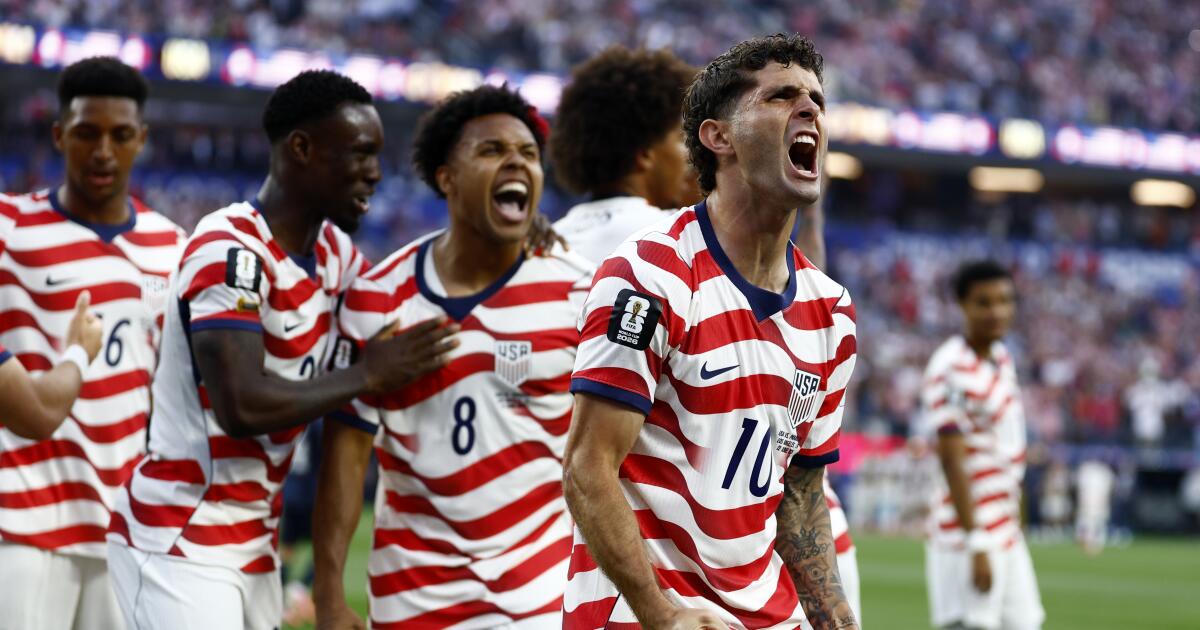
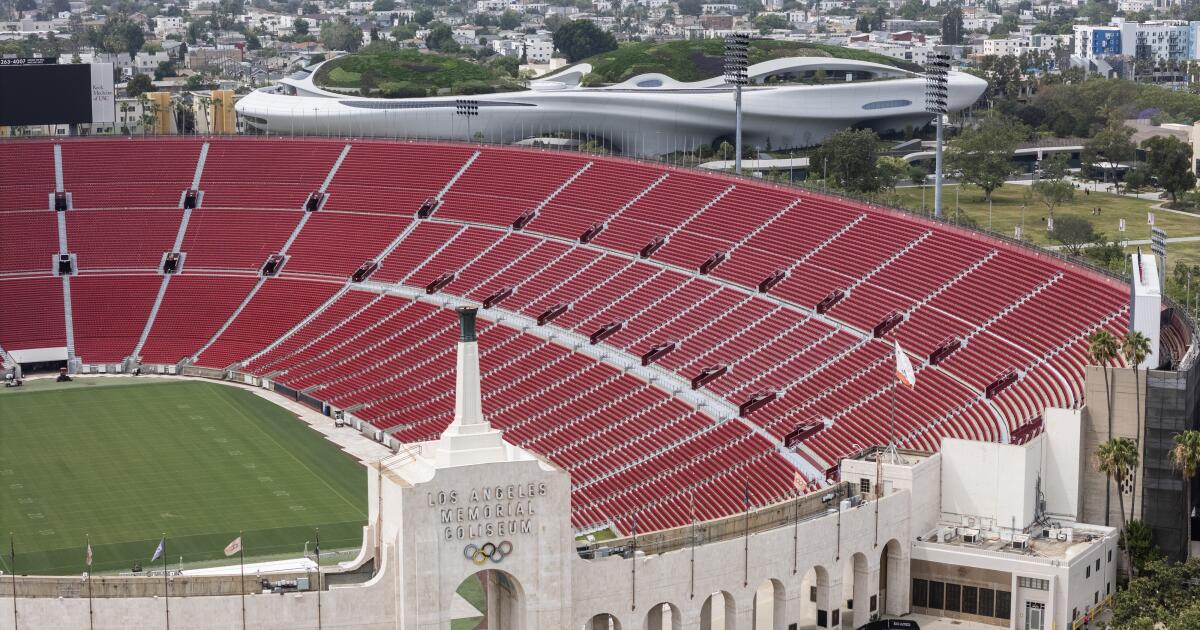
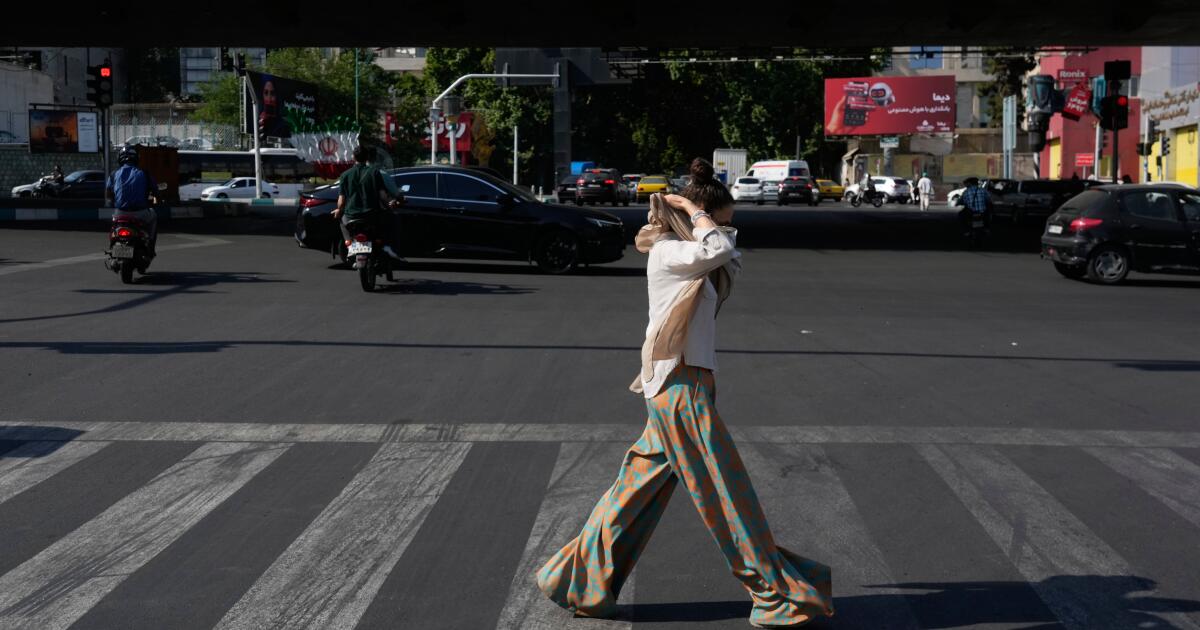
“Do you have an extra ticket?” a man shouted outside SoFi Stadium last Thursday.
The World Cup has been drawing fans from around the globe. But for many, getting a seat in the stadium has come at a steep price.
Some were lucky enough to nab $400 to $500 tickets through official World Cup lotteries, others paid thousands of dollars to catch the action IRL. Tickets for the upcoming USA versus Turkey match were selling for more than $1,400 on resale sites.
The demand has been so high that authorities have been warning fans about how to avoid ticket scams.
As crowds flocked into the stadium, we asked attendees about how much they paid to get into the most-watched sporting event in the world. Here’s what they shared.
Their responses have been lightly edited for length and clarity.
Luis Moreno, Luis Moreno Jr., Angelica Castellano, Diana Moreno and Ramon Aguilera of Orange County
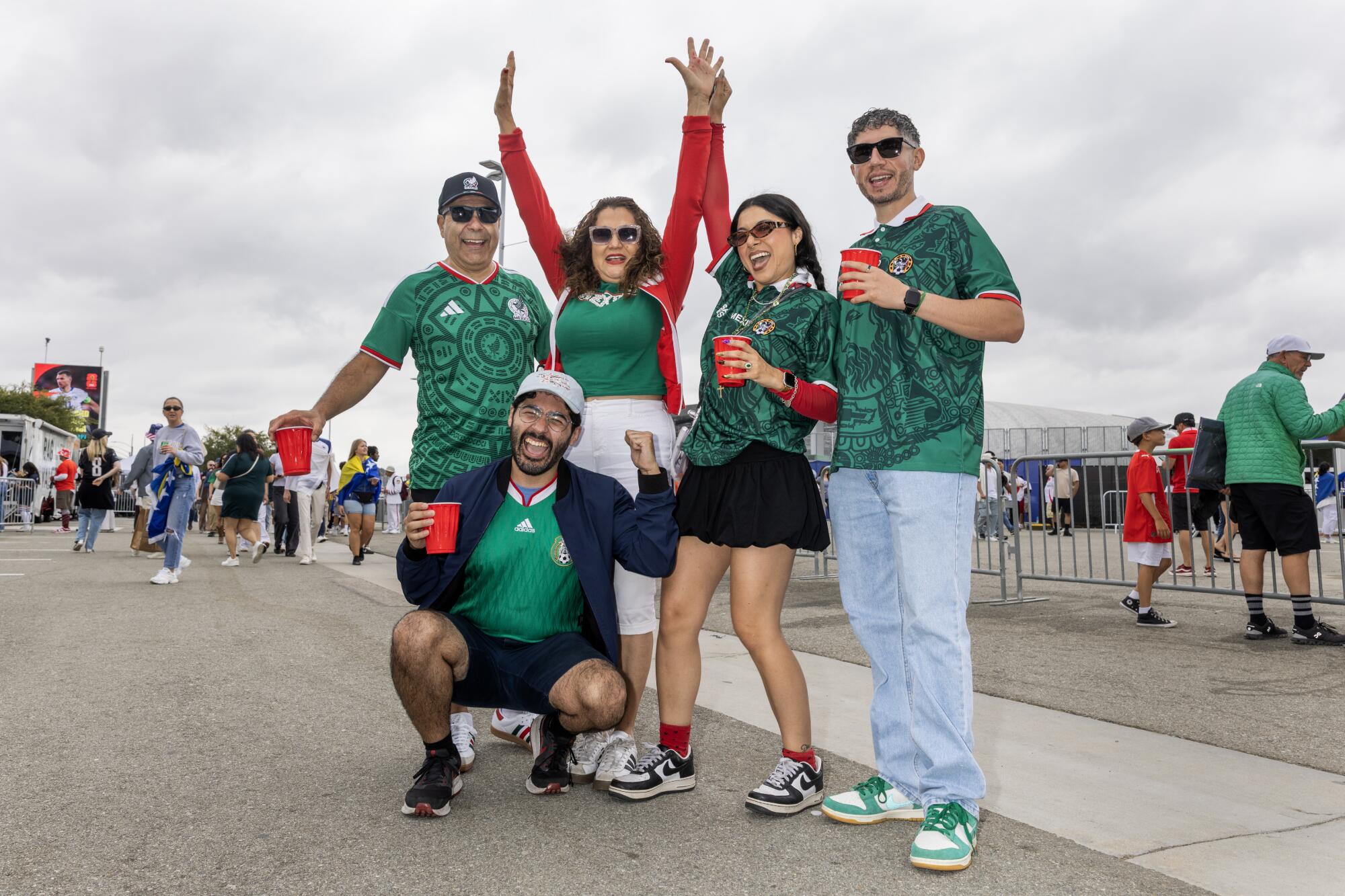
Luis Moreno, Luis Moreno Jr., Angelica Castellanos, Diana Moreno and Ramon Aguilera sport Mexico gear.
How much did you pay for your tickets?
Diana: We don’t want to say because I don’t want our parents to know.
*Whispers* We paid retail. It was like $500 per ticket. For Father’s Day, we wanted to make sure he got to enjoy it.
Why did you want to attend the World Cup?
Castellano: We went in ‘86 in Mexico, ‘94 in Pasadena and now here. We’re excited because I want to enjoy it with my kids. If we didn’t come, I would’ve been sad because they need to see how it is.
Diana: Now, it’s our turn. Even though [today’s match] is not our country, we still had to come and experience it. We’ll watch our team play later on the big screen.
Did you have to give up anything to be here?
Diana: Work, but that doesn’t matter. This is more important. Time with family.
Luis Jr.: Sleep. [Laughs]
Diana: It’s Thursday. We’re out here watching the game, we’re drinking, so there’s no complaints.
Was it worth it?
Diana: Absolutely. No matter what happens today. The fact that we’re here, it’s already a success.
Tell me about your outfit. You’re rocking Paisaboys, an L.A. brand.
Diana: I got the Paisaboys shirt on, repping. I know they have a collaboration with Nike. I got my Nike shoes on and I’m just ready to have a good time. My mom sewed her top last night. She wanted to add a little touch to it.
Angelica: Yes! This is an old, old, old jacket.
Diana: My dad’s outfit is sponsored by me. All Adidas, Father’s Day gift.
Luis Sr.: I got lucky this year.
Adam Chapman and Sarah Harrell of Washington, D.C.
Adam Chapman and Sarah Harrell.
How much did you pay for tickets?
Harrell: We went to two games: USA versus Paraguay [in Los Angeles] and Senegal versus France in New Jersey/New York.
Chapman: The L.A. tickets were way more expensive. We bought them presale for like $1,940, but the [seats] were still very high in the arena and the resale prices are actually cheaper than the ones we bought on presale. It’s horrible. [Laughs]
Why did you want to come to the World Cup?
Chapman: This is my first men’s World Cup. I went to the women’s World Cup in Australia a couple years ago. The last time the U.S. had a men’s World Cup here was like forever ago. We’re probably not going to have another in our lifetime, so I really wanted to make sure we had a chance to go to some games.
Did you have to give up anything to be here?
Harrell: We’re moving the day we get back, so we were packing until the moment we got here. Some of this gear was last-minute purchasing in order to make that work. Also, we took a six-hour plane ride, middle seats. We really committed to get here. We got cat sitters, we both took days off from work, the whole thing.
Was it worth it?
Chapman: Yeah, just for the experience. It’s more money than we would’ve wanted to pay but yeah.
Harrell: We bought the tickets like a year and a half ago, so it’s been on the calendar forever. We ended up getting to bring my brother and his best friend to celebrate his 40th birthday, so it sort just worked out for all of us.
Cambage: This is my first fútbol game ever. I wanted to come cause it’s L.A. Yay sports! It’s a once-in-a-lifetime opportunity. Let’s get out there and get into it.
Samimi: I’m born and raised in L.A. so I’m happy to see the World Cup here.
Tell me about your outfit inspiration.
Samimi: I’m wearing Honor the Gift, Russell Westbrook’s brand, a Nike top, my shorts are from a random boutique in L.A. and Jordan shoes.
Cambage: I just went crazy at the Nike store. I’m not gonna lie. We just came from the Nike store. I’m reppin’ USA today. Yes, I am Australian, but I do live in America and USA is AUS. [Laughs]
Kenan Sahbaz of St. Louis and family
Bosnia and Herzegovina fans cheer on their team.
How much did you pay for your ticket?
I got mine directly through the FIFA website. We paid $500 a piece. I brought my son, my cousins and their kids.
Why did you want to attend the World Cup?
Sahbaz: This is our very first World Cup. It’s a historic event for our very small country, Bosnia and Herzegovina. This is a huge accomplishment in the past 12 years. This is going to be the first time we’ve made it here again. We’ve got a really good squad and I think we can do some amazing things for our country. This is a time when we really need some support and joy in the country, and no better way to do it than at the World Cup.
Who’s your favorite player?
Kids: Džeko.
Did you have to give up anything to be here?
Sahbaz: A lot. Work. Time. We were initially going to go on vacation to the Bahamas, but I asked him either the Bahamas or the World Cup. So when we found out that we made it, it was the World Cup. We canceled everything else. We even went to the qualifiers in Wales and that was a once-in-a-lifetime experience as well. There was just no way we were going to miss it.
Was it worth it?
Sahbaz: 100%. Win or lose, we still win today.
Daniel Henriquez and David Njenga of Seattle
David Njenga, left, sports Kenya gear, while Daniel Henriquez cheers for El Salvador.
How much did you pay for your ticket?
Henriquez: This match was $500 each. We bought it in like October of last year.
Why did you want to attend the World Cup?
Njenga: Because this is the World Cup. You have to go to a World Cup. This is my second one. I was in Qatar for the last World Cup.
Henriquez: The energy! World Cup baby!
Njenga: There’s people from all over the world. We are all assembled here to enjoy this moment.
Henriquez: This is what happens when all the world comes together. This is our utopia. We all love each other. We’re all here for one thing, to support our country.
Did you have to give up anything to be here?
Njenga: My job. I have to be at work right now, but I took the day off. I don’t mind.
Henriquez: I’m a nurse for the fire department. My boss was awesome. She gave me a day off. I love my boss Nancy. Go Nancy!
Was it worth it?
Njenga: It is worth every penny. It’s not even the money. It’s the experience. After this, we head to San Francisco for another game.
Henriquez: Then we’re heading to Vancouver and then we have another game in Seattle.
Njenga: We’re going to six games [in total]. Our Houston tickets were the cheapest. They were about $400.
Cindy Vazquez of Grenada Hills
Cindy Vazquez Zavala reps Mexico with her outfit.
How much did you pay for your ticket?
It was free.99. Shh!
Why did you want to come to the World Cup?
This is my first World Cup. The Jordan team invited me to attend this game, so lucky me. That’s why I’m wearing Jordans today. I’m in the industry so they invited a few employees from neighborhood stores to come.
Tell us about your outfit inspiration.
Today there’s a Mexico game, so I still gotta rep even though I’m attending this match [Switzerland versus Bosnia and Herzegovina]. The outfit is a Nike T90 jersey and my lace is from Amazon. I got the little [soccer] ball, the little World Cup and teddy bear from the gas station. I needed it.
Did you have to give up anything to be here?
I actually had to request PTO to attend, but the store is still running without me. Right after this game, I actually have to jet back. I work at Feature, which is a sneaker boutique in Studio City. S/O Feature for allowing me to come here!
Fabian Almiron of Spain
Fabian Almiron, originally from Paraguay but currently living in Spain, rides Metro to the game.
How much did you pay for your ticket?
I paid $1,100 for the first game [June 12], $290 for the Turkey game [June 19] and the last game with Australia was $170 [June 25].
Why did you want to come to the World Cup?
This is my first World Cup. I live in Spain, but I’m rooting for Paraguay. I’m very excited to be seeing them participate after 16 years.
Did you have to give up anything to be here?
I used like 20 to 25 days of vacation time to come see the World Cup.
Was it worth it?
Yes!
Sunny Kwong, Sam Mallari, Antonio Evangelista, Michael Evangelista of San Diego and Los Angeles
Antonio Evangelista, Sam Mallari, Michael Evangelista and Sunny Kwong are decked out in Bosnia and Herzegovina gear.
How much did you pay for your ticket?
Michael: We paid $400 each. We got lucky with the last chance lottery. They released the tickets a few months ago.
Why did you want to attend the World Cup?
Michael: We’re rooting for Bosnia this time. This is our first World Cup.
Antonio: It’s a lifelong dream. I’ve loved the sport ever since I was in the Philippines.
Did you have to give up anything to be here?
Michael: Most of us had the day off. I worked in the morning at like 6 a.m. and then I’m going to work afterward. I really wanted to carve out time to be there.
Mallari: I took time off because this is my first soccer game ever and I wanted to experience the World Cup with true fans.
Was it worth it?
Michael: 100%. It’s honestly a once-in-a-lifetime experience. It’s been awesome to be here with my dad. We watched the last World Cup finals and we were literally in tears. I know he’s been playing soccer ever since he was in the Philippines military.
Antonio: 20 years.
Becky Clift of Orange County and William Wagner of San Diego
Colleagues William Wagner and Becky Clift sport traditional festival inspired outfits to cheer on Switzerland.
How much did you pay for your ticket?
Clift: They were gifted to us.
Wagner: We’re a fortunate group.
Why did you want to come to the World Cup?
Clift: The World Cup in America is super fun, so we wanted to support it and be a part of it. This was the game that we got tickets for, so we decided to dress up a little bit and have some fun.
Wagner: We’re both soccer people. We both speak the world’s language, so we’re happy to be a part of it here.
Tell me about your outfit inspiration.
Wagner: I have a very close Swiss friend who was equipped for this. One quick phone call and here I am.
Clift: Then I had to get mine so I could support.
Did you have to give up anything to be here?
Wagner: A full day of work. We’re both engineers. We know each other through work.
Was it worth it?
Wagner: We’ll find out.
Clift: Heck yeah!
Jorge Morales of Topanga
Jorge Morales holds out a ball he got at the World Cup opener in Mexico City.
How much did you pay for tickets?
It was between $800 to $900 for my USA versus Paraguay tickets. I bought them through Seat Geek.
Why did you want to come to the World Cup?
I wanted to experience it not just in Los Angeles, but I also wanted to experience it in Mexico. I’m going to three games in Los Angeles and four in Mexico City. Going to my first World Cup in Mexico City was a whole different ballgame. Mexico played in their home country and they won. It was like pandemonium. Even though it was raining over there at the time, it was still a lot of fun. Everyone was hugging each other. I’m looking at you, New York Knicks fans. [Laughs]
Did you have to give up anything to be here?
I’m used to traveling, so I’m like this ain’t nothing. I just wanted to experience a World Cup game and the fact that it’s in three countries, you’re not going to experience that any other time. It’s the one and only World Cup where you’re going to see three countries hosting it.
Alexi Kulik, Marcella Harkness, Luke Kulik and Ian Harkness of San Diego
Switzerland fans Alexi Kulik, Marcella Harkness, Luke Kulik and Ian Harkness.
How much did you pay for your ticket?
Ian: $450 per ticket.
Alexi: We won the ticket lottery. That’s the only way ‘cause the resale is expensive.
Why did you want to attend the World Cup?
Marcella: This is our first World Cup!
Ian: I was at the Switzerland versus Qatar game. Similar outfit. We got it dialed this time. Lots of fun. Tough ending, but what are you going to do?
Luke: We wanted to support Switzerland. Everyone in the family is Swiss. It’s fun to go to a World Cup game. We were just excited to get tickets. I think it’s a great way for the family to spend time together and a good excuse to get out of work.
Did you have to give up anything to be here?
Luke: Time off work. Time to come here. We drove up here. I don’t think we gave up much. We just enjoy being here.
Ian: $450.
Alexi: And we woke up at 5 a.m., so that we could come up here and spend the day together.
Was it worth it?
All: Yes!
Anja Gegic, Dino Gegic, Benjamin Mustafic, Nordin Kapic, Armin Kapic of Los Angeles
Bosnia and Herzegovina fans Anja Gegic, Dino Gegic, Benjamin Mustafic, Nordin Kapic and Armin Kapic.
How much did you pay for your ticket?
Nordin: $3,000. We’re like literally on the field.
Anja: $450. In L.A., we got it like that.
Why did you want to attend the World Cup?
Anja: This is our second time ever qualifying for the World Cup. We are so proud to be here and support our country today.
Nordin: I mean, look around. Why would you not want to be here today?
Armin: We’re hoping for the win!
All: 2-0!
Bendicht Hügli and Lucia Grajales of Mexico City
Lucia Grajales and Bendicht Hugli, both currently living in Mexico City, hold a Swiss flag.
How much did you pay for your ticket?
Hügli: The ticket was $650. That’s stealing. That’s robbery. When I went in ‘86, I think the tickets were 10% of the price I paid for this year.
Why did you want to attend the World Cup?
Hügli: I had some business in San Diego. I saw Switzerland is going to be here, so let’s hit it and break the bank to get tickets. I went to the World Cup in Mexico City in ’86. I saw 12 games. I’m going to one this time.
Was it worth it?
Hügli: We’ll see. If Switzerland plays lousy, then I’m going to be pissed, but I think they’ll do better than in the first game.
Flavia Sacco and Isidoro Garcia of Washington, D.C.
Flavia Sacco and Isidoro Garcia root for Paraguay.
How much did you pay for your ticket?
Isidoro: I think it was around $500 per ticket. Again, we were very lucky because Paraguay was the first game.
Flavia: It was early bird without knowing who was going to play.
Isidoro: We’re also going to the Paraguay versus Turkey game in San Francisco and the third one in Mexico City.
Why did you want to come to the World Cup?
Flavia: We’re rooting for Paraguay. I’m from Paraguay, born and raised.
Isidoro: This is my second World Cup. I went to the one in Qatar. We were very excited about it. Actually, we were very lucky too because we bought Paraguay’s tickets when they were selling them blank. So we just bought the three tickets for Paraguay before knowing the group stage and then it turned out to be in the U.S., so it was awesome.
Flavia: We were hoping it would be on the East Coast because that’s where we live and it ended up being on the other side of the country, but we already had the tickets and we really wanted to go to a game, so we flew. We’re coming straight from the airport. We have our 5-month-old baby who is at the hotel with my mom.
Did you have to give up anything to be here?
Isidoro: I guess time with our daughter. Even though it’s only going to be a few hours, we miss her a lot. She’s very tiny. Every [moment] is precious with her.
Was it worth it?
Isidoro: Yes, even though it’s a few hours and hopefully Paraguay will pull it off.
Jorge Espinosa of Los Angeles
Jorge Espinosa of Los Angeles.
How much did you pay for tickets?
For the USA versus Paraguay ticket, I think I paid like $1,800, and for another match, I think I paid about $1,020, so a little less. I think that’s when the prices started to go down.
Why did you want to come to the World Cup?
I’ve always wanted to go. I missed my chance to go to Brazil in 2014. I really wanted to go, but I had just taken a huge trip to Asia, so I couldn’t really go. I didn’t have any money left and I’ve been thinking about the World Cup being here since it was awarded to the U.S. I was really bummed out when it was awarded to Qatar instead of the U.S. and also instead of Australia. I’m really excited about it. It feels unreal.
What does it mean for the World Cup to be in your hometown?
It means so much. I remember when they had it here in ‘94. I didn’t get a chance to go to any of the games, but the energy that you feel around the city is like next level. The events they’ve been hosting are so awesome. You get to meet more people from other walks of life and other countries.
Did you have to give up anything to be here?
I just pretty much had to pick up more debt, but I get points so it’ll help fly somewhere. Also, debt disappears when you die so they can try coming after me for that World Cup money, but they never will. [Laughs]
Was it worth it?
I looked at the price and was like, “It’ll never be this cheap in my life, ever.” It’s only ever going to go up, and, hey, it’s in my backyard.
The raft of proposed changes includes a new constitution and anti-corruption office, and the ousting of the president.
Published On 22 Jun 202622 Jun 2026
Hungary’s Prime Minister Peter Magyar has launched a wide-ranging reform drive aimed at pulling the state out of the captivity into which it was forced by former Prime Minister Viktor Orban.
In a fiery speech to parliament on Monday, Magyar announced a raft of economic, political and legal measures dubbed “Operation Cleansing Fire”. The plan will see the Tisza Party government install a new constitution, purge the country’s institutions, establish a new anti-corruption office, and unseat the president.
Recommended Stories
list of 4 itemsend of list
“We will free our country from the captivity of the political and economic mafia that has ruled for the past 16 years,” Magyar said.
Magyar took office in April, unseating the former prime minister after 16 years of rule. Orban’s Fidesz party had spent that time using its majority to seize control of virtually every lever of power in Hungary. It was also accused of organising systemic corruption, pushing Hungary closer to Russia, and sowing discord within the European Union.
Tisza now faces a daunting task to untangle that web, to rid Hungary of corruption and to remove key Orban allies throughout the power pyramid.
The proposed changes are part of a reform race for Magyar’s government. Using Tisza’s constitutional majority, he is pushing to fulfil a deal with the EU to implement reforms that would unlock a total of 16.4 billion euros ($19bn) in funds – frozen due to rule of law concerns during Orban’s reign – by the end of August.
Key to that drive is the removal of President Tamas Sulyok. Magyar has called on the head of state – appointed by Orban – to resign, and on Monday proposed a constitutional amendment for his removal.
The president of Hungary has few formal powers, but can slow the adoption of legislation by returning it to parliament or forwarding it to the Constitutional Court.
Sulyok has maintained he had no political agenda. Fidesz lawmaker Gergely Gulyas called Magyar’s speech on Monday “slanderous and appalling”.
Magyar’s plans would see the election of a new president, for a maximum of five years, if Sulyok is removed.
A constitutional review, complete with public discussions, would, meanwhile, kick off in September and be subject to a referendum.
Other changes would set an age limit of 70 for judges at the Constitutional Court, forcing Orban ally Peter Polt to retire as head judge, and limit lawmakers’ terms to 12 years.
Citing figures that corruption has cost Hungarians 8 to 10 percent of gross domestic product in recent years, Magyar vowed that Hungary’s top talent would field the new anti-corruption authority.
“The best police officers, the best investigators and the best experts will work for this agency,” Magyar said.
Earlier this month, the Hungarian parliament passed a constitutional amendment limiting prime ministerial terms to eight years, effectively preventing Orban from returning in the future.
MPs also voted to scrap a provision underlying the establishment of the so-called Sovereignty Protection Office, which was created in 2023 to protect Hungary from “foreign influence” and was used to investigate critics of Orban.
Closing the office was among the priorities that rights group Human Rights Watch recommended in April, alongside “moving quickly to meet the rule of law milestones” required for the EU funds, including judicial independence and anti-corruption safeguards.
How it started: A dream. A French machine-gun officer in the trenches during the First World War. A man named Jules Rimet, who believed an international soccer tournament would bring the nations together with the goal of peace.
How it’s going: The world’s biggest party. A 48-nation celebration of the world’s most beloved sport. Expected to generate about $8.9 billion, it’s become such a big deal that it’s being hosted by three countries — one of which, yes, launched a war on a competing nation in the months before the tournament.
The United States’ war with Iran, costly in all the profound ways that war is, also laid the groundwork for an uneven — and possibly precedent-setting — playing field.
At this World Cup, Team Melli has been subjected to shifting travel restrictions and uncertainty unlike the other 47 teams, spending the tournament commuting between Southern California and its base in Tijuana.
And still, after Sunday’s 0-0 draw against Belgium, the world’s No. 10-ranked team, Team Melli is in position to not only get out of its group at the World Cup for the first time, but to win Group G.
Iran’s treatment only makes its performance more impressive — while bringing into question the future of a tournament that purports to be apolitical. And conjuring up concerns about how the Olympics will operate when L.A. is supposed to open its arms to the world two years from now.
Will we be laying down blanket bans again? Will it be easier to ditch diplomacy than to deal hospitably with a global audience for a global event?
Russia and Qatar were capable of implementing systems that relaxed visa requirements to accommodate every team and its fans in the previous two World Cups. Why couldn’t the United States?
Instead, the U.S. State Department suspended visa issuance for nationals from not only Iran, but also from participating countries Haiti, Senegal and Ivory Coast. Iraq’s striker, Aymen Hussein, was held and questioned for nearly seven hours at Chicago’s O’Hare airport.
And the U.S. has allowed members of Iran’s team — discounting the 15 administration officials who reportedly were denied entry — to enter the country only within 24 hours of a match and leave the same day.
And those arbitrary restrictions — they’re OK 24 hours before a match, but not 48? — have put Team Melli at a competitive disadvantage.
“I think that united us even more,” said winger Alireza Jahanbakhsh, who spoke eloquently in English postmatch, a gracious statesman in Adidas sneakers. “That’s one of the things that I think we showed today — we showed a great team character. And part of it comes from the situation we are in.”
Through an interpreter, coach Amir Ghalenoei broadened the scope of what Iran has been facing in its runup to the World Cup.
“We were in a state of war for six months, we didn’t have a league and I remember once during a FIFA qualifying day, we traveled 40 hours by land to another country to play,” Ghalenoei said. “Everybody knows about the visa issues. Everyone knows about our coming to America. A part of the team was in competition conditions and part of them had their domestic league suspended because of the war … and many of the teams that were supposed to play us, canceled.
“I think we entered the World Cup in the worst possible conditions. This is the part I wanted the whole world to know … but the players who entered the World Cup under these conditions are truly commendable.”
It’s been a spirited rebuttal to what’s felt like a counterattack on the inherent values of the World Cup. A reminder that governments and governing bodies can get it wrong, but the beautiful game stays undefeated.
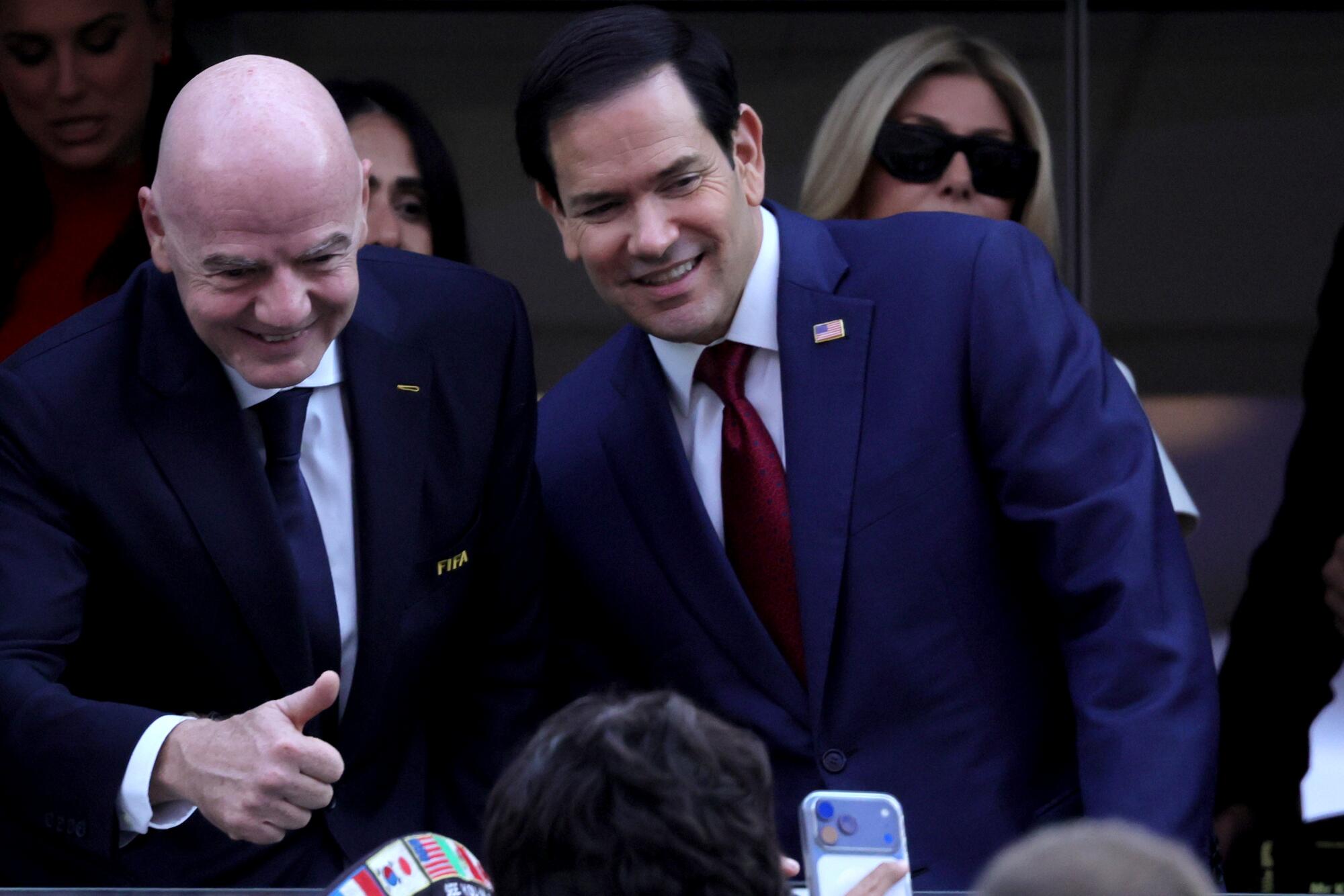
FIFA president Gianni Infantino, left, and U.S. Secretary of State Marco Rubio pose for a photo before a World Cup game between the U.S. and Paraguay at SoFi Stadium on June 12.
(Robert Gauthier / Los Angeles Times)
But what about FIFA?
What about the all-powerful governing body that runs the sport, whose motto is “Football Unites the World”?
The world’s foremost party planning committee, with the cachet to override branded venue names with generic, location-based names — Los Angeles Stadium instead of SoFi Stadium — on Google and Apple maps?
What has FIFA done to flex its muscle to maintain the integrity of the world’s beautiful game?
Not much.
There have been niceties and brownnosing, but no sanctions or threats thereof. Not even a hint of repercussions for diminishing the integrity of the event.
No fines, like what FIFA imposed on six national football associations in response to racist incidents involving supporters during the qualifiers for the World Cup.
No bans, like what FIFA leveled in 1988, when it ousted Mexico from all FIFA competitions for using four overage players in the Under-20 World Cup, or in 2006, when Myanmar was banned from qualifying after refusing to play Iran in an Asian qualifying match for the 2002 World Cup.
Peace talks are ongoing between the United States and Iran, but Iran’s footballing ambassadors haven’t been free to move or to prepare as they wish ahead of its matches against Belgium, and before that, their 2-2 draw against New Zealand.
Apparently, though, Iran will get greater control over travel arrangements before its now hugely consequential final group-stage match is in Seattle against Egypt on June 26, or so Ghalenoei believed when he addressed reporters Saturday.
“What my problem is, why didn’t they let us come earlier for the first two games as well?” Ghalenoei asked. “If they’ve managed to do this now, why didn’t they do that for our first game and for this game?”
Good questions.
Questions no one should be asking at the World Cup.
WASHINGTON — Colombian presidential candidate Abelardo de la Espriella has vowed to crush criminal groups and slash government programs. He promises to bomb “narco-terrorist” camps and build sprawling mega prisons if he wins Sunday’s runoff election.
De la Espriella’s views have earned him the vociferous backing of President Trump, who has broken with White House tradition by publicly seeking to tip the scales in foreign elections — particularly in Latin America.
After Trump gave his “complete and total endorsement” to De la Espriella, whom he referred to by his nickname, “El Tigre,” the candidate posted an AI-generated image of a bald eagle and a tiger, with American and Colombian flags waving side by side.
“You have paved the way for the people to defeat the entrenched powers that have long held sway,” he wrote to Trump. “In Colombia, we have now begun to follow the same path.”
De la Espriella, a political newcomer who built his campaign around gym workout videos and vows to “disembowel” the left, is part of a new wave of far-right, MAGA-aligned politicians in Latin America openly borrowing from Trump’s playbook, presenting themselves as outsiders who will trim the government, curtail immigration and militarize law enforcement.
In a region that remains plagued by high crime and inequality after a decades-long period of leftist domination known as the “Pink Tide,” the playbook appears working.
More Latin Americans now identify with the right than at any time over the last two decades, according to polling firm Latinobarómetro. A series of conservatives have won presidential elections in recent years, giving Trump a slate of willing partners as he seeks to expand U.S. power in the region, combat drug cartels and counter growing Chinese influence.
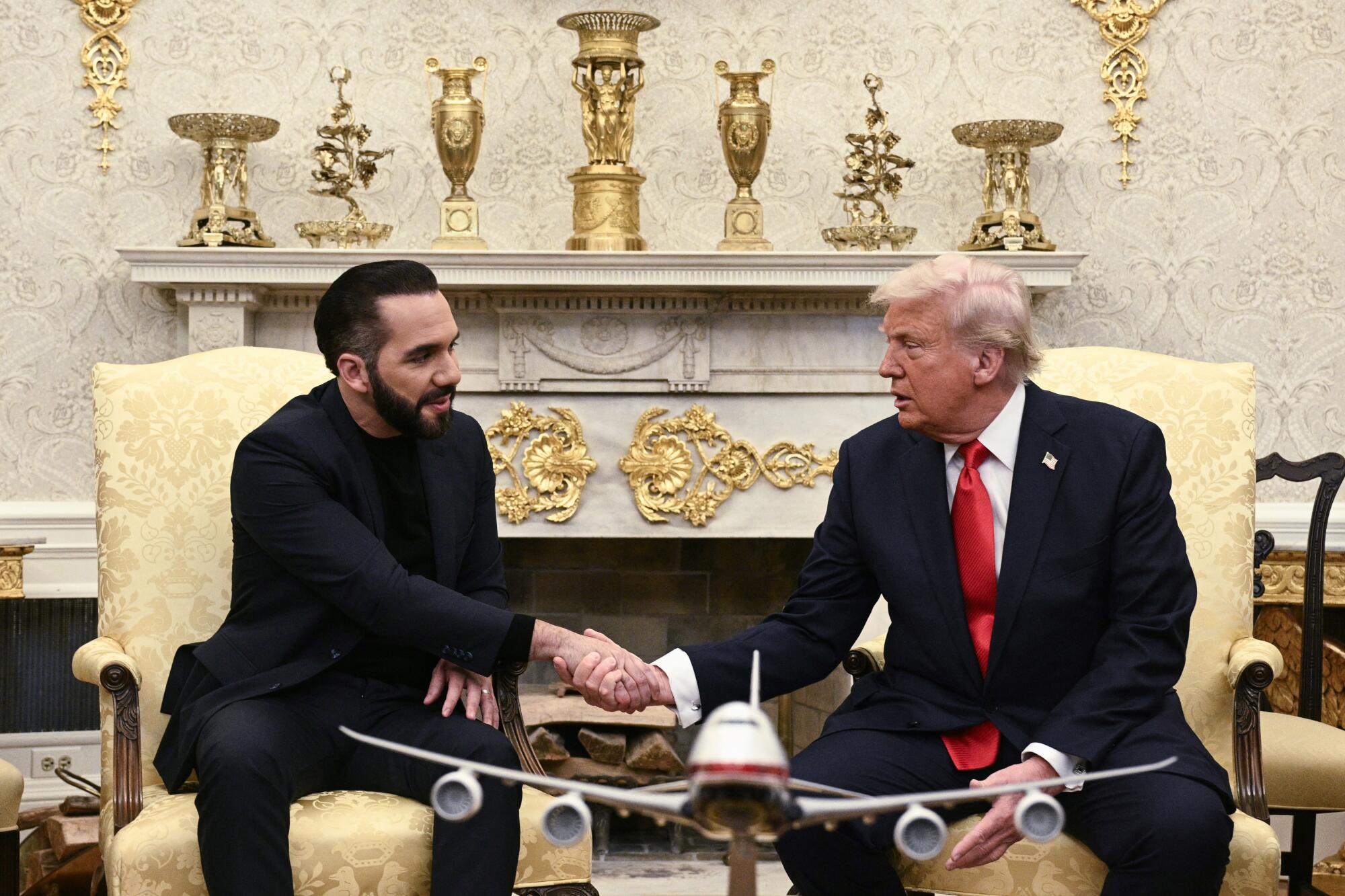
President Trump meets with El Salvador’s president, Nayib Bukele, in the Oval Office of the White House on April 14, 2025.
(Brendan Smialowski / AFP via Getty Images)
Among Trump’s many allies are Argentina’s Javier Milei, a libertarian firebrand whose dramatic cuts to state services were a blueprint for Elon Musk’s so-called Department of Government Efficiency, known as DOGE; and El Salvador’s Nayib Bukele, a mano dura autocrat who housed U.S. deportees in his notorious prisons to assist Trump’s immigration crackdown.
Ecuador’s Daniel Noboa has welcomed U.S. Special Forces, who are attacking drug traffickers in his country, and Chile’s José Antonio Kast has pledged a border wall along his country’s frontier with Peru and Bolivia in his quest to “make Chile great again.”
Trump might soon gain another ideological bedfellow in Peru with the election of Keiko Fujimori, the daughter of late autocrat Alberto Fujimori. With ballots still being counted, Fujimori was on track for a narrow victory
In a sea of nations led by conservatives, the left now retains power in just three key countries: Mexico, Colombia and Brazil.
It faces serious challenges in two of them.
Ahead of October’s presidential election in Brazil, incumbent Luiz Inácio Lula da Silva, a leftist stalwart and one of the last vestiges of the Pink Tide, has been polling even with Flávio Bolsonaro, the son of former President Jair Bolsonaro, a Trump ally convicted of convening a Jan. 6-style insurrection.
Brazil’s President Jair Bolsonaro, right, with President Trump during a dinner at Trump’s Mar-a-Lago estate in Palm Beach, Fla., on March 7, 2020.
(Alan Santos / Associated Press)
And then there’s Colombia, where De la Espriella, a criminal defense attorney, surged ahead in the first round of voting and this weekend faces off against Sen. Iván Cepeda, an ally of leftist President Gustavo Petro.
Petro drew Trump’s ire by denouncing the U.S. military campaign to oust leftist President Nicolás Maduro of Venezuela and a spate of lethal U.S. attacks on alleged drug boats.
Petro slammed Trump’s endorsement of De la Espriella, calling on Colombians to “vote freely and not allow ourselves to become either slaves or anyone’s colony.”
Mexican President Claudia Sheinbaum also accused Trump of electoral interference after the U.S. announced drug trafficking charges against several members of her ruling Morena party and The Times revealed that two more sitting governors are under investigation.
“Is it truly a legitimate interest to combat organized crime?” Sheinbaum asked of the U.S. investigations. “Or are we perhaps witnessing how sectors of the American far right … intend to influence the 2027 election in our country?”
President Trump meets with Argentine President Javier Milei during the United Nations General Assembly on Sept. 23, 2025, in New York.
(Evan Vucci / Associated Press)
The White House has declined to comment on Sheinbaum’s criticism. But Trump earlier this month warned Mexico that his administration is “focused on coming in by land” to deter drug trafficking.
“President Trump has been clear that Mexico must do more to combat the drug cartels running rampant in their country,” a White House official told The Times when asked whether Trump is planning a military operation there.
Trump, who publicly backed Kast and President Nasry Asfura of Honduras, as well as Milei’s political party ahead of Argentina’s midterm elections last fall, has openly mused that he should charge money for endorsement of leaders in foreign countries.
Guillaume Long, who served as foreign minister in Ecuador under leftist President Rafael Correa and who is now a fellow at the Center for Economic and Policy Research, criticized Trump’s “unprecedented, unabashed interventionism in Latin American politics.”
“There are a number of taboos that have been broken,” he said.
Long added that Latin America is mirroring the United States in its political divisions. “I think we’re likely to see in the coming decades a very polarized politics,” he said. “And that doesn’t bode very well for political stability.”
Much of Trump’s activity in the region, including the deposing of Maduro, has been presented as part of a war on drug cartels, which the White House has formally declared terrorist organizations. Long described that rationale as a “pretext” for expanding U.S. political and economic influence in the region.
Nicolás Maduro and his wife, Cilia Flores, are escorted by federal agents as they make their way to an armored car for a trip to a federal courthouse in Manhattan on Jan. 5.
(XNY/Star Max/GC Images)
He said he believed that focus on cartels had pushed some Latin American politicians to the right “because they think being security hawks will make them popular with the Trump administration.”
But James Bosworth, the founder of Hxagon, a company that provides political risk analysis in Latin America, said many leaders in the region have come to tough-on-crime policies on their own.
“I think that some of the hemisphere is willing to play along with it because the hemisphere has issues, including security issues, where the U.S. can be of assistance,” Bosworth said. “Many Latin Americans do want a greater military focus, so there’s certain alignment that’s occurred.”
Conversely, Mexican journalist Alex González Ormerod said he believes Trump has been influenced by Latin American leaders, including Bukele, who suspended civil liberties and began locking up alleged gang members en masse in 2021.
“I think there’s a lot of cross-pollination going on,” he said, crediting groups like the Conservative Political Action Conference, a gathering of right-wing activists and elected officials that has hosted events in Brazil and Argentina.
Many analysts cautioned that Latin America operates on a pendulum, swinging every few years between right and left.
“There’s a lot of evidence that voters are just unhappy and voting for the opposition, and then losing patience very quickly with whoever is in office,” said Benjamin Gedan, director of the Latin America Program at the Stimson Center.
Voters dissatisfied with the status quo so often vote out incumbents there is a phrase for it: voto castigo, or “the punishment vote.”
Ceballos reported from Washington and Linthicum from Mexico City.
WASHINGTON — In congressional races across the country, a new crop of super PACs is taking to the air with millions of dollars worth of advertisements to sway voters.
“President Trump said it best, ‘Celeste Maloy will never let you down,’” says one advertisement supporting the Utah Republican representative in her upcoming primary election.
“Standing up to big pharma, fighting for local jobs, Val Hoyle doesn’t back down,” says an ad backing the Oregon Democratic representative ahead of her primary victory last month.
The super PACs have nondescript names — such as Jobs and Democracy PAC and American Mission — and the text is so generic that it almost seems to have been created by artificial intelligence.
That isn’t so far off the mark. The AI industry has funded the ads.
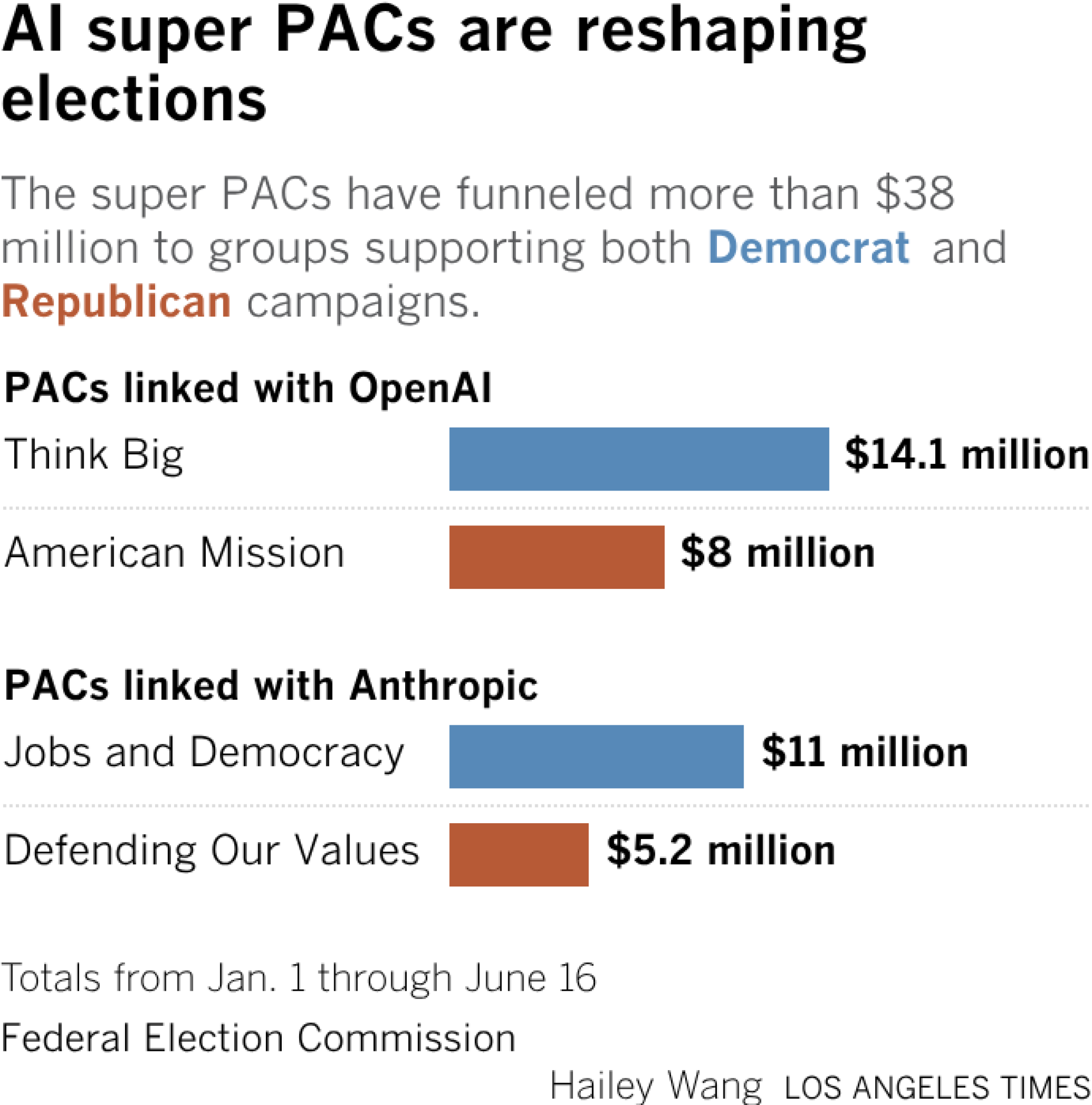
One network of super PACs is linked to Anthropic, maker of the popular AI tool Claude, and the other to Open AI, maker of ChatGPT.
They have been among the most prolific political spenders so far in the 2026 midterm elections, splashing out more than $37 million to date to influence races across the country and making the groups among the biggest outside spenders so far in congressional races. That number could grow exponentially as campaign season heats up closer to the November election — and as the Silicon Valley giants prepare initial pubic offerings that are poised to raise billions of dollars for the companies and their executives.
The AI political spending boom comes as emerging technology companies have become increasingly “comfortable with using their power to achieve a political goal,” said Adam Kovacevich, a former Google public policy executive and founder of Chamber of Progress, a technology trade group with a progressive orientation.
The leading AI companies have a history.
Anthropic was formed by former OpenAI employees who were concerned that the company was less focused on its original mission to safely harness the power of AI.
The companies are now the leading drivers of the burgeoning AI industry, and their competing views about how the technology should be regulated are playing out in a wide-ranging political ad spending war that has targeted congressional races in big cities and rural areas alike.
Anthropic calls for more stringent regulation and supports efforts by states such as New York and California that have passed more aggressive AI laws.
The groups spending in these races are super PACs, which are able to raise and spend unlimited amounts of money in federal races thanks to the 2010 Citizens United Supreme Court decision.
In some races, the AI-backed political groups have spent more than the candidates they are backing.
“There was no way as a grassroots person that I could compete with that kind of money,” said Al Olszewski, whose opponent in a Montana Republican congressional primary beat him by 30 points after getting a boost from $877,000 in ads from a super PAC backed by OpenAI’s co-founder. “I got crushed.”
The AI behemoths have emphasized that they are independent from the political groups.
One group counts $25 million in support from OpenAI co-founder Greg Brockman and his wife, Anna, alongside $100 million tied to one of Silicon Valley’s biggest venture capital firms, which holds a large stake in OpenAI. The global policy chief for OpenAI was reportedly involved in conceiving the group.
The other side has gotten $20 million from Anthropic and millions more from donors whose identities are not public.
This anonymous political cash is commonly known as dark money, and its prevalence is growing.
(Los Angeles Times photo illustration; source photos courtesy of the Tech Oversight Project)
“This has become very normalized now,” said Brendan Glavin, director of insights at OpenSecrets, which tracks campaign spending. “In 2024, we tracked over $1 billion in dark money.”
The political activity of these AI companies and executives reflects a dramatic shift from how emerging technology companies have historically engaged with politics.
Google, for example, didn’t hire its first in-house Washington lobbyist until after the company had gone public in 2005.
“I think that for a long time, the tech industry lobbying strategy was just ‘leave us alone,’” Kovacevich said.
He sees the spending by these AI-linked super PACs as following the recent playbook developed by the cryptocurrency industry, which has funded the only network of political groups that has spent more on congressional races this year than those linked to OpenAI.
“I think what the crypto industry realized was that there’s no substitute for building up political power,” Kovacevich said.
The political stakes for these technology companies are significant.
“AI policy is far from settled,” said Asad Ramzanali, the former deputy director for strategy in the White House Office of Science and Technology Policy during the Biden administration and the director of artificial intelligence and technology policy at the Vanderbilt Policy Accelerator.
Earlier this month, the Trump administration banned foreign nationals from using the most powerful AI model developed by Anthropic — and even banned the company’s own employees from it — which forced the company to restrict access for all users.
Manhattan matchup
The two super PAC networks have largely shied away from producing ads that mention AI and have mostly chosen to avoid competing against each other in the same races.
There’s one big exception.
In the marquee Manhattan Democratic congressional primary to replace retiring Rep. Jerry Nadler (D-N.Y.), each side has spent millions of dollars.
While the field includes Kennedy scion and social media star Jake Schlossberg and former Republican turned Trump critic George Conway, the target of all the AI-backed spending has been Alex Bores, a former Palantir data scientist who now serves in the New York state Assembly.
New York congressional candidate sponsored a state measure Bores requiring major AI companies to be transparent about their safety protocols and promptly report safety incidents.
(Yuki Iwamura / Associated Press)
That’s because Bores sponsored a state bill, known as the RAISE Act, that requires major AI companies to be transparent about their safety protocols and promptly report safety incidents. The bill was signed into law in December 2025.
The ads sponsored by the group tied to OpenAI, which has spent more than $7.5 million in the race, paint Bores as someone who can’t be trusted.
They cite his support from other tech billionaires, including former crypto mogul and convicted financial fraudster Sam Bankman-Fried, whose super PAC spent $100,000 to support Bores in 2022 when he first ran for New York Assembly.
“Is that really who should be shaping AI safety for our kids?” one ad asks.
An ad sponsored by the Anthropic-backed network, which has also spent more than $7.5 million supporting Bores, makes the case that the bill he sponsored is exactly why he should be elected.
“As a computer engineer, Alex Bores saw how dangerous unregulated AI could be and he wrote New York’s RAISE Act to put real safeguards on A.I. and hold big tech accountable,” the ad says.
The AI ad barrage in New York has even included what might be considered a kumbaya moment in the ad wars — another super PAC created to support Bores is most heavily backed by both an employee of Anthropic and an employee of OpenAI, who both focus on AI safety.
The group, Dream NYC, has spent more than $1.7 million supporting Bores.
Bores and fellow New York State Assemblymember Micah Lasher have been atop the most recent polls in the race ahead of the June 23 primary.
A general view of businesses in St. George, Utah, on Wednesday.
(Ian Maule / For The Times)
Rural Republicans
For voters in many parts of the country, the debate over AI policy has played out locally as a debate over the massive data centers required to power the technology.
In Utah, a proposed data center in Box Elder County, backed by “Shark Tank” television personality Kevin O’Leary, has generated controversy because of questions about its impact on resources in the drought-prone state and its environmental effect on the nearby Great Salt Lake.
In the state’s most competitive Republican congressional primary — the vast, newly drawn 3rd Congressional District — both candidates expressed concerns about how the project has been developed and called for greater transparency in this plan and for future data centers in the state.
Utah congressional candidates Phil Lyman and Celeste Maloy in a debate on June 1. A super PAC backed by Anthropic has spent more than $920,000 to support Maloy.
(Rick Egan / Pool / The Salt Lake Tribune Via Associated Press)
Despite their similar position on the project, a super PAC backed by Anthropic has spent more than $950,000 to support Maloy, who is running in the new district after the boundaries of her old district changed.
“It’s a lot of money to throw at a race,” said her opponent, Phil Lyman, a former conservative Republican state Representative who ran to the right of Utah Republican Gov. Spencer Cox in an unsuccessful primary challenge in 2024.
Lyman insists he is no AI skeptic.
“I’m not anti data centers, I’m pro-transparency,” he said. “I think the future is bright with AI.”
The group said it is backing Maloy because it sees her as “someone who’s worked the issue” of AI regulation and who “has demonstrated leadership” with Republicans in Congress.
Maloy’s campaign didn’t respond to request for comment.
Utah congressional candidate Phil Lyman speaks during a Cottage Meeting at the SunRiver Community Center Ballroom in St. George, Utah, on Wednesday.
(Ian Maule / For The Times)
But Lyman suspects the group’s support for Maloy ahead of their June 23 primary has more to do with old-fashioned politics than any emerging technology.
Begona Gomez is accused of using her position as the prime minister’s wife to secure work contracts.
Published On 20 Jun 202620 Jun 2026
The wife of Spain’s Prime Minister Pedro Sanchez has been barred from travelling abroad as she prepares to face trial on corruption charges.
Investigating judge Juan Carlos Peinado issued the ruling on Saturday, ordering Sanchez’s wife, Begona Gomez, to hand in her passport and appear in front of court twice per month until a verdict is issued. She is charged with embezzlement, influence peddling, corruption in business dealings and misappropriation of funds.
Recommended Stories
list of 3 itemsend of list
Gomez has consistently denied any wrongdoing in the case, which stems from a complaint filed by an anticorruption group with far-right ties. It focuses on the creation and management of a chair at Madrid’s Complutense University that was co-directed by Gomez, as well as the alleged use of public resources and personal connections to advance private interests.
Sanchez has dismissed the allegations against his wife as an attempt by the right wing to undermine his government. Sanchez’s Socialist Party has said Gomez is innocent and subject to a years-long campaign of political persecution
No date has yet been set for the politically explosive trial.
The case is one of several corruption investigations involving Sanchez’s allies that are approaching trial or already before the courts, increasing pressure on the prime minister.
Several close allies, including the Socialist Party’s number three and Sanchez’s former transport minister, are under investigation in cases involving alleged kickbacks linked to public works, oil and gas contracts, and the procurement of masks during the pandemic. They deny wrongdoing.
Separately, Spain’s High Court said it was investigating former Prime Minister Jose Luis Rodriguez Zapatero over allegations he led a network that profited from lobbying public authorities on behalf of third parties, including airline Plus Ultra. He denies the claims.
Sanchez, who has not been named in any of the cases, has rejected opposition calls to step down and call early elections.
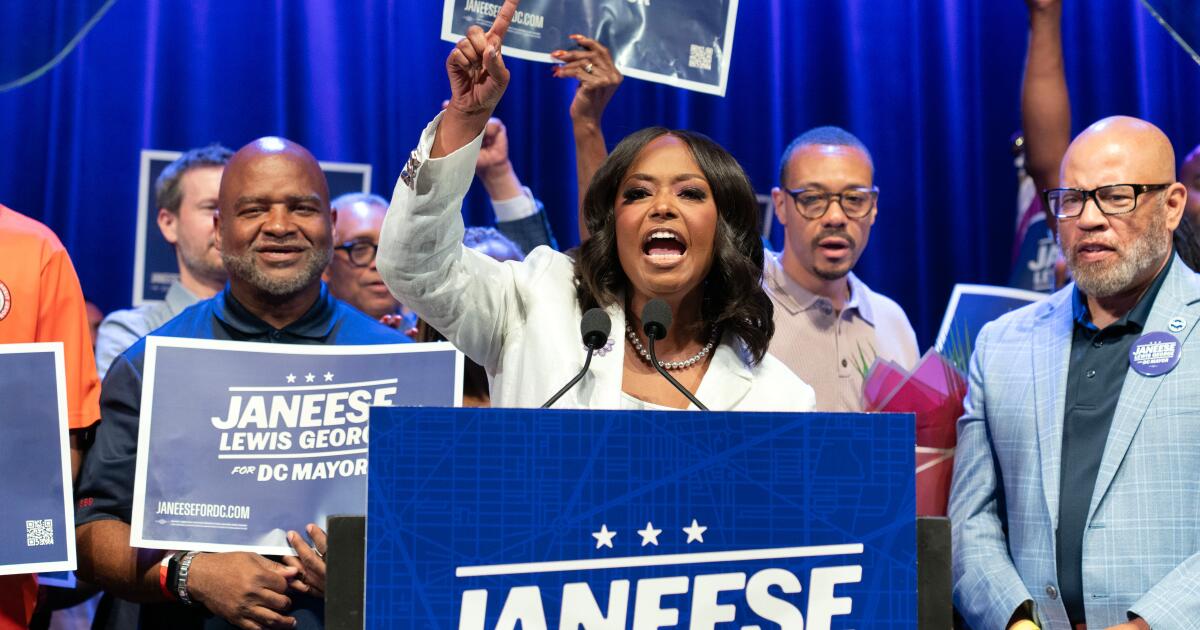
WASHINGTON — As Janeese Lewis George paves a path to the mayor’s office in Washington, D.C., she’s told voters they could have it all.
Her unapologetically expansive, left-wing agenda includes subsidized or even free childcare, increased down payment assistance for homebuyers and community resources to reduce crime, plus a promise to aggressively confront President Trump’s attempts to reshape the nation’s capital.
“People are tired of hearing what government can’t do. They want to hear what government can do,” Lewis George said in an interview before the city’s primary, where she defeated her Democratic opponents and positioned herself to win the general election in November in a city dominated by Democrats.
Lewis George’s victory signals a break with a quarter-century of centrist governance in Washington, and it puts her in the vanguard of democratic socialists who have ascended in urban politics over the last year. Zohran Mamdani toppled Andrew Cuomo, the scion of a political dynasty, on his way to becoming New York City mayor. Katie Wilson won an upset victory to lead Seattle last fall. And this month, Nithya Raman clinched a spot in the November runoff against Los Angeles Mayor Karen Bass.
All of them are members of the Democratic Socialists of America, or DSA. The political organization has seen its membership ranks swell from a few thousand to more than 100,000 nationwide over the last decade after an influx of younger Americans joined following the presidential bids of Vermont Sen. Bernie Sanders, also a self-described democratic socialist.
There’s little sign of national coordination among the candidates, and it’s unclear whether voters are gravitating toward their promises of improved government services, their vows to fight the Trump administration or their critiques of capitalism.
But from coast to coast, confrontational progressives are advancing in mayoral races. City leaders can draw outsized attention for their successes and failures, and democratic socialists will be under pressure from residents to deliver on their vows for a new kind of governance. Whether that translates to national politics is a next test for their movement.
“They are all channeling a displeasure with a status quo and a serious desire for economic populism that the establishment Democratic Party hasn’t been preaching,” said Eric Stern, a Democratic strategist with Fight Agency, a political consulting firm that strategized Mamdani’s mayoral campaign.
Stern added that Democratic voters appeared more willing to support the most progressive candidate in mayoral races rather than in contests for the U.S. House. Candidates like Mamdani and Raman, Stern said, are “daring voters to dream and fall in love not just with the individual candidates but also the political process as a whole.”
A rising left navigates America’s urban challenges
The trend of progressives surging in urban areas may have limits for its broader impact on Democratic politics. Democratic mayors in cities including Atlanta, Houston, Miami and San Francisco won on relatively moderate platforms in recent years.
Progressive have also faced noteworthy challenges. Chicago Mayor Brandon Johnson was endorsed by the city’s DSA chapter during his 2023 mayoral run but has since faced criticism from both moderate and liberal local leaders on issues such as immigration, the local budget and public safety. Recalls and public pressure ousted progressives elected to district attorney offices in multiple jurisdictions over the last five years, when criminal justice reform efforts ran into dissatisfaction over public disorder following the COVID-19 pandemic.
Trump’s hardline immigration and law enforcement tactics have also become a challenge for liberal cities. The president’s agenda poses an especially serious threat to Washington, D.C., because of its status as a federal territory.
“Maybe we take back Washington and run it on a federal basis,” Trump told reporters this month when asked about the potential election of a democratic socialist as the district’s mayor. “We won’t put up with it.”
But progressives hope the current wave of anti-Trump furor in deep blue cities across the country will help buoy the chances of those on the hard left.
“It’s not folks looking for the leftmost option so much as looking for a candidate who’s gonna be on their side,” said Ravi Mangla, speaking for the left-wing Working Families Party. The party often endorses the same candidates as the DSA and is readying to target more mayoral offices in the country’s biggest metropolises this fall and in 2028.
“It’s less about whether you are on the right or on the left so much as whether you are willing to punch up at the powerful,” he added.
Mamdani and Lewis George are both self-described “sewer socialists” who emphasize the need for responsive government services rather than critiques of market economics. The phrase recalls the socialist Gilded Age mayors whom critics derided as too preoccupied with managing public works projects.
The term’s revival is partly a strategic move to align leftist ideas with concerns over affordability and the economy, voters’ top concern in the midterm elections, and shift the public perception of democratic socialists from firebrands who support radical policies to independent-minded public servants.
“This is absolutely a change election and I’m excited to bring the change that people want, which is really putting people first in the city and having the moral clarity and courage to stand up to Trump,” Lewis George said.
For voters the ‘socialist’ label did not seem to matter
While conservatives have used the “socialist” label to attack Democrats as extreme or incompetent, some D.C. voters appeared ambivalent before Tuesday’s primary.
Several lifelong residents said they believed Lewis George was a “fighter” but didn’t think she’d have much of an impact on the local economy, given the city’s status as a federal district.
“I go back and forth on my own labels and whether I am supportive of that movement or not, but I am supportive of making D.C. more affordable,” Owen Fitzgerald, a University of Maryland graduate student, said of his support for democratic socialism.
Fitzgerald voted for Lewis George because she would stand up to Trump and said he’d first learned of her campaign from friends in his neighborhood. But he didn’t know she was a democratic socialist until he saw news reports describing her with the label.
“It sends a cultural message to this administration that the people who are surrounding them in the capital are opposed to their platform, opposed to their political agenda, and I think that it will send a message, both nationally and internationally,” Fitzgerald said.
Brenda Jaimes pushed her way through an ecstatic crowd in downtown Santa Ana Thursday night, stopping in the middle of Fourth Street and calling attention to herself by shouting, “Me! Me!”
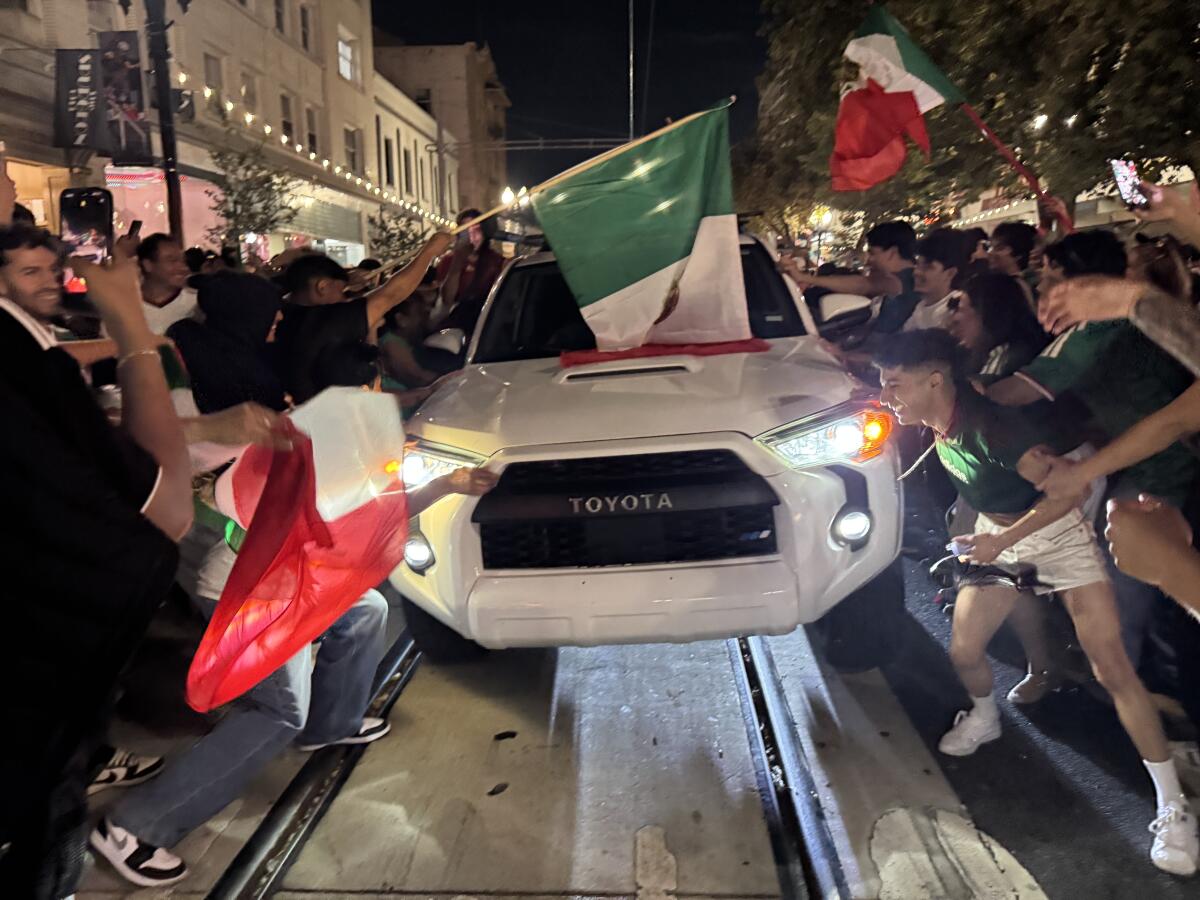
Fans blew horns and spun noisemakers, chanting “México!” and “¡Sí se puede!” They brandished the Mexican flag seemingly everywhere: on banners, painted on cheeks, emblazoned on Jaimes’ tube top. They stood on the back of trucks and boogied.
An Orange County Fire Authority truck flashed its sirens to cheers. A line of drivers cruised down Fourth Street — the historic cultural and economic heart of Latino Orange County — to high-five the crowd and let people shake their cars as if everyone was inside a bounce house.
Jaimes wanted something more dramatic.
She lay down in the arms of some men wearing green Mexico soccer jerseys. They counted to three, launched her a good 8 feet upward, then effortlessly caught the laughing Jaimes.
Scenes like this replicated themselves across Southern California after the match, from Koreatown to Boyle Heights to Pacoima to Huntington Park — really, anywhere with a big Latino population. It happens any time Mexico wins big in soccer. But the pachanga was even more pronounced in Santa Ana.
A year earlier, Fourth Street was empty. Federal immigration agents were seizing people across the city. The National Guard set up a roadblock complete with an armed Humvee for over a month, just a block away from where Jaimes and so many others celebrated.
One of the most Latino big cities in the country trembled in fear. On Thursday night, Santa Ana erupted in joy.
“This here is the antithesis of the raids last year,” said Sandra De Anda, who wore a Stetson and a Tigres Mexican soccer club jersey and waved a South Korea flag. She’s the director of policy and legal strategy at the Orange County Rapid Response Network.
Last June, the Santa Ana native joined thousands as they marched down Fourth Street for days demanding that ICE and the National Guard leave town. Through the rest of 2025, she and others in the Rapid Response Network fought la migra in courthouses and through fundraisers for immigrant detainees and their loved ones.
“They tried to take our community down, but they had no chance,” De Anda added as her boyfriend rushed off to join the celebration. “We Mexicans always get beat down, but we have pride. Tonight, you see how we stand up when we need to.”
Jaimes agreed.
“It’s so important to do this especially after last year,” she told me after her short turn as a Cirque du Soleil performer. “We don’t care what Trump can say about this. It was his birthday recently — who cares? This right here is real.”
Another young woman shrieked as she sailed above us. Jaimes pointed at her, then looked at me. “Throw yourself también [also], bro!”
I stuck to slapping the hoods and windows of so many cars that my hand turned black with soot.
Mexico soccer fans shake a car cruising down Fourth Street in downtown Santa Ana after Mexico’s 1-0 World Cup win over South Korea on Thursday.
(Gustavo Arellano / Los Angeles Times)
Seeing Mexico become the first country to win its World Cup group would be thrilling any year. But in 2026, when Trump continues to meddle in Latin American affairs while his migra goons keep launching raids across the country, the satisfaction hits that much more.
Few things irk Trump and his followers more than Mexicans succeeding at anything. Eleven years ago this week, he announced his presidential campaign by stating that Mexico was “not sending its best” immigrants but instead, people he claimed were mostly rapists and drug dealers. Trump has spent his two terms obsessing over the U.S.-Mexico border, attacking anything that reeks of diversity and demeaning Mexican President Claudia Sheinbaum as if she were a junior executive at one of his many failed companies.
Conservatives and more than a few liberals always get furious when Mexican Americans wave the flag of their ancestral homeland — but rooting for Mexico’s soccer team especially brings out the venom. Fans far outnumber supporters of the U.S. soccer team during matches in this country, which brings on accusations of treason against Mexican Americans even though other diasporas do the same, with nowhere near the same opprobrium.
Haters don’t get why so many Mexican Americans root for El Tri. The team embodies what it means to be Mexican: They’re a good group of folks who always seem to get bad breaks and never seem to win against the powers that be — but never stop fighting for a better day, while having fun doing so.
That’s why Americans of all ethnicities should back Mexico along with the U.S. side in this World Cup, which Trump has already sullied. The U.S. Department of Homeland Security denied a Somali referee entry into this country because he allegedly was “talking to some very bad people,” per the White House World Cup task force. The Trump administration is forcing Iran’s squad to base its training camp in Tijuana, which means players have to fly to matches in Los Angeles and Seattle instead of taking every other team’s short bus trip.
Every Mexico victory should give solace to the underdogs of the world and affirm the belief that a communion of nations engaged in friendly rivalries is better than Trump’s proclivity for launching indiscriminate raids and bombings. To cheer for Mexico is about as American as you can get right now.
Sydney Tran took her turn at the Fourth Street procession in a Honda Civic packed with friends. The crowd shook her car with such vigor that the 23-year-old Westminster resident couldn’t turn up the music like people shouted at her to do.
“This is crazy!” yelled Tran, who wore a Mexico soccer jersey. “I’m Vietnamese, but this is wonderful to see my Mexican friends so happy. They deserve to be happy — it’s been rough for them. It’s been rough for all immigrants.”
Mexico fans celebrate a goal while watching a FIFA World Cup soccer Group A matchup between Mexico and South Korea in Boyle Heights on Thursday.
(Eric Thayer / Los Angeles Times)
The festivities were still going strong when I left. Restaurants that were usually closed by 10 p.m. had lines out the door. Dance parties sprouted on sidewalks. Rancheras, funk and oldies blasted everywhere. The police were nowhere to be seen, unlike last year, when they broke up the anti-ICE protests with rubber bullets and tear gas.
Cynicism shot through me for a second. Mexico, which won on a fluke goal and two miraculous saves, stands virtually no chance of beating soccer titans like France and Argentina once the knockout stage of the World Cup begins. Trump’s immigration team vows that more raids are forthcoming. And I can only hope that the overwhelmingly young crowd will take the passion they showed for Mexican soccer to the ballot box this November.
Then I chilled out.
Everyone around me got to breathe and scream and let out their frustrations about our nation in the most delightful way imaginable. Reality would return the next morning — but for one night, for a few hours, life was wonderful for Mexican Americans, and better days ahead seemed possible. Sí se puede, indeed.
Package holiday provider TUI is launching a new direct flight from London Gatwick to a sunshine island in the Indian Ocean that has been likened to a cheaper Maldives or Mauritius
The new route will depart from London Gatwick twice weekly, operating on Wednesdays and Sundays from 3 November 2027(Image: Getty Images/iStockphoto)
TUI is launching a new non-stop flight to a sun-drenched archipelago likened to the Maldives.
From July 2, sunseekers will be able to get their hands on the package holiday provider’s latest offering – direct flights to Zanzibar in Tanzania.
The new route will depart from London Gatwick twice weekly, operating on Wednesdays and Sundays from 3 November 2027, with the last outbound flight of the season on 22 March 2028, giving customers four months to check out the Indian Ocean winter-sun destination.
Known as the ‘Spice Island’ thanks to its farming industry history, Zanzibar offers a mix of white-sand beaches, thick green forests, mangroves and flat grasslands – all within an hour’s drive of each other. The UNESCO World Heritage Site of Stone Town in Zanzibar City adds a rich culture, helping the island blend relaxation with discovery.
Year-round temperatures of 23°C to 32°C make the destination a brilliant winter sun option for both families and couples alike. It also offers a more affordable alternative to Indian Ocean favourites like the Maldives and Mauritius.
The cost is one of the major draw factors of Zanzibar.
Visitors typically spend between £21 and £109 per day per person, with an average of around £50, covering accommodation, sightseeing, food, and local transport, according to Budget Your Trip.
This compares well to the Maldives, where a typical traveller spends around £265 per day and a one-week trip for two averages about £3,800, Budget Your Trip notes. Typically, meals cost about twice as much in the Maldives as in Zanzibar.
The Maldives earns its premium through private-island resorts, overwater bungalows, and a more exclusive feel, but if you want stunning beaches and turquoise water on a more modest budget, Zanzibar is a great bet.
TUI has paired up its new breaks on Zanzibar with a safari. The experience begins with a short flight from the island to neighbouring national parks Nyerere and Serengeti. From there, holidaymakers can head out in search of elephants, lions, and giraffes.
TUI Musement also offers its own National Park and Spice Farm Tour, where customers can spot rare red colobus monkeys, visit a local upcycling centre and discover more about Zanzibar’s history as ‘The Spice Island’ through guided visits and a traditional lunch at a community-run spice farm.
The holiday company owns a number of properties across the island, including TUI BLUE Bahari Zanzibar, , known for its beachside setting on the north-east coast, and The Mora Zanzibar, which is a five-star resort. It boasts private pools and family rooms that sleep up to five guests.
How much does it cost?
All-inclusive package holidays to Zanzibar departing on 17 November 2027, including direct TUI flights, transfers and a seven-night stay at TUI BLUE Bahari Zanzibar start from £2,085 per person, based on two adults sharing.
All-inclusive package holidays staying at the Zanzibar Bay Resort departing on 1 December 2027, including direct TUI flights, transfers and a seven-night stay start from £1,615 per person, based on two adults sharing.
TUI is not the only operator on the island.
The Lost and Found Hostel sits on the east coast and offers very cheap accommodation for those who don’t mind forgoing a little luxury. It has beds for just £16 a night.
Makofi Zanzibar costs roughly double that, but is a little fancier. It is a standout budget pick for the beach. One minute walk to the sea, dorms and private rooms, reliable electricity, and a good restaurant on site.
Several major carriers fly from the UK to Zanzibar, including Ethiopian Airlines, Turkish Airlines, Emirates, and Qatar Airways. All current routes require one or two layovers, with the average journey taking about 12 to 17 hours.
VANCOUVER, Canada — When the first men’s World Cup game played in Canada kicked off last week, Anthony Totera sat in the stands and wept.
“It was a dream come true,” said Totera, who has spent most of his 57 years on earth promoting Canadian soccer. “I can’t describe the emotions. It was something surreal.”
If the 1994 World Cup, the first held in the U.S., forever altered the direction of American soccer, this summer’s tournament, which Canada is sharing with the U.S. and Mexico, has the potential to do the same for that country.
“This is going to be something monumental,” Totera said. “We’re going to get to another level, another point, where we’re going to say this was when it all turned.”
With an opening draw against Bosnia and Herzegovina last week in Toronto and Thursday’s 6-0 blowout victory over Qatar in Vancouver, this tournament is already the most successful on the field for Canada, which had lost all six previous World Cup games it had played. Now it’s poised to advance to the knockout rounds for the first time ever.
Jonathan David’s three goals were more than Canada had scored in its previous World Cup seven games combined. And former LAFC goalkeeper Maxime Crepeau, who lost his chance to play in the last World Cup when he broke his leg in the MLS Cup final, had no trouble making them stand up, recording Canada’s first-ever World Cup clean sheet.
The hosts outshoot Qatar 32-2 and had 97 touches in the box in one of the most dominant performances in recent World Cup history.
“I really think that we’re a soccer country,” LAFC midfielder Stephen Eustaquio said. “It’s a very special group.”
But the win was a costly one since Canada, which entered the tournament missing three starters to injury, lost another early in the second half when midfielder Ismael Kone was carted off on a stretcher with an apparent broken leg after Qatar’s Assim Madibo clipped him from behind.
And while that success on the field — costly or not — is significant, Steve Reed, the former Canadian Soccer Assn. president who was instrumental in bringing the World Cup to Canada, said the real goal wasn’t to win games as much as it was to win over the public.
“Each time we have hosted major tournaments, we have seen a significant increase in participation and general public interest,” said Reed, who was part of the group that organized the 2015 women’s World Cup in Canada. That tournament produced nearly a half-billion dollars in economic activity, double the original projections. It also boosted investment of soccer infrastructure, including the construction or upgrading of 21 “FIFA-quality” pitches, and surged youth participation numbers. The quarterfinal game between the host country and England drew a record TV audience of 20.8 million Canadians.
“I would say that we have proved that we excel at hosting major events. This will just be reinforced in 2026,” Reed said.
“In terms of expectations,” he continued, “one would be the continued growth of the game, particularly on the men’s side. We have always been great at the grassroots level. But we need to be better at the top end of the game, creating more professional opportunities for players in our domestic leagues and creating a pipeline to bigger clubs in major leagues.”
Canada fans celebrate after a 6-0 win over Qatar at the World Cup on Thursday.
(Kaleb Tatum / Associated Press)
That’s exactly the kind of legacy the 1994 World Cup created in the U.S., where it gave birth to Major League Soccer, a deep lower-tier professional infrastructure and an academy system that has sent players to major teams all over the world. Canada has also benefited from that, with MLS placing teams in Vancouver, Montreal and Toronto. Nine players from the league — including three from LAFC — are on Canada’s World Cup team.
In the last decade, Canada has begun building its own youth development system. It also launched the Canadian Premier League, an eight-team professional league that has already sent 15 players to the national team. Those initiatives had a good foundation to build on since soccer is Canada’s most popular sport in terms of registration and participation and ranks behind only hockey as a spectator sport.
Still, when Victor Montagliani, a former Canadian Soccer Assn. president, first publicly floated the idea of bidding to host the men’s World Cup in 2013, he was lampooned.
“People absolutely laughed at him, all across this country,” said Totera, who is now the grassroots ambassador for the Premier League. “But his closest friends and people that knew him knew he didn’t lie when he said, ‘I want to bring the World Cup to Canada.’ And he brought it.”
Canada had to pair with the U.S. and Mexico to make that happen, with the so-called United Bid beating back a proposal from Morocco thanks in part to some steady diplomacy from Reed, who took over as president when Montagliani was chosen to lead CONCACAF, the governing body that oversees soccer in North America, Central America and the Caribbean.
Canada’s reward was 13 World Cup games — seven in Vancouver and six in Toronto. Mexico gets the same number, while 78 of the record 104 matches will be played in the U.S.
That same year, 2018, Reed and Canada Soccer put the final piece of its World Cup preparations in place when it hired John Herdman to rebuild its men’s team.
In seven years with the country’s women, Herdman had taken a team that finished last in the 2011 World Cup to the quarterfinals of the next tournament, sandwiched between two bronze-medal performances in the Olympic Games. His impact on the men’s team was equally as stunning.
When Herdman took over, it had been 32 years since Canada played in its only World Cup. The country not only returned in its first cycle under the new coach, but it won the CONCACAF qualifying tournament to earn its place in the 2022 tournament.
“Being a Canadian football supporter, the roller-coaster ride has been downward for most of the years,” said Totera, who pulled on his first Canada soccer shirt the year he entered first grade. “But for the last few years, it’s been on on the upswing.”
Herdman found success in part by making the recruitment of dual nationals a priority, starting four of them — including Alphonso Davies, who immigrated to Canada from a refugee camp in Ghana — in Qatar.
Nearly a quarter of Canada’s population was born somewhere else and Herdman leaned into that diversity.
Jesse Marsch, the U.S.-born coach who took over the national team in 2024, followed Herdman’s lead, recruiting six dual nationals to his World Cup team. As a result the 26 players on Canada’s roster, or their parents, come from more than 17 countries — from Iran, Croatia, Jamaica and Barbados to Haiti, Lebanon, Nigeria and the Philippines.
“We’re a melting pot. We embrace it,” said Totera, whose family moved to Canada from Italy. “I look at that team, our team, and they’re from all parts of the world. Not one from one section of the world or the other section. No, all over.
“Amazing.”
Now, with a win and draw in two games, that diverse Canadian team is almost certain to advance out of a World Cup group stage for the first time — just as the U.S. did when it first hosted a men’s World Cup in 1994.
“After ‘94, after the World Cup was there, they took off to bigger and better things,” Totera said. “I believe once we get into the knockout route, we won’t look back.
“We’re on the cusp of something really special in this country right now. And we need to grab it and run with it.”
Unprecedented sports feats and historical firsts are usually joyous affairs. Something to celebrate, fun trivia to tuck away for later.
On Monday in Inglewood, the history was much more fraught, and not at all trivial.
Iran’s national soccer team played on American soil — this time on SoFi Stadium’s natural turf — for the first time in 26 years. And for the first time, a country hosted a World Cup participant with which it is mired in an on-again, off-again war.
There was, in the days and hours leading up to the match, protest and pushback from portions of the large, local Iranian diaspora who didn’t think it was possible to support the country’s football team without supporting the oppressive regime.
But inside SoFi Stadium, thousands of L.A.’s Iranian supporters gave the team its full-throated support. So did many new Mexican fans who’ve adopted Team Melli, which has been staying and training in Tijuana between matches as it was barred from the United States except for game days.
Most of the near-sellout crowd of 70,108 were there cheering Iran, helping propel this team under so much pressure to an entertaining 2-2 tie with New Zealand.
And there, among the thousands of enthusiastic Iran supporters swept up in the match, was my son’s favorite soccer coach, Narbé Mansourian, with his son, 13-year-old Daniel.
Narbé’s brother got his hands on a pair of nosebleed tickets and immediately handed them over to his soccer-loving relatives.
And Narbé — a fifth- and sixth-grade social studies teacher in Hollywood — had no qualms about backing these Iranian men. There were no second thoughts about separating the players from the politics in the country with the complicated geopolitical — and personal — history.
Now, know this: Mansourian is no fan of Iran’s Islamic regime. He was 7 in 1983 when his father, a political dissident, was executed in Evin Prison, nine months after he’d been apprehended.
Narbé remembers visiting his dad, Vazgen, at the notorious prison. He remembers the long drive to get there, the long wait to see him and the game he and his mom used to play: “Today you are 4 years old.”
Narbé Mansourian, right, and his son Daniel before Monday’s World Cup match between Iran and New Zealand at SoFi Stadium.
(Mirjam Swanson / Los Angeles Times)
What started as a way to avoid paying bus fares for 6-year-old Narbé became the way to fool guards at prison, where only the small children were allowed to physically touch their imprisoned loved ones.
He remembers being allowed behind the glass, where he’d wait for his dad to emerge, blind-folded.
When his dad was killed at 37, Narbé said his mother didn’t immediately find out. And when she did, she initially told Narbé that he’d been sick. There was no funeral and when they went to visit his father’s grave, they found a dirt field. There were no markers, Narbé recalls.
He has kept Vazgen’s Coke-bottle glasses, his watch and the still-intact little LEGO house they built together before his dad was taken to prison.
Narbé has held onto so many difficult memories, including the nighttime terrors associated with bombings during the Iran-Iraq war. But there are also happier recollections. Like the stories he would make up about good guys going against the greedy. And, yes, memories of going to soccer games with his dad.
So, “absolutely, I’m going to root for the Iranian national team,” Narbé said before Monday’s match, saying that, to him, equating the Iranian national team with the country’s regime is like rooting against the Knicks because you don’t like President Donald Trump, a native New Yorker.
“It’s not like a cartoon good guy, bad guy,” Narbé said. “There’s so much gray. Because they live there. My heart goes out to them. It can’t be easy, to kind of teeter-totter like that.”
A pre-revolutionary Iranian flag is displayed before the World Cup group stage match between Iran and New Zealand at SoFi Stadium.
(Allen J. Schaben / Los Angeles Times)
I should’ve expected this outstanding youth soccer coach would be most concerned with the players on the pitch.
Some fans got into SoFi on Monday with the Iranian Lion and Sun flag, a historic Iranian national and opposition flag that was banned from the stadium because FIFA desires to steer free of politics (unless it’s steering straight into them). It was a strange sight in Los Angeles, seeing stadium workers asking attendees to discard flags in an effort to censor the expression of people here.
Some of those fans turned their backs during the national anthem, which many in the stands jeered at its start. But then, once the game took hold, so did the support.
“There were many Iranians here,” Iran coach Amir Ghalenoei said through an interpreter. “They believe in different political affiliations, different beliefs, but they all wholeheartedly encouraged us, and I think that’s a victory for all of us.”
Country singer Tyler Farr is recovering after he missed his weekend show.
The “Rednecks Like Me” singer was slated to perform at the Goshen Stampede in Goshen, Conn., on Saturday, but the festival announced just hours before gates opened that Farr had an accident on his Chapel Hill farm, about 45 minutes outside of Nashville.
“Due to a motor vehicle incident on his farm, Tyler Farr was taken to a local hospital and diagnosed with a severe concussion,” read the Instagram post. “Tyler Farr will no longer be able to perform at the Goshen Stampede on June 13, 2026. We appreciate everyone’s understanding and will share additional event information as it becomes available. We wish Tyler a speedy recovery.”
David Foster and the All Stars took Farr’s place in the lineup. The event featured two rodeos with bull riding and steer wrestling, monster trucks, carnival rides and country music. Farr shared Goshen Stampede’s post to his since-expired Instagram stories but hasn’t shared any further updates.
Representatives for the country musician did not immediately respond to The Times’ request for comment.
This isn’t the country music star’s first rodeo. Farr, who released “Quit Bein’ Country” last fall, stopped by Taste of Country’s podcast to promote his new EP and told the outlet that he got into a car wreck on the way there and said his truck was too high.
“There’s a big lift on it, and if it had been a normal vehicle, it’d probably been something you could have just buffed out, but the reinforced-steel, ultra off-road bumper I have broke a taillight and knocked the bumper off [the other vehicle],” he said, adding that his truck didn’t have a scratch. “Luckily the person was cool, cop was cool.”
Apparently the last time he was in an accident (before the one in December), his 2013 hit “Redneck Crazy” went to No. 1 on the charts.
The singer has also been candid about his love for country living and turkey hunting.
“When I moved to Nashville, it wasn’t to be in the Hall of Fame,” he told Land.com last year. “That wasn’t a goal … I’m a pretty simple person. My goal was literally to be on the Opry, have a hit song, little country house in the woods, some land, a tractor.”
The president held a cage fight on the White House South Lawn, complete with flyovers, fireworks, mini-skirted “octagon girls” and the surrealistic sight of mixed martial arts fighters striding through historic White House rooms flanked by National Medal of Honor winners.
Despite wide public disapproval for Sunday’s event and much scathing commentary about the political and psychological messaging of Donald Trump’s choice of a Vegas-like spectacle to celebrate his 80th birthday, and the country’s 250th, the sky did not fall, the original Constitution in the nearby National Archives did not tear in two and none of the fighters passed out from the heat or bug bites.
Things didn’t even get bloody until the final match in the fifth hour, when Justin Gaethje kicked and punched the crap out of widely favored Ilia Topuria.
Even so, it was impossible to emerge from watching UFC Freedom 250 without feeling punch-drunk.
Not because of the fighting; because of almost everything that was not the fighting.
Beginning with Paramount+, owned by the Trump-friendly Ellison family’s Paramount Skydance, which recently received Justice Department clearance for its highly controversial acquisition of Warner Bros. Discovery.
The jarring sight of past UFC matches being seemingly projected onto the Jefferson Memorial and the Capitol gave way to a series of poorly produced “historical” moments in which UFC fighters were cast as inheriting the same “fighting spirit” that motivated this nation’s Founding Fathers, past presidents and war veterans. Down to the inevitable strains of the Village People’s “Y.M.C.A.” (the baffling anthem of MAGA), the event projected a macho-man view of patriotism that was just as ghastly as many feared it would be.
UFC fighters are indeed dedicated and talented athletes who have overcome all manner of personal obstacles. But to compare them with Thomas Jefferson or American soldiers storming the beaches of Normandy is absurd and more than a little insulting.
The tens of thousands of UFC and Trump fans who gathered on the South Lawn and the Ellipse, however, were clearly having a very good time. Proceedings were delayed an hour by the threat of storms, but the weather cooperated in the end. “The President’s Own” United States Marine Band, and in particular, soloist Staff Sgt. Hannah Davis, gave masterful performances throughout. And while the Claw, the 600-ton steel structure arching above the Octagon, certainly looked like the first stage of an alien attack during the day, it put on a pretty terrific (if more than a little Vegasy) light show at night.
For those watching from home, however, these bright spots were glimpsed and heard infrequently, drowned out by the endless hyperbolic intonations of commentators (including Joe Rogan, who initially criticized the event), the long and invariably self-aggrandizing introductions of the various participants and the onslaught of frequently militaristic commercials, more than a few of which, included ads for Ram, featured UFC President and Chief Executive Dana White.
Which isn’t surprising when you think about it. White’s longtime support for the president culminated in his organization covering the event’s $60 million in production costs, and from the moment a smiling White joined Trump as he made his way through the White House to the front row, the event served as an almost-six-hour ad for the UFC.
Though I am not a UFC fan, I realize that showmanship is key to the sport’s wild and increasingly broad popularity. Championship matches, which rarely last longer than 30 minutes and sometimes much less, are inevitably preceded by hours of participants making all manner of florid claims and trash-talking their opponents. (Which may explain Trump’s fondness for the UFC.)
But when all of this strutting, preening and wild-eyed reaction revolves around what was, for better and worse, a series of rules-free brawls being force-fed into a narrative about this country’s enduring strength, what emerges is not so much a sporting event as it is a piece of naked and nationalistic propaganda.
Which came to a head in the final fight. After the six previous matches concluded rather quickly with bloodless knockouts (a UFC record), the fight between American Gaethje and the German-born, Georgia and Spain-representing Topuria lasted much longer. Gaethje, introduced as “the most violent man in the most violent sport,” left the lightweight champion’s face such a mess that even Rogan was shocked.
By all metrics, including Topuria’s refusal to go down, it was the best fight of the night. But hearing the crowd chant “USA, USA” as the bloody blows fell … well, let’s just say it was not everyone’s notion of a presidential birthday celebration.
Some have suggested that Trump staged the event in the hope of regaining the support of young men who helped him win the last election. Even if that was not the case, it was difficult to view UFC Freedom 250 in any way nonpartisan (especially after British former heavyweight champion Tyson Fury strode out of the White House wearing a “Trump for Prime Minister” hat).
Yes, several of the six non-American participants entered to Spanish or Portuguese songs (why so much fuss then about Bad Bunny at the Super Bowl?) but some of the winners are longtime MAGA supporters and made that very clear — Bo Nickal thanked Trump for being the only one “to have the balls” to stage such an event while Josh Hokit followed up his thanks to “my lord and savior Jesus Christ” with “Michelle Obama is a man. Am I right, America?”
IF you’re looking for an affordable stay that ticks all the boxes, a Premier Inn is one of the best.
Here is everything you need to staying at the Arundel hotel in Sussex.
Sign up for the Travel newsletter
Thank you!
Here is everything you need to staying at the Premier Inn Arundel hotelCredit: Premier Inn
Where is the Premier Inn Arundel?
This charming Premier Inn nestled on the edge of the South Downs, feels more like a cosy, country hotel than a convenient pit stop to explore East Sussex.
On the outskirts of Arundel, the hotel faces picturesque fields and is very conveniently located to explore Arundel Cathedral and Arundel Castle.
Both are less than a ten-minute drive away.
What are the rooms like?
Premier Inn pride themselves on offering budget-friendly comfort in over 800 locations, and this country hotel is no different.
A federal judge has ordered the Trump administration to restore signs related to topics such as climate change, slavery and Indigenous and LGBTQ+ history that were removed under an executive order to purge language at national parks that allegedly cast America in a negative light.
The order has prompted the removal of mentions of President Washington’s slaves at Independence National Historical Park in Philadelphia, signs regarding climate threats at Fort Sumter in South Carolina and a pride flag at the Stonewall National Monument in New York City, according to the lawsuit challenging the action.
A preliminary injunction was issued Friday by U.S. District Judge Angel Kelley in Boston, who sided with a coalition of conservation and historical groups and ordered all language removed under the order to be reinstated before the Fourth of July. Earlier this year, another federal judge ordered the signage related to Washington’s slaves restored.
In Friday’s injunction, Kelley accused the Trump administration of seeking “to rewrite the Nation’s history with a white-out pen,” and said that national parks play an important role in telling the multifaceted history of America, including “the good, the bad, and the ugly.”
“Because Defendants deemed it important to strip the parks of these undeniable truths in anticipation of the 250th Anniversary of our great Nation,” she wrote, “it is equally important that our shared history be honestly told and fully restored by the 250th Anniversary to properly honor the remarkable achievements of the United States.”
A spokesperson for the U.S. Department of the Interior dismissed the ruling as the work of a “liberal activist judge.”
“The Department will look at our appeal options while we celebrate UFC Freedom 250 on the South Lawn of the White House this weekend in honor of our nation’s 250th with the greatest president in the history of our country — President Donald J. Trump,” the spokesperson said in a statement.
Trump initially signed the executive order in March 2025, arguing that a revisionist movement is seeking to undermine American history by replacing objective fact with a distorted, ideologically driven narrative.
“Under this historical revision, our Nation’s unparalleled legacy of advancing liberty, individual rights, and human happiness is reconstructed as inherently racist, sexist, oppressive, or otherwise irredeemably flawed,” the order stated.
Under the order, more than 430 sites under the purview of the National Park Service were told to review language on monuments, memorials, statues and markers to ensure they didn’t disparage Americans past or present, with a close eye on language added during former President Biden’s administration. QR codes were also added at sites encouraging visitors to report any signs they believed violated the order.
In February, a coalition including the National Parks Conservation Assn., American Assn. for State and Local History, Assn. of National Park Rangers and Union of Concerned Scientists filed a lawsuit in federal court in Boston alleging that the order was erasing American history and science.
“National parks serve as living classrooms for our country, where science and history come to life for visitors,” Alan Spears, senior director of cultural resources at the parks conservation association, said in a February statement. “As Americans, we deserve national parks that tell stories of our country’s triumphs and heartbreaks alike. We can handle the truth.”
COMPLETELY surrounded by Italy, one European country that’s home to the oldest republic in the world makes for a dreamy escape.
With only two million people visiting last year – less than the population of Greater Manchester – San Marino is a great European option if you don’t want the crowds.
Sign up for the Travel newsletter
Thank you!
San Marino is the fifth smallest country in the worldCredit: Alamy
Officially a UNESCO World Heritage microstate, San Marino – which is the fifth smallest country in the world – feels like “walking around in a Disney movie” according to one visitor on Instagram.
The Disney-like feel is most likely due to San Marino‘s three towering medieval castles at the top of Monte Titano.
Guaita Tower – which is the First Tower – was built in the 11th century and is the largest of the three.
Visitors can head to the tower and explore the battlements, as well as old prison cells and the Chapel of Santa Barbara.
Cesta Tower – the Second Tower – is slightly newer, dating back to the 13th century and sits on the highest of Monte Titano’s peaks at around 755 metres above sea level.
The tower is home to the Museum of Ancient Weapons.
It features three towers that make it look like it has been ripped out of a fairy taleCredit: Alamy
And finally, there is the Montale Tower – the Third Tower – which is the smallest and youngest of the three, built in the 14th century.
This tower is not open to the public though.
There’s also Piazza della Libertà, which is the heart of the Old Town.
Here, visitors can explore a number of shops and small museums, as well as stop at the historic parliament building.
And while you don’t get your passport stamped when visiting San Marino, you can head to the tourist centre inside Porta San Francesco, and get a physical stamp in your passport as a souvenir for €5 (£4.33).
To catch an amazing view of San Marino, head up the Cableway which goes from Borgo Maggiore to the city centre and then to the monument of Bartolomeo Borghesi.
You can hop on a cable car to get amazing views of the regionCredit: Alamy
The cities of Florence, Rimini and Bologna are all close by as well, making San Marino the ideal day trip if you’re staying in one of them.
Though if you did want to stay in San Marino, there are a few options including the four-star Grand Hotel San Marino costing from £69 per night in June.
The easiest way to get to the microstate is by hopping on a shuttle bus from Rimini, which costs about €7 (£6.06) and takes around an hour.
When it comes to spending money in San Marino, it is typically cheaper than Italy with the average coffee costing €1.57 (£1.36) and the average beer costing €5 (£4.33).
Hotels cost as little as £69 per nightCredit: Alamy
In comparison, in Florence a beer will set you back at least a euro more and a coffee costs from €2.05 (£1.77).
Flights to Rimini in June cost from £37 return and take between two and two-and-a-half hours from the UK.
Alternatively, if you want to go to Bologna, return flights in June cost from £28 and again, take between two and two-and-a-half hours from the UK.
From Bologna, it then takes about an hour and 20 minutes on the bus to reach San Marino.
It was a game eight years in the making. The first World Cup match on American soil in more than a generation and the start of a tournament that has the potential to alter the direction of soccer in this country for the next generation.
And the U.S. seized on every bit of that opportunity Friday, with Christian Pulisic setting up two goals and Folarin Balogun scoring twice in his World Cup debut, sparking an impressive 4-1 victory over Paraguay in a game that was far more one-sided than the score indicated.
The U.S., which needed a big effort to start the tournament, was on the front foot from the start, going in front to stay in the seventh minute — although it was Paraguayan midfielder Damián Bobadilla who got credit for the goal after stepping in front of Balogun and deflecting in a cross from Weston McKennie.
Pulisic, the American star who is under intense pressure to perform in this tournament, set up the goal, pushing the ball between a pair of defenders before poking it on for McKennie in the center of the box. Bobadilla then did the rest, inadvertently sticking his right foot in front of the ball and bouncing it by Paraguayan keeper Orlando Gil.
Balogun appeared to double the lead coming out of the hydration break midway through the opening half, but the goal was negated by an offside call. That only delayed the second goal, however, with Balogun making it 2-0 by one-timing in a perfect feed from Pulisic from the penalty spot in the 31st minute.
Balogun added to the U.S. advantage just before the intermission, running on to a perfectly weighted through ball from Malik Tillman, stepping through a challenge from Omar Alderete entering the penalty area and turning around Paraguayan captain Gustavo Gómez before left-footing a shot into the top left corner to complete his first brace for the national team.
Gil was just a spectator on the play, with no chance to best the save. The goal marked the first time Paraguay had given up three scores in a World Cup game — much less one half — since 2002 and it came at the end of what was arguably the best opening 45 minutes a U.S. team has played in the tournament in decades.
Gio Reyna scored the fourth U.S. goal on the final play of the game.
Pulisic left in favor of Sebastian Berhalter to start the second but the U.S. continued to dominate in every way it was possible to dominate, controlling the ball for nearly 60 of the 90 minutes and completing more than twice as many passes. Paraguay’s first shot on goal didn’t come until the 73rd minute when Mauricio, a halftime substitute, took advantage of a slow-reacting U.S. defense to pull a goal back.
U.S. coach Mauricio Pochettino also got a solid game out of center back Chris Richards, playing for the first time since tearing two ligaments in his left ankle a month ago.
The Americans will face Australia in the second of three group-stage games next Friday in Seattle, where a draw will all but guarantee them a spot in the round-of-32, something Pulisic said should be just the first objective for this team.
This World Cup is the largest and most ambitious sporting event in history, with three host countries — Canada and Mexico, in addition to the U.S. — and a record 48 teams playing 104 games in 16 cities spread across four time zones. A long run by the American team, playing on home soil, could excite a nation and give soccer the kind of boost it hasn’t seen since 1994, the last time a World Cup was played here.
It could also change the narrative of a tournament whose run-up was clouded by outrageously high ticket prices, travel bans, the threat of ICE raids at tournament venues and the war in the Middle East, the first to pit a World Cup host against a World Cup qualifier.
And the U.S. portion of that tournament opened with pomp despite those circumstances, with Thai pop star Lisa, Nigerian recording artist Rema and Brazilian singer Anitta headlining a 10-minute mini concert staged before a massive replica of the World Cup trophy set over a blue map of the U.S. Katy Perry mounted a stage of her own an hour later to debut her song “Wonder” as the flags of the 48 participating countries circled around her.
President Trump did not attend the game, just as Mexican president Claudia Sheinbaum skipped her country’s opener Thursday in Mexico City and prime minister Mark Carney missed Canada’s first game Friday in Toronto. Secretary of State Marco Rubio took Trump’s place in the Hollywood-heavy crowd of 70,492 that packed SoFi Stadium, one which included Tom Cruise, David and Victoria Beckham, Halle Berry, Rob Lowe, Becky G, Jaime Foxx, Paris Hilton, Bill Gates, Justin Trudeau and Kareem Abdul-Jabbar.
That crowd was a sea of blue and red — the U.S. and Paraguay share the same colors — but the cheering was primarily for the Americans since Paraguay rarely mounted a threat.
WASHINGTON — A year after the Trump administration kicked off its aggressive immigration enforcement tour with military-style raids across greater Los Angeles, federal officials have veered toward a less flashy but broader strategy: making immigrants’ lives harder so they will leave.
The changes range in scale and scope, from disqualifying immigrants from certain jobs to indefinitely pausing the processing of visa applications. They target those lawfully present as well as the undocumented.
Since President Trump’s second term began, the administration has used executive orders and federal regulations to chip away at services or benefits, such as work permits and small business loans, that immigrants could obtain in the past.
Now, immigrants are finding that freedoms — the ones that once made the U.S. a desirable place to start over — are disappearing. Many are retreating back into the shadows as they fear previously routine tasks, such as traveling across states, filing taxes and seeking medical care.
“The priority is to force people to leave the country or not come, regardless of legal status or really any other criteria,” said David Bier, immigration studies director at the Libertarian think tank the Cato Institute. “They’re taking a sledgehammer to the system.”
Trump won the White House in part on his promise to clamp down on illegal immigration, but recent polling shows support for his agenda has waned, especially after immigration agents shot and killed two U.S. citizens in Minneapolis.
In a statement, White House spokesperson Abigail Jackson said Trump’s highest priority has always been the deportation of immigrants with criminal records. The Department of Homeland Security said Trump also prioritizes immigration that strengthens the country financially, socially and culturally.
President Trump displays the signed “Secure America Act” during a ceremony in the Oval Office on Wednesday. The act provides $70 billion for immigration enforcement and border-security agencies.
(Aaron Schwartz / CNP, Bloomberg)
The number of arrests by ICE agents has declined. On average, ICE arrested about 1,000 immigrants per day in early March, down from a peak average of just under 1,400 in mid-January, agency data show. And there are fewer detained immigrants — facilities across the country held about 60,000 detainees in April, compared to more than 70,000 in late January.
The downturns prompted some Trump loyalists to say the administration is failing to fulfill his signature promise, which is an assertion the administration rejects.
“ICE is NOT slowing down,” said Homeland Security spokesperson Lauren Bis. “Since Day One, DHS law enforcement has been delivering on President Trump’s promise to the American people to arrest and deport criminal illegal aliens.”
At a border security conference last month, Tom Homan, who leads border policy for the White House, suggested immigration agents would return to more muscular enforcement tactics.
“You ain’t seen s— yet,” he told the audience.
But along with focusing on deportations, the administration is deploying other tactics to deter illegal — and legal —immigration.
ICE agents confront protesters on June 8 as they gather outside the federal immigration center at Delaney Hall in Newark, New Jersey, where ICE is housing detained immigrants.
(Spencer Platt / Getty Images)
Curtailing visas
Last month, the Department of Homeland Security announced that “except in extraordinary circumstances,” immigrants seeking lawful permanent residency must leave the U.S. to complete the process. After a backlash, the administration defended the policy, saying it won’t prevent anyone who qualifies for a green card from getting one.
U.S. Citizenship and Immigration Services, the agency in charge of processing immigration benefits, has upped security screening since Trump took office. The agency says that’s to root out fraud, but critics say all it does is unnecessarily slow down a system that already vets applicants vigorously.
The administration indefinitely banned people from 75 countries from receiving immigrant visas, which allow people to move permanently to the U.S.
In a similar move, the government halted the processing of immigration applications for people from 39 countries and who are already in the U.S. On June 5, a federal judge struck down the policy in a scathing ruling that said the administration “justifies its actions with pretextual concerns of ‘national security’ that mask anti-immigrant sentiments.”
Children of Guatemalan origin, from left, Areimy, Mariela and Enrique, arrive at Miami International Airport on Dec. 4, 2025, as they prepare to leave the United States to reunite with their recently deported parents in Guatemala.
(Chandan Khanna / AFP via Getty Images)
The judge’s ruling may offer relief, but for many immigrants, the effects of the policy are devastating. Armin, a 42-year-old from Iran, said he has racked up more than $15,000 in debt since the pause took effect in December. Armin asked The Times not to fully identify for fear of jeopardizing his immigration case.
The nutritional scientist came to the U.S. in 2019 on a student visa and has a pending green card application under a provision that allows certain highly skilled immigrants to apply for permanent residency without needing an employer to sponsor them.
After receiving his PhD and completing a postdoctoral program, Armin was in between jobs when he received a research grant in November. But with the processing of his work authorization halted, the university that issued the grant said it couldn’t hire him as a research associate. In February, he was turned down for another job.
Armin said he is confused about why the administration won’t differentiate between legal immigrants and those who should be deported.
“I can’t believe it,” he said. “I’m doing research and my research has national interest benefits. You expect support from the government. Unfortunately they don’t differentiate. They don’t care about your resume.”
Bier said the visa policies affect half of all legal immigrants coming from abroad. He published a report in April about how Trump has cut legal immigration far more than illegal immigration, noting that the administration’s policies have led to big drops in visas for international students, high-skilled workers and refugees.
“The legal immigration system is being used as a means to carry out the mass deportation agenda,” he said.
Alessandro Negrete, who lived most of his life in the U.S. undocumented, crosses into Mexico after deciding to leave.
(Robert Gauthier / Los Angeles Times)
Encouraging self-deportation
More than 90,000 immigrants have been granted voluntary departure since the start of the Trump administration, according to federal immigration court data through April that was analyzed by TRAC, a data research organization. Voluntary departure avoids official deportation and can leave open the possibility of an immigrant returning to the U.S. legally.
Homan, who declined to be interviewed for this story, has said self-deportations were part of the administration’s immigration plan all along.
“We knew if we surged unlimited ICE resources in the interior, and we do these operations, that that will force those that are here illegally to leave on their own,” he recently told the Washington Examiner.
Halting work permits
In the past, asylum seekers and others with deportation protections have had the ability to seek permits to work legally in the U.S. But work is now an administration target.
One proposed regulation would prevent asylum seekers from working legally in the U.S. Another proposal, published Friday, would further restrict access to work permits for other immigrants.
Under a rule that took effect last month, asylum seekers pay an annual $102 fee within 30 days of receiving a notice from U.S. Citizenship and Immigration Services. If the deadline is missed, their applications will be rejected — with no opportunity to appeal — and they could be placed in deportation proceedings. Those who apply for asylum with the agency have entered the U.S. legally, such as on a visa, and are not undocumented.
Asylum seekers rest at a Tijuana migrant shelter a day after President Trump began his second term in the White House.
(Robert Gauthier/Los Angeles Times)
Conchita Cruz, co-executive director of the Asylum Seeker Advocacy Project, said many asylum applicants have not received notice that the fee is due.
Cruz said she believes the Trump administration is using these changes as an excuse to dismiss people’s asylum claims. While the president has the power to decide whether to offer or rescind humanitarian programs, such as Temporary Protected Status, the right to seek asylum is enshrined in law.
“We’re worried this is a pretext for people to fall out of the asylum system and fall out of the workforce,” she said.
The processing of work permits has already been slowed, leaving many immigrants who still qualify for employment authorization unable to work.
During a House Homeland Security Committee hearing last week, Rep. Lou Correa (D-Santa Ana) asked Homeland Security Secretary Markwayne Mullin to help him speed up the work permit renewals for two police officers who were recently fired by agencies in his district because their DACA status expired.
Mullin said he would help but that Congress ultimately must pass a permanent solution for DACA recipients.
“These are police officers on Main Street, sir,” Correa responded.
“Not all of them are,” Mullin said. “I’m not just going to wave a magic wand and fix them all.”
“You have that magic wand — that’s your job,” Correa said.
It wasn’t just Democrats complaining about slow processing. Rep. Gabe Evans (R-Colo.) similarly asked Mullin for help because many of his constituents — “farm workers, youth ministers, nurses, grocery store business managers” — who have lived and worked in the U.S. legally for decades are now having trouble renewing their visas.
Secretary of Homeland Security Markwayne Mullin, left, and President Trump, center, walk to the motorcade after exiting Air Force One at Joint Base Andrews, Maryland, on May 20.
(Kent Nishimura / AFP via Getty Images)
Calls for mass deportations
Mullin, who took the reins in March after Trump fired his predecessor, Kristi Noem, rolled back some of Noem’s policies, including telling agents to stop entering homes without judicial warrants and canceling some contracts she had initiated.
But the changes and the downturn in arrests have drawn criticism from some fervent Trump supporters.
“Trump’s legacy is tied up in this,” said Mike Howell, a former DHS attorney who founded a group called the Mass Deportation Coalition. “It’s going to be hard to tell a younger voter to get excited to show up when one of their top issues is mass deportation and, a year and a half in, it doesn’t appear it’s going full-steam ahead.”
Howell said enforcement at work sites is critical to scaling up arrests and deportations. That more such operations haven’t happened, he said, is a political decision to appease wealthy donors and special interest groups who don’t want to see their workers deported.
The architect of Trump’s immigration agenda is Stephen Miller, a top White House aid who has called for a “moratorium on immigration from third-world countries,” demanded 3,000 arrests per day and said that immigrants and their descendants “recreate the conditions, and the terrors, of their broken homelands.”
Royce Bernstein Murray, a former Homeland Security official who worked on immigration policy under the Biden administration, said the winding down of flashy enforcement surges has given the administration more time to “focus on tearing down the legal immigration system.”
“This is Stephen Miller’s sweet spot,” she said. “He was never in enforcement — he’s a policy guy. This is really an opportunity for him to make good on all he has planned for years.”
While ICE has, in recent months, returned to its more conventional targeted enforcement tactics, Homan has sought to make clear that mass deportations are still a goal.
“For the people out there saying ‘President Trump’s getting weak on mass deportation,’ you don’t know what the hell you’re talking about,” Homan said at the border expo.
On Monday, Homan told Fox News that he had just reviewed plans for an ICE operation that would surge agents to New York City.
WASHINGTON — The House Appropriations Committee has approved $875 million to fund public transportation for the 2028 Olympic Games, a positive sign for LA28 after the exclusion of Olympics transit funding from President Trump’s fiscal year 2027 budget request this spring.
The funding must be passed by Congress in a future spending bill — part of a lengthy 2027 budgeting process that is underway now — but its approval in committee last week is a crucial signal of investment from Washington after weeks of uncertainty.
“We are encouraged by the House Appropriations Committee’s action,” spokesperson Maya Pogoda of the Los Angeles County Metropolitan Transportation Authority said in a statement, “and we look forward to continuing to work with the Senate and the White House to make America’s Games the best ever in history.”
LA Metro has sought $2 billion in federal funding for the planned transit service for the Games, which includes leasing buses, hiring drivers and building temporary depots. With the clock ticking to start projects that require significant lead time to be completed before the Games, the absence of any funding in Trump’s budget request in April had raised concerns among lawmakers and other stakeholders.
In recent weeks, the transit authority, the city and LA28 had publicly pressed for federal funding; LA28 Chief Executive Casey Wasserman reportedly met with lawmakers on Capitol Hill in April.
“The House Appropriations Committee’s most recent transportation bill is another positive signal of the continued bipartisan support in Congress to provide federal transit money for the Games,” LA28 spokesperson Jacie Prieto Lopez told The Times.
The inclusion of the funding in the bill conveyed bipartisan support for the Games, an event that Trump — who places an outsize importance ondisplays of patriotism — is likely to want to see go well during his tenure.
“This is on the American stage,” said former Los Angeles County Supervisor Zev Yaroslavsky, who was on the City Council during the 1984 Olympic Games. “The success of the Games are the success of the country.”
The Olympics item was included in the fiscal year 2027 transportation funding bill approved by the House Appropriations Committee last week. In its report, the committee noted that the funding is intended for all host cities, including those outside California.
“The 2028 games will put our nation on center stage, and this investment will help ensure that we are prepared to meet the moment and showcase why the United States is the best country in the world,” Rep. Steve Womack (R-Ark.), who chairs the subcommittee that put forth the bill, said in a statement.
The Games in Los Angeles are expected to draw massive crowds and will be the first Summer Olympics held in the United States since Atlanta hosted in 1996. More than 4 million tickets were sold during LA28’s first ticket release; asecond ticket drop is coming in August.
The massive event requires federal involvement not just on funding but also on issues including athlete visas and the import of Olympic horses.
LA Metro has planned to lease 1,700 buses from transit agencies across the country, build three temporary transit depots and create dedicated traffic lanes for athletes, officials and others as required by the International Olympic Committee. Metro estimates that 1 million additional trips per day will be taken during the 16-day Games.
It’s crucial for federal funding to come through in a timely manner, Yaroslavsky said, particularly given the scope of the security and transportation considerations for the sprawling Games.
“The city and the LA28 committee need to know that this money is going to be made available,” Yaroslavsky said. “This has to be in place long before the Games start.”
DUBAI, United Arab Emirates — President Trump threatened Thursday to launch major strikes on Iran and seize control of its oil industry as escalating attacks between the countries pushed the Middle East closer to the resumption of a full-scale war.
Trump said in a social media post that the U.S. would hit Iran “VERY HARD TONIGHT” and would “assume total control” of Iran’s oil and gas industries, including the vital Kharg Island oil terminal, in the “not too distant future.”
The American leader’s latest threats came as efforts to negotiate an end to the war appeared stuck. Trump has voiced his frustration with the stalled negotiations, warning earlier in the week that Tehran would “pay the price” for taking too long to reach a deal.
Iran’s monthslong stranglehold on the Strait of Hormuz has disrupted global energy supplies, driven up fuel prices and made food and other basics more expensive well beyond the region.
The U.S. and Iran traded strikes for a second straight day Thursday after reaching a tenuous ceasefire more than a month ago. While the strikes have increased tensions in the region, they have been more limited compared to the early weeks of the war and negotiations between the U.S. and Iran are ongoing.
Trump’s threats on Thursday, while stark, represented his latest verbal escalation in the Iran war. In April, he warned Iran that “a whole civilization will die tonight, never to be brought back again” if it didn’t agree to his terms, before extending a ceasefire.
Trump weighs trying to seize Iran’s main oil terminal
Kharg Island — located on the other side of the Persian Gulf from U.S. bases in Kuwait and Saudi Arabia — is the beating heart of Iran’s oil industry, through which 90% of its exports pass. It is important because Iran’s coastline is mostly too shallow for tanker ships to dock.
It was unclear how serious Trump was about his threat to seize it.
“My preference has always been to take Kharg Island,” Trump said in an interview Thursday on Fox News. “I don’t know that America has the stomach for it to be honest.”
American troops would be vulnerable on Kharg Island because of its close proximity — about 21 miles — to the Iranian mainland, from which missiles, drones and artillery could be fired.
Trump indicated in the interview that he remains averse to sending U.S. forces into Iran. “We could walk in there tomorrow. We could take soldiers — I don’t want to have boots on the ground. But if I wanted to we could put a small group of soldiers and take over the place.”
Trump compared his threat to take over Iran’s oil industry to how the U.S. assumed control of Venezuela’s oil sector after capturing then-president Nicolás Maduro in January.
Iran says US attacks have made ceasefire `meaningless’
American strikes on Iran that lasted into Thursday morning appeared more intense and widespread than the day before.
Tehran released little information on the extent of the damage and said it fired back at Kuwait, Bahrain and Jordan, as it had the previous day.
It was the third time this week that back-and-forth strikes have rattled the Middle East. The first involved attacks between Iran and Israel, followed by the two rounds of fire between the U.S. and Iran, which hit countries in the region that host American bases.
Iran’s Foreign Ministry said in a statement Thursday that the U.S. attacks had “effectively rendered the ceasefire … meaningless,” without saying it was abandoning it.
U.S. Treasury Secretary Scott Bessent said in a social media post that the U.S. would extract funds from frozen Iranian accounts to offset the costs of damage to American allies as well as any tolls Iran imposes on ships seeking passage through the Strait of Hormuz.
Beyond the deadlock over the strait, the two sides also remain at odds over Iran’s nuclear program, which Tehran insists is peaceful but which the U.S. and Israel fear could be used to build an atomic weapon due to its stockpile of highly enriched uranium. The U.S. and Israel said a major reason they went to war on Feb. 28 was to ensure that Iran would never be able to do that.
Iran has insisted that any deal to end the war must also end fighting in Lebanon between its ally Hezbollah and Israel. But Israeli Prime Minister Benjamin Netanyahu appears intent on pursuing his goal of destroying the militant group.
U.S. strikes Iran and Iran fires back at Gulf states
Central Command said its latest round of airstrikes came “in response to Iran’s unwarranted and continued aggression” and targeted “Iranian military surveillance capabilities, communication systems and air defense sites.” It did not elaborate on the damage done by the strikes, which it said ended just before sunrise Thursday in Iran.
Explosions from the strikes echoed around Iran’s capital, as well as the port city of Bandar Abbas and other southern areas along the Strait of Hormuz. Iran’s paramilitary Revolutionary Guard later said sites hit included a manufacturing complex, a military barracks and a local Guard base outside of Tehran.
Kuwait closed its airspace for several hours because of the attack, but did not elaborate on any damage. Jordan said it intercepted 20 Iranian missiles fired toward an area that is home to a base hosting U.S. troops, though no one was hurt.
Bahrain’s Interior Ministry said an 11-year-old girl was hurt and cars and homes were damaged by debris from interceptions responding to the Iranian attack.
Meanwhile, Israel warned residents in the country’s north to seek shelter after the detection of suspected incoming fire from Lebanon, where Israel is fighting the Iran-allied Hezbollah militant group.
U.S. fires on another merchant ship to enforce blockade
The U.S. military’s Central Command said Thursday that it struck a Guinea-Bissau-flagged tanker attempting to evade the American blockade on Iranian ports. It said the M/T Jalveer was transporting Iranian oil when it was disabled late Wednesday after its crew failed to obey U.S. orders.
It’s the ninth merchant vessel the U.S. military says it disabled to enforce the blockade.
Three Indian sailors were killed when American forces struck the Palau-flagged M/T Settebello on Tuesday, India’s minister overseeing ports and shipping said Thursday on X.
U.S. Central Command said American forces issued warnings before firing on the ship, which it accused of trying to evade the blockade.
The leader of the International Maritime Organization, a United Nations agency, condemned the attack.
Gambrell and Madhani write for the Associated Press. Madhani reported from Washington. AP writers Will Weissert, Collin Binkley, Michelle L. Price and Konstantin Toropin in Washington; Sheikh Saaliq in New Delhi; Munir Ahmed in Islamabad, Victoria Eastwood in Cairo and Russ Bynum in Savannah, Ga., contributed to this report.
BRITS heading to Spain need to be aware of a new rule update that could get them banned from entering the country.
Currently, Brits visiting Spain need to show they have a certain amount of money in their bank at the border.
Sign up for the Travel newsletter
Thank you!
Brits could be refused entry to Spain under updated rulesCredit: Alamy
However, an upgrade to this rule means all travellers from non-EU countries must be able to prove they now have at least €1,098.90 (£948.12).
For longer trips, the figure will rise in line with how many days you are in the country for, working out to around an extra €121.10 (£104.48) per day.
For example, if you intend to stay in Spain for 10 days, you will need to prove you have €1,220 (£1,052.79) in funds.
Brits can prove they have the money in several ways including having the cash, presenting debit or credit cards accompanied by bank statements, showing cheques or providing a letter of credit.
However, it is worth noting that screenshots of online bank statements are not accepted.
The money must be shown in euros or the equivalent amount in your own currency, so for Brits, this would be in pounds.
Brits heading to Spain must prove they have sufficient funds for their tripCredit: Alamy
Despite the requirement not being new, the amount tourists need to prove has been updated to be in line with 10 per cent of Spain’s minimum wage, which recently increased.
The rule was first introduced in 2021, at the end of the Brexit transition period.
Brexit meant that Brits became “third-country nationals” and therefore have to follow the rules for entering the EU when travelling to European countries.
Similar proof-of-funds requirements are in place across all Schengen countries.
The amounts do vary though – for example, in France, travellers must be able to prove they have €65 (£56.08) per day, yet in Latvia, the figure drops to €14 (£12.08) per day.
Even though proof-of-funds can be enforced by border officers in Spain, checks are not usually carried out on every traveller entering the country.
If they don’t, border force officers can refuse them entryCredit: PA
But if a border force officer asks you to prove your funds and you do not have the amount needed, then they can refuse you entry into Spain.
Advice from the UK Foreign Office states: “Make sure that you have access to enough money to cover all of your costs when travelling abroad, including unforeseen costs, e.g. medical care.
“To avoid getting into financial difficulties abroad, you should take prepaid travel cards, traveller’s cheques, local currency, credit and bank cards with you.
“Check what you can use in the country you are visiting and ensure you have enough money.
“Make a note of how to stop any credit cards or traveller’s cheques being used if lost or stolen, and of traveller’s cheque numbers.
“[And] get comprehensive travel insurance, ensure it provides you with adequate financial cover for your personal needs, and check for any exclusions.
“If you don’t have adequate travel insurance, you will need to pay any costs you are charged.”
WASHINGTON — The State Department will offer a “premium” expedited service for foreigners seeking business or tourist visas to come to the United States that will set applicants back $750 — on top of the initial fee of $185.
In a notice to be published in the Federal Register this week, the department will unveil a pilot program that will allow visa applicants to pay the $750 to schedule an appointment for an interview within 10 days of the payment at select U.S. embassies and consulates.
The pilot program will run from July 1 to Dec. 31, according to internal documents obtained by the Associated Press and a State Department official, who spoke on condition of anonymity because the program has not yet been announced.
The move is a potential effort to ease conditions caused by the Trump administration’s push to make entering the United States more difficult. The administration has cracked down on most forms of migration for foreigners — demanding that bonds of up to $15,000 be paid for visa processing in some, mainly African, countries and requiring years of personal history, including social media accounts, to be vetted.
The new requirements have caused delays in visa processing around the world, prompting complaints.
Wait times for visa interviews for citizens of countries that are not part of the Visa Waiver Program can be several months if not longer. But paying the fee for the “optional premium add-on service” does not guarantee that a visa will be issued.
The embassies and consulates at which the expedited service will be available are to be announced before the program takes effect July 1. The pilot program will run through the end of the year but could be extended depending on demand.