MILWAUKEE — It was an evening for pomp and pageantry, for celebrating a World Series between two of the five major league teams never to win one. But, before the first pitch of the first game, the commissioner of baseball and the head of the players’ union held separate media gatherings that only served to reinforce the notion that a lockout in December is a virtual certainty and Opening Day next March is in serious jeopardy.
Of all the major North American sports, baseball is the only one without a salary cap. The players and their union vow to keep it that way, and union chief Bruce Meyer said every proposal the owners make on every issue is contingent upon a salary cap. How, someone asked commissioner Rob Manfred, can the owners strike a deal if the union is entrenched against a cap?
“Re-thinking where you are is a really important part of trying to make a deal,” Manfred said. “It’s actually a skill in collective bargaining. It’s easy to say, ‘I’m here and I’m never moving.’ That’s not a particularly skilled approach to the process.”
That is perilously close to telling the other guy at the negotiating table how to negotiate. It’s also something you might say when you’re feeling pretty darn good that you’re going to win the negotiation.
“We have an unprecedented level of unanimity among ownership that it is something that we need to do,” Manfred said.
He wouldn’t say otherwise at this point, of course. The owners were unified in 1994, when they last demanded a salary cap. They didn’t win, and fans lost the final two months of the 1994 season and the first month of the 1995 season.
When the NHL got its salary cap, owners shut down the league for a full year. Would MLB owners forgo a year — or at least several months — of ticket sales and media revenue to get their cap? Would MLB players forgo a year — or at least several months — of their salaries to stave off a cap?
We won’t know the answer to either question until the spring, and until then a new collective bargaining agreement would require one side or the other to abandon its position.
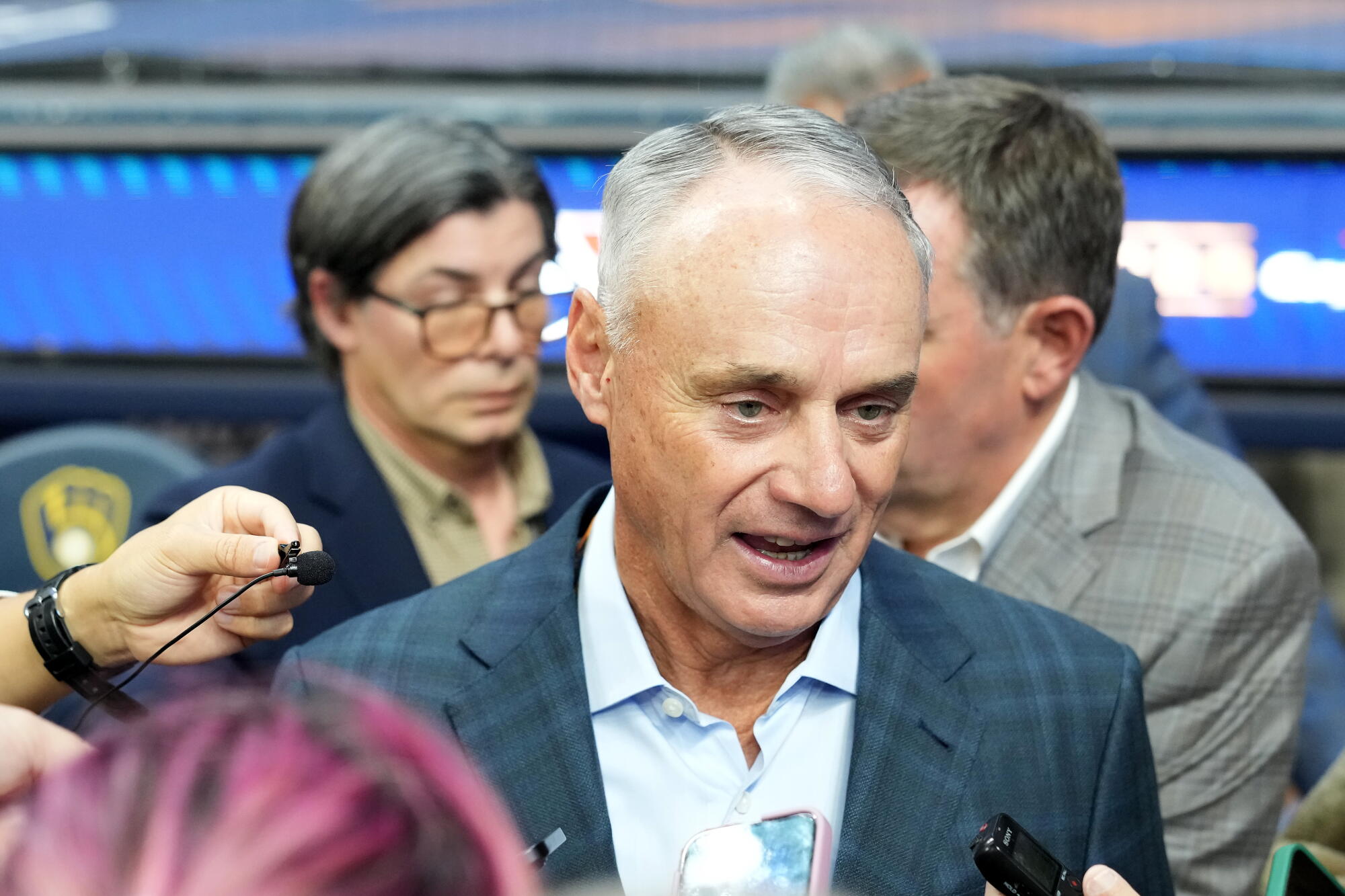
MLB commissioner Rob Manfred speaks with the media before Game 1 of the World Series in Milwaukee on Friday.
(John Fisher / Getty Images)
That makes this year’s World Series something of a Rorschach test: Is a Brewers-Rays series proof that the system actually works just fine the way it is?
To Manfred, the answer is no. A series featuring two of baseball’s smaller markets is an anomaly when history shows a correlation between payroll and success, not only in the regular season but in advancing through the playoffs.
“It’s not that no small market can win,” Manfred said. “It’s just that it’s pretty rare.”
To Meyer, the answer is yes.
“It has nothing to do with what the Dodgers are doing,” Meyer said. “There is no reason whatsoever that the Pirates can’t do what the Brewers have done, or what the Rays have done.”
The Pirates, Meyer said, do not spend all the money they are allotted to sign draft picks. The Brewers, playing in baseball’s smallest market, might not routinely hand out free-agent riches, but owner Mark Attanasio said his team ranks “right in the middle” of the 30 teams in spending on baseball operations.
Attanasio publicly stumped for a salary cap here Friday, saying it would “help us compete but more importantly all of the other teams with lower payrolls too.” He said Brewers fans already fear it might take another 44 years to return to the World Series.
Said Meyer: “That doesn’t seem like a great way, with all due respect, to try and generate excitement among your fans.”
Meyer said this year’s series “undermines their argument” for what he called “the nuclear bomb of a salary cap.” He said the owners are uninterested in the union’s proposals for addressing competitive balance, including increased revenue sharing among owners and a tax against teams that fail to win consistently, and he alleged the league’s argument is “a charade” for what the owners really want: “to suppress salaries and gut player rights.”
The takeaway: Don’t book non-refundable airline tickets and hotel rooms for spring training.
On other topics:
— As The Times has reported, MLB is keeping an eye on federal investigations into Dodgers owner Mark Walter and his insurance empire, which is under scrutiny for allegedly violating laws designed to protect investors. Walter also is a defendant in multiple civil lawsuits filed by investors alleging fraud and breach of contract.
“As always when we have an investigation — external, law enforcement, whatever — we monitor that,” Manfred said. “That’s where we are right now. We’re just watching what’s going on right now.”
Over the past two months, amid efforts to find what could be more than $20 billion to recapitalize insurance funds, Walter has sold his controlling interest in the Lakers and a minority share of Chelsea, the English Premier League club. On Friday, Bloomberg reported he is seeking to sell the Sparks. He has no plan to sell the Dodgers, team president Stan Kasten has said.
— Meyer said the MLBPA continues negotiations with LA28 over how major league players would be accommodated in the 2028 Olympics. “As of now, we’re not getting satisfaction on those things,” Meyer said.
Both the league and the union say they want to participate in the Games, but Manfred said MLB would normally start preparing its 2028 schedule early in 2027. The league has agreed to an extended All-Star break to accommodate the Olympics, but MLB also could tire of waiting for the union to agree with LA28, which badly wants MLB players to participate.
MILWAUKEE — Milwaukee is going absolutely nuts. The Brewers have sold out Game 3 and Game 4 of the World Series.
The Tampa Bay Rays will host those games, but the Brewers invited fans to come to their stadium and watch on the big screen. The Brewers sold more than 31,000 tickets to each of their watch parties at $15 apiece. On Friday morning, StubHub offered them for resale, starting at $168.
There is nothing quite like a city uniting behind a team that never has won a World Series. Ask Logan Henderson.
Henderson, the Brewers’ starting pitcher Saturday in Milwaukee, grew up a huge fan of the Houston Astros. He was 15 when he saw his first World Series game.
“My parents had always said, if we were fortunate enough to be able to watch them go to the World Series, we’re going to do everything we can to get there,” Henderson said. “I was blessed that my parents got tickets to go to the games.
“There’s nothing like it. I’m on the other side of it now. I was a spectator and a fan, now I’m a player. It’s definitely surreal.”
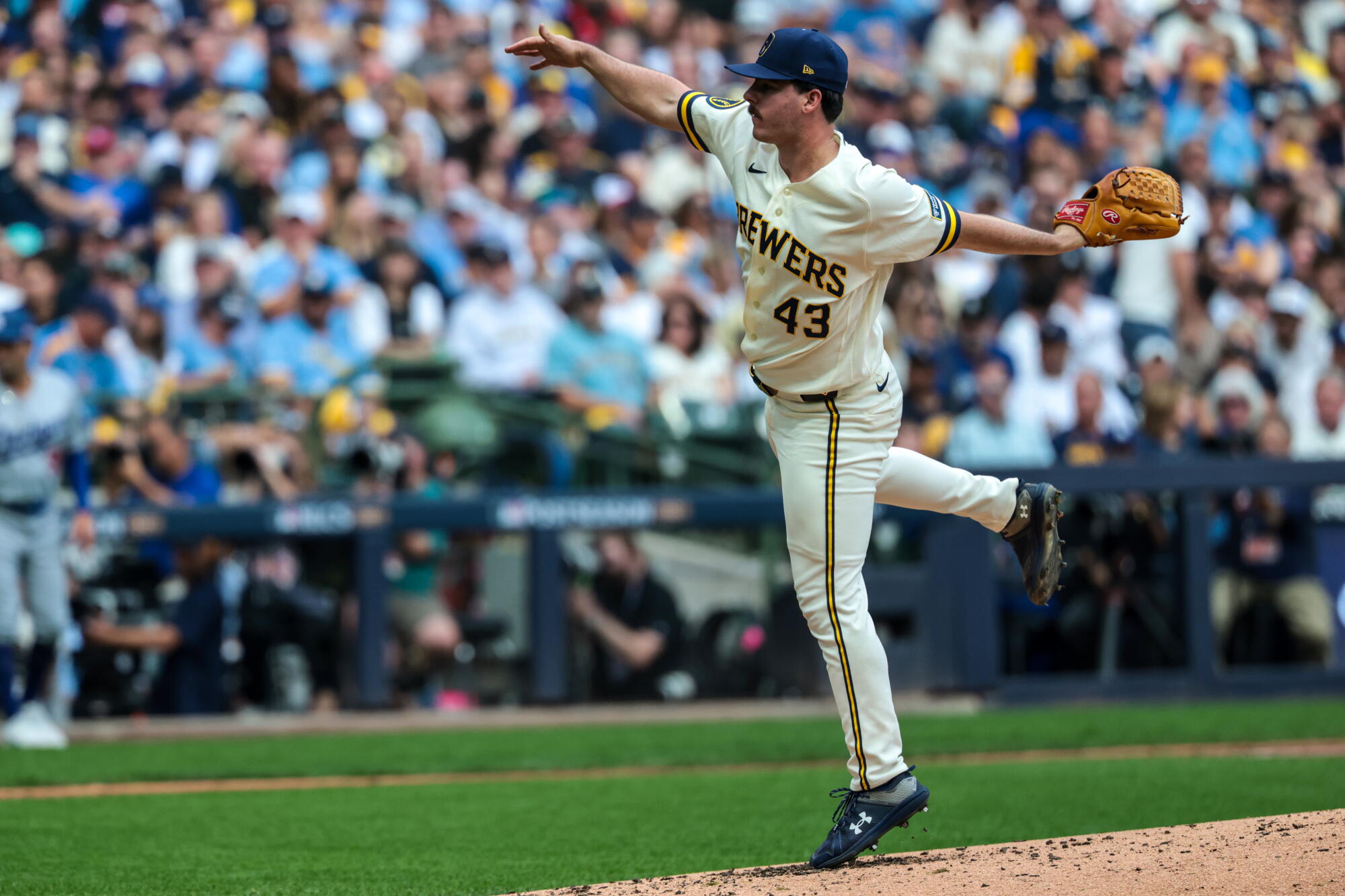
Milwaukee Brewers pitcher Logan Henderson follows through on a pitch during Game 2 of the NLCS against the Dodgers in Milwaukee on Oct. 12.
“I went to the one before the crazy one,” he said. “L.A. ended up winning that game.”
In the crazy one, the Dodgers blew two four-run leads, tied the score with three runs in the ninth inning and lost in the 10th.
If we knew then what we know now, Game 4 would be the crazy one: Dodgers pitcher Alex Wood constantly changing his signs, suspicious that the Astros might be up to something, whatever that might be.
Dodgers pitcher Alex Wood delivers from the mound during Game 4 of the World Series against the Astros on Oct. 28, 2017, in Houston.
(Pool / Getty Images)
Wood was vindicated three years later, when a league investigation revealed the Astros had been cheating in 2017, stealing signs from a television monitor next to the dugout and relaying them to batters by banging on trash cans. The practice, according to the report issued by commissioner Rob Manfred, was refined during the regular season and extended “throughout the postseason.”
The scandal outraged the Dodgers and their fans. The Los Angeles City Council voted unanimously to demand Manfred award the 2017 championship to the Dodgers. Their players wanted nothing to do with that. A real championship, after all, would come with champagne and beer in the clubhouse and a parade through the streets.
When the Astros’ team buses arrived at Dodger Stadium for games during the pandemic season of 2020, when ballparks were closed to the public, Dodgers fans gathered outside to boo.
Dodgers fans boo Jose Altuve of the Astros after he struck out in a game on Aug. 3, 2001, at Dodger Stadium.
“That meant absolutely everything to the city. I hope that means what it did for me to the fans in Milwaukee here.”
The Rays also are trying to bring their first championship home to Tampa Bay. In 2017, hard as this might be to believe today, the mighty Dodgers had not won a championship in 29 years.
And now, as a major leaguer, Henderson has an acute appreciation of the little things that can mean the difference between victory and defeat, between a parade and another plaintive chorus of “wait ‘til next year.”
“I would rather face a player that was taking steroids than face a player that knew every pitch that was coming,” Wood tweeted after Manfred’s report on the Astros’ cheating.
Henderson knows how hard this is to do. The Brewers haven’t appeared in the World Series in 44 years, and owner Mark Attanasio said nervous fans already are wondering whether their next appearance will be 44 years away.
So I asked Henderson if, all these years later, the scandal changed how he felt about those Astros.
He paused.
He exhaled.
He paused again.
“Maybe a little bit,” Henderson said. “It’s unfortunate. I try not to think about it or talk on it too much. I think now, being in the game, my perspective on it is a little different.
“I think for the kid in me — and the huge baseball fan I was — that team will always have a special place in my heart.”
Marshall Faulk is an extraordinarily active 53-year-old. The first-ballot NFL Hall of Fame running back is the head football coach at Southern University in Baton Rouge, La. He runs a foundation in his name that assists underprivileged youth. He works out. He plays a lot of golf.
And he has Parkinson’s disease.
Faulk revealed his diagnosis on The Caring Neurologist podcast this week, saying he noticed Parkinson’s symptoms on the golf course.
“The rigidity in my hand, just sometimes after I play a lot or I practice a lot,” he said. “I just thought it was normal nerves when putting and stuff like that. But it started to be times where I was playing, but I wasn’t in a match, and it would still do that. I was like, ‘Wow, is that normal?’”
Faulk said he was diagnosed about 18 months ago. An unfailing optimist in his social media dispatches and a fiery truth-teller when addressing his team, the former Rams Super Bowl champion described himself on the podcast as “one of the lucky ones” because he caught the disease early.
“The doctor was like, ‘You need to go get checked,’” he said. “You need to go have X, Y and Z done. You’re at an age, it’s possible; it’s likely that it’s not, but you need to go get checked.’”
He jumped on the phone to speak with other former NFL players who share the diagnosis.
“They told me about some of the symptoms and things they had that they thought [were] just football-related, that it didn’t relate to Parkinson’s in any manner,” Faulk said. “They wish, in those early stages, if they had maybe just known a little earlier, they would be in better shape.”
Former Green Bay Packers greats Brett Favre and Ahman Green currently live with Parkinson’s. So does former quarterback Bernie Kosar.
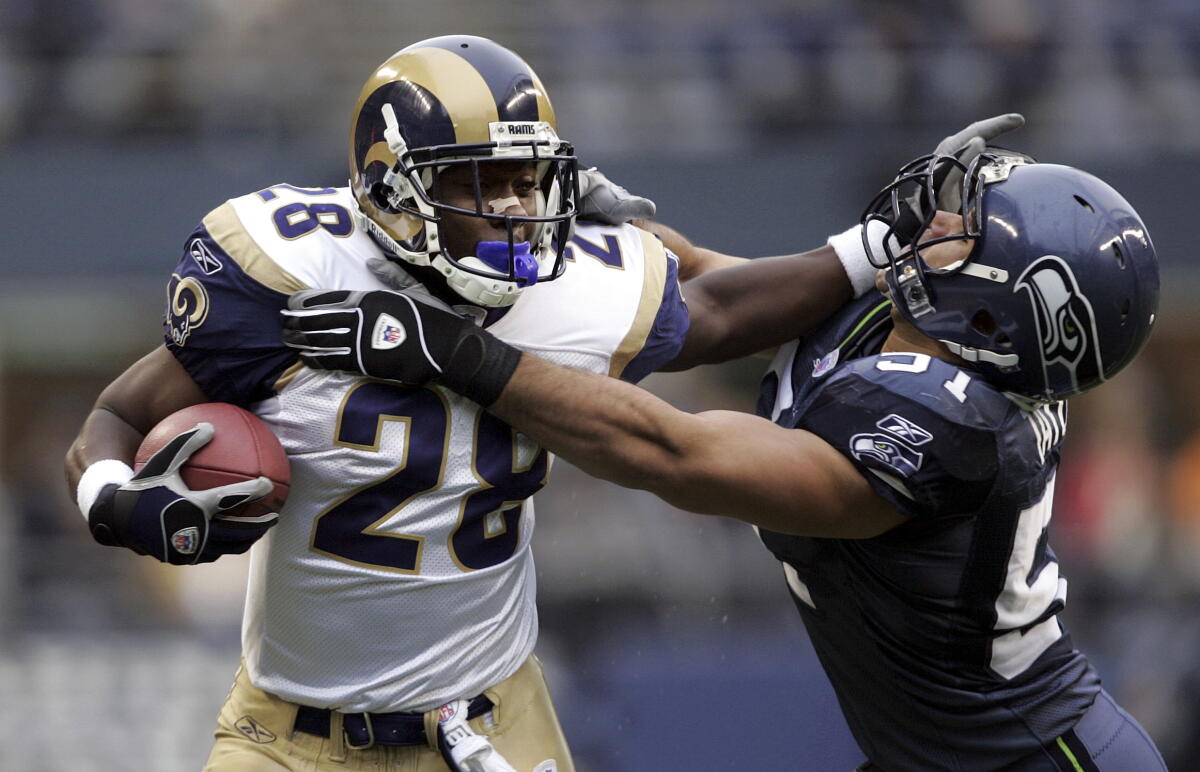
St. Louis Rams’ Marshall Faulk, left, straight-arms Lofa Tatupu of the Seattle Seahawks during a 2005 NFL game.
(Elaine Thompson / Associated Press)
Perhaps the most noteworthy sports figure to battle Parkinson’s was boxing great Muhammad Ali, who died in 2016. Faulk met Ali at a dinner and said on the podcast that he is comforted by the memory.
“He leaned over to me and he whispered, ‘You a bad boy,’” Faulk said. “And then he made a couple other comments. I was like, ‘He’s all there.’ So knowing that, I didn’t look at it like life is going to end.”
Faulk was seemingly indestructible as a player. An All-American at San Diego State, he was drafted second overall by the Indianapolis Colts in 1994 and immediately made an impact, rushing for more than 1,000 yards for the first of seven times and being named NFL rookie of the year.
Faulk was traded to the then St. Louis Rams ahead of the 1999 season and led their “Greatest Show on Turf” offense to a Super Bowl XXXIV victory in January 2000. The following season, Faulk was named NFL MVP. He transitioned to the NFL Network broadcast booth after retiring in 2005 having rushed for 12,279 yards and 100 touchdowns while also catching 767 passes for another 36 touchdowns.
He got into coaching in 2025, joining Deion Sanders’ staff at Colorado. When the opportunity arose to become the head coach at Southern, Faulk didn’t hesitate even though he already had been diagnosed with Parkinson’s.
“I could have stayed at Colorado. I was comfortable. But I’ve never done well in life when comfortable,” he said at his introductory news conference at Southern. “And I’m not gonna lie to you. This is uncomfortable, and I like it.”
The Jaguars, an HBCU school competing in the FCS, are 3-4 in Faulk’s first season after going 2-10 in 2025. Faulk’s messages to his players go beyond football. On Thursday he posted this on Instagram: “Protecting your game goes far beyond avoiding injury. Protect your body. Protect your mind. Protect your circle. Protect your future.
“The decisions you make away from the field can have just as much impact on your future as what happens between the lines,” he continued. “Choose the people, habits, and environments that move you closer to where you want to go. Send this to a young athlete who needs this reminder today.”
Helping others is why he decided to open up about his Parkinson’s diagnosis, he told host Dr. Sandeep Thakkar on the podcast.
“I want to help as many people as I can,” he said. “What you want to do with that information is pass it on to the next generation to make sure that they have it better, that they know more. And you’re doing it to leave this world a better place than it was when I got here.”
Mohammed Annour spent much of his youth living in a flimsy shelter in a dusty, overcrowded refugee camp in east Africa, where the days were long, the food was poor and the future nonexistent.
“Go to the army and fight. That’s one option,” said Annour, who fled war in Sudan for the refugee camp in Chad when he was 9. “The other one is you stay there. But you don’t have a future.”
If he had stayed, Annour, now 33, has little doubt how his story would have ended.
“Probably,” he said, “I’m dead.”
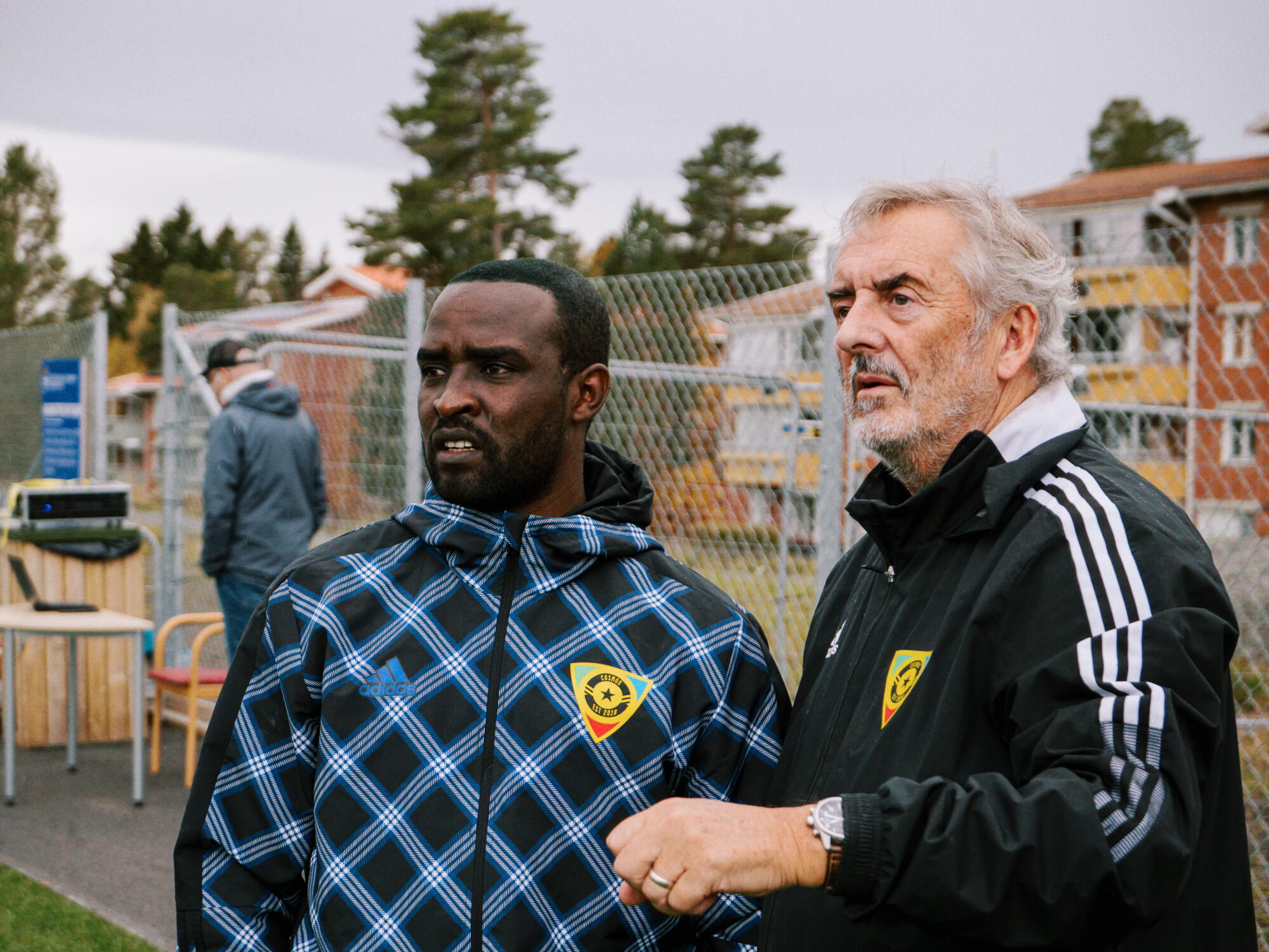
Mohammed Annour, a refugee soccer player who became a coach, and Alan Barker, chairman of the Mighty Cosmos, look across a field in Sweden.
(Courtesy of Darren Hamlin)
Instead, he’s in Sweden, raising two boys, working as a quality control inspector for a textile company and playing amateur soccer for a team in the country’s fifth division. And the only thing that separates his experience from the tens of thousands of desperate people he left behind in the camp is the fact someone believed in him enough to give him a chance.
“Everybody needs a chance,” Annour said. “Don’t throw people out. People just need a chance in life.”
“And we got that chance,” he continued, “because of Katie-Jay and Gabriel.”
Scott and Stauring founded the humanitarian group iACT largely to respond to the crisis in Darfur, a semi-desert plateau in western Sudan that has known nothing but war this century. But unlike many of the dozens of other similarly minded people and groups working in Africa, Scott and Stauring came not to preach, but to listen. They came with questions, not answers.
And what they were told was that the children in the camps needed more than food and shelter. They needed a routine, they needed recreation, they needed joy and they needed hope.
Founders of iACT Gabriel Stauring, left, and Katie-Jay Scott hold up gifts they received after a training session in the Central African Republic. Stauring and Scott were killed in a car crash in 2021, but their nonprofit continues to support refugees.
(Courtesy of iACT)
In other words, they needed soccer.
“Many organizations came into the camps. They just came around and took some pictures and then they leave,” said Annour, a slight man with a serious countenance. “I think [Scott and Stauring] understood us as humans, not just these kids or these people who need food or shelter.
“They saw another side. They saw these people that can make something in life.”
“They were so kind, careful,” Annour said. “Listening to everyone. It didn’t matter where you came from, which color you are. They were open and gave time to everyone they met.”
“Honestly, I didn’t know they were going to change my life or anything,” added Moubarak Abdallah, another refugee introduced to soccer by Scott and Stauring. “I saw them as other people who just come and go. But they were quite special people.
Grace Tanda, of the Mighty Cosmos, strikes the ball during a match. The soccer team in Sweden is comprised of refugees.
(Courtesy of Darren Hamlin)
“They wanted to help our ideas shine, to [give] other people hope. They were listening to what I needed.”
Today, there are more than 5,000 children participating in iACT soccer academies in Chad, the Central African Republic, Cameroon and Mexico. Another 1,800 children are enrolled in the group’s Little Ripples preschool program, which also served 475,000 meals to students and staff last year.
But the organization, like many similarly focused humanitarian groups, is fighting for its survival amid a global backlash against refugees and migrants.
The hostility has been especially strong in the U.S., where the second Trump administration has sharply restricted immigration and asylum access and drastically cut congressionally approved spending for life-sustaining programs previously funded through USAID. Many European countries have followed that lead, adopting a stauncher approach to border enforcement and deportations and slashing support for development assistance by 13.8% in 2025, the largest cut in a decade.
This summer, violent anti-immigrant protests in South Africa forced more than 178,000 people to flee to Zimbabwe, Malawi, Nigeria and other countries, reversing a trend that has seen the region’s richest country welcome migrants to work on farms, in construction and other low-paid jobs. Public sentiment toward refugees and migrants has also hardened elsewhere, creating a crisis for nonprofit aid groups.
The Office of the United Nations High Commissioner for Refugees, or UNHCR, this month warned the gap between humanitarian needs and donor contributions is widening, leading to deep cuts and forcing aid groups to fight one another for the shrinking dollars that remain — all at a time when conflicts in Syria, Gaza and Ukraine have swelled the number of refugees worldwide to nearly 42 million; another 69 million people are displaced.
That’s more than 1 out of every 70 people on Earth, according to the UNHCR.
Annour and his family were once part of that wave, fleeing their home in Sudan in 2003, stepping around dead bodies and witnessing unimaginable horror, to escape one in a series of continuing civil wars that have given way to genocide. More than 15 million people have been displaced in the 23 years of fighting, with more than 1.3 million still stranded in teeming refugee camps in eastern Chad.
Annour said he would have perished there if not for Stauring and Scott, who introduced soccer to their camp. Three years after the pair arrived, an international tournament for stateless players, the CONIFA World Football Cup, was held and iACT entered a 20-man team comprised of players from 12 camps. Annour, a left back, made the cut as did Abdallah, a physical midfielder with a perpetual smile who would become the team captain.
“No one is thinking this [is] going to be life-changing,” Abdallah remembers thinking. “You know, there was like a small chance but it became big dreams for us.”
The team, Darfur United, was outscored 39-0 in its two games in Ostersund, Sweden, but most of the players chose to stay in Ostersund rather than return to their camps and were welcomed by the Swedish government. They received asylum and eventually formed an integration team, the Mighty Cosmos, that advanced as high as the fifth division of Swedish soccer.
Abdallah is a natural leader, said Alan Barker, chairman of the Mighty Cosmos, and the kind of person who receives total respect from the other players.
Mugenyi Ngabu, left, cheers during the Mighty Cosmos’ match in Sweden. The team is comprised entirely of refugees.
(Courtesy of Darren Hamlin)
“He is a sort of guy you can rely on 100%,” Barker said. “Personally, I would trust him with my life. He is a doer, not a talker. A problem solver not a problem creator. And he always wants the best for everybody.”
Annour, he added, has been troubled by knee injuries on the field but remains “a strong and quiet yet forceful personality of the group.”
“He is a passionate believer in fair play and honesty and has no room for dishonesty or deception in any aspect of life,” Barker continued. “Maybe that’s a reflection of his childhood in the refugee camps and Chad, where there was no time for such things. He’s a sort of guy whose name would be first on the team sheet. The team sheet of football and life.”
More important is the fact that the players, teenagers or young adults when they arrived in Sweden, have married, had children of their own, become citizens and integrated into the local community, where their civic work was this year recognized with one of Sweden’s most prestigious awards.
“I never dreamed to be in this position when I was a kid. I was trying to survive, to live day by day,” said Annour, who is working three jobs to support his sons, aged 1 ½ and 4.
“I’m here. I can provide for my family. Moubarak provides for his family. It’s like saving a generation, not just me and Moubarak.”
“It’s about the chances,” agreed Abdallah, 35, who also lives in Sweden where he coaches the Mighty Cosmos while raising a 5-year-old son.
“The door has to open. That’s all.”
iACT offered a way to open those doors when it first rolled that battered soccer ball onto a dirt lot. Without that, “these guys wouldn’t be here, wouldn‘t have the lives they have,” said Darren Hamlin, a British filmmaker who has started a Kickstarter campaign to fund a documentary on the refugee players.
By focusing on single players and their game and not the vastness of the sprawling global refugee crisis, Hamlin says the film has the power to redefine these former refugees not as obscure numbers but as flesh-and-blood people with dreams and talents and aspirations. That was what inspired Scott and Stauring when they founded iACT.
“Football has this power to transcend sports. It becomes an emotional thing,” said Hamlin, who is behind on his goal of raising $66,000 by the end of the month to expand work on the documentary. “It doesn’t matter how many stats or things we put in front of people; they don’t really pay attention.
“But football kind of goes deeper sometimes. Football is kind of the vehicle that delivers the message.”
Getting that message out, however, is becoming increasingly difficult. As government funding for refugee programs around the world has dried up, groups like iACT have found themselves fighting for the same slice of a much smaller funding pie.
“Fundraising at all levels has become more difficult with the gutting of USAID, especially with the increase in larger NGOs [non-government organizations] applying for foundation grants,” said Merri Weir, a retired teacher and iACT board member since 2016. “It is becoming harder and harder because we’re competing with larger NGOs. The funding stream has become tighter.”
At the same time, the need has swelled.
“The refugee camps in Chad are still very unstable,” said Weir, who has visited the camps multiple times. “The current war has not ended and shows no sign of ending. Refugees are still coming across the border, which has more than doubled the number of Sudanese refugees.
“It is critical that we are able to sustain our current refugee-led programs.”
In response, Weir’s group, which will hold its annual fundraising event in Manhattan Beach next month, has considered everything short of a corner lemonade stand and selling chocolate door to door to make up for the lost financial backing it needs to continue what Scott and Stauring started.
“In the past, it is our uniqueness and our innovation and our refugee-led action [that] set us apart,” said Weir. “It was very appealing.”
The Trump administration complicated things even further in June 2025 when it instituted a travel ban and entry restriction list on Chad, leading the Chadian government to retaliate by revoking visas for American citizens, including aid workers. That means fewer children playing soccer and attending preschool, fewer meals being served — and fewer success stories like the ones told by Abdallah and Annour.
“I spent 12 years in a refugee camp,” Abdallah said. “People just hope to get a meal for the day. [iACT] brought the footballs and then just brought the idea. A chance to change our lives. Opportunity.
“There’s a lot of people in the refugee camps [that] could be pilots, doctors, better football players. Maybe there is the next Lionel Messi, Cristiano [Ronaldo], Lamine Yamal in the camp. But they don’t have any opportunity to get out.”
“The world is crazy. It’s just war everywhere,” added Annour, who is about to begin a college course on sports science. “Those people who don’t like refugees, who don’t want the United Nations to bring more refugees, they need to put themselves in our shoes.
“People are so naive to think they can just ignore what’s going on. It’s getting bigger every day.“
Abdallah and Annour may have left the camps, but the camps have not left them. The work they have done in Sweden includes the construction of a community sports and culture center, addressing crime prevention and mental health, refugee resettlement, and fundraising efforts that support the work of iACT and other groups working with the people they left behind.
“My mom is still in the same camp, so I’ve been back three times now with a lot of footballs, football boots and football equipment,” Abdallah said.
Scott and Stauring, who lived in Redondo Beach before the fatal car crash, thought they were bringing soccer to the camps in Africa, but what they really brought was hope and proof that if someone just opens the door, you might be surprised what you find on the other side.
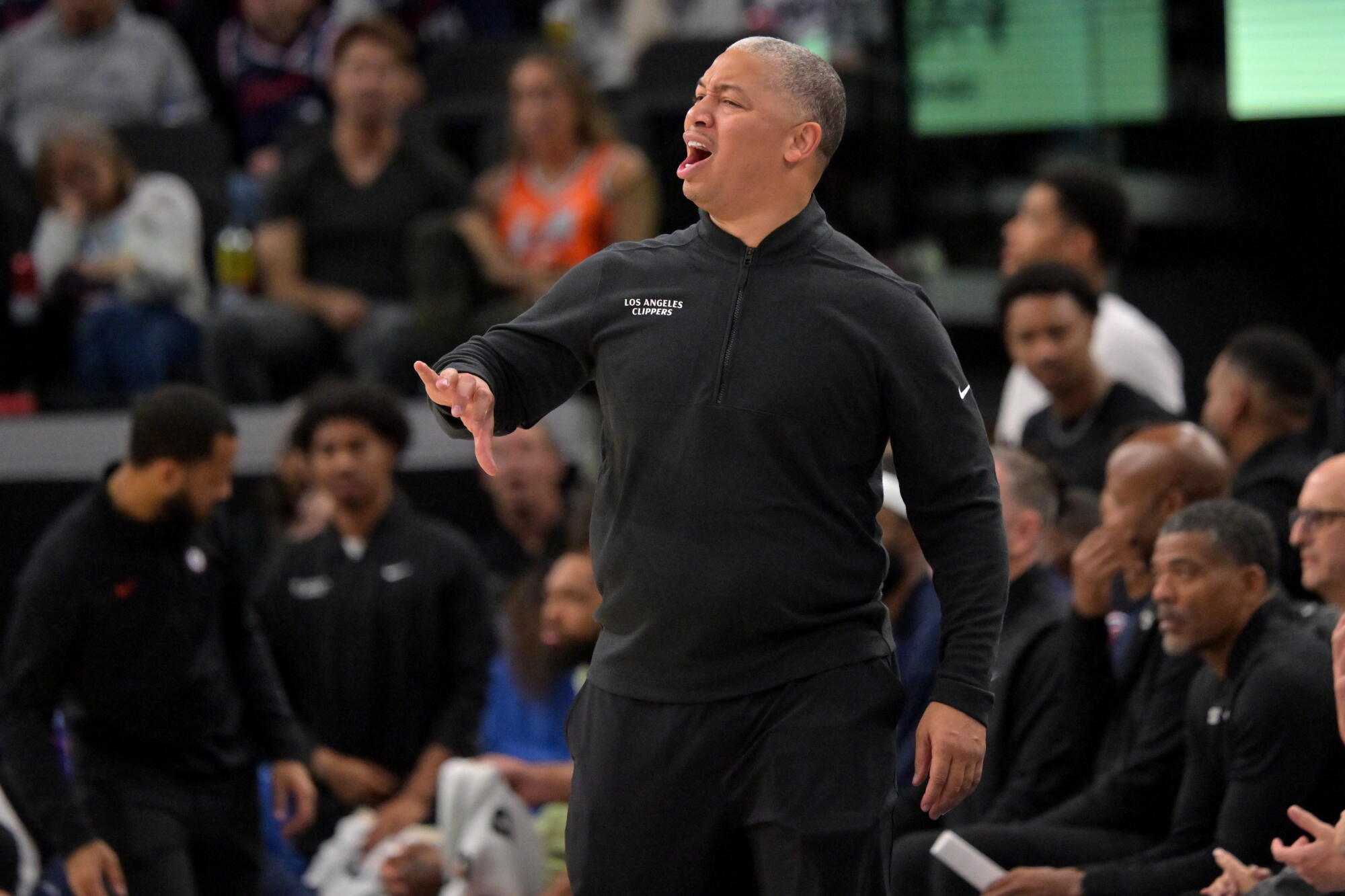
Not with superstars or championship aspirations. But with the promise of free parking, a jersey trade-in and a basketball team that is, at least, better than the Sacramento Kings, who they beat 121-96 in both teams’ season opener. Coach Tyronn Lue dedicated the win to suspended team owner Steve Ballmer: “Just want to say thank you for everything. We’re still fighting for him.”
Clippers coach Tyronn Lue directs his players during a win over the Sacramento Kings Wednesday at Intuit Dome.
(Jayne Kamin-Oncea / Associated Press)
Wednesday’s fan appreciation stuff was a swell gesture, as a start. But it wasn’t nearly far-reaching enough.
Not for embattled Clippers supporters who have stuck with the team through thick and thin, sickness and health, in spite of Donald Sterling, the former cheap, racist owner and now Ballmer, the wealthy, over-invested one whose salary cap circumvention cost his team its first-round picks in the 2029, 2030, 2031, 2032, and 2033 NBA drafts.
To fans, that was the most consequential part of the historic punishment dealt by the NBA, which commissioned a year-long investigation that determined the Clippers committed audacious levels of salary cap circumvention.
The league also fined the team $30 million, suspended team owner Ballmer and president of business operations Gillian Zucker for a year and president of basketball operations Lawrence Frank for six months.
And Leonard? He got a $700,000 slap on the wrist and got traded back to Toronto, where he signed a two-year, $115 million contract extension and on Wednesday, had Raptors coach Darko Rajaković saying he was “super excited for the chance to bring a Hall of Famer back home.”
“That’s one of the most insulting parts of it all, the way [Leonard] was able to walk away scot-free and the fans are left sort of holding the bag,” said Torrance’s Justin Ratterree, while he tried to dodge raindrops as he waited in line, four hours before tipoff, to trade in his No. 2 Leonard jersey.
Young Clippers fans watch the team play the the Sacramento Kings Wednesday at the Intuit Dome.
(Jayne Kamin-Oncea / Associated Press)
“It’s rough right now. Defending the team this past couple months has been really rough … and I’ve kind of just given up defending. How can you defend it?”
Even Ballmer stopped doing that, releasing a statement on Sept. 13 that read, in part: “This has been a very difficult time for everybody associated with the Clippers, and for that, I have sincere regrets.
“I want to apologize to our fans, employees, and my fellow NBA team owners for the distraction and distress this matter has caused, for which I accept responsibility as principal owner.
“We are,” he added, “committing to put this chapter behind us.”
Yes, let them try to scrub the memory of Leonard, the intensely skilled and private player who demanded so much of the Clippers when he signed with them as a free agent in 2019. Who made no efforts to popularize the team, missed almost as much time as he worked, and who failed to lead the Clippers to their first championship or anywhere close to it in his seven seasons.
After his trade to Toronto went through on Sept. 23, the Clippers resisted posting the “Thank You, Kawhi” graphic that pro sports teams do when they part ways with a player.
Let them also forget to play a tribute video when Leonard’s Raptors visit Intuit Dome for the only time this season on Nov. 2.
And let the Clippers expand the jersey swap beyond the first 4,000 paying customers at Game 1; there was no official figure available Wednesday night for exactly how many jerseys were traded and how many of them belonged to he-who-must-not-be-named.
The Clippers should keep it going, offer the option all season. Set it up at the Intuit Dome’s Lost and Found — invite fans to exchange the No. 2 jersey of the player whom they lost all respect for a guy they’ve found themselves newly enamored with, likely rookie Keaton Wagler if Wednesday’s exchange was any indication.
Clippers fans also deserve more than having their parking picked up until an hour before gametime, on one rainy workday, on late notice.
They should have their parking at games covered all season — or at least substantially reduced from the typical $70 price that’s already too steep. (The Dodgers didn’t start charging $65 until the National League Division Series!)
They should do more if they want to continue to draw a crowd to watch a team whose best player is now Darius Garland, whose future is compromised, whose current best-cast scenario — the play-in! — only Clippers fans could love.
Clippers forward Rui Hachimura drives past Kings guard De’andre Hunter and center Domantas Sabonis Wednesday at the Intuit Dome.
(Jayne Kamin-Oncea / Associated Press)
Several fans Wednesday also said they would appreciate improved transparency, including in terms of player injury and availability news.
It’s the least the team can do for these patient people, who will have the type of team that they usually fall hard for, actually — a group of gamers, devoid of divas, punching above their weight.
“All this stuff that’s going on,” Lue said, “you can’t take that out on our players … that’s not their fault, you know?”
It’s not fans’ fault, either. Let’s see the Clippers go above and beyond for them.
Welcome back to The Times’ Lakers newsletter and welcome back to real NBA games.
The regular season begins Tuesday with a triple-header. It’s the first time in eight years that the Lakers are watching the opening day action at home. That could be a small sign of where the Lakers stand in the NBA pecking order now.
Not many people know what to make of this team. There are nine new players. Another ownership change is pending. The Western Conference has two juggernauts at the top.
But within this summer of change, the Lakers managed to maintain one key partnership.
All things Lakers, all the time.
Get all the Lakers news you need in Thuc Nhi Nguyen’s weekly newsletter.
By continuing, you agree to our Terms of Service, which include arbitration and a class action waiver. You agree that we and our third-party vendors may collect and use your information, including through cookies, pixels and similar technologies, for the purposes set forth in our Privacy Policy such as personalizing your experience and ads.
Two-headed monster
With more than half of their roster wearing the purple and gold for the first time, some Lakers might still be getting on the same page after less than three weeks of practices. Meanwhile, Luka Doncic and Austin Reaves are already playing a completely different game.
“They’re always, like, playing chess out there,” guard Collin Sexton said.
After an offseason of change, it’s still the Lakers’ two most established stars who will control the season’s fate. Doncic and Reaves were 30-11 in games played together last season. In 1,092 minutes, lineups with Doncic and Reaves together outscored opponents by 8.9 points per 100 possessions, the third-best net rating on the team for any pair of regular rotation players. Their established chemistry gives the Lakers a strong foundation for the season.
“Austin and Luka, they kind of see things before it happens,” Sexton said. “And I feel like that allows them to be so good offensively and be able to score, but also to put us in the right situation to be successful as well.”
The duo that could be one of the most offensively potent pairings in the league proved that they could have success last season, helping the Lakers surge up the Western Conference standings during a magical March. Doncic scored 600 points during the month, despite missing one game because of a technical foul accumulation suspension. Reaves averaged 5.8 assists, his highest average for a month with more than six appearances last season. With LeBron James serving as the most heralded third option in the history of basketball, the Lakers went 15-2.
It was painful but a little poetic that Doncic and Reaves — whose wholesome friendship became the envy of NBA Twitter — suffered injuries during the same game to end the hot streak.
Doncic told Sports Illustrated this summer that he “regret[ted]” coming back into the game against the Oklahoma City Thunder after he felt a twinge in his hamstring during the first half. The severity of the injury kept him out for the rest of the season.
“I thought we had a team that could compete for a championship,” Doncic said during training camp. “So I was kind of disappointed, kind of let the team down, so it’s definitely motivating for this season.”
Reaves returned during the postseason after an oblique injury, but couldn’t regain his consistency. He played in a career-low 51 games last season and missed out on what could have been his first All-Star selection.
Determined to fortify his body for another long season, Reaves hired former Lakers head strength and conditioning coach Ed Streit to work with him. He hoped that having a dedicated strength coach, which stars including James and Doncic already have, would help him take “the next step,” Reaves said.
After waiting and learning behind veterans such as James and Anthony Davis, Reaves is now an undisputed top-two player on the Lakers. He signed the richest contract ever for an undrafted player this offseason. Doncic was among his most vocal supporters.
“We talked about it even middle of last year, towards the end of last year, continuing this partnership for as long as we can,” Reaves said. “I enjoy being around him so much that coming back and being a Laker was the main thing when the season ended.”
Initially Reaves didn’t know if he would establish a close bond with Doncic after the former Dallas superstar was shockingly traded. Doncic was quiet when he first arrived in L.A. Now Reaves, who loves to hate his newest best friend, is sad to admit that they’re so similar.
They share a creative style of basketball. They’re ruthless competitors. They love golf.
The most important thing is another shared obsession.
“At the end of the day, we care about winning,” Reaves said, “and that’s all that matters.”
General managers voted on the top four teams in each conference, with four points awarded for each first-place vote, three points for second place, two for third and one for fourth, and the Lakers received 10% of fourth-place votes and 1% of total available points, which placed sixth in the total score.
The San Antonio Spurs, who were also the general managers’ choice to win the NBA title, had 53% of first-place points in the Western Conference. The Oklahoma City Thunder were effectively tied in the survey, with both teams getting 34% of the available points. With two young, deep teams at the top of the conference, all roads seem to lead to an encore of last year’s Western Conference final.
But this league celebrates its parity. Eight champions in eight years? Almost nothing compared to more than the 40 years since a repeat Western Conference finals matchup. The West hasn’t had a conference finals sequel since the Lakers and Spurs in 1982 and 1983.
The season could turn unexpectedly for one of the top teams, opening the door for another team to crash the party. NBA general managers don’t think the Lakers would be first inside the velvet ropes, but executives believe the team could be an enigma. In response to a NBA.com survey question on which team’s success is the toughest to predict this season, the Lakers received the third-most votes.
The league can’t tell the type of team the Lakers will be. They at least have their goals clear.
“Realistically, I would say championship,” Doncic said at the Spectrum broadcast desk on media day. “If that’s not your goal, I don’t know what you’re doing here.”
Poll question
Where do you think the Lakers will finish in the Western Conference?
It’s here! The opener! The Lakers should be familiar with the Warriors after playing two preseason games against their in-state rivals. Rookie Yaxel Lendeborg emerged as an immediate impact player, averaging 15.6 points and 7.4 rebounds on 56.9% shooting during the preseason.
Friday vs. Clippers, 7 p.m. PDT
Old friend Rui Hachimura returns with the Clippers, who have moved on from the Kawhi Leonard Era but begin the season without Brandon Ingram (Achilles) and Max Strus (foot). Rookie guard Keaton Wagler could be one of the few bright spots for the struggling franchise this season.
Sunday at Jazz, 2 p.m. PDT
The Lakers’ first road game is a homecoming for Walker Kessler, returning to the franchise that drafted him, and a reunion with another former Laker Jaxson Hayes. Hayes, who signed a two-year, $12-million contract with the Jazz, is in line to get significant minutes for Utah after an early injury to Jusuf Nurkic (foot).
Favorite thing I ate this week
Poke from Redondo Beach’s Jus’ Poke.
(Thuc Nhi Nguyen / Los Angeles Times)
The Lakers did not bless us with a tropical training camp (looking at you, Clippers and Warriors) so a trip to Redondo Beach’s Jus’ Poke will have to be the closest I get to Hawaii for now. The poke selections are always fresh and stand out for their simplicity and execution. No superfluous toppings and sauces. Just, as the name suggests, really good poke.
The Dodgers’ offseason began at 8:07 Thursday night. Heavily favored to win a third straight World Series, they were swept into winter by the Milwaukee Brewers.
The final score doesn’t really matter, but for the record it was 6-4 Brewers. It wasn’t really that close.
The Dodgers led in every game of the National League Championship Series. They didn’t win any of them. No team has ever done that while getting swept in a best-of-seven series. So while the Dodgers didn’t three-peat, they made history just the same.
“They were relentless with everything that they did,” Dodgers infielder Max Muncy said of the Brewers. “They just strung together good at-bat after good at-bat. That’s usually what we do.
“We didn’t do it this series and they did.”
The Dodgers’ starting rotation, the most expensive in history, gave up 16 hits and 13 runs in 18 innings for a 6.50 earned-run average. The bullpen was nearly as bad, posting a 4.50 ERA in 16 innings.
The Brewers’ relievers, on the other hand, were spectacular. Milwaukee manager Pat Murphy went to his bullpen 14 times and just twice did a reliever give up a run. All four victories against the Dodgers and all seven Brewers wins this postseason have gone to a reliever, with the bullpen posting a 1.33 ERA in 40⅔ innings.
“Pitcher after pitcher came in and executed,” Muncy said. “When one of their pitchers faltered, the next guy came in and picked up the slack.”
And each time the Dodgers took a lead, the Brewers waited no more than two innings to cut into the deficit. Milwaukee trailed 4-0 after two innings Thursday. By the top of the fifth, the score was tied. An inning later, the Brewers went ahead to stay, becoming the first team with six comeback wins in their first eight postseason games.
“They respond,” Murphy said of his players. “We’ve talked about it all year long. You have a bad week, you have a bad game, you have a bad at-bat, you bounce back.”
“I love the Dodgers. I love their players. They’ve got legendary players,” he continued. “But we came in with a group that would not be denied. They were hungry, very hungry.”
The two-time defending champion Dodgers, meanwhile, appeared to be full. They hit with runners in scoring position as often as they hit into double plays, going four for 27 and stranding 24.
“We had our opportunities. We just didn’t get the job done,” first baseman Freddie Freeman said. “We won two [titles]. We came up short on the third.
Milwaukee’s Garrett Mitchell, right, celebrates with Cooper Pratt after hitting the go-ahead home run in the sixth inning of a 6-4 win over the Dodgers in Game 4 of the NLCS on Thursday night.
(Robert Gauthier / Los Angeles Times)
“There’s a lot of hurt at the end of the season. Sometimes you just get beat. That’s just kind of how it goes. You have to give credit to the Brewers. They played really good baseball.”
A year ago the Dodgers swept the Brewers in the NLCS. This fall the results were reversed.
“The sadness is we just didn’t accomplish our goal,” Muncy said. “The goal every year is to be the last team standing. This year we had a chance to do something historic, and we didn’t accomplish it. And every single time you’re not the last team standing, it’s heartbreak and it’s failure and it’s not what you’re looking for.”
The Dodgers’ clubhouse was closed for more than 35 minutes after the game, partly to process that heartbreak but also to give manager Dave Roberts and veteran infielder Miguel Rojas, who announced his retirement, a chance to address the team. When the doors finally opened, nearly every player was sitting in front of his locker, most still in uniform, waiting to explain what seemed to be inexplicable.
How did the greatest team money can buy wind up so flat when the stakes were so high?
“We’ve been grinding all season long,” said right-hander Tyler Glasnow, who retired the first 10 Brewers in order, but lasted just one more inning. “No one slacked off at all. Everyone just came in and worked hard. They just played a lot better than us. They were hitting on everything. It wasn’t our year.”
“Not every time it’s gonna be us,” left fielder Teoscar Hernández added through a forced smile. “It’s not fair for us to be doing the same thing over and over every year. Teams are going to learn from their losses the same way we’re gonna learn from this one.
“So hopefully we come back next year stronger.”
Speaking of next year, no one would.
Half the players on the Dodgers 26-man NLCS roster are on expiring contracts. The core of the team — Mookie Betts, Freeman, Muncy, Kiké Hernández and Teoscar Hernández along with pitchers Blake Snell and Glasnow — are 33 or older. The Dodgers could look very different when spring training starts — if spring training starts — in February.
“There’ll come a time when we think about next year,” Muncy said. “But that’s not right at this moment.”
The Dodgers have an extra-long winter to get through first.
What we don’t know: What the future holds, in what could be a turbulent winter for the Dodgers and for all of Major League Baseball.
Here are four things we don’t know about the Dodgers, but well worth keeping an eye on:
Shohei Ohtani
Just three short months ago, we wondered whether Ohtani would win his fifth most valuable player award and his first Cy Young Award. Has the time come for the Dodgers to consider curtailing his pitching?
As the Dodgers trudged through the playoffs, we endured daily drama over where in the lineup Ohtani would bat (first, second, fourth, fifth or sixth) and what he could produce despite playing through multiple injuries.
We’ll soon get a better understanding of those injuries, and whether rest, rehabilitation and/or surgery might be recommended for each one. We’ll also get a better sense of what the future might hold for Ohtani as a two-way player, and for his potential to perform at an elite level on both sides of the ball.
Ohtani said he plans to resume pitching next year. He is 32. He just completed his 14th professional season.
Ohtani has pitched more than 132 innings once since 2016, when he was 22 and playing for the Nippon Ham Fighters.
In his three seasons with the Dodgers, this was the first that did not involve rehabilitation from elbow surgery. He started 14 games before a knee injury prevented him from pitching any more this season.
Payroll
Dodgers pitcher Tarik Skubal walks off the field during Game 1 of the NLDS.
(Eric Thayer / Los Angeles Times)
Major league owners are poised to shut down the sport this winter, in pursuit of a salary cap designed to restrain the Dodgers, since they won’t restrain themselves.
The owners’ initial proposal set a salary cap of $245 million next year. The Dodgers already have $347 million committed to 14 players next year, according to Cot’s Baseball Contracts.
Under a cap, the owners have promised a transition period to account for existing commitments, and an actual negotiated cap could be higher.
Even if the players do not agree to a cap — and they insist they won’t — whatever economic system that would emerge from collective bargaining would be almost certain to make it painful for the Dodgers to spend so freely.
Whatever the case, the Dodgers could face the kind of difficult roster choices they often have papered over with money this decade. Two closers for $141 million? Good luck with that.
And would they be able to fit soon-to-be free agent Tarik Skubal into their payroll? Skubal might well sign before the lockout is expected to start in December, but there is nothing agent Scott Boras loves more than pitching a marquee free agent to a new owner. The two other Southern California teams — the Angels and San Diego Padres — both have one.
Age
Dodgers president of baseball operations Andrew Friedman, left, and general manager Brandon Gomes have decisions to make about their aging roster.
(Luke Hales / Getty Images)
When Andrew Friedman made his name as the general manager of the Tampa Bay Rays, he did it in large part by taking advantage of one market inefficiency within the American League East: He beat up on the Boston Red Sox and New York Yankees because they were stuck with rosters crowded with aging stars on big contracts. The Rays couldn’t have done that even if Friedman had wanted to.
He didn’t want to do it too much in Los Angeles, because it compromises roster flexibility. But, after seven National League West titles and no World Series championships, ownership went all in: Mookie Betts (12 years, $365 million), Freddie Freeman (six years, $162 million), Ohtani (10 years, $700 million), Yoshinobu Yamamoto (12 years, $325 million), Tyler Glasnow (five years, $137 million), Blake Snell (five years, $182 million), Will Smith (10 years, $140 million) and Kyle Tucker (four years, $240 million).
It worked: three rings in six years. Now the bill comes due.
The Dodgers fielded the oldest group of position players in the major leagues this season. Ohtani and Betts are under contract through their age-39 seasons; Smith will be 38 when his deal’s up, Yamamoto and Max Muncy 37, Snell 36, Glasnow 35.
Something to watch this winter: Freeman is 37, signed through next year. He would like to play until 40 and finish his career here. That would take a two-year extension. Would the Dodgers say no?
Ownership
Mark Walter’s insurance empire is under investigation by federal authorities — and the subject of discussions with state regulators — over allegations the businesses he controls failed to properly follow laws designed to protect investors.
Walter’s company has denied wrongdoing, and neither Walter nor his businesses have been charged with a crime. He is, however, a defendant in multiple civil lawsuits in which insurance policyholders claim he and several of his companies committed fraud and breach of contract.
Walter may need more than $20 billion to satisfy regulators by recapitalizing insurance companies. He abruptly sold the Lakers in August, in a deal that valued the team — not just Walter’s controlling interest — at $12.5 billion. He and fellow Dodgers co-owner Todd Boehly also sold a small stake in English soccer club Chelsea FC last month for about $1.27 billion, the Financial Times reported. It is uncertain how Walter would provide the rest of the money for recapitalization.
“Regarding the Los Angeles Dodgers, to be clear, the team is not being sold,” Walter’s holdings company said in a statement last month.
It is uncertain whether a resolution with insurance regulators would satisfy the Department of Justice, which reports to President Trump. In July, when the Dodgers visited the White House, Walter presented Trump with an official World Series championship ring with his name engraved on it. He also sold the Lakers to former Disney chief Bob Iger and venture capitalist Joshua Kushner, the brother of Trump’s son-in-law.
Major League Baseball is monitoring the situation and could conduct its own review after the state and federal matters are concluded.
Dodgers left-hander Blake Snell, sitting next to soon-to-be free agent Tarik Skubal at their lockers in the aftermath of their team’s elimination from the National League Championship Series elimination, made a promise:
“I’ll be recruiting,” he interjected with a smile, as Skubal declined to comment on free agency, saying it was too soon to try to predict what the future would hold for him.
That would be Snell’s side project between rounds of video games — 2K specifically. (Skubal admittedly “sucks” at the game, but Snell says his teammate “has heart, though.” The rest can be taught.)
The expected lockout, and MLB’s insistence on a salary cap in their CBA proposals, have also cast doubt on what the system will look like next year — whenever the season begins.
Not to mention, the stars in the Dodgers’ lineup, already the oldest in the majors (weighted by at-bats and games played), will be another year older.
Could this be the end of an era?
“I don’t feel that at all,” Skubal said. “It’s hard to win the World Series, and this group has done it the last two seasons. Obviously, not this year, but … I think that this group is incredibly talented. And the preparation and the work ethic that this group has — I don’t buy into that narrative.”
Said Snell: “We’re only getting better.”
Plenty of people outside of the Dodgers’ downcast clubhouse Thursday evening saw the Brewers’ four-game sweep of the defending back-to-back champions as the fall of a dynasty. But the players inside fervently disagreed.
“When you have Shohei Ohtani on your team, Yoshinbou Yamamoto, Freddie Freeman, Mookie Betts and the years ahead of these guys, you can never think that it’s going to be the end,” Rojas said. “And I know this organization so well, they’re not going to be satisfied with this loss. I think they’re going to move forward and continue to improve the team in any capacity, and I believe that we’re going to be even better next year.”
Said Hernández: “I don’t know what’s going to happen with me personally, moving forward for next year. But this team is well-positioned to keep winning and keep competing deep into October. So not only is this locker room very talented, but there’s a lot of guys knocking on the door in the minor-league system that can be really impactful players. So the organization is in good hands.”
Rookie Josue De Paula showed down the stretch, and with his plate discipline even in high-octane moments in the postseason, just how impactful the young players in the Dodgers’ system could be. And there are more behind him.
This offseason, the Dodgers front office will try to strike a balance between continuity and fresh faces. For some of their impending free agents, who spoke highly of the organization, that meant uncertainty in the immediate aftermath.
“I love this place,” Hernández said. “I’ve played for three other teams, but every time I look at my career, I obviously go back to this place. I’ve been here the longest. I hope I get back. I feel like I have a lot left. … I would love to have one more try, trying to win another one. But I don’t really know what’s going to happen.”
Vesia, too, said he’d love to return.
“From the coaching staff, to the front office, to the players that have taken me under their wing, have helped mold and shape me into who I am and how I carry myself, how I go about my business,” Vesia said of his six years in the organization. “And if it wasn’t for the people in this room, I would not be where I’m at today. So, very thankful. This whole experience has been life-changing.”
Skubal is in a unique situation. In line to be the top free agent pitcher in this year’s class, he held his cards closer to the vest. But he gave a glowing review of his time with the Dodgers.
“It was an honor and a privilege to be here and compete with these guys, and to wear L.A. across your hat and across your chest,” he said. “It’s something that I took a lot of pride in. And, obviously, didn’t end the way that I wanted it to. But that’s life. That’s baseball. I had a ton of fun here, and I loved competing with these guys.”
Whenever a teammate needs a pep talk McKennah Iamaleava is quick to give it — a skill one learns growing up in a family full of accomplished athletes.
“Growing up my parents [Nic and Marlienna] would tell us family is No. 1 and whenever you’re in a hole or whatever the situation you can always come back to them,” Iamaleava said. “So, whether it be about sports or school we always have someone to go to.”
A 5-foot-9 senior outside hitter on the Long Beach Poly High girls’ volleyball team, McKennah is continuing the legacy of success of her four older siblings while simultaneously passing it on to her three younger ones.
“I’m one of eight so volleyball runs in the family,” the reigning Moore League player of the year said. “I started playing when I was 6 or 7.”
However, volleyball is not the only sport McKennah played as a child.
“I dabbled in basketball some too,” she confessed. “My aunt Janitah played at Carson High and the University of Oregon.”
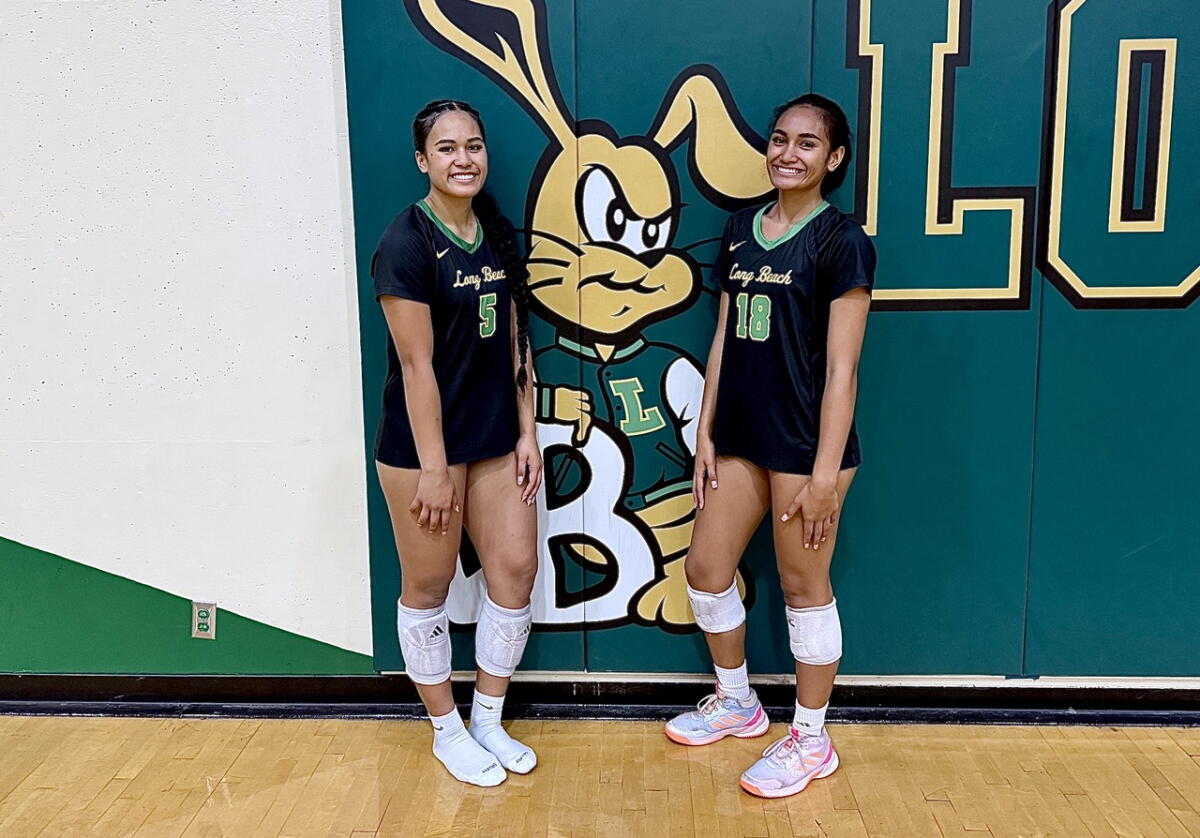
Sisters McKennah, left, and Ellie Iamaleava are two of eight siblings who have played volleyball.
(Steve Galluzzo / For The Times)
McKennah is committed to UC Irvine and, not surprisingly, its proximity was a major factor in her choosing to join the Anteaters’ program.
“First of all, it’s close to home and secondly I love the coaching staff,” she said. “All of the girls are super nice, the campus is beautiful and competing in the Big West is going to be exciting.”
Her oldest brother Matt played volleyball at Long Beach State, her older sister Nicaylah played at Cypress College and her two closest brothers, Nico and Madden, also grew up playing the sport while excelling in football and both are now quarterbacks at nationally ranked UCLA.
“We see them [Nico and Madden] a few times a week,” McKennah said. “We have dinners together. Of course we go to all of their home games.
“We don’t talk for long right after, we’ll keep it short and then next day is usually the recap.”
Nico suffered a knee injury in the second quarter of UCLA’s 17-15 win at Oregon on Oct. 10 and is out indefinitely. McKennah was among the first people to offer him encouragement.
Long Beach Poly High senior McKennah Iamaleava celebrates after winning a point against Redondo Union.
(Steve Galluzzo / For The Times)
“I wasn’t there but I was watching,” she said. “It was a hard shot to take but Nico’s tough and he’ll come back strong. I was texting him right after the game and also in our group texts. I hope Madden gets some playing time. It would be good for him as well.”
Having such a strong support system makes McKennah well-equipped to handle the ups and downs of volleyball and life.
“I probably talk to Matt the most,” McKennah said. “He’s already gone to college and graduated and I went to a few of his matches, which was so fun. Nicaylah is the libero of our family. … I watched her passing and she would teach me a lot. I’m glad I have her.”
McKennah’s two youngest sisters, Mallory (15) and Nori (12), also play volleyball but her tightest bond is with her closest sibling Ellie, a junior opposite hitter at Poly.
Long Beach Poly High junior Ellie Iamaleava celebrates winning a point during a recent match.
(Steve Galluzzo / For The Times)
“Ellie and I are close,” McKennah added. “Our rooms are right next to each other so every time I want to annoy her I just go to her room. My sister is encouraging to me because she’s very hard on herself. She’ll get a great kill but won’t be satisfied, which motivates me even more to be better as a person and a player.”
“McKennah and I are always with each other,” Ellie agreed. “Her being an older sister kind of plays into that. She really pushes me. She helps me through all my hardships as a new player and I look up to her a lot.
“She’s always on top of everything and the game’s real natural to her. I want to play in college too — anywhere close to home.”
Poly (25-7) wrapped up its fourth straight league title last week under head coach Gerald Aquiningoc, who guided the Jackrabbits to theSouthern Section Division 3 championship in 2024 and the Division 2 semifinals last season.
Along with Madden (then a senior), McKennah (a sophomore) and Ellie (a freshman) transferred to Poly from Warren High in September 2024.
“Amazing family,” Aquiningoc said of the Iamaleavas. “McKennah and Ellie are super coachable and huge pieces of our program. When they transferred in even though they couldn’t play that whole first year they were still super involved. They helped us practice and to prepare for our matches. They were our best scout team.”
Aquiningoc cited McKennah’s leadership as a big reason the program has been on the rise.
“I think I lead more by example — I’m just always thinking,” McKennah said. “If I don’t say it I’m usually thinking it, no matter how it comes out and I have a close relationship with our setter [Mina Orbiso]. I’m super confident that I can put the ball away and I tell her.”
Iamaleava, who plays club for SC Rockstar, appreciates the trust that Aquiningoc has in her.
“Coach G gives me the space to grow as a person and a player,” she said. “I’m thankful because I know that on the court I can pick what I want and how I’m feeling and it means a lot to me. The confidence he has in his players is amazing.”
The Jackrabbits are seeded second in the Division 2 playoffs and host Gold Coast League champion Campbell Hall in the first round Tuesday night.
“I’d say this our best team, yes,” McKennah said. “We have so much talent at every position. It’s kind of fun because you can throw anyone out there and they’ll perform.”
What Iamaleava lacks in height she makes up for with her intelligence, placement and angles that keep opponents guessing whether she will hit it down the line or crosscourt. She is adept at receiving serve and what she does in the back row is as valuable as what she does in the front row.
“Being a short hitter you have to use the hand, hit off the block and find different kinds of shots,” she said. ”There’s a lot to think about.”
McKennah’s stats from Poly’s regular-season finale at Redondo Union on Wednesday reflect how complete a player she is. She had 22 kills, 14 digs, six blocks and did not miss a single serve in the Jackrabbits’ five-set victory.
Iamaleava is planning to major in business and is happy to the see the sport grow so much since she started playing.
“Women’s volleyball is getting so much attention and I love it because it encourages all of the younger players to keep doing it,” she said. “What do I want to do long-term? Something with a sport but I’m still deciding if I want to keep playing volleyball or just stay around it.”
In the short term, Iamaleava wants to conclude her high school career with a medal around her neck and make her family proud.
“That pressure turns into a motivation to keep pushing ourselves,” she said. “For Ellie and I there’s a really high ceiling with our older siblings and we try to live up to that.”
It was 41 years ago in April of 1987 as a 28-year-old sportswriter that I was given one of my favorite assignments.
From LAX, I flew to Indianapolis, rented a car and drove one hour to Bloomington, Ind., home of the NCAA basketball champion Indiana Hoosiers. My most vivid memory was nervously driving on Route 37 with no GPS guiding me and seeing the many varieties of basketball hoops hanging on farm houses and family homes, providing powerful evidence that all the stereotypes about the state’s love for basketball were true.
This was months after the best selling book, “A Season on the Brink,” was published. And a month after coach Bob Knight and Indiana won their fifth NCAA basketball championship.
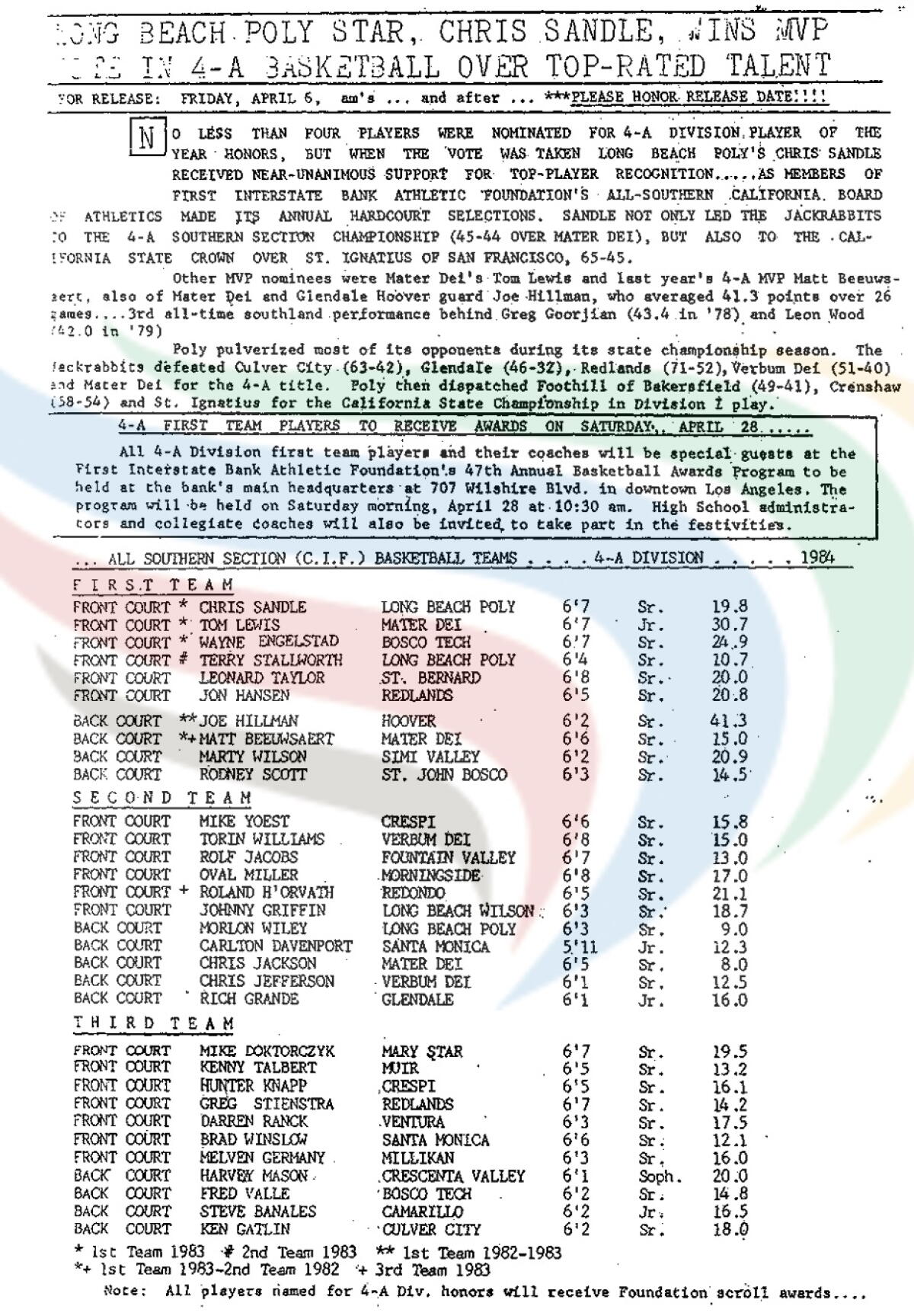
My assignment was to check in with Glendale native Joe Hillman, a 1984 Hoover High graduate who was Knight’s first recruit from west of the Mississippi River. Hillman averaged 41.3 points his senior year at Hoover He ended up being a reserve guard behind Steve Alford and Keith Smart on the 1987 NCAA championship team, so it was perfect timing.
He also continued to play baseball and was a 25th-round draft pick of the Oakland Athletics in 1986.
Fast forward to Tuesday at the YMCA in La Cañada Flintridge. The guest speaker for the Glendale Quarterback Club was Hillman. It was the first time seeing him since my trip to Indiana. Now 60 and living outside of Indianapolis, Hillman was asked tough questions.
1984 All-CIF basketball team.
(1984 Foundation)
Can you still hit?
“I can still do that.”
Can you still make free throws?
“I don’t know about that.”
How come you never went into coaching?
“I wouldn’t have been patient enough.”
How did Knight convince you to go to Indiana?
“We don’t have this in Indiana,” Knight told him during a visit to Santa Anita while looking out at the San Gabriel Mountains. “Why would a California kid come to Indiana?”
Hillman: “I want to play on a national championship team.”
Any Knight stories to tell?
“I don’t know if you can put them in a paper.”
Years later, when talking to other players, Hillman said, “There was a method to his madness. They all had the same stories with different names.”
Indiana’s Daryl Thomas (24) and Joe Hillman (44) victorious during interview with CBS announcers Billy Packer (L) and Brent Musberger (R) in 1987.
(Manny Millan/Sports Illustrated via Getty Imaages)
Among the Knight truths: Players who practiced best always got to play. The best players always got the most heat from him. Anyone who graduated from Indiana received his total loyalty.
Hillman remembers calling Knight eight years after graduation seeking a phone number to reach a Reebok executive to inquire about a job. Knight ended up telling the executive he’d drop Adidas shoe contract for Reebok if Hillman were hired. Hillman didn’t get the job but learned what Knight would do for any player who got his degree.
“He was the most honest, most blunt coach,” Hillman said.
Asked why he chose to be subjected to such harsh criticism for four years, Hillman said, “My father was on me from the time of T-ball. He said constructive criticism was good.”
Comparing today’s college sports environment of NIL deals with the 1980s, Hillman said, “It would have been scary what kind of money we could have gotten.”
Hillman expressed disappointment at the lack of multiple-sport athletes today in high school sports. He said even Knight appreciated and supported his option to keep playing baseball.
Looking back on that trip from 1987, I re-read my observations: “The four-lane highway that stretches from Indianapolis to Bloomington is virtually deserted as darkness begins to descend over the lush, green countryside. The temperature is in the 50s, and the sky is overcast after three straight days of damp weather. The picturesque Midwestern landscape is immaculate, but equally alluring are the distinctive basketball hoops found among the farms and family homes along Route 37. Hoops are everywhere — on barns, rooftops, telephone poles, even next to power transformers.”
I remember getting lost in a forest trying to find where Hillman was living in a townhouse.
I wrote: “After finding the correct street, the quickest way to locate an Indiana basketball player’s residence is to ask a young fan. Shooting baskets by himself on a court not far away was a 12-year-old.
Heidi Burge Horton, a former WNBA player who started her basketball career alongside her twin sister at Palos Verdes High School and inspired a Disney Channel Original Movie, has died. She was 54.
Horton died Oct. 5 after a battle with gliobastoma, a type of brain cancer, according to an online obituary. The former University of Virginia standout was reportedly diagnosed with the Grade 4 cancer last year and briefly went into remission, but the tumors returned in July, according to Houston news site Chron.
“We are deeply saddened by the passing of Heidi Burge Horton,” the Virginia women’s basketball team said in a statement posted last week on X. “Heidi was a cherished member of the Virginia Women’s Basketball family, her legacy will forever be a part of Virginia Athletics.”
Horton and her identical twin, Heather Burge, played four seasons at Virginia, where they helped the team win three Atlantic Coast Conference titles and make three NCAA Final Fours under future Hall of Fame coach Debbie Ryan. Among their teammates at college was Dawn Staley, the Hall of Famer and Olympian who coaches the University of South Carolina.
“We are all heartbroken!” Staley wrote on X following Horton’s death. “We love you Heidi. May your soul rest in peace and your body pain free.”
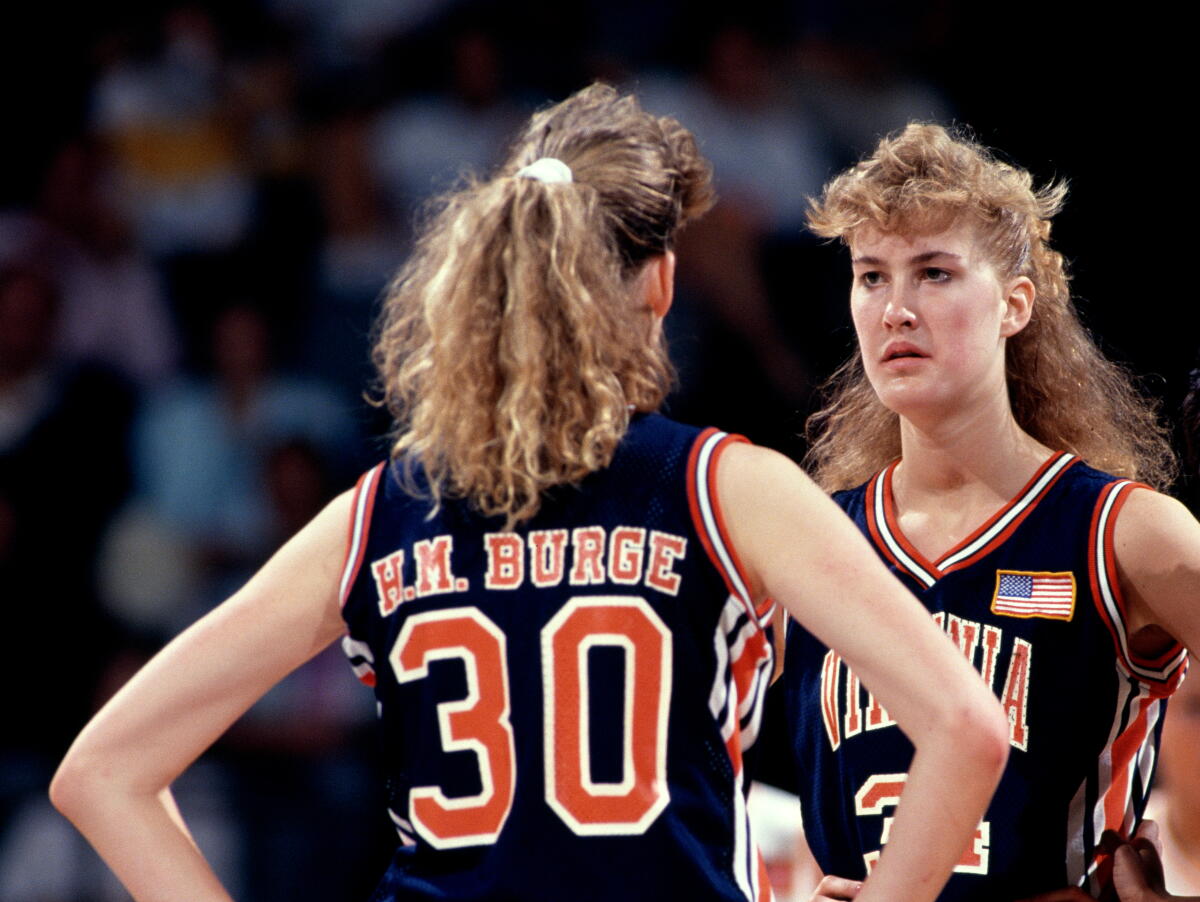
The University of Virginia’s Heidi Burge, right, with sister and teammate Heather Burge during the 1991 NCAA women’s championship game against Tennessee.
(Jim Gund / Getty Images)
After graduating from college, Horton and her sister headed overseas to play professionally in Europe. When the WNBA was formed in 1996, she joined the Sparks to play in the inaugural season alongside a familiar face, Lisa Leslie.
“I played with the twins since we were 14 years old,” Leslie wrote, along with a broken heart emoji, in the comments of the WNBA’s Instagram post announcing Horton’s death. “I’m so sad to hear this! I pray for the whole family.”
Heidi Ann Burge was born six minutes after her twin sister, Heather Marie, on Nov. 12, 1971, in Harbor City. She grew up in Redondo Beach before her family moved to Palos Verdes so the sisters could attend the high school there, according to a notice by Eickenhorst Funeral Services.
The twins didn’t grow up playing basketball but were recruited by Palos Verdes High‘s coach, who noticed their towering height. Both sisters were 6 feet 1 by ninth grade and would grow to be 6-5.
Horton was more resistant to trying out than her sister, and both were novices when they joined the team. The sisters would become star players over the course of their high school careers, but they were praised more for their character and work ethic than their impact on the court.
“I don’t think they’ve had a weekend off in three years,” their coach, Wendell Yoshida, told The Times in 1989. “They’ve practiced when they didn’t want to practice. They’ve worked through the tears, the sweat, the hurt, the pain. That’s what made them special. They didn’t make it just because they’re tall.”
Horton was known as the more outgoing and gregarious of the pair, but both sisters were described as being inquisitive, opinionated, fiercely loyal and competitive.
The adjustment to the college game was a bit rough for them at first, and the sisters did not get much playing time together until their junior year. They developed a reputation for being prone to mistakes and turnovers and were considered a bit soft. But once again, the sisters put in the work to improve and became key pieces for their team.
“When we did cry it was mostly out of frustration,” Horton told The Times in 1992. “Just not being able to do the things the other players could do. … Our defense wasn’t effective enough for us to deserve to be out there together. Now, we’ve proved offensively and defensively that we are an unstoppable pair when we get to play together.”
Heidi Burge, right, rises up to block Houston Comets guard Kim Perrot during a game on July 16, 1997.
(Mark J. Terrill / Associated Press)
After graduating with degrees in Spanish and rhetoric and communications studies, Horton played basketball professionally in Europe. After the establishment of the WNBA, she played for the Sparks in 1997 and the Washington Mystics in 1998 before retiring after two seasons.
Horton and her sister inspired the 2002 Disney Channel Original Movie, “Double Teamed.” The movie told a fictionalized account of the twins’ time at Palos Verdes High School. Horton was portrayed by Annie McElwain.
After retiring from playing, Horton moved to Houston, where she briefly served as a commentator for the Comets. She later became involved with Hoops-School, a youth basketball camp where she served as a coach and mentor.
“When you had the kind of coaching I did, you have to work really hard,” Horton told the Buzz Magazines in 2024. “But I also want to give a lot of credit to my coaches. Now I get to give the golden nuggets of wisdom to the kids I coach.
“Second graders, fifth graders, they listen,” she added. “That’s the biggest reward in your whole life. I had so many people pour into me, and I get to just pour it right out. That’s the torch.”
Horton is survived by her husband, Patrick; their children, Jonathan and Holly; her twin sister, Heather Quella, and other loved ones.
Big Brother fans weren’t impressed with one star’s actions during the latest episode
Philip sparked backlash on Thursday(Image: ITV)
One Big Brother star has sparked backlash after their comments in the house.
The hit reality series returned to screens on Thursday (October 15), ahead of the next eviction. Yasmin, Twinks and Rob will all face the public vote on Friday night (October 16). Yasmin notably received a killer nomination this week, while Twinks and Rob each received six nominations from their fellow housemates.
The housemates tackled another shopping task during the latest episode, as the house transformed into Big Brother’s body. The teams were given various challenges to determine who would be awarded the luxury shopping budget, while the losing side had to face basic rations.
Drama quickly ensued when Rochelle upset Harry during the task, leading to him storming out of the living area. Harry was supported by his fellow housemates as he broke down in tears in the bathroom.
But the tension didn’t end there, as Philip later shared his true feelings about Rochelle, who he has appeared to be close with in the house. During a whispered conversation in the garden, Philip told Lynx: “Lynx, I have wished for her to go.
“So, if she f****** goes, because it’s got that way now. I haven’t got no time for her. I haven’t, I’m telling you, I’m speaking honest with you. That’s why I have time in bed, because I want to stay away from her. And that’s no word of a lie that.”
Ensure our latest Big Brother stories always appear at the top of your Google Search by making us a Preferred Source. Click here to activateor add us as Preferred Source in your Google search settings
Philip went on: “Rochelle has said too much… And it’s funny what she kept saying to me and all. She’d say, ‘You’re my best friend in here.’ She said, ‘You’ll never turn on me, will you? Never turn on me.’ She kept saying that to me. She’s got too f****** much to say.”
Lynx added: “And it’s never-ending. And like you make such a pure soul like Harry get like that today, and then you come in the bathroom and make it about you. It’s just sometimes you just have to think about what you say.”
Philip continued: “See, she’s had a very privileged [life] from a child. I think she’s been spoiled, and I think she’s got away with everything. Everything she wants, she got. She never wants to listen about you, about your life, about your things. And do you know what? I’m not really interested and I don’t want to tell her.”
Lynx then said: “Since Sam went or like, when he was giving his reason to vote her, he was like, ‘All you talk about is me, me, me.’ God that stuck with me.”
Philip shared that Sam was “f****** right” about what he said, before concluding: “This is what she’s like. And come on, Lynx, she’s got on everyone’s [nerves]. She has. The ones [that have] gone and the ones [that are] here, she f****** has.”
Content cannot be displayed without consent
Viewers were left speechless after hearing Philip’s comments, with many sharing their shock on social media. “Not a good look,” one person wrote on X.
Another added: “Wow can’t believe Philip’s now turning on Rochelle. I sense a downfall coming.” A third said: “Not Philip showing his true colours after that chat about Rochelle!”
A fourth viewer echoed the sentiment, saying: “Philip is giving game player, sorry not sorry.” Someone else similarly shared: “Philip turning on his ‘best friend’ is not what I expected.”
Chargers offensive coordinator Mike McDaniel didn’t shy away from discussing his job security Thursday amid a frustrating 0-5 start to the season.
“I feel like it’s core to my job to always feel that way,” McDaniel said when asked if he’s coaching for his job. “I need to do the very best I possibly can, all the time, because [of] the players, the organization, the fans.
“So, that’s second nature. … I think it’s disrespectful to all those that choose to invest in our game and our team to not look at things that way. The second you get comfortable in this league, it’s a wrap; it’s too good. I will be doing my very best, because from an integrity standpoint, I think it’s really insulting to do anything else. And that won’t change.”
McDaniel says his determination is unwavering. His place in the Chargers’ organization, however, might not be if things don’t change soon.
The Chargers, who rank 10th in total yards allowed per game on defense (311.6), enter Sunday’s road game against the undefeated Kansas City Chiefs averaging just 16.8 points per game, the third-lowest mark in the NFL above just the also-winless Miami Dolphins (14.0) and Tennessee Titans (11.6). Quarterback Justin Herbert ranks 22nd in passing (937 passing yards) and is last in the NFL in total quarterback rating (26.6).
Injuries have played a significant role in the Chargers’ offensive struggles. Eight offensive players either didn’t practice or were limited in practice because of injuries on Wednesday. Four rookies started on the offensive line in Sunday’s loss to the Denver Broncos and wide receivers Ladd McConkey, Quentin Johnston and Brenen Thompson, didn’t play.
McDaniel insists that he’s been giving the franchise all he has.
“I would be so embarrassed if I told you, ‘Well, now I’m going to try harder,’” McDaniel said. “Like, what? What have you been doing? I’m confident in the players that we have. The improvement that I see before the results generally lead to good things. But talk is cheap. We got to do.”
A Miami jury returned a mixed verdict Tuesday evening in the domestic violence civil trial against Tyreek Hill, awarding his estranged wife $500,000 in compensatory damages, while finding the five-time All-Pro wide receiver liable for two of 10 claims of battery.
Lakeeta Vaccaro Hill was denied punitive damages by the six-person jury that deliberated for less than four hours. The week-long trial addressed allegations of physical and verbal abuse committed by Hill against Vaccaro, who sought $8 million.
“Mr. Hill was very pleased that he was able to get his story out and to be able to tell the world what he’s not been able to speak about,” Hill’s attorney Christi Bright told reporters. “He’s very grateful.”
Hill, a free agent who last played when he suffered a knee injury Sept. 29, 2025, could face discipline under the NFL personal conduct policy should he sign with a team. A player can be suspended even in the absence of criminal charges and previous related conduct can figure into any discipline.
The NFL has said Hill’s personal conduct is under review. He pleaded guilty to assault and battery by strangulation of his pregnant girlfriend in 2015 when he was a student at Oklahoma State and was the subject of a child-welfare investigation in 2019 after his three-year-old son suffered a broken arm.
During the civil trial in Miami-Dade County, Hill was found liable for one count of battery for a January 2024 incident and another from April 2025 that occurred one day before Vaccaro Hill filed for divorce. Their marriage lasted 18 months.
Vaccaro Hill testified during the trial that Hill shoved her to the ground, twisted her breasts, pulled her hair and threatened her. Hill also testified, admitting to telling Vaccaro Hill that he could “get people to hurt her.” He also testified that during one episode, he used enough force to create a hole in a wall he pressed her against.
He testified that Vaccaro Hill stole money from him and that the couple argued about a post-nuptial agreement and his relationships with the mothers of his seven other children. Hill and Vaccaro Hill have one daughter together, Capri.
“I wish I could have handled that situation a whole lot better,” Hill testified. “I wish I could have, you know, talked to my wife better. … I just wish I could just take it all back.”
Hill, 32, began his NFL career with the Kansas City Chiefs in 2016 and made eight consecutive Pro Bowls, six with the Chiefs and two with the Dolphins, who released him last offseason. He ranks sixth among active players with 11,363 receiving yards and seventh with 819 receptions.
The Chiefs have expressed interest in reuniting with the speedy 5-foot-10 receiver, who was a favorite target of quarterback Patrick Mahomes when Kansas City won a Super Bowl in 2020. Hill has made $143.68 million in career NFL player salary and bonuses, according to Over the Cap.
Rams left tackle Alaric Jackson has been suspended for two games without pay for punching Buffalo Bills linebacker Bradley Chubb after Monday night’s game at SoFi Stadium, the NFL announced Tuesday.
The Bills defeated the Rams 37-34 in overtime. The incident occurred on the field as players from both teams were talking and exchanging jerseys.
Jackson violated Rule 12, Section 3, Article 1, which applies to “any act which is contrary to the generally understood principles of sportsmanship,” the NFL said in the release announcing the suspension.
Jackson can appeal the suspension.
The loss of Jackson leaves star quarterback Matthew Stafford potentially vulnerable when the Rams play the Arizona Cardinals on Sunday and the Las Vegas Raiders on Oct. 25.
Veteran David Quessenberry could start in place of Jackson. Or coach Sean McVay could move right tackle Warren McClendon Jr. to the left side and play Quessenberry on the right.
Rookie Keagan Trost has been on injured reserve since before the start of the season.
This is the second time that Jackson has been suspended. In 2024, he sat out the first two games for an unspecified violation of the NFL’s personal conduct policy. Jackson had been named the defendant in a lawsuit filed by a woman, who alleged he recorded her without her consent during sex, that he refused to delete the video and that he taunted her with it. The civil suit was dismissed.
Jackson also was under scrutiny before this season after he was arrested on suspicion of felony domestic violence involving an incident in West Hills. The Los Angeles County District Attorney’s office and the City Attorney declined to file formal criminal charges.
Alaric Jackson has a history of violent outbursts. Still, it was surprising to see the Rams star offensive tackle punch Buffalo Bills linebacker Bradley Chubb on the SoFi Stadium field moments after the Bills defeated the Rams 37-34 in overtime on Monday.
Players were milling around midfield, exchanging jerseys and making small talk when Chubb appeared to say something to Jackson, who was chatting with another Bills player. Jackson immediately marched over to Chubb and slugged him once in the face, knocking a cap from his head.
Players from both teams intervened, and the episode was documented on video by the NFL. Based on precedent, Jackson, 28, likely faces a suspension.
One year ago, Detroit Lions safety Brian Branch was suspended for one game after he smacked Kansas City Chiefs receiver JuJu Smith-Schuster in the helmet after a game.
At the time, Branch spoke to reporters in the locker room and admitted his actions were “childish.”
Jackson did not make himself available for an interview after Monday’s incident, although Chubb did.
“It’s just emotions, you know what I mean? Emotional game. It was a close game,” Chubb said. “And, you know, they always catch the second guy. So, I let him swing. And then my teammates held me back, and I just chilled.”
Jackson averted a suspension ahead of this season when authorities declined to file formal criminal charges after he was arrested on suspicion of felony domestic violence. Police responded to a call at a home in West Hills on June 8 at 11 p.m. and said in a report that the 6-foot-7, 338-pound Jackson was arrested for “willfully inflicting physical or corporal injury resulting in a ‘traumatic condition’ [such as a bruise, scratch, swelling, or internal injury] on an intimate partner.”
Jackson, who is in his sixth season with the Rams and fourth as quarterback Matthew Stafford’s blindside protector, entered a diversion program that required him to complete probation and anger management classes. Four months earlier, he had signed a three-year contract that included $35 million in guarantees. He is scheduled to earn $18.4 million this season.
In 2024, Jackson was suspended for two games by the NFL for violating its personal conduct policy following a lawsuit filed by a woman alleging he recorded her without her consent during sex. The woman, who also reported it to the league, alleged that Jackson refused to delete the video and taunted her with it. The civil suit was dismissed.
Saracens have sacked Totoa Auvaa, the academy player who was involved in a nightclub incident with England cricketers Ben Stokes and Gus Atkinson in June.
The English Prem club have confirmed that the 21-year-old Samoan forward has left with immediate effect following another incident in St Albans on Saturday.
Auvaa had originally been stood down from all club duties while Saracens investigated the matter.
“The club has determined that his conduct falls short of the standards expected of everyone who represents Saracens, both on and off the pitch,” read a club statement., external
“We take our responsibilities to our supporters, young people and partners seriously and we remain committed to upholding the standards of our conduct expected across the club.”
A disciplinary hearing by the England and Wales Cricket Board (ECB) found that then England captain Stokes and pace bowler Atkinson breached “contractual obligations” but were blameless for “violent conduct” in an incident in June.
Both were present in a London nightclub when a member of England’s security staff was left bloodied and in need of medical attention after being struck by Auvaa.
Stokes and Atkinson were made unavailable for England’s second Test defeat by New Zealand while Auvaa was not sanctioned.
Alisson: Could do nothing to keep out Erling Haaland’s strike then beaten by a beauty from Jeremy Doku and some solid footwork from Rayan Cherki. 5
Ronald Araujo: Got a cheap yellow card early on and will be annoyed that the first two Man City goals came from his side. 5
Virgil van Dijk: Often pushed out of position to help Liverpool deal with getting outnumbered in midfield. Perhaps could have closed Haaland down quicker. 6
Jeremy Jacquet: Wasn’t a bad display from a young talent who is very impressive but this must have been a real eye-opener against a quality City attack. 6
Milos Kerkez: Battled well with Iliman Ndiaye and pushed up regularly but lacked quality in the final third. 5
Alexis Mac Allister: Grew into the game and put in a good shift but struggled once Liverpool went down to 10 men. 5
Ryan Gravenberch: Came in for the injured Dominik Szoboszlai and was Liverpool‘s best player until he got sent off for a second yellow card. Naive on his part. 6
Victor Munoz: Played with such a fearlessness and was an absolute nuisance for Man City, causing Nico O’Reilly all sorts of problems. 7
Florian Wirtz: Simply has got to do better, particularly in games of this magnitude. Was largely ineffective and made some poor decisions. 4
Bradley Barcola: Sharp on the ball and did his defensive duties but, like Wirtz, must to do more in the final third. 5
Lewis Koumas: Making his first Premier League start and the 21-year-old got stuck in from the outset in an energetic display that was loved by the Anfield crowd. 7
Subs:
Nyoni (on 66, Wirtz): 6
Frimpong (on 75, Araujo):5
Ngumoha (on 75, Koumas): 5
Gomez (on 88, Jacquet)
Chiesa (on 88, Barcola)
Subs not used: Mamardashvili, Endo, Tsimikas, McConnell,
To understand the dedication and determination of football players from unbeaten Cleveland High, let’s review the commitment of backup quarterback Julio Avalos. He was so excited after guiding the Cavaliers to a 14-9 win over City Section power Birmingham that he spent all night watching film.
Asked what time he finally decided to go to sleep, Avalos said, “4 a.m.”
The entire offensive line eats together at lunch in the cafeteria.
“You see people hiding their food,” one lineman quipped.
They also get together on Thursdays for pasta night, where one player acknowledged eating “six to eight” chocolate chip cookies to close out a night of shared love for carbohydrates.
Then there’s the 34-year-old coach Mario Guzman. It’s been decades since a young coach armed with a teaching credential has pulled off the kind of breakthrough season in the City Section that Cleveland is enjoying, at a time when the City has lost such historic coaching figures as Robert Garrett, Angelo Gasca, Lorenzo Hernandez, Paul Knox and Mike Walsh.
Think back to 1992 when Troy Starr of Taft was 30 years old and took his team to the City 3-A final after a winless 1991 season.
If Cleveland (7-0) wins out and captures the West Valley League title, the Cavaliers likely will receive the No. 2 seeding behind defending champion Carson in the City Section Open Division playoffs. Cleveland never plays in the Open Division.
“I told him, ‘Good luck, baby,’” Birmingham coach Jim Rose said of his message to Guzman.
“They have 30 seniors. That’s a huge help,” Rose said. “He’s got his guys believing in what they do as a program. Their identity is to pound the ball on offense. The first two series, we gave up touchdowns. One thing about Cleveland is they always get athletes, but they put it together this season. He’s got enough big guys and enough speed to get it going.”
Cleveland also went on the road to beat another City power, Crenshaw, 24-18. Each win came with Avalos at quarterback, replacing the injured Domenik Fuentes. Avalos normally plays receiver, but he had to fill in last season when Fuentes got hurt before returning for the playoffs.
Cleveland’s offensive line has been a strength, including, from left, right tackle Carlos Gomez, right guard Carter Fitzgerald, center Pedro Castaneda, center Adam Garbisch, left guard Jovanni Orellana and left tackle Josue Fonseca.
(Eric Sondheimer / Los Angeles Times )
Guzman was caught by surprise last season when he didn’t prepare for losing Fuentes, so all summer, he vowed to never again to be without a fully ready backup quarterback. Fuentes returned on Friday night to pass for 208 yards and three touchdowns in a 37-20 win over El Camino Real.
Cleveland has multiple running backs, led by Moyosoreoluwa Odebunmi. The defense features middle linebacker Joseph Hurtado, who Rose said is impressive as a tackler.
Guzman is a third-year coach who was an assistant under former coach Peter Gunny. Guzman graduated from Grant and served as an assistant there for several years while going to Valley College, Cal State Northridge and National University to gain a teaching credential. His wife, Elizabeth, helps out with her cooking skills during preseason practices. She’s a prekindergarten teacher for ages 4 and 5, which means she has lots of patience.
The wife of Cleveland football coach Mario Guzman, Elizabeth, is cracking 15 dozen eggs for Thanksgiving practice. City DII finalists. Cooking for 60 players. 25 pounds pancake mix. A new tradition at Cleveland. pic.twitter.com/4QAKZ0pjal
“She was fired up,” Guzman said about the Birmingham game. “She wanted a headset.”
TK Drayton, who’s been in Cleveland’s program for four years, said of Guzman, “He loves us outside of sports. He checks on you. You want to go the extra mile for him.”
Discipline has been big for Guzman, whether that means players show up to weight training wearing all black or making sure they never walk when heading to the practice field.
Guzman also has integrity. He’s the last adult to leave Cleveland after games. Sometimes it takes until nearly midnight for the final player to be picked up by a parent. Guzman waits with him. Yes, it would be easy for Guzman to give the player a ride home, but that’s against LAUSD rules for teachers and coaches.
“All you can do is watch,” Guzman said.
The players have placed their trust in Guzman, as have parents. He’s delivering.
Melanie Marx bought Angel City season tickets before the team was a team. It had no players, no coach and no uniform. It was more a concept than a reality and Marx bought in.
“I’ve always had pride for this team.” she said. “This was the first team from the NWSL that I’ve been able to say that I’m a supporter for.”
Yet supporting Angel City, she says, has been as exhausting as it has been exciting. Once the most valuable women’s professional sports team in history, Angel City has had one winning season and made just one playoff appearance in its first four seasons.
Attendance declined more than 22%, high-profile players such as Alyssa Thompson, Christen Press, Ali Riley and Madison Hammond have either been transferred away, retired or been allowed to leave and the team hasn’t re-signed popular captain Sarah Gorden for next season. At the same time, it has gone through five coaches and three general managers/sporting directors in less than five years.
Angel City defender Gisele Thompson celebrates with teammates after scoring a goal.
(Lindsey Wasson / Associated Press)
That’s not exactly what Marx signed up for.
“I’m upset as a fan, of course, and I’m upset as a season-ticket holder,” she said. “But I’m also upset as a fan of these players and someone who’s been invested in this league of almost 10 years.”
“What keeps myself and others coming back week to week is because of the players themselves,” she added. “Because the results on the pitch haven’t always matched the ambitions of the supporters.”
During the past three months, that support has finally been rewarded. Following Sunday’s draw with first-place Gotham FC, the reigning NWSL champion, Angel City (12-8-7) heads into the league’s two-week international break riding a seven-game unbeaten streak and is in sixth place in the 16-team table, in position for another playoff berth.
The team has lost just twice in 16 games under interim coach Leif Gunnar Smerud. Its 12 victories with three games to play is already a franchise record for a single season, as are its 45 goals. After posting a substantial negative goal differential in its first four seasons, Angel City’s plus-16 mark this year in best in the league.
And in the current international break, the team had a record nine players called up to various national teams. It’s one of the most dramatic turnarounds in NWSL history, one that may have saved at least a portion of the team’s most loyal fan base.
“My renewal for next year just recently came up and I was on a bit of knife’s edge deciding whether I want to go ahead,” said Michael Jaeger, an attorney who has had multiple Angel City season tickets in section 133 since the first season. “There have been consistent problems throughout.
“I really want the team to succeed. Given the recent successes, I did go ahead and re-up for next year because I’m feeling optimistic.”
Optimistic but not necessarily confident.
“I am not feeling like ‘OK, this is what I’ve been waiting for. The team’s really turned a corner,’” Jaeger said. “That to me would be success on the field, plus a decision about Sarah Gorden, plus [a] permanent head coach who we know is at least going to have one or more seasons to have things play out.
“So I don’t think we’re there yet. I like the current trend but because not a lot has necessarily changed about the front office, I’m not ready to say ‘OK, we’re fully on the right track.’”
Angel City has only itself to blame for that lack of trust. When the team launched with a massive ownership group that included Hollywood A-listers, former U.S. women’s national team stars and sports luminaries including Serena Williams and Billie Jean King, it promised to ignite a revolution in women’s sports.
Angel City FC fans chant during a match against the San Diego Wave at BMO Stadium on May 9.
(Luiza Moraes / Getty Images)
“We’re not just building a soccer club. We want to build an organization that has impact,” said Julie Uhrman, one of its team’s three founding owners.
And while Angel City has done real, meaningful work in the community, providing millions of meals to the hungry, funneling millions of dollars into community programs and taking a courageous stand against ICE raids across Southern California, as a soccer team it hasn’t delivered on its promises.
The loyal fans blame the front office, which has waived nearly six dozens players and five managers, including interim coaches, through its revolving doors since the first season. Mark Parsons, who won six trophies as manager with the Portland Thorns, was hired 20 months ago to stabilize things but his highly touted global search for a coach ended with Alexander Straus spending just a year with the club — going 7-15-5 in parts of two seasons — while Parsons unsettled the roster by making more than 40 transactions.
“There’s just a lack of trust in the front office frankly,” said Nadia Johnson, who attended games every season but didn’t buy season tickets until this year. “We’re still doing these chaotic things, which is really frustrating as a fan.”
And the chaos may not be ending anytime soon. Despite his success, Smerud has not publicly been guaranteed anything beyond this season; officially, the team is still searching for a new manager.
Gorden, the captain and anchor of the defense, is out of contract at the end of the season as is veteran Claire Emslie. Meanwhile Sydney Leroux, 36, who has played one minute the past two seasons as she deals with mental health issues, is signed through 2027.
At the same time, Parsons has built the league’s youngest roster around players whose performances are bigger than their names. Goalkeeper Angelina Anderson, 25, is third in the league with nine clean sheets and 12 wins. Brazilian Maiara Niehues, 22, already has a franchise-record nine goals while Evelyn Shores, 21, has tied the single-season record with seven assists and defender Gisele Thompson, Alyssa’s sister, leads all outfield players with 2,420 minutes.
“I am excited about how diverse our team is and really how they’ve grown,” season ticket-holder Johnson said. “It’s playoff crunch time and so it’s always exciting, especially when your team is in it. So I’m excited to see where they go.”
But after four seasons of mediocrity and worse, however, she’s learned to keep her fingers crossed.
“I’m not confident if we get a rough patch next year what decisions will be made in terms of trying to repair that,” she said. “So yeah, that’s where I’m at.”
Mustache. Aviator sunglasses. Bears sweater vest. Though Mike Ditka‘s look may be iconic, his time as a player and coach is what cemented his name in NFL history.
Ditka, the first ever tight end to be inducted into the Pro Football Hall of Fame and coach of the legendary 1985 Chicago Bears, has died. He was 86.. His family announced his death in a statement Friday.
“It is with profound sadness that we announce the passing of our beloved husband, father, grandfather, and friend, Mike Ditka,” The family said. “While the world knew Mike as a Hall of Fame football player, legendary coach, and leader of the Chicago Bears’ Super Bowl XX championship team, we knew him as the heart of our family. Mike will be missed beyond measure and remembered forever.”
With nicknames “Iron Mike,” “Da Coach” and “The Hammer,” Ditka was inducted into the Pro Football Hall of Fame in 1988 after a 12-year playing career that featured five Pro Bowls, 427 receptions, 43 touchdowns and 5,812 receiving yards.
Ditka, who won two Super Bowls as a coach and one as a player, revolutionized the tight end position, transforming it from a primarily blocking-focused role to one that could pose a threat in receiving.
Notorious for his fiery personality, Ditka also took his stardom from field to screen, starring alongside Will Ferrell in “Kicking & Screaming,” in which he played himself. Though instead of coaching the championship-winning Bears, he helps coach a little league soccer team — but his competitive spirit remains the same. He also made several TV appearances, including in “Cheers,” “L.A. Law” and “Entourage.”
Born in Carnegie, Pa., on Oct. 18, 1939, Ditka was a first-round draft pick of the Chicago Bears in 1961. The team at the time was helmed by Bears founder, president and head coach George Halas, who later bestowed Ditka with his first NFL head coaching job in 1982.
Coming from the University of Pittsburgh, where he also played basketball and baseball and received All-America honors in football, Ditka immediately became a mainstay in the Bears lineup, going on to start 84 straight games. He was named rookie of the year with 56 catches for 1,076 yards and 12 touchdowns, becoming the first tight end to reach 1,000 yards receiving in his rookie season.
He also earned All-NFL honors from 1961 to 1964 and made the NFL Pro Bowl five times in his first six seasons. Ditka was enshrined into the College Football Hall of Fame in 1986.
Chicago Bears tight end Mike Ditka is tackled after a pass reception against the Green Bay Packers at Wrigley Field on Oct. 16, 1966.
(Associated Press)
The tight end eventually became a coach, famously leading the 1985 Chicago Bears. The team, one of the best in NFL history, went 15-1 and scored 456 points while only allowing 198. The Bears had plenty of personality that year as well, audaciously recording a rap-styled video called “The Super Bowl Shuffle” that was released during the regular season.
But it was not only a strong season on paper — Ditka is credited with leading the Bears back to relevance and luster after losing records in 1980, 1981 and 1982. He built them back to a team fans adored and competitors feared.
“I think that’s the way Mr. Halas always wanted it,” Ditka told The Times in 1985. “He wanted to have a ballclub with a certain personality, a team made up of, you know, rough, tough guys, a team that didn’t take any crap from anybody and could dish it out.”
Ditka and the team brought triumph to Chicago in Super Bowl XX in New Orleans with a 46-10 win against the New England Patriots.
Winning NFL coach of the year with the ’85 team, Ditka is one of only two who have won a Super Bowl as a player, assistant coach and head coach.
“I believe Mike Ditka represents us, in more ways than one,” then linebacker and captain Mike Singletary told The Times. “We know he’s not coaching the Chicago Bears because he needed a job. The Bears mean something to Mike Ditka. The team is part of him.”
His time in Chicago wasn’t all glitz and glamour, though. Ditka wasn’t immediately welcomed back to the Bears as a coach, with his temper a source of strain between him and the owners. He also had a DUI conviction in 1985 and suffered a heart attack in 1988.
“There was a (magazine) poll of 200 NFL players who said the coaches they would least like to play for were, first, (Tom) Landry and, tied for second, Don Shula and me. I was flattered. What a great compliment,” wrote Mike Ditka in his 1986 autobiography.
Ditka was entrenched in controversy, having been outspoken about Washington not changing its name from the Redskins, also facing backlash for comments he made in 2016 criticizing Colin Kaepernick and social justice protests, later apologizing.
Despite it all, his name is etched in NFL history.
“Ditka was proud and headstrong,” wrote former Times sports columnist Mike Downey. “He was common and condescending. … He did as he pleased. But he restored the reputation of the Chicago Bears, made them winners and made them watchable.”
During his playing career, he made an iconic 63-yard catch-and-run against the Steelers on Nov. 23, 1963, which stands in 69th place on NFL’s 100 Greatest Plays. The highlight helped the Bears to a 17-17 tie after being down 17-14 in the fourth quarter; the team later went on to win the NFL championship.
In 1967, he was traded to the Philadelphia Eagles and then to the Dallas Cowboys in 1969. During his time with the Cowboys, Ditka made it to two Super Bowls, with a loss in 1971 and finally a win the following year in which he scored the final touchdown in a 24-3 win against the Miami Dolphins.
After retiring in 1972, Ditka joined the Cowboys as an assistant coach. He got his hands on the Super Bowl trophy once again in 1977 with the team and stayed on until joining the Chicago Bears.
The Hall of Famer’s ties with Chicago were once again severed, this time with his firing in 1993 following a 5-11 season. But he refused to shed the navy and orange in the years after he went 106-62 and led the Bears to seven playoff appearances in 11 seasons.
“Yeah, I was fired by the Bears, but that’s life,” Ditka said during a visit to Chicago’s practice field in 2013. “There has never been a time I was not a Bears fan. I have a right to be a Bears fan as much as anybody. I played on a championship team and I coached a championship team.”
The Bears retired Ditka’s number, 89, in 2013.
His involvement with the NFL expanded off the green as he explored TV commentating, even earning Sports Emmy nominations for outstanding sports personality in 1994 and 1996.
Ditka did have one more head coaching stint in the NFL from 1997 to 1999 with the New Orleans Saints. After two 6-10 seasons, the Saints traded all of their draft picks — plus a first-round selection in 2000 — to move up and select running back Ricky Williams. But the team went 3-13 in 1999 and Ditka was fired after the season.
He finished his coaching career 121-95 after the 15-33 stint in New Orleans.
“I’ve been to the top of the mountain and I’ve seen it,” Ditka told The Times in 2004. “And I’ve been to the bottom of the mountain and I’ve seen that too. I don’t want to get anywhere between them anymore.”
Professional football would not see the last of him, however, as he went on to do radio and TV broadcasting for programs such as The NFL Today, Monday Night Football and SportsCenter. His passion for football would never fade, apparent in his launch of X Football, women’s tackle football competition league, in 2021.
And his mark on Chicago was not confined to the stadium gates; he was a partner in Ditka’s Restaurant Group which first opened a steakhouse in downtown Chicago in 1997, boasting its signature dish, “Da Pork Chop.” While the original location closed in 2020, there are still locations in Oakbrook, Ill., and Pittsburgh.
After a short stint living in Florida, Ditka and his wife, Diana, replanted roots in Chicago at the end of 2024.
‘‘I was born in Pennsylvania and raised in Pittsburgh, but Chicago is my home . . . and it is my life,” Ditka told the Chicago Sun Times.