California has billionaires on the brain.
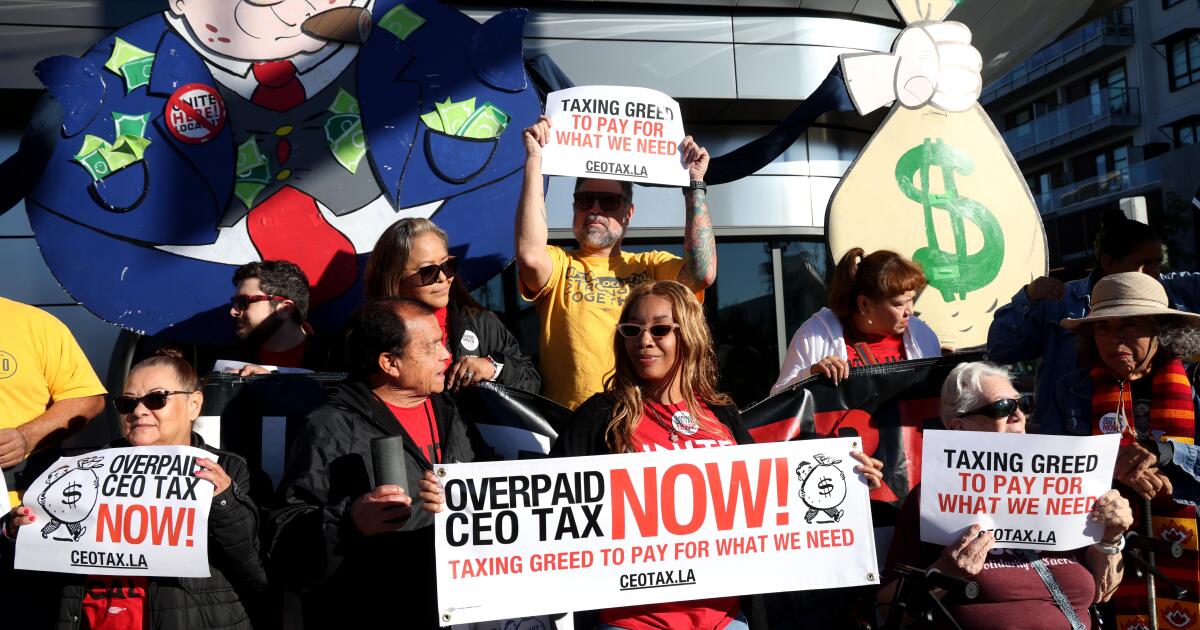
Last week union activists, hoisting giant cutouts of money bags and a cigar-smoking boss, announced a proposal to raise Los Angeles city taxes on companies with “overpaid” chief executives.
They rallied in front of a symbol of the uber rich: the futuristic, steel-covered Tesla Diner owned by Elon Musk, the world’s richest man.
Meanwhile, a “billionaire tax” proposal prompted some of the wealthiest Californians to consider fleeing the state, amid arguments that they would take their tax revenue — and the companies they run — with them, hurting the ordinary residents the proposal is designed to help.
The focus on taxing the richest of the rich comes amid a growing affordability crisis in California, home to the nation’s most expensive housing market and highest income tax.
More than 200 billionaires reside in California, more than any other state, according to a group of law and economics professors at UC Berkeley, UC Davis and the University of Missouri who helped draft the statewide billionaire tax proposal, which proponents are hoping to place on the November ballot.
And they are getting richer. The collective wealth of the state’s billionaires surged from $300 billion in 2011 to $2.2 trillion in October 2025, according to a December report by those professors. In Los Angeles, where the median sale price of $1 million puts home ownership out of reach for many residents, prominent billionaires include David Geffen, Steven Spielberg and Magic Johnson.
One conspicuous billionaire is especially unpopular in California: President Trump, who, despite campaigning on bringing down the cost of living, recently called the word “affordability” a “con job” as he redecorated the White House in gold.
“In a deep blue state like California that has voted against Donald Trump by such large numbers in the last three elections, voters are even more predisposed to be suspicious of billionaires, because he’s now the person with whom they associate the status,” said Dan Schnur, a politics professor at USC, UC Berkeley and Pepperdine.
The state and local tax-the-billionaires proposals, he said, are “about retribution,” much like last year’s Proposition 50, which temporarily redraws the state’s congressional districts to favor Democrats as a counterweight to Trump’s efforts to increase Republican seats in Texas.
To get the statewide billionaire tax proposal on the November ballot, supporters need to collect nearly 875,000 signatures by June 24.
The measure would impose a one-time tax of up to 5% on taxpayers and trusts with assets, such as businesses, art and intellectual property, valued at more than $1 billion. It would apply to billionaires who were residents of the state on Jan. 1, with the option of spreading the tax payment over five years.
Service Employees International Union-United Healthcare Workers West, its main backer, said it will raise $100 billion. Most of those funds would be used for healthcare programs, with the remaining 10% going to food assistance and education programs, the union said.
Suzanne Jimenez, the union’s chief of staff, said Friday that “catastrophic” federal funding cuts stemming from Trump’s One Big Beautiful Bill Act will force hospitals to close, eliminate healthcare jobs and cause insurance premiums to spike, leaving senior citizens and veterans with limited access to services.
The California Budget & Policy Center estimates that as many as 3.4 million Californians could lose Medi-Cal coverage and rural hospitals could close unless a new funding source is found.
Jimenez called the proposal “a modest tax” that “affects few people.”
But Gov. Gavin Newsom vowed to stop the billionaire tax, arguing that California can’t isolate itself from the other 49 states.
“We’re in a competitive environment. People have this simple luxury, particularly people of that status, they already have two or three homes outside the state,” Newsom said at the New York Times’ DealBook Summit last month. “It’s a simple issue. You’ve got to be pragmatic about it.”
The billionaire tax would temporarily increase revenues by tens of billions spread over several years, but if billionaires move away, the state could lose “hundreds of millions of dollars or more per year,” according to the nonpartisan California Legislative Analyst’s Office.
Some of California’s wealthiest say they are indeed heading for the exits.
Andy Fang, the billionaire co-founder of DoorDash, wrote on social media: “I love California. Born and raised there. But stupid wealth tax proposals like this make it irresponsible for me not to plan leaving the state.”
Peter Thiel, the billionaire co-founder of PayPal and Palantir, announced in December that his investment firm opened a new Miami office. He donated $3 million that month to a political action committee connected to the California Business Roundtable, which is fighting the measure.
State records show that Google co-founders Larry Page and Sergey Brin have been cutting ties to California and moving business interests out of state.
Rick Caruso, the billionaire real estate developer who self-funded his losing 2022 L.A. mayoral campaign to the tune of more than $100 million, said in a statement that “the proposed 5% asset tax is a very bad policy. It will deliver nothing it promises and instead hurt California with lost jobs and hundreds of millions a year in lost revenue from existing income taxes.”
Ending months of speculation, Caruso announced Friday he will not challenge Mayor Karen Bass again, nor will he run for governor in a race that includes billionaire hedge fund founder Tom Steyer.
In Los Angeles, supporters of the “Overpaid CEO Tax” announced outside the Tesla Diner that they must collect 140,000 signatures in the next 120 days to get the measure on the November ballot. The measure would raise taxes on companies whose CEOs make at least 50 times more than their median-paid employee. It would apply only to companies with 1,000 or more employees.
The Fair Games Coalition, a collection of labor groups including the Los Angeles teachers union, is sponsoring the measure, which would allocate 70% of the revenue to housing for working families, 20% to street and sidewalk repairs and 5% to after-school programs and access to fresh food.
Business groups have denounced it, saying it would drive companies out of the city.
“Luxury for a few, while those who cook, who clean, who build, who teach, who write — the people who make the city prosperous — are stretched to the breaking point,” Kurt Petersen, co-president of the airport and hotel workers union Unite Here Local 11, said at Musk’s diner, describing it as an avatar for an unjust L.A. economy.
A similar effort to increase taxes on companies with disproportionately paid CEOs is underway in San Francisco, where voters already approved a levy on such businesses in 2020.
On Friday, Doug Herman, a spokesperson for Bass’ reelection campaign, said she has “not taken a position” on the state or city wealth tax proposals. But at her campaign launch last month, Bass framed the mayoral race as “a choice between working people and the billionaire class who treat public office as their next vanity project.”
Jeremy Padawer, a toy industry executive and animated TV producer who lost his home in the Palisades fire, said the mayor’s framing of the race as a battle against billionaires feels contrived, especially given the intense criticism of her handling of the fire.
Power is as relevant as money, and Bass is “the most powerful person in the room,” said Padawer, who organized the “They Let Us Burn” rally on the one-year anniversary of the fire.
“I know a lot of billionaires,” Padawer said. “And I think that billionaires have a propensity to do a lot of good, but they also have the propensity to do a lot of bad.”
Times staff writer Queenie Wong contributed to this report.