Business groups such as the California Chamber of Commerce, the California Teachers Assn. and Planned Parenthood Affiliates of California oppose the proposal.
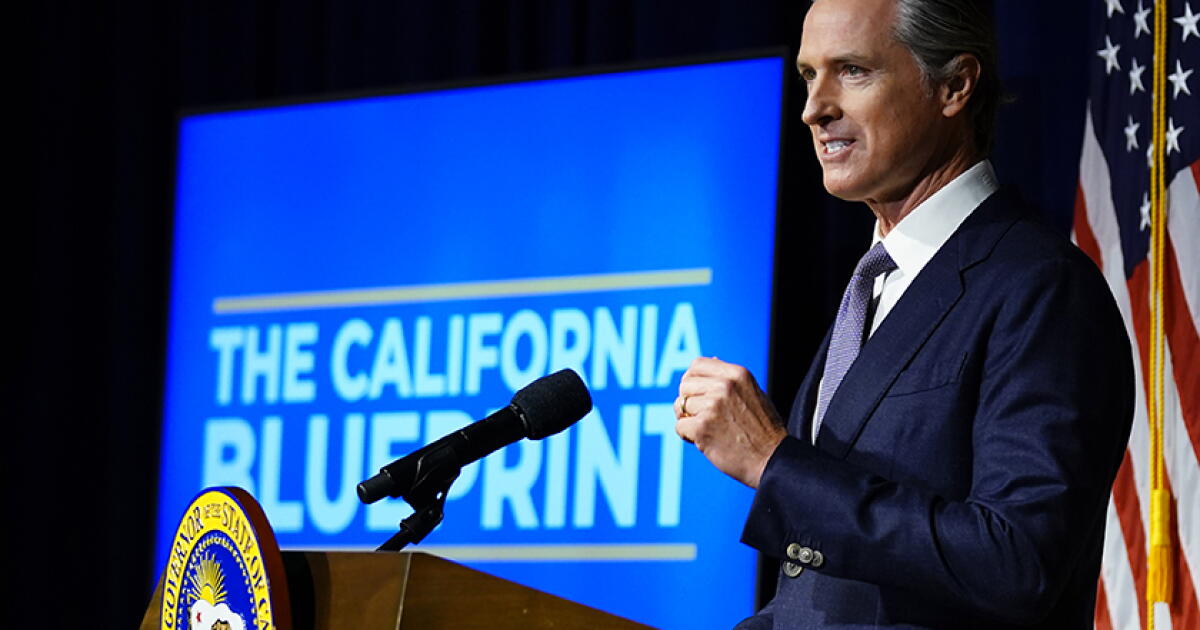
Gov. Gavin Newsom and Democrat Xavier Becerra and Republican Steve Hilton, who are running to replace Newsom, also have spoken out against it.
Opponents describe the wealth tax as a “flawed experiment” that will harm California’s economy because companies and rich people will flee the state.
“If they leave, it will create a huge hole in our budget, threatening core services like education, healthcare and public safety,” arguments against the proposition say.
Opponents of the measure say the proposal is an ineffective attempt to address the long-term effects of the healthcare cuts and would harm California’s economy and budget.
The state budget in California already is largely dependent on income taxes paid by its highest earners. Because of that, revenues are prone to volatility, hinging on capital gains from investments, bonuses to executives and windfalls from new stock offerings, and are notoriously difficult for the state to predict.
Billionaires such as Palmer Luckey, the co-founder of defense tech startup Anduril Industries, and entrepreneur Mark Cuban have pushed back against the proposal on social media. Some tech executives have been relocating or moving their assets to try to avoid the potential tax. Google co-founder Sergey Brin has been cutting ties to California, relocating to Nevada while funding groups such as Building a Better California that are backing ballot measures that could nullify the billionaire tax.
More than $187 million has been spent opposing the proposition, with the bulk coming from Building a Better California, cryptocurrency company Ripple Labs and its co-founder Chris Larsen, data from the secretary of state show.
A new Pixar animated film, the sequel to Lionsgate’s “Michael” and a large crop of indie projects are among the latest films to be awarded a California tax credit for in-state production.
In total, 35 films — including 28 independent projects — received production incentives in the latest round of incentives.
Together, the projects are expected to contribute more than $1 billion in direct production spending in-state and hire more than 5,400 cast and crew members and more than 24,800 background actors, the California Film Commission said Wednesday.
“California is the home of entertainment, full stop,” Gov. Gavin Newsom said in a statement. “We’re not just protecting that legacy; we’re investing in its future.”
Pixar received the largest credit ($40.1 million) for an untitled animated film, followed by Lionsgate, which was awarded $30.8 million for the sequel to “Michael,” the film based on the life of Michael Jackson. Paramount Pictures got $29.3 million for an untitled crime thriller.
The latest round of tax credit awards comes less than a month after Newsom signed a bill to create the state’s first post-production incentive. Industry editors, sound mixers, visual effects artists and composers had said such a credit was necessary to lure jobs back from overseas.
On a national level, a bipartisan coalition of lawmakers is pushing to create a federal tax credit for film and TV. The bill is expected to be introduced in Congress in early November and backers are aiming to get it passed by Dec. 11, when the current Congress ends. If passed, the credit would take effect in 2027 and would be stackable with states’ production incentives.
California Republican gubernatorial candidate Steve Hilton dove deep into his housing platform and lobbed a few attacks at his Democratic opponent, Xavier Becerra, during a town hall with Los Angeles news outlets Tuesday.
Hilton also pointed to some disagreements with President Trump, providing daylight between himself and a president who remains deeply unpopular in California, during the event hosted and livestreamed by the Los Angeles Times and LAist.
Democratic Gov. Gavin Newsom’s final term ends in early January, providing California voters the opportunity to select a new governor at a time of conflict between the state and the Trump administration over environmental policies, immigration, healthcare and other pressing issues.
Ballots already have started to arrive in California voters’ mailboxes ahead of the Nov. 3 election.
Here are the top takeaways from the discussion with Hilton:
Walking the tightrope on Trump
Republicans running for statewide office already have an uphill battle because of California’s heavily Democratic electorate. It’s an acute challenge this year, campaign experts say, because many Democratic voters are itching to help their party regain control of Congress and neutralize Trump’s agenda.
Trump endorsed Hilton in April, which helped the former Fox News host pull ahead of his GOP rival, Riverside Sheriff Chad Bianco, and secure the second-place spot in the primary election, behind Becerra.
On the campaign trail, Hilton has remained supportive of Trump and said Democratic policies, not the war in Iran, are to blame for high prices.
The Republican said those differences are rooted in his strong support for states’ rights.
“The broader point I want to make, and you can track this back to the commentary and what I’ve written over the years, is I’m a strong believer in decentralizing power,” he said. “I think there’s far too much involvement of the federal government in our affairs in California, and I’m going to be a very strong advocate for bringing those powers back in all sorts of ways.”
Gas prices, taxes and housing permits
Hilton described California’s cost of living as “a nightmare” and a major contributor to residents and businesses moving out of the state.
He laid out an affordability plan, which he refers to as “Califordable,” that he would prioritize if elected governor. His plan includes:
Ending income taxes for Californians who earn $150,000 or less.
Slashing oil industry regulations and clean energy mandates for utility companies to achieve $3 gas and lower electric bills.
Ushering in a new construction boom of single-family homes, including by developing 10 new cities around the state, and capping government fees on newly constructed houses.
He blames the state’s affordability woes on Democrats, who have controlled the state legislative seats and held every elected statewide office since 2009.
“It’s not just that it’s time for some change in California, it’s time for balance. It’s time to try something different after 16 years of doing it the same way,” he said.
Republican gubernatorial candidate Steve Hilton said he does have some policy differences with President Trump during a town hall at the Los Angeles Times Building on Tuesday in El Segundo.
(Ronaldo Bolanos/Los Angeles Times)
Hilton said he would stop enforcing laws requiring communities to meet housing production goals and instead focus on building in undeveloped areas of the state that want new homes.
“We’ve got this attitude that the only place you can build is inside what’s currently developed, and that’s motivated by a desire to stop traffic and sprawl and all these things. But the consequence of that is that you end up finding [it] almost impossible to build anything” because of permitting battles and lawsuits, he said. “My plan is to open that up so that we build outwards, not just upwards, increasing the amount of space we use for housing.”
How he would pay for it all
Hilton said that Newsom and Democratic lawmakers have gotten accustomed to spending big and that he wants to return California’s state budget to its pre-pandemic size.
Earlier this year Newsom signed a budget just shy of $352 billion. His first budget as governor, in 2019, clocked in at nearly $215 billion.
The growth occurred during a time “when around 2 million people on net have moved out of the state,” Hilton said. “So we’re spending twice as much for a big reduction in population and worse results.”
He said he could offset the tax cuts by ending funding for high-speed rail, trimming state agencies by 5% and cracking down on Medicaid fraud. Together, he estimates those cuts would save about $25 billion annually. He has also promised to end state-funded healthcare for undocumented immigrants and to hollow out agencies that regulate the state’s air quality and coastlines.
Another round of attacks on Becerra
While he largely stayed focused on policy, Hilton criticized Becerra’s record as U.S. Health and Human Services secretary and dinged him for skipping the town hall.
“Looking forward to perhaps one day having another chance to sit down with my competitor in this race, Xavier Becerra. We’ve had one debate. He promised that there would be debates, plural. Not to be today. But hopefully we can have that conversation because Californians deserve a conversation about the future of our state,” he said during his opening remarks.
On Monday, Hilton attacked Becerra for having “pulled out” of the debate, though the Democratic candidate never agreed to attend a debate proposed by The Times and LAist. Becerra’s spokesperson said the campaign declined the invitation because of a full campaign schedule.
In the weeks following the June primary election, Becerra made himself scarce on the campaign trail and attended few public events. In August, he told reporters there would be multiple debates. He and Hilton faced off last week in an hourlong debate on CNN but no other debates have been announced.
Offshore wind projects “grotesque,” Hilton says
At a time when the Trump administration has systematically dismantled climate and environmental policies, Hilton took care to cast himself as an environmentalist who is concerned about climate change.
He criticized many of the policies favored by Democrats, however, as a “very one-dimensional way of thinking” and offered a more business-friendly approach to addressing climate change:
Planting 3 billion trees and restoring wetlands.
Expanding the use of climate-friendly geothermal energy near places such as the Salton Sea and Sonoma and Modoc counties.
Expanding oil production in California, which he said reduces the need to import foreign oil on tanker ships that spew carbon emissions.
“So that’s a way of reducing carbon emissions that doesn’t burden working people and small businesses with the highest energy costs in the country. We’ve got to get the balance right,” Hilton said.
Hilton aligns with Trump’s vehement opposition to offshore wind projects, a potential source of abundant renewable energy. This year, the Trump administration announced deals to pay wind project developers billions to abandon U.S. wind leases off the coasts of California, North Carolina, New York and New Jersey.
“I think offshore wind is an absolute abomination. I mean, you look at beautiful Morro Bay or Humboldt up in the northern part of our state,” Hilton said. “The industrialization of our coastline that offshore wind would create, I think, is just grotesque, and I’m dead against it.”
Working across the aisle
When asked how he would work with a Democratic majority in the state Legislature, Hilton said he has experience doing it — as an advisor to former United Kingdom Prime Minister David Cameron, he shared an office with a member of the opposite party.
“We worked together very well. Didn’t agree on everything,” he said. “That would be my attitude. I’m very open. I’m not tribal. I’m not particularly partisan. I’m a pragmatic, problem-solving kind of person, and I’m looking forward to working with the Legislature.”
He said he would press the Legislature to cut spending and “the endless number of bills that they pass every year. … But I want to work together to reduce costs for Californians.”
Hilton also found alignment with Democrats who ran in the gubernatorial primary, including former Orange County Rep. Katie Porter, San José Mayor Matt Mahan and former Los Angeles Mayor Antonio Villaraigosa.
“Katie Porter in the primary … actually endorsed my tax plan. Matt Mahan and I agree on a lot of things to help” cut costs and speed up housing constriction, he said. “Antonio Villaraigosa, we agreed on a lot of things to do with energy policy. So I think there are Democrats who we’ll be able to work with to get consensus on some of the things that we need to get done.”
Sen. Bernie Sanders, a hero among the nation’s progressive voters, stumped in Southern California on Monday for a wealth tax on the California ballot in November that has drawn hundreds of millions of dollars in campaign spending.
“What you are showing people from coast to coast and all over is that, yes, we can take on the greed of the oligarchs,” said Sanders (I-Vt.), who called Proposition 40 the most important ballot measure in the country. “Yes, we can create an economy and a government that works for all of us, not just the 1 percent.”
Sanders name-checked billionaire tech founders including Elon Musk of SpaceX, Mark Zuckerberg of Meta and Google co-founder Sergey Brin, whose mentions were repeatedly met with boos from the crowd gathered at the Novo in downtown Los Angeles.
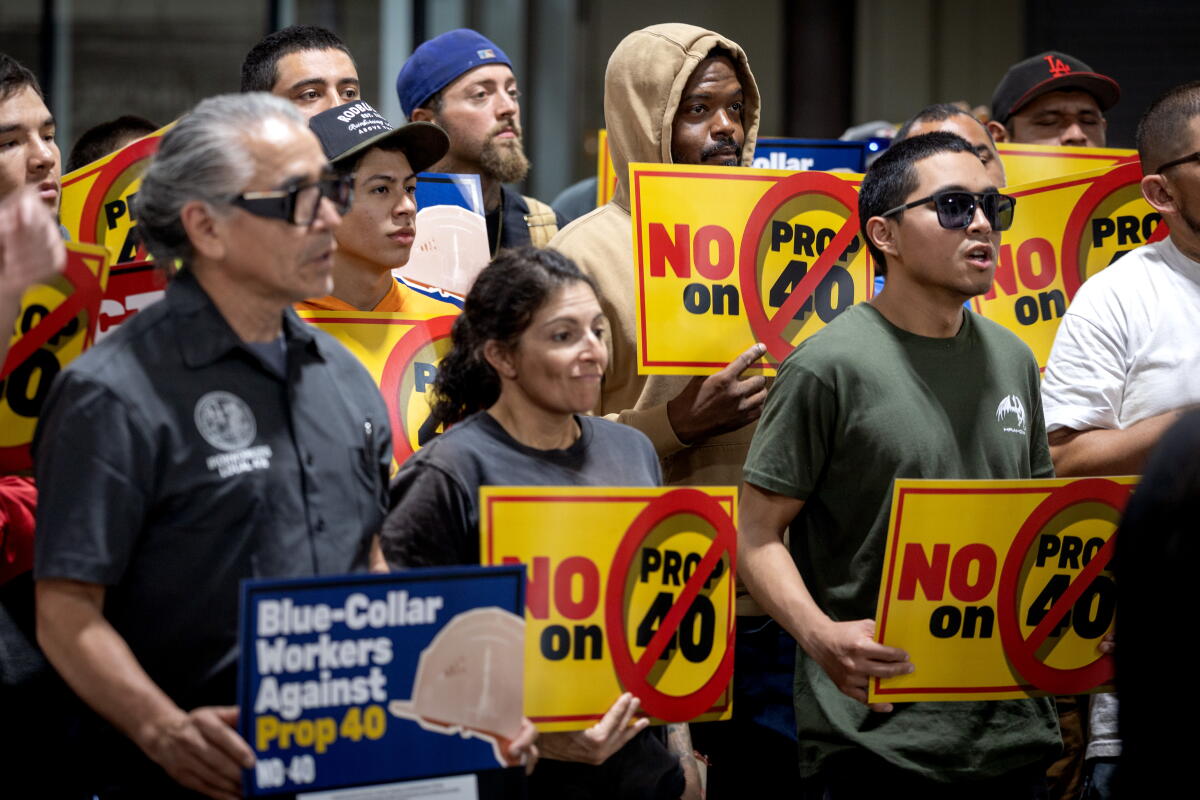
Labor leaders, speaking earlier on Monday at a union training facility in La Palma, argued that although the billionaires tax is billed as a one-time tax on the assets of the state’s wealthiest residents, it includes a loophole that would allow state lawmakers to tax the savings and retirement accounts and home equity of all Californians.
“In the trades, we know you always read the blueprints and you always read the fine print,” said Xochitl Medrano, the political director for the district council of the Ironworkers of the State of California and Vicinity. Medrano was surrounded by union workers chanting, “No on 40!”
“Our workers are not billionaires; they are working people. After 20, 30, or even 40 years of breaking their backs on the job sites, our members have the opportunity to have a decent pension, some retirement savings, and equity in a home that they’ve been working to pay off,” she said. “That’s not wealth handed to them. That’s sweat equity. … We won’t stand by and let a tax that’s supposed to target billionaires turn into a trap door for working families.”
Proposition 40 is among the most contentious issues on the Nov. 3 ballot. The measure was crafted by a healthcare union to offset $100 billion in impending federal healthcare funding cuts approved by congressional Republicans and signed by President Trump last year. Millions of Californians could lose their healthcare coverage because of those cuts.
There are two opposing measures on the November ballot, Propositions 41 and 42, that would nullify the billionaires tax if either receives more votes.
About 45% of likely voters supported Proposition 40, while 42% opposed it and 13% were undecided in a late September poll by UC Berkeley and the Los Angeles Times. That’s a decline in support compared with a poll six weeks earlier, when 48% of likely voters supported it while 41% opposed it.
The proposal has drawn more than $300 million in campaign contributions, nearly all against it. Ballot measures are not subject to caps on campaign donations.
Sanders was joined by Rep. Ro Khanna (D-Fremont) and artists including the rapper Common, who called for “them billionaires to pay up” between freestyle verses. Shepard Fairey, known for his famous portrait of President Obama, unveiled banners in support of the wealth tax campaign, which served as a backdrop on the event stage.
Rally attendee Datosha Williams, an SEIU-UHW member who works in healthcare customer service, said Proposition 40 is a backstop to federal healthcare cuts, which could lead to hospital closures around the state.
“My biggest fear is that I will see some of my coworkers lose their jobs,” she said. “My biggest fear is that my 8-year-old son, who is asthmatic, will have long waits in an ER.”
At the event at the Ironworkers Training Center in La Palma organized by labor leaders to oppose the wealth tax, apprentices attended workshops about rigging and collective bargaining rights.
“We’re not opposed to making the wealthy pay their fair share. We’re not opposed to creating a high-quality and low-cost health insurance plan for Californians,” said Andrew Gonzales, the council representative for the Los Angeles and Orange Counties Building and Construction Trades Council. “We just don’t think Prop. 40 is the right vehicle to go about that.”
Gonzales pointed to the volatile state budget’s dependence on tax revenue from wealthy Californians, some of whom have proactively moved out of the state because of the proposal.
“That’s already having an immediate impact to the state’s budget,” he said. “So we already see the danger that can occur.”
Foes of Proposition 40 attend a rally on Monday at the Ironworkers Training Center in La Palma.
Proposition 42 would prohibit new taxes on “retirement holdings, individually-owned assets, and other forms of personal savings” that take effect after Jan. 1, 2026. That includes financial assets, investment accounts, intellectual property, personal belongings and other assets used for retirement or financial planning.
It also would bar retroactive taxes on past earnings unless the state is using revenue from the tax to respond to emergencies such as a fire or a flood.
Proposition 42 could nullify Proposition 40, the proposed billionaire tax, because the two measures conflict with one another. If voters approve both, the one with the most “yes” votes generally would become law, according to the Legislative Analyst’s Office.
Proposition 42 could reduce state tax revenue but it’s unclear by how much, according to the office’s analysis. Currently, the state does tax certain personal property such as vehicles. It doesn’t tax people for owning financial assets like stocks and investment accounts but does tax income from them.
The California Taxpayers Assn., the California Society of Certified Public Accountants, the CalAsian Chamber of Commerce and others back the proposition. They say it would result in the government spending taxpayer dollars more wisely while improving transparency.
The bulk of the contributions to support the proposition have come from Building a Better California, data from the California secretary of state’s website show. Top contributors to Building a Better California include Sergey Brin, Google’s co-founder; John Doerr, chairman of venture capital firm Kleiner Perkins; and Eric Schmidt, the former chief executive of Google.
Proposition 41 “requires more accountability, transparency and trackable progress of programs funded by our taxes, so that we stop funding failure and start funding successful outcomes,” a website for the proposition states.
The ballot initiative was spearheaded by the United Firefighters of Los Angeles City Local 112, the union representing rank-and-file firefighters, which has long argued that the department is underfunded.
The president of the union has said that the tax would be the most important thing for the LAFD “really ever.”
“The most important thing for the citizens of L.A. is our response times; this ballot measure would help us get more firefighters, more paramedics, more fire stations and more apparatus, which would let us respond faster to citizens of L.A.,” said Doug Coates, the president of UFLAC.
“In the Palisades, this measure would have let us respond quicker, knock it down faster, protect more homes … We would have saved more homes if we had had more firefighters, period,” he said.
The sales tax would represent the biggest investment in the city’s fire department since 2000, when voters approved Proposition F, a ballot measure that authorized the issuance of a $532-million bond — more than half of which was allocated to build 19 neighborhood fire stations and a helicopter maintenance facility.
The initiative also has received support from Mayor Karen Bass as well as Councilmember Traci Park, who represents Pacific Palisades.
Manchester City will claim as part of their appeal that key sponsorship deals were funded by the Abu Dhabi government, rather than the club’s owners.
Owners Abu Dhabi United Group (ADUG) – a private investment company belonging to United Arab Emirates vice-president and deputy prime minister Sheikh Mansour – are said to have topped up the value of commercial deals as part of a “disguised funding scheme” to the scale of £830.69m.
This, it was argued, enabled the club to appear to comply with Premier League and Uefa financial rules.
However, as first reported by the Daily Mail and Times, sources have told BBC Sport that City are expected to tell an appeal board that they have evidence showing the money directed to sponsors came from the Abu Dhabi government, rather than from ADUG.
Premier League rules allow state-owned bodies to sponsor clubs.
The independent commission detailed how City had “denied there had ever been any disguised funding scheme of the type alleged by the Premier League. Its case was that [it] had misunderstood how Abu Dhabi sponsorship agreements had been funded… The reality was [the club contested] that Abu Dhabi sponsors had always been liable for all recorded sponsorship fees and all had in fact been paid to the club by Abu Dhabi sponsors from their own funds/resources.
“No part of any recorded sponsorship fee had been paid by ADUG or from using ADUG funds. Abu Dhabi sponsors had from time to time applied for financial assistance from the Abu Dhabi government toward their liability to pay the recorded sponsorship fees – such applications had been granted…”
The independent commission rejected this submission as “untrue”, saying: “We concluded that it was an ‘explanation’ that the club had concocted well after the event in an attempt to obscure and conceal the realities of the disguised funding scheme.”
City’s argument is likely to lead to renewed debate over the extent to which City’s ownership is separate from the Abu Dhabi state, and over the ramifications of club ownership with state connections.
Mansour is a member of the ruling family of Abu Dhabi, and the brother of UAE President Sheikh Mohamed bin Zayed Al Nahyan.
Since the takeover in 2008, City have insisted the club is a completely private enterprise, and not state-owned. However, some critics have questioned the distinction, with human rights campaigners claiming the ownership of City has been used to “sportswash” the UAE.
On Saturday, City chairman Khaldoon Al Mubarak referred to “irrefutable evidence” that he claimed supports the club’s claims of innocence. City have claimed the commission’s decision contained “clear material errors, of law, principle and fact, and is unsafe”.
It has emerged that Al Mubarak, who was appointed chairman of City following the takeover in 2008, is named as an Emirati diplomat on the UK government’s current directory of all foreign representatives.
Representatives of foreign states and their diplomatic staff “enjoy privileges and immunities under the Diplomatic Privileges Act (1964)”, giving diplomats immunity from prosecution under criminal, civil and administrative laws.
City’s principal sponsor Etihad Airways has said it is considering legal action against the Premier League, claiming the release of the commission findings had “damaging implications… despite the airline not being named in the redacted published findings”.
The UAE’s state-owned national airline said it “categorically rejects any finding, conclusion or implication that suggests the airline has ever been involved in improper commercial arrangements”.
Etihad is owned by sovereign wealth fund L’Imad which is chaired by the Crown Prince of Abu Dhabi, the son of the UAE president.
The Premier League declined to comment when contacted by BBC Sport.
Additional reporting from James Landale, diplomatic correspondent for BBC News.
A proposal to tax California’s billionaires has fractured Democratic politics, repelled some of the state’s richest residents and exploded into a costly battle that’s overshadowing even the gubernatorial election.
Known as Proposition 40, the ballot measure is also dividing the very industry it’s supposed to help. The healthcare workers union behind the initiative, which would authorize a wealth tax on billionaires, says the levy would raise sorely needed funds to shore up health coverage.
By contrast, leading California hospital and doctor groups are opposing the measure ahead of the November vote. They say the one-time 5% levy on the state’s wealthiest is a risky gambit with an uncertain path to victory — as well as a distraction from other proposals to shore up healthcare.
“This is an experiment on a taxation scheme that’s not been done before, and it puts healthcare in a more vulnerable position as a result,” California Medical Assn. Chief Executive Dustin Corcoran said at a recent briefing in Sacramento. “It’s not a healthcare ballot measure.”
Less than six weeks before election day, polls show a divided electorate. But whatever the outcome, the fight is exposing a broader problem confronting California: how to preserve one of the nation’s largest expansions of publicly funded healthcare as a big chunk of the money that helped pay for it disappears.
Over the last decade, California increased access to publicly funded healthcare by broadening eligibility for Medi-Cal, the state’s Medicaid program, and other types of insurance, allowing millions more residents to gain coverage. The number of people without insurance fell to 2.4 million in 2024 from about 6.5 million in 2011.
Now, that trend is expected to reverse. According to the Congressional Budget Office, President Trump’s budget bill last year will lead to $1 trillion in healthcare-related cuts over a decade. Earlier this week, the Trump administration said it recently removed 760,000 people from Obamacare plans across the nation, alleging that some were enrolled improperly and others don’t exist.
Combined with strict work requirements, more frequent eligibility checks and a pullback in state spending pushed by Democratic Gov. Gavin Newsom, the changes are projected to push California’s uninsured population under the age of 65 to 4.6 million by 2030, according to the UC Berkeley Labor Center.
“Without trying to be melodramatic, when millions of people lose coverage, it is entirely predictable that thousands will die unnecessarily because of foregone treatment,” said Dave Regan, president of SEIU-UHW, the healthcare-workers union pushing the billionaire tax.
“There is an absolute consensus on what the problem is, and there’s a consensus that there’s no other solution on the table,” he said in an interview at Bloomberg’s San Francisco offices.
Even before the budget cuts start to bite, financial strains are mounting at institutions such as Martin Luther King Jr. Community Hospital in South Los Angeles.
MLKCH’s waiting room is now mostly used for treating patients, with 16 wooden cubicles functioning as care rooms. Sick or injured people are also cared for in the hospital’s front hallways and in what used to be the meditation chapel and the gift shop.
The hospital opened in 2015 with an emergency department built for 25,000 visits annually. In 2024, it handled 130,000. Dr. Elaine Batchlor, its CEO, said further funding reductions “would threaten the sustainability of the hospital.”
Batchlor isn’t taking a position on Proposition 40 and has been looking for other sources of revenue. SEIU-UHW’s Regan argues there’s no other way to raise the money needed to fill the massive gap.
The California Budget & Policy Center estimates the state stands to lose roughly $30 billion in federal Medi-Cal funding each year. Asking California lawmakers for that amount is a “fool’s errand,” Regan said. “And on top of that, the only people the legislature will tax are ordinary people.”
The union estimates the levy would raise $100 billion over five years, with 90% earmarked to shore up health coverage amid impending budget cuts.
Critics dispute the projection. The state’s nonpartisan Legislative Analyst’s Office says the tax would probably raise tens of billions of dollars, but potentially reduce income-tax revenue in the long run, as some ultrawealthy residents depart the state.
Recent polls show an increasingly contested path for Proposition 40. A recent UC Berkeley-Politico poll found 45% of likely voters in favor, but opposition has increased since early this year and now stands at 43%. A separate Public Policy Institute of California survey put support at 52% and opposition at 46%.
Led by Sergey Brin, wealthy opponents have poured almost $230 million into funding Building a Better California, according to a filing late Thursday. That’s helping them flood the airwaves with anti tax advertising. There are also two competing ballot measures designed to torpedo Proposition 40 if they pass.
Billionaires aren’t the only detractors. Critics have also assailed Proposition 40 for carving out an exception to California’s constitutional funding rules to steer most proceeds to healthcare. While the state generally earmarks at least 40% of General Fund revenue to public schools and community colleges, the billionaire-tax proposal excludes the new levy from that calculation.
Corcoran, the medical association chief, argues that even if Proposition 40 passes in November, legal challenges would potentially delay its implementation for years.
“There’s a lot that we can do looking ahead to 2028 when these cuts start taking greater effect that frankly would provide more immediate relief than Proposition 40 would,” he said. His group and others are pushing instead for large corporations to help cover the cost of public insurance for their workers.
Regan called that proposal “the worst public policy on planet Earth,” saying costs will be passed on to consumers and that it essentially acts as a payroll tax on low-wage workers.
He also disputed the notion the billionaire tax would lead the ultrawealthy to leave the state, pointing to Nvidia Corp. CEO Jensen Huang, who earlier this year said he would be “perfectly fine” with the levy. As for legal challenges to the billionaire tax, Regan said he believes they can be resolved in 12 months.
The uncertain funding picture has many hospitals bracing for cuts.
James Suver, CEO of Ridgecrest Regional Hospital, about 150 miles north of Los Angeles, said he’s not betting on proceeds from the billionaire tax. He’s weighing options that include pausing maternity care again, cutting physician recruitment and reducing emergency-room service.
“Our future under the most likely scenario is not looking very good,” Suver said. “We’re beyond doing minor nips and tucks to be able to offset some of the changes that I suspect may be happening in the future.”
Clanton writes for Bloomberg. Kara Wetzel of Bloomberg contributed.
WITH ancient ruins like the Acropolis and the Temple of Zeus, Athens has long been considered one of the oldest cities in the world – but it’s about to get much more modern.
A new billion-pound seafront regeneration project with a towering skyscraper and luxury shopping has resulted in the city being dubbed the ‘new Dubai‘.
The Ellinikon project which includes the building of a 650 foot tower is underwayCredit: theellinikon.comThe regeneration is taking place on the Athens RivieraCredit: theellinikon.com
A regeneration project called The Ellinikon an estimated €8billion (£6billion) is set to completely transform the area to become its first ‘smart city’.
Sign up for the Travel newsletter
Thank you!
At its core is an enormous skyscraper called Riviera Tower – once transformed it will be the tallest building in Greece at over 650 feet high.
Inside will be around 170 luxury apartments including penthouses and each one will have panoramic views over the coastline.
The Ellinikon will also have new additions including ‘Little Athens’, a new neighbourhood right next to the beach with apartments as well as small shops and cafés.
The Riviera Galleria will be a new complex for luxury shopping with 80 new shops covering 10,000 square metres.
At the galleria will also be upscale restaurants, artisan ice-cream parlours, beauty salons and organic markets.
The upscale and luxury aspect mirrors what visitors expect when heading to the seafront neighbourhoods of Dubai.
The ancient city of Athens is considered one of the oldest in the worldCredit: Alamy
In order to entice expats into Greece, the country is also offering tax breaks – much like Dubai which is a playground for the wealthy.
Since its debt crisis in around 2009, Greece has made a ‘remarkable economic recovery’, according to the IMF.
Part of this is thanks to tax breaks aimed at families, young workers and expats.
Under new rules this year, investment professionals who relocate to Greece can pay five per cent on “carried interest” – this is a fraction of the rate in the UK.
The project is being built on the site of the former Ellinikon International AirportCredit: Not known, clear with picture deskThere will be new luxury apartments, shopping gallerias and spasCredit: theellinikon.com
Talking to The Times, Henley & Partners, which organises residence and citizenship planning for the rich says interest in moving to Greece has surged.
It’s now the second-most popular destination after St Kitts & Nevis for relocation.
Mario Rafael, a managing director at the firm. said: “Greece is increasingly competing for the attention of the same internationally mobile families considering places such as Milan and Dubai.”
If it does turn into a Dubai-alternative, for Brits it’ll be much easier to get to as the flight is around four hours less.
While it might not be the winter hotspot like the city in the UAE, Athens still has scorching summers too.
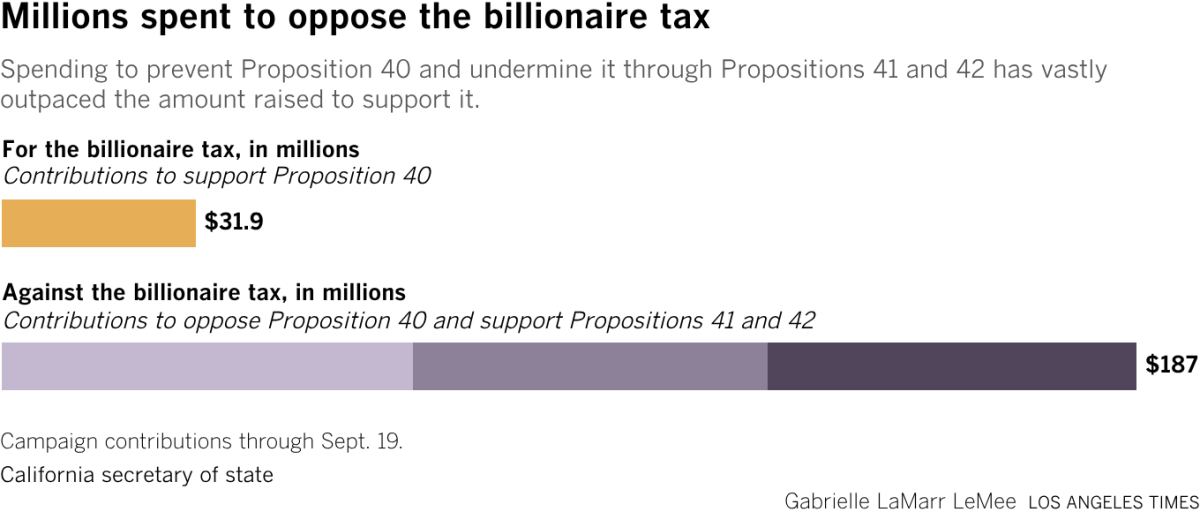
Opponents of the billionaire tax on the November ballot have vastly outraised the proposal’s supporters, with the anti-Proposition 40 effort and the backers of two other ballot measures crafted to nullify it raising $187 million compared to the $32 million raised by boosters of the wealth tax, according to campaign finance documents filed with the state.
The reports, filed Thursday, account for donations through Sept. 19 and do not include several million dollars that have poured into campaign coffers in recent days. The numbers are expected to vastly increase before the Nov. 3 election.
The bulk of the money raised by the proponents of Proposition 40, which would enact a one-time 5% tax on California billionaires’ assets, appears to have been spent on gathering signatures to qualify the measure for the November ballot. The campaign had only $207,000 in the bank, according to the latest campaign finance reports.
A leader of the union that crafted the proposal accused wealthy Californians who are spending heavily against the measure of lying to voters. The measure is designed to offset $100 billion in impending federal healthcare funding cuts expected to impacts millions of Californians.
“The billionaires take and take — tax break after tax break — and now they’re spending that money to deceive voters and avoid paying their fair share,” said Suzanne Jimenez, the chief of staff of the Service Employees International Union-United Healthcare Workers West. “Voters want their money back from the billionaires and want local emergency rooms to stay open. California does not need more tax breaks for billionaires. California needs emergency rooms for patients, hospitals that stay open, and healthcare people can access and afford.”
Opponents of the billionaire tax argue that it would do more harm than good.
“The more Californians learn, the more they see Proposition 40 for what it is — a harmful tax scheme that permanently damages the state’s budget and economy with zero accountability or safeguards to ensure funding actually improves care or lowers costs for patients,” said California Medical Assn. President Dr. René Bravo, the leader of one of the groups opposing the billionaire tax.
Proposition 41 would nullify the billionaire tax if, in the event that both measures are approved, it receives more “yes” votes. Proposition 41 would prohibit any new state tax from being excluded from a voter-approved cap that restricts how much tax revenue the state can spend each year.
“Californians deserve better results for their hard-earned tax dollars,” said Molly Weedn, a spokesperson for the Proposition 41 campaign.
Proposition 42 would prohibit new taxes on personal property, intellectual property, retirement accounts and other assets, and would limit situations in which a ballot measure or state lawmakers can impose or raise taxes retroactively — both of which are essential parts of Proposition 40. If both measures pass and Proposition 42 receives more “yes” votes, it would nullify the wealth tax.
The proposed billionaire tax has divided California Democrats, with Gov. Gavin Newsom opposing it while the state Democratic party supports it.
In recent polling, a majority of likely voters did not support any of the three proposals.
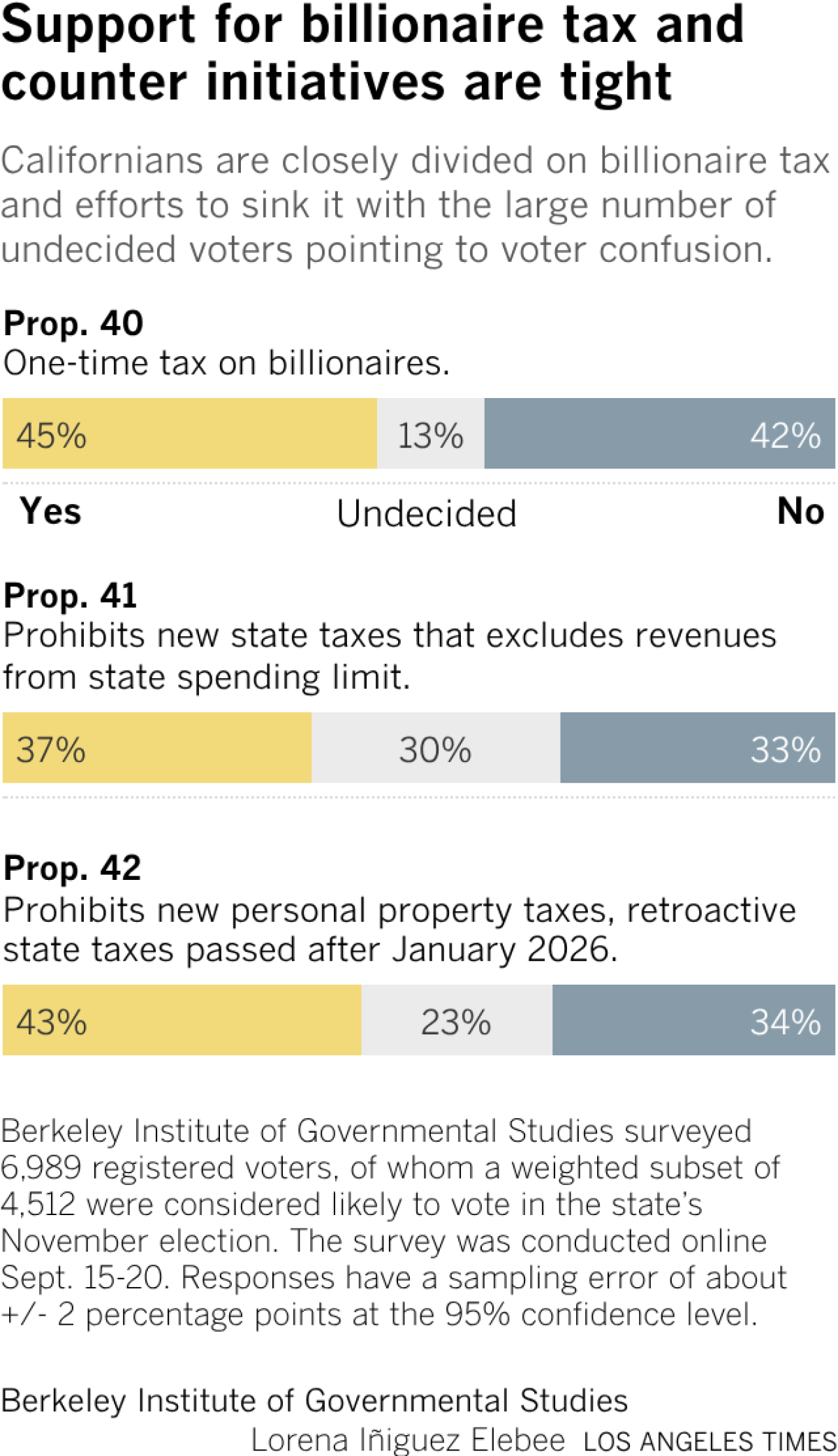
While 45% of likely voters supported the billionaire tax, 42% opposed it, according to a poll released Friday by UC Berkeley’s Institute of Governmental Studies and co-sponsored by the Los Angeles Times. Voters also are torn about the two ballot measures designed to nullify it.
The other measure receiving great attention, Proposition 39, which would require voters to show government-issued ID to cast ballots, faces a similar financial disparity. Opponents to the measure have raised $39.3 million compared to $15.6 million garnered by supporters.
Fifty-two percent of likely California voters oppose the voter ID proposal, while 39% support it and 9% are undecided, according to the Berkeley poll.
In the race to replace Newsom, Democratic former Biden cabinet member Xavier Becerra has raised $35.8 million, while his GOP rival, conservative strategist and television commentator Steve Hilton, has raised $22.3 million.
Becerra remains the front-runner in the governor’s race, which is not surprising since Democratic voters outnumber Republicans nearly 2 to 1. In last week’s Berkeley poll, the Democrat had the support of 58% of likely voters, while 33% backed the Republican.
The slate of statewide measures on the Nov. 3 ballot provides voters two opportunities to tax the rich, which in past years has proved tantalizing to California’s left-leaning electorate.
Only one of those measures has strong voter support, however, and it’s not the proposition that’s attracted nationwide attention, ignited a nearly quarter-billion-dollar political slugfest and created a rift among top leaders in the Democratic Party.
Likely voters expressed middling support for Proposition 40, a one-time 5% tax on billionaires’ assets intended to compensate for an impending $100 billion in federal healthcare funding cuts. They were far more likely to back Proposition 3, a ballot measure that would make permanent a tax increase on the wealthy that funds schools and healthcare, according to a poll released Friday by UC Berkeley’s Institute of Governmental Studies that is co-sponsored by The Times.
Proposition 3 appears to be a much less controversial endeavor, which may explain why it has more voter support. The ballot measure would extend a tax enacted in 2012 on individuals who earn at least $360,000 a year that is set to expire in 2031. Proposition 40 proposes a brand-new tax on billionaires and is opposed by Gov. Gavin Newsom, who fears that it could hurt the state’s finances in the long run.
“When you’re going about taxing the billionaires’ assets, I mean that’s something kind of new and different, and it’s risky, and the governor’s against it, and you know a lot of people are expressing caution about it,” said Mark DiCamillo, director of the poll.
Voters are deeply concerned about income disparity but also skeptical about the unusual approach of the billionaire tax.
Proposition 40 has drawn the greatest attention and campaign spending of the 14 ballot measures voters will decide on Nov. 3.
In the poll, 45% of likely voters support the proposal, while 42% oppose it and 13% are undecided. That’s a decline in support compared with six weeks ago, when 48% of likely voters supported it while 41% opposed it, and comes after nearly $100 million of spending on television ads, social media messages and mailers, largely from opponents.
The billionaire tax was crafted by a healthcare union in response to legislation passed by congressional Republicans and signed by President Trump last year that could result in millions of Californians losing Medi-Cal coverage, rural hospitals shuttering and other healthcare services being slashed unless a new funding source is found.
The proposal would retroactively apply to billionaires who lived in California as of Jan. 1, prompting some to preemptively move out of the state. Ninety percent of the revenue would fund healthcare programs, and the remaining funds would be spent on education programs and food assistance.
There are two counterproposals on the ballot that would nullify the wealth tax if either receives more votes than Proposition 40, and they have raised $144 million. Voters are torn about Proposition 41, which would prohibit any new state taxes from being excluded from a voter-approved cap that restricts how much tax revenue the state can spend each year. The billionaire tax would have such an exclusion. Voters also are divided on Proposition 42, which would prohibit new taxes on personal property, intellectual property, retirement accounts and other assets and would limit situations in which a ballot measure or state lawmakers can impose or raise taxes retroactively — both of which are essential parts of the billionaire tax initiative.
Proposition 42 has greater support, with 43% backing it, 34% opposing it and the remainder undecided, according to the poll. Even more voters were uncertain about Proposition 41: 3 in 10 said they were undecided, while 37% said they supported it and 33% said they planned to vote against it.
The large number of undecided voters this close to the election points to voters being overwhelmed by the sheer number of statewide ballot measures, DiCamillo said.
“It’s confusion,” he said, adding that many voters may make a decision once they receive more ballot information.
That said, the fact that none of these proposals has the support of more than 50% of likely voters doesn’t bode well for their prospects, DiCamillo said.
Ballots will begin arriving in the mailboxes of the state’s 23.2 million voters in days.
Democratic voters outnumber Republicans by nearly 2 to 1 in California, but the party’s leaders are deeply divided about the billionaire tax, given the volatile state budget’s reliance on the wealthy. Newsom, who is pondering a 2028 presidential campaign, and the two men vying to replace him — Democrat Xavier Becerra and Republican Steve Hilton — oppose it. Rep. Ro Khanna (D-Fremont), a potential 2028 White House contender, supports it, as does the California Democratic Party.
Additionally, Dave Regan, president of Service Employees International Union-United Healthcare Workers West and architect of the ballot measure, has come under scrutiny. Regan has been accused of threatening and intimidating women who worked for the union’s parent organization, and of physically assaulting one, according to reporting by The Times. He was also accused of trying to extort SEIU’s state council, suggesting that it could face an investigation over “governance issues” if it did not support Proposition 40, according to an investigation commissioned by SEIU.
Regan has denied these claims, describing them as a “smear” campaign orchestrated by Proposition 40 opponents.
Much less attention has been paid to Proposition 3. Californians who earn more than $360,000 now are subject to a 10.3% tax, while those who earn more than $721,000 face a 12.3% levy. The vast majority of the billions raised through this tax go to K-12 schools, while the remainder is spent on community colleges and healthcare.
The other ballot measure that is receiving national attention is Proposition 39, which would require voters to present a government-issued identification document to cast a ballot or provide a PIN or the last four digits of their Social Security number when submitting mail-in ballots.
The measure also would require the California secretary of state and county election officials to verify that registered voters are U.S. citizens by “using government data,” which according to supporters could include information in the federal Social Security Administration database, jury summons information and other government records.
The proposal comes as Trump has continued to make claims that elections, notably in California, are being rigged by Democrats. Americans are increasingly alarmed about the security and sanctity of voting, and growing fears about intimidation efforts at polling places in the midterm elections.
Fifty-two percent of likely California voters oppose the voter ID proposal, while 39% support it and 9% are undecided, according to the poll.
“It doesn’t look like it’s in a strong position,” DiCamillo said, noting that while voters have opposed it in prior polls, the opposition has grown.
Nearly one-third of voters were undecided about two other propositions:
Likely voters were evenly split about Proposition 4, which would repeal a ban on public funding of campaigns, with 35% supporting it and 35% opposing it, and the remainder undecided.
Four out of 10 likely voters opposed Proposition 43, which would increase the threshold necessary to pass local taxes from a simple majority to two-thirds, while 31% supported measure and 29% were undecided.
Voters will also face questions about environmental policy, housing, recall elections and other matters, as well as statewide, congressional and local elections. Californians are fatigued by the length of the ballot.
The Berkeley IGS/Times poll findings are based on an online survey in English and Spanish of 6,989 registered California voters, 4,512 of whom are considered likely voters, on Sept. 15-20. The results are estimated to have a margin of error of about 2 percentage points in either direction in the overall sample, and larger numbers for subgroups.
LAS VEGAS — Susan Gonzalez plans to pay off her credit card now that she no longer needs to pay taxes on the dollar bills that she stashes away at the end of long shifts pouring beers and mixing cocktails in a smoky sports bar.
Thanks to President Trump, “there’s more money in our pockets,” the registered Republican said. The Iran war might have spiked gas prices, but Gonzalez is still confident that the U.S. economy is getting stronger.
The Jackpot Bar & Grill, located about 4 miles from the Las Vegas Strip, is in the heart of Nevada’s 3rd Congressional District, where Democratic Rep. Susie Lee is trying to fend off a challenge from Republican candidate Marty O’Donnell. The state has the highest concentration of tipped workers in the country because its economy is driven by the hospitality and tourism industries, making Trump’s “no tax on tips” policy a critical part of his party’s midterm pitch here.
The question for Nevada voters is whether they’re seeing more benefit from lower taxes or more pain from the country’s economic troubles, such as energy costs and declining tourism.
Lee’s district is a top target for the Republican Party in its fight to maintain control of the House. With a mix of working-class and high-income neighborhoods, it’s the most competitive of Nevada’s four congressional seats. In 2024, both Lee and Trump won the district.
Lee has held the seat since 2019, campaigning as a moderate and highlighting her bipartisan record. O’Donnell, a composer known for his work on the “Halo” video game series, became his party’s nominee this year with help from Trump and a $3 million personal loan.
The race has caught the attention of Trump-aligned super PACs. Safety and Affordability, an offshoot of MAGA Inc., committed this month to spending almost $3.2 million on advertising to help O’Donnell, according to the ad-tracking firm AdImpact. The total effectively matches the $3.1 million O’Donnell’s campaign has already spent on advertising reservations through November.
The heavy commitment puts pro-O’Donnell forces ahead by more than $1 million in the ad spending race in the district, where Lee’s campaign has spent $2.9 million and the Democratic House leadership super PAC House Majority Fund has put in $2.3 million.
Nevada is the birthplace of ‘no tax on tips’
Trump first announced his policy proposal at a June 2024 campaign event in Nevada, and he has repeatedly said that he was inspired by a Las Vegas server who suggested the idea.
“So we’re eating, and this beautiful young lady walks over, and I said, ‘How are you doing, everything good?’” Trump said in August. “‘Sir, they’re taxing me to death.’ I said, ‘Really? What are they taxing?’ ‘They’re taxing my tips. Sir, they should have no tax on tips.’”
The proposal was included in a sweeping package of tax breaks, social-services cuts and immigration enforcement that Trump signed into law last year.
O’Donnell has centered his attack against Lee for her vote against that bill.
“When she had an opportunity to vote for things that would actually help the people of the district, she said no,” O’Donnell told The Associated Press.
Lee attributed her vote to what she says were harmful and unpopular policies in the package. She also noted that the “no tax on tips” part of the legislation expires at the end of 2028.
“More importantly, they came at the cost of cutting Medicaid and SNAP and healthcare,” Lee told the AP at a recent canvassing launch in Las Vegas.
She and other Nevada Democrats support a separate proposal that would make permanent “no tax on tips” while also fixing what they say are issues with the current policy.
Slump in tourism lessens ‘no tax on tips’ impact
Lee said the tax cut isn’t helping because tourism is falling off.
“When people are feeling the pinch at home all across this country, the first thing they cut is their trip to Vegas,” Lee said.
Nevada’s tourism fell 7.5% from 2024 to 2025, according to Las Vegas Convention and Visitors Authority CEO and President Steve Hill. Las Vegas hosted the Super Bowl and the second annual Formula 1 Grand Prix in 2024.
At a recent economic forum, Hill said high rollers are continuing to visit the city but lower-income visitors are not. The number of international visitors has also dropped significantly, especially Canadians who watched Trump feud with their country over trade and other issues.
O’Donnell said Las Vegas tourism is on the “comeback.” He said Trump’s tariffs served as a necessary way to negotiate with countries “that have been absolutely ripping us off.”
The composer blames the high cost of living on Democrats. He recently told a crowd at the Republican midterm convention in Dallas that one good job used to be enough to raise a family, buy a house and “live a comfortable, fulfilling life while getting ahead.”
“Somewhere along the way, that deal got broken,” he said. “Now many need two incomes just to tread water, and we’re still digging our way out of Biden’s inflation crisis.”
Nevada’s powerful labor unions are backing Lee
While O’Donnell has help from Republicans’ national war chest, Lee has the support of the political powerhouse that is the Culinary Workers Union, representing 60,000 hospitality workers in Nevada.
Secretary-Treasurer Ted Pappageorge said the current “no tax on tips” policy brings some relief but is “deeply flawed.” A married couple filing jointly can deduct only up to $25,000 of their tipped income, Pappageorge said. The policy also does not apply to automatic gratuities that are charged to large parties, he said. Lee and other Nevada Democrats want to fix that, he said.
“There’s a history of our Democrats here fighting for fair taxation,” Pappageorge said.
On a recent weekend in Lee’s district about 50 days before the election, members from the Culinary Union, the American Federation of Labor and the Congress of Industrial Organizations knocked on voters’ doors, hoping to sway those still undecided.
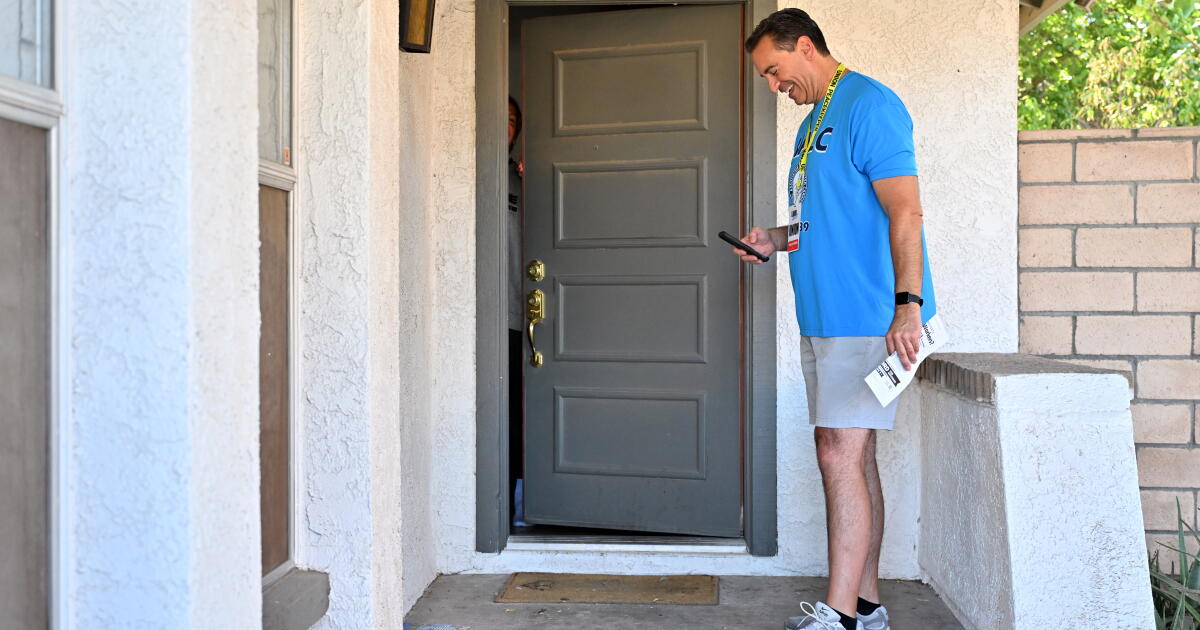
Paul Peterman, president of the local chapter of the National Association of Letter Carriers, wearing a blue union T-shirt, a lanyard and shorts, walked to union households, carrying flyers supporting Lee and other Democrats. He asked a resident who he planned to vote for. “All Republican,” said the man, hidden behind his screen door. Peterman asked if he could leave a non-Republican flyer, and the man said, “No.”
“Sorry to bother you,” Peterman said as the door closed.
At the next door, the voter identified as an independent but said he’d vote for Lee. A voter at another house said who he plans to vote for was private. Nobody answered at the next few doors.
Peterman has been canvassing these neighborhoods for years, describing it as important union work.
“It sends a message that we’re all united, and you also need every hand on deck, too, to be successful in what you want to achieve,” Peterman said.
California is considering Proposition 40, which would impose a one-time 5% tax on its billionaires. This initiative is seen as a way to generate funds for healthcare, education, and food assistance, given that California is home to around 250 billionaires worth over $2 trillion. However, political analysts suggest that the proposition’s chances of passing are uncertain, especially with rising debates around income inequality and the implications for the state’s economy.
Opinion polls indicate a divide in support for the tax. A UC Berkeley poll from August showed 48% of likely voters in favor while 41% opposed, and a September poll showed support at 52%. However, historically, California ballot measures need strong initial support to succeed, and undecided voters often lean towards rejecting measures. Critics of the proposition argue it might drive billionaires out of the state, lowering potential tax revenue in the future.
Notable figures, including billionaires like Sergey Brin, are actively campaigning against Proposition 40, with Brin sharing his personal experiences to express concerns about socialism and its effects. Additionally, Governor Gavin Newsom opposes the measure and is advocating for a federal wealth tax instead.
California’s history with ballot initiatives reveals a complex relationship with taxation. While the state has a history of direct democracy, it has only approved about a third of citizen initiatives in the past. A recent attempt to raise taxes on high earners, Proposition 30 in 2022, was rejected, reflecting that even in a predominantly Democratic state, voters may not support aggressive tax increases on the wealthy.
The uniqueness of this initiative lies in its retroactive tax structure, which could limit billionaires’ ability to avoid the tax by relocating. However, supporters like economist Emmanuel Saez argue that the tax will not significantly deter wealthy individuals or tech startups, stressing California’s attractive qualities, such as its universities and infrastructure, which he believes outweigh potential tax burdens.
Overall, Proposition 40 encapsulates the ongoing conversation about wealth inequality in America and the contentious debate surrounding the taxation of the ultra-rich, making it a critical issue for California voters in the upcoming election on November 3.
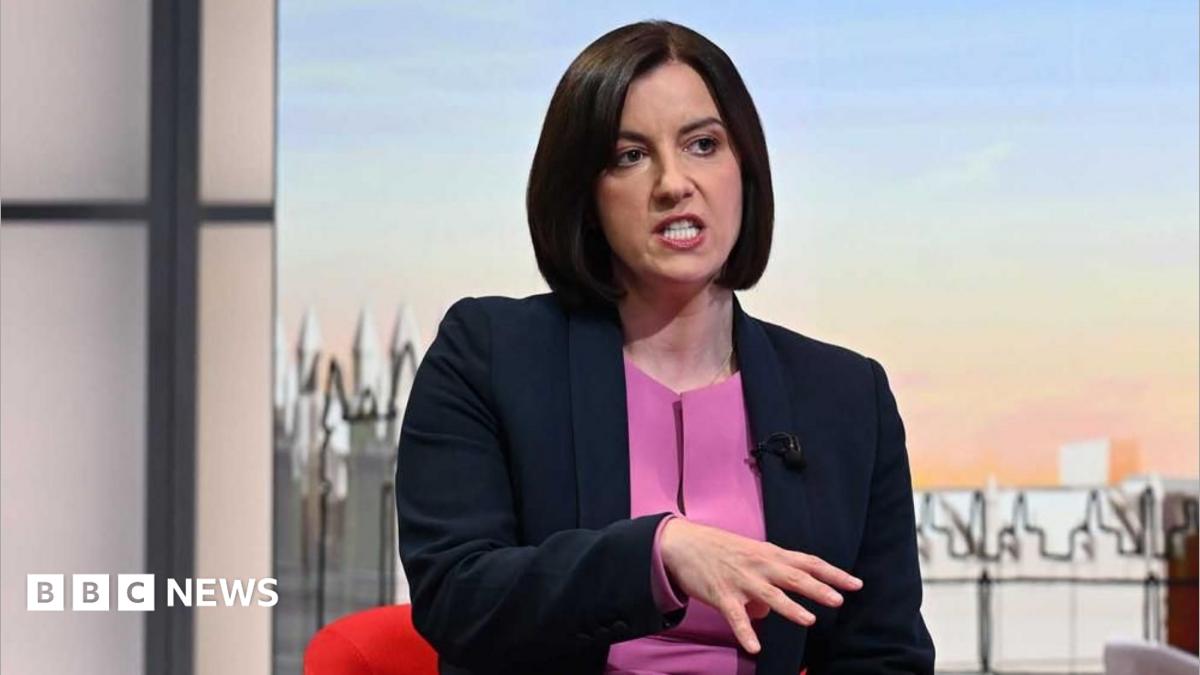
The Labour Party chair has said Sir Jim Ratcliffe loses “the moral high ground” by making statements about the UK while living in tax exile.
Speaking to Sunday with Laura Kuenssberg, Bridget Phillipson said she would take the billionaire businessman’s comments that the UK was “on the slide” with a “pinch of salt”.
Sir Jim, the founder of petrochemical giant Ineos and Manchester United’s co-owner, told the BBC he has lost confidence in the UK due to a combination of high taxes and high immigration.
He has been a tax resident in Monaco since 2020 and said “things would have to get better” in the UK for him to return.
When questioned over the remarks, Phillipson said Sir Jim loses “the moral high ground” by “making these kinds of pronouncements while choosing to make decisions, that he is within his rights to make, to become a tax exile”.
Pushed on whether it bothers her that people who create jobs and pay a lot of tax were leaving the UK, the minister said she was “optimistic about our country’s prospects”.
Other high profile billionaires have left the UK, including including steel tycoon Lakshmi Mittal and most recently the UK’s third biggest taxpayer, hedge-fund boss Chris Rokos.
But, Philipson argued the country was in a good position ahead of the Budget next month, and Andy Burnham has shown a “sense of hope and optimism whilst recognising that many families are still struggling and there is more to do.”
“Of course, there are challenges, including big international headwinds, but I fundamentally believe that we are in a strong position going into this budget because of the decisions taken over the last two years, and I believe our country’s best days lie ahead of us,” she said.
Philipson declined to speculate over whether there would be tax rises in the Budget on 28 October, and said the government remained committed to being disciplined about its spending rules.
The new incentive is aimed at bringing back jobs for the industry’s editors, sound mixers, composers and visual effects artists. It will allow a 35% to 50% credit on qualified expenses related specifically to post-production work done in California, and unlike the state’s existing film and TV credit, it doesn’t require productions to shoot here.
“This legislation protects the extraordinary people who make this industry possible and makes it unmistakably clear: California is still the future of film and television,” said Gov. Newsom in a statement. “We have the talent. We have the infrastructure.”
The bill, AB 2319, was authored by Assemblymember Nick Schultz (D-Burbank) and introduced earlier this year. It cleared the state Senate 33 to 5 on Aug. 30, and the Assembly approved the final version 72 to 2 the same day. Schultz originally sought $100 million for the program. It is expected to start in January with $10 million, according to the Assemblymember Schulz’s office.
“It’s a historic moment for California’s post-production community. But it’s also just the beginning of what we really need to do to to fight for our industry,” said Marielle Abaunza, president of the California Post Alliance, a group advocating for the bill. She said the group is readying its strategy to get more funding for the program next year.
As Hollywood productions continue chase tax credits to other states and countries, much of the post-production work is going with them. California’s share of U.S. post-production employment has fallen from 53% to 42% over the last 13 years, according to CVL Economics, an economic consulting firm tied to California Post Alliance. The state had about 12,000 post-production jobs last year, per CVL Economics.
Ben Urquhart, 51, spent 18 years as a post-production executive at NBCUniversal. The Culver City resident hasn’t been able to find work in the two and a half years since he was laid off.
“It’s grim and it’s hard. There are jobs, but we have a large amount of extremely qualified people competing for every level of job,” Urquhart said. “When I was a kid, I was a [production assistant] in the 90s, and you could get a job within a couple of weeks. But when I got laid off a couple of years ago, I realized that is certainly not the case at all anymore. It’s been a large-scale transformation.”
Urquhart said the new incentive would help California compete with jurisdictions that already offer these credits and “level the playing field.”
Last year, California expanded its film and TV tax credit program, more than doubling the old $330-million cap to $750 million through June 30, 2030. The existing program already covers post-production, but only if 75% of filming or the overall budget is spent in the state.
Newsom also signed a bill that would strengthen the current tax incentive program overall. In June he revealed a state budget measure that capped how much in tax credits a business can claim each year, a limit industry groups warned would undercut the expanded program. But the new Senate Bill 186 enhances refundability for the industry and exempts independent productions from the credit limits, starting next year.
A federal film and television tax credit could boost U.S. production spending by $125 billion and add more than 143,000 jobs by 2035, according to a new study commissioned by the Motion Picture Assn.
The analysis, released Tuesday morning, is expected to bolster Hollywood’s push for a federal production incentive, which the industry says is necessary to compete with the generous credits offered abroad. Sixty-five nations now offer them, the study said.
The effort has been quietly building for more than a year. It got a major boost last month when President Trump posted on Truth Social backing a proposed credit.
Details are still being worked out,, but the study assumed a transferable credit with a minimum rate of 20% on qualified spending for U.S. resident labor — broadly what industry groups have supported. It also assumed add-ons of 5% for independent production companies and 5% for labor costs in areas the Federal Emergency Management Agency has declared disasters.
If the incentive took effect Jan. 1, 2027, U.S. production spending would reach $277.5 billion through 2035, the study said, compared with $152.2 billion without it.
A coalition that includes the Motion Picture Assn., industry unions, producers’ groups and small production businesses, along with Democratic and Republican lawmakers, is expected to press the case at a virtual news conference Tuesday.
“A federal incentive would be a gamechanger for our industry,” Charles Rivkin, chairman and chief executive of the Motion Picture Assn., said in a statement. “This study tells us that we can bring more opportunities to life for people in all 50 states who bring great stories to life.”
SACRAMENTO — President Trump and the Republican Congress have unintentionally provided California state government with the financial means to subsidize — help save — endangered local news reporting.
Now it’s up to Gov. Gavin Newsom to capitalize on the unanticipated gift.
He can sign or veto legislation to end state tax breaks for large corporations paying top executives $1 million-plus salaries and, instead, provide tax breaks for struggling California news outlets employing local reporters.
The state legislation would conform California law to a little-known provision of Trump’s “Big Beautiful” tax bill that eliminated corporate deductions for execs’ compensation exceeding $1 million.
Expert columnists cover the insights, legislation, players and politics you need to know.
By continuing, you agree to our Terms of Service, which include arbitration and a class action waiver. You agree that we and our third-party vendors may collect and use your information, including through cookies, pixels and similar technologies, for the purposes set forth in our Privacy Policy such as personalizing your experience and ads.
I’ll admit to feeling a bit squeamish about this.
First, it’s a conflict of interest, arguing that a governor — whom my colleagues and I write about often — should shovel public dollars into our profession.
Second, why should state government and taxpayers be asked to subsidize a private enterprise that’s flailing in the marketplace? Especially one that prides itself in being an impartial watchdog over government actions and politicians’ behavior. The dog shouldn’t be begging for food from the critters it watches.
OK, but subsidizing local news reporting is investing in democracy. Robust coverage of city halls, school boards, Sacramento politicians and the like is essential for self-government.
And that journalism is in free fall all across America as exploding technology and social media opportunism have altered news consumption, mostly bypassing local communities and often spewing misinformation.
So this legislation, AB 2222 by Assemblyman Christopher Ward (D-San Diego), reaches far beyond just helping the troubled news industry. It’s about more than providing media outlets with financial incentives to retain and hire local reporters. It’s bolstering democracy.
Independent journalism is a pillar of democracy, providing citizens with reliable, fact-based information about how their elected representatives are performing their duties, fulfilling their campaign promises and cozying up to special interests.
You’re not going to glean that information from the politicians. You’re going to get mostly self-serving spin — government propaganda — whether it emanates from the White House, the state Capitol or the local mosquito abatement district.
That’s why the nation’s Founders protected press freedom in the Constitution’s 1st Amendment.
Thomas Jefferson famously wrote: “Were it left to me to decide whether we should have a government without newspapers, or newspapers without a government, I should not hesitate a moment to prefer the latter.”
Of course, that was early in Jefferson’s political career, before he became vice president and later president. He ultimately turned into a harsh press critic. For example: “Nothing can now be believed which is seen in a newspaper. Truth itself becomes suspicious by being put into that polluted vehicle.”
Jefferson, like countless politicians ever since, apparently carried a huge chip on his shoulder because of reporting on his job performance that ticked him off.
Newsom is a master at attracting friendly national news coverage, especially on cable TV. But he naturally shudders at more critical coverage by Sacramento beat reporters.
As of this writing, the governor hadn’t publicly disclosed how he feels about the local reporter tax credit bill.
His finance department, which crafts the state budget, opposed the measure when legislators were considering it. The state would “not [be] receiving any incremental economic benefit to justify the expenditure,” its analysis read.
Again, even if that were true, citizens and democracy would benefit.
Also, the analysis contended, the tax credit would likely “provide windfall benefits” for news media owners “rather than encourage new hiring activity.”
That’s not quite accurate. Anyway, it could discourage layoffs and save reporters’ jobs.
Late last week, the McClatchy newspaper chain — owner of the Sacramento Bee and several medium-sized California papers, plus dozens across America — announced massive newsroom layoffs.
Since 2002, more than 12,000 local journalism jobs have been lost in California, according to the bill’s sponsor, the advocacy group Rebuild Local News. More than 3,500 newspapers have closed nationwide.
Many communities have become “news deserts.”
When that happens, fewer citizens turn out to vote, tax money gets spent more carelessly and political corruption increases.
Under the legislation, California media outlets — big and small — would be granted modest tax credits for each employee covering state and local news. There’d be $20,000 for up to five full-time positions and $15,000 for each of the rest. On top of that, there’d be an additional $15,000 for every new full-time job that’s created. Part-timers would be entitled to $7,500.
“National news outlets would be excluded. So would partisan ‘pink slime’ sites controlled by political action committees,” says Matt Pearce, policy director for Rebuild Local News, a former Los Angeles Times reporter and newspaper guild leader.
It would be the most ambitious program of its kind in the country. New York, Illinois and New Mexico currently offer local news subsidies.
“It’s about civic infrastructure and the foundation of democracy. We’re teetering toward autocracy,” says former state Sen. Steve Glazer (D-Orinda), an ex-mayor who has long pushed for stronger local news coverage.
This bill won’t save local newsrooms. But it may give them breathing room while the big thinkers try to concoct a more profitable business model for democracy’s watchdog.