“Having a target on your back means that you’re worried about what someone else is going to do,” she added. “That’s an outcome-based [way of] thinking, and we have to be obsessed with our process, obsessed with our standards.”
As the Bruins prepare to open the season at Pauley Pavilion against Lehigh on Monday, they are focused on getting better every day and following the championship-level process the program established. It’s not their job to worry about what others think about them, forward Sienna Betts said.
“I don’t really care what the media has to say or whatever,” Betts said. “It really is just a matter of what is in these four walls and what we know we’re putting into practice every day.”
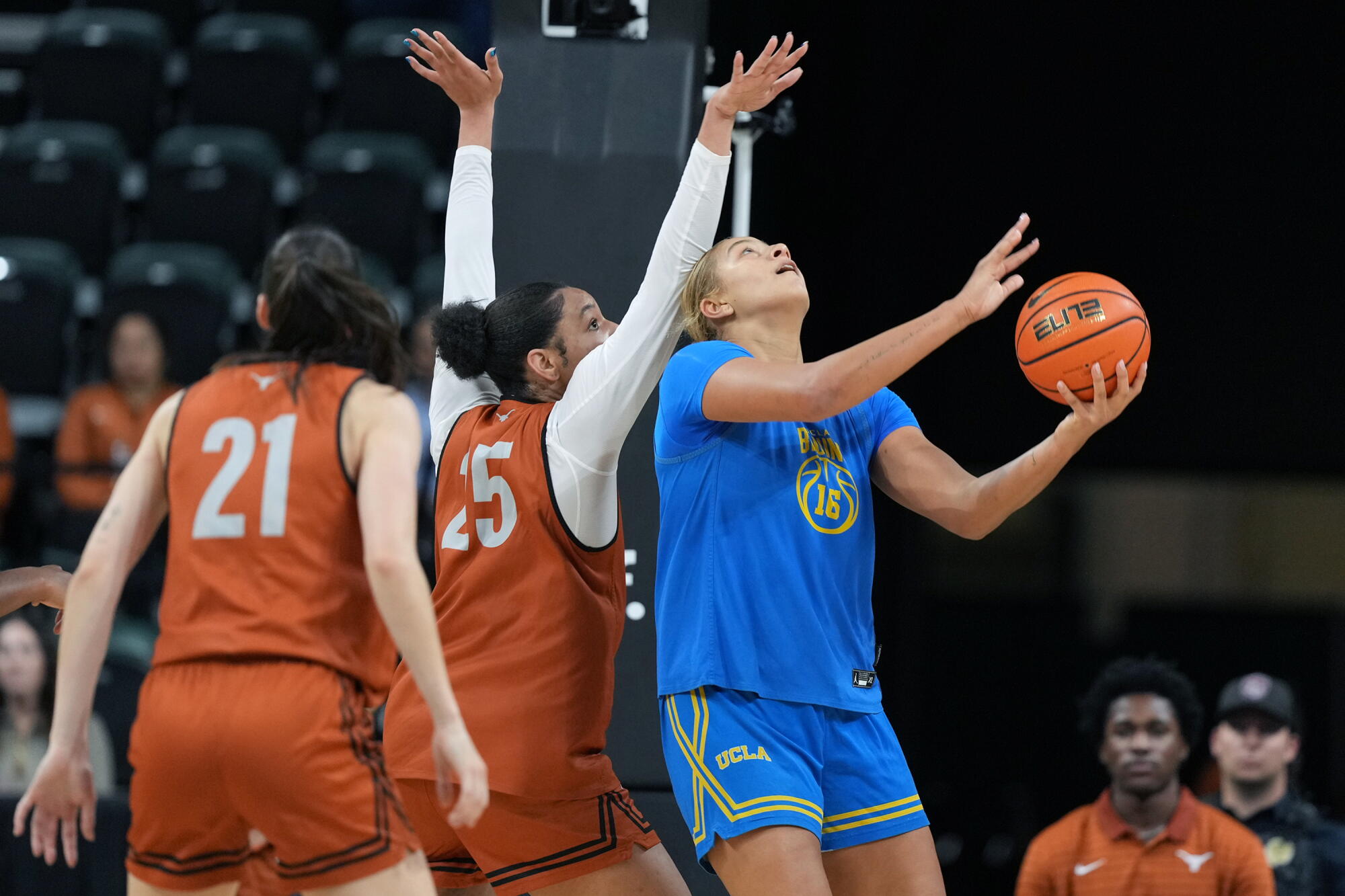
UCLA forward Sienna Betts shoots under pressure from Texas’ Breya Cunningham at H-E-B Center in Cedar Park, Texas, on Sunday.
(Scott Wachter / Getty Images)
While the Bruins are maintaining the same championship standards as last year, the group tasked with meeting them looks considerably different than last season.
UCLA will begin the 2026-27 season with five players returning from the championship team, Betts being one of them. None of the returning players were starters, with the top six performers getting selected in the 2026 WNBA draft. The rest of this season’s Bruins consists of seven newcomers, including two freshmen and five transfers.
“We’re not trying to repeat an outcome, we’re repeating a process,” Betts said. “We’re our own group and I don’t think it’s fair to put the weight of last year on this group.”
Close’s roster includes the No. 5 transfer portal class in the nation, according to ESPN. The group includes Donovyn Hunter, who transferred from TCU and described the process of transferring as uncomfortable. She also said adjusting to a new system is difficult.
“We’re going to mess up, we’re going to make mistakes, we’re not going to get it on the first try, but knowing that there’s a coach that’s behind you, that knows you’re going to get to that level has been the most important thing for all of those transfers and the freshmen,” Hunter said.
Three of the five transfers are international players learning English, including Elina Aarnisalo, who returned to Westwood after spending a season at North Carolina.
UCLA guard Donovyn Hunter drives to the basket in front of Texas’ Breya Cunningham in Cedar Park, Texas, on Sunday.
(Scott Wachter / Getty Images)
“We spent a lot of time together … so that’s helped us on court and obviously practicing every day,” Aarnisalo said. “… Even though there might be a language barrier, sometimes we’re just spending time together and learning [from] each other so that relationship part comes pretty naturally for all of us.”
Regardless of the language barriers, Betts said building the team’s chemistry is a good start and a work in progress as they enter the start of the season.
“I think our connection on the court, it’s really showing and we’re still just learning how to play with each other. … It takes time,” she said. “The team last year, they were playing with each other for four years and over.”
Even with the added pressure that comes with last year’s championship run, Aarnisalo isn’t worried about the expectations. She’s enjoying the kind of media attention the Bruins are getting.
She’s happy the returning players were able to lift the trophy last year and says the exposure that goes with it is an opportunity to show off the newly reloaded UCLA team.
“We’re making our own process out of this,” she said. “Obviously, the standards are the same, like it’s championship standards, but it’s completely new people, new personalities. [We’re] just trying to create our own storyline for this year.”
Quinn brings new perspective to UCLA
Breeze coach Noelle Quinn directs players during an Unrivaled game against the Laces on Feb. 27 in Medley, Fla.
(Leonardo Fernandez / Getty Images)
After spending 12 years as a professional player and six years coaching in the WNBA, Noelle Quinn has returned to Westwood. She is a two-time WNBA champion, winning a title as a player and a coach.
“I have not been able to find anyone else that has won a conference championship in college, a WNBA championship as a player and as a coach,” Close said. “You don’t think when she talks, they listen?”
The fourth overall pick in the 2007 WNBA draft has had an influence among the UCLA coaches, with Close noting associate head coach Tony Newnan told Quinn during a staff meeting that she was making him a better coach.
On the court, Quinn’s defensive expertise is creating an environment that has helped Bonnie Deas get excited about playing defense.
“I love defense and she brings so much energy to our defensive side of the game,” Deas said. “She’s so switched on with our scout and film, she makes defense really, really exciting.”
Betts describes her defensive presence as calming.
“I love the way she just talks and the way she talks about defense and just the game,” she said. “She brings such warmth to this gym.”
On television, ads for UCLA Health show up behind the Dodgers’ home plate and in the background when Justin Herbert, the Chargers’ quarterback, speaks after a game.
At the Lakers’ training facility, the health system’s logo appears on the court and throughout the building, under a marketing partnership that cost the university tens of millions of dollars.
The ads are part of the public university health system’s strategy to increase the number of Southern Californians using its providers at its fast-growing number of clinics and hospitals.
University officials say its expansion to five hospitals and 300 clinics — up from 150 locations a decade ago — has given more Southern Californians access to its academic medicine.
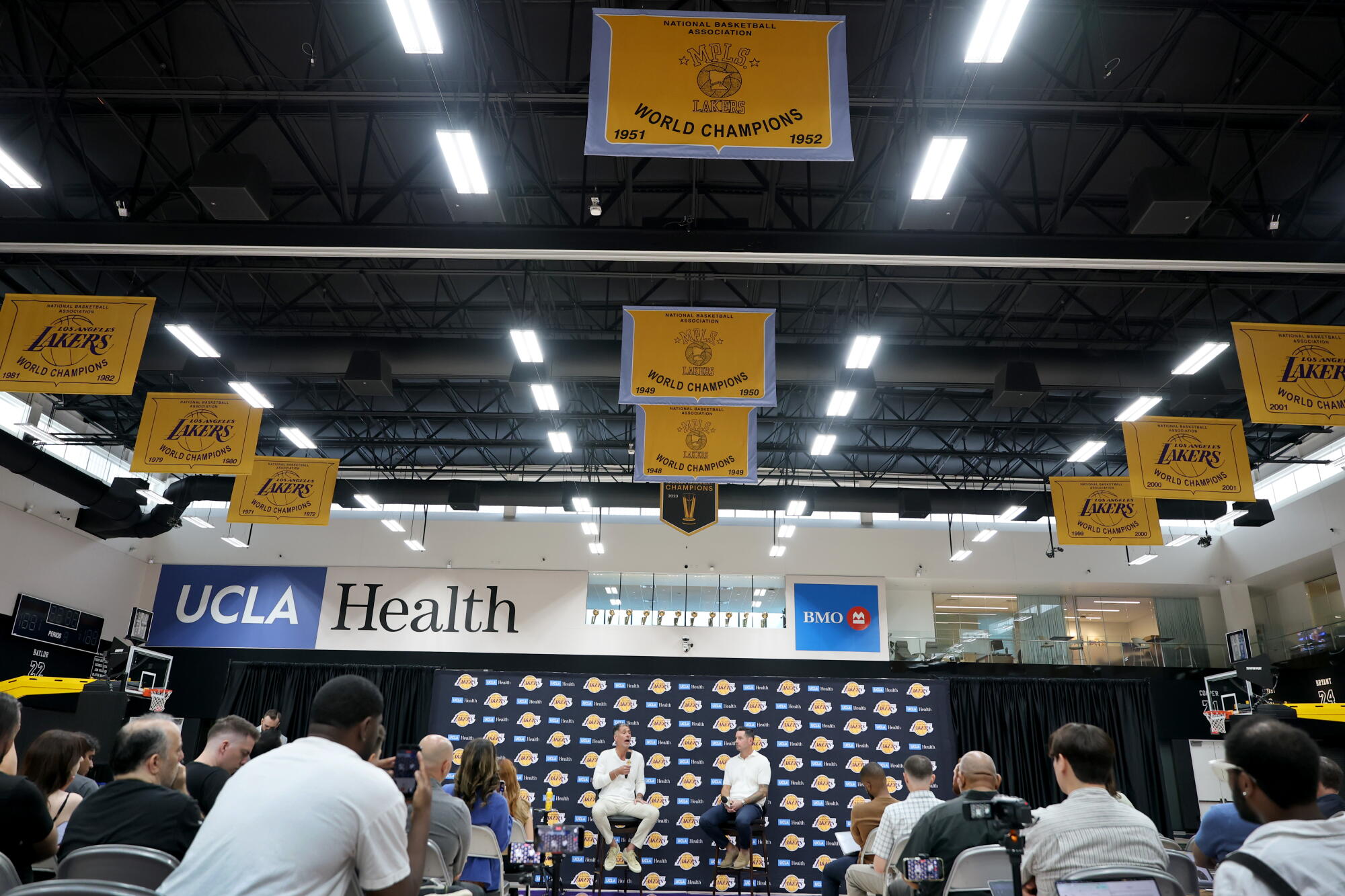
Lakers championship banners hang from the rafters and trophies are on display in an office overlooking the news conference as Lakers general manager Rob Pelinka, left, speaks while Lakers coach JJ Redick listens at the UCLA Health Training Center in El Segundo.
(Allen J. Schaben/Los Angeles Times)
Last year, the system’s clinics and hospitals recorded 4.2 million outpatient visits — more than five times the number in 2015.
“As a public institution, we’re trying to make sure that patients within our community have access to care,” said Dr. Robert Cherry, UCLA Health’s chief medical and quality officer. “That’s the primary and overriding concern, because there’s an acute demand for our services.”
Yet healthcare economists point to repeated studies showing that hospital consolidation — where health systems expand, take over competitors and hire more of a region’s physicians — has become a leading driver of escalating health costs and insurance premiums, while doing little to raise the quality of care.
Glenn Melnick, a USC professor of healthcare finance, has documented how hospital consolidation in Northern California caused health costs to escalate. He said the mergers and acquisitions have continued, including with UCLA Health and other hospital systems in Southern California. UCI Health acquired four community hospitals in 2024.
One consequence, Melnick said, is surging insurance premiums for employers, which leave companies with little money for wage increases, while employees end up paying more for their health insurance and out-of-pocket medical costs.
“We’re now, I think, at a breaking point,” he said.
UCLA executives said the aim of the expansion was not to increase revenues the health system receives from commercial insurers. And they say they don’t believe UCLA Health is large enough to influence health costs.
“We actually represent only a small fraction of the inpatient capacity, physicians, clinics and resources available across the large and complex healthcare market in L.A.,” said Johnese Spisso, UCLA Health’s president, in an interview.
Nonetheless, the system’s expansion and its other recent financial decisions have led to protests by some of the university’s own staff and faculty, who point out the new clinics have been added mostly in wealthier neighborhoods, including Malibu and Montecito, where the majority of families have commercial insurance.
None of its clinics are in South or East Los Angeles, where more residents are covered by Medi-Cal, the state program for low-income people.
Cameron Carr during a news conference at the UCLA Health Training Center in El Segundo.
(Arwen Clemans/Los Angeles Times)
University of California system officials say Medi-Cal’s reimbursements are so low that they don’t cover the cost of care at the state’s five UC medical centers. Those losses, they say, must be covered by charges to those with commercial insurance.
Last month, dozens of medical residents and interns protested outside a UC Regents board meeting after UCLA Health failed to renew a Medi-Cal contract that had covered thousands of low-income patients. The doctors waved signs with slogans “Corporate Greed” and “Keep UCLA Health public.”
Dr. David Schriger, UCLA professor emeritus of emergency medicine, said that given the mission of the state’s public university, he questioned why the expansion had not included neighborhoods such as South Central L.A.
“The public should be making these decisions,” Schriger said. “It should not be at the whim of some executives.”
Santiago Munoz, UCLA Health’s chief strategy officer, said officials don’t consider neighborhood income levels when deciding where to open clinics. Instead, he said, the system has been adding clinics along freeways running north and south.
“We’re staying close to the 405 and the 101 because driving to locations in Los Angeles is inevitable, and it’s very difficult to get to Westwood,” he said.
Munoz noted that UCLA had recently leased a 20,000-square-foot space for a clinic in Inglewood, has locations in downtown Los Angeles, and provides physician services at two of L.A. County’s public hospitals.
“We are trying to go to where patients are,” Munoz said.
Worries about crowding
Nurses at the university’s flagship hospital Ronald Reagan UCLA Medical Center in Westwood say the expansion has created crowding that has caused what they describe as an ongoing, daily crisis in the emergency room.
Patients coming from the 300 clinics for hip replacements, heart surgeries and other procedures at Ronald Reagan often wait one or two days in the emergency department until beds become available upstairs in the hospital, according to UCLA officials.
To accommodate those patients who’ve been admitted but don’t have a room, the hospital has installed dozens of beds in what was once the emergency department’s waiting room and in adjacent spaces. That has forced people waiting for emergency care into a large white tent outside, which was put up during the COVID-19 pandemic.
“How do you do a good exam in a tent? It just doesn’t work,” said Dianne Sposito, a nurse who works in the emergency department. “I feel patients are in grave danger right now. Accidents are bound to happen.”
LeBron James has fun with his daughter, Zhuri, as son, Bronny, looks on during a G League game at UCLA Health Training Center in El Segundo.
(Wally Skalij/Los Angeles Times)
A university spokesperson said the system has “extensive strategies to keep patients safe and decompress our emergency departments.”
At the September Regents committee meeting, Spisso, UCLA Health’s president, told board members that the system needs to add as many as another 400 hospital beds so that newly-admitted patients no longer have to wait.
For months, rumors have circulated that UCLA will soon buy Providence St. John’s Health Center in Santa Monica, which would make the university the only hospital operator in that city. UCLA bought the city’s other hospital in 1995.
UCLA officials declined to say whether they were talking about acquiring the hospital. “We’ve found it’s best not to talk about discussions we may or may not be having unless or until we have something to announce,” Phil Hampton, a university spokesperson, said in a statement.
Consolidation hikes costs
The California Health Care Foundation found in a 2021 study that hospital markets were reaching “monopoly levels” in many of the state’s counties. The consolidation was increasing prices with “little to no improvement in quality” of care, the report said.
The study also detailed how physicians often change their referral and prescribing patterns after their practices are acquired by hospitals, sometimes requesting imaging or other procedures that are not needed.
Melnick, the USC professor, noted that when UCLA acquires physician practices and “re-designates them as hospital-outpatient departments,” the clinics can begin billing insurers for an additional “hospital facility fee” for routine office visits, imaging and minor procedures.
He added that insurers often consider UCLA as a “must-have” network, allowing it to negotiate higher reimbursement rates. When the insurer folds UCLA’s new hospitals and clinics into their plan, he said, it often agrees to raise rates at the newly-acquired providers to match what UCLA is receiving as an academic system. Patients get the same care, he said, “but there is a new name on the door.”
Munoz said that UCLA Health was adding facility fees to some bills, including for imaging, but not for physician care. “We’re running a fairly lean operation in the community when it comes to physician services and not collecting the facility fees that others are,” he said.
More income from patient charges
UCLA is not the only hospital system expanding in the L.A. region. For example, Cedars Sinai has also been adding clinics and buying hospitals.
Price data shows that insurers and patients often pay more for care at UCLA Health and Cedars.
Anthem, Southern California’s largest commercial insurer, this year is paying $20,265 to UCLA for a total knee replacement at Ronald Reagan, according to data gathered by Serif Health, a San Francisco firm that collects data from hospitals and insurers. That price is 9% higher than last year and doesn’t include physician fees, the implanted device or anesthesia.
Anthem pays Cedars more than twice as much for a knee replacement, according to Serif’s data, while it pays Providence St. John’s 22% less. Cedars’ current negotiated reimbursement is $42,559 — an increase of almost 17% over last year.
University executives said that because UCLA Health is an academic health system it provides a high volume of complex care that is more costly than care at non-academic hospitals.
UCLA’s expansion strategy has been financially successful, according to the health system’s annual report.
Last year, UCLA Health operating revenues grew by nearly 20% to more than $5 billion. After paying for expenses, its operating income was $793 million, a margin of almost 16%. That compares to the median operating margin of 1.5% for 45 academic medical centers across the country, according to a 2024 study by McKinsey & Company.
UCLA officials said the operating margin was not a good comparative measure because it doesn’t include a $496-million transfer to the university’s medical school to cover other operations including the training of physicians.
“Education, research, and clinical care are all part of our mission and our responsibilities to really train that next generation of healthcare professionals,” Spisso said.
Expansion continues
The university is now spending nearly $300 million to renovate a 170,000-square-foot building that sits on nine acres near Los Angeles International Airport. Purchased in 2024, the campus’ many offerings will include a sports medicine institute with physical therapy and advanced imaging, as well as an ambulatory surgery center with 10 operating rooms.
The university also plans to soon open a new 119-bed psychiatric hospital in L.A.’s Mid-Wilshire neighborhood. The facility was once the 204-bed Olympia Medical Center, where most patients were Black, Latino and underinsured. Olympia shut down after the university purchased it in December 2020.
The renovated hospital allows UCLA to relocate and expand the 74-bed Resnick Neuropsychiatric Hospital, which is currently on the fourth floor of Ronald Reagan Medical Center.
“We have patients waiting for mental healthcare so we made a $650-million investment in this new facility,” Spisso said. “We will probably lose around $50 million a year just operating it, but we saw it as one of the most underserved areas.”
UCLA then plans to add 103 beds to Ronald Reagan by renovating its fourth floor, increasing the medical center’s capacity by 23% to ease the overcrowding.
In 2024, the university bought the 260-bed West Hills Hospital and Medical Center in the San Fernando Valley from HCA Healthcare.
Last month, Spisso told the Regents committee that the hospital, now known as UCLA West Valley Medical Center, and its surrounding clinics, were making more money than officials had expected.
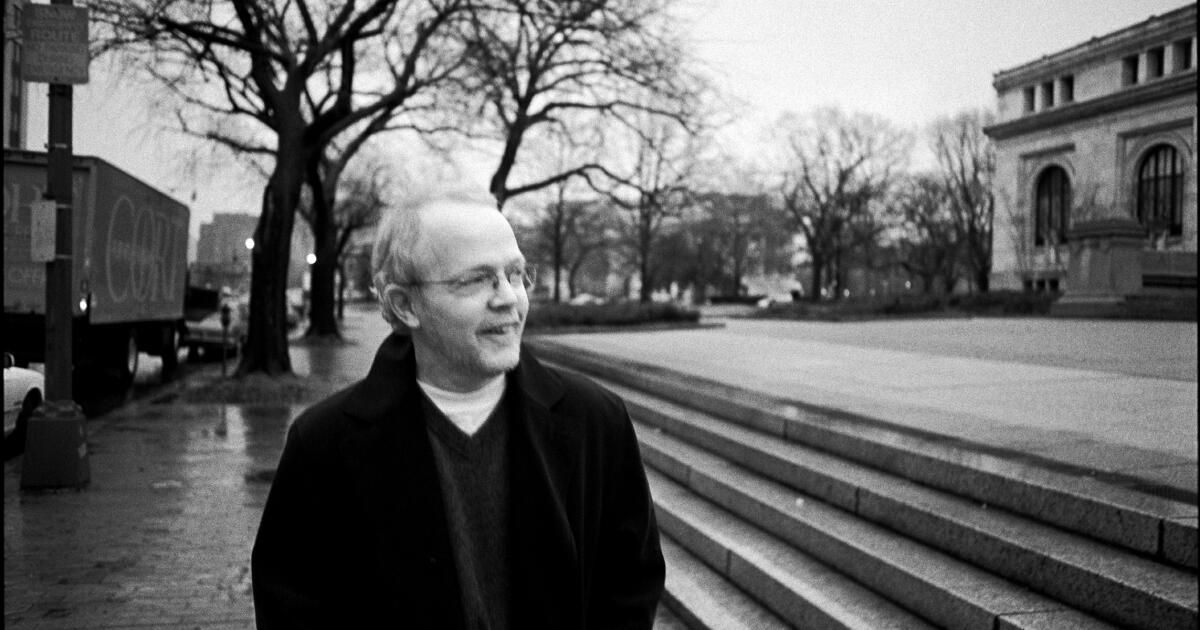
Noah Adams, a longtime host of NPR news program “All Things Considered” and a journalist known for his gentle voice and genuine curiosity, has died. He was 84.
Adams died Oct. 16 at his home in Yellow Springs, Ohio, according to NPR. The cause was complications of a benign brain tumor removed eight years ago, his wife and longtime NPR news producer Neenah Ellis told the New York Times.
A host of the weekday edition of “All Things Considered” for 18 years, Adams helped cover major news events and produced segments from his travels around the country, talking to everyday people, often in small rural towns.
“He never liked talking to people who he knew had preprogrammed things to say,” Melissa Block, a former “All Things Considered” host who’d previously worked as a producer for Adams, said in NPR’s segment announcing his death. “He wanted people who were genuinely speaking from their heart and with conviction and sincerity.”
Born on Sept. 15, 1942, in Ashland, Ky., Adams joined NPR in the mid-1970s after working various jobs including as a DJ and in construction in and around his hometown. A college dropout, Adams was inspired to start working in public radio after encountering “All Things Considered” as a listener.
He was introduced to the program by a colleague shortly after it debuted in 1971. He told The Times in 2002 that he remembered thinking, “That sounds conversational, that they intend for me to be listening, that I’m smart enough to be listening,” when he first heard the show.
After working at the University of Kentucky’s public radio station, he applied for a job at NPR. He was hired as a production assistant on “All Things Considered” in 1975 before becoming a weekend co-host for the show in 1978. He moved to the weekday show in 1982.
Susan Stamberg, Adams’ “All Things Considered” co-host from 1982 to 1987 who died last year, described him as “the most genuine, uncontrived voice in broadcasting” in the foreword of his 1992 book about his work on the program.
“The conviction shines through the words he writes, and the quiet and very powerful way in which he speaks,” she wrote, according to Current. “He is a quiet, careful man, a craftsman in his work, his seriousness softened by a twinkle in his eye, an occasional goofy grin, and the daffodils he’ll bring into the studio on an especially tense or stuffy day.”
Adams mentioned the camaraderie with his colleagues and one-on-one interviews as among the things he would miss when he left his job as host of “All Things Considered” for a second and final time in 2002.
These interviews, which often turned into “a conversation that’s so quiet and so slow,” were the “kind of conversation [that] cannot be accomplished on anything but radio,” he told The Times.
Among Adams’ signature audio work is the 1981 radio documentary “Father Cares: The Last of Jonestown,” as well as a series of interviews with Tom DeBaggio, a man living with Alzheimer’s disease, and an interview with Betsy Walter, an 8-year-old girl whose parents had gotten divorced. Adams wrote a number of books, including “Piano Lessons: Music, Love, and True Adventures,” which chronicled Adams’ quest to learn how to play the piano in his 50s, and “The Flyers: In Search of Wilbur and Orville Wright.”
“He has a writer’s eye, and I think you hear that when he’s on the air,” Robert Siegel, Adams’ “All Things Considered” co-host, said in 2002. “And he takes sound very seriously. When you combine writing with sound, you can create extraordinary radio.”
SoFi Stadium is going strong. The deal that built it is in a smoldering heap.
A decade ago, Rams owner Stan Kroenke and Inglewood Mayor James T. Butts Jr. happily dug ceremonial shovels into the dirt at Hollywood Park, celebrating the impending construction of the world’s most expensive stadium.
Electronic billboards are seen along Century Boulevard in Inglewood on Tuesday, Oct. 20.
(Eric Thayer / Los Angeles Times)
Now they’re on opposite sides of a court fight that has spilled onto the Nov. 3 ballot and threatens further development on the nearly 300-acre site.
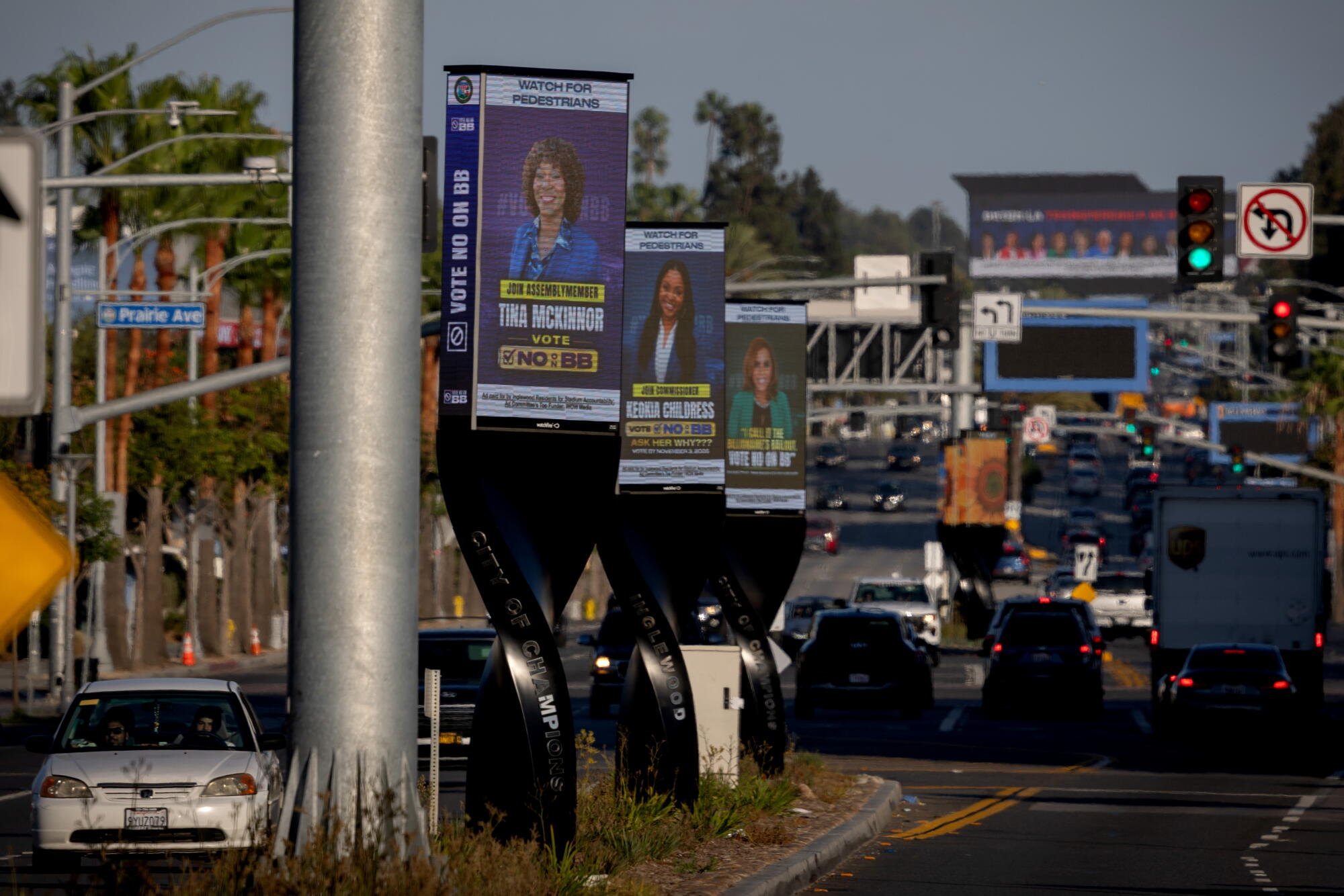
The feud started over billboards. Last year, Inglewood signed a deal with WOW Media to put electronic advertising all around the city — 60 digital signs carrying 108 screens. Some are bus-shelter-sized kiosks, while others are street displays up to 22 feet tall and positioned on sidewalks and medians.
Those present problems for SoFi Stadium, Intuit Dome and the Forum because they have their own advertising deals and sponsors who paid for exclusivity. Those venues collectively sued Inglewood and WOW Media to block the deal, raising this scenario in a court filing: “Will Pepsi want to sponsor the Super Bowl, knowing Coca-Cola could pay WOW to put up full-motion billboards next to the stadium?”
Skip Miller, lead attorney for the city, said the kiosks are “quite nice and blend in with the surrounding areas,” and that they are connected to a network that provides critical traffic and safety information to thousands of drivers and pedestrians.
Electronic billboards are seen on along Century Boulevard on Tuesday, Oct. 20, 2026 in Inglewood, CA.
(Eric Thayer / Los Angeles Times)
A judge sided with Inglewood, and an appeal is under way.
In the meantime, those opposed to the billboards are taking it to the voters. On the ballot is Measure BB — as in “Billboard Blight” — which would restrict billboard advertising on public property. Miller said the city will challenge it in court if it passes, calling it free-speech discrimination.
The signs generate as much as $7.4 million a year, according to Inglewood budget records.
A consultant hired by the Yes on BB campaign estimated the city’s digital kiosk deal with WOW Media would generate $280,000 to $1.1 million a year, roughly 0.1% to 0.5% of Inglewood’s $238-million general fund.
John Shallman, a Los Angeles-based political strategist managing the “Yes on BB” campaign, also pointed to the unusual length of the billboard deal, which is 20 years plus two 10-year options.
Rams owner Stan Kroenke, right, talks to team president Kevin Demoff before a game against the New York Giant at SoFi Stadium on Sept. 21.
(Allen J. Schaben / Los Angeles Times)
“It’s biblical in length,” Shallman said. “You go back 40 years. We didn’t even have the Internet. We didn’t have cellphones.”
The billboards are part of the fight, but there’s a lot more. Back when the development agreement was signed in 2015, the deal was that Hollywood Park — interchangeable here with Kroenke’s companies — would pay up front for all the improvements around SoFi Stadium and eventually be reimbursed by the city. That means all the road upgrades, water lines, streetlights and the like. Same for event-day police and emergency services.
Over the years, that ran up a significant bill. Kroenke’s companies now want $448 million from the city. Inglewood, which last year wired Kroenke $20 million, is demanding that money back.
So how could that chasm be so wide? A turning point came last month when Los Angeles County Superior Court Judge David K. Reinart ruled the 2015 development agreement “void from the beginning and unenforceable.”
To understand why the judge ruled that way, it’s important to go back a decade and examine how the agreement was constructed.
One of the appealing aspects of building an NFL stadium in Inglewood was the speed with which a development agreement could be assembled and approved. Los Angeles went 20 years without an NFL franchise, during which all sorts of stadium ideas were proposed and eventually died. One of the stumbling blocks for those was the environmental-review process, which could take months or even years.
But at that time in California, there was an opportunity for Inglewood to fast-track the process. Instead of negotiating a new development agreement — there was one from 2009, when Hollywood Park was still a racetrack — supporters of the NFL stadium could bring it to the Inglewood City Council as a voter initiative.
People cross Century Boulevard near an electronic billboard in Inglewood.
(Eric Thayer / Los Angeles Times)
The council then had the choice to either adopt the initiative word for word, or send it to voters. No new environmental review required. Sure enough, in February 2015, the council approved the initiative, 5-0.
Now Kroenke had an approved stadium plan and not just fancy renderings to bring to fellow NFL owners, who 11 months later gave the thumbs up to a state-of-the-art venue at Hollywood Park. There was a competing stadium plan in Carson backed by the San Diego Chargers and Oakland Raiders that was taking the same fast-track approach with its city.
Regardless, the Hollywood Park plan won and the stadium was ultimately constructed, a $5-billion marvel that in February will play host to its second Super Bowl. It has also played host to the World Cup, major concerts by Taylor Swift and Beyoncé, and will be the swimming venue for the 2028 Summer Olympic Games. The Chargers moved to Los Angeles as tenants in the stadium.
“Inglewood loves SoFi Stadium,” said Miller, the city’s attorney. “Nothing is ever going to happen to SoFi Stadium. … As far as the rest of Hollywood Park, the developer has to follow the law, just like any other developer. This developer, who’s a very powerful, very wealthy person, has to follow the law just like anybody else.”
That’s not something you would have heard in 2015 when Kroenke and the city were pulling in the same direction. Something happened in 2018 that changed the landscape in California, and gave Inglewood an argument for why it shouldn’t be required to reimburse the developer for nearly half a billion dollars in public improvements.
It was a court decision involving Moreno Valley, a city about 75 miles east of Inglewood that planned to build a major development through the same approval process that was used in Inglewood. But environmental groups challenged that in court and won. A judge determined that type of development agreement requires negotiations and public hearings, not just a voter initiative. The agreement was voided.
SoFi Stadium in Inglewood, home of the Los Angeles Rams, hosts events throughout the year.
(Eric Thayer / Los Angeles Times)
Meanwhile, everything was moving forward in Inglewood. SoFi Stadium was constructed. The big events rolled in. Promises made, promises kept.
All the while, there was the outstanding issue of the city paying back Hollywood Park for all those improvements, but that arrangement was configured to ensure Inglewood could do so without going into the red. The deal said the city could keep the first $25 million in tax revenue from the stadium every year, then use the revenue generated beyond that to reimburse Kroenke’s companies.
In May 2025, Inglewood made a payment of $20 million.
Two months later, pointing to the Moreno Valley decision, the city deemed the development agreement invalid and demanded its money back.
Hollywood Park found that especially galling because four times over the past decade the city signed assurances to Kroenke’s lenders that the money would be paid back — and three of those times were after the Moreno Valley decision.
In the view of Hollywood Park, Inglewood welcomed the jobs, tax revenue, increased property values and heightened prestige for a decade, then walked away from the deal when the bills came due.
“Now that it’s time for the city to essentially uphold its end of the bargain, now that it’s received all the benefits, it’s saying, ‘Well, actually, we consider this agreement void. Thank you for the stadium, thank you for everything else, but we’re not going to uphold our end of the deal,’” said John Quinn, outside counsel for Hollywood Park in the matter.
An electronic billboard on Century Boulevard in Inglewood.
(Eric Thayer / Los Angeles Times)
Hollywood Park’s argument is that it followed the rules in 2015 in getting the development agreement unanimously approved by the City Council, and the results — a bustling stadium district and development around it — speak for themselves.
The city’s side said it connected the dots on the Moreno Valley case only after the lawsuit was filed against Inglewood and WOW Media last year.
And the city is backing a ballot initiative of its own, Measure AT, which would eliminate a $15-million cap on the 10% admission tax on ticket sales the stadium pays. Venues with fewer than 20,000 seats, including Intuit Dome, would for the first time be charged a 2.5% admission tax on ticket sales.
The ballot measure could generate an additional $47 million to $50 million annually, a city of Inglewood impact report states. Olympic events at both venues in 2028 could be especially lucrative for the city.
Hollywood Park sees that as punishment for challenging the billboard deal.
Also on the ballot, the contentious Inglewood mayor’s race. Butts is running for a fifth term, and his main challenger is Gloria Gray, an Inglewood City Council member.
Meanwhile, Hollywood Park’s legal losses are stacking up. The judge last month rejected the argument that because Inglewood is a charter city, one that operates under its own constitution, it should abide by the original development agreement.
The city is billing the fight as a billionaire versus the people. Those representing Kroenke’s interests say Inglewood should honor its commitment and provide the reimbursements it long promised.
An attorney representing Hollywood Park says changing the rules midstream could have a chilling effect on future developments in California.
“It’s going to seriously discourage new development throughout the state, and we’re not just talking about stadiums,” said Quinn, chairman and founding partner of Quinn Emanuel Urquhart & Sullivan LLP. “We’re talking about all kinds of planning and zoning decisions — including affordable housing projects.
“This just creates a really damaging cloud of legal uncertainty over all development in California.”
NEW YORK — “860,” the title of Billy Crystal’s tremendously moving new Broadway show at the Imperial Theatre, refers to the address of his house in the Pacific Palisades that was destroyed in last year’s fire.
Crystal re-creates the events of Jan. 7, 2025, as the wildfire that began in the Santa Monica Mountains started making its way down toward his home at 860 Chautauqua Blvd. Video clips of the escalating emergency are shown as a cardigan-clad Crystal, standing in a facsimile of his home office (the conjuring work of scenic designer Scott Pask), re-creates the horror of having to decide what to take with him as the evacuation orders come in.
The photos, awards and other memorabilia aren’t just souvenirs of his storied career. They are pieces of the life he built with his wife, Janice, and their two daughters as well as a record of the friendships that made Hollywood feel like a welcoming community for a wide-eyed Long Island kid.
“860,” impeccably directed by Scott Ellis, occurs in a series of flashbacks. Crystal brings us back to what it was like as he and his wife made their way across a jam-packed Sunset Boulevard in separate cars to the safety of their daughter’s house as smoke and flying embers turned their small-town paradise overlooking the Pacific Ocean into an apocalyptic war zone.
A baseball superfan, Crystal gives us the play-by-play as though he were calling a World Series game that had taken an unimaginable turn. Hana S. Kim and Kylee Loera’s video design turns us into eyewitnesses of that terrible day.
I was in Los Angeles when the Palisades and Eaton fires broke out, but I was far enough away not to feel the immediacy of the threat. Crystal had me in full fight-or-flight mode, as if I were in the car behind him going 5 mph along the only route out of danger.
Billy Crystal in “860” at the Imperial Theatre on Broadway.
(Avery Brunkus)
Making a show about a recent public trauma isn’t easy to pull off, but Crystal has managed it as perhaps only he could. “860” is a meditation on loss, but it’s also a theatrical memoir of his multifarious career as a comic, actor, filmmaker and celebrated Oscar host. He returns to his days on “Soap,” the controversial nighttime parody of a daytime soap opera created by Susan Harris that featured Crystal in the role of Jodie Dallas, one of TV’s first openly gay characters.
Crystal was living in an apartment in then-smog-filled Hancock Park with his wife and daughters when he was filming the show’s third season. The couple wanted to move to an area that had better air quality for their children, and someone asked if he knew about the Pacific Palisades.
“It was a small town, good schools, beautiful afternoon breezes from the nearby ocean, one main street with some shops, a deli named Mort’s that had lean corned beef and a lot of people who didn’t put mayonnaise on pastrami,” Crystal recounts.
The house they came to see wasn’t for them, but a for-sale sign at 860 Chautauqua caught their eye. The real estate agent told them that the owners “were very motivated to sell because they were very motivated not to be together anymore.”
It was December 1979 when, with a 30-year mortgage in hand, they moved into the house. Two women who grew up at 860 (“Imagine the twins from ‘The Shining’ — but they’re 55”) paid a welcome call to say how pleased they were that their former home was back in the hands of show people.
The original owners were vaudevillians who had a mind-reading act and were passionately into the occult. They socialized with the comic luminaries of their day, including humorist Will Rogers, who would regularly stop by on his horse. Behind a secret wall, Crystal found a hidden room with a cork board that had clippings that suggested maybe it wasn’t such an accident that the house became his.
Crystal, the emcee of all emcees (as his performance at this year’s Hollywood Bowl Opening Night once again proved), tells the story of his home with buoyant humor and charm, turning loss into living memory. To set up the meaning of what was destroyed, he takes us back to his roots, starting with his graduation in 1970 from NYU, where he took a film production class with a young Martin Scorsese, who would critique his work in a manner that Crystal, the Al Hirschfeld of celebrity impersonators, hilariously captures.
Crystal’s comic timing was honed in the clubs doing stand-up. Jack Rollins, the producing titan who managed Mike Nichols, Elaine May and Woody Allen, imparted some wisdom after watching Crystal’s act. Crystal thought he killed it that night, but Rollins told him that he failed to “leave a tip,” meaning reveal something about himself in his jokes.
Opening for Blood, Sweat & Tears in Scranton, Pa., a huge opportunity, Crystal faced a hostile audience. But he won the crowd over and thought maybe he could really make this stand-up comedy thing work. But then he was sent back out onstage after lead singer David Clayton-Thomas decided he didn’t want to perform and had to win the jeering music fans over again — and then a third time. While driving home on the New Jersey Turnpike to his wife and baby that night, he felt his future in front of him, having found not only his calling but also his voice.
Crystal’s luckiest break may have been in not being drafted during the Vietnam War, but a close second was being invited to do his Howard Cosell-Muhammad Ali routine at a televised gala for the boxing legend. Crystal not only crushed it but he made a lifelong friend in Ali, who was already his personal hero.
Bonds forged in comedy, like the one he had with Robin Williams, deepened into a lasting brotherhood. Norman Lear cast Crystal as Rob Reiner’s best friend on “All in the Family,” and life imitated art. Their successful collaborations — crystallized in the fake orgasm scene at Katz’s Delicatessen in “When Harry Met Sally” — were an outgrowth of their telepathic comic rapport.
In reviewing his famous life, Crystal reanimates parts of our own. And it’s this shared history that helps us understand what he lost when his house went up in flames. The magnitude of the devastation is made personal for all of us.
But just when you think things can’t get any worse, something completely unthinkable happens. For Crystal, this occurred at the end of 2025, his annus horribilis, when Reiner and wife Michelle were found stabbed to death at their Brentwood home.
Some things are too painful for words, and Crystal knows that sense cannot be made from senselessness. But he’s already told us so much about this unique friendship that nothing more needs to be said.
Crystal doesn’t wallow in grief or self-pity. He bears the weight of his losses with his wit and generous spirit to help us carry the weight of our own. (When he walked into a store to buy a new wardrobe after the fire, he reports, the salesclerk looked at him and said, “Let me guess … Ozempic?”)
No one gets out of this world without becoming a master of the art of losing, to invoke the poet Elizabeth Bishop. But laughter can sustain us through our losses, and Crystal thinks it’s no accident that one of the few things that was salvaged from the ashes of his home was a stone from his garden with the word “laughter” engraved on it.
I found Crystal’s previous solo show “700 Sundays” to be a touch mawkish, so I wasn’t expecting to be so powerfully moved by “860.” But this is just a brilliantly conceived and executed piece, and I hope it yields Crystal another Tony Award.
But even more, I hope the production finds its way home to where it belongs, Los Angeles. We could really use the fortifying laughter.
As swiftly as Barry Manilow returned to the stage following a health-related hiatus, he has stepped away.
On Friday, Manilow cut his concert short just two songs after it began. The 83-year-old crooner abruptly told the crowd to talk among themselves as he walked off stage, according to concertgoers who detailed the incident on social media. The curtain dropped, and a few moments later the audience was told the show was a wrap. Manilow’s performance slated for Saturday was subsequently nixed.
The day before, on Thursday, the “Copacabana” singer had returned after a six-week break to perform at the International Theater at the Westgate Las Vegas Resort & Casino, telling the audience, “I’m back!” Manilow appeared to be spry and energetic throughout the show. “God, I feel like I’m a teenage idol again,” he joked when a couple of audience members tossed underwear onto the stage. He picked up a pair of full-coverage briefs and asked if they needed to go to the laundry, then a pink lacy thong and joked, “I’ll keep this pair.”
“After a triumphant welcome-back concert on Thursday, Barry got hit with bronchitis and had to cancel his Friday and Saturday shows,” reps for Manilow told Paste Magazine.
Last year, Manilow revealed that he had been diagnosed with lung cancer and that surgery would require him to postpone several performances. In May, he told The Times that, since he had surgery, he was getting winded just walking down the hallway. “Ninety minutes of screaming in tune, which is what I do for a living — I’m not up for that yet,” he said at the time. “I will be, but it’s taking a long time to get my voice back. They warned me that I’d have to learn to breathe again. So these days, I get up, I go to my piano and I try to be creative. Before I know it, the afternoon’s over.”
The star returned to the stage in June following a six-month hiatus, in support of his latest album, “What a Time,” his first LP loaded with new material in almost 15 years.
But in August, Manilow canceled shows because of vocal and technical problems before telling fans he needed to pause. “We just finished a fantastic summer tour, 29 shows in 68 days,” the singer said. “The shows were fantastic. The audiences were fantastic. And I sounded fantastic. But it seems that we were pushing a little too hard.
“Now we all need to sit down and shut up,” Manilow said.
JUNEAU, Alaska — In the thick of Alaska’s primary election season this summer, independent Bill Hill took a break from his U.S. House campaign to return home to Bristol Bay.
The world’s biggest sockeye salmon run was beginning, and that meant he needed to get back to work.
“I told my team that I have got to fish,” he said, adding: “Commercial fishing is the way that we pay the bills.”
Hill, 57, grew up in a tiny southwest Alaska village where he said his family had no phone and had to haul water from a nearby lake for cooking and bathing. Today, while he no longer has to fetch water, his lifestyle is not much different. He lives in a remote fishing community of about 430 people that he has called home for nearly half his life.
A retired teacher and school administrator, Hill has positioned himself as a working-class candidate who can relate to Alaskans’ frustrations with high fuel and other costs. He has made affordability and pushing back against billionaires a central theme in his campaign against Republican Nick Begich, who’s seeking a second term in Congress.
“We are pedal to the metal, making sure that every Alaskan knows about this campaign, every Alaskan knows what we stand for and every Alaskan knows that it’s really one of them going to Congress,” Hill told people at a campaign event this week in Juneau, wearing his standard campaign uniform of jeans, a zip-up vest and cap with a fishing company logo. “I need your help getting there.”
The race has become a concern for Republicans as they are trying to hold onto their majority in the U.S. House. Vice President JD Vance held a rally this week for Begich and Dan Sullivan, the U.S. senator who also is in a tight reelection race. President Trump is scheduled to do another in the coming week.
Begich and Republican political action committees have ratcheted up ad spending in the House race since the primary.
Planes, ferries and four-wheelers on the campaign trail
Hill, a first-time candidate who is Alaska Native, faces an incumbent from a prominent family long associated with the state’s politics. Begich’s late grandfather once held the state’s only U.S. House seat. Begich’s uncle Mark was a U.S. senator. Both were Democrats. Nick Begich is a lifelong Republican and has aligned himself with Trump, who has carried Alaska in his White House runs.
Hill’s campaign said he has traveled more than 20,000 miles in the state, including by plane, ferry and all-terrain vehicle, to introduce himself to voters and promote his message.
Begich’s name recognition presents a hurdle for Hill’s campaign, but some Democrats tried to clear a better path for Hill. One suspended his campaign before the August open primary and endorsed Hill. Two other Democrats with virtually no name recognition withdrew after the primary despite being in line to advance.
One candidate registered as a Democrat remains in the top four, Eric Hafner. He has no apparent ties to the state and is incarcerated in New York.
Hafner received 3.8% of the vote, enough to qualify for the ranked vote general election on Nov. 3. His submitted candidate biography appearing in state election materials makes no reference to his stint in federal prison, where he is serving time for making threats against police officers, judges and others.
Hill’s campaign has shared stickers showing Hafner in an orange jumpsuit and calling him a “fake ‘Democrat.’”
“We want to make sure that the Alaskan people are well-informed,” Hill said.
Begich gets support from Trump and the U.S. House speaker
The contest has received national attention, with spending by groups that include the National Republican Congressional Committee and House Majority PAC, which seeks to flip the U.S. House to Democrats.
In early August, U.S. House Speaker Mike Johnson, R-La., held a rally for Begich that was closed to reporters. Vance called Begich a “machine” and effective legislator during his rally in Fairbanks, where Vance also gave support to Sullivan, who faces a challenge from Democrat Mary Peltola, a former congresswoman.
Trump has cited Begich’s support of his signature package of tax breaks, social service cuts and immigration enforcement that was passed last year. The president plans to headline a rally Tuesday in Wasilla, hometown of Sarah Palin, the party’s 2008 vice presidential nominee.
Hill said the visits show Republicans are nervous.
“I was not going to get into this race to waste people’s time, to waste people’s money,” he said. “I did my due diligence before jumping in to ensure that there was a path to victory.”
Begich’s campaign did not respond to messages from the Associated Press. On social media, the campaign has highlighted events such as Begich’s visit to the Alaska State Fair and recently has taken swipes at Hill.
Zach Bannon, an NRCC spokesperson, said Begich has delivered “commonsense wins for Alaska,” including support of expanded oil and gas development. He called Hill a “far-left Democrat.”
Hill was endorsed by Democrats but asserts his independence
Hill, who was endorsed by the Alaska Democratic Party, said he is a lifelong independent. He said he will not be beholden to a “party boss” or party line, and he rankled some voters earlier in the campaign by not explicitly saying which party he would caucus with in the House if he were elected.
He has said he is willing to work with anyone on what is best for Alaska. He also has called for bans on congressional stock trading and for limiting the influence of money in elections.
Hill said he wants to help build coalitions, saying he “can be a big part of a small group that makes big changes.”
Democrat Bill Brown came to the Juneau event planning to vote for Hill but wanting to talk with him directly. He said they aligned on numerous issues, including support for the environment, schools and ending “forever” wars.
The retired economics professor said policy is important, but in this political moment he finds himself “most interested in the integrity of the candidate. Bill Hill convinced me on that issue.”
Hill, who is Dena’ina Athabascan, said the top concerns he hears about from Alaskans are the price of fuel and overall cost of living. He said he had to fly home earlier this year and pump fuel oil from the textile manufacturing business he runs with his wife and bring it back to his house in a barrel because the community had run out.
He said fuel prices jumped from about $6.70 per gallon to about $9 per gallon after a barge shipment to his town earlier this year. Prices also have been higher elsewhere, particularly in communities accessible only by air or water. On social media, Hill’s campaign calls out Begich for his support of the Iran war as it posts photos of fuel prices around the state.
Steve Davis, a voter at Hill’s Juneau event this week, called him authentic and a “really good dude.” He said he was drawn to Hill in part because he wants to see Congress reclaim its oversight role. Hill drew applause during the gathering when he said Congress must reassert itself as a separate but equal branch of government.
“We don’t need a unified executive, we don’t need kings,” Davis said. “We need a Congress that actually functions.”
Barry Manilow has returned to the stage after taking a break following his summer tour.
Manilow performed at the International Theater at the Westgate Las Vegas Resort & Casino on Thursday night, telling the audience, “This is the first time back in a long time. I have some medical problems, but I’m back!”
The audience cheered and a couple of crowd members tossed underwear onto the stage. He picked up a pair of full-coverage briefs and asked if they needed to go to the laundry, and then a pink lacy thong and joked, “I’ll keep this pair.”
“God, I feel like I’m a teenage idol again.”
Last year, Manilow revealed that he had been diagnosed with lung cancer and that surgery would require him to postpone several performances. The star returned to the stage in June following a six-month hiatus, in support of his latest album, “What a Time,” his first LP loaded with new material in almost 15 years.
But in August, he canceled shows because of vocal and technical problems before telling fans he needed to pause. “We just finished a fantastic summer tour, 29 shows in 68 days,” the singer said. “The shows were fantastic. The audiences were fantastic. And I sounded fantastic. But it seems that we were pushing a little too hard.
“Now we all need to sit down and shut up,” Manilow said. “So, we’re going to take a break until we return to the Westgate Las Vegas on Oct. 8. When I’ll be singing like a bird. I hope to see you then.”
The “Copacabana” singer is slated to hit the stage again on Friday evening.
In 2011, Joe Kay debuted Soulection as a college radio show at Cal State Long Beach, spinning rare B-sides, progressive beats, inventive flips of classic records and soulful underground tracks.
Fifteen years later, the niche local broadcast on K-Beach Radio has ballooned into a cultural movement that extends far behind his alma mater’s campus. Beyond its flagship on Apple Music with nearly 750 episodes (Grammy-winning producer Swizz Beatz was a recent guest DJ), Soulection is also an independent record label, live event and clothing brand. Operating under the banner “the Sound of Tomorrow,” the collective championed artists like Kaytranada, Brent Faiyaz, Bryson Tiller and Snoh Aalegra before they were household names.
Still, Kay remains hungry for more. “There’s so much more to do,” says Kay, who released his first project “If Not Now, Then When?” last year.
“We’re at this breaking point of not just being underground,” he adds. “It’s like we’ve been D-1. We’ve been to the playoffs. Now we’re like how do we get to the championship and not just show up to the championship, how do we win?”
On Saturday, Kay and his tight-knit crew are celebrating Soulection’s 15th anniversary with a festival at Reframe Studios Outdoors in Atwater Village. The lineup includes DJ sets from Kay, Grammy-winning producer and artist Kaytranada, Sango, Esta, DJ Miss Milan (who DJs for Doechii), Ayanna Heaven and surprise guests. (Kay doesn’t even know who all will show up.)
Ahead of the hallmark event, Kay spoke about how he continues to find emerging talent when everyone’s an artist or DJ these days, building long-term staying power, his new dance music concept and why he’s nowhere near done pushing the limits of what Soulection can do.
Joe Kay and his team are celebrating 15 years of Soulection on Saturday at Reframe Studios Outdoors in Atwater Village.
(Jason Armond / Los Angeles Times)
This weekend, you are celebrating the 15th anniversary of Soulection with several guests, including Kaytranda, who has been connected to the brand for years but has yet to be on an official Soulection lineup until now. What does this homecoming mean for you?
It’s special. Just having Kaytranada, it’s been long overdue but right on time, and to me that’s all that matters. About four years ago, we did a private party in L.A. in between Coachella, and it was him, Peggy Gou and myself, and it was a really cool party. So we played together, but in terms of a public, front-facing event, this is the first time he’s been on one of our lineups. What I appreciate about him is his work ethic. That man just doesn’t love to DJ, but this man works so hard. I work really hard, and then I see him and it makes me just want to go harder. This man is constantly on tour and he just finds a way to keep putting out music that people care about so much. I think that alignment between him, Esta and Sango is special. Even having Miss Milan, it’s one thing to be a DJ for someone like Doechii, but to also see what she does independently, I really admire that. There’s not a lot of women in the space who are moving like that and are recognized. She’s a boss on stage. Then, Ayanna Heaven is from New York, but she’s Jamaican and we’re lucky to have her.
What else can we expect at the show?
We’ll have a sunset set of Soulection and Friends, so special guests will pop out to do a couple songs. We’re not even sure who’s going to be popping out completely, but we have a handful of names and there’s some good people who I feel like have been part of the Soulection sound and Soulection radio. In London, people were like :We wanted a party. There were a lot of performances.” So now we’re giving people the party and we’re trying to move, but there will be a portion where everyone does a couple of songs. I love how we listen to feedback from one event and we make adjustments. I think that’s part of why we’re still around.
Soulection was pivotal in giving early platforms to artists like Brent Faiyaz, Bryson Tiller and Anderson .Paak before they became global superstars. What is your internal filter for spotting rising talent and has this changed over the years?
It’s a loaded question because talent and gifted people are everywhere. I find those people everyday. But in terms of who has the “it factor,” that one takes more layers. It’s not about “Does this person have to have that ‘factor’ for me to give them an opportunity or to be excited about them?” It’s more so an internal feeling. Nowadays, content is important so it’s the music and it’s mainly how they message themselves. How are they communicating their work, their vision and is it resonating with me? Then I scan their socials. I have no problem following anyone. I’m not one of those guys like “I have to have my following ratio at a certain amount and I’m too cool to follow you.” If I’m interested, I’m interested. I think today it takes a lot more to stand out. It’s a saturated [market], but I feel if you can break off and stand out now, it says a lot more than ever because everyone’s an artist and a DJ. Whereas 10 to 30-plus years ago, it was so much more of a rarity. It was a lot harder to be an artist so now that’s what makes it a bit more complicated.
It’s been over a year since you released your debut project “If Not Now, Then When?” You’ve talked about overcoming impostor syndrome to make it. What did you learn about yourself throughout the process?
It went by really quick. I’m really glad we dropped that project. It taught me a lot. When people ask, “So what do you do? Or can I find you on Apple or Spotify?” It’s nice to have something to direct people to outside of the radio show, there’s a body of work. I get emails every week of how many people are still discovering the music even though it might be old to us. Working on this project taught me a lot about accountability. I realized putting out a project as a label head and allowing artists to share their vision versus how I would do things are two different worlds even under Soulection. I’m so used to being on the executive or A&R side and letting people cook like “We’re here to help market it, but this is your work.” I honestly was proud of it because in my opinion “This is how I think you should do a rollout” and it was nice to show proof of concept. Also, working with all these great artists. I’m still in awe when I think about D-Mile being on two records. Bruno Mars is on tour right now, selling out SoFi Stadium. He’s doing like 8-10 times what we’re doing and D-Mile is a big part of his sound. To know we had him be a part of my project was a blessing and says a lot about the work that has been done.
Last year, you talked about potentially releasing an album this year. Are you still planning to do that?
It truly is extremely difficult to get a project done when you’re on tour and that’s why it didn’t get done. I did about 30 cities and when you’re going city to city, country to country, there’s really no time. When you’re putting together these projects, I feel like you have to literally be stationary for weeks at a time when you wake up and that’s all you think about. It’s very difficult when you’re stopping and going and nowadays. There’s a lot of chasing with the artists. Even if they are down, artists have their own projects, their own rollouts, their own tours. We’ve also been working on this 15-year celebration for the last year and a half, so I would say the album is the next focus.
You’ve been cooking up a new concept called Tempo. Can you tell us about that?
I’m very passionate about Tempo. If I could launch it today, I would. I’ve been using that word so much because I keep trying to tell people we’re trying to make people dance. If the women move and are having a good time, everyone’s moving. That’s why we love dancehall, Afrobeats, amapiano and now as we’ve seen in the last years, Afro House, and these other genres. It’s essentially dance music. I’m also very close to South Africa, specifically Cape Town and Johannesburg. That’s a place I’ve been going since 2015 and I’ve built a really good connection with people out there. As these new subgenres started to come out in like 2018, I’ve been very passionate and researching that music. A couple years ago, I was there and I curated these shows with some really great local artists and producers. I’m just very passionate about trying to push those artists to a higher scale. Imagine Brent [Faiyaz], Leon [Thomas], SiR or Snoh Aalegra or Kwn, hearing their vocals on an Afro House record or just the right tune that has that tempo. Now all of a sudden, you have Shimza, Keinemusik or Francis Mercier playing the records in front of 30,000 to 50,000 people. I feel like we have those relationships with the artists. They need to be told like, “This is who you need to work with. Trust me.” Then bringing them together and not feeling like we have to make it pop or saturate the music or make the drums lighter and more radio-friendly. I think we do it in an organic Soulection style. To me, that’s really the goal of Tempo. It’s not just an event, but it’s also like a sub label of Soulection that focuses on electronic music, a lot of Afro electronic music but not just that — just house music in general. There’s no boxes or boundaries to it. If it moves you, we’re going to put it out.
Joe Kay will be DJing alongside Kaytranda, Sango, Esta, DJ Miss Milan and Ayanna Heaven at the Soulection anniversary show on Saturday.
(Jason Armond / Los Angeles Times)
Looking back on the last 15 years, what are you most proud of what you’ve built with Soulection?
There’s a couple things. One, it’s nice to have my team who have been with us for over a decade. It’s a testament to what we’ve built, that people still want to be here. It makes me feel good that I have a loyal group of people who are my friends, who I’m grateful to call my family and who go up to bat for me and the team everyday. It’s not easy. Now that we’re older, I feel like, we choose to be here. Secondly, to think about all the artists and collectives that have been motivated by Soulection and have gone on to create their own businesses or have gone on to sign to agencies or get a manager. To know they were listening to Soulection at one point, that’s all it was meant to be — to inspire. It’s not about being on Soulection, it’s more of how do you take this motivation and create your own. It’s nice to be a part of that, but also they did the work.
That’s cool because it makes me think of how you were heavily inspired by labels like Stones Throw. You wanted to intern for them, but ended up creating your own thing and now Soulection is a blueprint for others.
I’m still inspired by Stones Throw. They literally just hit 30 years, so they’re literally two times what we’re doing. That had me thinking like, “Damn, what are we at year 30?” To see them still doing it, it’s very admirable. To be [a blueprint] is still great, but I don’t feel complacent. We just feel like there’s so much more to do. You asked, “How do I stay excited to show up to work everyday amongst all the craziness” and I think it’s my curiosity. I’m just grateful to provide for my family and for so many others for just doing something that I love everyday. Being about music, arts and highlighting people, that’s a blessing. I think we can take that for granted, but I don’t and I really do wake up everyday like, “How are we going to change someone’s life?” That’s the best part about it.
The 49th Kennedy Center Honors gala will go on despite the recent closure of the Kennedy Center, with the event moving to the Capital One Arena in Washington, D.C., on Dec. 7. The honorees and a broadcaster for the program will be disclosed at a later date.
The annual event will take place amid an ongoing legal battle as President Trump attempts to add his name to the building.
Hours after a federal judge blocked the president’s attempt to restore his name, the Kennedy Center’s board voted on Sept. 15 to shutter the venue for renovations. Trump, however, threatened on social media to block the $250-million renovation, which he initially proposed, if his name weren’t added to the facade.
In mid-September, a picture of the president aboard Air Force One reviewing plans that were titled “Kennedy Center Demo[lished]” prompted panic as architectural, preservation and civic organizations asked the court for a “neutral officer to protect the building and institution.”
A federal judge ordered Kennedy Center leaders to provide 30 days’ notice before any changes, including demolition.
Last year’s Kennedy Center Honors gala, which recognizes artists who have contributed to American culture, was hosted by Trump and televised on CBS and Paramount. The ceremony, honoring Sylvester Stallone, Kiss, Gloria Gaynor, Michael Crawford and George Strait, earned the lowest ratings in its history. It was not announced whether Trump would return as master of ceremonies for this year’s event.
Tom Cruise is one of the bankable stars in Hollywood. But his pull may not be enough to lift his upcoming film “Digger” from a likely hard fall at the box office this weekend.
That would be unwelcome news for Warner Bros., whose movies have largely struggled to connect with audiences this year, in contrast to 2025, when the studio ran up a string of hits such as “Sinners” and “Weapons.”
All of this comes as the studio braces for an uncertain future with Paramount Skydance’s $111-billion acquisition of Warner Bros. Discovery set to close on Tuesday.
“No single film is going to capsize the boat,” said Stephen Galloway, dean of the Dodge College of Film and Media Arts at Chapman University. “However, it’s coming at a precarious time because it follows a series of less-than-successful releases at the very moment when the Warner Bros.- Paramount deal has been greenlit, and everybody — no matter how high up — is terrified for his or her job.”
Matching the success of the 2025 film slate was always going to be a tall order, particularly when so many of Warner Bros.’ movies that year overperformed.
So far this year, the studio’s domestic box office haul is $437.7 million, representing about 5.6% of the total theatrical revenue in the U.S. and Canada, according to Rentrak data.
Last year, Warner Bros.’ total at this time was $1.8 billion, aided by back-to-back successes starting with “A Minecraft Movie,” which went on to become the highest-grossing movie at the domestic box office during that calendar year.
The studio currently does not have any film in the top 20 of domestic box office earners this year, which includes some holdovers from 2025, with Emerald Fennell’s adaptation of “Wuthering Heights” ranking at 21 with $84 million. Bets on films like Maggie Gyllenhaal’s “The Bride!” cratered, while DC Studios’ “Supergirl” misfired.
“Digger” is unlikely to turn things around.
The satire from director Alejandro González Iñárritu about an impending climate change apocalypse has divided critics, yielding very mixed reviews. Tracking predictions for the film’s debut have steadily trended downward and settled between $15 million and $19 million.
That would be a major miss, given the film’s production budget was about $125 million (not counting marketing costs).
“Digger” faces several hurdles. For one, the film has a major twist, which complicates its marketing and makes it difficult to tell audiences what it’s about.
Then there’s Cruise’s nearly unrecognizable performance as Digger Rockwell, an eccentric oil tycoon whose drilling operations have led to the unfolding climate disaster. Clad in prosthetics with a head full of graying hair, Cruise is far from his usual stunts-heavy, bravado-filled roles, which could make his typical audience less likely to come out to theaters, analysts said.
“It has a lot of question marks,” said David A. Gross, who writes the movie industry newsletter FranchiseRe. “It doesn’t look like it’s heading for financial success.”
The film will have value to Warner Bros. beyond its theatrical reception. “Digger” probably will also make money through ancillary revenue streams such as premium video on demand and streaming, industry experts said. And if Cruise wins his much-coveted Oscar for his role as Digger, that is also a plus, Galloway said.
Beyond the fate of “Digger,” Warner Bros.’ theatrical business will be of prime importance to the combined Paramount-Warner company.
Last year, Warner’s studio business, which includes both film and television production, brought in $12.6 billion in revenue. This year, it’s projected to generate $11.1 billion, according to market expectations. On a positive note, Warner Bros. still has its animated “The Cat in the Hat” film releasing in November and the popular “Dune: Part Three” at the end of the year.
The prospects for Warner Bros. should improve next year, when the film and TV studios are expected to amass $11.7 billion in revenue, driven by strong titles including the sequel to “Minecraft” and a new “Lord of the Rings” movie, according to Bernstein research.
Aside from theatrical revenue, Warner Bros.’ film and TV properties have been key drivers of business to HBO Max and will also provide valuable content to Paramount+, particularly as the linear cable networks continue to decline.
“I would argue the studios are the very reason Paramount Skydance is buying Warner Bros.,” said Laurent Yoon, senior analyst at Bernstein. “Everything starts with the studios.”
The combined company is also legally required to release at least 30 films a year as part of a settlement agreement over antitrust claims with 12 state attorneys general, including California’s Rob Bonta. Paramount Chief Executive David Ellison has previously said the two studios would each release 15 films a year.
But the type of content the studios release could change after the merger is completed. Under film chiefs Pam Abdy and Mike De Luca, Warner Bros. developed a reputation for auteur-driven, original stories, particularly after the success of the 2025 slate. Ellison’s slate has trended toward blockbuster fare.
The combined company will also face a massive debt load of more than $80 billion after the merger closes, meaning there may be greater pressure for future films to be hits.
“Ellison is primarily in the business of delivering blockbusters,” Galloway said. “That’s going to be even more important as he tries to right the ship of his debt.”
U.S. Immigration and Customs Enforcement officers have been ordered not to engage in high-speed car chases and to make vehicle stops only if they have completed specific training, under new internal guidance issued after several drivers were shot in encounters with ICE.
A memo sent to officers in ICE’s Enforcement and Removal Operations division and obtained by the Associated Press warned they are not any under circumstances authorized to chase vehicles that fail to pull over. Instead, officers should take down the vehicles’ information for further investigation, according to the memo signed by ICE’s executive associate director, Marcos D. Charles, and dated Wednesday.
The new guidance comes after ICE-initiated vehicle stops have repeatedly escalated when drivers have refused to cooperate or tried to flee. ICE agents have opened fire during more than a dozen such encounters since last year, killing at least four people and wounding several others.
President Trump’s administration has faced internal tension over how to handle traffic stops, which are seen as particularly high-risk encounters.
After fatal shootings of drivers in Maine and Texas in July, ICE officers were directed to temporarily pause most vehicle stops. But the next day, Trump went on social media to direct the agency to continue traffic stops, calling them “one of ICE’s most important and effective Crime Fighting tools.”
ICE has faced intense pressure from the White House to deport more people who are in the country illegally, and its arrests have reached record numbers. At the same time, the agency’s rapid hiring spree last year resulted in some poorly vetted and trained officers hitting the streets.
In a statement, ICE downplayed the significance of the memo, which said the new guidance was intended to replace and amend previous directives issued earlier this year, last year and in 2018.
“Occasionally, ICE leadership issues guidance reminders to law enforcement officers,” the statement said. “Vehicle stops and arrests of illegal aliens continue.”
The new memo outlines steps intended to improve the safety of vehicle stops for ICE officers, drivers they are targeting, their passengers and the public.
The memo told ICE’s field office directors that they must ensure vehicles used for traffic stops have lights and sirens that let the public know they are law enforcement vehicles when activated. Underthe guidance, all officers on the scenes of vehicle stops must wear and activate their body cameras.
In addition, only officers who have completed one of five specific agency training courses can conduct vehicle stops. Officers who have not completed the courses can participate in vehicle stops only “in a support capacity” as passengers and cannot be the drivers of any of the vehicles involved.
The guidance says ICE officers can continue to use a controversial technique known as pinning, which is defined as “using a vehicle or physical barrier to trap or stop a car,” but only if they have received special training. Similarly, only trained officers can use spike strips that deflate tires to prevent drivers from fleeing.
The memo came the day that courtroom testimony highlighted ways in which two ICE officers involved in a vehicle stop, pursuit and shooting that wounded a delivery driver in Austin last month would not have complied with the new guidance.
During a bond hearing for Wilber Rafael Garces Perez, testimony showed that the officer who shot him wasn’t wearing a body-worn camera. The ICE officer who did have a camera was driving in a separate car and turned it off during the pursuit.
Prosecutors presented surveillance video that showed an ICE agent chasing Garces Perez at high speeds through residential streets after he fled an initial traffic stop.
Garces Perez faces federal assault charges after investigators say he struck an ICE officer with his driver’s side mirror. That officer then shot into Perez’s vehicle, lodging a bullet in his back, officials say.
Attorneys for Garces Perez have called the charges against him “retaliation” and have argued that the camera footage was inconclusive because it didn’t fully capture the moment when he allegedly tried to flee.
Foley writes for the Associated Press. AP reporter Anna Wilder contributed to this report from Austin, Texas.
WASHINGTON — The Trump administration is removing Syria from a list of countries that are not allowed to purchase or import U.S. weaponry, a step that is part of a monthslong process of easing sanctions on the new government in Damascus and its leaders.
In a notice published Wednesday in the Federal Register, the State Department said it was amending its International Traffic in Arms Regulations, or ITAR, so that Syria no longer was among the nations subject to a policy of denial for licenses and other approvals needed for the sale of U.S. weapons and munitions.
The change effective Thursday means that arms sales requests from Syria will now be considered on a case-by-case basis.
President Donald Trump acted last year to ease economic sanctions on Syria that had been in place for decades during now-ousted President Bashar Assad’s rule. In August, Secretary of State Marco Rubio rescinded Syria’s designation as a state sponsor of terrorism, helping paving the way for the latest step in drawing closer to the current government.
The State Department has also announced plans to reopen the U.S. Embassy in Damascus. It has been closed for 14 years.
With Syria’s removal from the ITAR blacklist, only seven countries remain subject to the policy of denial for licenses for U.S. arms exports: Belarus, China, Cuba, Iran, Myanmar, North Korea and Venezuela.
Syria’s interim president, former rebel leader Ahmad al-Sharaa, overthrew the Assad government nearly two years ago and has embarked on a policy of change that has impressed the Trump administration. His moves have led to hopes of eventual stability in a country that was wracked by civil war and the Islamic State insurgency that engulfed northeast and western Iraq for years.
Wednesday’s withdrawal of U.S. forces from Iraq may mean that the Syrian government plays a greater role in preventing an IS resurgence.
After being securely held for nearly four decades by one of the most preeminent politicians in California history, the House seat to represent bright blue San Francisco in Congress is up for grabs in November — and dividing the Democratic Party.
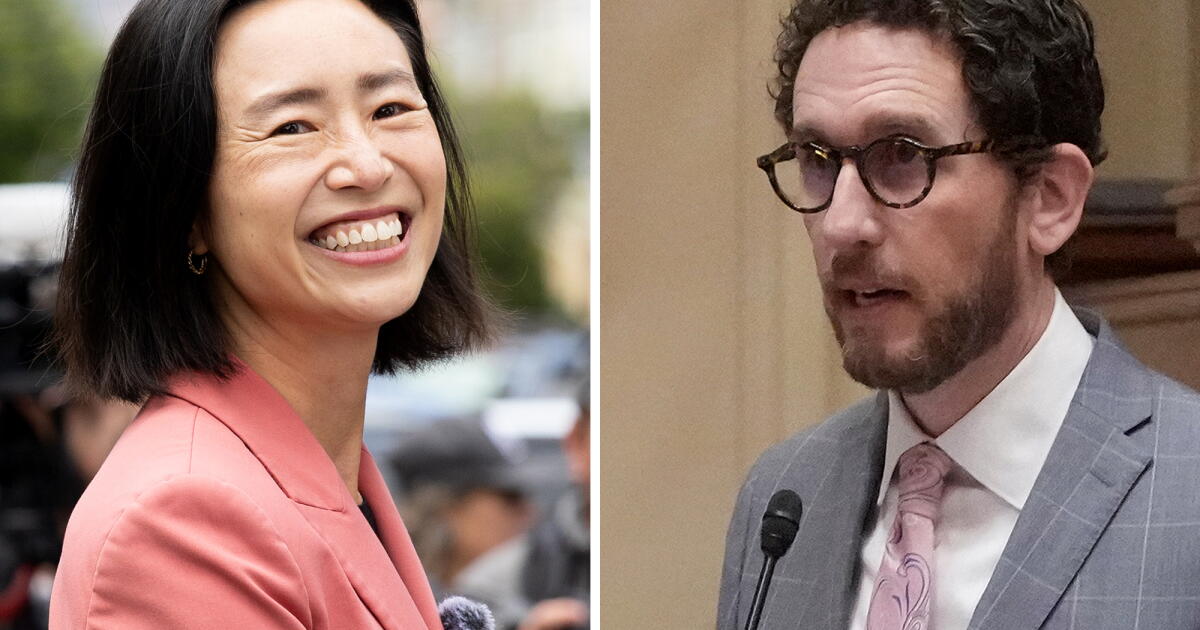
Rep. Nancy Pelosi (D-San Francisco), 86, the powerful former House Speaker who’s held the seat since 1987, announced last year that she would not run again. In May, she passed over state Sen. Scott Wiener (D-San Francisco) — a prolific California legislator long considered a potential successor — to endorse San Francisco Supervisor Connie Chan, a local progressive with less legislative experience but strong support from labor.
Pelosi’s endorsement sent Chan, who had been languishing in polls, surging past Democratic tech millionaire Saikat Chakrabarti in the June primary. Chan finished with nearly 30% of the vote and Chakrabarti took 18%. Wiener won, with nearly 41% of the vote.
Both Wiener, a gay man and staunch advocate for the city’s large LGBTQ+ community, and Chan, who immigrated to the city from Hong Kong at age 13 and has deep ties to its large Chinese and immigrant communities, would make history by winning. Wiener would be the first out LGBTQ+ person to represent the city in Congress, and Chan the first Asian American immigrant woman.
The race has sharply divided the state’s Democratic establishment as a rare intraparty showdown between a deft legislator who has driven liberal California policy for years and a rising progressive with the powerful imprimatur of the icon they seek to replace.
Both acknowledge they would take the same or similar positions on many issues, and fiercely oppose President Trump’s agenda. But they also say San Franciscans face a real choice between them that will help define the city for years.
“There is a clear cut between the two of us,” Chan said. “He has long enjoyed establishment support and industry support, and we’ve been grassroots, on the ground, [Asian American and Pacific Islander] community, working people and labor unions — in collaboration and coalition building.”
“We need Democrats who are willing to fight — to fight in a smart way, and to fight in an aggressive way, to defeat Donald Trump and to lower the cost of living,” Wiener said. “We are past the time where we need Democrats in office who were just going along to get along, or who, like Connie Chan, are just part of the status quo.”
Wiener is a MAGA target
Wiener, 56, has lived in the Castro neighborhood since 1997 and was a deputy city attorney and local Democratic Party chair before being elected to the Board of Supervisors in 2010. He was elected in 2016 to the state Senate, where he’s had a massive influence, authoring more than 100 bills that have been signed into law. Allies and critics say he is a workhorse, and at times both effective and divisive.
Wiener has been endorsed by the state and local Democratic parties; a slew of state leaders including California Atty. Gen. Rob Bonta, state Senate President Pro Tempore Monique Limón (D-Santa Barbara) and Assembly Speaker Robert Rivas (D-Hollister); various queer and labor groups including AFSCME; more than half the city’s supervisors; and various members of Congress.
Wiener has passed some of the state’s most progressive laws on LGBTQ+ rights, including protections for gender-affirming care, and challenged federal immigration agents in California. He has also pushed progressive laws — backing safe injection sites, extending bar hours until 4 a.m., decriminalizing psychedelic drugs — that have put some of his fellow Democrats in uncomfortable spots when forced to vote on the controversial issues.
Some in San Francisco label him a moderate, though that designation would draw laughs elsewhere in the country and even in Sacramento. Wiener is one of the most reviled state politicians on the conservative right nationally, and has received scores of death threats for his work, particularly on transgender issues. His website touts a laundry list of profane and homophobic attacks from MAGA loyalists — Elon Musk called him a “scumbag,” former Rep. Marjorie Taylor Greene called him a “communist groomer” — that he wears as a badge of honor.
On housing, Wiener has pushed for deregulation and development near transit hubs statewide to solve the housing and affordability crises, riling some homeowners averse to increased density and some progressives who say his plan favors developers and threatens existing rent-controlled housing. On tech, Wiener has pushed for artificial intelligence regulation but also been criticized for taking a technocratic approach with buy-in from wealthy tech leaders.
Wiener has passed laws protecting net neutrality, capping prescription costs and mandating mental health parity, ending mandatory minimum sentences for nonviolent drug offenders, and requiring corporations disclose their greenhouse gas emissions. He has received substantial financial support from tech leaders and opposes Proposition 40, the ballot measure that seeks to impose a one-time tax on the state’s billionaires.
Rep. Robert Garcia (D-Long Beach), also gay and a former Long Beach mayor, said he considers Wiener a friend but also a generational legislator who has “led the country” on LGBTQ+ rights and housing policy. “I don’t think there’s a better legislator in the United States on housing,” Garcia said.
Rep. Laura Friedman (D-Glendale), who worked with Wiener for years in the state Legislature, said he has been a champion for many issues important to Californians — including the environment — while holding big industry accountable and backing labor. She said while many politicians decide to either rack up easy wins with legislation that barely moves the needle or focus on “progressive value signaling” without accomplishing much of anything, Wiener “takes on some of the most difficult and controversial progressive issues and really gets them done.”
Nancy Tung, the local Democratic Party chair, said many San Francisco politicians “recede” from the city’s raucous local policy debate once they reach higher office, but Wiener is “still is in the knife fight,” especially on housing and affordability issues — showing he cares about the city and making him “such a good fit” for Congress.
Tung said she understands the appeal of sending a fellow Asian American woman to Congress in this political moment, but that Chan “just does not have the legislative record that Scott has.”
Chan for ‘working people’
Chan, 47, who lived in a rent-controlled Chinatown apartment after immigrating with her mother and younger brother, now lives with her firefighter husband and son in the Richmond neighborhood. She was a community and legislative aide for years — including for then-Dist. Atty. Kamala Harris — before being elected to the Board of Supervisors in 2020. She has served as budget chair since 2023 and has centered her campaign, largely funded by Pelosi’s network, around what she calls her “career fighting for working people.”
Chan has been endorsed by a host of Congress members, including Pelosi and Sen. Adam Schiff (D-Calif.); major labor groups including the California Federation of Labor Unions and the California Teachers Assn.; various progressive organizations and fellow and former supervisors; former mayor and S.F. power broker Willie Brown; and Chakrabarti, who since the primary has shared his campaign staff and funding with her.
Chan, who supports Proposition 40, has helped create a $400-million reserve fund in San Francisco to make up for federal cuts to Medicaid and housing subsidies. She also passed a supplemental budget to fund immigration defense services for people targeted by the Trump administration and passed various labor-friendly measures, including a minimum wage increase for in-home workers and cost-of-living adjustments for city service workers.
Pelosi said Chan “understands that budgets are statements of our values,” has “championed justice and progress for working families” and “brings an important lived experience to this moment” as an immigrant woman. Schiff said Chan has impressed him as “a very powerful voice for those who are disenfranchised” and someone with “the potential of growing into” a leader like Pelosi.
Kim Tavaglione, executive director of the San Francisco Labor Council, said she encouraged Pelosi to endorse Chan because Chan “supports San Francisco values,” listens to labor and is a great strategist.
Cleve Jones, the San Francisco activist who has fought for gay political representation since Harvey Milk’s historic 1977 election to the Board of Supervisors, said Wiener “has done some very good things, particularly around LGBTQ issues and HIV/AIDS,” but also angered some in the LGBTQ+ community by repeatedly showing up to an annual Trans March that organizers ask politicians not to attend.
Wiener, who is Jewish, was aggressively heckled at this year’s march, namely for his stance on the Israeli war in Gaza, which he was slower than other progressives to label a genocide. Conservatives mocked him for being targeted by his base, and Wiener ended up fundraising off the incident — which Jones said was “so cynical.”
He said Wiener’s “loyalty is to big developers, big tech and big real estate,” and that he “doesn’t really see the urgency of yet another white man elected to Congress” when San Francisco can send a stronger message by electing Chan, an immigrant woman of color.
Affordability and Trump
Chan said she is a “pragmatic” progressive who has balanced the city’s budget while protecting “healthcare, education, immigration resources” and other working-class priorities. She said Wiener is focused on deregulation for market-rate housing development, whereas she has prioritized tenants’ rights and protecting existing rent-controlled housing in her push for affordable units.
Chan said she will “walk and chew gum at the same time” in Washington by working for affordability while battling Trump, including by reversing his healthcare cuts, expanding Medicaid, providing affordable childcare, abolishing U.S. Immigration and Customs Enforcement and finally figuring out meaningful immigration reform.
“I’m not sugarcoating it as if it’s easy. But we gotta be able to find ways to work together to push those things forward,” she said.
Wiener said he and Chan share the goal “of getting Trump and MAGA out of office, and then making sure that people never feel tempted to flirt with authoritarianism again.”
But he said the way to do that is to advance policies that will “lower people’s cost of living and make people’s lives more sustainable” — including by passing universal healthcare, building millions of new homes, creating low-cost child care and leading a clean energy transition — and that he is the only candidate in the race with a proven ability to do that.
“This is a race to succeed the most effective and operational member of Congress in modern American history,” Wiener said. “San Francisco should send someone who actually has a track record, a proven track record, of being able to deliver.”
Hot mics have embarrassed many a media professional.
Cincinnati Reds longtime broadcaster Thom Brennaman was suspended indefinitely in 2020 after his microphone accidentally picked up him using a three-letter anti-gay slur.
Charles Barkley dropped an uncensored F-bomb during an Inside the NBA on TNT broadcast in 2025 while venting about NBA award voters.
And just two months ago, San Francisco Giants executive Buster Posey trolled radio station KNBR on-air after a behind-the-scenes employee was caught on a hot mic talking trash about him.
Add reporters covering Sacramento Kings media day Monday to the list. At least three were heard in an unvarnished conversation about Kings players Ben Simmons and Zach LaVine that took a personal turn.
A handful of local outlets livestreamed media day interviews. But the mics also picked up reporters chatting, and embarrassing comments went beyond their frequent use of the hyper-localized and outdated NorCal modifier “hella.”
Comments begin about Simmons, a guard on a one-year, non-guaranteed contract after missing last season with injuries. A female says “That’s what comes with being Ben Simmons. He is cringe, cringe,” and another jumps in to say he is “lucky he’s so fine.”
The first media member agrees, saying “He’s a good-looking dude. His skin is, like, so smooth, I was like, damn, no tattoos?”
A male voice joins the conversation, asking, “I thought Jordan Poole was your type.”
A female voice replies, “Allegedly, I like light-skinned, I guess.”
The male voice continues: “What about Zach LaVine, then?”
“Hella fine,” the female voice replies.
“I think his personality annoys the [expletive] out of me, so that’s what makes him less fine,” the first person says. “Zach’s cute but his personality [expletive] annoys me. He just seems like hella like a prick. But he is beautiful.”
“He’s a [expletive] UCLA guy,” replies the third person. “Just all of them are.”
Another voice jumps in, offering that LaVine is “hella fine, too.”
Someone asks how the others would rank Kings players by hotness. One voice votes for Simmons because of “his skincare routine.”
Apparently referring to the team’s woeful 22-60 record last season, the male voice responds by cracking, “Well, Ben wasn’t a King for the last year and a half either,” to which a female voice concedes, “That’s true.”
The reporters involved have not been publicly identified, and none of the players have responded. LaVine’s wife, Hunter, did offer a low-key comment to the Kings Muse recording, writing on X, “a great start to the season!”
The episode called to mind the hot mic that marred the Toronto Raptors’ postseason news conference last April. Two unidentified media members were heard making disparaging comments about players Scottie Barnes and Jonathan Mogbo.
“It’s not just his enunciation, which, like, was super bad, especially last year,” one person said about Barnes. “But even the attitude. Just the attitude — like he’s having fun up there. First year or even before, he just kept getting worse and worse every year.”
Rookie forward Mogbo was the next target. “When I first interviewed Mogbo when he was drafted, I was shocked ’cause he was so dumb,” the person said.
Raptors fans were appalled by the comments, but Barnes responded with humor on social media. It remains to be seen how Simmons and LaVine react.
WASHINGTON — Former Justice Department special counsel Jack Smith, who brought two federal indictments against President Trump, told lawmakers on Tuesday that he “will not be silenced by continued threats of prosecution” from the Trump administration and that he believes the rule of law is being threatened like never before.
Smith also told the Senate Judiciary Committee that he stands behind the criminal cases he brought against Trump, a Republican, and that he and his team acted without regard to politics.
“I made those decisions without regard to President Trump’s political association, activities, beliefs or candidacy in the 2024 presidential election,” Smith said. “Our investigation developed proof beyond a reasonable doubt that President Trump engaged in serious crimes against our nation. If asked whether to prosecute a former president today based on the same facts, I would do so regardless of whether that president was a Republican or a Democrat.”
Republicans sought to cast the prosecution as a political fishing expedition, accusing Smith of bending ordinary procedures in an overzealous pursuit of the president.
“The Smith election case ultimately wasn’t just about Trump,” said Republican Sen. Chuck Grassley of Iowa, the chairman of the committee. “It was about partisan agents and prosecutors mapping out the Republican apparatus.”
Sen. Dick Durbin of Illinois, the top Democrat on the committee, accused Republicans of spreading “baseless conspiracy theories” about Smith’s investigations as part of an effort to “whitewash” the history of Trump’s 2020 election loss and the Jan. 6, 2021, attack by a mob of Trump’s supporters on the U.S. Capitol.
“President Trump demonstrated a wanton disdain for the laws of the United States, the will of the people and our national security,” Durbin said. “The aspersions cast on Mr. Smith, nonstop, are petty, personal and political. They are nothing but a smoke screen to distract from the president’s own clear, unlawful conduct.”
The hearing is expected to focus on subpoenas for phone records
Even as Smith defends his investigations, he is expected to be pressed anew by Republican senators about his team’s access to the phone records of GOP lawmakers as prosecutors investigated Trump’s efforts to overturn his loss to Democrat Joe Biden.
In previous testimony, Smith has stood behind subpoenas that prosecutors issued for the phone records of Republican members of Congress who were in touch with Trump when violent supporters of the president rioted inside the U.S. Capitol on Jan. 6, 2021. He has said that such subpoenas are a “common practice” in investigations and were necessary in this instance to understand the “scope of the conspiracy” between Trump and his Republican allies.
Nonetheless, the revelation that Smith’s team secretly obtained the phone records during his investigation has animated some Republican lawmakers, who point to it as proof of overreach by the Biden administration Justice Department and a hard-charging prosecutor.
In July, the Republican chairman of the House Judiciary Committee, Rep. Jim Jordan of Ohio, referred Smith to the Justice Department for potential prosecution on allegations that he lied at a previous hearing about his collection of the records — something Smith’s attorneys have vigorously disputed.
“I stand by my testimony before the House of Representatives,” Smith said. “I will not be silenced by the continued threats of prosecution from the president or others.”
Grassley, the Senate committee chairman, first disclosed last year that Smith’s prosecutors had obtained what’s known as “toll records” — data that reveals the date, length and time of phone calls between two parties but not the content of the communications.
Smith has repeatedly justified the move as necessary to document any contact that Trump or surrogates may have had with lawmakers on Jan. 6, 2021, as the president beseeched his supporters to halt the certification of the election results.
“My office didn’t spy on anyone,” Smith said during a hearing in January.
Smith is the subject of a criminal referral from Republicans
Smith was appointed in 2022 by then-Atty. Gen. Merrick Garland to take over investigations into Trump’s efforts to reverse his election loss and Trump’s retention of classified documents at his Mar-a-Lago estate in Palm Beach, Florida. Both investigations resulted in felony indictments, but Smith abandoned the cases after Trump won back the White House in 2024, citing longstanding Justice Department opinions that say sitting presidents cannot be federally indicted.
Smith has remained a top target of retribution for Trump and his administration, which last year announced that it would revoke the security clearances of the lawyers representing the former special counsel. The Office of Special Counsel, an independent watchdog agency responsible for enforcing a law against partisan political activity by federal employees, also announced last year an investigation into Smith.
Jordan’s referral to the Justice Department centers on a December 2025 exchange in which Smith was asked about subpoenas that prosecutors had issued for the toll records.
Smith said the records he requested did not include the content of the communications. But Jordan maintains that answer was misleading in light of records released by Grassley showing that Smith had obtained the contents of 44 lawmakers’ text messages in a separate subpoena to the National Archives and Records Administration that sought the communications of various Trump advisers and aides.
In response, Smith’s lawyers called his answers “unimpeachably truthful” and noted that he was responding to questions explicitly about toll records, which did not include the contents of any text messages.
WASHINGTON — The Senate on Monday is expected to approve a bipartisan bill that would give the NCAA and its member conferences the authority to enforce uniform national rules on college athletics.
If the bill is passed by the Senate, it would move to the House and, if approved, on to President Trump for his signature to become law.
What the Protect College Sports Act would do
Under the Protect College Sports Act — co-authored by Sen. Maria Cantwell (D-Wash.) and Sen. Ted Cruz (R-Tex.) — the NCAA would be granted a limited antitrust exemption that would allow the organization to create standardized rules around athlete eligibility, limit conference realignment and prevent the creation of a super league — a private-equity model for college sports that would replace NCAA subdivisions.
The bill is also an attempt to codify the $2.8-billion antitrust settlement reached last year in House vs. NCAA, which allowed Division 1 schools to share revenue with their current players and compensate past players. The new bill would increase the revenue sharing cap to around $50 million per school from $21.5 million, albeit with a more strict and enforceable model.
Under Name, Image and Likeness deals, wealthier schools were able to circumvent the “soft” $21.5-million cap by lining up lucrative corporate sponsorships and endorsements for prospective athletes. The bill would allow the NCAA to crack down on attempts to bypass the limit by incorporating booster or affiliated-entity money into total revenue sharing calculations, while also giving schools an additional $27 million in the funding cap to retain current athletes.
Potential boost for smaller schools
A potential consequence of the bill could be that big-name programs lose their ability to draw the best college athletes with promises of massive compensation, allowing smaller programs to compete under NCAA regulations.
The NCAA and its affiliates have spent tens of millions of dollars lobbying for congressional intervention on its rule-making power over the last seven years. Supporters of the bill, including Cruz, have said the bill would bring order and consistent regulation to college sports.
“If we’re going to be having a national competition … it is only Congress that can establish a clear and enforceable legal rule book,” Cruz said on the Senate floor last week.
Influential figures in college sports, including former Alabama head football coach Nick Saban and ESPN analyst Pat McAfee, have publicly called on Congress to pass the measure. It has also drawn support from 24 of the NCAA’s athletic conferences.
“Congress does need to fix the mess in the courts and create a national framework so the people inside college sports can enforce fair rules,” Saban said during a Senate Commerce, Science and Transportation committee hearing in June. “Without that legal certainty, every rule becomes another lawsuit, every standard becomes another risk, and the system keeps drifting toward a professional model.”
What the opponents say
The legislation is not without its opponents. Some players, labor organizations and members of Congress argue that the bill would prevent highly sought-after college athletes from participating in their own negotiation process.
“What this bill does, at its core, is protect a system of exploitation,” Sen. Chris Murphy (D-Conn.) said in an AFL-CIO trade union press release. “This bill protects the billions of dollars that coaches and executives are making by suppressing compensation for some of the most highly valued athletes in the world.”
The Congressional Black Caucus and the NAACP have also brought forward concerns that the bill does not allow Black athletes — who make up a majority of players in the football and basketball programs — into the collective bargaining process.
The NCAA plans to enforce a five-year eligibility rule, cap agent fees at 5%, put penalties on second transfers and codify student-athlete protections, such as 10-year degree completion assistance and post-eligibility healthcare. If the bill passes, all challenges to these rules would have to be handled in federal court.
Some senior Republican officials in the House, including Rep. Tim Walberg (R-Mich.) and Rep. Brett Guthrie (R-Ky.), have expressed some hesitance in passing the legislation without clarity as to whether student-athletes will be considered employees and if further limits should be placed on international student-athletes. If changes are made in the House, the bill would be returned to the Senate for another vote.
Support from Trump
Trump, on the other hand, has expressed strong support for the bill.
“THE PROTECT COLLEGE SPORTS ACT is a great Bill, and the Senate will hopefully stay in D.C. until it passes,” he wrote on Truth Social last month. “Without this Bill, millions of young Athletes will be hurt, programs will be canceled … the fans will be robbed, and Universities will go broke”
Let’s get the rose-colored story line out of the way, right away.
The postseason starts Tuesday, and it could be the last we see of Major League Baseball for a long, long time. The owners expect to lock out the players when the collective bargaining agreement expires Dec. 1, and the owners have made their pitch loud and clear: No new agreement without a salary cap, for they believe there can be no true competitive balance without one.
You’ll hear a lot about how the way this postseason sets up, or how it plays out, could impact the bargaining.
Don’t believe a word of it. Nothing that happens this October will be relevant to the new labor agreement.
Come on. The team with the lowest payroll — the Cleveland Guardians — won their division. So competitive balance can’t be completely out of whack, can it?
Cleveland hasn’t won the World Series since 1948. The opponent was the Boston Braves, who subsequently moved to Milwaukee and then Atlanta.
What about the team with the best record in the American League: the Tampa Bay Rays, who beat up on big-market bullies in the New York Yankees and Boston Red Sox?
The Rays never have won the World Series.
Well, what about the Milwaukee Brewers? For the second consecutive season, the team in baseball’s smallest market posted baseball’s best record.
The Brewers got swept in last year’s National League Championship Series. They never have won the World Series.
But aren’t the Brewers the best example of a team playing beyond its payroll instead of using it as an excuse?
Isn’t that what got everyone agitated? Doesn’t everyone outside L.A. know the Dodgers have destroyed competitive balance, and the owners are trying to fix it?
The owners were ready to fight for more than a year before the Dodgers helped themselves to Díaz, Tucker and Skubal. For years, the commissioner’s office touted baseball’s competitive balance, citing in part how the league championship series and World Series matchups changed almost every year.
After the Dodgers won in 2024, the commissioner’s office redefined competitive balance as how often a small-market team won the World Series, last accomplished by the 2015 Kansas City Royals. The seeds for this winter’s labor war had been planted.
If the Dodgers flop this October, the owners are not going to suddenly back off a salary cap. If, say, the Brewers or Rays win, the owners will say that’s the exception that proves the rule.
There are ways for owners to direct more revenue to small-market teams without the salary cap the players insist they will not accept, and without limiting the definition of success to winning the World Series, which risks devaluing the product among 29 fan bases every year. Whether the owners wish to consider them without the cost certainty that comes with a salary cap will be the story line of the cold winter ahead.
The Dodgers are scheduled to open next season on March 25. Neither owners nor players would have lost any significant revenue by then — ticket sales and broadcasting rights for owners, salaries for players — so a new agreement by then is uncertain at best.
So enjoy the postseason.
So, at least for now, isn’t the postseason tilted toward the Dodgers and Yankees?
Those screams you hear are coming from New York, where Yankees fans are annoyed that their team finished with the second-best record in the AL and still could be eliminated in two or three days. The Yankees finished behind the Rays and received a wild card.
The Yankees lost 13 fewer games than the AL West champion Houston Astros and 10 fewer games than the AL Central champion Guardians, both seeded ahead of them. The Astros are a .500 team, the worst record a division champion has taken into the postseason. The Guardians get a bye, just like the Dodgers.
The Yankees drew the Red Sox, which means painful amounts of national commentary will focus on (1) how the system victimized the Yankees and the Red Sox; and (2) baseball’s most hyped rivalry.
Until baseball realigns its divisions or seeds its playoffs by wins, regardless of division, the Yankees should simply do what Aaron Judge said about how they should respond to criticism of their fundamentally frightening 2024 World Series: “Play better.” And baseball’s best rivalry will be on October display only if the Dodgers and San Diego Padres meet in the NL Championship Series.
Still laughing, though, at sanctimonious Yankees fans believing baseball is somehow unfair to the poor, gutty Yankees.
Can anyone save baseball in 2027?
We should try Pope Leo. He’s a long-suffering Chicago White Sox fan. In his first full year as pope — and after three consecutive 100-loss seasons — the White Sox made the playoffs.
Some fans call it a miracle, a reporter told the pope. Did the pope have anything to do with the turnaround?
He smiled.
“No comment,” he said, then paused.
“Great things happen in Chicago,” he said.
The Cubs made the postseason too. The Cubs and White Sox have shared Chicago since 1901. This is the fourth time both have qualified for postseason play. Deep dish pizza for all, but a World Series in Chicago this fall might truly require divine intervention.