$200 million-plus spent fighting and supporting billionaire tax
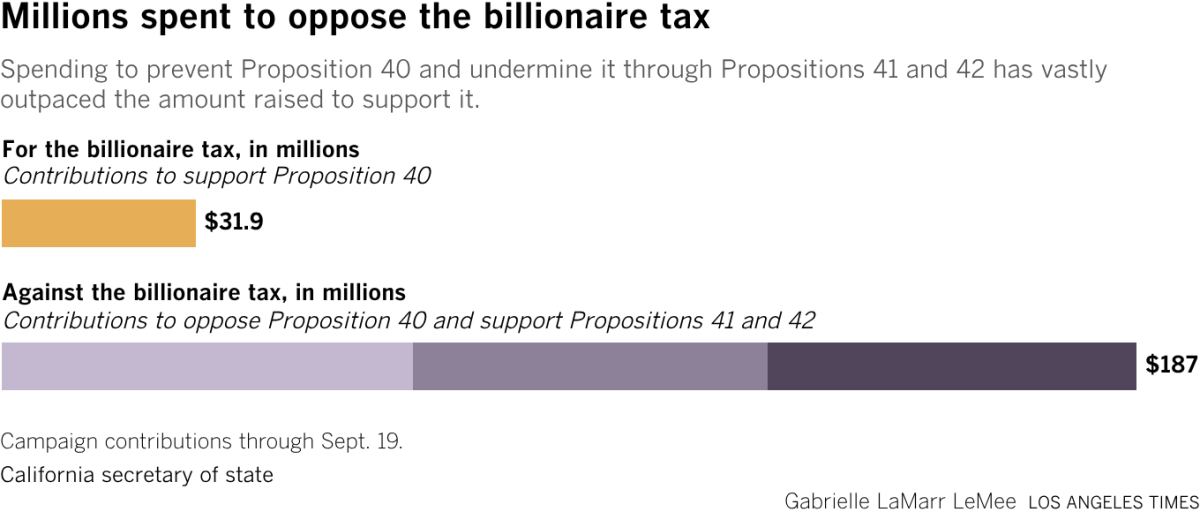
Opponents of the billionaire tax on the November ballot have vastly outraised the proposal’s supporters, with the anti-Proposition 40 effort and the backers of two other ballot measures crafted to nullify it raising $187 million compared to the $32 million raised by boosters of the wealth tax, according to campaign finance documents filed with the state.
The reports, filed Thursday, account for donations through Sept. 19 and do not include several million dollars that have poured into campaign coffers in recent days. The numbers are expected to vastly increase before the Nov. 3 election.

The bulk of the money raised by the proponents of Proposition 40, which would enact a one-time 5% tax on California billionaires’ assets, appears to have been spent on gathering signatures to qualify the measure for the November ballot. The campaign had only $207,000 in the bank, according to the latest campaign finance reports.
A leader of the union that crafted the proposal accused wealthy Californians who are spending heavily against the measure of lying to voters. The measure is designed to offset $100 billion in impending federal healthcare funding cuts expected to impacts millions of Californians.
“The billionaires take and take — tax break after tax break — and now they’re spending that money to deceive voters and avoid paying their fair share,” said Suzanne Jimenez, the chief of staff of the Service Employees International Union-United Healthcare Workers West. “Voters want their money back from the billionaires and want local emergency rooms to stay open. California does not need more tax breaks for billionaires. California needs emergency rooms for patients, hospitals that stay open, and healthcare people can access and afford.”
Opponents of the billionaire tax argue that it would do more harm than good.
“The more Californians learn, the more they see Proposition 40 for what it is — a harmful tax scheme that permanently damages the state’s budget and economy with zero accountability or safeguards to ensure funding actually improves care or lowers costs for patients,” said California Medical Assn. President Dr. René Bravo, the leader of one of the groups opposing the billionaire tax.
Proposition 41 would nullify the billionaire tax if, in the event that both measures are approved, it receives more “yes” votes. Proposition 41 would prohibit any new state tax from being excluded from a voter-approved cap that restricts how much tax revenue the state can spend each year.
“Californians deserve better results for their hard-earned tax dollars,” said Molly Weedn, a spokesperson for the Proposition 41 campaign.
Proposition 42 would prohibit new taxes on personal property, intellectual property, retirement accounts and other assets, and would limit situations in which a ballot measure or state lawmakers can impose or raise taxes retroactively — both of which are essential parts of Proposition 40. If both measures pass and Proposition 42 receives more “yes” votes, it would nullify the wealth tax.
The proposed billionaire tax has divided California Democrats, with Gov. Gavin Newsom opposing it while the state Democratic party supports it.
In recent polling, a majority of likely voters did not support any of the three proposals.
While 45% of likely voters supported the billionaire tax, 42% opposed it, according to a poll released Friday by UC Berkeley’s Institute of Governmental Studies and co-sponsored by the Los Angeles Times. Voters also are torn about the two ballot measures designed to nullify it.
The other measure receiving great attention, Proposition 39, which would require voters to show government-issued ID to cast ballots, faces a similar financial disparity. Opponents to the measure have raised $39.3 million compared to $15.6 million garnered by supporters.
Fifty-two percent of likely California voters oppose the voter ID proposal, while 39% support it and 9% are undecided, according to the Berkeley poll.
In the race to replace Newsom, Democratic former Biden cabinet member Xavier Becerra has raised $35.8 million, while his GOP rival, conservative strategist and television commentator Steve Hilton, has raised $22.3 million.
Becerra remains the front-runner in the governor’s race, which is not surprising since Democratic voters outnumber Republicans nearly 2 to 1. In last week’s Berkeley poll, the Democrat had the support of 58% of likely voters, while 33% backed the Republican.