billionaire

Billionaire investor Ackman makes $64bn bid for Universal Music Group | Music News

Billionaire investor Bill Ackman’s Pershing Square has proposed a takeover of Universal Music Group in a $64bn deal, the latest twist in his nearly five-year quest for the music label giant.

Pershing Square proposed a cash-and-shares offer on Tuesday through its acquisition vehicle that values Universal Music at about 30.40 euros ($35) per share, a 78 percent premium to the last closing price of 17.10 euros ($20), making the deal worth 55.75 billion euros ($64.31bn).

Recommended Stories

list of 4 itemsend of list

Universal Music Group (UMG) – the company behind international superstars, including Taylor Swift, Billie Eilish and Kendrick Lamar – is expected to move its listing to New York from Amsterdam, paving the way for more investors, including index funds, to own the company and ultimately lead to more robust earnings and a higher valuation.

Universal Music declined a Reuters news agency request for comment.

For Ackman, one of the world’s most voluble investors, who cemented his fame and fortune as an activist investor, forcefully pushing corporate America to adopt changes, this is a far friendlier approach, investors and industry analysts said.

Even as the music industry is flourishing, UMG’s share price has lagged, something Ackman is pledging to fix with this proposed deal.

Ackman’s letter to Universal Music Group’s board carried a mixed tone, at times complimentary of current management, led by chairman and chief executive Lucian Grainge, and critical of the company’s “underutilized balance sheet” and handling of its 2.7 billion euro ($3.1bn) investment in Spotify Technology.

Fears of AI disrupting the music industry have played a role in UMG’s lacklustre performance. Its share of the music market has been sliding, and streaming growth is decelerating, Wells Fargo analysts noted. In March, UMG delayed its plans for a US listing.

Nonetheless, Ackman will need the support of UMG’s top shareholders – Bollore Group, which holds an 18.5 percent stake, and Vivendi, which owns 13.4 percent – to push through any transaction. China’s Tencent is a significant shareholder. French billionaire Vincent Bollore’s family controls 80 percent of UMG’s voting rights.

Old target

Ackman first flirted with Universal Music Group in 2021, when his Pershing Square Tontine Holdings, a shell corporation created to take a private company public, zeroed in on its target. But Ackman shelved the complex deal in the wake of heavy US regulatory scrutiny. Instead, Pershing Square became one of UMG’s biggest investors in 2021, and Ackman sat on its board until last year.

Post transaction, Ackman said Grainge should remain Universal Music’s chief executive.

Ackman said he and former Hollywood super-agent Michael Ovitz met with Grainge over dinner “a couple of weeks ago” to discuss the potential merger.

“Lucian encouraged us to send it in,” Ackman said.

Ackman proposed adding new directors, including Ovitz – who shepherded the careers of Madonna and Michael Jackson – who would become the board chair. Additionally, two representatives from Pershing Square would get seats, he said, not saying yet whether he would be one of the directors.

Shares of UMG, which is listed in Amsterdam, were up 13 percent on Tuesday, while Bollore Group climbed 5 percent. Shares in Vivendi were up more than 10 percent.

Pershing bought a 10 percent stake in UMG from Vivendi ahead of its 2021 Amsterdam IPO and has since repeatedly pressed for a New York listing, arguing it would boost UMG’s share price and liquidity.

Pershing currently has a 4.7 percent stake, making it UMG’s fourth-biggest shareholder.

UMG’s shares have lost almost a third of their value since its IPO.

Even as global music revenues grow year after year, UMG and other major labels, like Sony and Warner Music, are scrambling to stay competitive as streaming services from Spotify, Amazon, Apple and Deezer take an ever greater share.

They are now also contending with disruptions brought on by the expansion of AI – from copyright disputes to the advent of song-generating AI tools – that threaten to upend how music is created, consumed and monetised.

One survey last year found that a staggering 97 percent of listeners could distinguish between AI-generated and human-composed songs.

Under Tuesday’s proposal, Pershing’s SPARC Holdings would merge with UMG, and the new entity would become a Nevada corporation listed on the New York Stock Exchange.

Source link

Billionaire investor launches $65 billion Universal Music takeover bid

Billionaire investor Bill Ackman has launched a $65 billion bid to purchase Universal Music, the label representing some of music’s biggest names like Taylor Swift, Kendrick Lamar and Bad Bunny.

As part of the proposed deal, UMG would merge with Ackman’s investment firm, Pershing Square Capital Management, and the company’s stock listing would be relocated from Amsterdam to the New York Stock Exchange.

Pershing Square already holds more than 4.5% of the music giant’s shares. Ackman said the move to a U.S.-based stock exchange would increase the value of UMG .

“UMG’s stock price has languished due to a combination of issues that are unrelated to the performance of its music business and importantly, all of them can be addressed with this transaction,” said Ackman in a statement.

The proposed deal includes Universal Music merging with Pershing Square SPARC Holdings, an acquisition company approved by the Securities and Exchange Commission in 2023. If agreed upon, the proposed transaction could close at the end of the year, according to the company.

Universal Music Group currently has its corporate headquarters in the Netherlands and a local L.A. office in Santa Monica. The label was founded in 1996. Over the years, it’s cemented its reputation as one of the music industry’s “Big Three,” alongside Warner Music Group and Sony Music Entertainment. Universal also controls smaller labels like Republic Records, Interscope Geffen A&M, Capitol Music Group, and Def Jam Recordings.

The news has drawn a level of skepticism, as Ackman will need two-thirds of UMG’s investors to approve the proposed deal, including French billionaire Vincent Bolloré, who is UMG’s largest shareholder with a morethan 18% stake, according to Bloomberg.

If finalized, UMG shareholders would receive €9.4 billion in cash, around €5.05 per share, or roughly $10.9 billion and $5.84 per share.

Investors would receive 0.77 shares in the new merged company. This would value the total consideration package of cash and stock estimated to be worth €30.40 per share, a 78% premium to UMG’s stock price. The transaction will also include the cancellation of 17% of UMG outstanding shares. The new UMG will have 1.541 billion shares outstanding.

UMG’s stock price has jumped over 11% to €19.05 Tuesday morning, due to this potential acquisition.

Source link

Billionaire candidate for California governor catching heat for past business interests, wealth

Billionaire hedge fund founder turned environmental warrior Tom Steyer, a leading Democratic candidate for California governor, is facing mounting questions about how he earned his wealth — notably investments in private prisons that are now being used to house undocumented immigrants facing deportation.

Some of the most vicious political attacks come from his Democratic rivals and Sacramento special interest groups as the June 2 primary election fast approaches, but Steyer has been dogged for years about his past, controversial business ventures and how they help fund his unbridled campaign spending.

Steyer, 68, faced that ire during a town hall event in San Diego last week.

“Tom, you’re not going to come to San Diego and ignore this detention center,” Holly Taylor, a 37-year-old Democrat screamed at Steyer, holding signs with QR codes to help detainees at an Otay Mesa private prison that Steyer’s hedge fund backed. “It’s a concentration camp. They’re drinking water out of a toilet.”

Taylor, a crime scene cleaner from Pacific Beach, is among scores of people who gather weekly at the facility to raise money for detained immigrants to provide them some comfort amid the Trump administration’s Immigration and Customs Enforcement raids.

In 1986, Steyer, co-founded Farallon Capital, which had shares valued at $89.1 million in the Corrections Corp. of America in 2005, according to the Securities and Exchange Commission. That company, now known as CoreCivic, operates private prisons around the nation that are housing people picked up by federal immigration agents, including the one in Otay Mesa.

It is not the first time Steyer has faced criticism about the connection with private detention facilities. At the California Democratic Party convention in February, protesters dressed in orange prison jumpsuits sought to draw attention to the controversy.

His Democratic rivals have also seized upon the issue to question the billionaire’s progressive credentials.

“Before he was a progressive, he made millions off of companies that operate ICE detention centers, that operate private prisons that incarcerated young children,” state Supt. of Public Instruction Tony Thurmond said during a recent interview with a political influencer known as Mrs. Frazzled.

“His entire campaign is built on the backs of kids in cages,” Rep. Eric Swalwell, (D-Dublin) wrote Tuesday in a post on X.

People protest outside of a lunch held by California gubernatorial candidate Tom Steyer

People protest outside of a lunch held by California gubernatorial candidate Tom Steyer at the 2026 California Democratic Party State Convention in San Francisco on Feb. 21.

(Jeff Chiu / Associated Press)

Several years earlier, Yale University’s graduate teachers union called upon the school — Steyer’s alma mater — to divest from Farallon because of concerns about how the private prison company treated detainees, notably minorities.

Steyer has repeatedly expressed remorse about his former firm’s ties with the detention company. In 2012, he sold his stake in Farallon, which was named in reference to islands off the coast of San Francisco and was once one of the largest hedge funds in the world.

“I deeply regret that Farallon made that investment, and I personally ordered the investment in CCA to be sold because it did not accord with my values then or now,” Steyer told The Times in 2019 after he launched a short-lived presidential campaign.

Asked to comment about the latest iteration of the controversy, Steyer’s campaign pointed to comments he made in March at a town hall in San Francisco about how among the hundreds of thousands of companies his hedge fund invested in, the private prison company changed the course of his life.

“It was a mistake, and I sold it over 20 years ago, thinking, not that it won’t be profitable, it’s just a mistake. I don’t want to be in that business. But let me say this, it wasn’t just a mistake,” Steyer said. “It was also a big wake-up call that I was in the wrong place, that I was in a business that was taking me to places I absolutely didn’t want to go. And there’s a reason I walked away from that business and walked away from a ton of money, because I felt like that is not the life I want.”

He added that he and his wife, Kat Taylor, have spent the past two decades pushing for rehabilitative justice — treatment instead of mass incarceration except for violent felons.

“Am I a perfect person? No, have I made mistakes? Yes,” Steyer said. “But for those of you who like to read the Bible, there is a moment on the road to Damascus when someone makes a change, and I have made a big change, and I did it a long time ago, and I’ve been pushing very, very hard the other way.”

Farallon also invested in fossil fuel projects, including an Australian coal mine that denuded thousands of acres of koala habitat and generated an enormous amount of carbon emissions.

Steyer, who has a net worth of $2.4 billion according to Forbes, has painted himself as a reformed billionaire who walked away from Farallon because of angst about how he earned his fortune. He has spent hundreds of millions of dollars supporting Democratic causes, notably efforts to fight climate change.

“The truth is that is not where I think there is value, and that is not what I’m seeking in my life,” he said at a Sacramento town hall in March when retired state employee Gina Coates asked how, as a woman of color, she could believe his promises given his privilege as a wealthy white man.

“In terms of trusting me, let me say this, I left my business 14 years ago, and anybody who cared about money would not have done it,” Steyer said.

Steyer later said at the town hall that he left Farallon because he realized that he didn’t want to remain on that path.

“I want to have a meaningful life,” he said. “I want to stand with the people of this state and have actual prosperity. Twelve trillionaires and 40 million people who can’t make rent is not success.”

But Steyer and his wife continue to receive significant income from the hedge fund, including millions of dollars in investments, holdings and various complicated transactions in 2024, according to a statement of economic interest and tax returns he was required to file with the California Secretary of State’s office because of his gubernatorial run.

A Steyer campaign spokesman said Steyer created guardrails to ensure that he does not profit off companies he morally disagrees with.

“Tom has put in place an investment policy to ensure that he does not directly invest in fossil fuels, payday lending, or private prisons,” spokesman Anthony York said. “To the extent he inadvertently incurs exposure to those industries through third-party managers or liquid legacy investments, Tom will donate all profits to charity.”

After leaving Farallon, Steyer became one of the nation’s top Democratic donors. And he has used his wealth to fund his political ambitions. Steyer contributed nearly $342 million of his own money to his short-lived 2020 presidential campaign, according to the Federal Election Commission.

In the 2026 governor’s race, Steyer has donated nearly $112 million to his campaign as of Thursday, according to the California secretary of state’s office. He has been an ubiquitous presence on the airwaves, including local news programs and campaign ads that aired during the “Puppy Bowl” on the Animal Planet channel on Super Bowl Sunday. In the past month, Steyer has aired more than 5,000 ads, according to iSpot, which tracks television commercials.

California, home to 23.1 million registered voters, is home to some of the nation’s most expensive media markets. And candidates, particularly those who are not well known, need to spend heavily on television advertising if they hope to have a successful campaign.

But money is no guarantee of success. Billionaire Meg Whitman, the former eBay chief and formerly a longtime Republican donor, spent $144 million of her money on her 2010 gubernatorial bid. That set a record for a candidate’s contribution in a state race at the time, but Whitman lost to Jerry Brown by nearly 13 percentage points.

In 1998, Democratic multimillionaire Al Checchi who had been the co-chair of Northwest Airlines spent $40 million of his wealth on an unsuccessful run for governor, also a record at the time.

Steyer is one of the top three Democrats in the sprawling field to replace termed-out Gov. Gavin Newsom. And his liberal positions are drawing the ire of powerful forces in Sacramento. On Tuesday , the state’s Realtors donated $5 million to an independent expenditure committee opposing Steyer’s bid.

Taylor, who confronted Steyer at the San Diego town hall, said she had not planned to be so vocal. But as the event unfolded, she decided she had to speak, not only to Steyer but to the attendees. She and her compatriots gather every Sunday outside the Otay Mesa facility to raise money to help detainees buy food in the prison commissary and call their families.

“My main issue is that he has gotten financial gain off of these people suffering,” she said.

Source link

California’s proposed billionaire tax gains majority support in new poll, with a partisan split on voter ID

A new poll shows California voters are sharply divided over two brewing statewide ballot measures stirring up the nation’s partisan and economic divides: a one-time tax on billionaires to pay for mostly healthcare and a voter ID mandate that includes citizenship verification.

The survey conducted by UC Berkeley’s Institute of Governmental Studies and co-sponsored by The Times showed 52% of registered voters supported the billionaire’s tax, while 33% said they opposed it. Fifteen percent were undecided.

Support for the voter ID measure was more evenly split, with 44% of voters in support, 45% opposed and the remainder undecided.

The pair of statewide proposals, which have yet to qualify for California’s November ballot, emanated from opposite sides of California’s political spectrum. Organized labor and progressives are pushing hard for a new wealth tax in response to Republican cuts to federal healthcare programs, and the GOP-led call for additional voter restrictions comes in the wake of President Trump’s baseless claims that the 2020 election was stolen from him.

Poll director Mark DiCamillo said he “was a little surprised” by the results given how much attention each measure has already received.

“Just from reading the press accounts of these initiatives, I thought they would both be well ahead. There’s been a lot of discussion about them and advocates seem to be very confident in their chances of passage, but the polls seem to indicate otherwise,” he said.

The divisions over each measure fell largely along partisan and ideological lines.

On the billionaire’s tax initiative, 72% of Democratic voters said they would support the measure if the election were held today — and the same percentage of Republicans oppose it. A slim majority — 51% — of voters who are unaffiliated or registered with another party support the wealth tax, while 30% said they oppose it, with the remainder undecided.

Republican voters overwhelmingly support the voter ID initiative, with 91% saying they would vote for it. More than two-thirds of Democratic voters, 68%, said they would oppose the measure. No party preference voters appeared evenly split.

Neither ballot measure has officially qualified for the November ballot thus far, though proponents of the voter ID measure said this month that they turned in 1.3 million voter signatures to elections officials, well above the 875,000 required to qualify. Proponents of the new tax on billionaires have until June 24 to submit signatures to elections officials.

The billionaire tax has generated national news coverage and widespread debate over whether it would benefit low-income Californians or end up hurting the state’s tax base as billionaires move out of the state to avoid paying it.

The proposal is backed by the Service Employees International Union-United Healthcare Workers West, which represents 120,000 workers in California. Union leaders say that the tax would raise $100 billion to backfill steep cuts to federal healthcare programs under a sweeping tax and spending bill approved by the Republican-controlled Congress and signed in the summer by Trump.

The measure would impose a one-time 5% tax on the assets of California residents who are worth $1 billion or more, with options to pay it over multiple years.

According to SEIU-UHW, the new tax would apply to around 200 people in the state, though several wealthy tech leaders have made moves to change their residences and avoid paying the tax should it pass. In recent months, Meta Chief Executive Mark Zuckerberg, Google co-founders Larry Page and Sergey Brin and others have bought up lavish beachfront estates and new commercial office spaces in South Florida.

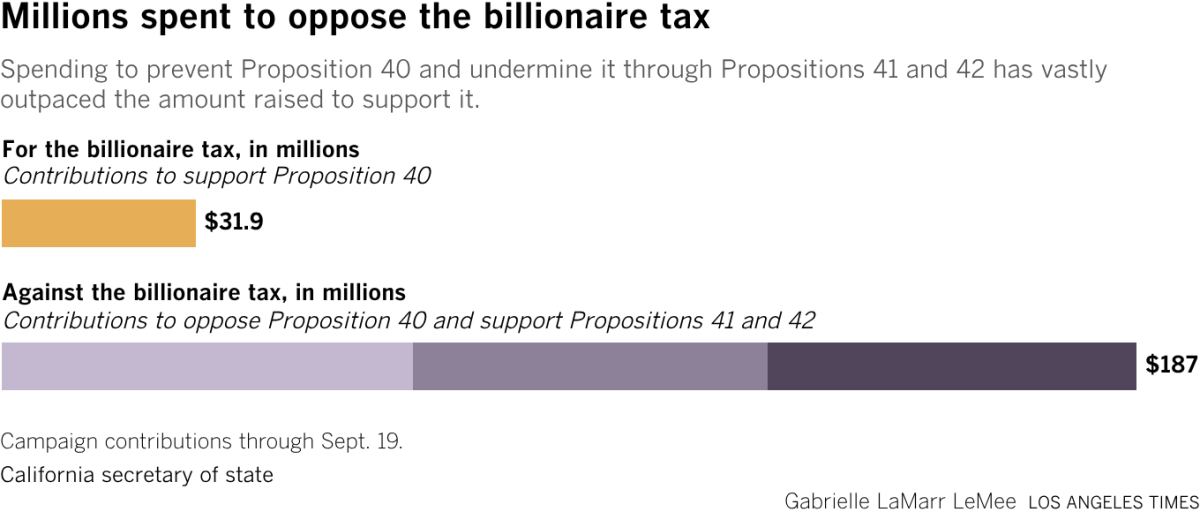
Some of those billionaires are also ponying up to defeat the measure. Brin, who according to Forbes is the world’s third-richest person, has contributed $45 million to a new ballot measure committee called Building a Better California, which is pushing an alternative statewide ballot measure that could scrap the billionaire’s tax.

Brandon Castillo, a veteran ballot measure campaign strategist who is not working on either of the two measures, said even though it’s currently polling above 50%, the billionaire’s tax is starting out “in a really shaky position.”

“This is not a very strong place to start,” he said. “That’s not to say they can’t keep this thing over 50%, but when you’re starting just barely above 50% and you have a tsunami of money and a huge campaign against you, it’s really hard to keep yourself at that level.”

Though previous public opinion polls at the state and national levels have shown broad support for requiring proof of citizenship to vote in elections, even among Democrats, the new Berkeley poll showed liberal voters are skeptical of the measure.

Proponents of voter ID contend that such laws prevent election fraud and, along with proof of citizenship mandates, prevent noncitizens from voting. Opponents say ID requirements threaten the fundamental constitutional rights of Americans who do not have the documentation readily available, and that the restrictions are unnecessary given that voting by noncitizens is rare and already outlawed in the U.S.

Under current law, Californians are not required to show or provide identification when casting a ballot in person or by mail. They are required to provide identification when registering to vote, and must swear under penalty of perjury, a felony, that they are eligible to vote and a U.S. citizen.

The poll showed that slim majorities of predominantly Spanish-speaking voters, voters who were born in another country and first-generation immigrants support the voter ID measure. A plurality of Latino voters also favor it, with 44% in support and 41% opposed.

But DiCamillo cautioned against reading too much into those numbers, noting that awareness of the measure is still relatively low.

“I’ve always seen in my history of measuring Latino voters’ support that they are relatively late deciders on most ballot measures,” he said. “How they break will be critical. I would say we’ll have to look at how they feel when we do our final preelection poll.”

Voter ID laws are also a top priority of Trump, who has pressured the Senate into taking up the SAVE Act, which would impose nationwide requirements for proof of citizenship to vote and already has passed the House of Representatives.

Castillo said Trump’s support could sway Democratic and liberal-leaning independents to vote against the measure.

Both DiCamillo and Castillo noted that with the November election still seven months away, voters are not paying much attention and those on either side of each ballot measure have not launched major campaigns yet.

“I suspect by the time election day comes around, these awareness numbers on the billionaire’s tax certainly are going to be much higher,” Castillo said. “You’re going to see 80-90% of voters familiar with it, just because they’re going to be inundated with advertising and earned media between now and November.”

The Berkeley IGS/Times poll surveyed 5,019 registered California voters online in English and Spanish from March 9 to 14. The results are estimated to have a margin of error of 2.5 percentage points in either direction in the overall sample, and larger numbers for subgroups.

Source link