measure

L.A. City Council panel seeks to ban e-bikes from city hiking and equestrian trails

A Los Angeles City Council panel is pushing to ban electric bikes from most city recreational trails, saying the machines pose a threat to hikers and equestrians.

The council’s Arts, Parks, Libraries, and Community Enrichment Committee voted 3 to 0 in favor of the measure, which now goes to the council’s Transportation Committee before potentially advancing to the full City Council, which would have to approve the ban before it takes effect.

“When you have something that’s motorized traversing that same space, especially if it’s somewhat of a rugged space, for folks that have sensitivities — knees, ankles — you don’t want to create an intimidating situation,” councilmember Adrin Nazarian said.

Although he voted to support the measure, Nazarian said he was open to making changes such as restricting some classes of e-bikes instead of a unilateral ban.

The ban, proposed by councilmember John Lee, would still allow e-bikes on designated bikeways in the city, including some of those along the L.A. River and city beaches.

Regular bikes are already banned from anything designated as a “trail,” according to a city ordinance, but a spokesperson for Lee said e-bikes were a gray area that his proposal aims to address.

Supporters of the measure include Lisa Baca of the Monteverde Ranch Equestrian Center in the northeast San Fernando Valley, who said horses are animals that can easily be spooked by facing moving e-bikes.

“They panic and it becomes very dangerous” for both riders, she said in an interview. At the same time, Baca noted that enforcing any ban on remote trails would be difficult.

Eli Akira Kaufman, director of the nonprofit advocacy group BikeLA, criticized the proposed ban as a “blunt instrument” and said the city should instead engage in a public education campaign aimed at getting people to share space safely.

Michael Schneider, chief executive of StreetsForAll, said the main problem on trails comes not from e-bikes but from people riding more powerful motorcycles and motorized trail bikes that aren’t street legal.

Federal regulations around e-bikes are lenient; they are considered nonmotorized vehicles like regular bikes and don’t require riders to have driver’s licenses or insurance. Local regulations, such as the one proposed by Lee, can vary widely by jurisdiction.

Under California law, e-bikes and e-motorcycles are separately classified by motor power, top speed and whether the bike has working pedals. Class 1 and Class 2 e-bikes don’t require licenses or insurance, while Class 3 riders need to be at least 16.

Catherine Lerer, a partner at law firm McGee Lerer Ogrin who has worked on dozens of e-bike accident cases, said accidents are more dangerous because riders — sometimes children — are moving faster than they would on a regular pedal bike.

“Minors riding e-bikes do not appreciate how fast that these bikes go, and they don’t know the rules that apply to riding an e-bike,” Lerer said. “It’s just a recipe for disaster.”

Source link

Texas talk of swallowing eastern New Mexico is an old impulse

When the speaker of the Texas House recently outlined his priorities for the next legislative session, he mentioned tax relief, the development of data centers and a notion that sent many eyebrows skyward.

Dustin Burrows, a Republican from Lubbock, directed the chamber’s governmental oversight committee to study the legal and economic implications of Texas absorbing one or more counties in eastern New Mexico.

The “conversation,” Burrows told the Dallas Morning News, “is ultimately about culture, opportunity and the right to choose a path that reflects the shared values of the Permian and Delaware basins,” a vast desert expanse awash in oil and natural gas.

Apparently, Texas lawmakers have time and money to burn.

The notion of the swaggering state swallowing a chunk of its resistant neighbor is completely far-fetched. Just four states have been carved from the territory of others: Kentucky, Maine, Vermont and West Virginia. And it’s been quite a spell since the last time that happened. West Virginia split off from Confederate Virginia in 1863.

Realistically, there is no end of hurdles — legal, political, practical — that would have to be surmounted for a partial Texas-New Mexico merger to occur. Both states would need to agree — New Mexico is a hard no — and Congress would also have to approve.

But the impulse to bust up, break away and move on is as old as America itself and, at the same time, as fresh as the latest provocation to pass the lips of the nation’s frothing commander-in-chief.

“Calexit,” the idea of California breaking away from the U.S. and becoming its own nation, took root during President Trump’s turbulent first reign and gained renewed support as soon as he returned to power. Texas toyed with the idea of secession when Barack Obama was president.

“The driver,” said Syracuse University professor Ryan Griffiths, an author and expert on secession, “is politics and polarization.”

The notion being if you don’t like it, then leave.

Or, at least, make noise about doing so.

Eastern New Mexico — dry, desolate — looks and feels very much like an appendage of West Texas. Its residents have long been estranged from the rest of their state and, especially, the Democratic leadership in Santa Fe, the state capital. That is not to say, however, the slightest inch of New Mexico territory will be going anywhere anytime soon.

Earlier this year, two Republican state lawmakers introduced a measure to give voters a say on whether they wanted their counties to break away — or, as one of the legislators put it, “Get the hell out of New Mexico.” The constitutional amendment died without a hearing.

When Burrows renewed talk of a takeover, Javier Martinez, speaker of the New Mexico House, responded without equivocation. “Over my dead body,” he said.

But the notion has garnered Burrows plenty of attention in the Lone Star State, a place with no lack of self-regard. And it certainly hasn’t hurt his standing with Texas’ arch-conservative Republican base, which has sometimes viewed Burrows with suspicion.

“People in Texas have a lot of fun with the idea that Texas … is entitled to secede and that maybe it can restore lost lands in New Mexico, Kansas, Colorado and beyond,” said Cal Jillson, a longtime student of Texas politics at Southern Methodist University. “It [appeals to] the conservative base, but also to everyone who loves to chuckle.”

Serious or not, secession — or independence, as some prefer to call it — has long been the dream of dissenters, of the discontented and those who feel put upon or politically unrepresented. America, after all, was birthed by divorcing itself from Britain and King George III.

For the longest time, residents in the ruddy north of blue California have agitated for a breakaway state called Jefferson. In recent years unhappy conservatives in eastern Oregon have spoken of splitting from their Democratic state and becoming a part of Republican Idaho. (Lawmakers in Boise passed a measure in 2023 inviting Oregon to the negotiating table; Oregon has so far declined to show.)

Since 2020, voters in 33 rural Illinois counties have voted to separate from their state and its Democratic leadership, a move welcomed in a measure passed by the Republican-run Indiana Legislature and signed by the state’s GOP governor, Mike Braun. (Illinois Gov. JB Pritzker dismissed the 2025 legislation as “a stunt.”)

Which, indeed, it appeared to be.

But Richard Kreitner said there is a certain logic behind secession movements, as governments from Washington to the statehouse are seen as increasingly unresponsive and dysfunctional.

“As people become more disenfranchised … more disillusioned from the political process, you’re going to start looking outside of the political process, the political structure, the constitutional structure, for a possible solution,” said Kreitner, who hosts a history podcast, “Think Back,” and has also written a book on secession. “If you’re going to do that in a country founded with a secessionist manifesto, the Declaration of Independence, at some point people are going to start thinking about that.”

Legitimate grievance grounded in serious concern is certainly worthy of attention. But exploiting that discontent to draw notice or score cheap political points — as Burrows seems to be doing in Texas — is something altogether different.

The chance of New Mexico ceding a part of itself to Texas is precisely zero, meaning the legislative study is less about “culture” and “opportunity” than the speaker and fellow Republicans evidently looking to troll their blue-state neighbor.

There are better, more productive ways for lawmakers to spend their time.

And their taxpayers’ dime.

Source link

Social Programs a Key to Budget Votes : Support: The inclusion of $1 billion for a family preservation bill illustrates how legislators were lured to back the President’s deficit-reduction measure.

Buried in the fine print of the massive deficit-reduction bill is–of all things–a brand new social program.

The new program will cost $1 billion over the next five years–somewhat less than the Clinton Adminstration had requested, but still a substantial sum in this era of tight budgets.

Supporters, including Health and Human Services Secretary Donna Shalala, insisted that some provisions in the new program actually would save the government money in the long run. Even many of the program’s supporters questioned that assertion, however, although they insisted that the money is worth spending in any case.

The family preservation and support program–along with expanded spending for childhood immunization, tuberculosis prevention, food stamps, “empowerment zones” intended to help inner cities and the earned income tax credit for low-income workers–represents the flip side of the massive budget cutting and tax-raising efforts of the bill. All told, those social programs–aimed in large part at helping families with children–will receive an additional $29 billion from the bill.

“The President’s long-term investments for kids and families have been very well supported by this bill,” said Shalala.

The social-program funds not only were key to keeping some of President Clinton’s policy initiatives alive, they were crucial to winning support for the budget in the heavily Democratic House, where liberal Democrats and members of the Congressional Black Caucus had threatened to vote against the budget bill unless it contained money to back up at least part of Clinton’s promise to “invest” in programs for the poor.

“There are a number of important features in this bill that represented the basis for many liberal and progressive Democrats to feel they could support the overall budget,” said Rep. Henry A. Waxman (D-Los Angeles).

The survival of the family preservation program, which at several points during the long budget negotiations seemed likely to die, would mark the end of a long legislative road. The program would give money to the states for early intervention and support programs for troubled families. It has passed the House three times and was approved by both chambers last year as part of another piece of legislation ultimately vetoed by then-President George Bush.

Supporters of the program argued that, by intervening early, social workers can help troubled families before their situations deteriorate so much that the state has to place children in costly foster care programs.

Skeptics, including Senate Finance Committee Chairman Daniel Patrick Moynihan (D-N.Y.), argued that the ability of social workers to accomplish those goals has never been proven. At one point during budget talks, Moynihan derided the program as “welfare for social workers,” several participants said.

But other legislators argued that, even if the program does not save money by avoiding foster-care placements, it will provide badly needed help for children. “This creates early intervention to keep children from being abused,” said Rep. Robert T. Matsui (D-Sacramento), who was the program’s chief sponsor in the House.

The program “has been pared down a good deal, but at least we got it,” Matsui said.

The birth of this new program is an object lesson in how legislators and Administration officials can use the arcane rules of the budget-cutting process to advance other items on the legislative agenda.

Over the years, Waxman has become a master at that art. This time around, he engineered a new $200-million program to expand the number of tuberculosis patients who can receive federal Medicaid benefits over the next five years. He also played a key role in winning money for the Administration’s proposed child immunization program, which would receive $585 million under the budget bill.

Although immunization has been a high priority for Clinton and First Lady Hillary Rodham Clinton, Waxman and other supporters of the program had to overcome opposition not only from congressional conservatives but from some White House officials who were willing to accept much lower dollar amounts for the program as they sought to hit their deficit-cutting goals, according to Administration and congressional sources.

Under the tuberculosis program, people who are poor but not otherwise eligible for Medicaid–primarily single men without children–and who have active tuberculosis can receive government-supplied out-patient services if the state they live in decides to participate. Public health officials said they hope that the additional money will reduce the rapid spread of the disease by targeting a group of people who often do not receive care.

The immunization program has two major components. The first part will provide $500 million over the next five years to pay for vaccinations for 2.6 million children whose families lack insurance. The money also will cover the 6.5 million children now covered under Medicaid, relieving the states of a financial burden.

The second part of the bill, which has drawn howls of outrage from drug manufacturers, would allow all states to buy vaccines in bulk at the price manufacturers provide to the federal Centers for Disease Control and Prevention–something 11 states now do. The CDC has negotiated steep discounts from the prices that drug companies charge private pediatricians.

Source link

California’s proposed billionaire tax gains majority support in new poll, with a partisan split on voter ID

A new poll shows California voters are sharply divided over two brewing statewide ballot measures stirring up the nation’s partisan and economic divides: a one-time tax on billionaires to pay for mostly healthcare and a voter ID mandate that includes citizenship verification.

The survey conducted by UC Berkeley’s Institute of Governmental Studies and co-sponsored by The Times showed 52% of registered voters supported the billionaire’s tax, while 33% said they opposed it. Fifteen percent were undecided.

Support for the voter ID measure was more evenly split, with 44% of voters in support, 45% opposed and the remainder undecided.

The pair of statewide proposals, which have yet to qualify for California’s November ballot, emanated from opposite sides of California’s political spectrum. Organized labor and progressives are pushing hard for a new wealth tax in response to Republican cuts to federal healthcare programs, and the GOP-led call for additional voter restrictions comes in the wake of President Trump’s baseless claims that the 2020 election was stolen from him.

Poll director Mark DiCamillo said he “was a little surprised” by the results given how much attention each measure has already received.

“Just from reading the press accounts of these initiatives, I thought they would both be well ahead. There’s been a lot of discussion about them and advocates seem to be very confident in their chances of passage, but the polls seem to indicate otherwise,” he said.

The divisions over each measure fell largely along partisan and ideological lines.

On the billionaire’s tax initiative, 72% of Democratic voters said they would support the measure if the election were held today — and the same percentage of Republicans oppose it. A slim majority — 51% — of voters who are unaffiliated or registered with another party support the wealth tax, while 30% said they oppose it, with the remainder undecided.

Republican voters overwhelmingly support the voter ID initiative, with 91% saying they would vote for it. More than two-thirds of Democratic voters, 68%, said they would oppose the measure. No party preference voters appeared evenly split.

Neither ballot measure has officially qualified for the November ballot thus far, though proponents of the voter ID measure said this month that they turned in 1.3 million voter signatures to elections officials, well above the 875,000 required to qualify. Proponents of the new tax on billionaires have until June 24 to submit signatures to elections officials.

The billionaire tax has generated national news coverage and widespread debate over whether it would benefit low-income Californians or end up hurting the state’s tax base as billionaires move out of the state to avoid paying it.

The proposal is backed by the Service Employees International Union-United Healthcare Workers West, which represents 120,000 workers in California. Union leaders say that the tax would raise $100 billion to backfill steep cuts to federal healthcare programs under a sweeping tax and spending bill approved by the Republican-controlled Congress and signed in the summer by Trump.

The measure would impose a one-time 5% tax on the assets of California residents who are worth $1 billion or more, with options to pay it over multiple years.

According to SEIU-UHW, the new tax would apply to around 200 people in the state, though several wealthy tech leaders have made moves to change their residences and avoid paying the tax should it pass. In recent months, Meta Chief Executive Mark Zuckerberg, Google co-founders Larry Page and Sergey Brin and others have bought up lavish beachfront estates and new commercial office spaces in South Florida.

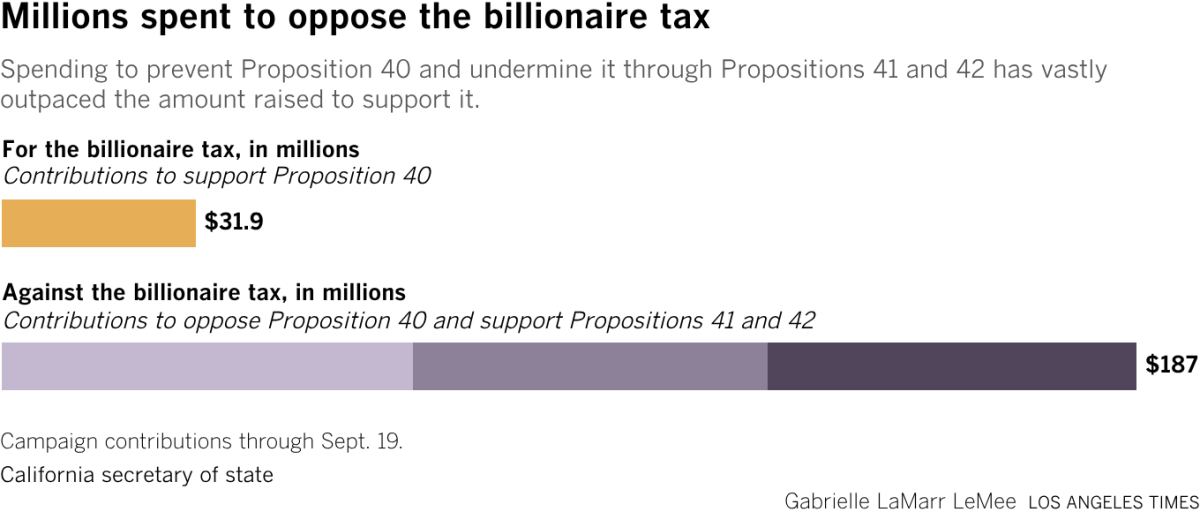
Some of those billionaires are also ponying up to defeat the measure. Brin, who according to Forbes is the world’s third-richest person, has contributed $45 million to a new ballot measure committee called Building a Better California, which is pushing an alternative statewide ballot measure that could scrap the billionaire’s tax.

Brandon Castillo, a veteran ballot measure campaign strategist who is not working on either of the two measures, said even though it’s currently polling above 50%, the billionaire’s tax is starting out “in a really shaky position.”

“This is not a very strong place to start,” he said. “That’s not to say they can’t keep this thing over 50%, but when you’re starting just barely above 50% and you have a tsunami of money and a huge campaign against you, it’s really hard to keep yourself at that level.”

Though previous public opinion polls at the state and national levels have shown broad support for requiring proof of citizenship to vote in elections, even among Democrats, the new Berkeley poll showed liberal voters are skeptical of the measure.

Proponents of voter ID contend that such laws prevent election fraud and, along with proof of citizenship mandates, prevent noncitizens from voting. Opponents say ID requirements threaten the fundamental constitutional rights of Americans who do not have the documentation readily available, and that the restrictions are unnecessary given that voting by noncitizens is rare and already outlawed in the U.S.

Under current law, Californians are not required to show or provide identification when casting a ballot in person or by mail. They are required to provide identification when registering to vote, and must swear under penalty of perjury, a felony, that they are eligible to vote and a U.S. citizen.

The poll showed that slim majorities of predominantly Spanish-speaking voters, voters who were born in another country and first-generation immigrants support the voter ID measure. A plurality of Latino voters also favor it, with 44% in support and 41% opposed.

But DiCamillo cautioned against reading too much into those numbers, noting that awareness of the measure is still relatively low.

“I’ve always seen in my history of measuring Latino voters’ support that they are relatively late deciders on most ballot measures,” he said. “How they break will be critical. I would say we’ll have to look at how they feel when we do our final preelection poll.”

Voter ID laws are also a top priority of Trump, who has pressured the Senate into taking up the SAVE Act, which would impose nationwide requirements for proof of citizenship to vote and already has passed the House of Representatives.

Castillo said Trump’s support could sway Democratic and liberal-leaning independents to vote against the measure.

Both DiCamillo and Castillo noted that with the November election still seven months away, voters are not paying much attention and those on either side of each ballot measure have not launched major campaigns yet.

“I suspect by the time election day comes around, these awareness numbers on the billionaire’s tax certainly are going to be much higher,” Castillo said. “You’re going to see 80-90% of voters familiar with it, just because they’re going to be inundated with advertising and earned media between now and November.”

The Berkeley IGS/Times poll surveyed 5,019 registered California voters online in English and Spanish from March 9 to 14. The results are estimated to have a margin of error of 2.5 percentage points in either direction in the overall sample, and larger numbers for subgroups.

Source link