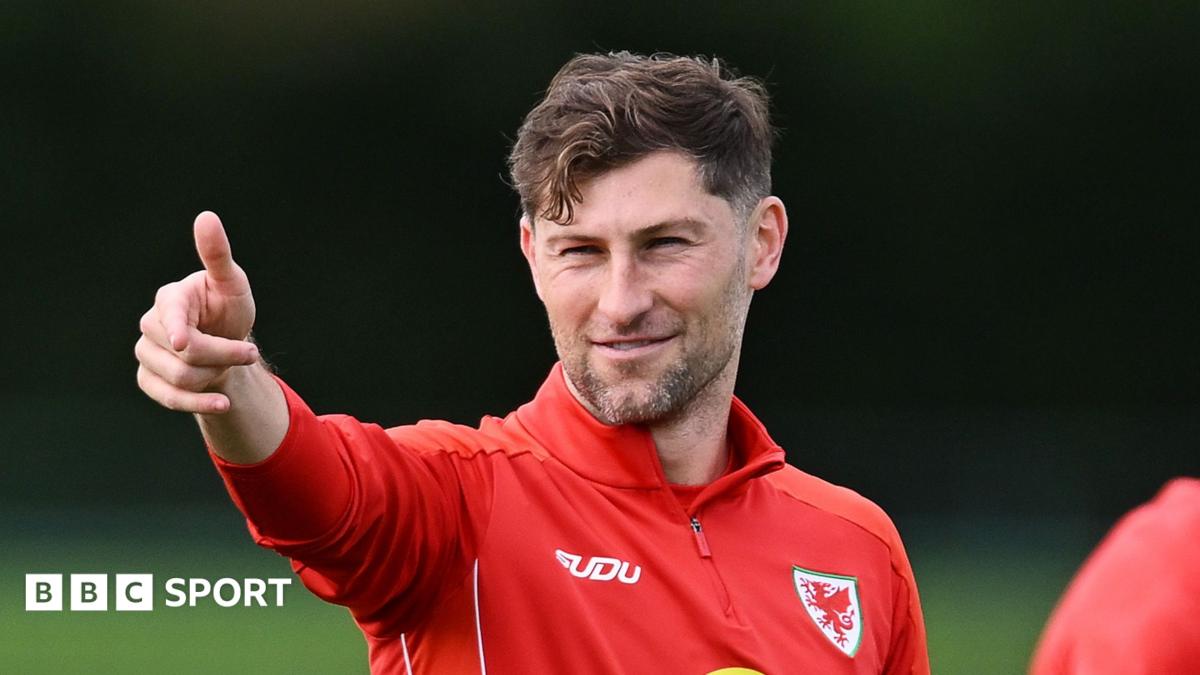
Wales will again be without the likes of Karl Darlow, Joe Rodon, Dylan Lawlor, David Brooks and Harry Wilson due to injury as they look to maintain the momentum gained thanks to the Norway triumph.
Bellamy says he has no choice but to make changes to the side which began on Thursday as Wales seek to make amends for last Sunday’s defeat in Denmark.
Having emerged with some credit despite losing their Nations League opener against Portugal 10 days ago, Wales were well beaten on a demoralising evening in Copenhagen.
Davies hopes the Cardiff City Stadium factor will be key as Wales chase victory against a Danish side who, in 21st, are 17 places above them in the Fifa rankings.
“It does make a big difference going away. We didn’t get a grip on the game [in Denmark] whereas when we played Norway in Cardiff, it’s our home, our fans, our atmosphere,” he said.
“It felt like a different game and we had much more control… you just know you have to try to make your home advantage count.”
And that won’t be the only difference from last season because Laviolette, the winningest American-born coach in NHL history, has inherited an aging team in transition, one he and his new staff have immediately tried to put their stamp on.
“The coaching changes brought a lot of excitement,” goaltender Darcy Kuemper said. “It’s new drills, new systems, so it kind of makes everyone turn on their brain and challenge themselves, which is fun for guys at this level.”
Not all of the changes are positive, however.
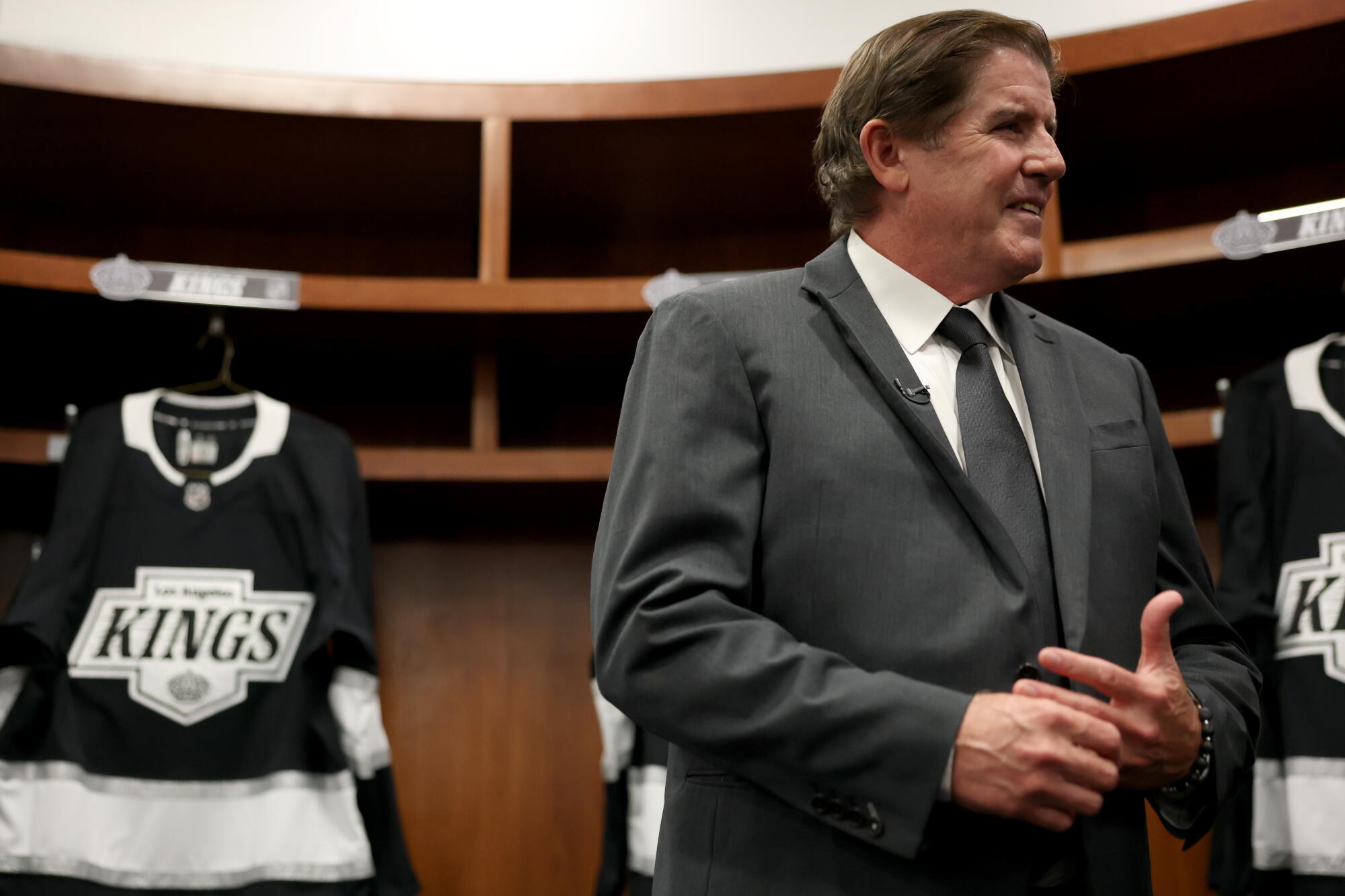
Kings coach Peter Laviolette stands in the team’s locker room at their practice facility in El Segundo in June.
(Eric Thayer / Los Angeles Times)
For the first time in 20 years, the Kings are starting a season without Anze Kopitar, the franchise leader in games, assists and points and a two-time Stanley Cup champion. That has left a big hole on the ice and in the locker room, where Kopitar’s leadership was invaluable.
Also gone are wingers Andrei Kuzmenko and Jeff Malott, who left as free agents, and center Trevor Lewis, who retired. High-scoring winger Kevin Fiala, meanwhile, will miss the first couple of months, at least, after experiencing a setback in his return from a gruesome leg injury sustained at the Milan-Cortina Olympics.
That could hurt Laviolette’s effort to transform the Kings from the defense-first system they’ve been for years into a quicker, more aggressive offensive-style team. The Kings, whose scoring has declined in each of the last four seasons, had just 225 goals in 2025-26, fourth-fewest in the NHL, while the power play converted fewer than 18% of its chances, fifth-lowest in the league.
Two of the key pieces in turning that around will be forwards Adrian Kempe, who led the team in scoring the last three seasons, and Artemi Panarin, who had his best offensive season under Laviolette with the New York Rangers, scoring 49 goals and 120 points in 2023-24. The Kings are also counting on young forwards Quinton Byfield and Alex Laferriere, both 24, to take the next step in their development.
For Laferriere, change has been the main constant in his time in Los Angeles.
Kings right wing Alex Laferriere shoots in front of Philadelphia right wing Travis Konecny on March 19.
(Jessie Alcheh / Associated Press)
“This is going to be my fourth year with my fourth different coach,” said Laferriere, who had career highs in goals (21), points (44) and average TOI (18:18) last season. “It kind of reminds me a little bit of my rookie year. It kind of gives me that fresh slate, just trying to prove myself and try to gain the coach’s belief.”
In the dressing room, the Kings have given Kopitar’s crown to defenseman Drew Doughty, who will take over as captain in his 19th NHL season. At 36, he’s the third-oldest player on one of the NHL’s oldest teams and the last holdover from the 2014 Stanley Cup team.
“I’m not changing anything about myself when it comes to leadership,” he said. “I’ve been a leader on this team for a long, long time and been the loudest voice in the locker room and the guy that people come up to.
“One thing I will change: I always had Kopi as kind of the even-keel guy, where my emotions kind of go up and down. I’m going to be more aware of that and try to keep more of an even-keel.”
Whether a new coach, a new system and a new leader will be enough to get the Kings to the playoffs for a sixth straight season remains to be seen.
Laviolette, a Stanley Cup winner with Carolina two decades ago, has missed the postseason just three times when he’s been behind the bench the whole season. But the makeover he faces with the Kings is shaping up as one of the most challenging of his career, and most of the preseason prognostications have the Kings failing to make the cut.
If Fiala comes back early and healthy and if the team adapts quickly to the change in style, those predictions may prove overly dire. If not, the transition to the Laviolette Era could be more difficult than expected.
Joel Quenneville had one mission when he took over as coach of the Ducks last year: get them back to the playoffs.
He did much better than that. The Ducks scored a franchise-record 273 goals, spent much of the season atop the Pacific Division and knocked off the powerful Edmonton Oilers in the first round of the playoffs before falling to the Vegas Golden Knights, the eventual conference champions, in the second round.
All of which raises a question for Quenneville and the Ducks coming off a summer of upheaval and turnover: What can they do for an encore?
“Expectations are going to be higher across the board,” said Quenneville, whose team opens the season Friday in Las Vegas against the Golden Knights. “That’s healthy. But at the same time, it’s an everyday thing that that challenge is going to be out there.”
Before Quenneville arrived, the Ducks stumbled through a franchise-record seven straight losing seasons. Now many of the players in his locker room are thinking beyond just making the postseason.
“The culture change, we can really feel it,” goaltender Lukas Dostal said. “What we did last year, obviously we want to improve and move even further.
“You don’t play hockey to just think like ‘OK, we want to make the playoffs.’ You want to go as far as possible. So the sky’s the limit. I really trust this team.”
“At the end of the day, you want to win a Stanley Cup,” added new captain Mikael Granlund. “You have to have that one goal. We’re going to do everything we can to be better than last year.”
Many Ducks are certainly going to be better paid than last year. General manager Pat Verbeek had no choice but to overspend on center Leo Carlsson, signing him to a five-year, $90-million contract after the Flyers offered Carlsson the same deal. The 21-year-old, who had a career-high 29 goals and 38 assists last season, is the NHL’s highest-paid player this season.
Verbeek also re-signed restricted free agents Cutter Gauthier, (six years, $81 million) and Pavel Mintyukov (five years, $36 million) and gave center Tim Washe a $9-million contract extension. Gauthier led the team with 41 goals and 69 points last season.
“It’s a sign you’re doing something correctly,” Quenneville said of his players being rewarded. “But at the same time, I don’t think we change too much our demands. They know we work on a meritocracy and the better you do, the more you’re going to play.”
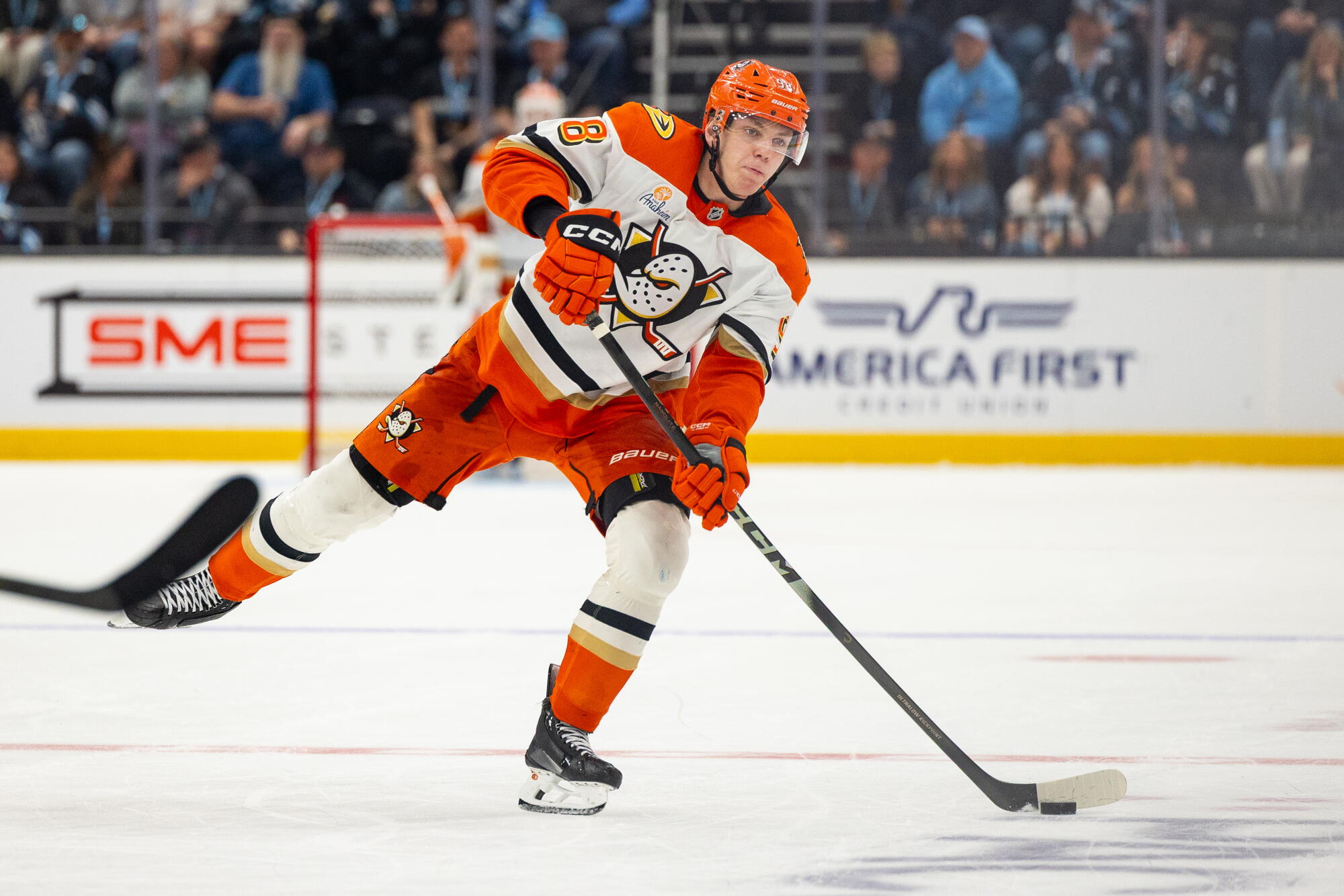
Ducks defenseman Pavel Mintyukov passes against the Utah Mammoth on March 20.
(Melissa Majchrzak / Associated Press)
All that spending left the team with nothing to offer veteran winger Chris Kreider, who was released this summer, joining an exodus that included key defensemen John Carlson, Radko Gudas, Olen Zellweger and Jacob Trouba.
The Ducks will also be without forward Troy Terry, who averaged 24 goals over the past five seasons, until well into the winter as he recovers from hip surgery.
As a result, the Ducks start with several new pieces up front and thin experience on the blue line, which isn’t a good look for a team that gave up 288 goals last season, fourth-most in the NHL.
Despite the additions of veterans A.J. Greer, a Stanley Cup winner in Florida who was acquired to add a physical presence in the attack, and Nick Jensen, 36, who was signed to stabilize the defense, the Ducks will once again have one of the youngest rosters in the NHL. But Quenneville has a history of turning young teams into champions. Nineteen years ago he took over a Chicago Blackhawks team that was the youngest in the league and led it to the conference final. A year later that team captured the Stanley Cup, the first of three Quenneville won in Chicago.
For the Ducks to match that, their summer additions will have to add up to more than the subtractions. And the investment Verbeek made in Carlsson, Gauthier and Mintyukov will have to pay off. What’s certain, however, is after last season’s breakthrough, the Ducks won’t be sneaking up on anyone.
“We made it a little harder for ourselves,” Washe said. “We’ve got a little target on our back.”
Fans have been deciphering the lyrics on the tracks of Taylor Swift’s new extended albumCredit: TAS Rights ManagementFans believe one song is about the former husband of her actress pal Sophie TurnerCredit: Splash
Taylor sings on the track, her new single: “If you wanna party with somebody who might know about the Devil on his shoulder under his halo . . . When the toxins take their hold, you’d rather die than let it go.
Sign up for the Showbiz newsletter
Thank you!
“But if you’re sick of him, I got you, I was Patient Zero. I’ve been there, felt the reeling, done the healing, said the curses and prayers when the fever turns a dreamer into a pathetic ghost.”
Taylor has revealed that the track resulted from a get- together with friends where one of them told how she had been contacted by an ex’s new girlfriend, asking if she had had the same experiences with the guy.
She added: “And everyone in our group just immediately started saying, ‘Oh, I’ve been through that too’.
“And I thought to myself, ‘If this has happened to all of us, it’s such an interesting angle on humanity and on relationships.
“And I wonder if I could write something from the perspective of getting this phone call, and really only from the perspective and the side of the phone call of the ex who’s been through it before.”
The extended album also includes an open apology to one of Taylor’s exes, who most fans are sure is Tom Hiddleston.
Taylor also previously dated Joe Jonas – and her track suggested she felt sympathy for SophieCredit: GettyAnother of the tracks appeared to offer an olive branch to ex Tom HiddlestonCredit: Getty
Their two-month romance played out very publicly in 2016, when the Night Manager actor became a laughing stock after wearing an “I heart TS” T-shirt.
On Pink Clouding, Taylor sings: “Years later, I still wonder how to tell you sorry.
“I didn’t wanna let you down. So I left you up there on a pink cloud.”
She adds: “I hope you realised my kind of trouble wasn’t worth it and the way I treated you, you never deserved it.
“And I swear to God, to this day, I wake up scared that I left scars on a good person.
“And I gave you zero reason to believe it. So be it. But it didn’t mean nothing. Just ’cause I could leave it.
“I hope you landed safely on the ground. And I hope you’re so happy now.”
Tom definitely is, but I’m not so sure Joe will feel the same, now he is trending all over social media again.
FLO LOOKS SHRED HOT
Florence Pugh wore a fabulous silver gown in a photoshoot for Vanity FairCredit: Nadine Ijewere/Vanity FairFlorence wore a futuristic headpiece for her cover image for the magazineCredit: Nadine Ijewere/Vanity Fair
FLORENCE PUGH looks like she’s ready to go to a disco in this fabulous silver gown on the cover of Vanity Fair.
The Dune actress wore the backless dress with a futuristic headpiece for the mag cover.
Florence said: “I don’t want to be a secret, but I also don’t want everything to be divulged.
“The important thing is that we’re happy, and I feel solid and safe and sturdy. And that’s worth its weight in gold in our lives.”
MANIFEST’S TURKISH DELIGHTS
VIRAL Turkish girlband Manifest are taking over the UK after landing in London to meet their fans.
The band hosted a VIP boat party on the Thames with Bizarre hanging out with them as they took in the sights of the capital, complete with Union Jack umbrellas.
During the boat ride, the girls treated us to an exclusive first performance of their as-yet-to-be-named debut English single.
They were also filming a Netflix documentary special, with Bizarre’s Jack set to make a cameo.
They will headline their first UK show next month, skipping smaller venues to headline at OVO Arena Wembley.
From what we have seen of Manifest so far, I’m sure it will be one to remember.
DUA’S SUCH A SWEETIE
Dua Lipa left little to the imagination with this creative top – that looked like it could have been made out of SmartiesCredit: Instagram/@dualipa
IF you like a tucking into the occasional tube of Smarties, this picture of Dua Lipa will hit the sweet spot.
The singer posed in a top that looked like it was made up of hundreds of the sugar-covered chocs. tied together with string.
Dua has been hard at work on a new record, the follow-up to her No1 album Radical Optimism which came out two years ago.
Fans should expect an announcement some time next year.
DOLLY’S LAST DUET WITH U2
Dolly Parton’s final vocal performance is being released as a duet with BonoCredit: Getty
DOLLY PARTON’s final vocal performance is being released as a duet with Bono on U2’s first album in nine years.
The Irish band have announced Carnaval de Luz will be out on November 12.
It includes Torn, which Dolly started before handing it over to U2 to work on, with the help of Snow Patrol’s Johnny McDaid.
Bono told Rolling Stone: “When she got ill, she got out of her bed to sing this song. And you can hear that. I can’t even listen to it now. She sang her heart out, and I cannot believe that’s an 80-year-old woman.”
Bono said it came about after Dolly, who died last month, turned down an Irish folk-themed side project he was working on.
Brian Eno, Ryan Tedder, Martin Garrix have also been involved in the album.
ELTON JOHN is opening the Apple Music Hall at Battersea Power Station in London on Monday.
Tickets go on sale at 9am the same day at applemusichall.com.
The opening series for the 600-capacity venue will also include Charli XCX, Chase & Status, Burna Boy, Arlo Parks and Troye Sivan.
Sets will later be available to watch on Apple Music.
ROBBIE: I ASKED TO JOIN OASIS
Robbie Williams has revealed he asked if he could join Oasis after Liam Gallagher left the bandCredit: Getty
On stage in Bogota, Colombia, where he is on tour, Robbie said: “I am a massive Oasis fan, so two years after they broke up I thought, ‘I’ll phone Noel Gallagher’.
“I phoned Noel and said, ‘Noel, you need a new lead singer. Let it be me’. He laughed and put the phone down. That was the last time I spoke to Noel and it makes me sad.”
Given the beef between Robbie, Noel and Liam over the years, I think it was probably a wise move.
Rob, above with Liam at Glasto in 1995, will be hoping he can get tickets for next year’s reunion tour.
I’ve still not had my code for ticket sales this weekend and the wait is killing me.