The year was 1923, and thousands of people a month were flooding into Los Angeles in hopes of finding a job in the nascent film business.
Many planned to start as background actors, dreaming they’d be discovered by a director and finally get their big break. These behind-the-scenes actors would wander from studio lot to studio lot, lining up in hopes of being cast.
But the chaos of aspiring actors searching for jobs eventually became too much. Even silent screen star Mary Pickford took to warning wide-eyed newcomers that they should save enough money to survive for five years before coming out to Hollywood.
Out of calls to create safeguards around this fledgling business, and more order around background acting opportunities, emerged the Central Casting Corp.
Central Casting — now so eponymous that its name has become a cultural phrase — celebrated its 100th anniversary earlier this month.
I recently spoke with Mark Goldstein, president and chief executive of the Burbank-based company, to talk about changes in the industry, including the threat of artificial intelligence, runaway production and the role of a background actor in 2025.
Goldstein acknowledged the tough environment for background performers, also commonly known as extras, who populate restaurants, parks and other film and TV scenes to make the environment seem more realistic — all without saying a word.
After the lows of the pandemic, and then the explosion of content during the peak TV era, one of the main challenges for Central Casting’s members is just finding new roles, he said.
“There’s been a little bit of a pullback in production over the last year,” said Goldstein, who serves as president and CEO of Central Casting as well as production finance and management tools firm Entertainment Partners, which owns the agency. “It’s really just constantly finding the right roles for people.”
In Southern California, of course, jobs have been more scarce as production has flowed to other states and countries offering steeper film incentives.
Then there is the advent of computer-generated imagery, which has lessened the need for massive crowd scenes that were once standard.
“Before [CGI] technology, we may fill up an arena, like we may fill a 5,000-person shoot or a 10,000-person shoot,” Goldstein said.
Remember the long lines for casting calls?
No more.
More recently AI has been a key concern for background actors, though Goldstein said he doesn’t think the new digital tools and the rise of synthetic characters will eliminate the need for background actors.
“There’s a lot of conversation [about] is it human or technology? And we kind of view it as human and technology,” he said. “The consumer wants believability, and so there’ll be situations where it’s really important to have the human role involved, but there may be other situations where AI and technology can be helpful.”
He added: “We have legendary people that started their career because they wanted to follow their dream to become an actor in Hollywood,” he said, ticking off the names of famous alumni such as Clark Gable, Carole Lombard, Eva Longoria, Will Ferrell and Brad Pitt. “And we don’t see that changing.”
Despite the challenges, aspiring actors still register with Central Casting every day, Goldstein said. The company has 200,000 background actors in its database, with more than 20,000 new names added a year. About 3,000 are placed in roles each day, the company says.
One of those is Jaylee Maruk, 38, who signed up with Central Casting in 2009 and has worked steadily ever since.
Maruk works often on “Grey’s Anatomy” and has credits on Hulu’s “Paradise” and Apple TV’s “Shrinking.” She once stood in for Greta Lee in Apple TV‘s “The Morning Show.”
“What I love about doing background is it really gives a solid foundation about what it’s like to be on set and what the expectations are,” Maruk said.
But she worries about her future, especially with the rise of AI and the migration of production.
“Productions will pack up and leave,” she said. “They’ll go somewhere cheaper, and it’s becoming harder and harder for us. That’s really the biggest concern, trying to entice and support productions staying here.”
Towns in far-off countries like Hungary and Turkey can be made to look just like places in America, she says. And they can cast local residents instead of U.S.-based performers like Maruk. After all, background actors don’t have speaking roles, so not speaking English isn’t a problem.
“We want our work to be here,” said the Lake Balboa resident. “Our families are here, our lives are here.”
Last year, I got a glimpse into the world of background acting when I covered the annual Los Angeles Union Background Actors Awards. Though tongue-in-cheek at times — the awards themselves are called Blurries — the ceremony and winners’ speeches also highlighted these actors’ key roles in Hollywood.
I met background actors who had done the job for years, including one who got his first role as a 12-year-old in “Hello, Dolly!” Many talked about the difficulty of the last few years and the desire for respect for their professional work. Some were full-time background actors; others did the work part time. All were passionate about what they did.
“It really is just preparedness and luck, as they say,” Maruk said. “And also just having a lot of motivation and resilience.”
Stuff We Wrote
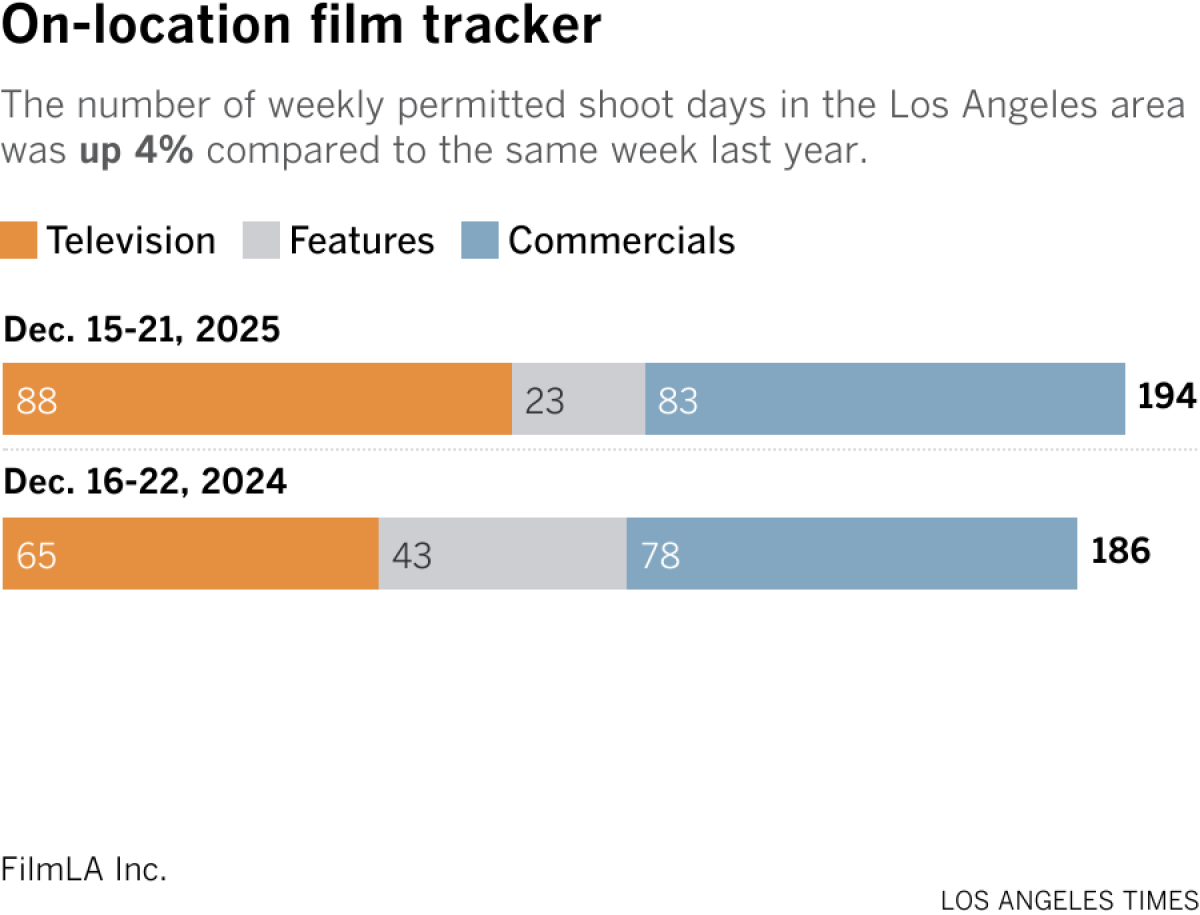
Film shoots

Number of the week

James Cameron’s “Avatar: Fire and Ash” brought in $89 million in the U.S. and Canada during its opening weekend. Globally, the film made $346 million, with big hauls in China and France.
That opening total came in at the lower end of box office analysts’ expectations and is also less than the massive opening weekend for its predecessor film, 2022’s “Avatar: The Way of Water,” which grossed $134 million in its domestic debut. But “Avatar” films tend to build momentum at the box office over subsequent weekends, so the Na’vi aren’t vanquished yet.
In addition to “Avatar,” this past weekend also saw strong performances from Angel Studios’ animated “David,” as well as Lionsgate’s thriller “The Housemaid,” pushing the year-to-date domestic box office total a slim 1% above the same time period last year. That’s helpful for theaters but doesn’t bode well for the box office’s overall performance this year.
Finally …
My colleague Josh Rottenberg looks at what movie stardom will mean in an age of AI. In that story, he has an interview with the creator of Tilly Norwood, the AI-generated character that recently sparked a furious debate in Hollywood about the role of synthetics in film and TV.