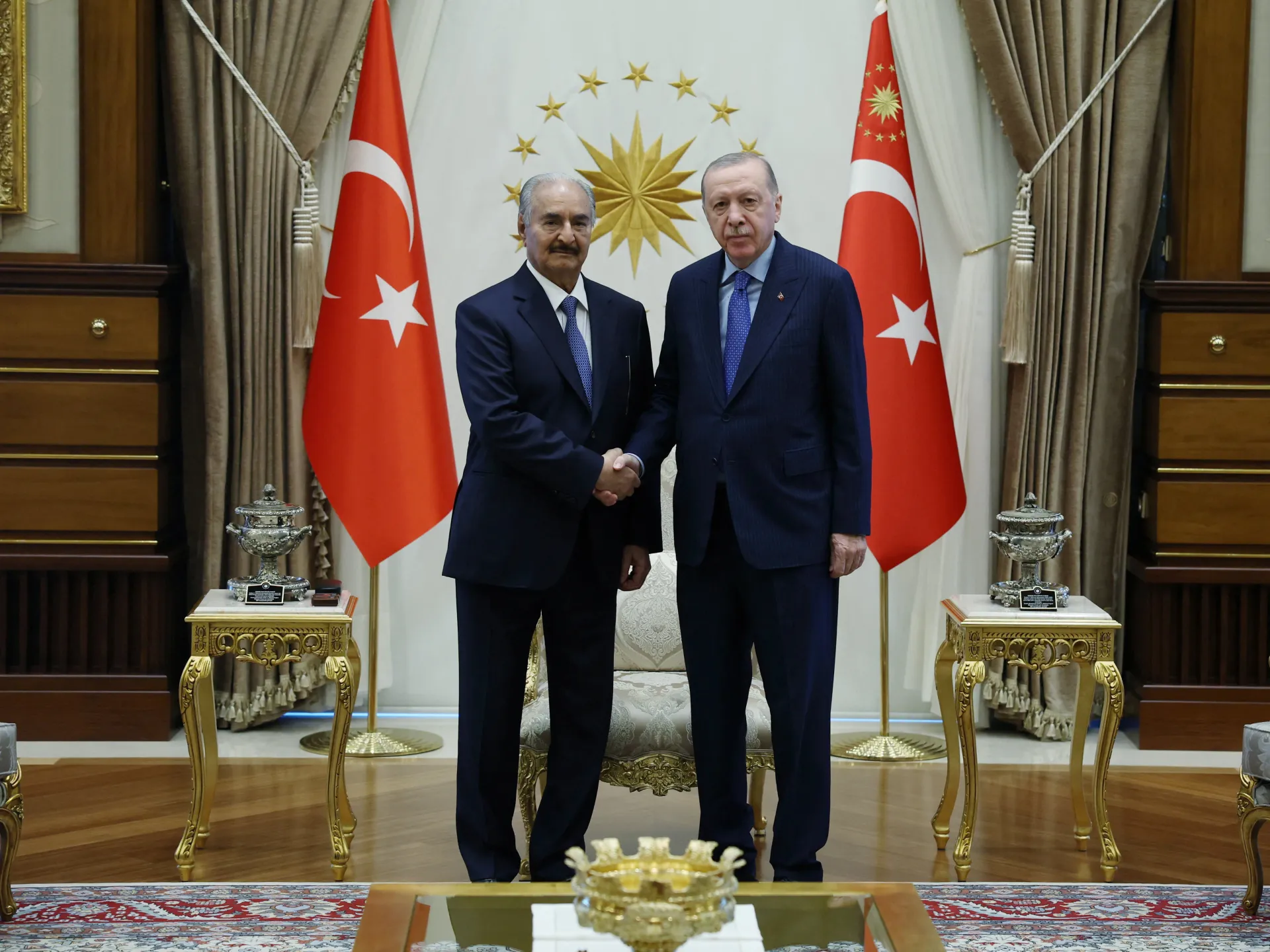
Turkish President Recep Tayyip Erdogan hosted eastern Libyan military commander Khalifa Haftar in Ankara on Wednesday, days after the Tripoli-based prime minister from the rival administration held talks with the Turkish foreign minister in Istanbul.
Haftar’s first trip to Ankara comes nearly seven years after Turkiye helped the internationally recognised Government of National Accord (GNA) repel a military offensive led by his self-styled Libyan National Army (LNA).
Recommended Stories
list of 3 itemsend of list
But following the 2020 United Nations-brokered ceasefire, Turkiye has pivoted towards a pragmatic approach, working to bring the rival administrations towards a unified government and military as it seeks to safeguard its maritime interests in the Mediterranean Sea.
The meetings come ahead of an expected visit by Erdogan to Libya, his first in 15 years, as Ankara seeks to reconcile the country’s rival administrations.
So what are Ankara’s interests in forging closer ties with Haftar, and what are the challenges ahead as Ankara seeks to reunify Libya?
Why did Turkiye invite both leaders?
Turkiye’s 2019-20 military intervention in support of the Tripoli-based government turned the tide of the Libyan civil war, forcing Khalifa Haftar’s forces to retreat from western Libya. But after the ceasefire later that year, Ankara began establishing contacts with the eastern authorities.
This rapprochement accelerated in 2025, after the United States launched efforts to reconcile Libya’s rival governments. A concurrent UN track produced the 4+4 agreement this past August, a political roadmap for a unified government and nationwide presidential and parliamentary elections within two years.
Turkiye was among the states to welcome and encourage the reconciliation process, while deepening its diplomatic and military ties with the east. In July, Ankara reached agreements with Haftar’s LNA on military infrastructure and training.
Jalel Harchaoui, a Libya analyst, told Al Jazeera that Turkiye’s military strength and staying power have granted it prestige across Libya.
“Today, no Libyan leader of consequence can afford to spurn Ankara,” he said.
Of particular importance to Ankara’s relations with Libya is a maritime boundary agreement that it signed with the Tripoli-based government in 2019, but which was only adopted by the east last month.
The deal is a political flashpoint for several countries in the Eastern Mediterranean, opposed by Greece and Israel, and has been criticised by Egypt, which argued that it violated its own maritime rights.
But Ankara has defended the agreement as lawful.
What steps has Turkiye taken to unify Libya?
Turkiye has sought to bring Libya’s rival military leaderships together. In May, Turkish Defence Minister Yasar Guler met Abdulsalam al-Zoubi, the deputy defence minister in Tripoli, and Saddam Haftar, Khalifa Haftar’s son and a senior LNA commander. Turkish intelligence chief Ibrahim Kalin later met Saddam Haftar in the eastern city of Benghazi.
In October, Ankara hosted further talks on military reunification, including discussions on establishing a joint military command in the central city of Sirte. However, disagreements over who would exercise political authority over a unified military remain unresolved.
On the economic front, Turkiye was among 10 countries that welcomed Libya’s adoption of its first unified national budget in more than a decade.
Ankara has also coordinated its diplomatic efforts with other countries involved in the reconciliation process. In June, Turkish Foreign Minister Hakan Fidan held talks in Cairo with his Egyptian and Saudi counterparts and with Massad Boulos, a senior adviser to US President Donald Trump.
In August, Fidan travelled to Tripoli and Benghazi for separate meetings with Prime Minister Abdul Hamid Dbeibah and Khalifa Haftar respectively.
Ankara has, however, not publicly endorsed a specific power-sharing arrangement. US mediators have backed a contentious proposal to make Saddam Haftar chairman of the Presidency Council, the three-member body that serves as Libya’s head of state.
It is unclear whether Erdogan’s December visit will bring Dbeibah and Khalifa Haftar together for direct negotiations. No such meeting has been confirmed.
Why does Turkiye want a united Libya?
For Turkiye, much is at stake in Libyan reconciliation. Ankara has military and economic interests in both parts of the country, as well as the maritime boundary agreement that underpins its claims to potentially gas-rich waters in the Eastern Mediterranean.
Bringing Libya under a single government would allow Ankara to pursue its defence, energy and reconstruction agreements within a unified institutional framework.
“Turkiye has gone from backing one side to engaging both because a stable, unified Libya best protects its economic and maritime interests,” said Sansom Milton, a senior research fellow at the Center for Conflict and Humanitarian Studies.
Saban Kardas, a research professor at Qatar University, told Al Jazeera that the effort was also in line with Turkiye’s historic approach to diplomacy with a divided state.
“The idea is to push for a national unity of some form. To make engagement sustainable, you need to see some measure of national unity,” he said.
What challenges remain ahead for Turkiye?
Although Ankara is currently well-positioned with Tripoli and Benghazi, analysts told Al Jazeera that instability and diverging visions of who will lead a reconciled Libya present major hurdles.
“Despite the assets and advantages Turkiye has accumulated in Libya, the country remains volatile,” Harchaoui said.
Libya is grappling with a deepening economic crisis, a weakening dinar, rising living costs, fuel and cash shortages and deteriorating public services. All of these have led to an increase in protests and strikes over the past year, casting a shadow over efforts for political stability.
While Saddam Haftar’s proposed appointment as chairman of the Presidency Council has the backing of US mediators, it faces opposition from powerful armed and political factions in western Libya, particularly in Misrata.
The city, a stronghold of the 2011 uprising that toppled Muammar Gaddafi, also helped defeat Khalifa Haftar’s offensive in 2020.
“A further difficulty is that western Libya has no single chain of command, so leaders in Tripoli cannot guarantee that the armed groups around them will accept a deal reached in their name,” said Milton, of the Center for Conflict and Humanitarian Studies.
“The main challenge is that division remains profitable for elites and armed groups on each side, who control separate revenues and institutions and have little incentive to merge them,” he added.
Kardas said, “It comes down to the local parties to put aside their differences and work through their deadlocks and divisions.”