Libya

Libya Oil Output Hits 12-Year High; Revenues Trickle In| Global Finance Magazine

Central bank bottlenecks and massive import costs delay the impact of a $4B windfall.

War-torn Libya is pumping oil at its fastest pace in more than a decade, averaging about 1.4 million barrels per day in April, according to National Oil Corp. operating data.

Still, refining capacity, distribution networks, and subsidy-financed imports remain strained by years of institutional division since the 2011 conflict, when production fell sharply from about 1.5 million barrels per day to near-collapse levels during the civil war.

The imbalance reflects Libya’s fragmented downstream system, where crude oil exports continue but refining capacity, distribution networks, and subsidy-financed imports remain strained by years of institutional disruption since the 2011 uprising and the overthrow of longtime dictator Muammar Gaddafi, when production fell sharply.

Tracking Libya’s Hydrocarbon Windfall

The state-owned NOC reported $2.82 billion in gross oil revenue in April, followed by nearly $4 billion in May, the highest monthly intake in over 10 years, according to local energy reports citing official data. Crude flows through Es Sider, Ras Lanuf, and Zawiya terminals into Mediterranean markets, where it is priced against Brent-linked benchmarks.

Translating stronger production and upstream earnings into direct benefits to the state and its people remains challenging, however.

The May surge coincided with a sharp increase in fuel imports; NOC Chairman Masoud Suleman confirmed the contracting of 17 gasoline tankers, the highest monthly fuel import volume in Libya’s history. Even as import activity rose, several cities in western Libya reported fuel shortages and long queues at filling stations, exposing persistent breakdowns in domestic distribution.

The cash conversion of oil earnings is still structurally uneven. In April, only $1.91 billion of $2.82 billion in gross revenue reached the Central Bank of Libya after fuel-import and settlement deductions routed through the Libyan Foreign Bank mechanism. That left roughly $910 million stuck within upstream settlement layers awaiting final transfer into the sovereign liquidity system.

On June 3, the central bank launched a $3.5 billion foreign currency allocation program to cover letters of credit (LOCs), foreign transfers, and retail foreign-currency demand, according to Libyan financial disclosures, amid persistent import financing pressure on food, fuel, and industrial inputs.

Central Bank at the Center of Fiscal Fault Line

The central bank sits at the center of this fiscal roundelay. It is the sole legal recipient of hydrocarbon revenues and converts inflows into domestic liquidity for salaries, imports, and foreign exchange allocations, making it the clearing hub for the national economy.

That role has repeatedly placed it at the center of political escalation. Last August, a dispute over central bank leadership triggered a production shutdown in the eastern half of the country that quickly cut output from nearly 959,000 barrels per day to 591,000, according to NOC data. The United Nations Support Mission in Libya warned that disruption of the central bank’s clearing function would freeze LOCs and salary payments, given that hydrocarbons account for more than 90% of export earnings.

The underlying political structure remains split between the UN-backed Government of National Unity in Tripoli and the Government of National Stability based in Benghazi and Tobruk in the east; UN mediation is ongoing, but national elections remain stalled. A rare shift occurred on April 11, however, when the rival eastern and western legislative bodies signed a landmark agreement to unify public spending, creating Libya’s first consolidated budget framework since 2013.

Foreign Majors Return as Political Risk Persists

Production recovery continues. Libya is targeting 1.6 million barrels per day by the end of 2026, supported by the rehabilitation of mature fields across the Sirte and Murzuq basins and incremental drilling gains.

Investment is also returning at scale.

In February, Libya awarded oil and gas exploration licenses for the first time in 17 years, granting acreage to Chevron, Eni, QatarEnergy, and Repsol, alongside other global operators competing for the Sirte, Murzuq, and offshore Mediterranean blocks. The round followed broader upstream agreements involving TotalEnergies and ConocoPhillips, BP, Shell, and ExxonMobil, signaling renewed international exposure to Libya’s estimated 48.4 billion to 50 billion barrels of proven reserves, the largest in Africa.

Libya’s constraint is now fiscal rather than geological, the analytics firm Geopolitical Desk notes; production has stabilized, but “funding flows remain irregular, procurement cycles constrained, and fiscal authority contested across parallel administrations.”

The result is a landscape where record output, rising revenues, and partial political coordination coexist with fragmented financial execution, ensuring that Libya’s oil recovery is measured in barrels but constrained in how fully it translates into state power.

Source link

Libya’s largest oil refinery halts operations during fighting | Conflict News

Zawiya refinery shut down in ‘precautionary measure’ as emergency declared following explosions and gunfire nearby.

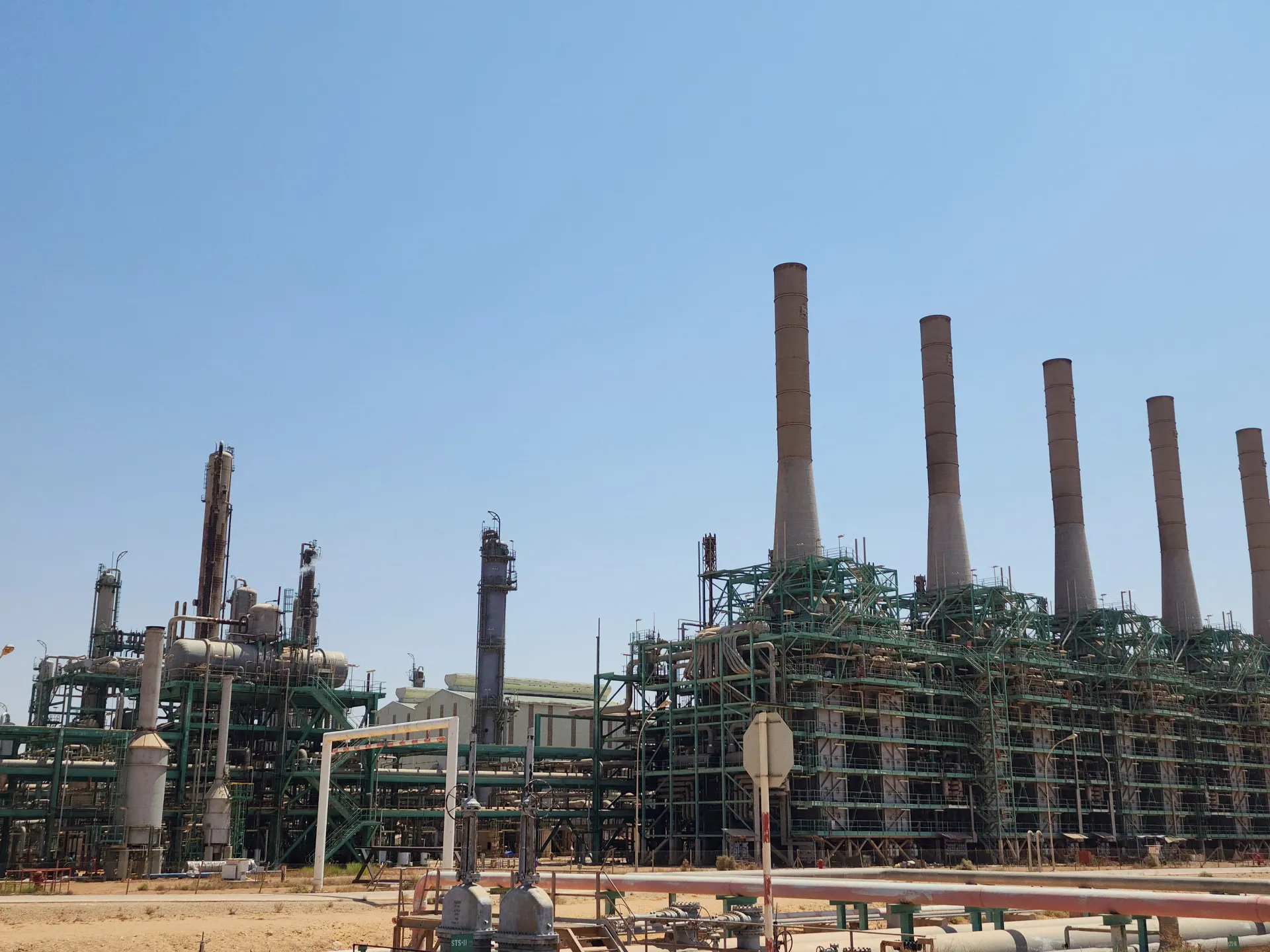
Libya’s largest operational oil refinery at Zawiya has been shut down and ‌an emergency declared following fighting between armed groups nearby.

The National Oil Corporation (NOC) and Zawiya Refining Company announced a “precautionary halt” to operations and evacuated employees from the oil complex and port.

Recommended Stories

list of 3 itemsend of list

NOC confirmed the safety of all employees and added that fuel supplies would continue as normal.

A Facebook statement said alarm sirens were activated “following armed clashes involving heavy weapons that erupted around the oil complex in the early hours of Friday”.

“These clashes resulted in several heavy weapons projectiles landing in various locations within the oil complex,” adding that no significant damage had been reported.

“However, the clashes have intensified and reached the residential area adjacent to the refinery, making the area a direct target for heavy shelling and significantly increasing the risk of further damage,” it said.

Authorities in Zawiya, west of the capital Tripoli, said they had launched a “large-scale operation” against criminal groups, as fighting and explosions were heard, the AFP news agency reported.

The operation targeted “criminal hideouts and wanted individuals” who were “involved in serious acts”, the authorities said, citing “murder and attempted murder, kidnapping and extortion, drug, arms and human trafficking and illegal migration”.

Videos verified by Al Jazeera showed explosions and gunfire, as well as damage to several cars and facilities inside the refinery. The sound of sirens was audible after shells fell inside operational sites.

The Zawiya Refining Company called on all parties to cease fire immediately and for the Libyan authorities to intervene to protect lives and key facilities.

The refinery, around 40km (25 miles) west of Tripoli, has a capacity of 120,000 barrels per day. It is connected to the 300,000 ⁠bpd Sharara oilfield.

Since Muammar Gaddafi’s downfall in 2011, Libya has been plagued by violence between the Tripoli-based Government of National Unity (GNU), led by Prime Minister Abdul Hamid Dbeibah, and the eastern-based government, led by military leader Khalifa Haftar which is not internationally recognised.

It is unclear what caused the fighting, but local media said it started following a security operation against armed groups.

Source link

Camouflaged F-15E Painted To Mark F-111’s Libya Raid Blasts Through Mach Loop On First Flight

A U.S. Air Force F-15E Strike Eagle, specially painted to mark 40 years since Operation Eldorado Canyon, the U.S. raid on Libya, has taken to the air for the first. Hauling a load of eight inert 500-pound GBU-12 laser-guided bombs, today the jet flew the legendary low-level routes that run through Wales, better known as the Mach Loop. The spectacular accompanying photos of the sortie were kindly shared with TWZ by David Lister and Alec Walker.

With a color scheme recalling an F-111F Aardvark of the same unit, the 48th Fighter Wing F-15E serial 91-0311 had first been unveiled in a ceremony at RAF Lakenheath in England, on April 28. However, it seems its first flight in its new look was recorded today.

The F-15E screaming through the Mach Loop earlier today. facebook.com/davidlisterphotography

The jet departed Lakenheath in the morning as EAGLE 31, accompanied by its wingman, EAGLE 32. After taking on fuel from a KC-135 Stratotanker, the jets headed to North Wales. From there, EAGLE flight went to the Holbeach Air Weapons Range on the coast north of Lakenheath, where the inert bombs were dropped. 

A U.S. Air Force F-15E Strike Eagle, specially painted to mark 40 years since Operation Eldorado Canyon, the raid on Libya, has taken to the air.
facebook.com/davidlisterphotography David Lister

Recalling the F-111, the specially painted F-15E has the same camouflage scheme in two shades of green and tan, and the original 494th Tactical Fighter Squadron marking and red band on the tail. The tails of the jet also bear the legend “40 years Eldorado Canyon,” the panther emblem of the 494th, an F-111 silhouette, and the 48th wing’s Statue of Liberty insignia.

Notably, the nose radome is left in its standard gray paint.

The bombed-up F-15E departs Lakenheath earlier today. Stewart Jack
Stewart Jack

Elsewhere on the nose, the Strike Eagle carries another F-111 silhouette and the inscription “Karma 52” in red. This commemorates KARMA 52, the Lakenheath-based F-111F serial 70-2389, which was the only example of the type lost during the Eldorado Canyon raid. The jet, armed with four GBU-10 laser-guided bombs, was flown by pilot Capt. Fernando L. Ribas-Dominicci, and weapons system officer Capt. Paul Lorence. The exact fate of KARMA 52 remains unknown, with the aircraft wreckage never being located after it came down in the Mediterranean.

Capt. Ribas-Dominicci’s body was later washed ashore; the body of Captain Lorence was never recovered. Their mission had been a hazardous one: a single-ship, low-level attack on a heavily defended target at night.

A U.S. Air Force F-15E Strike Eagle aircraft assigned to the 494th Fighter Generation Squadron sits behind a heritage design mock-up at RAF Lakenheath, England, March 18, 2026. During Operation El Dorado Canyon, an F-111F Aardvark “Karma 52” aircraft, the captain and the weapons system officer went missing while flying over the Mediterranean Sea. The markings on the modern paint scheme pay tribute to the personnel and aircraft that were lost during the mission. (U.S. Air Force photo by Airman 1st Class Rilynn Jacobs)
The F-15E sits behind a heritage design mock-up at RAF Lakenheath, England, March 18, 2026. U.S. Air Force photo by Airman 1st Class Rilynn Jacobs Airman 1st Class Rilynn Jacobs

Two dozen F-111s of the 48th Fighter Wing, also based at Lakenheath, were at the forefront of the Air Force’s Eldorado Canyon strikes, conducted in April 1986, together with Navy assets from the aircraft carriers USS America and USS Coral Sea. The raid was launched by U.S. President Ronald Reagan after the bombing of a West Berlin discotheque, in which two U.S. soldiers were killed and over 70 others wounded. Libyan leader Muammar Gaddafi was blamed for the attack.

U.S. airmen prepare a 48th Fighter Tactical Wing F-111F Aardvark aircraft for take-off prior to Operation Eldorado Canyon. National Archives

Ever since, the 48th Fighter Wing at Lakenheath has remained the first choice for a wide variety of critical missions around the globe, most recently Operation Epic Fury over Iran. This campaign has seen four combat losses of the F-15E, three of them to friendly fire. As to the other loss, this led to one of the most dramatic and complex combat search and rescue (CSAR) missions of recent times, before the two crew were safely recovered.

Alec Walker/@phoenixegmh Alec Walker

As of 2025, as you can read about here, the Air Force was planning to return its two squadrons of F-15Es from Lakenheath — the only permanently forward-deployed examples of the aircraft — to the United States.

Currently, Lakenheath is home to the 492nd and 494th Fighter Squadrons flying the Strike Eagle. These squadrons each have a primary aircraft assigned (PAA) complement of 26 aircraft, although this is subject to some fluctuation. Under the 48th Fighter Wing, these operate alongside the 493rd and 495th Fighter Squadrons flying the F-35A, the first of the Air Force’s stealth jets to be based in Europe.

F-35As assigned to the 495th Fighter Squadron at RAF Lakenheath. U.S. Air Force Photo By Tech. Sgt. Rachel Maxwell 

As well as being fitted with the more powerful Dash 229 engines, Lakenheath’s F-15Es have been at the front of the queue to receive a sophisticated new radar warning and electronic warfare suite, the AN/ALQ-250 Eagle Passive/Active Warning Survivability System, or EPAWSS.

With the F-35A now firmly embedded at Lakenheath and apparently also provided with forward-deployed B61-12 thermonuclear gravity bombs, these stealthy jets may well take over entirely the F-15E, provided Congress approves consolidating the Strike Eagles in the United States. It is also possible that the decision to significantly boost the planned F-15EX Eagle II buy may see these plans changed.

In the meantime, the F-35A flies alongside the F-15E at Lakenheath, where these jets and their airmen continue the proud traditions of the 48th Fighter Wing.

Contact the author: thomas@thewarzone.comu

Thomas is a defense writer and editor with over 20 years of experience covering military aerospace topics and conflicts. He’s written a number of books, edited many more, and has contributed to many of the world’s leading aviation publications. Before joining The War Zone in 2020, he was the editor of AirForces Monthly.


Source link