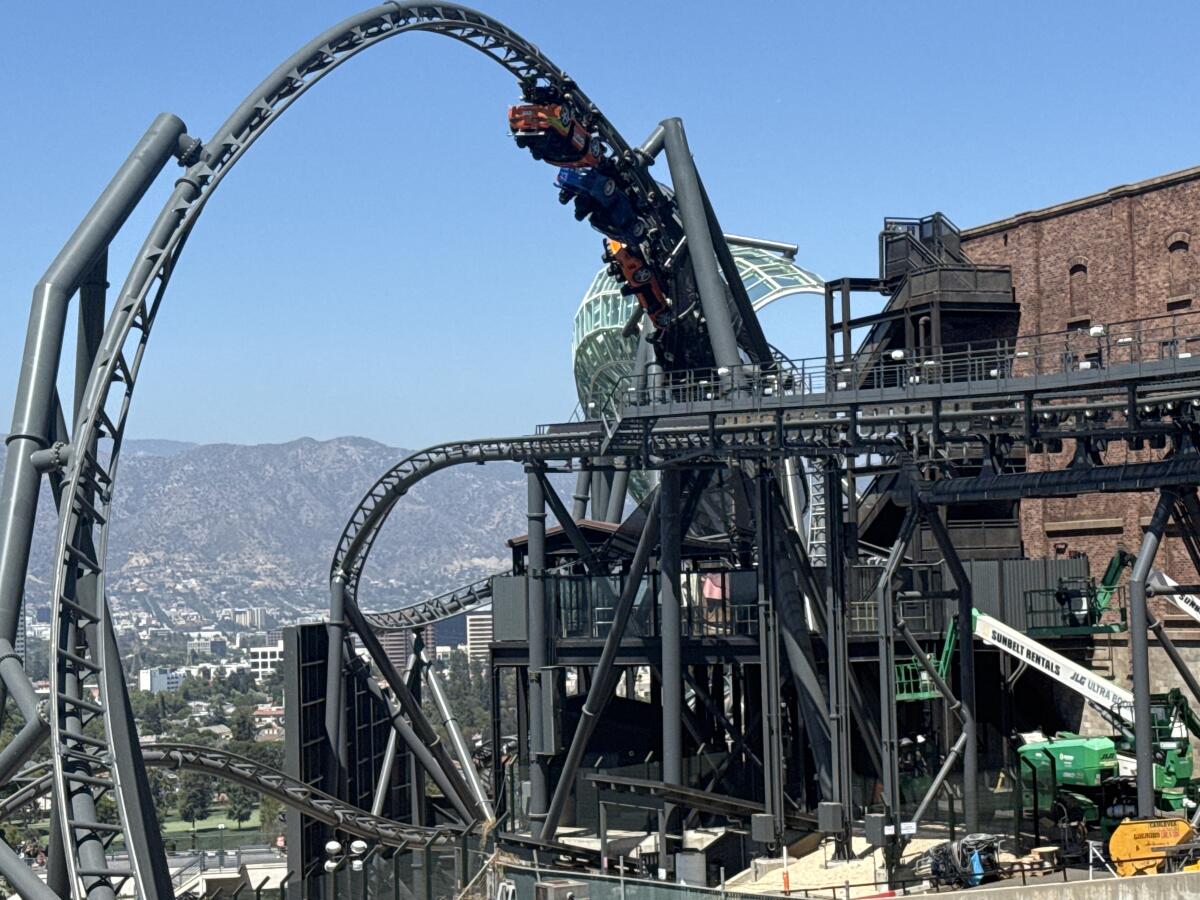
When the creators behind Universal Studios Hollywood’s soon-to-open “Fast & Furious” coaster discusses the attraction, they speak of it not only as the most grown-up, intense ride at the park, but also as one of the most extreme coasters in Universal‘s global portfolio. That means, in theory, a ride as vaunted as its Florida coasters Jurassic World VelociCoaster and Stardust Racers.
For riders, some of the perception of danger will come from the coaster’s location. Fast & Furious: Hollywood Drift is set on a hill between the park’s upper and lower lots. It will careen over, under and around guest escalators, and take attendees on a journey that includes multiple inversions and speeds of 72 mph, making it the fastest coaster at any Universal park. A particularly unique facet is the ability for its cars, each meticulously designed after a real vehicle, to rotate 360 degrees.
Plenty of coasters have the capacity to spin, but Universal has been hyping the high-speed “drift” sensation of its cars. Each ride vehicle will have distinct programming along the coaster’s 4,100 feet of track, and the hope is to create the feel of a stunt car just barely maintaining its control.
I like a coaster, but I’m also, I’ll admit, a tad squeamish. Hollywood Drift is expected to open by mid-summer, and at the time of writing, only Universal stakeholders had been on the attraction. Jon Corfino, the park’s lead creative executive, was one of those riders, so as he gave me a tour of the coaster, I pressed him to describe what the experience is like. Here’s what I learned.
So Fast & Furious: Hollywood Drift is intense. But just how intense is it?

A loop on Fast & Furious: Hollywood Drift.
(Todd Martens / Los Angeles Times)
The late, great theme dark designer Eddie Sotto once devised a simple formula for what makes a good coaster: Fear minus death equals fun. I wanted to ask Corfino just how scared I would be. Answer: Pretty frightened. Probably.
“It’s a high level of intensity, absolutely, for sure,” Corfino says.
And yet Corfino tried to calm my nerves. Hollywood Drift, he explained, is designed to feel relatively slick — polished, if you will.
“I’ve ridden coasters that I would say are high intensity, but they’re very aggressive,” he says. “They’re very rough. But if you look at what we tried to achieve here, it’s that you’re in a [car] vehicle. It’s very smooth. It’s not something that would be not natural for a car, if that makes sense.”
Well, except for the whole going upside down part. Based on Corfino’s assessment, we can expect some white knuckles, as Hollywood Drift will lift riders off their seats at multiple points.
“You definitely feel you’re coming out a couple times, and not the least of it is when you’re upside down,” Corfino says. The coaster will utilize a lap restraint that extends from the top.
“You’ll be holding on,” he says. “When you’re upside down, you’re holding on.”
What about the drops?

Unversal Studios’ Hollywood’s Fast & Furious: Hollywood Drift is set to open this summer.
(Todd Martens / Los Angeles Times)
Corfino didn’t pinpoint the exact steepness of the drops on Hollywood Drift, but riders will encounter one immediately after launch. When exiting the show building, designed to look like a warehouse garage, Hollywood Drift will take a sudden dip off a cliff. The sharp drop is one of many.
Riders will encounter, for instance, a so-called “bunny hop,” which is typically a series of small hills that provide airtime. But Hollywood Drift will play with riders’ expectations through its terrain. Those mid-ride hills are “actually pretty darn steep,” Corfino says. And then before the ride ends, riders will go up, over and under Universal Studios’ most recognizable feature (except perhaps Stuart the Minion): its escalators.
“When you go up over the loop, that’s very steep. You’re coming straight down over the stairway and then underneath the stairway,” Corfino says.
How real are the cars?

The minicars of Fast & Furious: Hollywood Drift.
(Todd Martens / Los Angeles Times)
The coaster will feature four heavily detailed miniature cars as ride vehicles. These four-seaters — mimicking a Dodge Charger, Mazda RX-7, Nissan Skyline GT-R and Toyota Supra — all come complete with working taillights. And each has its own distinct sound effects, engine and brake noises that match their real cars. Guests will hear brakes each time the vehicle drifts or turns.
The minicars aren’t complete tiny re-creations. The odometers in the coaster cars, for instance, are for show only.
“The truth is I was really laboring,” Corfino says of the accuracy of the coaster cars. “They all have realistic sound effects, and when you hit the bottom, the big launch, I wanted to hear the NOS kick in. But you’re going so fast, at 72 mph, and with the wind, you’re not hearing anything. Quite frankly, your vision is even kind of shaky because you’re going so fast.”
That sort of attention to detail is what separates a Universal or Disney coaster from so much of the industry — even if riders will be clutching their restraints too hard to notice the discrepancies in each car’s engine roar.
I’m eager to get on the ride. I will, however, pretend I didn’t hear Corfino say that thing about “shaky” eyesight.
This week in SoCal theme parks

Dataland is now open in downtown Los Angeles. Theme park fans should give it a look.
(Carlin Stiehl / For The Times)
- “Stranger Things” lives at Halloween Horror Nights. Universal Studios Hollywood’s trickle of announcing haunted houses for its Halloween event continues. After unveiling a “Sinners” house earlier this year, Universal has added “Stranger Things” to the roster. “Stranger Things” is no outsider to the festivities, but this house will be themed specifically to the show’s fifth and final season. Expect, of course, some Demogorgons and other nasty creatures. Halloween Horror Nights is set to launch on Sept. 3.
- Theme park fans, pay attention to this new museum. Now open in downtown Los Angeles is Dataland, which was described by this outlet as a “25,000-square-foot immersive, environmental, generative, multisensory AI arts museum.” While there’s much to discuss and debate regarding the center’s use of AI, Dataland’s inaugural exhibition, “Machine Dreams: Rainforest,” is the kind of all-encompassing, wrap-around display theme parks are known for (I’d argue Dataland is, in fact, more indebted to theme parks than the world of fine arts, but that’s another column). No doubt those in the immersive space are paying close attention as to how Dataland is received.
- “Toy Story 5” has arrived, in theaters and at the Disneyland Resort. Fans of the “Toy Story” franchise will want to make their way to Disneyland’s Pixar Place Hotel, where a second-floor exhibit features drawings and sculptures from the new film. And for hotel guests, coming July 2 is the “Disney Poolside Splash Bash,” a pool party with music, trivia and appearances from Jessie, Bo Peep and Woody. If you’ve seen the movie, I encourage you to check out Amy Nicholson’s review of the work. She found, perhaps, that the toys have overstayed their welcome.
- Bag checks and metal detectors arrive at CityWalk. Universal Studio’s theme park adjacent shopping and dining area is home to a couple should-be cultural institutions: the Los Angeles outpost of Jimmy Buffett’s Margaritaville and one of the finer Imax theaters in the nation. Now getting to either comes with an extra hurdle, as Universal has placed CityWalk within the theme park’s security zone. Prepare for bag checks, metal detectors and extra time if you’re heading to a sold-out screening of Christopher Nolan’s “The Odyssey.” The local film community, as reported by The Wrap, is having a fit.
What I’m thinking about

A media image distributed by Adobe and Walt Disney Imagineering is designed to show how AI software can be used in the design process.
(Adobe / Walt Disney Imagineering)
Generating attention this week was an announcement from Adobe and Walt Disney Imagineering, the creative arm of the company responsible for theme park designs, regarding a new AI partnership. AI is a term I generally believe is rightfully viewed with skepticism, especially when it comes to creative work. As a writer, I view utilizing AI to help craft a story as strictly forbidden; journalism, after all, is a storytelling art. But I’m not above tools that can help accelerate tedious aspects of the process, such as using AI to help transcribe an interview.
So places in which Adobe’s Firefly Foundry could, say, transform drawn 2D renderings into potential 3D models seem not entirely troublesome, especially for an industry in which one of the most time-consuming aspects is the build. And yet there were components of the announcement, as well as the press materials distributed with it, that made me cringe. The generation of on-demand, on-brand assets, for instance — one of the promised abilities of the software — is a job for an artist, not a computer.
And Adobe and WDI proved my point. Accompanying the press release was an image of Disneyland’s Haunted Mansion ride vehicles, the Doombuggies, as re-imagined by the program. A perfect, coffin-like design from Bob Gurr was now bedazzled with garish, grotesque imagery that had little similarity with anything in the Haunted Mansion. That the two companies viewed something this amateurish as a prime example of what the software could achieve should raise an eyebrow.
Tell us your stories. Ask us your questions.
Have a theme park tale to share? Whether it was a good day or less-than-perfect day, I would love to hear about it. Have a question? A tip? A fun photo from the parks to share? Email me at todd.martens@latimes.com. I may feature your note in an upcoming newsletter.
Ride on,
Todd Martens
P.S.

Changes are coming to Disneyland’s classic Autopia ride.
(Allen J. Schaben / Los Angeles Times)
Disneyland’s classic Autopia attraction is facing a deadline. The Disneyland Resort has already stated that the gas-powered minicars of Autopia would be on the way out in early 2027. Disneyland officials confirmed just a few weeks ago that the park has an agreement with the California Air Resources Board to retire the current engines next year. No closing or reopening date has been announced, and no details on the new cars have yet been released.
But, thanks to new reporting from environmental reporter (and former Times staffer) Sammy Roth, it’s been revealed that the theme park faces a strict deadline to begin making the switch. In a recent edition of Roth’s Climate Covered Goggles, the writer noted that due to an agreement with the board, Autopia in its current form must shut down by Feb. 1, 2027.
While that doesn’t shed any clarity on when the ride may reopen with refreshed vehicles, it at least provides a timeline as to how long it will likely exist in its current form.