studios

What it’s like to ride ‘Fast & Furious’ at Universal Studios Hollywood

When the creators behind Universal Studios Hollywood’s soon-to-open “Fast & Furious” coaster discusses the attraction, they speak of it not only as the most grown-up, intense ride at the park, but also as one of the most extreme coasters in Universal‘s global portfolio. That means, in theory, a ride as vaunted as its Florida coasters Jurassic World VelociCoaster and Stardust Racers.

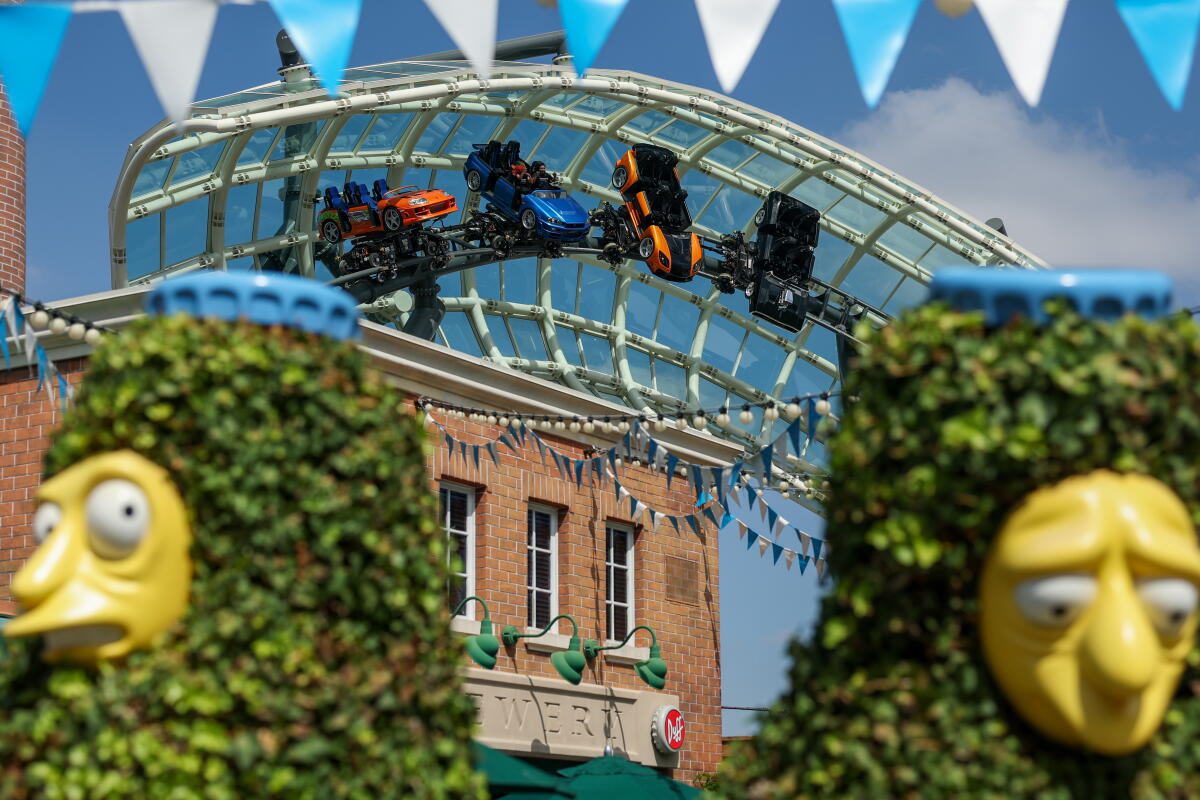
For riders, some of the perception of danger will come from the coaster’s location. Fast & Furious: Hollywood Drift is set on a hill between the park’s upper and lower lots. It will careen over, under and around guest escalators, and take attendees on a journey that includes multiple inversions and speeds of 72 mph, making it the fastest coaster at any Universal park. A particularly unique facet is the ability for its cars, each meticulously designed after a real vehicle, to rotate 360 degrees.

You’re reading Mr. Todd’s Wild Ride newsletter

Todd Martens’ newsletter delivers news and commentary on the past, present and future of theme parks, right from the theme park capital of the world — Southern California.

Plenty of coasters have the capacity to spin, but Universal has been hyping the high-speed “drift” sensation of its cars. Each ride vehicle will have distinct programming along the coaster’s 4,100 feet of track, and the hope is to create the feel of a stunt car just barely maintaining its control.

I like a coaster, but I’m also, I’ll admit, a tad squeamish. Hollywood Drift is expected to open by mid-summer, and at the time of writing, only Universal stakeholders had been on the attraction. Jon Corfino, the park’s lead creative executive, was one of those riders, so as he gave me a tour of the coaster, I pressed him to describe what the experience is like. Here’s what I learned.

So Fast & Furious: Hollywood Drift is intense. But just how intense is it?

One of the inversions of Fast & Furious: Hollywood Drift.

A loop on Fast & Furious: Hollywood Drift.

(Todd Martens / Los Angeles Times)

The late, great theme dark designer Eddie Sotto once devised a simple formula for what makes a good coaster: Fear minus death equals fun. I wanted to ask Corfino just how scared I would be. Answer: Pretty frightened. Probably.

“It’s a high level of intensity, absolutely, for sure,” Corfino says.

And yet Corfino tried to calm my nerves. Hollywood Drift, he explained, is designed to feel relatively slick — polished, if you will.

“I’ve ridden coasters that I would say are high intensity, but they’re very aggressive,” he says. “They’re very rough. But if you look at what we tried to achieve here, it’s that you’re in a [car] vehicle. It’s very smooth. It’s not something that would be not natural for a car, if that makes sense.”

Well, except for the whole going upside down part. Based on Corfino’s assessment, we can expect some white knuckles, as Hollywood Drift will lift riders off their seats at multiple points.

“You definitely feel you’re coming out a couple times, and not the least of it is when you’re upside down,” Corfino says. The coaster will utilize a lap restraint that extends from the top.

“You’ll be holding on,” he says. “When you’re upside down, you’re holding on.”

What about the drops?

Rotating coaster cars coming down from a loop.

Unversal Studios’ Hollywood’s Fast & Furious: Hollywood Drift is set to open this summer.

(Todd Martens / Los Angeles Times)

Corfino didn’t pinpoint the exact steepness of the drops on Hollywood Drift, but riders will encounter one immediately after launch. When exiting the show building, designed to look like a warehouse garage, Hollywood Drift will take a sudden dip off a cliff. The sharp drop is one of many.

Riders will encounter, for instance, a so-called “bunny hop,” which is typically a series of small hills that provide airtime. But Hollywood Drift will play with riders’ expectations through its terrain. Those mid-ride hills are “actually pretty darn steep,” Corfino says. And then before the ride ends, riders will go up, over and under Universal Studios’ most recognizable feature (except perhaps Stuart the Minion): its escalators.

“When you go up over the loop, that’s very steep. You’re coming straight down over the stairway and then underneath the stairway,” Corfino says.

How real are the cars?

Coaster car vehicles on a track.

The minicars of Fast & Furious: Hollywood Drift.

(Todd Martens / Los Angeles Times)

The coaster will feature four heavily detailed miniature cars as ride vehicles. These four-seaters — mimicking a Dodge Charger, Mazda RX-7, Nissan Skyline GT-R and Toyota Supra — all come complete with working taillights. And each has its own distinct sound effects, engine and brake noises that match their real cars. Guests will hear brakes each time the vehicle drifts or turns.

The minicars aren’t complete tiny re-creations. The odometers in the coaster cars, for instance, are for show only.

“The truth is I was really laboring,” Corfino says of the accuracy of the coaster cars. “They all have realistic sound effects, and when you hit the bottom, the big launch, I wanted to hear the NOS kick in. But you’re going so fast, at 72 mph, and with the wind, you’re not hearing anything. Quite frankly, your vision is even kind of shaky because you’re going so fast.”

That sort of attention to detail is what separates a Universal or Disney coaster from so much of the industry — even if riders will be clutching their restraints too hard to notice the discrepancies in each car’s engine roar.

I’m eager to get on the ride. I will, however, pretend I didn’t hear Corfino say that thing about “shaky” eyesight.

This week in SoCal theme parks

Dataland is now open in downtown Los Angeles. Theme park fans should give it a look.

Dataland is now open in downtown Los Angeles. Theme park fans should give it a look.

(Carlin Stiehl / For The Times)

  • “Stranger Things” lives at Halloween Horror Nights. Universal Studios Hollywood’s trickle of announcing haunted houses for its Halloween event continues. After unveiling a “Sinners” house earlier this year, Universal has added “Stranger Things” to the roster. “Stranger Things” is no outsider to the festivities, but this house will be themed specifically to the show’s fifth and final season. Expect, of course, some Demogorgons and other nasty creatures. Halloween Horror Nights is set to launch on Sept. 3.
  • Theme park fans, pay attention to this new museum. Now open in downtown Los Angeles is Dataland, which was described by this outlet as a “25,000-square-foot immersive, environmental, generative, multisensory AI arts museum.” While there’s much to discuss and debate regarding the center’s use of AI, Dataland’s inaugural exhibition, “Machine Dreams: Rainforest,” is the kind of all-encompassing, wrap-around display theme parks are known for (I’d argue Dataland is, in fact, more indebted to theme parks than the world of fine arts, but that’s another column). No doubt those in the immersive space are paying close attention as to how Dataland is received.
  • “Toy Story 5” has arrived, in theaters and at the Disneyland Resort. Fans of the “Toy Story” franchise will want to make their way to Disneyland’s Pixar Place Hotel, where a second-floor exhibit features drawings and sculptures from the new film. And for hotel guests, coming July 2 is the “Disney Poolside Splash Bash,” a pool party with music, trivia and appearances from Jessie, Bo Peep and Woody. If you’ve seen the movie, I encourage you to check out Amy Nicholson’s review of the work. She found, perhaps, that the toys have overstayed their welcome.
  • Bag checks and metal detectors arrive at CityWalk. Universal Studio’s theme park adjacent shopping and dining area is home to a couple should-be cultural institutions: the Los Angeles outpost of Jimmy Buffett’s Margaritaville and one of the finer Imax theaters in the nation. Now getting to either comes with an extra hurdle, as Universal has placed CityWalk within the theme park’s security zone. Prepare for bag checks, metal detectors and extra time if you’re heading to a sold-out screening of Christopher Nolan’s “The Odyssey.” The local film community, as reported by The Wrap, is having a fit.

What I’m thinking about

An image of a Haunted Mansion Dooombuggy with AI art.

A media image distributed by Adobe and Walt Disney Imagineering is designed to show how AI software can be used in the design process.

(Adobe / Walt Disney Imagineering)

Generating attention this week was an announcement from Adobe and Walt Disney Imagineering, the creative arm of the company responsible for theme park designs, regarding a new AI partnership. AI is a term I generally believe is rightfully viewed with skepticism, especially when it comes to creative work. As a writer, I view utilizing AI to help craft a story as strictly forbidden; journalism, after all, is a storytelling art. But I’m not above tools that can help accelerate tedious aspects of the process, such as using AI to help transcribe an interview.

So places in which Adobe’s Firefly Foundry could, say, transform drawn 2D renderings into potential 3D models seem not entirely troublesome, especially for an industry in which one of the most time-consuming aspects is the build. And yet there were components of the announcement, as well as the press materials distributed with it, that made me cringe. The generation of on-demand, on-brand assets, for instance — one of the promised abilities of the software — is a job for an artist, not a computer.

And Adobe and WDI proved my point. Accompanying the press release was an image of Disneyland’s Haunted Mansion ride vehicles, the Doombuggies, as re-imagined by the program. A perfect, coffin-like design from Bob Gurr was now bedazzled with garish, grotesque imagery that had little similarity with anything in the Haunted Mansion. That the two companies viewed something this amateurish as a prime example of what the software could achieve should raise an eyebrow.

Tell us your stories. Ask us your questions.

Have a theme park tale to share? Whether it was a good day or less-than-perfect day, I would love to hear about it. Have a question? A tip? A fun photo from the parks to share? Email me at todd.martens@latimes.com. I may feature your note in an upcoming newsletter.

Ride on,

Todd Martens

P.S.

Changes are coming to Disneyland's classic Autopia ride.

Changes are coming to Disneyland’s classic Autopia ride.

(Allen J. Schaben / Los Angeles Times)

Disneyland’s classic Autopia attraction is facing a deadline. The Disneyland Resort has already stated that the gas-powered minicars of Autopia would be on the way out in early 2027. Disneyland officials confirmed just a few weeks ago that the park has an agreement with the California Air Resources Board to retire the current engines next year. No closing or reopening date has been announced, and no details on the new cars have yet been released.

But, thanks to new reporting from environmental reporter (and former Times staffer) Sammy Roth, it’s been revealed that the theme park faces a strict deadline to begin making the switch. In a recent edition of Roth’s Climate Covered Goggles, the writer noted that due to an agreement with the board, Autopia in its current form must shut down by Feb. 1, 2027.

While that doesn’t shed any clarity on when the ride may reopen with refreshed vehicles, it at least provides a timeline as to how long it will likely exist in its current form.


Source link

The journey to create Universal Studios’ ‘Fast & Furious’ coaster

When Jon Corfino was among the first to test ride Universal Studios Hollywood’s new high-speed “Fast & Furious”-inspired coaster, it was the culmination of a convoluted decade-plus journey filled with uncertainty. For before any track was laid, before the ride was even associated with “Fast & Furious” or any film franchise, Corfino, the park’s lead creative executive, didn’t know whether a coaster could even exist.

Universal Studios Hollywood is landlocked, constructed around a working film studio, meaning space is at a premium. And then there’s the problem of noise. Coasters, historically, are loud, and film productions necessitate a quiet environment. The theme park is also nestled against a neighborhood full of homes and apartments.

You’re reading Mr. Todd’s Wild Ride newsletter

Todd Martens’ newsletter delivers news and commentary on the past, present and future of theme parks, right from the theme park capital of the world — Southern California.

To make it work at all, the coaster would need to stand on a relatively steep hill, winding over, under and around escalators between the park’s upper and lower lot. It extends significantly beyond guest-accessible areas, visible even from nearby Ventura Boulevard. “It wouldn’t be your first choice,” Corfino says of the topography. “But in a way, it makes it more dynamic that we were able to do it.”

He continues, “Everything we do is a bit of invention.”

When discussion on the project first began a decade or so ago, Universal Studios Hollywood was far from a thrills park. While the Wizarding World of Harry Potter was nearing completion and would open in 2016 — a full-scale re-creation of a fictional world that would alter the tenor of the park — the vast majority of Universal rides were designed to place guests inside the world of stories they had already seen on the screen. Or to let them “ride the movies,” as Steven Spielberg once coined. The park’s portfolio was also dotted with stunt and animal shows.

Coaster cars going through a loop.

Fast & Furious: Hollywood Drift will reach speeds of 72 mph and take riders through multiple inversions.

(Todd Martens / Los Angeles Times)

Universal was once heavily dedicated to pulling the curtain back on how movies were made. A coaster simply didn’t fit the vibe.

“It was never a thought,” Corfino says of his earliest days at Universal back in the 1990s. “It was a different ethos. We were going to take you behind the scenes and show you stuff. But during the epic transformation of bringing in ‘Potter,’ and immersing you in different environments, it became more of a reality.”

And so began the process of looking for a franchise to associate with the coaster, one that would still make sense with Universal’s inside-the-movies mindset. At the time, there already was a “Fast & Furious” segment on Universal’s behind-the-scenes tram tour (now shuttered, a replacement is expected to be unveiled in 2027).

“You go through a lot of ‘what ifs,’” Corfino says. “I can say, one of the earlier ‘what ifs’ was ‘what if this,’ in terms of brand. We already had one [‘Fast & Furious’ attraction] on the backlot, but we didn’t know what else we were going to be doing, so you go through a lot of different ideas. But it was early on that we said, ‘This brand speaks to it.’”

The view of Fast & Furious: Hollywood Drift from Universal Studios Hollywood's Wizarding World of Harry Potter.

The view of Fast & Furious: Hollywood Drift from Universal Studios Hollywood’s Wizarding World of Harry Potter.

(Todd Martens / Los Angeles Times)

Fast & Furious, the street racing mega-franchise that’s celebrating its 25th anniversary this year, works in part because Universal could theme the coaster around cinematic stunts. Before guests board the ride, they will walk through a twisting queue area that will focus on prop cars with installations designed to show how movie magic is brought to life. Guests will be prodded to scan QR codes to further go behind-the-scenes, that is if they’re not distracted watching the coaster, which will launch directly above them and then go on a journey through multiple inversions on the side of a hill.

And then there was another problem: Would it be too loud? Before land was moved, Universal placed speakers on the old special effects and stunt buildings to see how noise traveled down the hill. “We did recordings all over the place and really established a baseline on which to design,” Corfino says.

Ultimately, the tracks would be complemented with multiple sound walls and shields, the latter clear structures designed to block coaster rumbles and audience screams. And because the cars can rotate 360 degrees, Universal can in theory direct rider yells away from the studio below and the neighborhood nearby. What’s more, the actual track has been filled with pea gravel, designed to minimize nose from any reverberations.

“It’s incredibly quiet,” Corfino says. “We were able to do that by putting materials inside portions of the track to deaden the sound. I’m not sure we would have needed it, but it was important to do the right thing. It’s pea gravel and rocks. It’s quieter than I ever thought it was going to be.”

VP of Universal Creative Jon Corfino, who led the creative development of the Fast & Furious coaster, in 2019.

VP of Universal Creative Jon Corfino, who led the creative development of the Fast & Furious coaster, photographed in 2019.

(Brian van der Brug / Los Angeles Times)

A 72-mph coaster with 360-degree rotation and multiple loops and inversions that’s relatively muffled? Perhaps. I can only say that as I watched test cars speed by me last week from an upper lot lookout, the soundtrack from the Jurassic World water ride below was certainly louder.

An opening date for the coaster has not yet been set, but it’s soon. The other week the Universal website briefly posted June 26 as a launch date, and while that was once a targeted day, it will not be the coaster’s grand opening, which is now expected after the Fourth of July holiday (the coaster will be open intermittently for tech rehearsals for some time before its official date).

But Corfino is willing to make one promise. “Given the physical realities of putting this on the side of a hill,” he says, “this is the best view in Hollywood.”

That is, if you’ll be brave enough to keep your eyes open to take it all in.

Coaster cars coming down from a loop.

Universal Studios Hollywood first began exploring a high-speed coaster more than a decade ago.

(Todd Martens / Los Angeles Times)

This week in SoCal theme parks

  • Los Angeles loves a parade. Head to the Los Angeles County Museum of Art on Saturday evening for the Art Parade, which is designed to showcase L.A.’s thriving creative community with a colorful procession down Museum Row. Of particular note: Experiential art firm Meow Wolf, which is in development on its first-ever Los Angeles installation, will be participating. Meow Wolf’s L.A. exhibit, influenced equally be sci-fi and cinema, is on target for a winter opening.
  • Disneyland history is Los Angeles history. The Autry Museum of the American West has a new exhibit, “Life, Liberty and Los Angeles.” As part of the show, which highlights how SoCal reflected and contradicted our nation’s founding ideals, guests will come across a 1967 Autopia vehicle from Disneyland. Now perhaps a bit quaint, the ride once exemplified our region’s dreams of an open freeway. Autopia is due next year to be remade with electrical vehicles.
  • Plan a tour of Walt Disney’s former Los Feliz home. Disney and his family in the 1930s lived in a storybook mansion. Keepers of the house have announced that it will be open on a few select Saturdays this summer for tours. Though a private residence, tours are led by Disney expert Dusty Sage, who oversees the Micechat website and fan community. I’ve been inside, and can report the house is full of unique design quirks as well as a number of only-in-SoCal historic tales.
  • A lively night at Downtown Disney. Head to Downtown Disney on Friday at 5 p.m. for Yardfest 2026, an evening to honor the music and traditions of historically Black colleges and universities. Expect performances from the Texas Southern University Ocean of Soul Marching Band near the area’s live stage, which itself has a unique design paying homage to famed Black architects, as well as specialty food offerings and Mickey Mouse in his drum major outfit.

Ride report

Two female can-can dancers in red, white and blue outfits.

Knott’s Berry Farm has a new show inside the Calico Saloon dubbed “Spirits and Shenanigans.” The production is part of the park’s summer offerings.

(Todd Martens / Los Angeles Times)

Today’s report is on a show. It’s summer season at Knott’s Berry Farm, which means a new storyline for its popular Ghost Town Alive!, a heavily improvised, actor-led experience that unfolds like a live-action role playing game. New this year is a hootin’ and hollerin’ good time of a show in “Spirits and Shenanigans,” which takes place in the Calico Saloon inside the park’s historic Ghost Town.

At 25-minutes, the production centers on the fictional husband-and-wife bar proprietors, who sing of leaving Illinois to open the spot, as well as its boot-tapping, can-can dancing staffers. Just ever-so-slightly risque with a bit of a patriotic feel, it’s a fast-moving ode to drinking holes and the sense of local community they provide. Expect tap dancing as well as numbers that will turn the entire stage into a drum kit. So if you’re heading to Knott’s this summer, “belly up to the bar,” as they sing, and grab a Boysenberry IPA and one of the few inside seats for this lively, can’t-miss production.

Tell us your stories. Ask us your questions.

Have a theme park tale to share? Whether it was a good day or less-than-perfect day, I would love to hear about it. Have a question? A tip? A fun photo from the parks to share? Email me at todd.martens@latimes.com. I may feature your note in an upcoming newsletter.

Ride on,

Todd Martens


Source link

Studios in Microsoft’s Xbox division brace for closures

Several studios in Microsoft Corp.’s Xbox gaming division, including Montreal-based Compulsion Games and San Francisco-based Double Fine, are in active negotiations to spin off as they try to thwart closure, according to people familiar with the company’s plans.

Cambridge, England-based Ninja Theory, the maker of Hellblade, is also in conversations with Xbox, as are several other studios across the portfolio that are at risk of being shuttered.

The studios may still have the opportunity to buy themselves back from Xbox and go independent, although many employees will probably lose their jobs as a result, said the people, who asked not to be named because they were not authorized to speak to the press.

Employees at several studios have been informed of the situation and given permission to seek new work but were told that the status of the studios is still in flux.

An Xbox spokesperson declined to comment.

The potential closures are part of a broader reorganization being overseen by Asha Sharma, who took over as Xbox’s new chief executive in February.

Last week, Bloomberg News reported that the gaming division is planning significant layoffs. Sharma sent out a memo to staff lamenting the bleak state of the business, which has seen revenue and margins plummet in recent years. “Going forward, this cannot continue,” she wrote.

Compulsion Games, Double Fine and Ninja Theory all made award-winning games that were not commercial hits. But even some of Xbox’s more commercially successful studios are not yet sure how they will fit into Sharma’s new mandate, which will prioritize the biggest franchises as the company looks to return to growth.

Compulsion Games is the developer behind South of Midnight, which was released last year. Double Fine, best known for the Psychonauts series, released the smaller games Keeper and Kiln over the last year.

Xbox is facing the current challenges despite having made major purchases in recent years, including its acquisition of Activision Blizzard Inc. for $69 billion in a deal that closed in 2023.

Xbox Game Studios head Craig Duncan stepped down last week ahead of the layoffs, said the people familiar with Microsoft’s plans. Gaming newsletter the Game Business previously reported his departure.

Schreier writes for Bloomberg.

Source link

DGA’s board throws support behind tentative contract with major studios

The Directors Guild of America’s national board on Friday unanimously recommended its membership vote in favor of a four-year contract with the major studios that would increase wages, boost contributions to its health plan and establish guardrails surrounding AI technology.

“We entered this negotiation with three main priorities: secure our Health Plan, protect jobs, and ensure that our members remain secure as AI continues to impact our industry,” DGA President Christopher Nolan said in a statement. “We succeeded in these areas and gained in many others.”

Under the proposed contract, major studios would increase their contributions to the DGA’s health plan by 24.4% over four years, the largest since the plan was founded. In return, the DGA would recommend changes to its plan’s trustees including “modest” increases to the eligibility threshold and annual premiums, the DGA said on Friday.

The contract also increases minimum salaries for most jobs by 2.5% in the first year and up 3% for each of the following years in the agreement. Directors of network non-prime time strip dramatic programs will see their minimum salaries increase 2.5% for each year under the agreement.

The union, which represents more than 19,500 directors and members of directorial teams in areas such as film, commercials and news, said the agreement helps the union’s push for a federal production incentive. Hollywood creatives believe such a benefit could prevent U.S. entertainment jobs from moving overseas where production costs can be significantly lower. The proposed agreement secures a commitment that most senior management at the major studios represented by the Alliance of Motion Picture and Television Producers “would engage in meaningful advocacy for a federal production incentive above and beyond the ongoing lobbying efforts of the Motion Picture Association,” according to the DGA.

The contract also adds more guardrails to AI technology, including treating footage created by artificial intelligence as the same as footage shot by a camera, meaning it will still be under the director’s control, according to the DGA. Major studios will also be required to notify the DGA if an employer decides to license a director’s work to train a generative AI system to create new work, the union said. The agreement also establishes an employer-funded program to enhance directors’ AI skills.

“With these gains, a four-year Agreement was both appropriate and necessary to provide stability and potential for growth at a moment when the industry has been experiencing contraction,” Nolan said in a note to members on Friday.

DGA and AMPTP reached the tentative contract earlier this week. At that time, AMPTP said “we appreciate the hard work and commitment of our guild partners in achieving a fair deal that helps advance a stable and successful entertainment industry.”

DGA members will have until June 25 at 5 p.m. to vote on the plan. If approved, the contract would go into effect July 1 and run through June 30, 2030.

Source link

Director’s Guild reaches tentative deal with studios

The Director’s Guild of America has struck a tentative deal with the Alliance of Motion Picture and Television Producers, completing the negotiation cycle for Hollywood’s major unions.

SAG-AFTRA ratified its contract last week, the Writers Guild approved its deal back in April, and the DGA has similarly landed on a new contract, after nearly a month of negotiations. The latest deal with major film and TV studios was announced on Tuesday, but its terms have not yet been disclosed.

The Directors Guild, led by its president Christopher Nolan, reportedly entered negotiations in hopes of improving conditions to create new jobs, bulk up its health fund, and increase protections against generative AI.

“The tentative agreement will be presented to the DGA National Board for approval,” the DGA said in a statement. “Consistent with the Guild’s longstanding practice, terms of the agreement will not be released publicly until the National Board has completed its review.”

Negotiations started on May 11, and the current contract is set to expire on June 30. Once the DGA National Board approves the new contract, it will be sent to its members for a ratification vote. The union represents nearly 20,000 helmers, assistant directors, associate directors, unit production managers and stage managers.

The studios said they were pleased to have reached this latest tentative agreement with DGA.

“We appreciate the hard work and commitment of our guild partners in achieving a fair deal that helps advance a stable and successful entertainment industry,” AMPTP said in a statement.

The DGA’s tentative contract marks the last few steps of the current Hollywood union negotiation cycle. The previous one in 2023 was marked by the industry-stopping strikes from SAG-AFTRA and WGA, and the industry is still feeling the impact from them. But this year’s bargaining season was much quieter and uncontroversial. SAG-AFTRA and WGA will reconvene with the studios for bargaining in 2030, as they all signed four-year contracts.

Source link

SAG-AFTRA members approve deal with major studios

SAG-AFTRA members overwhelmingly approved a four-year TV and film deal with major studios including Netflix, Disney and Warner Bros. Discovery on Thursday night, increasing minimum wages and addressing concerns about the use of AI performers.

The deal, which was expected to be approved, received the support of 91% of SAG-AFTRA members who voted on the agreement, which starts July 1 and ends June 30, 2030. The union represents 160,000 performers, including actors, stunt performers and influencers.

“This agreement builds on the foundation members fought to establish and carries that work into the next chapter of our industry,” said SAG-AFTRA President Sean Astin in a statement. “It delivers meaningful gains in compensation, strengthens protections around artificial intelligence and digital identity, reinforces the long-term security of members’ benefit plans and recognizes the realities of how performers work today.”

Under the new deal, the length of the agreement between SAG-AFTRA and major studios represented by the Alliance of Motion Picture and Television Producers expands from three years to four years.

It also boosts minimum wage by 3% annually, increases contributions to the health plan by 1% and expands the bonus to the union’s Success Bonus Distribution Fund based on residuals that performers get for popular streaming programs.

The contract also addresses concerns about the growing use of artificial intelligence in TV and film and its impact on actor jobs. Last year, many actors spoke out about Tilly Norwood, a computer-generated “actor” and whether synthetic characters like her could threaten their livelihoods. Some performers have also advocated for getting paid if their likenesses are used to create such characters made through AI systems.

Not all members were in favor of the contract, saying it did not go far enough in protecting performers against AI.

“It normalizes the use of AI replicas and synthetic performers rather than drawing a firm line protecting human performers and their jobs,” said Chuck Slavin, a background actor and performer.

Slavin, a former New England local board member, ran against Astin for SAG-AFTRA president last year.

Producers agreed to “a principle strongly favoring human performances” and that producers would only use a synthetic if it “brings significant additional value to the motion picture.” If a producer decided to use a synthetic in a role that could be done by a human, they would need to notify the union and bargain in good faith.

Additionally, the contract merges the pension plans of the Screen Actors Guild and the American Federation of Television and Radio Artists, which were previously separate but combined in 2012 to form SAG-AFTRA.

Their health plans were consolidated in 2017, but the pensions have remained separate . That was a major sticking point with members, some of whom couldn’t qualify for benefits as their contributions were split between two plans. Studios agreed to boost their overall contributions to the combined plan by 1%.

SAG-AFTRA’s deal comes after the Writers Guild of America members also approved an agreement with the AMPTP in April.

The groups were able to agree on contracts this year, without striking as they did in 2023.

“SAG-AFTRA’s leadership brought a genuine commitment to partnership, and together with the WGA agreement, these deals demonstrate what is possible when the industry works toward practical solutions that support its long-term stability,” AMPTP said in a statement.

The Directors Guild of America began negotiations with AMPTP last month, with its contract expiring on June 30.

Staff writer Cerys Davies contributed to this report.

Source link

Spotify invests big in podcasts. Here’s how new studios are paying off

On a recent weekday morning inside a studio in the heart of Hollywood, Rachel Lindsay and Van Lathan, co-hosts of The Ringer’s “Higher Learning,” were getting ready to roll.

By the time the podcasters came into the Spotify Sycamore Studios for their show, which covers all things in Black culture and politics, the overhead lights were set, and the cameras were precisely angled. Decorative books were propped up between their seats and a big red “Higher Learning” logo stood behind them.

As soon as everyone silenced their phones, the hosts began to banter like two old friends. Lindsay complimented Lathan on his recent foray into stand-up comedy at the Netflix is Joke Fest at the Laugh Factory.

“I just have to say … basically a star is born,” said Lindsay, grinning. “I have to talk about it. Now I never doubted you.”

The pair helms one of the many shows on The Ringer podcast network, known for its roster of A-list celebrity hosts and sports and culture commentators that recently moved into Spotify’s newest podcasting studios.

The 11,000 square-foot space on Sycamore Avenue was designed as both a home base for The Ringer’s production and a video podcasting hub for select Spotify creators.

Since its opening earlier this year, the space has welcomed more than 25 podcasters and shows, on top of the dozens of shows that still record at Spotify’s Mateo studios in the Arts District.

The company estimates that over the last five years it has contributed more than $10 billion to the podcasting industry, including payouts to creators and investments in new content.

Podcasts are just one arm of Spotify’s business, as the audio giant has over 100 million songs and 700,000 audiobooks on its platform. But video podcasts have become an increasingly important way for the company to keep listeners tuned in — and paying for subscriptions amid growing competition from Apple Music and YouTube Music. Despite a surge in profits in the first quarter, Spotify’s share price has fallen 25% this year as investors worry about a slowdown in subscriber growth.

Van Lathan and Rachel Lindsay record their podcast at Spotify's Sycamore Studios.

Van Lathan and Rachel Lindsay record their podcast, “Higher Learning with Van Lathan and Rachel Lindsay,” at Spotify’s Sycamore Studios in Hollywood on May 7. The podcast is distributed on Spotify through The Ringer.

(Allen J. Schaben/Los Angeles Times)

One of the main drivers behind opening the Sycamore studios was to create a central hub for The Ringer, a media company Spotify acquired for $250 million in 2020.

Geoff Chow, Spotify‘s head of podcast studios and The Ringer’s managing director, said the investment is already paying off “in terms of the productivity and the quality of the content we’re able to produce from here.”

The Ringer is one of the streamer’s most popular assets. Spotify includes nine Ringer shows in its list of the top U.S. podcasts.

“They’re pouring into this space and their creators,” Lathan said, before recording a new “Higher Learning” episode. “We really have the freedom to do so much.”

He and Lindsay said the studio has elevated their show by switching up their workflow and increasing in-person work.

Thanks in part to its centralized location, tucked between the offices of SiriusXM and music and sports entertainment company Roc Nation, they say guests are more eager to visit and record in person. Lathan joked that even while walking down the street, he’ll run into radio personalities like Sway Calloway, who hosts his own successful “Sway in the Morning” show on SiriusXM, and convince them to come up for a tour of the space.

Sycamore has already seen guest appearances from Snoop Dogg on “Game Over with Max Kellerman and Rich Paul,” Pennsylvania Gov. Josh Shapiro on “Higher Learning with Van Lathan and Rachel Lindsay” and “Project Hail Mary” author Andy Weir on “House of R.”

“This street is so cool,” Lindsay added. “It’s just a different energy here.”

The duo first started recording at Spotify’s Arts District campus, which is more focused on audio-driven programs. But as the podcasting landscape evolves and video becomes a more important element, “Higher Learning” is now able to maximize on the new studio’s video-first capabilities.

Chris Thomas, studio operator, works in the control room on the podcast, "Higher Learning."

Chris Thomas, studio operator, works in the control room on the podcast, “Higher Learning with Van Lathan and Rachel Lindsay.”

(Allen J. Schaben/Los Angeles Times)

Spotify also employs a combination of full-time employees and freelancers that staff each show, including sound engineers, lighting specialists and set designers who help keep the place running.

The Ringer, founded by media mogul Bill Simmons, exists online as a website, a podcast network and video production house, anchored in sports, pop culture and politics coverage. Some of its most popular programs include “The Bill Simmons Podcast,” “The Rewatchables” and the inaugural Golden Globe winner “Good Hang with Amy Poehler.”

Many of the hosts overlap within The Ringer’s podcasting ecosystem. Just between Lathan and Lindsay, they host and appear as regular guests on as many as five shows, so they work from the studio three to five times a week. By being in close quarters together, a greater sense of collaboration has enveloped The Ringer’s team. Chow said there are some days when Simmons will walk onto four shows a day, just to share his thoughts on a topic.

“This is my dream of what The Ringer is. We’re all here talking, we’re all existing together,” Lathan said. “We’re all popping in and out of different rooms all the time.”

Exterior view of Spotify's Sycamore Studios, the company's newest podcasting facility.

Exterior view of the building that houses Spotify’s new Sycamore Studios. The company takes up one floor of the facility.

(Allen J. Schaben/Los Angeles Times)

The Ringer was first founded in 2016. At the time, Simmons had recently been ousted from ESPN due to a strained relationship with higher-ups. Simmons had spearheaded the network’s Grantland sports blog, which focused on cultural commentary that is similar to what The Ringer does today. The Ringer soon established itself as one of the fastest-growing independent podcast networks.

The brand still keeps its roots in fandom — whether it’s through football or “Game of Thrones,” said Chow. So, to have a space that reflects the diversity of its programming often makes recording more fruitful, especially during key moments like the NFL draft or awards season.

As The Ringer continues to expand its roots in Hollywood, the network remains focused on maximizing its content.

In January, The Ringer started airing select podcasts on Netflix to reach a wider audience. Chow said the partnership is off to a promising start. Each of the five recording studios at the Sycamore site is fully equipped with live-streaming technology — making the weekly Netflix live shows possible.

“Podcasts have become like a cultural hub and curator of things that are happening in the world,” Chow said. “We always want to innovate and test. That’s something that was exciting to us to think about bringing our audience new content in different places.”

Source link

SAG-AFTRA reaches a tentative deal with the studios

SAG-AFTRA and the Alliance of Motion Picture and Television Producers have landed on a new tentative contract.

The actors union’s new agreement with the trade group that negotiates with Hollywood unions on behalf of the major studios will reportedly improve AI protections and boost the guild’s pension fund. Similar to the pact the Writers Guild reached with the studios last month, SAG-AFTRA’s contract will last four years instead of the usual three.

SAG-AFTRA confirmed the tentative deal on Saturday. The union said in a statement that “specific details will not be released” until the SAG-AFTRA National Board reviews its terms.

The contract is set to cover workers who are involved in motion pictures, scripted primetime dramatic television, streaming content and new media.

The actors union began negotiations with the studios in February and extended those talks in March, but paused to allow the AMPTP to finish negotiations with the writers union. Negotiations resumed April 27 and ended May 2.

The tentative contract still needs to be voted on by its members — SAG-AFTRA represents more than 160,000 actors, broadcast journalists, dancers, DJs, stunt performers, voice-over artists and other entertainment professionals.

The union’s current contract is set to expire June 30. SAG-AFTRA joins WGA as the latest Hollywood union to strike a deal with the studios.

The Directors Guild of America is the last union that still needs to reach an agreement with the studios. Negotiation sessions with AMPTP will begin on May 11, as its contract is set to expire on June 30.

Source link

Disney could learn a thing or two from Universal Studios’ Fan Fest Nights

Welcome to the first edition of Mr. Todd’s Wild Ride, a weekly newsletter all about theme parks.

Theme parks, I’ve long believed, are art. Here in Southern California, they are institutions.

You’re reading Mr. Todd’s Wild Ride newsletter

Todd Martens’ newsletter delivers news and commentary on the past, present and future of theme parks, right from the theme park capital of the world — Southern California.

And here at The Times, I have been writing about theme parks for more than a decade. As a journalist but also as a fan, even attempting to analyze my own love for these spaces and why I keep going back.

My entry to theme parks were trips to Florida’s Walt Disney World. These vacations were the highlight of my youth, helping a shy, awkward kid get out of his shell and discover a safe world of play. As I’ve gotten older, I’ve come to see parks as places that reflect our popular myths back to us, allowing us to live inside them and define a role for ourselves. I still insist on riding Pirates of the Caribbean each Disneyland visit, just as my father used to. It’s the second-greatest ride at the park, after all.

  • Share via

That’s not to say theme parks are perfect. They are crowded, they are expensive and increasingly they separate the haves and the have-nots. We’ll talk about some of that here, too, in addition to theme park history, theme park artistry, SoCal theme park news and how to maximize your day. Thank you for reading, and I hope you enjoy the ride.

Take on a character and quest at Universal Studios

I am standing in front of a makeshift cemetery. On the paths between gravestones are colored footprints, as if left by cartoon characters. These are the trails of a suspect. Purple imprints are what I’m seeking.

I am on the case, and the Scooby-Doo gang is here to help: Velma, Daphne, Fred, Shaggy and, of course, Scooby-Doo himself. Left in the thorny bushes of the graveyard is a clue. Once the latter is discovered, I am one step closer to solving the mystery, one that has unleashed a host of Universal’s classic movie monsters on the ol’ Europe section of the studio’s backlot.

A van and a theme park Scooby-Doo character.

A mash-up of Universal’s classic monsters and “Scooby-Doo!” characters is featured in a game-like experience at Fan Fest Nights.

(Christina House / Los Angeles Times)

Can I and a few hundred strangers restore order and save the day?

Universal’s Fan Fest Nights is in its second year, and after a mixed debut last spring, the after-hours, specially-ticketed event has hit its stride. The centerpiece of the fest, which runs on select nights through May 16 with tickets starting at $74, is a mash-up of “Scooby-Doo!” and Universal’s Monsters, a lengthy game-focused quest with escape room-worthy puzzles.

  • Share via

The experience, as well as those focused on the worlds of “Harry Potter,” “Dungeons & Dragons” and anime sensation “One Piece,” are hefty, limited-time installations that would be worthy of including in a theme park’s daily operations, as the best of them experiment with character interactions and role play.

While exploring these pop-up worlds, I couldn’t help but think about how stagnant Disney’s own specially-ticketed events have become. Fan Fest and Universal’s Halloween Horror Nights change yearly, yet Disneyland’s popular Oogie Boogie Bash has become repetitive and its other themed nights are too reliant on photo ops and traditional character meet-and-greets.

Taken as a whole, Fan Fest resets expectations for what an after-hours, theme park event should be.

Here there are photo ops and limited-run food, sure (and I highly recommend the graham cracker-like Scooby Snack cookies), but Universal’s live theatrical team has placed the emphasis on exploratory attractions. Actors abound, allowing guests to lean in and take on an active role.

A giant, bird-like puppet before guests at a theme park.

A “Harry Potter” experience at Fan Fest Nights is a walk through a fantastical forest looking for a magical creature.

(Christina House / Los Angeles Times)

In the Potter-focused “Forbidden Forest: Search for the Hippogriff,” we are amateur wizards on the prowl for a magical creature, in this case a majestic, oversized puppet. It reminded me of being a young Boy Scout and going on evening hikes into the woods with a guide regaling us with mysterious tales. In “Dungeons & Dragons: Secrets of Waterdeep,” a returning experience from last season, we are alternately adventurers and thieves.

And in the Scooby gang’s “The Case of the Phantom Director,” we are cast as extras in a film production. The Scooby Doo quest, the heart of the night, comes complete with a 14-page manual full of character bios, clues and missions. You’ll have to read, but it’s a bet that today’s guests are craving personal and interactive attractions that pull as much from immersive theater as they do classic theme parks. I applaud this sort of tinkering with the formula, even as I wonder how attendees will take to having to complete actual brain-teasers in a theme park. At least there is a payoff with a mini show (you do not need to complete the challenges to see the finale).

It took my friend and me more than an hour to solve the Scooby game, and, I confess, we didn’t complete one of the four mini-puzzles. While none of the head-scratchers individually are all that stressful, they are more complex than typical theme park fare and require guests to get out of a mindset of rushing from event to event. (Another friend of mine declared herself too “stupid” to complete the missions, but Scooby fans may simply enjoy living in the make-believe world and playing with the actors).

More of this kind of playful inventiveness, please. Magic isn’t always a fancy animatronic. Sometimes it’s just personalization.

A "One Piece"-inspired stunt show is a popular offering at Universal's Fan Fest Nights.

A “One Piece”-inspired stunt show is a popular offering at Universal’s Fan Fest Nights.

(Christina House / Los Angeles Times)

The week in SoCal theme parks

  • Star Wars: Galaxy’s Edge will roll out some major changes on Wednesday. Out with Kylo Ren and in with Darth Vader (and Luke, Han and Leia). I’ll have more on this next week.
  • It’s your last chance to meet a Wall-E and Eve robotic figure at the Pixar Place Hotel. Wednesday is the final day currently on the schedule. This has been a popular meet and greet at the Disneyland Resort, so give yourself at least an hour, maybe more, to stand in line if it’s a priority for you.
  • Looking for a Disneyland deal? If you can get there midweek, single-day, single-park tickets can be had for $104 on Wednesday and Thursday. The friendlier price is also available next week, on May 5-6.
  • Universal Fan Fest Nights returns Friday through Sunday and while I clearly had a positive experience, if you’re considering going, be prepared for lines. The “Harry Potter” walk-through was a two-hour wait most of the evening. Queue up early, too, for the crowd-pleasing “One Piece” stunt show, as there were only three performances on opening night.
  • Disneyland has announced a host of new food options coming to the park this week, including blueberry cobbler doughnuts at Lamplight Lounge and a Philly cheesesteak at Pym Test Kitchen.
  • Facial recognition is now being used widely at Disneyland entrance gates. Disney isn’t the first theme park or major SoCal venue to utilize such technology, but Times news writer Hannah Fry spoke to guests about its implementation and delved into the ethical concerns surrounding it.

The best thing I ate at the parks

Two graham cracker cookies and two colorful boxes of cookies with a cartoon dog.

Universal Studios’ Scooby Snacks cookies are a delightful treat.

(Todd Martens / Los Angeles Times)

I mention this above, but as part of Fan Fest, Universal Studios has released a box of “Scooby Snacks.” They come in bundles of four, packaged in cute purple and green Girl Scout-inspired boxes. They are a delight, and only about $10. The honey & cinnamon dog tags also make a fine coffee accompaniment with breakfast as these are slightly oversize, graham cracker-style cookies. The only negative is you’ll need a Fan Fest ticket to snare them.

Ride report

Guests head to a tram tour at Universal Studios Hollywood.

There was recently a tweak to Universal Studios’ tram tour.

(Genaro Molina / Los Angeles Times)

The past couple weeks I’ve spent a significant amount of time at Universal Studios, partly in prep for Fan Fest and the arrival of the Fast & Furious coaster this summer, but I also wanted to take in its studio tram tour (officially designed as the World Famous Studio Tour). Aside from being a historic attraction, there was recently a change to its “King Kong” section. Namely, 3-D glasses are no longer required. As someone prone to motion sickness, this is a welcome change and I’m pleased to report it looks spiffy. Now if we could just do something about that stomach-churning “The Simpsons” ride.

Tell us your stories. Ask us your questions.

Have a theme park tale to share? Whether it was a good day or less-than-perfect day, I would love to hear about it. Have a question? A tip? A fun photo from the parks to share? Email me at todd.martens@latimes.com. I may feature your note in an upcoming newsletter.

Ride on,

Todd Martens

P.S.

I often work remotely from theme parks — find me on my laptop at Flo’s V8 Cafe at Disney California Adventure, near the Calico Saloon at Knott’s or out in back of the Three Broomsticks at Universal Studios. But even when I’m in a normal office, I still like to write with a bit of theme park optimism. So I turn to music.

My favorite bands (Wilco, the Clash, Sleater-Kinney) will distract, so lately I’ve been seeking instrumental fare. And Disneyland Paris has just released a gem of a work soundtrack. It re-imagined its second park as Disney Adventure World, and while I’m confused as to why my editor didn’t send me to Paris to review it (nudge, nudge), I’ve been consoling myself with the “Adventure Way Symphonic Suite” from the London Symphony Orchestra and French composer Philippe Rombi. It’s calming, a bit majestic, and reminds me of early days music at Florida’s Epcot. That is, it’s music that aims to conjure wonder.


Source link

Writers Guild members ratify new contract with studios

Members of the Writers Guild of America have officially ratified their newest contract with the Alliance of Motion Picture and Television Producers.

More than 90% of the 11,000 voting members in both WGA East and West registered their support of the new agreement. The voting period closed Friday at noon, after the union first struck a tentative deal earlier this month.

The new contract includes a robust healthcare plan in which studios pay over $320 million to sustain the health fund, higher residual rates — including a provision for a “success bonus” for the most popular streaming shows from 50% of the base residual to 75% — and language on the licensing of work for AI training.

“The first reaction [from members] was relief that we were not going to be going into a period of labor strife or strike authorization vote, in the midst of this contraction,” said John August, the co-chair of WGA’s negotiating committee, referring to the ongoing challenges in the industry. “Members want to work, and they want to get back to doing their job.”

Negotiations between the union and film and TV studios began in March, as the union’s current contract expires May 1. August said that, at the beginning of the negotiations, expanding the healthcare plan was a top priority. The union was able to secure increases that would raise the cap that companies pay to as high as $400,000 by 2028.

Union officials say the current cap has remained unchanged for two decades as healthcare contributions have steadily declined because there are fewer working writers.

But under the new contract, members would, for the first time, have to start contributing to their healthcare costs to the tune of $75 per month. The earnings threshold to get coverage would increase by about $7,000 to $53,773, leaving many members concerned about the higher cost.

“This is all difficult. Healthcare in America is not a good situation. But we were really mindful, as we always are, of trying to make sure the career of writing is sustainable,” negotiating committee co-chair Danielle Sanchez-Witzel said.

Additionally, the contract terms have been extended from the WGA’s usual three years to four — though it is not the first time the guild has added more time to its deal with the studios. Sanchez-Witzel clarified that the four-year period for the new contract ”is, by no means, a standard. This is just what we needed this year and what we agreed to for this cycle.”

“We were here in 2026 trying to get some things that we didn’t get earlier [in previous negotiation cycles] and happy for the progress we made,” she said.

The WGA is the first of the Hollywood unions to strike a deal with the studios. AMPTP congratulated the WGA on the ratification in a statement released shortly after the vote totals were announced.

“This deal reflects a collaborative approach that supports both writers and the industry’s long-term stability,” AMPTP said.

SAG-AFTRA and the Directors Guild of America still need to negotiate new contracts.

The actors’ union began its negotiations in February and extended those talks in March, but paused to allow AMPTP to finish its deal with the writers’ union. SAG-AFTRA’s and the DGA’s contracts expire June 30.

Source link