A hike among redwoods is fine if you go in for that sort of thing.
But to gaze upon those towering trees from a slow train with a stiff drink in your hand — that’s something else entirely.
And with the latest added offerings from Mendocino County’s historic Skunk Train, slow-rolling drink-sipping is possible on short excursions from the railway’s stations in both Fort Bragg along Highway 1 and Willits along U.S. 101.
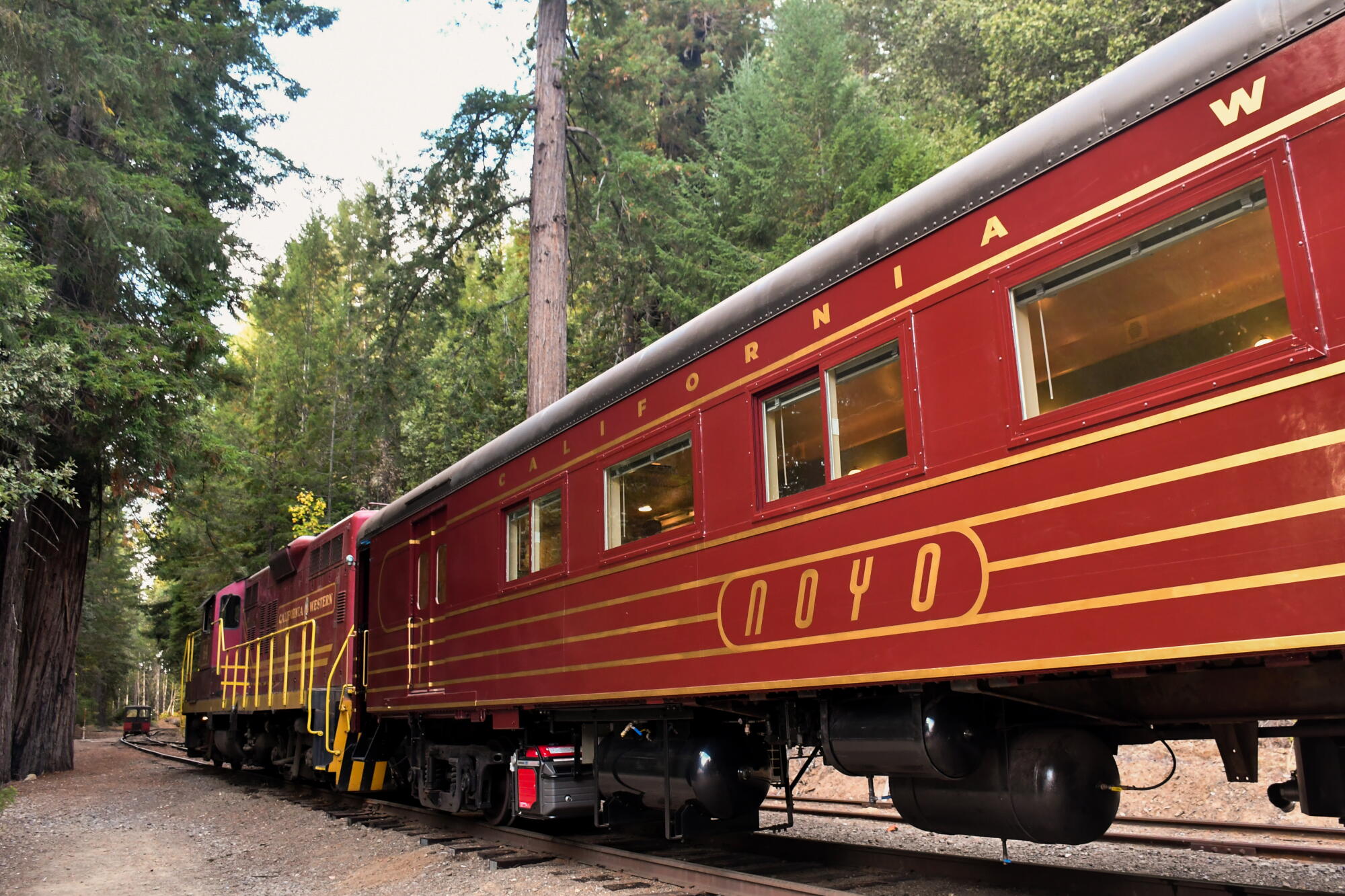
Known as the Noyo, this car is a new cocktail car that’s part of the Skunk Train, rolling from Willits, Calif.
(Christopher Reynolds / Los Angeles Times)
The first part of this expansion happened last year when the Mendocino Railway, better known as the Skunk Train, unveiled the Redwood, a fancy railcar offering cocktails as part of a seven-mile round trip from Fort Bragg. The Willits end of this expansion followed in September, when the railroad introduced another reconditioned traincar, this one known as the Noyo. Formerly a U.S. Army railcar, it’s now been reborn as a rolling cocktail lounge for up to 22 guests, featuring leather chairs, plush couches, a carpeted floor and ‘50s overtones.
On the journey I joined recently, passengers mingled in a spacious, adults-only railcar with vintage jazz on the sound system and servers outfitted in spiffy white jackets. For about $200 each, Willits-based passengers get a 16-mile round trip, charcuterie snacks and two cocktails (or mocktails).
Most popular cocktail so far: the Redwood Martini, made with dry gin, dry vermouth and orange bitters, served with a sprig of redwood.
The journey takes about two hours, passing through an 812-foot-long tunnel (a.k.a. Tunnel No. 2), then pausing to turn around in a clearing known as Crowley.
Passengers relax in the Skunk Train’s “presidential class” railcar, the Noyo, from Willits.
(Mendocino Railway)
Crowley, once a logging camp, can’t be reached by road, but train passengers can wander among picnic tables, fire pits, cornhole games and a massive, gnarled old redwood known as the Wolf Tree. (In September, when the performers of the Flynn Creek Circus were in town, the troupe hauled a big tent out to the clearing and staged two weeks of live performances there.)
Through October and November, the Skunk Train offers “presidential class” cocktail-car trips four to five days per week from Fort Bragg, two to three days per week from Willits. In December, trips from Willits are also offered on most weekdays and service from Fort Bragg drops to two days per week. (Willits-based service shuts down in January and February before resuming in March.)
1
2
1.Passengers in the Skunk Train’s “presidential class” railcar, the Noyo, from Willits get two cocktails (or mocktails) with the price of admission for a two-hour round-trip journey.2.Besides cocktails or mocktails, service aboard the Skunk Train’s “presidential class” cars from Willits and Fort Bragg includes charcuterie plates.(Mendocino Railway)
These cocktail cars are the latest additions in a decade of Skunk Train team improvisations in the wake of long history and, more recently, trouble on the tracks.
The Fort Bragg Railroad started up in 1885 to haul redwood and fir logs to the coast for shipping south to San Francisco. By 1911 there was steam-driven passenger service between Fort Bragg and Willits, and by 1925, locals had nicknamed it the “skunk train” because of the odor that billowed from the railcars’ recently introduced gasoline-burning engines and oil-burning stoves.
That moniker might have faded, but in May 1959, National Geographic magazine devoted a spread to the train under the headline “The Friendly Train Called Skunk.” In its 40 miles, that article noted, the train climbed more than 1,600 feet, crossed 34 bridges and trestles and rounded some 381 turns, occasionally pausing to deliver groceries to rural neighbors.
A passenger soaks up atmosphere on the two-hour, round-trip Skunk Train journey from Willits in Mendocino County.
(Christopher Reynolds / Los Angeles Times)
Alas, the timber industry faded, a mail delivery contract was lost and railroad ownership changed hands. On the way, the Skunk Train began to depend mostly on tourists. Then in 2013, the railroad’s Tunnel No. 1 collapsed, blocking the tracks about four miles east of Fort Bragg. Repairs followed, but the same tunnel collapsed again in 2015. There were no injuries in either accident, but it remains impossible for any railcar to make the full 40-mile journey between Fort Bragg and Willits.
“We are committed to reopening the tunnel,” Mendocino Railway president and CEO Robert J. Pinoli has said. But the reopening won’t be quick. Besides the challenge of rebuilding the tunnel, the railroad has been tangled for several years in legal disputes with the city of Fort Bragg and the California Coastal Commission. For now, every trip on the Skunk Train, including traditional railcars and increasingly popular pedal-assisted railbikes, is an out-and-back journey designed to avoid the blocked tunnel.
From Fort Bragg, most train and railbike trips go 3.5 miles east and 3.5 miles back again. From Willits, most trips go eight miles west and turn around, including the fall Pumpkin Express and Christmas Train. The great exception is “Railbikes on the Noyo,” a 25-mile journey that begins near Fort Bragg with a hike to the east end of Tunnel No. 1. From there, guests pedal an eastbound railbike for 12.5 miles through the forest, including a dozen wooden trestle bridges and recurring views of the Noyo River. After a picnic lunch, guests double back to where they started. That adventure usually takes about six hours and starts at $564 (combined) for two people sharing a two-seat railbike.
The new cocktail car excursion, meanwhile, requires less time, less money and less perspiration.
A view of the Skunk Train’s Noyo railcar.
(Mendocino Railway)
After our train reversed direction at its midway stop in Crowley, I could have stayed in my comfortable cocktail-car seat. But I had been tipped to check out the back end of the train. That’s the open observation car (no ceiling) in the back of the train. Skunk Train employees say it was first built for the U.S. Marines to transport Sherman tanks. It works just fine carrying us gawking civilians.
“Ahhh,” said 2-year-old Elle Davis, looking up to the sky and standing by her mother, Kaitlyn Davis of Willits. The observation car is open to all aboard — that is, the Noyo Car passengers and to those Skunk Train passengers who pay standard fares ($81.47 per adult) for less luxe railcars (open to all ages).
As you stand there with the wind in your face and the rails rattling below, the evergreen boughs whoosh past. Depending on the hour and humidity, the sky might be dimming or masked by fog. These days you don’t get that skunky scent of years gone by, but a ride is still a full sensory experience. And even if you have an adult beverage in your hand, you might find yourself with the same sense of rejuvenation that engineer Johnny Galliani described to National Geographic back in 1959.
“Young or old, they’re all kids when they ride with us,” Galliani said. “Nothing like a ride on this train to take the years off your back and make you young again.”
Passengers board the Skunk Train on an excursion from Willits to a forest clearing (once a lumber camp) called Crowley.
Steve Tatham always wanted to work in theme parks. And growing up in Anaheim, some sort of career associated with Disneyland seemed readily attainable.
“Disneyland was the local business,” Tatham says. “It’s where everyone ended up when they were students and working part-time, and I was no exception.”
You’re reading Mr. Todd’s Wild Ride newsletter
Todd Martens’ newsletter delivers news and commentary on the past, present and future of theme parks, right from the theme park capital of the world — Southern California.
By continuing, you agree to our Terms of Service, which include arbitration and a class action waiver. You agree that we and our third-party vendors may collect and use your information, including through cookies, pixels and similar technologies, for the purposes set forth in our Privacy Policy such as personalizing your experience and ads.
While in college, he got a job as a Jungle Cruise skipper, and since then, he has never looked back. Over the course of his career, Tatham has spent nearly 30 years with the Walt Disney Co., many of them in theme park design with Imagineering. More recently, Tatham worked at Universal Creative for more than a decade and was the executive creative director of Epic Universe, the company’s impressive new Florida park.
Today, Tatham is turning his focus toward the next generation of theme park designers, having recently been tapped by USC to lead the Bachelor of Fine Arts in Themed Entertainment program, which is offered out of the cinema school. The four-year program is designed to prep students for a myriad of fields — modern theme park design firms work not only on new attractions but readily contribute to museums, zoos, immersive marketing events and more.
And yet theme park designer can feel like an elusive dream job, one based on connections, mentoring or even just luck. Part of that myth was shaped by the initial Disney Imagineers, many of whom were simply making up the job as they went along. As a longtime admirer of Tatham’s work, I recently chatted with the newly crowned academic leader on how one should prep for a career in the field, hoping to demystify it just a little bit.
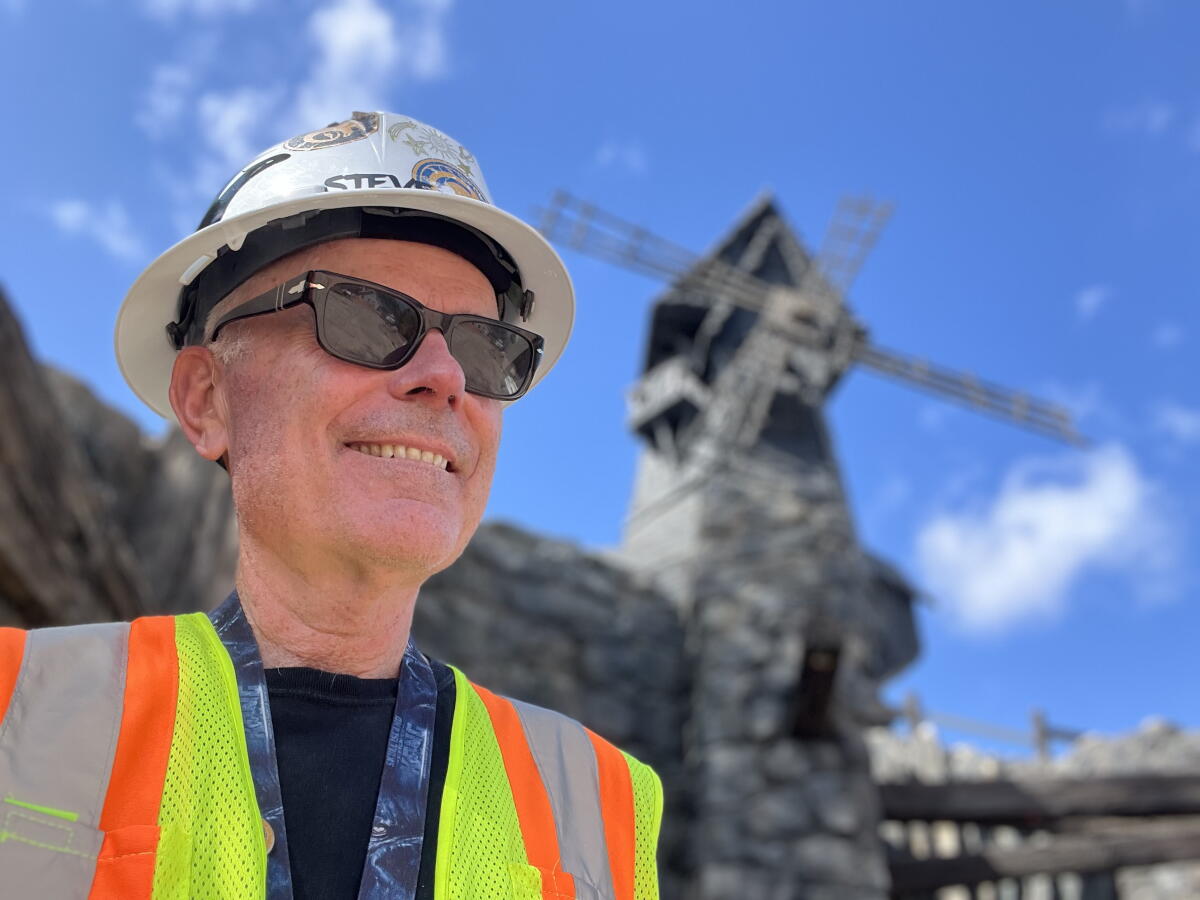
Steve Tatham, photographed in Florida’s Epic Universe, is leading USC’s undergraduate program in theme park design.
(Steve Tatham)
You don’t need to major in themed entertainment to work in theme parks
There aren’t too many universities that offer a theme park design degree. (Along with USC, Purdue offers a themed entertainment design major and the Savannah College of Art and Design has one of the best-known and longest-running programs in the country.)
But Tatham notes that when he began his career in the industry, it generally wasn’t a field accounted for by universities. And many theme park designers I meet as a reporter, whether relatively new to the industry or veterans, created their own paths into the biz.
Tatham’s own background still provides a solid template for those students looking to enter themed entertainment design, as not everyone will have the means or the ability to attend a program such as USC’s. “I wrote my own major,” he says of his time as an undergrad at UC Berkeley, where he targeted theme parks as his career goal. He majored in film design but took courses that combined theater, architecture, environmental psychology and film studies. After graduating, Tatham went to UCLA for a masters in architecture.
Architecture was a career path pushed to Tatham by longtime scenic designer Henry May, who was his advisor at Berkeley. It was an early recognition that theme park design is an offshoot of urban design, requiring principles necessary in both stagecraft and real-world planning.
Think beyond theme parks
People are hungry for themed experiences. Global theme park attendance topped 246 million in 2024, a 2.5% increase, according to the Themed Entertainment Assn., which also charted a nearly 15% growth in attendance at the world’s top 20 museums, which are often a fertile industry for theme park designers. And that says nothing of the domestic trend of smaller, more locally-focused entertainment centers (think Netflix House or Meow Wolf).
It’s why Tatham tells his USC students to think beyond a Disney or Universal creation.
“If you look in the world out there, there’s marketing firms doing pop-up retail and pop-up dining, and they are doing immersive design in museum spaces,” Tatham says. “In addition to theme parks, there are opportunities within marketing and within architecture. Students who get this interdisciplinary training, which involves coding, architecture, design, exhibition work, landscape architecture and lighting, it’s a growing field.”
Steve Tatham once served as a tour guide on Universal Studios Hollywood’s behind-the-scenes tram tour.
(Genaro Molina / Los Angeles Times)
The best lessons come from observing guests
Long before Tatham was designing Epic Universe, he was working as a tour guide at Universal Studios Hollywood. As a film buff, he enjoyed the early-career job, but says one lesson from those days continues to stick with him.
“I would go on and on, because I love movie history, and I would be like, ‘Right here is where Jimmy Stewart worked, and Edith Head designed costumes,’” Tatham says. “They would politely listen, but then when ducks walked across, they would get excited and take pictures. People love things that are alive and immediate and happening now. People respond to what is immediate.”
The best theme park design is in conversation with guests. I think of Epic’s “How to Train Your Dragon”-inspired land and the bounty of movement found in the space via animatronic dragons (if you promise dragons, guests better see dragons!), or Disneyland’s New Orleans Square, where the curved, winding paths encourage constant discovery.
AI won’t replace great original ideas
Tatham is careful when speaking on the subject of artificial intelligence. He doesn’t want to dismiss its potential to be used as a development tool. And yet Tatham is direct when it comes to AI and creativity.
“I think there are a lot of challenges with AI. I think there are a lot of things that are scary,” he says. “But I think, ultimately, if it’s used as a tool, it can be useful to artists.”
But there are limits.
“AI is never going to come up with a great idea,” he says. “It’s just going to recombine and reconfigure and spit back to you ideas that others have had. So I think this is an opportunity for original thought to stand out even more than it has in the past.”
Jennifer Bascom of Disneyland, gives a telegram to Disneyland guest Keith Kocienski of Fullerton while playing a live-action role-playing game in Frontierland called Legends of Frontierland back in 2014.
(Christina House / For The Times)
But the integration of smartphones remains a challenge
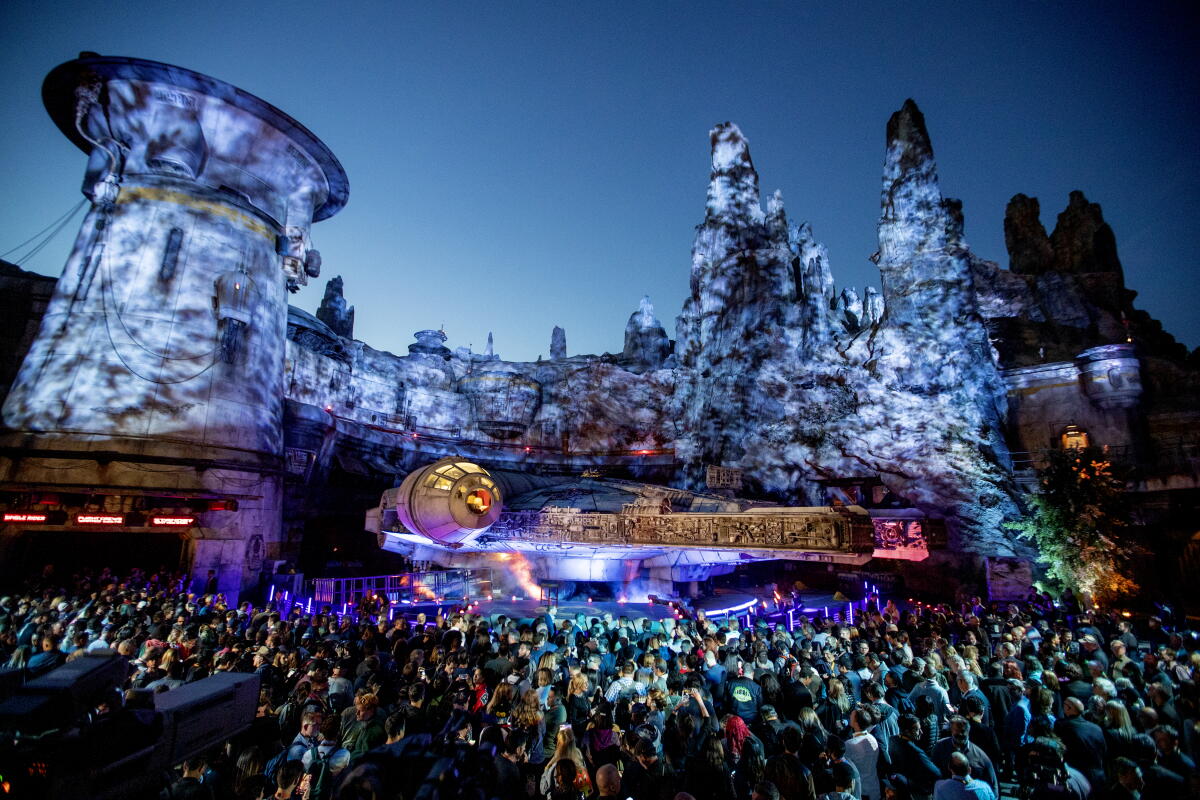
While Disney recently shuttered its Play Disney Parks mobile app, the park is experimenting with connectivity between the video game “Fortnite” and its attraction Millennium Falcon: Smugglers Run. Tatham cautions that any time a theme park invites someone to use a smartphone during their day at the park, designers are then pulling them away from the curated experience.
“The problem is when you’re in Universal or Disneyland, you’re now competing with all the opportunities that people have to explore their own entertainment,” Tatham says. “Are they going to be on Instagram or playing Solitaire online? So now you’re competing with that.”
And yet Tatham thinks there are lessons to be learned from the interactive world, as long as designers focus on real-world play. Tatham, after all, worked on what was once of my favorite Disneyland projects, the great but short-lived Legends of Frontierland. Some of those who contributed to it brought it to Knott’s Berry Farm, where it has been fine-tuned into the terrific Ghost Town Alive! The latter is a rarity in the theme park space.
Yes, it’s possible to make a decent salary
So how much can one expect to make? This isn’t an easy question to answer, as there’s only so many slots at Walt Disney Imagineering and Universal Creative, and the theme park design industry encompasses so much more.
There are independent themed entertainment firms to marketing outposts to studios to museums to architecture companies to theaters and more. And salaries can vary greatly between the public or private sector, as well as entry level versus senior positions. Even recruiting sites have a broad range, from around $50,000 to above $200,000.
The good news, says Tatham, is there is a high ceiling. Additionally, that there is a breadth of industries to work in should help any potential graduates. “There are many different job descriptions with different salaries in the themed entertainment field,” Tatham says.
And yet he knows it’s a concern of parents.
“I want students and parents to know that it is possible to make a solid steady income in the arts and that they shouldn’t focus on a backup plan but rather on putting together a killer portfolio because there is work for those who have honed their skills,” he says. “I would tell them that they should be prepared to live in Orlando, Fla., or Glendale, Calif., and be open to international assignments. Top directors can make in excess of $250,000 a year, but they should be prepared for starting salaries similar to architecture, graphic design or similar creative fields.”
A Disneyland cast member playing the role of Alice in Wonderland interacts with guests.
(Christina House / Los Angeles Times)
Remember why theme parks still matter
Anytime I have an opportunity to chat with someone with Tatham’s experience I want to hear their take on one question in particular, and that’s why they love theme parks and why they believe the spaces resonate with so many people. As someone charged with creating passion among the next generation of theme park designers, I was especially interested in Tatham’s response.
“If you go to a theme park, there is something for every demographic,” he says. “There are things for kids. There are things for grandparents. There are things for everyone in between. People can enjoy those times together, which was the original intent of Walt Disney. He was looking for a place while in Griffith Park where he could go do things with his daughters. He created it because it did not exist.”
For Tatham, it’s about the memories.
“If you ask people about their experience in theme parks, they will remember in great detail which parks they went to and who they were with,” he continues. “Ask them about going to the movies, they might say, ‘Sure, I went with my family, but can’t tell you what movies and who I was with.’ But they will remember those moments with theme parks. It’s a great bonding experience. That’s the reason they exist and the reason I love to create them.”
This week in SoCal theme parks
Plans are underway to refurbish the Griffith Park merry-go-round.
(Christina House / Los Angeles Times)
The Griffith Park carousel will spin again. Assessments are underway to see what it will cost to once again get the Griffith Park merry-go-round spinning. Theme park fans best know it as the site that is said to have inspired Walt Disney to dream up what would become the Disneyland Resort, and it has been shuttered since 2022. Curiously, there’s also a Disney connection with the carousel today, as some of those who work at Walt Disney Imagineering are volunteering their time and efforts to restore this treasure in Griffith Park. Read my story here.
Six Flags Magic Mountain shuts down second coaster. Six Flags is closing several rides across the U.S. and Canada — including the Goliath roller coaster at Six Flags Magic Mountain in Valencia — after a man fell to his death from a roller coaster at one of its parks in Georgia. Park officials said Tuesday that the closures were out of an abundance of caution and were temporary. Times writers Hailey Branson-Potts and Fedor Zarkhin have more on this story.
Merry Minions. Universal Studios Hollywood has unveiled its slate of holiday of programming, and returning this year are its popular “Grinchmas” offerings, including the 65-foot winding, drooping, Dr. Seuss-inspired Christmas tree. There will be meet-and-greets, including a reading of “How the Grinch Stole Christmas,” as well as holiday carolers and ornament decorating. New this year will be holiday festivities in the park’s kid-focused Minion Land, complete with Minions in holiday attire. Super Nintendo World, Wizarding World of Harry Potter and other areas will also be dressed for the season, beginning Nov. 21 and lasting through Jan. 3.
A heads-up for ‘Cars’ fans. It’s the 20th anniversary of the “Cars” franchise, and those with a special affinity for the series will want to find their way to Disneyland’s Pixar Place Hotel and park themselves on the hotel’s second floor art gallery. That’s where the hotel is hosting an exhibit honoring the film with drawings, paintings, sculptures and behind-the-scenes footage that document how Radiator Springs Racers was brought to life. And before you go, read my story on how Route 66 inspired the film and Cars Land.
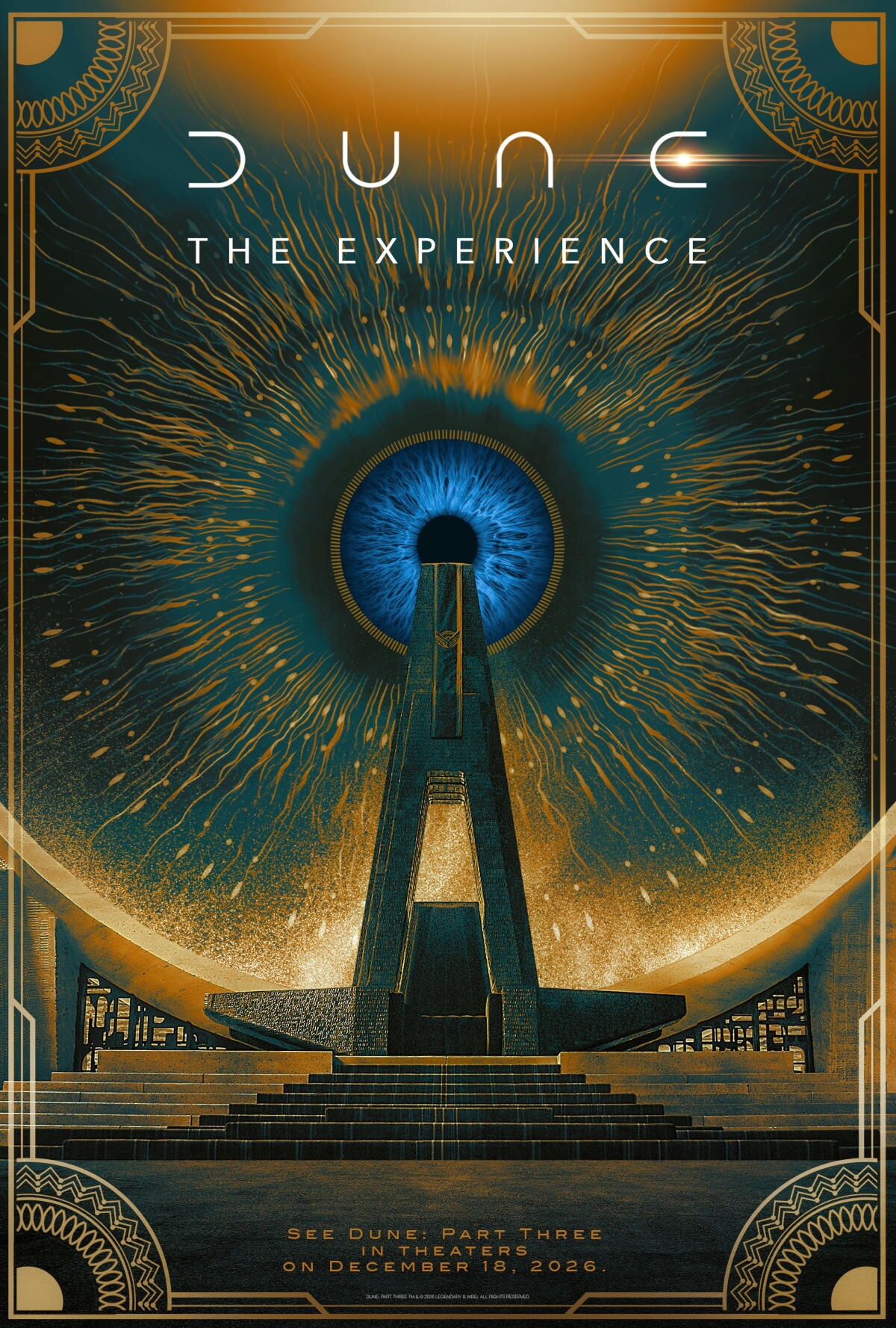
Step into the world of ‘Dune.’ Tickets are now on sale for an immersive “Dune” exhibition in downtown L.A. that promises spectacle, as well as a bit of mystery. Step around, and potentially inside, awe-inspiring vehicles from the film, or come face-to-face with the Bene Gesserit, a group of priestesses who possess, among other things, the ability to bend the will of others. “Dune: The Experience” opens Nov. 20 and and is currently set to run through Dec. 20, although an extension is likely. Standard tickets start at $42 but there are various ticket packages available.
Ride Report
The dinosaurs on the Disneyland Railroad.
(Todd Martens / Los Angeles Times)
It’s always a good idea to hop on a Disneyland attraction that has been recently refurbished. It’s generally a chance to see the ride in tip-top shape. And so I was eager to get on the Disneyland Railroad on a recent trip to the park, as the dinos in the Primeval World world section of the attraction had recently been hidden behind illustrated tarps. Good news, as the dinosaurs are looking as sharp as they ever have. No real changes were made to the figures, but they’re all moving as they should, be it munching on grass, rattling out of an egg or getting ready for battle.
The theatrical lighting overall feels a little brighter, and the few digital effects — a volcano erupting in the background, for instance — are all in working order and bring an added sense of dimension to the diorama scenes. Be sure to add it to your day. The Disneyland Railroad is also a fine reminder to slow down during your Disneyland visit.
Tell us your stories. Ask us your questions.
Have a theme park tale to share? Whether it was a good day or less-than-perfect day, I would love to hear about it. Have a question? A tip? A fun photo from the parks to share? Email me at todd.martens@latimes.com. I may feature your note in an upcoming newsletter.
Ride on,
Todd Martens
P.S.
What is “Eggs in Space”?
(Todd Martens / Los Angeles Times)
A cinematic mystery is brewing, one that seemingly has connections to the local immersive entertainment community. What, for instance, is “Eggs in Space”? A recent sci-fi event at indie nonprofit movie theater and store Vidiots ended with the beginnings of a puzzle.
The screening appeared to be interrupted by a film that was taking control of the projectors. The film? “Eggs in Space.” As an abstract image of an egg appeared on screen, performers began walking toward the front of the theater in a transfixed, cult-like fashion.
There is, of course, no record of a film titled “Eggs in Space,” although there is a website dedicated to its disappearance. So dig in. A new alternate reality game just dropped. I have a hunch you’ll want to know where it leads.
—
This newsletter is free thanks to the support of L.A. Times subscribers. If you’re not yet a subscriber, explore subscription packages to unlock unlimited digital access and support award-winning local reporting.
Was this newsletter forwarded to you? Sign up here to get it in your inbox.
The A Place in the Sun presenter shared the sad news that the guest had died, months before the episode first aired.
Jasmine Harman shared the tragic news(Image: Channel 4)
A Place in the Sun presenter Jasmine Harman shared the tragic news that a guest on the show had died, just months before the episode aired.
The Channel 4property programme returned with a repeat episode on Tuesday, 13 October, that had originally aired around the same time last year. It saw the presenter take couple Jackie and Delroy around Marbella in Spain, where they were looking for their dream holiday home.
Jackie and Delroy were hoping to buy their first home together, having met two years earlier on a dating site. They wanted to move to Spain permanently to start a whole new life together.
Reflecting on their relationship at the start of the episode, Jackie said: “We met and I think we knew fairly soon that there was something special.” Delroy meanwhile quipped: “Who else would you be with, I’m Prince Charming!” They had a budget of £600,000, telling Jasmine what they wanted to find somewhere with three bedrooms, sea views and their own pool.
At the end of their search, Jackie and Delroy revealed to Jasmine that they’d decided to make an offer on one of the properties they’d seen. “That’s fantastic news,” the presenter celebrated. The property was on the market for under £691,000, though Jackie and Delroy wanted to negotiate a lower price.
They explained: “The house is very tired, it needs a lot of updating. There’s no en-suite in the main bedroom, lots of flooring throughout the house to change, we have a kitchen to change, so we figure, about £605,000.”
Jasmine replied: “That’s over £85,000 off the asking price, which, as cash buyers, for a property of that level, you may stand a chance of getting something for £605,000.”
The presenter rung the vendor’s agent, putting forward the offer, while Delroy told her: “There’s only so much where I will go, with my developer head on, I know what needs to be done, so no way is my heart going to overrule my head.” However, unfortunately their first offer wasn’t accepted, with Delroy and Jackie going up to £625,000 and leaving that price on the table.
After filming, it was revealed that their second offer had been accepted, but Jasmine shared the heartbreaking news with viewers that Delroy had sadly died, just months before the episode originally aired.
After filming with the couple had ended, she said: “A couple of hours later, the agent called me back to say the vendor had decided to accept Jackie and Del’s offer of £625,000. However, sadly Delroy became ill shortly after returning to the UK. And they had to put the move to Spain on hold. Tragically, he passed away in April 2025. We send our deepest sympathies to Jackie and all their family.”
“What a sad ending,” one viewer wrote, as the repeat episode aired on Tuesday, 13 October. Another said: “Not expecting a heartbreaker today on #APlaceInTheSun.” “Well that was an unexpected and sad ending,” another echoed. Someone else commented: “RIP Delroy.”
Viewers also paid tribute on a post Jasmine had shared after Delroy’s death. She’d written on Instagram last year: “Tonight’s episode of A Place in the Sun was in remembrance of a very special person. I was so incredibly sad to hear the tragic news about Del’s passing. My heart goes out to Jacqui and all of Del’s loved ones. Jacqui you are so strong and he would be so proud of you.
“It’s another reminder; we never know what is around the corner. Live life to the full and cherish moments with your loved ones. RIP Del Delroy Alphonso Burke 17/10/1965 – 09/04/2025.”
Having watched the repeat episode, several viewers flooded to the comments. One wrote: “This was the saddest ending ever RIP big fella x.” Another said: “So sorry to hear that Del passed and that you didn’t get to live your lives in the sun. RIP Del.”
Someone else commented: “Just watched this, very sorry to hear this, he looked so well in the show.” Yet another said: “Just watched the episode (a year later) and wasn’t sure I heard it correctly at the end but unfortunately i did! RIP Del!”
A Place in the Sun is available to watch on Channel 4.
ATHENS, Greece — U.S. Secretary of State Marco Rubio flatly refused to comment on a new report alleging that U.S. Ambassador to Greece Kimberly Guilfoyle engaged in improper and possibly illegal conduct before taking up her post.
Rubio told reporters that he would not discuss the allegations contained in a Wall Street Journal story that said Guilfoyle had asked a donor and supporter of President Trump to pay a $100,000 credit card bill just before her confirmation hearing, promising him access to administration officials if he did.
He spoke before leaving Greece, where he delivered a speech calling for European countries to return to what he described as their civilizational roots.
Rubio said he was aware of The Wall Street Journal’s report, which was published late Wednesday, but had no idea if it was true and he would not address it.
“You guys walk around thinking that because some source told you something and you reported it, it’s the gospel. It’s not the gospel. It’s not the gospel for me. That’s not the way we do things,” he said at the foot of his plane as Guilfoyle, who was there to see him depart Greece, looked on.
At a joint news conference with the Greek foreign minister on Wednesday, Rubio said he would not address the allegations while visiting a foreign country, but added, “Suffice it to say our embassy here is doing a great job. Our ambassador has been a strong ambassador here.”
The top two Democrats on the House Foreign Affairs and Senate Foreign Relations committees have called for an investigation into Guilfoyle, but Rubio would not say if he was prepared to open one.
Congressional Democrats already were looking into claims reported last month by the Wall Street Journal that Guilfoyle acted improperly while serving as the top U.S. envoy to Greece.
The Journal reported that Guilfoyle told guests at a reception that the U.S. could undermine the Greek government if it chose to, promoted the business interests of one particular Greek construction and energy company, and allowed its lobbyist into private diplomatic meetings.
Guilfoyle, a former Fox News Channel host and California prosecutor who was once engaged to Trump’s son Donald Jr., has denied any wrongdoing and Rubio has defended her before.
It’s an annual fall tradition that Disneyland increase its prices — and stealthily in the night. Starting Tuesday, guests will pay more to experience the Happiest Place on Earth.
But the increases are relatively light. For the eighth year in a row, Disneyland did not raise the cost of the lowest-priced ticket, which is $104. And its highest-priced ticket, which is $224, also did not change. The increases were felt primarily on mid-level tiers for single-day, single-park tickets, and were limited to $5 apiece.
You’re reading Mr. Todd’s Wild Ride newsletter
Todd Martens’ newsletter delivers news and commentary on the past, present and future of theme parks, right from the theme park capital of the world — Southern California.
By continuing, you agree to our Terms of Service, which include arbitration and a class action waiver. You agree that we and our third-party vendors may collect and use your information, including through cookies, pixels and similar technologies, for the purposes set forth in our Privacy Policy such as personalizing your experience and ads.
Other prices also remain unchanged. The cost of Disneyland’s popular annual pass program, the Magic Key, did not increase. The top-tiered Magic Keys have been subject to hefty yearly spikes over the last decade. Parking remains fixed at $40, and multiday tickets have not been affected.
Collectively, this is one of the smallest overall increases made by the Disneyland Resort in recent history, as last year, its highest-priced single-day ticket jumped in cost $18. At a time when leisure costs are rising and forcing Americans to stay home, it comes as somewhat of a relief that Disneyland is not asking its fans to pony up substantially more cash to get through the gates.
While the Walt Disney Co. provided no official statement on the increases, Disneyland Resort officials noted in an email that it is aware guests are more closely watching their wallets in 2026. Thomas Mazloum, chairman of Disney Experiences, in a comment given to CNN, said, “Our goal is to put guests at the center of our decision making, and that starts by listening to them. That matters more now when families are watching every dollar, and we see it in the choices they make every day — in how they plan, in how far ahead.”
It’s also an indication that, at least for the time being, the Disneyland Resort has pushed its prices as far as they can go. Disneyland is blessed with an in-demand product, but every commodity has its limits.
In May, the Walt Disney Co. reported a 1% decline in attendance at its U.S.-based parks compared with the prior year, which the company attributed to “continued softness” in international visitors. In August, however, Disney bounced back, and noted, especially at Florida’s Walt Disney World, that attendance had perked up. Overall, visitation at its U.S.-based theme parks was 3% higher than in the previous year’s third quarter, the company said. This boost was largely attributed to a variety of summer deals.
As someone who is at Disneyland nearly every week, I can report that summer crowds were relatively manageable. There have been some asterisks, such as the World Cup and high heat, both likely keeping guests away, but anecdotally, Disneyland crowding hasn’t been nearly as extreme this year. I simply believe that people do not currently have the excess funds that they once had.
And Disney seems to be responding to the economic climate, especially in making it easier for its biggest fans to visit the resort. In conjunction with the price increases, Disneyland President Jill Estorino announced Tuesday that the company would be removing its no-show penalty on annual passholders. Additionally, passholders can now cancel their reservations up to 11:59 p.m. on the day of their reservations.
These are welcome changes, as previously guests were allowed three no-show penalties before their ability to make reservations was restricted, and had to cancel the night before. But plans change, and the reservation system restrictions, initially put in place to manage crowding during the COVID-19 pandemic, had increasingly felt like an impediment. While reservations are still required, which Disneyland has stated helps the resort plan its crowd-forecasting and staffing, the system is more lax and user-friendly than it has been.
Digging deeper into Disneyland’s pricing, there have been some small changes elsewhere. The cost of the line-skipping feature Lightning Lane, which can fluctuate based on crowding levels, now has a top price of $38, an increase of $1. And the park-hopper add-on for single-day tickets, which can also fluctuate, increased $5-$10, depending on the day. And earlier this year Disneyland did increase its prices on a number of food items.
The Disneyland Resort, to be sure, is not cheap. In the world of entertainment, it remains a luxury good on par with postseason Dodgers tickets (albeit with cheaper parking than Dodger Stadium). But I credit the Disneyland Resort for reading the cultural room. Pulling the plug on its recent steady and hefty price increases, especially on annual passes, shows the company can occasionally listen to its audience as much as it does Wall Street. Sure, a price decrease would be nice, but we don’t live in a fantasyland.
This week in SoCal theme parks
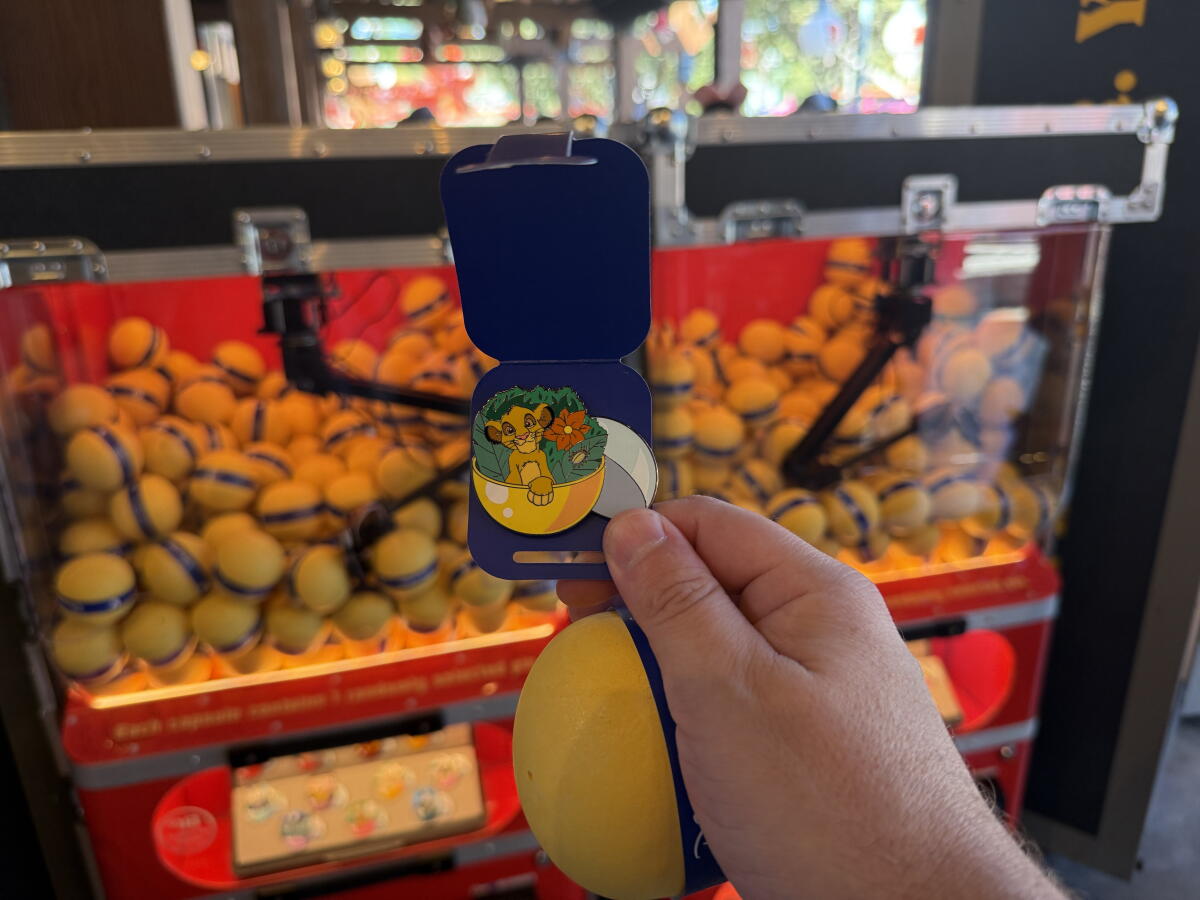
The Disneyland Resort has added new collectible pin trading vending machines.
(Todd Martens / Los Angeles Times)
Attention Disneyland pin traders! The Disneyland Resort has added a new pin line available in select vending machines throughout the property— look for them in San Fransokyo Square and Pixar Pier in Disney California Adventure and at the Star Wars Trading Post in Downtown Disney. Each pin is $18, and one buy gets you one egg-like orb with a mystery pin. There are 15 in the set — I got Simba, as seen above — and offerings include park staples such as the Hatbox Ghost as well as classic characters such as Princess Aurora and Dumbo. Some are marked limited edition — “chasers,” in Disney pin trading speak — so be on the lookout. Thanks to Mr. Daps for the heads-up.
A Disneyland ticket deal. With life constantly getting more expensive (see above), it’s a good time to hunt for a deal. If you’re a Costco member, reports are that there’s a pretty good one happening right now. Valid through Dec. 18, Costco is said to be selling a two-day Disneyland park hopper ticket with the line-skipping feature Lightning Lane already added in for $329.99. The offer includes a $60 dining card, and works out to a savings of a couple hundred. Disney Tourist Blog has more details on the limited deal.
An applaudable energy project. Six Flags Magic Mountain has announced the completion of its solar carport project, the largest solar carport in California. Covering 4,315 parking spaces, the project was designed to offset 100% of the energy consumption of Magic Mountain and Hurricane Harbor (while also providing some shade and sun protection for its parked cars). The project is interconnected with the Southern California Edison grid, meaning excess energy may be exported as well as allowing the parks to draw energy from the project when needed. The carport also offers 109 electric vehicle charging stations.
A pause at Castle Park. Riverside’s long-standing Castle Park is beginning the creation of what it says is a“reimagined experience.” As such, on Nov. 1 its Ride Park will halt operations for the foreseeable future. “We’re taking the time to plan the right rebuild and will share updates as plans take shape,” the company says in an FAQ on its site. Its mini golf and arcade areas will continue to welcome guests.
More on the noise issues around the ‘Fast & Furious’ coaster
Riders on Universal’s new Fast & Furious: Hollywood Drift.
(Ronaldo Bolanos / Los Angeles Times)
There will be no shortage of updates and news on Universal’s new Fast & Furious: Hollywood Drift coaster in the coming weeks, months and maybe even years, especially as the attraction continues todraw the ire of the park’s neighbors in Toluca Lake. Universal Studios Hollywood held a meeting with nearby residents on its studio lot last Wednesday. The session was closed to the media but was said to attract more than 350 neighbors. I spoke with a number of residents, as well as Universal, after the session, and indications are that the two sides still haven’t settled on a compromise. The issue, of course, stems from the sound of rider screams from the coaster drifting into the residential area.
Universal has promised, through the end of the year, to not begin operating the coaster before 9 a.m., and has also, in response to community feedback, installed a new sound barrier featuring an additional 1,900 square feet of sound absorbing material. The new barrier includes a sail that’s about 63 feet tall and 31 feet wide. But residents I spoke to feel it’s not yet enough. I’ve heard many stories from neighbors in recent weeks regarding the disruption caused to their lives. They range in extremes. A neighbor without air conditioning says they can no longer open their windows. A resident who offers meditation services from their home says their business is now potentially forever impacted. A teen was unable to complete a SAT prep test due to the incessant screaming. Many report insomnia from the rise in anxiety levels. There’s plenty more.
The meeting was said to grow contentious near its end. Residents provided data on how the effects of noise, specifically screams, can cause stress-related responses. Universal is said to have discussed the challenges in further mitigating the sound. County supervisor Kathryn Barger was in attendance and is calling for additional communication between the two sides. “The meeting’s dialogue made clear that the lives of surrounding residents are being impacted and disrupted,” Barger said via a statement. “I respect Universal’s decision to host this forum and listen to the concerns being raised. I encourage all stakeholders to maintain an ongoing honest dialogue.”
Tell us your stories. Ask us your questions.
Have a theme park tale to share? Whether it was a good day or less-than-perfect day, I would love to hear about it. Have a question? A tip? A fun photo from the parks to share? Email me at todd.martens@latimes.com. I may feature your note in an upcoming newsletter.
Ride on,
Todd Martens
—
This newsletter is free thanks to the support of L.A. Times subscribers. If you’re not yet a subscriber, explore subscription packages to unlock unlimited digital access and support award-winning local reporting.
Was this newsletter forwarded to you? Sign up here to get it in your inbox.
Good Morning Britain’s Ranvir Singh and Kate Garraway spoke to the UK’s Minister for Aviation, Keir Mather, on Friday’s show.
10:16, 02 Oct 2026Updated 10:18, 02 Oct 2026
Kate Garraway wasted no time in mentioning the MP’s age(Image: ITV)
Good Morning Britain viewers were quick to call out Kate Garraway.
On Friday’s instalment of the ITV show (October 2), Kate and her co-star Ranvir Singh welcomed Aviation Minister Keir Mather onto the programme to speak about the proposed plan to stop airlines charging parents who want to sit by their children.
However, before the interview had even begun, the Good Morning Britain star was quick to remark on the 28-year-old’s youthful appearance, which didn’t go down well with people watching.
She commented: “We’re joined here now by Aviation Minister, Keir Mather, first time on Good Morning Britain, you’re there in Manchester airport this morning. When we saw you pop up, I have to say, we thought, ‘My goodness, ministers are getting younger every day’. You’re going to please a lot of people if you are the new prefect, because there’ll be a lot of people cheering about this.”
The MP didn’t address the remark as he dived straight into the topic he was on the show to speak about. However, as the interview came to an end, The ITV star touched on his age once again.
She said: “I understand you are indeed the youngest Minister since Gladstone in 1834, so it’s not just my old eyes that see you as young, good to speak to you this morning.”
As Kate and Ranvir went to address what he had spoken about with their panellists, Salma Shah and Caroline Flint, the presenter asked if they also felt old listening to the MP speak.
Salma commented: “I mean, I’ve never felt so old.” With Caroline adding: “He answered your questions, he did say yes, no, and what have you, we’ve seen people much older, not doing that.”
It wasn’t long before people commented on the interview, with many quick to call out Kate for her remark to the MP. One person on X said: “How outrageously patronising! Ooh, aren’t you young!”
Someone else wrote: “How patronising to remark on his age and call him a prefect! @GMB #gmb.” Another viewer commented: “@GMB Not cool to patronise the MP just because he’s young.”
While one person said: “Just watched @Mather_Keir on @GMB this morning, a great interview, I’m just really disappointed in the hosts and panel guests, that the conversation following was about his age and ‘how well he answered the questions for his age’ rather than discussing the issue in hand, bit shocking really.”
Meanwhile, one person praised the MP, commenting: “Excellent interview on @GMB from @Mather_Keir from @manairport this morning. Nice to see young govt ministers on TV.”
Good Morning Britain is available to watch on ITV weekdays from 6am.
An interactive, floor-to-ceiling walk-through “Dune” attraction is coming to Los Angeles in November, and it promises spectacle, as well as a bit of mystery. Step around, and potentially inside, awe-inspiring vehicles from the film, or come face-to-face with the Bene Gesserit, a group of priestesses who possess, among other things, the ability to bend the will of others.
In one centerpiece of the exhibit, guests will be asked to take their so-called “test of humanity,” an opportunity to place one’s hand in a box and, in the lore of the “Dune” franchise, experience a none-too-pleasant sensation. It’s a battle of will, and intellect, and at “Dune: The Experience,” the hope is it will be fun.
“Dune: The Experience” is an immersive, walk-through exhibit coming to downtown Los Angeles.
(Fever / Legendary Entertainment )
“I don’t want to spoil exactly what happens when you put your hand in the box, but it is intended to be somewhat shocking, participatory and to put people on edge,” says Rob Shalhoub, a team lead at Fever, which is producing the event in partnership with Legendary Entertainment. “It really immerses you into the intensity of these films, where you’re up close and personal with these characters.”
“Dune: The Experience” is planned to launch in November in support of the theatrical release of Denis Villeneuve’s “Dune: Part Three,” which is out on Dec. 18. The event doesn’t have an opening date or an end date yet, but it is intended to tour. It will be in Los Angeles at a location in downtown’s Art’s District at least through the end of December. Expect costumes, props and life-size vehicles from the film, as well as projection-based rooms designed to immerse guests in the desert planet of Arrakis.
There will be about a dozen rooms to explore, says Shalhoub, each designed for guests to spend around five minutes in. Some will feature hidden messages within ancient carvings, while others will emphasize photo opportunities with Paul Atreides’ throne, allowing guests to attempt their best Timothée Chalamet impression. “Dune: The Experience” is also built for attendees to linger, as it will feature an area with themed food and cocktails.
“It will reward your curiosity,” says Amado Trevino, director of interactive media and experiences for Legendary Entertainment. “Walls will begin to whisper throughout. You get to take Paul’s throne and see the desert come alive around you. Guests may even find out if they have what it takes to ride a sandworm.”
Different rooms are said to explore contrasting sensations, with some emphasizing touch, sound or visuals.
“We have this amazing projection room where you’re going to get to experience what it’s like in the desert in Arrakis, to really feel the scale of the desert and some of the dangers that lurk within the desert, namely sandworms,” Shalhoub says. “We’ve re-created these environments in a very interactive and immersive way.”
Adds Trevino, “There are things to see, there are things to hear, there are things to do, and there are things to feel. We’re showing beautiful artifacts from the productions, but you’re doing it from within the world of ‘Dune.’ ”
Former Walt Disney Co. Chief Executive Bob Chapek knows his reputation among Disney fans, especially Disneyland loyalists. In his new book “Behind the Castle Walls,” he defends his changes to the Disneyland experience, the vast majority of which are still felt today.
“Contrary to what some people tried to paint me as,” he writes, “I wasn’t just a maniacal, money-optimizing machine.”
Sign up for Mr. Todd’s Wild Ride
An insider guide to the ever-changing world of theme parks, coming to you straight from SoCal — the theme park capital of the world.
By continuing, you agree to our Terms of Service, which include arbitration and a class action waiver. You agree that we and our third-party vendors may collect and use your information, including through cookies, pixels and similar technologies, for the purposes set forth in our Privacy Policy such as personalizing your experience and ads.
When I had the chance to talk to him last week, I wanted to know if having that image bothers him.
“I’m not concerned about it,” he says, speaking via phone from his Florida home. “I don’t give that any thought at this point. But I’m very proud of the performance of the parks segment during my time. The numbers bear that out.”
Chapek, in his role as chairman of the parks division and later CEO of the company, presided over an eight-year period beginning in 2015 in which Disneyland would significantly raise prices, introduce add-on perks, and, in my opinion, create the unsettling sense that you could be having more fun if you just spent more money.
When Chapek took over the parks segment, Disneyland would begin to fully remake its annual passholder program, largely by significantly increasing its price and limiting access. (In 2015, the top priced annual pass was close to $800. Today, it’s $1,899.) Single-day tickets to the parks would also begin a period of aggressive price hikes. Today, a one-day, one-park ticket tops off at $224. It’s widely expected that Disneyland will be raising its prices again this October, as it has done nearly every year in recent history.
Additionally, benefits that Disneyland guests long took for granted as free, such as the line-skipping Fastpass program, would become a paid perk on Chapek’s watch. Access to some attractions would be grouped together as part of a package now known as a Lightning Lane. In-demand rides such as Star Wars: Rise of the Resistance would be sold separately.
Bob Chapek has defended price increases at Disneyland, noting that ambitious projects like Galaxy’s Edge require capital.
(Allen J. Schaben / Los Angeles Times)
Prices on all of the above typically increase yearly. Today, guests who spring for the front-of-the-line Lightning Lane pass as well as individual access to Rise of the Resistance can expect to pay around an extra $65 per person once having their tickets scanned.
Chapek notes he faced significant opposition at Disney in making these changes.
“To all who come to this happy place, welcome,” goes Walt Disney’s original dedication speech, which for decades was used as a guiding light that every guest who entered Main Street, U.S.A., would be treated as an equal. That meant, with limited exceptions, no special access for anyone.
This was seen as an “inviolable virtue” at Disney, but one Chapek was ready to break, as he writes in his book.
“Everyone is equal when they come through the gates no matter what walk of life they come from,” Chapek tells me. “What’s different, though — and this isn’t because we say it’s different, it’s because the guests say it’s different — it’s that guests say they want an experience that’s tailored to what they can afford.”
Maybe. I don’t have access to guest satisfaction surveys, but that sounds like something only people with a certain privilege say. No doubt guests who can afford less don’t want a worse experience.
Chapek in his book describes himself as a “disruptor,” and considers Lightning Lane-like add-ons “bespoke” experiences that appeal to guests who crave a more customizable day. While they are common at nearly every theme or amusement park, I consider them classist, creating a haves-versus-have-nots mindset as soon as guests step through the gates.
Chapek defends the move to me, pointing out that while he presided over the parks, it’s lowest price one-day, one-park ticket stayed steady at $99 (today it’s $104). While true, and while Disneyland has even sought to increase the number of days offered at its introductory price since Chapek was ousted from the company in 2022, these are often midweek tickets, necessitating that working families take a day off and force a child to skip school.
“How about demand?” says former Walt Disney Co. CEO Bob Chapek, seen here with Minnie Mouse at Hong Kong Disneyland, when defending his price hikes.
(Kin Cheung / Associated Press)
“How about demand?” Chapek says to me when I point out that I have been critical of the moves. “Do people stop coming? That would obviously be a big concern. Even with the increase in prices that were taken on the annual passes, it would temporarily soften demand, but a year later they were subscribed just like they were before. Wall Street has certain expectations that may not be consistent with the expectations of guests of a certain pass type.”
Chapek reveals in his book that there is somewhere around 1.1 million annual passholders to Disneyland, which is today known as a Magic Key. With each price increase, he writes, that number would tumble to around 1 million, but within about 12 months they would be back to a level they were at before the rise in prices.
During Chapek’s reign, the company also introduced a reservation system, which asks guests to plan in advance. The price increase, later coupled with a reservation system, is designed to cut down, in part, on spontaneous trips to the resort, forcing guests to be more intentional about their Disneyland plans. This can aid, of course, in forecasting crowds and park staffing, but is also intended to limit days in which the park can feel overcrowded.
During his five-year tenure as parks chairman, Chapek writes that profits within the segment went up 18%. And that was largely due to an increase in individual guest spending. Over the decades, certain leaders of the Walt Disney Co. have arguably more closely ingratiated themselves with fans than Chapek has, but the fact remains that Chapek fundamentally and forever altered the approachability and the affordability of a Disneyland visit.
“In order to build things like Galaxy’s Edge and Avengers Campus, that takes capital,” Chapek says. “That capital takes revenue.”
My long-term fear, however, is that this has created a slippery slope. Disneyland guests now brace for yearly price hikes each fall, and this is coupled with yearly spikes on food prices each summer. Once the company and its shareholders become accustomed to such a financial boost, an environment where individual guest spending sharply increases even when domestic park attendance is soft or steady, there’s likely no turning back. Disney has created a business that will target the highest-spending consumer year in and year out.
And thus, guest equality, what was once an “inviolable virtue,” is forever a thing of the past, no matter who is in charge.
This week in SoCal theme parks
The X2 roller coaster at Six Flags Magic Mountain.
(Myung J. Chun / Los Angeles Times)
X2 has been retired. Six Flags has officially pulled the plug on Magic Mountain’s X2 coaster, which has been the subject of recent controversy after several lawsuits allege people were injured on the ride. Six Flags shut down X2 in July amid a state investigation into the coaster. “While X2 consistently passed a multitude of safety tests, we have decided to close the ride because we believe it’s the right thing to do. Ride safety is a cornerstone of our business, and when we see guest confidence affected, we take it seriously,” Brian Oerding, Six Flags Magic Mountain president, said in a statement. The Times’ Fedor Zarkhin has more on the news.
Don’t miss Disneyland’s mariachi band. There are a few more opportunities to catch Mariachi Alegría de Disneyland in Rancho Del Zocalo park inside Frontierland. The performances, set for the evenings of Oct. 6, 7, 13 and 14, are part of the resort’s National Hispanic Heritage Month celebrations. Also, beginning Oct. 4 and lasting through Oct. 15, guests can meet the character of Elena of Avalor near Royal Hall next to Sleeping Beauty Castle.
Heads up for those attending Halloween Horror Nights. If you have a visit planned to Universal Studios Hollywood’s Halloween Horror Nights and you’re interested in the park’s new Fast & Furious: Hollywood Drift coaster, there’s now an opportunity to ride it. For a cost. Universal is selling access to the coaster for $19.95 per person. Previously, the coaster was only available to those who sprung for the fancy R.I.P. Tour, which is now sold out.
Work out in Disneyland! The Disneyland Resort has announced new fitness classes across its two parks, an early morning perk for guests staying at one of its three hotels. Among the offerings is the ability to do yoga in Star Wars: Galaxy’s Edge, agility and strength exercises in Cars Land, and a mini-boot-camp-style class in Avengers Campus. Classes range in price, but most are under $49.
Tell us your stories. Ask us your questions.
Have a theme park tale to share? Whether it was a good day or less-than-perfect day, I would love to hear about it. Have a question? A tip? A fun photo from the parks to share? Email me at todd.martens@latimes.com. I may feature your note in an upcoming newsletter.
Ride on,
Todd Martens
P.S.
Me, enjoying a beverage, on the now shuttered Star Wars: Galactic Starcruiser.
(Allen J. Schaben / Los Angeles Times)
There is one area where the former CEO of the Walt Disney Co. and I are in complete agreement. Chapek and I both miss Star Wars: Galactic Starcruiser, colloquially known as the Star Wars Hotel. The ambitious, but costly, multi-day experience was one of the most creatively inspiring offerings in company history.
In “Behind the Castle Walls,” Chapek writes that he believes it was shuttered too soon. The Starcruiser closed after about a year of operation. “Was it perfect the first time? Absolutely not,” Chapek tells me. “Was it one of the most ambitious lodging experiences we have ever created? Yes.”
A place dedicated to play — and light role-play — the Starcruiser allowed guests to fully inhabit a fictional world. It was an argument that interactivity could have been the future of theme parks. “It seemed to have the plug pulled on it prematurely,” Chapek says, “and I think it was a big opportunity missed.”
— This newsletter is free thanks to the support of L.A. Times subscribers. If you’re not yet a subscriber, explore subscription packages to unlock unlimited digital access and support award-winning local reporting.
Was this newsletter forwarded to you? Sign up here to get it in your inbox.
A guest on The Repair Shop opened up about how the precious item meant so much to her family.
21:06, 23 Sep 2026Updated 21:07, 23 Sep 2026
A guest on The Repair Shop broke down in tears (Image: BBC)
A guest on The Repair Shop broke down in tears as she opened up about her son’s health.
The BBC programme returned to screens on Wednesday, September 23, with spin-off Beyond the Barn. The series follows experts restoring precious items from guests across the country, while also discovering what happened after the special items were restored.
Wednesday’s programme saw a treasured trophy revived, as well as a coronation scrapbook brought back to life. At the start of the show, Ruth Dalton from Rochester arrived with a gardening tool.
She sought The Repair Shop team’s help, including expert Jonathan Reid, in reviving her grandfather’s gardening tool, a pair of secateurs, so her son could use them.
She explained: “I have my late grandfather’s gardening scissors. He used them all the time, and I kind of wanted to keep them as a reminder of him and his gardening.”
She continued: “His name was Stan. He was a real, real green-fingered guy. He had a massive garden. I used to love spending time with my grandad. As children, we were always up there, helping him in the garden.
“There were little steps that went up to a big lawn and different archways. He used to tell us what plants you could touch and what they did. You know, ‘Don’t touch the roses, you might get pricked by the roses,’ and that sort of thing.
“He was very encouraging and did teach us a lot, gardening was his life.” Ruth went on to reveal that she herself loved gardening, though her own garden wasn’t “at its best”.
Ruth explained how she wanted the secateurs fixed so she could tend to her own garden, which was built for her son. She said: “His name is Samuel, he’s got a condition called Bainbridge-Ropers syndrome.
“He was only the 12th person in the UK to be diagnosed, and there’s about 300 worldwide. He’s coming up to 26 years old. He can’t walk, he can’t talk, he doesn’t really understand much but he loves being outside. His demeanour changes completely when he’s out in the fresh air.”
She added: “He can’t do things on his own but he really loves doing things like when we’re weeding and stuff. If he can reach them, he’ll pull the weeds out himself. So I thought these would be perfect because they’re just about the right size for Samuel to hold.”
She went on to point out some “dreadful” issues with the scissors, including how rusty they were and how stiff they were to use, as well as the old paintwork that was flaking off.
When asked how it would feel for her son to be able to use the same pruners that her grandfather once used, Ruth broke down in tears. She said: “My grandad’s always there, and his guiding hand on Samuel’s… I do things hand-on-hand with him, I almost feel that if he could use those, it would be my grandad’s hand helping him and to get him out there doing something purposeful gives him that little bit of independence. It would be special, he’s a special boy, he deserves it.”
The Repair Shop: Beyond the Barn is available to watch on BBC iPlayer
Normally when a telephone rings inside a bar, it’s the duty of the staff to pick it up. But when an old-timey rotary dial phone suddenly springs to life at the Last Canteen, it’s up to guests to decide what to do next.
Answer it — or attempt to make a call from it — and you’ll encounter one of dozens of pre-recorded messages. They’re calls from an imagined future, one when a war-torn America is on the mend from some sort of apocalyptic catastrophe. They’re messages, perhaps, for the bar’s fictional founder, a shotgun-carrying mysterious woman known for her mean bartering skills, or maybe if you’re lucky, you will dial into what sounds like an early 20th century party line and hear from those looking for a date in the Valley, now a neutral zone among warring factions.
You’re reading Mr. Todd’s Wild Ride newsletter
Todd Martens’ newsletter delivers news and commentary on the past, present and future of theme parks, right from the theme park capital of the world — Southern California.
By continuing, you agree to our Terms of Service, which include arbitration and a class action waiver. You agree that we and our third-party vendors may collect and use your information, including through cookies, pixels and similar technologies, for the purposes set forth in our Privacy Policy such as personalizing your experience and ads.
The Last Canteen, situated on a stretch of Ventura Boulevard that’s just a short walk from the Universal City metro and minutes from Universal Studios Hollywood, is a new restaurant and bar that looks lifted from a theme park. It also feels like a throwback to an earlier time, when Los Angeles was an epicenter of the themed restaurant.
Southern California has a storied history when it comes to themed establishments. There’s our penchant for food-shaped eateries, of course — see our giant doughnuts or the Tail o’ the Pup — but dinner with a side of story is a Los Angeles-area staple that predates any corporate chains such as Rainforest Cafe or Chuck E. Cheese. From the long-forgotten Jail Cafe in the 1920s to our region’s birth of the tiki bar to the themed restaurant explosion of the ‘80s and ‘90s, when even Steven Spielberg got into the action with the submarine-focused DIVE! in Century City, the themed restaurant has long found a receptive audience in Southern California.
And the Last Canteen feels especially built for our moment.
The Last Canteen’s three founders were going for a lived-in feel.
(Eric Thayer / Los Angeles Times)
Taking influence from the likes of “Mad Max,” “Fallout” and a host of other dystopian, postapocalyptic media, the Last Canteen is a bar for an era — and a city — when the future seems especially uncertain. Whether it’s AI, corporate consolidation, inflation or the struggles of Hollywood that’s got you down, the Last Canteen wants to be your “Cheers” of sorts.
“It’s not the brightest of times, I would say for most of the world, but certainly younger generations are feeling like we got the rug pulled over us — the state of the economy and corporate overreach,” says Jimmy Clements, 32, who founded the Last Canteen with two other friends from the hospitality industry.
“We always joke that the world is ending, but there’s some charm in fully embodying what that would mean, and realizing there’s something on the other side,” he adds. “That’s what attracts me to the genre. OK, the worst thing possible happened, but there’s still people on the other side. We still need community and a place to eat and drink.”
A grenade fashioned out of a baseball is one of the items hidden in the Last Canteen.
(Eric Thayer / Los Angeles Times)
Or as Clements’ partner TJ Lewis says, “Who doesn’t watch ‘Mad Max’ and dream of riding on top of a crazy car with a spike in your hand?”
Despite a potentially bleak concept, the Last Canteen is open and welcoming. The color palette is soft, leaning heavily on dust-like sandy vibes, the cocktail menu takes influence from the fruity, complex world of tiki bars, and a sense of humor permeates the main dining room.
Yes, a demolition bomb, which is actually a movie prop from Angelina Jolie’s “Unbroken,” hangs from the ceiling, but take a moment to explore the venue and you’ll find grenades colorfully fashioned out of baseballs, or rewritten maps of the Valley in its new “Wasteland” era. Universal Studios’ famed minion still stands, but the Ikea is now a “hall of justice.”
Newspapers dot the walls. They’re filled with fiction that tell of the bar’s new reality, giving the place a sense of history and lore. One article, for instance, speaks of a battle that broke out near the remnants of US-101 next to the old “sidewalk stars site.” Another tells of how the bar’s founder took over the land where the establishment now stands. By force, of course. And don’t miss the beer taps, fashioned out of bullets, guns and baseball bats.
The Last Canteen is a themed bar that feels ripe for our era, one in which the future is filled with uncertainty.
(Eric Thayer / Los Angeles Times)
“It’s the difference for us between immersive and themed,” says Lewis. “Like the Hard Rock Cafe is themed. It’s got music on the wall, but you don’t feel like you’re at a concert when you’re there. It’s not immersive. What we were really going for is a lived-in space. We didn’t cover this in ‘Max Max’ posters. It is in the world of. It’s really open-ended. All the details on the wall help paint a picture.”
Of course there were limits. The team jokes that if they really wanted to exploit the dystopian theme, then drinks should likely be served in red plastic cups. Instead, the Last Canteen has proper drinkware, but each type of glass does come from a different set, as the owners wanted to give it a found materials vibe. The menu doesn’t stray too heavily from bar fare, and there are bowls of bison chili ($18), a burger ($18), a charcuterie plate ($21) and, of course, a “Last Meal,” which is a half grilled cheese, a cup of chili and a glass of sarsaparilla ($25).
The cocktail program, however, is extensive. The blackberry-infused Blackthumb or the spiced A Torch or Rosemary feel like darker twists on brighter, lively tiki fare. For those craving the latter, there is currently a frozen version of a Zombie. Bar founders Clements, Lewis and Drew Aloe say the menu, both cocktails and food, will change seasonally.
The Last Canteen founders Jimmy Clements, from left, TJ Lewis and Drew Aloe.
(Eric Thayer / Los Angeles Times)
And the tiki influence is no accident. The three cite the Disneyland Hotel’s Trader Sam’s as the Last Canteen’s primary influence. Also an inspiration? Oga’s Cantina at Disneyland’s Star Wars: Galaxy’s Edge. Theme parks were on their mind as much as the apocalypse.
“What they do so well is they feel really lived in,” Clements says of Trader Sam’s and Oga’s. “It doesn’t feel like a cute homage. You walk in the door and you’re somewhere else.”
And guests are noticing.
“We had someone opening weekend tell me that this feels like an end-of-the-world Trader Sam’s. Thank you. That’s all we want,” Lewis says.
This week in SoCal theme parks
Fast & Furious: Hollywood Drift is now in daily operations at Universal Studios Hollywood.
(Ronaldo Bolaños / Los Angeles Times)
New coaster. New accolades. New noise complaints. Universal Studios Hollywood officially opened its Fast & Furious: Hollywood Drift last week after months of running the thrill ride in a soft open phase. Fans were happy, with some even calling it the “best” coaster in SoCal. But nearby neighbors in Toluca Lake still want change, arguing that the sound of rider screams from the coaster is disrupting their lives.
Calling all Disney film buffs. Starting this Sunday, Santa Ana’s Frida Cinema will begin hosting a weekly “Walt Disney Studios” film series hosted by historian/educator Jeff Kurtti. First up is “20,000 Leagues Under the Sea,” which will also feature a presentation from artist/designer Kevin Kidney, who over the years has contributed to many a Disney parks project. Other Sunday screenings will include “Alice in Wonderland,” “Disneyland Handcrafted,” “Swiss Family Robinson” and more. Check out the full series here.
And speaking of “Disneyland Handcrafted.” It’s the last call for tickets to a stellar Disneyland history and charity event at Santa Ana’s Bowers Museum, which on Sunday will screen the Leslie Iwerks documentary as well as host a reception and panel. Historian and author Tim O’Day will moderate a talk that includes the film’s producer, Mark Catalena, former Imagineer-turned-historian Tom Morris and current Imagineer Emily “Emo” O’Brien, who oversees creative at Disneyland and is leading the team behind the just-announced makeover of Tomorrowland. Tickets start at $125 and are on sale now.
Ride report
The concluding, trippy scene in Inked, a new maze from Knott’s Scary Farm.
(Todd Martens / Los Angeles Times)
As we get deeper into Halloween season, I wanted to highlight another haunted maze, this one being the best one at this year’s Knott’s Scary Farm event. Inked is the maze, and it’s set in a 1930s cartoon studio. While of course having the requisite number of scare actors who will pounce on guests after they turn any corner, the maze also charms as it features original animation in the style of Disney’s classic “Silly Symphony” cartoons. Nearly every room in the haunted house boasts a cartoon scene starring a cutesy ghost, a little cat and an often sad pumpkin man.
The story is the drawn figures have come to life and are now murderous, but you’ll wish you could stop and watch a graveyard short or hang with a jazzy skeleton band. Giant pumpkin heads are animated with cartoon eyes and a mirror-heavy psychedelic scene, pictured above, brings the maze to a fiery conclusion. Knott’s is perhaps relying too heavily on returning mazes of late, but Inked is a winner.
Tell us your stories. Ask us your questions.
Have a theme park tale to share? Whether it was a good day or less-than-perfect day, I would love to hear about it. Have a question? A tip? A fun photo from the parks to share? Email me at todd.martens@latimes.com. I may feature your note in an upcoming newsletter.
Ride on,
Todd Martens
P.S.
Magic Mountain’s currently shuttered X2 coaster has been in the news of late.
The X2 ride has for years been the Valencia park’s crown jewel, the first roller coaster in the world that spun riders 360 degrees in their seats. It even topped my ranking of thrill rides at the park. I wrote that it was a risky choice, as the coaster is not for the faint of heart. Its seats extend off the track, giving you a sensation of flight at its most chaotic, with an assortment of loops that suddenly shift direction and segue into drops. Due to the constantly changing direction of its seats, the path of the track can be hard to discern.
But X2 has come under close inspection after several lawsuits allege people were injured on the ride. Six Flags shut down X2 in July amid a state investigation into the coaster. The Times’ Fedor Zarkhin has the story.