Offices at the Supreme Court in Tirana were set ablaze as anti-government protests over corruption, education, and unemployment entered their fifth day.
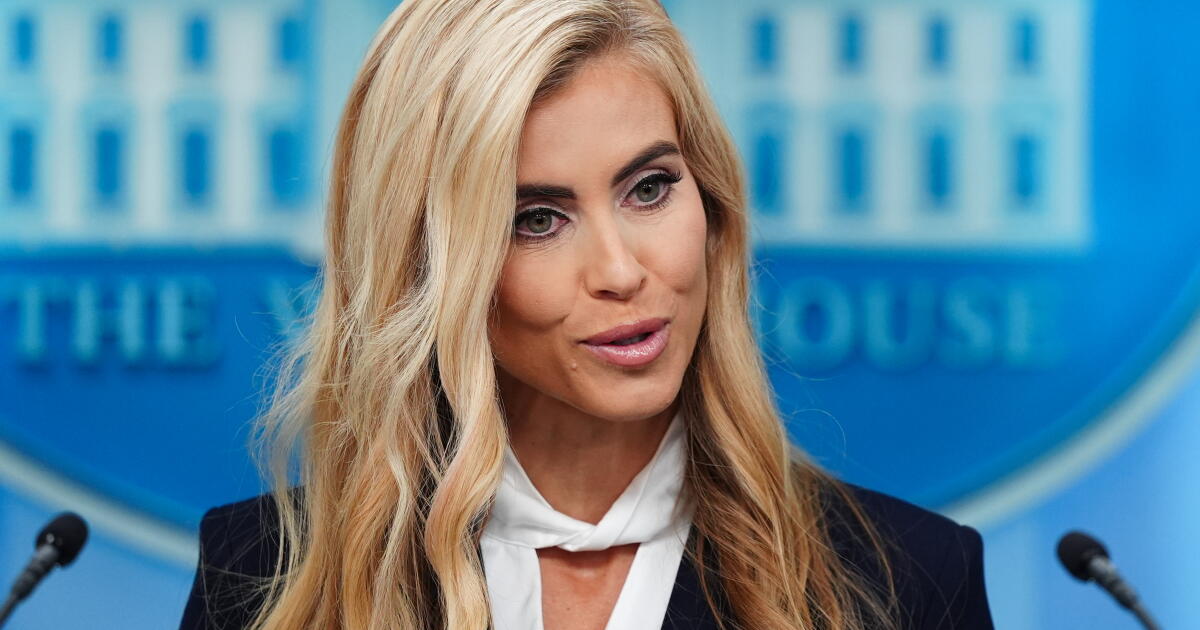
Five days. That’s how long President Trump’s latest press secretary, Katie Zacharia, lasted before she was fired Friday.
Her stint, which was about as long as the recommended shelf life for an open can of beans (if refrigerated), broke the previous record set by Anthony Scaramucci.
During Trump’s first term, Scaramucci lasted 11 days as White House communications director — the suggested length of time before a sealed pack of hot dogs expires.
Their minuscule tenures represent an impressive race to the bottom in a once-prestigious role that was created just under a century ago, during the Great Depression.
The press secretary typically stuck in the job for years or entire terms, rather than days or weeks. For reference, Scaramucci’s dizzying 2017 arrival and departure broke a 72-year-old record.
Jonathan Daniels served just 19 days (recommended expiration time for a tub of sour cream) in 1945. He at least had a valid excuse for his short run: President Franklin D. Roosevelt died.
Trump told reporters Friday that Zacharia might continue to work for him “in some form, but maybe a more pleasant form.”
He sowed further confusion when he recounted his conversation with Zacharia, claiming that he told her, “Honestly, if I were you, I’d reconsider” and asked her, “Katie, do you need this? I don’t think you need this.”
With verbal chops like those, who needs an articulate press secretary? Apparently not Trump, judging by his appointment of someone whose debut was anything but professional.
Let’s take a trip down memory lane and recall her first day on the job. It was Monday.
Zacharia appeared wholly unprepared when she took the lectern to address the press corps. She looked down and read nervously from a script, took just three questions and embarrassingly mixed up references to “her husband” and “her president.” She abruptly exited the briefing after just 11 minutes.
Zacharia previously worked as a conservative commentator and senior communications advisor for Trump Media & Technology Group (Truth Social). She monitored the president’s social media posts to discern what was of importance to him, then would go on air to talk about those topics. In essence, she was a press secretary, just not in the White House.
She told the conservative outlet Human Events on Thursday that she had been aiming for a job within the administration, frequently appearing as an expert voice on conservative platforms such as Fox News.
“My philosophy is, I’m on TV enough where if he sees me and he likes me, then I will be recruited for the job,” she said. “I do not believe that lobbying for that job would have been successful, and I wanted to work for it. I wanted to audition for it.”
She succeeded Karoline Leavitt, who served quite a long time — 19 months — before leaving to “spend more time with my family,” then immediately signed on with Fox News as an on-air contributor.
The revolving door of Trump administration press secretaries has at least been entertaining. Most stayed on significantly longer than Zacharia (the bar is low, after all), and at least a few managed to leave a lasting impression.
Sean Spicer kicked off the parade in 2017, scolding journalists his first day on the job when defending the size of Trump’s inauguration crowd. It was record-breaking, he claimed. It was not.
Spicer became the inspiration for one of the best recurring “SNL” sketches ever when Melissa McCarthy transformed into him, embodying the new administration’s disdain toward the press: “I’m not here to be your buddy!” she screamed at befuddled reporters.
McCarthy’s “Spicy” is hard to beat, but a Zacharia parody could come in a close second should it end up as the premise for “SNL’s” cold open this weekend.
When Trump announced her appointment last week in a social media post, he referred to her as “an attorney.” She referred to herself as a lawyer.
But when a reporter asked Trump on Monday where she had passed her bar exam, the president threw the question to Zacharia, who was standing behind him on the South Lawn. She stepped up to the mic and answered, “When I moved to China.”
By Wednesday, reporting surfaced that Zacharia sat for the California bar exam after graduating from Pepperdine University’s law school in 2011, but did not pass. In China, she worked in international transaction law, which didn’t require admission to a state bar.
If history is any indicator, whoever replaces Zacharia as Trump’s press secretary should have a go bag packed and stashed directly behind the lectern.
The once-respected position has been degraded by six years of poor decisions and a volatile president who prefers to communicate with the electorate at 3 a.m. in ALL CAPS via his own social media platform.
Here’s to the next White House press secretary. May you outlast the shelf life of a carton of milk.
WASHINGTON — President Trump bypassed his White House chief of staff last week in selecting Katie Zacharia as his press secretary and chief messenger, triggering days of scathing headlines about her credentials and abilities before her ignominious resignation on Friday.
Susie Wiles, that senior-most aide ostensibly in charge of the president’s team, is facing his scrutiny over a different set of problems: widespread public anxiety over corruption in government under the Trump administration. The issue has surpassed the economy as the top concern of voters entering next month’s election, according a Fox News poll released this week.
Marco Rubio, the president’s secretary of State and national security advisor, has been silent on Trump’s decision to cut a deal with Moscow on diesel sales that could fuel Russia’s war against Ukraine. The president’s poll numbers have been below water across the board, but especially so on foreign policy, where over two-thirds of Americans disapprove of his job performance and support Kyiv’s fight for freedom.
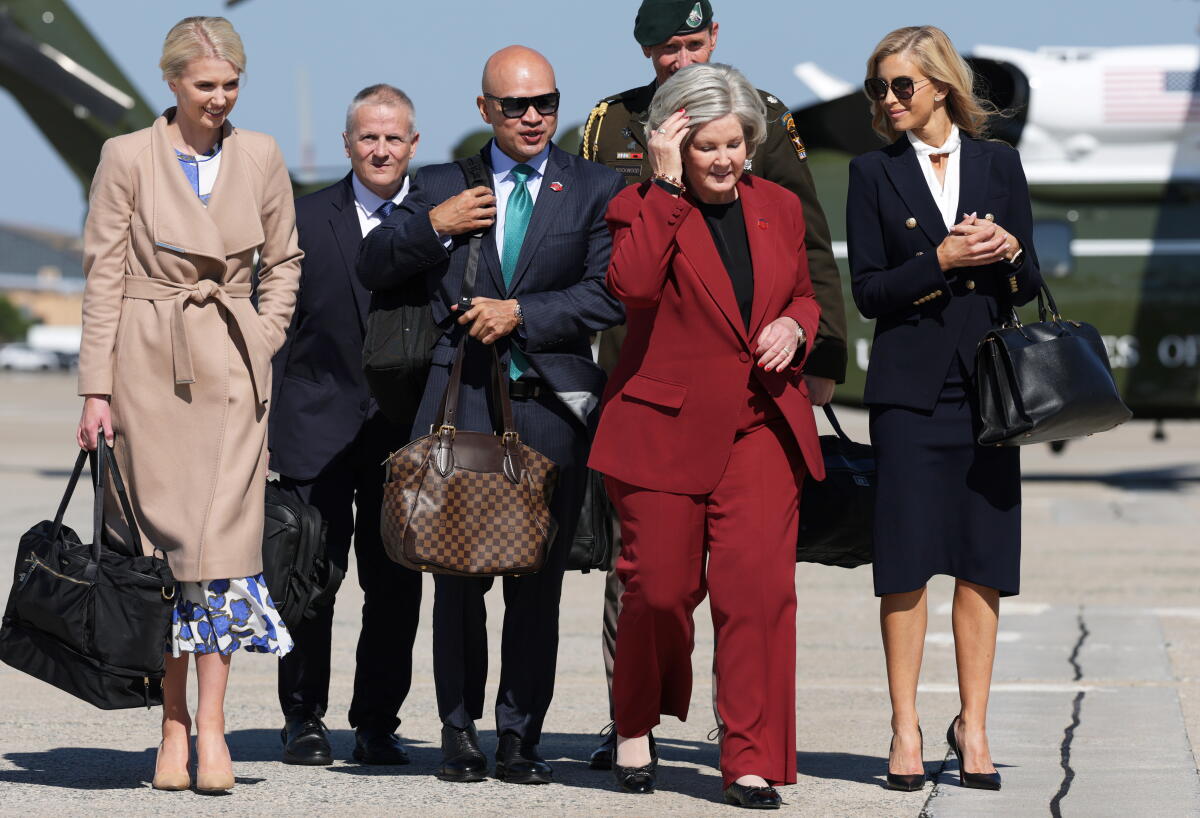
Trump aides walk to board Air Force One on Tuesday: Natalie Harp, Trump’s executive assistant, left; Walt Nauta, director of Oval Office operations (in sunglasses); Chief of Staff Susie Wiles; and then-Press Secretary Katie Zacharia.
(Alex Wong / Getty Images)
And on Thursday, the president was forced to reverse a course set out by Defense Secretary Pete Hegseth and the Pentagon to live-stream the execution of a convicted mass shooter by firing squad.
In the final stretch of the 2026 midterms, nearly two weeks out from election day, a White House that has enjoyed relative stability over the past two years has returned to the state of disarray that characterized much of Trump’s early political career, anticipating sweeping losses to Democrats in the House and Senate.
Staff upheaval is expected as officials brace for a blame game over Republican performance, with some distancing themselves from what they see as a fading political movement.
Polls suggest that Republicans are likely to lose control of the House, setting up two years of relentless congressional probes through the twilight of the Trump era, and that Democrats could even flip the Senate, winning in ruby red states from Ohio to Alaska.
It is historically a time for closing arguments, when politicians deliver their final pitches to voters in neat, disciplined packages.
Yet Trump’s campaign blitz across the country in recent weeks has generated a muddled message, dismissing the importance of the election itself at the risk of depressing Republican votes, overshadowing local candidates seeking distance from his record and touting an economy unrecognizable to most Americans.
President Trump walks ahead of Katie Zacharia at the White House.
(Win McNamee / Getty Images)
The president’s selection of Zacharia, who lasted just five days on the job, raised fresh questions about his message discipline in the final stretch.
And infighting within the White House has reinforced a narrative among political pundits that Democratic gains are a fait accompli, despite Zacharia, in her first and only press briefing, foretelling of Republican energy and excitement “never seen before in the history of midterms thanks to President Trump.”
Election officials across the country fear that, anticipating inevitable losses, Trump may be laying the ground to challenge the authenticity of the election results themselves.
“You know, this is the only guy that — it’s ‘promises made, promises kept,’ but he did more things than he promised,” Trump said Thursday, referring to himself in the third person. “I think we did. We did much more than we promised.”
The extent of the coming West Wing shakeup could be extensive, reaching into a Cabinet that has had far less turnover than Trump experienced in his first term.
Zacharia is the second senior official forced out by Trump in just three days, after Kimberly Guilfoyle, the former fiancée of one of Trump’s sons who served as U.S. ambassador to Greece, was revealed by the Wall Street Journal to have asked a Trump donor to pay off her $100,000 credit card bill.
Now, the president has begun asking political allies and donors about Wiles’ job performance, according to a recent Politico report, and several top administration officials are vying for her role, anticipating her resignation after the elections next month.
The conclusion of the midterms will also kick off the start of the 2028 presidential election season, when Republican hopefuls — including many from Trump’s Cabinet — are expected to launch exploratory committees.
British Defense Secretary Wes Streeting and U.S. Defense Secretary Pete Hegseth stand for anthems at the Pentagon on Thursday.
(Finn Gomez / Getty Images)
“We have to get through the midterms first,” Trump said at the end of August, asked about Hegseth reportedly considering a run. “I bet there’s a lot of people considering it that you don’t know about. You have a lot of people.”
The party of incumbent presidents regularly loses seats in midterm elections, and it is common for presidents to shake up their staffs halfway through a term.
But the last time a term-limited Republican president faced voters in midterm elections, in 2006, Democrats swept into power in both houses of Congress — and President George W. Bush’s political capital never recovered.
That year, 37% of voters said they approved of Bush’s job performance. Polls published this month by AP and Reuters have found Trump already below that threshold.
In the GOP presidential primaries that followed, candidates jockeying to replace Bush distanced themselves from his legacy. He ultimately left office with an approval rating of 25%.
Netflix replaced one of its top executives in a major management shake-up on Thursday, a day after the company announced it was laying off 6% of its staff.
Chief Content Officer Bela Bajaria is leaving the company after a decade, Netflix said in a statement. She will be replaced by former Disney executive Peter Rice, who was most recently chairman of Walt Disney Television and chairman of general entertainment for Walt Disney Co.
“Peter is one of the most effective at-scale operators in the entertainment industry,” Netflix Co-Chief Executive Ted Sarandos said in the statement. “His business acumen is sharp, his talent relationships are exceptionally strong, and his experience across TV and film is deep and broad.”
Bajaria’s exit comes as Netflix has been under pressure from investors to turn out more hit shows and movies and increase the amount of time consumers spend on the platform amid rising competition from other streamers.
“Due to the slowdown in massive hits and viewer growth, an ax was gonna fall on some executives who led content strategy,” said Ross Benes, senior analyst at research firm Emarketer.
Bajaria oversaw the teams responsible for Netflix content around the world. She joined Netflix in 2016 and was named chief content officer in 2023. She was instrumental in expanding Netflix’s reach internationally and the streamer’s push into live events.
Hits released on Netflix during Bajaria’s tenure include the 2025 animated movie “KPop Demon Hunters” and crime drama series “I Will Find You.” Under her leadership, Netflix grew its reach in live programming, streaming NFL games as well as WWE matches. The company also changed its film strategy to focus on fewer movies that aimed to be bigger and better.
She also played a key role in helping Netflix generate large audiences for its non-English-language original series, reality shows and programs that featured talent from underrepresented communities.
But her tenure also coincided with mounting challenges to growing Netflix’s business.
Free, ad-supported streaming services like YouTube are increasingly taking up more streaming hours and investors are concerned about how Netflix will continue to grow. YouTube represented 14.2% of streaming time in the U.S. on TVs compared to Netflix’s 7.8% in July, according to Nielsen data.
Netflix has said efforts like live programming have been successful at getting significant subscription sign-ups. While live programming represents 5% of Netflix’s content budget, it holds 1% of watch time on the streaming service, Sarandos has said.
The company also was poised to buy Warner Bros. Discovery, which would have dramatically increased its library of content, but Netflix bowed out of the auction after the price became no longer “financially attractive.”
Netflix stock has declined 40% from a year ago. Shares closed Thursday at $72.61, up 3%.
“The drop in share price has been staggering,” said Stephen Galloway, dean of Chapman University’s Dodge College of Film & Media Arts. “That plunge, plus the negative reaction to its move to buy Warner Bros. left it vulnerable, and so you have to do two things. One is right the ship, but you also need to send a message to shareholders that you’re taking action.”
In a memo to staff announcing the change in leadership, Sarandos wrote, “I know this is a big change in a year that has already had its share. But I also see an opportunity to take our slate to the next level, especially in UCAN [U.S. and Canada] where we have an outsize impact in creating big, buzzy hits that our members love and drive conversation around the world.”
Rice is an experienced corporate executive who spent nearly three decades navigating Rupert Murdoch‘s media empire, serving as president of 21st Century Fox and CEO of Fox Networks Group.
He also brings deep roots in the feature film world, having previously run Fox Searchlight Pictures, which could mean he will want to put his own stamp on Netflix’s film group, Galloway said. That group is currently led by executive Dan Lin.
“Netflix has fundamentally changed the way stories are made, shared and experienced around the world,” Rice said in a statement. “They’ve shown again and again that they’re willing to take chances on distinctive voices and fresh ideas, and I’m excited to work with the team to help bring even more great stories to members everywhere.”
Actor Tom Arnold unleashed on Chuck Lorre on X in response to the former “Roseanne” writer-producer’s claims in his new memoir, “Sitcom.”
“He thinks he’s brilliant & beloved like Norman Lear but Chuck ‘Chuckles’ Lorre’s a terrible human, an angry dry drunk who lies every time he opens his mouth,” Arnold wrote Tuesday.
Arnold and the ’90s sitcom’s co-creator and titular star, Roseanne Barr, were married Jan. 20, 1990, four months after he first appeared on the show as a poker pal of Barr’s TV husband and four days after Barr’s real-life divorce from her husband of 14 years, William Pentland, was finalized.
Barr and Arnold were hostile to their writing and producing colleagues on the show and the network, Lorre told the Los Angeles Times’ culture critic Mary McNamara in an interview published Tuesday, the day of the book’s release.
“We were punished, the writers,” Lorre told The Times. “The word ‘cruelty’ comes to mind. And I still don’t know why, why so much cruelty. It wasn’t like we didn’t want to make a great show. We were proud to be on that show.”
Hired in 1990 after Barr fired all of the show’s writers, Lorre recalls in the book that he had a rude awakening when he took the job.
“I was now the co–executive producer on the number one show on television. I swaggered into the office assigned to me and met Danny Jacobson (a world-class comedy writer who would go on to cocreate ‘Mad About You’ with, sorry, Paul — ‘My Two Dads’ — Reiser),” Lorre writes in “Sitcom.”
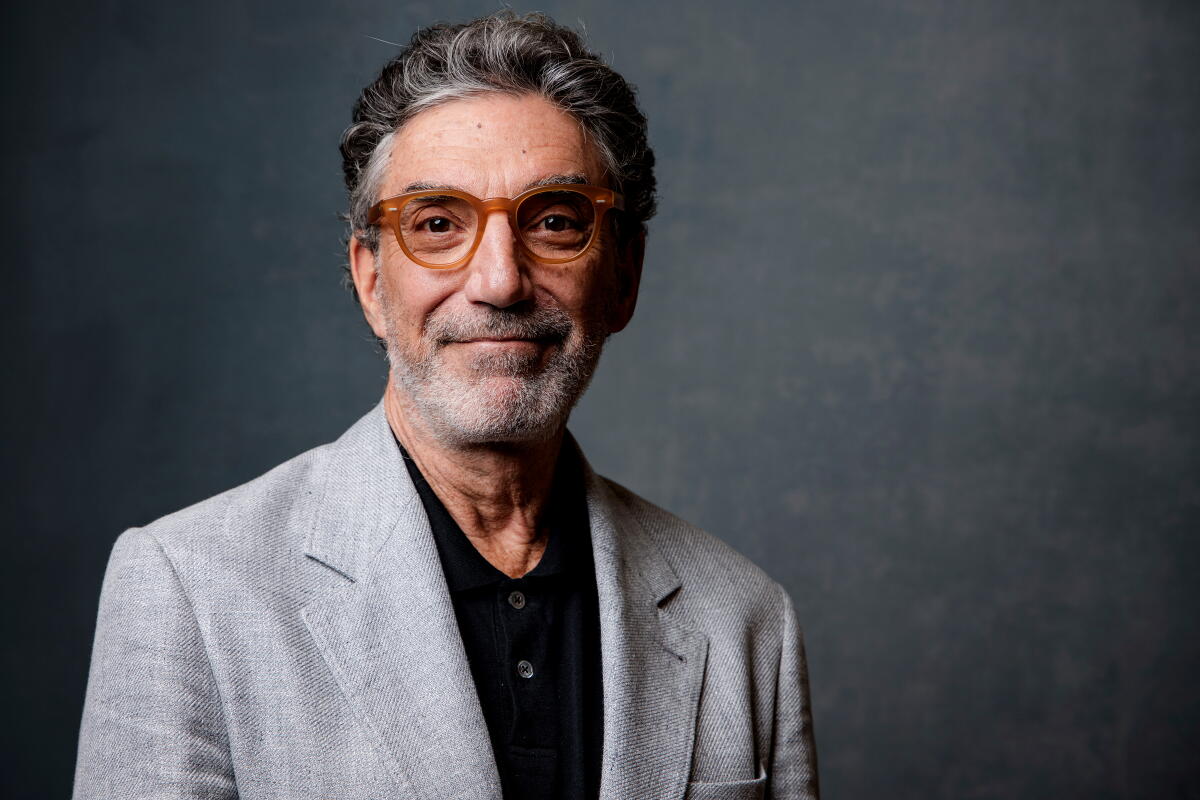
Chuck Lorre, pictured in 2024, related several anecdotes in his book “Sitcom” that didn’t sit well with Tom Arnold.
(Willy Sanjuan / Invision / Associated Press)
“Danny, having been fired by Roseanne for being talented, was packing up his stuff when I walked in. He showed me a sloppy, hand-scribbled couple of pages and explained this was a ‘script’ by the show’s new executive producer, Tom Arnold. It had been part of Danny’s job to write real scripts and put Tom’s name on the front page — as if Tom had written them,” Lorre continues. “Bob, myself, and several other staff writers would be ordered to do this on many occasions…. Was it a portent of bad things to come? You tell me.”
For her part, Barr admitted after the 1990 firings, “Yeah, I probably was difficult to work with, now looking back.”
“I don’t think I was as especially clear as I could have been,” Barr told former Times television writer Rick Du Brow in a November 1990 article. “It’s like being a woman and an administrator — I never had any background like that. I didn’t know how, like I do now, to go in and say, ‘This is what I want you to do.’ I think that’s common with women in business. I would go in there and try to get them to agree with me rather than tell them what I want to do.”
Arnold’s social media screed doesn’t directly address any of Lorre’s claims in the book but resorts to name-calling and his own claims against the producer, who went on to create or co-create sitcom hits including “Cybill,” “Dharma & Greg,” the Charlie Sheen-starring “Two and a Half Men” and “The Big Bang Theory” and its offshoots.
“He trashes Trump but he is Trump & he’s a bitter hack who actually believes his lame vanity cards at the end of his lame shows are Paddy Chayefsky worthy,” Arnold wrote, invoking the three-time Oscar-winning writer of “Network.” “Chuckle’s made $800,000,000 off the backs of very talented women & a naive cracked up Charlie Sheen (clean & sober since he’s not under Lorre’s strange, abusive tutelage) then trashes them all to make him feel cool but don’t worry, Chuck hates himself more than we ever could.”
Some thoughts on uber producer Chuck Lorre’s new book… https://t.co/KaUN4fen9h
Lorre’s accounts of Arnold in “Sitcom” included several other anecdotes, including one seemingly questioning the “True Lies” and “The Stupids” star’s trustworthiness.
“Executive Producer Tom was angrily explaining to Bob [Myer] and me that some bastard had stolen Roseanne’s love letters to him and sold them to the National Enquirer. His plan was to hire a private detective and get to the bottom of this treachery. And he did. It took one day. The detective found a cashed check for twenty-five grand from the National Enquirer made out to Tom Arnold. Mystery solved.”
Lorre was famously fired after two years on the show, which Arnold recalled in concluding his X post: “I wish everyone could’ve seen his arrogant, sad clown face the day Roseanne made me fire him.”
Barr later fired Arnold from “Roseanne” in 1994 amid their divorce. In 2018, after posting a racist tweet, Barr was fired from the “Roseanne” reboot, which was resurrected as spinoff “The Conners.”
A hike among redwoods is fine if you go in for that sort of thing.
But to gaze upon those towering trees from a slow train with a stiff drink in your hand — that’s something else entirely.
And with the latest added offerings from Mendocino County’s historic Skunk Train, slow-rolling drink-sipping is possible on short excursions from the railway’s stations in both Fort Bragg along Highway 1 and Willits along U.S. 101.
Known as the Noyo, this car is a new cocktail car that’s part of the Skunk Train, rolling from Willits, Calif.
(Christopher Reynolds / Los Angeles Times)
The first part of this expansion happened last year when the Mendocino Railway, better known as the Skunk Train, unveiled the Redwood, a fancy railcar offering cocktails as part of a seven-mile round trip from Fort Bragg. The Willits end of this expansion followed in September, when the railroad introduced another reconditioned traincar, this one known as the Noyo. Formerly a U.S. Army railcar, it’s now been reborn as a rolling cocktail lounge for up to 22 guests, featuring leather chairs, plush couches, a carpeted floor and ‘50s overtones.
On the journey I joined recently, passengers mingled in a spacious, adults-only railcar with vintage jazz on the sound system and servers outfitted in spiffy white jackets. For about $200 each, Willits-based passengers get a 16-mile round trip, charcuterie snacks and two cocktails (or mocktails).
Most popular cocktail so far: the Redwood Martini, made with dry gin, dry vermouth and orange bitters, served with a sprig of redwood.
The journey takes about two hours, passing through an 812-foot-long tunnel (a.k.a. Tunnel No. 2), then pausing to turn around in a clearing known as Crowley.
Passengers relax in the Skunk Train’s “presidential class” railcar, the Noyo, from Willits.
(Mendocino Railway)
Crowley, once a logging camp, can’t be reached by road, but train passengers can wander among picnic tables, fire pits, cornhole games and a massive, gnarled old redwood known as the Wolf Tree. (In September, when the performers of the Flynn Creek Circus were in town, the troupe hauled a big tent out to the clearing and staged two weeks of live performances there.)
Through October and November, the Skunk Train offers “presidential class” cocktail-car trips four to five days per week from Fort Bragg, two to three days per week from Willits. In December, trips from Willits are also offered on most weekdays and service from Fort Bragg drops to two days per week. (Willits-based service shuts down in January and February before resuming in March.)
1
2
1.Passengers in the Skunk Train’s “presidential class” railcar, the Noyo, from Willits get two cocktails (or mocktails) with the price of admission for a two-hour round-trip journey.2.Besides cocktails or mocktails, service aboard the Skunk Train’s “presidential class” cars from Willits and Fort Bragg includes charcuterie plates.(Mendocino Railway)
These cocktail cars are the latest additions in a decade of Skunk Train team improvisations in the wake of long history and, more recently, trouble on the tracks.
The Fort Bragg Railroad started up in 1885 to haul redwood and fir logs to the coast for shipping south to San Francisco. By 1911 there was steam-driven passenger service between Fort Bragg and Willits, and by 1925, locals had nicknamed it the “skunk train” because of the odor that billowed from the railcars’ recently introduced gasoline-burning engines and oil-burning stoves.
That moniker might have faded, but in May 1959, National Geographic magazine devoted a spread to the train under the headline “The Friendly Train Called Skunk.” In its 40 miles, that article noted, the train climbed more than 1,600 feet, crossed 34 bridges and trestles and rounded some 381 turns, occasionally pausing to deliver groceries to rural neighbors.
A passenger soaks up atmosphere on the two-hour, round-trip Skunk Train journey from Willits in Mendocino County.
(Christopher Reynolds / Los Angeles Times)
Alas, the timber industry faded, a mail delivery contract was lost and railroad ownership changed hands. On the way, the Skunk Train began to depend mostly on tourists. Then in 2013, the railroad’s Tunnel No. 1 collapsed, blocking the tracks about four miles east of Fort Bragg. Repairs followed, but the same tunnel collapsed again in 2015. There were no injuries in either accident, but it remains impossible for any railcar to make the full 40-mile journey between Fort Bragg and Willits.
“We are committed to reopening the tunnel,” Mendocino Railway president and CEO Robert J. Pinoli has said. But the reopening won’t be quick. Besides the challenge of rebuilding the tunnel, the railroad has been tangled for several years in legal disputes with the city of Fort Bragg and the California Coastal Commission. For now, every trip on the Skunk Train, including traditional railcars and increasingly popular pedal-assisted railbikes, is an out-and-back journey designed to avoid the blocked tunnel.
From Fort Bragg, most train and railbike trips go 3.5 miles east and 3.5 miles back again. From Willits, most trips go eight miles west and turn around, including the fall Pumpkin Express and Christmas Train. The great exception is “Railbikes on the Noyo,” a 25-mile journey that begins near Fort Bragg with a hike to the east end of Tunnel No. 1. From there, guests pedal an eastbound railbike for 12.5 miles through the forest, including a dozen wooden trestle bridges and recurring views of the Noyo River. After a picnic lunch, guests double back to where they started. That adventure usually takes about six hours and starts at $564 (combined) for two people sharing a two-seat railbike.
The new cocktail car excursion, meanwhile, requires less time, less money and less perspiration.
A view of the Skunk Train’s Noyo railcar.
(Mendocino Railway)
After our train reversed direction at its midway stop in Crowley, I could have stayed in my comfortable cocktail-car seat. But I had been tipped to check out the back end of the train. That’s the open observation car (no ceiling) in the back of the train. Skunk Train employees say it was first built for the U.S. Marines to transport Sherman tanks. It works just fine carrying us gawking civilians.
“Ahhh,” said 2-year-old Elle Davis, looking up to the sky and standing by her mother, Kaitlyn Davis of Willits. The observation car is open to all aboard — that is, the Noyo Car passengers and to those Skunk Train passengers who pay standard fares ($81.47 per adult) for less luxe railcars (open to all ages).
As you stand there with the wind in your face and the rails rattling below, the evergreen boughs whoosh past. Depending on the hour and humidity, the sky might be dimming or masked by fog. These days you don’t get that skunky scent of years gone by, but a ride is still a full sensory experience. And even if you have an adult beverage in your hand, you might find yourself with the same sense of rejuvenation that engineer Johnny Galliani described to National Geographic back in 1959.
“Young or old, they’re all kids when they ride with us,” Galliani said. “Nothing like a ride on this train to take the years off your back and make you young again.”
Passengers board the Skunk Train on an excursion from Willits to a forest clearing (once a lumber camp) called Crowley.
The Dodgers have two pitchers who have won multiple Cy Young Awards in Blake Snell and Tarik Skubal. Another starter, Yoshinobu Yamamoto, is the reigning World Series most valuable player.
None of them will be on the mound Thursday when the season will be on the line. Instead, manager Dave Roberts will put the ball — and his team’s future — in the massive right hand of Tyler Glasnow, who will have no margin for error.
“It’s win or go home,” Skubal said. “Our backs are against the wall.”
That’s not how Andrew Friedman, the Dodgers’ president of baseball operations, saw things playing out when he traded three prospects to Detroit for Skubal in August. Or when he spent $182 million to sign Snell before last season. Or when he committed $325 million to sign Yamamoto the season before that.
And while that may not be the way the Dodgers wanted things to play out, they say they like their chances — for one night, at least.
“Everybody in the team is very confident in his ability and the stuff that’s coming out of his hand and doing his job,” Skubal said of Glasnow.
“I feel great about Glas,” utility man Kiké Hernández added. “He’s got some of the best stuff in the game. I feel like our pitchers have given us a chance every day to win a game, and we just haven’t hit. So we just got to hit.”
Glasnow started the season as the No. 3 starter, but before the Dodgers had gotten six weeks into their schedule, he was on the injured list because of lower back spasms. He spent most of the season there, pitching more innings in minor-league rehab starts than he did for the Dodgers between May and September.
He returned to make six starts down the stretch, striking out 49 in 34-1/3 innings to finish the season 5-2 with a 3.53 earned-run average in 13 starts, then held Atlanta to one hit over 4-2/3 innings in the deciding game of the division series.
“He’s fresh,” Roberts said of Glasnow. “He’s got a lot of arm talent. He’s got experience certainly in the postseason. We’ve got a lot of guys behind him” in the bullpen.
“I think he’s going to pitch well.”
The Dodgers’ season is depending on that. Glasnow, however, is just approaching it as another start.
“When I was younger maybe I’d feel it and get excited, and I’m like, ‘Oh, I can throw 105 if I try hard,’” he said. “Now it’s more about trying to settle in and go back to as close of a normal feeling as possible, not trying to chase it and be any different or any more or any less. Just try to stay with it and what I’ve done all week, my preparation, how I feel on the mound, and just keep it consistent.”
Glasnow, 33, has pitched in 17 postseason games for Tampa Bay and the Dodgers, going 2-6 with a 4.27 ERA. Only Snell, among Dodgers starters, has more playoff appearances. But Glasnow hasn’t won a playoff game since the 2020 division series when he was pitching for the Rays.
If he can give the Dodgers a boost Thursday, however, if he can extend their season just one more day, it could give the team new life.
Only one team has come back from a three-game deficit to win a best-of-seven League Championship Series and that was the 2004 Boston Red Sox team Roberts played for — a team that also gave the ball to its fourth-best starting pitcher with its season on the line.
On the afternoon of Game 4, with the New York Yankees looking to beat Derek Lowe and sweep the Sox, Boston’s Kevin Millar stepped on the field at Fenway Park and issued a warning.
Dave Roberts of Boston steals second past Derek Jeter of the Yankees in the ninth inning of Game 4 of the 2004 ALCS. Roberts and the Red Sox became the only team to come back from down 3-0 to win an LCS.
(Jed Jacobsohn / Getty Images)
“Don’t let us win tonight,” he shouted. “If we win today, we’ve got Pedro [Martínez] coming back and then [Curt] Schilling will pitch Game 6 and anything can happen in a Game 7.”
The series played out exactly as Millar predicted. And if Glasnow can rescue the Dodgers, they would have their three high-paid aces — Skubal, Yamamoto and Snell — lined up for the next three elimination games.
But none of that matters if they lose Thursday.
“We just need to win tomorrow’s game,” Skubal said.
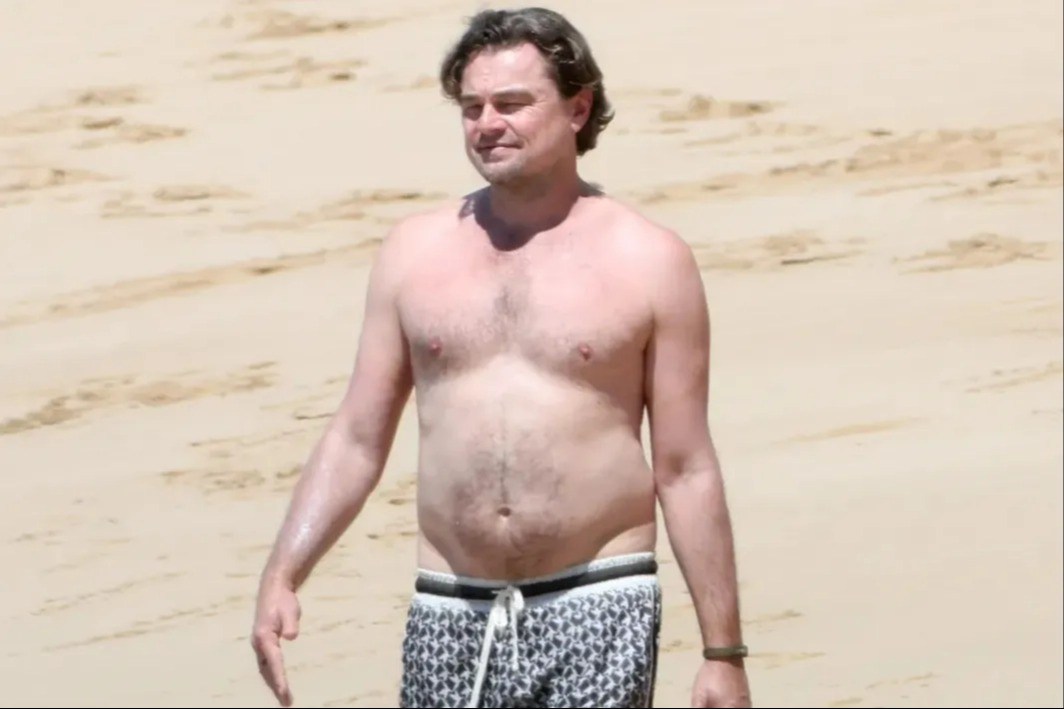
IF Leonardo DiCaprio, a man who seems to have dated half the Victoria’s Secret catalogue, can’t whip his shirt off on a Hawaiian beach without critics likening him to a beached whale, what hope is there for the rest of us blokes?
The recent photos of Leo catching some rays sparked a frenzy of online trolling, with keyboard warriors gleefully pointing out that the actor – shock horror – no longer possesses the boyish physique he sported 30 years ago on the bow of the Titanic.
Leonardo DiCaprio has been criticised for his supposed ‘dad bod’ after he was snapped on a beach in HawaiiCredit: BackGridDiCaprio, aged 24, starring in the 2000 blockbuster The BeachCredit: Alamy
Apparently, we are now fair game and it’s open season on the male waistline.
Leo’s holiday flab, the internet decided, was public property, ripe for mockery.
They disparagingly call it the “Dad Bod” – even though Leo, as far as we know, has yet to produce any sprogs.
It’s a term delivered with a patronising smirk, conjuring images of a bloke whose primary exercise consists of walking to the fridge between repeats of Top Gear.
But let’s pause for a second and reverse it. Would any sane person ever dream of pointing a camera at a woman on a beach and laughing at her “Mum Bod”?
You’d be cancelled in an instant with feminists queuing up to condemn you.
Yet, when it comes to blokes, it seems the rules against bodyshaming don’t apply.
Now, I’ll acknowledge the elephant in the room, women have put up with relentless, toxic body scrutiny for decades.
But it’s the women in my life who have been most gleeful when scrutinising poor Leo.
It’s only fair they argue, after all 51-year-old Leo isn’t shy at letting his own preferences be known, dating a string of twenty-somethings who look like they’ve never consumed a carb in their short lives.
But underneath the jokes about Leo’s paunch, there is a serious side to all of this.
The pressure to look like a muscle bound Marvel actor is driving ordinary blokes to desperate measures – and contributing to poor male mental health.
Chris Pratt sporting a pair of USA flag branded shorts during a visit to the beach in 2006Credit: Splash NewsChris Pratt has since undergone a huge transformation but still contends with bodyshaming comments
Gym memberships are skyrocketing, not just because men suddenly care about their cardiovascular health, but because they are chasing the Hollywood aesthetic.
We are witnessing an epidemic of normal blokes turning to unregulated peptides and sometimes illegal supplements, desperately trying to keep up with the unachievable, steroid-assisted standards plastered across their Instagram feeds.
I’ll hold my hands up and confess I am one of the millions who has tried the fat jabs.
After years of miserable yo-yo dieting, I would always end exactly back where I started, so I finally caved and got on the Mounjaro.
The pharmaceutical quick fix certainly worked, helping me to lose a couple of stone within six months despite the dreaded side effects.
But despite my smaller frame – and annoyingly pricey new wardrobe to match – I still have to contend with the toxic pressure of the perfect body burrowed in my own brain.
And I’m far from the only one. Just look at the male celebs who are supposedly at the top of the food chain.
Pop icon Robbie Williams has been open about his own torturous battle with his weight and his use of fat jabs, telling fans: “I could write a book about self loathing where my body image is concerned, like pure self hatred.
To most men, Zac Efron has the perfect male physique but it has contended with depression over his body imageCredit: NetflixJames Corden has spoken out on body image issues and created Nessa and Smithy’s love story to show bigger people falling in love on the screenCredit: Getty
“The struggle is real. The sadness is shocking. I’ve had it all my life. And it won’t abate.”
James Corden has faced abuse from those obsessed with his waistline, even channelling his frustration with the industry into Nessa and Smith’s love story in Gavin & Stacey.
He once said: “If an alien came back and they had to take a reading on planet Earth by just watching films or TV, they would imagine that if you are chubby or fat or big, you never really fall in love, you never have sex. Certainly no-one really ever finds you attractive.”
Even the supposed “hunks” are miserable. While Jason Momoa has shrugged off “Dad Bod” criticism, Zac Efron has spoken out about the severe dehydration and “pretty bad depression” he suffered to get his Baywatch body.
While Chris Pratt had to ditch his Parks & Rec “dad bod” to break Hollywood as the ripped Star-Lord in Guardians of the Galaxy.
But then found himself criticised for being too thin, forcing him to warn critics to back off: “Just because I am a male doesn’t mean I’m impervious to your whispers. Body shaming hurts.”
So it’s little wonder that the next generation of young men are endlessly preening themselves in the mirror.
Aquaman star Jason Momoa has laughed off claims that he has a dad bodCredit: BackGridDespite Robbie Williams bulging muscles, the showman has said he has ‘self hatred’ towards his own bodyCredit: Instagram/robbiewilliams
They call it looksmaxxing, a dystopian online cult where young lads obsess over every facet of their appearance to fit a very specific alien-like visage.
We have genuinely reached a point where an influencer known as Clavicular, literally smacks himself in the face with a hammer in a bid to attempt to reshape his jawline, and is watched in this mindboggling process by millions of impressionable youngsters.
We have created a world where teenage boys are learning that blunt-force facial trauma is preferable to looking like a normal human being.
It’s time to call time on the madness.
If the price of a Hollywood physique is a lifetime of misery, macros counting, and taking a hammer to your own cheekbones, you can count me out.
Let’s leave Leo to enjoy his Hawaiian holiday in peace, and please give us blokes a bloody break too.
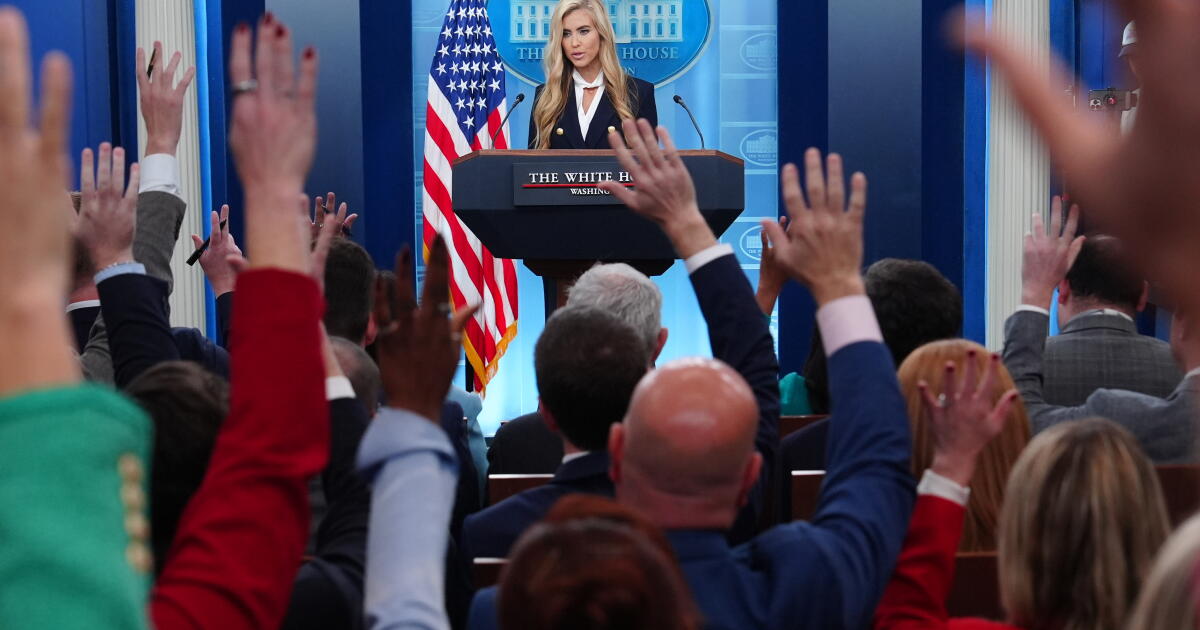
President Trump’s new press secretary stepped to the podium, the eyes of a packed room of journalists — and many in their audiences — upon her. She smiled broadly at the sea of faces both probing and friendly. With that, Katie Zacharia went live and became the official voice of the world’s most powerful person.
Fourteen minutes and just three questioners later, she was done. In the aftermath, it was clear that the former Newsmax commentator accomplished at least one thing: She put the “brief” back in briefing.
In her debut Tuesday, Zacharia looked downward and often read directly from a script. She paused and grinned when she uttered the words “Department of War.” She stumbled on a question about her background and mixed up the words “husband” and “president.” The few questions she took were nonconfrontational and from media outlets that have been sympathetic to the Republican president. In short: She made no memorable impression — or at least, to hear some tell it, not the one she likely wanted.
This would not be an easy job under any circumstances. Trump most frequently serves as his own spokesman. And his antagonism toward the media has created a new layer of tension. Zacharia is finding out on day one that she, too, will be under constant watch. Some — including a few of those who have stood in her shoes — didn’t think it went all that well.
In fractured times, in a national media scrum unimaginable just a few decades ago, what is the proper way to approach a job like this? How do you speak effectively when your boss speaks for himself so often that he commandeers the news cycle multiple times a day — and sometimes late into the night — with remarks provocative, unexpected and sometimes incendiary?
For one, you realize for whom you work: not your audience of millions but your audience of one, and the absolute need for his approval.
“I get to do what I was doing on the outside already, which was hoping to amplify, multiply and expand upon President Trump’s incredible agenda for the American people,” Zacharia said. Nowhere did she mention the task of disseminating accurate information to Americans.
The press secretary role has been many things
Over the nearly 10 decades since former journalist George E. Akerson made his and the office’s debut as Herbert Hoover’s press secretary in 1929, the job has served many purposes: deliverer of information, amplifier of policy, jouster with journalists, protector of the presidential reputation and, sometimes, overlord of obfuscation.
Under Trump and his second-term press secretary so far — Karoline Leavitt, who resigned in August — the job has been primarily one of acting as the immovable object against an irresistible, and in Trump’s eyes sometimes treasonous, force.
Leavitt got to know this terrain well in her 17-month tenure. She took a smiling but combative stance against a press that was increasingly coming under Trump’s criticism for coverage — and was named in at least one lawsuit about White House media access. She was not shy about interdicting what she considered media bias. “What a stupid question,” she said to one reporter at a briefing last year.
Trump, outside the White House on Tuesday shortly after Zacharia’s briefing, praised her debut as “excellent.” She was standing behind him at the time.
Other early reviews were more critical. MS NOW quoted one unnamed White House official as saying of the performance: “She needs to get much better fast, otherwise she’ll break Scaramucci’s record.” Anthony Scaramucci, an early White House communications director for first-term Trump, lasted 11 days in 2017. Said Scaramucci on X Tuesday afternoon: “I hope she makes it.”
Joe Biden’s former press secretary, Jen Psaki, now the host of a show on MS NOW, put it more succinctly, posting on X: “Well that briefing was basically an SNL skit….except it wasnt.”
Talking up Trump but taking few questions
While Zacharia’s performance — and of course, that’s what every briefing is — may have been bumpy to some, it was also mostly content-free except for news she broke about the White House asking U.S. Ambassador to Greece Kimberly Guilfoyle to quit, which she immediately did.
Predictably, also like Leavitt before her, Zacharia spent a great part of her opening monologue praising Trump and giving an “up ‘til now”-style update on his second term’s priorities and accomplishments so far. Talking points included a “booming economy,” “his historic boom in energy production” and “a great relationship with Venezuela.”
She was also fond of superlatives, a trait that likely will resonate with a president whose remarks are often equally if not more expansive: “President Trump is working to secure the Western Hemisphere for centuries to come.”
When it came to questions, though, she was downright parsimonious. She allowed three questioners, then answered an additional one as she prepared to depart. The three called on during the briefing were Breitbart, Fox News and the Daily Mail, all of which have been friendly to Trump in varying degrees during periods of his two terms. And she said she would continue Leavitt’s policy of bringing “new media” in — which has often meant outlets more sympathetic to Trump.
“We love new media and we want to be able to embrace it,” she said. Currently, three major outlets — CNN, MS NOW and Politico — are fighting to regain White House access after Trump banished them last month, saying he didn’t like their coverage and calling it “fake news.”
How will Zacharia fare in coming days and weeks and, if it lasts, months? That, like so much else, depends on one thing: Donald Trump.
The late U.S. Sen. Howard Baker once famously said that, when being asked difficult things, handle it something like this: If you don’t like the question being asked, just answer a different question. On Tuesday, a half-century later, Katie Zacharia found a different way in — pick three nonconfrontational questioners, then defer to your boss and say: The End.
MANY parents usually spend years saving up for family holidays abroad.
But one savvy couple has managed to swap life in the UK for a full-time travel adventure – all while saving £36,000.
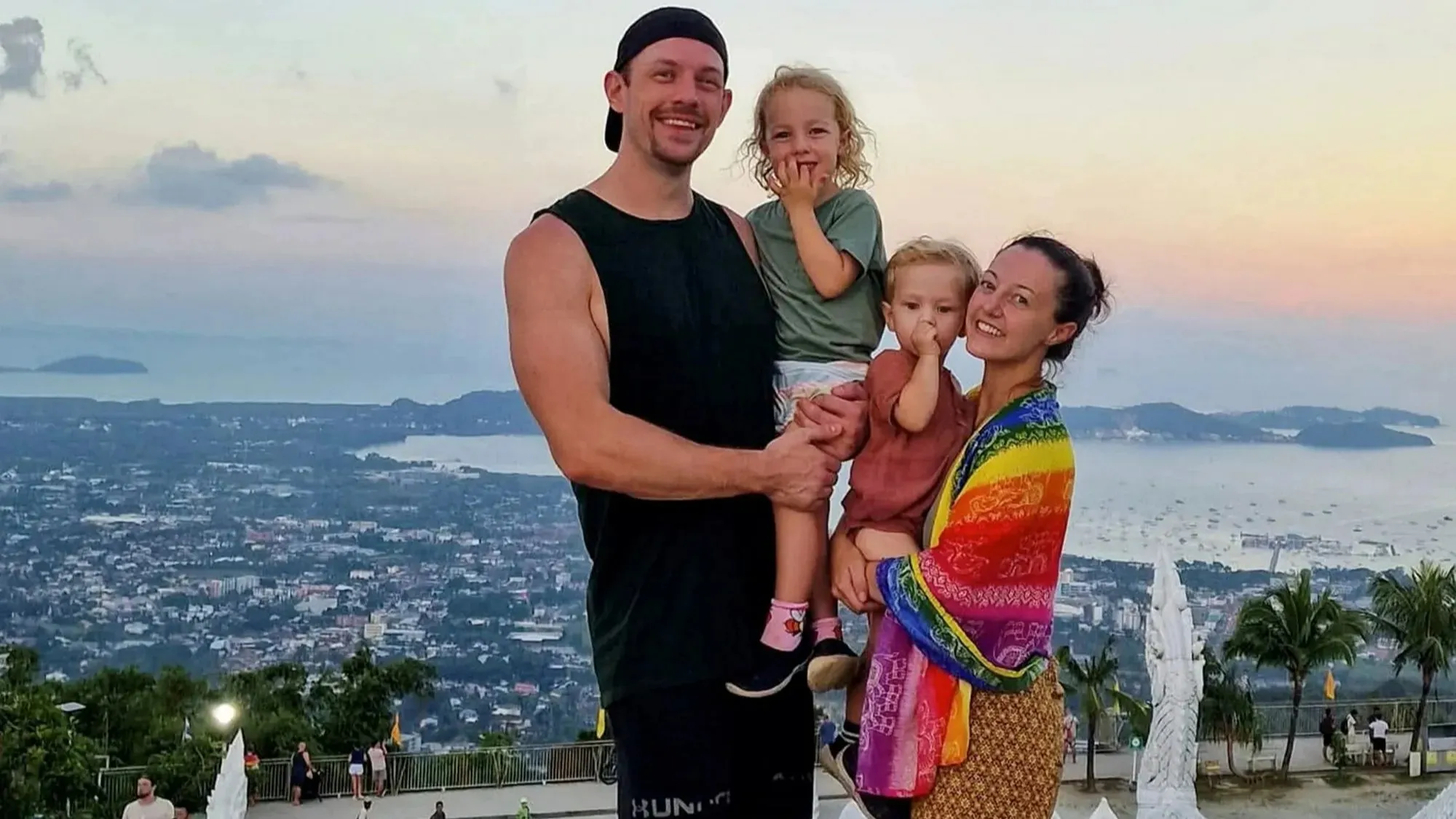
Steven, Aurora, Atlas and Ruth in Phuket, ThailandCredit: SWNSSteven and Ruth enjoying quality time with their kids in Sri LankaCredit: SWNS
Back in 2023, Ruth and Steven Rowe made a decision which shocked a lot of people after “selling everything they owned” and buying a one-way ticket to Sri Lanka.
They have been globe-trotting ever since on a budget of just £30 a day, and have turned the world into a classroom for their two children Aurora, five, and Atlas, four.
Ruth, 35, and Steven, 36, said they had always dreamed of travelling full-time and, as the moment approached to put the children into a nursery, they felt the time was right.
Ruth said: “We knew those early years were precious and we wanted more time together as a family before school routines took over.”
The family-of-four looking over a field Bali – one of the 17 countries they have visitedCredit: SWNSSteven, carrying Aurora, and Ruth with Atlas in her armsCredit: SWNS
They flogged all their belongings on Facebook Marketplace or via car boot sales and set off from the village of Eardisley, Herefordshire, with just two suitcases of clothes and a few toys.
The family has already been to 17 different countries, ticking off bucket-list destinations such as Costa Rica, Guatemala, Ecuador, and Indonesia.
They stay four weeks at a time in Airbnbs and have also visited the likes of Thailand, Malaysia, Cyprus, the USA, Colombia, and Peru – all while saving around £12,000 a year.
They currently have no plans to return and want to continue world-schooling in exotic locations – while spending around £2,000 a month, compared to £3,000 back in the UK, as a result of their rent and outgoings being less.
Ruth and Steven had been renting a barn conversion and had both children during the Covid-19 pandemic.
They had travelled extensively before having kids but couldn’t shake the feeling that there was still so much of the world they wanted the children to experience.
Ruth added: “We wanted more time with them as we know those early years are precious, so we thought, why not just do it? So we did.
“Selling everything was an exhilarating experience.
“Our car, furniture and most of our possessions all went through Facebook Marketplace and car boot sales.
“We kept only a handful of memory boxes filled with special items from the children’s early years and a few clothes.
“We set off at the start with two big suitcases, a medium and a small one – and a stroller.
“And since then we’ve downsized to just two suitcases – it is really surprising how little you really need.
“Possessions don’t make you happy, life experiences do.”
They arrived in Sri Lanka with no return ticket and no real plan beyond seeing where life took them.
Ruth added: “And we’re still travelling now. We’ve been travelling full-time ever since, slow-exploring the world as a family, while my husband runs his coaching business remotely and we embrace world-schooling on the road.
“It’s been beautiful, chaotic, challenging and incredibly freeing.”
Steven, Aurora, Ruth and Atlas pictured together in GuatemalaCredit: SWNSThe family pose in Antigua, GuatemalaCredit: SWNS
The couple also support themselves financially via Steven’s online coaching business – which he can still run wherever they are in the world.
However, Steven revealed the lifestyle isn’t always glamorous.
He added: “We use Airbnbs mainly but I’ve been working out of little cupboards in some places – it has been challenging at times but we’re in a fortunate position.
“We aim to live off around £30 a day and we stay in places for a month at a time so I can work Monday to Friday.
“But it can vary greatly; a two-bed apartment in one country can be £800 but a smaller one in another country £1,300.”
The couple say their children are now educated through “life experiences” – be it picking up Spanish in Latin America or learning about volcanoes while hiking in Peru.
And they say giving the kids no screen time whatsoever on their travels has helped them to become more patient and creative.
Ruth added: “They are also learning counting through things like paying a tuk-tuk driver in different currencies and the first time Aurora ever wrote her name it was in sand on a beach with a stick.
They also visited a waterfall in ColombiaCredit: SWNSChilling out at the Pacific coast of Costa RicaCredit: SWNS
“We give them no screen time at all – which I think has taught them patience on their travels and to be more creative when they are bored sitting on a bus.
“They thought the TV back home was a radio as we’d only use it for Spotify and we think that’s allowed their imagination to flourish.
“I have just seen their confidence grow so much, and of course there’s no way of really telling how they would have been at home, but they are just so open and talk to anyone – young and old.
“I will sit down and teach them some reading and phonics and writing – but we’re not rigid with it and it’s still very much about learning through playing.
“It wasn’t a case of we hated the UK – we just love the world. But I was never a fan of the cold and rain so that is something I don’t miss.
“Also, we’ve found children aren’t treated like nuisances like you find in some restaurants in the UK.
“They are welcomed in and looked after, lots of places have playgrounds too to keep them entertained; that was a big difference to the UK too.
“Sri Lanka is just the most welcoming place we’ve ever been – people would invite us to eat in their homes and absolutely loved the kids.
“Costa Rica is beautiful with all the wildlife and jungle, Guatemala is underrated – it is also an incredible place and one of our favourites.”
Ruth was also not a fan of the cold and wet British weather – but admits she misses British chocolate.
She added: “The only thing I miss is friends and family – and also British chocolate.”
Steven also believes the lifestyle has been transformational for the children.
He said: “These positive environments have brought such positive developments so far in our children. Atlas was swimming independently at two.
“This way they get one-to-one without being part of the larger school system, which we have no issue with, we just see the benefits from doing it this way.
“We make sure the children are at the centre of what we do, we always research kids’ clubs and activities wherever we stay.
“They are loving learning about all the wildlife too – we had iguanas and sloths outside our doors in Costa Rica.
“Aurora had surf lessons in Bali and will be sandboarding in the Peruvian desert; it’s magical for them.
“The children have most enjoyed all the swimming they’ve been able to do and all the wildlife has been a massive enjoyment for them too.”
The Dodgers never waver in their game plan for the regular season: win enough games to secure a bye in the opening round of the playoffs and, in so doing, afford players all the down time they need during the summer to be in top form come fall. They do not need to hurry anyone off the injured list so they can squeak out another National League West title.
Unfortunately for the Dodgers and their increasingly perilous hope of a three-peat, they did not follow that game plan with Shohei Ohtani. The Dodgers failed Ohtani this summer, and now all that remains is for them to cross their collective fingers and hope for the best.
Hope, as they say, is not a strategy.
The Dodgers should drop Ohtani from the postseason roster.
Amid headlines about how the Dodgers might have benched Ohtani for Game 3 of the NL Championship Series, manager Dave Roberts said the thinking was more about coupling Tuesday’s day off with a second consecutive day of rest.
“It was never a benching,” Roberts said.
Roberts drew a parallel between what might have happened with Ohtani and what did happen with Freddie Freeman during the NLCS two years ago, when the Dodgers provided what the manager called a “reset” — a day off for the team, followed by a rest day for Freeman.
“And he ends up winning the MVP in the World Series,” Roberts said.
Freeman had been playing with a bad ankle for three weeks, and even then he had been more productive that October than Ohtani has been in this one. Ohtani has been playing with a bad knee and biceps for three months, and the Dodgers already have tried intermittent rest.
They tried that in September, twice. They touted their bye week before the start of the playoffs. They talked up their three days off before the start of the NLCS.
They went 0 for 4. Enough already.
Roberts said the Dodgers — not just Ohtani, but the coaching staff and the training staff — see progress. True, no doubt. But we’ve heard similarly encouraging words after each of Ohtani’s rest breaks.
“We’re listening to Shohei, and we’re going to support the crap out of him and believe in him,” Roberts said, “and that’s it.”
Ohtani said Tuesday that his symptoms have subsided since the Dodgers put him on the injured list, for the minimum stay. That was a month ago.
Shohei Ohtani is just three for 20 this postseason.
(Robert Gauthier / Los Angeles Times)
On Tuesday, he said his approaches can alternate between “focusing on reducing the symptoms and getting rid of the pain and/or just making sure that I’m moving well in the swing.”
There is no evidence so far that this might work, and an uncomfortable and increasing body of evidence that it might not.
Ohtani is batting .150 in the playoffs, with three hits in 20 at-bats. Of the 39 players with at least 20 at-bats this postseason entering play Tuesday, only three have a lower OPS than Ohtani’s .411.
One of them, Dodgers catcher Will Smith, has one hit in 23 at-bats. But he is hitting the ball hard: in the NLCS, one ball hit at 102 mph, another at 101, and every ball hit harder than the one Ohtani hit the hardest.
That exit velocity: 86 mph.
He has not pulled a ball in the series for a hit, or for an out.
Over his major league career, he has homered once every 14 at-bats.
He has not hit a home run since Aug. 18, a span of 107 at-bats. He has driven in one run since then; the Dodgers batted him cleanup in Game 2.
And, since hitting that last home run, Ohtani is batting .036 against fastballs thrown 95 mph or harder. The average fastball in this postseason: 96.2 mph, according to analyst Mike Petriello’s close-up of all the different ways Ohtani’s swing is fouled up.
When Ohtani spoke with reporters before the playoffs started, he said he might not know the full extent of his injuries or what he might need to do to rehabilitate them until after the postseason.
“I haven’t been able to get a good grasp of the root cause of all this,” he said then. “I think that process is going to happen during the offseason, when I’m going to have a little bit more time to be able to address it. But as of now, it’s something I’m just going to have to manage.”
The Dodgers did not need Ohtani to win the NL West. They needed to shut him down for an extended period to maximize their chances of winning in October.
They failed to do that. They believed a few days of rest would allow them to nurse Ohtani through the rest of the season.
After 33 months of construction and $1.3 billion in spending, the Hollywood Burbank Airport’s new terminal opened on Tuesday morning, with a medley of arrivals and departures in the minutes after 7 a.m.
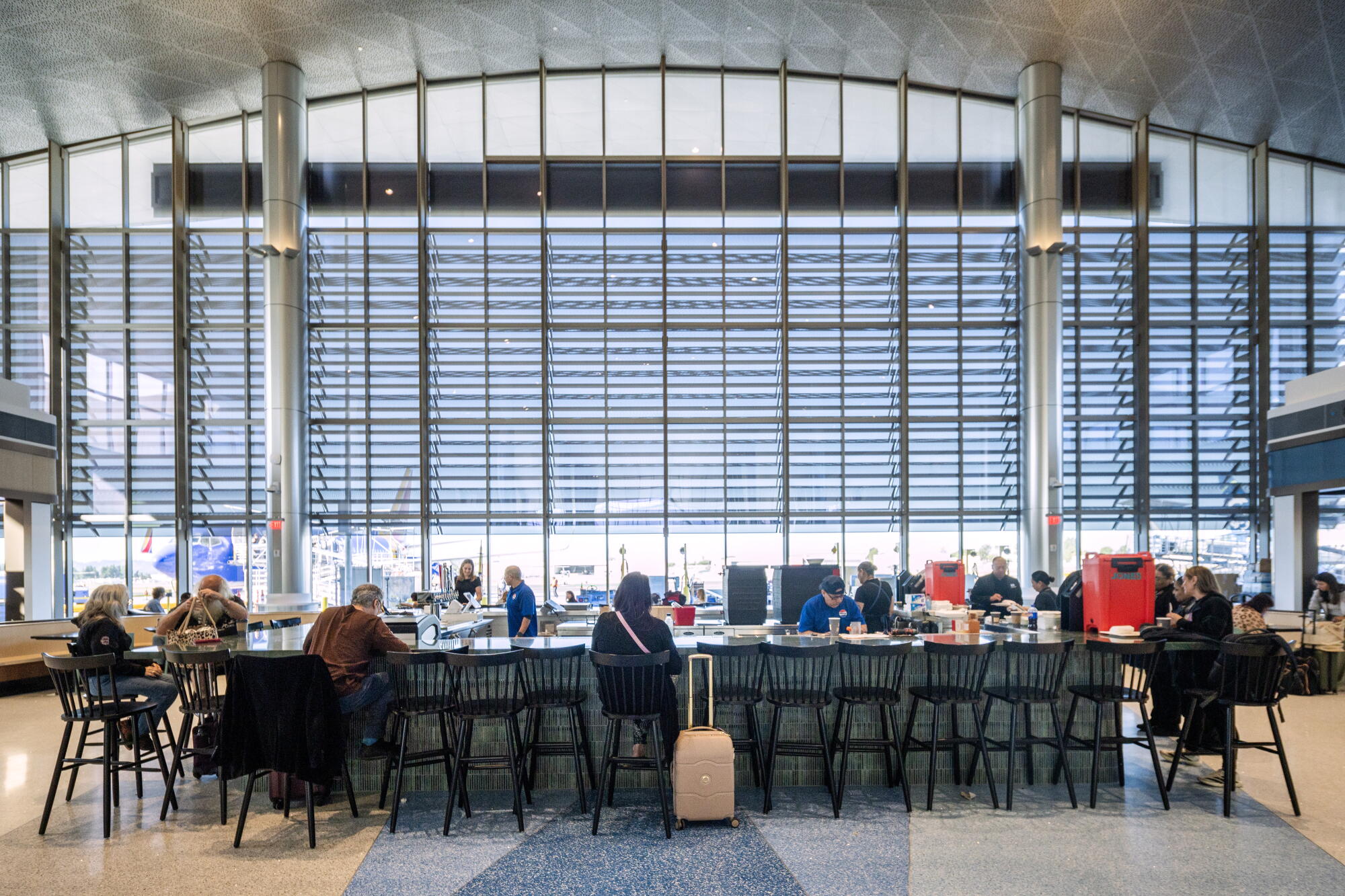
Instead of the snug, historic facility whose Spanish Colonial Revival style dated to 1930, travelers found themselves in a sleek terminal at Winona Avenue and Hollywood Way, distinguished by high ceilings, contemporary art, twinkling terrazzo floors, abundant charging stations and landscaping full of cactus and succulents, along with a few “wet paint” signs. Passengers gawked at mirrored grid artwork by Glenn Kaino overhead.
Passengers at Pete’s Pub inside the new Hollywood Burbank Airport terminal. None of the 13 food concessions are fully open.
(Myung J. Chun/Los Angeles Times)
“It was weird,” said Tanya Radke, 25, of Van Nuys, who was headed to Kansas City and caught off-guard by the terminal switch. “It was not what I thought was going to happen today for me.”
But looking around, the passenger called the new space a big upgrade. “It reminds me a lot of the Kansas City airport,” Radke said. “It was well overdue.”
The day’s schedule called for about 90 departures and arrivals by eight airlines, roughly the same schedule as in the previous buildings. The new terminal also has the same two runways and same number of gates — 14 — as the airport’s previous two-terminal alignment. And passengers still often board planes from the front and back, using outdoor steps from the tarmac, rather than enclosed tunnels. That practice is something travelers have long praised for its informality and efficiency.
But the new building does bring many changes. It measures about 50% larger than the two old terminals combined — about 355,000 square feet — with higher ceilings and a pair of illuminated steel sculptures by Cliff Garten flanking the main entrance.
The first departure was Alaska Flight 3401 to Santa Rosa at 7:03 a.m. with 33 passengers aboard. The first arrival: Southwest Flight 189 from Las Vegas, which landed at 7:16 a.m. with 30 passengers aboard.
The new terminal opened after 33 months of construction and $1.3 billion in spending.
(Myung J. Chun/Los Angeles Times)
“The taxi off was a little different. Instead of turning right, you turn left,” said Southwest Airlines pilot Mike Petros, who arrived at 7:31 a.m. with a planeload of passengers from Sacramento. At the start of the flight, Petros said, “We told them that we would be flying to a new terminal, so if they had anybody picking them up, let them know.”
Still, many were surprised. Airport management deployed several staffers to redirect confused travelers from the old terminals (now idle) to the new one. Anthony Bailey, 29, said he learned of the switch from an Uber driver on his way to the airport.
“So far, I’m liking it,” Bailey said of the new terminal, standing near gate 13 before catching a flight to Las Vegas. “Nice and clean. The TSA line was pretty smooth.”
While most of the six retail stores were open on Tuesday, none of the terminal’s 13 food concessions were fully operating. Two eateries were offering grab-and-go options, and airport spokesperson Mike Christensen said more options would arrive later in the day and week.
Katelyn Bailey and travel companion Pigeon check in for a flight to the Bay Area.
(Myung J. Chun / Los Angeles Times)
When the new terminal concessions open, dining options will include Guy Fieri’s Flavor Town, Spring Chicken, Diane’s Farm Table and Italian Market, Jones Coffee, Perry’s Joint, Poquito Mas, West Coast Smash Burgers, Massis Kabob, Starbucks, Border Grill, Jet Tila’s Asian Table, Santa Canela bakery and a bar, Pete’s Pub, with picture-window views of the runways and Verdugo Mountains.
Many travelers, including William Langlois and Annie Cerillo of Tampa, noted the shortage of eating options on Tuesday. “It’s horrible, there’s no restaurants and not enough security stations,” said Langlois, who had gone to the old terminal first and was redirected. Before this change, “this was the easiest airport,” said Cerillo.
In the new terminal, airport officials say, the walk from the entrance to the farthest gate is 1,285 feet, down from 1,600 feet now, with wider corridors and sidewalks and access to power plugs for devices from every seat. (Its many charging stations are now mostly USB-C ports, not USB.) The new terminal includes eight TSA lines, versus five in the old set-up. Baggage claim carousels have moved from outdoors to indoors.
The airport’s new parking structure includes about 2,000 spots and 310 charging ports for electric vehicles. (The airport’s total number of parking spaces is 6,637, the same as before.)
Alaska Airlines Flight 3401 to Santa Rosa was the first flight to depart from the new terminal at Hollywood Burbank Airport on Tuesday.
(Myung J. Chun/Los Angeles Times)
As it did before, the airport supplies shuttle bus service between the new terminal and Burbank Airport-South Train Station (which connects with Amtrak’s Pacific Surfliner) and the Burbank Airport-North Station at San Fernando Road and Hollywood Way.
Among many preparations for the day, Burbank airport officials staged a “passenger simulation trial” on Sept. 19, inviting 1,500 volunteers to behave like passengers in the new building, giving dozens of airport workers staffers, including TSA staffers and airline gate agents, a chance to prepare for Tuesday.
The airport, second busiest in L.A. County, was built in 1930 and is run by the Burbank-Glendale-Pasadena Airport Authority. For decades it has been favored by many local travelers as a simpler, faster, quainter alternative to Los Angeles International Airport. The Burbank airport’s site in the San Fernando Valley, however, has often put its leaders at odds with residents of surrounding suburban neighborhoods. Unlike LAX, which has no flight curfew, the Burbank airport has limited operating hours — 7 a.m. to 10 p.m.
Passengers disembark Southwest Flight 189 from Las Vegas just before 7:30 a.m. This was the first arrival into the new terminal at Hollywood Burbank Airport.
(Myung J. Chun / Los Angeles Times)
Before this week’s move, the aged Burbank facility didn’t meet current state seismic standards or Federal Aviation Administration design standards, which prompted repeated safety warnings. Airport officials said the new design also increases the distance between the terminal and the nearest runway, formerly as little as 257 feet, to about 880 feet — a change that brings the airport into compliance with FAA standards.
Voters approved the Burbank airport terminal replacement project in 2016. Construction began in 2024. The airport reported about 6.2 million arriving and departing passengers in 2025, flying to and from about 30 nonstop destinations.
“It’s a beautiful building, but buildings aren’t anything without people who fill them with dedication and service,” said Tyron Hampton, president of the Burbank-Glendale Airport Authority and City Councilmember in Pasadena. He predicted that the new facility would attract not only new passengers but new businesses to the commercial corridor along Burbank’s Winona Avenue.
As Burbank unveils its new terminal, the opening of LAX’s most high-profile project — the SkyLink automated people mover (a 2.25-mile electric train route linking terminals to rail service and rental cars) has been delayed by technical and legal issues until Jan. 6 at the earliest.
“I don’t like to compare,” said Hampton when asked about LAX. “We have 14 gates. LAX has 161.”
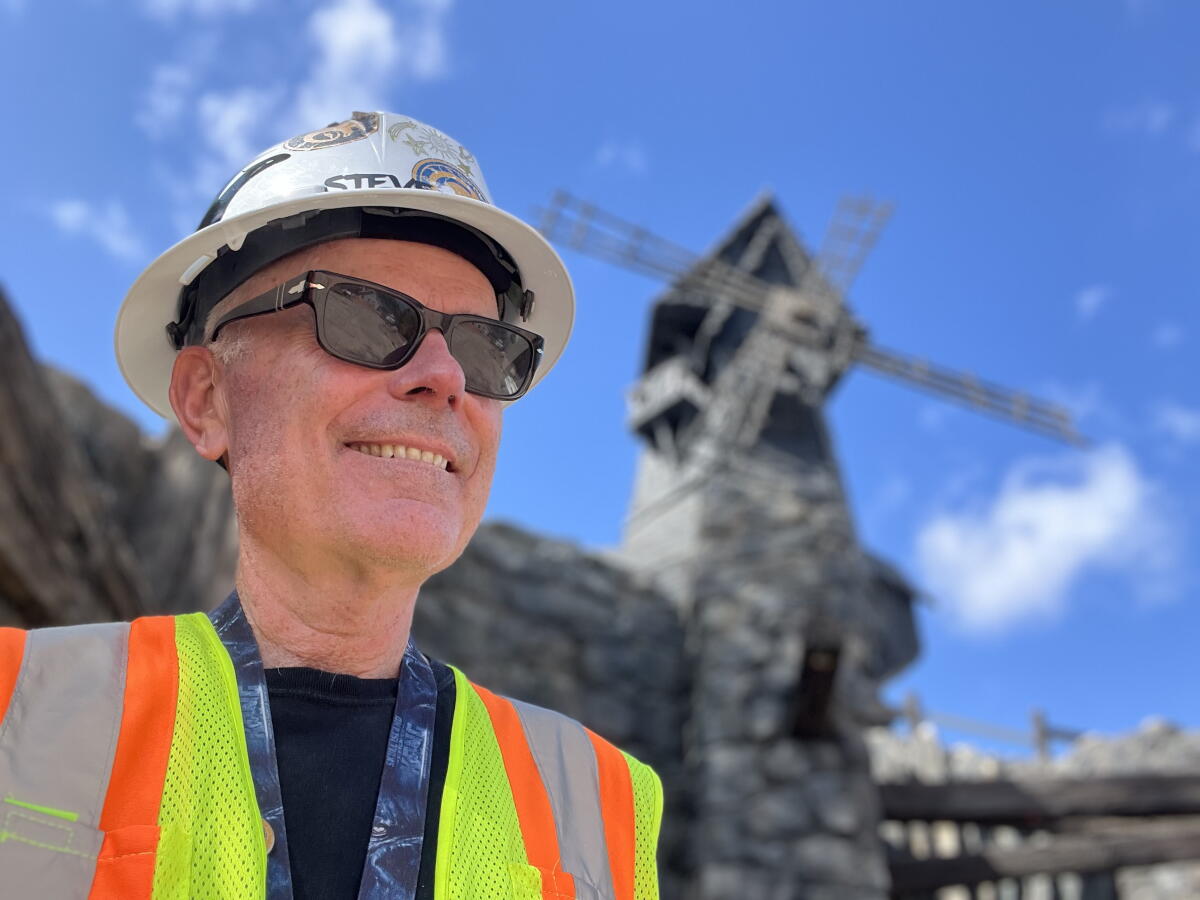
Steve Tatham always wanted to work in theme parks. And growing up in Anaheim, some sort of career associated with Disneyland seemed readily attainable.
“Disneyland was the local business,” Tatham says. “It’s where everyone ended up when they were students and working part-time, and I was no exception.”
You’re reading Mr. Todd’s Wild Ride newsletter
Todd Martens’ newsletter delivers news and commentary on the past, present and future of theme parks, right from the theme park capital of the world — Southern California.
By continuing, you agree to our Terms of Service, which include arbitration and a class action waiver. You agree that we and our third-party vendors may collect and use your information, including through cookies, pixels and similar technologies, for the purposes set forth in our Privacy Policy such as personalizing your experience and ads.
While in college, he got a job as a Jungle Cruise skipper, and since then, he has never looked back. Over the course of his career, Tatham has spent nearly 30 years with the Walt Disney Co., many of them in theme park design with Imagineering. More recently, Tatham worked at Universal Creative for more than a decade and was the executive creative director of Epic Universe, the company’s impressive new Florida park.
Today, Tatham is turning his focus toward the next generation of theme park designers, having recently been tapped by USC to lead the Bachelor of Fine Arts in Themed Entertainment program, which is offered out of the cinema school. The four-year program is designed to prep students for a myriad of fields — modern theme park design firms work not only on new attractions but readily contribute to museums, zoos, immersive marketing events and more.
And yet theme park designer can feel like an elusive dream job, one based on connections, mentoring or even just luck. Part of that myth was shaped by the initial Disney Imagineers, many of whom were simply making up the job as they went along. As a longtime admirer of Tatham’s work, I recently chatted with the newly crowned academic leader on how one should prep for a career in the field, hoping to demystify it just a little bit.
Steve Tatham, photographed in Florida’s Epic Universe, is leading USC’s undergraduate program in theme park design.
(Steve Tatham)
You don’t need to major in themed entertainment to work in theme parks
There aren’t too many universities that offer a theme park design degree. (Along with USC, Purdue offers a themed entertainment design major and the Savannah College of Art and Design has one of the best-known and longest-running programs in the country.)
But Tatham notes that when he began his career in the industry, it generally wasn’t a field accounted for by universities. And many theme park designers I meet as a reporter, whether relatively new to the industry or veterans, created their own paths into the biz.
Tatham’s own background still provides a solid template for those students looking to enter themed entertainment design, as not everyone will have the means or the ability to attend a program such as USC’s. “I wrote my own major,” he says of his time as an undergrad at UC Berkeley, where he targeted theme parks as his career goal. He majored in film design but took courses that combined theater, architecture, environmental psychology and film studies. After graduating, Tatham went to UCLA for a masters in architecture.
Architecture was a career path pushed to Tatham by longtime scenic designer Henry May, who was his advisor at Berkeley. It was an early recognition that theme park design is an offshoot of urban design, requiring principles necessary in both stagecraft and real-world planning.
Think beyond theme parks
People are hungry for themed experiences. Global theme park attendance topped 246 million in 2024, a 2.5% increase, according to the Themed Entertainment Assn., which also charted a nearly 15% growth in attendance at the world’s top 20 museums, which are often a fertile industry for theme park designers. And that says nothing of the domestic trend of smaller, more locally-focused entertainment centers (think Netflix House or Meow Wolf).
It’s why Tatham tells his USC students to think beyond a Disney or Universal creation.
“If you look in the world out there, there’s marketing firms doing pop-up retail and pop-up dining, and they are doing immersive design in museum spaces,” Tatham says. “In addition to theme parks, there are opportunities within marketing and within architecture. Students who get this interdisciplinary training, which involves coding, architecture, design, exhibition work, landscape architecture and lighting, it’s a growing field.”
Steve Tatham once served as a tour guide on Universal Studios Hollywood’s behind-the-scenes tram tour.
(Genaro Molina / Los Angeles Times)
The best lessons come from observing guests
Long before Tatham was designing Epic Universe, he was working as a tour guide at Universal Studios Hollywood. As a film buff, he enjoyed the early-career job, but says one lesson from those days continues to stick with him.
“I would go on and on, because I love movie history, and I would be like, ‘Right here is where Jimmy Stewart worked, and Edith Head designed costumes,’” Tatham says. “They would politely listen, but then when ducks walked across, they would get excited and take pictures. People love things that are alive and immediate and happening now. People respond to what is immediate.”
The best theme park design is in conversation with guests. I think of Epic’s “How to Train Your Dragon”-inspired land and the bounty of movement found in the space via animatronic dragons (if you promise dragons, guests better see dragons!), or Disneyland’s New Orleans Square, where the curved, winding paths encourage constant discovery.
AI won’t replace great original ideas
Tatham is careful when speaking on the subject of artificial intelligence. He doesn’t want to dismiss its potential to be used as a development tool. And yet Tatham is direct when it comes to AI and creativity.
“I think there are a lot of challenges with AI. I think there are a lot of things that are scary,” he says. “But I think, ultimately, if it’s used as a tool, it can be useful to artists.”
But there are limits.
“AI is never going to come up with a great idea,” he says. “It’s just going to recombine and reconfigure and spit back to you ideas that others have had. So I think this is an opportunity for original thought to stand out even more than it has in the past.”
Jennifer Bascom of Disneyland, gives a telegram to Disneyland guest Keith Kocienski of Fullerton while playing a live-action role-playing game in Frontierland called Legends of Frontierland back in 2014.
(Christina House / For The Times)
But the integration of smartphones remains a challenge
While Disney recently shuttered its Play Disney Parks mobile app, the park is experimenting with connectivity between the video game “Fortnite” and its attraction Millennium Falcon: Smugglers Run. Tatham cautions that any time a theme park invites someone to use a smartphone during their day at the park, designers are then pulling them away from the curated experience.
“The problem is when you’re in Universal or Disneyland, you’re now competing with all the opportunities that people have to explore their own entertainment,” Tatham says. “Are they going to be on Instagram or playing Solitaire online? So now you’re competing with that.”
And yet Tatham thinks there are lessons to be learned from the interactive world, as long as designers focus on real-world play. Tatham, after all, worked on what was once of my favorite Disneyland projects, the great but short-lived Legends of Frontierland. Some of those who contributed to it brought it to Knott’s Berry Farm, where it has been fine-tuned into the terrific Ghost Town Alive! The latter is a rarity in the theme park space.
Yes, it’s possible to make a decent salary
So how much can one expect to make? This isn’t an easy question to answer, as there’s only so many slots at Walt Disney Imagineering and Universal Creative, and the theme park design industry encompasses so much more.
There are independent themed entertainment firms to marketing outposts to studios to museums to architecture companies to theaters and more. And salaries can vary greatly between the public or private sector, as well as entry level versus senior positions. Even recruiting sites have a broad range, from around $50,000 to above $200,000.
The good news, says Tatham, is there is a high ceiling. Additionally, that there is a breadth of industries to work in should help any potential graduates. “There are many different job descriptions with different salaries in the themed entertainment field,” Tatham says.
And yet he knows it’s a concern of parents.
“I want students and parents to know that it is possible to make a solid steady income in the arts and that they shouldn’t focus on a backup plan but rather on putting together a killer portfolio because there is work for those who have honed their skills,” he says. “I would tell them that they should be prepared to live in Orlando, Fla., or Glendale, Calif., and be open to international assignments. Top directors can make in excess of $250,000 a year, but they should be prepared for starting salaries similar to architecture, graphic design or similar creative fields.”
A Disneyland cast member playing the role of Alice in Wonderland interacts with guests.
(Christina House / Los Angeles Times)
Remember why theme parks still matter
Anytime I have an opportunity to chat with someone with Tatham’s experience I want to hear their take on one question in particular, and that’s why they love theme parks and why they believe the spaces resonate with so many people. As someone charged with creating passion among the next generation of theme park designers, I was especially interested in Tatham’s response.
“If you go to a theme park, there is something for every demographic,” he says. “There are things for kids. There are things for grandparents. There are things for everyone in between. People can enjoy those times together, which was the original intent of Walt Disney. He was looking for a place while in Griffith Park where he could go do things with his daughters. He created it because it did not exist.”
For Tatham, it’s about the memories.
“If you ask people about their experience in theme parks, they will remember in great detail which parks they went to and who they were with,” he continues. “Ask them about going to the movies, they might say, ‘Sure, I went with my family, but can’t tell you what movies and who I was with.’ But they will remember those moments with theme parks. It’s a great bonding experience. That’s the reason they exist and the reason I love to create them.”
This week in SoCal theme parks
Plans are underway to refurbish the Griffith Park merry-go-round.
(Christina House / Los Angeles Times)
The Griffith Park carousel will spin again. Assessments are underway to see what it will cost to once again get the Griffith Park merry-go-round spinning. Theme park fans best know it as the site that is said to have inspired Walt Disney to dream up what would become the Disneyland Resort, and it has been shuttered since 2022. Curiously, there’s also a Disney connection with the carousel today, as some of those who work at Walt Disney Imagineering are volunteering their time and efforts to restore this treasure in Griffith Park. Read my story here.
Six Flags Magic Mountain shuts down second coaster. Six Flags is closing several rides across the U.S. and Canada — including the Goliath roller coaster at Six Flags Magic Mountain in Valencia — after a man fell to his death from a roller coaster at one of its parks in Georgia. Park officials said Tuesday that the closures were out of an abundance of caution and were temporary. Times writers Hailey Branson-Potts and Fedor Zarkhin have more on this story.
Merry Minions. Universal Studios Hollywood has unveiled its slate of holiday of programming, and returning this year are its popular “Grinchmas” offerings, including the 65-foot winding, drooping, Dr. Seuss-inspired Christmas tree. There will be meet-and-greets, including a reading of “How the Grinch Stole Christmas,” as well as holiday carolers and ornament decorating. New this year will be holiday festivities in the park’s kid-focused Minion Land, complete with Minions in holiday attire. Super Nintendo World, Wizarding World of Harry Potter and other areas will also be dressed for the season, beginning Nov. 21 and lasting through Jan. 3.
A heads-up for ‘Cars’ fans. It’s the 20th anniversary of the “Cars” franchise, and those with a special affinity for the series will want to find their way to Disneyland’s Pixar Place Hotel and park themselves on the hotel’s second floor art gallery. That’s where the hotel is hosting an exhibit honoring the film with drawings, paintings, sculptures and behind-the-scenes footage that document how Radiator Springs Racers was brought to life. And before you go, read my story on how Route 66 inspired the film and Cars Land.
Step into the world of ‘Dune.’ Tickets are now on sale for an immersive “Dune” exhibition in downtown L.A. that promises spectacle, as well as a bit of mystery. Step around, and potentially inside, awe-inspiring vehicles from the film, or come face-to-face with the Bene Gesserit, a group of priestesses who possess, among other things, the ability to bend the will of others. “Dune: The Experience” opens Nov. 20 and and is currently set to run through Dec. 20, although an extension is likely. Standard tickets start at $42 but there are various ticket packages available.
Ride Report
The dinosaurs on the Disneyland Railroad.
(Todd Martens / Los Angeles Times)
It’s always a good idea to hop on a Disneyland attraction that has been recently refurbished. It’s generally a chance to see the ride in tip-top shape. And so I was eager to get on the Disneyland Railroad on a recent trip to the park, as the dinos in the Primeval World world section of the attraction had recently been hidden behind illustrated tarps. Good news, as the dinosaurs are looking as sharp as they ever have. No real changes were made to the figures, but they’re all moving as they should, be it munching on grass, rattling out of an egg or getting ready for battle.
The theatrical lighting overall feels a little brighter, and the few digital effects — a volcano erupting in the background, for instance — are all in working order and bring an added sense of dimension to the diorama scenes. Be sure to add it to your day. The Disneyland Railroad is also a fine reminder to slow down during your Disneyland visit.
Tell us your stories. Ask us your questions.
Have a theme park tale to share? Whether it was a good day or less-than-perfect day, I would love to hear about it. Have a question? A tip? A fun photo from the parks to share? Email me at todd.martens@latimes.com. I may feature your note in an upcoming newsletter.
Ride on,
Todd Martens
P.S.
What is “Eggs in Space”?
(Todd Martens / Los Angeles Times)
A cinematic mystery is brewing, one that seemingly has connections to the local immersive entertainment community. What, for instance, is “Eggs in Space”? A recent sci-fi event at indie nonprofit movie theater and store Vidiots ended with the beginnings of a puzzle.
The screening appeared to be interrupted by a film that was taking control of the projectors. The film? “Eggs in Space.” As an abstract image of an egg appeared on screen, performers began walking toward the front of the theater in a transfixed, cult-like fashion.
There is, of course, no record of a film titled “Eggs in Space,” although there is a website dedicated to its disappearance. So dig in. A new alternate reality game just dropped. I have a hunch you’ll want to know where it leads.
—
This newsletter is free thanks to the support of L.A. Times subscribers. If you’re not yet a subscriber, explore subscription packages to unlock unlimited digital access and support award-winning local reporting.
Was this newsletter forwarded to you? Sign up here to get it in your inbox.
From Maddie Lee: Mookie Betts slapped his bat with his free hand after tipping a slider from Brewers right-hander Abner Uribe back into catcher William Contreras’ mitt.
Betts had been setting the tone for the Dodgers from the leadoff spot all postseason, taking good at-bats against some of MLB’s best starting pitchers. But there wasn’t much he could do against a sinker-slider mix like Uribe’s.
Uribe shuffled off the mound, and the crowd at American Family Field roared.
Then, with left-handed-hitting Freddie Freeman coming to the plate, Milwaukee had an answer for him too. Manager Pat Murphy signaled to the bullpen, left-hander Aaron Ashby emerged and struck out Freeman on four pitches, only one of which touched the strike zone.
“They all throw 100 [mph] from different angles,” Freeman said after the Dodgers’ 7-4 loss in Game 2 of the National League Championship Series on Monday.
The Dodgers’ performance against the Brewers bullpen on Monday magnified how much the star-powered lineup hasn’t been clicking with Shohei Ohtani struggling at the plate. He went 0-for-4 in the cleanup spot in Game 2, bringing his postseason total to three hits, all singles, in 20 at-bats.
Manager Dave Roberts told The Athletic after the game that he would “have a conversation” with Ohtani Tuesday to determine “what’s best for him, what’s best for [the team].”
Get the latest on L.A.’s teams in the daily Sports Report newsletter.
By continuing, you agree to our Terms of Service, which include arbitration and a class action waiver. You agree that we and our third-party vendors may collect and use your information, including through cookies, pixels and similar technologies, for the purposes set forth in our Privacy Policy such as personalizing your experience and ads.
Three-peat chance is looking weak
From Bill Plaschke: Once brimming with life, the Dodgers’ historic quest has curled up into a withered heap.
The three-peat is slowly, agonizingly having the life squeezed out of it by a collection of hardscrabble Midwesterners with no regard for stardom or status.
Two games into the National League Championship Series, the three-peat was formally placed on life support Monday after the mighty Dodgers lost a second consecutive game to those little giants known as Milwaukee Brewers.
This time the score was 7-4 after another devastating night at American Family Field, and now the Dodgers trail two games to none in a best-of-seven series that appears beyond their control.
For a second consecutive game, their ace was knocked out. For a second consecutive game, their powerful offense petered out.
For a second consecutive game, they looked like a weary, aging band of fallen stars that had stumbled into a surprisingly deep pothole and had no idea how to climb out.
No. 1 Milwaukee vs. No. 2 Dodgers at Milwaukee 2, Dodgers 1 (box score) at Milwaukee 7, Dodgers 4 (box score) Wednesday at Dodgers, 5 p.m., FS1/FOX Deportes/FOX One Thursday at Dodgers, 6 p.m., FS1/FOX Deportes/FOX One *Friday at Dodgers, 6 p.m., FS1/FOX Deportes/FOX One *Sunday at Milwaukee, 5 p.m., FS1/FOX Deportes/FOX One *Monday at Milwaukee, 5 p.m., FOX/FS1/FOX Deportes/FOX One
ALCS
No. 1 Tampa Bay vs. No. 2 Cleveland Cleveland 7, at Tampa Bay 3 (box score) Tuesday at Tampa Bay, 5 p.m., TBS/truTV/UniMas/HBO Max Thursday at Cleveland, 3 p.m., TBS/truTV/UniMas/HBO Max Friday at Cleveland, 3 p.m., TBS/truTV/UniMas/HBO Max *Saturday at Cleveland, 5 p.m., TBS/truTV/UniMas/HBO Max *Monday at Tampa Bay, 2 p.m., TBS/truTV/UniMas/HBO Max *Tuesday at Tampa Bay, 5 p.m., TBS/truTV/UniMas/HBO Max
Iamaleava is expected to miss the rest of this season with a knee injury, according to a person with knowledge of the injury not authorized to discuss it publicly.
Chesney said he is waiting for UCLA doctors to “make the final call on things.”
“He has a meeting later today, and he’ll have a whole lot more clarity on exactly where things are at,” Chesney said of Iamaleava during a news conference Monday. “Everything being reported is what’s being reported. There is a serious concern at this moment, but at the same point in time, there is nothing that has been fully ruled at this moment.”
The injury is a blow for the No. 12 Bruins, who are 5-0 during Chesney’s first season and have a favorable path to the College Football Playoff.
Chesney said that while Ty Dieffenbach and Madden Iamaleava, Nico’s younger brother, both earned the right to start, Chesney will start Dieffenbach going forward and see how it plays out.
1893 — The U.S. yacht Vigilant wins the America’s Cup with a three-race sweep over the British challenger Valkyrie II.
1947 — The NHL holds its first All-Star game with the All-Stars beating the Toronto Maple Leafs 4-3. Toronto’s Harry Watson scores the game’s first goal and assists on the other two goals. Trailing 3-2 after two periods, Montreal’s Maurice Richard and Chicago’s Doug Bentley each score to give the All-Stars the win.
1961 — Jacky Lee of the Houston Oilers passes for 457 yards and two touchdowns in a 31-31 tie with the Boston Patriots. Charley Hennigan of the Oilers catches 13 passes for 272 yards.
1963 — Mickey Wright wins her fourth LPGA championship in six years by beating Mary Lena Faulk, Mary Mills and Louise Suggs by two strokes.
1982 — IOC Executive Committee approves the reinstatement of Jim Thorpe’s gold medals from the 1912 Olympics.
1985 — Phil Simms of the New York Giants passes for 513 yards with an NFL-record 62 pass attempts in a 35-30 loss to the Cincinnati Bengals. Simms completes 40 passes with 29 for first downs, also an NFL record.
1998 — For the first time in NBA history, the league cancels regular season games after labor talks break off.
2001 — DeShaun Foster of UCLA runs for a school-record 301 yards and four touchdowns as the Bruins beat Washington 35-13.
2001 — Georgia Southern fullback Adrian Peterson is held to 71 yards rushing, snapping his NCAA-record streak of 36 straight regular-season games with at least 100 yards.
2011 — American Jordyn Wieber wins another gold medal, beating Russia’s Viktoria Komova for the all-around title at the world gymnastics championships in Tokyo. Wieber, who led the Americans to the team title two days earlier, finishes with 59.382 points, just 0.033 ahead of the Russian.
2013 — Kenya’s Dennis Kimetto, six weeks removed from a bout of malaria, breaks the course mark in capturing the Chicago Marathon. Kimetto finishes in 2 hours, 3 minutes, 45 seconds, leading a 1-2-3 finish for Kenyan men. He beats the mark of 2:04:38 set by Ethiopia’s Tsegaye Kebede last year.
2017 — Gustav Nyquist scores twice and Detroit has four goals in the third period to beat Vegas 6-3, handing the NHL’s newest franchise its first loss. Vegas is the first NHL expansion team to win its first three games.
2019 — Simone Biles becomes the most decorated gymnast in history when she wins record 25th medal at the World Championships in Stuttgart, Germany.
Compiled by the Associated Press
This day in baseball history
1903 — The Boston Pilgrims win the first World Series, 5 games to 3, with a 3-0 victory over the Pittsburgh Pirates.
1960 — Bill Mazeroski opens the bottom of the ninth with a home run off Ralph Terry of the New York Yankees to give the Pittsburgh Pirates a 10-9 victory and the World Series championship.
Compiled by the Associated Press
Until next time…
That concludes today’s newsletter. If you have any feedback, ideas for improvement or things you’d like to see, email me at houston.mitchell@latimes.com. To get this newsletter in your inbox, click here.
The Tom Cruise-led “Digger” is poised for a massive loss after ticket sales for the political satire fell 60% in its second weekend in theaters in the U.S. and Canada.
The Warner Bros. film made just $3.2 million in those theaters over the weekend, according to a studio estimate. Its opening weekend brought in $8 million, Cruise’s lowest opening as a leading man since 2007’s “Lions for Lambs.” Global ticket sales for “Digger” were only $35.3 million.
The tepid box-office returns mean the studio is now expected to lose at least $150 million on the film, including ancillary revenue streams such as premium video-on-demand and streaming, industry sources said. Historically, a film has typically needed to make 2½ to three times its budget to recoup its costs.
A Warner Bros. spokesperson did not respond to a request for comment.
It’s a tough result for the film, which stars Cruise as an aging oil tycoon whose company sets off an environmental catastrophe. Analysts have said that the film was challenging to market, given a major twist in the plot, and that Cruise’s nearly unrecognizable appearance could have dissuaded his fan base from coming out to support the film.
The film suffered from polarizing critical reviews, notching a 53% on aggregator Rotten Tomatoes. Opening-night audiences gave it a C+ on CinemaScore, a grade that typically points to weak word of mouth and steep drops in the weeks that follow.
The budget for “Digger” raised the stakes. Warner Bros. has said the film cost $125 million to produce, though some industry experts and trade reports have estimated the cost was at least $160 million, citing production delays.
That figure also doesn’t include marketing costs, which sources said could have increased in the days after the film’s opening since Warner Bros. began using the divided reviews in social media and TV ads to encourage people to see the film for themselves.
The film will have value to Warner Bros. — and Skydance, the newly combined company that now owns it — beyond its theatrical reception. “Digger” probably will make money through downstream revenue sources such as streaming. If Cruise wins his first competitive Oscar, that also would be a plus for the film.
But a film’s domestic reception, and to some extent, its international box office revenue, does play a role in the value of those downstream revenue opportunities, experts said.
“Even with respectable ancillary income based on the film’s pedigree, the movie is going to lose a lot of money,” David A. Gross wrote in his FranchiseRe movie industry newsletter shortly after the film’s opening.
The reception for “Digger” comes during a tough time for Warner Bros.
The studio has had a string of disappointments this year, including Maggie Gyllenhaal’s “The Bride!” and DC Studios’ “Supergirl.” None of its 2026 releases has crossed $100 million at the domestic box office.
But the prospects for Warner Bros. should improve next year, according to the research and brokerage firm Bernstein. Skydance has said it will keep the Warner Bros. and Paramount studios distinct, though Paramount Pictures chiefs Dana Goldberg and Josh Greenstein are expected to oversee both. Bernstein expects the Warner Bros. film and TV studios to amass $11.7 billion in revenue, driven by strong titles that include the sequel to “Minecraft” and a new “Lord of the Rings” movie.
As swiftly as Barry Manilow returned to the stage following a health-related hiatus, he has stepped away.
On Friday, Manilow cut his concert short just two songs after it began. The 83-year-old crooner abruptly told the crowd to talk among themselves as he walked off stage, according to concertgoers who detailed the incident on social media. The curtain dropped, and a few moments later the audience was told the show was a wrap. Manilow’s performance slated for Saturday was subsequently nixed.
The day before, on Thursday, the “Copacabana” singer had returned after a six-week break to perform at the International Theater at the Westgate Las Vegas Resort & Casino, telling the audience, “I’m back!” Manilow appeared to be spry and energetic throughout the show. “God, I feel like I’m a teenage idol again,” he joked when a couple of audience members tossed underwear onto the stage. He picked up a pair of full-coverage briefs and asked if they needed to go to the laundry, then a pink lacy thong and joked, “I’ll keep this pair.”
“After a triumphant welcome-back concert on Thursday, Barry got hit with bronchitis and had to cancel his Friday and Saturday shows,” reps for Manilow told Paste Magazine.
Last year, Manilow revealed that he had been diagnosed with lung cancer and that surgery would require him to postpone several performances. In May, he told The Times that, since he had surgery, he was getting winded just walking down the hallway. “Ninety minutes of screaming in tune, which is what I do for a living — I’m not up for that yet,” he said at the time. “I will be, but it’s taking a long time to get my voice back. They warned me that I’d have to learn to breathe again. So these days, I get up, I go to my piano and I try to be creative. Before I know it, the afternoon’s over.”
The star returned to the stage in June following a six-month hiatus, in support of his latest album, “What a Time,” his first LP loaded with new material in almost 15 years.
But in August, Manilow canceled shows because of vocal and technical problems before telling fans he needed to pause. “We just finished a fantastic summer tour, 29 shows in 68 days,” the singer said. “The shows were fantastic. The audiences were fantastic. And I sounded fantastic. But it seems that we were pushing a little too hard.
“Now we all need to sit down and shut up,” Manilow said.
The Saudi Arabia-led coalition fighting in Yemen has said its forces intercepted another ballistic missile launched by the Houthis towards the Saudi capital, Riyadh, as the city reels from attacks that have killed at least 14 people in recent days.
In a statement on X, Turki Al-Maliki, the spokesperson for the coalition, said the Houthis fired one ballistic missile at Riyadh and two towards Khamis Mushait, a city in the southwest.
Recommended Stories
list of 4 itemsend of list
All three were “intercepted and destroyed”, he said.
Residents of Riyadh reported several powerful explosions on Monday night, moments after a text message to their phones warned of an aerial threat.
The Houthis, who control Yemen’s most populous areas, including the capital, Sanaa, said their target in Riyadh had been King Khalid International airport.
Yahya Saree, a Houthi military spokesman, said the group had also sent a drone towards a military airbase at Khamis Mushait, near the Yemeni border. He again warned international airlines and travellers “against operating flights to airports” in Saudi Arabia, except in the holy cities of Mecca and Medina, saying the facilities were “unsafe”.
The renewed attacks came as King Khalid International airport in Riyadh remains closed after a Houthi attack on Saturday that killed at least 13 people and wounded more than 300 others. Another strike on Sunday killed one person and wounded 11.
Saudi authorities said the airport would remain closed until this Saturday, and airlines have canceled flights. The Houthis have also struck Saudi oil facilities.
The attacks come as the Houthis fight forces aligned with Yemen’s internationally recognised government for control of the country. The Saudi-led coalition has carried out an air campaign against the Houthis and backed the government’s ground forces. The fighting erupted amid regional tensions set off by the United States and Israel’s war on Iran.
Speaking at an energy conference in Riyadh, Saudi Arabia’s Energy Minister Prince Abdulaziz bin Salman Al Saud said the attacks on airports over the last week have tested the kingdom’s resilience.
“The events of recent weeks are serious,” the minister said. “Our response must be equally serious.” He added that Vision 2030, Crown Prince Mohammed bin Salman’s plan to diversify the Saudi economy, “must continue. Investment must continue”.
Saudi authorities have meanwhile opened an investigation into why the country’s air defences failed to stop the barrage, according to two regional officials who spoke to The Associated Press on condition of anonymity. An initial inquiry found that the Houthis first launched several drones to clear a path for a mix of cruise and ballistic missiles, which then reached the airport, the officials said.
The Houthis possess ballistic missiles with warheads that can change direction in flight, posing a challenge to the Patriot interceptors and other systems the Saudis rely on.
One official told AP that investigators also wanted to know why the defences had not given earlier warning of an attack in which missiles and drones flew more than 1,000km, or 620 miles, to reach Riyadh.
US President Donald Trump separately criticised the Houthis but gave no indication that Washington would intervene. “Well, the Houthis are misbehaving very badly. No good,” he told reporters when asked what he planned to do about the group.
A Houthi official warned that US involvement would bring retaliation.
“If the US becomes involved in the aggression against Yemen, we will not deliberate over the decision to respond; rather, there will be a swift and painful response targeting the US and all its interests in the region,” Mohammed al-Bukhaiti, a member of the Houthis’ political bureau, told the AFP news agency.
Al-Bukhaiti also warned “all employees and workers at Saudi oil facilities and airports to stay away from these sites, as they have become legitimate targets”.
The attacks have put events scheduled in Riyadh this month under pressure, including the kingdom’s flagship investment conference and the WPC Energy Congress, where several top oil executives were dropped from the programme.
The United Arab Emirates’s national carrier Etihad Airways announced on Monday that it was cancelling all flights to and from Riyadh until next week. It also suspended flights to Dammam and Jeddah.
Bahrain’s national carrier Gulf Air said it, too, was cancelling all Riyadh flights until Saturday.
US operator Delta announced it would delay the launch of direct flights from Atlanta to Riyadh, scheduled for October 23.
WASHINGTON — U.S. District Judge Ana Reyes on Monday ordered a 24-hour halt to tree-cutting at the East Potomac Golf Course, a historic D.C. golf course that has been part of President Donald Trump’s plans to remake the city.
Reyes issued the order following a tense three-hour hearing in which she blistered the government for having deceived her with its actions over the holiday weekend.
Reyes said the 24-hour temporary order could be extended to 14 days if necessary. It was limited to one day while the government tries to find a key Trump administration official to discuss why a massive tree-cutting at the park needed to occur over the holiday weekend, with little notification to plaintiffs in a lawsuit trying to halt renovation plans or the judge.
It’s the latest example of the erosion of trust between the government and the independent judiciary, as the Trump administration tries to steamroll scrutiny of its actions, from the White House ballroom to immigration enforcement.
The hearing started with a blistering 15-minute statement from Reyes, who has declined repeated motions from the plaintiffs to halt work by the administration out of concern that its strategy has seemed to be move ahead on projects despite court actions.
“I am thoroughly unamused right now,” Reyes said. “I do not know how I could have made it any plainer that I did not want what was to happen, to happen.” The judge added: “I have given the government every single benefit of the doubt that it would not do precisely what it has done.”
She told the government’s lawyers sharply: “I wanted you all to be better than you have been.”
The emergency hearing on a holiday expanded as the judge ordered the government to get various participants in the decision-making process into the hearing remotely.
Reyes plans to hold another hearing Tuesday and wants to hear from Greg Wischer, deputy chief of staff at the Interior Department. Wischer pushed for the work to be done urgently, according to testimony from Frank Lands, deputy director of operations for the National Park Service.
Fields writes for the Associated Press.AP writer Matthew Daly contributed to this report.
Speaking on Match of the Day, Wayne Rooney and Toby Alderweireld discuss whether Ryan Gravenberch should have been sent off, after he received two yellow cards in Liverpool 3-0 defeat to Manchester City in the Premier League.
Speaking on Match of the Day, Wayne Rooney and Toby Alderweireld analyse how Jeremy Doku changed the game in Manchester City’s favour, after coming on as a substitute in his side’s 3-0 win against Liverpool at Anfield.
Speaking on Match of the Day, Toby Alderweireld and Wayne Rooney discuss why Manchester City’s 3-0 victory against Liverpool leaves the Premier League in limbo as the club awaits a potential punishment, which could include a points deduction, after they were found guilty of financial breaches.
Speaking on Match of the Day, Wayne Rooney says VAR made the wrong decision in awarding Crystal Palace their second goal, which saw the home side take the lead as they went on to beat Nottingham Forest 3-1 in the Premier League.