My theme park day begins with gunfire. A jailbreak! But shortly after, I‘m attending a wedding. Next I’m on a mission, helping the local postmaster justify his uncontrollable desire to open everyone’s packages, and trying to find a way to do so without telling a lie.
This is just another Sunday morning at Knott’s Berry Farm’s “Ghost Town Alive!,” a now-10-year-old interactive show — live-action role-playing game is more accurate — that has become the best summer offering at any theme park, and not just in SoCal but in America. There’s a daily story, including three editions of a single-page newsletter that are updated every day. There’s also lots of improv. Over the years, I’ve found myself on the prowl for mysterious elixirs, playing matchmaker, collaborating on group stories in a schoolhouse, doing police work, participating in a mustache contest or flashing a press badge.
“Ghost Town Alive!” ultimately is the promise of theme parks fulfilled, that is that we can enter a fantasy world and play as cartoonish, or maybe even idealized, versions of ourselves.
You’re reading Mr. Todd’s Wild Ride newsletter
Todd Martens’ newsletter delivers news and commentary on the past, present and future of theme parks, right from the theme park capital of the world — Southern California.
By continuing, you agree to our Terms of Service, which include arbitration and a class action waiver. You agree that we and our third-party vendors may collect and use your information, including through cookies, pixels and similar technologies, for the purposes set forth in our Privacy Policy such as personalizing your experience and ads.
It’s a rarity, an event with 46 actors — about 30 of whom appear each afternoon — who lead guests through scavenger hunts, puzzles or just conversations about life in Calico, the fictional town of Knott’s Berry Farm’s Ghost Town area. The cast ranges from those just out of college to those in their mid-70s, and no character is ever played by more than one actor. This gives Calico a sense of life, an illusion that it’s actually populated, but also allows actors to fully develop a personality and let their characters evolve.
Before creative director Andy Crocker was working on “Ghost Town Alive!,” she was visiting it as a fan. Crocker, an experiential designer who has worked on projects for companies as wide-ranging as the Los Angeles Public Library and Walt Disney Imagineering, specializes in particular on guest-to-actor interactions.
“Ghost Town Alive!” unfolds like a live-action role-playing game. But expect plenty of silliness.
(Allen J. Schaben / Los Angeles Times)
“I will never forget the first time I saw it as a guest,” Crocker tells me. “I came with my husband, and we did not bring our kid. We walked in, and I saw a little girl in a pink cowboy hat with a painted-on mustache following an outlaw off to jail. That outlaw was giving a gritty HBO performance. Wasn’t patronizing. Wasn’t talking down. He was giving her a hero moment, and I burst into tears. I didn’t know this was possible to do on this scale with such an institution. The empowerment that performer gave to that guest, I will never forget.”
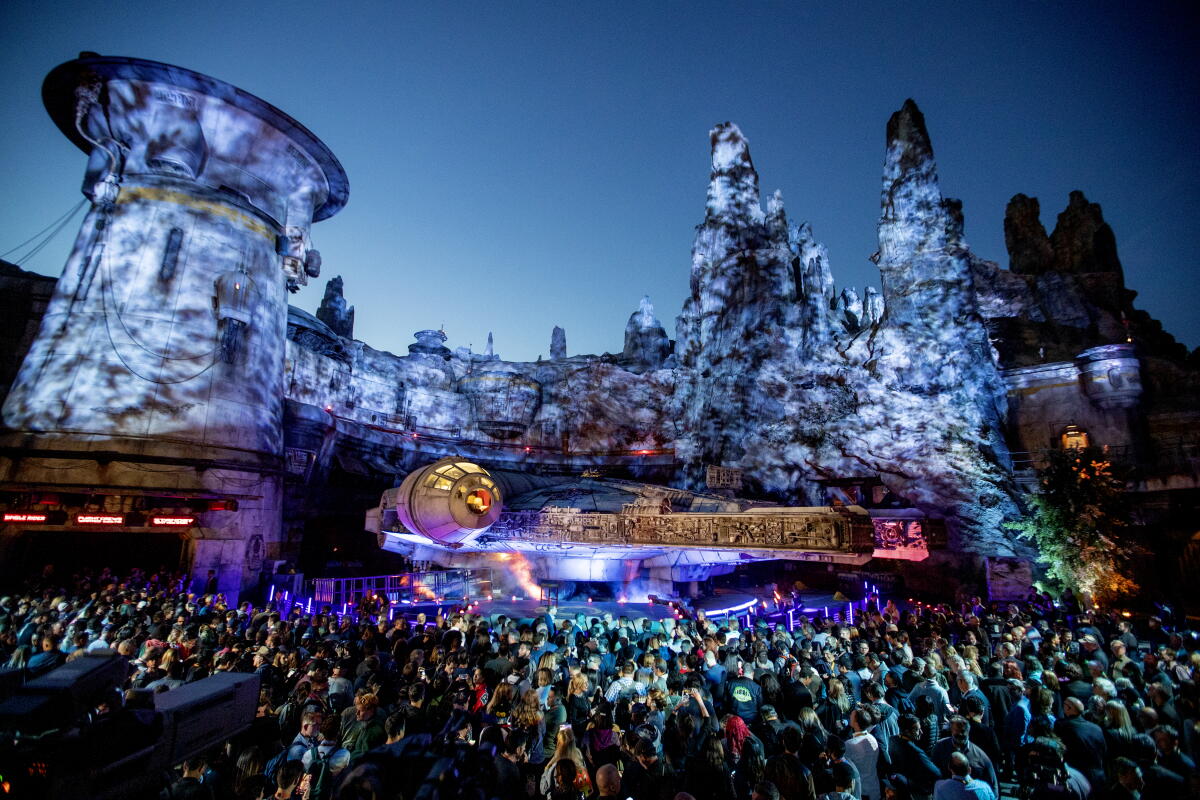
To make a theme park feel personal is no easy feat. In fact, designers have long been trying to solve this problem, whether by creating interactive attractions that feel responsive to the guest, or short-lived experiments such as the late but great Star Wars: Galactic Starcruiser, colloquially known as the Star Wars hotel.
Crocker says others have asked for the “secret sauce” to “Ghost Town Alive!” They’ve tried — and are trying — but she’s not so sure the magic can be replicated. One, Knott’s is blessed with a real, 100-year-old Ghost Town. That allowed for the investment to be solely in the cast and performance rather than infrastructure. And yet actors, of course, aren’t cheap.
A single-page newspaper is printed three times a day during “Ghost Town Alive!”
(Todd Martens / Los Angeles Times)
“The amount of people that we have, that’s tough for a lot of places,” Crocker says. “They try to do it with less, and it doesn’t quite work.”
Speaking on a panel hosted by trade group the Themed Entertainment Assn., Jeff Tucker, Knott’s Berry Farm’s show writer, says one early mistake Knott’s made was thinking everyone who works in Ghost Town could partake. That meant, for instance, taping dialogue cues to cash registers in the saloon in the hopes that bartenders could become a character. The concept failed. “It’s a logistical nightmare,” he says. The lesson: Hire actors to perform. Let bartenders be bartenders and retail staff be retail staff.
Another reason Crocker tells me “Ghost Town Alive!” is so rare, and will remain so: It doesn’t rely on intellectual property, or a known franchise, which has become the lifeblood of modern theme parks. “With things that are heavy IP, it’s very tricky to control your IP and to allow for real play, guest agency, and, honestly, artist agency,” she says.
Evan Battle, center, who plays Deputy Chester Davenport, at Knott’s Berry Farm’s “Ghost Town Alive!” in 2024. The interactive theatrical experience allows guests to mingle with about 30 actors.
(Allen J. Schaben / Los Angeles Times)
That’s important, as “Ghost Town Alive!” can shift with the whims of the guest. There’s a core storyline this year. A rich, Beverly Hills-like family is revealed to be the true owners of Calico, and how the residents respond is the key narrative of the day. But there are multiple tales to uncover, including hidden factions (check out the Calico Historical Society) and who is taking who to the 4 p.m. hoedown, which ends each daily game of “Ghost Town Alive!”
But Crocker has also seen it get rather heartwarming.
“My mom came to see it,” she says. “She has some health concerns. There was a character who was in a crazy mix-’em-up and said he would not make it to the hoedown and that this would be his last day on Earth. This character and my mom ended up having this conversation about how if you know you don’t have a lot of time left, what would you do with your time? I was surprised by that pivot.”
It helps, Crocker says, that she’s noticed one commonality among the “Ghost Town Alive!” staff. They play — or were weaned on — tabletop role-playing games such as “Dungeons & Dragons,” which at their best allow for an anything-goes approach designed to follow the direction of the players rather than a strict script.
Tucker on the panel said there was one rule the crew lives by that defines the success of “Ghost Town Alive!”: “It’s not real,” he said. “We can do whatever we want.”
This week in SoCal theme parks
Not yet ready for prime time, Knott’s Berry Farm has delayed the opening of Montezooma: The Forbidden Fortress.
(Todd Martens / Los Angeles Times)
Montezooma is not yet zooming. Knott’s Berry Farm initially intended to launch its reimagined Montezooma’s Revenge, now known as Montezooma: The Forbidden Fortress, this week. Late Thursday, the park delayed its public unveiling, with a spokesperson citing additional fine-tuning that surfaced during its final days of testing. The delay is not expected to be a prolonged one. “We appreciate everyone’s understanding and look forward to welcoming media and guests in the coming days when we can showcase the attraction exactly as intended,” read a statement from the park.
A monthlong Lego celebration. Carlsbad’s Legoland likes to describe its Lego Festival, which started Monday and runs through Aug. 30, as a child’s first fest. Expect lots of characters and an assortment of play-focused areas. One is dedicated to music, another is a free-run creative zone and a third is a Lego garden designed to soothe. New this year is a game-heavy center dedicated to the Pokémon franchise, as well as a challenge-filled F1 installation.
It’s now more expensive to eat at Disneyland. Price hikes, unfortunately, are a yearly-occurrence at the Disneyland Resort, and this summer, like every summer, hundreds of food items have ever-so-slightly increased in cost. Most are in the range of a dollar or so — give or take a quarter or two — but expect to pay $7, up from $6.50, for a scoop of popcorn. I admittedly do not keep a database of Disneyland food prices, but sites like Mickey Visit or Theme Park IQ have tracked the most egregious price bumps. Looking at their data, you may want to think twice about dining at Disneyland’s Rancho del Zocalo Restaurante, where prices have been increasing even as portions over the years have been declining.
Where is Fast & Furious: Hollywood Drift? We’re now in midsummer, and Universal Studios Hollywood’s Fast & Furious: Hollywood Drift still does not have an official opening date. While sources familiar with the coaster’s operations point to routine mechanical issues that have arisen during its test and adjustment phase, one thing is certain: It’s not delayed due to noise complaints from neighbors, as rumors suggested last week. A Universal spokesperson pushed back on the notion that the coaster is delayed, stating it would still open this summer, which lasts into late September.
The best thing I ate at the parks
The hearty cottage pie from Downtown Disney’s Gordon Ramsay at the Carnaby.
(Todd Martens / Los Angeles Times)
I’ve been eagerly anticipating the opening of Gordon Ramsay at the Carnaby at the Disneyland Resort’s Downtown Disney, the latest concept in which the celebrity chef has agreed to lend his name. This one is an upscale gastropub, and while I’ll leave the full cuisine analysis to the professional food writers, as a parkgoer I do believe it fills a void in Disneyland’s shopping and entertainment district, bringing the area an adult-focused space with upscale (read: expensive) twists on old favorites like fish and chips ($33) and cottage pie ($38). And after reading breathless press release-like articles and posts from my theme park peers (“utter perfection,” proclaimed one) I couldn’t have been more excited to dine there this weekend.
Let’s start with the vibe, which I found to be rather confused. I was seated in the tiny, uncomfortable indoor bar, a place that felt like an afterthought and leaned airport terminal drinking hole, as it’s situated at the top of a stairwell and serves primarily as a thoroughfare into the dining hall. That a pub, especially one with an extensive cocktail menu (I did love my $22 cotton candy-infused Old Fashioned) would treat its introductory bar as a throwaway rather than a centerpiece of the experience was disappointing (an outdoor bar is significantly more enticing). The core dining space leans contemporary more than a traditional, wood-infused pub, feeling cafe-like with its ‘60s rock posters and framed portraits of those in mod outfits. More theme-ing would have been welcome, as I read it as slightly cold and corporate rather than homey and intimate. Instead of, say Pasadena’s Lucky Baldwins, this felt like a nice break room at a major record label.
But my dish was delightful. I had my heart set on the cottage pie, this one infused with a hearty portion of short rib. I probably should have taken leftovers, because it’s heavy, but in the best way possible. The potato-rich top felt creamy and buttery, while the meat was equally soft. The whole thing felt invitingly plush. I walked away mixed. No complaints on my entrée, and I’m eager to come back and try the fish and chips, and yes, that viral sticky toffee pudding dessert, but longing for a more welcoming atmosphere, especially at this price point.
Tell us your stories. Ask us your questions.
Have a theme park tale to share? Whether it was a good day or less-than-perfect day, I would love to hear about it. Have a question? A tip? A fun photo from the parks to share? Email me at todd.martens@latimes.com. I may feature your note in an upcoming newsletter.
Ride on,
Todd Martens
P.S.
Drowned Out Productions’ “The Shoebox Museum” explores love and loss.
(Drowned Out Productions. )
There’s a show running Saturday and Sunday in Los Angeles that I believe theme park fans should make time for. “The Shoebox Museum,” at North Hollywood’s After Hours theater, is a walk-through immersive experience at its most thoughtful. It’s short, at around 30 minutes, but it stayed with me for hours after it concluded.
“The Shoebox Museum,” from Drowned Out Productions’ Jackson Mancuso, who does theme park design by day, is a mediation on heartbreak, asking what we want to leave behind, and take with us, as we explore our grief. It’s meticulously designed, as we follow light cues through byzantine rooms filled with everyday ephemera — the type of stuff that only holds meaning to those who were in love. It’s a show about how an once broken heart, even mended, still finds ways to haunt us.
A number of companies are bidding to offer services under the Channel Tunnel, and one start-up is looking to offer direct services to a variety of European cities, as well as opening up a former Eurostar route
The route would run using high-speed Siemens Velaro Novo trains(Image: Siemens)
Since its launch in 1994, Eurostar has held a near-monopoly over the Channel Tunnel route as the only high-speed rail operator that could offer services from London to European cities.
But that is set to change, with a number of rival companies now planning to offer their own services connecting with Europe, and one provider could be offering a range of new direct routes from 2030.
Gemini Trains, a start-up operator, has planned a number of new routes that would run from the capital, which would see direct trains from the UK to Germany for the first time. Its plans also include convenient links from London to Paris, with introductory fares reportedly starting at £59.
Initial planned services would include London to Paris Nord, Disneyland Paris, and Charles de Gaulle Airport. It’s also reportedly considering offering links to Brussels-Midi and Cologne, and then expanding to Frankfurt and Düsseldorf.
While Eurostar previously offered a direct route to Disneyland Paris, this was discontinued in 2023 due to the company focusing on its city destinations after the pandemic. Offering services direct to Paris’ Charles de Gaulle airport would mean travellers could also avoid having to take taxis or public transport from Gare du Nord for connections, which can take around half an hour and can be complicated during rush hour.
Gemini claims a London to Cologne route would take around four hours directly. Currently, it can take six hours with at least one change.
However, the trains would not run from St Pancras, due to pressures on capacity, and instead Gemini plans to create a hub at Stratford International, offering stops at Ebbsfleet International and Ashford International, which used to have Eurostar services. Kent locals have long campaigned for a return of its continental services since they were suspended in March 2020 due to Covid-19, only to never resume.
Gemini’s plans include leasing eight Siemens Velaro Novo trains, each one capable of carrying 550 passengers, and promising “comfortable seats, good wifi and mood lighting.” There will also be a business class available with privacy screens.
The start-up is not the only challenger to emerge against Eurostar. Virgin Trains has ordered 12 Alstom trains and secured access to Temple Mills, a depot in East London that’s the only site that can house cross-channel trains. Gemini did not manage to secure access to Temple Mills, but is looking at a potential depot in Ashford, or may base it in Belgium or Germany.
Trenitalia, the Italian rail operator, and a Spanish start-up called Evolyn, are said to be mulling over plans to offer cross-channel services.
Adrian Quine, CEO of Gemini Trains, said: “The forecast growth through the Channel Tunnel is enormous, yet only 50 per cent of the slots on the track are currently used. Eurostar, a monopoly operator, has become lackluster and very expensive. We will shake things up by offering new routes, new stations, new trains, new interiors, new cheaper fares and encouraging people to shift from plane to train.
“For too long, there has been no choice but Eurostar, which in 32 years has opened up virtually no new routes and in fact has cut some.”
However, Eurostar is reportedly fighting back against its new raft of rivals, investing £1.7 billion into 50 new double-decker trains, and plans to launch direct services to Geneva and Frankfurt, via Cologne, with an estimated start date of 2031.
Have a story you want to share? Email us at webtravel@reachplc.com
Todd Martens’ newsletter delivers news and commentary on the past, present and future of theme parks, right from the theme park capital of the world — Southern California.
By continuing, you agree to our Terms of Service, which include arbitration and a class action waiver. You agree that we and our third-party vendors may collect and use your information, including through cookies, pixels and similar technologies, for the purposes set forth in our Privacy Policy such as personalizing your experience and ads.
So when I had the opportunity to talk to Chris Mortensen, one of the Disneyland Resort’s longest-tenured vacation planners, I wanted to know his.
Mortensen recently celebrated his 40th year with the company, and has spent more than 20 of them in his current role as director of West Coast Travel Operations. That means a significant part of his job is talking on the phone with those who want advice on how to plan their Disneyland days.
He comes from a Disney family. His wife has spent about 30 years with the resort, and one of their children is also a cast member. If anyone should know how to plan a special day at Disneyland, it’s Mortensen.
One of his key pieces of advice: Decide what’s most important to you as a guest. “Is it a thrill ride? Is it entertainment? Is it food?” Mortensen asks. “One of the things that I like to tell people is that you’re going to have a really busy day, but take time for yourself.”
Here are some of Mortensen’s other favorite park tips. We steered the conversation to Southern California locals, and those who may want a little glimpse of what makes Disneyland so special.
Get around the park by train
Here’s one hint, off the bat, that Mortensen says he gives most everyone: “Use the Disneyland Railroad as a form of transportation. Yes, it’s a great little attraction. Seeing the dinosaurs is one of my favorites. But it’s also a great way to get from one place to another. If you’re on Main Street and don’t want to walk all the way back to see ‘Bluey,’ jump on the railway. It’s a great way to get a little rest, and experience the park.”
Decompress at Disneyland’s most tranquil spot
Disneyland’s Snow White Grotto is a tranquil spot overlooked by many guests.
(Todd Martens / Los Angeles Times)
Mortensen notes that it’s impossible to see all Disneyland has to offer in a single day, but rather than stressing about rushing from attraction to attraction, prioritize those that are important to you, and then take a breather at some overlooked park elements, especially those that add to its beauty and tranquility. I couldn’t agree more, and was pleased when Mortensen singled out one of my favorite places in the park: the Snow White Grotto, which is on a path on the eastern side of Sleeping Beauty Castle.
Sculpted by Leonida Parma from Carrara marble, the initial figures have, according to Disney’s fan club D23, been since replaced by fiberglass ones built from the original molds. The eight figures are still a sight, and Disney legendary designer John Hench constructed the fountain that holds them in 1960. The character figures, in the midst of a collection of jutting rocks and log bridges surrounding a peaceful waterfall, are all the same height, so Hench used forced perspective illusions to make it seem like Snow White was towering over the dwarf sculpts.
“The Snow White wishing well — you won’t find that anywhere [else],” Mortensen says. “Bring a quarter and toss it in, experience that.”
Take time for the Sleeping Beauty Castle Walkthrough, a lesser-known attraction
Don’t sleep on the Sleeping Beauty Castle Walkthrough at Disneyland.
(Todd Martens / Los Angeles Times)
“People don’t know about it,” Mortensen says of the self-guided mini-tour that tells the tale of Princess Aurora.
Indeed, I had the Sleeping Beauty Castle Walkthrough to myself one late Sunday morning. The attraction, best experienced with patience in mind, is largely inspired by the artwork of Eyvind Earle. Earle’s approach, after all, is designed to transport us, to place us in lush, fairy-tale-like environments that contain an ever-so-slightly foreboding atmosphere.
Think of this as a mini-art gallery where illuminated dioramas spring to life and transform before us. The walk-through was updated with new effects and artwork in 2008 but dates to 1957.
It’s Disneyland. Order the iconic turkey leg.
Mortensen and I clearly have different palates. If I’m recommending a must-try Disney snack, it’s not the churro. It’s the corn dog. Mortensen, however, is voting for the turkey leg. A brave choice, I believe, as it’s a hefty item and, well, a lot of tough meat. Mortensen, however, made his case.
“It’s unique,” he says. “Yes, you can get a churro, but where else can you walk around and just literally bite out of a turkey leg? It’s about trying to create memories. Every time we have conversations with someone, it’s about, ‘What’s going to make a memory for you?’ You’re always going to remember walking around Disneyland as a 5- or 6-year-old little boy or girl with a turkey leg.”
Turn It’s a Small World into a scavenger hunt
Cinderella is one of the many Disney characters that was added to It’s a Small World in the late 2000s.
(Todd Martens / Los Angeles Times)
Mortensen had my attention when he declared It’s a Small World a must-do attraction at the park. After all, the Mary Blair-styled boat excursion is my favorite Disneyland ride.
Mortensen highlights a once controversial but now beloved late 2000s renovation that added more than two dozen Disney and Pixar characters to the attraction. When riding It’s a Small World, he says, try to spot as many as possible. Disneyland even recently placed Miguel from “Coco” in the ride. Focusing on the scavenger hunt, says Mortensen, helps turn a familiar attraction into one that feels fresh.
“There’s more to it than just riding the attraction,” he says.
Spot details in the windows of Main Street
Enjoying a horse-drawn trip around Main Street, U.S.A., is a relaxing start to a Disneyland day.
(Todd Martens / Los Angeles Times)
Disneyland’s introductory land is a joy. Often, I start my day with a ride on one of Disneyland’s horse-drawn carriages, which venture from the foot of Main Street, U.S.A., to the Sleeping Beauty Castle and back. It’s a relaxing way to settle into the theme park and take a look at the exquisite designs of the Main Street buildings, which many guests rush past on their way to one of the park’s many rides.
Mortensen wanted to call specific attention to Main Street’s windows, which celebrate those who were integral to the development of the park. Many are nods to famed Disneyland designers. Most recently, the park awarded a window to the just-retired Kim Irvine and her mother, Leota Toombs. Irvine and Toombs were longtime creatives with Walt Disney Imagineering vital to the development of the park.
“I love to point out the windows on Main Street,” Mortensen says. “If you and I were walking in, that’s what I would do. I’d grab a box of popcorn, and just point out two or three of the names. Some people you may recognize. Some people you may not.”
And I certainly won’t argue with popcorn for breakfast.
This week in SoCal theme parks
Disney legend Don Iwerks died last week at 96.
(Lori Shepler / Los Angeles Times)
A legend was lost. Don Iwerks, whose inventiveness helped transform Disney’s theme parks, died July 9 at the age of 96, reported the Walt Disney Co. For Disney and his own studio, Iwerks Entertainment, Iwerks helped develop technologies and techniques like Circle-Vision, the 360-degree camera behind “America the Beautiful” and other early Disney attractions, and the 3D effects used in attractions like Captain EO and Star Tours. He also had major contributions to the world of cinema, instrumental, particularly, in the effects sequences of “Mary Poppins.” Read more about Iwerks in The Times’ obituary by Corinne Purtill.
Fiesta Village is no more. The Inland Empire amusement park, which stood for more than 50 years, closed for good last weekend. A center for mini golf, roller skating and go-karting, Fiesta Village announced the closure last week, citing rising operation costs and declining attendance.
Montezooma’s Revenge is back. The reimagined coaster, now known as Montezooma: The Forbidden Fortress, is set to return to Knott’s Berry Farm on Monday. Shuttered for the last four years, the ride has essentially been rebuilt, now featuring enhanced Aztec theming, new trains and a modern launch system. Look for a report on the remade coaster next week.
It’s almost Halloween season. Disneyland in mid-August will launch its Oogie Boogie Bash, Universal will follow in early September with Halloween Horror Nights and Knott’s Berry Farm isn’t far behind with its Knott’s Scary Farm. The latter is the longest-running Halloween event in the Southland, and defined the maze-focused haunt formula. Tickets are now on sale for all three happenings.
Happy 71st anniversary, Disneyland! On Friday, Disneyland will turn 71. While the occasion won’t be as grand as the 70th anniversary, which has been celebrated for the past year and will essentially continue up until the start of the park’s Halloween activities, the Anaheim theme park typically recognizes the birthday with some light festivities for guests. Think, perhaps, a character cavalcade or some specialty treats.
Tell us your stories. Ask us your questions.
Have a theme park tale to share? Whether it was a good day or less-than-perfect day, I would love to hear about it. Have a question? A tip? A fun photo from the parks to share? Email me at todd.martens@latimes.com. I may feature your note in an upcoming newsletter.
Ride on,
Todd Martens
P.S.
The initial news for those who purchased Disneyland’s specially priced $59 nighttime ticket is good. While now sold-out, Disneyland launched the promotional evenings this past Sunday, and the park didn’t appear flooded with twilight guests. Attendance was continuing a summer trend of being relatively light, and though wait times increased in the evening, nothing was headache-inducing.
At times, even showcase attraction Star Wars: Rise of the Resistance stood at about 40 minutes, with Space Mountain often showing a similar wait time. Most rides, however, were even more approachable, topping off at around 25 minutes throughout the night. Since the evening ticket only gives guests a taste of Disneyland — five hours worth — it’s a positive sign that the event’s opening night kept things manageable, providing those who bought in at a budget price a prime experience.
After 52 years of providing the Inland Empire with mini golf, roller skating and go-karting, Fiesta Village Family Fun Park is shutting down.
The Colton amusement park said in a statement Tuesday that it will remain open to the public for its final days this weekend.
“This decision has not been easy. For decades, Fiesta Village has been a place where families gathered, friendships grew and memories were made,” the company said in the statement.
Owner Michelle O’Brien said that rising operation costs and declining attendance were the main reasons behind the closure.
“It’s been a privilege to be the steward at the park. It’s devastating to have to close it, but you get to a point where there are no other options,” O’Brien said. “We’re so grateful that Fiesta Village carried a place in people’s hearts.”
The park first opened in 1974, with a mini golf course, waterslides and go-karts. O’Brien purchased it in 2002 and has operated it ever since. Under her and her husband Patrick’s ownership, the park added attractions such as the Scrambler and Tilt-a-Whirl, along with laser tag and a roller skating rink.
Since the COVID-19 pandemic, the theme park industry has struggled to fully rebound. Rising costs and a lack of tourism have made the business increasingly difficult to sustain.
Last year, California’s Great America, a Silicon Valley park operated by Six Flags Entertainment, had to cut its workforce and shorten its season. Even theme park giants such as Disneyland are seeing slight downturns in attendance. Disney previously said its U.S. theme parks saw a 1% drop in attendance compared with the prior year, which the company attributed to “continued softness” in attendance by international visitors. Disneyland’s Anaheim park also recently began offering $71 tickets to draw more local visitors.
For parks like Fiesta Village, the rising cost of essentials such as food ultimately makes survival harder, said Dennis Speigel, president of International Theme Park Services, a consulting firm. He added that competition from nearby parks is also drawing business away. As a Southern California venue, Fiesta Village sits within driving distance of destinations such as Knott’s Berry Farm and Disneyland.
“It’s hard for smaller parks to compete with the big entities that surround them. Particularly now as we continue to see this amazing growth in technology for rides and attractions,” Speigel said. “Big attractions are very expensive propositions for parks to put in, and parks like Fiesta Village can’t keep up with that.”
Given the current economic uncertainty, Speigel said, theme parks will probably see a “flat year” — meaning no major growth or decline industrywide.
After Fiesta Village’s final celebration with the public on Friday and Saturday, the park will host a private event Sunday before shutting down for good. It’s unclear what will happen to the property afterward.
“Thank you for allowing us to be part of your lives and your family traditions,” the company wrote. “We will always cherish the role Fiesta Village has played in bringing people together.”
Times staff writer Samantha Masunaga contributed to this report.
America’s semiquincentennial came and went, and the Disneyland Resort marked the occasion with a transformation of its now-classic Soarin’ ride. Gone, for now, is Soarin’ Over California and Soarin’ Around the World. In their place is Soarin’ Across America, a lightly patriotic-themed journey from coast to coast.
There are flyovers of nationalistic symbols such as the Statue of Liberty, Mount Rushmore National Monument and the Washington Monument, but the majority of its dozen locations are national parks, making Soarin’ Across America a love letter to America’s natural and diverse beauty. And it felt like a four-and-a-half-minute celebration.
You’re reading Mr. Todd’s Wild Ride newsletter
Todd Martens’ newsletter delivers news and commentary on the past, present and future of theme parks, right from the theme park capital of the world — Southern California.
By continuing, you agree to our Terms of Service, which include arbitration and a class action waiver. You agree that we and our third-party vendors may collect and use your information, including through cookies, pixels and similar technologies, for the purposes set forth in our Privacy Policy such as personalizing your experience and ads.
Soarin’ Across America has the strongest scene of any of the three attraction films, which envelop riders as they ascend in the sky on a hang glider simulator. That’s its opening, a shot of a rocket launch at Florida’s Kennedy Space Center. We start level with the spacecraft, and then follow its journey into the clouds. Being this close to a liftoff, and feeling the sensation of rising with it, creates an inspiring, rousing moment. As in any Soarin’ film, we are promised the great outdoors, but here we get magnificent ingenuity.
Is it the best Soarin’? I’d still rank Soarin’ Over California as No. 1, as it has a sort of goofball charm, such as tumbling skiers or a golf ball flying toward the audience. But Soarin’ Across America is a worthy successor. It takes a more patient approach, as the ride now seems to linger longer over certain locales, allowing us to take in the majesty of the Grand Canyon West or vibrancy of the Louisiana bayou without distraction. I appreciated the tonal shift, which makes it stand on its own and doesn’t try to force itself to capture the original’s whimsy.
A coastal scene from Soarin’ Across America.
(Disney Parks)
I also enjoyed the new smells. When hovering near the Hawaii coast, for instance, the tropical fragrances that wafted over guests seemed to reflect the gummy fruitiness of a mai tai. (No, that wasn’t just me longing for an afternoon break at Trader Sam’s.)
I went in with a bit of skepticism, and I’m relieved to say my fears weren’t realized. Well, fully realized. This is a divisive time in American history, and cultural works are increasingly viewed through a political lens. When announcing the attraction, Disney did so with symbolism of the American flag, a bald eagle and the Statue of Liberty, art that was admittedly bright and welcoming, but also could be read as giving it an uncomfortable, chauvinistic sheen.
Share via
Not everyone in 2026 may be excited with a flight simulator that serves as a cheerleader for America. And I still question the inclusion of Mount Rushmore, which has a long, controversial history, and has been a fascination of President Trump’s. But aside from that scene, and some odd red, white and blue sparkler-like fireworks visible in the New York Harbor, which curiously distract from a view of the Statue of Liberty, Soarin’ Across America doesn’t lay on the jingoism. At least until the final moments, when we see an American flag in the sky above Disneyland’s Sleeping Beauty Castle.
I’ll take it. The vibe throughout is one of restraint. When we glide near a Maine lighthouse, the film seems to pause, allowing the rocky coast and long-standing structure to be the stars. A dip across the American plains takes us above a herd of bison, but by and large movement is kept to a minimum (here the scent is of grassy freshness, which I’m betting is not what a bison smells like). A train in the Ozarks, for instance, comes to us rather than the film rushing to trace its path.
Filmed primarily with helicopters and drone shots, Soarin’ Across America utilizes CGI, courtesy of Industrial Light & Magic, less than Soarin’ Around the World, and primarily on scene transitions when we appear to fly next to a bird. This is an attraction that leans more National Geographic, that is it is unobtrusive and unstaged, than past iterations of Soarin’. While some may miss more active visuals, I appreciate that each Soarin’ film takes a different approach. Long term, it will allow Soarin’ Across America to serve as a snapshot in time, of an America at a certain point in history.
Soarin’ Across America shows aerial vistas across the United States, and it’s arriving at a divisive moment in our nation’s political history.
(Disney Parks)
And that’s already true. For when the film takes us down in front of the Washington Monument, we can off in the distance ever-so-slightly glance at the Lincoln Memorial Reflecting Pool, caught before its current Trump adminstration remodeling. Depending on your point of view, it can be unintentionally uncomfortable or amusing to see a locale before it became a political lightning rod. But that’s sort of the appeal of the Soarin’ films. They’re glimpses of not just a moment in time, but of a constantly changing world.
In that sense, there’s something relatively quaint about Soarin’, especially for our fast-paced, thrill-focused world. Soarin’ was groundbreaking when it debuted in 2001, but today we have venues like Las Vegas’ Sphere and Inglewood’s Cosm, whose spherical screens are higher definition and can even create the illusion of movement. Soarin’ Across America charms — all four of my rides last week ended in audience applause — by simply being a calming, relaxed journey that stokes our sense of adventure.
This week in SoCal theme parks
Disneyland Park has now welcomed more than 1 billion guests.
(Christian Thompson / Disneyland Resort)
Disneyland: More than 1 billion served. The Disneyland Resort over the weekend welcomed its 1 billionth guest. The distinction went to 8-year-old Andres Robles, who with his family was treated to a VIP tour of the park. Disneyland has updated its population sign atop the Disneyland Railroad’s Main Street Station. To help put into context how unfathomably large 1 billion is, it’s worth noting that it took Disneyland, which in recent years has been drawing around 17 million attendees, nearly 71 years to reach that number.
The Cenobites are coming to Universal Studios Hollywood. The latest addition to this year’s Halloween Horror Nights has been revealed, and it’s a haunted house based on the “Hellraiser” franchise. Pinhead actor Doug Bradley will reprise his role for the walkthrough attraction by voicing the character’s representation in the house. Halloween Horror Nights is set to launch Sept. 3.
Don’t miss this look into Disney history. PBS SoCal will on Friday, July 17, show the documentary, “Bob Gurr: Living by Design.” It’s a revealing look into the life of a key early Disneyland designer, as Gurr created the look and feel of the Haunted Mansion “Doombuggies,” the original Autopia cars, the bobsleds of the Matterhorn and, of course, the first Disneyland Monorail. Before you watch, get to know the colorful, outspoken Disney legend.
A Disneyland deal for Anaheim residents. Good news for those who live near the Disneyland Resort. For a limited time from July 20 through Aug. 8, Anaheim residents will have access to a locals-only deal. Adult one-day tickets will start at $71, while child tickets will be $50. Park-hoppers for adults will sell for $104 while child tickets will remain $50. It’s a significant savings and a great way to see the start of the park’s Halloween season. The tickets go on sale July 16.
The best thing I ate at the parks
The al pastor pork chop at Lamplight Lounge.
(Todd Martens / Los Angeles Times)
One of Disneyland’s best dishes is currently available at Disney California Adventure’s Lamplight Lounge, its Pixar-decorated pub-like outpost. It’s a sliced al pastor pork chop served with cheese polenta, pineapple relish and a spicy red chili butter sauce ($32). The pork is soft, the polenta creamy and it carries just enough heat to give it a bit of an edge. While filling, it’s surprisingly not too heavy, and Lamplight is always a lively spot to take a break from the parks. I only wish the place had a non-hazy IPA.
Your questions answered
Disneyland’s Sleeping Beauty Castle on a crowded 2019 day.
(Jay L. Clendenin / Los Angeles Times)
Hi Todd, we went to the park [Sunday] and it was empty: walk on to Cars, walk on to Indy. Thirty minutes for Guardians. Everything else was down to about 5 [minutes] besides Tiki Room because it’s a 15 min show. Are they struggling this summer? I haven’t seen a day like that at Disney since I was a kid. — Jake from Riverside
Disneyland has been unseasonably comfortable this summer (read: less people). And the Fourth of July holiday week was kind of a breeze, with low wait times at most attractions at both parks.
But I wouldn’t says struggling, as I have seen busy days in recent weeks and Sunday was particularly unique. Mexico and England were playing a much-buzzed-about World Cup match, which no doubt kept crowds at bay. But it’s true that Disneyland this summer has, on a whole, been more pleasant, crowd-wise, than in year’s past.
Ultimately, I attribute the potentially lighter attendance to a combination of factors. One, the park has likely hit the peak price it can currently offer guests (fingers crossed this is true, as I don’t think most Disneyland fans can absorb another yearly price hike right now). Two, the aforementioned World Cup is drawing away potential attendees. And three, everything is more expensive today, forcing families to choose between, say, an afternoon at Dodger Stadium or a day at Disneyland. It’s increasingly untenable to do both.
And people are hungry for different, approachable ticket options. Last week, for instance, Disneyland unveiled a new evening ticket deal for all guests. The $59 offer allows attendees to enter either Disney California Adventure at 5 p.m. or Disneyland at 7 p.m. Available Sundays to Wednesdays through Aug. 5, all dates sold out in six days, unless Disneyland allots more tickets for the deal.
Tell us your stories. Ask us your questions.
Have a theme park tale to share? Whether it was a good day or less-than-perfect day, I would love to hear about it. Have a question? A tip? A fun photo from the parks to share? Email me at todd.martens@latimes.com. I may feature your note in an upcoming newsletter.
Ride on,
Todd Martens
P.S.
Universal Studios Hollywood first began exploring a high-speed coaster more than a decade ago.
(Todd Martens / Los Angeles Times)
Universal Studios Hollywood’s new Fast & Furious: Hollywood Drift is set to open soon, and while many are excited, I’m curious to hear from those who live near the theme park. Universal has emphasized how it has instituted a number of noise-mitigating factors, from placing pea gravel in the tracks to building sound walls and creating shields designed to capture rider screams.
Theme park rides, however, can still be loud. If you’re in one of the neighborhoods surrounding the park, drop a line at todd.martens@latimes.com and let me know if Universal’s efforts have been enough, or if the coaster is a disruptive presence.
Outside of this there are two waterparks – Aqua Land and Tropic Lagoon – which have a combined 70 waterslides.
Thrill seekers can head to Aqua Land as this is where the faster rides are.
For a more relaxed visit, Tropic Lagoon is better for younger guests with pools and gentle splash parks, as well as heated pools and wave pools.
Although save time for Turtle Coaster, one of the biggest waterslides in the world which has 14mph speeds and up to four passengers at a time.
There is also a more laidback beach area for younger guestsCredit: The Land of LegendsThe new waterworlds joins the main theme park and two other waterparksCredit: The Land of Legends
The waterparks are open from April to October, during the busier summer season.
But if you want to stay onsite, it is super cheap too.
Sadly, this is just out of the waterpark season in November, so if you want to be able to access the waterparks, prices jump to £1,339pp.
Stays start from £809ppCredit: The Land of Legends
Visitors all say the same with one writing on TripAdvisor it was their “best ever family holiday” another added that it was the theme and waterpark that made it “paradise for kids”.
Also at the resort is Nickelodeon Land, Adventure Land and themed hotel rooms.
Disneyland Resort is rolling out the red carpet for its closest neighbors with a limited-time $71 ticket deal exclusive to Anaheim residents.
The one-day, one-park promotion runs from July 20 through October 8, a timeframe that includes Halloween celebrations at Disneyland. Anaheim residents over age 10 can also purchase discounted one-day Park Hopper tickets during this time for $104. Children ages 3 to 9 can get either one-day, one-park tickets or one-day Park Hopper passes for $50. Park reservations are required.
Disneyland has offered deals for Anaheim residents in the past. But this promotion comes less than a week after the theme park announced a limited-time $59 evening ticket offer. Already, that deal has sold out for all dates.
Together, the two promotions highlight the importance of local visitors for Disneyland. Earlier this year, an executive said the theme park’s high volume of California attendees helped mitigate a dip in international tourism. More than 50% of the Anaheim theme park’s audience typically has been from California.
The Burbank media and entertainment company previously signaled that it would pivot its marketing and promotional efforts toward domestic visitors as it monitored the headwinds affecting international attendance.
In May, Disney executives said its U.S. theme parks had a 1% drop in attendance compared with the previous year, which the company attributed to “continued softness” in international visitors. However, during a second-quarter earnings call, Disney leaders said the park was starting to move past those headwinds.
Since its opening in 1967, Pirates of the Caribbean has stood as an anchor at Disneyland, a statement piece that has defined the direction of the park.
And that remained true last week when Walt Disney Imagineering unveiled a new audio-animatronic pirate. It’s wow-inducing. It’s also narrative-wrecking. And it fundamentally shifts the vibe of the attraction’s early scenes.
The high-tech pirate, we can bet, is just a small preview of the park’s next-gen toys. Because when changes come to Disneyland, they often hit Pirates of the Caribbean first. Over a half-century ago, the robotic figures of Pirates were a symbol of Disneyland’s technological ambitions, dazzling audiences with characterized but lifelike movements. With the ride, Disneyland made it clear that as the world advances, so, too, would the park.
You’re reading Mr. Todd’s Wild Ride newsletter
Todd Martens’ newsletter delivers news and commentary on the past, present and future of theme parks, right from the theme park capital of the world — Southern California.
By continuing, you agree to our Terms of Service, which include arbitration and a class action waiver. You agree that we and our third-party vendors may collect and use your information, including through cookies, pixels and similar technologies, for the purposes set forth in our Privacy Policy such as personalizing your experience and ads.
As culture shifted and the lecherous buccaneers of the ride began to look more like symbols of sexual harassment, they would be forced to undergo some welcome personality adjustments. A redheaded victim of sex trafficking would transform into one of the ride’s most striking characters, and a number of rides from the Jungle Cruise to Splash Mountain would eventually undergo similar reassessment.
For Pirates of the Caribbean, after all, is the attraction that defined the Disneyland template. Its mastery is that it is a series of larger-than-life dioramas constructed around an abstracted narrative where themes of greed, lust and intemperance take precedence over a plot with a firm beginning, middle and end. And thus it made sense for Imagineering, the outfit of the company responsible for theme park experiences, to unveil its latest tech-driven master work on the ride.
A new animated pirate on Disneyland’s Pirates of the Caribbean shifts from living to dead using projection technology.
(Todd Martens / Los Angeles Times)
Reaction, however, has been less than enthused. Disneyland’s own social media accounts are flooded with pointed critiques, but even if we consider that social media tends to lead with gripes, some of the park’s most ardent fan sites have referred to the reimagined scene as a gutting. Why so much hullabaloo over a single robot? If we allow that Disneyland is a place that generations make pilgrimages to, then Pirates of the Caribbean is its most sacred temple. Handle with care.
Where once was a foreboding skeleton frozen in time atop a treasure and swords, there is now an animated figurine built with the latest in projection technology. The latter transitions from living to dead, caught in a perpetual loop with each glimpse of the cavern’s “cursed treasure,” which it continually lifts and drops. The pirate is placed after the ride’s two dips in a gold-filled room among the winding, mysterious underground chambers that help set its tone.
Dead pirates fill the caverns of Disneyland’s Pirates of the Caribbean.
(Todd Martens / Los Angeles Times)
Since the attraction’s opening, the only living beings in this portion were a lone seagull and maybe a stray sea critter or two. It is here where the mystique of Pirates of the Caribbean is set, and guests are placed in the active role of piecing together the time-shifting narrative. Story is hinted at rather than fed to us. We hear tales of the hexed fortunes found in the caves via ghostly narration, but see only its after-effects — skeletons locked in a chess battle or standing behind the wheel of a crumbling ship.
The centerpiece treasure room, where our new pirate is found, has long been a breathtaking scene. Previously, a now decayed body sat atop a mountain of wealth, an empty, soulless figure done in by selfish pride. It was disquieting, and a bit ghoulish. Stray, soft musical notes underscored the tragedy. Further on, a trapped pirate quietly transitions from living to dead via an old theatrical mirror illusion, and the boats float into a city filled with battles and buffoonery.
Gone is the subtlety. A somber tableau is now relatively loud, as our eyes no longer take in the full set but zero in on a bright and at times lively figurine. I cannot deny that it is an impressive piece of technology. On the multiple rides that I took Monday morning, I overheard two teens describe it as “pretty cool” and watched as a young child excitedly shouted to his mom and dad that the figure’s face was changing.
The caverns of Pirates of the Caribbean set a foreboding tone.
(Todd Martens / Los Angeles Times)
Such reactions are no doubt what Imagineering is hoping for. Part of the job of stewarding a classic attraction, after all, is ensuring it maintains an appeal to future generations. But I believe two things can be true. The new pirate may captivate some audiences and it can also stylistically and tonally clash with the attraction. This is the right tech, perhaps, for a more animated experience, one such as the in-development “Coco” ride coming to Disney California Adventure. Unfortunately, in Pirates it’s misplaced. Worse, it’s distracting, as we’re immediately drawn to its movement, grunts and quick-transitioning face.
I lament losing what was there. Projected figures, even the best of them, such as this one, are still media and can still gleam with light. And while the original Pirates of the Caribbean designs by Marc Davis were exaggerated, they were brought back to reality by Blaine Gibson, who sculpted them with bold, hardened features that made them at once heightened but believable. They may have been cartoonish, but they weren’t actual cartoons, and this figure is too much of a contrast, its comic-like excess feeling less relatable, less human. And that says nothing of its snort-like laughs, which reminded me too much of the huffs and puffs of the ride’s donkeys.
It also raises more story questions than it answers. Why, for instance, aren’t the other skeletons caught in a loop? Sometimes more is said by saying less, and this feller leans silly in a portion of the ride that calls for spooky. Ultimately, it just feels unnecessary, a symptom of our often exhausting, tech-obsessed, digital-drenched age where new, needless tools are shoved in our faces daily.
Thankfully, the rest of the attraction serves as a reminder that no computer wizardry can out-class old-school theater. Theme parks should evolve with the times, but sometimes it takes artful restraint to not mess with what’s already timeless.
This week in SoCal theme parks
Disney California Adventure turns Soarin’ Over California into Soarin’ Across America. The makeover will be unveiled July 2, just in time for the Fourth of July holiday and the celebration of America’s semiquincentennial. While Soarin’ Across America is already open at Florida’s Walt Disney World and I’ve written about the patriotic re-imagining, I’ve waited to see it in the flesh and will have impressions next week.
Fireworks! If you’re looking for them this weekend, our theme parks have got you covered. Disneyland, of course, has an annual Fourth of July show with patriotic music, and the park will be running “Disney’s Celebrate America! — A Fourth of July Concert in the Sky” Friday through Sunday. If you’re heading to Knott’s, be sure to check out the park’s free-to-visit Independence Hall, a replica of the Philadelphia landmark that will be offering guided tours Friday and Saturday, while Six Flags will feature fireworks Friday through Sunday. Universal Studios Hollywood will on Friday and Saturday debut a new Fourth of July-themed fireworks show.
Shattered glass on Fast & Furious: Hollywood Drift. Fans are eagerly awaiting the opening of Universal Studios Hollywood’s new “Fast & Furious”-inspired coaster, and word spread via social media recently that a panel of glass on one of the ride’s sound barriers had shattered. Universal declined to comment, but sources familiar with the ride characterized it as an “installation error” that shouldn’t delay the public launch of the ride, which is expected by mid-summer. I reached out to California’s Division of Occupational Safety and Health’s Amusement Ride & Tramway Unit (Cal/OSHA), which monitors the state’s theme park attractions. A spokesperson said the situation was looked into but did not warrant further evaluation.
Have a theme park tale to share? Whether it was a good day or less-than-perfect day, I would love to hear about it. Have a question? A tip? A fun photo from the parks to share? Email me at todd.martens@latimes.com. I may feature your note in an upcoming newsletter.
Ride on,
Todd Martens
P.S.
Visitors tie paper tags bearing wishes onto trees in the courtyard of the Broad as part of an exhibition dedicated to Yoko Ono.
(Kayla Bartkowski / Los Angeles Times)
Theme parks often are about the power of imagination, allowing us to play pretend in heightened, alternate worlds. And I had theme parks on my mind while I traversed the Broad’s excellent current exhibit dedicated to Yoko Ono.
What, perhaps you wonder, does Ono have to do with theme parks? “Yoko Ono: Music of the Mind” documents the entirety of the artist’s career, and much of her early work centers on play. Real, philosophical play, essentially the idea that through creativity, fantasy and a bit of silliness, we can all see the world differently.
Whether it was communicating with her audience while in a bag (1964’s “Bag Piece”), an antecedent to Meow Wolf’s “Experience Tube,” or offering instructions to count stars, tally our wrinkles, drop off peas on a morning walk, attach wishes to a tree or create fictional maps of our neighborhoods, much of Ono’s career was dedicated toward building community and connections through playfulness and imagination.
It’s freeing work, and a reminder that a little frivolity via participatory art — and that’s really what theme parks and so-called immersive entertainment provide — is a necessary ingredient for happiness.
ONE of the biggest rollercoasters at Disneyland Paris is set to close until next summer.
Visitors to the theme park won’t be able to ride the East Australian Current for almost a year.
Sign up for the Travel newsletter
Thank you!
Crush’s Coaster at Disneyland Paris will close for 10 monthsCredit: Alamy
Crush’s Coaster is found in Disney Adventure World, formerly known as Walt Disney Studios Park, and will close for renovations on September 7.
The ride first opened in 2007 and over time has become one of the most popular attractions with wait times often exceeding 60–120 minutes on busy days.
The good news is that Crush’s Coaster is closing for upgrades only and is expected to open nextsummer.
Over 10 months the rollercoaster will go through two phases of works.
The first is technical, which Disneyland Paris has said is “essential to the attraction’s operation”.
It includes the replacement of certain control systems, sensors, communication equipment and sections of track.
The second phase will involve testing what has been changed in phase one to make sure everything is working before it reopens to the public.
During the closure, the attraction will also get a makeover with a repaint and clean.
Crush’s Coaster previously closed in 2015 when it underwent a six month refurbishment.
But this closure will be the longest since it opened 19 years ago.
Crush’s Coaster will undergo technical work – and a refreshCredit: AlamyThe ride first opened in 2007 and has become a very popular attractionCredit: Alamy
When the creators behind Universal Studios Hollywood’s soon-to-open “Fast & Furious” coaster discusses the attraction, they speak of it not only as the most grown-up, intense ride at the park, but also as one of the most extreme coasters in Universal‘s global portfolio. That means, in theory, a ride as vaunted as its Florida coasters Jurassic World VelociCoaster and Stardust Racers.
For riders, some of the perception of danger will come from the coaster’s location. Fast & Furious: Hollywood Drift is set on a hill between the park’s upper and lower lots. It will careen over, under and around guest escalators, and take attendees on a journey that includes multiple inversions and speeds of 72 mph, making it the fastest coaster at any Universal park. A particularly unique facet is the ability for its cars, each meticulously designed after a real vehicle, to rotate 360 degrees.
You’re reading Mr. Todd’s Wild Ride newsletter
Todd Martens’ newsletter delivers news and commentary on the past, present and future of theme parks, right from the theme park capital of the world — Southern California.
By continuing, you agree to our Terms of Service, which include arbitration and a class action waiver. You agree that we and our third-party vendors may collect and use your information, including through cookies, pixels and similar technologies, for the purposes set forth in our Privacy Policy such as personalizing your experience and ads.
Plenty of coasters have the capacity to spin, but Universal has been hyping the high-speed “drift” sensation of its cars. Each ride vehicle will have distinct programming along the coaster’s 4,100 feet of track, and the hope is to create the feel of a stunt car just barely maintaining its control.
I like a coaster, but I’m also, I’ll admit, a tad squeamish. Hollywood Drift is expected to open by mid-summer, and at the time of writing, only Universal stakeholders had been on the attraction. Jon Corfino, the park’s lead creative executive, was one of those riders, so as he gave me a tour of the coaster, I pressed him to describe what the experience is like. Here’s what I learned.
So Fast & Furious: Hollywood Drift is intense. But just how intense is it?
A loop on Fast & Furious: Hollywood Drift.
(Todd Martens / Los Angeles Times)
The late, great theme dark designer Eddie Sotto once devised a simple formula for what makes a good coaster: Fear minus death equals fun. I wanted to ask Corfino just how scared I would be. Answer: Pretty frightened. Probably.
“It’s a high level of intensity, absolutely, for sure,” Corfino says.
And yet Corfino tried to calm my nerves. Hollywood Drift, he explained, is designed to feel relatively slick — polished, if you will.
“I’ve ridden coasters that I would say are high intensity, but they’re very aggressive,” he says. “They’re very rough. But if you look at what we tried to achieve here, it’s that you’re in a [car] vehicle. It’s very smooth. It’s not something that would be not natural for a car, if that makes sense.”
Well, except for the whole going upside down part. Based on Corfino’s assessment, we can expect some white knuckles, as Hollywood Drift will lift riders off their seats at multiple points.
“You definitely feel you’re coming out a couple times, and not the least of it is when you’re upside down,” Corfino says. The coaster will utilize a lap restraint that extends from the top.
“You’ll be holding on,” he says. “When you’re upside down, you’re holding on.”
What about the drops?
Unversal Studios’ Hollywood’s Fast & Furious: Hollywood Drift is set to open this summer.
(Todd Martens / Los Angeles Times)
Corfino didn’t pinpoint the exact steepness of the drops on Hollywood Drift, but riders will encounter one immediately after launch. When exiting the show building, designed to look like a warehouse garage, Hollywood Drift will take a sudden dip off a cliff. The sharp drop is one of many.
Riders will encounter, for instance, a so-called “bunny hop,” which is typically a series of small hills that provide airtime. But Hollywood Drift will play with riders’ expectations through its terrain. Those mid-ride hills are “actually pretty darn steep,” Corfino says. And then before the ride ends, riders will go up, over and under Universal Studios’ most recognizable feature (except perhaps Stuart the Minion): its escalators.
“When you go up over the loop, that’s very steep. You’re coming straight down over the stairway and then underneath the stairway,” Corfino says.
How real are the cars?
The minicars of Fast & Furious: Hollywood Drift.
(Todd Martens / Los Angeles Times)
The coaster will feature four heavily detailed miniature cars as ride vehicles. These four-seaters — mimicking a Dodge Charger, Mazda RX-7, Nissan Skyline GT-R and Toyota Supra — all come complete with working taillights. And each has its own distinct sound effects, engine and brake noises that match their real cars. Guests will hear brakes each time the vehicle drifts or turns.
The minicars aren’t complete tiny re-creations. The odometers in the coaster cars, for instance, are for show only.
“The truth is I was really laboring,” Corfino says of the accuracy of the coaster cars. “They all have realistic sound effects, and when you hit the bottom, the big launch, I wanted to hear the NOS kick in. But you’re going so fast, at 72 mph, and with the wind, you’re not hearing anything. Quite frankly, your vision is even kind of shaky because you’re going so fast.”
That sort of attention to detail is what separates a Universal or Disney coaster from so much of the industry — even if riders will be clutching their restraints too hard to notice the discrepancies in each car’s engine roar.
I’m eager to get on the ride. I will, however, pretend I didn’t hear Corfino say that thing about “shaky” eyesight.
This week in SoCal theme parks
Dataland is now open in downtown Los Angeles. Theme park fans should give it a look.
(Carlin Stiehl / For The Times)
“Stranger Things” lives at Halloween Horror Nights. Universal Studios Hollywood’s trickle of announcing haunted houses for its Halloween event continues. After unveiling a “Sinners” house earlier this year, Universal has added “Stranger Things” to the roster. “Stranger Things” is no outsider to the festivities, but this house will be themed specifically to the show’s fifth and final season. Expect, of course, some Demogorgons and other nasty creatures. Halloween Horror Nights is set to launch on Sept. 3.
Theme park fans, pay attention to this new museum. Now open in downtown Los Angeles is Dataland, which was described by this outlet as a “25,000-square-foot immersive, environmental, generative, multisensory AI arts museum.” While there’s much to discuss and debate regarding the center’s use of AI, Dataland’s inaugural exhibition, “Machine Dreams: Rainforest,” is the kind of all-encompassing, wrap-around display theme parks are known for (I’d argue Dataland is, in fact, more indebted to theme parks than the world of fine arts, but that’s another column). No doubt those in the immersive space are paying close attention as to how Dataland is received.
“Toy Story 5” has arrived, in theaters and at the Disneyland Resort. Fans of the “Toy Story” franchise will want to make their way to Disneyland’s Pixar Place Hotel, where a second-floor exhibit features drawings and sculptures from the new film. And for hotel guests, coming July 2 is the “Disney Poolside Splash Bash,” a pool party with music, trivia and appearances from Jessie, Bo Peep and Woody. If you’ve seen the movie, I encourage you to check out Amy Nicholson’s review of the work. She found, perhaps, that the toys have overstayed their welcome.
Bag checks and metal detectors arrive at CityWalk. Universal Studio’s theme park adjacent shopping and dining area is home to a couple should-be cultural institutions: the Los Angeles outpost of Jimmy Buffett’s Margaritaville and one of the finer Imax theaters in the nation. Now getting to either comes with an extra hurdle, as Universal has placed CityWalk within the theme park’s security zone. Prepare for bag checks, metal detectors and extra time if you’re heading to a sold-out screening of Christopher Nolan’s “The Odyssey.” The local film community, as reported by The Wrap, is having a fit.
What I’m thinking about
A media image distributed by Adobe and Walt Disney Imagineering is designed to show how AI software can be used in the design process.
(Adobe / Walt Disney Imagineering)
Generating attention this week was an announcement from Adobe and Walt Disney Imagineering, the creative arm of the company responsible for theme park designs, regarding a new AI partnership. AI is a term I generally believe is rightfully viewed with skepticism, especially when it comes to creative work. As a writer, I view utilizing AI to help craft a story as strictly forbidden; journalism, after all, is a storytelling art. But I’m not above tools that can help accelerate tedious aspects of the process, such as using AI to help transcribe an interview.
So places in which Adobe’s Firefly Foundry could, say, transform drawn 2D renderings into potential 3D models seem not entirely troublesome, especially for an industry in which one of the most time-consuming aspects is the build. And yet there were components of the announcement, as well as the press materials distributed with it, that made me cringe. The generation of on-demand, on-brand assets, for instance — one of the promised abilities of the software — is a job for an artist, not a computer.
And Adobe and WDI proved my point. Accompanying the press release was an image of Disneyland’s Haunted Mansion ride vehicles, the Doombuggies, as re-imagined by the program. A perfect, coffin-like design from Bob Gurr was now bedazzled with garish, grotesque imagery that had little similarity with anything in the Haunted Mansion. That the two companies viewed something this amateurish as a prime example of what the software could achieve should raise an eyebrow.
Tell us your stories. Ask us your questions.
Have a theme park tale to share? Whether it was a good day or less-than-perfect day, I would love to hear about it. Have a question? A tip? A fun photo from the parks to share? Email me at todd.martens@latimes.com. I may feature your note in an upcoming newsletter.
Ride on,
Todd Martens
P.S.
Changes are coming to Disneyland’s classic Autopia ride.
(Allen J. Schaben / Los Angeles Times)
Disneyland’s classic Autopia attraction is facing a deadline. The Disneyland Resort has already stated that the gas-powered minicars of Autopia would be on the way out in early 2027. Disneyland officials confirmed just a few weeks ago that the park has an agreement with the California Air Resources Board to retire the current engines next year. No closing or reopening date has been announced, and no details on the new cars have yet been released.
But, thanks to new reporting from environmental reporter (and former Times staffer) Sammy Roth, it’s been revealed that the theme park faces a strict deadline to begin making the switch. In a recent edition of Roth’s Climate Covered Goggles, the writer noted that due to an agreement with the board, Autopia in its current form must shut down by Feb. 1, 2027.
While that doesn’t shed any clarity on when the ride may reopen with refreshed vehicles, it at least provides a timeline as to how long it will likely exist in its current form.
When Jon Corfino was among the first to test ride Universal Studios Hollywood’s new high-speed “Fast & Furious”-inspired coaster, it was the culmination of a convoluted decade-plus journey filled with uncertainty. For before any track was laid, before the ride was even associated with “Fast & Furious” or any film franchise, Corfino, the park’s lead creative executive, didn’t know whether a coaster could even exist.
Universal Studios Hollywood is landlocked, constructed around a working film studio, meaning space is at a premium. And then there’s the problem of noise. Coasters, historically, are loud, and film productions necessitate a quiet environment. The theme park is also nestled against a neighborhood full of homes and apartments.
You’re reading Mr. Todd’s Wild Ride newsletter
Todd Martens’ newsletter delivers news and commentary on the past, present and future of theme parks, right from the theme park capital of the world — Southern California.
By continuing, you agree to our Terms of Service, which include arbitration and a class action waiver. You agree that we and our third-party vendors may collect and use your information, including through cookies, pixels and similar technologies, for the purposes set forth in our Privacy Policy such as personalizing your experience and ads.
To make it work at all, the coaster would need to stand on a relatively steep hill, winding over, under and around escalators between the park’s upper and lower lot. It extends significantly beyond guest-accessible areas, visible even from nearby Ventura Boulevard. “It wouldn’t be your first choice,” Corfino says of the topography. “But in a way, it makes it more dynamic that we were able to do it.”
He continues, “Everything we do is a bit of invention.”
When discussion on the project first began a decade or so ago, Universal Studios Hollywood was far from a thrills park. While the Wizarding World of Harry Potter was nearing completion and would open in 2016 — a full-scale re-creation of a fictional world that would alter the tenor of the park — the vast majority of Universal rides were designed to place guests inside the world of stories they had already seen on the screen. Or to let them “ride the movies,” as Steven Spielberg once coined. The park’s portfolio was also dotted with stunt and animal shows.
Fast & Furious: Hollywood Drift will reach speeds of 72 mph and take riders through multiple inversions.
(Todd Martens / Los Angeles Times)
Universal was once heavily dedicated to pulling the curtain back on how movies were made. A coaster simply didn’t fit the vibe.
“It was never a thought,” Corfino says of his earliest days at Universal back in the 1990s. “It was a different ethos. We were going to take you behind the scenes and show you stuff. But during the epic transformation of bringing in ‘Potter,’ and immersing you in different environments, it became more of a reality.”
And so began the process of looking for a franchise to associate with the coaster, one that would still make sense with Universal’s inside-the-movies mindset. At the time, there already was a “Fast & Furious” segment on Universal’s behind-the-scenes tram tour (now shuttered, a replacement is expected to be unveiled in 2027).
“You go through a lot of ‘what ifs,’” Corfino says. “I can say, one of the earlier ‘what ifs’ was ‘what if this,’ in terms of brand. We already had one [‘Fast & Furious’ attraction] on the backlot, but we didn’t know what else we were going to be doing, so you go through a lot of different ideas. But it was early on that we said, ‘This brand speaks to it.’”
The view of Fast & Furious: Hollywood Drift from Universal Studios Hollywood’s Wizarding World of Harry Potter.
(Todd Martens / Los Angeles Times)
Fast & Furious, the street racing mega-franchise that’s celebrating its 25th anniversary this year, works in part because Universal could theme the coaster around cinematic stunts. Before guests board the ride, they will walk through a twisting queue area that will focus on prop cars with installations designed to show how movie magic is brought to life. Guests will be prodded to scan QR codes to further go behind-the-scenes, that is if they’re not distracted watching the coaster, which will launch directly above them and then go on a journey through multiple inversions on the side of a hill.
And then there was another problem: Would it be too loud? Before land was moved, Universal placed speakers on the old special effects and stunt buildings to see how noise traveled down the hill. “We did recordings all over the place and really established a baseline on which to design,” Corfino says.
Ultimately, the tracks would be complemented with multiple sound walls and shields, the latter clear structures designed to block coaster rumbles and audience screams. And because the cars can rotate 360 degrees, Universal can in theory direct rider yells away from the studio below and the neighborhood nearby. What’s more, the actual track has been filled with pea gravel, designed to minimize nose from any reverberations.
“It’s incredibly quiet,” Corfino says. “We were able to do that by putting materials inside portions of the track to deaden the sound. I’m not sure we would have needed it, but it was important to do the right thing. It’s pea gravel and rocks. It’s quieter than I ever thought it was going to be.”
VP of Universal Creative Jon Corfino, who led the creative development of the Fast & Furious coaster, photographed in 2019.
(Brian van der Brug / Los Angeles Times)
A 72-mph coaster with 360-degree rotation and multiple loops and inversions that’s relatively muffled? Perhaps. I can only say that as I watched test cars speed by me last week from an upper lot lookout, the soundtrack from the Jurassic World water ride below was certainly louder.
An opening date for the coaster has not yet been set, but it’s soon. The other week the Universal website briefly posted June 26 as a launch date, and while that was once a targeted day, it will not be the coaster’s grand opening, which is now expected after the Fourth of July holiday (the coaster will be open intermittently for tech rehearsals for some time before its official date).
But Corfino is willing to make one promise. “Given the physical realities of putting this on the side of a hill,” he says, “this is the best view in Hollywood.”
That is, if you’ll be brave enough to keep your eyes open to take it all in.
Universal Studios Hollywood first began exploring a high-speed coaster more than a decade ago.
(Todd Martens / Los Angeles Times)
This week in SoCal theme parks
Los Angeles loves a parade. Head to the Los Angeles County Museum of Art on Saturday evening for the Art Parade, which is designed to showcase L.A.’s thriving creative community with a colorful procession down Museum Row. Of particular note: Experiential art firm Meow Wolf, which is in development on its first-ever Los Angeles installation, will be participating. Meow Wolf’s L.A. exhibit, influenced equally be sci-fi and cinema, is on target for a winter opening.
Disneyland history is Los Angeles history. The Autry Museum of the American West has a new exhibit, “Life, Liberty and Los Angeles.” As part of the show, which highlights how SoCal reflected and contradicted our nation’s founding ideals, guests will come across a 1967 Autopia vehicle from Disneyland. Now perhaps a bit quaint, the ride once exemplified our region’s dreams of an open freeway. Autopia is due next year to be remade with electrical vehicles.
Plan a tour of Walt Disney’s former Los Feliz home. Disney and his family in the 1930s lived in a storybook mansion. Keepers of the house have announced that it will be open on a few select Saturdays this summer for tours. Though a private residence, tours are led by Disney expert Dusty Sage, who oversees the Micechat website and fan community. I’ve been inside, and can report the house is full of unique design quirks as well as a number of only-in-SoCal historic tales.
A lively night at Downtown Disney. Head to Downtown Disney on Friday at 5 p.m. for Yardfest 2026, an evening to honor the music and traditions of historically Black colleges and universities. Expect performances from the Texas Southern University Ocean of Soul Marching Band near the area’s live stage, which itself has a unique design paying homage to famed Black architects, as well as specialty food offerings and Mickey Mouse in his drum major outfit.
Ride report
Knott’s Berry Farm has a new show inside the Calico Saloon dubbed “Spirits and Shenanigans.” The production is part of the park’s summer offerings.
(Todd Martens / Los Angeles Times)
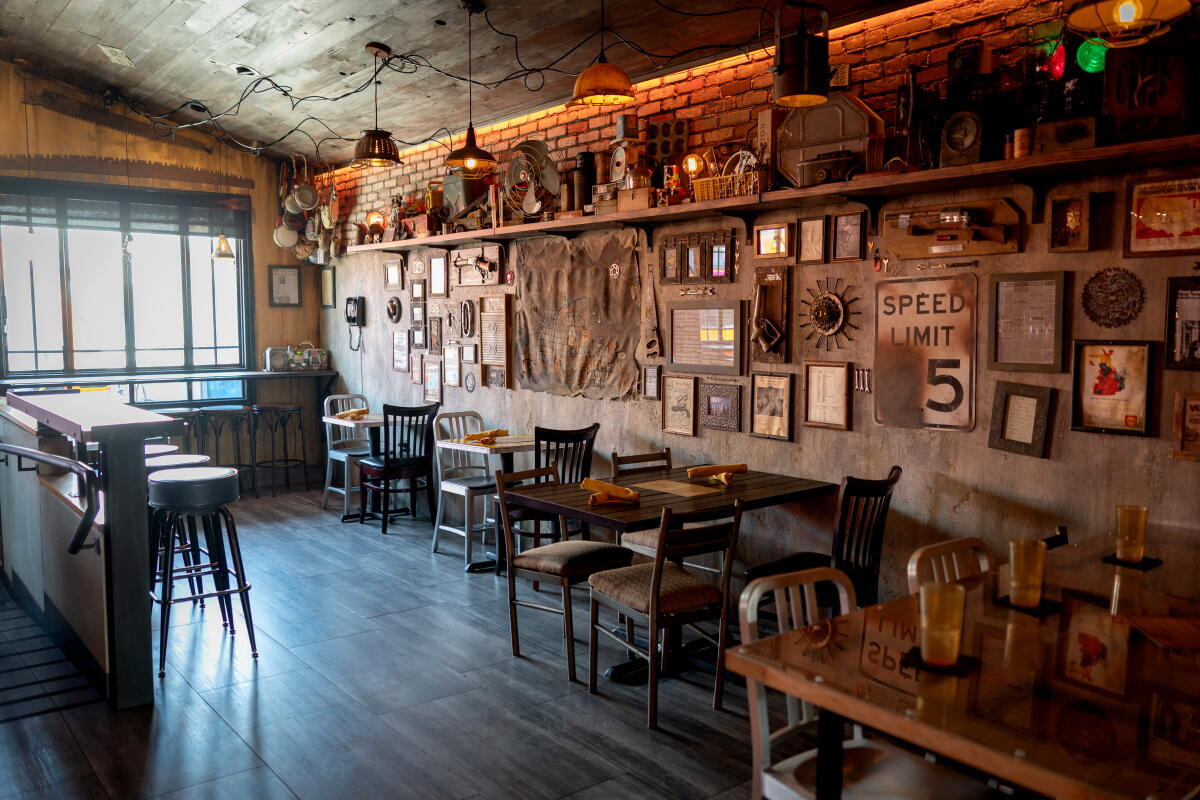
Today’s report is on a show. It’s summer season at Knott’s Berry Farm, which means a new storyline for its popular Ghost Town Alive!, a heavily improvised, actor-led experience that unfolds like a live-action role playing game. New this year is a hootin’ and hollerin’ good time of a show in “Spirits and Shenanigans,” which takes place in the Calico Saloon inside the park’s historic Ghost Town.
At 25-minutes, the production centers on the fictional husband-and-wife bar proprietors, who sing of leaving Illinois to open the spot, as well as its boot-tapping, can-can dancing staffers. Just ever-so-slightly risque with a bit of a patriotic feel, it’s a fast-moving ode to drinking holes and the sense of local community they provide. Expect tap dancing as well as numbers that will turn the entire stage into a drum kit. So if you’re heading to Knott’s this summer, “belly up to the bar,” as they sing, and grab a Boysenberry IPA and one of the few inside seats for this lively, can’t-miss production.
Tell us your stories. Ask us your questions.
Have a theme park tale to share? Whether it was a good day or less-than-perfect day, I would love to hear about it. Have a question? A tip? A fun photo from the parks to share? Email me at todd.martens@latimes.com. I may feature your note in an upcoming newsletter.
Now open is a revamped, kids-focused area in Looney Tunes Land, a remake of the former Bugs Bunny World and Whistlestop Park. All told, it’s a 5-acre space with nine rides, including two kiddie coasters, as well as still-to-come play areas, a live show and an in-development augmented reality experience.
You’re reading Mr. Todd’s Wild Ride newsletter
Todd Martens’ newsletter delivers news and commentary on the past, present and future of theme parks, right from the theme park capital of the world — Southern California.
By continuing, you agree to our Terms of Service, which include arbitration and a class action waiver. You agree that we and our third-party vendors may collect and use your information, including through cookies, pixels and similar technologies, for the purposes set forth in our Privacy Policy such as personalizing your experience and ads.
I last walked through the area about two summers ago, and it was in a derelict state. I’m happy to report it’s more welcoming, prettier and dotted with plant life and landscaping.
Gone is the vintage Magic Flyer, once Magic Mountain’s oldest coaster (the park’s eldest thrill seeker is now Gold Rusher). Also among the casualties: Tweety’s Escape, a steel swing that placed children in birdcages that had begun to look like mini jails. It was a grim-appearing ride.
The remaining attractions have all received some much-needed TLC. Some even have added mini storylines. What was Whistlestop Train, for instance, is now Taz’s Tasmanian Train Tours. It follows a narrative in which the ride’s titular character has escaped the zoo and is eluding capture, generally causing havoc on the countryside. It’s a calm, slow-moving ride through a small green space, and we see failed attempts to trap Taz, such as an overgrown mice contraption. The ride concludes with a mechanical not-so-hidden Taz, but not before glimpsing a statue of Tasmanian She-Devil in full kiss mode.
A look into the Bugs Bunny-focused area of Magic Mountain’s new Looney Tunes Land.
(Myung J. Chun / Los Angeles Times)
The reimagining comes two years after Six Flags Entertainment Corp. and the Cedar Fair Entertainment Co. completed a merger, which in SoCal brought Magic Mountain and Knott’s Berry Farm under the same ownership. Six Flags’ corporate creative producer Clayton Lawrence says post-merger, the company pinpointed upping the family appeal at Magic Mountain as among its first orders of business.
That meant last summer devoting resources to improving the Hurricane Harbor water park, which Lawrence says specifically attracts families and grandparents. This year, attention was turned to the primary park in Looney Tunes Land.
“We really thought about what this park needs,” Lawrence says. “What will the parents need? How do we slow the guests down a little bit? This park has so many thrills in it — so many coasters — that we wanted to create a place that was nice to take a break from all the action and also develop areas where grandparents and parents could watch little ones burn off energy.”
It’s safe to say that Magic Mountain’s core audience is likely always going to be thrill seekers. And that fan base will be served next year with the planned opening of a new coaster that will overlook the Looney Tunes area.
The kiddie coaster the Road Runner Express at Six Flags Magic Mountain.
(Myung J. Chun / Los Angeles Times)
Magic Mountain attracted 3.3 million visitors in 2024, according to data released by the Themed Entertainment Assn. While Lawrence was not able to break down which percentage of that number included those traveling with children 12 and under, it’s safe to say that a greater family appeal is viewed as one of the ways to boost a SoCal audience.
“There’s a lot of people who grew up coming up here, or their first ride was inside Bugs Bunny World,” Lawrence says. “A lot of families have a daredevil teen who can go on the rides, but they also have a little one. This is about the multi-demo family.”
Looney Tunes Land is broken into four mini areas — Taz-Mania, Road Runner Ridge, Bugs Bunny Play Park and Camp Duck Amok. While there are no major distinctions between the spaces, there are slight differences. Taz’s footprints, for instance, are found in the gravel-colored pavement of Taz-Mania, and in the Daffy Duck locale the flooring looks a bit like rockwork. A small outback-like trail in Taz-Mania will soon be home to an augmented reality game, and a much-needed green space in the Bugs Bunny spot will later this summer be populated with tunnels and little climbing structures.
Asqwer Turki, 13, poses for a picture with Wile E. Coyote at the new Looney Tunes Land at Magic Mountain.
(Myung J. Chun / Los Angeles Times)
There are fun additions to spot on the refreshed rides. The Canyon Cruiser beginner’s coaster, for example, nods to classic Looney Tunes cartoons, specifically prank-filled episodes featuring Daffy Duck, Bugs Bunny and Elmer Fudd. The children’s theater has been remade into Bunny Bowl, and given giant carrots that call the attention of guests.
Such light thematic touches, said Magic Mountain President Brian Oerding, have been missing from parts of the park. They’re vital, he says, in lengthening a guest’s day.
“We’ve learned that softening the hardscape creates a better environment, a better experience, and that means you’re going to want to hang out more,” Oerding says. “Some folks will walk by black asphalt and not think anything about it, but when you look into Looney Tunes Land, and you look at the softness of the pavement and the additional landscaping, we’ve created a happier space. Mom and Dad are happier, and that means they’ll hang out longer.”
Mountain Park President Brian Oerding officially opens the new Looney Tunes Land at Magic Mountain.
(Myung J. Chun / Los Angeles Times)
Looney Tunes Land has also given Magic Mountain some much-needed in-park entertainment, as the area has been lacking a live show for a number of years. “Vacation Mayhem” comes in at just under 15 minutes and features Bugs, Daffy, Porky Pig and Sylvester imagining their perfect getaway spots in song.
Things go wrong, of course, and Bugs even explores some vices by gambling in Las Vegas, which was an odd choice I thought for a kids show, but Looney Tunes did always have a bit of an edge. Nevertheless, the musical numbers, ranging from reworkings of “The Gold Diggers’ Song (We’re in the Money)” to “Hello Muddah, Hello Fadduh (A Letter From Camp)” keep it zipping along.
“If we don’t believe that entertainment and character shows are important, we’re missing it,” Oerding says. “Yes, the rides are cool, but we haven’t done an actual entertainment show in here in a long time.”
And Lawrence says Looney Tunes is essentially a model for the entire park. No, that doesn’t necessarily mean more kiddie rides in the coming years, only that Six Flags is looking at other places where the park can use some beautification.
“This is what we want to do for the rest of the park,” Lawrence says. “Disciplined design. Nice hardscape.”
And here’s hoping for some more plants and an additional fountain or two.
This week in SoCal theme parks
Alexis Rosales of Bell gets drenched by Luke Brodowski, performing as Fluke Mayfield at Knott’s Berry Farm’s Ghost Town Alive! in 2024.
(Allen J. Schaben / Los Angeles Times)
It’s the most wonderful time of the year. Knott’s Berry Farm begins its summer season on Friday, and that means the return of Ghost Town Alive! This interactive live show, now a decade old, is unlike anything at any other SoCal park, and in my mind it’s the best summer entertainment available. This hybrid live-action role-playing game and work of interactive theater enables guests to live out mini-Wild West adventures while interacting with more than two dozen actors. Players follow a loose story centered on the drama in the fictional town of Calico, in the park’s Ghost Town area. It’s silly, it’s wacky and there’s even a daily newspaper. Ghost Town Alive! runs on select days, and I’ll see you there Friday.
World Cup, Lego Style! Carlsbad’s Legoland is celebrating the arrival of the World Cup with a host of limited-time activities and Lego creations. The park, for instance, has built a 30-foot-long re-creation of SoFi Stadium, and elsewhere has created brick versions of a host of soccer stars. There are interactive events as well, such as accuracy challenges and games that have attendees trying to score goals off of Lego minifigures. Legoland’s FIFIA World Cup Experience 2026 launches Thursday and runs through July 19.
Oogie Boogie Bash tickets drop — and a Haunted Mansionstreet parade? The Disneyland Resort’s popular after-hours event Oogie Boogie Bash returns Aug. 18, and tickets for Magic Key passholders go on sale June 16 (the general public sale is June 18). New this year to the Disney California Adventure experience is what the resort is calling “Madame Leota’s Swinging Wake.” Though not a full-scale parade, expect Haunted Mansion characters — the concept art shows floats of the attraction’s “stretching room” portraits — as well as ghostly dancers. But with something new, something must depart. “Madame Leota’s Swinging Wake” is replacing the “Frightfully Fun Parade.” Ticket prices vary by day, starting at $139. October dates, for instance, top off at $199.
“Harry Potter” will hover above Dodger Stadium. A theme park-like drone show is arriving Saturday at Dodger Stadium. More than 1,200 drones will soar over the park as part of a “Harry Potter”-inspired production, which will also feature music, trivia and an appearance from the film’s Bonnie Wright (Ginny Weasley). Expect re-creations of “Potter” iconography such as Hogwarts Castle, magical creatures, the Sorting Hat and more. The hourlong show begins at 9 p.m. and Butterbeer will be on hand. Tickets start at $52.90 for adults.
Tell us your stories. Ask us your questions.
Have a theme park tale to share? Whether it was a good day or less-than-perfect day, I would love to hear about it. Have a question? A tip? A fun photo from the parks to share? Email me at todd.martens@latimes.com. I may feature your note in an upcoming newsletter.
Ride on,
Todd Martens
P.S.
Last week I put out a call for Disneyland fans to share their Carousel of Progress memories. The theater attraction, centered around a rotating auditorium, debuted at the 1964 World’s Fair before making its way to Disneyland in 1967. It was moved to Florida’s Walt Disney World in 1975. The Walt Disney Co. announced recently that the Florida version would be undergoing a top-to-bottom overhaul, but its dedication to technological optimism throughout the decades would remain.
I’m thoroughly enjoying the remembrances. Many cited it as a favorite. “My father was a musician, and it became a family tradition that we’d sit in the back row and sing ‘[There’s] a Great Big Beautiful Tomorrow’ loudly at the top of our lungs from the very beginning of the ride, which I’m sure newcomers thought was weird and probably annoying,” wrote one reader. Another noted, “The mid-60s were exciting years to be a kid, as the future seemed so promising and exciting; the [Carousel of Progress] plugged right into that enthusiasm.”
Many shared similar sentiments. “The animated activities of the characters and their dialogue embraced the ‘Happiest Place on Earth” theme that was prevalent throughout Disneyland in those earlier days,” said one fan. A few, however, called out that the attraction was sponsored by General Electric, making it feel a bit like an advertisement. As one reader summarized: “It was incredibly clunky product placement, even to a kid’s ears.”
Tiki, an offshoot of the Midcentury Modern movement, flourished in the ’40s, ’50s and ’60s, but began to experience a decline in the ’70s. Thus, by the ’90s, there were concerns at Disney that the Enchanted Tiki Room — the pivotal 1963 attraction that pioneered audio-animatronics — was no longer in vogue, its singing birds, totems and flowers a relic of another era.
You’re reading Mr. Todd’s Wild Ride newsletter
Todd Martens’ newsletter delivers news and commentary on the past, present and future of theme parks, right from the theme park capital of the world — Southern California.
By continuing, you agree to our Terms of Service, which include arbitration and a class action waiver. You agree that we and our third-party vendors may collect and use your information, including through cookies, pixels and similar technologies, for the purposes set forth in our Privacy Policy such as personalizing your experience and ads.
The company explored some early concepts to remake the Enchanted Tiki Room. One idea was to transform it into an ecological, save-the-rainforest show. Another was to redesign it with a “Lion King” theme.
“Let me tell you, we hated it,” says artist and designer Kevin Kidney of the latter concept.
Kidney, who worked in Disneyland’s art department in the ’90s, says he and his longtime collaborator Jody Daily were “terrified” the Enchanted Tiki Room would disappear, so much so that they began making fliers to advertise the show and putting them up all over L.A., in restaurants, bars and museums. “We started an underground movement to save the Tiki Room even while we were working on these projects. We tried to frame it in a cool, hip way, like, ‘Everyone needs to go and re-experience this amazing show.’”
Trader Sam’s Enchanted Tiki Bar took its influence from Disneyland’s Adventureland attractions, namely the Enchanted Tiki Room and the Jungle Cruise.
(Todd Martens / Los Angeles Times)
Thankfully, cooler heads prevailed, and the Enchanted Tiki Room remains to this day a vital piece of Disneyland history. And now with the modern tiki revival, it’s no longer an archival curiosity. In fact, the connection between Disney and tiki may be as strong as it has ever been, as this spring the Disneyland Hotel’s Trader Sam’s Enchanted Tiki Bar turned 15. Trader Sam’s took its cues heavily from the Adventureland attraction, its bar flanked by tiki totems with slowly wandering eyes. And watching over guests and bartenders is a re-creation of one of the show’s tiki gods.
“The totem pole on the bar, and Koro up in the rafters above the bar, are all original designs and sculpts for the Tiki Room at Disneyland,” Kidney says. “They made new castings for the bar off of the elements from the attraction.”
Kidney and Daily collaborated with Walt Disney Imagineering, the arm of the company devoted to theme park experiences, on some of the early designs for Trader Sam’s. It’s their mug collection, for instance, that was seen in the bar on opening day. And the pair designed a magnificent glowing ship in a bottle, which thanks to a Pepper’s ghost illusion, occasionally looks as if it’s breaking apart and sinking.
Trader Sam’s, says author and historian Sven Kirsten, writer of “The Book of Tiki,” is one of the more influential bars on the modern tiki landscape. Though it didn’t kickstart today’s movement, says Kirsten, it often serves as “a gateway,” introducing Disney’s millions of guests to the scene.
Kirsten says Trader Sam’s has rightfully earned its place among SoCal’s most respected tiki bars. And most popular. An unofficial Instagram page devoted to the bar, keeping tabs on its mug releases and off-menu bartender creations, has more than 39,000 followers.
The erupting volcano “windows” of Trader Sam’s Enchanted Tiki Bar.
(Todd Martens / Los Angeles Times)
“In the early 2010s the craft cocktail revival brought forth these so-called tiki bars that thought if they had a tiki cocktail menu they were a tiki bar,” Kirsten says. “But it was basket lamps and palm leaf wallpaper and that was it. Places like Trader Sam’s and Strong Water and Royal Hawaiian are floor-to-ceiling fully decorated. They’re what a tiki bar should be.”
Before the Disneyland Hotel had Trader Sam’s, the space was home to Hook’s Pointe, which was lightly themed to “Peter Pan.” Yet about a decade after the Walt Disney Co. completed a purchase to assume control of the Disneyland Hotel, Hook’s Pointe was earmaked for renovation.
“We were designing a Caribbean-style bar where Trader Sam’s is now, and that was where I said, ‘Let’s rethink this,’” said Kyle Barnes, an Imagineer who was instrumental in the creation of Trader Sam’s. Barnes was speaking at a recent event hosted by Disney’s fan club D23 on the history of Adventureland and Trader Sam’s.
“I said, ‘That’s more East Coast. This is West Coast.’ Hawaii and Midcentury really fit together with the tiki theme,” Barnes said, noting that the park’s Enchanted Tiki Room was initially pitched as a restaurant and once sat next to the Tahitian Terrace, a Polynesian-themed restaurant complete with hula dancers.
Trader Sam’s is home to many show elements. In addition to the sinking ship, there are bar seats that will begin to drop the longer guests sit in them. Also, there are two theatrical windows looking out toward a volcano, which will erupt when guests order a specific drink. The ship in a bottle and dipping barstools, said Barnes, were inspired by the Adventurers Club at Florida’s Walt Disney World, while the volcano windows were influenced by Florida’s version of the Enchanted Tiki Room.
The Kungaloosh cocktail at Trader Sam’s Enchanted Tiki Bar.
(Todd Martens / Los Angeles Times)
The Adventurers Club closed in 2008, but I was fortunate enough to visit it as a child, and it was instrumental in my love of Disney, theater and, well, bars. Full of actors, puppets and walls filled with artifacts that seemed to spring to life, the Adventurers Club was a place of play, and I still remember as a kid being asked by one of the actors to join the imaginary guild. It was a glimpse into a grown-up world full of revelry, silliness and colorful cocktails.
Trader Sam’s fills a similar niche for me today, and as part of its 15th anniversary, it added the Adventurers Club signature drink, the sweetly tropical Kungaloosh, to its menu. As a kid, I longed to enter an adult world. As a grown-up, I love an adult world with a childlike playfulness.
Tiki bars aren’t perfect, and have occasionally come under criticism as escapist fantasy that appropriates Hawaiian or Polynesian iconography. As such, Trader Sam’s has changed over the years. Shrunken heads, for instance, that once hung from the walls, were years ago removed.
Progress, and part of Trader Sam’s enduring appeal. “The jokes that we accepted long ago, they were jokes for only a part of the population,” says Kidney.
And Trader Sam’s remains full of absurdities — spend some time just soaking up the puns and ephemera that dot the walls. Just be prepared to duck when you see the bartenders reach for a spray bottle.
So cheers to another 15 years, and I hope to see you at the bar.
This week in SoCal theme parks
Space Mountain at night.
(Paul Hiffmeyer / Disneyland Resort)
A refreshed cartoon world. Magic Mountain will on Saturday unveil its new kid-targeted Looney Tunes Land, which is a makeover of its previous Bugs Bunny-focused area. Expect a brand new live show, and spaces designed to represent the personality of characters such as Bugs, Daffy Duck, the Tasmanian Devil, and Wile E. Coyote and Road Runner. Each of the attractions, such as calming train and balloon rides, has received a tune-up. I’ll take a closer look next week!
‘The Odyssey’ comes to Universal. While theme park fans await the opening date of Universal Studios Hollywood’s new “Fast & Furious” coaster, the park is zooming ahead with its Mega Movie Summer promotion. As part of the latter, a ship from Christopher Nolan’s “The Odyssey” will be added to the park’s tram tour. Elsewhere, Minions from “Minions & Monsters” will start meeting with guests, and various dining locations will receive light makeovers to represent films such as “Jaws” and the “Fast & Furious” franchise.
Changes afoot at CityWalk. Universal’s CityWalk is in the midst of a multiyear transformation. New spaces, such as one from Malibu Brewing Co., are on the way, while some legacy retailers are unfortunately disappearing. The latest: Publisher Dark Horse Comics is closing its Things From Another World retail location. The pop-culture shop is slated to close in September. No word yet on what may move into the space.
Space Mountain is back! After a brief overlay as the “Star Wars”-themed Hyperspace Mountain, Disneyland’s classic Space Mountain has returned just in time for the busy summer season. The coaster, which tops off at about 32 mph in near total darkness, should be back in all its vintage glory as of today.
A renewal perk. The Disneyland Resort in a move to create more loyalty among its Magic Key passholders is offering a bonus for those who opt to stick around for another year. A dining promotion, in which annual passholders can receive a dining gift card for as much as $100 if they choose to re-up, is underway through May of next year.
Tell us your stories. Ask us your questions.
Have a theme park tale to share? Whether it was a good day or less-than-perfect day, I would love to hear about it. Have a question? A tip? A fun photo from the parks to share? Email me at todd.martens@latimes.com. I may feature your note in an upcoming newsletter.
Ride on,
Todd Martens
P.S.
I’m curious if any longtime Disneyland fans have any memories of the Carousel of Progress. I’d love to hear them. The theater show, built around a rotating auditorium, debuted at the 1964 World’s Fair before making its way to Disneyland in 1967. It was moved to Florida’s Walt Disney World in 1975.
In case anyone missed it, the Walt Disney Co. announced last week that Carousel of Progress would be undergoing a top-to-bottom overhaul to update the show. No longer will it begin in the distant past, as the refreshed attraction will now start in the 1960s and take guests into the ’80s, the late ’90s and beyond. An ode to technological optimism, the original show was overseen by Walt Disney, but had undergone multiple changes throughout the decades, most notably in its final scene.
I’ll miss its glimpses of the 1920s and 1940s, but concede the attraction was notable today more for its Disney history than its cultural relevancy. Thus, I’m cautiously hopeful that this makeover can ensure the Carousel of Progress remains a Disney staple for decades to come.
One iconic Disney movie now has its own official area at Disneyland Paris, and we got to enjoy the incredible opening ceremony as well as enjoying the brand new ride that Disney fans have been long anticipating
My seven year old was enchanted by the entire experience(Image: Natalie King)
It’s difficult to believe that 13 years have passed since Frozen first graced our cinema screens. The adventures of Elsa and Anna soon became one of the most commercially successful animated pictures ever made, with its follow-up arriving in 2019. This means virtually every parent with primary school-aged children will, at some stage, find themselves able to reel off every word to Let It Go.
My seven year old daughter has kept the Frozen films on constant repeat on Disney+ for years. There’s something about the heartwarming stories of the two sisters that proves utterly captivating for her generation, even though she wasn’t born when the films originally came out. So when the opportunity arose to visit Disneyland Paris for the launch of Disney Adventure World featuring the World of Frozen – previously known as Walt Disney Studios Park – I responded with an enthusiastic yes.
The attraction forms part of ambitious expansion schemes for Disneyland Paris, and features stunning landscaped gardens surrounding a lake, brand-new dining venues and retail outlets, and arguably most importantly, the opportunity to enter Arendelle itself and become immersed in the magic. Not only was this my maiden voyage to Arendelle, it was also a first Disney adventure for both myself and my daughter, which made it all the more exciting.
Before the official opening back in March, we were treated to an exclusive preview, allowing us to explore the town at leisure, and it’s genuinely breathtaking. While Frozen is set in an imaginary kingdom, it draws heavily on Norwegian influences, and the park has recreated this flawlessly.
Against the striking backdrop of an enormous artificial North Mountain — where you can spot Elsa’s frozen palace shimmering in the distance — charming wooden structures are dotted throughout, packed with little nods to the film that will thrill Frozen fans.
Following a stroll around the lake soaking up the scenery, we kicked off our day with a visit to get my daughter’s hair styled. There’s a rustic wooden cabin beside the lake where children can select from an array of Scandinavian-inspired hairstyles including plaits and updos, finished with Frozen-themed hair embellishments. Face painting and flower crowns are also available for that authentic Arendelle style.
We also had a look inside the new Nordic Crowns Tavern, a welcoming spot at the heart of the park offering fast-service dining choices. The menu featured meatballs, fish, and other foods that complement the overall Scandinavian atmosphere of Arendelle.
But the star attraction is undoubtedly the World of Frozen ride, and so climbing aboard a boat, we set off into the unknown. The experience perfectly retells the story from the first film, guiding you through various scenes where you’ll spot familiar faces from the trolls, or love experts, to Sven, before going up a steep incline towards Elsa’s frozen fortress.
As the melody of Let It Go echoes around you, your boat suddenly hurtles backwards at pace, before you’re hurled from the North Mountain by the fearsome Marshmallow down a dramatic plunge. One tip for riders – don’t leave anything you don’t want soaked on the floor. I ended up having to use a hairdryer on my passport after my backpack got drenched through.
You then enjoy a firework display accompanied by delightful Frozen songs. My seven year old absolutely adored the experience, and it proved to be a trip highlight. And yes, we took a second spin — it would have been rude not to.
Time your arrival well and you can catch a Celebration in Arendelle, where beloved characters perform a spectacular show on boats across the water, and naturally, you can arrange a meet and greet with Anna and Elsa – although advance booking is required for this.
For those wanting to enjoy more Disney princess encounters without the lengthy waits, the new Regal View Restaurant is essential. I must confess, it feels somewhat strange stepping into an upscale restaurant after a morning spent at a theme park, and I felt rather underdressed compared to the elegant interior adorned with oil paintings and Disney-inspired ceramics.
That said, the staff were nothing short of delightful. As we settled in and enjoyed a three-course French meal, complete with charming nods to Disney princesses — from edible rose petals to dainty crowns — the princesses strolled between the tables to meet guests.
We were lucky enough to meet four princesses from the comfort of our seats, including Jasmine and Mulan, and each one was brilliantly professional and wonderfully engaging. My little one can be on the shy side when meeting characters, but they soon had her chatting away and practising princess twirls, and we had ample time to snap plenty of photos.
It’s certainly not a budget option, at €100 for adults and €50 for children for the set menu (roughly £86 and £43), but it made for a thoroughly relaxed and enjoyable experience — one that’s truly worth saving for a special occasion.
Amid all the buzz surrounding the World of Frozen, the brand-new Tangled ride was somewhat overlooked, though it’s an absolute gem for younger children. On Raiponce Tangled Spin, you gently drift around on spinning boats beneath a canopy of lanterns, making it the ideal attraction for little ones.
That evening, we made our way to the opening ceremony, where in a spectacular burst of glitter and confetti, the gates were flung wide open. Much like the iconic moment in the original film when the gates of Arendelle parted, there was an electric rush of excitement as we followed a brass band belting out beloved Frozen tunes.
French singer Santa took to the stage to perform Let It Go, amongst other songs, officially marking the park’s opening, with visitors making a beeline for the new ride and the chance to meet the princesses.
Rounding off the experience at the World of Frozen is a brand-new night-time spectacular, Disney Cascade of Lights, set on the lake. Combining drones, fireworks and pyrotechnics, it’s a breathtaking achievement and the ideal way to close the day for any Disney fan.
All in all, World of Frozen made for a magical experience and stands as one of the crown jewels of Disneyland Paris. As a first-time visitor to Disney, expectations were high, and the extraordinary attention to detail and outstanding entertainment on offer in Arendelle more than delivered. But above all else, watching my daughter wander around wide-eyed with wonder throughout the entire visit made every moment of the journey absolutely worthwhile.
Disneyland is no stranger to patriotism. Reflecting America — both its positives and its “hard facts,” to quote park founder Walt Disney — was part of its mission statement.
Over the years, the Walt Disney Co. in its parks has become more focused on its IP — that is, its film and television properties — rather than looking beyond its gates. But remnants from Disneyland’s past remain. The park still hosts a daily flag retreat, a respectful, music-focused ceremony often with the Dapper Dans and the Disneyland Band to honor veterans. Then there’s the animatronic show “Great Moments With Mr. Lincoln,” which is an inspiring, vital work of theme park theater. Using snippets of Lincoln’s most timeless speeches, it illustrates how words can unite rather than divide us, a rarity in today’s partisan-heavy landscape.
You’re reading Mr. Todd’s Wild Ride newsletter
Todd Martens’ newsletter delivers news and commentary on the past, present and future of theme parks, right from the theme park capital of the world — Southern California.
By continuing, you agree to our Terms of Service, which include arbitration and a class action waiver. You agree that we and our third-party vendors may collect and use your information, including through cookies, pixels and similar technologies, for the purposes set forth in our Privacy Policy such as personalizing your experience and ads.
I’ve never believed Disney should stay out of politics. I’d argue that’s impossible, anyway, as all art is political. What a company shows — or chooses to leave out of its content — is a reflection of its values.
This summer, Disneyland is leaning all the way into its patriotic tendencies. A Sam Eagle popcorn bucket, complete with a Fourth of July-style stars and stripes cap, is on the way. And the centerpiece of the festivities will arrive July 2, which is when the Disney California Adventure staple Soarin’ Over California transforms into Soarin’ Across America. Key locations on the hang gilder simulator will include Mount Rushmore National Monument, the Washington Monument, the Statue of Liberty and the Hollywood sign, among many a national park.
Soarin’ Across America shows aerial vistas across the United States, and it’s arriving at a divisive moment in our nation’s political history.
(Disney Parks)
Though designed to celebrate the 250th anniversary of our country’s founding, it’s impossible to ignore that it’s coming at a divisive time in the U.S. Soarin’ Across America’s poster art, as I noted last year when the new version of the attraction was announced, made me cringe, as it features a Statue of Liberty juxtaposed with the American flag and bald eagle — art that conveys a sense of nationalistic pride. In 2026, such emotions are complicated. Our country is disrupting the world, ICE raids have shattered our communities and just the other day, our president was effectively shielded from examination of his finances and legal conduct.
So please forgive me if I don’t exactly want to don the red, white and blue right now. Soarin’ Across America feels like the excited guest showing up to a wedding that’s only happening because the couple can’t get their deposit back.
While I do want to cheer its representation of our national parks — spaces that need all the positive publicity they can get right now, thanks to the administration’s budget cuts and layoffs — I wonder about the inclusion, of, say, Mount Rushmore, which has a long, controversial history, and has been a fascination of President Trump’s.
I’m skeptical, in short, as to how Soarin’ Across America will be read at this moment, a time when many are questioning the relevancy of patriotism and loyalty to a flag. So I was eager to discuss these thoughts with veteran Imagineer Tom Fitzgerald, an executive creative director who recently worked on Main Street, U.S.A.’s Walt Disney animatronic show, who met with me last week.
An attraction poster for Soarin’ Across America released via the Walt Disney Co.’s corporate media site.
(The Walt Disney Co. )
I asked him about potential discomfort around Soarin’ Across America’s patriotic displays. He lightly pushed back, arguing in essence that’s why the attraction is necessary.
“I think we were taking the opposite approach, the optimistic approach, which is what Disney is all about,” Fitzgerald says.
“How can we do something that will help us all celebrate?” he continues. “I know personally when I saw the Artemis II mission recently, I felt like we all came together and said what an astonishing achievement. We were all rooting, going up and coming down. I think that’s more what we wanted to do. Let’s just do a portrait of America, and let the guests go in and just enjoy it. … Let’s just let the audience come in without any preconceived notions and enjoy this four-and-a-half-minute journey.”
I did ask a follow-up, wanting to hear about the conversations that were had at Imagineering to ensure this ride wouldn’t be seen as political, even as it is showing locations such as Mount Rushmore, often a site of protests and criticism from Native Americans.
“I think for us, it’s like, go for the iconic place, and keep it all in the Soarin’ style, with the big music, hang gliding,” Fitzgerland says. “Just make it a journey that just flows from coast to coast.”
A coastal scene from Soarin’ Across America.
(Disney Parks)
Fitzgerald says the ride came together in exactly 12 months, making it a relatively fast, time-crunched project. Yet that also means Disney was aware of the heightened cultural environment it was entering.
The attraction is already open at Florida’s Walt Disney World but I don’t believe in reviewing rides via point-of-view videos, so I’m waiting until July 2 to experience it here. When it lands in Anaheim, I hope I find it an empowering, uplifting work. A number of its locations, including our own Griffith Park, or the Grand Canyon West, Denali National Park, a Maine lighthouse and more, are a reminder of our park wonders. It’s in these scenes that I believe Soarin’ Across American will thrive, and become that “portrait or tapestry of crossing America” that Fitzgerald describes.
Also important: The attraction is a reminder that a theme park such as Disney California Adventure is not so much an escape as an idealized reflection of what is happening beyond its borders. Theme park additions don’t happen in a vacuum, and I applaud its designers for continuing to take risks, especially when they don’t involve pop-culture IP (the IP being explored here is America).
And if Soarin’ Across America can inspire a few trips into our great outdoors, whether that’s an afternoon at the Griffith Observatory or that Grand Canyon trip you’ve been putting off, I’ll take that as a win. But it would have been fine with me if the red, white and blue fireworks had been left in the editing bay.
This week in SoCal theme parks
Halloween season is coming soon. Universal Studios Hollywood announced this week one of its first major haunted houses for 2026’s Halloween Horror Nights.
(Wally Skalij / Los Angeles Times)
“Sinners” is coming to Halloween Horror Nights. Ryan Coogler’s sexy, scary, music-heavy and politically-infused vampire film “Sinners” is getting the Halloween Horror Nights treatment at Universal Studios Hollywood. The 2025 Warner Bros. Pictures flick is set in the 1930s, and its Horror Nights haunted house will take guests into the film’s bluesy Club Juke. The would-be-safe haven, however, becomes anything but. I’m excited, but I do hope Universal is able to touch on some of the topicality and cultural commentary of the film. Halloween Horror Nights is currently set to launch on Sept. 3.
Become a Disneyland ‘park ranger.’ Theme parks are stages, and I love when designers create activities to inspire play or exploration. And Disneyland has done just that this summer with its “Mickey’s Park Rangers” activity book. The free, 33-page booklet, available from retail shops near Disneyland’s Rivers of America, is full of puzzles, factoids (I honestly didn’t know there were catfish in the park’s river) and some light scavenger-hunt-like quests. The last will take players through Pirate’s Lair on Tom Sawyer Island, the boats of Rivers of America and the Disneyland Railroad. All told, it’s an excellent way to slow down, play some games and rediscover historic aspects of Disneyland.
Do puzzles, see some apes. The Los Angeles Zoo on Saturday is hosting a special, game-focused puzzle adventure focused on its ape exhibits. “Zoo Quest: Amazing Apes” is an after-hours event in which participants will work in teams to solve puzzles across the zoo grounds, in this case zeroing in on the park’s ape habitats. The tasks will gradually reveal various ape facts as well as tip guests to the zoo’s conservation efforts. Tickets are $35 for those 12 and older, and $30 for those ages 2-11.
Park hop to your heart’s content. The Disneyland Resort revealed that on June 9 it is eliminating a rule that prevents park hopping between the Disneyland Park and Disney California Adventure before 11 a.m. Guests will still need to make a reservation at one of the Disney parks, but will be able to check in at either park, subject, of course, to availability. This is a positive development, essentially eliminating a pandemic-era rule and allowing guests who pay for the park hopper upgrade to freely move between locales.
The best thing I ate at the parks
A grilled cheese from the Grand Californian’s Hearthstone Lounge.
(Todd Martens / Los Angeles Times)
The signature restaurant at the Disneyland Resort is the Grand Californian’s Napa Rose. But don’t sleep on the hotel’s Hearthstone Lounge, which accepts walk-ups and reservations (bar seats can be hard to come by). Its relaxed casual atmosphere has made it one of my regular stops when at the park for a full day, and its menu ranges from the informal (sandwiches, pizza) to the more upscale (a $72 New York steak). I tend to lean to the former, and opted for the restaurant’s $21 grilled cheese sandwich on a recent visit. With Parmesan-crusted toast, it feels decadent but isn’t too filling, as bits of bacon, arugula and tomato balance out its mildly sweet and not-too-heavy Point Reyes Toma cheese filling.
Tell us your stories. Ask us your questions.
Have a theme park tale to share? Whether it was a good day or less-than-perfect day, I would love to hear about it. Have a question? A tip? A fun photo from the parks to share? Email me at todd.martens@latimes.com. I may feature your note in an upcoming newsletter.
Ride on,
Todd Martens
P.S.
“Mouse P.I. for Hire” is a recent video game in a vintage, 1930s-inspired animation style.
(Fumi Games / PlaySide Studios)
One of my non-theme park passions is video games, and I think Disney fans who also enjoy interactive entertainment may want to give a recent release a close look. “Mouse: P.I. for Hire,” essentially available on all platforms, is a well done lighthearted first-person shooter with some stylistic thought behind it. It’s gorgeous, a black-and-white game in the 1930s cartoon feel, and it’s filled with many a sight gag that wouldn’t have been out of place in “Who Framed Roger Rabbit.”
Its tone is of a noir film, and begins with a missing persons mystery while gradually spinning out to reveal a world full of of fascist, evil mice. When it comes to gameplay, it’s a bit old-fashioned, focusing on the cartoonish aspects of video game shooting rather than anything realistic. It’s good fun and a bit silly, and I like to think of it as something that an alternate world Disney could have dreamed up.
Disneyland’s Millennium Falcon: Smugglers Run has always been a fully realized “Star Wars” toy, an intimate, interactive attraction that focuses on arcade-style joy. A new upgrade opening Friday makes it decidedly slicker, giving the ride enhanced visuals, increased participatory actions and even an injection of cuteness.
Smugglers Run, which opened in 2019, puts six players in the cockpit of the Millennium Falcon, the ship made famous by Harrison Ford’s Han Solo in the original “Star Wars” trilogy. There’s still no Solo, but there is now Din Djarin, often referred to as simply the Mandalorian, and Grogu, the latter colloquially known as “Baby Yoda.” And although tied to the opening of the new film “The Mandalorian and Grogu,” Smugglers Run version 2.0 smooths out and improves upon many of the attraction’s quirks.
Blessedly, this is one marketing-driven decision that doesn’t feel like a gimmick, bringing unpredictability, humor and even more video game-like zaniness to the ride. Walt Disney Imagineering, the relatively secret division of the company focused on theme park attractions, has clearly listened to guest feedback and zeroed in on ways to not only improve the ride but also make it feel fresh, all while giving players more agency.
You’re reading Mr. Todd’s Wild Ride newsletter
Todd Martens’ newsletter delivers news and commentary on the past, present and future of theme parks, right from the theme park capital of the world — Southern California.
By continuing, you agree to our Terms of Service, which include arbitration and a class action waiver. You agree that we and our third-party vendors may collect and use your information, including through cookies, pixels and similar technologies, for the purposes set forth in our Privacy Policy such as personalizing your experience and ads.
“This is an inherently collaborative adventure,” says Asa Kalama, a creative executive with Imagineering. On the ride, groups of six are teamed up to take on various tasks within the Falcon. Kalama says Imagineering was focused on how the various positions of pilot, gunner or engineer interact with one another.
“We took all of those learnings and applied them to enhancements for each and every one of those roles,” Kalama says.
I was a fan of the initial version of the attraction, writing when it opened that it was a heavily detailed blast, especially if one was seated in a pilot’s role (one guest controls the vertical motion of the ship while another focuses on the horizontal). But over time some of the less-than-endearing traits of Smugglers Run started to nag, namely that the two guests assigned to an engineering position had little to do and its storyline was essentially a glorified errand in which we retrieved goods for Hondo Ohnaka, a scoundrel-smuggler who sets the ride in motion.
Concept art of the sci-fi-like planet of Coruscant, a new location in Millennium Falcon: Smugglers Run.
(Disney Parks)
Smugglers Run has always been a technical marvel, but it was a feat of engineering rather than one that forged an emotional connection. The tweaks should fix much of what has long ailed it. Now, instead of a singular fixed mission, guests will have the ability to visit one of three “Star Wars” locations: a planet such as the urban Coruscant, the gas realm of Bespin or the wreckage of the second Death Star near Endor. This decision is made by one of the engineers and levels up the attraction’s ability to surprise.
Using the latest version of Epic’s Unreal Engine, each Smugglers Run locale is heavily detailed, putting us in more of a dogfight as the Mandalorian chases down pirates and ex-Imperial officers. No matter the route, it feels more active and lighthearted. Those who have ridden it before know Smugglers Run has always been responsive, perhaps too much so as inexperienced gamers could spend the entire attraction crashing the ship. Those flight controllers have been softened a bit, meaning guests will still steer but now do so with something of an invisible guided hand.
“We’ve tuned it in such a special way that no matter how skilled or unskilled you might be, you’re always guaranteed to have a flight that feels really cinematic,” says Kalama. In the past, particularly bad fliers could spend the entirety of the attraction being berated by the character of Ohnaka. That element has essentially been removed, with Kalama joking that guests shouldn’t feel as if they are being “chastised.”
Concept art of the Death Star wreckage above Endor, one of the new locales of Millennium Falcon: Smugglers Run.
(Disney Parks)
Narratively, after some quick training on the desert-like planet of Tatooine, we join the Mandalorian in an effort to break up a deal between the pirates and the ex-Imperial officers. That’s enough of a setup to inspire some space fights and chase scenes through fantastical locations.
I rode it three times to visit each vista once, and each has a different tone and look. The neon, sci-fi area of Coruscant, for instance, contrasts with the darkened, industrial Death Star wreckage. At various times, I watched the Mandalorian chase down his targets, get the Falcon caught in a tractor beam or careen through magnetic-like fences. Those seated in the gunner or engineer positions will also be treated to additional clips of Grogu via their adjacent flight panels, the young alien here portrayed as something of a playful pet of a child who is exaggeratedly chill during the commotion.
“I think what we were very deliberate about is that actually each of these different planetary locations that you go to has a different vibe,” Kalama says. “If you go to Endor, you’re in the derelict wreckage of the old Death Star 2. The feel of it is really spooky. It’s dark. It’s mysterious. It’s smokey. The music is almost ominous. In contrast to something like Coruscant, which feels very bustling, vibrant and colorful. The goal was not only are you going to a different location from a geographic perspective but to feel emotionally like you’re going on a different adventure.”
Concept art of Tatooine, where the new mission of Millennium Falcon: Smugglers Run begins.
(Disney Parks)
By emphasizing a chase being driven by the Mandalorian, the tone of the ride feels faster. While it’s the same length of around five minutes, rushing the Falcon through the reddish, fiery atmosphere of Bespin, for instance, where riders will encounter mountainous natural wonders and floating, bulbous structures, gives guests plenty to admire. Smugglers Run has always been full of distractions, as the screen — in front and somewhat above guests — pulls viewers away from the seat-adjacent wall controls. I minded less having my attention ping-ponged around the cockpit with the enhancements, as taking the Falcon into a brief battle creates a more pleasurably hectic tone.
Ultimately, with more choices to make, from which location to visit or whether to focus on Grogu’s antics or the action ahead, Smugglers Run feels more dynamic. “What’s even really kind of extra cool is that in addition to choosing the planets, there are different paths you can take within each location,” says Matt Martin, a senior creative executive with Lucasfilm. “You can choose to go left or choose to go right. And you’re going to see and experience different things.”
The tweaks to Smugglers Run follow big changes to Galaxy’s Edge, as Disney recently expanded the land’s timeline to feature classic, fan-favorite characters such as Darth Vader, Han, Luke and Leia. The character additions bring added life to the area but do take the land away from its original intent as a mythical world where actions unfolded in real time. The dream, however, of a fully interactive theme park experience lives on with Smugglers Run.
Tell us your stories. Ask us your questions.
Have a theme park tale to share? Whether it was a good day or less-than-perfect day, I would love to hear about it. Have a question? A tip? A fun photo from the parks to share? Email me at todd.martens@latimes.com. I may feature your note in an upcoming newsletter.
Ride on,
Todd Martens
P.S.
Mr. Todd’s Wild Ride comes out every Tuesday, but we occasionally publish special editions (like this one!) when we have breaking theme park news. Make sure you’ve signed up to be the first to know.
A visitor has filed a $5-million lawsuit against Disneyland for allegedly failing to properly disclose the use of facial-recognition technology at park and collecting sensitive data on guests.
Summer Christine Duffield of Riverside County filed the lawsuit after a May 10 visit to Disneyland and sister park California Adventure, alleging that the resort violates privacy and consumer protection laws collecting biometric data of visitors, without adequate consent.
“Disney does not adequately disclose the use of their biometric collection, so consumers — which almost always include children — have no idea that Disney is collecting this highly sensitive data,” the plaintiff noted in the lawsuit. “Guests should be able to expressly opt in to this type of sensitive facial recognition technology with written consent — the onus of privacy rights should not be on the victim.”
The suit was filed on May 15 in U.S. District Court in New York. The lawsuit cites an article from The Times on consumer reaction to Disney’s use of facial recognition.
The Walt Disney Company didn’t respond to a request for comment.
“People are getting fed up with being force-fed new tech, new AI, new tracking tools,” said Ari Waldman, Professor of Law at the UC Irvine.
Walt Disney Co. rolled out its facial recognition technology in late April across Disneyland Resort to verify tickets. The way it works is guests’ faces are scanned, converted into a numerical identifier and matched with ticket data.
Disney’s privacy policy notes that the identifiers created for identification are deleted within 30 days unless they need to be kept for legal or fraud prevention purposes.
Guests who don’t want to use the technology can enter through a separate entrance marked with a silhouette of a head and shoulders with a slash through it. However, of the dozens of lines to enter Disneyland and California Adventure, there were only four that didn’t use facial recognition, during an April visit.
The sign saying “Use of this technology is optional,” adorn the security checkpoint entrances.
“This technology facilitates ease of reentry into our parks and helps prevent fraud,” the company noted in its website.
Use of facial recognition technology for crowd management and ticketing has become increasingly commonplace.
Dodger Stadium deploys facial recognition for guests using the “Go Ahead Entry” at certain gates without producing a physical or digital ticket to enter the stadium. At Intuit Dome in Inglewood, visitors can use “GameFaceID” to quickly move through a separate lane with their face as their ID.
The lawsuit comes at a time when there is increasing concern of surveillance in public places, and privacy advocates have rallied against the normalization of surveillance. More recently, concerns of the potentially abusive use of artificial intelligence by government to analyze large quantities of data — from texts to facial scans — to surveil U.S citizens resulted in a high-profile showdown between the Pentagon and Anthropic.
I always encourage people to slow down when they visit Disneyland, especially when taking their first few steps under the train tunnel onto Main Street, U.S.A. There’s too much you’ll miss if you’re racing from attraction to attraction. For to set foot in Disneyland is to be guided by many an invisible hand.
Winding, circular and branching paths not only direct guest flow, but create the tone for the experience. The sensation is meant to evoke one of lushness and grandeur, to envelope oneself in a garden as much as a land of play.
You’re reading Mr. Todd’s Wild Ride newsletter
Todd Martens’ newsletter delivers news and commentary on the past, present and future of theme parks, right from the theme park capital of the world — Southern California.
By continuing, you agree to our Terms of Service, which include arbitration and a class action waiver. You agree that we and our third-party vendors may collect and use your information, including through cookies, pixels and similar technologies, for the purposes set forth in our Privacy Policy such as personalizing your experience and ads.
A principal in defining the feel of Disneyland — and an influence felt today in all meticulously designed theme parks — is master landscape artist Ruth Shellhorn. A South Pasadena native, her work for decades often went overlooked, spoken of in the shadows of brothers Jack and Bill Evans, horticultural experts who also played an instrumental role in the development of the modern theme park as homes to arboretum-worthy spaces.
It was Shellhorn, however, who used plants and trees to unify the park’s contrasting elements and to help direct guest flow. She even heightened the illusion of magnifying the splendor of Disneyland’s Sleeping Beauty Castle. Her work was an argument that a stroll through a theme park should evoke natural as much as man-made wonder, a journey into fantastical lawns and courtyards.
Shellhorn, who died in 2006, faced her share of discrimination for being one of the sole women in a Disneyland leadership role, says Cindy Mediavilla, a retired lecturer from UCLA’s department of information studies and co-author of the book “The Women Who Made Early Disneyland.”
“She was treated like chopped liver by the men,” says Mediavilla, “but she perseveres, and her work is still relevant to the park today.”
And it’s still being discovered. San Francisco’s Walt Disney Family Museum, home currently to an exhibit on Disneyland’s early days, will host a virtual chat June 17 on her work. Her contributions are also detailed in part in a relatively new behind-the-scenes tour at Disneyland, “Women Who Make the Magic.” The latter, a $110 add-on to a Disneyland day, is part of the park’s initiatives to appeal to those who want to dig deeper into Disneyland history, and also touches on the likes of Mary Blair, Kim Irvine, Martha Blanding and others.
Harper Goff, Bill Evans, Dick Irvine, Walt Disney, Ruth Shellhorn and Joe Fowler examine Disneyland plans in April 1955, just months before the park would open.
(Ruth Patricia Shellhorn Papers, UCLA Library Special Collections / Disney)
What might be most astonishing about the way Shellhorn transformed Disneyland is that she did it all in a matter of months. She was recommended to park founder Walt Disney by a friend and brought onto the Disneyland project about four months before its July 1955 opening.
“The Evans brothers are mostly focused on Adventureland, which is where they can put in all these fabulous plants that they’ve been collecting, but they aren’t as effective in figuring out how to design the other areas of the park,” says Todd James Pierce, a creative writing professor and Disney historian whose book “Three Years in Wonderland” documents early Disneyland.
“Landscape is going to be one of the last things that goes in, and so these problems don’t really present themselves as critical to Walt until the buildings start going up,” says Pierce.
While I went into the Disneyland walking tour familiar with Shellhorn’s work, the guided trek inspired me at last to dig more fully into her contributions. It was Shellhorn, for instance, who finished the floral portrait of Mickey Mouse at the entrance gates, choosing dwarf pink phlox for his tongue, according to Kelly Comras’ 2016 biography of the landscape architect.
Comras documents, too, how Shellhorn helped design Main Street entrance areas, namely the benches and green spaces that surround a flagpole. Shellhorn chose reddish concrete paving, white-flowering trees and perennials in shades of red, white and blue to “embellish Disney’s patriotic theme,” writes Comras.
Photo of blueprints for Disneyland’s tree planting design from a 2005 Times article on Ruth Shellhorn.
(Ken Hively / Los Angeles Times)
The author notes how weeks before opening, Disney replaced the flagpole with a bandstand. Shellhorn protested, arguing that it disrupted sightlines to the castle and overpowered the space. The landscape architect won.
“Ruth liked a lot of control,” says Pierce. “Walt would call her stubborn and I think that’s probably true.”
Shellhorn’s diaries are in UCLA’s Special Collections, where she privately expresses frustrations about Disneyland’s male-focused chain of command.
“She talks about how upset she gets with other art directors, in terms of them coming into her space,” Pierce says. “Some of that is gendered. It’s a group of men who are designing Disneyland, and here is this high-powered, very professional, extremely talented woman who is coming in to talk about how these men’s different areas are going to work together. There’s a hierarchy that’s a bit difficult.”
And yet Shellhorn successfully tied together multiple disparate spaces.
Disneyland’s centerpiece hub area, the entrance to its core themed lands and gateway to the castle, is, for example, a key area where Shellhorn played a major part. Shellhorn directed the grading of the bulldozers in constructing the moat around the fantasy palace, and also gave the entrance to each land a specific botanical personality — grasslike bamboo, for instance, near Adventureland, as well as jacarandas and senegal date palms to give it tropical bursts of color. Her compositions, writes Comras, “made the area flow together so seamlessly that visitors were unaware of her artistic intervention.”
Shellhorn, it should be noted, was extremely accomplished by the time she came to Disneyland, being named in 1955 a “woman of the year” by this newspaper. Her non-Disneyland work was pivotal in redefining commercial spaces throughout the Los Angeles region. She was perhaps best known for helping define the Southern California look of Midcentury Modern architecture for the now-defunct Bullock’s department store chain, which transformed the American shopping mall from an errand to a social outing.
But it’s her work at Disneyland that endures, and forever elevated the look, tone and feel of the American amusement park. So don’t just stop and smell the flowers next time you’re at Disneyland. Take a moment to remember the woman who initially had the vision for them.
The week in SoCal theme parks
Beginning May 22, new scenes inspired by the film “The Mandalorian and Grogu” will come to Millennium Falcon: Smugglers Run.
(Artist concept / Disneyland Resort)
A new mission for Millennium Falcon: Smugglers Run. The big news in local theme parks this week is the transformation of the arcade-style Millennium Falcon flight simulator ride in Disneyland’s Star Wars: Galaxy’s Edge. The refreshed version of the attraction will open Friday with a new storyline and increased levels of interactivity inspired by the film “The Mandalorian and Grogu.” Guests will now have the option to vote upon which “Star Wars” locale to visit as they seek to help the bounty hunter and his little pal break up a deal between a gang of pirates and Imperial officers. I’ll be experiencing the ride this week, so stay tuned to Mr. Todd’s Wild Ride for first impressions.
Get to know some sharks. San Diego’s Sea World will on Friday unveil a reimagined shark-focused exhibit. “Shark Encounter” still features the park’s signature moving tunnel as well as enhanced visuals to heighten its educational-focused objectives, including a multi-screen video installation to highlight shark diversity and dispel myths about the species. Eleven different varieties are highlighted in the park, including the endangered Australian leopard shark.
Prepare for liftoff across America. Disney has revealed new details on Soarin’ Across America, which opens at Disney California Adventure on July 2. The reimagined attraction, designed to celebrate the 250th anniversary of the founding of America, will feature the Mount Rushmore National Memorial, Grand Canyon West, the New England coastline and more. The celebration of patriotism has already opened at Walt Disney World’s Epcot, meaning there’s plenty point-of-view ride videos circulating the web. I’ve opted not to watch them, wanting to go in fresh when it comes to Anaheim, and thus will save my thoughts until I can experience the attraction firsthand.
It’s water park season! Confession: I have never been to a SoCal water park. Maybe this is the summer I change that? Knott’s Soak City Waterpark is now open in Buena Park, and Hurricane Harbor next door to Magic Mountain in Valencia will begin its summer season on Saturday.
Give up the dream of a third Disneyland park (for now). Wish-focused articles inspired rumors that the Disneyland Resort was prepping for a third park in Anaheim after permits were filed for its Toy Story Parking lot, land that will no doubt be reimagined after the resort builds a new parking garage on its Eastern side. I hate to be the bearer of bad news, but don’t bet on a third park coming to Disneyland anytime soon. While the resort recently won approval on its Disneyland Forward project, which paves the way for new attractions, hotels and dining to land in Anaheim, nothing in those plans implies a third park. Instead, they point to expansions of the existing Disneyland Park and Disney California Adventure, while implying that the current Toy Story lot will be remade into a mixed-use shopping, dining and hotel area. To further dash anyone’s hopes, biz writer Samantha Masunaga has more.
The best thing I ate at the parks
A special Butterbeer cream puff is available until the end of the month at Universal Studios Hollywood.
(Todd Martens / Los Angeles Times)
It’s Butterbeer season at Universal Studios Hollywood, meaning the theme park is offering a few limited-time Butterbeer-flavored treats through May 31. Butterbeer in drink form isn’t, admittedly, my favorite, as the butterscotch is tempered with vanilla trappings that give it a cream soda-type feel. It’s an acquired taste. But when the park puts Butterbeer in dessert items, they tend to be pure butterscotch decadence. So it was with this rich but pleasing cream puff currently available at the Three Broomsticks in Wizarding World. The $7.99 delectable comes with a soft, doughy shortbread cookie topped with butterscotch-infused whip cream. The sauce — buttery and caramel at its most addictive — extends down into the fluffy cookie, creating a gooey, toffee-shortbread swirl after the first bite. For butterscotch fans, it’s a delight.
Ride report
Mr. Toad’s Wild Ride was, in 1955, a technological marvel.
(Todd Martens / Los Angeles Times)
I’ve been working my way through Roland Betancourt’s fascinating book, “Disneyland and the Rise of Automation,” which traces how the park’s early technological innovations would forever change entertainment and influence postwar America. Relatively early Betancourt talks about the importance of Mr. Toad’s Wild Ride, which inspired me to get back on the ride the other week. Namely, he argues, it elevated the theme park art form in making use of prior patents to create a fully automated, story-driven attraction. Where there had once been simple gags, now there was narrative — and in the case of Mr. Toad’s, a message about drunken, reckless driving. And its effects, while today may seem relatively rudimentary, still work, especially when the vehicle shakes to simulate the traversal of railroad tracks before a mirror effect has us barreling toward a collision with a locomotive.
Tell us your stories. Ask us your questions.
Have a theme park tale to share? Whether it was a good day or less-than-perfect day, I would love to hear about it. Have a question? A tip? A fun photo from the parks to share? Email me at todd.martens@latimes.com. I may feature your note in an upcoming newsletter.
Ride on,
Todd Martens
P.S.
A stolen animatronic from Walt Disney World’s Wonders of Life pavilion at Epcot is a mystery at the heart of documentary “Stolen Kingdom.”
(Antenna Releasing)
Explore a darker side of Disney fandom via the documentary “Stolen Kingdom.” And by darker, I mean criminal. The film, from writer, director, producer Joshua Bailey, focuses on so-called “urban explorers” — folks who document deserted or abandoned buildings, hoping to give their audience a sort of backstage view of spaces that have been left behind.
Over the years at Walt Disney World, urban explorers have broken into abandoned water parks or areas once dedicated to animal preservation. The film builds to the tale of a stolen animatronic figure from the closed Wonders of Life pavilion at Epcot. Some of these items can end up on the increasingly lucrative Disney black market, where once stolen — or sometimes trashed collectibles — can fetch big money via auction. Depending on your point of view of these social media-driven attention seekers, “Stolen Kingdom” will fascinate or infuriate.
The film is screening Thursday at Laemmle North Hollywood and Friday at Brain Dead Studios. Head to the movie’s website to purchase tickets or find other SoCal showings.
Last week, news organizations and Disney bloggers learned that the Mouse House had filed building permits with the city of Anaheim related to a parking structure at Disneyland Resort.
That immediately sparked rumors about a third park — a long-held dream of Walt Disney Co. fans who want to see more rides, themed areas and Mickey-related shopping destinations.
But that will remain a dream — at least for the foreseeable future.
Anaheim city officials confirmed as much in an internal email about one of the news articles, noting to City Council members and the mayor that the permits were, in fact, for minor parking lot improvements within the existing Toy Story parking structure off Harbor Boulevard.
You’re reading the Wide Shot
Samantha Masunaga delivers the latest news, analysis and insights on everything from streaming wars to production — and what it all means for the future.
By continuing, you agree to our Terms of Service, which include arbitration and a class action waiver. You agree that we and our third-party vendors may collect and use your information, including through cookies, pixels and similar technologies, for the purposes set forth in our Privacy Policy such as personalizing your experience and ads.
The email, which was reviewed by The Times, said the improvements were not related to an already-approved expansion of Disneyland Resort, or “what could ultimately be developed on the property in the future.”
A Disneyland spokesperson told me the permits are related to painting and striping at the Toy Story parking structure. So much for a third theme park.
It’s not the first time there’s been a hullabaloo about an additional park at Disneyland Resort.
In the early 1990s, there were serious talks about a Disneyland expansion called Westcot Center, a West Coast version of Walt Disney World’s Epcot in Florida. The plan at one point was to include three hotels, a public plaza and a number of retail, dining and entertainment options all around a central lake. At one point, both Anaheim and Long Beach were vying to be chosen as the site.
But that all collapsed in the mid-’90s amid financial concerns. Disney later built California Adventure, and briefly teased the idea of a third theme park complex with both a water park and amusement park that could complement the two-park resort. But that but never came to fruition.
The idea came up yet again about 10 years ago at an annual shareholders meeting in San Francisco, when former Chief Executive Bob Iger batted down speculation about a third park.
“We have plans at Disneyland for an expansion that we have not announced but those plans at the present do not include a third gate,” he said at the time.
More on that expansion later, but the truth is Disney simply doesn’t have enough land in Anaheim to build out a third theme park. I spoke with Len Testa, president of theme park travel site TouringPlans.com, who laid out the issues for me.
A third park would probably need a minimum of 80 to 120 acres of land to accommodate big new rides, as well as necessary behind-the-scenes facilities like employee break rooms and other back-of-the-house infrastructure.
“They’re landlocked,” he said. “And to acquire that land now in any way that would keep the campus centralized and avoid the logistics of a far-flung transportation network, that would be prohibitively expensive.”
That’s not to say that Disneyland Resort isn’t expanding on the land it does have.
Two years ago, Anaheim approved expansion plans for a project known as DisneylandForward, which will allow the company to build new attractions alongside shops, restaurants and hotels.
Development plans include a bigger Avengers campus with two new rides, as well as a “Coco” ride and “Avatar”-themed area in California Adventure, as well as a new parking structure.
Although it’s not a park, adding new lands and rides is “mission critical” for Disneyland Resort, Testa told me. After all, to drive attendance, you need to regularly open new attractions.
And these new rides can’t just be any old rides — they have to be “epic, mammoth blockbusters” that no one’s seen before, which takes time, space and money, he said.
Disneyland Paris is a good example. The European tourism resort saw a notable boost in attendance after it opened a World of “Frozen”-themed land in March.
“When you have that type of expansion and you can fill the park, you feel very, very good about that,” Disney Chief Financial Officer Hugh Johnston said last week at the MoffettNathanson media, internet and communications conference. “When we leverage our [intellectual property] and take that IP and build big new attractions, not little things … it’s these big new things that actually tend to just really bring in the consumers.”
That’s also key when you consider Disney’s growing competition from Universal Studios, which recently opened Epic Universe in Orlando and siphoned off some attendance from Walt Disney World.
And while the company’s TV and film business is vital, its theme parks still throw off most of the cash — new Disney CEO Josh D’Amaro recently called the parks the “physical centerpiece of the company.” And of course, they retain a deep link to Disney’s heritage.
As Walt himself noted, Disneyland is a “living” entity that would “never be finished.”
Stuff We Wrote
Film shoots
Number of the week
Lionsgate’s musical biopic “Michael” retook the top spot at the box office last weekend with a haul of $26.1 million in the U.S. and Canada.
The film, which chronicles the early career of singer Michael Jackson, has had remarkable staying power atop the charts since it debuted in late April. The film’s weekend revenue was down only 31% in North America compared with the previous weekend.
Overall, “Michael” has now made an estimated $703.9 million in worldwide box office revenue, with $421.1 million coming from international markets.
What I’m watching
Now that WNBA season is in full swing, I’ve been watching my L.A. Sparks and caught the game against the Toronto Tempo on Sunday. It was a rough game, but here’s hoping the Sparks can start turning things around, and quickly.
Pedro Pascal took his “Star Wars” character to the streets on Saturday, going undercover as the Mandalorian to surprise Disneyland guests aboard the Millennium Falcon: Smuggler’s Run attraction.
A video posted on Disney’s social media showed the actor in full costume, then lifting his helmet to reveal himself.
“Now you all have to die because you’ve seen my face,” he joked to the stunned parkgoers.
After the surprise, Pascal posed for pictures with the dozen or so fans.
Pascal was later joined by co-star Sigourney Weaver, director Jon Favreau and LucasFilm President Dave Filoni at Galaxy’s Edge, the 14-acre “Star Wars”-themed section of the park modeled after an outpost on the fictional planet of Batuu.
The appearance was part of the press tour for “The Mandalorian and Grogu,” a spinoff of the Disney+ series “The Mandalorian.” The film, which releases on May 22, is the first “Star Wars” movie to hit theaters since 2019.
Several Disneyland Paris visitors have gone online this week to share photos of the ‘eyesore’ white construction board that’s been put in front of the Sleeping Beauty Castle while refurbishment work happens
12:04, 07 May 2026Updated 12:07, 07 May 2026
The main bridge and central archway entrance of the Sleeping Beauty Castle are currently closed for a major refurbishment (stock image)(Image: NurPhoto, NurPhoto via Getty Images)
The iconic Sleeping Beauty Castle is one of the main attractions at Disneyland Paris, with many visitors excited to get their first glimpse of it when they go there. However, many have been left “gutted” as the main bridge and central archway entrance are currently closed for a major refurbishment scheduled to last until late September 2026.
Several Disneyland Paris visitors took to Facebook groups this week to share photos of the ‘eyesore’ white board that was put in front of the Sleeping Beauty Castle. They said they were left ‘devastated’ that this would be their family’s first experience at Disney and that it would now be ‘ruined’.
One person shares a wrote on Wednesday (May 6): “Not being funny but they could have at least got a feature wall maybe to represent the bridge. This is not a little refurbishment, Disney planned this and definitely have the money to make it more attractive whilst the park is still open to visitors paying a lot of money.”
Another agreed: “I’d be so devastated if this was my first and only time being able to go to Disney. Everyone wants pics in front of the castle. It’s a lot of money to be paying and for many a once in a lifetime holiday and yes while you’re not paying just to get a photo at the castle that is a big part of the experience for many.
“Gutted we can’t get our annual photo in front of it this year but lucky enough to have gotten three photos in front of it so far.”
A third chimed in: “Actually gutted. We’ve booked for June. Why is this being done in the summer months when logically it will be busier period. Surely it makes more sense to do in the winter.”
Despite the complaints, many Disney fans argued you could still get nice pictures of the castle behind the boards.
One person wrote: “We got a picture this morning behind the boards, and a nice empty bridge too.”
Content cannot be displayed without consent
While another added: “You can still get lovely pictures, if not better from the side.”
Another person also showed people what the castle looked like at night during the fireworks. They wrote: “We have just got back from being in the reserved viewing area for the fireworks this evening. I know a lot of people wanted to see what the view is like.
“To be honest we didn’t even look at the boards. They’ve moved the area backwards so you’re looking up and none of the projection is limited. Honestly we still had the best time.”
The post was captioned: “They have officially decorated the white wall, and it definitely looks prettier.”
One person replied: “Is this real? If so it looks a million times better and has made me feel so much happier about our trip in a couple of weeks. I know everyone is going on about photos but I don’t care about getting the perfect shot-it’s about the impact for my two girls walking up to the castle for the first time in their lives and getting that first impression and ‘wow’ factor.”