At a recent training session for 300 immigration activists in Los Angeles, the main topic was Minnesota and the changes to federal immigration tactics.
For the last few months, federal law enforcement officers have intensified their efforts to locate and deport immigrants suspected of living in the country illegally. They have used children as bait, gone door-to-door and at times forcibly stormed into people’s homes without judicial warrants.
But it was the fatal shootings of Renee Good and Alex Pretti, two U.S. citizens protesting immigration raids in Minnesota, that sparked a growing backlash of the federal government’s aggressive actions and caused activists to reconsider their own approach when monitoring Immigration and Customs Enforcement.
“One quick note about de-escalation,” Joseline Garcia, the community defense director for City Council District 1, told a crowd at St. Paul’s Commons in Echo Park. “What we would do when it came to de-escalation is we’d tell people their rights, try to get their information and try to reason with the ICE agents and pressure them to leave.”
“Things have changed a ton in the past two months, so that’s not something we’re willing to put you all at risk to do,” she added. “There is risk here and we are always encouraging people to stay safe and please constantly be assessing the risks.”
The immigration crackdown began in Los Angeles last summer but has continued in the region even after the national focus shifted to Chicago and now Minneapolis. The last month has seen a new series of arrests and actions that have left local communities on edge.
While the scope of the sweeps and the number of arrests in Los Angeles appear to be down overall compared with last summer, daily immigration operations are being documented across the city, from street corners in Boyle Heights to downtown L.A.’s Fashion District.

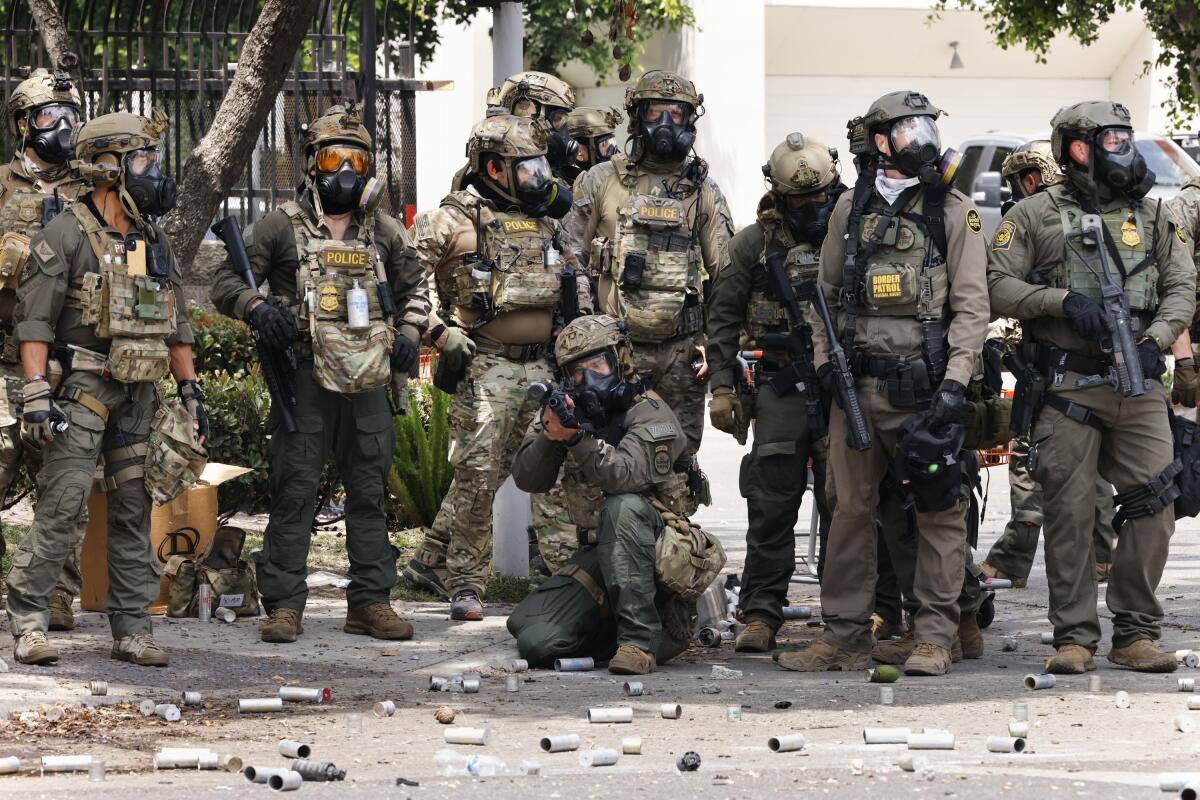
Federal agents carry less-lethal projectile weapons in Los Angeles in June.
(Carlin Stiehl / Los Angeles Times)
A spokesperson from the Department of Homeland Security did not respond to The Times’ requests for comment. In a previous statement the department said Border Patrol agents were continuing to operate in the city to “arrest and remove the worst of the worst criminal illegal aliens.”
Earlier this month, renewed fears spread among shoppers in the Fashion District after federal agents conducted an immigration sweep that shut down local commerce to check vendors’ proof of citizenship. Days later a federal agent opened fire at a suspect, who the Department of Homeland Security said rammed agents with his vehicle while attempting to evade arrest, during a targeted operation in South Los Angeles.
Local immigration activists say they have noticed a change in immigration agents’ tactics. The change has forced activists to also adjust their tactics.
“What we’re seeing now are large numbers of officers to grab anywhere from one to five people, not necessarily questioning them, and then moving out as quickly as possible,” said Juan Pablo Orjuela-Parra, a labor justice organizer with the National Day Laborer Organizing Network.
Maribel C., associate director of Órale, a Long Beach-based immigrant advocacy group that was established in 2006, said rapid response volunteers in Long Beach have reported similar tactics by immigration agents.
“In as fast as 30 seconds” a target can be “literally taken off the streets” by federal agents, leaving no time for a rapid response volunteer to relay “know your rights” information or get the detainee’s name, said Maribel, who is not providing her full name to protect her safety.
Immigrant rights advocates say one thing that has not changed is federal officials continue to detain immigrants with no criminal history.

On Jan. 20, exactly one year into the Trump administration’s second term, the U.S. Department of Homeland Security said about 70% of people whom the agency has arrested have been convicted or charged with a crime in the United States.
In the first nine months of the administration’s immigration crackdown, from Jan. 1 to Oct. 15, a Times analysis of nationwide ICE arrests found that percentage to be about the same.
In Los Angeles, the same analyses found that of the more than 10,000 Los Angeles residents who were arrested in immigration operations, about 45% were charged with a criminal conviction and an additional 14% had pending charges.

Between June and October of last year, the number of arrests has fluctuated significantly.
The arrests peaked in June with 2,500 people who were apprehended — including those who have pending criminal charges or were charged with immigration violations — but the following month the number fell to slightly more than 2,000. After further drops, a small spike in arrests occurred in September, with more than 1,000 arrested and then dramatically dropped in October with fewer than 500 arrests.
Officials have not released detailed data since then.
“I think what’s happened in Minnesota is terrifying for everyone in the country because those tactics that are being implemented in Minnesota are going to be the same tactics that are going to be implemented elsewhere,” Maribel said.
After a second fatal shooting of a U.S. citizen by federal officers, the Trump administration is moving to scale back its presence in Minneapolis and in the process bumping Border Patrol commander Gregory Bovino out of the state, with border advisor Tom Homan taking his place.
Bovino led and participated in highly visible immigration operations in Los Angeles, Chicago, Charlotte, N.C., and Minneapolis, sparking outrage and mass demonstrations.
At the training event in Echo Park, organizers said the recent events in Minnesota are jarring and forcing them to reconsider the safety of activists who protest or document immigration raids. Those activities will continue, they said, but with a focus on safety.
“Over the past two weeks, we saw that they’re escalating to the point of killing people that are exercising their rights,” Garcia said.