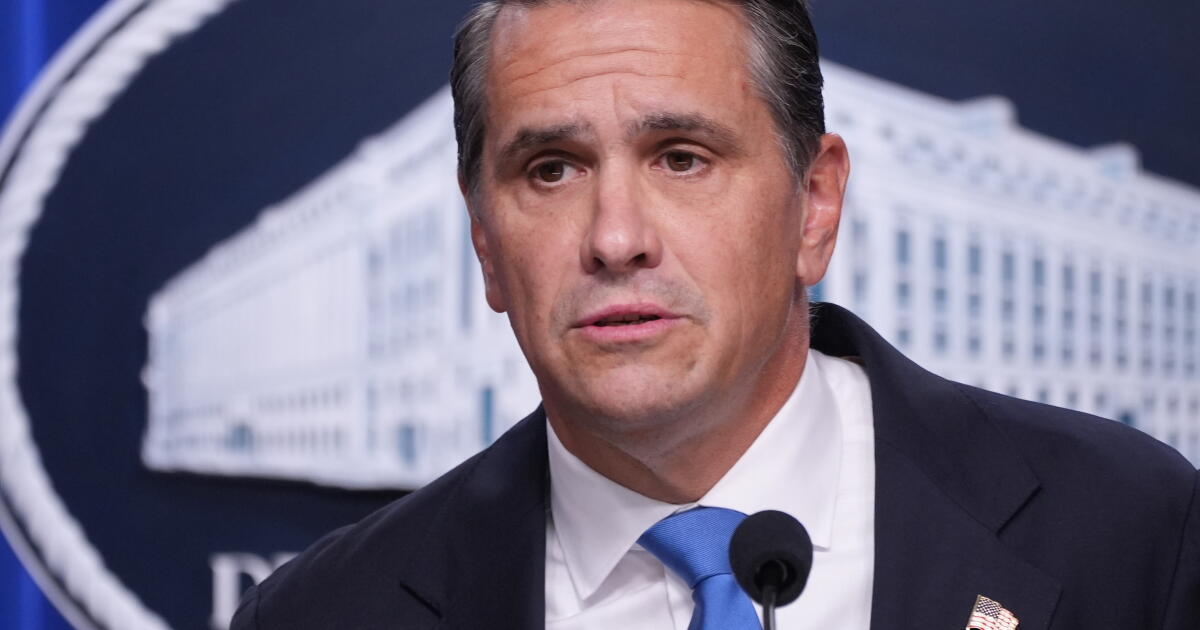
MINNEAPOLIS — A Minnesota prosecutor on Monday announced charges against an Immigration and Customs Enforcement officer in the nonfatal shooting of a Venezuelan man during the Trump administration’s crackdown in the state.
The officer, Christian Castro, is charged with four counts of second-degree assault and one count of falsely reporting a crime in the Jan. 14 shooting of Julio Cesar Sosa-Celis, Hennepin County Atty. Mary Moriarty said at a news conference. A warrant was issued for his arrest.
“Mr. Castro is an ICE agent, but his federal badge does not make him immune from state charges for his criminal conduct in Minnesota,” Moriarty said, adding that Sosa-Celis never posed a threat. “There is no such thing as absolute immunity for federal officers who commit crimes in this state or any other.”
A federal officer shot Sosa-Celis in the thigh after he and another officer chased a different man to the apartment duplex where the man and Sosa-Celis lived. Moriarty said both Sosa-Celis and the other man were legally in the U.S.
Federal authorities initially accused Sosa-Celis and Alfredo Alejandro Aljorna of beating an officer with a broom handle and a snow shovel during the incident. But a federal judge later dismissed the charges, and federal officials opened an investigation into whether two immigration officers lied under oath about what happened.
Minneapolis last month released video of the incident captured from a distance by a city-owned security camera.
Department of Homeland Security and Justice Department officials didn’t immediately respond to emails seeking comment. Homeland Security previously said that lying under oath is a “serious federal offense” and that making false statements could result in an officer being fired or prosecuted.
The administration sent thousands of officers to the Minneapolis and St. Paul area as part of President Trump’s national deportation campaign. Homeland Security, which oversees ICE, called Operation Metro Surge its largest immigration enforcement operation ever and deemed it a success.
But tensions mounted during the weekslong campaign, and the shooting deaths of U.S. citizens Renee Good and Alex Pretti by federal officers provoked mass unrest and questions about officers’ conduct.
Hennepin County, which includes Minneapolis, has been conducting investigations into multiple incidents and filed charges last month against an ICE agent for alleged actions while on duty.
Minnesota leaders and the Trump administration have since clashed over which has the authority to investigate and prosecute officers for conduct while on duty. The Trump administration has suggested that Minnesota officials don’t have jurisdiction.
State officials have said they don’t trust the federal government to investigate itself or hold officers accountable.
“There’s no modern precedent for what happened to the people here in Minnesota,” Moriarty said Monday. “So it requires a lot of us to dig in and look at ways to hold people accountable that we probably never thought we would be looking at in our careers.”
Hennepin County continues to investigate Good’s and Pretti’s killings and sued the administration in March over access to evidence in the two cases, as well as in the case involving Sosa-Celis. Although Moriarty hasn’t charged anyone in either killing, she has said she’s confident her office’s investigations will bring transparency, even if not criminal prosecution.
Fingerhut and Sullivan write for the Associated Press. Fingerhut reported from Des Moines, Iowa.
WASHINGTON — Senators unanimously approved a resolution Thursday to withhold their pay during government shutdowns, an attempt to make federal closures financially painful for lawmakers after a string of record-breaking impasses in the past year.
The bipartisan support for the measure comes at a time when federal closures have become longer and more frequent, frustrating lawmakers who say there should be punishment when Congress fails at its most basic legislative duty.
Under the resolution, senators’ pay would be withheld by the secretary of the Senate whenever a government shutdown affects one or more agencies, then released once funding is restored. It will take effect the day after the Nov. 3 general election.
“Shutting down government should not be our default solution to our refusal to work out our issues and our differences,” said Sen. John Kennedy, the bill’s sponsor, in a floor speech Wednesday.
“This is about putting our money where our mouth is,” said Kennedy, R-La.
Two shutdowns in the past year created significant financial hardship for tens of thousands of federal workers, particularly at the Department of Homeland Security. The department reopened last month after a 76-day partial shutdown, the longest agency funding lapse in history.
The Homeland Security shutdown came just a few months after a 43-day lapse of the entire federal government, which was the longest such closure on record.
The Constitution stipulates that lawmakers must be paid so they have received salaries during shutdowns even as federal workers went without paychecks. When the full government shutdown began in October amid a dispute over health care subsidies, Sen. Lindsey Graham proposed a constitutional amendment to require members to forfeit their paychecks when the government is closed.
“If members of Congress had to forfeit their pay during government shutdowns, there would be fewer shutdowns and they would end quicker,” Graham, R-S.C., said at the time.
Graham said his legislation was the most “constitutionally sound” way to deal with the problem, but the process would have been much more laborious as three-fourths of states must ratify an amendment.
Lawmakers in previous shutdowns have often pledged to forgo their paychecks while federal workers went unpaid.
Kennedy told reporters Wednesday that he pushed his measure to ensure there is “shared sacrifice” during shutdowns. He added that it does not go as far as he would like, but that it’s a start.
Asked why it does not extend to the other chamber of Congress, Kennedy said “the House’s business is the House’s business” while also touching on the tensions between the Senate and House.
“There’s a very strong undercurrent of animosity among some of my friends in the House,” Kennedy said.
“It’s quickly becoming like two kids fighting in the back of a minivan,” he said.
Cappelletti and Jalonick write for the Associated Press.
SAN DIEGO — President Trump nominated Cameron Hamilton on Monday to lead the Federal Emergency Management Agency, a surprising comeback for the former Navy SEAL who was fired from his role as FEMA’s temporary leader last year after he defended its existence.
His nomination comes as the Trump administration has increasingly signaled it is backing away from promises to dismantle FEMA, an agency that has faced withering criticism by the president. The nomination of Hamilton, who argued abolishing FEMA was not in the country’s best interests, is the latest indication of that change.
If confirmed, Hamilton would be the principal advisor to Trump and Homeland Security Secretary Markwayne Mullin on emergency management and FEMA’s first permanent administrator in Trump’s second term. The agency has gone through three temporary leaders, including Hamilton’s brief tenure from January to May 2025.
He would take over an embattled agency still reeling from Kristi Noem’s turbulent leadership of the Department of Homeland Security, of which FEMA is part. FEMA’s workforce has been worn down by mass staff departures, policies that hamstrung operations and a 75-day-long Homeland Security shutdown that ended April 30.
Hamilton will need to ensure the agency is prepared for summer disaster season, just weeks away, while answering to Trump, who is likely to expect major reforms after a council he appointed recommended sweeping changes on Friday.
“Now is the opportunity to stabilize FEMA,” said Michael Coen, the agency’s chief of staff in the Obama and Biden administrations.
Fired after defending FEMA
Hamilton, who had never been a state or local emergency management director and who had publicly criticized FEMA in the past, was a controversial choice when Trump named him temporary leader in January 2025, just days before the president floated the idea of “getting rid” of FEMA.
His rupture with Homeland Security officials began as he defended a federal role in supporting disaster-affected states, tribes and territories.
“Once the conversation shifted to, ‘Now we’re going to abolish,’ I immediately expressed concern,” he said in September on the “Disaster Tough” podcast with John Scardena, a former FEMA incident management team leader.
Homeland Security officials even subjected him to a polygraph test, accusing him and other officials of leaking details of a private meeting. He passed but said he knew his dismissal was inevitable.
At a May 7, 2025, appearance before a House Appropriations subcommittee, Rep. Rosa DeLauro, a Connecticut Democrat, asked Hamilton if he believed FEMA should be abolished.
“I do not believe it is in the best interest of the American people to eliminate the Federal Emergency Management Agency,” he replied. The next day, he was fired.
Hamilton will have to rebuild trust
Defending FEMA despite knowing it would probably cost him his job generated respect and trust among people whose job it is to lead communities through crisis, said Scardena, now president of the consultancy Doberman Emergency Management Group, which trains emergency managers.
“He won myself over and I think a lot of people by what he did,” Scardena said.
But multiple current FEMA employees who requested anonymity for fear of retribution for speaking publicly told the Associated Press they had concerns over some of the actions taken under Hamilton.
In 2024, Hamilton shared posts on X promoting misinformation about FEMA spending during Hurricane Helene.
During his temporary leadership, FEMA ceased door-to-door canvassing to reach survivors after disasters, and canceled a multibillion-dollar resilience grant program, since restored by a federal judge. The Department of Government Efficiency gained access to internal FEMA networks containing survivors’ private information. FEMA staff were fired for fulfilling a reimbursement payment to New York City for housing undocumented immigrants as part of FEMA’s Shelter and Services program.
Hamilton has said he believes FEMA needs major reform. He has said that he wants FEMA to move faster, that the agency is saddled with responsibilities he sees as outside its remit, and that some states have become too dependent on the agency. A Trump-appointed council last week urged sweeping changes to FEMA, which would require congressional action.
“I think he’s going to need to rebuild trust across the agency,” said Deanne Criswell, FEMA administrator under former President Biden, adding that she believes Hamilton cares about FEMA and she appreciated his outreach to emergency management directors and former officials during and after his tenure.
Senate confirmation process could raise questions of experience
Hamilton could face pushback in the Senate confirmation process over never having led an emergency management agency, a common stepping stone to becoming administrator of an agency with over 21,000 employees.
Federal law requires the FEMA administrator to have “a demonstrated ability in and knowledge of emergency management and homeland security” and at least five years of “executive leadership and management experience.”
Hamilton trained as a Navy hospital corpsman before spending a decade as a Navy SEAL on SEAL Team Eight. He then became a U.S. State Department emergency management specialist handling overseas crisis response, then directed emergency medical services at the Department of Homeland Security.
WASHINGTON — Before being deployed to Los Angeles during anti-ICE protests last summer, U.S. Marines were given 12 rules for engaging with protesters, and Rule 1 was clear: Force “of any kind” was allowed only as a last resort.
If force were used, the rule stated, it “should be the minimum necessary to accomplish the mission.”
That detail is among 178 pages of federal documents released by the Marine Corps to the nonprofit watchdog group American Oversight through the Freedom of Information Act and shared exclusively with The Times.
The documents paint a thorough picture of how Marines prepared to deploy in Southern California, where they stood alongside National Guard members and agents with the Department of Homeland Security.
The documents also illuminate a glaring contrast between the training of Marines and that of immigration agents, who have been accused repeatedly of using unnecessary force against peaceful protesters, bystanders and immigrants during enforcement operations.
“Ironically, I would’ve felt much safer with Marine engagement than with DHS because of the depth of training,” said Ryan Schwank, a former instructor for Immigration and Customs Enforcement recruits at the ICE Academy within the Federal Law Enforcement Training Center in Georgia.
Schwank is a whistleblower who resigned in February after revealing that the Trump administration had slashed immigration officer training. After reviewing the documents obtained by American Oversight, he said the training given to Marines on crowd control was “significantly more in-depth and longer than training given to an ICE officer, even under the best of circumstances.”
An ICE agent walks through tear gas that was fired to push protesters back during a raid on Atlantic Boulevard in the city of Bell on June 20, 2025.
(Genaro Molina / Los Angeles Times)
The Department of Homeland Security did not respond to questions and instead pointed to a February news release that said training has not been cut back and that new hires receive additional training after leaving the academy.
“ICE law enforcement officers are trained to use the minimum amount of force necessary to resolve dangerous situations to prioritize the safety of the public and our officers,” said Lauren Bis, a department spokesperson. “Officers are highly trained in de-escalation tactics and regularly receive ongoing use of force training.”
Schwank noted that the Marines and ICE officers came to Southern California with different objectives: As protectors of people and property, the Marines had a more limited, reactive mission, while ICE officers were charged with making arrests, a confrontational role.
“We’re giving [ICE officers] less training on it and fewer refreshers than the Marines are getting and yet we’re putting them in a situation where they’re taking the more confrontational actions to where they’re more likely to have to make split-second decisions,” Schwank said.
For most of history, he added, ICE agents detained people who were already in the custody of another law enforcement agency. He said ICE was never meant to act as riot police.
“The real fundamental problem isn’t ICE agents using force,” Schwank said. “It’s ICE agents using force in an environment they are not trained for.”
The training of Marines, and the lead-up to their deployment, is outlined in the documents reviewed by The Times.
On June 6, a commanding general emailed other generals to say that “national-level leadership” had directed Marines to assume an “alert posture” and be ready to support the Los Angeles Police Department, Los Angeles County Sheriff’s Department and ICE officers who were already responding to civil unrest in downtown Los Angeles.
The Marines would safeguard federal facilities and thus “protect lives and property through the restoration of civil order,” the email said.
Marines push back anti-ICE protesters in front of the Federal Building during a “No Kings Day” in downtown Los Angeles last June.
(Carlin Stiehl / Los Angeles Times)
First, though, they needed to be trained.
The five-day course reviewed use-of-force policies, less-lethal weapons and handling of civil disturbances.
Overall, the 12 rules emphasized safety, urging Marines to be reasonable, to de-escalate tensions and to avoid confrontations with individuals who posed no threat.
Marines could use non-deadly force, if necessary, to control a situation or protect themselves or other federal personnel, and deadly force “only when all lesser means have failed.”
“Exercise due regard for the safety of innocent bystanders when using any type of force,” the rules state.
Schwank said there is no equivalent to the Marines course at Homeland Security. When he left the academy in February, he said, “there was no crowd control training, period.”
Crowd control was briefly added to the curriculum in 2021 for experienced law enforcement officers, he said, but it was later removed. ICE recruits may also have gotten lessons on crowd control after leaving the academy and joining their respective field offices, he said.
When Schwank left the agency, a six-hour class called “Public Order Public Safety” was in development for the 2026 curriculum, according to documents he provided to Congress. Homeland Security did not respond when asked if the class had started.
“I wouldn’t assume that any of the ICE officers on scene in L.A. had received any sort of actual crowd control class,” Schwank said. “They might have gotten a one-to-two-hour PowerPoint slideshow, but that would’ve been it.”
Marine Col. Beth R. Smith confirmed that the entire 2nd Battalion 7th Marines received academic and practical training before deploying to Los Angeles.
Managing civil disturbances has been an issue for Homeland Security since at least 2021, according to an audit conducted by the agency’s internal watchdog review of a 2020 deployment to Portland, Ore.
That year, President Trump mobilized federal power against the protests that spilled into Portland streets after the murder of George Floyd by a Minneapolis police officer. Trump sent 755 Homeland Security agents to defend federal property in what would come to be seen as a dry run for much larger operations of his second term.
A protester damages a Waymo vehicle at Los Angeles Street and Arcadia Street in L.A. on June 8, 2025.
(Robert Gauthier / Los Angeles Times)
Nested on rooftops, agents launched chemical weapons against protesters. Ground forces fired less-lethal rounds at point-blank range and forced participants into unmarked vans without explanation.
The audit by the Homeland Security inspector general found that only seven of 63 officers reviewed had received any level of riot and crowd control training. Some officers told investigators that they needed additional training, and many “questioned their involvement in the operation” due to the lack of preparation.
”Without the necessary policies, training, and equipment, DHS will continue to face challenges securing Federal facilities during periods of civil disturbance that could result in injury, death, and liability,” the audit concluded.
As of spring 2025, Homeland Security records show, the department had not corrected the training failures flagged in the audit years earlier.
Schwank agreed that the concerns raised in the inspector general’s report were never addressed.
Liz Hempowicz, deputy executive director of American Oversight, said the Marine Corps’ emphasis on de-escalation and on using force only as a last resort stands in stark contrast to what happened on the ground in Los Angeles with immigration agents.
The practices outlined in the documents “differ from positions taken by senior DHS leadership, whose separate internal communications revealed a mindset that appeared far more encouraging of violence,” she said.
Internal Homeland Security emails also obtained by American Oversight revealed that the agency’s lead attorney said federal agents in Los Angeles should have “just started hitting the rioters and arresting everyone that couldn’t get away.”
“These records underscore that the difference between disciplined restraint and unnecessary harm can come down to the tone set at the top — and when that tone shifts toward hostility, the human cost can be devastating,” Hempowicz said.
Jennifer Kavanagh, director of military analysis at Defense Priorities, a military research group, said that for Homeland Security, the issue is partly a training deficiency and partly a cultural shift against agent accountability.
“Trump talks about ‘the enemy within’ — this is what he’s talking about,” she said. “To some at DHS, the enemy within is all immigrants, it’s cartels — it’s also groups that are protesting the government.”
Conversely, the Marines’ documents emphasized personal liability and responsibility. For example, one page said that “if you either use more force than is necessary, or respond with DEADLY-force to a NON-deadly threat — You will likely lose your right to self-defense, and you will be viewed, under the law, as the ‘Aggressor.’”
Marines were told to immediately report anyone violating the 12 rules of engagement.
The high level of training for Marines shows that command considered the optics of military personnel harming or even killing civilians, Kavanagh said. But just because the deployment worked out last year doesn’t make it a good idea in the long run, she said.
Kavanagh, alongside Gov. Gavin Newsom, Mayor Karen Bass, and LAPD Chief Jim McDonnell, opposed the military deployments to Los Angeles last year, maintaining that Marines are trained for foreign combat, not domestic crowd control.
“I see these deployments as a recipe for disaster,” she said.
Schwank said ICE’s training touches on personal liability but not in as much depth. Last fall, Stephen Miller, Trump’s deputy chief of staff, said ICE officers “have federal immunity in the conduct of your duties, and anybody who lays a hand on you or tries to stop you or tries to obstruct you is committing a felony.”
On the ground in Los Angeles, ICE agents and other local law enforcement fired a range of less-lethal weapons at protesters, such as pepper balls, hard foam rounds or canisters delivering flash-bang grenades and tear gas.
At a June 12 protest, a federal agent shoved freelance journalist Anna Sophia Moltke to the ground, causing sprains on her left arm and leg and deep scrapes to her hip and knee that have since scarred. She was carrying a camera, she said, and wore clear press credentials and a helmet that said “PRESS.”
“I remember distinctly there being no violence at all until police and ICE showed up,” she said. “We saw them firing rubber bullets into the crowd. People started running away. I was halfway turned around when they started rushing the crowd, and a tall, 6-foot-4 masked man used both hands to push me onto the concrete.”
Moltke said she recalled a large group of protesters gathered near the Marines stationed at the northern end of the detention center, just before police and ICE swept through and forced her to the ground. To her knowledge, she said the Marines remained at their post and didn’t participate in street skirmishes.
WASHINGTON — After weeks of delay, the House voted Thursday to fund much of the Department of Homeland Security, but not its immigration enforcement operations, and send the bipartisan package to President Trump to sign, ending the longest agency shutdown in history.
The White House had warned that temporary funding Trump had tapped to pay Transportation Security Administration and other agency personnel would “soon run out,” and that sparked new threats of airport disruptions.
DHS has been without routine funds since Feb. 14, causing hardship for workers, though much of Trump’s immigration agenda that is central to the dispute is being funded separately.
“It is about damn time,” said Rep. Rosa DeLauro of Connecticut, the top Democrat on the House Appropriations Committee, who proposed the bill more than 70 days ago.
The House swiftly voted by voice, without a formal roll call, to pass the measure.
The House’s narrow Republican majority has repeatedly stalled out under House Speaker Mike Johnson, with his own party tangled in internal disputes on a range of pending issues, including the homeland security funding. While the Senate unanimously approved the bipartisan package a month ago, the bill languished in the House.
Democrats refused to fund U.S. Immigration and Customs Enforcement and the Border Patrol without changes to those operations after the fatal shootings of two U.S. citizens by federal agents during protests against an immigration crackdown in Minneapolis. Republicans would no go along with a plan pushed by Democrats to fund TSA and the other parts of DHS without the money for ICE and Border Patrol.
To break the impasse, Republicans in both the House and Senate decided to tackle the immigration enforcement funding on their own through what is called budget reconciliation, a cumbersome weekslong process ahead.
By beginning that budget process Johnson, R-La., was able to unlock a broader bipartisan bill for TSA agents and the rest of DHS. House Republicans late Wednesday adopted budget resolution on a largely party-line vote, 215-211, that is focused on eventually providing $70 billion for immigration enforcement and deportations for the remainder of Trump’s time in office and ensure Democrats can no longer block funding. Trump’s term ends in January 2029.
One key Republican, Rep. Chip Roy of Texas, said isolating the immigration-related money on a separate track is “offensive to the men and women who serve in ICE and Border Patrol, and are serving this country every single day.”
NEW ORLEANS — The French government is pressing the U.S. Department of Homeland Security to release the 86-year-old French widow of a military veteran from immigration custody after she was detained this month.
U.S. Immigration and Customs Enforcement agents detained Marie-Therese Ross in Alabama on April 1 after she overstayed her 90-day visa, according to Homeland Security. Ross is now held at a federal immigration detention facility in Louisiana.
She is among the thousands of people targeted by the Trump administration’s mass deportation agenda that has led to the detentions of the spouses of U.S. troops and military veterans who previously received greater leniency under scrapped policies.
Rodolphe Sambou, the consul general of France in New Orleans, told the AP that the French government has “fully mobilized” to push for her release. He said he has visited her in detention twice so far.
“Given her age, we really want her to get out of this situation as soon as possible,” Sambou said. “We want to get her out of jail.”
Sambou said that he has been communicating frequently with Ross’ family and French officials in Washington, Atlanta and Paris to try and coordinate Ross’ release and ensure she has access to sufficient food and healthcare. He said the French government has also contacted Homeland Security.
He declined to comment on her legal status or other details of her case.
Ross married Alabama resident William Ross last April, Calhoun County marriage records show. Ross died in January, according to an obituary from his family, which says he was a former captain in the U.S. Army.
A lawyer who is representing Ross in a separate legal matter did not immediately respond to a request for comment. Ross’ family did not respond to requests for comment.
Brook writes for the Associated Press. AP writer Samuel Petrequin in France contributed to this report.