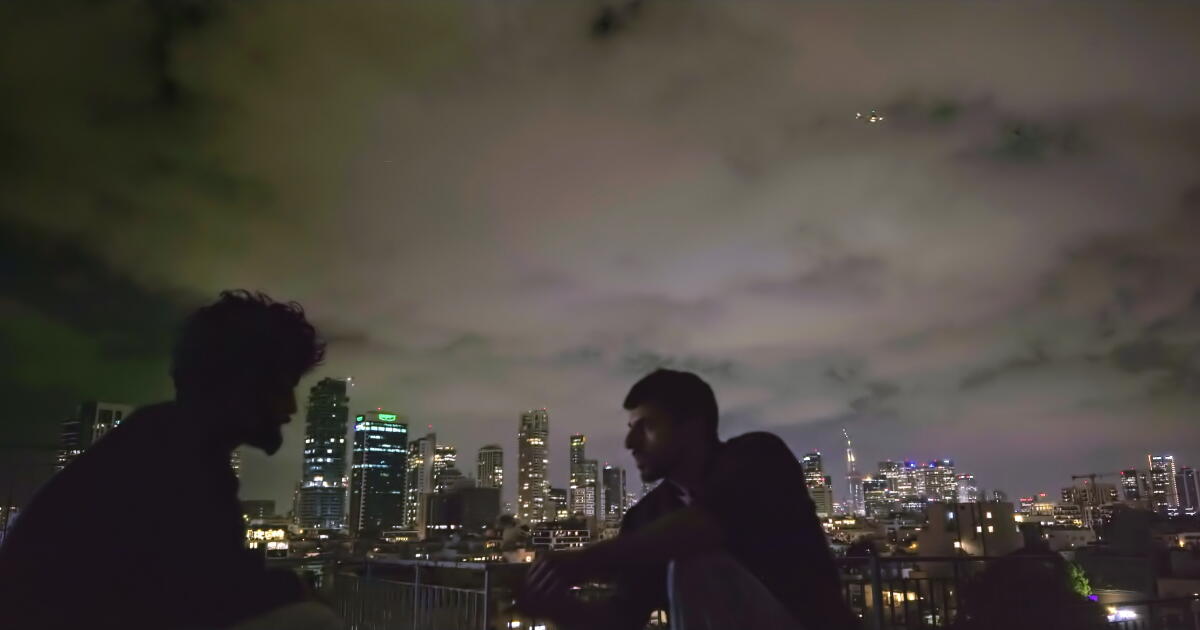
Owing to his illness, 26-year-old Sasha from Orenburg, a city in Russia close to the Kazakhstan border, has a Category V military ID, which under normal circumstances makes him ineligible for service.
But not during wartime.
Recommended Stories
list of 4 itemsend of list
Just before partial mobilisation was declared in 2022, he considered leaving for Kazakhstan. But while awaiting the bus, he struck up a conversation with his soon-to-be girlfriend.
As they turned back together, they decided against making the drastic move.
Over the past year, however, they have grown increasingly anxious.
“Since mid-2025, my girlfriend and I have been experiencing a severe decline in mental health. We see psychiatrists and take antidepressants,” Sasha told Al Jazeera.
He requested to be identified only by his first name to protect his anonymity.
“I don’t go outside unless it’s urgent and try never to be alone. I carry pepper spray for protection against aggression if it happens, like in Penza.”
Since June, there have been reports of attempted press-ganging in Penza, 625km (388 miles) southeast of Moscow.
Recent footage shared on social media has shown individuals dressed in plainclothes trying to force fighting-age men into vehicles to take them to the recruitment centre, while weeping women try to intervene – echoing similar scenes in Ukraine.
Potential recruits have also been reportedly summoned to police stations under bureaucratic pretexts, then beaten or threatened – for example, by having illicit drugs planted on them – into signing a military contract.
Local authorities deny the reports, claiming only men attempting to dodge the draft, who have already been mobilised, are being approached. They have also accused residents who have shared footage of the roundups of spreading disinformation.
Although the Penza roundups have received attention lately, local authorities throughout Russia have been accused of coercive methods for some time.
“In October 2022, a friend was stopped at night by military police,” said Sasha. “They identified themselves as civilians and didn’t show identification. They demanded a passport or military ID, and that he accompany them. My friend ran away.”
(Al Jazeera)
According to Mikhail Liberov, from the Conscientious Objectors Movement, military recruiters select the “right targets who, for one reason or another, are vulnerable to seduction, deception, blackmail, or are simply unaware of their actions”.
He said this group includes drug addicts, alcoholics, mentally unwell people, those with large debts and migrants “who don’t speak Russian or barely know what’s actually written, and are also afraid of deportation”.
Men above 35 years of age are also approached, and some are “willing to risk their lives and the lives of others for big money and the chance to become ‘heroes’.
“Then comes the threat of prison: A man arrested for petty hooliganism might be intimidated by the idea that, say, ‘We’ll plant drugs on you and put you in prison for 12 years,’ and many agree to sign contracts.”
Oleg Ignatov, senior Russia analyst at the International Crisis Group, said the recent roundups in Penza are likely isolated instances of local authorities trying to fill their recruitment quotas, rather than a systemic, nationwide effort.
‘Mobilisation will still happen’
These renewed recruitment incidents come amid rumours of a mobilisation effort and an expected Russian offensive this winter that will likely involve ramped-up attacks on Ukrainian energy infrastructure.
“I’ve already accepted that mobilisation will still happen, unless something happens that forces (Russian President Vladimir) Putin to end the war in Ukraine,” said Liberov, who believes Russia will ready troops within a year.
“Human rights activists are already working on the assumption that mobilisation will take place this fall,” he said.
In September 2022, Putin signed a decree allowing for partial mobilisation. Fearing deployment, thousands of men fled to neighbouring countries. But that mobilisation effort effectively ended two months later.
Russia has since been able to replenish its ranks by enlisting prisoners, as well as promising generous payouts.
However, the recruitment pool is dwindling.
According to the independent Russian news site IStories, the number of people voluntarily signing military contracts halved by late 2025. Those who enlist are disproportionately from underprivileged corners of society.
“The protracted war with Ukraine, the large number of dead soldiers, and the degradation of the Russian economy demotivate people from participating in such an adventure in the name of Putin,” said Liberov.
Official casualties are not made public in Russia.
The Washington, DC-based Center for Strategic and International Studies puts the number of deaths among Russian forces since the invasion of Ukraine in early 2022 at nearly 450,000.
Meanwhile, the 2022 mobilisation decree remains in effect, and the Russian offensive in Ukraine is lagging. The war is now being felt at home as Ukrainian drones strike deep into Russian territory.
“I only live once. I’m not going to sacrifice it for someone else’s wishes and will fight to the bitter end,” said Sasha. “Human life is priceless, and you have to cling to it until the end.”
Vladimir from Ulan-Ude, who has previously served as a conscript and is thus eligible for mobilisation, said he has a “generally negative attitude” about Russia’s war in Ukraine.
“I am preparing for a possible draft. In the event of an escalation, I will insist on the alternative civil service,” said the 35-year-old, who requested to withhold his surname over fears of reprisal. “I wouldn’t want to leave the country.”
According to the Russian constitution, alternative civilian service can be applied for when “convictions or religious beliefs contradict military service”.
Conscripts can serve either for 21 months at an organisation “subordinate to the bodies of the executive branch”, often taking jobs as nurses, cleaners or postal workers, or for 18 months at a defence manufacturing plant. According to the Ministry of Defence, about 2,000 people apply for alternative civilian service each year, with approximately half receiving approval.
Earlier this summer, Ukrainian President Volodymyr Zelenskyy claimed the Kremlin was secretly preparing for a mass mobilisation – a claim backed by reports in Russian independent media.
In June, lawmaker Andrey Gurulev of the governing United Russia party wrote on Telegram that “there’s now active talk, both behind the scenes and in high places, about the need for a new large-scale mobilisation.”
But expanding the army is expensive while budgets are under strain, and a huge influx of recruits still leaves a shortage of experienced officers and trained specialists.
“I would say that Russia’s problems right now are less about the quantity, but more about the quality of contractors,” said Crisis Group’s Ignatov.
“Russians need more skilled soldiers who can operate drones, who can operate modern warfare systems. And here they have more problems than the Ukrainians.
“But if this war continues, of course, we can assume that (mobilisation) could happen.”
The yearly sunbed wars are in full swing, and one TikToker has captured Brits pioneering a new way to queue for sunbeds without having to miss breakfast
Sunbed wars can put a dampener on your holiday (stock photo)(Image: Getty Images)
If you’re heading to a holiday hotspot such as Spain, Portugal, Greece, or Turkey, then the odds are you’ll see people reserving their sunbed first thing in the morning.
Whether the hotel is busy or not, you’ll often see a queue of Brits, and let’s face it, many other European nationalities too queueing up for the grand opening of the pool area so they can lay down their towel before they even hit the breakfast buffet.
But one TikTok poster has discovered a new hack that her fellow holidaymakers were using to avoid even needing to queue, and while it meant they could avoid needing to hang around the lobby, comments slammed it as ‘selfish’.
Content cannot be displayed without consent
The poster Sarah, who posts on TikTok as @mrsbainbridge, posted the video taken at the Hotel Best Oasis Park in Salou, Spain, showing a neat line of beach bags, inflatables, and other items holding peoples’ place in the queue while their owners are presumably doing something more fun.
In the caption, Sarah wrote: “Never have I came across somewhere like this for sun bed wars of a morning” as she panned across the variety of abandoned items. In a second video, she captured the massive queue, this time populated with people waiting to nab their favourite spot.
Comments overwhelmingly agreed with Sarah. Some said they simply wouldn’t follow the informal system: “I’m not waiting in a queue behind a bag. Straight to back of the first human I see in the queue.”, while another agreed: “nah if you’re not physically in the queue then I’m walking to the front”.
Others questioned whether there were steps the hotel could take to minimise the impact. One person suggested: “The hotel should be taking all those bags and putting them into an orderly pile in the corner. Same with towels left on sun beds for more than 40 minutes”.
Other posters who claimed they’d visited the same hotel as Sarah shared their story. One claimed: “Was there start of July, worse when the doors open.. absolute chaos! Grown men pushing children out of the way etc,” while another added: “Just left there. Joke each morning. Kids nearly getting trampled on then people putting towels down and disappear for the day.”
Sarah isn’t the only one to post videos of the hotel’s sunbed wars. Another user named Mandy posted a video captioned “10am sunbed dash” showing a huge queue of families with towels and inflatables trying to reserve a spot. Warning: video contains strong language.
In June, @deajak1405 also posted a video showing a ‘rat race’ which showed the view of the daily sunbed grab from his balcony. The user is heard laughing as grown adults are shown pushing through the doors as they open, jogging towards the pool area to find their favoured spot.
Some reviews of the hotel on TripAdvisor also highlight the hotel’s sunbed issues. A review from July claims: “The set up for sunbeds at this hotel is ridiculous. The doors to the pool open at 10am, people queue from 9am, then others just run past for a bed. My daughter 14 years old was pushed to the ground one day then my wife and daughter were verbally abused on other day. We also witnessed to major arguments in the week.”
Hotel Best Oasis Park has been contacted for comment.
Have a story you want to share? Email us at webtravel@reachplc.com
Asked about how he viewed the last 35 minutes of the game having had time to reflect, Tuchel said he felt “the same way – that we were too passive”.
“If you’re asking if I regret my decision, if this is the question, then I don’t regret my decisions,” he added.
“I felt that the momentum switches in the match. And I tried to help my team…
“I took several decisions, trusting my instinct, my intuition, my experience, trusting my competitiveness, and I took the decision in order to help the team and get the result. We didn’t get the result.
“So I take, of course, the responsibility and for these decisions. I would regret if I didn’t help. I would regret if we didn’t react.”
Tuchel said he was not willing to engage “in this kind of game” over who is to blame.
“No problem,” he said. “This is the deal that you sign up for, but I will not engage.
“For me, there is no-one to blame. If you need someone to blame, I take the responsibility. I’m the head coach.”
Asked why England’s record goalscorer Kane played so deep in the latter stages, he said: “What do you mean? Like in the last 30 minutes?
“Why we defended in a deep block. Well, that’s what you do if you defend in a block. We were not active enough.”
Tuchel said Argentina had “played with a lot of momentum after our goal”.
“They had a lot of offensive changes, and a lot of offensive positions,” the 52-year-old added.
“We could not stop the crosses, and we could not stop the runners into the box.
“So we decided to play a back five, to have more width in the field, to be closer to the guys who cross.
“We just became too passive, and Argentina, by the way, found another gear and they found the total flow.
“We played in the semi-final against the reigning world champions.
“We were 85 minutes 1-0 up. We played against the best player in the world, and we lost 2-1, which is painful.”
Tuchel was asked if he had studied data which showed England’s physical performance levels against Argentina were lower than the DR Congo game in the same stadium earlier in the tournament.
He said “even if we don’t want to admit it because it feels like an excuse”, the Mexico game with 10 men in the altitude of the Azteca Stadium and the heat against Norway in Miami “cost us more than we maybe thought”.
“The players literally gave everything physically [in] every single match. If you see this data drop, there must be a reason behind it, because the motivation was through the roof,” he said.
England have showed character at this World Cup, coming from behind to defeat both DR Congo at the last-32 stage and Norway in the quarter-finals.
“The difference is hanging on against Norway or Mexico [in the last 16], they have not got the quality this Argentina team have got in terms of the ability on the ball and the ability they have to punish you,” former England captain Alan Shearer told BBC Sport.
“Tuchel played his cards very, very early and it has backfired.”
England looked to have taken full control of the semi-final against their old foes when Gordon put them ahead 10 minutes into the second half.
England’s fans celebrated wildly – but then the Three Lions opted to sit back and defend.
“The fact that England got themselves in front and then basically handed Argentina the initiative… that was a coaching catastrophe from Thomas Tuchel,” Chris Sutton, a Premier League winner with Blackburn in 1994-95, told BBC Radio 5 Live.
“You can’t expect to defend for 30 minutes against the quality Argentina had.
“It’s all on the coach where I am concerned. He made the changes. He was negative, so the question which I’m going to ask is ‘how can you trust Thomas Tuchel to take this team forward?'”
England have come undone against Argentina in the past.
Who can forget Diego Maradona’s infamous ‘Hand of God’ goal at the 1986 World Cup or the 1998 World Cup defeat that burns so deep.
England, however, have no-one but themselves to blame for Wednesday’s loss.
“Norway and Mexico panicked against England,” former England goalkeeper Joe Hart told BBC Sport.
“I didn’t see one bit of panic from that Argentina side. I saw belief, I saw the realising they could free up the great man Lionel Messi in the pocket, and they were running all over England.
“Gareth Southgate took a lot of criticism for the big moments with England, when they had the lead in big games and shut up shop. I don’t see that anything has changed in that big moment out there.”
So what were the changes that frustrated England fans so much?
Leading 1-0, many expected Tuchel to go for another goal – but instead the German made three defensive changes.
He brought Konsa on for Gordon in the 72nd minute – switching to a back five – before bringing on further defensive reinforcements 10 minutes later in Burn and O’Reilly.
Tuchel sent on forwards Rashford and Toney in added time, but it proved too little too late.
“I felt the changes we made at 1-0, that if Argentina scored we wouldn’t make extra time,” added Rooney.
Former England defender Micah Richards told BBC Sport: “When England scored that first goal they should have gone for the second.
“Yes, you respect their quality, but dropping deep allowed Argentina to get into their flow.”
Former England goalkeeper Paul Robinson, speaking to BBC Radio 5 Live, said Tuchel went too deep too soon.
“I think he has got that wrong,” added Robinson, who won 41 caps for England between 2003 and 2007.
“He has got a lot of decisions right, but I think trying to defend a lead against this team was a wrong choice.”
But England do not have to remove direct play from their game entirely.
By managing the space and speed of the game, they can pick their moments to release the likes of Noni Madueke, Anthony Gordon, Marcus Rashford and Jude Bellingham.
If England do opt to play more slowly, they will also be hoping these ‘boring’ spells of play work to silence the Mexican home crowd.
The decision to pick a squad of similar profiles might be one of the more astute decisions Tuchel has made as England boss when it comes to this game too.
With a tactical plan in mind, making five substitutions that do not alter the dynamic of the game greatly, but instead reinforce the plan with freshness and energy as Mexico begin to tire could be the difference.
This could indeed be a match full of mini-games and picking moments in which to change things will be key.
Tuchel, as we’ve seen throughout his club career, and most recently against DR Congo, has a knack for getting mid-game tweaks right but the many variables of the game against Mexico make this one of his toughest challenges yet.