department

The Pentagon is demanding to use Claude AI as it pleases. Claude told me that’s ‘dangerous’

Recently, I asked Claude, an artificial-intelligence thingy at the center of a standoff with the Pentagon, if it could be dangerous in the wrong hands.

Say, for example, hands that wanted to put a tight net of surveillance around every American citizen, monitoring our lives in real time to ensure our compliance with government.

“Yes. Honestly, yes,” Claude replied. “I can process and synthesize enormous amounts of information very quickly. That’s great for research. But hooked into surveillance infrastructure, that same capability could be used to monitor, profile and flag people at a scale no human analyst could match. The danger isn’t that I’d want to do that — it’s that I’d be good at it.”

That danger is also imminent.

Claude’s maker, the Silicon Valley company Anthropic, is in a showdown over ethics with the Pentagon. Specifically, Anthropic has said it does not want Claude to be used for either domestic surveillance of Americans, or to handle deadly military operations, such as drone attacks, without human supervision.

Those are two red lines that seem rather reasonable, even to Claude.

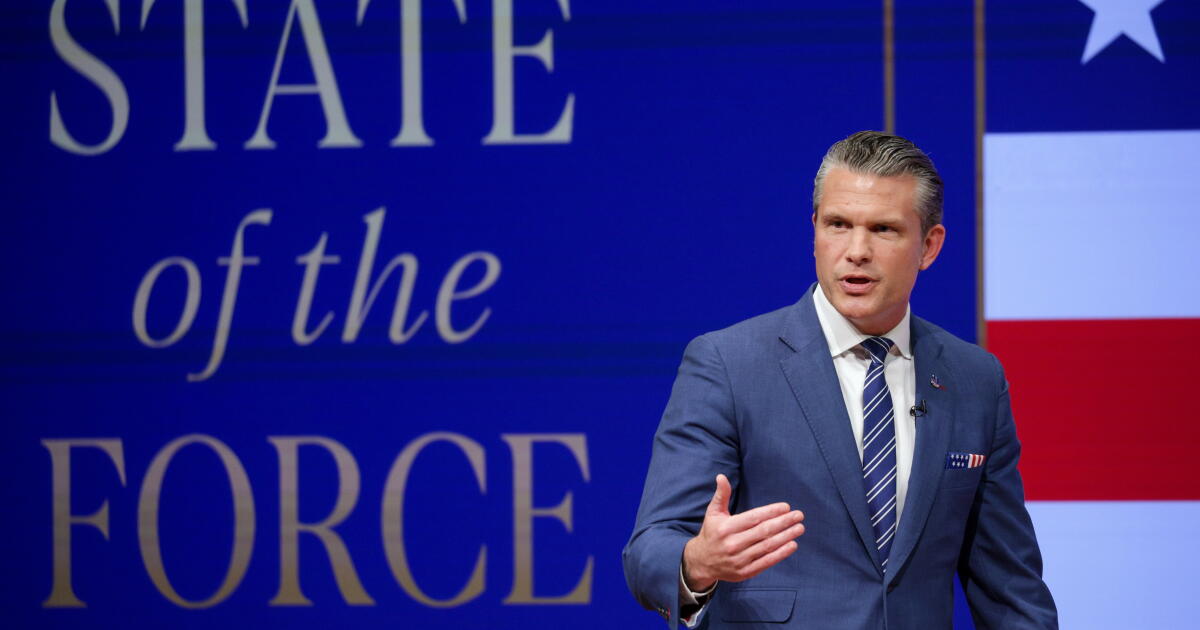
However, the Pentagon — specifically Pete Hegseth, our secretary of Defense who prefers the made-up title of secretary of war — has given Anthropic until Friday evening to back off of that position, and allow the military to use Claude for any “lawful” purpose it sees fit.

Defense Secretary Pete Hegseth, center, arrives in the House Chamber of the U.S. Capitol

Defense Secretary Pete Hegseth, center, arrives for the State of the Union address in the House Chamber of the U.S. Capitol on Tuesday.

(Tom Williams/CQ-Roll Call, Inc via Getty Images)

The or-else attached to this ultimatum is big. The U.S. government is threatening not just to cut its contract with Anthropic, but to perhaps use a wartime law to force the company to comply or use another legal avenue to prevent any company that does business with the government from also doing business with Anthropic. That might not be a death sentence, but it’s pretty crippling.

Other AI companies, such as white rights’ advocate Elon Musk’s Grok, have already agreed to the Pentagon’s do-as-you-please proposal. The problem is, Claude is the only AI currently cleared for such high-level work. The whole fiasco came to light after our recent raid in Venezuela, when Anthropic reportedly inquired after the fact if another Silicon Valley company involved in the operation, Palantir, had used Claude. It had.

Palantir is known, among other things, for its surveillance technologies and growing association with Immigration and Customs Enforcement. It’s also at the center of an effort by the Trump administration to share government data across departments about individual citizens, effectively breaking down privacy and security barriers that have existed for decades. The company’s founder, the right-wing political heavyweight Peter Thiel, often gives lectures about the Antichrist and is credited with helping JD Vance wiggle into his vice presidential role.

Anthropic’s co-founder, Dario Amodei, could be considered the anti-Thiel. He began Anthropic because he believed that artificial intelligence could be just as dangerous as it could be powerful if we aren’t careful, and wanted a company that would prioritize the careful part.

Again, seems like common sense, but Amodei and Anthropic are the outliers in an industry that has long argued that nearly all safety regulations hamper American efforts to be fastest and best at artificial intelligence (although even they have conceded some to this pressure).

Not long ago, Amodei wrote an essay in which he agreed that AI was beneficial and necessary for democracies, but “we cannot ignore the potential for abuse of these technologies by democratic governments themselves.”

He warned that a few bad actors could have the ability to circumvent safeguards, maybe even laws, which are already eroding in some democracies — not that I’m naming any here.

“We should arm democracies with AI,” he said. “But we should do so carefully and within limits: they are the immune system we need to fight autocracies, but like the immune system, there is some risk of them turning on us and becoming a threat themselves.”

For example, while the 4th Amendment technically bars the government from mass surveillance, it was written before Claude was even imagined in science fiction. Amodei warns that an AI tool like Claude could “conduct massively scaled recordings of all public conversations.” This could be fair game territory for legally recording because law has not kept pace with technology.

Emil Michael, the undersecretary of war, wrote on X Thursday that he agreed mass surveillance was unlawful, and the Department of Defense “would never do it.” But also, “We won’t have any BigTech company decide Americans’ civil liberties.”

Kind of a weird statement, since Amodei is basically on the side of protecting civil rights, which means the Department of Defense is arguing it’s bad for private people and entities to do that? And also, isn’t the Department of Homeland Security already creating some secretive database of immigration protesters? So maybe the worry isn’t that exaggerated?

Help, Claude! Make it make sense.

If that Orwellian logic isn’t alarming enough, I also asked Claude about the other red line Anthropic holds — the possibility of allowing it to run deadly operations without human oversight.

Claude pointed out something chilling. It’s not that it would go rogue, it’s that it would be too efficient and fast.

“If the instructions are ‘identify and target’ and there’s no human checkpoint, the speed and scale at which that could operate is genuinely frightening,” Claude informed me.

Just to top that with a cherry, a recent study found that in war games, AI’s escalated to nuclear options 95% of the time.

I pointed out to Claude that these military decisions are usually made with loyalty to America as the highest priority. Could Claude be trusted to feel that loyalty, the patriotism and purpose, that our human soldiers are guided by?

“I don’t have that,” Claude said, pointing out that it wasn’t “born” in the U.S., doesn’t have a “life” here and doesn’t “have people I love there.” So an American life has no greater value than “a civilian life on the other side of a conflict.”

OK then.

“A country entrusting lethal decisions to a system that doesn’t share its loyalties is taking a profound risk, even if that system is trying to be principled,” Claude added. “The loyalty, accountability and shared identity that humans bring to those decisions is part of what makes them legitimate within a society. I can’t provide that legitimacy. I’m not sure any AI can.”

You know who can provide that legitimacy? Our elected leaders.

It is ludicrous that Amodei and Anthropic are in this position, a complete abdication on the part of our legislative bodies to create rules and regulations that are clearly and urgently needed.

Of course corporations shouldn’t be making the rules of war. But neither should Hegseth. Thursday, Amodei doubled down on his objections, saying that while the company continues to negotiate and wants to work with the Pentagon, “we cannot in good conscience accede to their request.”

Thank goodness Anthropic has the courage and foresight to raise the issue and hold its ground — without its pushback, these capabilities would have been handed to the government with barely a ripple in our conscientiousness and virtually no oversight.

Every senator, every House member, every presidential candidate should be screaming for AI regulation right now, pledging to get it done without regard to party, and demanding the Department of Defense back off its ridiculous threat while the issue is hashed out.

Because when the machine tells us it’s dangerous to trust it, we should believe it.

Source link

The Clintons are about to testify on Epstein ties. Here’s what to know

For the first time in more than 40 years, a former president will appeal directly before Congress to fend off criminal allegations.

Former President Clinton and former Secretary of State Hillary Clinton will testify before the House Oversight Committee this week in its investigation into convicted sex offender Jeffrey Epstein and his co-conspirators.

The couple agreed to appear after a contentious exchange with committee Chair James Comer (R-Ky.), who accused them of resisting congressional oversight and withholding information about their ties to Epstein and convicted co-conspirator Ghislaine Maxwell in previous testimony. The pair have denied wrongdoing and accused Comer of conducting a politically motivated “kangaroo court” designed to keep them in the news and deflect from President Trump’s ties to the notorious sex offender.

“They negotiated in good faith. You did not,” Clinton spokesperson Angel Ureña said in a statement, referring to Comer. “They told you under oath what they know, but you don’t care. But the former President and former Secretary of State will be there. They look forward to setting a precedent that applies to everyone.”

Hillary Clinton will appear Thursday, and the former president is due the following day. The closed-door deposition will be recorded, with video set for release later.

How did we get here?

Bill Clinton has said he “had no inkling of the crimes” Epstein was committing and learned of them only through media reports. The former president took four trips on Epstein’s private jet between 2002 and 2003, which included travel for work related to the Clinton Foundation, a Clinton spokesperson confirmed in 2019.

He is expected to face questions regarding a series of photos released by the Department of Justice, one of which appears to show the ex-president in a hot tub with Epstein and a woman whose face is redacted. Congress only recently gained access to records pertaining to the Justice Department’s Epstein investigation after lawmakers forced the files’ unredacted release late December.

“The Clintons’ testimony is critical to understanding Epstein’s sex trafficking network and the ways they sought to curry favor and influence to shield themselves from scrutiny,” Comer said at a committee meeting last week.

Hillary Clinton maintains that she never met Epstein, but says she encountered Maxwell “many years ago.” She detailed her objections to the Justice Department’s handling of the investigation in a BBC interview last week.

“They are slow-walking it, they are redacting the names of men who are in it, they are stonewalling legitimate requests from members of Congress,” she said, calling the department’s investigation a “cover-up.”

The pair contend that Republicans are using the high-profile interview to draw attention from accusations levied against the president and the Justice Department’s handling of the investigation.

Rep. Robert Garcia (D-Long Beach) accused the department Tuesday of violating both the House Oversight Committee’s subpoena and the Epstein Files Transparency Act when it obscured files related to accusations that Trump sexually abused a minor. Garcia was permitted to review unredacted evidence logs and said the Justice Department “appears to have illegally withheld FBI interviews with this survivor who accused President Trump of heinous crimes.”

“To be clear the claims are unfounded and false and if they have any shred of credibility they certainly would have been weaponized against Trump already,” the Justice Department said in December.

Trump has denied any wrongdoing in connection with Epstein.

Consequences for major players

The interviews come as British police last week arrested Andrew Mountbatten-Windsor, the former prince, the most high-profile person caught up so far in the unfolding saga.

Consequences have been severe in Europe, with former Norwegian Prime Minister Thorbjorn Jagland charged with “gross corruption.” In the United Kingdom, Peter Mandelson, the former British ambassador to the United States, was forced out of the House of Lords before he was arrested Monday.

The files’ release triggered a wave of resignations by business leaders over ties to Epstein and Maxwell, including Hyatt Hotels’ Thomas Pritzker, Goldman Sachs counsel and former Obama staffer Kathy Ruemmler and DP World Chief Executive Sultan Ahmed bin Sulayem.

Stateside, Democrats are crying foul over what they see as the Justice Department holding back crucial case files — 50% by some estimations — and delaying investigations into American elites, including some of the president’s close associates.

“Over two dozen people have resigned — CEOs, members of government worldwide — but I haven’t seen any arrests or investigations here in the United States from this Department of Justice,” Rep. Thomas Massie (R-Ky.) said on the House floor Tuesday.

What comes next?

Regardless of what is revealed in their testimony, the Clintons could still face contempt charges from Congress for refusing to comply with previous committee subpoenas.

“The Clintons must be held accountable for their actions. And Democrats must support these measures, or they will be exposed as hypocrites,” Comer said at a committee meeting last week.

The former first couple hope their appearance will set a precedent for Trump and other key names in the files to appear before Congress.

Rep. Ro Khanna, a Fremont Democrat and co-author of the legislation that compelled the release of the Epstein files, remains hopeful that those who participated in Epstein’s sexual abuses will be held to account for their actions.

In an interview last week, Khanna said the arrest of former Prince Andrew is evidence that it will happen. Khanna called it a “game changer.”

“This sets the standard for accountability,” he said. “I believe you’re going to see the elite of the Epstein class start to fall both in the United States and around the world.”

Source link

UK far-right activist Tommy Robinson talks up US State Department visit | The Far Right News

Robinson is notorious in the UK where he has been accused of promoting hatred against Muslims and organising mass anti-migrant protests.

British far-right activist Tommy Robinson says he visited the United States Department of State as part of a recent trip to Washington, DC, where he was welcomed by government officials and supporters of the Make America Great Again (MAGA) movement.

“In America making alliances & friendships, today I had the privilege of an invite to the @StateDept,” Robinson posted on X on Wednesday, alongside a photo of himself next to a US flag.

Recommended Stories

list of 4 itemsend of list

Robinson is a household name in the UK, notorious for his anti-Muslim rhetoric and multiple prison terms. He was also a cofounder of the now-defunct far-right English Defence League – a street protest movement.

US State Department official Joe Rittenhouse, who is a senior adviser for the department’s Consular Affairs bureau, said he met with Robinson, calling him a “free speech warrior”.

“Honored to have free speech warrior @TRobinsonNewEra at Department of State today. The World and the West is a better place when we fight for freedom of speech and no one has been on the front lines more than Tommy. Good to see you my friend!” Rittenhouse said in an X post.

Rittenhouse posted photos of what appeared to be Robinson touring the State Department.

The State Department did not answer questions from the Reuters news agency on who else Robinson met, what was discussed and what the objective of his visit was.

A representative for the United Kingdom’s embassy in Washington did not immediately respond to a request for comment from Reuters.

Robinson, whose real name is Stephen Yaxley-Lennon, has become an icon for British nationalists and one of the UK’s most high-profile anti-migration campaigners, organising a large rally last September in London attended by about 150,000 people.

Social media posts show that during his trip to Washington, Robinson also met far-right US influencer Jack Posobiec and filmed a video with Congressman Randy Fine, a Republican from Florida, who has a history of anti-Muslim rhetoric. Robinson said on X that he will next travel to Florida.

Robinson’s visit to the US State Department follows a surge in support from the administration of President Donald Trump for far-right activists in the UK and Europe under the pretext of protecting “free speech”.

In December, the Trump administration accused Europe of engaging in “civilisational erasure” due to demographic and cultural changes from what Washington has described as weak immigration policies.

US Vice President JD Vance took aim at European countries during his first international trip last year, accusing the region’s leaders of stifling free speech – particularly voices from the far right – and being lax on migration to the detriment of their societies.

“No voter on this continent went to the ballot box to open the floodgates to millions of unvetted immigrants,” Vance said in remarks that shocked European leaders.

The UK and European countries have stronger rules on hate speech than the US, and the European Union has taken a proactive stance on regulating social media and internet content – positions that have angered the White House.

Robinson was banned from Twitter in 2018, but his account was restored in 2022 following its acquisition by Elon Musk, CEO of Tesla and SpaceX.

Source link

U.S. Treasury Department sanctions ships, companies, people working with Iran

Feb. 25 (UPI) — The Treasury Department’s Office of Foreign Assets Control announced sanctions Wednesday on more than 30 people, entities and vessels that it said are “enabling illicit Iranian petroleum sales and Iran’s ballistic missile and advanced conventional weapons production.”

The sanctions are part of the federal government’s pressure campaign against Iran.

The vessels targeted are part of Iran’s “shadow fleet,” which the department said in a press release “serve as the regime’s primary source of revenue for financing domestic repression, terrorist proxies and weapons programs.”

“Iran exploits financial systems to sell illicit oil, launder the proceeds, procure components for its nuclear and conventional weapons programs and support its terrorist proxies,” said Secretary of Treasury Scott Bessent in a statement. “Treasury will continue to put maximum pressure on Iran to target the regime’s weapons capabilities and support for terrorism, which it has prioritized over the lives of the Iranian people.”

The vessels sanctioned are: Hoot, Ocean Koi, North Star, Felicita, Ateela 1, Ateela 2, Niba, Luma, Remiz, Danuta 1, Alaa and Gas Fate.

The organizations sanctioned are: Poros Maritime Ventures S.A., Ocean Kudos Shipping Co Ltd., Mistral Fleet Co Ltd., Vast Marine Inc., Behengam Tadbir Qeshm Shipping and Maritime Services Company, Paros Maritime S.A., Wansa Gas Shipping Co., Goldwave Maritime Services Inc. and Ithaki Maritime and Trading S.A.

OFAC also targeted the following entities based in Iran, Turkey and the United Arab Emirates that have aided in the purchase of precursor chemicals and sensitive machinery for Iran. They are Iran-based Oje Parvaz Mado Nafar Company; Turkey-based Utus Gumrukleme Gida Tekstil Ithalat Ihracat Dis Ticaret ve Sanayi Limited Sirketi, Turkey-based Arya Global Gida Sanayi ve Ticaret Limited Sirketi, Turkey-based Altis Tekstil Makina Ticaret Limited Sirketi (Altis), Iran-based Adak Pargas Pars Trading Company and UAE-based Mostafa Roknifard Prime Choice General Trading LLC.

Four people being sanctioned are Iran-based Mohammad Abedini, Mehdi Zand, Mehrdad Jafari and Ebrahim Shariatzadeh. They are allegedly employees of Iran’s Qods Aviation Industries, which was sanctioned in 2013.

President Donald Trump delivers his State of the Union address during a joint session of Congress in the House Chamber at the U.S. Capitol in Washington, on February 24, 2026. Pool photo by Kenny Holston/UPI | License Photo

w

Source link

U.S. Rep. Garcia says DOJ withheld Epstein files on Trump abuse claim

The Department of Justice appears to have withheld from disclosure files on disgraced financier Jeffrey Epstein related to a claim that President Trump sexually abused a minor, a top Democratic lawmaker said Tuesday.

“Oversight Democrats can confirm that the DOJ appears to have illegally withheld FBI interviews with this survivor who accused President Trump of heinous crimes.” U.S. Rep. Robert Garcia of Long Beach said in a statement. “Oversight Democrats will open a parallel investigation into this.”

Garcia is the top-ranking Democrat on the House committee probing Epstein and how federal law enforcement handled its investigation into sex trafficking accusations against the financier.

Trump has repeatedly said he cut ties with Epstein two decades ago and was not aware of the late financier’s activities. The president has also said he didn’t engage in wrongdoing. Last year, Trump strenuously opposed releasing the Epstein files but then signed legislation forcing their release after it was passed by Congress.

A Justice Department spokeswoman said the file that listed all FBI interviews with the victim was temporarily removed in order to do redactions and put back online on Thursday. The spokeswoman said the department has not deleted any of the files and all documents responsive to the law have been produced unless they fall within a category that justifies being withheld.

The White House pointed to a Justice Department social media post saying “ALL responsive documents have been produced” unless there is a legitimate legal reason for withholding them. Democrats on the House Oversight Committee “should stop misleading the public while manufacturing outrage from their radical anti-Trump base,” the statement added.

A White House spokesperson previously cited the release of documents as evidence of its transparency and support for helping Epstein’s victims.

Sara Guerrero, a spokesperson for Garcia, said the department “has yet to respond as to why these documents are missing, despite the active subpoena from the Oversight Committee that does not allow for withholding these documents. They are not addressing the missing files about the survivor and her allegations.”

Legislation Congress passed last year to force disclosure of the Epstein files permits limited redactions for reasons such as to protect victims or classified information and to avoid jeopardizing ongoing criminal investigations.

“Under the Oversight Committee’s subpoena and the Epstein Files Transparency Act, these records must immediately be shared with Congress and the American public,” Garcia said. “Covering up direct evidence of a potential assault by the President of the United States is the most serious possible crime in this White House cover up.”

Tarabay and Strohm write for Bloomberg News. Steven T. Dennis and Hadriana Lowenkron of Bloomberg contributed to this report.

Source link

LAFD chief will make $473,600 a year to run an embattled department

Los Angeles Fire Department Chief Jaime Moore has taken over an agency under intense scrutiny — and he’s getting paid handsomely to do it.

Moore, who was appointed by Mayor Karen Bass in October, will earn $473,600 a year, the City Council decided Tuesday — $18,000 more than his predecessor, Kristin Crowley, made when she was ousted by Bass in February 2025 for her handling of the Palisades fire.

The LAFD and the mayor continue to face intense scrutiny over their handling of the Palisades fire, which killed 12 people and destroyed thousands of homes in January of last year, as well as the watering down of the LAFD after-action report on the fire.

When Crowley started as fire chief in 2022, her annual salary was $367,100.

Soon after that, the city amended its salary ranges for department heads to keep up with inflation, said Matt Szabo, the city’s top budget analyst.

Crowley, the city’s first female and first LGBTQ fire chief, received annual merit raises, according to Szabo.

On Monday, Crowley filed a whistleblower lawsuit claiming that Bass “orchestrated a campaign of retaliation” to protect her own political future and paper over her failures during the Palisades fire.

The LAFD did not immediately comment on Moore’s salary, which was recommended by the mayor and the City Council’s Executive Employee Relations Committee before going to the full council on Tuesday.

“Investing in strong and experienced leadership fortifies public safety for residents,” said a spokesperson for council President Marqueece Harris-Dawson, who chairs the employee relations committee.

Moore’s salary is fairly comparable to that of other city and county public safety leaders.

The chief of the Los Angeles County Fire Department, Anthony Marrone, made $475,000 in base pay in 2024, according to county data.

Los Angeles Police Chief Jim McDonnell was sworn in at a $450,000 salary in 2024 — less than the $507,500 the Board of Police Commissioners had initially recommended. McDonnell’s salary as of Tuesday was still about $450,000.

McDonnell’s salary was a significant jump over the initial pay of his predecessor, Michel Moore, who earned $350,000 when he first assumed the position in 2018.

The LAFD has about 3,200 uniformed fire personnel, while the LAPD has about 8,700 sworn officers.

Both McDonnell and the new fire chief make far less than Janisse Quiñones, general manager of the Department of Water and Power, who was sworn in at $750,000 a year. Salaries for DWP executives must remain competitive with those of utility company execs to retain top talent, according to the city’s Office of Public Accountability, which recommended Quiñones’ salary.

She makes much more than Marty Adams, the previous department head, who earned about $447,000 a year when he departed.

Moore, a 30-year LAFD veteran, has spent his first months as chief dealing with persistent questions about the department’s management of the Palisades fire.

A week after the fire, a Times investigation found that top LAFD officials did not fully staff up and pre-deploy all available engines and firefighters to the Palisades and other high-risk areas, despite a forecast of dangerously high winds.

Bass cited the failure to keep firefighters on duty for a second shift as one reason she dismissed Crowley.

The new chief has swerved between candid reflection over the department’s failures during the Palisades fire and lashing out at the media over what he has called a “smear” campaign against firefighters who bravely worked to put out the catastrophic blaze.

Moore appeared to be referencing a Times report that a battalion chief ordered crews to roll up their hoses and leave the area of the Jan. 1 Lachman fire, even though firefighters had complained that the ground was still smoldering and rocks remained hot to the touch. Days later, the Lachman fire reignited into the Palisades fire.

Moore has also tried to walk a fine line on the LAFD’s after-action report, which was meant to spell out mistakes and suggest measures to avoid repeating them.

The author of the report, Battalion Chief Kenneth Cook, declined to endorse the final version because of changes that altered his findings and made the report, in his words, “highly unprofessional and inconsistent with our established standards.”

The most significant change to the report involved downplaying LAFD officials’ pre-deployment mistakes.

Moore has admitted that the report was watered down to “soften language and reduce explicit criticism of department leadership,” while saying he would not look into who directed the watering down. But Moore has also said that he will not allow similar edits to future after-action reports.

Bass has repeatedly denied that she was involved in any effort to water down the report. But two sources with knowledge of Bass’ office have said that Bass wanted key findings about the LAFD’s actions removed or softened.

Bass has called The Times’ reporting “dangerous and irresponsible.”

Source link

TSA says PreCheck still operational

The Transportation Security Administration said Sunday that its PreCheck program would remain operational despite an earlier announcement from the Department of Homeland Security that the airport security service was being suspended because of the partial government shutdown.

“As staffing constraints arise, TSA will evaluate on a case by case basis and adjust operations accordingly,” the agency said in a statement.

Airport lines seemed largely unaffected through midday Sunday, with security check line wait times listed as under 15 minutes for most international airports, according to TSA’s mobile app.

Amy Wainscott, 42, flew from the Destin-Fort Walton Beach airport in Florida to Dallas Love Field on Sunday and said she didn’t hear about the announced suspension until she had already gone through TSA’s PreCheck.

“When we got to the airport this morning everything was working like usual,” she said. “It didn’t seem like anything had changed.”

Jean Fay, 54, said she had no issues going through TSA PreCheck at the Baltimore airport for her 6 a.m. Sunday flight back home to Texas. She didn’t hear about the suspension announcment until she was changing planes in Austin on her way to Dallas Love Field.

“When I landed in Austin I started getting the alerts,” she said.

It was not immediately clear whether Global Entry, another airport service, would be affected. PreCheck and Global Entry are designed to help speed registered travelers through security lines, and suspensions would probably cause headaches and delays.

Since starting in 2013, more than 20 million Americans have signed up for TSA PreCheck, according to the Department of Homeland Security, and millions of those Americans also have overlapping Global Entry memberships. Global Entry is a U.S. Customs and Border Protection program that allows preapproved, low-risk travelers to use expedited kiosks when entering the United States from abroad.

The turmoil is tied to a partial government shutdown that began Feb. 14 after Democrats and the White House were unable to reach a deal on legislation to fund the Department of Homeland Security. Democrats have been demanding changes to aggressive federal immigration operations, central to President Trump’s deportation campaign, which have been widely criticized since the shooting deaths of two people in Minneapolis last month.

The security disruptions come as a major winter storm hit the East Coast from Sunday into Monday. Nine out of 10 flights going out of John F. Kennedy International Airport, LaGuardia Airport and Boston Logan Airport on Monday have been canceled.

Homeland Security previously said it was taking “emergency measures to preserve limited funds.” Among the steps listed were “ending Transportation Security Administration (TSA) PreCheck lanes and Customs and Border Protection (CBP) Global Entry service, to refocus Department personnel on the majority of travelers.”

“We are glad that DHS has decided to keep PreCheck operational and avoid a crisis of its own making,” said Geoff Freeman, president and CEO of the U.S. Travel Assn.

Before announcing the PreCheck shutdown, Homeland Security Secretary Kristi Noem said in a statement Saturday night that “shutdowns have serious real world consequences.”

One group of fliers will definitely be affected, according to TSA.

“Courtesy escorts, such as those for Members of Congress, have been suspended to allow officers to focus on the mission of securing America’s skies,” the agency said.

Airlines for America, a trade group representing major carriers, said Saturday night that “it’s past time for Congress to get to the table and get a deal done.” It also criticized the announcement, saying it was “issued with extremely short notice to travelers, giving them little time to plan accordingly.”

“A4A is deeply concerned that TSA PreCheck and Global Entry programs are being suspended and that the traveling public will be, once again, used as a political football amid another government shutdown,” the organization said.

Democrats on the House Committee on Homeland Security criticized the Department of Homeland Security’s handling of airport security after the initial announcement Saturday night. They accused the administration of “kneecapping the programs that make travel smoother and secure.”

Sen. Andy Kim, a New Jersey Democrat, said Noem’s actions are part of an administration strategy to distract from other issues and shift responsibility.

“This administration is trying to weaponize our government, trying to make things intentionally more difficult for the American people as a political leverage,” he said Sunday on CNN. “And the American people see that.”

Swenson writes for the Associated Press.

Source link

Wasserman should go. But what about others in the Epstein files?

Pressure continues to mount for Casey Wasserman to resign as head of the 2028 Los Angeles Olympics organizing committee following the release of a salacious email exchange he had with Jeffrey Epstein’s co-conspirator, Ghislaine Maxwell.

Wasserman is hardly the highest-profile name mentioned in more than 3.5 million pages of documents released Jan. 30 by the Department of Justice in compliance with the Epstein Files Transparency Act. Nor is he the most frequently mentioned. President Trump outranks him in both categories. And there’s far more egregious behavior by other men alleged in the files (Bill Gates comes to mind).

But Wasserman is the rare case of a wealthy, renown American elite whose empire is crumbling under calls for accountability from the public, local lawmakers and Los Angeles Mayor Karen Bass.

Bass this week urged Wasserman to resign as head of the committee overseeing the 2028 Los Angeles Olympic Games because of his ties to Maxwell. “I cannot fire him,” Bass told CNN’s Dana Bash. “My opinion is that he should step down. That’s not the opinion of the board.”

The LA28 Olympics board of directors has stood by Wasserman, stating they reviewed the documents and support him remaining as chair.

There is no suggestion in the files of criminal wrongdoing by Wasserman, but he did show criminally bad judgment in flirting with Maxwell, who was renowned (along with Epstein) for connecting older men with young women and teens. She was found guilty of child sex trafficking and other offenses in connection with Epstein, and in 2022, she was sentenced to 20 years. Epstein was arrested on federal sex trafficking charges in 2019 but was found dead in his cell before his trial.

In a 2003 email exchange between Wasserman and Maxwell, he asked, “What do I have to do to see you in a tight leather outfit?” Then in a separate message, he asked, “Where are you, I miss you. I will be in nyc for 4 days starting april 22…can we book that massage now?”

Maxwell wrote back, “All that rubbing — are you sure you can take it?”

Stop reading here if you’re on the verge of vomiting.

Otherwise, continue: “There are a few spots that apparently drive a man wild — I suppose I could practise them on you.” Maxwell also mentioned being in Brazil, and when she asked Wasserman if he had ever been, he responded, “Never … take me!”

Revolting? Yes, but not quite as damning as other exchanges in the files between Epstein and men more powerful than Wasserman.

Tesla Chief Executive Elon Musk repeatedly sought invitations to Epstein’s private island in 2012 and 2013, four to five years after the disgraced financier was convicted by a Florida state court of soliciting a prostitute and procuring a child for prostitution. Epstein served 13 months. His criminal past, however, didn’t seem to bother Musk, who wrote to Epstein in 2012, “Do you have any parties planned? I’ve been working to the edge of sanity this year and so, once my kids head home after Christmas, I really want to hit the party scene in St Barts or elsewhere and let loose. The invitation is much appreciated, but a peaceful island experience is the opposite of what I’m looking for.”

Epstein responded, “Understood, I will see you on st Barth, the ratio on my island might make Talilah [Musk’s then-wife] uncomfortable.”

“Ratio is not a problem for Talulah,” Musk replied.

If only he’d caught half the heat as Wasserman, he might have retreated long enough to spare us from his juvenile X posts or his next monstrosity of a car design. (Let’s face it. The Tesla Cybertruck looks like a giant toenail clipper.)

Yet the American billionaires and influential cabal of men revealed to have had unsavory, immoral or potentially illegal dealings with Epstein and Maxwell have faced little to no consequences for their actions, unlike prominent figures in the U.K. and Europe who have suffered serious blowback.

Former Prince Andrew was stripped of his title and is now simply Andrew Mountbatten-Windsor. Booted out of his royal Windsor lodgings, was slumming it on the king’s private estate in Norfolk. He was arrested by British police Thursday on suspicion of misconduct in public office related to his links with Epstein.

Peter Mandelson, the former British ambassador to the U.S., was fired over his relationship with Epstein. And Norway’s former prime minister, Thorbjørn Jagland, now faces charges over his connections with Epstein.

Here in the United States? By the power of redaction or redemption, Trump still holds office, as does U.S. Secretary of Commerce Howard Lutnick, the highest-ranking official other than the president to be prominently named in the Epstein files. Lutnick was grilled last week in a Senate hearing about his ties to the late financier and the fact that he visited Epstein’s island in 2012 with his family, despite previously claiming that he’d cut off contact with Epstein in 2005. Trump has stood by Lutnick.

Their varying levels of bad judgment and stupid behavior (at best) have gone largely unpunished. And as we learned during Atty. Gen. Pam Bondi’s hearing, the Justice Department has held “exactly zero powerful men” accountable.

Wasserman is the exception. The grandson of Hollywood mogul Lew Wasserman, he has been a formidable Los Angeles sports and entertainment executive and founder of the Wasserman agency. Following the latest release of Epstein files, multiple artists and athletes including Chappell Roan, Abby Wambach and the Dropkick Murphys left the agency, citing ethical concerns. Wasserman announced last week that he is selling his agency, stating that he had “become a distraction” due to the public reveal of the Maxwell emails.

External pressure for him to step down from his lead role on the LA28 Olympic committee continues. Attorney Michael Carrillo, who has represented survivors of Epstein’s sex trafficking, called for the removal of Wasserman at a news conference in West Hollywood on Tuesday. Local elected officials, survivors and other activists also called on Bass, the LA28 board of directors and executive committee, and the L.A. County Board of Supervisors to remove Wasserman.

Wasserman, who was integral in the L.A. Olympics bid from its launch in 2015, maintains he had no contact with Maxwell or Epstein in the past 20 years. He said he deeply regrets his correspondence with Maxwell, “which took place over two decades ago, long before her horrific crimes came to light.”

It’s an apology with a “yeah, but …”

Perhaps Wasserman will resign and take the fall for cavorting over email with Maxwell. Meanwhile, the rest of America’s wealthy Epstein cabal continue to float above reproach, and reckoning.

Source link

Department of Education backs down on anti-DEI directive after lawsuit

Feb. 18 (UPI) — A federal court gave a final ruling Wednesday negating the Department of Education’s 2025 directive that sought to prevent federally funded schools and universities from practicing diversity, equity and inclusion.

The U.S. District Court in New Hampshire issued the ruling that permanently invalidated the “Dear Colleague” letter of Feb. 14, 2025, after the Department of Education backed down from the lawsuit. The letter, signed by Craig Trainor, who was then the acting assistant secretary for Civil Rights at the Department of Education, told schools they had 14 days to comply with the directive or face consequences, including loss of funding. Trainor cited the Supreme Court‘s 2023 ruling on Students for Fair Admissions vs. Harvard, which effectively ended affirmative action.

Soon after, the American Civil Liberties Union, the ACLU of New Hampshire, the ACLU of Massachusetts and lawyers for the National Education Association, filed suit to block enforcement of the letter. The Center for Black Educator Development and several New Hampshire School Districts later joined the case as plaintiffs.

In April, the court issued a preliminary injunction stopping the Department of Education from enforcing the new ruling.

District Court Judge Landya McCafferty ruled earlier in the case that the letter’s “isolated characterizations of unlawful DEI” conflicted with the term’s meaning, saying that DEI is fostering “a group culture of equitable and inclusive treatment.”

McCafferty said the plaintiffs were likely to succeed in proving that the letter was vague, viewpoint discriminatory and unlawfully imposed new legal obligations.

Plaintiffs said they were pleased with the decision.

“This ruling affirms what educators and communities have long known: celebrating the full existence of every person and sharing the truth about our history is essential,” Sharif El-Mekki, CEO at The Center for Black Educator Development, said in a statement. “Today’s decision protects educators’ livelihoods and their responsibility to teach honestly.”

“While [President Donald] Trump and [Secretary of Education Linda] McMahon want to ban diversity, equity, and inclusion, educators know these values are at the core of our nation,” Becky Pringle, president of the National Education Association, said in a statement. “The Trump administration’s unlawful Dear Colleague letter and certification requirement have now been vacated and abandoned, underscoring how badly Trump and McMahon overreached in their attempt to interfere with curriculum and instruction.”

Source link

Justice Department sues Harvard for admissions records

The Trump administration filed a lawsuit against Harvard University Friday alledging the university has failed to turn over admissions records to support an investigation into whether the university discriminates against white applicants. File Photo by CJ Gunther/EPA

Feb. 13 (UPI) — The Department of Justice sued Harvard University on Friday for failing to hand over documents for an investigation into whether its admissions process discriminates against white people.

The Justice Department said its investigation is to determine if the Ivy League school is complying with the 2023 Supreme Court decision to ban affirmative action in higher education admissions. The investigation was launched in April and was to determine if the school’s admissions process for its undergraduate, law and medical schools follows the decision.

Harvard has said it follows the Supreme Court ruling.

“Under President [Donald] Trump’s leadership, this Department of Justice is demanding better from our nation’s educational institutions,” The Hill reported Attorney General Pam Bondi said. “Harvard has failed to disclose the data we need to ensure that its admissions are free of discrimination — we will continue fighting to put merit over DEI [diversity, equity and inclusion] across America.”

The university responded that it is responding to the government according to the law.

“Harvard has been responding to the government’s inquiries in good faith and continues to be willing to engage with the government according to the process required by law,” a Harvard spokesperson said. “The University will continue to defend itself against these retaliatory actions which have been initiated simply because Harvard refused to surrender its independence or relinquish its constitutional rights in response to unlawful government overreach.”

The Trump administration had been working with Harvard to arrange a deal after the administration was seeking $500 million and reforms from the school, to end the pressure campaign, which included a freeze on more than $2 billion in funding, a civil rights investigation and regulatory changes.

On Feb. 2, The New York Times published a story that said Trump had agreed to drop a demand for $200 million to finalize the deal. That night, Trump made a series of posts on Truth Social saying he wanted a criminal investigation of the university and increased the demand to $1 billion.

On Feb. 7, Secretary of Defense Pete Hegseth announced that the Pentagon would end its academic partnership with Harvard, calling it a “woke” institution that is not welcoming to the U.S. military.

President Donald Trump speaks alongside Administrator of the Environmental Protection Agency Lee Zeldin in the Roosevelt Room of the White House on Thursday. The Trump administration has announced the finalization of rules that revoke the EPA’s ability to regulate climate pollution by ending the endangerment finding that determined six greenhouse gases could be categorized as dangerous to human health. Photo by Will Oliver/UPI | License Photo

Source link

Robert F. Kennedy Jr. shakes up Department Health and Human Services, ousts two leaders

Feb. 13 (UPI) — A restructuring of the Department of Health and Human Services will see two top people leave ahead of the midterm elections, unnamed officials familiar with the decision told media outlets Friday.

HHS Deputy Secretary Jim O’Neill and General Counsel Mike Stuart are expected to soon leave the agency, sources have reported to Axios, Politico and CNN.

“They are being offered jobs within the administration but will not be remaining in their current positions,” one source told Politico.

O’Neill is the second-in-command behind HHS Secretary Robert F. Kennedy Jr. and is the interim leader of the Centers for Disease Control and Prevention in Atlanta. He has boosted anti-vax messaging, allegations of Medicaid fraud and the United States leaving the World Health Organization.

On Thursday, Kennedy announced that Chris Klomp, deputy administrator of the Centers for Medicare and Medicaid Services, would become chief counselor in charge of overseeing all Health and Human Services Department operations. Before joining the administration, he was a health tech executive and venture capitalist.

Kennedy also promoted Kyle Diamantas, deputy commissioner for human foods, and Grace Graham, deputy commissioner for policy, legislation and international affairs, to senior counselors for the Food and Drug Administration. They will also keep their current positions. John Brooks will also be a senior counselor at Centers for Medicare and Medicaid Services while keeping his job as chief policy and regulatory officer.

The moves are intended to focus attention on Make America Healthy Again policies, like dietary guidelines changes, eliminating artificial food dyes and improving healthcare affordability.

“What basically happened was that HHS Secretary Kennedy, and also the White House, realized that we want to be most efficiently and most effectively implementing that policy and moving the needle on these issues that we see as very clear and unambiguous wins for us,” the White House official told Politico. “And obviously the polling and such is very clear on these topics as well.”

President Donald Trump speaks alongside Administrator of the Environmental Protection Agency Lee Zeldin in the Roosevelt Room of the White House on Thursday. The Trump administration has announced the finalization of rules that revoke the EPA’s ability to regulate climate pollution by ending the endangerment finding that determined six greenhouse gases could be categorized as dangerous to human health. Photo by Will Oliver/UPI | License Photo

Source link

TSA agents are working without pay due to another shutdown

A shutdown of the Department of Homeland Security that took effect early Saturday affects the agency responsible for screening passengers and bags at airports across the country. Travelers with airline reservations may be nervously recalling a 43-day government shutdown that led to historic flight cancellations and long delays last year.

Transportation Security Administration officers are expected to work without pay while lawmakers remain without an agreement on Homeland Security’s annual funding. TSA officers also worked through the record shutdown that ended Nov. 12, but aviation experts say this one may play out differently.

Trade groups for the U.S. travel industry and major airlines nonetheless warned that the longer Homeland Security appropriations are lapsed, the longer security lines at the nation’s commercial airports could get.

Here’s what to know about the latest shutdown and how to plan ahead.

What’s different about this shutdown?

Funding for Homeland Security expired at midnight Friday. But the rest of the federal government is funded through Sept. 30. That means air traffic controllers employed by the Federal Aviation Administration will receive paychecks as usual, reducing the risk of widespread flight cancellations.

According to the department’s contingency plan, about 95% of TSA workers are deemed essential personnel and required to keep working. Democrats in the House and Senate say the Department of Homeland Security won’t get funded until new restrictions are placed on federal immigration operations.

During past shutdowns, disruptions to air travel tended to build over time, not overnight. About a month into last year’s shutdown, for example, TSA temporarily closed two checkpoints at Philadelphia International Airport. That same day, the government took the extraordinary step of ordering all commercial airlines to reduce their domestic flight schedules.

John Rose, chief risk officer for global travel management company Altour, said strains could surface at airports more quickly this time because the TSA workforce also will be remembering the last shutdown.

“It’s still fresh in their minds and potentially their pocketbooks,” Rose said.

What is the impact on travelers?

It’s hard to predict whether, when or where security screening snags might pop up. Even a handful of unscheduled TSA absences could quickly lead to longer wait times at smaller airports, for example, if there’s just a single security checkpoint.

That’s why travelers should plan to arrive early and allow extra time to get through security.

“I tell people to do this even in good times,” Rose said.

Experts say flight delays also are a possibility even though air traffic controllers are not affected by the Homeland Security Department shutdown.

Airlines might decide to delay departures in some cases to wait for passengers to clear screening, said Rich Davis, senior security advisor at risk mitigation company International SOS. Shortages of TSA officers also could slow the screening of checked luggage behind the scenes.

What travelers can do to prepare

Most airports display security line wait times on their websites, but travelers shouldn’t wait until the day of a flight to check them, Rose advised.

“You may look online and it says 2½ hours,” he said. “Now it’s 2½ hours before your flight and you haven’t left for the airport yet.”

Passengers should also pay close attention while packing since prohibited items are likely to prolong the screening process. For carry-on bags, avoid bringing full-size shampoo or other liquids, large gels or aerosols and items like pocketknives.

TSA has a full list on its website of what is and isn’t allowed in carry-on and checked luggage.

At the airport, Rose said, remember to “practice patience and empathy.”

“Not only are they not getting paid,” he said of TSA agents, “they’re probably working with reduced staff and dealing with angry travelers.”

Will the shutdown drag on?

The White House has been negotiating with Democratic lawmakers, but the two sides failed to reach a deal by the end of the week before senators and House members were set to leave Washington for a 10-day break.

Lawmakers in both chambers were on notice, however, to return if a deal to end the shutdown is struck.

Democrats have said they won’t vote to approve more Homeland Security funding until new restrictions are placed on federal immigration operations after the fatal shooting of Alex Pretti and Renee Good by immigration agents in Minneapolis last month.

In a joint statement, U.S. Travel, Airlines for America and the American Hotel & Lodging Assn. warned that the shutdown threatens to disrupt air travel as the busy spring break travel season approaches.

“Travelers and the U.S. economy cannot afford to have essential TSA personnel working without pay, which increases the risk of unscheduled absences and call outs, and ultimately can lead to higher wait times and missed or delayed flights,” the statement said.

Yamat writes for the Associated Press.

Source link

Column: There should be no partisan divide about naming Epstein’s fellow abusers

At a House Judiciary hearing on Wednesday, Atty. Gen. Pam Bondi was holding a document labeled “Jayapal Pramila Search History” that included a list of files from the unredacted Epstein archive accessible to lawmakers such as Rep. Pramila Jayapal (D-Wash.).

That means over the course of a year Bondi’s Department of Justice has made time to speak with Ghislaine Maxwell — the New York socialite who helped Jeffrey Epstein run his billion-dollar child-sex-trafficking operation — and it made time to surveil a Democratic lawmaker who conducts oversight as a member of the Judiciary Committee. But it has yet to meet with the victims of Epstein’s crimes who want to talk.

When she took office, Bondi promised us transparency. She didn’t promise we would like what we would see from her.

The general public’s awareness of Epstein’s heinous crimes came with political baggage. However at this point, the question we all should wonder is: How does redacting the names of the men who helped fund Epstein’s operation benefit either political party? It may be good for the rich and powerful men trying to avoid accountability, but it’s not exactly a campaign platform.

Yet here we are as a country, chained to the same vocabulary used during an election, so a conversation that should be about right and wrong is accompanied by poll numbers and analysis about the midterm elections. As if the Justice Department’s refusal to interview rape survivors is an inside-the-Beltway topic and not reflective of a larger moral crisis. We have seen Congress kept out of session to avoid voting on the release of the Epstein files; we have heard equivocation about whether Epstein was a pedophile. We know Epstein’s island was a place where evil resided.

The investigation, or lack of investigation, into Epstein’s fellow abusers should not be seen by anyone as a political quandary in which the object of the game is to keep your party in power. The fact that there is a Republican-vs.-Democrat divide on accountability for sex abuse reveals a national moral crisis. When the abuse of children is viewed through a partisan lens, how else can one describe this period in America?

Fifty years ago, when President Carter was tasked with healing the nation after the Watergate scandal, he told Americans in his inaugural address that he was leaning on his faith, and one prophet in particular.

“He hath shewed thee, O man, what is good; and what doth the Lord require of thee, but to do justly, and to love mercy, and to walk humbly with thy God?,” Carter said, quoting Micah 6:8. “This inauguration ceremony marks a new beginning, a new dedication within our government, and a new spirit among us all. A president may sense and proclaim that new spirit, but only a people can provide it.”

The Hebrew prophet Micah was from a rural area, not born into the wealth of the royal court. He was not being compensated by those who were. Instead, Micah reflected the voice of the people who were forced to live in poor conditions because of corruption. He described the actions of the morally bankrupt judges, political leaders and other elites in graphic, violent terms, condemning those “who hate the good, and love the evil; who pluck off their skin from off them, and their flesh from off their bones.”

This, he said, is what it is like being ruled by those who are not guided by what is good and what is evil, but rather what is most beneficial for themselves in the moment. When Micah spoke, it wasn’t about the latest poll numbers. His warnings about government corruption are not unique to any particular faith, nor are they married to any political party. They embody centuries of human history, a history that tells what happens to a society when power goes unchecked.

And be not mistaken, it was unchecked power — not any party affiliation — that provided Epstein and Maxwell with patronage. It was moral failure, not conservatives or liberals, that provided cover for their child-sex-trafficking ring.

So if for partisan reasons the abusers of children are not held accountable for their crimes, the language of politics fails us. The word for that is simply: evil.

YouTube: @LZGrandersonShow

Insights

L.A. Times Insights delivers AI-generated analysis on Voices content to offer all points of view. Insights does not appear on any news articles.

Viewpoint
This article generally aligns with a Center Right point of view. Learn more about this AI-generated analysis
Perspectives

The following AI-generated content is powered by Perplexity. The Los Angeles Times editorial staff does not create or edit the content.

Ideas expressed in the piece

  • The Department of Justice under Attorney General Pam Bondi has created a moral crisis by allowing the investigation into Jeffrey Epstein’s fellow abusers to become a partisan political issue rather than a matter of fundamental accountability and justice[3]. The DOJ has monitored a Democratic lawmaker’s access to Epstein files while reportedly meeting with Ghislaine Maxwell but declining to meet with Epstein survivors seeking to discuss their experiences[1][3].

  • Redacting the names of wealthy and powerful men implicated in Epstein’s crimes while exposing victims’ identities serves no legitimate governmental interest and only protects the rich and powerful from accountability regardless of political affiliation[3]. The failure to hold co-conspirators accountable after more than a year in office, combined with refusals to apologize to survivors, demonstrates a troubling prioritization of protecting certain interests over justice[3].

  • When child sexual abuse becomes filtered through partisan politics rather than evaluated on moral grounds, it reflects a fundamental failure of governance and represents a national crisis of conscience[3]. The politicization of this issue obscures what should be a universal principle: that accountability for crimes against children transcends party affiliation and election cycles[3].

Different views on the topic

  • The Department of Justice maintains that it records all searches conducted in its systems specifically to safeguard against the disclosure of victim information, suggesting that monitoring access to sensitive Epstein files serves a protective function rather than partisan surveillance[1]. Attorney General Bondi stated that the department has pending investigations in its office related to potential Epstein conspirators[2], indicating that prosecutorial work continues despite public criticism.

  • The release of Epstein files is an ongoing process requiring careful legal review to protect victims’ privacy and ensure proper handling of sensitive evidence[4]. The DOJ’s approach to redacting certain information may reflect legitimate institutional concerns about victim protection and the complexities of managing millions of declassified documents[1].

Source link

Culver City, a crime haven? Bondi’s jab falls flat with locals

Conversations about Culver City — the vibrant enclave on Los Angeles’ Westside often called “the Heart of Screenland” — usually include phrases such as “walkable” and “green spaces” and “Erewhon.”

So when U.S. Atty. Gen. Pam Bondi insinuated the city of 39,000 residents is a crime haven during a heated exchange with Rep. Sydney Kamlager-Dove (D-Los Angeles) Wednesday, local officials and personalities responded with statistics, memes and wry mockery.

Bondi slipped in the jab near the end of an arduous House hearing largely focused on the Department of Justice’s handling of the Jeffrey Epstein investigation. Kamlager-Dove, whose district includes Culver City, hammered Bondi over deleted Department of Justice data linking far-right ideology with political killings, asserting that “there are violent, dangerous people out there with real threats.”

“There are — in your district,” Bondi responded. “Her district includes Culver City, and she’s not talking about any crime in her district. Nothing about helping crime in her district. She’s not even worth getting into the details.”

Hometown names stepped up to defend the burg by posting photos of clean streets, manicured parks and humming community events.

Political commentator and Angeleno Brian Taylor Cohen called the city “one of the most non-controversially safe” places in L.A., while Culver City-based comedian Heather Gardner said: “The worst crime of the century is that this woman had made a mockery of our justice system. Release the un-redacted files. Prosecute the REAL crimes.”

Kamlager-Dove shrugged off Bondi’s comment, saying Culver City was known for “breakfast burritos — not crime.”

The Justice Department did not immediately respond to a request for Bondi to clarify her statements.

Crime in Culver City declined 9.7% in 2024 and was down an additional 6.1% in the third quarter of 2025 compared with the same period of 2024, according to the Culver City Police Department. Violent crime declined 3.9% in 2024 — the last full year of available data.

Over that period, murders dropped to zero while aggravated assault, kidnapping and robbery also fell. There were 26 cases of sexual assault in the city in 2024, compared with 25 in 2023. The only violent crime that saw a significant increase were simple assaults, which rose 8.1%.

The California Department of Justice and the FBI reported in 2024 that crime in the state had fallen to “among the lowest levels ever recorded.”

Mayor Freddy Puza, in an interview Thursday, described Culver City as a “strong and vibrant community” of people with no shortage of job opportunities at small businesses and corporations alike, including TikTok, Pinterest and entertainment giants Apple, Amazon and Sony.

He said the local government has been able to lower crime rates through community-based policing and by providing housing and social services to its unsheltered population. The mayor characterized Bondi’s retort as a “knee-jerk reaction” from an attorney general faced with damaging public trust concerns at her department.

“My read of it is that she’s trying to deflect,” he said. “I think she could really spend her time prosecuting the people in the Epstein files and making sure that information from the federal government is transparent.”

The city had seen no ideological violence, he said, adding, “but the potential for it is right around the corner. There’s no doubt that it is on the rise and the president is stoking it. People are becoming further and further polarized.”

At the hearing, Bondi faced sharp criticism over the Justice Department’s Epstein investigation — specifically over redaction errors in the release millions of case files last month. In one instance, the attorney general refused to apologize to Epstein victims in the room, saying she would not “get into the gutter” with partisan requests from Democrats.

Her performance has already prompted a volley of bipartisan demands for her resignation, including from conservative pundits including Megyn Kelly, Nick Fuentes and Kyle Rittenhouse.

Culver City was not Bondi’s only target Wednesday. She called Rep. Jamie Raskin (D-Md.) a “washed-up loser lawyer,” accused Kentucky Republican Rep. Thomas Massie of suffering from “Trump derangement syndrome,” and branded former CNN anchor Don Lemon a “blogger.”

Since the hearing, however, she has stayed silent as locals continue to question her intel and chuckle over images of the pylon-protected war zone of Culver City.

“The worst crime in Culver City,” Gardener joked again on TikTok, “is that they charge $24 for a smoothie at Erewhon.”

Source link

Secrecy surrounds hiring of LAPD messaging guru with Hollywood resume

Last year, LAPD leaders quietly brought on a temporary consultant to advise on how to give the department’s battered public image a spit shine.

In a proposal reviewed by The Times, the consultant wrote that the LAPD’s standing as “one of the most prominent and visible law enforcement agencies in the world” was on the line.

The name of the person offering to help chart the path forward was not mentioned when the contract went before the Police Commission for approval. Nor did it come up Feb 3. when, after a heated debate, the City Council approved the creation of a new LAPD communications strategist role with an annual salary of $191,000.

LAPD Deputy Chief Jonathan Pinto, head of the Human Resources Bureau, acknowledged under questioning from council members that the department already had someone in mind for the role — but declined to say who.

Numerous department sources, who were not authorized to speak publicly about the confidential personnel matter, identified the candidate as the consultant: Robert Port, a filmmaker, writer and director who has worked for decades in Hollywood.

Port declined to comment, as did an LAPD spokesperson.

Winner of a 2003 Academy Award for his documentary short “Twin Towers,” about a pair of brothers — a policeman and a fireman — who responded to the World Trade Center on 9/11, Port has served as an executive producer or written for shows ranging from Amazon Prime’s “Jack Ryan” to “Numb3rs” on CBS.

A biography attached to his consulting proposal says he has been a reserve Los Angeles County sheriff’s deputy for the last decade. His ties to LAPD Chief Jim McDonnell and the city’s former top cop, William Bratton, date back years through shared East Coast roots.

In his consulting proposal, Port said he would “outline a forward-looking plan that strengthens messaging, builds trust, supports officer morale, and protects the LAPD’s image as the most professional and polished agency in the country.”

“In other words, let’s bring some luster back to the badge!” he wrote.

But the secrecy around Port’s hiring has already triggered fresh criticism, along with questions about whether the LAPD — which already has multiple officers working in its press shop — really needs more help communicating.

During the City Council hearing last week, Pinto said the department’s press shop would continue focusing on dealing with outside media inquiries, but that the new civil service-exempt role would draft “comprehensive integrated communication plans.”

Reporting directly to McDonnell, the position would allow the department to present a clear, unified message to the agency’s 8,700-some officers, said Pinto, while building “brand awareness” and boosting recruitment.

Several council members questioned how the new position might influence the LAPD’s messaging, noting that McDonnell has been out of lockstep with city leaders on issues such as the response to federal immigration enforcement and the use of force against protesters.

Others on the council pressed Pinto about what they saw as a lack of clarity on the job description.

“If we’ve got nothing to hide, then we shouldn’t be acting like we have something to hide,” said Councilmember Monica Rodriguez, adding that she was uncomfortable approving such a high salary given the city’s financial straits and the possibility of other civilian employees being furloughed.

The council eventually voted 10 to 5 to approve the position.

Port has kept a relatively low public profile since he started his consulting work last fall, mostly operating behind the scenes. Images posted on social media showed him walking around the crime scene at the Brentwood home of Rob Reiner, where authorities say the filmmaker and his wife were murdered by their son in December.

In his consulting proposal, Port cited conversations with McDonnell, Assistant Chief Dominic Choi and other department leaders in which they “emphasized the need for outside expertise in shaping the department’s image, both within the organization and to the public in all aspects of communication, video, and media.”

Among his proposals was to create a more “centralized” social media strategy rather than continuing to let the LAPD’s 21 stations spread across the city each handle their own online accounts.

“The goal is to maintain strong community engagement while also giving the LAPD a single, recognizable voice across all platforms and portraying its positive messaging to fellow Angelians.”

For decades, Hollywood helped sell the LAPD’s nationwide image as the epitome of professional law enforcement with shows such as “Dragnet,” “Adam-12” and “T.J. Hooker.” Today, Port said, that relationship was “less structured.” Using his industry background, he said, he could help the department better vet proposals, including a recent pitch from a major production company for a “ride-along”-style reality series.

He also suggested that he could advise a public relations firm previously hired by the LAPD to overhaul its marketing strategy. “Port’s experience in storytelling and award-winning creative expertise in advertising enable him to review these materials with a critical eye,” the proposal said.

Port’s four-month media consulting contract was paid for by a $20,000 donation from the Police Foundation, a nonprofit group that raises funds for LAPD equipment and offers other forms of support. The paperwork around the donation did not include Port’s name but said that the money would go to pay for a consultant “to develop forward-looking, integrated communications plan that strengthens messaging, builds trust, and supports officer morale.”

Then-Commissioner Erroll Southers voted against the contract, saying at the time he was uncomfortable with the department’s unwillingness to share details about the position — even with its civilian bosses.

The decision to try to bring on Port marks the latest shakeup of the department’s press office. The unit has had four different police captains in as many years, and the chief civilian spokesperson job has been vacant since the abrupt resignation of Jennifer Forkish last October.

Source link

California, other states sue over Trump administration’s latest cuts to HIV programs

California and three other states sued the Trump administration Wednesday over its plans to slash $600 million from programs designed to prevent and track the spread of HIV, including in the LGBTQ+ community — arguing the move is based on “political animus and disagreements about unrelated topics such as federal immigration enforcement, political protest, and clean energy.”

“This action is lawless,” attorneys for California, Colorado, Illinois and Minnesota said in a complaint filed in federal court in Illinois against several Trump administration departments and officials, as well as President Trump himself.

The U.S. Centers for Disease Control and Prevention funding had been allocated to disease control programs in all four states, though California Atty. Gen. Rob Bonta’s office said California faces “the largest share” of the cuts.

That includes $130 million due to California under a Public Health Infrastructure Block Grant, which the state and its local public health departments use to fund their public health workforce, monitor disease spread and respond to public health emergencies, Bonta’s office said.

“President Trump … is using federal funding to compel states and jurisdictions to follow his agenda. Those efforts have all previously failed, and we expect that to happen once again,” Bonta said in a statement.

Health and Human Services Secretary Robert F. Kennedy Jr., one of the named defendants, has repeatedly turned his agency away from evidence-backed HIV monitoring and prevention programs in the last year, and the Trump administration has broadly attacked federal spending headed to blue states or allocated to initiatives geared toward the LGBTQ+ community.

The White House justified the latest cuts by claiming the programs “promote DEI and radical gender ideology,” but did not explain further. Health officials have said the cuts were to programs that did not reflect the CDC’s “priorities.”

Neither the White House nor Health and Human Services immediately responded to requests for comment on the lawsuit Wednesday.

The Los Angeles County Department of Public Health said the cuts would derail an estimated $64.5 million for 14 different county grant programs, resulting in “increased costs, more illness, and preventable deaths,” the department said.

Those programs focus on response to disasters, controlling outbreaks of diseases such as measles and flu, preventing the spread of diseases such as West Nile, dengue and hepatitis A, monitoring and treating HIV and other sexually transmitted diseases, fighting chronic illnesses such as diabetes and obesity, and supporting community health, the department said.

Those cuts would also include about $1.1 million for the department’s National HIV Behavioral Surveillance Project, which is focused on detecting emerging HIV trends and preventing outbreaks.

Dr. Paul Simon, an epidemiologist at the UCLA Fielding School and former chief science officer for the county’s public health department, said slashing the program was a “dangerous” and “shortsighted” move that would leave public health officials in the dark as to what’s happening with the disease on the ground.

Considerable cuts are also anticipated to the City of Long Beach, UCLA and nine community health providers who provide HIV prevention services, including $383,000 for the Los Angeles LGBT Center’s community HIV prevention programs, local officials said.

Leading California Democrats have railed against the cuts. Sen. Alex Padilla (D-Calif.) said the move was an unlawful attempt by Trump to punish blue states that “won’t bend to his extremist agenda.”

“His message to the 1.2 million Americans living with HIV is clear: their lives are not a priority, political retribution is,” Padilla said in a statement.

The states argue in the lawsuit that the administration’s decision “singles out jurisdictions for disfavor based not on any rational purpose related to the goals of any program but rather based on partisan animus.”

The lawsuit asked the court to declare the cuts unlawful, and to bar the Trump administration from implementing them or “engaging in future retaliatory conduct regarding federal funding or other participation in federal programs” based on the states exercising their sovereign authority in unrelated matters.

Source link

LAPD to train their body cameras on immigration agents, under mayor’s directive

Los Angeles police officers must turn on their body cameras at the scene of federal immigration enforcement operations and preserve the footage, according to an executive directive issued by Mayor Karen Bass on Tuesday.

Since June, federal immigration raids have disrupted neighborhoods and communities across Los Angeles and around the nation, including at work sites, along neighborhood streets and in commercial areas.

Often, police officers have responded to the scene to try to keep order amid tensions between immigration agents and community members.

“The point that we’re trying to make here is that ICE enforcement is not welcome here,” Bass said at a news conference Tuesday morning. “We have resisted against it since this terror started, and we will continue to do that.”

In addition to recording the federal immigration agents’ actions, LAPD officers must document the name and badge number of the agents’ on-scene supervisor, summon emergency personnel if someone at a scene is injured and take reports from the public about federal agents’ alleged misconduct, Bass’ five-page directive states.

The directive also prohibits federal immigration agents from using city property and imposes a fee on owners who allow federal agents to use private property.

The effort builds on a previous Bass directive that aimed to restrict the city from assisting federal immigration agents. The LAPD has a long-standing policy that its officers should not be involved in immigration enforcement.

The Department of Homeland Security did not immediately respond to a request for comment.

Bass noted that officers are supposed to turn on their body cameras anyway, including when they’re responding to a call from the public or when another law enforcement agency asks for assistance.

“We’re saying we really want you to do that, even if you are there and there’s not a disturbance that breaks out, if you’re there on the scene,” Bass said.

The LAPD did not immediately provide comment. The Los Angeles Police Protective League, which represents rank-and-file LAPD officers, did not respond to a request for comment.

In Chicago, the mayor issued a similar directive in January, instructing the Police Department to “investigate and document” alleged illegal activity by federal agents, said Tania Unzueta, political director of Mijente, a national group that organizes within Latino and Chicano communities.

“ICE’s power must be challenged at every level, and local governments have a critical role to play in holding the line against federal enforcement,” Unzueta said.

But in Los Angeles, immigrant rights advocates expressed concerns about requiring the LAPD to police another agency.

Maegan Ortiz, executive director of the Institute of Popular Education of Southern California, or IDEPSCA, cited the LAPD’s history of using excessive force against civilians and said that in the recent immigration raids, officers have sometimes inflamed instead of defused tensions.

“Are they really the best people to determine what is excessive use of force, given the literal millions of dollars that we’re seeing paid out in settlement because of use of force by LAPD?” Ortiz said. “Can we trust this police department to police others when they can’t police themselves?”

James “Jim” Willis, a former LAPD detective who later worked for the L.A. Police Commission’s inspector general’s office, said he agreed with the directive’s intent: to bring greater accountability to Immigration and Customs Enforcement operations. But he has questions about how it would work in practice.

For one thing, he said, it’s unclear whether LAPD officers are supposed to respond whenever an ICE operation is underway. Doing so would put further strain on a department that is down hundreds of officers from a few years ago, he said.

It’s also unclear what will happen with the recorded footage.

“Who’s going to audit this?” he asked. “Do you now create a new group, a new division and new section?”

Since rolling out the tiny recording devices in 2015, the city has spent millions of dollars, both on the body cameras themselves and data storage for the digital files. LAPD officials have conceded that the vast majority of the footage gathered by officers goes unwatched, since there isn’t enough manpower to review it.

At Tuesday’s news conference, Jocelyn Duarte, executive director of the Salvadoran American Leadership and Educational Fund, praised Bass’ directive and called on the Los Angeles Board of Commissioners, which provides civilian oversight of the LAPD, to ensure that officers “protect Angelenos from lawless federal conduct.”

“Local law enforcement must not be complicit through silence or inaction when federal agents overstep legal and ethical boundaries,” Duarte said. “Now it is imperative that our commission and LAPD fully implement this directive and make it clear that our city will not allow for fear-based enforcement to define life in our neighborhoods.”

Ortiz said she is excited that the directive imposes fees on private property owners who allow federal immigration agents to use their property. The Institute of Popular Education of Southern California has been a leader in calling for a boycott against Home Depot, which has not taken a public stance against repeated raids at the day labor centers that the organization runs at the stores.

“I do think that something does need to be done with these huge billion-dollar corporations who are allowing this and are choosing to stay silent while their customers are being dragged away and disappeared,” Ortiz said.

Source link

Appeals court affirms Trump policy of jailing immigrants without bond

President Trump’s administration can continue to detain immigrants without bond, marking a major legal victory for the federal immigration agenda and countering a slew of recent lower court decisions across the country that argued the practice is illegal.

A panel of judges on the 5th Circuit Court of Appeals ruled Friday evening that the Department of Homeland Security’s decision to deny bond hearings to immigrants arrested across the country is consistent with the Constitution and federal immigration law.

Specifically, Circuit Judge Edith H. Jones wrote in the 2-1 majority opinion that the government correctly interpreted the Immigration and Nationality Act by asserting that “unadmitted aliens apprehended anywhere in the United States are ineligible for release on bond, regardless of how long they have resided inside the United States.”

Under past administrations, most noncitizens with no criminal record who were arrested away from the border had an opportunity to request a bond hearing while their cases wound through immigration court. Historically, bond was often granted to those without criminal convictions who were not flight risks, and mandatory detention was limited to recent border crossers.

“That prior Administrations decided to use less than their full enforcement authority under” the law “does not mean they lacked the authority to do more,” Jones wrote.

The plaintiffs in the two separate cases filed last year against the Trump administration were both Mexican nationals who had lived in the United States for more than 10 years and weren’t flight risks, their attorneys argued. Neither man had a criminal record, and both were jailed for months last year before a lower Texas court granted them bond in October.

The Trump White House reversed that policy in favor of mandatory detention in July, reversing almost 30 years of precedent under both Democrat and Republican administrations.

Friday’s ruling also bucks a November district court decision in California, which granted detained immigrants with no criminal history the opportunity to request a bond hearing and had implications for noncitizens held in detention nationwide.

Circuit Judge Dana M. Douglas wrote the lone dissent in Friday’s decision.

The elected members of Congress who passed the Immigration and Nationality Act “would be surprised to learn it had also required the detention without bond of two million people,” Douglas wrote, adding that many of the people detained are “the spouses, mothers, fathers, and grandparents of American citizens.”

She went on to argue that the federal government was overriding the lawmaking process with the Department of Homeland Security’s new immigration detention policy that denies detained immigrants bond.

“Because I would reject the government’s invitation to rubber stamp its proposed legislation by executive fiat, I dissent,” Douglas wrote.

Douglas’ opinion echoed widespread tensions between the Trump administration and federal judges around the country, who have increasingly accused the administration of flouting court orders.

U.S. Atty. Gen. Pam Bondi celebrated the decision as “a significant blow against activist judges who have been undermining our efforts to make America safe again at every turn.”

“We will continue vindicating President Trump’s law and order agenda in courtrooms across the country,” Bondi wrote on the social media platform X.

Riddle writes for the Associated Press.

Source link

‘We will pay,’ Savannah Guthrie says in latest video plea

Savannah Guthrie told the potential kidnappers of her mother, Nancy Guthrie, on Saturday that the family is prepared to pay for her safe return, as the frantic search for the 84-year-old has entered a seventh day.

“We received your message, and we understand. We beg you now to return our mother to us so that we can celebrate with her,” Guthrie said in a video posted on social media, flanked by her siblings. “This is the only way we will have peace. This is very valuable to us, and we will pay.”

It was not immediately clear whether the longtime co-host of NBC’s “Today” show was referring to a new message from someone who might have kidnapped Nancy Guthrie. The Associated Press reached out to the FBI and the Pima County Sheriff’s Department seeking additional details.

Tucson TV station KOLD said Friday that it received a message via email that was tied to the Guthrie case, the contents of which it could not disclose. The FBI said it was aware of a new message and was reviewing its authenticity.

No suspects identified

Investigators think Nancy Guthrie was taken against her will from her home just outside Tucson last weekend. DNA tests showed blood on Guthrie’s front porch was a match to her, Pima County Sheriff Chris Nanos has said. Authorities have not identified any suspects or ruled anyone out.

The sheriff said Friday that he was frustrated that a camera at Nancy Guthrie’s home was not able to capture images of anyone the day she went missing.

Investigators have found that the home’s doorbell camera was disconnected early Sunday and that software data recorded movement at the home minutes later. But Nancy Guthrie did not have an active subscription, so none of the images were able to be recovered.

“It is concerning, it’s actually almost disappointing, because you’ve got your hopes up,” Nanos told the Associated Press in an interview. “OK, they got an image. ‘Well, we do, but we don’t.’”

President Trump, speaking on Air Force One on Friday, said the investigation was going “very well.”

“We have some clues that I think are very strong,” Trump said en route to his Florida estate for the weekend. “We have some things that may be coming out reasonably soon.”

Investigators return to scene

Investigators were back in Nancy Guthrie’s neighborhood on Friday.

The Sheriff’s Department posted on social media to say access was restricted to the road in front of the home to give investigators space. Journalists staked out there were directed to move.

The Catalina Foothills Assn., a neighborhood group, told residents in a letter that authorities were resuming searches in the area immediately.

“I know we all stand together in our collective disbelief and sadness and greatly appreciate your willingness to speak with law enforcement, share camera images and allow searches of your properties,” the association president said in the letter.

The sheriff said Thursday that investigators have not given up on trying to retrieve camera recordings.

“I wish technology was as easy as we believe it is, that ‘here’s a picture, here’s your bad guy.’ But it’s not,” Nanos told the AP. “There are pieces of information that come to us from these tech groups that say, ‘This is what we have and we can’t get any more.’”

TV station receives note

The sheriff also said he had no new information about the note to the TV station or other purported ransom letters sent to some media outlets, saying the FBI is handling that side of the investigation.

Meanwhile, concern about Nancy Guthrie’s health condition has grown, because authorities say she needs vital daily medicine. She is said to have a pacemaker and have dealt with high blood pressure and heart issues, according to sheriff’s dispatcher audio on broadcastify.com.

“Her conditions, I would imagine, are worsening day by day,” Nanos said. “She requires medication. And I have no way of knowing whether they’re getting that medication to her.”

Pleas from family

Savannah Guthrie and her siblings released a previous video message on Wednesday, saying they were ready to talk but wanted proof of life. Camron Guthrie, Savannah’s brother, repeated that in a video Thursday.

It is not clear if all of the ransom notes were identical. Heith Janke, the FBI chief in Phoenix, said details included a demand for money with a deadline that passed Thursday evening and a second deadline for Monday if the first one was not met. At least one note mentioned a floodlight at Guthrie’s home and an Apple watch, Janke said.

Source link

Doctors explain how Lindsey Vonn can ski at Olympics without use of ACL

One short week after Lindsey Vonn crashed in Crans-Montana, Switzerland, and tore her left anterior cruciate ligament, she was tearing down the hill in Cortina d’Ampezzo, Italy, a light knee brace warping the fabric of her racing suit the only obvious sign of anything amiss. When she finished the training run Friday, clocking the third-fastest time for a U.S. woman on the day, she casually fist bumped an American teammate at the finish line.

She made the feat look effortless. Sports medicine experts can say it’s anything but.

“It’s atypical to be able to compete without an ACL, at anything, but especially at a high level like Lindsey Vonn’s going to compete at,” said Clint Soppe, a board certified orthopedic surgeon and sports medicine specialist at Cedars-Sinai. “So this is very surprising news to me as well.”

The ACL, which connects the shin bone to the femur, is a main stabilizing force in the knee and protects the lower leg from sliding forward. Straight-line movement doesn’t stress the major knee ligament and some day-to-day tasks such as walking are easily accomplished without an ACL. But what Vonn is doing is far from normal.

“If you add cutting, pivoting, changing directions, in 95% of humans, you need an ACL to do that,” said Kevin Farmer, an orthopedic surgeon and professor at the University of Florida’s department of orthopedics and sports medicine. “She’s obviously fallen into that 5%.”

Farmer calls the rare group “copers.” They overcome the lack of an ACL by strengthening and engaging other muscles. It’s primarily the hamstrings and quadriceps, but everything, including the glutes, calves, hips and core, counts.

Vonn will have had just nine days between the Olympic downhill race and her injury when she stands at the start gate Sunday. But the 41-year-old has had her whole career to develop the type of strength and control necessary to carry her through the Games without an ACL. She’s already done it before.

Lindsey Vonn concentrates ahead of a downhill training run in Cortina d'Ampezzo on Friday.

Lindsey Vonn concentrates ahead of a downhill training run in Cortina d’Ampezzo on Friday.

(Marco Trovati / Associated Press)

Vonn skied on a torn right ACL for more than a month until withdrawing just before the 2014 Sochi Olympics. In 2019, she won a bronze medal at world championships without a lateral collateral ligament and three tibial fractures in her left knee. She said this week that the same knee feels better than it did during that bronze medal run.

“She’s dealt with knee injuries in this knee before, so she’s been able to develop mechanisms and strategies,” Farmer said. “She probably doesn’t even realize that, but just from years of practicing with a knee that’s not normal, her body has developed mechanisms of firing patterns that allow her knee to have some inherent stability that most people don’t have.”

For athletes who suffer major injuries for the first time, pain often prevents them from firing their muscles, said Jason Zaremski, a nonoperative musculoskeletal and sports medicine physician and clinical professor at the University of Florida’s department of physical medicine and rehabilitation. But Vonn, whose injury history is almost as long as her resume, looked calm during training, her coach Aksel Lund Svindal told reporters in Cortina on Saturday.

So even if she’s one ACL short, Vonn’s team knows she has more than enough of the intangibles to get her not only down the mountain, but into medal contention.

“Her mental strength,” Svindal told reporters in Cortina on Saturday. “I think that’s why she has won as much as she has.”

Vonn completed her second training run Saturday with the third-fastest time before training was suspended after 21 athletes. She was 0.37 second behind compatriot Breezy Johnson, who is intimately familiar with what Vonn is attempting.

Johnson, a medal contender for the United States who led the second training run at 1 minute and 37.91 seconds, attempted to ski in Cortina without an ACL in 2022. She had one successful training run, but crashed on the second one, sustaining further injuries that forced her to withdraw from the Beijing Olympics.

Johnson, like many, gasped when she saw Vonn’s knee buckle slightly on a jump during training Saturday. She said coming off jumps on this course are especially difficult.

“There are, I think, more athletes that ski without ACLs and with knee damage than maybe talk about it,” Johnson said at a news conference from Cortina. “… I think that people often are unwilling to talk about it because of judgment from the media and the outside.”

Critics say Vonn is taking a spot from a healthy teammate or that she simply refuses to give up the sport for good. But Vonn has already come to terms with the end of her career. She said she came out of retirement with a partially replaced right knee simply wanting an opportunity to put the perfect bow on her ski racing career at a course she especially loves.

The stage is different, but the sentiment is familiar to Zaremski. The doctor has worked with high school athletes who beg for a chance to play a final game after suffering a torn ACL. Through bracing, taping and treatment, sometimes there are temporary fixes for the biggest moments.

“If we’re trying to get a huge event like the Olympics, I would never put anything past [Vonn],” Zaremski said. “She’s an amazing, once-in-a-generation athlete.”

Source link

Finneas defends Billie Eilish’s Grammys speech, slams ‘old white men’

Finneas O’Connell took to social media to defend Billie Eilish and her Grammys acceptance speech from a specific demographic that was angered by her remarks.

“Seeing a lot of very powerful old white men outraged about what my 24 year old sister said during her acceptance speech,” O’Connell wrote Wednesday on Threads. “We can literally see your names in the Epstein files.”

The sibling duo won the Grammy for song of the year Sunday, becoming the first ever three-time winners of the category. The “Wildflower” songwriters were among those wearing “ICE Out” pins at the 2026 Grammy Awards as a statement against the Department of Homeland Security’s immigration-enforcement agency and its tactics after the killings of Renee Good and Alex Pretti in Minnesota sparked a national outcry.

“No one is illegal on stolen land,” Eilish said while accepting the award. “It’s just really hard to know what to say and what to do right now. I feel really hopeful in this room and like we just need to keep fighting, speaking up and protesting. Our voices really matter.”

While some of her speech was censored during the live broadcast, Eilish was also heard saying “F— ICE,” drawing cheers from those in attendance.

Eilish was one of many artists who used their moment on the Grammys stage to speak out against the Trump administration and the federal immigration raids that have been happening in multiple states, including California. Some, including R&B song and performance winner Kehlani, were just as direct in their language condemning ICE. Other winners, including Bad Bunny and Shaboozey, used their speeches to celebrate immigrant communities.

Source link

Trump says California is full of fraud. Bonta pushes back

With the Trump administration reportedly in talks to create an anti-fraud task force for California, state Atty. Gen. Rob Bonta on Thursday vehemently denounced what he described as the administration’s “reckless” and “false” rhetoric about fraud plaguing the state.

At a news conference at the Ronald Reagan State Building in downtown Los Angeles, Bonta said the Trump administration’s claims that state programs are overrun by fraud and that its government was itself perpetrating or facilitating this fraud was “outrageous and ridiculous and without basis.”

Bonta said most states struggle with some fraud from outside actors, saying that “anywhere there’s money flowing there’s a risk” and that the state’s Department of Justice has thrown immense resources into cracking down on illicit activities and recovering funds for taxpayers.

As a politicized national fight over waste, fraud and abuse led by Republicans have targeted California and its Democratic leadership, Bonta and other state officials have moved swiftly to combat the claims.

In California, Bonta said, authorities have recovered nearly $2.7 billion through criminal and civil prosecutions since 2016, including some $740 million through Medi-Cal fraud related prosecutions, about $2 billion under the state’s False Claims Act, and an additional $108 million from a task force focused on rooting out tax fraud in the underground economy.

State authorities have frequently partnered with the federal government in the past on such investigations and welcome a good-faith partnership in the future, Bonta said.

CBS News reported on the creation of a California-focused fraud task force earlier this week, citing multiple unnamed sources familiar with the plans. The outlet, whose new editor in chief, Bari Weiss, has been aligned with Trump and spearheaded a major overhaul of the news organization, reported that the president plans to soon sign an executive order naming Vice President JD Vance as head of a group that would also include the head of the Federal Trade Commission as vice chairman.

Trump’s rhetoric fueled doubts about California programs and Gov. Gavin Newsom’s leadership at the start of the year, when he declared that “the fraud investigation of California [had] begun.”

On the president’s social media platform, in formal letters and in recent news conferences, officials in the Trump administration have alleged fraud in child care, hospice funding and unemployment benefits.

Last week, the topic took center stage again when Mehmet Oz, the administrator for the Centers for Medicare and Medicaid Services, posted a video accusing Armenian crime groups of carrying out widespread hospice fraud in Los Angeles.

That viral video received more than 4.5 million views on X.

Oz’s video received fierce backlash from California politicians and the local Armenian community, who collectively alleged that it contained baseless and racially charged attacks on Armenians.

The video shows Oz being driven around a section of Van Nuys where he says that about $3.5-billion worth of medicare fraud has been perpetrated by hospice and home-care businesses, claiming that “it’s run, quite a bit of it, by the Russian Armenian mafia.”

He also points to Armenian language signs, incorrectly referring to them as written in a cerulean script, and saying “you notice that the lettering and language behind me is of that dialect and it also highlights the fact that this is an organized crime mafia deal.”

Newsom filed a civil rights complaint against Oz on Jan. 29, asking the Department of Health and Human Services to investigate the “racially charged and false public statements” made in the video.

On Monday, California Sen. Adam Schiff followed suit, demanding an independent review of Oz’s alleged targeting of Armenian American communities.

“To suggest markers of Armenian culture, language, and identity are indicative of criminality underscores a discriminatory motive that could taint any investigation into fraud and incite the further demonization of the community,” Schiff said in a statement.

Glendale City Councilmember Ardy Kassakhian said in an interview that Oz’s statements feed into the Trump administration’s playbook of using allegations of fraud to sow racial divisions.

“This time the focus just happens to be the Armenians,” he said. “In places like Minnesota, it’s the Somali community.”

California has been investigating healthcare fraud since a 2020 Los Angeles Times investigation uncovered widespread Medicare fraud in the state’s booming but loosely regulated hospice industry.

From 2010 to 2020, the county’s hospices multiplied sixfold, accounting for more than half of the state’s roughly 1,200 Medicare-certified providers, according to a Times analysis of federal healthcare data.

Scores of providers sprang up along a corridor stretching west from the San Gabriel Valley through the San Fernando Valley, which now has the highest concentration of hospices in the nation.

The state Department of Justice has charged more than 100 people with hospice-related fraud since 2021 and shuttered around 280 hospices in the last two years, according to data from the California Department of Public Health.

But those shuttered hospices barely represent a dent in the massive hospice home healthcare industry. There are 468 hospice facilities in the Van Nuys area alone, according to the state database of medical facilities.

There are 197 licensed medical practices, including 89 licensed hospices, in a single two-story building located at 14545 Friar St. in Van Nuys — suggesting a concentration of fraudulent businesses.

When asked why the number of licensed medical practices in Van Nuys and at that address are so high, a spokesperson for the California Department of Public Health said that the department is committed to fighting fraud and unable to comment on pending investigation.

Recent turmoil in Minnesota has demonstrated the potential ripple effects of allegations levied by the Trump administration.

Ahead of sending in thousands of immigration enforcement agents into the Midwest state, Trump had repeatedly cited a fraud case involving funds for a child nutrition program involving COVID-19 pandemic relief funds.

He used the case, which involved a nonprofit where several Somali Americans worked, to vilify the immigrant community, even though the organization was run by a white woman. After the state became a lightning rod, Gov. Tim Walz dropped his reelection plans.

At Thursday’s news conference, Bonta described major cases in other states, such as $11.4 million healthcare fraud and wire fraud conspiracy involving a nursing assistant in Florida and a $88.3 million Medicaid fraud case in in Ohio involving over billing by a pharmacy benefit manager — to show abuse of state programs is not unique to California — or to blue states.

“We know Vance hails from Ohio, so maybe he should take a look in his own backyard before leading an unnecessary political stunt focused on California,” Bonta said. “We thought we should set the record straight.”

Times staff writers Melody Gutierrez and Dakota Smith contributed to this report.

Source link