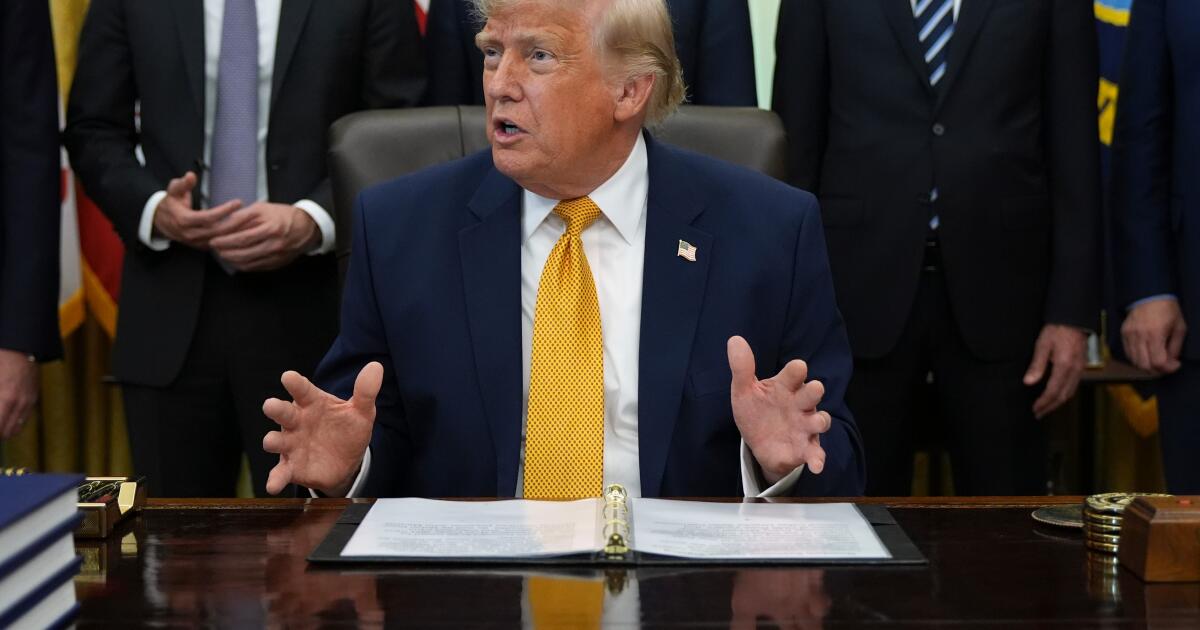
WASHINGTON — The Trump administration is backing away from plans to create a $1.8-billion fund to compensate people who claim the government was weaponized against them, a retreat that comes amid a cascade of legal setbacks and a revolt within members of the Republican Party.
But Senate Democrats say the concession is not enough, and are pushing legislation to ensure no president can ever attempt the creation of such a fund again.
“If Republicans are serious about ending this brazenly corrupt scheme, they should have no problem voting for legislation banning any president from creating such a slush fund in the future,” Sen. Adam Schiff (D-Calif.) wrote Monday in a post on X.
Senate Minority Leader Chuck Schumer (D-N.Y.) added that Democrats plan to force a vote on a measure to ensure that Trump and Republicans are “truly abandoning this corrupt scheme.”
“Trump’s word is nowhere near enough,” Schumer wrote on X. Earlier in the day, Schumer vowed to force a floor vote to make Republican lawmakers take a public stance on the issue.
Schiff, along with Sens. Mark Kelly of Arizona and Elissa Slotkin of Michigan, introduced the “Drain the Slush Fund Act” on Monday. The bill, if approved, would bar any payout arising from a lawsuit filed by a president or vice president, language that is designed to permanently foreclose the fund, or anything like it, from being put in place by a future administration.
The White House did not comment on the president’s thinking. But in a statement, the Department of Justice said the decision to scrap the fund was in response to a federal judge’s ruling last week that temporarily blocked payouts from the fund while legal challenges remain pending. The department said it “disagrees strongly” with the move, but stopped short of saying it would challenge the decision.
“This fund was open to anybody who was so weaponized, targeted, or persecuted, whether they were Democrat, Republican, Conservative, Independent, or otherwise,” the statement read. “The Department will abide by the Court’s ruling.”
U.S. District Judge Leonie Brinkema, who was nominated to the bench by President Clinton, a Democrat, has scheduled a June 12 hearing for argument on whether to extend the order blocking the fund.
While the court ruling is not permanent, the unraveling over the fund is a notable defeat for Trump, who has cast it as a long-overdue reckoning for Americans he says were targeted by “an evil, corrupt and weaponized Biden administration.” For Republicans who publicly criticized the fund, it may come as a relief as the concept had been widely seen as a political liability heading into the midterm elections.
The Department of Justice created the fund to settle a lawsuit Trump personally brought against the Internal Revenue Service over the leak of his tax returns. The settlement also includes a clause permanently barring the IRS from pursuing any tax claims against Trump and his businesses that were filed before May 19 — a provision that, according to an analysis by Forbes, would save Trump and his family more than $600 million.
The White House declined to comment on whether the administration would also make changes to the tax immunity clause. The Democrats’ bill does not address that provision.
“Congress doesn’t need to pass a law to remind the Acting Attorney General [Todd Blanche] that he doesn’t have the authority to grant a blanket pardon for tax crimes by the president, much less when the AG is his personal attorney,” a Schiff spokesperson said in a statement. “The attempt at IRS immunity is corrupt and undoubtedly illegal — and we look forward to seeing it exposed as a fraud.”
Beyond Trump’s own legal disputes with the IRS, the fund was structured to accept claims from anyone who said they had been targeted by the government, a category the administration made clear could include those who were convicted for attacking the U.S. Capitol on Jan. 6, 2021.
Trump pardoned and commuted the prison sentences of 1,500 people who were charged in connection with the attack, and neither he nor Vice President JD Vance ruled out the possibility that those individuals would be able to receive money from the fund.
That possibility immediately ran into trouble with lawmakers. Senate Republicans, many of whom were caught off guard by the arrangement, publicly revolted against the fund and derailed plans to vote on legislation to fund Trump’s immigration crackdown amid the deep disagreement.
A closed-door meeting last month between Blanche and GOP senators grew heated, with lawmakers demanding answers the administration was seemingly not prepared to give.
Sen. Ted Cruz (R-Texas), who attended the meeting, described it as “angry” in an episode of his podcast last month. Cruz said that roughly 45 Senate Republicans had attended and estimated that “at least half of them were blasting the attorney general.” Based on those reactions, Cruz predicted the administration would need to amend its position on the fund.
“We will see the administration announcing at a minimum a modification of this, because if they don’t they’ve got a full-on revolt in the Senate,” he said.
The fund also led to criticism outside of Congress. Former Vice President Mike Pence, who served in Trump’s first administration, told NBC News in an interview Sunday that it was a “bad idea from the start.”
“I would encourage the administration just to drop it,” Pence said.
A pair of nesting bald eagles has been spotted in Los Angeles County, according to a recent Instagram post from the L.A. County Department of Parks and Recreation.
In the video posted Friday, the two eagles are perched on a high tree branch in an undisclosed location. Native nesting birds, like bald eagles, are protected under federal law, and disturbing active nests can “disrupt breeding and impact their success,” the department said in the post.
The department did not immediately respond to a request Sunday for comment about where the eagles took up refuge.
Southern California residents should give nesting birds plenty of space and avoid lingering near nest sites, the post said.
If possible, residents should hold off on tree trimming or vegetation clearing during nesting season. Dogs should also remain leashed and under control around trees and shrubs where birds may be nesting, and residents also should not fly drones near wildlife.
If a nestling is in distress, the department said to contact the San Dimas Raptor Rescue Center for advice at (626) 559-5732.
WASHINGTON — President Trump on Friday gave his endorsement to a January study by the Department of Health and Human Services that calls for cutting the number of vaccines recommended for every American child.
An executive order from Trump directs federal agencies to align their policies behind the study, which recommended an overhaul long called for by Health Secretary Robert F. Kennedy Jr. The study found that the United States recommends more childhood vaccines than many peer nations.
The Trump administration previously moved to narrow the number of recommended childhood vaccines in response to the report, but the move was blocked by a federal judge in Massachusetts. The administration is appealing the decision.
The study recommends vaccinating all children against 11 diseases. Several others would be recommended only for high-risk groups or when doctors recommend them in what’s called “shared decision-making.” That includes vaccines for flu, rotavirus, hepatitis A, hepatitis B, some forms of meningitis and RSV.
Trump’s order adds weight behind the study at a time when the administration had appeared to be trying to shift focus away from Kennedy’s more contentious vaccine policies and toward topics with more widespread support among medical professionals, such as healthful eating.
The order directs the Centers for Disease Control and Prevention to review the study and “take any appropriate steps” to update its vaccine recommendations. It says the CDC should “provide maximum flexibility to parents and doctors” and directs agencies to make sure all actions, regulations and funding are aligned with the study.
The order adds that any changes should ensure that Americans retain their current access to vaccines.
States, not the federal government, have the authority to require vaccinations for schoolchildren. While CDC requirements often influence those state regulations, some states have begun creating their own alliances to counter the Trump administration’s guidance on vaccines.
Trump directed the Department of Health and Human Services to carry out the study in December.
Kennedy is a longtime activist against vaccines and has sought ways to inject his skepticism about the shots into national guidance, running counter to the overwhelming consensus of medical experts. Last year, he announced the CDC would no longer recommend COVID-19 vaccines for healthy children and pregnant women, though public health experts said they saw no new data to justify the change.
Last June, he fired a 17-member CDC vaccine advisory committee and later installed several of his own replacements, including vaccine skeptics.
The January report found that vaccine recommendations for American children had increased in recent decades. It also highlighted countries where no vaccines are required to attend school.
MIAMI — The Trump administration has extended protections shielding about 11,000 Lebanese from deportation, allowing them to stay and work in the United States for another six months.
The decision, announced Thursday by the Department of Homeland Security, marked a rare reprieve for people protected by temporary measures that have been harshly criticized by Republicans. The extension comes amid ongoing fighting in southern Lebanon between Israeli troops and Hezbollah fighters.
The decision was automatic, meaning that the administration missed the deadline by which it was supposed to decide on whether to extend the measure called Temporary Protected Status for Lebanese people living in the U.S. who are covered by the program. By statute, the status automatically extends for six months if the department misses the deadline.
It was an unusual outcome for an administration that has canceled the protections that had covered people from 13 countries, including Venezuela, Haiti, Nicaragua and Syria from deportation.
TPS was created by Congress in 1990 to prevent deportations to countries suffering from natural disasters or civil strife, giving people authorization to work in increments of up to 18 months. More than 1 million immigrants from 17 countries were protected by TPS at the beginning of the Trump administration, after the Biden administration greatly expanded its use.
The program has been at the center of a controversy.
Republicans and critics of TPS argue that the program and its protections deviate from their original temporary intent, taking on a quasi-permanent character when extended. Its defenders assert that it is a fundamental humanitarian program that prevents vulnerable individuals from being forced to return to dangerous conditions.
The DHS notice said that former DHS Secretary Kristi Noem and current Secretary Markwayne Mullin, who has led the department for the last two months, “were unable to make an informed determination on Lebanon’s TPS designation.”
The extension allows existing beneficiaries to keep their protections through Nov. 27, “if they still meet the eligibility requirements for TPS,” according to the notice. The work permits that were already issued for Lebanese TPS holders will be valid until the same day.
This is the second time the Trump administration has automatically extended a TPS designation. The first happened nearly a year ago with South Sudan, but the protections were terminated in November 2025, after the six-month extension period.
There are dozens of lawsuits challenging the termination of TPS at federal courts in different states. The Supreme Court is set to make a decision on TPS that protected Haitians and Syrians during the summer, and the result is expected to have an impact on all the other cases.
Advocates welcomed the extension.
“Extending Temporary Protected Status means Lebanese nationals in the United States will not be forced back into dangerous conditions but allowed to stay and continue supporting their families and contributing to their local communities,” said Kelly Razzouk, vice president of policy and advocacy at the International Rescue Committee.
José Palma, national coordinator of the National TPS Alliance — an advocacy group that has fought in federal courts against the cancellation of TPS for several countries—welcomed the extension of protections for the Lebanese.
“But we need to find a permanent solution for all TPS beneficiaries,” he warned.
Salomon writes for the Associated Press. AP writer Rebecca Santana contributed to this report.
For thieves looking to strip Los Angeles for parts, copper has become a fast-moving currency.
The problem has become so persistent that the Los Angeles Department of Water and Power is now asking for its own armed police force to protect vulnerable utility equipment, street lighting and critical infrastructure, insisting that the department’s contracted and unarmed security guards aren’t cutting it.
“They lack the authority to detain or arrest suspects, intervene in crimes in progress, conduct searches, or carry firearms for enforcement purposes,” according to a May 21 report from the city agency. “Delays hinder timely intervention, reduce investigative effectiveness, and contribute to repeat victimization of LADWP facilities.”
Under DWP’s current “observe and report” security model, an officer who sees someone cutting a fence or stripping copper from a transformer has little authority apart from yelling a warning or making a 911 call, according to the department report.
The proposal asks for 20 to 50 sworn officers to start, hired over a five-year period, along with support staff. If approved, the force would give the agency’s officers the authority to carry a firearm, make arrests and investigate thefts. The plan was scheduled to be discussed Thursday by the City Council.
The push comes as citywide service requests for streetlight repairs have surged over the last several years.
L.A.’s historic streetlights outside the Bureau of Street Lighting near Virgil Avenue and Santa Monica Boulevard.
(Jason Armond/Los Angeles Times)
The city logged 14,328 electronic streetlight service requests in 2018, according to data from the Bureau of Street Lighting. Requests have tripled since then, reaching an all-time high of 46,079 in 2024, the last full year of available data.
Mayor Karen Bass’ office said in March that copper thefts are a leading cause of streetlight outages. Repairs have been backlogged for months.
Prices for the metal are at an all-time high, driven by major supply disruptions in Indonesia and Chile, and soaring demand from artificial intelligence data centers and electric grid infrastructure. Thieves typically exchange the metal for cash at recycling centers, where it can fetch up to $5.30 per pound. The City Council last year approved a program offering up to $5,000 for information in metal and wire theft cases.
Theft losses alone exceed $1 million annually, according to DWP.
Establishing a new police force would require changing the city charter, meaning voters will have a say come the November midterm elections. Authorities will also need to obtain state legislative approval for the plan.
Officials said rolling out the police department would cost $9.7 million over three years, plus up to $6 million annually to pay for staffing. They maintain those costs are less than the $46 million combined DWP spends each year on private security contractors and unarmed staff security.
On Hill Street in downtown L.A., streetlights have been targeted by thieves and vandals.
(Jason Armond/Los Angeles Times)
Any cost overflows would be paid for by DWP customers.
Timothy O’Connor, executive director for the Los Angeles Office of Public Accountability, a spending watchdog, said his office is not convinced that the agency could minimize long-term cost creep, or that the new force would offset enough costs to justify the program. The proposed force of a few dozen officers, he said, would be too small to get the job done.
“Theft losses at DWP are real and are increasing. However, eliminating these losses is not enough to offset the proposed costs,” he said. “Furthermore, DWP will be unable to fully eliminate theft given the diffuse nature of the DWP system.”
But O’Connor also said the department is faced with real security risks like those posed by drone attacks or terrorism threats, which he said “appear to justify the proposal at some level.”
In February, a man shot himself after he drove his car through the perimeter fence of a power substation while carrying explosives and several firearms. Dubbing the incident an attempted terrorist attack, officials said the episode could have caused catastrophic infrastructure damage.
David Levitus, executive director of the advocacy group LA Forward, said he was surprised to learn of the proposal so late in Los Angeles’ ongoing charter reform process, which his organization has monitored closely.
“The fact that this is being dumped in late May — what’s the rush?” Levitus said. “I think we really need to be wary of creating new police departments in general, but especially without a clear case and clear constraints and accountability mechanisms.”
President Trump’s administration is suing four states over their refusal to issue undercover license plates to federal agents, the latest front in the wider struggle between the White House and Democratic-led states over the Republican president’s immigration crackdown.
The Department of Justice alleges in separate lawsuits announced Thursday that Maine, Massachusetts, Oregon, and Washington state are imposing unconstitutional restrictions that it says impede law enforcement and threaten agents’ safety.
“By denying undercover license plates to DHS components, including ICE, while issuing them to their own state agencies, these governors are pursuing discriminatory and obstructionist policies against federal law enforcement,” said acting Atty. Gen. Todd Blanche in a statement.
“These actions undermine federal immigration enforcement, allow dangerous criminals to escape justice, and terrorize American communities,” Blanche added.
The Justice Department filed the suits on Wednesday in U.S. district courts in the respective states. The four state governments are accused of trying “to obstruct the Federal Government’s immigration enforcement efforts, even though control over immigration and the nation’s borders is an exclusive federal power.”
Additionally, the Justice Department argues in the suits that the U.S. Constitution’s Supremacy Clause bars state governments from regulating federal law enforcement.
Maine Secretary of State Shenna Bellows, who oversees her state’s plate program and is also a Democratic candidate for governor, said she’s confident her decisions will hold up in court.
“What ICE did in Maine and continues to do was terrorize our friends and neighbors,” Bellows said in an interview Thursday. “There are no secret police in a democracy and we will always stand up for our Mainers safety and freedom.”
A spokesperson for Massachusetts Atty. Gen. Joy Campbell said the state’s lawyers are “reviewing the complaint and will defend the RMV policy to the greatest extent possible.”
Officials in Washington and Oregon did not respond to a request for comment on the federal action.
Feds say agents are endangered when easily identified
The administration asserts that federal agents “frequently investigate and apprehend violent criminals, including cartel members, gang members, sex offenders, human traffickers, and other violent offenders” and says making those authorities easily identifiable subjects them to increased harassment and potential physical harm.
The lawsuit comes after a back-and-forth between the DOJ and some state officials. The administration previously sent state officials letters demanding they justify their policies.
Maine Atty. Gen. Aaron Frey answered the Justice Department last week, defending his state’s policy and disputing the DOJ’s contention that it has hampered federal enforcement actions.
“Rather, the program reflects a legitimate and constitutional policy choice by the SOS not to allow its resources to be commandeered by the federal government for use in civil immigration enforcement activities that have, in Maine and elsewhere, resulted in multiple incidents of abusive and unconstitutional conduct by DHS officials,” Frey wrote.
Bellows, in her role as secretary of state, announced a pause on confidential license plates in January, after federal authorities ramped up their immigration enforcement activities in the state. Bellows said at the time that the state wanted to be “assured that Maine plates will not be used for lawless purposes.”
The federal suit against Maine argues that the state “has issued confidential license plates to law enforcement agencies for many years” and that “such plates are explicitly authorized under Maine law.” The state’s review this year, the suit argues, resulted in unlawful state regulation of the federal government by requiring federal applicants for state license plates to attest that federal vehicles that obtained confidential plates would not be used for civil immigration enforcement. The suit also states that Maine did not impose commensurate requirements on state or local agencies applying for the plates, making the program discriminatory against the federal government.
Bellows has previously defended her decision.
“When ICE asked for confidential license plates, I said no” because “covert civil immigration enforcement is not something Maine will facilitate,” she said last week.
Arguments are similar to debate over agents’ masks
The Trump administration’s arguments on the license plates are similar to its defense of federal agents wearing masks on their deployments to American cities. That became a flashpoint in an extended government shutdown over Department of Homeland Security funding, as Democrats on Capitol Hill demanded key changes to how Trump’s mass deportation plans were carried out after masked federal agents killed two U.S. citizen protesters in Minnesota.
The White House and DHS have maintained the agency’s mask policy, and the administration already has won a federal court order blocking a California law that barred law enforcement officials from covering their faces in the state.
Additionally, the administration has been at odds with so-called sanctuary cities where local law enforcement does not assist federal authorities with immigration enforcement. And Blanche has instructed the Justice Department’s Civil Division to identify all state and local laws, policies, and practices that could impede what the administration describes as “lawful federal operations.”
Barrow and Whittle write for the Associated Press. Barrow reported from Atlanta. Whittle reported from Scarborough, Maine.
WASHINGTON — The Justice Department has opened an investigation into whether E. Jean Carroll, the longtime advice columnist who has said Donald Trump sexually assaulted her in a New York department store 30 years ago, lied during the course of civil litigation against the Republican president, according to a person familiar with the matter.
The person who confirmed the existence of the investigation was not authorized to publicly discuss an ongoing inquiry and spoke on the condition of anonymity. The perjury investigation is being led by the federal prosecutors’ office in Chicago, and acting Atty. Gen. Todd Blanche has had no involvement because of his prior work as Trump’s personal attorney, the person said.
Lawyers for Carroll did not immediately respond to requests for comment from the Associated Press on Thursday.
It’s the latest in a series of investigations the Trump administration Justice Department has opened into perceived adversaries of the president. The actions, including securing an indictment last month against former FBI Director James Comey, have raised alarm from Democrats and former officials that an institution meant to make prosecutorial decisions independent of the White House is being weaponized.
Carroll has said a flirtatious, chance encounter with Trump in 1996 at Bergdorf Goodman’s Fifth Avenue store in Manhattan ended violently. She said Trump slammed her against a dressing room wall, pulled down her tights and forced himself on her. Trump has called the allegations a “made-up scam,” and he has attacked her motivations, saying they were politically driven or arose from a desire to promote her memoir.
A jury in 2023 found Trump liable for sexually abusing Carroll, awarding her $5 million. The following year, another jury awarded Carroll $83.3 million in a defamation case related to Trump’s social media attacks on her.
The Justice Department is scrutinizing a statement Carroll made in the course of the civil litigation that no one else was paying her legal fees. It later became public that a Chicago-based organization backed by Reid Hoffman, the co-founder of LinkedIn, had helped fund Carroll’s case. Trump’s lawyers in the civil case accused Carroll of concealing that information, which they said called into question whether the case was politically motivated.
A court entry earlier this month said Trump won’t have to pay the award until the U.S. Supreme Court gets a chance to review the case or reject an appeal. The 2nd U.S. Circuit Court of Appeals agreed to a request by one of Trump’s lawyers that it let the president delay the payment to Carroll, though it required that he post a $7.4 million bond to cover any additional interest costs, a request Carroll’s attorney had made.
The Carroll investigation was first reported by CNN.
WASHINGTON — Former Atty. Gen. Pam Bondi is scheduled to meet with the House Oversight Committee on Friday to discuss the Justice Department’s investigations into deceased sex trafficker Jeffrey Epstein and its release of files related to that investigation.
But the circumstances surrounding her meeting with the committee raise questions about how much the committee will actually learn about either.
For one, the former attorney general will not be under oath in a sworn deposition but will provide a transcribed interview, which is voluntary. Bondi’s interview with the committee will happen behind closed doors with members of the committee and staff and will not be filmed. The committee says it plans to release a transcript soon after the hearing.
And Bondi will be represented at her interview by Assistant Atty. Gen. Harmeet Dhillon, which legal experts say raises the prospects that the Department of Justice could direct Bondi to not answer some questions posed by the committee.
Former Atty. Gen. William Barr, former President Clinton and former Secretary of State Hillary Clinton all gave sworn depositions.
Rep. James Comer (R-Ky.), the chair of the committee, rejected the Clintons’ offer to provide a transcribed interview, rather than sit for a deposition, out of concern that someone giving a transcribed interview could “refuse to answer whatever questions he wanted for whatever reasons he wanted.”
Comer’s spokesperson said Bondi was allowed to sit for a transcribed interview, rather than a deposition, because the former attorney general was “cooperative.”
“Unlike the Clintons who defied subpoenas for seven months, former Attorney General Pam Bondi voluntarily and quickly cooperated with the Committee to identify a mutually agreeable date,” spokesperson Austin Hacker said in a statement.
Bondi had, in fact, refused to comply with the committee’s subpoena while she was still in office, and the ranking Democrat on the committee, Rep. Robert Garcia (D-Long Beach), filed a resolution on April 29 to hold Bondi in contempt for not complying with the committee’s subpoena a month earlier. Bondi’s agreement to provide a transcribed interview was announced the same day.
The committee subpoenaed Bondi in March to learn more about the department’s long-running investigations into Epstein — the financier accused of abusing more than 1,000 women and girls and directing some of them to have sex with his high-powered friends — and the department’s release of files in response to the 2025 Epstein Files Transparency Act, which mandated disclosure of the investigative records.
Asked whether Dhillon’s participation indicated that the department planned to invoke privilege and bar Bondi from sharing some information, the department said in a statement that Dhillon and other agency officials would attend Bondi’s interview “solely to ensure accurate representation of Department processes, facilitate any necessary clarifications, and support a complete factual record for the Committee.”
The department added that it “routinely provides staff” to assist with “congressional engagement involving past Department staff actions.”
But a former DOJ ethics official, speaking on the condition of anonymity for fear of retribution, said that Dhillon’s participation in the proceedings was anything but routine.
Typically, this type of work would be handled by a less senior attorney at the department who had more direct involvement with the subject matter at hand, the former official said. Dhillon oversees the department’s civil rights division, while the investigations into Epstein were criminal matters.
“I don’t see where Harmeet Dhillon has the experience or the normal level of authority that this would be delegated to,” the official said. “Everything about this seems unusual.”
Bondi would also need to have submitted a formal request for representation from the department.
“It doesn’t just happen willy-nilly,” the former ethics official said.
The department didn’t say how Bondi came to be represented by the agency’s attorneys. Bondi, who said this week she is being treated for thyroid cancer, didn’t respond to a request for comment.
The presence of Dhillon — a San Francisco attorney and Republican party insider who has been talked about as a potential pick for attorney general — could also present a conflict of interest, experts said.
“It’s unclear if she is representing the interests of Bondi, the department, or herself,” said Dave Rapallo, a former staff director of the House Oversight Committee.
He said that Dhillon would not have been able to represent Bondi if her testimony was provided in a deposition because the committee’s rules prevent agency lawyers from attending depositions.
Bondi was fired by President Trump on April 2. She was dogged by questions about her handling of the Epstein investigation throughout her time in office.
Trump campaigned on the promise of releasing information about the government’s investigation into Epstein in 2024 and in February 2025, Bondi told Fox News that she had on her desk a list of clients of Epstein — who died in federal custody in 2019.
But months later, as questions swirled about Trump’s relationship with Epstein, the Justice Department announced that it was closing its investigation into Epstein and said that, in fact, no such client list existed.
Soon after, Rep. Ro Khanna (D-Fremont) and Rep. Thomas Massie (R-Ky.) introduced the bipartisan Epstein Files Transparency Act, requiring the Justice Department to release all of the records from its investigation into Epstein. Trump initially opposed the legislation but ultimately signed it into law.
The department has released millions of pages of records in response to the law. While Acting Atty. Gen. Todd Blanche said in January that there are millions of additional pages of records that are not yet public, the department has indicated that it doesn’t plan to release these additional files.
WASHINGTON — Joe Biden sued the Justice Department on Tuesday in an effort to block the release of audio recordings and transcripts of the former president’s interview with a ghostwriter that were obtained by the special counsel who investigated his handling of classified documents.
Biden’s lawyers said in a lawsuit filed in Washington’s federal court that the Justice Department plans to release the files to Congress and a conservative group, the Heritage Foundation, after the department had previously argued that they were exempt from disclosure under the public records law.
Biden’s lawyers argued that the disclosure would “constitute an unwarranted invasion of President Biden’s privacy.”
“Every American, including a sitting or former Vice President, has a right to privacy in the personal conversations he has within his own home,” his attorneys wrote. “And when the U.S. Department of Justice obtains that private information through a criminal investigation, the Department bears a particular responsibility to protect it from disclosure.”
At issue in the case are audio recordings and transcripts of Biden’s interviews at his home in 2016 and 2017 with Mark Zwonitzer, who worked with Biden on his two memoirs. The files were scrutinized by special counsel Robert Hur as part of his investigation into the president’s improper retention of classified documents, from his time as a senator and as vice president.
Hur’s yearlong investigation led to a 345-page report that questioned Biden’s age and mental competence but recommended no criminal charges against the then-81-year-old. Hur said he found insufficient evidence to successfully prosecute a case in court.
Biden has separately fought the release of the audio of his interview with Hur. The House in 2024 voted to hold Biden Atty. Gen. Merrick Garland in contempt of Congress for refusing to turn over that audio after the White House exerted executive privilege, shielding it from Congress.
The transcripts of five hours of Biden interviews with federal prosecutors was released that same year. While Biden was adamant that he treated classified information seriously, the transcript shows that he was at times fuzzy about dates and details and he said he was unfamiliar with the paper trail for some of the sensitive documents he handled.
Republicans have argued Biden was being given a pass by his own Justice Department and that Trump had been unfairly victimized by prosecutors. Democrats, for their part, stressed Biden’s cooperation in the investigation and strongly contrasted that with the separate criminal case against Trump, who was accused of refusing to return classified documents requested by the National Archives that he had at his Florida estate.
WASHINGTON — The U.S. Department of Justice has acknowledged removing from its website news releases about criminal cases related to the Jan. 6, 2021, riot and insurrection, calling the information about the prosecutions “partisan propaganda.”
The purge of news releases documenting criminal charges, convictions and sentencings is the latest step by the Trump administration to reimagine the history of the assault on the U.S. Capitol, when hundreds of supporters of President Trump stormed the building in an effort to halt the congressional certification of his 2020 election loss to Joe Biden.
Trump, on his first day back in office in January 2025, pardoned, commuted the prison sentences or vowed to dismiss the cases of all of the 1,500-plus people charged with crimes during the Capitol assault, including those convicted of sedition and of attacking officers with makeshift weapons such as flagpoles, a hockey stick and crutch. More than 100 police officers were injured, many of them seriously, and five died as a consequence.
On Monday, the Justice Department announced the creation of a $1.776-billion fund meant to compensate Trump allies who claim they were unjustly investigated and prosecuted. Acting Atty. Gen. Todd Blanche has not ruled out that Jan. 6 rioters convicted of violence will be eligible for payouts, prompting bipartisan anger in Congress.
After a journalist on Friday observed on the social media platform X that the Justice Department was “quietly” removing news releases on its website that were related to the Jan. 6 attack, including about a Texas man who pleaded guilty to assault and also faced separate state charges of soliciting a minor, the department responded through its “rapid response” account that there was “nothing ‘quiet’ about it.”
“We are proud to reverse the DOJ’s weaponization under the Biden administration. We will do everything in our power to make whole those who were persecuted for political purposes,” the post said. “This includes stripping DOJ’s website of partisan propaganda.”
Among the releases removed from the site were those concerning seditious conspiracy cases against members of the Proud Boys and Oath Keepers, far-right extremist groups, some of which resulted in convictions and long prison sentences.
The Justice Department, in an unopposed motion last month, asked a federal appeals court to vacate those seditious conspiracy convictions, a request that was granted Thursday. The department on Friday moved to dismiss the cases against the group members.
Trump was impeached for inciting an insurrection on Jan. 6 and was indicted on felony charges related to his actions. Those charges were dismissed after his 2024 election victory.
WASHINGTON — President Trump on Friday oversaw the White House swearing-in of the new Federal Reserve chair and said he would like Kevin Warsh’s help in stimulating the economy even as he tried to emphasize that the nation’s central bank would remain independent.
Trump spent months criticizing Warsh’s predecessor, Jerome Powell, for being reluctant to cut interests rates, with the Republican president arguing that lower borrowing costs would provide an economic boost. By taking the unusual step of holding the ceremony in the East Room and not the Fed, Trump made clear his pleasure that Warsh is now in charge.
The war with Iran has caused gas prices to spike, unsettled financial markets and driven inflation concerns across the economy. Those developments have led to recent doubts about whether Warsh might heed Trump’s calls and push the Fed to lower rates.
Still, Trump said he had faith that Warsh would prioritize a strong economy.
“Thankfully, unlike some of his predecessors, Kevin understands that when the economy is booming, it is, that’s a good thing,” the president said. Trump said it was not necessary “to go crazy. Just let it go. We want it to boom.”
Supreme Court Justice Clarence Thomas administered the oath of office. Also on hand were House Speaker Mike Johnson (R-La.), Justice Brett Kavanaugh, CIA Director John Ratcliffe and Cabinet members.
“I expect he will go down as one of the truly great chairmen of the Federal Reserve that we’ve ever had,” Trump said of Warsh.
Republican President Reagan swore in Alan Greenspan as Fed chair at the White House in 1987. Republican President George W. Bush attended the 2006 ceremony at central bank headquarters when Ben Bernanke became chair.
But having the event at the White House raises more questions about the Fed’s independence at a time when Trump has constantly sought to bend the independent central bank to his will.
Trump’s Department of Justice began an investigation into Powell and the Fed’s extensive building renovations. That drew backlash from lawmakers and the department scrapped the investigation. The Fed’s internal watchdog is now handling the matter. Powell’s term as chair ended last week, though he has opted to remain on the Fed board for now.
Trump made a point of saying during his remarks, “Honestly, I really mean this. This is not said in any other way: I want Kevin to be totally independent.”
“I want him to be independent and just do a great job,” Trump said. “Don’t look at me, don’t look at anybody. Just do your own thing.”
In the next breath, however, Trump said that “in the eyes of many, the Fed has lost its way in recent years” under his predecessor, Democratic President Biden. Trump also suggested that Warsh is looking to lead policies that promote “positive economic growth” and that doing so did not have to mean higher inflation.
Trump also noted that the stock market had risen Friday. “That means they like you,” he said of Warsh.
Warsh once harshly criticized Fed’s policies, including its low interest rate policies coming out of the pandemic, which he says contributed to the largest U.S. inflation spike in four decades in 2021-22. More recently, he has sometimes echoed Trump’s demands for lower rates.
Warsh says productivity gains from artificial intelligence will help the economy grow more quickly without spurring inflation, enabling the Fed to reduce borrowing costs. Many Fed officials, however, disagree that AI’s development will support rate cuts, especially because the technology has also been blamed for large-scale layoffs in the computer sector and other parts of the economy.
On Friday, Warsh promised “to lead a reform oriented Federal Reserve, learning from past successes and mistakes, both escaping static frameworks and models and upholding clear standards of integrity and performance.”
He told Trump that he believes “these years can bring unmatched prosperity that will raise living standards for Americans from all walks of life. And the Fed has something to do with it.”
Warsh further noted that the Fed’s mandate “is to promote price stability and maximum employment. When we pursue those aims with wisdom and clarity, independence and resolve, inflation can be lower; growth, stronger; real take home pay, higher and America … more prosperous.”
As he left the ceremony, Treasury Secretary Scott Bessent reinforced Trump’s message, predicting to reporters that Warsh will “do the right thing for inflation and growth.”
Weissert and Price write for the Associated Press.
A briefing memo obtained by The Times appears to support former Rep. Katie Porter’s accusation that a Tom Steyer staffer leaked a video of her yelling at an employee, an outburst that tainted her gubernatorial prospects when the video became public.
The video, which was obtained in October by Politico, showed Porter erupting at a staff member who appeared in the background of a prerecorded Zoom call between the former congresswoman and then-Energy Secretary Jennifer Granholm.
During a nationally televised interview on CNN by Dana Bash on Monday, Porter accused the Steyer campaign of leaking the damaging video.
“I am confident that is the case,” Porter said after Bash asked how she knew Steyer was the source. “I’ve been told by many people it’s a Department of Energy video, it was only held by the Department of Energy, and people can follow the trail to who his campaign staffers are and understand what happened there.”
Following the CNN interview, Steyer’s campaign denied that the candidate was involved with the leak.
Gubernatorial candidate Tom Steyer hosts an “LA Block Party” campaign event Wednesday at East Los Angeles College in Monterey Park. Rocky Mosse, 9, waits his turn for a photo with Steyer.
(Robert Gauthier/Los Angeles Times)
“Tom has nothing to do with that video,” Steyer campaign spokesperson Sepi Esfahlani said after Porter levied the accusation on Monday. “This is an attempt from Katie Porter to deflect from her past mistakes. Katie Porter only has one person to blame for her standing in the race, and it’s herself.”
According to a briefing memo from the meeting obtained by The Times, Steyer spokesman Kevin Liao was listed as an “expected participant” on the video call between Granholm and Porter, which took place on June 21, 2021, and was filmed to promote electric vehicles by the Biden administration. Granholm and Liao were the only participants listed from the Energy Department, according to the document obtained by The Times.
“This is a 20 minute recorded Zoom with Energy Secretary Jennifer Granholm to discuss the importance of investing in electric vehicles,” the document apparently prepared for Porter and her staff states. “Kevin Liao, Granholm’s press secretary, reached out to set this up. His team will edit this video down into a 2-3 minute clip for social media. Secretary Granholm will have a whiteboard, as noted in the script.”
The edited video conversation was posted on the U.S. Department of Energy’s Facebook page in early July 2021. Politico reported that the Porter staff member snapped at by the congresswoman was not the source of the video provided to the news outlet.
The clip from the Porter-Granholm call was the second unflattering video of the candidate to surface last fall. Days earlier, another clip began to circulate, showing Porter threatening to end an interview with CBS California reporter Julie Watts after becoming frustrated by Watts’ questioning.
U.S. Secretary of Energy Jennifer Granholm speaks during the UNFCCC COP29 Climate Conference in Baku, Azerbaijan, in 2024.
Before the videos became public, Porter had a narrow edge in the race, according to a poll by UC Berkeley’s Institute of Governmental Studies, though many voters at the time remained undecided. Though Porter has continued to hover in the upper tier of gubernatorial hopefuls, she currently trails behind two Democrats — Steyer and former Biden cabinet member Xavier Becerra — and one Republican, former Fox News host Steve Hilton.
The UC Irvine law professor has repeatedly said she apologized to the employee, who spent four more years working in Porter’s congressional office. Dozens of former staffers also came to her defense in an open letter last month.
Liao declined to comment when reached Wednesday evening. He is a primary spokesman for Steyer’s campaign and sent the press release announcing the San Francisco billionaire’s campaign for governor in November. Granholm, when reached via text message, denied leaking the video and said she did not know who did.
According to his LinkedIn profile, Liao, a Los Angeles-based political consultant, worked as Granholm’s press secretary from January through October 2021, during the time the Porter video was recorded. In 2024, he founded Frontrunner Strategies, a consulting firm which has been paid more than $45,000 by Steyer’s campaign, according to campaign finance records.
Porter’s campaign declined to comment on the document.
Voting is underway in the primary election to replace Gov. Gavin Newsom, who is term-limited and exploring a 2028 presidential bid.
A Wednesday Emerson College poll showed Democratic former U.S. Health and Human Services Secretary Xavier Becerra leading with 19%, followed by both Republican former Fox News host Steve Hilton and Steyer at 17%. Riverside County Sheriff Chad Bianco, a Republican, had support from 11% of likely voters and Porter had 10%. San José Mayor Matt Mahan, former Los Angeles Mayor Antonio Villaraigosa and state Supt. of Public Instruction Tony Thurmond were in single digits. Twelve percent of voters were undecided, according to the poll.
Top candidates, with the exception of Thurmond, are slated to appear in a Thursday night debate hosted by CBS California and the San Francisco Examiner.
WASHINGTON — Senators unanimously approved a resolution Thursday to withhold their pay during government shutdowns, an attempt to make federal closures financially painful for lawmakers after a string of record-breaking impasses in the past year.
The bipartisan support for the measure comes at a time when federal closures have become longer and more frequent, frustrating lawmakers who say there should be punishment when Congress fails at its most basic legislative duty.
Under the resolution, senators’ pay would be withheld by the secretary of the Senate whenever a government shutdown affects one or more agencies, then released once funding is restored. It will take effect the day after the Nov. 3 general election.
“Shutting down government should not be our default solution to our refusal to work out our issues and our differences,” said Sen. John Kennedy, the bill’s sponsor, in a floor speech Wednesday.
“This is about putting our money where our mouth is,” said Kennedy, R-La.
Two shutdowns in the past year created significant financial hardship for tens of thousands of federal workers, particularly at the Department of Homeland Security. The department reopened last month after a 76-day partial shutdown, the longest agency funding lapse in history.
The Homeland Security shutdown came just a few months after a 43-day lapse of the entire federal government, which was the longest such closure on record.
The Constitution stipulates that lawmakers must be paid so they have received salaries during shutdowns even as federal workers went without paychecks. When the full government shutdown began in October amid a dispute over health care subsidies, Sen. Lindsey Graham proposed a constitutional amendment to require members to forfeit their paychecks when the government is closed.
“If members of Congress had to forfeit their pay during government shutdowns, there would be fewer shutdowns and they would end quicker,” Graham, R-S.C., said at the time.
Graham said his legislation was the most “constitutionally sound” way to deal with the problem, but the process would have been much more laborious as three-fourths of states must ratify an amendment.
Lawmakers in previous shutdowns have often pledged to forgo their paychecks while federal workers went unpaid.
Kennedy told reporters Wednesday that he pushed his measure to ensure there is “shared sacrifice” during shutdowns. He added that it does not go as far as he would like, but that it’s a start.
Asked why it does not extend to the other chamber of Congress, Kennedy said “the House’s business is the House’s business” while also touching on the tensions between the Senate and House.
“There’s a very strong undercurrent of animosity among some of my friends in the House,” Kennedy said.
“It’s quickly becoming like two kids fighting in the back of a minivan,” he said.
Cappelletti and Jalonick write for the Associated Press.
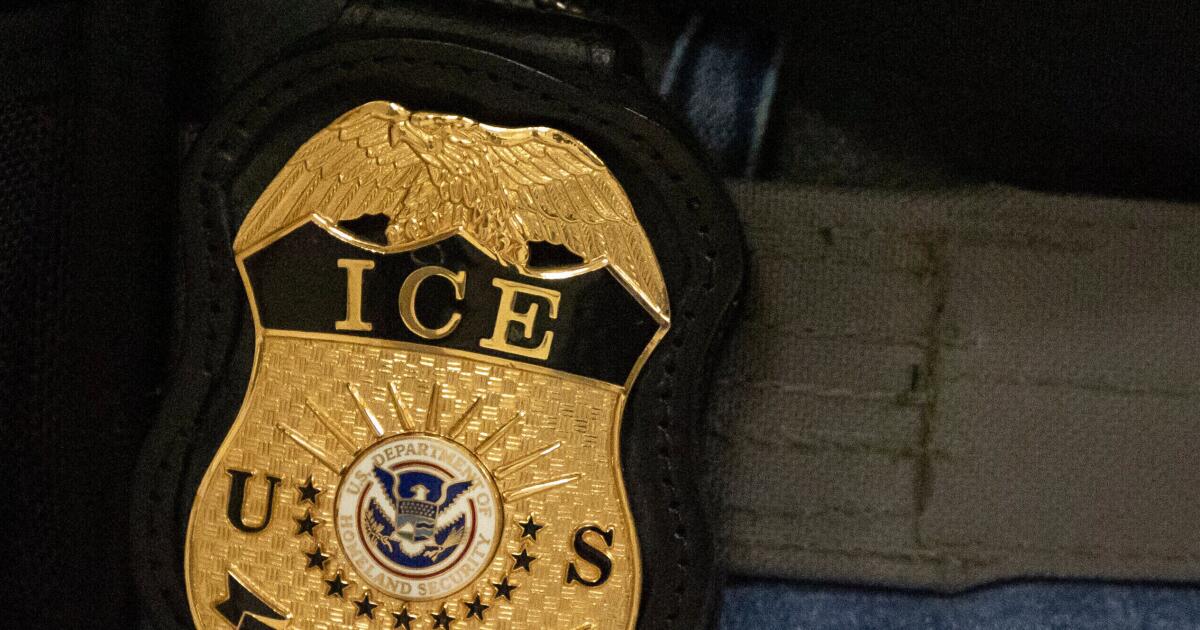
WASHINGTON — David Venturella, a former executive at a private prison operator, will serve as the acting head of U.S. Immigration and Customs Enforcement, the Trump administration says, after the agency’s current leader steps down at the end of the month.
A spokesperson for the Department of Homeland Security said late Tuesday that Venturella would succeed Todd Lyons, who led the agency through much of the administration’s tumultuous crackdown on immigration. ICE did not immediately respond to an email seeking additional information Wednesday.
Venturella left the Geo Group in early 2023 and has been working at ICE leading the division that oversees detention contracts, members of Congress wrote in a public letter earlier this year.
At the Geo Group, which houses around one-third of ICE detainees, Venturella served in a number of posts, including executive vice president overseeing corporate development, according to a Securities and Exchange Commission filing. He also oversaw removal operations for ICE in 2011 and 2012 after working for federal contractors, including one that specializes in security clearances and background checks.
Geo has benefited from President Trump’s mass deportation push, garnering big contracts to open three shuttered facilities. Among them was a $1-billion, 15-year deal for a detention center in New Jersey’s largest city.
“Last year was the most successful period for new business wins in our company’s history,” Geo’s CEO George Zoley said during an earnings call last week.
Geo owns and operates 23 ICE detention facilities, with about 26,000 available beds. Zoley also said that ICE’s air transportation subcontract had continued to steadily increase and that it secured a new contract last year for electronic monitoring.
Venturella will lead ICE at a time when the public mood has soured on Trump’s immigration crackdown, which sent surges of federal immigration officers into American cities to round up immigrants. Those raids sent tensions soaring and prompted clashes between protesters and law enforcement, leading to the fatal shootings of two U.S. citizens in Minneapolis earlier this year.
Trump returned to the White House on a promise of mass deportations, and ICE has been a central executor of that vision. Under Lyons’ leadership, the agency used a massive infusion of cash to expand hiring and detention capabilities, and it ramped up arrests to meet demand from the Republican administration.
Federal officials announced Lyons’ departure last month from ICE, which had gotten $75 billion from Congress to fulfill Trump’s mass deportation campaign.
Venturella’s appointment comes as Homeland Security Secretary Markwayne Mullin settles into his role atop the Cabinet agency overseeing ICE. Mullin has promised to keep his department out of the headlines and has indicated a softer tone on immigration, although he is expected to align with the president’s priorities on mass deportations.
One contentious issue confronting Homeland Security now is a plan for converting warehouses into immigrant detention centers. Conceived while Kristi Noem led the department, the effort has encountered multiple lawsuits and intense community blowback, including in Republican-led states.
The $38.3-billion plan would increase detention capacity to 92,000 beds and mean acquiring eight large-scale facilities, capable of housing 7,000 to 10,000 detainees each, and 16 smaller regional processing centers.
Those, and other sites, were supposed to be running by the end of November. But after Noem’s departure, the department paused the purchase of new warehouses as it scrutinizes all contracts signed during her tenure.
Last month a judge extended a pause on transforming a massive Maryland warehouse into a processing facility for immigrants, and there are signs that federal officials are scaling back the plans.
This could be good news for Geo. The Florida-based company has about 6,000 idle beds at six company-owned facilities, Zoley said last week.
Zoley had offered a note of skepticism about the warehouse plan during an earlier earnings call in February, noting that renovating a warehouse is “more complicated than you may think.” At that point, he said the company was “cautiously” looking at whether to bid to help operate some of them.
SAN DIEGO — President Trump nominated Cameron Hamilton on Monday to lead the Federal Emergency Management Agency, a surprising comeback for the former Navy SEAL who was fired from his role as FEMA’s temporary leader last year after he defended its existence.
His nomination comes as the Trump administration has increasingly signaled it is backing away from promises to dismantle FEMA, an agency that has faced withering criticism by the president. The nomination of Hamilton, who argued abolishing FEMA was not in the country’s best interests, is the latest indication of that change.
If confirmed, Hamilton would be the principal advisor to Trump and Homeland Security Secretary Markwayne Mullin on emergency management and FEMA’s first permanent administrator in Trump’s second term. The agency has gone through three temporary leaders, including Hamilton’s brief tenure from January to May 2025.
He would take over an embattled agency still reeling from Kristi Noem’s turbulent leadership of the Department of Homeland Security, of which FEMA is part. FEMA’s workforce has been worn down by mass staff departures, policies that hamstrung operations and a 75-day-long Homeland Security shutdown that ended April 30.
Hamilton will need to ensure the agency is prepared for summer disaster season, just weeks away, while answering to Trump, who is likely to expect major reforms after a council he appointed recommended sweeping changes on Friday.
“Now is the opportunity to stabilize FEMA,” said Michael Coen, the agency’s chief of staff in the Obama and Biden administrations.
Fired after defending FEMA
Hamilton, who had never been a state or local emergency management director and who had publicly criticized FEMA in the past, was a controversial choice when Trump named him temporary leader in January 2025, just days before the president floated the idea of “getting rid” of FEMA.
His rupture with Homeland Security officials began as he defended a federal role in supporting disaster-affected states, tribes and territories.
“Once the conversation shifted to, ‘Now we’re going to abolish,’ I immediately expressed concern,” he said in September on the “Disaster Tough” podcast with John Scardena, a former FEMA incident management team leader.
Homeland Security officials even subjected him to a polygraph test, accusing him and other officials of leaking details of a private meeting. He passed but said he knew his dismissal was inevitable.
At a May 7, 2025, appearance before a House Appropriations subcommittee, Rep. Rosa DeLauro, a Connecticut Democrat, asked Hamilton if he believed FEMA should be abolished.
“I do not believe it is in the best interest of the American people to eliminate the Federal Emergency Management Agency,” he replied. The next day, he was fired.
Hamilton will have to rebuild trust
Defending FEMA despite knowing it would probably cost him his job generated respect and trust among people whose job it is to lead communities through crisis, said Scardena, now president of the consultancy Doberman Emergency Management Group, which trains emergency managers.
“He won myself over and I think a lot of people by what he did,” Scardena said.
But multiple current FEMA employees who requested anonymity for fear of retribution for speaking publicly told the Associated Press they had concerns over some of the actions taken under Hamilton.
In 2024, Hamilton shared posts on X promoting misinformation about FEMA spending during Hurricane Helene.
During his temporary leadership, FEMA ceased door-to-door canvassing to reach survivors after disasters, and canceled a multibillion-dollar resilience grant program, since restored by a federal judge. The Department of Government Efficiency gained access to internal FEMA networks containing survivors’ private information. FEMA staff were fired for fulfilling a reimbursement payment to New York City for housing undocumented immigrants as part of FEMA’s Shelter and Services program.
Hamilton has said he believes FEMA needs major reform. He has said that he wants FEMA to move faster, that the agency is saddled with responsibilities he sees as outside its remit, and that some states have become too dependent on the agency. A Trump-appointed council last week urged sweeping changes to FEMA, which would require congressional action.
“I think he’s going to need to rebuild trust across the agency,” said Deanne Criswell, FEMA administrator under former President Biden, adding that she believes Hamilton cares about FEMA and she appreciated his outreach to emergency management directors and former officials during and after his tenure.
Senate confirmation process could raise questions of experience
Hamilton could face pushback in the Senate confirmation process over never having led an emergency management agency, a common stepping stone to becoming administrator of an agency with over 21,000 employees.
Federal law requires the FEMA administrator to have “a demonstrated ability in and knowledge of emergency management and homeland security” and at least five years of “executive leadership and management experience.”
Hamilton trained as a Navy hospital corpsman before spending a decade as a Navy SEAL on SEAL Team Eight. He then became a U.S. State Department emergency management specialist handling overseas crisis response, then directed emergency medical services at the Department of Homeland Security.
The National Science Foundation suspended at least 18 research grants to UC Berkeley last month despite a court injunction restricting such suspensions, according to an attorney representing university scientists in a class-action lawsuit.
The NSF declined to comment on the suspensions.
The grants include at least one that the NSF had previously canceled and was compelled by a federal court order to restore, for a series of mixed-reality exhibits at the Lawrence Hall of Science showcasing Indigenous Ohlone knowledge about the natural world, said one of the project’s leaders, Jedda Foreman.
Foreman, an associate director at the Lawrence Hall of Science, said another researcher on her team received an email from UC Berkeley’s vice chancellor of research, Katherine Yelick, notifying them that the National Science Foundation had suspended the $1.4-million grant. Foreman said she viewed the email, which said the university had received a letter from the NSF raising concerns about “foreign funding.” The email did not provide a copy of the letter or explain further, she said.
Foreman said the Lawrence Hall of Science had not received any foreign funding for the project.
“The grantees were given near-zero information about what was problematic in the execution of their grant,” said Claudia Polsky, a professor at UC Berkeley School of Law who is representing Foreman and other researchers in a suit they filed last year contesting a previous round of grant cancellations by the Trump administration.
Polsky said her legal team was seeking more information about the 18 suspensions, but was concerned that the freezing of Foreman’s grant may violate a court order a federal judge issued in that case restoring the defunded projects.
UC Berkeley spokesperson Dan Mogulof said in a statement that the university “is engaged with the government on matters pertaining to research grants, and remains committed to compliance with all federal laws, rules and regulations.”
He declined to comment on the types of grants affected, the amount of funds at stake, or the potential effect on the campus.
One of the Lawrence Hall of Science exhibits, which were co-designed with Ohlone youth, is scheduled to open Sunday, with another set for the fall of 2028. Researchers also are studying whether participating in creating exhibits sparks more interest in science among Indigenous young people and makes them more likely to pursue STEM careers.
“We’re doing a lot of hoping and finger-crossing that something works out,” Foreman said. “It was such a powerful project and we really want to be able to share what we’ve learned.”
National Science Foundation turmoil
The University of California received $525 million in National Science Foundation grants in the 2024-25 budget year. But that funding source has become increasingly volatile under the Trump administration as the federal agency has terminated nearly 2,000 grants nationwide that it said did not align with its priorities — including those focusing on diversity, equity and inclusion — and has been slower to approve and disburse new awards.
Other federal agencies also terminated research grants en masse last year. Some of the cancellations have been reversed by the courts.
UC researchers are contesting grant reversals by the National Science Foundation, Department of Energy, National Institutes of Health, Department of Transportation, Department of Defense, Environmental Protection Agency and National Endowment for the Humanities in the class-action lawsuit, filed last year. The University of California is not a party to the suit.
Last June, the researchers won a key legal victory when U.S. District Judge Rita Lin issued a preliminary injunction restoring grants canceled by the NSF, EPA and NEH — including for the Ohlone-focused exhibits co-led by Foreman, one of six named plaintiffs in the case. The judge barred the agencies from revoking funds using form letters that didn’t include an explanation specific to the grant at stake, or because of Trump’s anti-DEI executive orders.
Judge Lin stepped in again after the NSF froze hundreds of grants to UCLA in August, amid attempts by the Trump administration to secure a $1-billion settlement from the university over allegations of campus antisemitism. Indefinitely suspending a grant was the same as terminating it, Lin said in a ruling requiring the agency to reinstate the funds.
Polsky said last month’s suspension of Foreman’s grant raised concerns that the Trump administration was seeking a way around those orders. “It seems to us like something that should not have been canceled on the merits and raises suspicion that this was just a different way to cancel the grant,” she said.
UC looks to state for alternative funding
The University of California is ramping up efforts to find alternative funding for its multibillion-dollar research enterprise as federal support becomes less reliable. On Monday, UC President James Milliken spoke alongside state Sen. Scott Wiener and United Auto Workers president Shawn Fain at a Sacramento rally in support of state legislation to create a $23-billion fund for scientific research.
If successful, the bill will place a bond measure on the November ballot. Money from the bond would go toward research in wildfire and pandemic preparedness, new medical treatments and other areas, with revenue from inventions shared with the state. The state Assembly’s appropriations committee is set to consider the bill Thursday.
“If the federal government is going to continue to attempt to reduce funding for the research that has been so important to UC — that saves lives, that drives the economy — then the state of California, I hope, will be able to step up,” Milliken said at a meeting of the university’s Board of Regents on Wednesday.
UC Provost Katherine Newman told the regents she has been meeting with leaders of the Russell Group, a consortium of the United Kingdom’s top universities, to discuss collaborating on research in climate change, clean energy and public health — all areas that have seen federal funding threatened under the current administration.
Mello writes for Berkeleyside, which originally published this story. It wasdistributed through a partnership with the Associated Press.
Sheriff’s deputies in San Bernardino County arrested a Hesperia wrestling coach Tuesday as part of a child sex investigation.
Gene Richard Griffith III, 36, a wrestling coach at Hesperia High School and resident of the city, faces a charge of lewd and lascivious acts with a child, the San Bernardino County Sheriff’s Department said in a statement.
Hesperia High School officials did not immediately respond to an email seeking comment Saturday.
Griffith was booked into the High Desert Detention Center in San Bernardino on Wednesday.
A representative for the San Bernardino County Sheriff did not immediately return a request for further information about the alleged incident or possible bail terms.
Detectives from the Sheriff’s Department’s Crimes Against Children unit said in a statement they believe there might be additional victims, and ask anyone with information to contact Detective Victoria Twardowski at 909-890-4904.
Chad Bianco’s campaign for California governor leans heavily on his years as Riverside County sheriff, a record that has drawn praise from voters yearning to return to a tough-on-crime era and harsh criticism from others who consider him a far-right affront to the rule of law.
The stout, mustached Republican is running an unapologetic campaign against the “Democrat policies that have destroyed this state,” launching into angry diatribes about, as he sees it, the left’s failed record in California in debate after debate, on social media and in news interviews, during which where he often accuses the media of being complicit.
In an interview with The Times, Bianco said he is sick of what he calls soft-on-crime Democrats in Sacramento undermining him and other law enforcement leaders across the state, whom he wants to unleash if given the power.
Part of Bianco’s prescription for turning California around: cracking down on theft and drug offenses, stiffening sentences for both petty and violent crime, building more detention facilities, collaborating with federal immigration forces to deport immigrant offenders, and demanding greater personal accountability from homeless people suffering from mental illness and drug addiction.
Riverside County Sheriff Chad Bianco, a GOP candidate for governor, and Kate Monroe, CEO of VETCOMM, speak with people in the Skid Row area of Los Angeles. .
(Jason Armond / Los Angeles Times)
“It is impossible for me to keep my county safe because of politics. It is impossible for me to run my jails correctly because of politics. It is impossible for me to prosecute someone to the fullest extent of the law because of politics,” Bianco said. “Politics is destroying the state of California — and unfortunately for the Democrat Party, they are 100% to blame.”
It’s a message that has clearly resonated with a slice of the California electorate. Bianco has consistently polled above 10% among likely voters, putting the MAGA-aligned sheriff among the top tier of gubernatorial candidates in deep blue California thanks to a slew of Democratic candidates still splitting their party’s much bigger base.
It’s also a message receiving increased scrutiny as the June 2 primary nears, from rival candidates on both sides of the political aisle.
A spokesman for Democrat Xavier Becerra, who served as California attorney general during part of Bianco’s time as sheriff, called Bianco a “tyrant” and said he has run his department “like a man who answers to no one — not the president, not the courts, not the people he was elected to serve.”
Republican Steve Hilton, a former Fox News commentator endorsed by President Trump, has attacked Bianco for essentially the opposite reason — suggesting Bianco has literally and figuratively bent the knee to liberal forces in the state.
Despite Hilton’s attacks, Bianco’s political record is far right and fully in line with the MAGA base, including on sanctuary policies, election integrity and other issues favored by Trump.
LAPD officers and DEA agents converge along Alvarado Avenue near MacArthur Park targeting an open-air drug market on Wednesday.
(Genaro Molina / Los Angeles Times)
On crime
Crime has been a top issue for California voters for years, and Bianco will no doubt benefit among a portion of the electorate from having the title of sheriff attached to his name on the ballot.
According to a Times analysis of state-collected data through 2024, Bianco’s record on crime has been mixed. The data show violent crime rising for years under his leadership and being solved at lower rates than in surrounding counties. The data also show a more recent turnaround, with declines in such crime and improved clearance rates.
Bianco challenged the accuracy of the state data and offered his own snapshot of crime figures that painted a different picture — of much higher clearance rates, but also a much larger volume of violent crime in his jurisdiction.
Bianco, 58, joined the Sheriff’s Department in 1993 and was a lieutenant when he defeated the incumbent sheriff in 2018, taking over policing and jail oversight in 2019 for a vast swath of one of California’s largest counties. He won reelection in 2022.
Riverside County Sheriff Chad Bianco takes a knee with demonstrators after thousands marched to the Robert Presley Detention Center and were met with a roadblock of law enforcement during a protest against the death of George Floyd in 2020.
(Gina Ferazzi / Los Angeles Times)
According to the state data, overall violent crime in that county jumped in 2019, fell slightly in 2020, then increased each year from 2021 to 2023 before falling again in 2024. Homicides increased in 2019 and again in 2020, when the COVID-19 pandemic raged and cities across the country saw similar spikes, but declined each of the next four years, the data show.
Vehicle thefts have fluctuated during Bianco’s tenure but have been on the decline since 2021, according to the state data. Other forms of theft, as well as drug offenses — something Bianco said is crucial to address while backing Proposition 36, a ballot measure state voters passed in 2024 to increase penalties for such crimes — have also fluctuated in the county for years.
Meanwhile, Bianco’s deputies have struggled to reduce violent crime — like their counterparts in other counties — though they have made improvements under Bianco, according to state statistics.
The department cleared about 38% of violent crimes in 2018 and about 47% in 2024, with several fluctuations within that range in the years between, according to state data.
Law enforcement from surrounding communities, including San Bernardino County sheriff’s deputies and CHP officers, close off streets and lock down the perimeter at Loma Linda University Medical Center after a report of a gunman in the emergency department of Children’s Hospital on March 12, 2025.
(Gina Ferazzi / Los Angeles Times)
By comparison, the San Bernardino County Sheriff’s Department during the same time period saw violent crime clearance rates between about 50% and nearly 64%, while the Los Angeles County Sheriff’s Department saw rates between about 55% and 63%, the data show.
The Sheriff’s Department is responsible for law enforcement in the county’s unincorporated areas, which include deserts and mountains, as well as cities that contract with the agency — including Temecula, Moreno Valley, Lake Elsinore, Rancho Mirage and others. The Times analyzed state crime and clearance data from all those areas.
In 2021, the ACLU of Southern California wrote a letter to the California attorney general’s office demanding that it investigate Bianco’s department for “racist policing practices, rampant patrol and jail deaths” and noncompliance with past court orders requiring improvements.
In 2022, 19 people died in Riverside County jails, making them among the deadliest in the nation. An investigation by the Desert Sun later blamed “neglect by jail employees, access to illicit drugs, and cell assignments that put detainees at increased risk of violence or did not allow for close oversight.”
In 2023, California Atty. Gen. Rob Bonta launched a sweeping civil rights investigation to determine whether the Sheriff’s Department had “engaged in a pattern or practice of unconstitutional policing amid deeply concerning allegations relating to conditions of confinement in its jail facilities, excessive force, and other misconduct.”
Bonta’s office declined to comment on the ongoing investigation, which has yet to produce any public findings. Bianco pointed to the lack of results to date as proof there is nothing to uncover in his jails, which he claimed are the best-run in the state.
“If there was all of these bad things that I were doing, are you telling me that he was going to allow me to continue to do them for three years?” Bianco said. “There is not going to be anything because our attorney general is an absolute lying fraud and an embarrassment to law enforcement.”
Gubernatorial candidate Chad Bianco greets supporters during a break at the California Republican Convention at the Sheraton San Diego Resort on April 11.
(John Gastaldo / For The Times)
Bianco argued that crime data put out by the state has been cherry-picked by liberals to make law enforcement look bad.
He said crime was underreported in Riverside County before he took office because residents and business owners didn’t believe anything would be done about it, and that he actually “wanted our crime stats to go up” when he took over because it would mean trust had improved.
He said his agency had been struggling to retain deputies amid poor morale when he took over, but has since rebounded and become “one of the most proactive law enforcement agencies in the country” thanks to his focus on addressing crime “hot spots” and “broken windows” policing — a much-criticized theory that says addressing urban blight and enforcing laws against petty offenses also drives down violent crime.
Rep. Ken Calvert (R-Corona), who has endorsed Bianco, called him a “real law enforcement champion” for Riverside who despite challenges has “consistently made it harder for criminals to succeed in our communities.” Calvert said drug cartels operating in rural stretches of the Inland Empire make solving crime in the region difficult, but Bianco has “done a good job of trying to face up to it and move it in the right direction,” including as an outspoken critic of “soft-on-crime laws” in Sacramento.
Speaker of the House Mike Johnson (R-La.,) center, listens to Riverside County Sheriff Chad Bianco speak at a news conference in the U.S. Capitol as part of Police Week on May 15, 2024.
Speaking with The Times, Bianco defended the Oath Keepers — which he did again during a recent debate — and said it wasn’t right to judge the entire organization based on the actions of some members. He also said Trump was right to pardon many of the people charged in connection with Jan. 6 — who he said “did absolutely nothing” wrong and were “politically prosecuted with lies” — but that he disagreed with the president’s pardoning of others who were caught on video attacking U.S. Capitol police.
Bianco has claimed expansive powers as sheriff, including to buck state directives, as with COVID; has said his Christian faith is a driving force in his life; and has described his comment about a felon in the White House as a tongue-in-cheek criticism of bogus attacks on Trump.
He joined Huntington Beach in a lawsuit challenging California’s sanctuary policies, which generally bar localities and their law enforcement agencies from participating in federal immigration raids or initiatives, and has sent mixed messages on whether his deputies would work with Immigration and Customs Enforcement agents despite California’s laws.
In November 2024, he told Fox 11 L.A. that if keeping Riverside County residents safe meant “working somehow around” state laws and “with ICE so we can deport these people victimizing us and our residents, you can be 100% sure I’m going to do that.” In February 2025, he said Riverside County deputies “have not, are not and will not engage” in immigration enforcement, which he said is a federal responsibility.
Riverside County Sheriff Chad Bianco kicks off his campaign to run for governor at the city’s Avila’s Historic 1929 event center on Feb. 17, 2025.
(Gina Ferazzi / Los Angeles Times)
Also this year, Bianco caused an uproar when he seized more than 650,000 ballots from last November’s election as part of what he said was an investigation into whether they were fraudulently counted — a claim he is entertaining from a fringe group of election deniers, despite assurances from county and state officials that the allegations are baseless.
Bonta sued to stop the investigation, arguing there is no basis for it and that Bianco has no such authority without buy-in from him and oversight from state elections officials. He accused Bianco of having gone “rogue” and creating “a constitutional emergency in the process.”
The California Supreme Court halted the investigation as it weighs arguments in the case.
Bianco slammed Bonta for trying to halt his investigation, which he said was “probably one of the most easy criminal investigations you could ever, ever imagine” and normal work for a sheriff.
Bob Shrum, a longtime Democratic strategist and director of the Dornsife Center for the Political Future at USC, said much of what Bianco does, including his seizure of ballots, is “performative Trumpism” — and “out of step with California.”
Chad Bianco, left, answers a question as Tom Steyer watches during a gubernatorial debate at Pomona College on Tuesday, April 28, 2026 in Claremont, CA.
(Eric Thayer/Los Angeles Times)
Joy Silver, chair of the Riverside County Democratic Party, said Bianco has been cultivating an image as a tough-on-crime candidate for years, but in recent debates has shown his true colors as an angry ideologue with few policy ideas and little willingness to work across the aisle.
Silver said Bianco’s simplistic “own the libs” approach to governing has already harmed Riverside, and would serve no one were he governor.
“There’s no policy or solutions or anything that are packed into that,” she said. “It’s just a hateful message.”
VATICAN CITY — The Vatican raised the “need to work tirelessly in favor of peace” in talks Thursday with U.S. Secretary of State Marco Rubio, who came to Rome on a fence-mending visit after President Trump’s criticisms of Pope Leo XIV over the Iran war.
Both the Vatican and the U.S. State Department stressed that Rubio’s meetings with Leo and the Vatican’s top diplomat underscored strong bilateral ties. Those relations, though, have been strained over Trump’s repeated broadsides about Leo’s calls for peace and dialogue to end the U.S.-Israeli war.
Rubio, a practicing Catholic, has often been called on to tone down or explain Trump’s harsh rhetoric. He had an audience first with Leo, which was complicated at the last minute by Trump’s latest criticism of the Chicago-born pope. During a 2½-hour visit, Rubio then met with the Vatican secretary of state, Cardinal Pietro Parolin, who on the eve of his visit had strongly defended Leo and criticized Trump’s attacks.
“Attacking him like that or criticizing what he does seems a bit strange to me, to say the least,” Parolin said Wednesday.
After the meetings, the U.S. State Department said that Rubio and Parolin discussed “ongoing humanitarian efforts in the Western Hemisphere and efforts to achieve a durable peace in the Middle East. The discussion reflected the enduring partnership between the United States and the Holy See in advancing religious freedom.”
In a separate statement about the audience with Leo, U.S. State Department spokesperson Tommy Pigott said that the two discussed the situation in the Middle East and the Western Hemisphere. “The meeting underscored the strong relationship between the United States and the Holy See and their shared commitment to promoting peace and human dignity,” he said.
The Vatican, for its part, said that during Rubio’s meetings with both Leo and Parolin, “the shared commitment to fostering good bilateral relations between the Holy See and the United States of America was reaffirmed.”
It said the two sides exchanged views on the current events “with particular attention to countries marked by war, political tensions, and difficult humanitarian situations, as well as on the need to work tirelessly in favor of peace.”
Rubio also has meetings Friday with Italian Premier Giorgia Meloni and Foreign Minister Antonio Tajani. Those meetings might not be much easier for Washington’s top diplomat, given both have strongly defended Leo against Trump’s attacks and have criticized the Iran war as illegal — drawing the president’s ire.
A mission to smooth ties
The tensions began when Trump lashed out at Leo on social media last month, saying the pope was soft on crime and terrorism for comments about the administration’s immigration policies and deportations as well as the Iran war. Leo then said that God doesn’t listen to the prayers of those who wage war.
Later, Trump posted a social media image appearing to liken himself to Jesus Christ, which was deleted after a backlash. He has refused to apologize to Leo and has sought to explain away the post by saying that he thought the image was a representation of him as a doctor.
Rubio said that Trump’s recent criticisms of Leo were rooted in his opposition to Iran potentially obtaining a nuclear weapon, which he said could be used against millions of Catholics and other Christians.
Leo has never said Iran should obtain nuclear weapons and that the Catholic Church “for years has spoken out against all nuclear weapons, so there is no doubt there.”
“The mission of the church is to preach the Gospel, to preach peace. If someone wants to criticize me for announcing the Gospel, let him do it with the truth,” Leo said late Tuesday, after Trump again accused him of being “OK” with Iran having a nuclear weapon.
By Thursday, tensions seemed to have eased.
Rubio gave Leo a small crystal football paperweight. He acknowledged Leo’s known allegiance to the Chicago White Sox, saying “you’re a baseball guy,” but noted that the football had the seal of the State Department on it.
“What to get someone who has everything?” Rubio joked as he gave Leo the paperweight.
Leo, for his part, gave Rubio a pen apparently made of olive wood — “olive being of course the plant of peace,” Leo said — with his coat of arms on it and a picture book of Vatican artworks.
Trump also has criticized Meloni and other NATO allies for a lack of support for the Iran war, recently announcing plans to withdraw thousands of American troops from Germany in the coming months.
Vatican seen as willing to have dialogue
Giampiero Gramaglia, former head of the ANSA news agency and its onetime Washington correspondent, said that he didn’t expect much to come out of Rubio’s visit for Italian or Vatican relations. He, and other Italian commentators, believe Rubio instead was looking to smooth over relations with the pope for his own political ambitions, as well as the upcoming midterm U.S. congressional elections and 2028 presidential race.
“I doubt Rubio has the role of conciliator for Trump,” he told Italy’s Foreign Press Association. “I have the perception that Rubio’s mission is more about himself” and his political ambitions as a prominent Catholic Republican.
The Rev. Antonio Spadaro, undersecretary in the Vatican’s culture office, said that Rubio’s mission wasn’t to “convert” the pope to Trump’s side. Rather, Washington “has come to acknowledge — implicitly but legibly — that (Leo’s) voice carries weight in the world that cannot simply be dismissed.”
“The situation created by President Trump’s remarks required a high-level, direct intervention, conducted in the proper language of diplomacy: a semantic corrective to a narrative of frontal conflict with the church,” he wrote in an essay this week.
Cuba is also on the agenda
Rubio said that topics other than the Iran war were on the agenda for the Vatican visit, including Cuba. The Holy See is particularly concerned about the Trump administration’s threats of potential military action there following its January ouster of Venezuelan President Nicolás Maduro.
Trump has said frequently that Cuba could be “next,” and even suggested that once the Iran war is over, naval assets deployed in the Middle East could return to the United States by way of Cuba.
Rubio is the son of Cuban immigrants and a longtime Cuba hawk.
“We gave Cuba $6 million of humanitarian aid, but obviously they won’t let us distribute it,” Rubio said. “We distributed it through the church. We’d like to do more.”
Winfield and Lee write for the Associated Press. Lee reported from Washington.
The Los Angeles City Council on Wednesday voted in favor of new restrictions on so-called “pretextual” traffic stops, signaling a growing impatience with the Police Commission’s failure to rein in a controversial LAPD tactic that critics say enables racial discrimination.
The vote requests that the department’s all-civilian watchdog adopt new guidelines similar to San Francisco, which bars police officers from pulling people over for broken taillights and other minor equipment violations unless there is a safety threat.
“Board of Police Commissioners: Get this done; we’re watching, no excuses,” said Councilmember Imelda Padilla, who shared stories of her late father being stopped by police with no explanation. “This is what this generation wants.”
If the new policy were adopted, LAPD officers would be prohibited from stopping motorists, bicyclists or pedestrians for minor violations “except in cases where the violation poses a significant and imminent safety risk.”
The unanimous vote followed sometimes emotional testimony at a City Council meeting from Angelenos about how their lives had been shaken by discriminatory traffic stops and searches.
Several speakers pointed to a growing body of research showing that minor stops disproportionately affect Black and brown motorists and do little to combat violent crime while eroding public trust. In recent years, there have been several high-profile traffic stops that resulted in officers or drivers being killed.
The current LAPD policy, in place since 2022, requires officers to record themselves on their body-worn cameras stating the reasons for suspecting a more serious crime had occurred when making a stop for a minor infraction.
The measure passed Wednesday stops short of a categorical ban that some have sought, but was still met with cautious optimism by traffic safety reformers.
“It helps place the city of Los Angeles on a path of ending racial profiling by LAPD,” said Chauncee Smith, of Catalyst California, a group that advocates for racial justice.
Smith’s group recently released a report that said such stops have continued to disproportionately affect Black and Latino drivers.
Smith said the new policy advanced by the City Council represents “a more formal, explicit prohibition,” adding that he hopes the Police Commission will ultimately give officers even less discretion in deciding when to make stops.
In a brief statement after the vote, Mayor Karen Bass thanked Harris-Dawson for his “leadership and dedication in moving this updated policy forward.”
“I will work closely with the Police Commission and Chief [Jim] McDonnell to implement it and to provide officers with appropriate training,” Bass said.
Any changes to the policy will probably draw strong challenges from within the LAPD and the Los Angeles Police Protective League, the powerful union that represents the city’s rank-and-file officers.
McDonnell has publicly defended the stops as an essential law enforcement tool in the department’s fight against guns, gangs and drugs. He and some transportation safety advocates have argued that persistent traffic deaths — road fatalities have in recent years outpaced the number of homicides — indicate the city needs to crack down harder on reckless driving.
The proposed change comes against the backdrop of a broader effort by city leaders to wrest greater oversight of the LAPD from the Police Commission. A spokesperson for the civilian body said it would evaluate how to proceed.
“The Board intends to place this item on a forthcoming agenda to enable a full and transparent discussion of the Department’s pretextual stop policy, which will include the recommendations from the City Council,” the statement said.
McDonnell did not respond to a request for comment.
The vote was the latest move in a broader push to remove police officers from traffic enforcement. Some advocates have argued that more punitive approaches that prioritize arrests and traffic citations do little to keep city streets safe; instead, they argue the city should invest in unarmed civilian workers and speed bumps, roundabouts and other street modifications that could help curb unsafe driving.
Adrienna Wong, a senior attorney with the American Civil Liberties Union, said Wednesday’s vote showed city leaders taking action on an issue that was personal to them.
“I think what you saw today in council was the council members have lived experiences and are hearing from their constituents and are voting to represent their constituents in a way that the Police Commission has not,” she said.
WASHINGTON — Before being deployed to Los Angeles during anti-ICE protests last summer, U.S. Marines were given 12 rules for engaging with protesters, and Rule 1 was clear: Force “of any kind” was allowed only as a last resort.
If force were used, the rule stated, it “should be the minimum necessary to accomplish the mission.”
That detail is among 178 pages of federal documents released by the Marine Corps to the nonprofit watchdog group American Oversight through the Freedom of Information Act and shared exclusively with The Times.
The documents paint a thorough picture of how Marines prepared to deploy in Southern California, where they stood alongside National Guard members and agents with the Department of Homeland Security.
The documents also illuminate a glaring contrast between the training of Marines and that of immigration agents, who have been accused repeatedly of using unnecessary force against peaceful protesters, bystanders and immigrants during enforcement operations.
“Ironically, I would’ve felt much safer with Marine engagement than with DHS because of the depth of training,” said Ryan Schwank, a former instructor for Immigration and Customs Enforcement recruits at the ICE Academy within the Federal Law Enforcement Training Center in Georgia.
Schwank is a whistleblower who resigned in February after revealing that the Trump administration had slashed immigration officer training. After reviewing the documents obtained by American Oversight, he said the training given to Marines on crowd control was “significantly more in-depth and longer than training given to an ICE officer, even under the best of circumstances.”
An ICE agent walks through tear gas that was fired to push protesters back during a raid on Atlantic Boulevard in the city of Bell on June 20, 2025.
(Genaro Molina / Los Angeles Times)
The Department of Homeland Security did not respond to questions and instead pointed to a February news release that said training has not been cut back and that new hires receive additional training after leaving the academy.
“ICE law enforcement officers are trained to use the minimum amount of force necessary to resolve dangerous situations to prioritize the safety of the public and our officers,” said Lauren Bis, a department spokesperson. “Officers are highly trained in de-escalation tactics and regularly receive ongoing use of force training.”
Schwank noted that the Marines and ICE officers came to Southern California with different objectives: As protectors of people and property, the Marines had a more limited, reactive mission, while ICE officers were charged with making arrests, a confrontational role.
“We’re giving [ICE officers] less training on it and fewer refreshers than the Marines are getting and yet we’re putting them in a situation where they’re taking the more confrontational actions to where they’re more likely to have to make split-second decisions,” Schwank said.
For most of history, he added, ICE agents detained people who were already in the custody of another law enforcement agency. He said ICE was never meant to act as riot police.
“The real fundamental problem isn’t ICE agents using force,” Schwank said. “It’s ICE agents using force in an environment they are not trained for.”
The training of Marines, and the lead-up to their deployment, is outlined in the documents reviewed by The Times.
On June 6, a commanding general emailed other generals to say that “national-level leadership” had directed Marines to assume an “alert posture” and be ready to support the Los Angeles Police Department, Los Angeles County Sheriff’s Department and ICE officers who were already responding to civil unrest in downtown Los Angeles.
The Marines would safeguard federal facilities and thus “protect lives and property through the restoration of civil order,” the email said.
Marines push back anti-ICE protesters in front of the Federal Building during a “No Kings Day” in downtown Los Angeles last June.
(Carlin Stiehl / Los Angeles Times)
First, though, they needed to be trained.
The five-day course reviewed use-of-force policies, less-lethal weapons and handling of civil disturbances.
Overall, the 12 rules emphasized safety, urging Marines to be reasonable, to de-escalate tensions and to avoid confrontations with individuals who posed no threat.
Marines could use non-deadly force, if necessary, to control a situation or protect themselves or other federal personnel, and deadly force “only when all lesser means have failed.”
“Exercise due regard for the safety of innocent bystanders when using any type of force,” the rules state.
Schwank said there is no equivalent to the Marines course at Homeland Security. When he left the academy in February, he said, “there was no crowd control training, period.”
Crowd control was briefly added to the curriculum in 2021 for experienced law enforcement officers, he said, but it was later removed. ICE recruits may also have gotten lessons on crowd control after leaving the academy and joining their respective field offices, he said.
When Schwank left the agency, a six-hour class called “Public Order Public Safety” was in development for the 2026 curriculum, according to documents he provided to Congress. Homeland Security did not respond when asked if the class had started.
“I wouldn’t assume that any of the ICE officers on scene in L.A. had received any sort of actual crowd control class,” Schwank said. “They might have gotten a one-to-two-hour PowerPoint slideshow, but that would’ve been it.”
Marine Col. Beth R. Smith confirmed that the entire 2nd Battalion 7th Marines received academic and practical training before deploying to Los Angeles.
Managing civil disturbances has been an issue for Homeland Security since at least 2021, according to an audit conducted by the agency’s internal watchdog review of a 2020 deployment to Portland, Ore.
That year, President Trump mobilized federal power against the protests that spilled into Portland streets after the murder of George Floyd by a Minneapolis police officer. Trump sent 755 Homeland Security agents to defend federal property in what would come to be seen as a dry run for much larger operations of his second term.
A protester damages a Waymo vehicle at Los Angeles Street and Arcadia Street in L.A. on June 8, 2025.
(Robert Gauthier / Los Angeles Times)
Nested on rooftops, agents launched chemical weapons against protesters. Ground forces fired less-lethal rounds at point-blank range and forced participants into unmarked vans without explanation.
The audit by the Homeland Security inspector general found that only seven of 63 officers reviewed had received any level of riot and crowd control training. Some officers told investigators that they needed additional training, and many “questioned their involvement in the operation” due to the lack of preparation.
”Without the necessary policies, training, and equipment, DHS will continue to face challenges securing Federal facilities during periods of civil disturbance that could result in injury, death, and liability,” the audit concluded.
As of spring 2025, Homeland Security records show, the department had not corrected the training failures flagged in the audit years earlier.
Schwank agreed that the concerns raised in the inspector general’s report were never addressed.
Liz Hempowicz, deputy executive director of American Oversight, said the Marine Corps’ emphasis on de-escalation and on using force only as a last resort stands in stark contrast to what happened on the ground in Los Angeles with immigration agents.
The practices outlined in the documents “differ from positions taken by senior DHS leadership, whose separate internal communications revealed a mindset that appeared far more encouraging of violence,” she said.
Internal Homeland Security emails also obtained by American Oversight revealed that the agency’s lead attorney said federal agents in Los Angeles should have “just started hitting the rioters and arresting everyone that couldn’t get away.”
“These records underscore that the difference between disciplined restraint and unnecessary harm can come down to the tone set at the top — and when that tone shifts toward hostility, the human cost can be devastating,” Hempowicz said.
Jennifer Kavanagh, director of military analysis at Defense Priorities, a military research group, said that for Homeland Security, the issue is partly a training deficiency and partly a cultural shift against agent accountability.
“Trump talks about ‘the enemy within’ — this is what he’s talking about,” she said. “To some at DHS, the enemy within is all immigrants, it’s cartels — it’s also groups that are protesting the government.”
Conversely, the Marines’ documents emphasized personal liability and responsibility. For example, one page said that “if you either use more force than is necessary, or respond with DEADLY-force to a NON-deadly threat — You will likely lose your right to self-defense, and you will be viewed, under the law, as the ‘Aggressor.’”
Marines were told to immediately report anyone violating the 12 rules of engagement.
The high level of training for Marines shows that command considered the optics of military personnel harming or even killing civilians, Kavanagh said. But just because the deployment worked out last year doesn’t make it a good idea in the long run, she said.
Kavanagh, alongside Gov. Gavin Newsom, Mayor Karen Bass, and LAPD Chief Jim McDonnell, opposed the military deployments to Los Angeles last year, maintaining that Marines are trained for foreign combat, not domestic crowd control.
“I see these deployments as a recipe for disaster,” she said.
Schwank said ICE’s training touches on personal liability but not in as much depth. Last fall, Stephen Miller, Trump’s deputy chief of staff, said ICE officers “have federal immunity in the conduct of your duties, and anybody who lays a hand on you or tries to stop you or tries to obstruct you is committing a felony.”
On the ground in Los Angeles, ICE agents and other local law enforcement fired a range of less-lethal weapons at protesters, such as pepper balls, hard foam rounds or canisters delivering flash-bang grenades and tear gas.
At a June 12 protest, a federal agent shoved freelance journalist Anna Sophia Moltke to the ground, causing sprains on her left arm and leg and deep scrapes to her hip and knee that have since scarred. She was carrying a camera, she said, and wore clear press credentials and a helmet that said “PRESS.”
“I remember distinctly there being no violence at all until police and ICE showed up,” she said. “We saw them firing rubber bullets into the crowd. People started running away. I was halfway turned around when they started rushing the crowd, and a tall, 6-foot-4 masked man used both hands to push me onto the concrete.”
Moltke said she recalled a large group of protesters gathered near the Marines stationed at the northern end of the detention center, just before police and ICE swept through and forced her to the ground. To her knowledge, she said the Marines remained at their post and didn’t participate in street skirmishes.
ATLANTA — The Department of Justice is seeking the names of every person who worked in the 2020 election in Georgia’s Fulton County, a Democratic stronghold that Donald Trump has long accused of widespread voter fraud he falsely says cost him victory against Joe Biden in the state that year.
Lawyers for the county filed a motion on Monday night to quash a grand jury subpoena that asks for the names and personal contact information of county employees and volunteer poll workers. This latest action comes after the FBI in January went to a Fulton County elections warehouse and seized ballots and other documents from the 2020 election, which Georgia’s certified totals showed Trump lost in the state to Biden by 11,779 votes out of nearly 5 million cast. Trump, a Republican, still insists the election was stolen from him even though judges and his own attorney general concluded otherwise.
Monday’s court filing says the subpoena is meant to “target, harass and punish the President’s perceived political opponents.” The request is “grossly overbroad and untethered to any reasonable need,” the county’s lawyers argue. It “cannot yield any evidence that could result in a criminal prosecution,” they wrote, arguing that the statute of limitations on any federal crime related to the 2020 election has already expired.
The Justice Department did not immediately respond to an email seeking comment Tuesday.
County Board of Commissioners Chairman Robb Pitts, in an emailed statement, called the subpoena “yet another act of outrageous federal overreach designed to intimidate and chill participation in elections.”
“Let me be crystal clear. Fulton County will not be intimidated,” said Pitts, a Democrat who’s running for reelection.
Since the 2020 election, Trump “has obsessively propagated the debunked conspiracy theory that Fulton County ‘stole’ the 2020 election from him,” the county’s lawyers wrote. “And he has made it clear that he seeks retribution against those who refuse to indulge his baseless claims.”
Trump has already targeted individual poll workers like Ruby Freeman, who was attacked by him and his supporters after the election. Freeman, who’s Black, has said she was forced to flee her home after false claims of election fraud against her led to racist threats and strangers showing up at her home.
The grand jury subpoena, dated April 17, was served on the county’s director of elections on April 20, the county’s court filing says. It seeks the “name, position/function, residential and email addresses, and personal telephone number(s)” for thousands of election workers “ranging from county employees who assisted on election day, to bus drivers who operated a mobile voting location, to volunteers and temporary poll workers,” the filing says.
The subpoena “is a chilling escalation in the campaign to terrorize Fulton County election workers,” the county’s lawyers wrote, adding that threats arising from the current political environment have caused election workers to “fear for their physical safety.” That and other stresses “including the likelihood of being scapegoated by public officials” are causing election workers to leave their jobs “in unprecedented numbers,” they wrote.
The county’s lawyers note that the subpoena directs the county to provide the records not to the grand jury but to an out-of-state Justice Department lawyer or to the FBI agent who wrote the affidavit used for the seizure of the county’s 2020 ballots in January.
The January seizure of the ballots and other records from Fulton County was one in a string of moves by Trump’s administration to obtain past election records from critical swing states. The FBI in March used a subpoena to get records related to an audit of the 2020 presidential election in Maricopa County in Arizona. And the Justice Department in April demanded that Michigan’s Wayne County turn over its ballots from the 2024 election, which Trump won against Biden’s vice president, Kamala Harris.
The Justice Department is also fighting numerous states in court for access to voter data that includes sensitive personal information. Election officials, including some Republicans, have said handing over the information would violate state and federal privacy laws.