BOSTON — A federal judge on Friday struck down a Trump administration policy enacted after the shooting of two National Guard members that made it harder for immigrants from dozens of countries to stay and enter the U.S.
In a ruling harshly criticizing the administration, U.S. District Chief Judge John McConnell Jr. said the policy “threw the lives of countless immigrants living in the United States into indeterminate legal limbo,” and he accused the U.S. Citizenship and Immigration Services of ignoring the law.
“In enacting its latest immigration policies, USCIS: claims statutory and regulatory authority that it does not possess; makes decisions without the reasoned explanations that it must provide; acts without regard for the reliance interests of applicants that it must consider; and justifies its actions with pretextual concerns of ‘national security’ that mask anti-immigrant sentiments that it is forbidden from letting influence its decision-making,” he wrote. “In legal terms that means USCIS’s actions are contrary to law and arbitrary and capricious.”
A spokesperson for the Department of Homeland Security did not immediately respond to a request for comment.
The policies enacted after the National Guard shooting last year meant that immigrants from 39 African, Asian, Latin American and Middle Eastern countries have been “categorically barred” from receiving final decisions on, among other things, their asylum, work permit, green card and citizenship applications.
“This ruling reaffirms a basic principle: the federal government cannot shut down lawful immigration pathways or discriminate against people based on where they come from,” said Skye Perryman, president and CEO of Democracy Forward, which represented the plaintiffs in the case. “These unlawful policies caused enormous harm to families, workers, asylum-seekers, and communities across the country who were left in limbo, unable to work, access protections, or move forward with their lives.”
The policies apply to U.S. Citizenship and Immigration Services, which approves applications for immigrants to work and become citizens. The agency, which is within the Homeland Security Department, often grants asylum, but only for those already in the United States when they apply. Immigration judges grant asylum to those who are stopped at the border; the ruling does not affect them, and neither do the policies that sparked the lawsuit.
It is part of an ongoing effort by the administration to tighten U.S. entry standards for travel and immigration, in what critics say unfairly prevents travel for people from a broad range of countries. The administration suggested it would expand the restrictions after the arrest of an Afghan national suspect in the shooting of two National Guard troops over Thanksgiving weekend.
In its motion to dismiss, which the court denied, the government argued that Congress gave the executive branch broad authority over immigration policy, including “the entry of aliens into the United States as well as discretion within the statutory scheme to confer as well as withdraw various discretionary benefits.”
“This case rests on a remarkable premise: that a federal court should prevent an agency from issuing the very policy guidance that provides government personnel with the guardrails necessary to ensure consistent, non-arbitrary, and individualized decisionmaking consistent with federal law,” the government wrote in its brief.
Immigration groups celebrated the ruling.
“This ruling sets a powerful precedent that the administration cannot ignore the law as laid down by Congress and cannot arbitrarily bar immigration benefits on the basis of national origin by fiat,” said Jamal Abdi, president at the National Iranian American Council. “Fortunately, this is still a nation of laws, and those who uphold America’s values have recourse to challenge and push back on such discriminatory, arbitrary policies.”
Shawn VanDiver, a Navy veteran who heads a coalition that supports Afghan resettlement efforts called #AfghanEvac, said the ruling was a “significant victory for the rule of law and for thousands of Afghan allies and other immigrants who followed every requirement asked of them.”
“Just this week in Dallas and Fort Worth, we met people who feared losing jobs because delayed work permit renewals threatened their livelihoods, families who postponed education, travel, and homeownership because they did not know when their cases would be resolved, and future Americans who had expected to become citizens only to see their applications stall without explanation,” VanDiver said.
June 5 (UPI) — A federal judge on Friday canceled a batch of President Donald Trump‘s immigration policies, forcing the administration to begin processing immigration and asylum applications.
The decision from a judge in Rhode Island said Trump’s immigration policies enacted last fall had left immigrants in the United States in “indeterminate legal limbo” because of “anti-immigrant sentiments that it is forbidden from letting influence its decision-making.”
The 135-page decision from Judge John J. McConnell Jr. said the decision to stop processing immigration applications from people from 39 countries “placed the lives of countless individuals on hold — solely by virtue of their countries of birth.”
The policies in question include a global pause on asylum applications filed with the U.S. Citizenship and Immigration Services, a pause on decisions on immigration applications of people from the 39 countries in a travel ban, which prevented them from getting permanent residency status, citizenship and more.
The administration announced the changes after an Afghan man allegedly shot two National Guard members in Washington, D.C., in November. Rahmanullah Lakanwal pleaded not guilty.
“USCIS’s hold on adjudications cannot be attributed to anything that these individuals did wrong; rather, it arises solely by the happenstance of their birth,” McConnell wrote.
“The court is reminded of a line often repeated in discussions around immigration policy: If people wish to immigrate to the United States, they ought to ‘follow the law’ and ‘do things the right way,'” he wrote. “This case serves as a perfect example of immigrants doing just that.”
Democracy Forward, a legal nonprofit that helped represent the immigration groups and unions behind the lawsuit, told The New York Times that it celebrates the ruling.
“This ruling reaffirms a basic principle: The federal government cannot shut down lawful immigration pathways or discriminate against people based on where they come from,” organization President Skye Perryman said. “These unlawful policies caused enormous harm to families, workers, asylum seekers and communities across the country.”
Shawn VanDiver, president of #AfghanEvac, also celebrated the ruling.
“For months, we have heard from Afghan allies whose citizenship ceremonies were canceled, work permits expired while waiting for decisions, green card applications stopped moving and families were left in uncertainty despite doing everything the right way,” The Hill reported VanDiver said in a statement.
“Today’s ruling is a significant victory for the rule of law and for thousands of Afghan allies and other immigrants who followed every requirement asked of them, only to see their cases frozen indefinitely.”
MILWAUKEE — A federal judge on Wednesday considered whether to throw out a jury’s guilty verdict against former Wisconsin Judge Hannah Dugan, who was convicted of felony obstruction for helping an immigrant evade federal officers.
The case was an early test of how the courts would respond to President Trump’s sweeping immigration crackdown.
Dugan had been scheduled to be sentenced on Wednesday, but U.S. District Judge Lynn Adelman postponed the proceedings indefinitely to instead hear arguments about whether to overturn her conviction.
Adelman did not rule from the bench and did not indicate when he might issue a decision. Dugan and attorneys for both sides left the courtroom without commenting to reporters.
Former judge’s attorney points to a Virginia case
Dugan’s attorney Steven Biskupic argued that her conviction was invalid and should be overturned. He said that was necessary because a federal appeals court in April overturned a key Virginia immigration case that the judge and prosecutors had cited in the Dugan case.
Biskupic argued that based on the 4th U.S. Circuit Court of Appeals overturning that ruling, Dugan was improperly convicted, procedurally, under a certain federal law.
“Our primary argument is this was an invalid theory of conviction,” Biskupic said.
In the Virginia case, an immigrant who was in the country illegally was detained by U.S. Immigration and Customs Enforcement agents and later escaped. He was recaptured and indicted on a charge of obstructing a pending immigration proceeding.
The federal appeals court found that the ICE action did not constitute a “pending proceeding,” as is required under the federal obstruction law.
Dugan’s attorneys argue that she should not have been charged because there was no “pending proceeding” against the immigrant in her courtroom being sought by ICE agents, only a warrant filed for his arrest. The filing of a warrant does not constitute a “proceeding” under the law, Biskupic argued.
Prosecutors countered that the facts in the Virginia case are different and don’t apply to Dugan’s. They also argued that other cases support Dugan’s conviction.
“The court should stick with its ruling,” said Richard Frohling, acting U.S. attorney for the eastern district of Wisconsin.
In response to a question from the judge, he contended that the appeals court was wrong to overturn the Virginia case. The judge also quizzed Frohling on what constitutes a proceeding under the law and how long it lasts.
“It could be a couple minutes, it could be a couple years,” Frohling said. “It all depends on the context.”
Dugan’s sentencing was postponed so the court can hear new arguments
Dugan, 67, faces up to five years in prison after a jury convicted her on Dec. 19. But it is unlikely that Dugan would be sentenced to prison. Federal sentencing guidelines generally call for probation for defendants like her who have no criminal history and are convicted of a nonviolent crime.
She resigned from her position as a Milwaukee County circuit judge two weeks after her conviction amid threats of impeachment from Republican state lawmakers. She had been a judge for nine years.
Dugan was present for Wednesday’s arguments but did not speak.
The Trump administration brought the case against Dugan as the president pressed ahead with his sweeping immigration crackdown. Trump’s administration and his allies branded Dugan as an activist judge, while Dugan’s attorneys said she was being unfairly targeted and argued, unsuccessfully, that she was immune from being charged because she was a judge.
Dugan’s case marked the first time that a state judge in Wisconsin went to trial on charges of obstructing immigration agents. She was acquitted of concealing an individual to prevent arrest, a misdemeanor.
Dugan helped an immigrant wanted by ICE agents
On April 18, 2025, immigration officers went to the Milwaukee County courthouse after learning Eduardo Flores-Ruiz had reentered the country illegally and was scheduled to appear before Dugan for a hearing in a state battery case.
Dugan confronted agents outside her courtroom and directed them to the chief judge’s office because she told them their administrative warrant wasn’t sufficient grounds to arrest Flores-Ruiz.
After the agents left, she led Flores-Ruiz and his attorney out a private jury door. Agents spotted Flores-Ruiz in the corridor, followed him outside and arrested him after a foot chase. A week later, FBI agents arrested Dugan in the courthouse, leading her outside in handcuffs.
New Jersey Governor Mikie Sherrill has imposed a curfew and deployed state police outside Newark’s Delaney Hall immigration detention centre after nights of clashes between protesters and ICE agents.
Ras Baraka, the mayor of Newark in New Jersey, has imposed a curfew on the area surrounding Delaney Hall, the immigration detention centre that has become a flashpoint in the debate over United States President Donald Trump’s mass deportation drive.
The Sunday morning announcement came amid a flare-up in tensions outside the detention centre, which is run by the private contractor GEO Group, as part of a 15-year deal with Immigration and Customs Enforcement (ICE).
Recommended Stories
list of 3 itemsend of list
“Due to the escalating situation at Delaney Hall and the increasing need for police intervention, immediate action is required to protect public safety,” Baraka wrote in a statement.
“Multiple individuals have already been arrested and found in possession of weapons, underscoring the seriousness of the threat.”
As part of the curfew, movement will be restricted within half a mile (0.8km) of the detention centre between the hours of 9pm and 6am US Eastern time (1:00 to 10:00 GMT).
A nearby road, Doremus Avenue, will also be closed to pedestrians and vehicles that cannot verify their need to be in the area.
Since the reopening of Delaney Hall as an immigration detention facility last year, it has been the site of confrontations between law enforcement and protesters, including Mayor Baraka himself.
The month of May has seen more than a week of daily protests outside Delaney Hall, after lawyers for the detainees at Delaney Hall announced a hunger strike was unfolding inside.
Detainees have denounced the living conditions to human rights groups, reporting expired food, a lack of medical care and abuse at the hands of authorities.
The Trump administration has justified its mass deportation campaign as an effort to rid the US of “the worst of the worst”, framing undocumented immigrants as a criminal threat.
But critics point out that many of those detained have no criminal record, and some who do have only been cited for minor offences.
The Transactional Records Access Clearinghouse, a data-tracking service from Syracuse University, found that, as of April, roughly 71 percent of those in ICE detention had no criminal conviction.
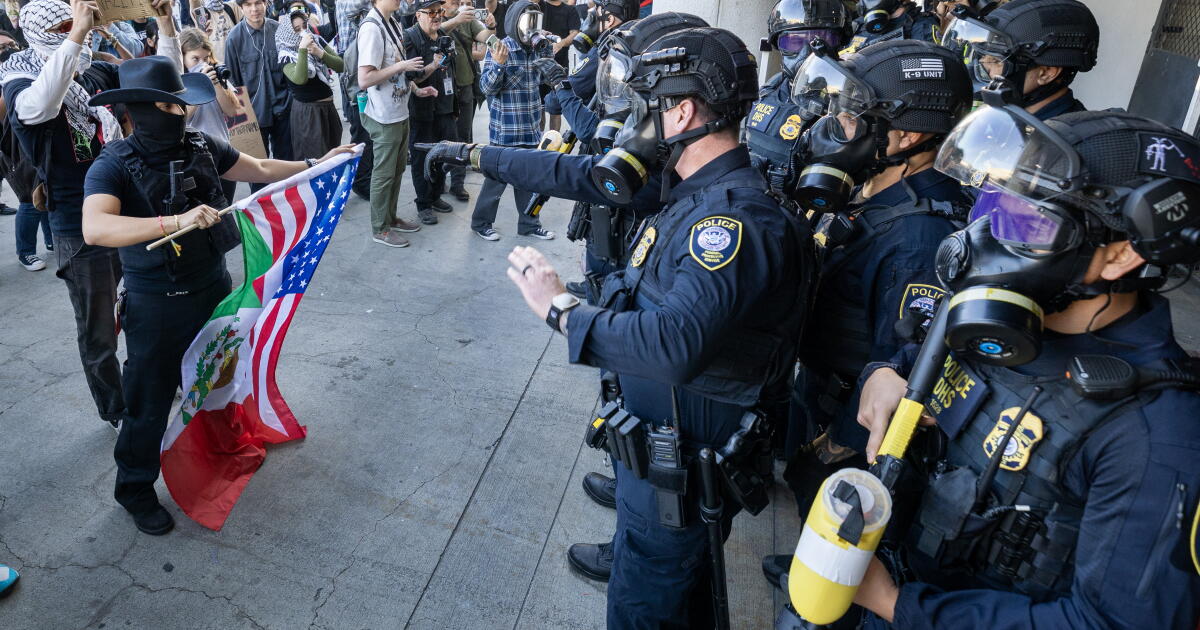
To show solidarity with the hunger strike, protesters have been gathering outside Delaney Hall, locking arms to form human chains and creating barricades to prevent access.
But that has led to tense confrontations with law enforcement, who have used batons and pepper spray to try to clear roads to the facility.
Governor Mikie Sherrill called for the establishment of designated protest zones, to mitigate the likelihood of conflict between officers and demonstrators.
But clashes have continued. Overnight on Wednesday, six protesters were arrested.
Politicians themselves have encountered tense interactions at Delaney Hall.
A year ago, one protest resulted in trespassing charges against Mayor Baraka and assault charges against US Representative LaMonica McIver, after a disagreement over which officials could enter the facility for an inspection.
While the charges against Baraka were dropped, McIver continues to face legal proceedings. She has denied the charges and called the prosecution politically motivated.
“One year ago, the Trump administration threw baseless charges against me for conducting oversight to protect immigrants at Delaney Hall,” McIver wrote on social media on Saturday.
“Have they tried to silence me? Yes. Have the stakes risen? Yes. Am I backing down from speaking up for you? Never.”
This past week, Governor Sherrill was also denied access to the facility. She has since issued a statement calling for Delaney Hall to be shut down.
At a news conference on Saturday, she blamed “national extremist groups” for arriving from out of state and escalating tensions. She added that the current precautions were designed to protect the safety of peaceful protesters.
“I urge those protesting outside of Delaney Hall to bring the temperature down, so we can focus on the detainees and their families,” Sherrill said.
She suggested that the actions of state and local officials would help head off any expanded ICE operations in New Jersey.
“I will not give ICE a pretext to expand operations at Delaney Hall or across our state. I will not put lives at risk,” she said. “I’m grateful to the vast majority of protesters who have assembled peacefully and raised their voices about Delaney Hall’s conditions.”
May 31 (UPI) — Newark, N.J., Mayor Ras J. Baraka instituted a curfew early Sunday in the area around an immigration detention facility where protesters have gathered in reaction to a hunger and labor strike there.
Baraka’s announcement came amid growing conflict between those supporting the hunger strikers at Delaney Hall detention facility and those who support the Trump administration’s immigration crackdown. The strike has been in effect since May 22 with detainees protesting what they describe as inhumane conditions at the facility.
Supporters of the strikers have gathered outside the facility since the start of the strike, and some have gotten into scuffles with Immigration and Customs Enforcement officials, prompting anti-immigration protesters to join the demonstrations.
“Due to the escalating situation at Delaney Hall and the increasing need for police intervention, immediate action is required to protect public safety,” Baraka said in a statement. “Multiple individuals have already been arrested and found in possession of weapons, underscoring the seriousness of the threat.”
Baraka said the curfew went into effect at midnight and applied to a half-mile surrounding the facility. He closed Doremus Avenue to all pedestrian traffic and limited vehicle traffic to those with official business in the area.
“This curfew will remain in effect nightly from 9 p.m. to 6 a.m. until further notice,” the mayor said.
In his statement, he said those violating the curfew will be issued a warning, and non-compliance would “result in removal from the area and the issuance of appropriate summonses and/or further legal action.”
Democratic and Republican candidates vying to replace Democratic Gov. Gavin Newsom have been sparring on televised debates and exchanging campaign attacks since April to garner the attention of voters statewide.
The candidates include a Riverside County sheriff, a former senior advisor to British Prime Minister David Cameron, a former Los Angeles mayor, a billionaire hedge fund founder and two former members of the U.S. House of Representatives.
Recent polls showed that the leading Democratic candidate is Xavier Becerra, a former U.S. Secretary of Health and Human Services whose campaign is focusing on affordability and housing for what he calls “working Californians.” Vying for one of the top two spots in the June 2 primary are Republican contender Steve Hilton, a former Fox News commentator who was endorsed by President Trump, and Democratic billionaire Tom Steyer, a hedge fund founder turned environmental warrior.
Here is what the top candidates have said on important topics such as immigration, housing and homelessness, affordability and the entertainment industry.
Immigration and ICE
The U.S. Immigration and Customs Enforcement raids that began in California last summer have been hotly debated by Democratic and Republican candidates.
Here is what the candidates said during a debate in May or stated on their websites, as well as some criticism they have faced during the campaign.
Xavier Becerra vowed to protect and lead the state against the Trump administration’s attacks on immigrants and marginalized communities. Becerra’s rivals have accused him of failing to protect migrant children when he served as Health and Human Services secretary under the Biden administration.
Riverside County Sheriff Chad Bianco opposes “sanctuary city” laws that block local law enforcement from assisting federal immigration agents, calls for the deportation of criminal illegal immigrants and says the border must be secured. But he has also faced criticism from fellow Republicans for supporting a pathway to citizenship for lawful, working undocumented people and telling his constituents that his deputies were not taking part in Immigration and Customs Enforcement raids.
Former Fox News host Steve Hilton, who legally immigrated to the United States from the United Kingdom, opposes California’s state and local sanctuary policies, and said the state must cooperate with the federal government because the governor’s job is to enforce laws, whether the governor agrees with immigration enforcement activity or not.
San José Mayor Matt Mahan plans to demand ICE officers be unmasked, vows to go after agents and immigration agency leadership when they violate the constitution and shield communities from unwarranted harassment.
Former Congresswoman Katie Porter said California should enforce its sanctuary laws statewide, “so we don’t have crazy cowboys taking the law into their own hands.”
Billionaire hedge fund founder Tom Steyer wants to strengthen California’s laws to ensure law enforcement agents can’t profile Californians based on their race, ethnicity, language, occupation or location. He also wants legislation that will grant the state attorney general the authority to hold ICE agents accountable for violent and illegal acts on the job. He supports abolishing ICE. But he has faced heat on the campaign trail for his former hedge fund’s investment in the Corrections Corp. of America, now known as CoreCivic, which operates private prisons around the nation that are housing people picked up by federal immigration agents. Steyer has repeatedly expressed remorse about his former firm’s ties with the company and said he personally ordered the divestment from private prisons before he sold his stake in the hedge fund.
State Supt. of Public Instruction Tony Thurmond says he plans to levy a new tax on companies that operate ICE detention centers, fight to abolish ICE, protect California’s sanctuary laws and work with Congress to establish a pathway to citizenship.
Former L.A. Mayor Antonio Villaraigosa supports helping law-abiding immigrants and said violent criminals have been deported under the state’s sanctuary laws, despite claims to the contrary by Republican candidates.
Housing and homelessness
Here’s what each candidate said about the need to address the state’s housing shortage and its stubborn homeless problem:
Becerra said he plans to cut “unnecessary red tape” and speed up “approvals for projects that meet affordability and environmental standards.” On homelessness, Becerra said he wants to establish a $150-million annual homelessness prevention fund to pay rents and fight eviction or foreclosure.
Bianco said he wants to end “overregulation of our building industry” and eliminate the California Environmental Quality Act, the California Coastal Commission and the California Air Resources Board. On homelessness, he wants cities to clear encampments and prioritize mental health and substance abuse treatment. He wants to force people to accept drug treatment “when necessary.”
Hilton proposes to reform the California Environmental Quality Act so that only government prosecutors can sue, preventing private individuals and organizations from stopping or delaying new housing projects. He also said he believes rent control measures reduce the incentive to build housing and wants to restructure or eliminate them. On homelessness, Hilton wants to build more low-cost group shelters instead of permanent housing.
Mahan said he wants to lower developer fees and taxes for infill housing. Mahan also said more homes should be built off-site in California-based factories, making them cheaper than building them on site. On homelessness, Mahan wants to make the state’s Homeless Housing, Assistance and Prevention grant permanent and fund it at $1 billion a year.
Porter said she would “greenlight innovative building strategies, shred unnecessary red tape and create incentives” to build needed housing. On homelessness, Porter wants more interim housing, emergency rental assistance and rapid rehousing programs.
Steyer is pledging to make it harder for large corporations to buy up the state’s housing stock and wants to encourage cheaper methods of home construction. On homelessness, Steyer wants to expand interim housing options and homeless services.
Thurmond said he wants to build 2 million new homes for “working Californians,” on 75,000 acres of surplus land that local school districts own. On homelessness, Thurmond wants to increase the number of housing units that include mental health and substance abuse services.
Villaraigosa said he wants to cut development fees and reform CEQA to speed housing development, particularly for infill housing. On homelessness, Villaraigosa wants to double the state’s investment in Newsom’s Homekey program to build an additional 10,000 units of permanent supportive housing over five years.
A comprehensive guide on the candidate’s full views on housing and homelessness is here.
What the candidates have said about affordability
The candidates offered their ideas for making California more affordable during debates in April and May as well as on their websites.
Becerra said he will stand up to price gouging and unjustified rate hikes and use the power of the state to lower prices “where the market has failed.”
Bianco says he wants to cut taxes for working families and businesses, stop the “over-regulation on California’s economy,” support job growth and unleash the state’s energy resources to lower the price of gas and utilities.
Hilton said he wants to eliminate income taxes on people who earn less than $100,000 and on the first $100,000 for Californians who earn more than that. He also wants to end California’s current tax on tips to ensure tipped workers keep more of their earnings.
Mahan said he wants to enact a “Gas Tax Holiday” that ends or reduces the tax on gas. He also wants to remove barriers to building affordable housing by putting a cap on fees charged for new housing construction.
Portersupports single-payer healthcare, providing free child care and college tuition and making wealthy corporations pay their “fair share” in taxes. To pay for it, Porter would impose a progressive corporate tax, meaning more profitable businesses and corporations would pay a higher rate. She also supports ending income taxes for those who earn less than $100,000.
Steyer called himself the only candidate who is “willing to take on the corporate special interests” that drive up the cost of living in the state. He said he would like to lower gas prices as well as streamline permitting, reform zoning and enforce laws to build affordable homes faster. He also supports single-payer healthcare.
Thurmond wants to provide a tax credit to make it easier for Californians to pay for the rising cost of gas, groceries and housing. He plans to establish a universal childcare program and provide low-cost loans to help small businesses make improvements at their firms.
Villaraigosa plans to support a California Fuel Affordability Guarantee to cap gas prices for working families.
The entertainment industry
Here’s what some candidates have listed on their campaign websites about their ideas to support California’s entertainment industry.
Becerrasupports state requirements that mandate productions disclose how AI is being used, cutting the “bureaucratic friction” of getting a filming location permit and vows to uphold the state requirement that ensures digital platforms share meaningful performance data with the cast, writers and directors.
Hilton wants to restore California’s competitive edge as a place for productions by creating financial incentives for film productions, cover the initial and technical costs associated with the development of a film or television project and reserve funding for independent and mid-budget projects.
Mahan said he plans to expand and modernize production incentives, make them more competitive and ensure the protections are for everyone who works on a film or television project from the technical crew to writers, directors and actors.
Steyer said he would like to block corporate mergers in entertainment, defend and expand film tax credits and eliminate the regulations and hurdles for permitting and logistics that “slow down productions.”
Times staff writers Seema Mehta, Nicole Nixon and Andrew Khouri contributed to this report.
The charges stem from the January 14 shooting of Julio Cesar Sosa-Celis in Minneapolis during Operation Metro Surge.
An Immigration and Customs Enforcement (ICE) agent charged with shooting a Venezuelan man during a controversial immigration raid in Minnesota has been arrested in Texas, according to United States authorities.
Agent Christian Castro, 52, was taken into custody on Friday after investigators from Minnesota tracked him down in the southern state, where he was arrested with assistance from the Texas Rangers and the Department of Homeland Security’s (DHS) inspector general’s office. He faces four counts of second-degree assault and one count of falsely reporting a crime.
Recommended Stories
list of 3 itemsend of list
The charges stem from the non-fatal shooting on January 14 of Julio Cesar Sosa-Celis in Minneapolis during Operation Metro Surge, a large-scale immigration enforcement campaign that drew widespread criticism for its aggressive tactics.
Prosecutors allege Castro fired through the front door of a residence, striking Sosa-Celis in the leg.
“Mr Castro was charged earlier this month with four counts of second-degree assault and one count of falsely reporting a crime for an incident on January 14, 2026, when he discharged his weapon through the front door of a home knowing there were people who had just run inside,” the Hennepin County Attorney’s Office said in a statement.
“The bullet travelled through the door and struck one victim in the leg before making its final impact in the wall of a child’s room.”
Minnesota officials welcomed Castro’s arrest, saying federal agents should be held to the same legal standards as everyone else.
“In Minnesota, we believe in equal justice under the law. That means nobody is above the law, including agents of the federal government,” said Minnesota Attorney General Keith Ellison. “I am pleased to hear Christian Castro has been taken into custody and will stand trial for the crimes he allegedly committed in Minnesota.”
Operation Metro Surge faces increasing legal scrutiny
The case became a flashpoint after federal authorities initially claimed Sosa-Celis and another man had assaulted ICE officers.
Those allegations later unravelled when video and other evidence emerged that contradicted agents’ accounts, prompting prosecutors to drop charges against Sosa-Celis and his housemate, Alfredo Aljorna.
The DHS later acknowledged that officers involved in the incident had provided false information about the shooting.
The outgoing director of ICE, Todd Lyons, also indicated a federal investigation was under way. “Lying under oath is a serious federal offense,” he said.
But through a spokesperson, ICE rejected Minnesota’s effort to prosecute the agent involved, calling the case “unlawful” and “a political stunt”.
Castro is the second federal officer charged this year in connection with Operation Metro Surge, an unusual step that reflects growing scrutiny of federal agents’ conduct during the immigration crackdown.
Hennepin County Attorney Mary Moriarty is also pursuing investigations into other incidents linked to the operation.
Operation Metro Surge began in Minnesota in December 2025. By the time Sosa-Celis was shot on January 14, hundreds of federal agents had been deployed across the Minneapolis-St Paul area in what officials described as the largest DHS operation in US history.
The crackdown ultimately prompted intense controversy, particularly after the fatal shootings of two US citizens: Renee Good on January 7 and Alex Pretti on January 24.
Against that backdrop, the investigation into the Sosa-Celis shooting further intensified scrutiny of federal agents’ tactics and conduct during the operation.
Since then, speculation has congealed into reality.
By almost any measure, tourism to the United States has cratered. Overall, it was down 5.5% last year from the year before. Visitors from Canada, traditionally the largest pipeline of foreign tourism, plummeted 21%.
Even with global anticipation building, the path to the U.S. for many World Cup travelers feels increasingly less like a red-carpet welcome.
— American Hotel & Lodging Association
That’s the largest drop from any country, according to statistics from the Commerce Department’s International Trade Administration cited by the Congressional Research Service. The runner-up is Germany, with a decline of 11.3%.
Expectations have faded that this summer’s World Cup games, which begin in the U.S. on June 12 with USA vs. Paraguay at SoFi Stadium, would buoy the flow of foreign visitors. Hotel bookings show that hasn’t happened, as my colleague Caroline Petrow-Cohen reports. According to an April survey by the American Hotel & Lodging Assn., hotel operators in all 11 of the U.S. host cities say that bookings are below their expectations.
Get the latest from Michael Hiltzik
Commentary on economics and more from a Pulitzer Prize winner.
By continuing, you agree to our Terms of Service, which include arbitration and a class action waiver. You agree that we and our third-party vendors may collect and use your information, including through cookies, pixels and similar technologies, for the purposes set forth in our Privacy Policy such as personalizing your experience and ads.
Those figures bode ill for the 2028 Los Angeles Olympics, whose organizers are also counting on a robust flow of foreign visitors.
More than 65% of the Los Angeles hotels responding to the survey reported dashed expectations, the association said. That wasn’t the worst result; the percentage was higher in five host cities, led by Kansas City, where nearly 90% of survey respondents reported booking paces below expectations.
The association identifies several reasons for the lackluster bookings, including botched planning by FIFA, the World Cup’s governing body. But much of the blame falls on issues created by one person: President Donald Trump. These include “increased gas and jet fuel prices,” which are artifacts of Trump’s Iran war and its upward pressure on oil prices.
The survey also points to concerns about visa availability and the treatment of foreign visitors once they land in the U.S. or cross the border.
The administration has disavowed any intention to interfere with the World Cup or the Olympics.
“Thanks to President Trump’s leadership, the FIFA 2026 World Cup will no doubt be one of the greatest and most spectacular events in the history of mankind,” White House spokesman Davis Ingle told me by email.
“International visitors who legally come to the United States for the World Cup have nothing to worry about,” the Department of Homeland Security said. “What makes someone a target for immigration enforcement is whether or not they are illegally in the U.S. — full stop.”
Trump pledged in 2018, when FIFA was weighing bids to host the 2028 World Cup, that “all eligible athletes, officials and fans from all countries around the world would be able to enter the United States without discrimination.” But concerns remain that family members of participating athletes might face restrictions on entering the U.S.
Vance said the U.S. wants foreign visitors “to come, we want them to celebrate, we want them to watch the games. But when the time is up, we want them to go home, otherwise they will have to talk to Secretary Noem.” (Trump subsequently ousted Kristi Noem as Secretary of Homeland Security, replacing her with former Sen. Markwayne Mullin, Republican of Oklahoma.)
Trump also committed himself to safeguarding the L.A. Olympics, stating, “I’m going to be supportive in every way possible and make them the greatest games.”
Yet America’s standing as a world-class tourist destination has plainly soured under Trump.
“Even with global anticipation building, the path to the U.S. for many World Cup travelers feels increasingly less like a red-carpet welcome,” the Hotel & Lodging Assn. observed.
“There is a perception that international travelers may face lengthy visa wait times, increased visa fees, and lingering uncertainty around entry processing. For those who do make the journey, concerns do not end at the border — questions about airport security screening wait times and airport congestion add another layer of hesitation.”
None of this should come as a surprise. As I projected last June, two administration initiatives in particular were poised to affect the World Cup and Olympics. The first was Trump’s crackdown on immigration.
Immigration agents, I noted, were acting as though they had carte blanche to detain people suspected of being in the U.S. illegally, conducting raids that sometimes swept up American citizens. That was before the Immigration and Customs Enforcement raids in Los Angeles, Minneapolis and other communities where immigration agents were accused of targeting specific ethnic and racial groups. And it was before the shootings of Renee Good and Alex Pretti in Minneapolis by immigration agents worsened their image as lawless thugs.
By then, however, stories had surfaced of foreign tourists being detained for weeks, even months, without explanation or apparent cause. A 65-year-old British woman named Karen Newman traveling on a valid tourist visa was arrested in September 2025 at the Montana border, shackled and held for six weeks in an ICE detention center. Other stories involved a German tourist who said she was held by ICE for 45 days, some of that time in solitary confinement; and a New Zealand woman who was detained with her 6-year-old son for three weeks.
The Department of Homeland Security didn’t deny that these incidents had occurred, though in relation to the New Zealand woman, whose visa had been only partially renewed, a U.S. Customs and Border Protection spokesman said, “When someone with an expired parole leaves the country and tries to re-enter the US, they will be stopped in compliance with our laws and regulations.”
The other policy that could interfere with the World Cup and Olympics are Trump’s travel bans and restrictions, which as of January covered 75 countries, including Brazil, Russia and 26 African countries.
Stringent regulations for some visa applicants — notably those coming to the U.S. to study or for work-study programs and their dependents — have further clouded America’s image as a destination. Applicants for those visas are required to open their social media accounts for the last five years for inspection by visa officers.
And Homeland Security Secretary Mullin last month raised the prospect of withdrawing customs officers from airports in so-called sanctuary cities, a move that would effectively shut down international flights at those airports.
The change couldn’t happen in time to affect the World Cup, but it could happen before the 2028 Olympics. Mullin’s idea didn’t win immediate favor with other members of Trump’s cabinet, including Transportation Secretary Sean Duffy.
Last year, the Department of Justice published a list of nearly three dozen states, cities and counties it defined as “sanctuary jurisdictions” because they “obstruct or limit local law enforcement cooperation” with ICE. Most are led by Democrats. They include California, and the cities of Los Angeles, San Francisco and Berkeley.
It’s true that immigration policies and rising travel costs are only part of the problem. The Hotel & Lodging Assn. also flayed FIFA for having block-booked hotel rooms in venue cities. These blocks “manufactured artificial demand by locking up large pools of inventory well ahead of the tournament,” the hotel group complained. The practice upended hotels’ planning by prompting them to increase staff and begin World Cup-themed renovations, preparing for crowds that may have been overestimated from the outset.
The block-booking “masked softer underlying traveler demand,” the association said, “with FIFA returning some blocks without a single reservation having been made.”
The hoteliers also groused that New Jersey and Philadelphia had proposed raising sales or lodging taxes in order to squeeze visitors. New Jersey lawmakers have proposed a short-term increase in its sales tax to 9.6% from 6.6% and in its lodging tax to 7.5% from 5%. Philadelphia is planning to raise its hotel tax to 10.5% from 8.5%.
None of this means that ticket sales for the World Cup won’t be healthy. FIFA has said that 5 million tickets have already been sold for the matches, even though the average price for even the cheapest seats at some venues tops $500. As my colleague Kevin Baxter has reported, fans are beginning to feel mulcted. That’s so especially because ticket buyers only learned the specific location of their seats after plunking down their money, at which point they discovered that they were placed in sections nowhere as desirable as they expected.
WASHINGTON — Last June 16, armed immigration agents broke the locks to forcibly enter an Oxnard auto body shop. Juan Carlos Ramirez, a U.S. citizen, filmed as they arrested his father.
Then the agents pepper-sprayed Ramirez, slammed him onto the hoods of two vehicles, punched his face and kneed him in the side, according to a legal claim he later filed against the federal government.
Local attorney Vanessa Valdez denounced Ramirez’s arrest at an Oxnard City Council meeting the next day. The following month, Valdez found herself in a similar situation when agents raided the cannabis company Glass House Farms.
Despite identifying herself as a legal observer, she said, agents — or possibly National Guard — deployed tear gas and shot her six times with rubber bullets. She ran and then, unable to see, crawled on all fours to escape.
Vanessa Valdez, a Ventura-based attorney, has filed a claim against the federal government, alleging she was hit with tear gas and six rubber bullets during the Glass House Farms raid last July.
(Christina House / Los Angeles Times)
“They were just shooting aimlessly, it seemed like,” she said. “I thought maybe they had fractured a rib because that’s how painful it was. I couldn’t sleep face down for three weeks.”
Ramirez and Valdez are among the dozens of U.S. citizens and immigrants who are seeking financial compensation for damages they say they suffered during President Trump’s immigration dragnet. For Valdez, that includes the cost of hospital visits, lost wages as she recovered, anxiety medication and seeing a therapist.
After reviewing public accounts and legal documents and interviews with more than a dozen lawyers and immigrants, The Times found that claimants from across the country are seeking at least $260 million.
In a statement, Homeland Security spokesperson Lauren Bis wrote that ICE officers are held to the highest professional standard and receive regular training. Bis said that when agents are faced with danger, they use their training to protect themselves and the public.
“The pattern is NOT of law enforcement using force. It’s a pattern of violent agitators attacking our law enforcement,” she wrote.
Asked about Valdez, Bis said law enforcement deployed chemical irritants including pepper balls, but not rubber bullets, after agitators attempted to breach the perimeter at Glass House Farms. She said Ramirez refused officer’s commands and physically attacked them, so they pepper-sprayed him in self-defense.
Lawyers who are experts in tort claims said the bureaucratic process is lengthy and complex, and any damage award would likely be lower than what a claimant is seeking.
Still, seeking redress through the Federal Tort Claims Act is one of the few legal remedies available for those seeking financial compensation for deaths, physical injuries, emotional trauma, unlawful detention or property damage caused by federal employees.
The number of claims is expected to rise.
Federal agents, some wearing street clothes and some wearing uniforms and protective gear, form a defensive line against hundreds of protesters outside the Metropolitan Detention Center in Los Angeles on Jan. 30.
(Allen J. Schaben / Los Angeles Times)
In recent months, advocacy organizations have prepared practice advisories for attorneys interested in filing tort claims, and law groups across the country have begun holding training sessions on the process.
“There is no question in my mind that a lot of people — hundreds, thousands — have been harmed significantly and will be legally entitled to large damages payouts, which are going to come from the federal government,” said Jonathan Feinberg, a Philadelphia-based attorney.
Feinberg, who specializes in cases involving excessive use of force by police and abuses of detained immigrants, is president of the board of directors for the National Police Accountability Project, which focuses on law enforcement misconduct.
“We’re going to be talking about Minneapolis in 2030,” he added.
Before they can sue in federal court, individuals must first request a review by the agency that they say is responsible, such as Immigration and Customs Enforcement or Customs and Border Protection. The agency has six months to respond and deny the claim or offer a settlement.
If the agency doesn’t respond or denies a claim, the claimant can then file suit.
Unlike civil rights lawsuits, in which juries decide the verdict, in tort cases, judges make that call. Only the agencies are named as defendants, not individuals.
The Times reviewed the claims of nearly 80 people filed since the start of 2025. The vast majority remain in the review stage. Lawyers anticipate most will not be settled, unleashing a flood of lawsuits starting this summer.
Federal law since 1871 has established that people can sue state and local officials for violating their constitutional rights. But the law left out federal actors.
One hundred years later, the Supreme Court allowed for damages lawsuits against federal officials who violate a person’s civil rights, though decisions in recent years have substantially narrowed that ability.
Democrats in California are pursuing legislation that would make it easier for residents to seek financial damages for constitutional violations committed by federal agents. Similar laws were already enacted in Maryland, Illinois and Connecticut, though the Trump administration has sued to block the latter two.
But there is a different route — tort claims.
Tort cases can be difficult to win, in part because the government can claim a “discretionary function exception,” which shields the agency from liability when the situation involves a policy-driven judgment call.
“So that’s what a lot of plaintiff’s lawyers are really anxious about, that the Trump administration is going to say, ‘Well, we’ve got our own immigration policies. Of course a lot of people disagree with them, but the statute is designed to give us the right to make those policy judgments,’” said Benjamin Zipursky, a Fordham University law professor who studies torts.
“Now, if I were the plaintiff’s lawyer, I would say, ‘Yeah, but shooting somebody in cold blood because you’re just mad about their political views, and they’re not really threatening your life at all — that’s not a policy judgment,’” he said.
The law office of John Burris, an Oakland-based attorney who represented Rodney King after he was severely beaten by Los Angeles police officers in 1991, has taken on damages clients in Minnesota. He said he anticipates filing around 80 tort claims stemming from the immigration enforcement actions there.
A memorial for Renee Good at the location where she was fatally shot in Minneapolis.
(Eric Thayer / Los Angeles Times)
Burris said the experience has given him flashbacks to the period before King’s beating and the subsequent protests over police brutality, when officers felt they could act with impunity.
“There’s 1779798656 a more fundamental understanding that bad stuff does happen,” he said. “Everyday people are not as willing as they once were to just accept a police officer’s perspective.”
Public disapproval over immigration enforcement rose after federal immigration agents in Minneapolis shot and killed two 37-year-old U.S. citizens, Renee Good, a mother of three, and Alex Pretti, an ICU nurse, in separate incidents.
Other deaths took place before the Minnesota operation: 23-year-old Ruben Ray Martinez, who was killed by an ICE agent in Texas who fired repeatedly through the open window of his car; Keith Porter, 43, who was killed in Los Angeles by an off-duty ICE agent after shooting his gun into the air on New Year’s Eve; and Jaime Alanis Garcia, 57, who fell 30 feet from atop a greenhouse while fleeing agents at the Glass House Farms site in Camarillo.
Lawyers for the families of Good, Martinez and Garcia confirmed they are pursuing tort claims. Lawyers for the other families did not respond to requests for comment.
Additional highly publicized cases have also resulted in tort claims: Marimar Martinez, who was shot five times by a Border Patrol agent in Chicago; Mahmoud Khalil, the Columbia University student and Palestinian rights activist who spent 104 days detained after the administration labeled him a national security threat; Aliya Rahman, a disabled woman on her way to a doctor’s appointment in Minneapolis who blacked out at a detention facility after ICE agents detained her.
New claims appear to be filed weekly. Seventeen men, women and children who were detained in a military-style raid at a Chicago apartment complex filed claims this month seeking about $5 million each.
In many of the cases, Bis said, the claimants impeded or assaulted agents. Pretti’s death remains under investigation, she said.
Willy Wender Aceituno stands in the parking lot where he was arrested last November by ICE agents in Charlotte, N.C.
(Jesse Barber / For The Times)
Willy Wender Aceituno was already a plaintiff in a class-action lawsuit filed by the ACLU of North Carolina challenging the policy allowing warrantless immigration arrests after he was stopped twice in a span of minutes by immigration agents last November. In March, he also submitted a tort claim.
Aceituno is a Honduran-born U.S. citizen who voted for Trump. On the day he was arrested, a group of masked agents checked his identification and left. Aceituno then filmed as a second group surrounded his red truck.
“If you break it, you will pay for it,” he tells them in Spanish seconds before one agent smashes the window with a baton. “Why did you do that, sir?”
Aceituno suffered cuts when agents threw him to the ground, which was covered in shattered glass. They placed him in an SUV with other detainees and drove him around Charlotte, N.C., before releasing him, still bleeding, more than 2 miles from his vehicle.
The moment brought back Aceituno’s childhood memory of watching his father be arrested by the Honduran military and disappeared.
“I remember they broke down the door, entered, put him in handcuffs and threw him to the ground,” he said. “I thought, ‘It’s happening again.’ To see the other Hispanics in the car made it feel like this is racial persecution. This is about skin, not criminality.”
Bis, the Homeland Security spokesperson, said Aceituno acted erratically, escalated the situation and refused to comply with officers’ commands.
Lawyers said many people, especially immigrants, who have viable claims have chosen not to pursue them out of fear of being targeted for deportation. Some were deported before they could sue.
“Even now, our clients wake up some days thinking, ‘What am I doing suing the federal government?’” said Iván Espinoza-Madrigal, executive director of the Massachusetts-based Lawyers for Civil Rights. “You have to have a lot of courage to be able to stand up against an administration that has put a bull’s-eye on you and that has targeted you based on your identity.”
Others have turned to mutual aid or online fundraisers to pay for medical bills or to repair property damage. On the website GoFundMe, donation campaigns describe shattered car windows, broken limbs, head trauma and mounting bills.
Some damage can’t be fully recompensated, Espinoza-Madrigal added.
Members of the Haitian community hold signs in support for the extension of Temporary Protected Status during a rally last month in Miami.
(Carl Juste / Miami Herald / Getty Images)
One of the organization’s clients is Jose Pineda, a Salvadoran man with Temporary Protected Status. A year ago, Pineda was stopped by ICE officers on his way to work in East Boston as a landscaper. They wouldn’t accept his Social Security and work authorization cards as proof enough that he was not deportable, and detained him without explanation, according to his tort claim.
So Pineda spent nearly two days in a holding cell at the ICE Boston Field Office with around 50 other people. He couldn’t sit or sleep and received minimal water and food.
Bis said agents “briefly questioned” Pineda because he matched the description of the subject of an operation, and that he was released after being identified.
When he was released, the claim alleges, his documents were returned but $600 in cash that he was saving to pay rent was not. The incident left him with frequent headaches, anxiety and memory loss, and exacerbated his gastritis. His absence from work resulted in a demotion from lead foreman to an assistant role.
“Whenever I drive, if someone stays behind me for three, four or five minutes, I start to imagine that it’s them again,” he said in an interview.
Pineda’s arrest also caused recurring nightmares that leave him shouting and thrashing around in bed. Out of fear that he could inadvertently harm his wife, they now sleep in separate beds.
SAN FRANCISCO — There are no immigrants waiting for rulings anymore at San Francisco’s main immigration court, no lawyers making arguments.
The court, which had 21 judges when President Trump was sworn in last year, had only two left when it closed May 1. The rest had been fired, retired or resigned amid a White House purge of federal immigration judges.
The closing is one more reflection of the turmoil that has upended the immigration court system as the administration looks for ways to churn through its massive backlog of 3.8 million asylum cases and deport as many people as possible.
Asylum denial rates have soared as the administration has fired almost 100 judges deemed to be too liberal, and approved using hundreds of military lawyers to replace them. Immigrants have been arrested when they arrive at courthouses or government offices for scheduled appearances.
But amid the nationwide upheaval, San Francisco is the first major city to be left without a primary immigration court, leaving chaos and dysfunction in a region long known for its friendliness to asylum seekers. The two remaining judges will work from another federal building in the city but will be part of an immigration court across the bay.
That reputation, court insiders say, might have led to its downfall.
“It was a vibrant legal scene and so I think if you were looking to target a court you would have to look at what San Francisco stands for,” said Jeremiah Johnson, an immigration judge in the city until he was fired in November. He is now executive vice president of the National Assn. of Immigration Judges.
Most of the court’s 117,000 immigration cases have been moved to a courthouse in Concord, a city about 30 miles away that opened two years ago to help with San Francisco’s backlog of cases. But turmoil has also reached that city. A courthouse that had 11 judges at the start of 2025 is down to five after a series of firings. It had a caseload of 60,000 cases even before the San Francisco cases were shifted over.
San Francisco’s immigration court, which had the third-highest number of asylum cases in the nation, was long considered one of the most favorable to people seeking asylum. From 2019 to 2024, almost 75% of petitioners received some form of relief, compared with 43% nationwide, according to data compiled by the Transactional Records Access Clearinghouse, a nonprofit data research center based at Syracuse University.
That’s partly because San Francisco, with its vast network of pro-immigrant organizations and pro bono or low-cost legal services, had one of the country’s highest rates of legal representation for immigrants.
The Executive Office of Immigration Review, the Department of Justice branch that oversees immigration courts, announced in March that it would close the San Francisco courthouse in 2027 as a cost-saving measure and move its cases to Concord. But the end came early after nearly all the San Francisco judges left or were fired. The Executive Office provided no detailed explanation for the changes, saying in a statement only that it had decided not to renew its lease for the court, and doesn’t comment on personnel matters.
Tight security in Concord courts
Security is tight at the Concord courthouse, perhaps because of the new influx of cases. Armed security guards ask every person if they are carrying weapons or explosives, and they watch as each person turns off their cellphone. Even coffee is not allowed in. Only water is acceptable, and then only if it’s in a transparent bottle.
Judah Lakin, an immigration attorney based in Oakland who also teaches at UC Berkeley School of Law, said the closure of the San Francisco court has made cases more time-consuming since it’s harder for his clients, who often travel from hours away, to reach Concord on public transportation.
One recent 10-minute hearing in Concord took him more than two hours of travel, he said.
But beyond logistics, Lakin said the chaos in immigration courts under the Trump administration has created a fraught court atmosphere. Mass firings have led to last-minute hearing cancellations, cases have been reset with little notice, and clients are often left in prolonged legal limbo, leaving them vulnerable to deportation.
One of his clients, he said, was provisionally granted asylum by a judge, who was then fired before signing the decision. The case was transferred to a second judge, who was also fired. Now on their third judge, his client is still waiting.
“The ground is constantly shifting underneath your feet, whether it’s judges being fired and hearings getting canceled, whether it’s your clients getting arrested, whether it’s getting denials on things that used to be standard and routine,” Lakin said.
“I think that’s on purpose. That’s by design. It’s part of the strategy,” he added.
‘Heartbreaking’
San Francisco’s immigration court was one of the first in the nation to hire judges with non-prosecutorial backgrounds, with many having previous experience working with immigrants at nonprofits or defending them in court.
To see the court close is “heartbreaking,” said Dana Leigh Marks, a former San Francisco immigration judge who retired in 2021 after 35 years on the bench and who was among the first judges in the nation to be hired from private practice.
She sees the Trump administration’s decision to close the largest immigration court in Northern California as part of an effort to undermine due process and eventually dismantle the path to asylum.
“It’s all a part of big ways and little ways that the Trump administration is trying to get noncitizens out of the country,” she said.
Johnson, the fired San Francisco judge, was appointed during the first Trump administration. He believes he was targeted because he granted asylum in 89% of the cases he heard.
“You don’t fire judges if you disagree with the way they’re handling a case; that’s not how courts work. If you disagree, you appeal that decision,” he said.
Johnson, who is the executive vice president of the National Assn. of Immigration Judges, defended his judicial record, pointing out that over eight years, only about 10 of his cases were appealed by the Department of Homeland Security, and very few were sent back for further hearings by the Board of Immigration Appeals.
Unlike federal courts, where there are strict rules of procedure and judges have lifetime tenure, the Justice Department runs immigration courts, and the attorney general can fire the judges with fewer constraints.
There were 754 immigration judges across the country at the start of Trump’s second term. Now, there are about 600, including some temporary judges, according to data collected by the judges’ union. Widespread courthouse arrests of immigrants have caused hundreds of people not to even show up for hearings, leading to deportation orders in absentia.
Nidaa Pervaiz came to the Concord court on a recent day to represent a client from Nepal. She prefers the new courthouse in some ways, since it’s closer to her home.
But, she said, she and her clients are already feeling the impact of the changes. Fewer judges leads to fewer hearings. That means more delays for her clients, whose paperwork can expire even before they can appear before a judge.
“Their whole lives are at stake, and they are coming to make a plea for their future” she said.
PHOENIX — As Sandra Ramirez watched footage of immigration officers cracking down on migrants over the past year, she knew her 2024 vote for Donald Trump was a mistake.
“There are a lot of people who are being harassed for the color of their skin, and that’s not right,” said Ramirez, who broke from her Democrat-voting family to cast a ballot for Trump.
“I’ll never go Republican again,” she said.
Trump made inroads with Latino voters like Ramirez during the 2024 elections, earning support that helped propel him to a second term in the White House.
As Republicans gear up for midterms this fall and look ahead to presidential elections in 2028, all eyes are on whether they can hold on to that key support or whether the administration’s sweeping immigration crackdown and an economy beset by high prices may drive Latino voters away.
Support among Latino Trump voters shows signs of softening
Latino voters have historically been largely aligned with the Democratic Party but during the 2024 election, they shifted significantly toward Trump. A majority still supported Democrat Kamala Harris for president, but Trump made big gains: 43% of Latino voters nationally voted for him, compared with 35% in the 2020 presidential election, a change attributed in part to their concerns about the economy.
Trump returned to office pledging to crack down on immigration, a promise that prompted arrest sweeps, often against Latino migrants, in homes, workplaces and schools, among others. According to an AP-NORC poll, more than half of Latino adults report knowing someone impacted by the Trump administration’s aggressive immigration enforcement.
More than a year into Trump’s second term, polling suggests a significant drop in support for the president among Latinos who voted for him in 2024, although a majority still supports him.
According to a Pew Research Center poll conducted in April, support for the president fell among non-Latino voters from 95% to 79% between February of last year and April of 2026. But among Latino voters who cast their ballot for Trump, the drop-off was more dramatic: 66% approved of his job performance in April compared with 93% at the beginning of his second term.
That national drop could prove crucial in a tight election in swing counties like Maricopa, the largest battleground county in the nation, which encompasses Phoenix and its suburbs. A third of Maricopa County residents are Latino, and one in four of them is an immigrant, according to the Latino Data Hub at UCLA.
Arizona, which also saw a slight increase in Latino support for Trump in 2024, has been a flashpoint in the immigration debate for years. Maricopa County Sheriff Joe Arpaio conducted high-profile raids in Latino communities and, later, the state saw large influxes of migrants during the Biden administration.
In outh Phoenix, opinions on Trump reflect deep divisions
On a warm afternoon in the predominantly Latino neighborhood of south Phoenix, a vendor at a street fair sold shirts imprinted with phrases like “Lowriders Sunday” while car club members polished their Chevrolets. The parking lot of the nearby Catholic church was full of parishioners attending Spanish-language Sunday Mass.
Albert Rodriguez, a Phoenix tattoo artist, said he once supported Trump. But then he saw how the administration was carrying out enforcement operations in Chicago, Minneapolis and Los Angeles.
He said the president promised to go after immigrants who were criminals, but instead Immigration and Customs Enforcement agents have been “hitting the paleta man,” referring to ordinary people trying to make a living from selling frozen treats.
“Big time, I regret it,” Rodriguez said of his 2024 vote for Trump.
Phoenix resident Ronnie Martinez, an Army veteran, backs Trump’s effort to stem crossings at the southern border.
“The border is only a hop, skip and a jump to our south. And I don’t want illegal alien criminals coming from Guatemala, Venezuela, Central America,” he said.
He didn’t like some of the images he’d seen of ICE arresting people in front of their children. But he was also sympathetic to ICE officers, who he said were doing the best they could in difficult situations, and he blamed Democratic officials who weren’t cooperating with immigration enforcement. He also cited economic initiatives as a reason for his continued support for the president, including the removal of taxes on tips and overtime.
Guadalupe Alaffa, another Phoenix resident, blamed President Biden’s policies for prompting Trump’s immigration crackdown.
“He left that damn border wide open,” said Alaffa.
Arizona battleground politics shaped by Latino voter influence
The growing influence of Latino voters is one of several factors that have eroded the GOP’s decades-long dominance in Arizona, putting the state at the center of congressional and presidential elections. Both of Arizona’s senators are now Democrats, along with the top three state officials.
Winning back some of the Latinos who shifted to Trump will be crucial to the reelection prospects of Gov. Katie Hobbs, Secretary of State Adrian Fontes and Atty. Gen. Kris Mayes, all Democrats first elected in 2022.
Democrats in Maricopa County have benefited from more than a decade of political organizing among Latinos mobilizing against hard-line immigration enforcement. The Republican-controlled Legislature in 2010 passed a state law known as SB1070, which required police to check the immigration status of anyone they suspected of being in the country illegally.
Around the same time, Arpaio was building a national profile on the right with immigration sweeps in largely Latino neighborhoods.
Some activists see the nationwide crackdown on immigrants as an extension of what Latinos in Arizona endured under Arpaio.
“We were the lab where they implemented a lot of this with Sheriff Joe and now it’s all over the United States,” said Salvador Reza, a longtime activist in Phoenix who advocates for the rights of day laborers.
For more than two decades, Arpaio was repeatedly elected while his department faced accusations of racially profiling Latino drivers and conducting sweeps in Latino neighborhoods and day labor areas. Deputies often stopped residents for traffic violations and turned noncitizens over to ICE, according to rights groups.
In 2013, a federal judge ruled his office had illegally profiled and detained Latinos, and a 2011 Justice Department report found widespread discrimination. After losing reelection in 2016, Arpaio was convicted of criminal contempt for defying court orders. He was later pardoned by Trump.
Rising prices and immigration enforcement erode Latino support
The GOP is at risk of losing some of the Latinos that Trump won over, said former Republican Gov. Jan Brewer, who signed the controversial 2010 bill. She cited economic concerns as a possible reason for the drop in support.
“With the inflation and the cost of living and the gasoline and the wars, I don’t know if they can afford to be a Trump Republican,” Brewer said.
Earl Wilcox, a longtime activist and restaurant owner in Phoenix, said between affordability issues and immigration enforcement, he believes Latino support for Trump is waning. Wilcox’s restaurant hosted Biden in 2024 when he launched an initiative meant to rally Latino support for the Democratic ticket.
“I don’t think the Republican Party will have the support it did the second time around,” Wilcox said, “and I think it started with the raids.”
Santana writes for the Associated Press. AP writers Jonathan J. Cooper and Amelia Thomson DeVeaux contributed to this report.
WASHINGTON — Senate Republicans appeared increasingly unlikely to meet their self-imposed deadline for passing a roughly $70-billion immigration enforcement bill this week as disputes over security funding for the White House and the Trump administration’s $1.8-trillion settlement fund effectively derailed progress.
Republicans were already expected to abandon $1 billion in security money for the White House complex and President Trump’s ballroom amid backlash from members of their own party. But then questions about the settlement fund added to some of the senator’s concerns. They are questioning who would get the money.
Republican senators met with acting Atty. Gen. Todd Blanche on Thursday as they worked to finalize the bill’s text and whether to put parameters on the settlement, which was designed to compensate Trump’s allies who believe they have been politically persecuted. Sen. John Thune (R-S.D.) told reporters that senators had questions and wanted to know “how we might make sure that it’s fenced in appropriately.”
But senators who emerged from the meeting were tight-lipped and indicated that lawmakers would not hold a vote on the package before leaving Washington for a Memorial Day break, risking failure to meet Trump’s June 1 deadline.
Asked about a vote this week, Sen. Susan Collins (R-Maine) responded, “I don’t even know.” Sen. John Kennedy (R-La.) was more blunt: “We’re going home,” he said.
The last-minute scramble comes as Democrats have criticized Republicans for trying to fund Trump’s ballroom when voters are concerned about basic affordability issues — and as some GOP lawmakers have grown increasingly frustrated with Trump. Several GOP senators have spoken out against the settlement, which was announced this week, and many were upset by the president’s endorsement Tuesday of Texas Atty. Gen. Ken Paxton in the party primary runoff next week against Sen. John Cornyn.
Asked Thursday at the White House if he was losing control of the Senate, Trump replied: “I don’t know, I really don’t know. I can tell you — I only do what’s right.”
Possible parameters on Trump’s settlement fund
The “anti-weaponization” fund, part of a settlement that resolves Trump’s lawsuit against the IRS over the leak of his tax returns, unexpectedly became one of the main complications in the bill. Democrats said they would force votes to block it or place restrictions on it.
Democrats have an opening because Republicans are trying to pass the immigration enforcement bill through a complicated budget process that requires a long series of amendment votes. Democrats are considering multiple amendments, potentially to block that new fund outright or to ban any payments to Trump supporters who harmed law enforcement officers in the Jan. 6, 2021, attack on the Capitol.
Presenting a united front, Democrats from both the House and Senate rallied on the Capitol steps Thursday to show their opposition. Senate Democratic leader Chuck Schumer of New York said the amendment process “will give Republicans countless chances to do the right thing.”
He added that if they declined to make changes, it would show voters that “Ballroom Republicans are not working for you, they are busy fighting for Trump.”
Those amendments, along with others, could pass as a growing number of Republicans have voiced reservations about the fund. So Republicans are now discussing their own last-minute additions to head that off, potentially placing some parameters on the settlement and who could receive compensation, according to two people with knowledge of the private discussions who requested anonymity to discuss them.
It was unclear how any Senate changes would be received in the House. House Speaker Mike Johnson (R-La.) said Wednesday that the House will pass the bill “whatever form it takes.”
Tensions rise between Senate and White House
As Republicans challenged the settlement and parts of his agenda, Trump unloaded on the Senate in a social media post on Wednesday.
He urged Republicans to fire the Senate parliamentarian, Elizabeth MacDonough, who said over the weekend that parts of the $1-billion security proposal cannot remain in the ICE and Border Patrol bill. Trump also renewed his long-standing calls for the Senate to pass the SAVE Act, a Republican bill that would require all voters to prove U.S. citizenship, and to end the Senate filibuster.
Republicans need to “get smart and tough,” Trump said, or “you’ll all be looking for a job much sooner than you thought possible!”
While they have been loyal to Trump on most issues, Senate Republicans have resisted his repeated calls — even in his first term — to kill the filibuster, which triggers a 60-vote threshold in the Senate.
Hanging over the growing GOP rift is Trump’s surprise endorsement of Paxton. That intervention has Republican senators privately fuming that it could cost them their majority in November as they view the incumbent, Cornyn, as the better candidate in the November general election.
Secret Service request falters
Under the Secret Service’s request, about $220 million would fund security improvements related to the ballroom. The rest would go for a new screening center for visitors, training and other security measures.
Sen. Thom Tillis (R-N.C.) said the effort to add the security package to the bill was a “bad idea.” The bill should not have included the other security improvements, he said, “because it’s just giving everybody the ‘billion-dollar ballroom.’”
Several other Republicans in the House and Senate have questioned the request, and senators left a briefing with the director of the Secret Service last week saying they needed a lot more information.
People “can’t afford groceries and gasoline and healthcare, and we’re going to do a billion dollars for a ballroom?” asked Louisiana Sen. Bill Cassidy, who lost reelection in his GOP primary on Saturday after Trump endorsed one of his opponents.
Left in the bill is the money for ICE and Border Patrol, which Democrats have blocked for months in protest of the administration’s immigration enforcement crackdown.
Democrats demanded changes for the agencies, but negotiations with the White House yielded little progress. So Republicans are using the complicated budget maneuver called reconciliation — the same process that allowed them to pass Trump’s tax and spending cuts bill last year — to fund the agencies through the end of Trump’s term with a simple majority and no Democratic votes.
Still, passage requires sign-off from the parliamentarian and unity from Republicans.
Jalonick, Freking and Groves write for the Associated Press. AP writers Collin Binkley, Lisa Mascaro and Joey Cappelletti contributed to this report.
MINNEAPOLIS — A Minnesota prosecutor on Monday announced charges against an Immigration and Customs Enforcement officer in the nonfatal shooting of a Venezuelan man during the Trump administration’s crackdown in the state.
The officer, Christian Castro, is charged with four counts of second-degree assault and one count of falsely reporting a crime in the Jan. 14 shooting of Julio Cesar Sosa-Celis, Hennepin County Atty. Mary Moriarty said at a news conference. A warrant was issued for his arrest.
“Mr. Castro is an ICE agent, but his federal badge does not make him immune from state charges for his criminal conduct in Minnesota,” Moriarty said, adding that Sosa-Celis never posed a threat. “There is no such thing as absolute immunity for federal officers who commit crimes in this state or any other.”
A federal officer shot Sosa-Celis in the thigh after he and another officer chased a different man to the apartment duplex where the man and Sosa-Celis lived. Moriarty said both Sosa-Celis and the other man were legally in the U.S.
Federal authorities initially accused Sosa-Celis and Alfredo Alejandro Aljorna of beating an officer with a broom handle and a snow shovel during the incident. But a federal judge later dismissed the charges, and federal officials opened an investigation into whether two immigration officers lied under oath about what happened.
Minneapolis last month released video of the incident captured from a distance by a city-owned security camera.
Department of Homeland Security and Justice Department officials didn’t immediately respond to emails seeking comment. Homeland Security previously said that lying under oath is a “serious federal offense” and that making false statements could result in an officer being fired or prosecuted.
The administration sent thousands of officers to the Minneapolis and St. Paul area as part of President Trump’s national deportation campaign. Homeland Security, which oversees ICE, called Operation Metro Surge its largest immigration enforcement operation ever and deemed it a success.
But tensions mounted during the weekslong campaign, and the shooting deaths of U.S. citizens Renee Good and Alex Pretti by federal officers provoked mass unrest and questions about officers’ conduct.
Hennepin County, which includes Minneapolis, has been conducting investigations into multiple incidents and filed charges last month against an ICE agent for alleged actions while on duty.
Minnesota leaders and the Trump administration have since clashed over which has the authority to investigate and prosecute officers for conduct while on duty. The Trump administration has suggested that Minnesota officials don’t have jurisdiction.
State officials have said they don’t trust the federal government to investigate itself or hold officers accountable.
“There’s no modern precedent for what happened to the people here in Minnesota,” Moriarty said Monday. “So it requires a lot of us to dig in and look at ways to hold people accountable that we probably never thought we would be looking at in our careers.”
Hennepin County continues to investigate Good’s and Pretti’s killings and sued the administration in March over access to evidence in the two cases, as well as in the case involving Sosa-Celis. Although Moriarty hasn’t charged anyone in either killing, she has said she’s confident her office’s investigations will bring transparency, even if not criminal prosecution.
Fingerhut and Sullivan write for the Associated Press. Fingerhut reported from Des Moines, Iowa.
WASHINGTON — A proposal to fund $1 billion in security additions for the White House campus and President Trump’s new ballroom fails to meet procedural rules, according to the Senate parliamentarian, dealing a blow to Republican plans to include it as part of a bill to fund immigration enforcement agencies for the next three years.
The parliamentarian’s ruling, described late Saturday by Senate Democrats, said that funding for a project as large and complex as Trump’s massive East Wing renovation is too broad to be included in the narrow GOP budget bill, which cannot be filibustered and needs only a simple majority to pass.
It’s unclear whether Republicans will be able to immediately salvage any part of the billion-dollar Secret Service proposal, which would fund security for Trump’s ballroom along with other parts of the White House, including a new visitor screening center, additional training for agents and extra reinforcements for large events. Republicans said Saturday night that they are revising the legislation based on the parliamentarian’s advice.
Ryan Wrasse, a spokesman for Senate Majority Leader John Thune (R-S.D.), wrote in a post on X that “none of this is abnormal” during the complicated budget process that Republicans are using to try to pass the immigration enforcement and White House security money on a partisan basis.
“Redraft. Refine. Resubmit,” Wrasse said in the post.
Democrats say they’re ‘ready to stop them again’
Democrats have seized on the security request, accusing Republicans of dedicating federal resources to the ballroom project instead of focusing on helping Americans with rising costs. Republicans have insisted that private donations will be used to build the ballroom and that the federal dollars are focused just on much-needed security enhancements.
Senate Minority Leader Chuck Schumer (D-N.Y.) took credit for the ruling after Democrats argued to the parliamentarian that the security money doesn’t belong in the bill.
“Republicans tried to make taxpayers foot the bill for Trump’s billion-dollar ballroom,” Schumer said Saturday evening. “Senate Democrats fought back — and blew up their first attempt.”
Schumer added that Democrats “will be ready to stop them again” as Republicans say they will revise the bill.
The ruling from the Senate parliamentarian is advisory, but such rulings are rarely if ever ignored when lawmakers put together legislation that can pass with a simple majority. Most bills are subject to a filibuster and thus need 60 votes for passage — meaning Republicans must find some Democratic support in the 53-47 Senate.
Part of immigration bill
Republicans are looking to approve a roughly $72-billion package to fund Immigration and Customs Enforcement and Customs and Border Protection until the end of Trump’s term after Democrats have blocked the money for months.
As part of that package, Republicans included $1 billion for White House security enhancements, part of it connected to Trump’s ballroom. The Secret Service had requested the money after a man was charged with trying to assassinate Trump at the White House Correspondents’ Assn. dinner last month.
The overall budget package is providing another boost of funding for Trump’s immigration and deportation agenda, fueling operations through September 2029. It comes on top of Immigration and Customs Enforcement and Border Patrol funds Congress provided last year in the One Big Beautiful Bill Act that Trump signed into law.
The parliamentarian kept most of the immigration portion of the legislation intact, though some minor provisions were blocked, including Customs and Border Patrol funds to hire, train and pay Border Patrol agents. Republicans said those were only technical fixes.
Oregon Sen. Jeff Merkley, the top Democrat on the Senate Budget Committee, said Saturday evening that “Democrats are prepared to challenge any change to this bill.”
Americans shouldn’t spend “a single dime” on Trump’s “Louis XIV-style ballroom and throw tens of billions more at two lawless agencies,” Merkley said.
Jalonick and Freking write for the Associated Press. AP writer Lisa Mascaro contributed to this report.
Tens of thousands of people marched in central London on Saturday in two protests: one against high immigration levels and another supporting Palestinians. Police deployed 4,000 officers, marking their most significant public order operation in years, and made 11 arrests by noon.
Prime Minister Keir Starmer criticized the Unite the Kingdom march for spreading hate, which was organized by anti-Islam activist Tommy Robinson. The government prohibited 11 foreign far-right figures from entering the UK to address the protest. A previous Robinson-led march attracted around 150,000 participants and resulted in over 20 arrests. Supporters at the recent march waved British and English flags, expressing concerns about high migration numbers and criticizing net-zero policies.
Protesters take part in a “Unite the Kingdom” rally organised by British anti-immigration activist Stephen Yaxley-Lennon, also known as Tommy Robinson, in London, Britain, May 16, 2026. REUTERS/Hannah McKay
Annual net migration peaked at nearly 900,000 in 2022 and 2023 but dropped to around 200,000 last year due to stricter visa rules. Immigration issues have impacted Starmer’s popularity and helped right-wing parties like Reform UK gain support. Some protesters expressed hostility towards Starmer, while Robinson called for peaceful actions during his rally.
Nearby, pro-Palestinian demonstrators commemorated Nakba Day, marking the loss of Palestinian land during the 1948 conflict. This march attracted those opposing Robinson’s protest and included displays of Palestinian flags. London has seen increased anti-Jewish incidents, leaving many Jewish individuals feeling unsafe in the area. The police have been making arrests for various public order offences related to these protests, and the government warned against antisemitic chants. Some slogans during the protest included calls related to the Israeli army that have led to previous arrests.
The former mayor of a conservative Kansas town was taken into custody by immigration authorities after acknowledging last year that he had voted in elections despite not being a U.S. citizen.
Joe Ceballos, who was born in Mexico and is a legal permanent U.S. resident, was detained Wednesday during a meeting at a U.S. Immigration and Customs Enforcement office in Wichita, Kan., according to his attorney, Jess Hoeme. He said Ceballos now fears he could be deported.
The 55-year-old resigned as mayor of Coldwater in December while facing state charges over voting as a noncitizen. While seeking citizenship in 2025, Ceballos admitted during an interview that he had voted, not knowing that green card holders don’t qualify, Hoeme said.
Ceballos was charged with voting illegally but pleaded guilty in April to misdemeanors in a deal with the Kansas attorney general. His case has drawn attention from the Trump administration and inspired supporters in his community, some of whom held signs reading “We Support Mayor Joe” and “ICE Out” as Ceballos walked into the federal building in Wichita.
“Let Joe go!” the crowd yelled.
“Thinking what could happen — it’s just kind of crazy,” Ceballos told reporters. “Obviously nervous. I don’t know what’s going to happen. I don’t know where they’re going to take me and what I can and can’t do inside there.”
An email seeking comment from the Department of Homeland Security was not immediately returned.
Trump and other Republicans have been warning of the dangers of noncitizens voting in elections since the beginning of the 2024 presidential election. Research, even by Republican election officials, show the problem is rare.
This year, Trump has been pushing Republicans in Congress to pass the SAVE Act, which among other things would require documented proof of U.S. citizenship to register and vote.
The administration also has significantly upgraded a program within Homeland Security that checks citizenship. At least 25 states, most of them controlled by Republicans, have used that system to check their voter rolls.
Ceballos was brought to the U.S. from Mexico by family when he was 4 years old. Hoeme said lawyers would next try to get an immigration judge to release him on bond.
He said Ceballos, at age 18, was encouraged to register to vote on the spot during a school field trip to the Comanche County courthouse. Ceballos has previously said in interviews with reporters that he voted for Republicans.
He was twice elected mayor of Coldwater, population 700, and also served on the city council. Ceballos won a new term in November but resigned after state Atty. Gen. Kris Kobach charged him with voting without being qualified and election perjury.
Kobach’s office, however, reached a deal with Ceballos. He pleaded guilty to disorderly election conduct, which Hoeme described as a misdemeanor similar to disturbing the peace.
“He has not been convicted of any kind of voter fraud. It should not have impacted his immigration status,” Hoeme said. “The Trump administration and ICE have doubled down on nonsense that he is a criminal.”
Ceballos has been a popular figure in Coldwater, where an advertisement in the Western Star newspaper encouraged people to support him.
“He’s kind of got to live the American dream, to come from absolutely nothing and build up — I don’t know about wealth — but to build up a business and have a job and be a productive part of society,” longtime friend Ryan Swayze told Wichita station KAKE-TV.
NEW YORK — A federal immigration court in Lower Manhattan has come to represent the Trump administration’s deportation campaign in New York City, with agents carrying out chaotic and sometimes violent arrests in the hallway as migrants leave hearings.
Now the court is serving as a front in a different kind of battle: one of the city’s most closely watched congressional races.
In the Democratic primary between incumbent U.S. Rep. Dan Goldman and former city Comptroller Brad Lander — for a district so solidly blue that the June primary is considered its deciding election — both candidates have made the Trump administration’s treatment of migrants at 26 Federal Plaza a feature of their campaigns, but with decidedly different approaches.
Goldman — an heir to the Levi Strauss denim fortune and former prosecutor who was lead counsel for President Trump’s first impeachment — has approached the topic with a lawyerly bent that leverages the power of his office.
He sued the administration to open immigration detention centers to members of Congress, conducts oversight visits and turned his office across the street into what he’s called a triage center that connects immigrants with advocacy groups and legal services that has, his campaign said, helped more than 30 people get released from federal custody.
After a recent visit, Goldman credited his oversight work as a reason conditions at a holding facility inside the building have improved.
“What you see from our multipronged approach is the way that I push back, which is not performative, but it is substantive,” he told the Associated Press outside 26 Federal Plaza after he toured the detention center that is closed to the public.
Meanwhile, Lander — a progressive city government stalwart who is running with the support of Mayor Zohran Mamdani — has acted as protester and court observer, watching hearings and attempting to accompany immigrants out of the building past masked federal agents.
His efforts have gotten him arrested twice, with the most recent case headed to a trial scheduled to take place just before the primary.
“I would characterize his oversight function as strongly worded letters,” Lander told AP when asked about Goldman’s approach. “And my oversight function is: Show up with hundreds of your neighbors and bear witness and accompany people and demand access and stay until they give it to you or they arrest you.”
Lander’s first arrest happened last year when he linked arms with a person authorities were attempting to detain in the hallway outside the court. Lander was running for mayor at the time, and the arrest gave his campaign a jolt of excitement at a time when Mamdani and former Gov. Andrew Cuomo were considered the front-runners in the race.
A few months later, after losing the mayoral primary but not long before launching his congressional campaign, Lander was arrested again during a large protest at the building and hit with a misdemeanor obstruction charge.
But instead of accepting a deal that would have made the case go away in six months, Lander instead opted to go to trial. He said the case would extract information about the federal government’s immigration enforcement efforts at the building during a tense period that predates Goldman’s oversight visits.
Goldman dismissed Lander’s efforts as performative.
“I don’t understand why someone would reject a dismissal of a case so that he can have a public trial, ostensibly to ask for information that I could provide him whenever he wanted because I have the answers from doing my oversight,” he said.
This week, Lander returned to 26 Federal Plaza to sit in on hearings. But just before entering the building, his team got word that federal agents were lingering outside an immigration hearing at a different federal courtroom in a building across the street. He raced over and eventually found the agents, who were wearing masks and milling around in the court’s waiting room.
“The challenge is trying to figure out who they’re going to arrest,” Lander said, popping out of the hearing, where he sat in a back row and took notes. After a while, the agents walked away from the hearing room, down a hallway and exited the floor. It was not clear why they left.
“Maybe we have different styles,” Lander said of his opponent after the agents departed. He later went back across the street and filmed a campaign video in front of 26 Federal Plaza.
SACRAMENTO — As Los Angeles prepares to host the 2028 Olympics, state lawmakers are raising concerns that potential clashes with President Trump could cause chaos.
State Sen. Susan Rubio (D-Baldwin Park), speaking at a legislative hearing this week on the 2028 Games, expressed concern about Trump’s animosity toward California and questioned whether that could affect the federal financial support that is essential to the Olympics.
“I know we rely a lot on the federal funding,” Rubio said. “Can you assure me that we’re not going to be left in the middle of the planning carrying the bag?”
Rubio was addressing Joey Freeman, the vice president of state affairs for the LA28 Organizing Committee, who testified before lawmakers.
Freeman assured legislators that the organizing committee had a “wonderful working relationship” with the Trump administration. He said the committee successfully advocated for $1 billion in federal funds for state and local law enforcement, and $94 million to boost transportation planning.
LA28 leaders previously projected that the Games will cost more than $7.1 billion. They’ve said the money will come from a mix of sources, including corporate sponsors, ticket sales, merchandise, the federal government and the International Olympic Committee.
Rubio, however, said she remained worried that the federal dollars could fall through.
“As a state, our funding is also stretched thin, and at the end of the day we don’t want to have to step in to save the Olympics,” Rubio said.
Several other concerns were raised during the roughly three-hour hearing, including questions about how to best protect visitors and participants from federal immigration raids. The Trump administration’s increased enforcement actions by Immigration and Customs Enforcement and U.S. Border Patrol last year in the Los Angeles area led to clashes with protesters and widespread concerns about immigrant rights.
Sen. Lena Gonzalez (D-Long Beach) said legislators were working on a package of bills to help rein in ICE during the event.
“Immigration is still front and center,” she said. “People are feeling even more worried that they’ll continue to be deported and kidnapped.”
Other lawmakers grilled Freeman for more information about ticket sales. LA28 previously advertised tickets as being affordable for locals, but many shoppers last month were dismayed to find prices in the thousands.
Freeman said he did not have specifics on the community ticketing program, which earned a rebuke from Sen. Laura Richardson (D-San Pedro).
“You’re in an official state hearing and I think you know there was a problem because it was well-publicized in the news,” she said. “The fact that we came to this committee and you don’t know how many tickets were issued, you don’t know how many of those were under $100 — you don’t have the information that we need.”
Paul Krekorian, executive director of the Los Angeles Office of Major Events, chalked up many of the concerns surrounding the games to political negativity. He pointed to the success of the Olympics in Los Angeles in 1932 and 1984.
“You hear the tickets are too expensive, there aren’t going to be enough opportunities, it’s going to be a big disruption, there’s going to be a lot of traffic, the city just went through these horrible fires, how are we going to pull this off?” he said. “I just want to remind all of us — L.A. knows how to do this.”
WASHINGTON — David Venturella, a former executive at a private prison operator, will serve as the acting head of U.S. Immigration and Customs Enforcement, the Trump administration says, after the agency’s current leader steps down at the end of the month.
A spokesperson for the Department of Homeland Security said late Tuesday that Venturella would succeed Todd Lyons, who led the agency through much of the administration’s tumultuous crackdown on immigration. ICE did not immediately respond to an email seeking additional information Wednesday.
Venturella left the Geo Group in early 2023 and has been working at ICE leading the division that oversees detention contracts, members of Congress wrote in a public letter earlier this year.
At the Geo Group, which houses around one-third of ICE detainees, Venturella served in a number of posts, including executive vice president overseeing corporate development, according to a Securities and Exchange Commission filing. He also oversaw removal operations for ICE in 2011 and 2012 after working for federal contractors, including one that specializes in security clearances and background checks.
Geo has benefited from President Trump’s mass deportation push, garnering big contracts to open three shuttered facilities. Among them was a $1-billion, 15-year deal for a detention center in New Jersey’s largest city.
“Last year was the most successful period for new business wins in our company’s history,” Geo’s CEO George Zoley said during an earnings call last week.
Geo owns and operates 23 ICE detention facilities, with about 26,000 available beds. Zoley also said that ICE’s air transportation subcontract had continued to steadily increase and that it secured a new contract last year for electronic monitoring.
Venturella will lead ICE at a time when the public mood has soured on Trump’s immigration crackdown, which sent surges of federal immigration officers into American cities to round up immigrants. Those raids sent tensions soaring and prompted clashes between protesters and law enforcement, leading to the fatal shootings of two U.S. citizens in Minneapolis earlier this year.
Trump returned to the White House on a promise of mass deportations, and ICE has been a central executor of that vision. Under Lyons’ leadership, the agency used a massive infusion of cash to expand hiring and detention capabilities, and it ramped up arrests to meet demand from the Republican administration.
Federal officials announced Lyons’ departure last month from ICE, which had gotten $75 billion from Congress to fulfill Trump’s mass deportation campaign.
Venturella’s appointment comes as Homeland Security Secretary Markwayne Mullin settles into his role atop the Cabinet agency overseeing ICE. Mullin has promised to keep his department out of the headlines and has indicated a softer tone on immigration, although he is expected to align with the president’s priorities on mass deportations.
One contentious issue confronting Homeland Security now is a plan for converting warehouses into immigrant detention centers. Conceived while Kristi Noem led the department, the effort has encountered multiple lawsuits and intense community blowback, including in Republican-led states.
The $38.3-billion plan would increase detention capacity to 92,000 beds and mean acquiring eight large-scale facilities, capable of housing 7,000 to 10,000 detainees each, and 16 smaller regional processing centers.
Those, and other sites, were supposed to be running by the end of November. But after Noem’s departure, the department paused the purchase of new warehouses as it scrutinizes all contracts signed during her tenure.
Last month a judge extended a pause on transforming a massive Maryland warehouse into a processing facility for immigrants, and there are signs that federal officials are scaling back the plans.
This could be good news for Geo. The Florida-based company has about 6,000 idle beds at six company-owned facilities, Zoley said last week.
Zoley had offered a note of skepticism about the warehouse plan during an earlier earnings call in February, noting that renovating a warehouse is “more complicated than you may think.” At that point, he said the company was “cautiously” looking at whether to bid to help operate some of them.
WASHINGTON — The Trump administration is suspending a requirement that foreign visitors from countries that have qualified for the World Cup and have bought tickets for the soccer tournament pay as much as $15,000 in bonds to enter the United States, the State Department said Wednesday.
The department imposed the bond requirement last year for countries that it said had high rates of people overstaying their visas and other security issues as part of the Republican administration’s broader crackdown on immigration.
Citizens from those five countries who have purchased tickets from FIFA are now exempt from the visa bond requirement. World Cup team players, coaches and some staff already had been exempt from the bond requirement as part of the administration’s orders to prioritize the processing of visas for the tournament.
“The United States is excited to organize the biggest and best FIFA World Cup in history,” Assistant Secretary of State for Consular Affairs Mora Namdar said. “We are waiving visa bonds for qualified fans who bought World Cup tickets” and opted in to the “FIFA Pass” system that allows expedited visa appointments as of April 15.
The waiver is a rare loosening of immigration requirements under the administration and will ease travel burdens for at least some visitors to the U.S. for the World Cup, which begins June 11 and is co-hosted by the United States, Canada and Mexico.
The administration has taken dramatic steps to restrict immigration in ways that critics say are incongruous with the type of unifying message that a global sporting event such as the World Cup is supposed to project.
For instance, the administration has barred travelers from Iran and Haiti, though World Cup players, coaches and other support personnel are exempt. Travelers from Ivory Coast and Senegal face partial restrictions under an expanded version of that travel ban, even without the visa bond exemption.
Foreign travelers also are facing new requirements to submit their social media histories, while the administration had deployed U.S. Immigration and Customs Enforcement agents at airports recently when Transportation Security Administration personnel were not being paid.
Those measures prompted Amnesty International and dozens of U.S. civil and human rights groups to issue a “World Cup travel advisory” that warns travelers about the climate in the U.S.
In a report this month, the main advocacy group for U.S. hotels blamed visa barriers and other geopolitical issues for “significantly suppressing international demand,” leading to hotel bookings for the soccer tournament that are far below what had initially been anticipated.
The American Hotel & Lodging Assn. said travelers are concerned about potentially lengthy visa wait times and increased fees, along with uncertainty about how they’re being processed to enter the U.S.
The bond requirements are part of the administration’s larger effort to clamp down on migrants who travel to the U.S. on temporary visas but then overstay them. Visa applicants from the affected countries are required to pay $5,000, $10,000 or $15,000 in bonds, which will be refunded if the traveler complies with the terms of the visa or if the visa application is denied.
As of early April, the number of World Cup fans affected by the bond requirement was believed to be relatively small, perhaps only about 250 people, according to U.S. officials who were not authorized to comment publicly and spoke on condition of anonymity. But they said that number was changing rapidly as more people buy tickets and some with tickets opt against traveling.
FIFA had requested the waiver, which had to be approved by the State Department and Department of Homeland Security, and was the topic of discussion at multiple meetings at the White House and elsewhere in Washington for several months, the officials said.
TUCSON — Tucson migrant advocates have designed a new tool to help track immigration-related enforcement in and around the city as arrests surge under President Trump’s mass deportation initiative.
Tucson Migra Map allows people to document and visualize enforcement activities by Immigration and Customs Enforcement and other federal agencies. While revealing patterns, the tool also raises questions about safety, transparency and the limits of public tracking tools.
“It indicates the level of chaos and how disruptive it is to our community,” activist Lucia Vindiola said in a statement. Vindiola launched the mutual aid group La Bodega to provide groceries and other help to people affected by increased enforcement.
“We are seeing firsthand the impact on families, limiting them from shopping for groceries and supplies,” Vindiola said.
Since Trump took office, immigration-related detentions have more than tripled in fiscal year 2025 — surging from fewer than 200 in late 2024 to more than 800 by June 2025. The response in communities nationwide has been swift, with groups such as the Tucson Rapid Response network organizing to monitor and track federal immigration action on the street.
Geographer Dugan Meyer, one of the map’s creators, is a PhD student at the University of Arizona who volunteers with Tucson Rapid Response and related organizations.
“This project came out of the documentation work that Rapid Response is doing, but also around the city,” Meyer said. “It is a community research project, community mapping project.”
The data are pulled from spreadsheets maintained since January 2025 that tracks and documents federal enforcement actions in greater Tucson such as raids, vehicle stops and aerial surveillance.
Incidents on the map are vetted and classified as “confirmed” or “credible but unconfirmed” based on the level of evidence.
“If we have photographs of, say, an agent wearing a tactical vest that says ‘ICE,’ that’s confirmed,” Meyer said. “Credible unconfirmed, we’re very confident something happened.”
Meyer said a trained Rapid Response observer witnessing an event, even if they had not photographed it, would be an example of a credible unconfirmed event.
“Their testimony about that would be enough for us,” he said.
Hundreds of people, including noncitizens, have contributed their eyewitness accounts of immigration enforcement to the map and the database it draws from, according to the Tucson Migrant Map website. Information from the local news is included, along with reports collected by Rapid Response and other neighborhood networks such as Migra Watch, and information shared on social media and in WhatsApp groups.
Rapid Response member Steven Davis has documented five incidents, including one in which he was pepper-sprayed by law enforcement. He says having these incidents recorded and published furthers his efforts to better show people what ICE is doing in their community.
“The value of the observation is that we take this out of the shadows and get it out into the public,” Davis said. “The Migra Map is a public-facing map that makes visible this activity that is mostly behind the scenes.”
Davis said knowing the data he collects will be used for Migra Map makes it more important for him to document diligently.
“There’s the saying, garbage in, garbage out. I want to make sure that the information that I’m providing is the most accurate information that I can possibly provide,” Davis said.
Meyer said that as of late April, the team had reviewed around 562 incidents, with about 300 meeting the threshold to be included. The goal is to review reported incidents within a week, then add qualifying cases.
“We know that the map is an undercount by any estimation,” Meyer said.
The map also includes police facilities and immigration detention facilities, along with flight paths of various federal agencies’ surveillance flights.
The accuracy of the reporting has been confirmed as more data is gathered, said Meyer. For example, repeated vehicle reports often confirm instances of surveillance.
Meyer said he hopes that the map will ultimately become a platform for information accessible to the public.
He said he thinks the map “can show in a way that people may know intuitively already.”
“It really helps us think about directly when we can see these things in relation to each other,” he added.
Meyer said that makes it easier to identify trends and point out hotspots like El Super grocery store on Tucson’s south side, which is frequented by mostly Latino customers and has seen a high concentration of enforcement.
“It’s used as a hunting ground for that, but there are others as well,” Meyer said, such as specific apartment complexes targeted by ICE or other agencies.
The Tucson Migra Map was not the first of its kind.
Last year, an initiative called People over Papers was used nationally to track immigration enforcement before being shut down by its host site, Padlet, for violations of its content policy.
Federal officials have said such tracking puts officers at risk, and other tracking sites, including ICEBlock, were previously taken offline after the Trump administration called for their removal.
Meyer said that he hopes the Constitution’s protection of free speech will protect Migra Map from a similar fate, and that people in other places will be encouraged to launch their own initiatives.
Davis, the observer, said that unlike the earlier trackers, the Migra Map doesn’t attempt to alert people to events occurring in real time, but reports enforcement actions after the fact.
“It doesn’t tell you where ICE is active right now. It tells you where ICE has been active in the last months,” Davis said. “You could file a Freedom of Information Act for the Tucson District Office and get the exact same information that we’re providing on the map.”
Meyer also noted that he and the other developers have been public about the project.
“It’s not a crime to collect this information and share this information,” said Meyer.
Nonetheless, some contributors opt to report anonymously out of fear.
“I think that anyone paying attention is at the very least concerned” about the current administration, Meyer said. He said he feels privileged he can publicly associate with the project.
But he allowed that Migra Map is far from perfect.
“The important thing is that it doesn’t tell us a lot,” Meyer said. “While many people would like it to be a real-time alert system, this map can’t be that.”
Cuellar writes for Arizona Luminaria, where this story was originally published. It was distributed through a partnership with the Associated Press.