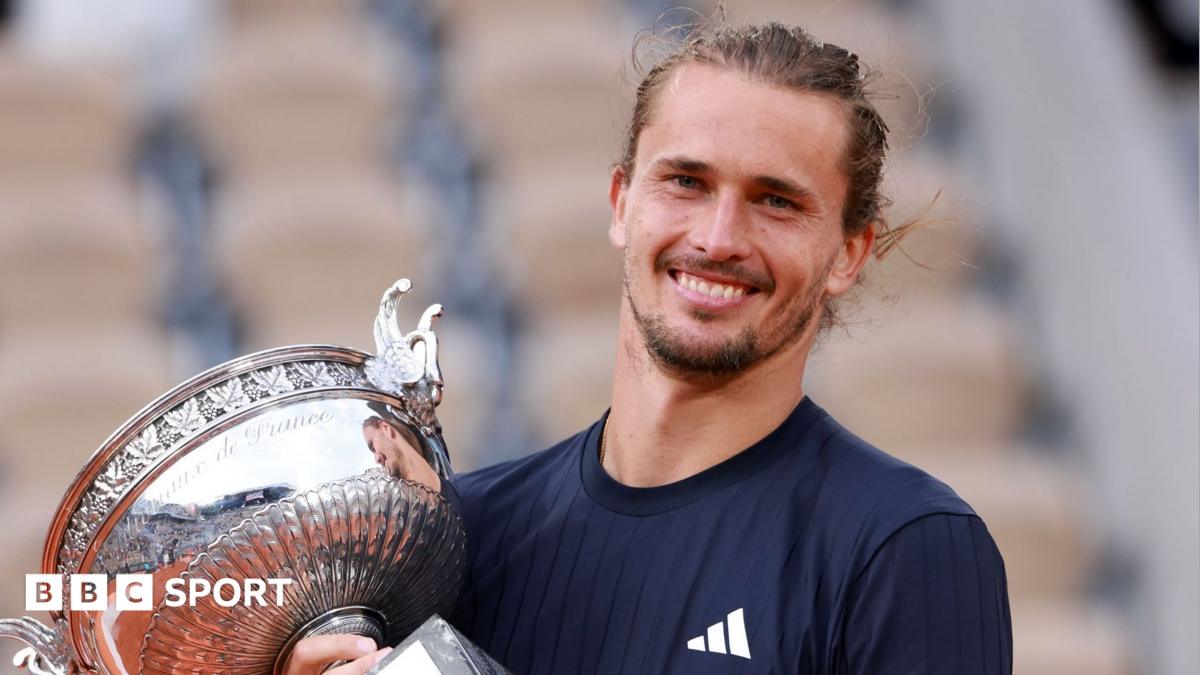
Alexander Zverev is guaranteed to finish the 2026 season as the world number one after Carlos Alcaraz’s surprise defeat in the Shanghai Masters.
German Zverev was on course to climb above current world number one Jannik Sinner, who has been ruled out for the rest of the year with a knee injury.
Alcaraz still had a mathematical chance of stopping Zverev until he was beaten 7-5 7-6 (7-4) by Belgium’s Zizou Bergs in the third round on Monday.
“It’s been a fantastic season for me. Knowing that I will finish the year on top of the rankings is just a dream come true,” said Zverev.
After losing three major finals, Zverev landed the first Grand Slam title of his career by winning the French Open in June, and followed that with victory at the US Open last month.
The 29-year-old has taken advantage of the injury problems suffered by Spaniard Alcaraz and Italian Sinner – the dominant pair on the ATP Tour in the previous two seasons – to become the world’s leading player.
Zverev cannot overtake Sinner until 2 November at the earliest.
He will become the first German to end the year as number one, and the oldest player to achieve the feat for the first time.
After suffering a serious ankle injury in the 2022 French Open semi-finals which kept him out for seven months, Zverev regained his place in the upper echelons of the sport and been ranked inside the top four continuously since March 2024.
“So much work and effort have been put into achieving this goal, especially after coming back from the ankle injury. I look forward to finishing the season in style,” he said.
The most forgotten hero in Dodger history stepped out of the shadows in 1987 as their instant general manager and created the miraculous monster that came to be in 1988.
The resuscitation of a Dodger brand during what was quite possibly its darkest moment? It all started with Fred Claire, the longtime Dodger executive who died Monday in his Pasadena home on his 91st birthday.
His quiet presence will forever be missed. His audacious impact should never be forgotten.
Claire was an endlessly kind, disarmingly honest and eternally humble sort whose love for the Dodgers was perhaps best illustrated by the story of his most prized souvenir.
After the Dodgers clinched the 1988 World Series championship in a stunning victory over the heavily favored Oakland A’s, catcher Rick Dempsey approached Claire in the champagne-soaked clubhouse. In Dempsey’s back pocket was the game ball used by Orel Hershiser to strike out Tony Phillips for the game’s final out.
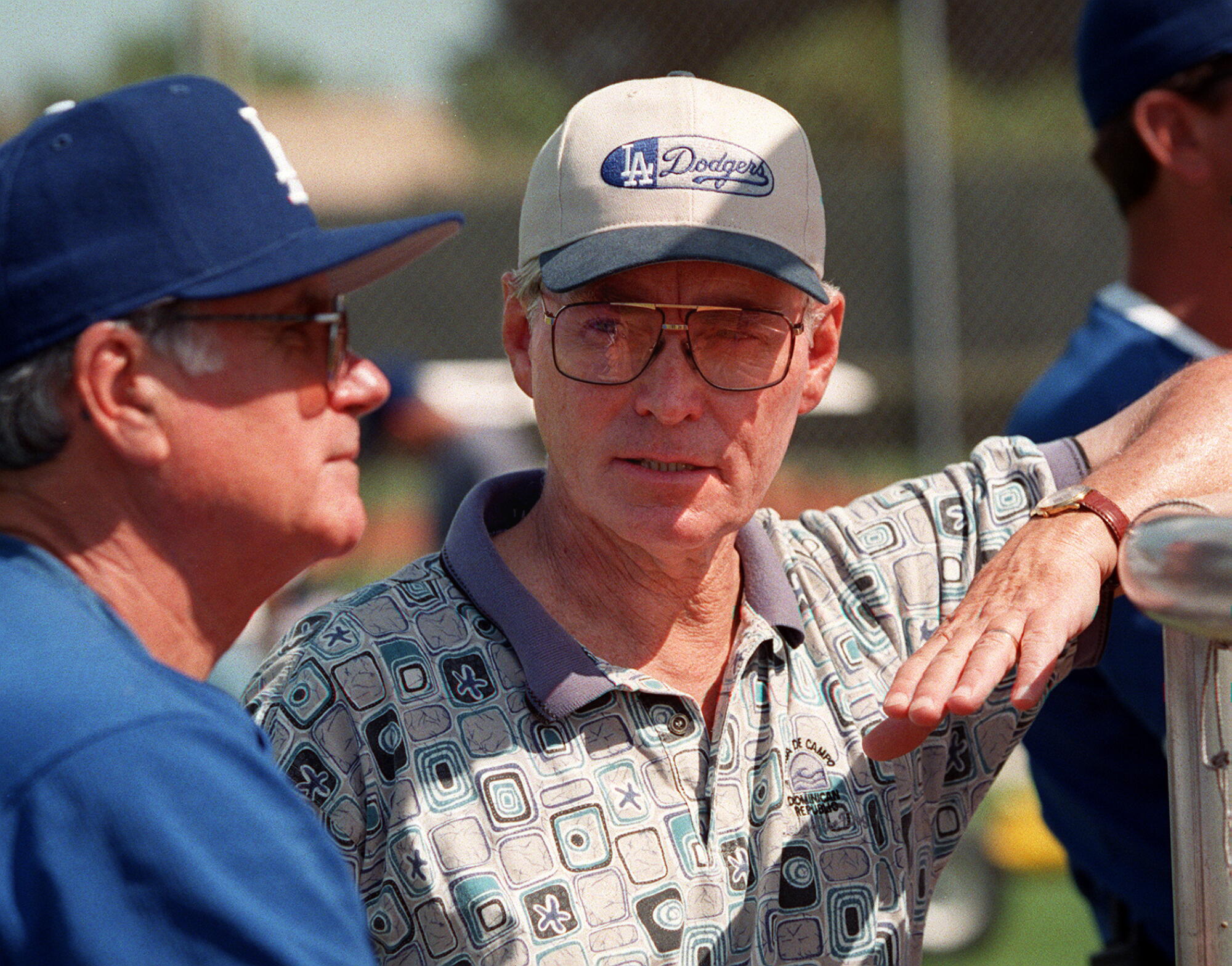
Fred Claire talks with Dodgers coach Joe Amalfitano at a batting cage during spring training.
(Kirk McKoy / Los Angeles Times)
Dempsey handed the ball to Claire in gratitude for the belief shown by the general manager in signing Dempsey and several other journeymen who helped lead the team to the title.
Claire quietly accepted the ball, took it home, put it on a shelf, but several years later realized it was needed elsewhere. At the time, the National Baseball Hall of Fame only had two final-out balls. Once again believing that the Dodgers were more important than himself, he donated his jewel to Cooperstown. The shelf remained empty.
“I just played one role in all this,” Claire told me several years ago. “In getting through our difficult times, I always believed in ‘We.’”
Referring to the Dodgers’ 1987 season as a difficult time was an understatement.
In April, longtime general manager Al Campanis was fired for making racist remarks about Black Americans on the TV show, “Nightline.”
Peter O’Malley, the Dodgers’ president at the time, made the sudden and strange choice to replace Campanis with Claire, the team’s public relations boss who had spent the first 11 years of his career as a sportswriter.
There was much criticism. There was overwhelming disbelief. But instead of apologizing for the promotion, Claire ran with it. One day after taking the job he cut popular pitcher Jerry Reuss and signed unemployed Mickey Hatcher and set the stunt man tone.
”I wanted some fire, and Mickey was the guy who could give us that,” Claire told me. “I don’t know if there were people who doubted me, but I never doubted myself. I knew I had the job for today, and I was going to make the most out of that day.”
He slowly turned a stuffy and entitled team into a lean and scrappy one, and by the time he made the brilliant move of signing free agent Kirk Gibson in January of 1988, the stage had been set.
Nine months later, it was only fitting that Gibson’s famous walk-off homer against Dennis Eckersley of the A’s in the World Series opener scored Mike Davis, who was also signed by Claire.
And the most valuable position player in that series? None other than the guy Claire signed first.
“Fred Claire was amazing,” Hatcher told me. “For a guy who was suddenly put into the limelight, he asked all the right questions, listened to everyone, and believed in all of us.’’
It was this great belief in collaboration that burned Claire in 1993 when he traded seemingly frail pitcher Pedro Martínez for second baseman Delino DeShields on the advice of his medical staff.
Martínez, of course, became a Hall of Famer while Claire became saddled with the stain of one of the worst trades in Dodger history. The perception surely irked a man who was just following organizational advice, but Claire never backed down from his role in the deal.
“The facts have to be the facts, and those facts are, I traded Pedro,” Claire told me.
That was Fred Claire personified, honest to the end, refusing to sacrifice his integrity, never surrendering his dignity.
Because he was too modest for acclaim and too quiet for headlines, Claire essentially disappeared from the Dodgers orbit for nearly two decades after his firing, instead focusing on teaching, consulting, and co-writing an autobiography entitled, “Fred Claire: My 30 Years in Dodger Blue.”
During this time he also became a touchstone for all Dodger alumni, as many former players contacted him daily for advice or help or just to remember the good old days. He never failed to answer a call, never turned down a request, seemingly every former Dodger knew his number and leaned on his goodness.
He was finally honored at Dodger Stadium in the summer of 2017 in an emotional ceremony that was long overdue. By then, he was heavily involved in the last great fight of his life, a battle against cancer that led him to become an important advocate and fund raiser for City of Hope.
In one of his final visits there last month, Claire didn’t focus on his illness, but rather his room number. He was quite proud that it was 4217, because Jackie Robinson was 42. Claire was with Robinson shortly before his death and constantly stressed the connection between the icon and his franchise.
In our final correspondence, on the day before he died, Claire texted me and several others with seven photos.
There were images of him with wife Sheryl, with Lasorda, with Dave Roberts, with several champagne-stained Dodgers in a celebratory clubhouse.
There was also a picture that did not contain him but spoke volumes about his character. It was a simple photo of a plaque bearing the number 42 and accompanied by a quote.
“A life is not important except in the impact it has on other lives.”
The United States Department of Justice has filed 40 new cases seeking to strip naturalised Americans of their citizenship over alleged crimes they have committed.
In a statement on Monday, federal prosecutors said they were targeting individuals accused of “serious offenses”, including money laundering, child sexual abuse, visa fraud and tax evasion.
Recommended Stories
list of 3 itemsend of list
The statement touted the 40 cases as the largest volume of denaturalisation petitions submitted in such a short period under President Donald Trump. The petitions were filed from late August through early October.
“Today’s announcement marks the largest denaturalization effort in modern history,” said Attorney General Todd Blanche.
“Under President Trump’s leadership, the Department of Justice will continue to employ the denaturalization process to maintain our national security and protect the American people.”
The 40 citizens targeted in Monday’s announcement include people from a range of countries, including Mexico, Pakistan, China and Sierra Leone.
They are accused of concealing criminal acts and other facts about themselves as they sought to obtain citizenship. Their criminal convictions largely came after they took their oaths of citizenship.
Two people on the list are also accused of engaging in espionage on behalf of China. Committing these crimes before they became citizens, the Department of Justice alleges, meant these individuals lacked “good moral character” and should have been denied citizenship.
Expanded use of denaturalisation law
The laws to denaturalise US citizens have been used for decades, but historically, they have been reserved for serious crimes.
After World War II, for instance, the US government moved to denaturalise dozens of citizens accused of concealing involvement in the Holocaust or engaging in war crimes.
Notable cases include that of Emma Goldman, a Lithuanian-born anarchist and women’s rights activist who was jailed in 1917 for her antiwar activities, before being denaturalised and deported to the Soviet Union.
But the practice has become much less frequent since the end of the Cold War.
Top officials in the Trump administration, however, have sought to expand denaturalisation as part of a push to conduct the largest deportation operation in US history.
Under US law, prosecutors can ask courts to strip citizenship from those born outside the country if they wilfully concealed a “material fact” during their citizenship application that would have otherwise disqualified them.
But Trump’s efforts to widen denaturalisation proceedings have received pushback from human rights groups, which argue they could leave people stateless.
Critics have also warned that Trump has sought to leverage denaturalisation against specific groups he perceives to be political rivals or enemies.
Last year, for instance, the Trump administration indicated it would seek to denaturalise large numbers of Somali Americans after allegations emerged in Minnesota of daycare fraud involving the Somali diaspora.
“Send them back from where they came, Somalia, perhaps the worst, and most corrupt, country on earth,” Trump wrote at the time.
Members of Trump’s Republican Party, notably Representative Andy Ogles, have also floated the possibility of yanking citizenship from New York City Mayor Zohran Mamdani, who was born in Uganda. Trump himself has falsely suggested Mamdani may be in the country illegally.
At one point, Trump even floated the idea of withdrawing citizenship from tech entrepreneur Elon Musk, a close ally and adviser to his second administration, after the two men had a falling-out in 2025.
Trump has also pushed to do away with birthright citizenship, which is granted to virtually all children born in the US. The few exceptions include the babies of diplomats and foreign military forces.
Birthright citizenship is protected under the US Constitution and cannot be taken away the way naturalised citizenship can.
In June, the US Supreme Court struck down Trump’s efforts to dismantle birthright citizenship, but legal battles continue after the president issued a second executive order also seeking to restrict how birthright citizenship is applied.
Luke Littler missed out on the chance to hold the senior and youth world titles simultaneously after suffering a surprise semi-final defeat at the World Youth Championship.
The 19-year-old world number one was beaten 6-5 by world number 68 Cam Crabtree, who will face German Jan Schmidt in the final on 29 November.
That match will take place on finals day at the Players Championship Finals in Minehead – an event Littler has also yet to qualify for having skipped the majority of Pro Tour events this season.
He is currently ranked 126th in the Players Championship order of merit and only the top 64 qualify.
Littler has won successive full World Championships and won the youth title as a 16-year-old in 2023, but the semi-final loss to 23-year-old Crabtree was his second successive exit at that stage having lost to Beau Greaves in 2025. He could though enter four more times, with the tournament open to players aged 23 or under at the start of the season.
The loss is the latest in a series of surprise exits for Littler, who was knocked out of the World Grand Prix in the first round by Luke Woodhouse and lost to Jonny Clayton in the quarter-finals of the World Series of Darts finals.
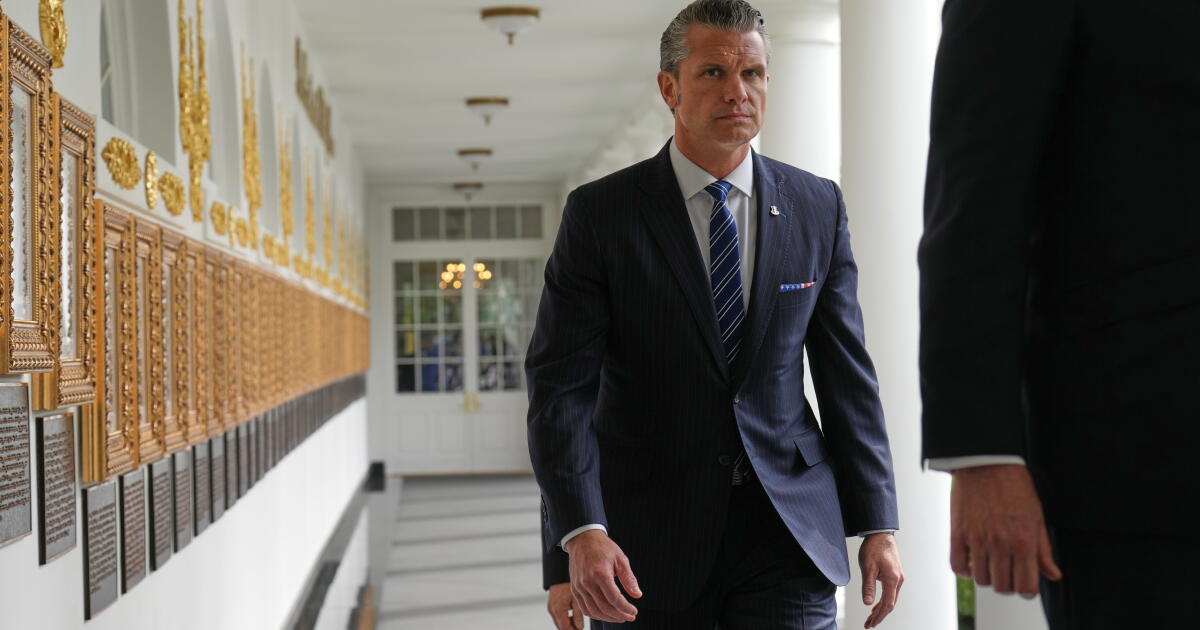
WASHINGTON — Defense Secretary Pete Hegseth is launching an office of religious affairs, the latest of his faith-related reforms at the Pentagon.
He announced in a speech Wednesday that the office will help offer “first-class religious support” and will report directly to him.
“Our department is, you might say, putting on the full armor of God, because while we wage physical war, we all know the real battle is spiritual,” he said.
Hegseth has infused his evangelical Christianity into his leadership of the Pentagon, hosting Christian worship services for employees and often speaking of the United States as a Christian nation.
The Office of Religious Affairs, or ORA, will advocate for military chaplains and religious support “at the highest level of the Department,” according to a Pentagon statement. It will not “compel religious participation, favor one faith, or diminish the rights of personnel of any faith or lack thereof.”
Some criticism of the initiative surfaced quickly.
The Pentagon “owes it to the nation’s service members to defend religious freedom,” said Rachel Laser, head of Americans United for Separation of Church, which has sued the Pentagon over its worship services. “Hegseth’s latest announcement violates that promise by elevating Christianity to an even higher role in shaping U.S. military policy.”
Other federal agencies have had religious or faith-based offices, which were established under President George W. Bush and were continued in different forms under the Obama and Biden administrations. President Donald Trump established a White House Faith Office and had a similar effort during his first term.
Shaun Casey, a religion scholar, led the State Department’s Office of Religion and Global Affairs during the Obama administration. The office did not promote religion or spiritual well-being, he said. “It was there to understand what were the political implications of lived religion in the various hot spots around the world.”
The leader of the new office has not been named. A Pentagon memo said the religious affairs director will coordinate spiritual resources, including “faith-based homeschool support for military families.” Hegseth has also pushed the military school system to introduce more coursework that draws from conservative and Christian influences.
The memo mentions “faith-based initiatives supporting Department-wide suicide reduction.” In recent years, the military has become increasingly dependent on chaplains to help address the growing numbers of troops in mental health distress. Hegseth has said he wants chaplains to focus more on God and less on therapeutic “self-help and self-care.”
The secretary has pushed other changes within the military’s chaplain corps, which provides spiritual care to troops. He ordered chaplains, who are commissioned officers, to no longer wear their rank on their uniform but instead be identified by religious insignia.
The Defense Department also slashed the number of religious affiliations it officially recognizes, down to 31 from more than 200 previously recognized traditions. The list no longer includes atheists, Unitarian Universalists, pagans and Wiccans.
Hegseth spoke directly to chaplains in his address Wednesday at Marine Corps Base Quantico in Virginia. Using Christian-inflected language, he said: “Live your calling. Stand firm. Preach truth. Minister to the flock.”
He then quoted from the Bible: “The Lord is on my side; I will not fear. What can man do unto me?”
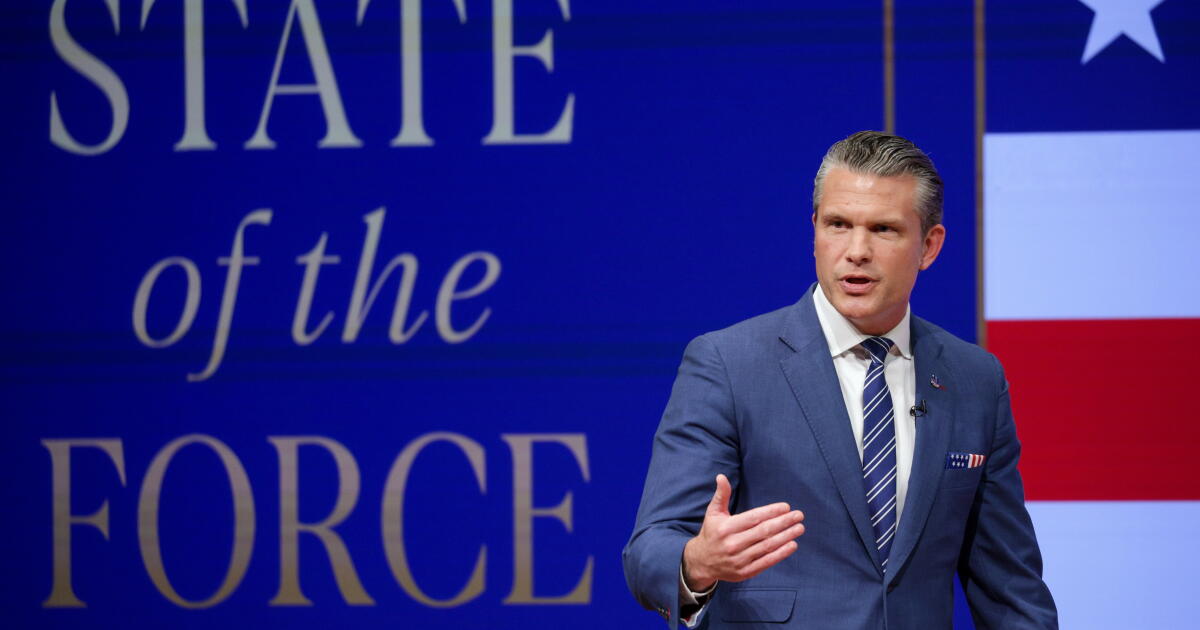
QUANTICO, Va. — Defense Secretary Pete Hegseth confirmed Wednesday that the U.S. military will cut 20% of its generals and admirals as he delivered what he is calling his “State of the Force” address.
Hegseth was speaking to junior officers and enlisted leaders at the Marine Corps Base Quantico in Virginia, the second year in a row that he has given such an address. This time, the U.S. military is seven months into a war with Iran with no clear end in sight, has captured Venezuelan leader Nicolás Maduro and killed more than 200 people in strikes on alleged drug trafficking boats in Latin America, among other actions worldwide.
The speech is not a usual fixture among Pentagon leaders. While Hegseth’s predecessors regularly addressed troops and top officers, they traditionally have done so in small or private settings.
The Pentagon chief, however, again focused on how he has drastically retooled the U.S. military by targeting what he calls “woke” culture — through a rollback of diversity programs, a review of ground combat units with female troops and a new screening program for “testosterone deficiency” among male personnel.
Pentagon officials had previewed that Hegseth would announce more cuts to the number of generals and admirals. He directed all military services to double the 10% reduction he ordered last spring for roughly 800 flag and general officer positions, making it a total 20% decrease to be completed by Jan. 1.
“I call it accountability and long overdue,” he said.
Several senators viewed Hegseth’s move as nothing short of a “purge” of the military’s top ranks that will take years to rebuild.
“He’s got some kind of like deep-seated grievance about leadership in the military,” said Sen. Mark Kelly, D-Ariz., the former Navy combat pilot and NASA astronaut, who has been critical of Hegseth. “He’s purging a generation of great leaders of the military, and it’s going to take a generation to recover from it.”
Republican Sen. Mike Rounds of South Dakota, a member of the Senate Armed Services Committee, said he wanted to understand Hegseth’s reasoning behind the decision.
“If it’s simply a matter of eliminating a very heavy top, there may be some validity to it, but I want to see it first,” Rounds said.
Hegseth and President Trump already have fired or pushed to retire more than two dozen military leaders since taking office, including the Army’s top uniformed officer, Gen. Randy George, a move that angered both Republicans and Democrats in Congress. The purge also has included a number of senior officers who are women or people of color.
Previous leaders who were ousted include Joint Chiefs Chairman Gen. CQ Brown; Chief of Naval Operations Lisa Franchetti; and Vice Adm. Shoshana Chatfield, the U.S. military representative to the NATO Military Committee.
Although Hegseth never gave specific reasons for those firings, most were tied to the belief that they endorsed or spoke openly in support of diversity, equity and inclusion programs, which have been targets of Hegseth and Trump.
As part of last year’s cuts, Hegseth also ordered the active duty military to shed 20% of its four-star general officers — the highest-level leaders — and the National Guard to shed 20% of its top positions, but it is unclear if all those cuts have been made. The new cuts could include any one-star general or above, or an officer of equivalent Navy rank.
When Hegseth first announced the effort to trim the highest levels of the military ranks, he argued it was intended to remove “redundant force structure to optimize and streamline leadership.” In a memo released in May 2025, he said the aim was to free the military from “unnecessary bureaucratic layers.”
The number of general officer positions in the military is set by law, but it is possible to let positions remain unfilled by not submitting replacements to Congress.
Hegseth’s efforts have extended well beyond personnel changes among the top ranks. He oversaw Trump’s ban on transgender troops while announcing new directives for “gender-neutral” or “male-level” standards for physical fitness.
Toropin and Finley write for the Associated Press. AP writers Lisa Mascaro and Meg Kinnard contributed to this report.
Pentagon official says the plan will be announced in the defence secretary’s ‘State of the Force’ address in Virginia.
Published On 30 Sep 202630 Sep 2026
United States Defense Secretary Pete Hegseth will cut the number of positions reserved for generals and admirals by 20 percent, a Pentagon official has told Al Jazeera, in a change that will affect leadership across the Army, Navy and Air Force.
Hegseth is expected to announce the decision on Wednesday during a visit to the Marine Corps Base Quantico in Virginia, where he will deliver his “State of the Force” address in front of junior officers and enlisted officials, the official said.
Recommended Stories
list of 3 itemsend of list
The Associated Press news agency, citing Pentagon officials, reported that Hegseth will direct all the military services to double the 10 percent reduction that he ordered last year to the roughly 800 flag and general officer positions. This would make it a 20 percent total decrease and is to be completed by January 1, 2027.
Fox News reported the new reductions could include any one-star general or above or officer of equivalent Navy rank.
The Washing Post reported that the cuts could affect the careers of “hundreds of current and rising military leaders following scores of firings and denied promotions”.
US President Donald Trump or Hegseth have fired, or pushed into retirement, more than two dozen military leaders since taking office in January 2025, including the Army’s top uniformed officer, General Randy George, in April.
The administration also fired the only two women serving as four-star officers, along with several other senior female officers. Other top officials have left through retirements and resignations, including the Army secretary, Dan Driscoll, who resigned this month after repeated clashes with Hegseth.
When the defence secretary first announced the effort to trim the highest levels of the military ranks, he argued it was intended to remove “redundant force structure to optimise and streamline leadership”. And in a memo released in May 2025, he added that his aim was to free the military from “unnecessary bureaucratic layers”.
At this time last year, Hegseth also declared an end to “woke” culture and announced new directives for troops that included “gender-neutral” or “male-level” standards for physical fitness.
Senator Jack Reed, a Rhode Island Democrat and ranking member of the Senate Armed Services Committee, expressed concern over Hegseth’s latest move in a statement. He said eliminating senior leadership positions must be done in consultation with Congress and warned that the planned cuts “should alarm every American”.
“Congress has been clear with the Secretary that he must consult this body and explain his reasoning for senior officer removals and promotion holds. To date, we have not received satisfactory answers,” Reed said.
“Our military is conducting major operations around the world, and the force is already under strain,” he added.
The number of general officer positions is set by law, but positions can be left unfilled if the administration does not submit nominees to Congress.
WASHINGTON — The Trump administration plans to limit the number of refugees admitted to the country to 17,500 mostly white South Africans, the administration told Congress on Tuesday, as it continues to transform a program that at one point served as a pathway to safety for people fleeing war and strife from countries around the world.
In a notice to Congress obtained by the Associated Press, the administration said the white South Africans faced seizures of their land and other forms of persecution and would be likely to assimilate when they come to America. The South African government has repeatedly rejected the idea that the white South Africans, who are Afrikaners, are a persecuted minority in the home country.
The Trump administration has dramatically altered a refugee program that historically enjoyed strong bipartisan support as it welcomed tens of thousands of refugees from countries around the world to new lives in America, and instead the administration has transformed it into a vehicle to resettle white South Africans in America.
The administration told Congress in the announcement that it intended to spend about $500 million to resettle the new arrivals to the U.S.
Presidents set the cap on how many refugees the U.S. will approve through the program each year, and historically, they’ve allocated those numbers across various geographic regions while factoring in wars or conflicts that spark humanitarian needs around the globe.
Marvin Reid can’t say how many pedestrians he’s seen get hit while trying to brave the North Hollywood intersection of Magnolia Boulevard and Tujunga Avenue. He gave up keeping count long ago.
One afternoon last spring, he watched a man get run over while walking toward a 7-Eleven on the corner. Fortunately, the man popped to his feet “like nothing ever happened” and hustled into the store, Reid said. A week or two prior, he said, an out-of-control motorist nearly plowed into the statue of Amelia Earhart that sits next to a library bearing the famous aviator’s name.
“This is really a bad spot,” said Reid, who has helped run a Jamaican food pop-up at the busy street corner for the past five years. “It doesn’t matter if it’s an old lady crossing the street with a walker.”
The number of Angelenos who die in traffic crashes now regularly outpaces those killed by homicide. From 2016 to 2023, the annual traffic death toll rose nearly 29% overall, and pedestrian deaths jumped roughly 54%. Fatal crashes fell slightly last year, but deaths still exceeded 300 in each of the last three years.
The city is rolling out 125 speed cameras in school zones, known street-racing corridors and places where speeding has contributed to a high rate of collisions — including Reid’s intersection.
But for him, the cameras aren’t a replacement for police traffic enforcement, which he said seems virtually nonexistent.
Even though LAPD squad cars are posted up outside the library “everyday,” he says, they rarely do anything about the drivers who come careening off the exit ramps from the nearby 170 Freeway.
Similar complaints are being echoed around the city. Historically, Los Angeles — like other places across the U.S. — has relied on police stops to produce road safety. But in recent years, public pressure has compelled city leaders to think more critically about whether enforcement can continue without the historical harms that has come along with it.
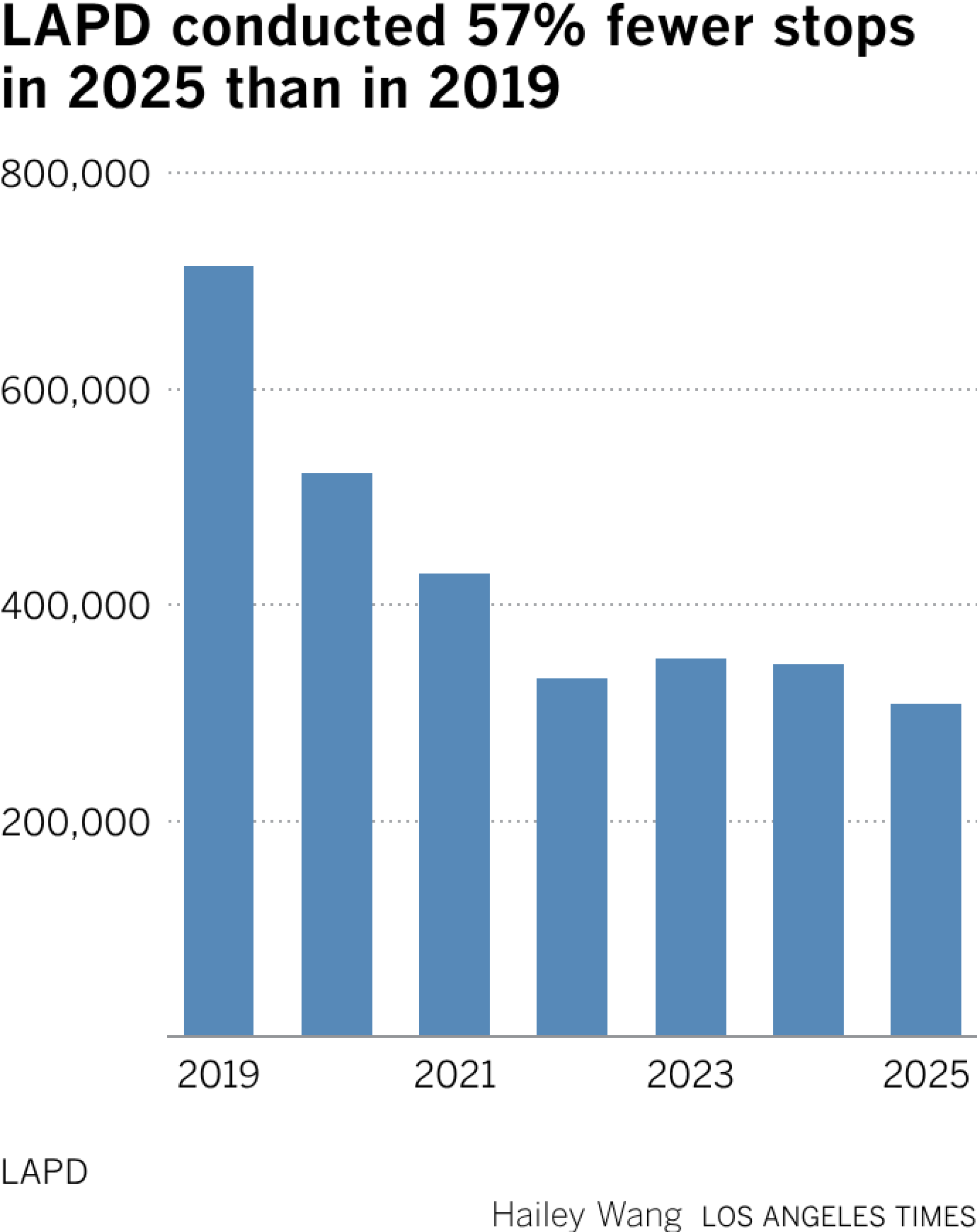
LAPD data show the department is far less proactive than it used to be.
In 2019, LAPD officers made about 713,000 stops across the city; by 2025, that number had decreased to roughly 308,000 — a roughly 57% decline. A Times analysis of police stop data found that the drop-off was especially pronounced in the Central, West Valley, 77th Street and Southeast police divisions.
In some ways, the decline in stops is unsurprising. Other large U.S. cities have seen similar changes in enforcement strategies by police since the pandemic. As the department continues to shrink, LAPD commanders say they have fewer resources to devote to traffic duty. Officials have been under pressure to curb the use of so-called “pretext stops,” in which officers use a minor violation — a broken turn signal, say, or a cracked windshield — as justification to stop someone in order to investigate whether a more serious crime has occurred.
The largest declines were in the Central and 77th Street areas
Change in police stops, 2019 to 2025
LAPD
Hailey Wang LOS ANGELES TIMES
Reform activists and some city leaders argue the stops are fishing expeditions that lead to police abuses — while failing to deliver safer streets.
The practice of pulling over random vehicles, often based on little more than a hunch, has been a cornerstone of the city’s crime-fighting strategy for decades. The tactic is especially prevalent among the department’s elite Metropolitan Division and anti-gang units, several of which have come under investigation in recent years for failing to document the stops and improper searches.
Since 2019, when a Times investigation found significant racial disparities in LAPD crime suppression tactics, officials have slowed — but never abandoned — the practice of flooding neighborhoods with tactical officers to pull people over and search their vehicles.
Four years later, stops for minor violations began dropping again after LAPD overhauled its policies to limit the circumstances under which officers can make pretext stops, joining law enforcement agencies in cities like Philadelphia, Seattle and Berkeley, Calif.
Yet a report published last year found that officers are still disproportionately targeting Black and Latino drivers.
LAPD Chief Jim McDonnell and other department leaders have fought against more restrictions, arguing they risk losing an essential weapon against serious crime.
But in May, the Los Angeles City Council passed a measure urging the Police Commission, the LAPD’s policy-making body, to further limit arbitrary pull-overs for non-moving traffic violations.
While LAPD officials had acknowledged issues in a handful of police divisions, the latest audit found that gang units citywide routinely flouted the department’s rules on pretext stops, including by often failing to obtain proper consent to search the vehicles they stopped. The inspector general’s office also found that gang officers didn’t always turn on their body-worn or dashboard cameras as required during these encounters and at times failed to properly log who they were stopping — resulting in an undercount of “both the number of detentions and the enforcement actions taken,” the report said.
The review, based on a sample of 300 stops as well as interviews with current and former gang officers, also highlighted ongoing confusion about what the department expects its officers to do when pulling someone over.
The findings of the second report — which reviewed pretext stops by officers from other units in January — are expected to be presented at an upcoming commission meeting.
The Los Angeles Police Protective League, the union for rank-and-file officers, and other proponents of pretext stops argue that elected leaders don’t grasp the consequences of doing away with the tactic, which the U.S. Supreme Court has deemed lawful.
Reform advocates have fought to deploy unarmed civilians instead of LAPD officers for traffic enforcement — as the city has already started doing for certain mental health-related calls — but the union has warned that the work is too dangerous. A state bill that would have allowed trained civilian workers to make traffic stops failed to make it through the state assembly.
With the death toll from speeding on the rise, more enforcement is needed, not less, department leaders say. The city, they argue, can’t afford to wait on alternative programs that require study, money and public buy-in that could take years.
Amid the debate over how to proceed, LAPD enforcement hasn’t vanished completely.
Even though the department no longer dispatches officers to the scenes of minor accidents, LAPD statistics show that enforcement the department’s 308-member traffic bureau has gone up. As of July, the number of traffic tickets issued had climbed 44% from the same time last year — increasing to more than 14,600 from around 10,100. Citations for impaired driving have also risen, and the department continues to crack down on street takeovers.
Still, progress toward new, non-police approaches to traffic enforcement has been frustratingly slow in Los Angeles, advocates say.
Advocates have pointed to mounting research in other cities that showed road improvements along high-injury street corridors were more effective than police at changing driver behaviors, ultimately reducing the number of traffic-related deaths and serious injuries more than the threat of being ticketed.
Supporters of so-called “self-enforcing” roads say narrowing lanes can lead to a considerable decline in crashes as drivers reduce their speed and move more cautiously than when the road is less wide. Such changes also reclaim space for protected bike lanes, public transit lines, or safer walkways — after long prioritizing convenience for cars, advocates say.
Car accidents are dangerous for everyone involved, but they have become even more hazardous for pedestrians and cyclists.
Experts cite speeding and cellphone distractions as two of the biggest problems.
Another factor is the proliferation of larger vehicles — a phenomenon known as “autobesity” — which have bigger blind spots and more likely to seriously injure a pedestrian or bicyclist.
Andres Ramirez, executive director for the transportation advocacy nonprofit People for Mobility Justice, said he’s cautiously optimism that the mayor’s promise of a “No Car” 2028 Olympic Games will help fast-track some of the most pressing road safety projects.
“The streets needs to be a lot safer for pedestrians, for bicyclists, different modes,” Ramirez said. “The most obvious way is ensuring that infrastructure projects are prioritized in communities that have long been ignored.”